




Abstract
This article examines how gendered workers experience invisibility in the South Korean television industry, focusing on writers who produce non-fiction programs, such as journalism shows and documentaries. Based on my in-depth interviews with 41 research participants, I reveal how the patriarchal, capitalist, and intensely hierarchical labour management in the industry has shaped an invisible writing workforce who are mostly women. Specifically, my research suggests that the exploitation of this invisible writing workforce takes two forms: the devaluation and underpayment of their labour and putting to work their marginalized subjectivities to enhance the quality of the programs in the production process. Finally, this research shows how writers recognize themselves as invisible workers and understand their invisibility as a form of discrimination and exclusion.
Keywords
This article examines how gendered workers experience invisibility in the television industry in South Korea (hereafter Korea). I define invisibility as being historically, socially, and/or culturally hidden from others – thus, socially, culturally, and/or economically marginalized as the term is utilized in fields such as cultural and media studies and sociology (Currie, 1998; Hall et al., 2013; Poster et al., 2016; Said, 1993). This article focuses on the invisibility of Korean television writers who make culture/journalism/documentary (CJD) programs, which in Korea refer to non-fiction programs, including culture programs, journalism shows, and documentaries. 1 CJD writers participate in the entire production process, performing tasks such as choosing topics, researching, casting, devising plots, and editing. 2 This workforce is highly gendered in that 97.6% of experienced writers (1326 out of 1359) were women in 2019 (Korea Television and Radio Writers Association [KTRWA], 2019).
Based on my in-depth interviews with 41 research participants, this article explores how the patriarchal, capitalist labour management system at Korean major broadcasters – such as Korean Broadcasting System (KBS), Munhwa Broadcasting Corporation (MBC), Seoul Broadcasting System (SBS), and Korea Educational Broadcasting System (EBS) – has organized this writing workforce as invisible. Specifically, this article examines how this gendered cultural workforce contrasts with a relatively visible workforce, in-house producer-directors (PDs), who are predominantly male. A writer usually works with a PD as part of a team in the CJD production sector. Therefore, the contrast between these two workforces shows a distinctive form of invisibility that writers experience related to gender inequity.
In the following sections, I introduce the concept of invisibility and describe how CJD writers have been excluded from written histories in Korea. Next, after discussing my research method, I describe my findings. Specifically, I show how major Korean broadcasters have differentiated writers and in-house PDs in the CJD production sector through forms of employment, recruitment processes, and payment systems, and put these two groups of workforces within a highly patriarchal relationship in the industry. Additionally, I describe how writers recognize themselves as invisible workers and experience their invisibility as a form of discrimination and exclusion in their working lives and, further, in Korean society. Finally, I show how the Korean television industry derives the cultural values of CJD programs from the marginalization of these writers. By focusing on these writers, this article seeks to extend our understanding of gender-based invisibility in cultural work.
Invisibility of women and invisible workers
Feminist scholars in the communication and media studies fields have explored how women workers have historically contributed to cultural production in communication and media industries, yet their contributions have been hidden across a range of national settings, including Korea (Kim and Baek, 2009), the United States (Hill, 2016), and the United Kingdom (Ball and Bell, 2013). These scholars have argued that women’s contributions have been devalued precisely because of this invisibility. I suggest that to understand women’s invisibility in cultural work, we need to distinguish two intersectional forms of invisibility: the invisibility of particular types of work, and the invisibility of women as subjects. The former kind of invisibility is often referred to as invisible work, a term derived from socialist-feminist scholars’ discussions about reproductive labour in households, often referred to as ‘women’s work’ (Daniels, 1987; Hatton, 2017; Leonard, 1998). Specifically, Daniels (1987) developed the term ‘invisible work’ to explain why traditional types of women’s work, such as housework and volunteer work, are devalued and underpaid. This work is devalued because traditional forms of women’s work have historically been conducted in the household, a setting not recognized as a workplace in the formal sense because the work occurs out of public view (Daniels, 1987). Such traditional work has also been historically and culturally linked to women’s allegedly inherent traits (e.g., empathy, caring, sensitivity) rather than skills obtained through training (Daniels, 1987). As a result, even when work categorized as women’s work is performed in paid workplaces, such as emotional labour in the service industry, it is often devalued (Warhurst, 2016). In addition, as Hatton (2017: 337) has argued, invisible work is often informal work that in many cases ‘is excluded from legal definitions of “employment.”’ In fact, many traditional forms of women’s work have been informal (Hatton, 2017; Poster et al., 2016).
Utilizing the concept of invisible work, feminist media scholars have shown that jobs involving gendered tasks and skills related to traditional women’s work tend to be devalued and often thought of as women’s work. This is particularly true for costume designers (Banks, 2009), secretaries and assistants in the film and television industries (Hill, 2016), and social media professionals (Duffy and Sawey, 2022) in the United States. These scholars have shown that such jobs involve emotional labour, interpersonal skills, and/or other work traditionally associated with women and caring labour in the home. In unpacking the forms of invisible work women perform, feminist scholars have challenged the highly gendered criteria used to assess the value of a particular form of work (Banks, 2009; Hill, 2016). In contrast, invisible work related to gendered skills and tasks is not fully applicable to the case of CJD writers in the Korean television industry because, as described later in this article, such gendered characteristics are not directly relevant to the work of these writers.
The concept of the invisibility of subjects is more useful to explain the labour and precarity CJD writers experience. In terms of the invisibility of subjects, scholars have used the concept of invisibility to explore how capitalism, patriarchy, and/or imperialism – forms of power and domination – differentiate and divide people into such categories as visible and invisible, and how they exclude invisible people from society and history (Currie, 1998; Hall et al., 2013; Poster et al., 2016; Said, 1993). Indeed, as Spivak (1988: 280) highlights, excluding marginalized people from representation in history and society is a kind of ‘epistemic violence.’ Feminist scholars have explored ‘how women have been excluded as actors and authors of history, their voices muted’ (Charkravarity and Roy, 1988, cited in Currie, 1998: 2). Specifically, feminist media scholars have shown how some women who have held more privileged or creative positions – such as directors, producers, and writers – have been less visible than their male counterparts and how their contributions have been devalued (Baker and Lloyd, 2016; Ball and Bell, 2013).
Moreover, since one characteristic of cultural work is making meaning and representing people and the world (Hall et al., 2013), I argue that the visibility of cultural workers is directly relevant to the power held by more privileged workers in communication and media industries. Cultural workers’ visibility is intimately connected to their reputation among workers in their field and the general public, and visibility and reputation are subsequently converted to social and economic value (Bourdieu, 1980). In this regard, the work of invisible cultural workers is socially, culturally, and economically devalued, further increasing workers’ invisibility. Arguably, the invisibility of feminized workers serves to perpetuate the unequal and gendered structure of labour (Conor et al., 2015).
CJD writers as hidden, gendered workers in the Korean television industry
This section first describes the characteristics of CJD programs and the production sector in Korea. Following that, it discusses how CJD writers are gendered freelancers (legally self-employed workers) in the Korean television industry and how they have been excluded from written histories. CJD programs aim to provide instructive and educational information or live up to an ethos of journalistic production. These programs play a critical role in delivering information and contributing to public and/or political discourse around current events. While Korean drama and entertainment programs are now widely circulated in the global media market, most Korean CJD programs usually end up being consumed domestically. As a result, Korean CJD programs tend to be less valuable commercially, and Korean broadcasters tend to set correspondingly lower production budgets for those in contrast to drama and entertainment shows (Oh et al., 2019).
In the early 1990s, Korean broadcasters produced most CJD programs in-house and, with the exception of the writers, most workers on these programs were employed as full-time, permanent workers (Kim and Kim, 2011). In particular, most in-house workers were men (Lee, 2004). As the Korean government implemented the compulsory outsourcing policy for programs in 1991, broadcasters began to use independent production companies as subcontractors to decrease their production costs for CJD programs (Song et al., 2019). Producing CJD programs at the lowest possible cost is a matter of life and death for independent production companies because, when these companies are unable to secure contracts with broadcasters, they often fail. As a direct result of this contracting process, workers for these companies tend to suffer from high job insecurity in an industry that relies on these workers’ unpaid or underpaid labour (Lee and Song, 2014). After the Asian financial crisis of the late 1990s, broadcasters transitioned a large portion of their employees from full-time and permanent to contingent workers in diverse forms of precarious employment, such as freelancing and temporary agency employment (Kim and Kim, 2011). Notably, broadcasters have employed some PDs as full-time, permanent workers even while they decreased the proportion of full-time, permanent PDs (Kim, 2022), hiring most writers only as freelancers.
In this CJD production sector, the writer position has been dominated by women almost since that position was created. Figure 1 presents the total yearly numbers of CJD writers with KTRWA membership, which only more experienced writers hold. Notably, women began to outnumber men in 1988 (9 women out of 17 writers) among CJD writers holding this membership.
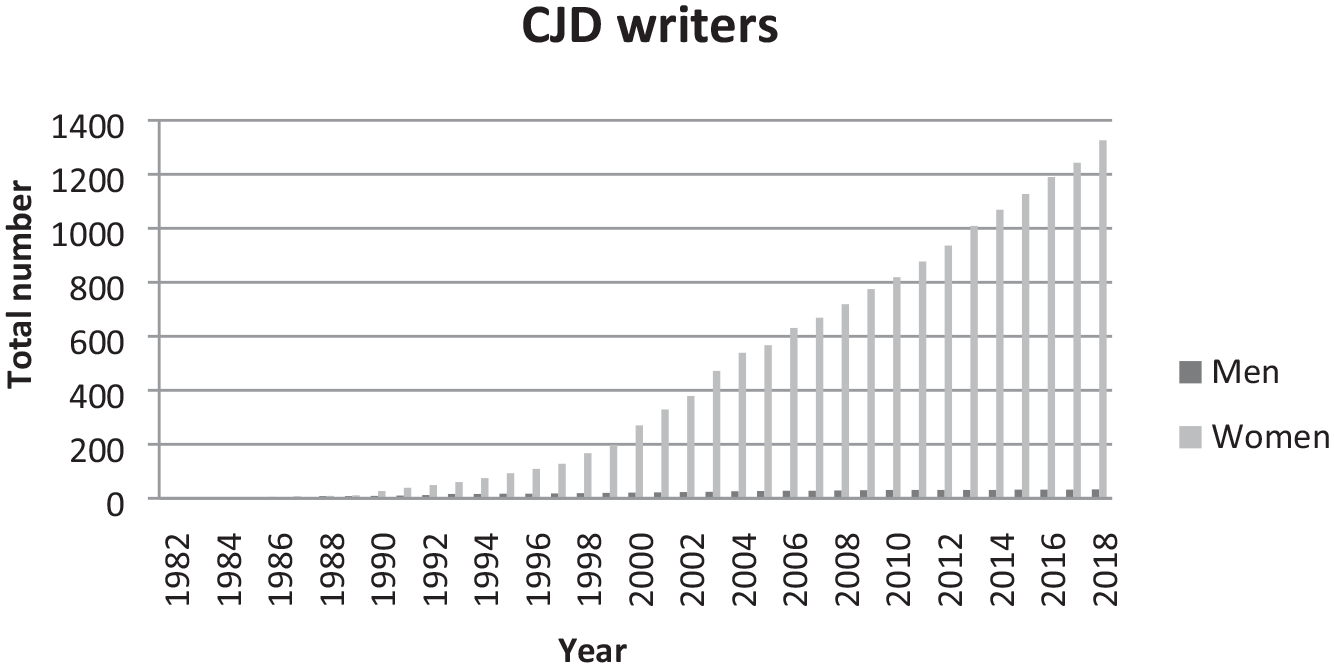
Total numbers of CJD writers with KTRWA membership.
The work of CJD writers has been marginalized in the written histories of those who work in the Korean television industry. More broadly, Korean television writers across genres beyond CJD writers tend not to figure in government documents and scholarly articles in Korea. Statistics on writers – such as their numbers and/or working conditions, including the level of pay and working hours – are not recorded in governmental reports like the Annual Survey of the Korean Broadcasting Industry (Ministry of Science and ICT [MSIT] and Korea Communications Commission [KCC], 2020). Specifically, the 2020 Annual Survey of the Korean Broadcasting Industry categorizes production staff in Korean terrestrial broadcasters as news reporters, PDs, announcers/presenters, technical staff (camera operators, light technicians, etc.), and ‘others’ (MSIT and KCC, 2020: 61). This report defines ‘others’ as ‘writers,’ ‘voice actors,’ and ‘workers who support program productions generally’ (MSIT and KCC, 2020: 61). In addition, most academic studies that discuss labour conditions in the industry tend to focus on historically male-dominated positions such as PDs (e.g., Chung et al., 2021; Kim and Kim, 2011; Lee and Song, 2014).
While Korean television writers in general experience invisibility, they face different degrees of invisibility depending on the genre they work in. Most Korean studies have primarily examined the labour of drama writers (e.g., Kim and Hong, 2017; Park et al., 2015), who have often historically been well-known to scholars and the public. In contrast, only a few studies on CJD writers exist (Youk and Youn, 2013; Kim, 2007, 2021); furthermore, media scholars have not paid attention to CJD writers and their work. This disregard was highlighted by Korean media scholars Youk and Youn (2013: 128), who revealed that ‘only in recent years we became aware that writers in the CJD production sector play a key role in producing programs, not just performing assistant roles to PDs.’
Despite this marginalization in the media and scholarly records, Korean writers have insightfully recorded their roles and labour to have themselves visible. Notably, some current or former CJD writers have made their work visible in the academic sphere through graduate theses. Specifically, by the mid-2000s, several graduate theses about CJD writers reported that CJD writers suffered from precarious working conditions, including job insecurity and low pay (Lee, 1997; Lim, 2004). Lee (1997) observed that a majority of CJD writers in the 1990s were women, most of whom in their twenties. Other production staff tended to devalue the labour of CJD writers by considering them as assistants to PDs rather than independent professionals (Lee, 1997). Lim (2004) connected this gendered precarity to the patriarchal division of labour in Korean society, which is still largely based on a male breadwinner model.
Since the late 2000s, several graduate theses have highlighted how writers play significant roles in the production of influential programs such as investigative journalism shows (Ryu, 2009) and documentaries (Choi, 2017), but the contributions of writers have been invisible. These studies reveal how writers often play critical roles in selecting topics for programs and determining programs’ views about the topics in the production process. In particular, Ryu (2009: 115) argues that previous studies of writers, including graduate theses, have tended to describe CJD writers as ‘young,’ ‘powerless,’ and ‘contingent women workers’ and focused on their precarious working conditions while failing to pay sufficient attention to these writers’ important contributions to the production of journalism programs.
Research method
Based on the concept of invisible workers and to extend the previous discussion on CJD writers in Korea, this article shows how Korean broadcasters manage CJD writers as an invisible workforce perpetuated by the patriarchal, capitalist labour management system, how they devalue the work of writers, and how the writers experience and understand their invisibility. To examine this writing group, I used a qualitative method – semi-structured, in-depth interviewing – because as described earlier, there are insufficient documented records about this writing workforce. Moreover, semi-structured, in-depth interviewing allows researchers to explore what marginalized people experience from their standpoints (Harding, 2004). Specifically, my research draws on in-depth interviews with 41 research participants who worked to produce programs airing on major Korean broadcasters. 3 The research participants comprise 36 writers (30 women and 6 men) and five PDs (two women and three men). The writers include senior writers with more than 30 years of experience and new writers with 1 year of experience. Most interviewees are graduates from various majors, including philosophy, economics, and communication. Because CJD programs include diverse genres, CJD writers tend to have different occupational identities: for example, journalist or documentarian. All interviewees in this article are referred to with pseudonyms constituting the type of occupation and number (i.e., CJD Writer 1, CJD PD 1). I interviewed all research participants in person in Korea between June 2018 and August 2019 and recorded all interviews with permission from the participants. I transcribed all recordings and analyzed them, focusing on the work and precarity they have experienced.
This study focuses on writers who work for major terrestrial broadcasters such as KBS, MBC, SBS, and EBS in the Seoul metropolitan area. MBC, SBS, and KBS have national networks and dominate the Korean television market (Lee, 2009). My interviews suggest that in the CJD production sector, the relationship between writers and PDs at broadcasters is different from that at independent production companies. This article focuses on the former: in particular, the relationship between writers and in-house PDs for broadcasters. Since CJD programs include a variety of formats and genres, the structures of the production teams and the relationships between the workers take a range of forms. To discuss what I have described as the invisibility of writers and their work in the CJD production sector, I present a somewhat typical account of the work of writers and their relationships with PDs by drawing on the accounts offered by interviewees.
Finding 1: two gendered labour models of PDs and writers
In this section, I describe how Korean broadcasters manage CJD writers as invisible workers in contrast to PDs. In the Korean television industry, except for some single-episode documentaries, most CJD programs are regular series aired weekly or daily year round. Each episode in a CJD series consists of one or several discrete stories; the length of each story varies from five minutes to an hour. The production teams for these CJD series consist of several small teams, which I refer to as story production teams. Each story production team produces a discrete story during a specific time frame without cooperating with other story production teams. For example, one weekly hour-long investigative journalism show explores one story per episode and has five story production teams. Each team is responsible for producing a 1-hour story every 5 weeks. On the other hand, one daily hour-long current events show airs for one hour (from Monday to Friday) and consists of six 10-minute stories per show or 30 stories per week. This show has 30 story production teams, and each produces one story every week. A production cycle is often so intense that workers reported severely compromising their sleep to complete the project near the airing date (CJD Writer 15).
Each story production team usually has one writer and one PD. My interviews suggest that only a few CJD programs, such as documentaries, have more than one writer on each story production team; usually one writer and one PD participate in the entire production process for each story. Other staff members such as camera operators, assistant directors, and assistant writers usually participate at specific stages of the process or in areas in which they specialize, such as researching or shooting an episode. Most CJD programs have a similar production process, which consists of selecting a topic, casting contributors, researching issues or interviewing people, shooting, devising a storyline, and editing it in rough chronological order. Most of the writers I interviewed suggested that in this production process, the roles of writers are often centred on planning and defining the content of programs. In fact, they considered that writers play a significant role in determining episode topics for their programs.
Theoretically, writers’ roles are distinguished from those of PDs, but in practice, the duties of writers and PDs often overlap during the actual production process. The notable difference between a writer and a PD regarding their roles on a team is that a writer is in charge of devising a plot for a show while a PD is in charge of filming. As most CJD programs are non-fiction programs, writers devise storylines and write scripts, including narrations for videos, based on the results of their research and the videos that PDs film. In particular, by devising a storyline, a writer produces a paper cut. In the Korean CJD production sector, this refers to an outline for editing with timecodes, called p’yŏnjim kusŏngan. After reviewing all the recorded videos, the writer devises a plot, hones a storyline, selects footage, and writes a paper cut by looking at and referring to the transcriptions of the footage. For this task, the writer evaluates the importance of the issues, analyzes the data and footage, chooses images, and arranges the order of the scenes. In this way, the writer plays a critical role in making arguments, suggesting agendas, and deciding how the programs frame the episode topics. While the writer’s partner PD edits by using editing programs on computers or other types of editing machines based on the writer’s paper cut, the writer is the one who generates the final script, including the narration. After that, the writer and PD perform the final editing process together.
In the production process for CJD programs, writers and PDs cooperate with each other intensively. However, the gender and working conditions of writers and in-house PDs at broadcasters are entirely different. In terms of gender, while women have been predominant in writing positions, men have been over-represented in in-house PD positions across genres. Specifically, in the early 2000s, 80% to 90% of in-house PDs across genres at major broadcasters were men (Lee, 2004). As late as 2019, men still accounted for 68.7% of in-house PDs across genres (1589 out of 2312) at Korean major broadcasters (KBS, MBC, SBS, and EBS) (MSIT and KCC, 2020). Moreover, broadcasters have managed these gendered workers by creating two different forms of workforces through different labour management styles: including different recruitment processes, employment relationships, and pay systems between writers and in-house PDs. Regarding the dominant employment relationships and recruitment and training methods, major broadcasters such as KBS, MBC, and SBS have clearly defined dual worker models. Among the writers, 99.3% were freelancers in the CJD sector at KBS, MBC, and SBS in 2021 (Kim, 2022). In contrast, 89.7% of in-house PDs were full-time, permanent employees (Kim, 2022). The salary for in-house PDs is also significantly higher than that for workers in non-standard employment. For example, in 2020 new employees, including in-house PDs at KBS, were paid an annual salary of around $37,350 US, and employees with 15 years of experience made around $80,030 (Chae, 2021). In contrast, KBS’s average annual salary for temporary contract workers was $25,150 (Chae, 2021). Regarding the pay level, it is also notable that broadcasters pay wages to in-house workers – including PDs, camera operators, and administrative staff – according to a pre-set wage scale; all in-house workers, including PDs with the same years of experience, tend to receive the same wage across all occupations regardless of their performance evaluation.
Entry-level in-house PDs are hired by broadcasters through formal recruitment processes that involve screening CVs, conducting written exams, and conducting interviews. It is true that competition for full-time permanent positions, including in-house PDs in major media companies, is intense and challenging in Korea. However, after being recruited, in-house PDs are consistently trained and supported by broadcasters: notably, most new in-house PDs are trained by working on several programs at these broadcasting corporations, and when in-house PDs become experienced enough, they become heads of their production teams.
In contrast to PDs, my interviews suggest that Korean broadcasters have managed CJD writers as freelance workers. Specifically, in the 1980s broadcasters introduced women workers into the CJD production sector by creating writing positions and expanding writers’ duties. The writing position was one of the few freelance jobs at that time. Throughout the 1980s and 1990s, the duties of CJD writers expanded from writing scripts and researching to devising program plots and casting actors, which previously were the duties of PDs. Since Korean broadcasters still hire most CJD writers as freelancers, these writers often suffer from job insecurity. Moreover, CJD writers’ employment is more precarious because most writers are hired through informal recruitment processes. Individual PDs (or writers on behalf of production teams’ PDs) recruit writers through their personal networks or job postings on online communities for writers. Most writers I interviewed in 2018 and 2019 worked based on oral rather than written contracts, agreed to after discussing pay levels with in-house PDs without their total hours or working schedules specified.
While most writers are hired as freelancers, my interviews suggest that in practice, many CJD writers tend to work in a grey area between direct employment and self-employment. Some writers I interviewed stated that, although they are freelancers, their working schedules resembled those of full-time employees. In fact, in December 2021, South Korea’s Ministry of Employment and Labour investigated how CJD writers worked at KBS, MBC, and SBS. Inspectors from the Ministry concluded that, while these writers were all employed on freelance contracts with the broadcasters, 152 out of the 363 writers they investigated should instead be regarded as labourers with direct employment relationships with the broadcasters and, as a result, protected by the Labour Standards Act (Media Today, 2022).
In fact, most Korean broadcasters avoid a formal employment relationship with writers and pay writers by using the Pauch’ŏ system, a distinctive labour management and payment method within the Korean broadcasting industry. Through this system, those broadcasters pay writers as part of the production costs assigned to a particular program, not as part of the labour costs (Kim, 2007). Further, my interviews confirmed that the pay levels for writers are significantly lower than those of in-house PDs.
While broadcasters consider only in-house PDs as employees whom they have to support, writers must develop their careers without such support and continually compete with others for the flow of contracts necessary to sustain their careers. Entry-level workers who want to develop their careers as writers must work as assistant writers, performing various duties such as researching and casting for CJD programs that support the entire production team rather than directly supporting the writers. After working for 2 or 3 years as assistants, this workforce may get opportunities to work in writer positions in the industry. Writers begin by producing short (5 minutes) stories and, as they gain experience, work to produce longer and longer programs. When writers work on one of several short segments per episode, they are referred to as sub-writers, while more experienced writers who produce one-hour or longer episodes are commonly referred to as main writers. The intense competition between writers makes it difficult for sub-writers to find opportunities to move up in the hierarchy and become main writers; even when they make the leap, they face precarious working conditions due to intense competition, job insecurity, and unstable pay.
Beyond the different labour models, Korean broadcasters have enabled a highly patriarchal relationship between CJD writers and in-house PDs. My research suggests that Korean broadcasters grant in-house PDs comprehensive rights to organize and manage their production teams, including hiring and dismissing writers at their discretion. These rights are often regarded as a distinguishing feature of the PDs’ directorship (yŏnch’ulgwŏn), a form of creative autonomy they enjoy in producing shows (CJD Writer 22). For hiring writers, formal criteria for evaluating writers’ abilities and performances do not appear to exist; rather, PDs’ preferences, working styles, and viewpoints have a major impact on writers’ job security (CJD PD 2). Many writers I interviewed suggested that writers have pseudo-employment relationships with in-house PDs, telling me they sometimes felt in-house PDs thought of themselves as employers instead of colleagues in the production of programs. One writer, a man with more than 20 years of experience, described this hierarchical relationship with PDs: ‘PDs regard writers as lower class. Even though PDs and writers work together, the former act as bosses who can command writers’ (CJD Writer 21).
Moreover, my interviews suggest that the working conditions of writers make them subordinate to in-house PDs in the production of programs. Individual PDs’ skills, capacities, and performances often dictate what and how writers work in the production process. As one PD described, For writers, working hours and workloads are not clearly defined. Even the boundaries of writers’ work seem to not be designated. If a writer works with an incompetent PD, she has to perform the work the PD is supposed to do. (CJD PD 2)
For example, writers’ duties generally do not include going to shooting locations and interviewing people. Nevertheless, writers sometimes take on these and other responsibilities without additional pay. Indeed, due to the power imbalance stemming from the fact that in-house PDs play a significant role in hiring writers, writers cannot easily refuse these requests.
Finding 2: invisibility, discrimination, and exclusion
This section discusses how CJD writers feel precarious as independent professionals, workers, and citizens and how they experience their precarity as forms of discrimination and marginalization by broadcasters and Korean society in general. As Thompson (1966) argues, people understand their status through their experiences and develop their class consciousness as labourers in their workplaces and society. Indeed, many writers I interviewed defined their status and work through their everyday life experiences. Regarding her working experience, one writer with almost 20 years of experience stated: As a writer, I am proud of myself. I always work hard and do my best when making programs. I am happy to talk about what I do as a writer; however, I am hesitant to talk about the labour rights of writers, the interests of writers, and the current labour conditions for writers. I would like to avoid how I work under these precarious working conditions. (CJD Writer 28)
While having high confidence and pride in her contribution to the production of programs, this writer feels precarious as a labourer who makes a living from her work.
Notably, some writers I interviewed considered that the title ‘writers’ does not represent what CJD writers do because the traditional concept of television writers refers to people who write scripts and create their own stories. In particular, several interviewees have asked themselves why writing positions in the CJD production sector exist in the Korean television industry and how they could be better defined. For example, several writers asked me whether North American media industries have a position comparable to CJD writers and the title for such a position. Based on my review of the research, writing positions in the Korean CJD production sector are distinctive in that such positions do not exist in comparable countries such as Japan (Lee and Song, 2014) and the United Kingdom (Lee, 2018). In Japan and the United States (Lee and Song, 2014), workers such as directors or producers carry out some of the responsibilities that Korean CJD writers do. While it is possible that a form of invisible workforce exists in other countries, at least in the CJD production sector, the job title tends to play a significant role in making a large portion of the work that writers do invisible.
Many writers I interviewed were conscious of their precarious working conditions through the discrimination and/or unfairness they endured. They recognized that their labour is devalued in contrast to that of in-house PDs who perform similar work but enjoy much better working conditions. Notably, by reflecting on the working conditions of in-house PDs, writers recognized how their working conditions are exploitative and discriminatory. For example, one writer told me that: I feel that I have been exploited. I do the same work, and sometimes do more work, but I receive lower pay without social benefits. There is a class difference between writers and [in-house] PDs and, regardless of my labour and contribution, PDs are the heads of production teams and get paid more. (CJD Writer 32)
In other words, because they work closely with in-house PDs, writers are regularly reminded of their distinctively precarious status. Several writers stated that they felt as if writers were outsiders at the broadcasters for which they worked. One interviewee said she was concerned that ‘I’m a worker who is not allowed to become an employee’ of a broadcaster (CJD Writer 29).
As most writers work only as freelancers, they are not entitled to certain basic rights and social resources (e.g., workers’ compensation insurance) guaranteed to other workers who have employment contracts and, therefore, are considered employees: including full-time permanent or temporary employees in Korea. 4 As one writer communicated, ‘I sometimes face barriers in my everyday life because I cannot get protection and benefits under basic rights as a labourer’ (CJD Writer 8).
I should highlight that all the experiences surrounding workers’ everyday lives construct how they understand and experience their work and their status as workers. Many writers I interviewed described discrimination, exclusion, and marginalization in their experiences as they were excluded from the communities of people with whom they worked, the workplaces where they worked, and the Korean legal labour rights that workers should have. These experiences and their recognition show – as statistics or employment status cannot – how writers have been invisible in their working lives.
Finding 3: valorization of marginalized subjectivities
In this section, I describe how a number of CJD writers see themselves as invisible workers and have developed marginalized subjectivities, and how such subjectivities contribute to the valuation of the CJD programs they produce. By subjectivities, I mean ‘the conscious and unconscious thoughts and emotions of the individual, her sense of herself, and her ways of understanding her relation to the world’ (Weedon, 1997: 32). Specifically, I found through my research that the feeling of marginalization is rampant among writers; the precarity these workers feel due to their status in the Korean television industry colors every aspect of their work, including their approach to producing CJD shows. For example, one writer told me: I have wondered why I am not allowed to be an employee of broadcasters and what the roles of writers are in the Korean television industry. . . . I have worked within the identity of a marginalized person both as a woman and a powerless person. To be honest, I have resolved my frustration and rage by making journalism programs. I can understand marginalized people. My viewpoints and words give them a voice based on my identity at broadcasters. (CJD Writer 29)
As this interviewee was aware, although writers’ labour has been exploited, their work has the potential to bring attention to the plight of marginalized people through the programs they produce. Because most in-house PDs are men or otherwise privileged people in the Korean television industry, writers are in a position to convey the distinctive viewpoints of women or marginalized people. Even when writers do not intend to give voice to marginalized people directly, it is worth noting that ‘women writers have participated in the production processes of most CJD programs’ and ‘when a production team chooses a social issue, develops it into a story for an episode, and chooses a viewpoint on it, the women on the team provide a voice for this process to some degree’ (CJD Writer 29). Many writers I interviewed asserted that their programs reflect their specific interests, opinions, and viewpoints. They defined themselves as not following the suggestions made by PDs and being quite critical of PDs’ ideas. Specifically, many writers described arguing with their colleagues or bosses to push for their viewpoints and thoughts to be reflected in the programs they produced. In extreme cases, some writers reported that they decided to quit their jobs in the middle of production because they were reluctant to include in the programs certain viewpoints that they disagreed with due to unequal power relationships with their partner PDs (CJD Writer 4; CJD Writer 8; CJD Writer 17).
As these examples illustrate, while writers seek autonomy in working on programs, their autonomy remains limited; in the end, they can see their views reflected in programming only so long as in-house PDs agree. Nonetheless, it is important to note that writers’ viewpoints as marginalized people directly contribute to enhancing the socially valuable role of CJD shows, which many interviewees pointed out as a motivating and satisfying aspect of their jobs. For example, several writers told me that documentaries and investigative journalism programs allow them ‘to make social agendas and contribute to social justice’ (CJD Writer 29) and ‘to approach truth and learn about people and society’ (CJD Writer 17). As one writer said, her role allows her to ‘impact society through [her] programs, which is exhilarating’ (CJD Writer 26).
While satisfaction from work is a significant consolation for these workers and thus to be celebrated, my research suggests that the Korean television industry produces the economic and cultural values of programs through hyper-exploitation of writers’ marginalized subjectivities. For example, regarding what writers do, one experienced writer told me that ‘writers are supposed to provide their ideas, and opinions on the issues from their viewpoints’ for making high-quality journalism programs, and that ‘in-house PDs sometimes asked her to provide critical comments in the production process’ for making qualified journalism shows (CJD Writer 32). Through my interviews, I found that more experienced writers tend to criticize unfairness and marginalization more decisively, suggesting they are more critical of precarity and unfairness. Another possible explanation is that broadcasters prefer to hire writers with critical viewpoints.
My interviews also suggest that some writers are willing to work unpaid hours to improve the quality of their programs because many are concerned about the cultural and social values of CJD programs. For example, one writer said, ‘I do not think that the low pay is an excuse for me to work less and, thus, produce a low-quality show’ (CJD Writer 28). Another writer told me that she often performs unpaid labour to enhance the quality of shows because she thinks that ‘it is our responsibility to provide quality shows for audiences’ (CJD Writer 17). As writers have deep ethical concerns about the cultural values of programs, writers tend voluntarily to put more time into their work. Similarly, Lee (2012) has reported that in the UK television industry, workers who produce non-fiction programs, including documentaries, tend to be motivated by ethical concerns and the cultural value of their programs.
Conclusion
In this article, I have described how CJD writers are an invisible workforce – in labour law, management, and even academia – in the Korean television industry, and their lack of visibility is both a cause and effect of patriarchal labour management. Specifically, my research suggests that the hierarchical, patriarchal, and capitalist labour management system in the Korean broadcasting industry has enabled two gendered worker models for CJD writers and in-house PDs, condemning the former to invisibility. The concrete labour of writers on production teams is defined by the patriarchal relationship between writers and in-house PDs with each of these workforces having different employment forms, pay levels, payment methods, and recruitment processes. Moreover, as broadcasters have accorded in-house PDs the right to hire and fire writers, in-house PDs and writers have a pseudo-employment relationship. As a result, the whims of in-house PDs determine writers’ labour conditions such as workload and pay. Furthermore, Korean broadcasters make the duties of writers subordinate to those of PDs.
Through their work experiences, CJD writers recognize their precariousness as a form of discrimination and exclusion as legitimate workers. Indeed, the job title of writer hides the gender inequity and unfair working conditions these workers face, obscuring or misrepresenting their roles and work. In addition, as most writers are freelancers, they get insufficient protection under Korean legal and social systems that differentiate workers according to their employment status. As a result of this discrimination and exclusion, writers have developed a notion of themselves as marginalized subjects, while at the same time criticizing unfairness as well as gender and class inequities in their working lives. In this way, CJD writers can convey marginalized viewpoints in their work and have some autonomy and power in producing CJD programs. Arguably, CJD writers increasingly have a voice as marginalized people, but they are precarious, invisible labourers in the Korean television industries within patriarchal, contemporary capitalism.
My research highlights the differences between the two intersectional forms of invisibility: the invisibility of particular types of work and the invisibility of women as subjects. Exploring CJD writers’ working conditions helps to extend our understanding of the exploitation of invisible culture workers (particularly women) beyond decreasing the labour costs for producing cultural products. My research suggests that the exploitation of this invisible cultural workforce could take two forms: the devaluation and underpayment of their labour and putting to work their marginalized subjectivities to enhance the quality of cultural products. I expect that these two forms of exploitation from invisible cultural workers can be applied to other marginalized positions in cultural industries, reflecting the distinctive characteristics of cultural workers who create informative and cultural meaning and represent people and the world. Finally, while this article focuses on CJD writers and their work in recent years, it would be useful to explore how the patriarchal labour management of these writers was historically formulated and if and how writers in other Korean cultural sectors, such as drama and entertainment programs, experience distinct forms of gendered management and precarity. By extension, feminist media scholars could examine how women in global contexts experience distinct forms of invisibility and precarity, and how their contributions to cultural production in communication and media industries are hidden.
