



Abstract
This working paper focuses on women in leadership roles in the Entertainment Department of BBC North, based at New Broadcasting House on Oxford Road, Manchester and subsequently at Media City UK. In so doing, it considers the role of the department’s founder, Janet Street-Porter, and her leadership of the then Youth Programmes department in the late 80s/early 90s. Drawing on interviews with six women professionals who worked either during or just after Street-Porter’s leadership and scholarship on women in the UK media industry, this paper considers some of the reasons why this environment proved so fertile for our interviewees. We also reflect on some of the key issues the interviews provoked: the issue of balancing motherhood with a career in the UK television industry, the importance of women’s networks, and the impact of class in terms of working in the BBC. In this sense, the BBC was formative for our interviewees, particularly through the leadership of an ‘outsider’ like Street-Porter despite structural issues of exclusion that remained present in the organisation.
Details of the interviewees’ careers, and the department heads under whom they worked.
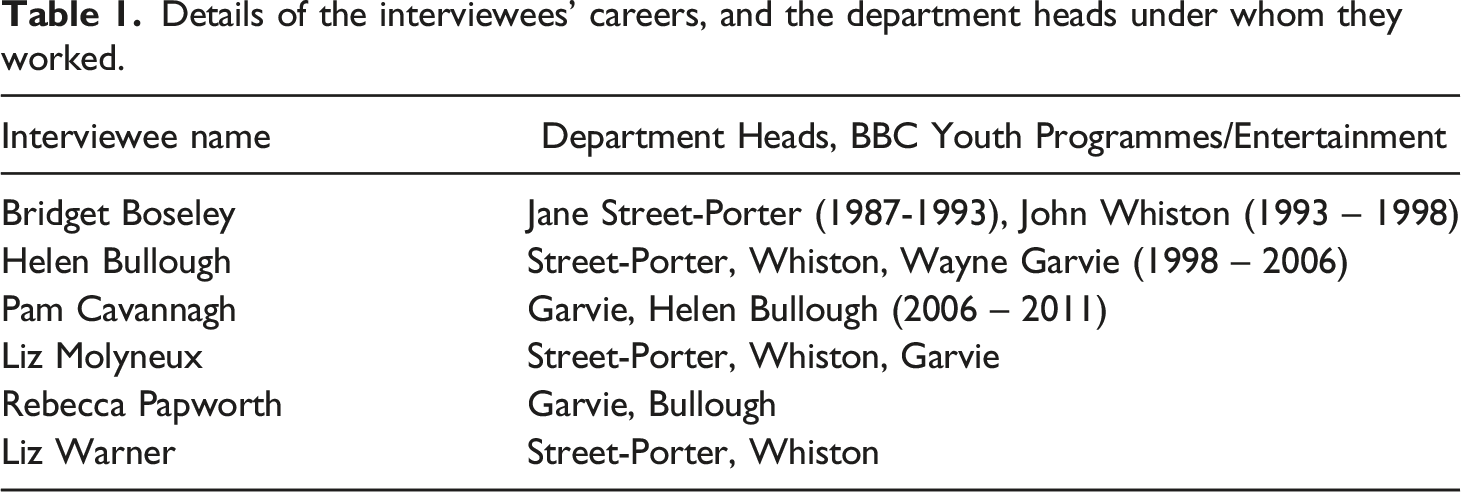
Our interviewees are not the only women to have worked in this particular department and achieved positions of power in the industry. One of our interviewees, Warner, contacted us after her interview with a list of more than ten other women who have had successful television careers after spending part of their early career under Street-Porter’s leadership in Youth Programmes, including Anna Beattie of Love Productions, the makers of The Great British Bake Off (BBC, 2010–2016; Channel 4 2016 - present), Orla Doherty, now an Executive Producer at the BBC’s Natural History Unit, Claire Pizey, Executive Producer of Top Gear, (2002 - present) and Samantha Lawrence, MD of Monkey Kingdom, the makers of Made in Chelsea, (2011 - present). That these women have in common the early career experience of working in Youth Programmes suggests that the department created the conditions under which women could develop the necessary skills, judgement and networks for a successful television career. In this paper we reflect on the specific qualities of the Department and its leadership that may have contributed to this development, as well as some of the hurdles (especially motherhood and exclusion by class identity) that women have to overcome to sustain a career in the television industry.
We undertook semi-structured interviews, mindful that ‘qualitative methods, such as interviews, are considered the best way for ensuring that the experiences of women - and other oppressed social groups - are heard’ (Wreyford and Cobb, 2017: 107). As Kate Murphy points out, the majority of what we know of the BBC’s history comes from the autobiographies of former male employees (2016: 8) and these interviews serve as a small counterpoint to what David Hendy has described as the accounts of ‘great men’ (2012: 362). It is important to be mindful, however, that the experience of these six women is not representative of all the women who worked in that department. Not everyone who worked there went on to enjoy a long, successful career or achieved positions of power within the industry. In their analysis of the Countryfile (BBC, 1988 -) ageism case, Simona Spedale, Christine Coupland and Sue Tempest observe that ‘individual experiences of the workplace can be qualitatively very different, reflecting unique, spatially and temporally situated combinations of the intertwining systems of age and gender’ (2014: 1600). Likewise, as Ruth McElroy reminds us, it is ‘misleading when individual prominent women in managerial roles are used metonymically to stand for a whole workforce’ (2017: 39). These interviews cover the experiences of six women working in the BBC over a period of more than 30 years. While they are not a comprehensive account of the period, they do offer insight into the working cultures of women whose production careers intersected with the BBC at a significant stage of their professional development.
The approach we took to the interviews was to invite the participants to reflect first on their careers as a whole, and then to think back on working with other women in positions of power in that department and beyond. Our interest in this was twofold: drawing on work by Gorton and Garde-Hansen (2019), we were interested in the ‘remembering’ of British television history and how these memories are useful to a broader understanding of television history. We are also interested in how this institutional knowledge might contribute to a greater archive of knowledge and understanding about the BBC in particular, using previously overlooked genres – Youth and Entertainment programming – to investigate what was happening in the organisation beyond the programmes themselves, looking below the surface of what Jean Seaton describes as ‘icebergs - what you see is a fraction of the work that goes into making them’ (2004: 157).
Building a youth programmes department in the north of England
Janet Street-Porter was recruited from LWT’s Network 7 (1987–88) in 1987 by the Controller of BBC Two, Alan Yentob, to form the Youth Programmes department for the BBC, based at Television Centre in London (Wyatt, 2003: 161). In the early 1990s it was announced that the department would move to BBC North at New Broadcasting House on Oxford Road in Manchester in an early move by the BBC to diversify its production bases out of the capital and stave off a plan by the then Deputy Director-General, John Birt, to close the site (Horrie and Clarke, 1994; Wyatt, 2003). In this period the department’s output was predominantly broadcast under the DEF II (1988 - 94) brand, a twice weekly stripping of youth programming which included the travel and careers brand Rough Guide (1988–94), a current-affairs show, Reportage (1988–94), a football magazine series, Standing Room Only (1991–94) and the music show, Dance Energy (1990–93) among others. When the department was initially formed, a number of programme makers followed Street-Porter to the BBC from LWT but either chose not to relocate to Manchester or left shortly after the move north. Street-Porter left in 1993 and John Whiston was appointed to head the department, by which time its output had expanded to include the quizzes Mastermind (1972-) and A Question of Sport (1970-), and the more mainstream travel brands, The Travel Show (1982–99) and Great Railway Journeys (1994–99). Whiston was succeeded by Wayne Garvie who joined from Granada Television’s Entertainment department and oversaw closer links between the department in Manchester and the Entertainment Department in Television Centre. During this time the ‘Youth’ label was finally dropped as the output became more archive based, notably with the I Love… brand (2000–01), before shifting focus again under the management of one of our interviewees, Bullough, to more factual entertainment titles including Dragons’ Den (2005-), Bank of Mum and Dad (2004-05) and Call The Council (2014–16). The department moved to Media City in 2011 where it remains with only A Question of Sport as a returning title.
As Susan Franks (2017) has observed, the BBC made tentative steps to improve opportunities and equality for women in the 1970s, and indeed Street-Porter founded the department only 2 years after the Sims Report, Women in BBC Management, showed that only 6 of 169 senior positions at the corporation were held by women (Murphy, 2022). However, Dunford (1993) observes that, in the Street-Porter era, the department was one of the few in the BBC with a high proportion of female practitioners, something that Bullough (2020), now head of BBC Children’s In-House Production, saw as evidence that Street-Porter was a trailblazer for the industry at this time, and one whose impact would still be remarkable today, telling us, Janet ran it and she was very interesting in terms of the impact that she made on the industry, in terms of her inclusive recruitment. So if you think about the content that that we were making, for the audiences that we were making it for, and the teams who were making that content […] they were probably the most diverse and inclusive teams that actually would be the envy of many companies now […] I think that was extraordinary.
Part of Street-Porter’s approach to diversity in recruitment may be credited to her own atypical BBC career, coming as she did via architecture school, fashion journalism and commercial radio, rather than the more conventional route at the time of joining the BBC as a graduate of an elite university.
While Street-Porter’s commitment to diversity was ahead of its time, Boseley (2020) explained that her management style went against gendered expectations: Janet Street-Porter would come into the Reportage office on a Thursday morning […] and we’d have to give our ideas in […] and she’d go ‘That’s shit, that’s rubbish, that’s shit, that's never going to make the TV’ and she’d just tell everybody off, that they were rubbish. And then on one particular occasion, that we were all so rubbish that she went into office and came out with a pile of allegedly CVs and slammed down on her desk and said ‘See how many people want your job, […]? You need to come up with some decent ideas.’ And she was terrifying, you know, and that […] Isn’t the sort of, softly, softly management of what women are supposed to be like. She didn't behave like that at all.
The behaviour that Boseley describes is situated within in a wider context of the change and inclusion that Street-Porter brought to Youth programming and set against the expectations of what women in leadership roles are ‘supposed’ to be and do. While Street-Porter’s approach challenged Boseley’s expectations, it supports Judy Wajcman’s study of gendered corporate management styles which found that ‘the similarities between women and men who have achieved senior management positions far outweigh any differences between women and men as groups’ (1998: 8). If we apply Wajcman’s analysis to Boseley’s experience, we can see that Street-Porter had adopted the dominant, masculine management style, becoming successful by being more like a man.
In that environment and context the way Street-Porter behaved may have been ‘terrifying’ but was also refreshing and inspiring. Boseley explains: ‘I was empowered by the women I worked for, I respected the women I worked for, and it made me feel I could succeed.’ And as Bullough recounts: I genuinely think that that generation that had, sort of, gone before, so for me, you know… the Janet Street-Porters or the Rachel Purnells, they might have had a tougher time, to be honest, but when they, when they started to build their teams and when their teams looked at them and thought ‘okay, well anything's possible’, that's a really powerful influence.
As Bullough mentioned, other women held positions of power in the department, notably the Editor of Youth Programmes, Rachel Purnell. Their leadership was an inspiration for the younger women who joined the department in Manchester, including Molyneux (2020), who worked alongside Bullough and Boseley in daytime programming at BBC North before joining the Youth department, and explained: I would characterise the opportunity for women to progress within that that Youth programming Department [as] incredibly positive. I think the leaders in that Department […], I could imagine being them because they were all around me. You have to see it in order to believe it don't you […] about being women in positions of power.
The experience of the women we interviewed who worked for Street-Porter were unusual in the male, Oxbridge graduate-dominated organisation described in accounts of the era by Born (2005) and Seaton (2015) amongst others. Warner told us about being interviewed by Street-Porter for her first role at the BBC after a drunken night out with a Series Producer and being given the job on the basis of having been able to keep up with him, again echoing Wajcman’s observation that ‘the male manager has been constituted as the standard against which women are to be measured’ (1998: 54). Warner (2021) contrasted Street-Porter’s approach to that of her successor, John Whiston, saying: ‘John was the professor, probably, and Janet was probably the crazy headmistress who started the school and, you know, but without her vision it wouldn’t be there.’
The interviewees who had worked in the Youth department during Street-Porter’s management all cited her leadership as an inspiration for the rest of their careers, particularly as a strong woman in a position of power in what was then still a male-dominated organisation, albeit as a strong woman who adopted a more typically masculine management style to progress in the industry. Where Street-Porter does not seem to have provided such inspiration, however, was the one situation where it was impossible for these interviewees to adopt a masculine approach – motherhood.
Balancing motherhood and ‘the job’
As Dent (2020), O’Brien (2014, 2017) Wreyford (2013), and others have shown, balancing a family with a career makes the screen industries a difficult place for women to work. In our discussions, this was a challenging issue for the women we spoke with, irrespective of the inroads Street-Porter’s leadership allowed for. Papworth (2020) acknowledged the difficulties of balancing the twin demands of family life and the all-consuming nature of production: I do think having children in this industry is incredibly difficult, and I think if I didn't have that sort of a gung-ho, “it'll be okay anyway” type vibe or way of approaching things I don't think I would have strategically considered having a baby because they are a nightmare to configure into a television career, you know, and I was very lucky that I had support in the background through family and my partner I think that, otherwise it would have been impossible.
Boseley echoed Papworth in citing the support of her husband, himself a successful programme maker, as being a vital component in her ability to manage the demands of her family and work life. She also recounted a story of getting stuck in traffic en-route to her daughter’s nursery from BBC Manchester and having to go down the line of cars, trying to find someone to call the nursery as her own phone battery had gone flat, and the relief of another driver giving her the thumbs up once they had got through. For Bullough, the realisation that motherhood was going to require changes to her working patterns came even before she gave birth, as she explains: I think might have been doing the Mother Theresa [obituary] at Everyman [1977–2005] until I was 39 weeks pregnant with [my daughter]. And I was almost completely motion sick for the entire time. You know, when I think back on it, I was sitting in an edit suite with an editor […] and moving pictures at that point were making me terribly sick. I remember going home on my very last day, I mean I think I had [my daughter] about three days later, and I remember going home thinking, ‘okay so you need to have a little word with yourself because this is not the person that you can be going forward’, you know?
Here Bullough articulates how she would no longer be able to give the total dedication to the job demanded by the production culture prevalent in the BBC, and the wider industry, at this time. It is also notable that in this story, it is the experience of being in the edit that Bullough remembers as problematic and not working until 3 days before giving birth. This sense of balancing work and family life is indicative of what Angela McRobbie (2020) identified as the Perfect, Imperfect, Resilience (P-I-R) – the pressure on working mothers to balance the two aspects of their lives without each being impacted, unless they pay for additional support and transfer the responsibility for childcare to others (Wajcman, 1998:150). This tends only to be available to middle-class working mothers, and some of our interviewees, after experiencing this challenge, chose to do so in order to ease the family pressure enough to maintain their television careers. It is interesting here that none of the interviewees who made that choice saw any conflict with their working-class upbringings, discussed in more detail below. It was presented as what they had to do to minimise the impact of their work on their family and vice-versa.
All of our interviewees who are mothers cited the support of their partners as being crucial to allow them to sustain their careers. Cavannagh told us how she maintained a home life in Manchester alongside a high-powered BBC managerial role in London, but felt judged by colleagues when they discovered how she had structured her work/life balance: ‘I do remember women particularly going, “How did you do that?” And I can remember thinking, ‘You wouldn’t say that to the man. You wouldn’t say that to a man’.’ Here, Cavannagh has internalised her decision, choosing to keep her family arrangements private rather than risk the criticism of her colleagues for making that choice, echoing Dent’s finding that mothers ‘hide’ their motherhood from others (2021: 136). What comes across very clearly in the interviews is a sense of a double standard—whether in describing leadership expectations or those of home/work balance. Women are assumed to take the brunt of family life and its demands, but do not have institutional support from the industry, both within the BBC and without, to manage the gendered difference. There was an overwhelming sense amongst the interviewees that this has not changed significantly since they were balancing home/work, One interviewee who had tried to address this imbalance was Warner, when setting up her own production company, betty (with a deliberately non-masculine lower-case b as a challenge to the very masculine names prevalent at the time, such as Blast, Ricochet and Maverick Productions). While Street-Porter had forged a path in the television industry for other women to follow, by adopting a more masculine management style, when Warner formed her own company, she took the opportunity to challenge the notion that a television career and a family were incompatible, explaining that at betty, ‘We were very, very family friendly. If you need to leave to go to a school appointment, then I didn’t even want to know. That was the sort of culture we wanted, which was you don’t even need to say it.’ While this effort was laudable, we must bear in mind Aust’s findings that such enlightened policies can also serve to alienate and isolate non-mothers (2021).
The issue of class in the BBC
As discussed, the women interviewed who worked with Street-Porter were inspired to follow her example and pursue senior careers within the BBC and the wider industry, in Warner’s case consciously turning away from the male-dominated style that Street-Porter had adopted to effect a positive change for parents working at her own company. While previous research has investigated the gendering of roles in television, with women over-represented in support roles rather than editorial (Hesmondhalgh and Baker, 2015), and the gendered reasons why women eventually leave the industry (Percival, 2020; O’Brien, 2014), none of our interviewees felt that they had experienced any sexism in their careers, beyond concerns over historic pay imbalances. This chimes with what Gill et al. (2017) describe as ‘gender fatigue’, where the potential for discrimination is acknowledged but dismissed.
While gender was downplayed by our interviewees, they all felt that their class and background had played a part in the progress of their careers as they came up against the ‘old boys’ network’, which they perceived as being experienced in terms of their upbringing rather than of their gender: it was where they were from that had an impact on their careers. This is perhaps surprising as their inspiration, Street-Porter, was renowned in the press for her non-Oxbridge background. All of the interviewees grew up in what the BBC would describe as the Nations and Regions, i.e. not London. None of the women had attended Oxford or Cambridge universities. Warner described Whiston’s surprise when he asked which college she had studied at, and she answered ‘Secretarial’. Molyneux, a native Mancunian who describes herself as a ‘chippy northerner’, related her experience of working as a commissioner in Television Centre in London later in her career and the feeling that she was being excluded from some conversations: I felt then that there were cliques and information that was actively guarded around getting commissions and that senior people in production knew people in commissioning and I suspected and know that they were probably having dinner and going to the Groucho club together and I was outside that. I don't think I was important enough to be excluded but I certainly wasn't included at all, and I did feel like an outsider […] and I feel that wasn't on gender but […] I did feel that was probably a bit to do with me not knowing them at college or in those circles […] I do feel I was excluded a little bit and not actively encouraged.
After leaving BBC Manchester, Warner became a commissioner at Channel 4 and also spoke of her own moment of realisation whilst working there that there are unseen connections and networks between powerful groups in the industry, explaining, I think the problem isn’t women, I think it is probably class and background. I probably think it’s difficult. When I went to Channel 4, I was going down to the set of Big Brother [with a senior male executive] and so he was saying “Oh, I know blah and blah and blah”. And I said: “How do you all know each other?” And he said, “Well because we went to Westminster” and I went “Oh.” I was so naïve because I still couldn’t quite work out why I didn’t know anybody because I've gone to school in Loughborough and then gone to Manchester so I still think that those networks are really powerful, and I still think that is still a big issue and there’s still a snobbery between London and Manchester or not just Manchester and I know that they’ve got, you know, the regional moves and Channel 4 have got their regional office and all of that is to try and redress it, I still I think that that has become a bigger issue than gender.
In their work on the BBC TV Series The Moorside (2017), titled ‘Erasing Diversity,’ Beth Forrest and Johnson (2020) note the absence of social class as a marker in the targets for the BBC’s Diversion and Inclusion Strategy. They cite Rhian E. Jones’ online piece on ‘Does the BBC care about class?’, in which she argues that ‘attempts to improve diversity […] rarely include attention to how socio-economic background can influence success. This is clearly problematic when it comes to representing the British public, as class is a fundamental dimension of disadvantage that intersects with many others’ (2015). Furthermore, Jones notes that a 2014 report by the Social Mobility and Child Poverty Commission, revealed that while only one percent of the general population had an Oxbridge education, one third of BBC executives had. Likewise, only 37% of executives had attended a comprehensive school, compared to 88% more generally, with around 50% having either an independent or grammar school education. In Warner’s example, having gone to the right school was an important advantage in a career in British television. The research from Jones, Forrest, and Johnson chimes with the interviews we conducted. For instance, Papworth, who went to school in Bradford, described speaking as the only woman in a meeting with senior men at the BBC in London and one of those men openly turning to his neighbour and announcing, ‘I can’t understand a word she’s saying’. It is important to note that in Papworth’s telling of this story, one of the significant details was that she was the only woman in the room, which suggests that she was aware of the gendered nature of the comment. However, in her analysis of the comment she concentrated on the class element, telling us: If you walk into a room where everybody knows each other ‘cos they all went to the same school or they all live in the same place […] you are the outsider. To belittle, to try and humiliate, all that is absolutely trying to push you out, isn't it? ‘Cos ultimately I think what you've got, I sort of said to myself with that one is, ‘How hard must I have worked to have got to that table?’ Maybe that's slightly intimidating, ‘cos she’s broken through, you represent change, don’t you?
While Papworth could reflect on the experience and how she had flouted the system, she acknowledged the issue that it highlighted, concluding: ‘I hate how classist the industry is.’ Bullough was quite open about her own background and the impact she felt that had on her early career, telling us that ‘there weren’t many people from Kirkcaldy whose Dad made lino working for the BBC when I joined it […] actually the fact that I was clearly from a working-class background was probably the thing that people notice before my gender because it was possibly more unusual.’
There is clearly a sense within the interviews of these women feeling like outsiders because of their class and background. This sense of otherness was cited as a reason for the Youth department’s success with regards to where it was located geographically, outside London and beyond the oversight of more traditional organisational patterns. Molyneux described for us how, in her opinion, being out of London and outside the creative nucleus of the industry gave the department and its programme makers the opportunity to flourish: I think the Oxbridge culture that existed within the BBC was at its most concentrated in London because that is where the seat of power was …therefore if you broke out of… what was a confine, you didn't have to behave like them, you didn't have to behave like commissioners behave, you didn't have to behave like controllers do to a certain extent. So I think it was the freedom of being outside of the leadership elite and the freedom to take some risks and I guess because at the very heart of the stuff that we were trying to create, was anarchic and different and so by definition that allowed people to blossom, try things out and be themselves more than fitting into a mould of people that they see around them that are succeeding …I felt as though I didn't have to wear a suit every day in order to make progress and actually quite the opposite might be true, I might want to appear far more anti-establishment rather than establishment.
Over the course of the interviews, we were told of unofficial competitions between teams on Rough Guide to come up with the most outrageous opening sequence, of end of series city breaks for the Travel Show production team and of producers being criticised at BBC Programme Review meetings for their graphics being too garish and busy but then being approached a few months later to oversee the rollout of the same graphic treatments for a nationwide regional opt-out. This echoes what Dunford (1993) found in his study of the department in the Street-Porter/Whiston era, that responsibility was devolved down the management structure and the innovations that resulted trickled through into mainstream programming. These two strands of being ‘other’, freed of the restrictions of Television Centre where one might bump into a senior manager with strong opinions about a recent programme, and coming from social backgrounds that bucked the old boys’ network, were repeatedly cited as a reason why the department flourished and our interviewees chose to stay there to enjoy the freedom of making programmes as they saw fit. As Warner explains: ‘It felt like, basically, we were the naughty kids that had taken over the building […] so yeah, it probably was a school without us realising, it was Bauhaus without realising we were Bauhaus.’
While the interviewees may have foregrounded the notion that their class and background had presented obstacles to their career paths rather than their gender, being a woman did factor when they discussed their peer-support networks, whether they were organised like Women in Film and Television or the sort of informal, ad-hoc groupings of peers that Rowan Aust has written about (2020). Cavannagh described having a network of female peers who she could talk openly and frankly with, that the television is ‘smoke and mirrors and everyone’s got to appear like everything’s okay. And actually, it’s a really, really tough industry’. Certainly, for Bullough, those connections are vital, she told us that, ‘women’s networks have grown up fast and firm and that that has benefited the cross fertilisation of ideas and support in a way that, to be honest, I don’t think more male skewing networks have. And so, I think that’s been a really, really interesting phenomenon.’ These support networks seem to provide an important counterpoint to the predominantly male, after work, pub-networking that Anne O’Brien (2017) observed excluded senior female workers in the Irish media industry, an exclusion that was especially marked if those women were also mothers.
Conclusion
The memories collected here are a snapshot of a generation of female practitioners who all began their careers between 1985 and 1995. While they all worked in one of the incarnations of what Street-Porter began as Youth Programmes, they didn’t all start there, none stayed there but they have all enjoyed, by any normal measure, sustained and highly successful careers. Each of them had fond memories of their time in that department, even if they subsequently experienced discrimination as a result of being parents or their social background. For those who worked with Street-Porter there was a clear sense that working for a highly visible woman who had been headhunted by the BBC, despite being atypical of the organisation at the time, to create a department in her own image was a formative experience for their own careers. The interviewees who joined the department after Street-Porter’s departure nonetheless entered a production unit managed by those who had worked with Street-Porter and taken their inspiration from her. Despite their differing origin stories and subsequent career paths, common themes repeatedly came to the surface – the importance of the department being an out of London ‘other’ giving them the freedom to try new things and a level of anonymity if things went wrong, albeit at the cost of themselves being ‘othered’ when they came into contact with traditional, London elites; the universal rejection of their gender as having impinged on their opportunities, albeit with the acknowledgement from the mothers in the cohort that the support of family was crucial to allow them to continue their career trajectory; and the acknowledgement that, as their careers have progressed, circumstances have deteriorated for those practitioners entering the industry behind them. As Warner put it: ‘it’s really interesting when we talk about these glory days of Manchester and there was a lot of hope and opportunity then and it seems that we might not have captured all of that and it might have slipped back a bit […] we’ve got chances to change it but maybe we haven’t all done as much as we should have done.’
The fact that Street-Porter was both inclusive, pioneering and yet also ‘terrifying’ and a ‘crazy headmistress’ offered a model of leadership, that while clearly part of its time and context, was also liberating and inspiring to the women who worked with her. The accounts here of Street-Porter’s management and of the wider department stand at odds with the accounts of departments in London at this time, particularly by Born (2005), of production units stymied by organisational change and internal strife. One of the over-riding concerns that emerged from our interviewees was how class continues to play a divisive and disabling role in the careers of those entering into the BBC and the wider industry. As other research has demonstrated, this continues to be a pressing issue that needs attention. Home/life balance continues to be a challenge, particularly for women. And in a time of greater uncertainty and precarity, this needs urgent attention.
Footnotes
Declaration of conflicting interests
The author(s) declared no potential conflicts of interest with respect to the research, authorship, and/or publication of this article.
Funding
The author(s) received no financial support for the research, authorship, and/or publication of this article.
