




Abstract
Cooking on television after WWII mainly addressed ‘the housewife’ audience, while women themselves were presenting television cooking programmes. History has largely forgotten the presenter Joan Robins, who appeared alongside Philip Harben and Marguerite Patten on BBC broadcasts of the late 1940s and 1950s. Robins specialised in ‘common-sense’ cookery, nutrition, and health, including a controversial slimming programme that featured advice that was later disputed by the British Medical Association. Robins’ ideas and innovations were not always welcomed by the BBC, who preferred more straightforward cookery demonstrations, resulting in her turning her back on broadcasting to concentrate on her other careers.
Joan Robins played a significant role in the delivery and development of television cooking (and food related) programmes on British television between 1947 and 1956. However, her contemporaries and colleagues, Philip Harben and Marguerite Patten are not only more familiar names but have been the subject of academic interest (Charlesworth, 2022; Geddes, 2022; Moseley, 2008). Robins was a significant figure in the development of broadcasting aimed at ‘housewives’ despite not being one herself. Robins was a professional, holding an Executive position with the Gas Light and Coke Company (which employed demonstrators to promote gas cooking, and later became known more simply as The Gas Board) and was a champion of not only women, but the ‘welfare of the whole country’ (Adams, 1962) who connected ordinary aspects of the home such as food and cookery to wider issues of equality, fairness, and standards. Robins believed that it was her role of Executive which led to her appointment as presenter on television, but at the same time (and from the very beginning) caused some conflicts of expectation within the BBC. Robins’ expectations of her role within the BBC, and the views she suspected were held by audiences watching from home, would ultimately lead Robins to prioritise alternative employment and senior roles (outside of broadcasting) to advance the rights and responsibilities of women as consumers in Britain (Shipley Times and Express, 1956).
The persona Robins portrayed matched the reality of her career as an Executive, linking her work in industry, politics, and campaign work on behalf of women. From photographs taken of her television cooking broadcasts, Robins appeared in relaxed clothing styles, smartly dressed in short-sleeved plain and floral outfits complete with a domestic pinafore apron. Her hair was swept up and always pinned in place (see Figure 1). In the publicity shots for her substantive position at the Gas Light and Coke Company, Robins was seen in pin-striped suits, embellished with brooches and wearing blouses with bows, with her hair in the same style. Robins wrote her professional correspondence to colleagues at the BBC on headed Gas Light and Coke Company paper, positioning herself as a professional employee of theirs, and signed off as the intimidating and perhaps regal-influenced ‘Joan R’, which then had to have a pencil addition of ‘obins’ added by BBC clerical staff before filing was possible (BBC WAC TV Art 1, 3 August 1940). Joan Robins as she appeared on BBC television cooking programmes. Photograph part of the Joan Robins Personal Archive courtesy of Catherine Robins.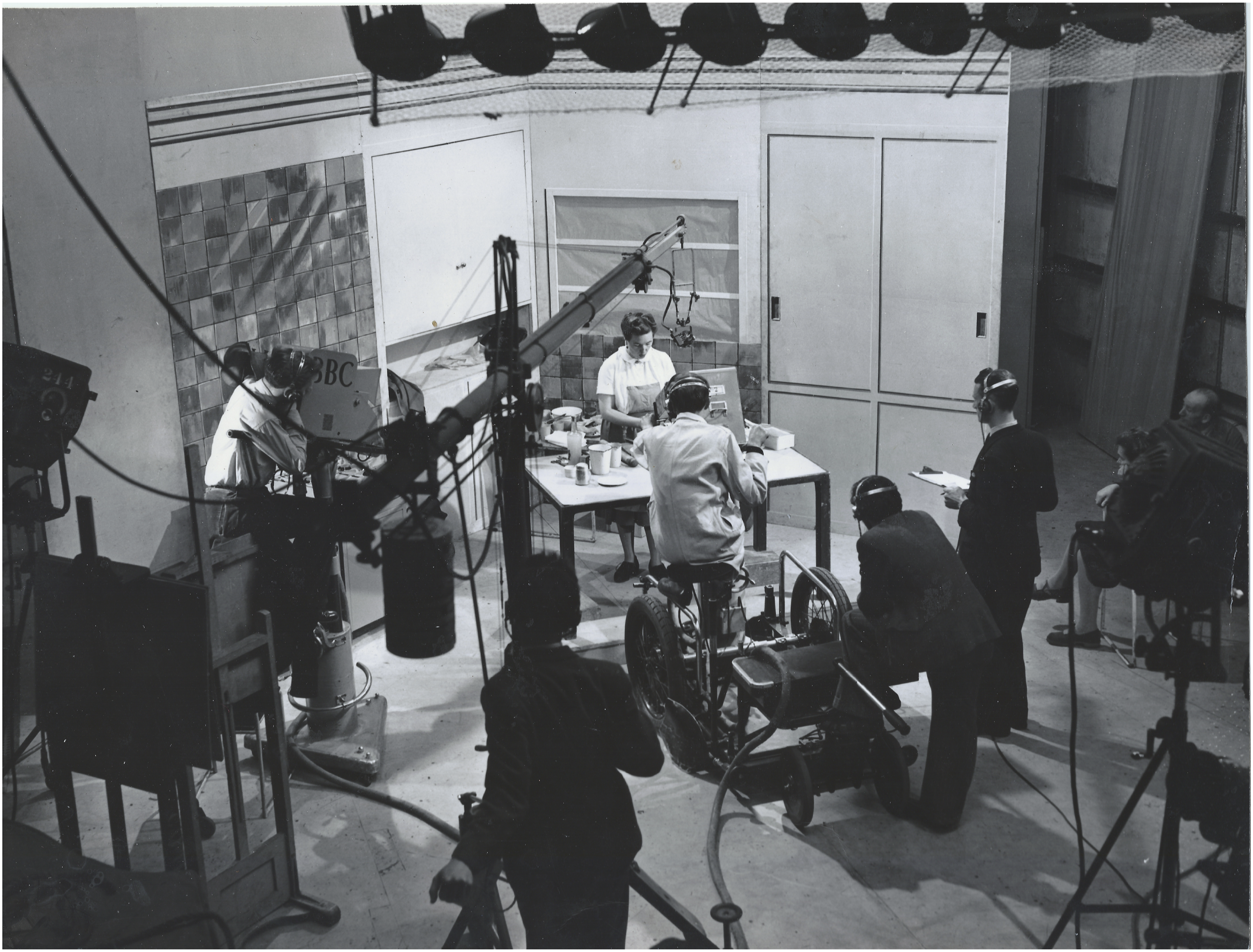
For this research, as the programmes themselves were mostly transmitted live, rarely recorded, and do not exist in the archives, I have pieced together a picture of programmes broadcast featuring Robins by using a variety of primary resources, following the pioneering work of Jason Jacobs in using BBC written archival resources in this way (Jacobs, 2006). In doing this, Robins can be placed back into the history of the BBC following, and complementing, the work of the AHRC Television for Women in Britain 1947-1989 project, which looks at television of the time made for and watched by women viewers. I add, therefore, to the work of Irwin (2013) looking at producer Doreen Stephens; Mosely (2008) and, more recently, Charlesworth (2022) who considered the contribution of Marguerite Patten. This research considers Robins’ role alongside these pioneering women, and the male presenters she appeared on screen with (see Geddes 2022).
The document files at the BBC Written Archives Centre in Caversham have been crucial to establish the discussions, suggestions, and ideas behind the scenes of television production. Archive files are collated by the BBC to hold information on programmes, presenters, and other contributors. The files contain correspondence (including letters, memos, and amendments), contracts, studio plans and diagrams as well as any relevant or noteworthy newspaper clippings which may have been discussed in the correspondence filed. Programme details are drawn the Radio Times listings (BBC Genome, 2021), and additional information is cited from the British Newspaper Archive and a collection of press and publicity photographs and other ephemera held as part of Robins’ own archive by her daughter Catherine. This paper considers Robins’ television career and the contribution she was able to make to television cooking and women’s programmes. I reconsider her as a significant innovator in television, discussing some of the potential issues she encountered at the BBC, before concluding that the contribution she was able to make at the BBC was undervalued. This paper marks her innovations and contribution to the development of television cooking programmes and seeks to situate her within the early histories of BBC television.
Mainly for women - context and career background
Television cooking programmes from 1936 to 1939, when broadcasts began and then ceased due to World War II, featured regularly in the schedules, although these were considered, as all initial programmes were, to be experimental in content and style, and largely ignored even by the BBC at the time (Wyndham Goldie, 1977: 11–13). Television cooking programmes resumed in 1946 after World War II. The BBC looked towards their established radio talk broadcasters to transfer to the television studios. Additionally, the BBC had a new role in helping to communicate the guidance issued on behalf of the Government from the Ministry of Food. Robins had joined the Ministry of Food in 1940, rising to oversee ‘food advice’ (Middlesex Independent and West London Star, 1947). Although uncredited in the Radio Times, Robins had herself presented regular talks as part of the Kitchen Front series from 1942 (see Lyons and Ross, 2016), which had helped to build her experience as a broadcaster (ODNB, 2021). Robins left the Ministry of Food in 1947 to accept a promotion at the Gas Light and Coke Company, where she oversaw the Home Service Section (ODNB, 2021) with a focus on ‘instruction in the home’ (Middlesex Independent and West London Star, 1947).
Robins presented her own series on BBC television shown in the afternoons. The Housewife in the Kitchen began in 1947 and broadcast throughout 1948 before being renamed For The Housewife, when Robins was joined by Philip Harben in hosting duties. In 1950, the BBC launched an entirely new cooking programme on television, Cookery Lesson in which Harben, Robins and Patten would form ‘a team of three’ led by Harben, with Robins and Patten referred to as the ‘other two cooks’ (Lincolnshire Echo, 1950). Cookery Lesson was also broadcast in the afternoons at 3p.m., in a change of scheduling for Harben who had previously occupied the evening slot with his own series simply entitled Cookery from 1946. Patten had previously given talks on food and cookery on the radio series Cookery Talk and had provided a semi-regular cookery slot in the television magazine programme Designed for Women from 1947 onwards.
Designed for women – Joan Robins and gender
Television cooking programmes before the war had a broad appeal, considering cooking at home an ‘art’ and a skill to be learnt, particularly considering changes to domestic situations and the lack of ‘servant help’ (Todd, 2009) leading households to consider preparing their own meals, instead of employing a cook (Benson, 2005). The initial programmes of 1936 featured women as presenters, such as Moira Meighn and Rosina Dixon described in the Radio Times ‘The Singing Cook’ (Radio Times, 1936) in standalone broadcasts. In 1937, Xavier Marcel Boulestin presented a dedicated series of cookery lessons in the form of menus, all built around his reputation as a food celebrity, restaurateur, and writer (The Listener, 1937). Following the war, television cooking programmes adopted a more gendered feel to appeal to the female viewer (Thumim, 2004: 59), connecting the need for food advice provided by the Ministry of Food in Britain to be shared with households still under food rationing and shortages.
The files held by the BBC Written Archives Centre indicate the tension between Robins as an Executive (as she regarded herself) and as a role model for ‘other’ housewives (as the BBC regarded her). Robins submitted a publicity blurb for use by the BBC which originated from the Public Relations Department of the Gas Light and Coke Company, underlining her professional credentials with them, the Ministry of Food and at home as a mother. Robins is described as ‘forthright, optimistic and gives lie to the rumour that women have no sense of humour’ (BBC WAC TV Art 1, 1947a). Mary Adams, a prominent producer at the BBC (Murphy, 2016) responsible for Robins’ programmes, added her own notes for the BBC publicity team asking them to make no mention of Robins work with the Gas Light and Coke Company, but instead to ‘build up her connection with the Ministry of Food and her practical experience at home’ (BBC WAC TV Art 1, 1947a)
It is within these additional publicity notes that Adams suggests that Robins be known as the ‘afternoon cook’ appearing fortnightly working in ‘double harness’ with Harben. Adams is keen to point out that there will be no duplication of recipes or overlap of methods. She underlines that Harben will continue to cook ‘in the evening’ concerning himself with cooking methods and demonstrating appropriate recipes to illustrate these, signifying a distinction in status. Robins on the other hand, would provide hints for the housewife ‘whose primary job is not cooking’ on ‘everyday food problems, e.g. how to cope with the milk shortage, what to do for Thursday’s dinner and how to stretch the fat ration’ (BBC WAC TV Art 1, 29 September 1947b).
Despite the on-screen appearances of Harben being in charge, with assistance in more ‘ordinary’ matters of homemaking from Robins, behind the scenes it was Robins who was more experienced and able to understand the requirements of the British housewife. Later, Robins would claim that she ‘taught Philip Harben how to cook’ during these times (Nelson, 1970) with memos at the BBC showing that she had more of an ‘overview’ role in ensuring that his broadcasts for his series of Cookery Lessons was accurate and in accordance with Ministry of Food guidance. Robins provided Harben with written comments and suggestions for all 12 of his lessons, indicating to him that she was a more experienced tutor and expert in cookery lessons (BBC WAC TV Art 1, Philip Harben Syllabus). She included a postscript to let Harben know that she had read his recent article in The Times in which he paid tribute to the housewives of Britain. Robins noted with a tongue-in-cheek tone that as she was herself a British housewife, she thanked him for his kind tributes, clearly finding them patronising.
Robins, however, understood the tensions in her role of appearing as and, at the same time, appealing to housewives watching at home. She presented herself as an expert on housewives while also distancing herself from actual housewives. In a letter to incoming producer SE. Reynolds, who took over as producer of Robins cookery segments in October 1947, she laid out her credentials as a professional and executive stating ‘I am by training an accepted expert in all matters pertaining to the home’ with a list of the committees she sat on, and useful contacts she held in the worlds of business, science, consumer concerns, politics and industry – all of which found her representing ‘the housewife.’ (BBC WAC TV Art 1, 4th October). She maintained that she was considered ‘authoritative’ on housewives and as a result was ‘the perfect answer to your problems’ in terms of producing programmes which successfully connected to areas of interest and concern that housewives wanted, and needed, to see.
To appease continual concerns at the BBC, who promoted an impartial stance, that she was perhaps too connected to one industry, namely gas, earning her the nickname ‘Mrs Gas’, she reassured Reynolds that she, even, from time to time used electrical cleaners and lighting, brushing off the label as ‘nonsense’. In a further attempt to convince Reynolds that she was that ‘perfect answer’ she laid out that she was ‘the modern housewife’ (although she worked full-time) before explaining that to her that meant ‘an expert in Home Economics, if you like.’ (BBC WAC TV Art 1, 20 September 1951a). In other correspondence, Robins sent outlines of a programme she was keen to pitch on Consumer Councils, in which she suggested she ‘take the part of the intelligent housewife’ in any discussions as well as summing up the programme contents at the end for the benefit of housewives watching at home (BBC WAC TV Art 1, Consumer Councils) further underlining her view that she was a representative of those housewives watching. Robins claimed that ‘ordinary housewives’ would find it difficult, for example, to know which equipment was best for them to use in the home based on advertising alone. She said ‘they’ could not possibly be able to judge, ‘but we are’ when attempting to justify her role in programmes linked to consumer affairs to the Board of Trade (BBC WAC TV Art 1, 21 October 1952a). Robins own view of herself as a ‘so-called expert’ was not shared by Reynolds however, who claimed to hate it, preferring her role to be understood as chair of a discussion, rather than an expert involved. Reynolds stated that he preferred a simpler set of programmes that Robins had suggested, where the information alone is set out, without any opinion or expert input, feeling that this would be more of ‘interest to women applied in practice.’ (BBC WAC TV Art 1, 21 April 1952b). This tension between perceived roles would dominate Robins’ television career.
Robins was subject to some negative newspaper reports, which suggested that she was somehow ‘setting wives against husbands’ (see BBC WAC TV Art 1/Talks/Joan Robins) and encouraging husbands to divorce their wives should the food they cook for them result in stomach ulcers (Daily Graphic, 1951). Robins detailed in a letter to the BBC how upset she was by the incorrect and ‘obnoxious’ press coverage and took the opportunity to reiterate her own views on family life, which were positive and in support of housewives. She noted that the reporter had contacted her following a press release which she had been unaware of from the BBC Publicity Department, and kindly asked that if any future releases were to be supplied to the press that she been informed in advance of them (BBC WAC TV Art 1, 30 Jan 1951). Later, Robins, keen to reinforce her background, skills, and unique ability to appeal to housewives, would write bluntly in her notes for future programmes that ‘there would seem to be a place in a woman’s programme for an authoritative person such as myself’ to deal with practical issues such as furniture, political aspects of cookery such as the availability of safe and nutritious flour, and purely ethical issues such as the rights of married women (BBC WAC TV Art 1, Notes for programmes/31 July 1953).
Common Sense Controversy
Robins was responsible for a programme broadcast by the BBC in the early months of 1951, listed in the Radio Times as Cookery 9: Corpulency, which caused considerable controversy for Robins and the BBC alike. Robins had the idea to link food with simple nutrition, information about fat content and ‘common-sense’ advice to educate housewives at home about slimming (BBC WAC TV Art 1, Letter to Mary Adams/30 March 1951c) Robins had developed a short series of four programmes dealing with common medical conditions, and ‘special diets’ which may help. The series began with Food for Diabetic Visitors in the afternoon of 6 February 1951, continued with two editions focusing on Food for Gastric Disorders the following 2 weeks, culminating with the Corpulency programme on 27th February.
For Corpulency, Robins engaged a medical expert, Dr Edwards, from University College Hospital to join her to deal with ‘popular misconceptions, and self-deceptions among healthy women’ as well as recommending recipes and other ways to reduce weight which could be a sign of ill-health, discomfort, and inconvenience (Radio Times, 1951). Robins submitted detailed notes on the programme structure and content ahead of time (BBC WAC TV Art 1, Notes on Slimming Programme/20 March 1951d). Robins’ idea was to introduce two ordinary housewives, Charlotte Black, and Avril Ames, who had volunteered to be part of the programme to benefit from the advice in ‘controlling their appetites to get back to their right weight’ (BBC WAC TV Art 1, Notes on Slimming Programme/20 March 1951e). Robins proposed explanations of calories, portions, and nutritional values to support sensible eating and menu planning, emphasising ‘building’ foods (for energy) and ‘protective’ foods (for health). Exercise and massage as well as food, would be suggested for ‘personal comfort and good health’ and the progress of the two volunteers would be monitored and featured again in follow-up programmes over the next few months and into the following year (BBC WAC TV Art 1, Letter to SE. Reynolds/5th March). Robins obtained a transcript of the programme following transmission which allowed her to keep a record of the advice given. The transcript confirms that the planned programme was broadcast as suggested, without variation (BBC Transcript, 1951).
Dr Edwards, writing from his position on the Medical Research Council, suggested that the two volunteers could be vetted and seen at his clinic prior to the appearance. His recommendation was that they should both have not previously attempted to lose weight, as the ‘initial rapid weight loss’ would be better demonstrated in people who had ‘not yet started reducing’ (BBC WAC TV Art 1, Notes from Dr Edwards/18 January 1951f). Robins also supplied some academic papers and published books about ‘obesity’ to the production team to lend weight to her research and legitimacy in offering such advice (BBC WAC TV Art 1, Letter to SE. Reynolds/22 January 1951g). Subsequent correspondence showed that both Mary Adams and Reynolds asked detailed questions about the content, which Robins sought clarification and reassurance from Dr Edwards (BBC WAC TV Art 1, Letter to Mary Adams/20 March 1951h).
However, the broadcast caused unwelcome headlines. Newspapers reported that Robins had also ‘followed her own good advice’ and lost one and a half stones in just over 2 months (The Londonderry Sentinel, 1951) while others reported on the broadcasts as part of a ‘slimming craze’ (Belfast Newsletter, 1951). Some news stories appeared which highlighted that the programme had drawn complaints and controversy from the British Medical Association (BMA) and other medical bodies resulting in the BBC not sending the accompanying diet and information sheets to the ‘50 thousand plump women’ who had requested them by sending in stamped, addressed envelopes, leaving the viewers disappointed (Davis, 1951). The main complaint from Lord Horder from the BMA appeared not to be connected to the advice contained within the programme, but more what he saw as women’s ‘search for the body beautiful’ claiming that he did not think that ‘a sylph-like figure’ was the ‘most important thing in the world’ (Davis, 1951).
Robins dismissed his advice as ‘fatherly’ but had to accept the BBC’s position and decision not to send out the information. Dr Edwards did not appear in any future updates on the programme, and instead Robins wrote a book, Common Sense Slimming (Robins, 1952), not officially endorsed by either the BBC or the medical authorities, to support her programmes. On the cover of the book, Robins is described as the ‘television slimming expert’ and Robins wrote a foreword detailing her broadcasts on the BBC (Robins, 1952: 8). An introduction to the book was provided by Dr Frank Jeffrey, introduced only as a ‘London Doctor’ without any explanation of Dr Edwards initial involvement (1952: 7). Newspaper articles surrounding the publication were more positive, referring to the book as ‘sensible advice on how to keep slim’ (Riding, 1952) and as ‘particularly useful for anyone who wants to lose weight’ (The Yorkshire Post and Leeds Mercury, 1952). At this time, television audiences were still relatively small, and many readers would not have seen the broadcasts, meaning the book would be reviewed as a standalone title. The programme volunteers would appear with Robins on screen again in July 1952 to coincide with publication and as a follow-up to review their slimming progress. Robins herself appeared less frequently on BBC broadcasts generally following this series but continued to present sporadically until 1956 with records showing her contribution had been lessened to simply ‘taking part’ in discussions, rather than fronting programmes as an established personality a much-reduced fee of eight guineas, indicating her reduced role (BBC WAC/Joan Robins/Contract/30 October 1956).
Housewives in the kitchen – how Robins was viewed by the BBC
Robins maintained her assumption that she had been asked to broadcast on television because of her industry experience and ability to connect with housewives at home through the screen. Initially, Robins was praised for her abilities, with memos showing that having seen ‘Mary Adam’s new cook’ in action, Cecil Madden (then producer) reflected that ‘I think she is good’ (BBC WAC TV Art 1, 23 September 1947c) Others described her as ‘competent and sympathetic’ on screen (BBC WAC TV Art 1, 1 October 1947d) and passed on the views of ‘experts’ who considered her talk to be ‘easily the best to date.’ (BBC WAC TV Art 1, 13th November)
Robins prided herself on ‘not using a script’ (BBC WAC TV Art 1, 6 February 1948), which occasionally prompted positive feedback from Reynolds, ‘I have never known you to give a better performance and offer you my heartfelt congratulations’ (BBC WAC TV Art 1, 29 March 1950). However, when required to provide script outlines, it was noted that ‘she is not considered a good enough writer’ (BBC WAC TV Art 1, 18 January 1951i). Reynolds commissioned a report looking at audience research for her Housewives Forum programmes, which highlighted, in his words, that ‘Joan Robins has not proved popular’ with ratings between 65 and 67% on the weeks she appeared, versus a range between 66 and 74% when other presenters were featured. Reynolds accepted part of the blame for the items not ‘being better’ which he attributed to his inability to discuss the items beforehand with Robins. His assessment was that ‘members of the public assisting Joan’ (as members of the Housewives Forum) had ‘never been vital’ and went on to describe Robins herself as ‘somewhat bossy’ which he vowed to ‘speak to her about’ (BBC WAC TV Art 1, Memo to H. Tel. T/9 December 1952d).
When Robins published her book on slimming, discussions on how she should be reasonably described on the cover were floated around the BBC, despite them not being involved in the publication, and the book not mentioning the BBC at all (BBC WAC TV Art 1, Letter to Mary Adams 19 February 1952e). BBC management attempted to undermine her professionalism by stating that ‘JR is
Robins never recognised that the BBC were her employers. She worked on a freelance basis (in the same way as other television cooking presenters of the time) with each appearance being individually contracted with an appropriate fee, ranging from 30 guineas initially to 15 guineas as the 1950s progressed and budgets tightened. Reynolds also worked as a freelance producer, attracting a much lower fee of just four guineas per edition however (see for example BBC WAC TV Art 1/Talks/Joan Robins/File 1 1947-61). The archive does not detail the reasons for this. If Robins wasn’t sure about doing something when asked by the BBC, she would reply that the Gas Coke and Light Company would need to be consulted as ‘they will need to give me permission to be associated with programmes of this kind’ (BBC WAC TV Art 1, Letter to Mary Adams/3 October 1952g) or she would ‘need to have a word with my Masters’ (BBC WAC TV Art 1/, Letter to SE. Reynolds/1 January 1955). When asked to attend a rehearsal for a programme, Robins wrote that she could not attend at the scheduled time as she had been asked to attend an important meeting at the House of Commons about Consumer Protection which she added ‘this is my “business” I feel I must go’ as justification for placing this other meeting ahead of the BBC rehearsal (BBC WAC TV Art 1, Letter to Mrs Ross Williamson/28 June 1956). At other times, and often, she wrote to BBC producers and staff on Gas Light and Coke Company headed paper indicating her own authority to correspond, confirm ideas, make suggestions, and decide on her own workload (see for example BBC WAC TV Art 1/Talks/Joan Robins File 1 1947-61).
Ultimately, Robins did not seem ‘at home’ within the BBC for several reasons. When Doreen Stephens (see Irwin, 2013) took on the role of Head of Women’s Programmes in 1953, Robins wrote wishing her all the best with the new regime, suggesting an understanding of the demands she would face as a woman in such a position (BBC WAC TV Art 1, Letter to Doreen Stephens/31 March 1954) When corresponding with Adams following her decline of a party invitation due to work commitments, Joan recognised the internal demands with ‘I know how terribly involved one gets with work particularly anything to do with the BBC which is an ‘all demanding’ service’ (BBC WAC TV Art 1, Letter to Mary Adams/24 June 1952h) During an interview later in her life she explained that ‘I was asked to stay on, but it was a toss up between getting ulcers or going back to the Gas Board’ even though she had clearly never left their employ while at the BBC. She elaborated that ‘Television takes people and saps them dry, and I’ve never regretted leaving it’ (Nelson, 1970).
Robins revealed her thoughts about the internal BBC view of what housewives wanted to see on television in the postscript of an otherwise mundane letter to Reynolds with an outline of a programme Robins proposed. Robins noted that there had been a suggestion of including in December’s broadcast the ‘more frivolous subjects’ such as Christmas presents, men’s ties and socks and children’s toys. Robins added ‘What about including a nice little rubber cosh!’ (BBC WAC TV Art 1, Letter to SE. Reynolds/17 November 1952i) indicating her view that these suggestions were demeaning to the housewives who would be watching.
About the home – an innovator and entrepreneur
Robins was naturally innovative and assumed that the BBC would welcome ideas to progress the ‘ordinary’ television cooking broadcasts, highlighting her view that food and cookery were not to be seen in isolation in the lives of women and their families. She submitted ideas for varying the types of food that was shown by the BBC, keen to show foods and cooking specialities from other parts of England rather than just London and encouraged the BBC to consider foods such as ‘foreign dishes’ for example curries (BBC WAC TV Art 1, From SE. Reynolds outlining Joan Robins suggestions/19 January 1948a). Robins suggested making cooking items more interesting by introducing elements of competition, encouraging viewers to submit directly to her recipe ideas to help with the potato ration with Robins testing them and dealing with all aspects of the administration required to bring them to screen (BBC WAC TV Art 1, Memo to Mary Adams/3rd February). The idea of a competition was eventually welcomed by the BBC, with suggested prizes of no more than £1 in value, in line with BBC policy (BBC WAC TV Art 1, Memo/19 February 1948c). Robins suggested ideas such as the Housewives Forum which had proved to be popular in America in relation to having opinion pieces representing a broad range of ‘real’ housewives’ views and at times from a single expert, where appropriate (BBC WAC TV Art 1, Letter to SE. Reynolds/13 February 1953a). Robins already had a ‘nucleus of women to join the panel’ which formed the Housewives Forum from her other activities (BBC WAC TV Art 1, Letter to Mary Adams/2 December 1952j).
Robins involved herself in innovation for practical aspects of broadcasting too, suggesting ideas for a more natural and useful sets for televised cooking programmes, with the placement of (and provision of) a suitable sink in For The Housewife for example (BBC WAC TV Art 1, From SE. Reynolds/13 March 1950a). Robins proudly claimed to invent a ‘Glass Cooker’ to allow the television cameras to capture her putting cakes into an oven and then seeing the cake rise while it was baking through a glass back, placed in easy view of the camera operator (Robins, 1950). Robins arranged for her invention to be trialled by cameramen at the studio to see how it would operate ‘under the blaze of light’ (BBC WAC TV Art 1, Letter to SE. Reynolds/26 June 1952k) which she suggested she may be ‘allowed to cook with’ to show sponge cakes and pastries during a broadcast the following year (BBC WAC TV Art 1, Letter to SE. Reynolds/21 October 1953b) (see Figure 2). Joan Robins demonstrating her Glass Oven on television from the studios at Alexandra Palace. Photograph part of the Joan Robins Personal Archive courtesy of Catherine Robins.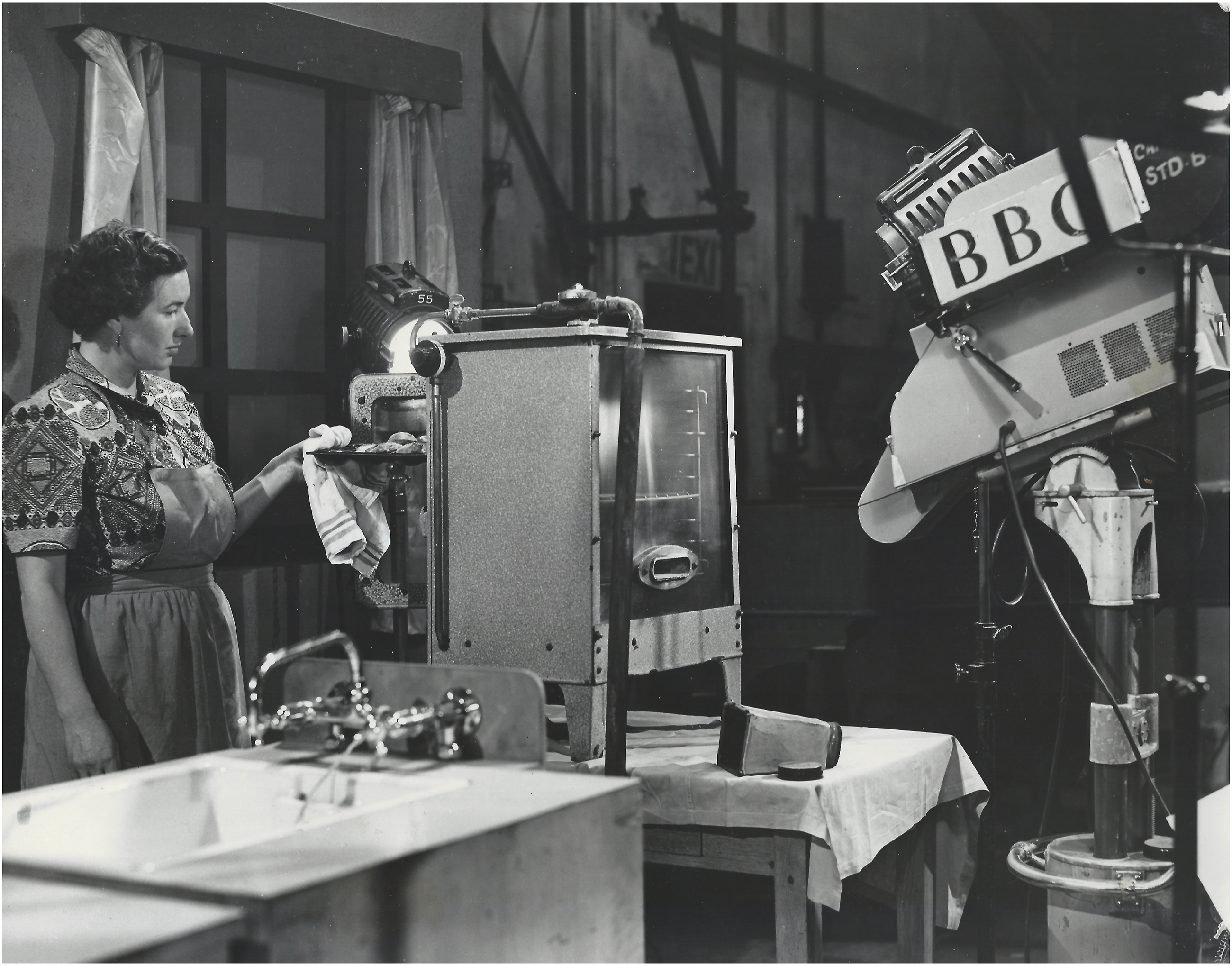
Conclusion
When Robins died in 1994, her obituary made only a scant mention of her television career, describing her incorrectly as ‘the first television chef’ and more correctly as ‘an early television personality’ (The Times, 1994). The tribute instead focused on her substantial body of work ‘furthering the cause of women in industry’ which had earned her an OBE in 1972. Robins became the President of the National Council of Women, representing housewives and their families in areas such as clothing standards (County Times and Gazette, 1953), shopping improvements (Birmingham Post, 1962), education (Belfast Telegraph, 1976), world hunger (Coventry Evening Telegraph, 1962) and electoral reform (Harrow Observer, 1977).
Robins was, as her obituary noted, ‘unusual in her own generation’ for her work as an executive, campaigner and ‘early feminist’ (The Times, 1994). Her work on television was a major part of that but has been under-recognised and forgotten in the subsequent decades since her first BBC Television appearances in 1947. In this article, I have shown that Robins’ persona, her position within industry and her connections with external institutions and politics, were all able to give her, in her view, a unique insight into what housewives at home would be interested in seeing on broadcasts intended for them. She took these insights and transformed them into ideas for programmes connected to food to cookery which would perhaps be mistaken for more modern ideas of ‘food’ programmes on television. These ideas involved nutrition, diet, well-being, exercise, consumer affairs as well as new techniques for showing audiences at home how the process of ‘cooking’ happens. Robins’ ideas were not often appreciated by the management of the BBC themselves, who held different views on what should be included in programmes, the role of the female presenter and indeed how presenters such as Robins should be portrayed. This tension eventually led Robins to become disillusioned with television and broadcasting, focusing her efforts instead on other, successful, ways to influence policy and practice which affected ordinary households.
Footnotes
Declaration of conflicting interests
The author(s) declared no potential conflicts of interest with respect to the research, authorship, and/or publication of this article.
Funding
The author(s) received no financial support for the research, authorship, and/or publication of this article.
