



Abstract
This article presents a range of hitherto unheard women’s testimonies of their experiences working in the BBC Drama Plays department during the 1970s and 1980s. It incorporates the subjective interview testimony of nine women who all worked on BBC1’s prestigious strand of one-off dramas, Play for Today (1970-84) to reveal commonalities and differences in their gendered work experiences. This incorporates topics such as discrimination, pay, working conditions, emotional labour and trade unionism. There is attention to what made working for the BBC unique, compared to ITV or independent production companies. It is discerned that BBC women workers generally saw the BBC as a meritocracy, but also that some regret the decline in the strength of television trade unions, which they saw as leading to a situation of pervasive exploitation in television today.
Play for Today (1970-84) was widely perceived as the BBC’s main ‘flagship’ strand of one-off dramas. Shown immediately after the 9 o’clock news, it was known for bringing challenging dramas to audiences regularly exceeding five million (May, 2022). Women writers' contributions to Play for Today are only just being acknowledged (Ball, 2022). From March 2020 to November 2021, to further the aim of uncovering oral histories, I conducted interviews with 58 people, including 19 women, who worked on the strand. None of these women have had their testimonies published previously, except Tara Prem (Jackson, 2009; Ball, 2015). Women interviewed include those who worked behind-the-scenes as Production Assistants, Director’s Assistants or Assistant Floor Managers (AFM). These overlooked roles did not receive on-screen credits in the 1960s: for instance, Linda McCarthy and AFM Jackie Willows were crucial members of the team who made the celebrated Wednesday Play (the single drama strand that preceded Play for Today) Up the Junction (1965) but went uncredited. This under-crediting situation gradually improved from the mid-late 1970s.
Details of interviewees.
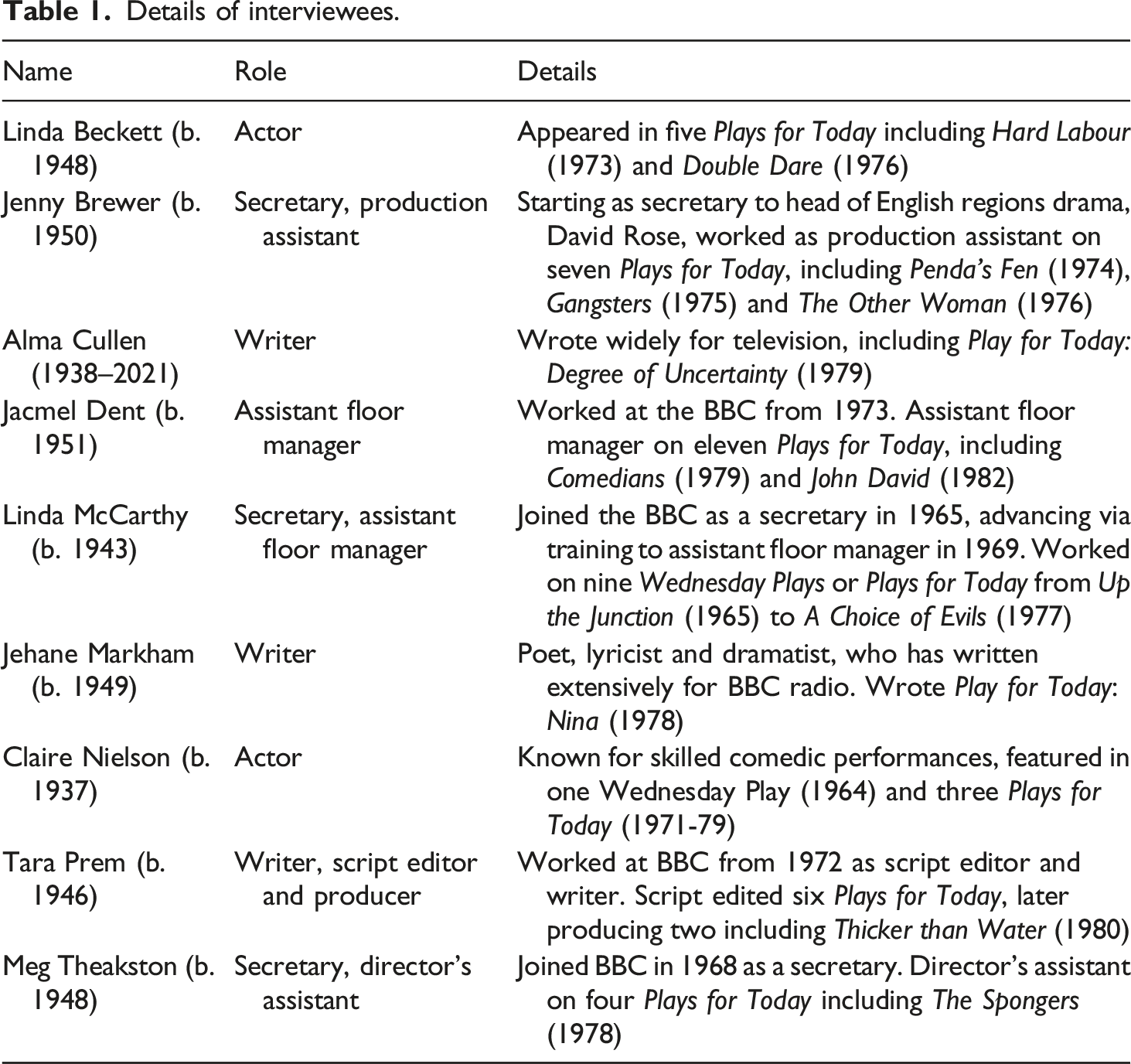
Oral history is used as a qualitative method in this media production research as uncovering living witnesses’ stories of economic, industrial and political changes they have lived through enables us to understand historical shifts within television and experiences of job roles (Banks, 2014: 546). Individual oral histories are useful as they can challenge ‘traditional sources [which] have often neglected the lives of women’ (Sangster, 1998: 87), offering an alternative which revises ‘received knowledge about them’ (Gluck and Patai, 1991: 2). The women’s voices articulate a range of sometimes clashing stories concerning historically contested events; this piece aims to relay, rather than deeply analyse, these voices. The article uses the approach that Gluck and Patai (1991) advocate: focusing on the women telling their own stories, to create research with women, rather than about women.
The BBC as a workplace for women
Interviewees variously raised incidents of sexual harassment, pay disparities and lack of childcare facilities that were indicative of a longstanding cultural problem with women at the BBC. In the early years of the BBC, certain women achieved renown doing incrementally graded salaried work, such as the powerful and autonomous radio drama producers Mary Hope Allen and Barbara Burnham (Murphy, 2016: 132–135). However, Allen and Burnham’s outlier success should not obscure the cost to the personal lives of women who advanced at the BBC. For example, in 1937 a complaint was made to Ariel, the BBC’s in-house magazine, about plans for a ‘marriage discouragement scheme’, highlighting institutional, sexism (Murphy, 2016: 108). Interviewee testimony reveals that the BBC of the 1970s and 1980s had not entirely assuaged these problems. For example, Jenny Brewer (2021) suggested: If you did get married, and if you were marrying someone from the BBC, you definitely had to leave. It was still like that in the 1970s. So, the reality is, if somebody married but then got pregnant they would have to leave. I hate to say it. So, those kind of things were discriminatory at that point. There was an expectation that you’d get married and you’d become a housewife. This practice was not unique to the BBC, it was reflective of the times.
Salaried BBC women did not feel sufficiently angry to protest, identifying not as ‘female workers with a shared grievance’ but with BBC men as crucial public servants (Murphy, 2016: 149–50). However, as Kate Murphy (2016) details, many BBC women workers were not equal, but grievances were averted through pay levels being secretive and trade union organising subtly discouraged.
In May 1973, the BBC put out a statement promising to improve its treatment of women employees and end job adverts tailored to one gender (ACTT, 1975: 42). However, the Association of Cinematograph and Television Technicians (ACTT) trade union’s landmark report, Patterns of Discrimination Against Women in the Film & Television Industries (1975), perceived that few concrete improvements had resulted, with power remaining in the hands of the male managerial class rather than being ceded to women workers (Bell, 2021: 181). The ACTT report, researched since 1973 by Sarah Benton, was presented to the union’s conference in spring 1975. This exhaustively empirical and emotionally affecting text documented a range of discriminatory practices pervasive in the film and television industries. Recommendations included extended maternity and paternity leave, expanded childcare facilities in every workplace where five or more employees wanted them and employees to be put on short attachments to grades of their own choosing (ACTT, 1975: 52). According to Suzanne Franks (2011) the BBC, in contrast to its relatively progressive early days, now lagged behind the civil service in gender equality terms. She details how the internal report Limitations to the Recruitment and Advancement of Women in the BBC (1973) revealed that no women were employed at Board or Controller level and documented BBC managers’ extensive ‘prejudiced and hostile’ attitudes to women workers (Franks, 2011: 127). By 1979, women still only fulfilled 7 per-cent of the BBC’s senior graded managerial roles (Murphy, 2016: 262–3).
The Labour government’s important mid-1970s legislation was a small advance set against women’s paltry representation in top jobs and the social context of everyday sexism. The BBC’s clubbable drinking culture, wherein ‘old boy’ cliques networked in the BBC Club bar, excluded women, and has been linked with habitual sexual harassment (Seaton, 2015; Sutherland, 2013). Interview testimony supports this. For example, Alma Cullen (2021) reports that while she did not actively recall experiencing overt discrimination personally, ‘I observed discrimination of course everywhere. In those days, men were always in powerful positions and women applying for jobs would be interviewed by a bank of 12 men sitting down. That would have intimidated me if I’d had to go for that kind of job.’ This culture in its wider manifestations was documented in the National Union of Journalists’ (NUJ) 1977 pamphlet, Images of Women, which emerged during a time when women trade unionists in ACTT forcefully argued for their union to campaign against media portrayal of women and workplace sexual harassment (Boston, 2015). ACTT followed the NUJ’s example in creating a code of practice advocating non-sexist language and imagery. However, the Trade Union Congress did little to tangibly address these issues, beyond publishing booklets with progressive rhetoric (Boston, 2015). Discussions during the ACTT Conference debate of the Patterns report were deliberately limited and the experimental workplace nursery opened at Pebble Mill in 1974 only lasted 1 year. By the time of the ACTT’s first Women’s Conference in 1981, little had changed since Patterns (Galt, 2020; Murphy, 2016). While there were some improvements from the 1980s on, patterns of BBC women workers being sexually harassed and discriminated against in terms of pay and childcare facilities persisted throughout the 1970s (Franks, 2011; Seaton, 2015).
Representation, discrimination and sexual harassment
Interviewees referenced specific incidences of workplace discrimination in the BBC as part of their work there. Linda Beckett (2021), for instance, echoes the NUJ’s claims about limited and sexist representation of women on-screen: Well, just an obvious generalisation: there were better parts for men than there were for women. There were more parts for men than women. Women tended to be the wife, the friend, never the protagonist. I was cast as a prostitute or some secretary, because that’s how they were written and most of the plays were written by men, with male directors and producers. But, I was grateful to play the prostitutes, the less than moral characters. It was a challenge, it was great, a lot of fun. At the time I didn’t ever think: oh, this is always how you’re perceived as a woman. Looking back now, you can see how women were portrayed, but then, I just was glad to get work. However, I enjoyed playing a middle-class feminist [in Janey Preger’s Play for Today: Under the Skin (1982)]. I was involved in talking to other feminists around me, but I didn’t specifically go out and research a feminist group because it was around us all. A lot of actors naturally thought that women were betrayed or the image of women wasn’t satisfactory. I prepared [for the part] by trying to get into the head of someone who’s quite intellectual: thinking rather than understanding the emotions as well, and [who] was a bit over-intense and too serious really about it all. So, I suppose that’s where I prepared more […] being middle class and doing an RP accent. I remember laughing at this character and thinking: oh dear, for goodness sake, do give it a rest! Not that the subject matter was wrong in my eyes, it was just that she was too in her head, really, rather than what real life is like.
Behind-the-camera workers, by contrast, recall the presence of strong women within powerful positions in the BBC, often perceiving their own advances within the Corporation in meritocratic terms. When asked whether, in her own experience and observation, she would describe the BBC she knew as male-dominated and discriminatory or whether she perceived barriers to women progressing within the organisation, Meg Theakston (2021a) said: I wasn’t aware of it really because I worked with women who had made it. There were powerful women like Monica Sims, Biddy Baxter, Ann Kirch… Anne Head and Margaret Matheson were very talented Drama producers. There was a female Head of Make-Up as well. I think if you had it you could make it. The BBC in those days was probably ahead of its time. Now, you could well say that men in suits were heads of department mostly and I can’t argue with that. There wasn’t anything that worried me. If you were good at your job... That I could join as a Secretary and work my way up from that position, it was so much more open then. Now, if you haven’t got a university degree, I may be wrong, but you wouldn’t probably get in at the bottom like I did.
Brewer reveals that discrimination increased as she climbed the hierarchy and illuminates some of the unspoken restrictions that women faced: In BBC drama, there were good, strong female production managers which was not normally a female role, and people like Tara Prem. So to a large extent, there were women around the department that you could see had worked their way up. At Pebble Mill, we had a female Head of Design, Margaret Peacock, as well as women as Head of Costume and Head of Make-Up. You might say well you would, wouldn’t you? But, actually, we had three strong females who for years ran those departments. Plus, in Costume, the bulk of the designers were female, in Make-Up they were all women, and in terms of scenic Design, in the early 1970s, it was half and half. If you wanted it, there was an opportunity. So, I never felt any particular discrimination. I started off in what was conventionally a female role as Secretary to the Head of Department, then moved to Production Secretary, Production Assistant and ended up Line Producer. I then moved away from drama to become Head of Planning in BBC Resources from 1990 to 1992 and that was quite different. Dealing with my fellow senior managers there, I did experience some discrimination. They found it challenging having a woman as their equal. I know there are friends of mine who were working outside of Drama who felt they’d come in to work at the BBC in what was seen as a traditionally female role. They could see that there was a structure that, if you wanted to, you could work your way up, but, for some reason, they didn’t quite have the confidence to think: oh, I might have a go at that. I think, in those days, when you applied for a job your current boss had to sign off the application form. So, some women felt not quite brave enough or thought that their boss hadn’t encouraged them. When I joined in the late 1960s, we couldn’t wear trousers to work and we had occasional inspections on our clothing. Extraordinary when you think about it now!
Claire Nielson (2021a) specifically identifies patriarchal biases and sexual harassment that had been illuminated by the Limitations (1973) and Patterns (1975) reports: Yes, I experienced a great deal of discrimination and gender bias at that time. I found out, afterwards, that I was paid less than half what my male counterparts earned. Directors could suddenly on a whim change rehearsal times, not giving a thought to actresses with children and their painstaking arrangements for childcare. There was also a lot of bullying and unwanted sexual advances for women actors to suffer – usually silently – for fear of losing their livelihood.
Her fellow actor Beckett notes that working in television compared favourably with theatre, where sexual harassment was rife: There were, occasionally, casting couch scenarios. I remember going for auditions for a theatre and being compromised within the interview, like if you play ball with me you might get a part, and I just walked out the door. I remember being compromised with other actors coming into my dressing room, suggesting things, and being very uncomfortable about that, so I did come across that from time to time. But on the whole, working in television, I don’t ever remember feeling less respected as a woman. I hear horrendous stories of other women but for some reason I didn’t feel that. I just remember loving working. There’s more time in theatre rehearsal, more time to get to know people. If you’re on tour or backstage you’re with those actors all the time, you can’t get out of the situation as easily. Whereas, on television, you’re in and out, really. I have had someone come into my dressing room when I was on television but it was another actor. When I say coming in I mean for a motive, you know [laughs]. But that didn’t happen very often. So, working in television you were less likely, in my experience, to be compromised. And I don’t remember being bullied by a television director or anything, no. The BBC particularly was very respectful back then, in all sorts of ways. In fact if anything, it’s got worse in terms of treating you as a human being. In film and television, as an actor, you’re treated with less respect I think nowadays, strangely enough.
BBC workplace experiences, ITV and trade unions
The following section situates such competing discourses of meritocracy and discrimination within discussion of BBC staff’s workplaces and how BBC pay and the BBC’s identity as an organisation differed from that of ITV. BBC women workers’ varied attitudes towards, and engagement with, trade unionism show their divergent responses to workplace inequalities. The BBC workplace’s social spaces could feel intensely gendered. Jehane Markham (2021) and Jacmel Dent (2021b), who worked on productions at the BBC’s Television Centre, recall the atmosphere of the BBC Club – where Theakston (2021b) claims ‘liquid lunches’ were regular – as intensely masculine and distinctly unwelcoming to women. Indeed, Markham claims that this ‘drinking culture’ partly convinced her against pursuing a career in writing for television beyond Play for Today: Nina. Interviewees’ descriptions of these workplace experiences bear out the Patterns findings: women faced unfair work conditions and pay at the BBC, despite many behind-the-scenes women workers carrying out skilled – and undervalued – emotional labour. Forthright and divergent accounts of experiences of television trade unions indicate that one union was guilty of patriarchal bullying, but also that, indirectly, some women workers’ lack of involvement in industrial struggles may have enabled inequalities to persist.
Melanie Bell (2021) argues that women film workers, in their discreetness, interpersonal communication skills and abilities to organise, solve difficult situations and express non-confrontational disagreement, made a major unsung contribution to creative filmmaking. Theakston’s (2021b) testimony suggests these were also skills required by women working at the BBC. Responding to questions about times in her BBC career when she showed resourcefulness or demonstrated problem-solving, Theakston explains: One was on constant alert to avoid or smooth over any potential problems or embarrassments [among] colleagues and cast. I often helped artistes learn lines, not all of them find it easy. Once, I was working on a Stephen Frears play and the lead actor, who went on to television stardom, just could not learn his lines. We were filming in a flat in Clapham and I had to neglect my duty and retire to a bedroom off set to help him with his lines for the next set up. There were some perks to the job!
Theakston (2021b) recalls incidences where she performed emotional labour, using her mediating skills to ensure that television dramas like Plays for Today were made on time and on budget: I tried to display tact and diplomacy on a daily basis – directors would not want you to work with them if you had the reputation of behaving differently. I am not being humble when I say that I had the reputation of being able to ‘handle’ difficult directors – there were others doing the same job as me who were more outspoken, shall we say. I do remember one director throwing pens and pencils around the gallery when losing his temper, having been told that there were no ‘two, four, sixes’ on our studio floor – blocks upon which furniture, etc., can be stood to raise them to a suitable height for a shot. He shouted: “A studio without two, four, sixes is like a house with no salt!”
A useful measure of the BBC as a workplace for women is to compare it with the institution’s major competitor in the 1970s and 1980s, ITV’s network of regional television companies. When asked what the BBC was like as a place to work compared with ITV, Beckett extolls the BBC’s values, which were underpinned by collective endeavour: I’ve always preferred working with the BBC, for good or bad. They always paid worse, much worse. I always feel, at the BBC, it’s teamwork and everybody seems considerate of everybody else. I’ve always thought of it as being a joy. I don’t know what it’s like now because I haven’t worked with the BBC for a while. It’s only my perception as a performer, but with the commercial companies I felt money was very much more a consideration. Which is odd because the BBC didn’t have as much money. But I thought the BBC [made] quality stuff, with less money than some of the commercial companies did.
Cullen echoes Beckett’s articulation of the BBC’s distinctive identity: I was largely educated by the BBC, which went through a golden period in the 1950s and 60s, with radio and television productions of every major drama in the general repertory, [including] American and European. [Working on ITV’s] Inspector Morse was extremely well-paid and you were trusted to get on with it.
While exalting Play for Today as high-quality drama, Nielson (2021a) is nuanced about her experiences with ITV and does not regret the passing of an era where there was snobbery against commercial broadcasting. Upstairs, Downstairs (1971–75) was very well-produced and directed. I very much enjoyed playing the suffragette character who influenced Elizabeth (Nicola Pagett). The other ITV programmes I was in [like Thriller, 1973–76] were more economically produced, more run of the mill and not at all in the same rank as Play for Today. Would you believe, in those early days of ITV, actors who appeared in actual TV commercials were often looked down upon? So much has changed and sometimes for the better.
Tara Prem (2021b) sees the BBC in the 1970s and 1980s as comparing well to its rivals and as a creative oasis compared with certain commercially-run independent companies: At the BBC, I was happy to have the job and loved the work, so did not question the pay. I was never employed directly by ITV or Channel 4, but worked for both as an independent producer. The worst employer was [an early independent company]; I was hired on a contract to produce three shows they had negotiated to produce. They were driven by profit, paid badly and generally behaved appallingly.
Dent (2021b) strongly echoes Nielson and Prem’s claims of the BBC’s distinctiveness and diverse drama output in the Play for Today era, and criticises ITV’s commercialism: I and many of my colleagues preferred to work for the BBC as there wasn’t the same variety of drama programmes at ITV and my feeling was that BBC drama productions were always of a higher quality than those of ITV, at least then. I have never been able to tolerate adverts – I see them as a form of bullying – and having to chop up drama productions to fit advert slots has always seemed sacrilegious to me! Those whose motives were monetary often left to be freelance or work for ITV.
Relevant to the question of working at the BBC by comparison to the ITV companies is the matter of unionisation. While actors were, straightforwardly, members of Equity, permanent behind-the-scenes BBC staff tended to be members of the in-house Association of Broadcasting and Allied Staff (ABS) union; any who also worked at ITV would have been members of the ACTT, which operated a closed-shop there. It has been noted (Chanan, 1980: 122) that members of the ACTT perceived themselves as ‘industrial workers’ in contrast to members of the BBC’s trade union the ABS, who saw themselves more as public servants, above the practice of making commodities. The BBC has been seen as a ‘QUANGO’ and a ‘social-industrial complex’ with those at the top feeling responsible for retaining a ‘moral order’ (Burns, 1977). While Heather Sutherland’s oral history interviewees recall male chauvinism and sexual harassment when they worked in the Light Entertainment division, they also spoke highly of their largely male colleagues due to their ‘pride in the BBC’s public service identity and position in society at the time’, especially compared to commercial competitors (Sutherland, 2013: 660). This self-perception of fulfilling an educational calling, or as being meritocrats doing higher ‘quality’ work at the BBC, could lead to many of its workers accepting lower pay than at ITV. For example, Dent (2021b) notes the ‘considerable’ pay disparity between the BBC and ITV; Nielson (2021b) claims that ITV ‘paid on average three times what the BBC could afford, so a job with ITV often financed actors to be able to pick and choose more.’ In April 1973 to March 1974, ACTT members who worked at the BBC and ITV had vastly different levels of pay according to their gender. While 46 per-cent of male employees earned £3000 or higher annually, only 18 per-cent of women did likewise (ACTT, 1975: 57). Asked about BBC pay and working conditions, Theakston (2021b) claims that ‘I did work overtime and it was paid. However, my monthly pay came to less than what I get for a pension every week now.’
In accord with accounts of the ACTT union paying lip service to gender equality, but ultimately defending male privileges (Galt, 2020), Prem (2021a) tells of a less positive experience of trade unionism: I was a member of Equity because I was an actress. At the BBC you didn’t have to be a member of anything. In my early days as an independent producer, I became a freelance ACTT member. But, working on an adaptation for Channel 4 of Dario Fo’s play The Accidental Death of an Anarchist (1983), I was blacked and, you know, made an example of. When the freelance ACTT people found out that I was going to take the money from Channel 4 and plough it straight back into a commercial company, they got very upset and decided that they would blacklist me. So, like a lamb to the slaughter I went in to see Alan Sapper and his henchman Bob Hamilton at the ACTT headquarters in Soho Square. I have never been bullied or frightened. I wasn’t expecting it, I was on my own. The pair of them sat there and said, you will never, never work again.
Union membership and activity was varied in the below-the-line workers interviewed. Linda McCarthy was a member of ABS, but Brewer (2021) explained that she ‘was never a member of a trade union’ and how, later as a senior manager she was ‘required, with others, to manage the consequences of any strike action but not as a union member.’ Theakston (2021a) recalls some union action at the BBC, but views it detachedly: I was a member of the ABS which later merged with the ACTT. There was a lady who was their shop steward, Jenny MacArthur, and she was very combative and passionate in representing her colleagues. I was in Drama Plays department during a PA strike in 1976. I didn’t ever call on the union for assistance, though. When asked whether she thought the ABS was a forceful, effective union at that time, Theakston (2021a) seems representative of a wider passivity among ABS members: I suppose, yes. I wasn’t a keen union member, I didn’t put myself up for any sort of position within the union or anything like that. Jenny MacArthur was the only person that I ever really knew that was union-orientated. I was aware of the union and it was thought to be a good thing. I paid my dues, but… I was surprised in my diary to see that I went to a union meeting.
While Prem and Brewer never recall going on strike, Brewer mentions that ‘working in Drama there were occasional strikes and, [in 1974], I remember one affecting [Play for Today:] Gangsters.’ Likewise, when asked, Theakston (2021a) explained that she never went on strike: Oh no, no, no. There was a strike by the PAs in 1976. I just remember that they picketed the gates. It was emotional and sad because they were our friends, but I don’t honestly remember a lot about it. I wasn’t a political person at all in those days.
McCarthy has a different perspective on the PAs' dispute: We did come out on strike once as PAs didn’t get overtime. You could work your socks off and you didn’t get any extra pay. It was very bad. And we were all very behind [the strike action]. I think it was about eight weeks and it was jolly difficult financially. There was a [hardship] fund that helped people. A lot of us just had to use our savings. But it meant something, we didn’t just do it. With better management, things could have been sorted out before they got to that stage. But anyway, I’ve never been a political animal.
When asked whether the trade unions in television in the 1970s and 1980s were over-powerful or simply stood up for their members very effectively, McCarthy (2021) supports the latter view: ‘I don’t remember anything big. But when it came to the PA strike, at least [ABS trade unionists] tried getting money to people who needed it and kept it well-organised.’
Echoing arguments about the erosion of women’s structural gains in the 1990s (Galt, 2020), Beckett advances a view that unions have had insufficient clout: Well, I don’t recall these troubles specifically. On the whole, I don’t think unions have been too strong. If anything I think unions haven’t been strong enough, really. Certainly, Equity hasn’t been strong enough at all. They were perhaps too frightened of their members. So, no, I don’t think they were too strong.
Despite her own negative personal experience in 1983, Prem (2021a) feels that workers’ rights have since been curbed excessively: After experiencing this terrible, powerful [sighs] iron rod that [the ACTT] wielded, the other result of having all these independents is that the trade unions lost all their power totally, so now everyone’s exploited dreadfully. I think it is probably true that a lot of unions [overly abused their power]. That’s the reason that Margaret Thatcher wanted to break them, but she succeeded in breaking them so that people are now completely unrepresented. We’ve gone from one extreme to the other. A lot of people have to work very hard, in often difficult circumstances for little and sometimes no money.
Interviewees had notably varied attitudes towards trade unionism and delineated a range of diverse experiences of membership. Women actors and writers felt very well represented as members of Equity and the WGGB and articulated the tangible benefits (Beckett, 2021; Cullen, 2021; Nielson, 2021a). However, below-the-line women workers interviewed tell of how the BBC’s ABS union’s membership was more passive, with the 1976 PAs' strike a partial exception. Notably, some women ABS members who either attended a meeting or went on strike express a shared aversion to seeing themselves as ‘political’, which accords both with ABS’s moderate reputation and the BBC’s self-image as being ‘balanced’ and above the political fray. In contrast, women writers and actors were part of union cultures more conducive to the ‘separate self-organisation’ that ACTT women activists pioneered in the 1970s and 1980s (Galt, 2020). Even though some of these gains were reversed in the 1990s, current BBC worker Dent (2021a) attests to the vastly more equal standing women have in the workplace today compared with when she started work at the BBC nearly 50 years ago.
Conclusions
These nine women’s accounts give a sense of the BBC as an imperfect organisation mired in unconscious discrimination, a masculine culture and managerial failures to encourage women towards promotion. While she avoided using polemical language concerning unfairness, a below-the-line worker like Theakston gives a detailed account of her undervalued emotional labour, which was vital in creating highly lauded BBC dramas for strands such as Play for Today. However, despite some incidences of sexual harassment and lack of childcare provision, the women generally felt that most fellow BBC workers treated them respectfully. They perceived a deep sense of ‘teamwork’ existing among staff proud to work in making what they perceived as ‘quality’ drama, despite low pay.
These BBC women’s mixed levels of enthusiasm for trade unionism reflect key societal divides. Some among them expressed their moderate levels of engagement with trade unionism, seemingly identifying strongly with their employer the BBC, seeing it as nurturing meritocracy. They may have internalised much of the Corporation’s ‘balanced’, non-political self-image. Others, including actors and writers, felt far more warmly towards trade unionism, perceiving its tangible benefits to their working lives. This group, alongside a producer who once experienced bullying from trade union bosses, regret the decline in trade union power and collective solidarity and feel that today’s television industry suffers as a result.
Footnotes
Acknowledgements
The author extends warm thanks to Bela Arora, Romi Arora, Linda Beckett, Jenny Brewer, Chrissie Cocks, Jacmel Dent, Marcella Evaristi, Janette Foggo, Ashi Forrester, Jemima Laing, Nemone Lethbridge, Linda McCarthy, Jehane Markham, Margaret Matheson, Claire Nielson, Tara Prem, Meg Theakston and Jane Wood. The author also thanks Vicky Ball and Sarah Ralph for advice in contacting interviewees, Hannah Andrews and Sarah Arnold for editorial input, and two anonymous reviewers for their suggestions. Special thanks also to interviewees for giving their consent for their words to be published and to Juliette Jones for transcribing all interviews used in this article and for advice on the article’s structure.
Author’s note
This article is dedicated to the memory of Alma Cullen, who died on 7 August 2021.
Declaration of conflicting interests
The author(s) declared no potential conflicts of interest with respect to the research, authorship, and/or publication of this article.
Funding
The author(s) received no financial support for the research, authorship, and/or publication of this article.

Author biography
Tom May is a Post-Graduate Researcher at Northumbria University. He is nearing completion of his PhD thesis, ‘A history and analysis of Play for Today (BBC1, 1970-84)’. He has previously taught a range of A Levels at Newcastle Sixth Form College from 2006–2018 and has recently taught on Northumbria’s Media, Mass Communications and Journalism degree programmes.