



Abstract
This article explores the ‘youthification’ of television through real-time storytelling. It draws on a study of the online youth drama blank (2018–2019), NRK’s first follow-up after the hit show SKAM (2015–2017). It finds that real-time drama brings unique opportunities to broadcasters aiming to reconnect with younger audiences, but also substantial challenges. This insight is essential, as previous studies have highlighted the format’s advantages while downplaying its problems and dilemmas. Furthermore, the article emphasises the continuous need for innovation in youth storytelling, especially at public service broadcasters with the mandate and ability to do so.
Introduction
For television producers aiming to reconnect with younger audiences, online drama published in real time has become an attractive new format. This is especially true for the Nordic countries, where several successful real-time online drama series have already been developed and produced. Best known is SKAM (2015–2017), produced by the Norwegian public service broadcaster NRK to attract young girls who were thought to be otherwise disinterested in material produced by the broadcaster. During its four seasons, SKAM transformed itself from a ‘secret’ online teen drama into a global cult phenomenon with viewers and fans in all age groups and across all continents (Sundet, 2020), cementing its status as a ‘best-case’ example of engaging youth content in the television industry (Davison et al., 2020; EBU, 2020). What is more SKAM has been remade in several European countries and the United States, where it was distributed as the ‘first Facebook Watch TV show’ (Donadio, 2016; Max, 2018). Following SKAM’s success, both NRK and other broadcasters have produced new real-time online drama series. Characteristic of these successors is their ambition to take best practice and the lessons of SKAM and translate them into new youth hit shows. In short, playing with time and platforms has become an essential strategy for many drama producers trying to reintroduce a sense of ‘liveness’ and ‘realness’ into a rapidly changing television landscape.
This article engages with this ‘youthification’ of television drama through real-time online storytelling. The term ‘youthification’ has a double meaning here. First, it refers to the strategic focus that television producers, executives and decision-makers bring to the production of youth content in the interest of answering the ‘youth challenge’ (Andersen and Sundet, 2019: 2) or ‘missing audience’ problem (Davison et al., 2020: 6). Studies have already demonstrated that the media lives of young people today are largely dominated by media platforms which are at once global and digital (Cunningham and Craig, 2019; Davison et al., 2020; Sandvik et al., 2020), meaning that national mass media and linear-flow television are being left behind. Notions such as the ‘lost generations’ signal the fact that the legacy media perceive reengagement with youth audiences as core to their future legitimacy and possibly existence (Lowe and Maijanen, 2019). In this context, real-time online drama represents a form of salvation.
Second, ‘youthification’ refers to the way in which producers, scholars and audience members conceptually make sense of television as an always-changing medium that must, to stay relevant, perpetually ‘youthify’ itself – through innovation involving genres, formats, platforms, storytelling techniques and distribution models. For instance, Benjamim Burroughs (2019) and Chuck Tryon (2015) both show how new streaming platforms – and Netflix in particular – actively rebrand themselves and the activity of streaming television as something other and ‘better’ than watching linear-flow television, indicating the useful elasticity of television as a medium (see also Johnson, 2019). This use of the term ‘youthification’ taps into the more extensive sociocultural debate about the future of television (Katz and Scannell, 2009; Spigel and Olsson, 2004) – one often linked to utopian and dystopian scenarios. For instance, the accelerated evolution from cable television to streaming has led Amanda Lotz (2020) to talk about the ‘future of televisions’ rather than the ‘future of television’ (see also Jenner, 2018; Lotz, 2018). In the present article, ‘youthification’ therefore represents a central reference point for addressing current changes within the television industry and, more precisely, within online youth drama productions.
This article’s argument draws on an in-depth production study of blank (2018–2019), NRK’s first successor after the hit show, SKAM. Both productions followed the same real-time online drama format initially developed by NRK to target young girls, in which small production teams with an exceptionally experimental approach to storytelling produced online drama on tiny budgets (Sundet, 2021). The format relies on extensive audience research to gain in-depth information about its target niche group and identify ways in which these series can serve its needs (Magnus, 2016). The storyline is published daily and in real time on a blog through a mix of video clips, chat messages and pictures. On the blog, the audience is invited to engage using the comment section following every update. The format’s real-time publishing means that the time and date in the series follow the audience’s own schedule, making the publishing rhythm irregular and unpredictable and thereby generating a sense of authenticity and ‘liveness’ (Sundet, 2020; see also Krüger and Rustad, 2019).
Two research questions guide this article: first, which insights did NRK gain from its hit show SKAM and how did the lessons learnt inform the production of blank? Second, what can these digital-first, youth-targeted productions teach us about the legacy of hit shows and the ‘youthification’ of television? In response to these questions the article aims to address how recent trends within the industry are impacting the production and publishing of youth television and the role of real-time drama in that context. It explicitly relates to the theme of this journal’s special issue by engaging with the impact of a new format for young audiences upon storytelling across platforms and screens and, more generally, by looking at what television studies can learn from productions aiming to ‘youthify’ television-screen cultures.
This article combines perspectives from production studies (Banks et al., 2015; Caldwell, 2008; Mayer et al., 2009) with various scholarly approaches to television’s digital transformations (Bruun, 2020; Jenner, 2018; Johnson, 2019; Lotz, 2018). Production studies provide a general framework for analysing television production cultures based on the fundamental assumption that these contexts inform media products (Banks, 2014: 120) – namely, blank is most productively analysed as both a public service production and a successor of a hit show. Scholarship on digital transformations offers an in-depth focus on change and innovation within television production cultures, thus framing the discussion according to more overarching debates on continuity and change within the larger field of television studies (Johnson, 2019; Lotz, 2018). In the case of blank, the ascent of both streaming and social media represented the digital transformation which was most important to its viability. In sum, the combined approach of the present article seeks to unpack the ‘youthification’ of television drama in both a practical and a theoretical sense.
‘Youthification’ through youth productions?
Surprisingly few studies address the production of youth television, though a substantial body of work exists on the production of children’s television (Potter, 2020; Seiter, 1993; Steemers, 2010) and youth media more broadly (boyd, 2014; Davison et al., 2020; Pires et al., 2019; Wee, 2017). Studies of youth television are typically positioned according to a commercial US perspective (Ross and Stein, 2008b) or a European public service one (Andersen, 2019; Davis and Dickinson, 2004; Lury, 2001; Woods, 2016), or they tend to focus on popular youth programmes such as Buffy the Vampire Slayer (1997–2003), Gilmore Girls (2000–2007), Dawson’s Creek (1998–2003) and SKAM. According to Sharon Maire Ross and Louisa Ellen Stein, there is a ‘significant dearth of work on Teen TV’ (2008a: 11) – one perhaps reflecting the abiding industry perception that youths are not watching television but spending time instead online.
Despite the lack of scholarly interest, existing studies have managed to highlight two key aspects of youth television. First, many studies find that youth alone seldom consume youth productions, instead emphasising that older age groups also find pleasure in consuming shows that allow them to return to youth storylines (Owen, 1999; see also Harrington and Bielby, 2010). Studies of SKAM fans confirm this aspect, as many middle-aged fans describe how the show allowed them to revisit feelings from their own youths (Petersen and Sundet, 2019; Sundet and Petersen, 2020). Of course, young people are also represented on television outside of the televisual spaces labelled (or overtly branded) as ‘youth’ (Ross and Stein, 2008a: 5). Furthermore, many of the television shows reaching the highest number of youths are not ‘youth television’ at all but international drama series, larger sport and entertainment programmes and examples of ‘event media’ (Kjus, 2009). A commercial (and analytical) category of youth television made by, with or for youth is nevertheless essential, as it highlights the ambitions of these shows and the domain to which they belong (Davison et al., 2020: 7). This category is particularly important to public service broadcasters with specific obligations towards serving the entire population and providing offerings of relevance to every social segment and age group, including youth. As I will discuss further below, ‘youth ownership’ was crucial to both blank and SKAM, as is demonstrated by the enormous reliance on audience research with young people ahead of production and, in particular, the shows’ ‘word-of-mouth’ promotional strategy (Faldalen, 2016).
Second, many studies find that the industry’s strategic focus on youth productions often connects to new technologies and innovation, interlinking the ambition of serving youths with the professional interest in exploring new ways of telling stories (Andersen, 2019; Lury, 2001; Woods, 2016, 2017). Television productions aimed at younger audiences tend to involve new media platforms, publishing models and storytelling techniques, reflecting the industry perception that digital and specifically social media serve tech-savvy young people (Krüger and Rustad, 2019; see also Andersen and Sundet, 2019). Many public service broadcasters echo this sentiment by stressing the necessity of following the audience onto new platforms to serve it (Moe, 2009). Previous studies on SKAM substantiate this imperative by focusing on how the show reflects teens’ ‘always-on’ reception mode in a media-saturated society (Duggan, 2020; Krüger and Rustad, 2019; Lindtner and Dahl, 2019; Sundet, 2020). Relatedly, one of the key selling points of the SKAM remakes was the original show’s ability to transition audiences from linear to online viewing modes (Sundet, 2021). What is more, television executives tend to pay close attention to young people’s preferences and behaviours, as mentioned earlier, reflecting a perception of youth behaviour as an indicator of future consumption patterns (Davison et al., 2020; Sandvik et al., 2020). Consequently, studies clearly indicate that youth productions represent a nexus of the challenges facing broadcasters in a changing television landscape (Andersen, 2019; Woods, 2016) – in particular, the quest for innovation and ‘newness’ often coincides with the need for cost efficiency, cuts and savings (Woods, 2017). This means that youth productions are often branded as innovative yet produced on diminutive budgets by small production teams. This situation leads us directly to the real-time online format analysed in this article.
Case and method: A production study of blank
The online drama blank was produced by NRK as its first successor following the hit show SKAM. Many of the blank team had also worked on SKAM, indicating the two shows’ interlinked relationship from the start. Both productions built on the same real-time online drama format but introduced different characters and fictional universes. Like SKAM, blank was a coming-of-age show following a cast of young characters as they navigated their way through life. Each season was centred on a different protagonist from the first-person point of view: Ella (Cecilie Amlie Conesa) in season 1, Zehra (Ayyüce Kozanli) in season 2, and Markus (Alfred Ekker Strande) in season 3. In telling its storyline, blank (like SKAM) mixed elements from drama and soap opera, but followed a more realistic and documentary aesthetic than SKAM, especially in its first season. The study of blank offers detailed insights into the production model of the real-time online drama format and especially the ways in which NRK translated its success with SKAM and attended to its legacy (see also Sundet, 2021).
Empirically, the study builds on observation of the blank production team from August 2017 to August 2018, a period which encompassed the pre-production, production and publication of its first season. It incorporates more than 150 hours of observation spread across more than 60 days, including strategic and weekly team meetings, activity in the writing and editing room, casting and on-set work. My approach was to ‘look over the shoulders’ of television workers to identify the interpretative and often taken-for-granted aspects of their practice (Caldwell, 2009). I had to negotiate access beforehand, but the production team was unusually open towards me as an outside researcher. For example, NRK granted my own admission card and gave me access to internal working documents and analytical tools. This generosity was particularly noteworthy given that blank was, again, the successor to SKAM and it faced high expectations from NRK, the public and the press.
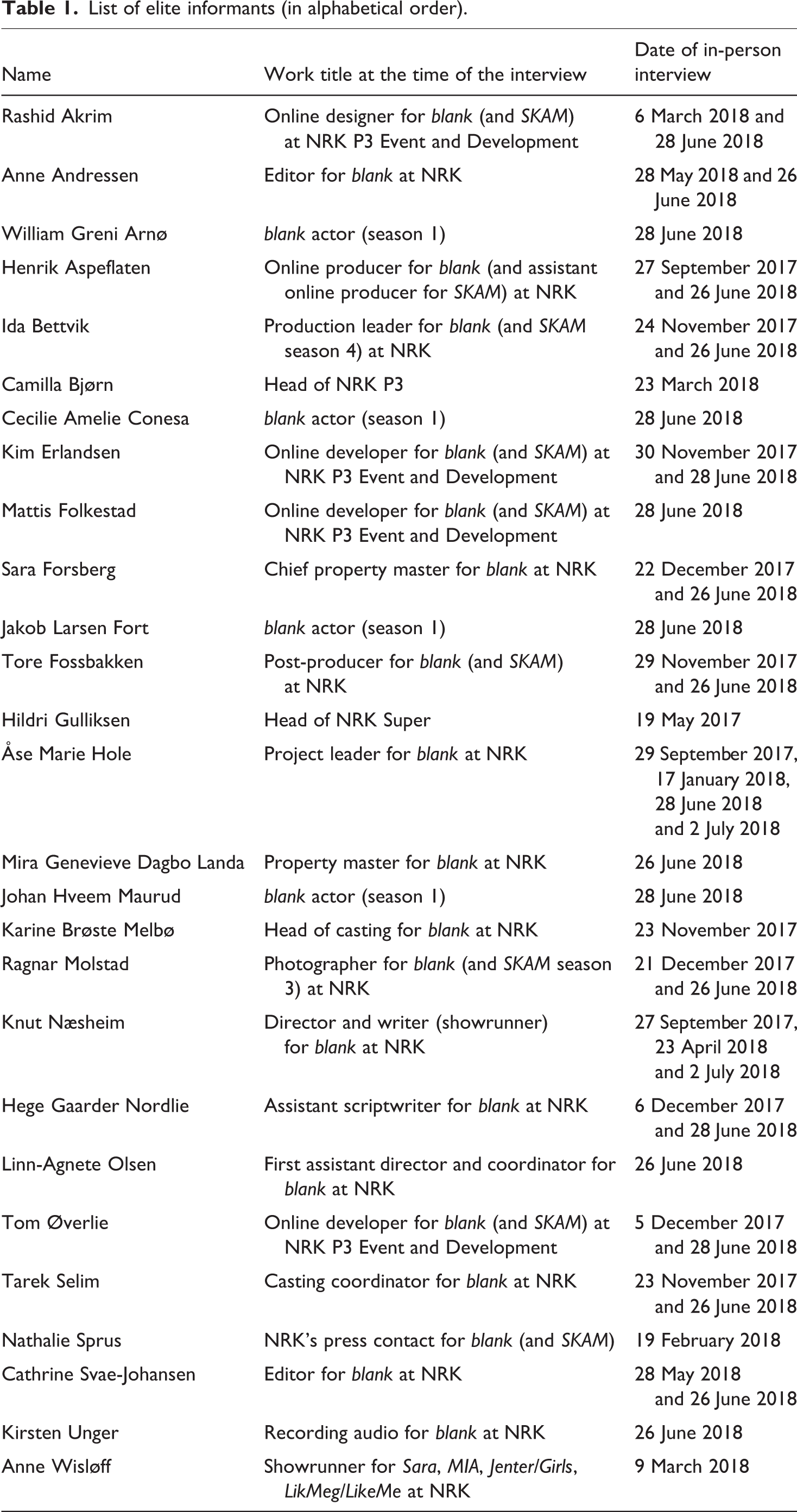
The study also builds on insights gained through interviews and discussions with the blank team members. Hanne Bruun (2016) labels such informants ‘exclusive’ because of their significant role and insight into the production under scrutiny. I interviewed everyone on the production team and some of the actors, many more than once (see Table 1). The interviews took place from autumn 2017 to spring 2018 – that is, before, during and after the airing of season 1. All of the interviews followed a similar semi-structured interview guide and included questions about work tasks and practices, the opportunities and challenges of the real-time drama format, and the lessons learned from SKAM. Even aside from the last topic, informants repeatedly brought up SKAM in both meetings and discussions, reflecting the many ways in which it guided the blank team. All of the interviews were transcribed and analysed thematically, with particular weight given to the informants’ ‘self-reflexivity’ (Caldwell, 2009), or specific and unguided reflections on the critical choices and strategies involved.
List of elite informants (in alphabetical order).
Finally, the study relies on an analysis of the many text and artefacts surrounding blank, including internal working documents (manuscripts, guidelines, schedules, etc.), institutional documents (addressing missions and strategies), promotional materials, news articles and fan-created content. John T. Caldwell (2009) labels such sources ‘media artefacts and industry deep texts’ and considers them as crucial to understanding media production (see also Gray, 2010).
Producing real-time online drama
As mentioned, NRK produced blank as the first successor to the hit show SKAM, and both shows built on the real-time online drama format originally developed at NRK to provide daily fictional stories for young girls. The first real-time NRK drama series – Sara (2008–2009), MIA (2010–2012) and Jenter/Girls (2013–2017) – all proved incredibly popular with their niche audience but gained little attention beyond this group or in the media (Nyborg, 2012). SKAM was the first real-time drama to reach a larger audience and quickly became one of NRK’s biggest successes of all time (Sundet, 2020). In terms of audience numbers, SKAM had an average of more than one million viewers per episode (not including viewing on the blog) for each of its first three seasons, out of a total Norwegian population of only five million people (Sørensen, 2019). Ordinarily, NRK would initiate several successor series before ending such a hit, but the success – and conclusion – of SKAM happened so rapidly and unexpectedly that it took NRK somewhat by surprise. The show ran for only four seasons before it ended, presumably because its production model was exhausting, and the show became bigger than anyone involved had intended or planned for. Consequently, NRK found itself with little time to put together a new team and develop the concept for such a successor. The first initiatives regarding what would turn out to be blank took place in 2016 (Hole, personal communication, September 2017), but the show’s team did not enter pre-production until August 2017 – that is, shortly after SKAM had ended. Perhaps unsurprisingly, several SKAM members were involved in the new show as well. The first season of blank commenced in April 2018 without any official announcement (Reisjå, 2018), following SKAM’s ‘word-of-mouth’ promotion strategy.
According to informants, producing a real-time online drama format brings both opportunities and challenges, most of which were handled (and retrospectively framed) according to lessons learned from SKAM. Furthermore, these opportunities and challenges were usually interlinked in complex ways. In what follows, I will address four such opportunities/challenges related to the specific format’s use of ‘audience insights’ (a buzz word of the industry meaning insights into audiences’ lived experiences), online platforms, real-time publishing and dialogue with the audience. Underlying all four is the outspoken goal of wanting the format to be innovative. As one of the format’s founders explained: ‘Online drama has always been different and experimental’ (Wisløff, personal communication, March 2018).
The first opportunity/challenge is the format’s emphasis on identifying audience needs based on extensive research involving audience insights. The focus on audience insights is made possible by the format’s narrow target audiences – 12-year-old girls in Sara, MIA and Jenter, 16-year-old girls in SKAM and 19-year-olds girls and boys in blank – which allowed production teams to dig deep into a relatively specific segment, at least by media standards. Most real-time drama series follow the NABC (Needs, Approaches, Benefits, Competitors) model which NRK has used since the mid-2000s to identify audience needs when it has developed new programmes and concepts (Hedemann, 2014). This model asks for an interview with a representative of the target audience, but both SKAM and blank teams conducted many interviews to achieve the broadest possible picture. The desire was to acquire in-depth information about the target audience and use that knowledge to serve its needs in a relevant and realistic manner. The very idea of the online drama format, after all, was based on a single audience interview NRK conducted with a young Norwegian girl who expressed a desire for an ‘online best friend’ (Gulliksen, personal communication, May 2017). In turn, the initial real-time online drama series placed their storylines ‘so close to reality that [they] could be true’ (Nyborg, 2012; see also Magnus, 2016). One SKAM and blank team member observed: ‘People know it is a product we have made, but they become so attached that the story feels real’ (Øverlie, personal communication, December 2017).
The NABC model was critical to identifying audience needs in the pre-production phase but also dictated a ‘way of thinking’ throughout the production process. blank’s showrunner explained: ‘We try to think like the target audience group at every stage, in every choice’ (Næsheim, personal communication, September 2017). This focus on audience insights reflects informants’ faith in their show’s cultural proximity, yet it also exposes the belief that a younger audience will prioritise relevance over ‘conventional quality’ (Gulliksen, personal communication, May 2017). These productions even formulated ‘mission statements’ reflecting NRK’s overall ambition concerning ‘popular enlightenment’ (Sundet, 2020). blank’s mission statement reads as follows: Our aim is to give 19-year-olds strong and identifiable characters who overcome external and internal barriers to their own development and who dare to face rejection and rise after defeat. In doing so, we will help them take ownership of their own lives in a new and insecure period and show them how to welcome love. (Internal working document, 17 August 2017, my translation)
The second opportunity/challenge is related to the format as online drama which mixes video clips, chat messages and pictures to tell its stories. Many informants stressed that being online was crucial to reaching a youth audience, because it allowed them to ‘use the internet and social media premises to tell a story where youths are’ (Akrim, personal communication, March 2018). In particular, they saw ‘made-for-mobile’ television content as essential to reaching young people (Erlandsen, personal communication, November 2017). Similar sentiments characterised the media’s praise of SKAM, which they saw as serving the ‘social media generation’ (Hughes, 2016) and representing the ‘future of television’ (Bradley, 2016). Of course, the use of social media in the storytelling also constitutes an effective way to promote these shows, as it enables the team to drop clips about characters and their storylines directly into youths’ social media feeds (Max, 2018). In addition, several blank informants highlighted the flexibility of structuring the show online rather than according to a fixed schedule or number of episodes: ‘This is the way storytelling should be done; we should not have to fit an episode into a slot like a “straitjacket” – it can affect the quality of the storyline’ (Nordlie, personal communication, December 2017).
Nevertheless, online drama represented a distinct and difficult format to master – one with limited historical precedent on which to rely. Drawing a parallel to Hollywood’s golden age, blank’s producer asked rhetorically: ‘How long did it take to learn to write a Western? How many Western movies did you have to see before you could make one yourself?’ (Hole, personal communication, September 2017). Even informants with experience on SKAM stressed that the online format was difficult to produce. SKAM and blank also published their storylines both as daily online drama and as weekly episodes (made available on NRK’s TV Player and linear youth channel), meaning the production teams had to produce shows to suit both formats and carefully coordinate where exactly to tell what part of the story.
A third opportunity/challenge is the format’s real-time publishing model. This model means that the time and the date in the series follows the same for the audience, making the publishing rhythm irregular, unpredictable and (hopefully) addictive, as audiences had to look for updates frequently (Sundet, 2020). One informant explained: ‘In online drama you get small drops of content that make the show always stay with you’ (Øverlie, personal communication, December 2017). The model also generates a sense of authenticity and ‘liveness’ in the shared, synchronous experience of watching the characters’ lives. Lastly, in tandem with its reliance upon a main-character point of view, the model strengthens audience identification with the central protagonist, which, in turn, embeds the audience deeply into the story world (Jerslev, 2017; see also Sundet and Petersen, 2020). One informant summarised: ‘The main point of real-time drama is to get into the viewers’ lives in such a way that during the day they will stop and think, “Has there been a new clip yet?” and “I wonder how they are doing?”’ (Fossbakken, personal communication, November 2017). Another informant agreed: ‘I think it is as simple as the feeling that this is happening here and now with someone you care about’ (Erlandsen, personal communication, November 2017).
Of course, producing a drama in real time also had its downsides. For one thing, several informants pointed out, it was hard to force the storyline to deal with time as though it were actually real. blank’s assistant scriptwriter lamented: ‘I have never thought so much about form as now; how guiding form is for content. (…) I find so much content not fitting the real-time formula’ (Nordlie, personal communication, December 2017). The informants also noted that writing and producing content only weeks before it was published – by a small production team on a low budget – was hardly a sustainable production model: ‘The online drama formula is a formula for success, but it is also the opposite, because it is not a sustainable way to work. It requires us to be few [in number], but the fact that we are few makes it too much work for each person’ (Fossbakken, personal communication, November 2017). Many informants referred to SKAM as a production involving ‘high wear and tear’, and blank’s producer stated the explicit goal of making blank’s production model more sustainable (Hole, personal communication, September 2017). The hope was to be able to better weather unplanned events such as a strike or a sick actor when schedules were so tight, to relieve some of the constant pressure on the production team and to align with conditions such as seasonal change or current events.
The fourth opportunity/challenge with the format involves its dialogue with the audience. The format relies on the idea that audiences should not only watch, but also discuss the series to learn from the moral dilemmas they present, again reflecting a commitment to popular enlightenment. The target audience, for example, would become better prepared to overcome difficulties in their own lives by ‘working through’ (Ellis, 2000) the show’s realistic scenarios and debating what they saw with peers (Sundet, 2020). Sharing and discussing thoughts and emotions about the show clearly has had value for audiences – several studies of SKAM fans, for instance, demonstrate pleasure in debating SKAM with others (Bengtsson et al., 2018; Lindtner and Dahl, 2020; Sundet and Petersen, 2020). Audience feedback also had great value for the production teams. One informant explained: ‘If you are good enough, you have a continuous focus group talking to you, commenting on what you make and sharing it’ (Aspeflaten, personal communication, September 2017). Several informants remarked on how this means of storytelling fed on audience response, to the extent that the production team would sometimes join in a cat-and-mouse game with the audience, in that it would leave Easter eggs, clues and codes for the audience to solve and play with (Akrim, personal communication, March 2018; Erlandsen, personal communication, November 2017; Øverlie, personal communication, December 2017). Due to, again, these shows being written and produced only weeks before they were published, the teams could also adjust storylines based on audience feedback in real time. For example, they could use it to keep things unpredictable: ‘When everyone in the audience thinks something will happen, you do the opposite instead. If we had published everything in advance, we would lose the flexibility that audience feedback gives’ (Bettvik, personal communication, November 2017). This close relationship with the audience and fans was also viewed as a useful way to promote these series: ‘If they [the show’s fans] love you, they will do the promotional job for you’ (Øverlie, personal communication, December 2017).
Of course, entering into and sustaining a dialogue with the audience had downsides for both the production teams and the actors. To start with, keeping up with the audience was time consuming and could take attention away from other pressing issues. Besides, not everyone on the team was fond of getting direct feedback every day, especially when it contested their own gut feelings about the show’s plans: ‘I find it hard to balance how much we should change based on audience response and how much we should stick to what had been planned’ (Nordlie, personal communication, June 2018). Furthermore, reading audience responses was not always a pleasant experience, as the fan community could be critical and even hateful, both towards the show and towards each other (see also Gray, 2003). According to one informant, she had to take a break from moderating the comment section after her first week, ‘because my heart hurt reading it’: ‘It was not only because people were angry at us or the show, but also towards each other’ (Nordlie, personal communication, June 2018). For the young actors – most of them with little television experience because of the format’s call for ‘new and authentic’ faces – audience feedback could also be tiring and hard to handle. One played a character who immediately got a lot of criticism and hate in the comments section: At the beginning, it got to me; I was not prepared. I know he is a character I play, but since we are so alike, it was still a bit too close to home. When you have a character in a theatre or a film, you have a larger process building it further away from you. Here, it was a bit like, ‘oh’. (Arnø, actor in blank, personal communication, June 2018)
Going again: ‘Creative no-go areas’
In the previous section, I discussed the opportunities and challenges of real-time online drama using SKAM and blank as critical examples. In this section, I will engage blank as a successor to a hit show, and specifically how the blank production team balanced the stress of innovation with the need to follow a proven recipe for success.
Many informants saw that the opportunity to build on a great success ‘paved the way’ for an approach at NRK which benefited the blank production (Øverlie, personal communication, December 2017; Sprus, personal communication, February 2018). While SKAM had to fight to do things differently, blank needed only to follow in its footsteps. In addition, being SKAM’s successor meant that blank started with more resources and stability than other online drama productions, including a larger budget, an experienced production team and the green light for several seasons right from the start (Hole, personal communication, September 2017). It also meant that blank automatically had the attention of both the press and the audience.
Still, it was a burden for the production team members, in the sense that everything they did would be viewed through the lens of the earlier show’s successes. One informant said: ‘The problem is the viewer will constantly compare blank with SKAM’ (Øverlie, personal communication, December 2017). In fact, for some on the blank team, the overwhelming success of SKAM was almost a reason not to take part in blank: ‘I remember understanding blank was following SKAM, without anyone saying so, and remember thinking: “Do I want to be part of this?”’ (Nordlie, personal communication, December 2017). Even blank’s showrunner expressed ambivalence when considering the new production: ‘Normally, I don’t worry, but SKAM had been such a huge success that I could not imagine anything but high expectations for the show that followed, and it scared me at first’ (Næsheim, personal communication, September 2017). Consequently, many informants expressed the need to differentiate blank from SKAM, including one with experience on both shows: ‘It’s important that we become something else than SKAM and that people feel they get something new. Not like, “okay, they changed the heading to green” but the rest is the same. Otherwise, we would be perceived as a “SKAM wannabe thing”’ (Erlandsen, personal communication, November 2017). Even the actors stressed the need for blank to be something else: ‘I did not like the comparison to SKAM. I would rather start slow and grow than start high and drop’ (Fort, personal communication, June 2018).
Precisely because SKAM had been so successful, differentiating the new show was not easy: why would anyone want to tamper with success? For many of the informants, one strategy was to try to forget about the earlier production: ‘I do not necessarily think of SKAM all the time, but SKAM is always with me in some way or another: “They did that, what should we do in the same way and what should we do differently.” (…) You get crazy thinking like that’ (Molstad, personal communication, December 2017). Another strategy was to deliberately explore alternative production and storytelling paths, but one informant quickly pointed out that SKAM had left an enormous imprint on Norwegian youth culture making it hard to be different and innovative: ‘There is so much that SKAM claimed, because the scenes have become epic. We cannot use the skate park and we cannot use Oslo Plaza – or we can, but we don’t want to. We want to make our own show’ (Nordlie, personal communication, December 2017). In this way, following behind a big success introduces certain ‘creative no-go areas’ for the production team, blocking some options while suggesting others.
Another challenge for the successor involved industry–audience relations. For example, informants described the dilemma of connecting with their blank target audience of Norwegian 19-year-olds without getting ‘absorbed’ by the most active SKAM fans, many of whom were in their 30s and 40s (Petersen and Sundet, 2019). Relatedly, several informants expressed concerns about becoming too popular with older age groups and thereby losing credibility and traction with the younger target group. In fact, a lot of work was done to try to avoid the allegiance of older viewers (Erlandsen, personal communication, November 2017; Næsheim, personal communication, April 2018).
This dilemma was, in fact, shared by the production team and some members of the audience, as evident in this comment posted on the blank blog: ‘Hoping this does not become as popular as SKAM. If so, there will only be people around 30+ screaming out analysis and theories and destroying the comment section’ (my translation). Another chimed in: ‘Hello creators. For your own sake, try to avoid parents getting hold of this show. It was not the same when my mother started posting how much she liked Noora [the protagonist in SKAM season 2] (like everyone else)’ (my translation). The team in addition had to deal with fans’ expectations of ‘more of SKAM’ in blank. Reading the blank’s comment section, it is noticeable that many fans applied ‘reading strategies’ (Gray, 2010) of blank as a SKAM-show, for instance illustrated by demand for more queer storylines. As one audience member wrote: ‘I’m so ready for a lesbian or trans story!’ (my translation).
Lastly, being a successor to a hit show was challenging because it activated a different set of expectations than those otherwise associated with the specific real-time production model. Thanks to SKAM, many people in the industry as well as at NRK expected blank to deliver high user numbers even though both shows sought only to serve their distinct niche audiences and explicitly avoided older audiences in the interests of sustaining their ‘teen’ and ‘youth’ bona fides. Again, the specific production model worked against the show’s prospects for numbers, in that the storyline was produced only weeks before being published by a small team on a small budget and with young, relatively inexperienced actors in leading roles. While the first real-time online drama series (Sara, MIA, Jenter, SKAM) were developed ‘under the radar’ with little to prove, any online drama following the success of SKAM meets an entirely different set of expectations.
Conclusion: The legacy of SKAM
This article explored the ‘youthification’ of television through real-time storytelling via a production study of the ways in which the Norwegian public service broadcaster NRK built on the legacy of its hit show SKAM through its successor, blank. ‘Youthification’ labels the processes related to a strategic focus on television content targeting youth audiences and, more analytically, a means of conceptualising television itself as a medium in perpetual flux. A key argument was that real-time online drama clearly offers many new opportunities for television players aiming to ‘youthify’ their product, allowing them to explore new publishing and storytelling models and industry–audience relations in ways particularly favourable for young audiences. Importantly, however, this format also brings with it substantial challenges and dilemmas. For example, the analysis of blank exposed many constraints in the real-time production model, which requires the production team to write, produce and publish a storyline almost all at once in a way that is not particularly sustainable. These findings represent an important response to previous studies of real-time online drama – and SKAM in particular – which have tended to privilege the benefits of the format over its challenges and dilemmas (Andersen and Sundet, 2019; Bengtsson et al., 2018; Krüger and Rustad, 2019; Lindtner and Dahl, 2019; Sundet, 2020). Clearly, this format is not an easy path to success, even though SKAM made it look that way.
The analysis further enumerated the challenges of following a great success story such as SKAM, which can impose ‘creative no-go areas’ on the production process which hinder additional experimentation and innovation. Changing aspects of a format which has already proven highly successful is difficult, even when the whole idea is to make experimentation and trial-and-error part of the successor show’s ‘production DNA’. While the real-time drama format rewards innovation and experimentation, the conditions of being a successor can redirect such shows onto more ordinary paths of development. Industry–audience relationships can be challenging as well, especially if the audience does not get what they want or expect in the sequel or applies the ‘wrong’ reading strategies (Gray, 2010). Successors of successful youth shows also might attract the ‘wrong’ audience – as the analysis indicated, blank had an especially hard time avoiding a larger – and older – audience than the one it sought. In sum, the article’s findings demonstrate that there are no easy answers even when the model of success is right in front of you, but that the enormously creative work of television ‘youthification’ carries on anyway. It highlights the pressing and continuous need for innovation in youth storytelling, especially at public service broadcasters with the mandate and ability to do so.
Footnotes
Declaration of conflicting interests
The author(s) declared no potential conflicts of interest with respect to the research, authorship and/or publication of this article.
Funding
The author(s) disclosed receipt of the following financial support for the research, authorship and/or publication of this article: Part of this project was funded by the Norwegian Non-Fiction Writers and Translators Association.
