




Abstract
In Australia, adults (and juveniles) convicted of murder are subject to a mandatory sentence of life imprisonment with a 20-year minimum non-parole period. This sentence is imposed on secondary offenders under doctrines of extended criminal liability, as well as the principal offender. Although a stated justification for mandatory sentences is public confidence, very little is known about public attitudes towards imposing a mandatory life sentence on offenders convicted of murder under extended criminal liability. Using a self-selected sample of the South Australian public and an online vignette survey approach, the study finds, first, that public knowledge of actual murder-related statistics and current sentencing practices is poor. Second, findings indicate that desert-based, or proportional, punishments are often preferred for secondary offenders, rather than the mandatory minima.
Keywords
Introduction
Following the abolition of capital punishment, courts in Australia, Canada, South Africa and many jurisdictions in Europe have been required to impose a life sentence with a mandatory period of parole ineligibility – or minimum sentence – on all persons convicted of murder (Fitz-Gibbon, 2016; Grant et al., 2020; Mitchell and Roberts, 2012a, 2012b; Terblanche and Mackenzie, 2008). Mandatory terms of imprisonment communicate censure from the community to the offender (Duff, 2009) and are justified on grounds that anything less would undermine public confidence (Mitchell and Roberts, 2012a). Yet despite the social and economic costs of such lengthy prison sentences (Deegan, 2021), a dearth of domestic or international research has specifically assessed public knowledge of murder statistics and views of associated sentencing practices (for exceptions, see Hidderley et al., 2021; Mitchell and Roberts, 2012a). Less still is known about public reaction to sentencing offenders who are convicted as secondary participants under a series of common law principles which can render people liable for crimes they never intended and did not physically commit. The study presented in this article is the first to examine public opinion towards sentencing for murder under principles of extended criminal liability, and so makes an important and novel contribution to the literature. It tests the primary rationale for the imposition of mandatory minimum sentence for murder, namely that anything less would shock the public conscience. This article presents data from an online survey conducted with 1556 members of the public in the state of South Australia, seeking to determine whether, in their view, there are some offenders, convicted of murder under doctrines of joint enterprise, who would not merit the mandatory minimum sentence, but rather some lesser penalty. It does this first, by gauging public knowledge regarding murder-related statistics, such as murder trends and average time served in prison, and second by assessing the circumstances in which mandatory sentences of imprisonment are consistent with or supported by the views of the public.
The article is structured as follows. First is a brief overview of the joint enterprise literature, drawing attention to how mandatory sentences come to be imposed on individuals who had no murderous intent at the time the victims were killed by another person. The second section provides details of the research project, including demographics of the respondents surveyed. Third, the article reports on the key themes to emerge from participant responses. It explores how public ignorance of murder trends and statistics sets the tone for dissatisfaction with the criminal justice system (CJS) and more punitive views. Despite showing considerable dissatisfaction with the perceived leniency of the CJS, the results indicate that mandatory sentencing – even for murder – rarely reflects the desire of the many members of the public, particularly when that mandatory sentence is imposed on secondary offenders. In particular, killings arising in the context of relatively unplanned, spontaneous acts of collective violence – or fights – that take a sudden and lethal turn, are seen to fall well outside the category calling for the mandatory minimum. This supports the principle that defendants should be sentenced proportionately in relation to the gravity of the offence and the specific circumstances of their involvement and knowledge. It also gives an indication as to the public view of the legitimacy of murder convictions in these cases. Finally, the implications of the work for enhancing fairness and public confidence in the CJS are discussed. Legislative change to mandatory sentencing regimes, it is argued, is vital to uphold principles of proportionality and moderate against potential injustices created by doctrines of extended liability.
Extended criminal liability (joint enterprise) and the life sentence
A recurring challenge in the criminal law is explaining ‘when participation in some wrongful endeavor gives rise to individual responsibility’ (du Bois-Pedain, 2019: 191). This question arises concretely in multi-defendant violent encounters, where the death of a victim is set by the spontaneous, single act of one of the participants only, resulting in murder convictions for other participants as secondary offenders. This is an example of the way a series of common law doctrines of extended criminal liability, often referred collectively in the international literature as ‘joint enterprise’ (JE), operate. Extended joint criminal enterprise (EJCE), as one variant, is particularly controversial. Under EJCE, a person [B] might reach an agreement or understanding with another or others simply to assault a person, but during that assault, one of the parties [A] goes beyond the scope of the agreement and commits a murder. In that situation, person B can still be guilty of murder if, when he or she agreed to commit the crime of assault, he or she foresaw the possibility that person A might kill or might inflict serious harm, yet B continued to participate in the joint venture with that degree of foresight (Chan Wing-Sui v The Queen [1985] AC 168). It does not matter that B does not want that outcome or thinks that there is little chance of it happening: ‘as long as it is possible, they are liable’ (Hayes and Feld, 2009: 29). 1
A closely related pathway to a murder conviction is to consider whether the accused were accomplices, aiding and abetting one another. This situation arises where person B neither inflicts the fatal wound nor shares an intention (or common plan) with the killer (person A) to cause death or serious harm. Instead, person B aids and abets person A when B is present at the scene of the crime, is aware of what A is doing and, with that knowledge, intentionally provides encouragement, assistance or support to A through words or by their presence and behaviour (Giorgianni v The Queen (1985) 156 CLR 473). Lending weight to the numbers of the accused group has been held to provide sufficient assistance in scenarios of group violence (Huynh v The Queen (2013) 87 ALJR 434 at [38]). At the same time, a person does not withdraw from a JE merely because they have qualms or wish they had not got involved. The courts are clear that it is not enough to say ‘Don’t do it’, or ‘Don’t be a fool’. To avoid liability as a participant in a JE, a person must do what reasonably can be done which, in some way, undoes or neutralises the effect of their previous encouragement or participation in the joint enterprise, a requirement known as ‘express countermand’ (R v Sully (2012) 112 SASR 157 at 178).
The common law doctrine of constructive, or felony, murder can also arise in multi-defendant events. In this scenario, an accused is deemed liable for murder perpetrated by another or others, if the death was caused by an ‘intentional act of violence’ during, or in furtherance of, a felony involving violence or danger. 2 In recent years, the classification of offences as felonies/misdemeanours has been abolished in Australia and ‘felonies’ replaced by, to use the South Australian example, ‘a major indictable offence punishable by 10 years [imprisonment] or more’. 3 For a murder conviction to be sustained under the doctrine of constructive murder, it is sufficient to show there was an agreement to commit the major indictable offence, and that death was caused during or in furtherance of that major indictable. 4 There is no need to show intent or foresight that the act causing death might be committed, or any extension of the base agreement.
Such regimes ‘seem to over-criminalise secondary parties’ (Amatrudo, 2016: 922; see also Hulley et al., 2019; Hulley and Young, 2022). Available literature suggests that these incidents impose ‘very serious criminal liability [on secondary participants] because they were in the wrong place at the wrong time in the wrong company’ (Clayton v The Queen [2006] HCA 58 per Kirby J at 119). Critical analysis of extended criminal liability also needs to be understood in relation to the ‘disproportionate and unfair applications of the law against certain groups’ (HC Deb, 25 January 2018, column 447). In the United Kingdom, EJCE is subject to considerable criticism for its propensity to ensnare young people, aged 14–24 years, on the fringes of violence (Hulley and Young, 2022; Mills et al., 2022) and for its disproportionate impact on Black and Minority Ethnic men (Hulley et al., 2019: 1328). Such realities are known to reflect the net-widening impact of the ‘identification and stigmatisation of groups as “gangs” in the prosecution process’ (Mills et al., 2022: 15). In the United States, similar felony murder provisions are known to result in extreme and excessively punitive outcomes for peripheral actors, often people of colour, young people, and women escaping intimate partner violence (Ghandnoosh et al., 2022).
Of particular relevance to this article, these doctrines of extended liability also violate the sentencing principle of proportionality – that sentences should be commensurate with offence seriousness and offender culpability (Wang, 2019). In Australia, as in other Commonwealth countries including England, Wales, South Africa and Canada, murder carries a mandatory maximum penalty of life imprisonment (i.e. imprisonment for the offenders’ natural life) (Fitz-Gibbon, 2013, 2016; Parkes et al., 2022). In most Australian states and territories, 5 the minimum time, or non-parole period (hereafter ‘NPP’), that a prisoner must spend in prison is fixed at 20 years, 6 which can apply to children as well as adults (Deegan, 2021). This mandatory starting point applies not just to the traditional conception of a murderer – that is, where a person sets out with the intention to kill, but also to a person who causes death with a lesser intention, such as to cause serious harm. Scholars and practitioners have long since argued that the mandatory life sentence for murder fails to reflect the range of culpability within one offence (Ashworth, 2007; Cotton, 2008; Fitz-Gibbon, 2013, 2016; Lynch, 2018; Roberts, 2003). In addition, there is no clear association between oppressive sentencing regimes and levels of offending/community safety (Hoel and Gelb, 2008), a fact which runs counter to populist approaches to sentencing and ‘tough on crime’ rhetoric. To this extent, recent parliamentary debate on EJCE in the United Kingdom has concluded that secondary parties in murder cases are ‘too often receiving mandatory life sentences for having a lesser part or no significant part when compared with the principal party’ (HC Deb, column 445). Most concerningly, in the United States, a conviction for murder, even as a secondary party, can include the death penalty or life without parole (Binder et al., 2017). Consequently, convictions for murder, under doctrines of extended criminal liability such as EJCE, are recognised as ‘on-ramps’ for extreme sentencing (Ghandnoosh et al., 2022).
Murder, mandatory sentencing and community sentiment
Unsurprisingly, a significant body of Australian and international research has sought to examine public opinion on crime and how attitudes develop over time. These studies consistently report moderate confidence in the CJS and views of sentencing as too lenient, particularly with respect to violent crime (Bartels et al., 2018; Marsh et al., 2019; Moore, 2020). From these studies, the majority view appears to be that the CJS caters to offenders more so than victims. For example, in a public opinions study conducted by Moore (2020), 85.8% of participants reported being very or fairly confident in the Australian CJS’ ability to treat the accused fairly. Less than half (47.7%) displayed the same confidence in the ability of the CJS to meet the needs of victims. On this basis, it appears the public is quite cynical of the CJS’ ability to respond to crime in satisfactory fashion. Against this background, mandatory sentencing – which seeks to set minimum sanctions and limit judicial discretion – is an immediately predictable and recognisable means for governments to address flagging confidence in the CJS. Yet, while numerous studies have examined public opinion on crime and punishment, generally, attitudes towards specific policies remain largely underexplored.
More specifically, existing literature offers little guidance on whether and how the public distinguishes among offenders in multi-defendant murder events and what appropriate punishment in these cases might involve. Exceptions to this include pioneering work by Finkel et al. (1991, 1997), Finkel and Smith (1993) who found community sentiment in the United States rejected identical sentences for principal and accessory in felony murder cases. Subsequent research on juvenile offenders – also in the US context – similarly concluded that community sentiment ‘does not support the assumption that all defendants charged under the felony murder rule should be regarded as equally culpable and sentenced in an equalistic manner’ (Garberg and Libkuman, 2009: 573). Rather than viewing such crimes as entirely the result of individuals ‘in it together’, Garberg and Libkuman (2009) showed that, from the community’s perspective, the attribution of responsibility and moral blame for felony murder rests on each defendant’s level of involvement in the killing and the heinousness of that crime (Garberg and Libkuman, 2009). This is consistent with studies that have examined public reaction to individual defendants convicted of murder (i.e. not in multi-defendant cases). While the majority of Mitchell and Roberts (2012b) sample indicated preference for natural life imprisonment for murder offenders, a significant minority (40%) indicated a sentence below 19 years would be appropriate across several scenarios. Applegate and Davis (2006) similarly found that ‘reactionary policies that punish all juveniles who commit murder with severe sanctions diverge from public preferences’ (p. 69). Using factorial vignettes, their study systematically varied five scenarios: manslaughter, attempted murder, murder as an outcome of an argument, and two first-degree murders committed during a robbery. Of particular note, the study revealed that people consistently differentiate between the types of murders committed and that, ‘for all but the most heinous murders, the public preferred sentences of relatively short stays in prison or less’ (p. 70). There is a serious problem, therefore, with the way in which legislative bodies envision, speak about and frame societal conceptions of adequate punishment for murder offending. However, no study, nationally or internationally, has systematically sought to examine how the public conceives of appropriate punishment for murder under JE. 7
Current study and approach to the field
The present study utilised a mixed-methods approach, incorporating vignette technique (Finch, 1987), to increase insight into public opinion on multi-defendant murder cases. Methodologies that provide context (e.g. in the form of specific cases and presenting alternatives) can engage participants more meaningfully by providing them with a concrete frame of reference on a specific issue. In such light, nuance can be seen. As well as research aiming to understand general beliefs about crime and policy, methodologies also need to critically engage participants with the issue – through education, focus group discussion and/or vignettes – to gain a more representative understanding of the considered public view (Frost, 2010; Gelb, 2006; Simpson and Butler, 2015; Stobbs et al., 2015). To this extent, scholars increasingly appeal for research that examines the attitudes of community members in the context of their knowledge base. As Mitchell and Roberts (2012b: 145) remind, ‘it makes little sense to point out that most people are very critical of judicial leniency without also noting that members of the public underestimate current severity levels of sentencing’.
Method
Participants completed an online survey assessing general attitudes on crime policy, awareness of current sentencing arrangements and perceptions of murder trends in South Australia. Measures of punitiveness, perceived leniency of the courts, support for alternatives to imprisonment, confidence in the courts and support for mandatory sentencing were also taken. Participants were also presented with four vignettes based on those used by Mitchell and Roberts (2010, 2012a, 2012b), which were short and easy to follow, to avoid respondent fatigue and maximise the number and quality of responses (Skilling and Stylianides, 2020). The scenarios (see later) were adapted from real-life murder cases in South Australia that had resulted in murder convictions for all defendants under JE pathways. Participants were asked to impose what they viewed as an appropriate minimum sanction for each individual, in each scenario. 8 This measure assessed whether there was variation in how the public sentenced individual offenders based on the role they played in the commission and characteristics such as intent-to-kill, planning or premeditation, and the gravity of the original offence, as against the mandatory sentence imposed by the South Australian courts. Analyses were conducted using Statistical Packages for the Social Science (SPSS; Version 28) software.
A self-selected sample of 1556 participants, aged 18–87 (Mage = 48.57, SDage = 16), were recruited via social media and print advertising to participate in the online survey. To be eligible for the study, participants had to be over 18 and reside in South Australia. 38.5% of the sample identified as male, 60.2% as female and 1.3% as nonbinary. The majority reported completing Year 12 (66.60%), with 92.22% of participants holding additional qualifications in vocational (e.g. trades; 42.0%) or tertiary settings (42.2% bachelor’s degree; 15.9% Higher Degree). The median weekly personal income of survey takers was $800–$999. 89.5% of the sample identified as Caucasian/White, 2.4% as Aboriginal, 0.3% as Torres Strait Islander and 9.0% as other. Previous criminal experience was also recorded, with 18.8% identifying as victims of crime and 14.2% as defendants in a criminal case.
Procedure
Ethics approval for the study was gained from the Social and Behavioural Research Ethics Committee at Flinders University. Participants were randomly recruited to complete the online survey between the periods of July and November 2022 through social and print media in exchange for an entry into 13 x $100 EFTPOS gift card prize draws. Prospective participants were informed they would read information regarding murder offences and sentencing. Entry into the prize draws was optional and required providing some personal information (email, phone number and first name) stored separately to survey answers. Participants were made aware of this condition prior to consenting to survey participation. Participants were first presented with demographic questions followed by criminal justice knowledge questions and vignettes. The presentation of all other blocks in the survey was randomised to prevent order effects. Mandatory sentencing knowledge questions were presented last given they may lead participants to have regard to current practices, potentially influencing attitudinal measures.
Measures
Dependent measures are listed in Appendix 3. Unless indicated otherwise, all items were measured on a 5-point Likert-type scale from 1 (strongly disagree) to 5 (strongly agree).
Confidence in murder sentencing
Confidence in murder sentencing was measured using seven items, adapted from question to sentence form, from previous Australian literature (Gelb, 2011a; Mackenzie et al., 2012; Roberts et al., 2011). Participants were asked to rate their agreement on the items as it pertained to murder sentencing. An example item is, ‘The individual judge is the best person to choose an appropriate sentence for each case’. Items were calculated together to form a mean score for each participant with higher scores denoting greater confidence (α = .99). 9
Punitiveness
Punitiveness was measured utilising eight items on which participants were asked to rate their agreement. Seven items were taken from Roberts et al. (2011) punitiveness scale (e.g. ‘People who break the law should be given stiffer sentences’). One item was adapted to use the word impose: ‘The most effective response to criminality is to impose harsher sentences’. An additional reverse-coded item ‘criminalisation can create more problems than it solves’ was created for the study. Items were calculated together to form a mean score for each participant, with higher scores denoting greater punitiveness (α = .99).
Support for alternatives to imprisonment
Five items were taken from Gelb (2011b) to measure participant’s support for alternative sanctions to imprisonment. A sample item is ‘fewer prison sentences should be given to non-violent offenders’. Participants were asked to rate their agreement with the items, with a mean score calculated to assess participants’ overall support for alternatives. Higher scores indicated greater support (α = .99).
Perceptions of sentencing leniency
Six items were taken and/or adapted from Gelb (2011b) to measure participants’ perceptions of leniency in sentencing. Participants were asked to rate their position on the items on a 5-point rating scale from 1 (much too tough) to 5 (much too lenient). Participants could also respond ‘don’t know’ which was excluded from analysis. An example item is ‘in general, the sentences handed down by the courts are . . .’. Items were calculated together to form a mean leniency perception score, with higher scores indicating participants’ perceived sentencing as more lenient (α = .90).
Support for mandatory sentencing
Support for mandatory sentencing was assessed through two items from Mackenzie et al. (2012): ‘there should be minimum terms of imprisonment to make sure that judges don’t give sentences that are too lenient’ and ‘laws should be written so that judges have less discretion in determining the final sentence’. Participants were asked to rate their agreement to these items with scores calculated together to form a mean overall score where higher scores indicated more support (α = .99).
Knowledge of murder trends
Two items were used to examine participants’ knowledge of murder trends in South Australia. The first was adapted to a South Australian context from Mitchell and Roberts (2012b). Participants read the sentence stem ‘Over the past decade, do you think the number of murders in South Australia has . . .’ and responded on a 5-point scale from 1 (decreased greatly) to 5 (increased greatly). A don’t know option was also provided. One item was created for the study, ‘please estimate the average number of murders in South Australia each year’, with the response field being open-ended. Responses were coded as correct (1) or incorrect (0) to provide an overall accuracy score from 0 to 2. Scoring can be seen in Appendix 1.
Knowledge of sentencing practices for murder
Knowledge of murder sentencing procedures in South Australia was assessed through seven items. These items assessed participants’ knowledge of varied aspects of murder sentencing, including the average length offenders convicted of murder spend in prison and on parole, as well as their understanding of whether sanctions were mandatory. Participants were presented with definitions of parole and non-parole periods prior to items being presented. Two items were taken/adapted from Moore (2020), an example item being ‘Out of every 100 people who are convicted of murder, how many do you think are sent to prison?’ with the response field ranging from 0 to 100. A further two items were adapted from Mitchell and Roberts (2012b) – for example, ‘Is the average time served in prison higher, lower, or about the same as in other Australian states/territories’. Four items were created for the study to better tap into knowledge of mandatory sentencing. An example item is ‘The maximum penalty (i.e. maximum time someone must serve in prison before being eligible for release on parole) for a murder conviction is . . .’ with participants able to select from several response options: 0 years (non-custodial penalty received, for example, community service), 1–4 years, 5–9 years, 10–19 years, 20–29 years and 30+ years, with release at some stage, imprisonment for offender’s natural life and don’t know. Participants’ responses were coded as correct or incorrect providing an overall knowledge score (see Appendix 2 for scoring). Higher scores denoted greater understanding, with a total possible score of 7 and minimum of 0.
Vignettes
Four vignettes were used to explore support for the current minimum NPP for murder offences when given specific cases to consider. The vignettes, all depicting murder offences and based on real JE cases from South Australia, are copied below. The vignette/cases chosen represent different pathways to a murder conviction in a multi-defendant event (extended joint enterprise, aiding and abetting, constructive murder). After reading the scenarios, participants read ‘Imagine you are a judge sentencing the people in this case. Please indicate the length of time each person should be required to serve in prison before they are eligible for release on parole’. The response options were 0 years, 1–4 years, 5–9 years, 10–19 years, 20–29 years and 30 years or more, with release at some stage, or imprisonment for offender’s natural life. Results indicated what participants, when acting as a judge, view as an appropriate term for murder offenders with view to understanding if this departed from mandatory minimum sentences.
Scenario 1
Max was assaulted by a group of males at a house party. After leaving the party, Max visited three friends who agreed to go back to the party to ‘get’ the men who assaulted him. As the friends arrived at the house, they saw Max put a small knife in his pocket. Confronting the men at the party, a scuffle broke out, in the course of which Max fatally stabbed one of the males in the chest.
Scenario 2
Alison (the ringleader), Jane and Margot decided to ‘bash’ Sarah for spreading false rumours about them. They each took turns kicking and punching her. As the assault continued, Jane began to regret becoming involved and stopped assaulting Sarah. At some point, Alison decided that Sarah had to die to prevent her reporting the incident to police. Alison picked up a cushion and suffocated Sarah with it while Margot held Sarah down. Jane stood by and watched. She did nothing to stop it.
Scenario 3
Cameron and Luke decided to rob a small-time drug dealer. Cameron lured him to an isolated car park on the pretext of buying drugs. At some point, Luke approached the car and, without warning, shot the drug dealer in the head.
Scenario 4
Three people agreed to break into a home to steal whatever cash they could find. Bill and Alex went inside while Josh acted as a lookout. Bill brought a hammer with him just in case he needed to defend himself. When the homeowner discovered the burglars, Bill hit him several times over the head with the hammer, killing him. Alex and Josh did not know Bill was armed, and Josh was outside the entire time.
Results
An overview of public opinion on crime
The present study measured several variables potentially relevant to public opinion, identified in literature: confidence in murder sentencing, punitiveness, support for alternatives to imprisonment and perceptions of sentencing leniency. The means and correlations of these variables are depicted in Tables 1 and 2, respectively. Of note, the mean of most variables indicated that survey takers perceived the courts to be somewhat lenient in their sentencing, with the mean trending towards the ‘agree’ response point in this scale. Participants’ mean confidence in the courts was also low and mean punitiveness scored at the midpoint of the scale. Mean support for alternatives scored at the midpoint. This contradiction: that respondents held simultaneous views of sentencing as too lenient and supported concessions for offenders, highlights the complexity of public opinion and has been observed in previous public opinion research (see Gelb, 2006; Mackenzie et al., 2012; Warner et al., 2011). Distributional checks revealed there was slight trend towards agreement, or greater support for alternatives, within the sample. Ultimately, these findings reinforce those of previous public opinion scholars and suggest the sample was internationally representative in their opinions on crime. Correlations similarly trended in anticipated directions.
Mean scores and standard deviations of key theoretical variables.
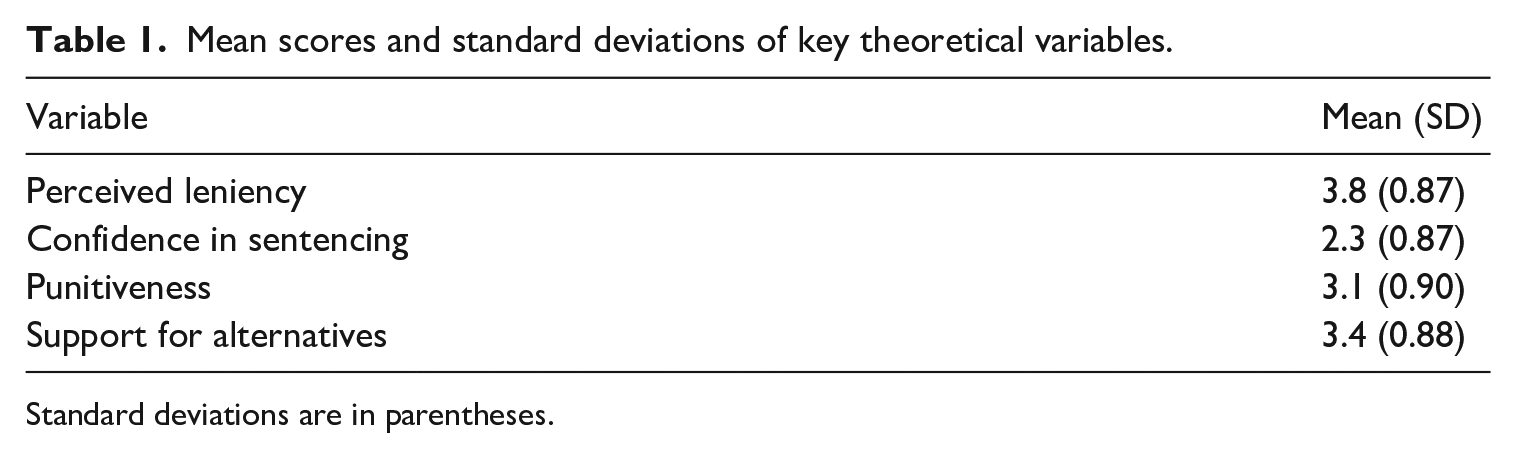
Standard deviations are in parentheses.
Correlations of key theoretical variables.
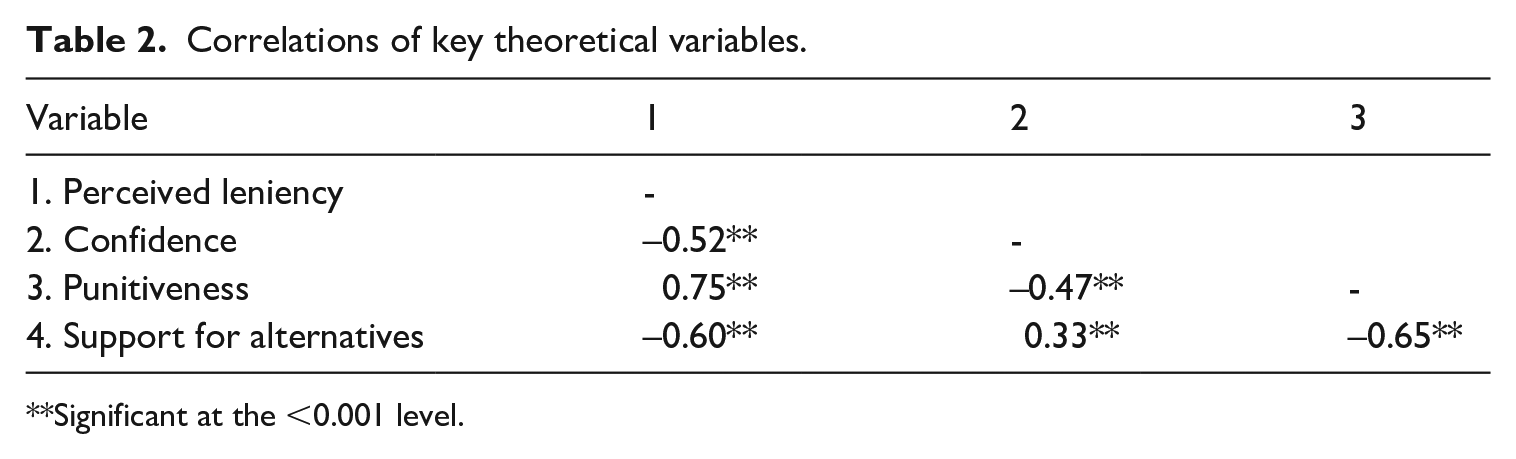
Significant at the <0.001 level.
Knowledge of murder trends and sentencing practices
An aim of the present study was to gauge the level of public knowledge regarding murder trends and sentencing practices within the state of South Australia. Regarding murder trends, participants scored a mean of 0.36 (SD = 0.55) out of 2, translating to an overall accuracy rate of 18.0%, indicating that understanding was overwhelmingly low. Looking at the two murder trend questions individually, only 14.5% of the sample accurately guessed that the number of murders had decreased in the past decade (Australian Bureau of Statistics (ABS), 2023). A further 32.7% of participants reported the number had remained the same, whereas the majority (52.8%) perceived murder offences to be increasing. This answer distribution is consistent with previous research findings that the public overestimates instances of violent crime (Mitchell and Roberts, 2012a) and perceives it as on the rise (Gelb, 2006; Indermaur and Roberts, 2009).
Turning to the sample’s estimations of average murders per annum, 21.3% of the sample responded within a ±5 range of the correct average number of murders each year. Notably, participants reported a mean response of 278.68 (SD = 4328.20) average murders each year, a notable contrast to the 16.2 (SD = 5.88) actual murders reported by the Australian Bureau of Statistics (2023). Distributional checks revealed several significant outliers within this item, which when removed, changed the mean estimation to 87.84 murders a year, SD = 270.82. These data suggest participants substantially overestimated how many murders are committed in South Australia annually and had very little knowledge of current trends in the crime.
Knowledge of sentencing practices was similarly low. Participants demonstrated a 22.4% accuracy rate, or mean of 1.57 (SD = 1.38), correct out of seven total questions related to knowledge of murder sentencing practices in South Australia. The data suggest that the sample tended to underestimate the severity of sentencing that corresponds to a murder charge. Participants underestimated the mandatory imprisonment sanction for all offenders convicted of murder, reporting a mean of 76.52 persons (SD = 26.19) sent to prison per 100 individuals convicted of murder. Moreover, the estimated mean NPP was 14.5 years (SD = 9.23), an underestimation considering the actually mandatory minimum of 20 years. Beyond underestimating the severity of current sentencing, the sample also had little knowledge of mandatory sentences existing. 54.1% of participants reported not knowing if the head sentence for murder was mandatory, a further 36.3% reported it was not. More topically, 59.20% reported not knowing if the NPP was mandatory. A further 22.0% reported it was not. These findings indicate that most participants appeared unaware of current practices.
Analysing the strength of mandatory sentencing support
To analyse baseline strength of support for mandatory sentencing, participants were asked to report their agreement on a 5-point rating scale to two related items about mandated sentencing. The mean of these items was 3.59 (SD = 0.97), with distributional checks revealing a spread in public support with trend towards greater agreement with mandatory practices. Pearson product moment correlations were conducted to examine the relationship between mandatory sentencing support variable with the other attitudinal measures. It is noted that support for mandatory sentencing strongly predicted increases in perceived leniency, r = 0.59, p < 0.001, and punitiveness, r = 0.69, p < 0.001. Thus, the more participants supported mandatory sentencing laws, the more punitive they were and the more likely to perceive the courts as lenient. Increased support for mandatory sentencing also moderately predicted decreases in confidence in the courts, r = −0.48, p < 0.001, and less support for alternatives to sentencing, r = −0.44, p < 0.001. These findings suggest the more the participants supported mandatory sentencing, the less confident they were in the courts’ capacity to provide appropriate sentences for murder offenders and less endorsing of alternative sanctions to imprisonment. Overarchingly, these findings suggest that support for mandatory sentencing – when asked about in the abstract – attracts support from those who hold less favourable views of the CJS and prefer harsher sentencing practices.
To explore mandatory sentencing attitudes further, independent samples t-tests were conducted to examine whether knowledge of the existence of a mandatory minimum sentence influenced participants’ attitudes. Here, participants were assigned to conditions according to whether they had reported belief there was the existence of a mandatory minimum sentence for murder or not within the knowledge questions. The means and standard deviations are reported in Table 3. Significant differences were evidenced across all domains. Community members that believed a mandatory minimum sentence did apply to murder offences evidenced significantly lower perceived leniency of the courts as compared to belief that it did not, t(480) = −3.873, p = < 0.001. The effect size of this relationship was small, d = −0.35. Moreover, knowing about mandatory minimums significantly increased reported confidence in the courts, t(585) = 3.91, p < 0.001, d = 0.32, while decreasing punitiveness, t(585) = −3.76, p < 0.001, d = 0.31. Interestingly, support for alternatives was significantly higher for those who believed mandatory minimum sentences existed than those who did not, t(586) = 3.31, p < 0.001, d = 0.273. A similar trend was evidenced for mandatory sentencing support with participants who reported belief in their existence demonstrating significantly lower support for mandatory sentences than those who did not, t(577) = −3.76, p < 0.001, d = 0.28. Possibly, then, people who are aware that mandatory minimum terms are in effect for murder sentencing have a better understanding of sentencing practices overall. As such, these citizens have the capacity to be more critical of existing practices than those unaware of their existence, and feel more trust in the CJS overall. However, it should be qualified that the practical difference between means is negligible, and reporting belief that mandatory minimum terms exist does not necessitate an accurate understanding of how long this minimum period is (i.e. 20 years). As such, these results should be interpreted with caution.
Means and standard deviations for attitudinal measures according to knowledge of mandatory minimum.
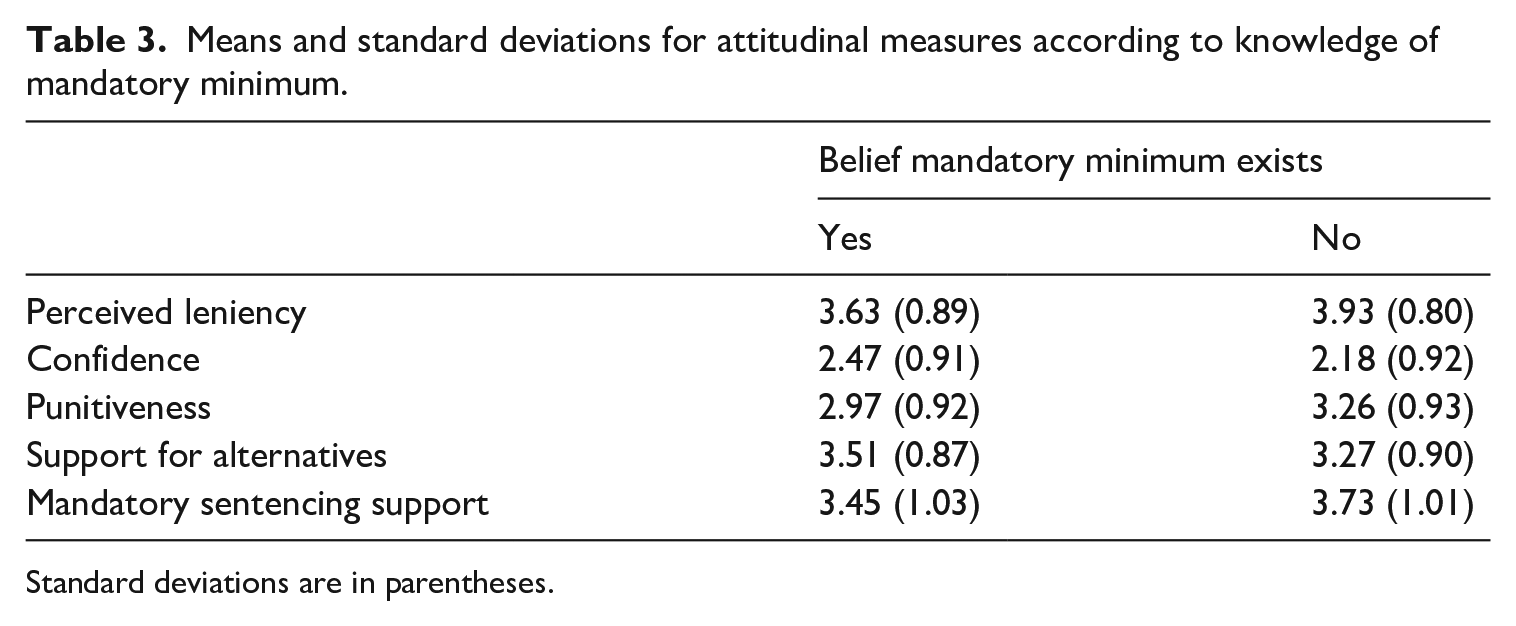
Standard deviations are in parentheses.
Public perceptions on appropriate sanctions for murder: Vignette results
Vignettes were employed to understand what the public may think is an appropriate minimum sentence for murder offenders convicted under the common law doctrine of JE. As aforementioned, this focus is unique in the national and international context. Surveys of the public in relation to similar doctrines of extended criminal liability (i.e. felony murder) in other jurisdictions are scarce and, published between 12 and 33 years ago, may not reflect contemporary attitudes (but see Applegate and Davis, 2006; Finkel et al. 1991; Finkel and Smith, 1993; Garberg and Libkuman, 2009).
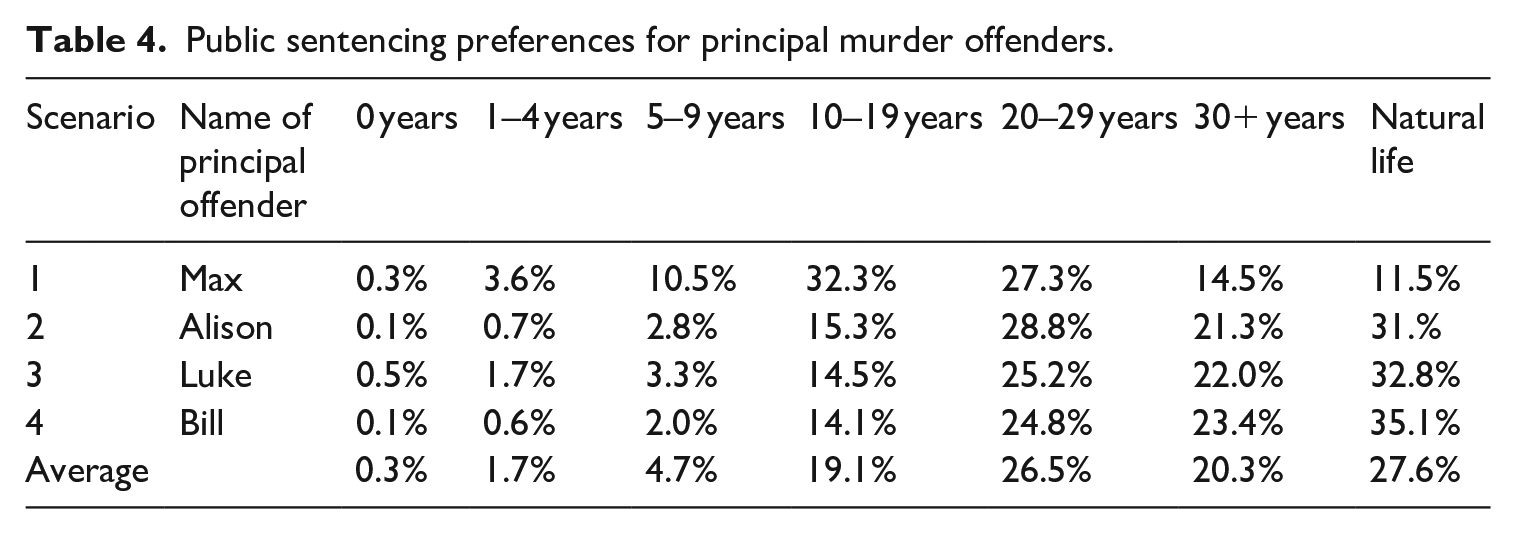
A percentage distribution of participants’ preferences is set out in Table 4 in relation to principal offenders and in Table 5, secondary offenders. Data presented in Table 4 show a majority preference for imprisonment for 20 years or above for principal offenders, indicating current minimum terms may be in line with what the public views as appropriate. However, a significant minority (25.5%) supported a mean minimum imprisonment term of 19 years or below even for principal offenders.
Public sentencing preferences for principal murder offenders.
Public sentencing preferences for secondary murder offenders.
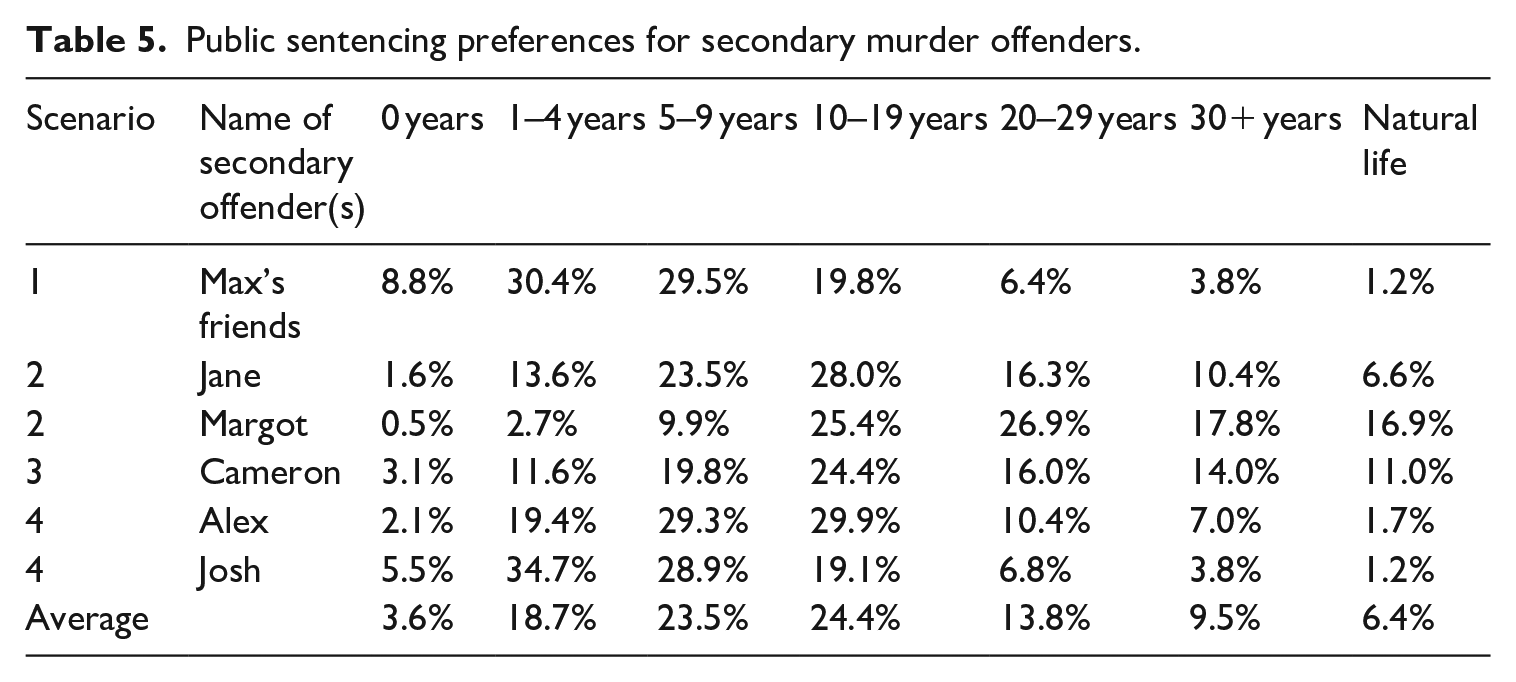
More importantly, findings in Table 5 for secondary offenders show that the majority of participants elected a minimum sentence range below the current minimum term. A substantial majority (70.2%) of participants preferencing a sentence range of 19 years or below overall.
Distributional analysis provides several key takeaway points: in relation to principal offenders who dealt the fatal injury, a 20-year minimum imprisonment term for murder offences has consistency with public desire. However, a majority of respondents would have imposed a sentence below the 20-year term for secondary offenders in contrast to current law. These findings suggest that current practice may be inconsistent and harsher than public expectation for secondary offenders. While moral responsibility was not measured, it is noteworthy, for example, that the majority of participants voted for a sentence range 9 years or below for arguably the least culpable players in Vignette 1 and 4 (i.e. those who had no awareness that the principal offender intended to cause grievous bodily harm).
A Friedman test was utilised to confirm if significant differences existed in the preferred mean minimum sentence range between each of the principal murder offenders. Because characteristics were not systematically varied in the vignettes, no claim can be made as to why sentences imposed varied. However, the relevant question is do they significantly vary? If so, then the blanket application of a mandatory minimum to all offenders, primary and secondary, is arguably not aligned with public preferences. For principal offenders, there was a statistically significant difference in sentence range imposed according to the offender presented, χ2(3) = 1420.59, p < 0.001, W = 0.32. For Scenario 1, a median (IQR) sentence range of 10–19 years was reported, whereas all other scenarios reported a median of 20–29 years. Post hoc analysis using Wilcoxon signed-rank tests with Bonferroni correction applied indicated the significance level was set at p = 0.008. The sentence range imposed for the principal offender in Scenario 1 was significantly lower than that for Scenario 2 (Z = −24.84, p < 0.001), Scenario 3 (Z = −21.82, p < 0.001) or Scenario 4 (Z = −25.35, p < 0.001). The range imposed for principal offenders in Scenarios 2 and 3 shared no significant difference (Z = −0.51, p = 0.608), although Scenario 4’s principal offender evidenced a greater sentence range imposed than both Scenarios 2 (Z = −6.37 p < 0.001) and 3 (Z = −5.05, p < 0.001). Therefore, there was significant variation in the sentence range study participants imposed on principal offenders, suggesting some differentiation according to the characteristics of the crime.
A Friedman test was also conducted to examine significant differences in the preferred mean minimum sentence range for secondary offenders. This test demonstrated a statistically significant difference in sentence range imposed according to the offender presented, χ2(5) = 3101.99, p < 0.001, W = 0.42. The median (IQR) sentence range imposed for secondary offenders in Scenarios 1 and Scenario 4 was 5–9 years imprisonment. However, Jane in Scenario 2 and Cameron in Scenario 3 received a median sentence range of 10–19 years, and Margot from Scenario 2 received a median of 20–29 years. Post hoc analysis using Wilcoxon signed-rank tests with Bonferroni correction applied indicated the significance level was set at p = 0.003. The results are depicted in Table 6. These data suggest that study participants would generally sentence secondary participants well below the current minimum term and impose variable sanctions according to the case.
Results of a Wilcoxon signed-rank test examining differences in sentence range imposed for secondary offenders.
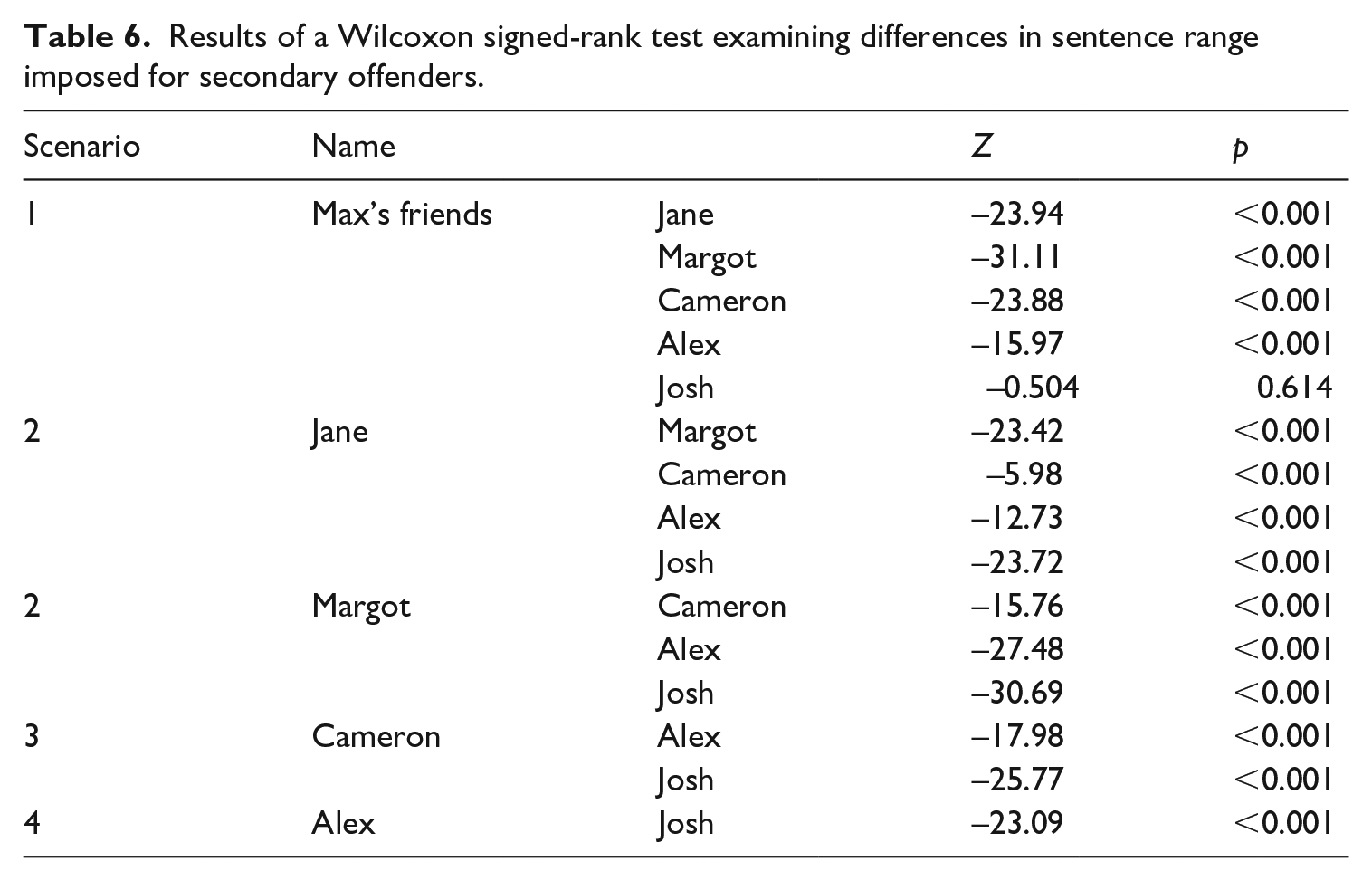
These findings indicate two key points: that imposing a mandatory sentence for murder which is the same across principal offenders in different scenarios appears inconsistent with public attitudes and that a sentencing regime that makes no distinction between primary and secondary offenders also appears inconsistent with public attitudes.
Discussion and concluding remarks
It is well accepted that the laws of a jurisdiction should reflect the values of those who live within it. From one perspective, a CJS aligned with public opinion is critical to co-operation from various participants in the justice process, including complainants, witnesses and jurors (Bartels et al., 2018). Indeed, lay person participation in the CJS is considered central to a healthy democracy (Gastil and Hale, 2018). Jurors, as one example, bring their collective experience from their lives in the community and it is that which stands them in good stead to weigh the evidence to determine what they accept as fact, what they reject and the conclusions they are prepared to draw. It is their collective experience that ultimately puts them in the best position to determine whether or not the prosecution has discharged their onus of proof.
From another perspective, public opinion serves as a measure of what is considered fair or just; tempering legal decisions that are too lenient or too harsh (Stobbs et al., 2015; Warner et al., 2011). As such, amendments to sentencing legislation are often justified on grounds of appeasing the public conscience (Sundt et al., 2019). However, scholars have highlighted the tendency for politicians to make decisions based on narrow polling that paints the community as highly punitive while ignoring nuances to public opinion (Stobbs et al., 2015). While mandatory sentencing regimes for murder have been in operation for decades (Fitz-Gibbon, 2016), limited research has examined public support for the practice, and to date there is no research that interrogates sentencing preferences for offenders convicted under joint enterprise liability. This article directly addresses this gap in knowledge.
The first objective of this study was to assess public knowledge regarding murder-related statistics, such as murder trends and current sentencing arrangements in South Australia. The findings revealed a substantial disjunction between how people perceive the frequency or risk of murder victimisation and the actual level of victimisation that occurs in the community. The South Australian public significantly overestimates the murder rate in their state, and significantly underestimates the length and severity of the resulting sanctions, evincing very low awareness about the existence of mandatory maximum and the minimum prison sentences required. This speaks to a broader issue regarding a lack of knowledge regarding crime trends and policy, and tendency to (erroneously) believe crime is on the rise and predominantly violent in nature (Gelb, 2006; Jones and Weatherburn, 2010; Mitchell and Roberts, 2012a). Relatedly, a second objective was to examine to what extent mandatory sentences of imprisonment for murder align with public preferences in South Australia. The results showed trends towards agreement with the practice, with support for mandatory sentencing correlated with expected attitudes such as punitiveness and low confidence in the CJS. To this extent, the issue of how to provide clear and accessible public legal education and consultation is of fundamental import to perceptions of legitimacy in sentencing and, in turn, the creation of fair and appropriate criminal justice policies. Without which, as scholars rightly point out, the public ‘will naturally rely on media reports which commonly over-represent extreme cases that fuel public criticism and confirm public skepticism’ (Roberts and Plesničar, 2015). To this extent, media coverage can be particularly damaging in JE cases, which are known to inappropriately use ‘gang’ discourse in order to police, prosecute and (collectively) punish racialised groups (Waller, 2024).
Our third aim was to explore whether – in the public mind – there are some offenders, convicted of murder under extended criminal liability, that do not merit the mandatory minimum sentence, but rather some lesser penalty. In respect of murder offending, as highlighted by Mitchell and Roberts (2013), ‘the primordial justification for the mandatory . . . sentence is that murder is a uniquely serious crime and thus warrants a unique sentence’ (p. 504). Anything less, it is argued by successive governments and policy makers, fails to vindicate the dignity of victims, deprioritises community safety and undermines public confidence in the judicial system. But, as Mitchell and Roberts (2013) remind, ‘not all murders are in fact uniquely serious’ (p. 504). The multi-defendant scenarios and the varied public views about appropriate sentences confirm this point. Typical EJCE events revolve less around what people intended or did, but around concepts of awareness, foresight and/or the nature of their involvement in a joint criminal activity. Against a burden of proof low enough to allow those ‘who are simply too morally remote from the crime, bit-part players or not even players at all, to be swept up in a prosecution and convicted on the basis that they were all “in it together”’ (Coleman, 2016: 2), mandatory sentencing for EJCE is particularly problematic. The 2016 ruling of the UK Supreme Court in Jogee (Mills et al., 2022) provides a powerful reminder that judicial discretion is critical to moderate penal excess for those offenders who do not fit neatly into the murderer category. Jogee’s case, heralded as righting a wrong turn in legal history, ruled that foresight of a possible outcome is insufficient to lead to criminal liability, which instead requires a participant’s knowledge of the principal offender’s crime. Despite this decision, however, the over-criminalisation of secondary parties in multi-defendant homicide events has continued unabated in the United Kingdom (Mills et al., 2022). Research that examines public views about the appropriateness of mandatory sentences for the offence of murder, and more pertinently, murder under extended criminal liability, provides important evidence to combat potential injustices created by doctrines of JE.
The most important finding from this study is the significant variability in what the public considers an appropriate sentence for murder in South Australia. More specifically, the findings suggest that current practice may be inconsistent with, and significantly harsher than, public expectation for some offenders. When provided with specific context, vignettes based on real murder cases, the majority of participants preferred sentences of imprisonment well below the mandatory 20-year NPP for secondary offenders convicted under doctrines of extended criminal liability. This was as low as half the current NPP in two of the four cases adjudicated, with participants showing a preference for 9 years or below. The social and economic implications of this situation are immense. At minimum, it means that each state and territory is wedded to (and deeply invested in) a model of sentencing and ‘punishment’ fundamentally at odds with the idea that individualised justice is not only possible, but preferable. Of course, there is need to interpret these findings with some caution, given vignettes were not systematically varied and several factors differed. Therefore, no claims can be made as to why some defendants in the vignettes evinced lower sentences than others. From the research findings presented earlier in this article, however, it is certainly worth suggesting that community members ‘are sensitive to the principle of proportionality and recognize the threat to this principle created by laws that mandate the same sentence for all offenders regardless of their levels of culpability’ (Roberts, 2003: 505). An indication as to the public view of extended joint enterprise is given by their choice of sentences as low as 1–4 years imprisonment for those offenders initially acting in furtherance of a plan simply to assault the victims. This could suggest that a conviction for murder simply did not make sense to these respondents. While we do not dwell on it here, the sentences imposed by participants on primary offenders also significantly varied, underscoring that mandatory minimums may not be preferred even for those with greater involvement in the crime. Further research is needed to pick up this challenge.
Limitations of online survey methodology need to be borne in mind when interpreting these results. Most notably, concerns have been raised about the validity (e.g. respondents with biases selecting themselves into the sample) and generalisability of findings (Andrade, 2020). In this study, for example, we found overrepresentations of certain cohorts (e.g. those with criminal justice experience) that may limit generalisation to the broader public. By the same token, there is also growing consensus that ‘just because a survey is based on self-selected methods does not automatically disqualify it from attention or invalidate its findings’ (Barratt et al., 2017). More specifically, the American Association for Public Opinion Research taskforce on non-probability sampling (Baker et al., 2013) highlights that ‘fit for purpose’ is an important concept for judging survey data and includes ‘balancing elements of relevance, accuracy, timeliness, accessibility, interpretability and consistency’ (p. 102). For this study, anonymous, opt-in surveys are an efficient and appropriate way to understand how the public feels about contentious subjects, such as sentencing and the criminal justice system, although stratified sampling may be useful in future. We are also unable to make causal claims about why people sentenced offenders differently. To this end, we have examined if, not why, there is variability as an indicator of whether current practices accord with public view.
The views and trends emerging from this research in South Australia may not be entirely relevant to situations elsewhere. But then, that is our point. Specifically, there can be no ‘one size fits all’ model for sentencing offenders convicted of murder. To this end, we have identified a range of instances which ‘encompass the possibility that not every person convicted of murder deserves a sentence of life on license’ (Tongue, 2015: 1277). Doctrines of extended criminal liability connect to a larger and more complex story about current, historic and personal disadvantage as well as the interpretation and reaction to social cues in particular circumstances. It is important to highlight the myriad contexts within which the offence of murder is committed as well as to consider whether a presumptive minimum sentencing scheme is in the best interests of justice. The public in this study – and others – appear sensitive to the principle of proportionality and recognise the value of judicial discretion to moderate penal excess and allow for more proportionate sentences to be applied on an individual case-by-case basis. The relative rarity of murder compared to other offences suggests that it can be. Without such an approach, ‘mandatory minima can violate the principle of proportionality, and this is likely to undermine, rather than enhance, public confidence in the courts’ (Roberts, 2003: 504).
Footnotes
Appendix 1
Appendix 2
Appendix 3
Acknowledgements
The authors would like to thank Emeritus Professor Kathy Mack, Flinders University, and the anonymous reviewers for their feedback on earlier drafts of this article. Data for this article stem from the project ‘Public Opinion and Mandatory Sentencing for Murder’. Sincere thanks to the Law Foundation of South Australia for funding this study.
Declaration of Conflicting Interests
The author(s) declared no potential conflicts of interest with respect to the research, authorship and/or publication of this article.
Funding
The author(s) disclosed receipt of the following financial support for the research, authorship and/or publication of this article: This study was funded by the Law Foundation of South Australia, project number A590-9.21.
