




Abstract
The so-called ‘wall of silence’ presents a threat to successful police investigations and criminal trials. Explanations for it have focused on cultural narratives, including distrust in the police, a ‘no snitching’ culture and manipulative ‘professional criminals’. Drawing on a study of serious multi-handed violence and ‘joint enterprise’ as a legal response, this article highlights the role of the law, and its agents, in generating silence among young suspects, whose primary concern is the legal risks of talking. Yet, these young people face a precarious trap, as their silence is interpreted as guilt by the police, propelling them towards charge. This article concludes that to avoid over-charging and to encourage young people with knowledge of serious violence to talk, structural change is needed. The system must reverse the legal rules regarding silence and reform the law on secondary liability to reduce the legal risks of talking.
Introduction
Newspaper headlines, such as ‘Murder hunt’s “wall of silence”’ in the United Kingdom (The Telegraph, 2005) and ‘A Cloak of Silence after South Bronx Killing’ in the United States (New York Times, 2016), are illustrative of an internationally recognised problem – that police investigations into serious violence are thwarted by the ‘wall of silence’ or a refusal of individuals, en masse, to talk to the police (Brookman et al., 2018; Wellford and Cronin, 2000; Westmarland, 2013). Explanations for the so-called wall of silence have been rooted in cultural narratives, specifically a ‘no snitching’ culture in the United States (Woldoff and Weiss, 2010) or no ‘grassing’ in the United Kingdom (Evans et al., 1996, cited in Clampet-Lundquist et al., 2015: 268) 1 and ‘professional criminals’ using their ‘right to silence’ to thwart investigations (Owusu-Bempah, 2018).
Reporting on interviews with young people and criminal justice practitioners, undertaken for a study of serious multi-handed violence and ‘joint enterprise’ as a legal response, 2 this article demonstrates that cultural narratives are offered by young people who experience violence as victims or witnesses to explain their non-engagement with police. However, for young suspects drawn into police investigations into serious violence as secondary parties, a key structural explanation dominates, as silence is primarily generated by concerns about the legal risks of talking in the context of joint enterprise – a legal doctrine that enables multiple individuals to be convicted for a single offence. Therefore, joint enterprise (and its application in practice) ensnares young people in a precarious trap: drawing them into an investigation and persuading them to remain silent (due to the legal risks of talking) – yet this propels them towards charge, as their silence is interpreted as guilt by the police. This scenario presents a particularly significant threat for those drawn into investigations into fatal violence, as it can result in a life-changing and identity-shattering conviction of murder and decades in prison (Crewe et al., 2020). We conclude by arguing that, to avoid over-charging of young people on the periphery of violence and discourage silence among those with real knowledge of serious violence, the system must reverse the adverse inference placed on silence and reduce the risks of talking by reforming the law on secondary liability.
The problem of silence, cultural explanations and responses
Silence is part of speech: ‘it is a form of social interaction imbued with meaning and emotions conveyed within social context’ (Hallsworth and Young, 2008: 134). In the context of police investigations, silence is viewed suspiciously as a sign of guilty knowledge. As such, it represents a significant barrier to establishing the full facts of the case, and identifying and eliminating potential suspects (Royal Commission on Criminal Justice, 1993; Wellford and Cronin, 2000). The ‘wall of silence’ is a metaphorical barrier that prevents people with assumed knowledge of an incident, en masse, from passing information to the police. The explanations for such behaviour have predominantly been cultural – blamed on distrust of the police and a ‘no-snitching’ culture among particular groups.
Distrust has been associated with individuals’ direct negative experiences of the police, including police harassment and the overuse of force (Brunson, 2007; Downing and Copeland, 2015; Rosenfeld et al., 2003). As stated by one respondent in Rosenfeld et al.’s (2003) study, ‘[Mistreatment] deters you from . . . wanting to do any type of business with [the police]’ (p. 297). For Black people, in particular, research suggests that non-engagement with the police is the result of multiple personal and vicarious experiences of discriminatory police practice (see, for example, Bowling and Phillips, 2007), which generate distrust (Brunson, 2007; Downing and Copeland, 2015). 3
A ‘no snitching’ culture has also been blamed for thwarting engagement with the police, as ‘the code of the streets’ emphasises the personal settling of disputes and the rejection of formal legal recourse (Anderson, 1999; Clampet-Lundquist et al., 2015). Such expectations are said to be reinforced by violence towards, and social marginalisation of, those who do disclose information to the police (Clayman and Skinns, 2012; Rosenfeld et al., 2003). Although contradictory evidence from the United States suggests that concerns about retaliation are ‘perception driven’ (National Institute of Justice, 1997: 128), there are examples of drug informants being ‘assaulted, raped and murdered’ (Woldoff and Weiss, 2010: 187). Certainly, as Rosenfeld et al. (2003) conclude, few labels ‘are more stigmatizing and more enduring, than that of a snitch’ (p. 298).
Given these dominant narratives, attempts to improve engagement with the police among the polity have focused on improving trust in the police by emphasising ‘procedural justice’ (Bradford et al., 2018; Clayman and Skinns, 2012; Tyler, 2003) and reducing the risk of identifying witnesses who provide evidence in a criminal case (e.g. see Crown Prosecution Service, 2020). Running alongside these endeavours, law reform has attempted to disincentivise silence among suspects.
Silence among suspects and the legal response
Prior to 1994, the ‘right to silence’ meant that judges may have remarked upon a suspect remaining mute in police interviews, but they were not able to explicitly invite juries to draw inferences of guilt from silence (Owusu-Bempah, 2018). Research undertaken in the 1980s and 1990s highlighted that only a minority of suspects were entirely uncooperative during police investigations, as most answered questions and made statements ‘either to admit or to deny the accusations’ (Royal Commission on Criminal Justice, 1993: 50). For those who remained silent in interviews, the strongest predictor was the legal advice they had received, with other factors including the severity of the offence and previous criminal convictions (Moston et al., 1993). Many of those who remained silent in police interviews went on to plead guilty and were convicted (Royal Commission on Criminal Justice, 1993), demonstrating that the right to silence did not prevent the gathering of information or conviction of suspects. However, concerns that ‘professional criminals’ were exploiting their right to silence, impeding the effectiveness and efficiency of police investigations, led to changes in the law (Royal Commission on Criminal Justice, 1993). The introduction of Section 34 of the Criminal Justice and Public Order Act 1994 allowed inferences of guilt to be drawn from ‘a defendant’s failure to mention, when questioned under caution, a fact relied on at trial’. (Owusu-Bempah, 2018: 111). Possible inferences included that the information subsequently provided in court was invented or would not have stood up to police investigation (Owusu-Bempah, 2018).
The reform of the law increased the legal risks of remaining silent in police interviews, amplifying the chances of a guilty verdict. This was despite concerns raised by the Royal Commission on Criminal Justice (1993) that such changes would be ‘against the interests of justice’, as they placed additional pressure on vulnerable suspects to engage in police interrogations, including those who were ignorant about the law (p. 52). There was a recognition of the plethora of reasons why innocent people might remain silent, including to protect loved ones, due to the anger, humiliation, intimidation, disorientation, and confusion generated by police interrogations, or to provide the opportunity to fully consider the allegations against them with legal guidance (Royal Commission on Criminal Justice, 1993). It is the legal risks of talking, specifically, to which we now turn.
Uncovering the legal risks of talking
Although the existing literature has the least to say on the legal risks associated with talking to the police, research on ‘snitching’ indicates such concerns among individuals. For example, Rosenfeld et al.’ s (2003) research with 20 ‘active street offenders’ found that some feared that they would shift from ‘complainants into suspects’ by talking themselves ‘into a hole’, being caught lying, and ‘drawing attention to their own misdeeds’ in their conversations with police (p. 298). As highlighted by the Royal Commission on Criminal Justice (1993), the potential to incriminate oneself was considerable for those unfamiliar with legal definitions and police procedures. As Innes (2003) notes, . . . the police manage the [interview] interaction in such a way as to gradually persuade the suspect to reveal more and more information. In the process of doing so the suspect is, perhaps without realizing it, further incriminating himself. (pp. 182–183)
Racialised concerns about the legal risks associated with police encounters have also been indicated by research conducted in the United States. Interviews with young Black men found that, during such encounters, they made ‘appraisals of personal or group susceptibility to physical, psychological, social, economic, or legal harm’ (Smith Lee and Robinson, 2019: 157–158), based on personal experiences of aggressive policing, as well as an acute awareness of societal racism and ‘the embeddedness of racism in law and criminal justice’ (p. 170). 4 In this article, we argue that increasingly punitive sentences and ‘net-widening’ policies and laws, such as joint enterprise in England and Wales (and joint criminal enterprise or accomplice liability in the United States, Australia and Hong Kong – see Reid et al., 2019 and Weinburg, 2019), increase the risks of engaging in a police investigation.
In England and Wales, joint enterprise or ‘secondary liability’ (Crown Prosecution Service, 2019b) enables a secondary party to be convicted of a principle offence if they ‘intended to encourage or assist’ another (the principal party) to commit the offence. Although foresight (of a second violent crime during the commission of a primary offence of burglary, for example) is no longer sufficient to convict the secondary party of the violent offence, it can be used as evidence of intention to encourage and assist (Crown Prosecution Service, 2019a). 5 Such rules mean that talking to the police about being present at the scene of a violent incident or being associated with a key suspect, for example, poses particular legal risks for individuals who can then be charged with the principle offence, based on ‘complicity’ (see Hulley et al., in progress). This has very significant consequences in cases involving fatal violence – a murder conviction and a life sentence, with potentially decades in prison. 6 This article argues that, in this context, the legal risks of talking persuade young suspects drawn into the joint enterprise ‘net’ to remain silent. Yet, these young people then become ensnared in a legal trap, as their silence is used to infer guilt, propelling them towards being charged with the principle offence.
The current study
The study examined youth violence in the context of the legal doctrine of joint enterprise in England and Wales. Semi-structured interviews were undertaken with four groups of participants in England. Table 1 summarises the details of the participants involved in the study.
Demographic details of the participants involved in the study.
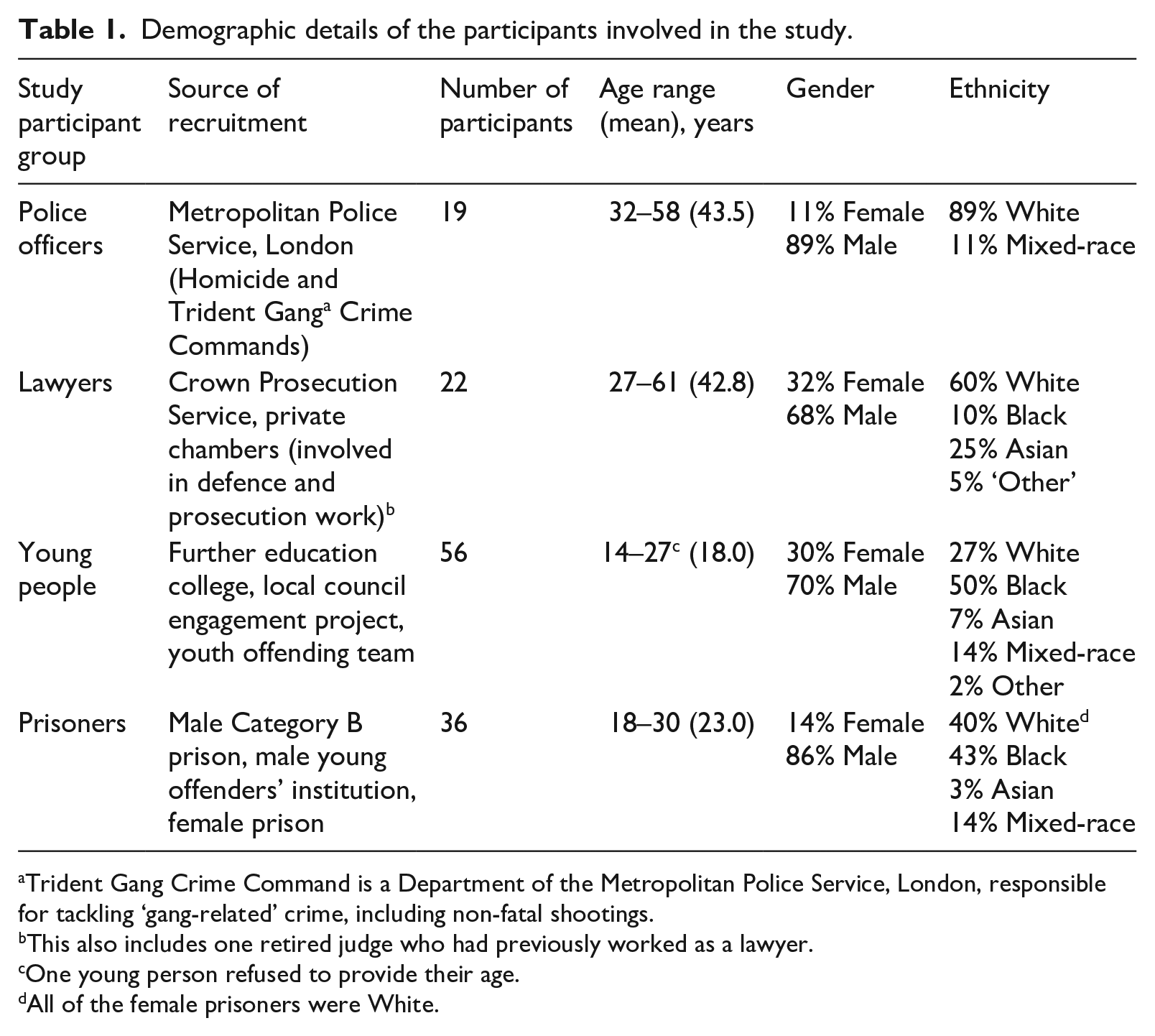
Trident Gang Crime Command is a Department of the Metropolitan Police Service, London, responsible for tackling ‘gang-related’ crime, including non-fatal shootings.
This also includes one retired judge who had previously worked as a lawyer.
One young person refused to provide their age.
All of the female prisoners were White.
The study employed a purposive sampling technique to recruit all participants. Practitioners who had worked on cases of serious violence involving multiple young people included police detectives and lawyers. The former worked in the Homicide and Trident (gang) units in the Metropolitan Police and were accessed through a senior officer in each of the units, who requested volunteers for the study via email. Each volunteer was then contacted directly by the research team. Crown Prosecution Service lawyers were contacted through senior staff in the organisation, who identified individuals with relevant experience and arranged interviews with those who volunteered. Barristers (including Treasury Counsel) were identified through key contacts, snowballing, advertising and Internet research focusing on lawyers with experience of prosecuting and defending cases of serious violence involving multiple young people. Each lawyer was contacted by the research team, either through their chambers or directly. As part of this snowballing process, one retired judge with experience of multi-handed trials also participated in an interview.
Young people aged 25 years and younger 7 were accessed through a Youth Offending Team, a further education college and council-based youth engagement project in London. 8 Most had experience of violence as witnesses, victims or perpetrators. Each organisation sought out volunteers and arranged interviews for the research team to undertake. The prisoner group included men and women who had been convicted of serious violent offences (wounding/causing grievous bodily harm with intent, manslaughter and murder) 9 when aged 25 years or younger. Prisoners were drawn from three prisons: an adult male Category B prison, a Young Offenders’ Institution and a female closed prison. Each prison provided the research team with a list of individuals who fit the research criteria (age and offence). Researchers then approached individuals to establish the relevance of joint enterprise to their case. Informed consent was obtained from all volunteers, following a detailed introduction to the research and the ethical considerations.
Interviews lasted between one and three hours; all were audio-recorded and professionally transcribed verbatim. Questions related to individual’s life histories (for practitioners, this focused on professional histories); experiences of violence (for practitioners, the process of investigating cases of serious ‘group-related’ violence involving young people); understandings and perceptions of joint enterprise and the law related to serious violence; and – for practitioners – perceptions of young people’s understandings of the law. The data were analysed on a computer software package (NVivo) using an iterative approach. This is a reflexive process, whereby the data are repeatedly revisited to develop and refine meaning and understanding (Srivastava and Hopwood, 2009).
Short surveys were also provided to participants in each group to ascertain key demographic characteristics. These data were analysed using SPSS, and the main results are shown in Table 1. Overall, almost half of the participants in prison (47%) identified themselves as being convicted as a ‘secondary party’ in their case, 21% as the ‘principal party’, 6% as ‘neither’ and 26% ‘didn’t know’. For those convicted of murder, these figures were (respectively) 52%, 13%, 8% and 26%, highlighting the prevalence of secondary parties within our sample.
Findings
Cultural drivers of silence among victims and witnesses
In the context of witnessing or being a victim of serious violence, young participants reported that they refused to engage with the police due to the cultural narratives that dominate the literature, specifically distrust of the police and fear of physical retaliation and social ostracisation from their community.
Most commonly, feelings of distrust towards the police were generated by negative personal interactions. Many of the young people in the study had experienced a multitude of accumulated negative interactions (Brunson, 2007), often first occurring in childhood. These ranged from police officers speaking to them disrespectfully, to sustained harassment, racist abuse, police corruption (e.g. falsifying evidence) and brutality. As a direct result, young people refused to cooperate with the police when they became victims of violence or bore witness to it: I used to come back from school and get stopped and searched just for no reason, just for jumping off the bus and buying a drink. [. . .] So, I have not really trusted the police from an early age. So obviously, when I got shot and I ended up going to hospital, I’m not going to talk to the police. (Devan, Mixed-race, convicted of murder)
As indicated by Devan, while distrust towards the police was common among the young participants, it was particularly prevalent for those from Black and minority ethnic (BAME) backgrounds, who felt that they experienced explicit and implicit bias (Goff et al., 2014). Such perceptions and experiences of institutionalised racism and police discrimination (Bowling and Phillips, 2007; Smith Lee and Robinson, 2019) negatively impacted their willingness to engage with the police: Personally, I don’t really like them. They’re ignorant and a lot of them are racist. [. . .] Even the Black police are racist. (Marcus, Black Caribbean, victim/witness/perpetrator of violence) I wouldn’t confide in the police. I don’t trust them. (Teana, Black British, victim/perpetrator of violence)
Alongside feelings of distrust, many young people refused to engage with the police due to their views on ‘snitching’, embedded in a shared cultural code: In this culture we’re in, people don’t really snitch. (Malik, Black British, victim/witness/perpetrator of violence) But in the streets, you’re labelled an outcast, a snitch. You have nothing. You have no reputation, nothing. All you’re going to be labelled as is a snitch. (Zachery, Mixed-race, convicted of murder)
While some young people attributed their refusal to ‘snitch’ to the intense loyalty they shared with their friends ‘on road’, not snitching was often described as part of the ‘code of the streets’ (Anderson, 1999): When you are looking in the movies and they are fighting the villain. You are the villain. That is you. The villain does not phone the police when he gets beaten up. [. . .] You cannot have it both ways. You cannot be saying, ‘Fuck the police’, and selling and doing all the illegal things in the world, but then when something happens to you, you want to bitch up and phone the police. [. . .] you might be sharing the same space, but you are not living in the same world. (Jamel, Black British, victim/witness/perpetrator of violence) The way we grow up out here [. . .] to go testify on someone [. . .] is wrong regardless if he’s killed your mum. To go testify on him now, the way you get trained out here is that you are not allowed to do that, you’re a snitch, you’re lower than low now. (Jenson, Mixed-race victim/witness of violence)
The penalty for snitching was most commonly stigmatisation (Rosenfeld et al., 2003; Sprigge, 1964) – long-term friendships and meaningful relationships could be torn apart by informing on another, and young people risked being ostracised and denigrated. Reputations could be ruined as distrust set in, and individuals could be banished from social groups, including their own family: I would never talk to the police about anything [. . .] Because the label of snitch is not a very good label. [. . .] You’d get disowned. (Dalton, Black Caribbean, convicted of GBH) You’d be excluded from the group. [From] Family, friends. (Lucy, White British, convicted of Section 18)
Alongside ostracisation, the physical risks of ‘snitching’ were perceived to be brutal for the informant and, potentially, their families, as young people repeatedly stated: ‘snitches get stitches’. Naomi graphically recollects the threats she received from the men who she witnessed murder a friend of hers: They were going to kill me, they’ll beat me up, they’ll come to my house. (Naomi, Black British, victim/witness of violence) [. . .] what the police don’t understand is that people don’t come to you and we don’t report these crimes because we’re going to get hurt worse. We’re trying to protect our family, we’re trying to protect our loved ones and ourselves in general. (Eva, White British, victim/witness of violence)
It was unclear the extent to which ‘snitching’ resulted in physical violence (see National Institute of Justice, 1997; Woldoff and Weiss, 2010), but there were individual examples of retaliation, which discouraged victims and witnesses from further interaction with the police: So, every time I called the police, [the perpetrators] came back harder at me and they did worse things to me and my family. And that’s why I don’t call the police, in fact, that’s why I don’t get involved in things now. (Eva, White British, victim/witness of violence)
In the absence of retaliatory violence, the violent capabilities of an avenger were enough to generate sufficient fear to silence a young person. While the risks of ostracisation and physical violence deterred young victims and witnesses from engaging with the police, for those who were drawn into police investigations as suspects, it was the legal risks of talking that silenced them.
Fear of legal risks as a driver for silence among suspects
Talking in police interviews was precarious for young people drawn into investigations through secondary liability, for two reasons: first, because of the low threshold at which their behaviour could be interpreted as evidence of complicity; second, because of the disproportionate and severe consequences of being found guilty as a secondary party, particularly for murder: I learnt a bit about [joint enterprise] before I went in to trial [. . .] and I said nothing because I felt if I say anything then even the smallest part under joint enterprise is paramount to admitting to murder. [. . .] it probably hinders investigations because other people don’t want to admit to things. [. . .] Because admitting anything, even involvement, can end up getting you a murder conviction. (Ian, White British, convicted of murder)
Supplementary findings from this study suggest that Ian’s concerns were warranted, as police and prosecution lawyers justify charging individuals for serious violence based on relatively weak notions of intent to encourage or assist, such as association between parties (Hulley et al., in progress).
For many suspects, silence was maintained due to their ignorance of the law on secondary liability specifically, as well as the broader legal concepts that were central to their prosecution, such as intention (as suggested by the Royal Commission on Criminal Justice, 1993). This lack of legal knowledge led to concerns about being ‘tripped up’ in a police interview, exacerbated by their vulnerabilities related to age and, for some, mental health issues. The young interviewees were not ‘professional criminals’; in fact, many lacked experience of the criminal justice system (particularly in the context of serious violent offences), and this directly influenced their decisions to remain silent in police interviews: You don’t know what’s going on, that’s the honest truth, or why this is happening. So the best thing to do is go ‘no comment’. (Jason, Black African, convicted of murder) I have never experienced a murder trial. I have never experienced an attempted murder trial. I have never been in a situation like that before. I was mentally not there. Physically I was suffering from anxiety, depression of being on a case like that. I was scared in case I slip up and say the wrong thing [. . .] or I do something wrong, which makes me look like I’ve done something. (Raj, Asian Bangladeshi, convicted of murder)
Raj highlights the multiple vulnerabilities many young people suffer and the impact of these on their decision to remain silent. Young people feared that they would incriminate themselves or talk themselves ‘into a hole’ (Rosenfeld et al., 2003: 289). Such risks were highlighted by those who did speak, such as Rosie who described naively ‘opening up’ to the police about personal matters, which contributed to her being charged with murder as a secondary party, despite initially being arrested for ‘perverting the course of justice’: [the police] kind of smile at you and they comfort you and they say it’s all going to be okay. [. . .] they ask you such personal things and you open up about things that maybe you’ve never even told anyone and things like that just so that they can sit there and go, ‘Do you know what, actually I think that she did this’, or, ‘she did that’. That is really, really heart-breaking. (Rosie, White British, convicted of manslaughter)
10
Young people’s inexperience of the criminal justice system and its processes was in stark contrast to the expertise of police detectives who had been trained in interviewing tactics and strategies: The Metropolitan Police Service invest a great deal of time, effort and money in training interviewers, so by the end of that I would exhaust your account to the point that you’re down on yourself, and I would be almost pushing you to say ‘why did you run? Don’t tell me you’re scared, you had nothing to do with it’. (Trevor, White British, detective) The police have the muscle and the resources to intimidate people into . . . because they do threaten people, if you don’t give evidence you get arrested for this, that and the other. (Gerald, Black African, defence lawyer)
Prisoners’ recollections of detectives pressurising them to talk in interviews included ‘grinding’ them down, restricting sleep by keeping lights on in custody and intimidation, which involved emphasising the risks of not talking: [The police gave] me a choice, you can either talk and probably walk or don’t talk and get put in a joint enterprise charge. (Kevin, Black-British, convicted of murder)
Despite the implication of such an ultimatum, young people’s realisation that the police were in a stronger position to frame the narrative of the incident, due to their skills and expertise, often encouraged them to remain silent. This was further reinforced by underlying feelings of distrust in the police and, for young Black men in particular, vulnerability in the face of police power. This distrust and vulnerability were grounded in negative interactions with the police over many years, as well as an acute awareness of the history of police mistreatment of their community and institutional racism (Smith Lee and Robinson, 2019): The system doesn’t help itself, the way they treat ethnic minorities. [. . .] There’s a lack of trust of the police community in general, the majority of races. [. . .] The way it’s perceived is police are after you. They’re just going to keep throwing something until it sticks, and that’s the mentality of a lot of people. It has been evident to a lot of people, to myself in this case, just throwing something until it sticks. (Joshua, Black African, convicted of murder) Regardless of me speaking now or not [in the investigation], [the police are] still going to continue their case.
[. . .] there is an argument that they might make, which is ‘Tell me where you were and then I can rule you out’.
No, that’s bullshit. [. . .] I’ve been arrested by police so many times, they come up with their own assumption anyway.
So you don’t feel like you can trust them -
No.[ . . .] Not at all. Not one little bit. [. . .] I’ve been in situations when I was younger when I’ve gone to police stations and said ‘This is what has happened’. I’m still being charged [laughs], I’m still getting arrested for certain things. So what was the point of me even speaking to you then? (Kelvin, Black Caribbean, convicted of murder)
In this way, young Black men made racial appraisals about their vulnerability to legal harm ‘and their limited ability to protect themselves’ (Smith Lee and Robinson, 2019: 170).
Young people’s lack of understanding of the law, their vulnerabilities, relative powerlessness, and their deeply embedded distrust or fear of the police led to them placing unwavering trust in their legal representatives. In homicide cases, young people reported that their defence lawyers’ instructions were almost exclusively to stay silent and ‘go no comment’: My solicitor advised me to go ‘no comment’ in my interview. So, I was nineteen. That’s my solicitor. Whatever she tells me, I’m going to do. So, she told me to go ‘no comment’, I went ‘no comment’. (Raj, Asian Bangladeshi, convicted of murder) I wouldn’t have spoken [to the police] because my legal’s [legal representative] told me to go no-comment and you follow your legal’s, you put all your trust. That’s basically God to you at that time. You know what you are facing and you realise, ‘hold on, I’ve come to jail and the starting sentence for gun crime is actually 30 years’. I’m thinking, ‘I’ve been around for 18 years and that feels like a long, long, long time. What the hell! 30 years? I’ve never lived 30 years, I don’t know what 30 years is like’. (Lloyd, Black Caribbean, convicted of murder)
Defence lawyers who participated in the study concurred that in cases of murder their advice to young clients was almost always to remain silent, based on the potential implications of their client talking, the power imbalance between their client and the police, and the emotional pressure of police interviews. This was particularly so when the stakes were highest and with young people who were especially vulnerable:
What’s your advice [to clients] until you have all the evidence? Is it generally no comment?
No comment, yes. Because it’s too serious to make a mistake. And, of course, average Joe Public thinks, ‘Well, if you’ve got nothing to hide you should tell the police’ but [. . .] what can happen is you can inadvertently put your foot in it. If you’re young – and I think kids sometimes want to please you, they want you to like them. [. . .] So with a young man I’d be very reluctant to let them answer questions. (Ahmed, Asian Pakistani, defence lawyer)
In this way, lawyers recognised that clients were ‘scared of [. . .] joint enterprise’ (Simon, White British, defence lawyer). Offering a ‘no comment’ interview made strategic sense early in the prosecution process: silence was ‘a good tactic, because at that stage, they don’t really know what the evidence is going to be and it doesn’t really get held against them’ (Alana, White British, defence lawyer). Lawyers considered that it was preferable to have an ‘adverse inference’ drawn from silence ‘than having proved to be a liar in a taped interview’ (Ahmed, Asian Pakistani, defence lawyer), even if the lie was an ‘innocent’ one. Although they recognised that silence could have adverse implications, The wall of silence [. . .] plays into [the prosecutions’] hands. I remember the prosecution counsel in a case saying, whether or not they gave evidence, nobody had actually said, ‘I saw X killing’. And he said ‘that’s another layer of proof that they’re in a gang because of the harmonious silence’. (Simon, White British, defence lawyer)
Simon’s observation highlights the legal risk for young suspects who remain silent in police interviews – that it can then be used to infer guilt. This assumption is embedded in law in the Criminal Justice and Public Order Act 1994 and, as we will set out in the next section, is also rooted in police practice, with significant legal implications.
The silence trap
The following assumption was widespread among detectives who participated in the study: . . . anyone who speaks in a suspect interview is normally telling the truth and they’ve got nothing to do with that murder. [. . .] Very rarely do we have people involved admitting it or, if they’re involved as a secondary party on the outskirts, telling us what’s happened. (Trevor, White British, detective)
Detectives assessed that young people who refused to speak in a suspect interview were knowledgeable about an offence and, often, deeply implicated in it. While there is little empirical support for their conclusions,
11
they appeared to be rooted in a theory of rational thinking that ‘if I’d done nothing wrong and I was arrested for murder I would be screaming it from the rooftops’ (Trevor, White British, detective): The fact is, if you haven’t done anything you are going to say. (Rob, White British, detective) If someone, god forbid, came in and beat up your husband and you were sat there, and you recognised them, you wouldn’t say, ‘didn’t know who did it. No idea’ . . . You’d be the first one stood at the parade saying, ‘That was him’. (Eric, White British, detective)
The detectives’ assessments of what constituted a ‘rational choice’ in such circumstances were embedded in normatively male and White notions of rationality (see, for example, Lloyd, 1979). In this context, they used cultural explanations to make sense of silence among young Black men in particular, reflecting a broader narrative of ‘colorblind racism’ (Bonilla-Silva, 2003). For example, Eric (White British, detective) described non-engagement of young BAME people as ‘a cultural thing. There’s a distrust’, while Keith (White British, detective) expressed confusion that despite the police being ‘more transparent now than we have ever been in our history [. . .] we are less trusted now [. . .] especially young Black men and because it’s a cultural thing they just don’t trust us’. Such narratives ignored the structural, racialised, prejudicial practices that young Black and Mixed-race people are exposed to in the criminal justice system, which increase their risk of being convicted, including in the context of joint enterprise specifically (see Young et al., 2020; Williams and Clarke, 2016; also see Bonilla-Silva, 2003; Smith Lee and Robinson, 2019).
While cultural distrust was used by police to contextualise patterns of silence among Black suspects, at an individual level the rational choice theory dominated their narratives, with detectives and prosecution lawyers arguing that those who presented as suspects remained silent because they were guilty and they were trying to ‘play the system’.
[Suspects] are very switched on. They are manipulative and devious when it gets to the court process; there is no doubt about it. They know how to play the system [. . .] they will never say anything, or very rarely say anything at the interview, they are canny from the start and they will wait until [. . .] all the prosecution evidence is served and then. . . and only then will they commit themselves; they will wait until the last possible moment. [. . .] They know what they are doing. (Paul, White British, prosecution lawyer)
The assumption that young suspects ‘know what they are doing’ ignores the vulnerabilities that many young people reported in this study – linked to their youth, ignorance of the law, inexperience of the criminal justice system and feelings of powerlessness. However, silence kept young people ‘in the frame’ (Rob, White British, detective) and was, ultimately, instrumental in decisions to charge them with serious violent offences, including murder. As Adrian explained in the context of his most recent homicide case, I guarantee this to you, if someone had [spoken] this weekend to me, I would not have taken the case to the CPS, but because he ‘no commented’, I took it to CPS and charged them. (Adrian, White British, detective) I think no comment increases the likelihood of them being charged in the first place. (Jeremy, White British, detective)
Police detectives experienced suspects’ silence as deeply frustrating, as they implored young people to talk in interviews, stating that (contrary to the direct route to charge outlined above) engaging would prevent young people from being charged.
If he said in interview, ‘This is what happened. Yes, I’m part of this group, yes we have beef with this kid [. . .] and we’ve all run over to him because we’ve seen him, and then when I’m there [. . .] three of them pulled knives out [. . .] But, I just stood there and kind of almost froze and let it go’, then I wouldn’t expect them to be charged with murder because I don’t think they’re guilty of murder. (Adrian, White British, detective)
Despite this argument, when pressed detectives recognised that talking could lead a suspect to implicating themselves: Sometimes I think ‘do you know what, that person would have been better off just giving an account’ because the likelihood is if that person turned round and said, ‘Do you know what, I’ve been really bloody stupid, I carried the gun for somebody, his name was Matt’, you know.
But doesn’t that implicate them?
Yes, it does, but you’ve got things like helping the police, you’ve got the early guilty plea which reduces your sentence, you’ve got age, you’ve got previous criminal history factors. [. . .] You’d get a lower sentence. Yes, they’d still get a [murder] charge. (Louise, White British, detective)
Here, Louise highlights the potential reduction in sentence that a secondary party could receive if they talked in an interview, ignoring both the significant impact on a person of receiving a murder conviction (see Crewe et al., 2020) and the extraordinary long tariffs handed down for murder with a gun, which start at 30 years for a person aged 18 years or above. Such life-shattering outcomes make the prospect of talking a very risky decision for a young person.
Concluding thoughts
This article presents a unique picture of the reasons young suspects in cases of multi-handed serious violence report remaining silent in police interviews and the significant implications for them of doing so. Crucially, it draws attention to the previously neglected impact of the legal risks of talking that persuades young suspects, drawn in as secondary parties, to remain silent and takes account of their multiple vulnerabilities, including age, ignorance of the law and relative powerlessness. Yet, it shows that their silence draws them into a legal trap.
Silence, like speech, is open to (mis)interpretation, and in the context of suspect interviews, the police ‘hear’ silence as guilt, and this propels young people towards being recommended for charge. In this way, their silence is weaponised by detectives, to be used against them. This weaponisation of silence is fuelled by an institutional (legally permitted) association between silence and guilt, embedded in detectives’ normative (situated, gendered and racialised) understandings of what constitutes ‘rational’ behaviour in police interviews.
Rather, for those at the scene of a violent incident or associated with a principal suspect, secondary liability exposes them to the significant risk of being convicted of a serious violent offence (including, for some, murder) and a substantial prison sentence. Many such young people remain silent due to fears about the legal risks of talking. These risks, as well as young people’s vulnerability, also shape the advice provided by expert legal counsel to remain silent and young people’s eagerness to follow it. Therefore, the law on secondary liability and, specifically, the low threshold at which an individual can be considered culpable for a serious violent offence are central to suspects’ silence in investigations.
It is worth noting that the vacuum created by young people’s silence in a criminal investigation provides space for the police and prosecution to insert their own case narrative. In ‘joint enterprise cases’ involving Black and Mixed-race suspects, research has shown that the ‘gang’ narrative dominates, as it offers a deeply embedded, normatively understood explanation for serious violence involving multiple defendants (see Williams and Clarke, 2016; Young et al., 2020). Thus, silence among young Black and Mixed-race suspects is likely to put them at particular risk of legal harm. 12
These findings, we hope, will refocus the discussion of the ‘wall of silence’ in two ways: first, by encouraging a distinction between the silence of victims and witnesses and the silence of suspects, implicated in investigations into multi-handed serious violence; second, by encouraging further discussion of the role that the criminal justice system – the law and its agents – plays in generating silence of secondary parties. On the latter, we make three final points.
First, we urge police and prosecution lawyers to recognise their part in enabling (or discouraging) individuals to engage in criminal cases, just as the research on procedural justice has alerted us to the role of the police and criminal justice agents in encouraging community engagement. Currently, the police draw multiple young people into investigations, 13 based on weak notions of intention to encourage or assist (such as association between parties Hulley et al., in progress), who are silenced due to the fear of the extraordinary risks of being convicted of serious violence. It is this silence that is then used to propel young suspects towards charge, based on the inference of guilt that it generates. This inference (which is legally permitted) is rooted in a normative (situated, gendered and racialised) understanding of rationality and ignores the vulnerability that young people feel when faced with the power of the police and the criminal justice system. For young Black men in particular, just as running from the police can be an attempt to avoid ‘the indignity of racism’ and ‘a legitimate fear of death’ (Smith Lee and Robinson, 2019: 172–173), remaining silent in a suspect interview offers protection against the racialised misinterpretation of talk and the potential legal harm that it exposes.
Second, we call for a return to the pre-1994 rules on the ‘right to silence’, 14 whereby judges were able to remark on the silence of suspects but could not explicitly invite juries to draw inferences of guilt from it. It is notable that the research presented here suggests that, contrary to its aims, the current adverse inference rule does not encourage suspects in cases of multi-handed serious violence to engage in police interviews. Rather, just as the Royal Commission on Criminal Justice (1993) feared, we believe that in ‘joint enterprise cases’ in particular it leads to the over-criminalisation of young people on the periphery of violence and, therefore, the law is ‘against the interests of justice’ (p. 52).
Third, and principally, we call for reform to the law on secondary liability and its application in practice to remove the low threshold at which an individual can be charged with a serious violent offence, murder in particular. Instead, we propose that those present at a violent altercation should be offered alternative, lesser charges, specific to the role that they played in the incident, or that, if necessary, a new offence be created which appropriately labels ‘assistance and encouragement’ of an offence and offers a proportionate punishment in response (see Hulley et al., in progress). Such changes would reduce the currently excessive legal risks that young people face as secondary parties, improve the perceived legitimacy of the criminal justice system and may encourage greater participation in police investigations.
Footnotes
Acknowledgements
Thanks to Dr Alice Ievins for discussions about this paper, to Dr Gary Pritchard for his research assistance and to the anonymous reviewers for their encouraging and constructive feedback.
Declaration of Conflicting Interests
The author(s) declared no potential conflicts of interest with respect to the research, authorship and/or publication of this article.
Funding
The author disclosed receipt of the following financial support for the research, authorship, and/or publication of this article: This work was supported by the Economic and Social Research Council (ESRC; ES/P001378/1) and the Isaac Newton Trust.
