




Abstract
Building on the work of Professor Joanna Shapland, this exploratory, phenomenological study theorizes contexts that ground desistance for people sentenced to life in prison for crimes committed as youth. The investigation draws from 28 interviews conducted with 10 formerly incarcerated youth lifers, all male, who were imprisoned for an average of 27 years in California. The major themes are presented along three phases in the desistance journey: life in prison as a barrier to desistance, the will to change, and policy changes and the process of parole. The analysis finds that despite a harsh and violent prison environment, all located sources of support (i.e. spiritual, family, and peers) that facilitated desistance and hope to create a meaningful life inside of prison. While the work of desistance was ultimately externally validated by a parole board, all participants asserted agency to take behavioral and attitudinal steps toward desistance long before they had hope for freedom.
The United States is the only nation in the world that condemns minors (under age 18) to die in prison (Rovner, 2023); a practice that is rejected by the United Nations Convention on the Rights of the Child (Convention on the Rights of the Child, n.d.). There are three major types of life sentences for youth convicted in adult criminal courts in the United States: juvenile life without the possibility of parole (JLWOP), a virtual life sentence (when the sentence length exceeds the natural life span) and life with the possibility of parole (JLWP). Combined, about 11,000 people are currently serving these life sentences, comprising one in seven “lifers” across US state and federal prisons (Rovner, 2023).
Children sentenced to life in prison are often the most vulnerable members of our society, having experienced significant adverse childhood experiences, traumas, and neighborhoods characterized by poverty, violence, and resource deprivation. According to a national study conducted by The Sentencing Project, nearly 80% of people sentenced to JLWOP (N = 1579) reported witnessing violence in their homes, and more than half (54.1%) witnessed weekly violence in their neighborhoods (Nellis, 2012). There are also glaring racial disparities in rates for youth sentenced to die in adult prisons, as 77% of those serving a JLWOP sentence are people of color (Prison Policy Initiative, 2016).
Scholars and advocates have documented the abuses and human rights violations associated with children sentenced to die in adult prisons (Caldwell, 2014; Mills et al., 2015; Nellis, 2015). Despite these conditions, a handful of qualitative studies have found that released juvenile lifers still have hope for their futures, and that they are often optimistic upon their reentry to society (Abrams et al., 2023; Daftary-Kapur et al., 2022; Taylor, 2024). Still, little is known about the process of desistance for youth lifers, who have a unique experience of spending most of their life course in prison. In this article, I build on the work of desistance theorists, and particularly the scholarship of Professor Joanna Shapland, to better understand the process of desistance for life sentenced youth. Through longitudinal qualitative interviews with released juvenile lifers, I seek to conceptualize and trace desistance in the context of life imprisonment.
Literature review and theory
The term desistance has both theoretical and empirical definitions that have emerged over the past 30 or more years. Desistance can be simply defined as the cessation of criminal attitudes and behaviors. Some scholarship has framed desistance as a discrete and measurable event, either “successful” or “unsuccessful,” while others have viewed desistance as a non-linear and more subjective process with starts and stops and a zigzagging pattern (Rocque, 2021). According to Rocque (2021), criminologists now commonly accept that desistance is a subjective, internal process that supports the cessation of criminal behavior and the lessening of criminal attitudes and associations over time.
One of the most accepted concepts in desistance research includes the “age-crime” curve, meaning that most young people with offending histories will age out of criminal behavior based on the biopsychosocial aspects of maturity (Hirschi and Gottfredson, 1983). Moreover, Laub and Sampson’s (2006) life course theory argues that adult roles and responsibilities such as marriage, childbearing, and employment provide key turning points for people to move toward desistance as they mature, even in the absence of any specific intervention. The age-crime curve has continued to carry weight in criminology despite facing some criticism for its simplicity (Haas, 2017), and research arguing that desistance is not necessarily a static or even a concretely measurable concept (Rocque, 2021).
Another key area of desistance research involves understanding the roles of agency (i.e. individual motivation) and structure (i.e. contexts, opportunities) in facilitating desistance. For example, some scholars have argued that agency and individual motivation are preconditions for behavior change (Giordano et al., 2002; Shapland and Bottoms, 2011). Others have suggested that material and contextual factors (i.e. marriage, employment) matter more than individual agency in moving away from criminal identities and behaviors (Laub and Sampson, 2006). Robust quantitative work in the United Kingdom has found that the subjective (i.e. internal, identity changes) can contribute directly to desistance as well as shape the set of social circumstances that pave the way for desistance (LeBel et al., 2008; Maruna, 2001). That said, this question in criminology is not fully resolved; as others have argued that desistance theory has had an overly individualistic emphasis that doesn’t account for social structure (Weaver, 2019).
Qualitative studies have uncovered a complex relationship between individual agency and external structures in the desistance journey. For example, Shapland and Bottoms (2011) suggest that the process of desistance is one in which people actively construct a different set of values and behaviors as they mature into a more law-abiding lifestyle. This can take many attempts and unfolds over time. Moreover, while most people with criminal histories will state their intention toward desistance goals, actualizing these goals can be hampered by material circumstances, social networks, and an array of external factors (Shapland and Bottoms, 2011). Abrams and Terry (2017), in their qualitative study of young men and women transitioning out of the juvenile justice system and into adulthood, also assert that a blend of agency and structure can align to support desistance. They find that while desistance indeed is a day-to-day enactment of decisions and personal agency, that opportunity structures and social support can help to facilitate a path toward desistance; such that sheer will alone may not be sufficient for young adults to desist. As young adulthood typically entails experimentation with identities and roles, Abrams and Terry (2017) also argue that more law-abiding social roles must be available for young people to achieve their desistance goals.
Less well theorized is how people who are convicted of serious and violent crimes at young ages find a pathway toward desistance in prison, where they likely have fewer contexts, opportunities, and processes to develop into law-abiding adults. Indeed, life course research has neglected to study personal changes that occur within the prison setting itself (Kazemian and Travis, 2015). This is important because prison conditions are notoriously harsh, with much research documenting violence, abuse, and overcrowding (Petersilia, 2008). In the United States, young people who are housed within, or transferred to adult prisons at age 18, are often pressured into joining in prison gangs or engaging illegal prison activities for survival and to avoid physical and sexual abuse by guards or other imprisoned people (Canlione and Abrams, 2021; Kupchik, 2007). All these conditions would hypothetically deter or delay a process of desistance (both attitudinally and behaviorally) as a young person may focus on survival.
From a life course perspective, a sense of time passing without an end in sight leads to struggles to find meaning and purpose, leading to despair and hopelessness (Crewe et al., 2017). The sense of hopelessness that can arise from a determinant or indeterminant life sentence could detract from motivation toward desistance, in the sense that if one doesn’t see a way out of prison, they may feel unmotivated to change at all (Nugent and Schinkel, 2016). Moreover, while leading a life in prison, the lack of opportunity to assume adult roles that facilitate aging out of crime (i.e. marriage child rearing, employment) are less available in a life spent in prison.
Desistance in the context of long-term imprisonment is undertheorized and understudied (Kazemian and Travis, 2015), particularly in the United States, where long sentences are common. Researchers who have examined the lives of individuals who have experienced prolonged periods of incarceration describe desistance an active process and not a discrete event. Crewe et al. (2017, 2020) studied young adults in the United Kingdom serving sentences of 15 years or more, all of whom received their sentenced when they were under age 25. They found at the initial interviews, a sense of anger and bewilderment characterized their early years in prison. However, as individuals several shifts occurred over time spent in prison, including (1) from an external focus to internal focus; (2) from a past orientation to a future one; and (3) from minimizing the harm they have caused others to accepting responsibility. They suggest that individual agency is associated with desistance even in prison contexts, as people facing long-term sentences learn to swim “with” rather than” against” the tide (Crewe et al., 2017, 2020).
Currently in the United States, incarcerated youth lifers now have an opportunity for hope that one day they might be free. Major Supreme Court decisions since 2005 have asserted that youth are fundamentally different from adults and as such, life imprisonment is tantamount to cruel and unusual punishment which is barred by the 8th amendment of the U.S. constitution. More specifically, on account of decisions in several cases (Graham, Miller, and Montgomery; see Appendix 1), many US states have banned life without parole sentences for youth altogether, and all are required to give a second look to those currently serving mandatory life without parole sentences. These laws have thus paved the way for a process of resentencing for youth lifers; each state has the purview to decide their own processes and mechanisms for case reviews (Rovner, 2023).
To date, about one-third of those serving JWLOP sentences in the United States have been paroled, and two-thirds remain either waiting for parole, resentenced to longer periods, or waiting for resentencing (Jackson et al., Forthcoming). As these laws and policies mostly apply to people serving JLWOP, the fate of those serving virtual life or JLWP (indeterminant life) sentences is less clear. That said, as more youth lifers are returning to communities after decades behind bars, there is a growing need to understand how people locate desistance in the context of long-term imprisonment. For example, parole boards may require evidence of efforts made toward rehabilitation, even though lifers often face restricted opportunities for programming or education in US prisons (Petersilia, 2008). What then does a pathway toward desistance entail? Moreover, if people who endure harsh prison contexts over numerous decades can find motivation to desist in the absence of robust external opportunities to support such change, what can an understanding of this experience add to desistance theory?
In sum, our current theories of desistance for young people who have committed serious and violent offenses are largely rooted in assumptions that they will eventually rejoin society, adopt adult roles and responsibilities, and gain a sense of agency on the pathway toward a law-abiding adulthood. However, less is known about whether how these ideas apply to those who form and experience most of their life course behind bars. This article addresses the following questions: How does desistance occur in the context of serving a life sentence? What can research with youth lifers add to desistance theory?
Method
This analysis for this article stems from a longitudinal qualitative study of released juvenile lifers (n = 10) in the state of California, including people who had served juvenile life sentences. All ten men in the study were also released on parole under one of several California laws concerning “youth offender resentencing” (see Appendix 2). Previously, this author and a research team published an analysis of desistance typologies and catalysts after the first round of interviews were completed (Abrams et al., 2020). This article extends this argument by adding subsequent interviews and focusing on contexts grounding desistance, rather than solely on precipitating events. An updated methodology is included in this section.
Recruitment and sampling
From September to December 2018, the study team recruited participants through referrals from advocacy organizations and halfway houses in the Southern California region that provide court-mandated transitional housing for people recently released from state prisons. The team sought participants who met the following criteria: (1) convicted of a homicide offense as a young person; (2) sentenced to life without the possibility of parole, de-facto life, or life with the possibility of parole; and (3) obtained release through a youth offender parole mechanism (i.e. was not retried or exonerated). Through these efforts, 22 men indicated an interest in the study, and we prioritized those who were convicted under age 18 and who had received life without parole. This initial recruitment resulted in nine participants who completed a series of two in person interviews. We subsequently added one additional member of the study in fall of 2020 as a new California law went into effect with a different parole mechanism. In this article, we analyze the interviews for all 10 men. A small and homogeneous sample that shared a core experience fits the phenomenological tradition and is not intended to be generalizable (Sokolowski, 2000).
Table 1 provides demographic information for each member of the study, using pseudonyms for confidentiality. The 10 participants identified racially as Black (n = 4), Hispanic (n = 4), and White (n = 2). The age of participants at the time of first interview ranged from 39 to 54, with a mean of 46.0. The length of time since release from prison ranged from 2 to 37 months with a mean of 9.5 months. The number of years that participants spent incarcerated ranged from 21 to 32 years, with a mean of 27.5. Four participants had served a life without the possibility of parole sentence, and six had served a life with the possibility of parole sentence. Among the sample, only Oscar was over 18 at the time of his crime, and the other 9 were under 18. Although a bit different based on the age of the committing offense, Oscar was included in this analysis as he was released under the same California youth offender sentencing law as several others in the study (SB 260; see Appendix 2).
Participant characteristics.
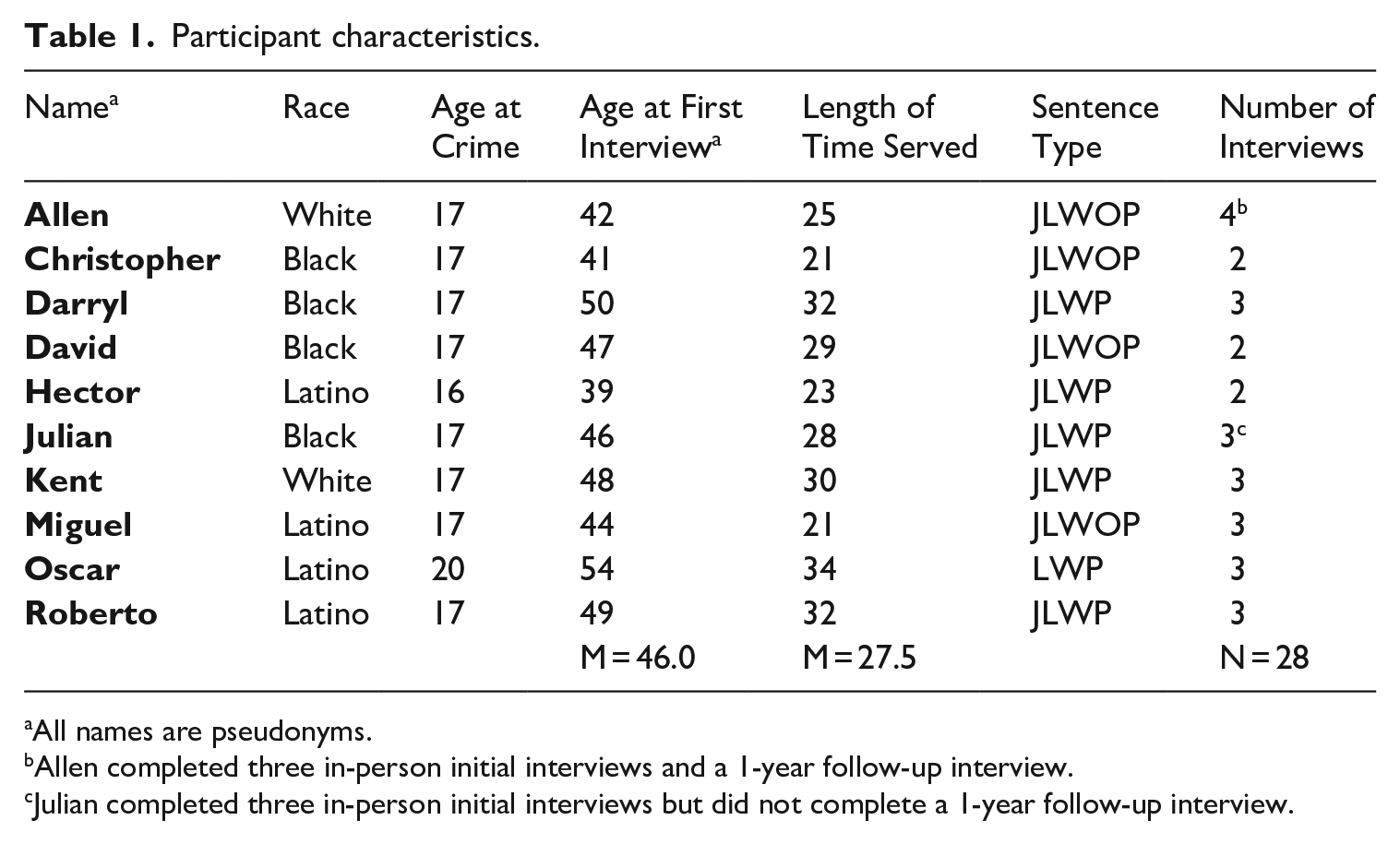
All names are pseudonyms.
Allen completed three in-person initial interviews and a 1-year follow-up interview.
Julian completed three in-person initial interviews but did not complete a 1-year follow-up interview.
Data collection
A team of researchers, including this author and two graduate students, conducted an initial series of two in depth interviews with all ten participants at private locations including reentry facilities, halfway houses, and university settings. Because the first two interviews were quite time intensive, two participants met with the researchers three times to complete the two interview guides. Next, 6 of the 10 participants completed a follow-up interview 9–16 months later over the phone or through Zoom or FaceTime, as COVID-19 restricted our ability to continue with in-person interviews. The total number of interviews that comprised the focal data set for this article is 28.
All interviews were conducted using a flexible interview guide with prompts. The first interview covered childhood history, family, school, friendships, criminality, and the homicide charge that resulted in the life sentence. The second interview included questions about finding meaning in prison, resentencing, reflections on victim impact, release, and transition back to society. The third interview followed up on transitions and current events (i.e. COVID-19, the murder of George Floyd and racial justice uprising, the highly contested US Presidential election of 2020). The third interview also involved some reflection on the process of parole, coming home, and reintegrating into society following long-term incarceration.
The interviews lasted between 90 and 160 minutes and were recorded either digitally with a phone recorder or on zoom. The researchers also administered a brief demographic survey at the first interview. The research team compensated participated with a US$35 gift card for the first interview and a US$40 gift card for any subsequent interview. Several participants declined the incentives. The Office of Research Protection for Human Subjects at the sponsoring University approved all procedures and consent forms related to the study.
Analysis
Interviews were transcribed verbatim by a professional transcription service and uploaded to Dedoose software version 9.0.107 to assist with data management, retrieval, and coding. The analysis team included the original researchers as well as one additional graduate student. Data analysis followed the steps associated with interpretative phenomenological analysis (IPA), which involves a deep reading of text, coding, and a detailed examination of each case (Smith and Fieldsend, 2021). We first constructed life histories for each participant. In the next phase, we then engaged in a process of open coding (Saldaña, 2014), inductively applying codes to sentences, chunks of text, and phrases found in the interview transcripts. After the initial coding was complete, we placed the codes into larger clusters of meaning to identify data patterns and themes (Smith and Fieldsend, 2021). For this analysis, we specifically focused on a set of codes and patterns surrounding participants’ narratives of desistance, agency, hope, and contexts grounding desistance in their prison contexts. This article does not include an analysis of desistance narratives beyond the periods of imprisonment and seeking parole. However, the authorship team has reported data on reentry and transition in related papers (Abrams, et al., 2020, 2023).
Results
The results presented in this section into three stages of the desistance journey: facing a life sentence, the will to change, and policy changes and the process of parole. Within these stages, I focus on the contexts grounding desistance, including both barriers and opportunities, and the overarching role of hope.
Facing a life sentence
The 10 men in this study shared the experience of being convicted of a homicide offense and receiving a sentence of either life without the possibility parole or life with the possibility of parole (i.e. 25 to life, 50 to life, etc.) at a young age. Many had already spent numerous years awaiting trial and had been held in the adult county jail or a juvenile detention center since the time of their arrest. All were eventually sentenced to life and transferred to one of numerous adult prisons in the state of California. Once in state prison, they were placed on restrictive yards due to the nature of the crime and lifer statuses; these are the yards commonly without access to rehabilitative programming or work privileges.
When these men entered their life sentences in the 1990s, California state prisons were characterized by substandard living conditions, overcrowding, gang and race riots, violence between inmates and staff, and rape and sexual abuse (Petersilia, 2008). Our participants also described in detail these conditions, including prison politics and survival, gangs, racial alliances, and violent and sometimes fatal conflicts between those imprisoned and with prison staff. Julian said of the California prison setting, “it’s the most selfish, hateful environment ever.” In the following conversation, Christopher, a former gang member, described how the prison environment reproduced and reinforced a criminal mind-set:
So, prison is stressful . . . like one of the guys that sat me down, he said I’m going to tell you this, and you either get it or you don’t get it. He said prison is like a minefield . . . It will explode anywhere. So, if you’re not careful, you’re going to die. Or you’re going to get hurt badly. So, prison is like a minefield. . . . Its 800 people on the level 4 yard. At least 700 have died in the last 30 or 40 years.
Because they have nothing to lose.
Everything is intense, magnified by 10,000.
Here, we see the how young people entering these restrictive yards are immediately socialized into joining prison gangs for protection and survival. The sense of having “nothing to lose” due to a life sentence amplified participation in continued criminal activity and violence, posing major barriers to launching any process of behavioral change.
In these conditions, a sense hopelessness washed over these young men as the reality sunk in that they would spend the rest of their lives in prison. The sense of having “nothing to lose” in turn, gave way to more violence. Darryl explained: “When I went to jail, even though I got crossed, [by fellow gang members] I was there already livin’ to die. It didn’t matter. Even when they gave me the time, it didn’t even hurt.” He continued to speak about why he participated in the racial politics and violence of the prison culture even though this lead to lock downs and further isolation in “the hole.” As he explains, the instinct to protect oneself through racialized group protection trumped his other needs: Part of my survival was . . . I was taught you don’t disrespect this race, that race, this way. Everything is race, even from the administration on down. They put you in some kind of category no matter what. You’re black, white, other, period. Then they promote it as a—no matter what, they treat differently. You see it as blatant. Of course, as a Black man, you’re frustrated. . . . The race also becomes just part of your mindset, and the concept and the politics of it. We were dumb enough to bite into it. At the time, we didn’t think about it, but we were dumb enough to think—our button was pushed. We were puppets.
Looking back, Darryl explains that instinct to protect oneself and to fall into the pattern of racialized gangs in prison just what the prison regime wanted: a way to maintain order and control. These conditions mirrored his prior experience in the community, where he had participated in taking a life due to loyalty to his gang.
Amid conditions of violence and harshness, most participants felt a stark absence of hope, which led them to believe that they would not be able to make a meaningful life for themselves in prison. Most had endured difficult childhoods, including violence and child maltreatment, and several were involved in foster care and the juvenile justice system as children and adolescents. Few had strong support systems even prior to their prison journey and suffered feelings that adults in their lives had betrayed them. Serving a life sentence hence a continuation of a trajectory of destructiveness and isolation that contributed to involvement in crime. As Oscar said, describing first few days in prison: “Yeah it was hopeless that first night. You feel gloom. You feel dread. This is it.” Christopher explained feeling numb: “When I went to jail, even though I got crossed, I was there already livin’ to die. It didn’t matter.” For most of the men, feeling devoid of hope continued a pattern of recklessness in behavior that resulted in continued criminality and further punishment, such as loss of privileges and time in solitary confinement. A few were even placed in solitary confinement for years at a time. Most felt, at least initially, that because their lives were “tossed away” to the system, they had no impetus to change. Hence at least in the initial stages of life imprisonment, desistance remained elusive.
The will to change
At various time intervals while serving a life sentence, participants reached a tipping point when they decided that they wanted to change; what one might consider as launching a desistance journey. In a prior paper, we noted that all participants went through a process of desistance in the life course in prison—but the timing and motivation differed for each (Abrams et al., 2020). Our team theorized three typologies of how this change occurred: Critical incident desistance (meaning that something snapped due to an internal or external event); gradual, non-linear desistance (meaning a back-and-forth process, until desistance finally clicked); and more immediate desistance upon receiving a life sentence (those who decided upon entering prison to immediately change course and live a meaningful, non-violent life in prison). They interpreted desistance as both behavioral; they stopped participating in illegal activities and began to engage in more rehabilitative activities; and internal: they expressed a commitment to changing and making a meaningful life in prison. These concepts were intrinsically related. As these findings were previously published (Abrams et al., 2020), this section of the results will focus more specifically on contexts grounding hope, and ultimately, desistance.
Contexts grounding hope and desistance
I had a sense of hope, of being able to try to live the best life that I could while I was alive—Allen.
For these men, the possibility of freedom was elusive for many years into their prison sentences; a circumstance that presents few incentives to change criminally rooted attitudes or behaviors. Yet even in these conditions, participants found motivation to create a more meaningful life prison, one that moved away from violence and toward spirituality, education, and supportive relationships with fellow prisoners. Moreover, the concept of “hope” played out prominently in these narratives, as narrated in Allen’s quote above and woven into this section.
One of the key contexts grounding desistance was the support of family members. Some participants were inspired by the family members who did not abandon them despite their criminal conviction and life sentence. For example, even if they did not see their relatives or receive visits for many years, family members wrote them letters and expressed that they would continue to visit and correspond. David, who was given a JWLOP sentence, spent several years getting into trouble in prison, including assaulting a staff member, and at several points, contemplating taking his own life. While in solitary, he thought about how his mother had not given up on him. He recalled, I wanted to be a different person. I remember writing my mother a letter, telling her, ‘‘I don’t want to be the guy that people remember as being a monster. I wanna be the guy that people can say: I actually learned something from that guy.”
It was at this juncture, and with the support of family visits, that he decided to give up gang activity and violence in prison and start participating in rehabilitation programs.
Other sources of hope to create a more meaningful life came from within the prison itself, through other lifers and older people in prison, along with some in prison programs (i.e. education, spiritual programming). Over the course of years in various prisons and being moved eventually to less restrictive prison units, participants were exposed to various educational opportunities, spiritual programs, prison employment, and other rehabilitation programs. These programs ranged in their scope and topic and were available at different times, and they provided a sense self-worth. For example, several participants took advantage of earning an educational degree or trade certificates in prison. Hector described, When I was in prison, I don’t want to say never, but I told myself, well, I’m here in prison, but it doesn’t mean that I can’t learn. It doesn’t mean that I can’t. I’m not gonna be miserable. I choose not to be miserable, just because I’m in this environment, just because I’m in this place. I’m gonna take my mind somewhere else. I’m gonna take my mind through school, through a job. I’m not gonna focus too much on prison. I would do that even when I went to the hole, I mean, that’s it. My books, that’s the first thing I asked the officers, for my property. “Hey, I just want soap, shampoo, deodorant, toothpaste, my toothbrush, and my book. I want my books.”
Similarly, describing his journey into trades, Hector discussed how his activities and his life began to take shape while in various prisons, programs, and levels of security. He said, I know how to run a dry clean machine. I got certified for customer service specialist and electronics technician, assistant. Right? When I went to a lower level, in 2004 I started working in the kitchen, culinary. I started getting involved in culinary, cooking and stuff. In 2007 I got in college. I been in college since 2007 ‘til now . . . All that time I was still messing up. I was the type of person that whatever happens, I’m there. In the peacetime or whatever, my time, I still went to school.
In these excerpts, Hector emphasizes that his journey was not linear, as he was still “messing up” while engaging in these activities. Yet in-prison programs such as literacy and employment provided the opportunity to exercise skills and learning that inspired these men to create a more meaningful life for themselves behind bars.
Other participants talked about the importance of spiritual life and study to ground their sense of hope and will to change. The study and practice of various faiths allowed people to reconsider how they had harmed others, and how they wanted to exercise their personhood in the future. Julian described: “I ended up becomin’ a Christian and readin’ the Bible and studyin’ and havin’ let go of my anger and all these different types of things, and I found peace. I let all that stuff go.” Through these groups and bible study, he considered how to reckon with the reality of a life sentence and to find inner peace.
Miguel described as an immediate turn to religion when he entered prison. In this longer narrative (edited some for brevity), he explains how prayer and contemplation allowed him to accept his life sentence and make his life meaningful, regardless of his circumstances: I started thinking about God, and I’m like, why? Why did you create me God? Why was I brought to this world to die in prison? Like why? And I wanted to seek that answer. I remember I went into the cell and like, I had never felt so lonely. I was in this six-man cell. And I remember it was so dirty like the cell was like . . . so dirty. There was graffiti everywhere and, it didn’t have no mattresses on the bunk. And it was cold, and the air was blowing, and I go in there and I sit down. And in that moment like, everything just flashes through my mind. And that’s how I felt—dark, cold, dirty. And I just started thinking about my family, I started thinking, like what did I do? Like how could I have taken someone’s life? At the time I don’t know why, but I was making a connection with my mother, and like what if that was me and I had died, how would my mother feel? And my dad? And something overcame me, like all of a sudden, I got scared like what’s going to happen? I’m going to die here, and I don’t want to die like this . . . In that moment I started remembering my childhood. I start remembering like this faith. I remembered the Lord’s prayer. In that moment I’m like, I’ve got to make things right with God or else I’m going to die in here. And I remember, I’m walking around, I’m walking around the cell, and I’m getting desperate, like I’m gonna to die. And I go to the back of the cell, and I just fall to my knees, and I start crying. And in that moment, I don’t know, I get up and I felt so light, and I felt different. I just remember like when I was a kid, people saying, if you confess to Jesus that he will forgive you. I remember me saying, “Jesus, will you truly forgive me for what I did?” And I remember that I was just different.
Miguel’s powerful narrative is a testament to his deep contemplation about the meaning of his own life, taking another life, and how his turn to faith could lead to self-forgiveness and compassion. Despite his crowded cell, the graffiti, and the “dirty” and “cold” environment, his focus on prayer led to hope and path to healing. For Miguel, being involved in a faith community immediately set him apart from gangs and prison culture, and his process of desistance began and continued through his deep dive into spirituality.
Policy change and the process of parole
During the long periods of time that these men were incarcerated, evolving policy changes—from the US Supreme Court to the California legislature—eventually brought some glimmer of hope for release. As legislation was proposed and eventually passed to give people sentenced at young ages a change to be resentenced, advocates and lawyers began to reach out to participants wanting to help with their cases. To contend with this potential glimpse of freedom, many tried to temper their expectations, knowing that there was a potentially a long road ahead. Miguel stated, Honestly, I knew the minute this bill passed, I knew that if I was in front of a judge, I was gonna get released. [. . .] I just felt [the clinic] was, they were covering all their bases and I understand that now, but at the time I’m like, “We don’t need all this. Why are you, why is this taking so long? Just put me in front of a judge.”
Allen shared that within the prison, a group of men serving JWLOP sentences started to form a community of support for one another. The process itself could take years; requiring people with JLWOP to get resentenced and then to seek parole. Yet seeing others getting resentenced—and released—provided glimmers of hope that one day, they could also be free:
I can remember as the other juvenile LWOPs were a part of this community that we had built, would go to different lawyer meetings, or whatever. People would be waiting for them to come back.
To see and hear what happened.
To absorb some of that hope that their lives maybe had meaning. And had worth.
This discussion with Allen shows that the process of being potentially released was not just about the release itself, but about showing others that lifers’ lives do have “meaning” and “worth.” This reveals that to Allen this was not just a matter of earning freedom; it was also a matter of asserting the core humanity of himself and his fellow youth lifers.
Moreover, as part of the parole hearing and process, all participants were asked to demonstrate remorse, concerted changes in behaviors and attitudes, and to detail their involvement in rehabilitation programs. Kent, who spent many years using drugs in prison before finally deciding to stop, had four failed parole hearings before he was finally granted his freedom. He explained, The problem is it took me a while to change, but it took me a while to learn how to convey that to ‘em. That’s the problem is we shouldn’t have to convey what we’re feeling to people. I gotta prove to you that I changed, which is cool, but my actions speak for themselves.
Kent proceeded to talk about how his experience of his internal self wasn’t always reflected in these hearings, but that he was confident one day he could convince the external world that he had truly changed.
In addition to preparing a statement for the parole board, participants also went through an internal process to convince themselves that actually deserved their freedom. Kevin explained that the external validation of being granted parole was a joyous moment, but that even before that, that he was proud of the changes he had made for himself. He stated, I rejoiced, I was happy, because I wanted the opportunity to be able to come in here before the Commissioners to show you that I’ve changed. Even if I don’t get found suitable, even if I don’t get out, I made the change for me, because it was the right thing to do, and I wanted that to be seen. I needed that to be seen, because I didn’t wanna be perceived as the monster for the rest of my life or the guy that took another man’s life and didn’t have any remorse behind it. I needed this to happen and having life without, wasn’t gonna happen.
As Kevin narrates, all these men had made changes in their identities, behaviors, and relationships for as “the right thing to do.” The stamp of parole approval provided another layer of validation for these changes but was not the main motivation for wanting to change.
In sum, over time, the policy evolution in the state of California provided a newfound hope for freedom, which may have influenced participants’ behaviors and attitudes once they became aware that freedom was indeed a possibility. Yet all these men took steps toward desistance before these laws were implemented. In this sense, resentencing and parole processes were validating and liberating, but not the main sources of participants’ hope or sense of self-worth.
Discussion
In this analysis, I find that desistance in harsh conditions appears to be not only possible for these youth lifers but also warrants consideration beyond the idea of aging out of crime or earning parole. As illustrated in a prior paper, the respondents in this study all located desistance through a blend of maturation, critical events, wanting to change, believing in the self, and moral reckoning and forgiveness (Abrams et al., 2020). In this article, I delve deeper into the contexts grounding desistance and how finding hope for living a meaningful life encouraged agency toward making changes that were necessary to get out of prison crime.
In the chicken-and-egg debate (LeBel et al., 2008), there is a lingering question about the interacting roles of structure and agency in launching and sustaining desistance. Most desistance scholars acknowledge that a blend of these factors is likely key to moving toward, and sustaining desistance over time for those who offend at young ages (Abrams and Terry, 2017; Farrall et al., 2010; Giordano et al., 2002; Maruna, 2001). However, understanding the timing, precursor, and blend of these elements remains an open question. Joanna Shapland and colleagues argue that agency should be considered a critical factor for desistance, a process that is not linear, which takes concerted efforts, and often seems unattainable for youth and young adults navigating post-prison society (Shapland, 2022; Shapland and Bottoms, 2011). Here, I consider what the study of youth lifers in the United States can add to these critical questions and conversations.
The context of the state prison in the United States, particularly as these participants describe it, is antithetical to what we might view as optimal contexts for attitudinal or behavioral change. From the absence of opportunity to exercise daily autonomy, to harsh conditions, threats of a real violence, racialized gang politics, and the lack of normalized adult social structures; being imprisoned during a time of normal “maturation” poses an uphill battle for attitudinal and behavior change. These findings resonate with those of Crewe et al. (2020) among youth lifers in the United Kingdom. In this study, we add into the mix of factors an absence of hope due to the imposition of life sentence, which in the United States, literally means life in prison. In sum, conditions for both motivation and the social structures that would lend themselves for the desire for, or the enactment of desistance more behaviorally, were not readily available, at least upon their adjustment to life imprisonment.
That said, through various conditions that interfaced with the internal work of change, these 10 men found motivation create a meaningful life for themselves; one that involved a desistance—expressed both behaviorally as well as in mind-set; as well as hope. These contexts grounding desistance included participation in educational, vocational, and spiritual programs; support from family and prison elders; and time to read, pray, and contemplate the meaning of their lives. Many had significant reflection time in solitary and in the boredom of prison life that eventually provided will to change. What these contexts may share with those who locate desistance in the free world may be that they inspire a sense of purpose, connection, and meaning. However, these elements would need to be explored in further research.
Amid extremely harsh conditions, desistance in the behavioral sense translated into ceasing participation in continued prison crimes, violence, and gangs. Without a measure of recidivism in the traditional sense (Rocque, 2021), the challenge to work their way into a different set of behaviors and mindsets all the while contending with the pressures of the institution itself that lends itself directly to participating in violence. For most, behavior and attitudinal changes emerged gradually and had starts, stops, and setbacks; similar to desistance patterns noted in other literature (Abrams and Terry, 2017; Shapland, 2022). For Miguel, the intensity of his spiritual self-discoveries grounded him mentally for a desistance journey that was unwavering throughout his time in prison.
In addition to changing prison behaviors, desistance also appeared to mean actively developing a self did not want to participate in causing further harm to others. Participants clearly took agency toward change—including perseverance, self-discovery, prayer, reading, and surrounding them with others who shared their values. They also made concerted efforts to find value in themselves, a sense of self-worth beyond the life sentence and beyond the crimes committed in the past.
The ultimate external validation of this internal change was having the parole board grant their freedom. That said, learning about the possibility for freedom or having that validation may have furthered desistance motivation, but did not spark the desistance journey. In other words, it was the critical ingredient. In fact, the men appeared to develop a sense of self-worth and self-love long before they had hope for their freedom.
Conclusion
In conclusion, this study adds empirical research to theories of desistance in the context of long-term imprisonment and harshness (Kazemian and Travis, 2015). Through this exploration of longitudinal narratives, I find that even within the prison, one can exert agency toward desistance and find contexts that support these changes. We understand that even in the harshest of circumstances and void of hope, one can find the will to change. This study is exploratory and limited in scope and does not purport to be transferable to other contexts. Indeed, a small study with ten participants provides a robust depth of perspective, but not breadth or replicability. Future research can build on these findings with larger samples and methods to continue to reflect on the connections between life sentences, hope, meaning, and desistance.
Footnotes
Appendix 1
Appendix 2
Declaration of conflicting interests
The author(s) declared no potential conflicts of interest with respect to the research, authorship, and/or publication of this article.
Funding
The author disclosed receipt of the following financial support for the research, authorship, and/or publication of this article: This study was partially funded by a seed grant from the UCLA Faculty Senate.
