




Abstract
Since the so-called ‘migrant crisis’ in 2015, there has been intense policy interest around irregular migration along the Central Mediterranean Route to Europe. Despite increased research focus on this route, the details and geographical intricacies of these migration journeys have scarcely been examined. In this study, we investigate the what, where and how of the journeys of 71 people who travelled from Libya across the Mediterranean Sea to Malta. To do so, we break down their journeys into scripts (i.e. sequences of activities) and represent them as a composite script graph. We find that journeys were long – 18 months on average – and circuitous, involving diverse and complex geographical paths. Smuggling, brokerage and working during transit were key aspects of most journeys. Worryingly, two-thirds of participants experienced detention and/or forced labour before reaching Malta. By pinpointing where and how harm occurs, the composite script graph can support policy makers in reducing harm, including by accounting for the possible harm that interventions may cause, directly or as a result of displacement.
Introduction
Increased irregular migration to Europe has made migrant smuggling a central and contentious issue in European politics, particularly since the so-called ‘migrant crisis’ of 2015 (Hutter and Kriesi, 2022). A key route to Europe is the Central Mediterranean Route (CMR), through conflict-affected Libya. In response, the European Union (EU) has invested heavily in research and measures designed to reduce irregular migration, including anti-smuggling and anti-trafficking activities (Bish, 2024a; EU Commission, 2016). A notable increase in research led by non-governmental organisations (NGOs) on irregular migration on the CMR since the ‘migrant crisis’ has shed light on some of the harms en route (Micallef et al., 2019), as have ground-breaking journalistic accounts (Hayden, 2022).
There is, however, a need for systematic empirical research into the largely unexplored details of migration journeys along the CMR and how they can become pathways to trafficking and exploitation (Murphy-Teixidor et al., 2020; Bish et al., 2024). Existing research has focused primarily on the macro-level geographies of migration (e.g. routes and numbers of arrivals) and the causes of departure, often overlooking the micro-geographies, decision-making processes and logistics (Crawley and Jones, 2021). These logistical geographies (Cowen, 2014), encompassing physical, social, economic and political infrastructures, are likely to shape migrants’ vulnerability to risks related to trafficking and smuggling.
While publications on irregular migration and harm on the CMR offer valuable conceptual insights derived from migration studies (Kuschminder and Triandafyllidou, 2020; Massari, 2015), empirical investigations remain scant. Moreover, where empirical work does exist, it occasionally lacks scientific rigour or transparency. Responding to these gaps and limitations, our study aims to map the standard migration-related activities that people undergo on their journeys on the CMR, using script analysis.
While we do not approach irregular migration itself as a ‘crime’, 1 we believe the frameworks and tools from Crime Science can be leveraged to understand harms experienced by migrants, many of which are caused by criminals taking advantage of their precarious situations (Micallef et al., 2019). Specifically, we deconstruct the journeys of people who travelled on the CMR into sequences of activities experienced on their way to Europe, situating each in space and time. Known as scripting, this approach helps us unpack how irregular migration takes place and identifies factors producing or facilitating exploitation and other harms.
We begin by giving an overview of the current research on irregular migration and harms to migrants on the CMR, with a focus on its data, methodological limitations and particular knowledge gaps. Then, we provide a brief overview of Crime Science and crime scripting before presenting our data and methods, findings and a discussion of the results.
Irregular migration in the central Mediterranean
The emergence of Libya as a transit hub for irregular migration to Europe
The CMR became a major pathway to Europe during 2015’s ‘migration crisis’, with people embarking primarily from Libya, Egypt, Tunisia and Algeria (Tinti and Reitano, 2017). Libya featured most prominently, likely due to its proximity to Italy and political situation. Under Muammar Qaddafi’s regime, controlled smuggling economies were allowed in Libya for political reasons (Tinti and Reitano, 2017). Following Qaddafi’s fall in 2011, the previous system disintegrated amid intense unrest. Libyan militias and smuggling networks took advantage of the power vacuum to assert their dominance over the migrant smuggling economy (Micallef, 2017).
According to Micallef (2017), the involvement of coastal militias in protecting and profiting from human smuggling activities was instrumental in the growth of the migrant smuggling economy between 2014 and 2017. Militias reportedly facilitated smuggling in several ways, including by smuggling people themselves, taxing smugglers and operating detention centres for migrants. The journey from Libya has been found to be typically organised by a smuggler who determines when conditions (e.g. weather, boat capacity or surveillance activity) are suitable for crossing. With the introduction of Search and Rescue (SAR) missions by the Italian government and NGOs in 2013, smugglers only needed to target the waters covered by SAR missions to ensure migrants’ delivery to Europe (Deiana et al., 2020).
Migrants on the CMR can travel through several transit hubs before reaching coastal Libya: a key example is Sebha in southern Libya, due to its position just north of the Sahara Desert (Tinti and Reitano, 2017). A significant people smuggling route links Sebha to the city of Agadez in Niger, which has become one of the most important hubs for trans-Saharan migration (Tinti and Reitano, 2017).
Agadez is the most northern major hub before the Sahara Desert of Niger, which is part of the Economic Community of West African States (ECOWAS), a block that offers all its citizens freedom of movement. Despite not always being fully implemented (Zanker et al., 2020), freedom of movement within ECOWAS facilitates travel from across West Africa to Agadez before the desert crossing into Libya (Micallef et al., 2019). Similar hubs for migration from East Africa have arisen in Ethiopia and Sudan on routes connecting East and Central Africa to Libya, due to insecurity primarily in Somalia, Eritrea and Sudan (Tinti and Reitano, 2017).
People travelling on the CMR have reported suffering and/or witnessing various types of harm en route, including detention, deportation, discrimination, violence (including sexual violence and fatal violence), abuse, forced labour, human trafficking, corruption, violent extremism, environmental problems and other health issues (OHCHR, 2021).
Abuse and violence are widespread in detention centres in Libya (Malakooti, 2019). Malakooti (2019) distinguishes between official and non-official detention centres. Official detention centres are established and/or authorised by the Directorate for Combating Illegal Migration (DCIM) of the Libyan Ministry of Interior. In contrast, non-official detention centres are not recognised by the DCIM and are generally run by smugglers or armed groups (Malakooti, 2019).
Representative estimates for the prevalence or incidence of various harms along the CMR do not yet exist, but there are highly concerning findings from what seem to be convenience samples. A 2017 survey of 921 people who arrived in Italy from Libya found that 75% reported having experienced physical violence along the route (UNHCR, 2019). Another report based on 50 interviews between 2014 and 2020 found that 85% of respondents who had travelled through Libya had suffered from torture and inhumane or degrading treatment (MEDU, 2020).
Gaps and limitations of existing research into the geographies of smuggling on the CMR
Existing research on the CMR has various gaps and limitations that need attention. There is an acute shortage of rigorous, independent, peer-reviewed research into migration and harms on the CMR (Bish, 2024a; Murphy-Teixidor et al., 2020). The existing evidence mainly comes from journalists, international organisations, and NGOs, whose findings may be particularly liable to biases, such as those linked to their funding and political agendas (Hüsken, 2021).
While vital in advancing knowledge about the CMR, such reports often derive from small and unrepresentative samples (Sanchez, 2019). Moreover, methodological transparency is rare, with uncertainty around data provenance and sampling strategies (e.g. search terms and inclusion parameters).
In addition to the generally limited empirical research on the details of migration journeys on the CMR, there are particular knowledge gaps around people’s activities and experiences leading up to exploitation. Existing studies often focus on geographical routes rather than experiences. The limited research that does examine lived experiences of migration has mostly been conducted with small samples (Kuschminder, 2021), analysing individual experiences separately. Yet, understanding common experiences and activities across geographies, as well as where – in migrants’ experiences, not just geographically – journeys diverge and converge can provide vital insights into risks and opportunities for harm reduction.
Scripting irregular migration, smuggling and trafficking
The academic study of irregular migration has been traditionally approached through lenses of migration systems, migration industry, migration network theories, and/or individual decision-making theories (McAlpine, 2021). While such frameworks provide important insights into migration dynamics, they do not necessarily capture the multifaceted nature of migration. In contrast, innovative approaches such as trajectory ethnography and social navigation theory focus instead in detail on individual journeys (Schwarz, 2020).
Given the complexities of international migration, an interdisciplinary approach is key (Massey et al., 1993). To date, few studies have approached migration from a Crime Science perspective (Cockbain et al., 2024). We argue, however, that examining human smuggling and trafficking through this lens can offer useful insights to address migration-related harm. To be clear, we are not conceptualising irregular migration itself as deviant behaviour, but as a phenomenon susceptible to attract criminal activities – as in the literature on crime generators and crime attractors (Brantingham and Brantingham, 1995). As such, we believe that ecological theories that stem from Crime Science can help in understanding the systemic and individual elements that contribute to the manifestation of harms along the CMR.
Crime Science has its theoretical underpinnings in opportunity theories of crime and environmental criminology (Felson and Clarke, 1998). These theories suggest that crime occurs when a motivated offender identifies a suitable target within a conducive environment, absent of capable guardianship. While acknowledging the influence of broader systems and structures governing irregular migration, we subscribe to the view that a closer focus on the immediate environments within which harms occur on the CMR can help identify key risks, consequences of policy and inform harm-reduction efforts. Within Crime Science (Cockbain and Laycock, 2017), crime scripting stands out as a particularly promising approach to understanding harms on the CMR. Originally proposed by Cornish (1994), it involves breaking down the crime-commission process into sequences of steps leading to and following a crime. A commonly cited application of crime scripting is the identification of ‘pinch points’ and the development of interventions to remove criminal opportunities. A step in this direction, the article represents migration journeys as scripts and combines them together into a single graph to reveal where they diverge and converge, and how and where certain harms tend to occur.
Emerging research has highlighted the benefits of extending a traditional focus on scripting offenders’ actions and decisions to cover victims’ experiences too (Copes et al., 2012; Leclerc, 2013; Smith, 2017). Without seeking to blame victims, victim scripts can be used to identify the decisions and routine activities that puts people at greater risk of victimisation, and therefore to inform prevention.
A systematic review by Dehghanniri and Borrion (2021) indicates that scripting approaches have yet to be applied to irregular migration at large or people smuggling specifically, although there have been a few applications to the study of human trafficking (Brayley et al., 2011; Savona et al., 2013). The closest conceptual parallel for irregular migration journeys is Zimmerman et al.’s (2011) study into migration, which deconstructed the migration process into five phases to conceptualise the typical actions, opportunities and vulnerabilities that occur. While their framework provides a valuable foundation for understanding migration journeys, they do not detail their methodology nor the data upon which it is based. We argue that its comprehensiveness could be significantly enhanced by adopting a more systematic method that incorporates often overlooked yet pivotal experiences migrants face, such as those related to work and work-related exploitation (ILO, 2017). Furthermore, we propose an innovative representation of the scripts through the creation of a composite script graph.
Method
Problem formulation
Our study aimed at mapping migration journeys to Malta, understanding where they diverge and converge, and how and where certain harms tend to occur along these journeys. To do so, we followed the scripting process proposed by Borrion and Dehghanniri (2023) and demonstrated its applicability to migration studies. To facilitate its adoption by others, we detail the various stages in this section: data collection, information extraction, script elaboration, script visualisation and presentation, and script verification and validation.
Data collection
In this study, we used secondary data provided by the Global Initiative against Transnational Organised Crime (GITOC). The data consisted of transcripts of interviews with migrants (>18 years old) at the Marsa Initial Reception Centre (IRC) in Malta: the first stop for all migrants rescued at sea and arriving in Malta’s seaports in NGO vessels, with the Armed Forces of Malta or private vessels. Our study uses a sample of 78 transcripts provided by GITOC, which were collected using convenience sampling. The interviews were conducted over 14 months (July 2018 to September 2019), in a private space of the centre (room or quiet corner), and generally lasted approximately one hour. They were semi-structured and designed to understand the participant’s journey as a narrative from beginning to end, with a particular focus on the routes taken, prices paid and any experiences of smuggling, trafficking and harm. The main interviewer, a GITOC analyst, had substantial experience in conducting interviews. As a former GITOC employee, the first author observed four interviews (6%), which gave him insights into the interviews’ context and style. The interviews took place in participants’ native language. They were typed directly on a laptop and translated into English by a professional interpreter with significant experience interviewing vulnerable people.
Ethics
Data collection was guided by GITOC’s ethical standards and safety regulations (GITOC, 2019). The UCL Research Ethics Committee (REC) approved our usage of the secondary data (reference 15451/001).
Information extraction
Creating the baseline script graph
To orient our work, we started with the creation of a baseline script graph delineating hypothetical migration journeys. First, the script graph gave us a glimpse into what our empirical script graph might look like; second, it helped us create a codebook defining the type of information we wanted to extract from the transcripts; and third, it served as a baseline against which to compare the empirical script graph.
Our baseline script graph was informed by thematic analysis of the existing literature and the first author’s previous research experience (see Micallef et al., 2019, 2021). The approach of combining scripts and codebooks was inspired by the work of others who studied drug trafficking and sexual offences against women (e.g. Chiu & Leclerc, 2021; Morgenthaler and Leclerc, 2023). However, we believe the method we followed to develop the script, based on states and state transitions (for more details, see Borrion and Dehghanniri, 2023), yields greater structural and syntactic consistency. For example, our script only comprises activities, whereas other scripts can consist of a heterogeneous mix of activities (e.g. ‘getting the goods’) and variables (e.g. ‘location of laboratory’, ‘benefits’; Borrion and Dehghanniri, 2023).
The baseline script graph included 102 distinct migration-related activities which people might realistically encounter en route to Europe, including travelling to a country, meeting a smuggler and meeting a broker. We assigned each activity a consistent codename (e.g. SAS12, LAS2, etc.), based on its mobility and duration: SAS (Short Activity Static – less than a day), LAS (Long Activity Static – more than a day), SAM (Short Activity Mobile) and LAM (Long Activity Mobile). In addition, given the geographical expanse covered by participants, we introduced a geographical component to the baseline script, and partitioned the region into the following six zones: Non-Neighbouring Countries to Libya (Zone 1), Neighbouring Countries to Libya (Zone 2), Southern Libya (Zone 3), Northern Libya (Zone 4), Mediterranean Sea (Zone 5) and Malta (Zone 6).
Coding the transcripts
We meticulously read each interview transcript, identified any interaction that significantly affected a person’s trajectory during their journey, and assigned the corresponding codename. 2 Through this process, 80 activities in the baseline graph were corroborated by the transcripts. We also identified one activity that did not feature in the baseline script graph and added it: a mechanical incident with a boat, which forced passengers to return to shore.
Then, for each transcript, we recorded the codes in chronological order. If a participant travelled through the same zone more than once, we recorded that accordingly. We consulted maps for accuracy, particularly when coding geographic areas of uncertainty. For instance, participants reporting work on goldfields straddling the Chad–Libya border were coded as being in Libya, since the activity has been reported to mostly occur on the Libyan side (Bish, 2021).
The coding process also addressed levels of uncertainty in the script production. When a step was obviously missing in a script, we added an activity to produce an uninterrupted sequence. We assigned it the label ‘inferred’ if it was the only plausible preceding activity, and ‘assumed’ otherwise, in which case the most likely path was selected (Borrion, 2013). This process yielded a set of scripts with 8.2% inferred and 20.9% assumed activities (n = 2634). The majority (71%) of the events, however, were clearly evidenced in the transcripts; and every activity mentioned in the scripts was empirically justified at a ‘known’ level by at least one participant.
Reviewing and improving the results
We assessed the quality of the individual scripts (see Borrion, 2013). For completeness, we removed seven transcripts that contained too many gaps. Following this process, we maintained a total of 81 activities across all six zones, comprising 29 unique types (with some activities recurring across several zones). The percentage of ‘assumed’ steps in the sample (now reduced to n = 71) thereby decreased from 21% to 14%, while ‘inferred’ nodes slightly increased from 8% to 9%. ‘Known’ nodes rose from 71% to 77%.
Elaboration of the micro-level and macro-level scripts and composite script graph
The 71 sequences of codes were used to represent 71 individual scripts. To do so, steps were defined as nodes and the connection between those steps as edges. The high level of standardisation used to produce the scripts made the process relatively straightforward. A composite script graph was also created by merging all 71 scripts together.
Owing to its complexity, the composite script graph can be difficult to understand at first. To improve its usability, we sought to produce less granular scripts, by merging thematically similar steps into a single activity. For example, ‘Wait in detention centre’ and ‘Forced labour’ were grouped into a more general step called ‘Detained/exploited’. Cornish (1994) uses different names to refer to scripts at different levels of abstraction: track, script, protoscript, metascript and universal script. In the following, we simply refer to ours as the micro-level (81 steps) and macro-level (21 steps) scripts and composite script graphs.
Script visualisation
We represented the two sets of scripts and composite script graphs using Python’s NetworkX and Matplotlib libraries. With this algorithm, we were able to quickly display any script of our choice and create animated sequences of scripts. This also helped visualise the number of participants moving between activities on the composite scripts (see the weighted arrows in Figures 1 and 2), providing quantitative insights into connectivity between activities in our sample. The coding scheme presented earlier (SAS, LAS, SAM and LAM) was used to emphasise time and space. Activities were reconfigured spatially and standardised across zones for visualisation. Grouped activities in the macro-level graph have the following colour codes: green represents travel, blue represents activities that facilitate travel, red represents activities that impede travel and are harmful, and orange represents activities that impede travel but are not inherently harmful (Figure 1). We did not apply any colour-coding to the micro-level graph, to facilitate text legibility.
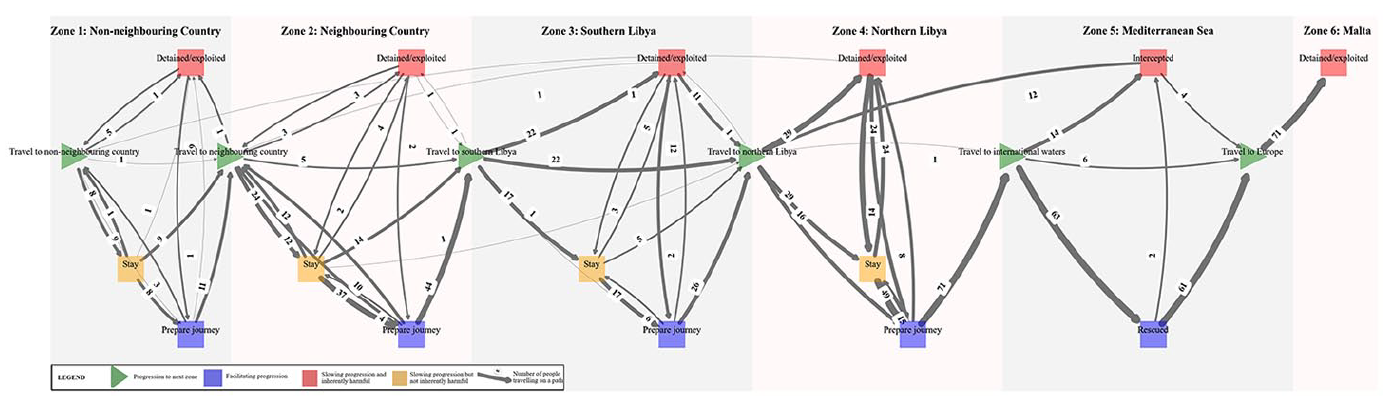
Macro-level graph of migration journeys post-grouping (n = 71).
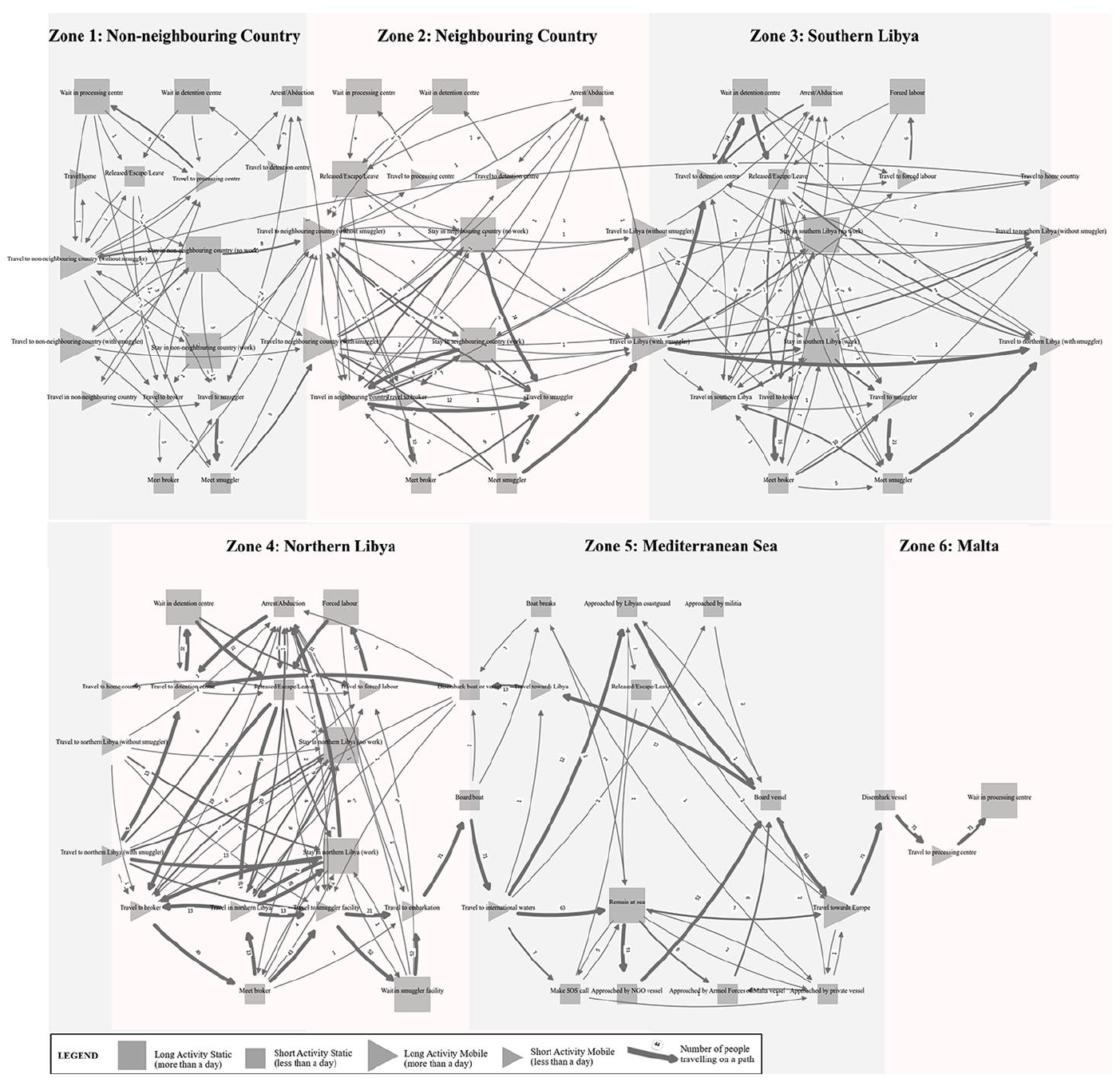
Micro-level graph of migration journeys pre-grouping (n = 71).
Verification and validation
Borrion’s (2013) quality criteria informed script development. These included indicating the script type (i.e. performed, meaning they actually happened) and the context within which they occurred, limiting our sample to transcripts that had sufficient information to represent the journeys to Malta without gaps, describing the scripting method to allow its replication (including the way we integrated multiple scripts), applying the scripting method systematically (e.g. coding, merging and visualisation), avoiding extracting information not relevant to our primary purpose (i.e. mapping journeys and understanding where they diverge and converge) and indicating the elements that were uncertain in the scripts. We developed two composite scripts at two levels of abstraction (micro and macro) and adopted different symbols to distinguish between four types of activities to support the usability of the scripts for research and policy.
We performed verification to ensure the scripts faithfully represented the information within the transcripts (accuracy, ambiguity and completeness criteria). This involved the independent double-coding of 11 transcripts 3 (14%) and a final consistency check, whereby we cross-referenced each activity with each narrative to ensure the logical order was respected and to eliminate any redundancies. Regarding the ambiguity criterion, two independent academics reviewed the scripts and considered them clear enough.
Although we endeavoured to rectify potential gaps and oversights in the script, it is possible that some errors persist. We acknowledge that there is inherent subjectivity in our interpretations, which may have influenced the final scripts. Moreover, we could not assess the accuracy of the information in the transcripts (e.g. potential self-report bias). This underscores the inherent challenges and complexities of the exercise and serves as a reminder of its limitations (see ‘Discussion’ section).
Validation: The script graphs fulfilled their primary purpose: to identify the stages of migration journeys and the points where they converge and diverge. The ultimate test of their utility remains their applicability in real-world scenarios of informing policy.
Results
Overview of the sample
Most of the 71 participants were men (89%, n = 63), while eight were women. Participants were aged 18–50 years at the time of interview, but all except one were below 36 years (Median = 21, IQR = 6.5). Half were below 21 years (n = 36). Participants originated from 17 countries in total, across Central, East, North and West Africa, as well as the Middle East. The most common nationality by far was Sudanese (n = 31, 44%), followed by Eritrean (n = 7, 10%; Figure 3).
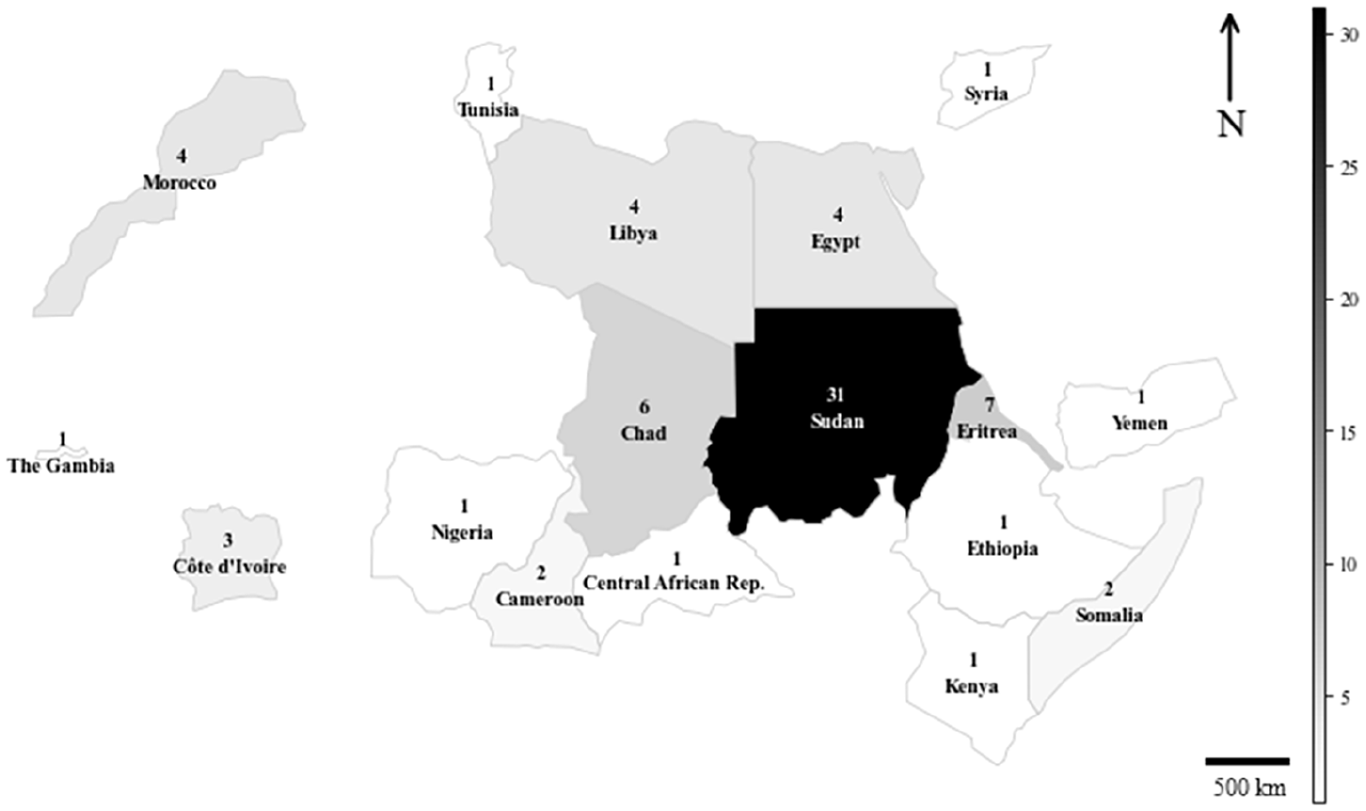
Map of participants by reported country of origin (n = 71).
Time travelled
Journey lengths from self-identified journey start-point to arrival in Malta varied greatly. The median duration of journeys was 18 months (Min = 3 days, Max = 115 months, IQR = 22 months). Two-thirds of participants travelled for more than a year (n = 48). Of the others (n = 23), only nine travelled for less than three months before reaching Malta. By subtracting the duration of their journey from their age upon arrival in Malta, we deduced that 15 participants (21%) were below 18 years when they began their journey.
Zones travelled
Participants travelled through between three and five zones before reaching the sixth zone, Malta. Twenty-two participants departed from non-neighbouring countries to Libya (Yemen, Somalia, Côte d’Ivoire, Nigeria, Cameroon, the Central African Republic, Morocco, Ethiopia and the Gambia). In addition, 40 participants (56%) departed from neighbouring countries to Libya (Algeria, Chad, Egypt, Niger, Sudan and Tunisia) and 9 participants (13%) departed from Libya itself (see the shortest journey script in terms of activities depicted in Figure 4). All participants travelled through Libya and embarked on boats in the Mediterranean from Libya.
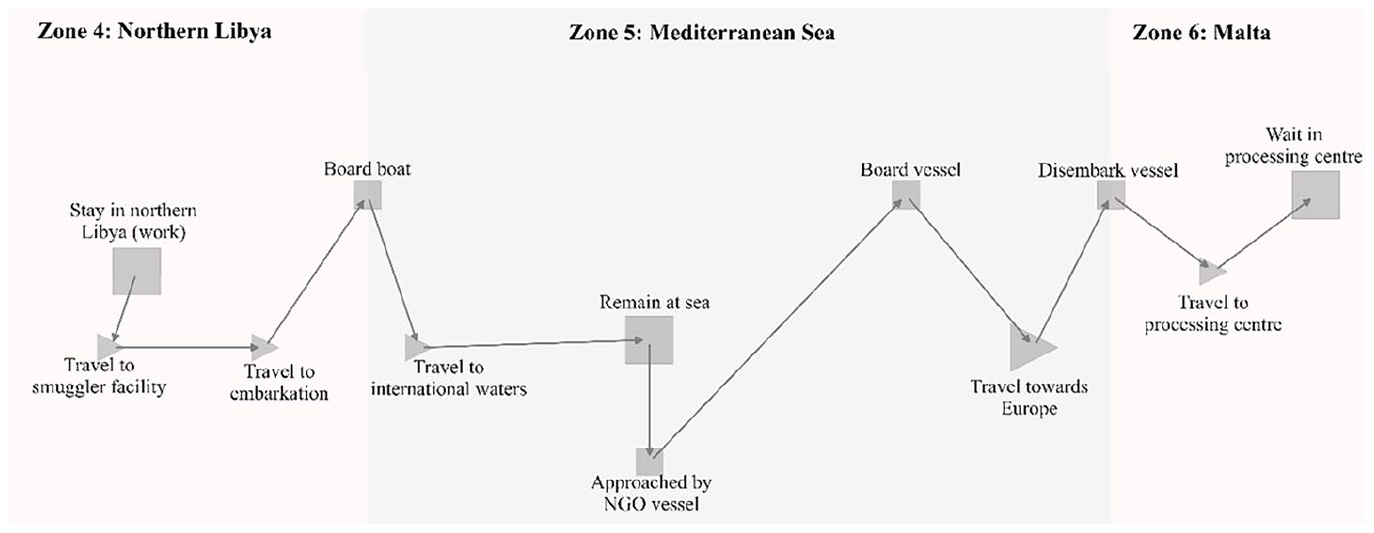
Ahmed’s journey (not his real name).
Ahmed’s journey (not his real name) represents one of the shortest in terms of activities (n = 12) among those we documented (see Figure 4). Originally from Sudan, Ahmed spent the majority of his life in Misrata, a city in northern Libya, where he worked as a tiler. Despite his long-standing residence, he faced increasing discrimination and ethnic prejudices, which culminated in him being unpaid for his work. In search of a new beginning, Ahmed entrusted LYD 2500 to a smuggler (approximately US$1825, as converted using a historical currency converter for 2018 – note, due to currency fluctuations, this may not accurately reflect the exact value at the time). He then spent two days waiting in the smuggler’s facility located in Zliten, a town in northern Libya. Following this brief wait, he was placed on a boat and subsequently rescued at sea by an NGO search and rescue vessel. Ahmed was interviewed three months after his stated departure in the IRC in Malta.
Twenty participants travelled through two neighbouring countries to Libya (combinations of Niger, Chad, Sudan, Algeria, Tunisia and Egypt). Moreover, 14 participants travelled through two non-neighbouring countries to Libya before reaching a neighbouring country, highlighting the non-linearity of journeys. Two participants travelled through four non-neighbouring countries on their journeys, underlining the considerable duration and geographical distance of their journeys. Travel between zones 1 and 4 (i.e. between a non-neighbouring country to Libya and northern Libya) involved land travel for most participants (n = 66 or 93%), except for five participants who travelled by plane to Libya: three from Egypt, one from Syria and one from Morocco. Two other participants from Morocco also travelled by plane, but only until Tunisia (Tunis) and Algeria (Algiers), respectively, whereafter they travelled to Libya by road, using a smuggler.
Macro-level script graph
When creating the macro-level composite script graph, we found that participants experienced six broad groups of activities: four in the first four zones and two in the Mediterranean Sea (Figure 1). When travelling through the first four zones up to the Mediterranean Sea, all participants experienced at least the first three of the following grouped activities (Figure 4):
Staying in the zone, with or without working;
Preparing their journey, by going to see a smuggler and/or a broker;
Travelling to the next zone, with or without a smuggler; and
Being detained and/or exploited, following arrest or abduction.
When they were in one of the first four zones, participants reported undergoing two principal grouped activities: either staying in the zone (with or without work) and/or preparing their journey to the next zone by meeting a broker and/or a smuggler. To get to the next zone, participants either travelled with or without a smuggler. All participants used a smuggler for at least one zone transition (see below). While either staying in a zone, preparing their journey or travelling, a key obstacle that most participants (68%, n = 48) encountered was detention and often some (other) form of exploitation, following arrest or abduction.
Participants transitioned between these grouped activities in different sequences until they reached the Mediterranean Sea and Malta (see arrows between grouped activities in Figures 1 and 5). For instance, during their travel participants could go from staying in a zone (with or without work) to being detained, or preparing their journey (with a smuggler and/or a broker), or travelling (with or without a smuggler).
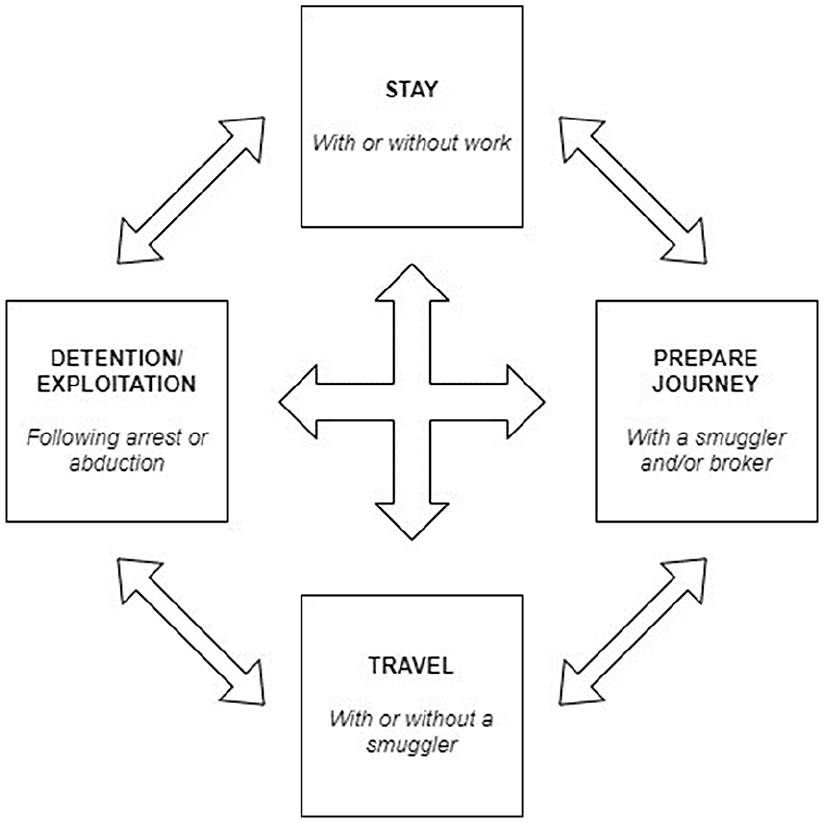
Interactions between groups of activities experienced by migrants on the CMR.
Upon reaching northern Libya (zone 4), all participants boarded a boat to reach international waters in the Mediterranean Sea (zone 5). Once at sea, participants reported one of two situations. They were either intercepted by the Libyan coastguard or a Libyan militia and brought back to Libya (n = 14, 20%), or they were rescued (n = 71, 100%) 4 by an NGO SAR vessel, a private vessel (e.g. fishing or cargo boat) or an Armed Forces of Malta vessel and brought to Malta. Finally, upon arriving in Malta, all participants were brought to the Marsa IRC. This final stage was labelled under the category ‘Detention/Exploitation’ because migrants were detained upon arrival (n = 71, 100%). While no instances of exploitation were reported by participants, interviews did not specifically focus on this issue. Therefore, its presence cannot be ruled out. Notably, a 2020 EU investigation into the Marsa IRC concluded that it was ‘an establishment in disarray, which has allowed a dangerous, and potential fatal, environment for detained migrants and its own staff to develop’ (Council of Europe, 2021).
Micro-level script graph
At the micro level of abstraction, we found migration scripts involved several types of similar or ‘routine’ activities that participants experienced, albeit in different orders. In addition to travel itself, these included but were not limited to the use of a smuggler; the use of a broker to meet a smuggler, work, forced labour and detention (Figure 2). Each journey was distinct, featuring a unique sequence of micro-level activities. Although some activities were common among participants, as depicted by the graphs’ arrow thickness, the exact sequence of activities varied for each participant from start to finish.
Preparing the journey
Participants commonly undertook two particular activities before travelling to a new zone: using a smuggler and meeting a broker. All participants used a smuggler at least once on their journey to Europe, highlighting the importance of smugglers in irregular migration on the CMR. Of participants who transited across more than one zone (n = 62), over half (n = 32) used a smuggler for all zone transitions, while just 11% (n = 7) used a smuggler only once. Over three quarters of participants used smugglers in more than one zone (n = 54). Of these, two-thirds of participants reported using a smuggler in a country neighbouring Libya (n = 47), while all participants used smuggling services in northern Libya to cross the Mediterranean Sea.
The pervasive use of smugglers across zones, but particularly within Libya, underscores their significance in assisting migrants to complete their journeys to Europe along the CMR. However, the findings indicate that smugglers’ importance varied during journeys: being particularly critical in Northern Libya and less so in non-neighbouring countries to Libya. Fewer than half (n = 12) of participants who departed from a non-neighbouring country to Libya (n = 22) used a smuggler before reaching Libya.
Sixty-one participants (86%) met a broker who facilitated their travel. A broker was coded as any intermediary who connects a migrant with a smuggler (the person who transports them), whether they be a professional broker, a community member, family or a friend (Jones and Sha, 2020). Most participants (n = 51) reported meeting a broker in northern Libya (zone 4). Twenty participants met brokers in more than one zone. Meeting a broker was often in the context of reaching smuggler warehouses, where smugglers house individuals before transporting them for the sea crossing. Northern Libya was also the zone where all participants used a smuggler, suggesting that the importance of brokerage also ties in with the importance of smuggling there.
Travel
In addition to travelling between zones, which all participants did to reach Malta, 49 (69%) participants also reported travelling within a given zone. Participants were labelled as travelling within a zone when they had already stayed in the zone for more than one day and travelled to another place within the zone (as opposed to simply travelling directly through it). The zone within which most participants reported travelling was northern Libya (n = 41).
Staying and working
Two-thirds of participants (n = 48, 68%) reported working on their journey to Europe. That does not include participants who worked in conditions of forced labour, which we cover below. However, although participants worked voluntarily in exchange for money, their labour conditions were often described as sub-standard or exploitative. Several participants reported working in southern Libya’s goldfields, excavating sometimes 30-metre-deep pits through rock layers to unearth gold. Of participants who reported working en route, 90% (n = 43) worked in northern Libya. Twenty-three participants reported working in more than one zone, up to a maximum of four zones. Out of the 31 participants who reported working before reaching northern Libya, most (n = 25) then also worked in northern Libya.
A close reading of the transcripts showed the importance of work on migration journeys, both in motivating and facilitating migration. While some participants reported they had travelled to Libya to find work and later decided to leave for Europe, others used work en route to fund their onward journeys. Participants usually found work either directly with the person hiring them, or by meeting members of their diaspora who lived in Libya and could act as intermediaries in organising both work and onward travel. The types of work in Libya included construction, hospitality (restaurants), gold mining (southern Libya only), shopkeeping and farming.
Detention and exploitation
Over two-thirds (n = 48) of participants reported experiencing detention (defined as the state of being held against one’s will) before crossing the Mediterranean Sea. Most such detention events occurred in Libya (n = 56), with 13 participants reporting being detained more than once during their journey and only seven before Libya: in Sudan (n = 2), Ethiopia (n = 2), Egypt (n = 1), Niger (n = 1) and Yemen (n = 1). Interviews did not always specify whether the detention centre was official (government-run) or unofficial (see the section on context earlier), therefore we coded all under the same ‘detention centre’ label, defined as a facility where migrants are held in custody.
Most of those who were detained reported torture or being beaten and asked for a ransom to be released. The median price for the 10 participants reporting ransom demands was US$3200 (IQR = 4200, Min = 800, Max = 5500).
Seventeen participants (24%) reported working in conditions that we labelled as forced labour according to the International Labour Organization (ILO) (1930) definition. 5 All the reported forced labour instances were in Libya (for a detailed discussion of forced labour on these journeys, please see Bish et al., 2024).
Discussion
This study shows the varied and often protracted experiences migrants face on the CMR, supporting more recent findings in the literature (see Crawley and Jones, 2021). Our results reflect a different approach into deconstructing these journeys, revealing detailed interactions and reliance on smugglers and brokers, mainly in northern Libya confirming other findings in the literature (Malakooti and Fall, 2020).
Looking at the role of work during migration (most notably in Libya), we uncover a key but often missed part of the migration process that plays a significant role in prolonging CMR journeys (see also Crawley and Jones, 2021). Insights into the conditions of detention and the common use of forced labour in Libya show the uneven, acute risks across the CMR and highlight the need for focused interventions where harms concentrate. These circumstances are exacerbated by EU border control policies, especially the backing of the Libyan coastguard who brings people to detention centres, demonstrating the need for critical policy reassessment (Pacciardi and Berndtsson, 2022).
Our research refines and builds on existing models of migration, particularly Zimmerman et al.’s (2011), by offering more specific insights into the ‘travel’ phase they identified and clearly documenting the non-linearity of migration pathways along the CMR. Our findings, as illustrated by the complexity of the composite script graphs, resonate with calls for a complex systems approach to studying irregular migration (McAlpine et al., 2021). A systems approach views irregular migration as a dynamic, multi-layered system with non-linear interactions, demanding more holistic analytical strategies. In this regard, a close reading of the transcripts also highlighted the importance not only of constraints but of people’s agency and decision-making, reacting to opportunities within their environment (see Bish et al., 2024). This finding challenges commonplace depictions of irregular migrants as passive victims on their journeys (Kuschminder, 2021).
We hope to have made the case for applying opportunity theories to the study of irregular migration and related harm. These theories suggest that crimes are a product not just of offenders’ dispositions but the immediate situational context, and the interaction between the two (Felson and Clarke, 1998). Through our script analysis, we highlighted how ‘opportunities’ – specific situations and environmental conditions along the CMR – produce conditions that make irregular migrants (already by nature a vulnerable group) prone to harms, including detention and exploitation. Our insights underscore that these vulnerabilities are shaped by identifiable environmental factors, aligning with the principles of opportunity theories. Script graphs have proved useful tools for organising the various activities people experienced on the CMR. In future research, graph theory could be applied to analyse migration journeys to identify specific pathways into – and out of – harm. Moreover, a larger sample could be used to compare journeys across gender, nationality and age groups.
Crime scripting has typically been approached with a prevention perspective (Cornish, 1994). Here, however, we have applied scripting to gain valuable empirical insights into the behavioural aspects of migration, which Cornish (1994: 159) highlight as one an essential benefit of scripting. Considering a crime prevention intervention model would require an entirely new field of inquiry. We plan to explore this through more detailed connected crime scripts from the perspective of the offender to devise harm-reduction interventions, mindful of unintended harms. Indeed, an intervention model in the field of migration requires cautious deliberation due to potential harm impacts (Zimmerman et al., 2021). For example, while aiming to curb smuggling, activities undertaken by the Libyan coastguard increased detentions and abuses of migrants and impeded the movement of people fleeing danger (Bish et al., 2024).
Limitations
The resulting script graph (n = 71) should not be misconstrued as a representative or complete picture of the journeys experienced by the 4851 irregular migrants recorded as successful sea arrivals in Malta over the 2018–2019 period, let alone generalised to those who departed or arrived elsewhere or, tragically, died on their journeys. As an illustration of this, 22 nodes which had been identified conceptually for the baseline script graph were removed from the empirical script graph, since they were not described as having taken place in participants’ journeys. Many states and activities that had been described in the baseline script graph, such as ‘death’, could not have been experienced. One node that had not been identified conceptually was added to the empirical graphs: while there was no incident of a boat sinking in the Mediterranean Sea during the crossing (node removed from baseline script graph), one incident of a boat breaking was observed, and a node added to reflect this novelty.
As with any interview-based research, self-report bias (Althubaiti, 2016) may affect both socio-demographic data and journey details. Participants may have misrepresented or omitted information due to concerns over their age or desire to strengthen their asylum applications. This risk was minimised by ensuring the interviews were anonymous and confidential and emphasising that interviews would not affect their asylum claims.
Moreover, the research primarily captured accounts of labour exploitation, potentially underreporting sexual exploitation, which is even more stigmatised and sensitive (Gezie et al., 2019). Although there may have been some loss of nuance or error, despite careful translation efforts (Squires, 2009), this limitation is arguably less salient, given our focus on what happened during journeys, rather than how people described their experiences.
Finally, while we hope to have demonstrated the value of scripting in migration studies, our research also highlighted the broader limitations of scripting as a method. The value of scripts and script graphs comes from the ability to deconstruct behaviours into a certain level of abstraction, to enable the cross-comparison of complex sequences of activities. However, this necessary abstraction can remove contextual detail, such as precision in space and time, and introduce some subjectivity, such as what constitutes ‘smuggling’.
Policy implications
While a fuller discussion of the policy implications is beyond our remit here, the prevalence of detention and exploitation experiences deserves particular attention. That over two-thirds of the sample reported experiences of detention en route before Malta raises considerable concerns.
The severity of reported experiences in Libya cannot be understated. Harrowing instances of abuse, arbitrary detention and human rights violations are rampant, intensified by policies that often deprioritise migrant welfare (Pacciardi and Berndtsson, 2022). This research underscores the need for immediate reform, advocating for policies that realign with human rights principles. Addressing severe systemic problems in Libya and ensuring robust, humane asylum protocols in the EU are imperative steps towards mitigating the harm inflicted on vulnerable populations (Bish, 2024b). Such measures would complement our findings, emphasising swift identification and support for individuals in dire need upon their arrival in Europe.
Crucially, over two-thirds of participants should have benefitted from additional protections owing to their past experiences of severe human rights abuses, and yet were detained upon arrival in an IRC. The Maltese government’s ‘Strategy for the Reception of Asylum Seekers and Irregular Migrants’ states that an asylum seeker can be detained for up to 12 months, and an irregular migrant for up to 18 months (Maltese Ministry for Home Affairs and National Security, 2015). However, this detention requirement is waived for people who are ‘vulnerable’, that is, ‘victims of human trafficking [. . .] and persons who have been subjected to torture, rape or other serious forms of psychological, physical or sexual violence’ (Official Journal of the EU, 2013; Art. 21). While forced labour, as identified in the scripts, is not explicitly mentioned here, it can conceptually overlap with human trafficking, as the boundaries blur when elements of movement and coercion are introduced (Bish et al., 2024; Plant, 2015).
As a result, and according to the directive, once released from the IRC, participants who fit this definition should no longer be detained, be accommodated in an ‘open centre’ and be offered psychological or medical support as required (Maltese Ministry for Home Affairs and National Security, 2015). It is not reasonable to expect affected individuals to be familiar with and able to appeal to legal classifications like those in Directive 2013/33/EU. In any case, the burden of identifying ‘vulnerable’ people should not rest on the migrants, who may lack the information, capacity or access to legal advice to self-identify as such. Our research suggests people in considerable need are under-identified in Malta, which is a considerable concern elsewhere too (see van der Leun and van Schijndel, 2016). Ensuring the timely identification and support of those in particular need in IRCs will likely require staff motivation, capacity, knowledge, and top-down political will. Importantly, our findings reveal that ‘vulnerability’ upon arrival is shaped by experiences en route, not just the initial motivations for leaving, challenging the simplistic ‘economic migrant’ versus ‘trafficking victim’ binary.
This research has helped and identify the various types of vulnerability that can occur on the CMR and that fit the EU definition. Our findings show where and how it can happen, and therefore can help tailor better questions to rapidly identify such vulnerability in migrants arriving. Prompt identification of vulnerability, decisive political will and tangible operational changes are essential to reduce detention durations and broaden access to necessary support. There are, of course, broader questions about both the morality and impacts of immigration detention in general, which are beyond our current scope.
Footnotes
Acknowledgements
The authors express their sincere gratitude to GI-TOC for granting permission to use the data essential to this research.
Declaration of Conflicting Interests
The author(s) declared no potential conflicts of interest with respect to the research, authorship, and/or publication of this article.
Funding
The author(s) disclosed receipt of the following financial support for the research, authorship, and/or publication of this article: This work was supported by the Engineering and Physical Sciences Research Council (EPSRC) grant EP/N509577/1 and the UCL-Université PSL Collaborative Research Groups funding scheme. The authors have applied a Creative Commons Attribution (CC BY) licence to any Author Accepted Manuscript version.
