




Abstract
Focusing on how to deal with relapses when trying to desist from crime, this article utilises findings from a qualitative and prospective interview study to illustrate what it means to desist. Ten women’s desistance journeys have been studied longitudinally since 2015. Over these years, the women have encountered setbacks and relapses, yet somehow persevered on their path towards a different ‘normal’ life, free from crime, condemnation and marginalisation. Their struggle highlights the need for persistence to sustain desistance from crime. Persistence and desistance are generally conceptualised as each other’s counterparts within life-course criminology, yet putting persistence at the heart of desistance journeys can deepen our understanding of the process involved.
Introduction
It’s a little heavy. I have been so tired lately. And also felt like, or been a bit mentally unwell, you know. I’ve had a lot of panic or anxiety, and it’s been up and down like that. I prefer to stay at home, isolate myself, sleep, you know. But it’s still somewhat manageable. I’ve just been a bit low really. And then, you know, my finances also stressing me out a lot. I’m so damn broke. And nothing, you know, no matter how I try to manage it, it always ends up . . . I mean, it doesn’t work. It doesn’t add up [. . .] And everything piles up. But overall, it’s still okay, you know. I mean . . . it’s nothing major or anything. It’s just that, yeah, I’ve felt better, haha. But yeah, there haven’t been any . . . I haven’t relapsed. I mean, since . . .
What it means to desist from crime has been widely debated within criminology (Halsey and Deegan, 2015; Maruna, 2001; Rodermond et al., 2016; Shapland, 2022). Through this fruitful debate, desistance is now increasingly recognised as complex processes by which individuals shift from one (criminalised) way of living and acting to a different (more normative) one (Bersani and Doherty, 2018; Broidy and Cauffman, 2017; Fredriksson and Gålnander, 2020; Rocque, 2021). Recent research investigating the complexity inherent in such processes has highlighted how the processual shift in lifestyle and identity can be frightening, painful, as well as commonly subject to setbacks and relapses (Fredriksson and Gålnander, 2020; Halsey et al., 2017; Nugent and Schinkel, 2016). In her recent article, Professor Joanna Shapland (2022: 12) made a call for research looking into how people maintain processes of desistance over time, and particularly how desistance can be picked up again after a relapse. This article is a response to her call. Building on the existing foundation of research into relapses within ongoing desistance processes, this article seeks to further our understanding of how people manage to maintain processes of desistance in the face of such adversities. In other words, how do people persist in their attempts to desist from crime?
Persistence in offending and desistance from crime are generally thought of as two separate concepts with their respective areas of research within life-course criminology (see, for example, Kazemian et al., 2018). Indeed, with one being tied to crime and the other to the absence of crime, persistence and desistance might even be considered each other’s counterparts. Conceptually, persistence captures a continuation or repetition of a particular behaviour. Desistance, however, is meant to capture the absence of such activity rather than a presence (Maruna, 2001). However, it may be more suitable to think of the two concepts as occupying two sides of the same coin.
A core strength of life-course criminology is its inherent capacity to capture the complexity involved in lives, particularly acknowledging peoples’ ability to change over time. Desistance and persistence should thus not be tied to different categories of people, but rather to different trajectories or lifestyles (Shapland, 2022). Eventual desistance from crime is normative and expected, and studies have found that even the most persistent offenders eventually desist from crime (Laub and Sampson, 2003). As pointed out by Shapland and Bottoms (2011), ‘persistent offenders do many things other than think about or commit offenses . . . for much of the time, most offenders engage in everyday practices and routines that are similar to those of everyone else’ (p. 257). Hence, lives marked by persistent offending seem to also include absence of crime (see also Shapland, 2022 for a follow-up study). Similarly, I will argue that desisters have to be persistent in order to maintain their desistance processes in the face of severe setbacks.
Drawing on qualitative and prospective interviews with 10 women in Sweden, this article will further our understanding of what it means to desist from crime. The study is longitudinal and has followed the women’s desistance journeys since 2015. In the aggregate, the women are ‘successful’ in their desistance processes, meaning that they generally stay out of crime and slowly and carefully approach mainstream society. Nevertheless, their desistance journeys are full of vivid examples of hardships, setbacks and relapses. How then did the women stay on track despite such adversities? Putting persistence at the heart of desistance journeys can deepen our understanding of the process involved, and challenge some established truths within criminology and criminal policy and practice.
Contemporary understanding of setbacks in desistance
It is clear from existing desistance research that a lot needs to happen during a desistance process. In many ways, desistance involves leaving a familiar way of life behind because it has been labelled ‘wrong’, unwanted or destructive, in search of an unfamiliar, ‘normal’ life (Fredriksson and Gålnander, 2020). As prospective desisters set out on this journey, unfamiliarity with ‘normality’ can lead to ‘vague’ or ‘modest and conventional’ aspirations for their future, including being ‘Confident. Hardworking. Trustworthy. A good person to get on with’ (Bottoms and Shapland, 2011: 67). Importantly, what can be understood as modest dreams for the general population may be near unreachable for desisters who find themselves in a severely disadvantaged social position. Life scripts as cultural imaginaries tied to class, age, and gender condition what aspirations are available to pursue – or even formulate (Gålnander, 2020a). People engaged in criminalised lifestyles rarely have stable housing, employment, pro-social contacts, or beneficial health factors ready at hand (Bottoms and Shapland, 2011). The journey towards inclusion in the mainstream can thus be both long and demanding. It has even been likened to an obstacle course to emphasise the structural barriers often faced when attempting to obtain employment or housing, as well as acquiring new pro-social contacts (Österman, 2018; Stone, 2015). At the core of this argument lies acknowledgement of how agentic efforts always are acted out in an interplay between subjective and social factors, where structural barriers may render these agentic efforts obsolete (Elder et al., 2003; Giordano et al., 2002).
One influential theoretical model divides the desistance process into primary, secondary and tertiary desistance. Primary desistance denotes a period of non-offending, while secondary desistance involves a change in self-identity where the individual no longer thinks of herself as an offender (Maruna and Farrall, 2004). Tertiary desistance is a relational component, focusing on the recognition of an individual’s change by others and the desisting individual’s development of a sense of belonging or affiliation with conventional society (McNeill, 2016). However, the sequential nature of these concepts has been questioned, and desistance might be better understood as occurring in different spheres rather than following a specific order. To address this, Nugent and Schinkel (2016) propose the terms act-desistance for non-offending, identity desistance for internalising a non-offending identity and relational desistance for the acknowledgement of change by others.
The change in identity involved in processes of desistance from crime is thus inherently social, involving acceptance and social recognition of desistance by other people and society at large (Barry, 2016). A key premise within symbolic interactionism is that the ‘self’ for any actor is a social object, developed through social interaction (Buchanan and Krohn, 2020). This is evident in Mead’s (1934) observation that ‘we are more or less unconsciously seeing ourselves as others see us’ (p. 68), which in effect makes it ‘impossible to conceive of a self arising outside of social experience’ (p. 140). Building on this notion elucidates how the three spheres of desistance influence each other. Drawing on Mead (1934), how we act can be construed as dependent on self-conception, which in turn depends on how we see ourselves reflected by others, which again depends on how we act. It follows that a change in any sphere involved in desistance can influence the desistance process as a whole – both furthering the journey onwards towards inclusion and affiliation with the mainstream, or adversely by derailing the journey back to old ways or habits.
Nugent and Schinkel (2016) also introduce the three concepts isolation, goal failure, and hopelessness to theorise the pains involved in maintaining desistance processes. Isolation is a common experience among desisters and arises from the need to detach from (or ‘knife off’ of) criminogenic influences (Maruna and Roy, 2007). However, an inability to connect to pro-social networks or new activities can lead to unwanted, prolonged and thus painful isolation. Such isolation can lead to loneliness, but also to an indecisive perception of self (Gålnander, 2020b). Goal failure, resulting from barriers hindering the achievement of desisters’ goals or aspirations, can create painful frustration. A combination of the pains of isolation and goal failure can lead to further pain of hopelessness; a precarious state where the maintenance of desistance becomes challenging, and relapses or setbacks are likely (Halsey et al., 2017; Nugent and Schinkel, 2016).
An expanding body of research now points to painful setbacks being a part inherent to desistance journeys for people who attempt desistance from a stigmatised position as ‘outsiders’ (Fredriksson and Gålnander, 2020; Halsey et al., 2017). Conceptualised as ‘fuck it-moments’, relapses within ongoing desistance processes can be understood as moments were people in crisis revert to the familiar (the old way of life) and temporarily suspend their search for something different (the new and ‘normal’ life; Fredriksson and Gålnander, 2020; Halsey et al., 2017). As such, a relapse has more to do with resolving feelings of hopelessness in the face of obstacles and (repeated) goal failure, and much less to do with wanting to harm others or the community generally. Furthermore, research has shown that relapses should not be viewed as entirely the result of individual shortcomings, since they are also linked to bureaucratic (in)action over legitimate fears and concerns of those struggling to desist (Halsey et al., 2017). This further highlights relational aspects of relapses. Similarly, well-timed social interventions and support has the capacity to dissipate the state of hopelessness. Social workers as well as supportive people more generally who show genuine care and provide consistent engagement and encouragement can help mitigate the effects of a relapse (Farrall, 2022 [2002]; Halsey et al., 2017). Thus, relapses are on one hand found common features of desistance journeys, and on the other hand, understood as temporary deviations from the trajectory towards inclusion in the mainstream rather than permanent returns to criminal behaviour. Building on this foundation of existing research, this article will explore how desistance processes can be sustained in the face of severe setbacks and relapses.
Methods
This article presents findings from a longitudinal interview study that followed the desistance processes of 10 women. The study utilised a prospective and longitudinal design, with repeated interviews conducted since 2016. Initially, interviews were conducted every 6 months for a 2-year period (2016–2018). Additional follow-up interviews were conducted with all 10 women in 2021. The recruitment approach aimed for diversity, and the women were recruited from various parts of Sweden through probation centres, prisons, and non-governmental organizations (NGOs) facilitating re-entry.
At the time of the first interviews, all the women were in the early stages of desistance, meaning they had just recently embarked on a different path, leaving criminality and, for most, drug use behind them. This methodological approach allowed for frequent interviews during the intensive, initial period of the women’s desistance processes, combined with the strengths of the longitudinal approach which captured the processes involved in act-, identity-, and relational-desistance. The interviews were lengthy, typically lasting between 2 and 2.5 hours. They covered a wide range of themes, including family, peer, and partner relations, victimisation, experiences with police, prison, and social services, drug use, other criminalised activities, as well as resource-focused topics like financial situation, debts, education, employment and health.
The interview transcripts were coded and analysed thematically, comprising explorations both longitudinally across the different sweeps of interviews (to explore continuity/change over time), and horizontally across the sample (to explore shared/unique experiences). Setbacks initially appeared as unique and situational experiences in the interviews. Over time, however, encountering and coping with severe adversities as a part of their desistance journeys became a prominent and shared theme for the women broadly. Life in desistance is often complex or ‘messy’ (Österman, 2018: 34). The analysis will tap into illustrative examples rather than provide a comprehensive overview of relapses found across the sample. Building on the women’s stories of how to deal with such adversities while maintaining their commitment to desistance, this analysis provides an in-depth investigation into the role of persistence in sustaining desistance in the face of severe setbacks.
Characteristics of the women
Although all 10 women had engaged in common street crime for decades, their offending and conviction histories varied significantly within the sample. For instance, one woman (Maia) had been convicted but never imprisoned, while another woman (Johanna) had spent a total of 13 years in prison. With one exception (Nina), all women had a history of regular drug (ab)use. 1
The women’s ages at the first interview ranged from 23 to 53 years. All the women were of Swedish or other Scandinavian ethnicity. With the exception of one woman (Marie), they grew up in impoverished conditions. Many had experienced periods in foster care and/or incarceration during their childhood and adolescence. Their employment and educational records were minimal as they embarked on their desistance journeys. Three of the women were homeless when I first met them, and an additional two experienced periods of homelessness during the longitudinal study. All 10 women had internalised a sense of otherness and were attempting to desist from crime and achieve inclusion into the mainstream from a position as excluded other (Becker, 1963).
Analysis: Maintaining desistance in the face of severe setbacks
For people who have lived their lives marked by crime and conviction as ‘outsiders’, segregated and excluded from mainstream society, a lot needs to happen in desistance. The women in this study attempted ‘normalcy’ and strived for inclusion into mainstream society from a marginalised position as ‘excluded others’ (Becker, 1963). Starting off from this position, desistance involved struggling to secure even the most basic human needs like shelter, social contacts and health (cf. Bottoms and Shapland, 2011). The longitudinal research design allowed for following the women’s attempts, capturing how they set up goals for themselves and achieved such goals, along with many instances of goal failure (Nugent and Schinkel, 2016). In an attempt to look back at this eventful time, I included a reflection exercise during the fourth interview sweep to capture the women’s perceptions of the first 2 years of their desistance processes. To support this reflection, I provided each woman with a sheet of paper and a pen. I drew an x-axis and a y-axis, representing the four interviews conducted over the research’s initial 2-year period. The x-axis denoted the interview points, while the y-axis allowed the women to subjectively assess their quality of life or how they had been during these specific times. I then suggested that the women drew a line representing how they had experienced the last 2 years. The resultant drawings offer valuable compliments to the interview excerpts, illustrating how life in desistance looks – and feels. I wish to utilise Norah’s illustration as a jumping off point for this analysis, see figure 1.
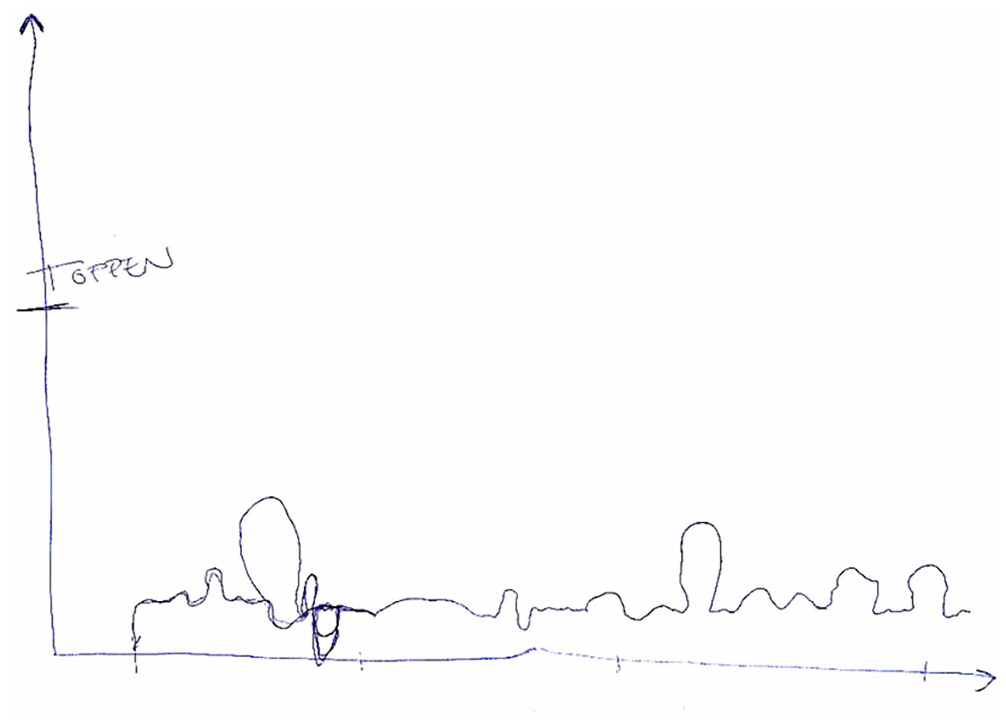
Norah’s reflection on 2 years in desistance.
When I explained the exercise, Norah quickly grasped its purpose but expressed scepticism about how high I had drawn the y-axis. ‘So, I should feel really good at the top? I’ll never reach that’, she commented as she began drawing. With great care, she depicted every obstacle she had faced in the past 2 years. When she reached the point representing our second interview, she challenged my outline and created a new upper boundary for the graph. In Swedish, she referred to it as ‘Toppen’ (the top), signifying the highest quality of life she could envision in her desistance journey. Her drawing vividly portrayed the rapid succession of ups and downs she had experienced. Norah remarked, ‘It looks like houses – or a really bad ECG!’ 2 At one stage between our initial and second interview, she described herself as being ‘practically dead’, which she credited to an overwhelming series of accumulated challenges. Particularly significant was her partner’s relapse into heroin abuse during that summer, leaving her heartbroken, scared, and alone with their child. Importantly, the peaks on the graph were associated with shared moments and cherished vacations with the same partner. ‘That’s life’, she concluded, ‘it has its ups and downs’.
The particular setback which makes out the lowest point is worth exploring in further detail. It was summer and Norah was working extra as an assistant nurse. She had returned to school and was halfway through finishing primary and secondary education with her goal set at university studies to become a nurse. Suddenly, her best friend (and mentor as she was further along on her own desistance journey) lost her husband to an overdose. While Norah scrambled to take care of her friend, her own partner relapsed on heroin and ‘disappeared’ from their home. Alone and with her dream of a happy family life shattered, Norah was thrown into a state of hopelessness (Nugent and Schinkel, 2016). At her lowest, she received a bunch of very strong benzodiazepines that her partner had ordered. Desperate for some relief, she took the pills herself and thus fell into a brief but intense relapse, which is the period Norah refers to as being ‘practically dead’. That could have been the end of her desistance journey, but somehow Norah persisted to maintain her commitment to desistance. With no recollection of the time on the pills, when she ‘came to’, she found that she had managed to get up every morning, go to work and ‘managed to pull it all off’. This has been theorised in a previous article (Fredriksson and Gålnander, 2020) as a sign of her successfully constructing a replacement self (Giordano et al., 2002) so closely tied to conventionality that it worked as if automated. After the relapse, Norah sobered up all on her own, but later sought assistance from her mother-in-law who ‘helped a lot [. . .] she’d be with (Norah’s son) so that I could be alone and have a cry in the bathroom’. Since Norah at that time was separated from her partner, she could not take the mother-in-law’s support for granted, who made her stance clear, however, explicitly telling Norah ‘I’m on your side’.
The folk high school 3 Norah was enrolled in was equally supportive. When the fall semester begun Norah ‘Was absent a lot and didn’t feel good. Which showed pretty clearly’. Instead of punishing Norah’s absence, the principal met with her and her teacher, and assigned her with a curator whom she saw every Tuesday. Norah was both grateful for and surprised by this support. She said,
That’s what’s so great about the folk high school! They actually help you so much, it’s crazy. Without them I’d have to turn to health care and that would have taken ages before I could see some old fart who’d be like ‘Mhm, aha, mhm, aha, mhm, aha’ and then prescribe me some random antidepressant and be like ‘go home and get some sleep’.
The school’s support was imperative for Norah’s ability to keep envisioning a better future and persist in her efforts to sustain desistance from crime and drugs (cf. Bottoms and Shapland, 2011; Gålnander, 2020b). With her clear goal of attending university to become a nurse still intact she was able stay on target. She managed to complete her secondary education that year, and subsequently enrolled at the university just as planned.
Norah’s strife thus serves to highlight several important lessons for how to maintain desistance in the face of severe adversities. First, a relapse does not necessarily mean the end of a desistance journey. Even while Norah was ‘practically dead’ under the influence of heavy benzodiazepines, she still managed to keep up appearances at work. Her relief over this was tangible – she had been very afraid of losing her job. While the money that this job brought was important to her, so was the sense of normalcy and affiliation with the mainstream that also came with it. Furthermore, Norah’s ability to remain on track is closely linked to the support network that she has built up around her. Importantly, these people did not turn their back on Norah once they found out about her relapse, but instead offered their increased presence and support to help her push on towards her goal (Maruna, 2001). Thus, if a relapse is conceptualised as being part of a desistance journey, rather than an interruption or abortion of desistance, the damaging effects of a relapse can be mitigated and desistance maintained (Halsey et al., 2017).
Over the years of this study, several of the women went through similar experiences of relapses that did not end or interrupt desistance but rather were part of their desistance journeys. Similar to Norah’s, Kate’s example is also pronounced in her drawing of life in desistance as shown in Figure 2.
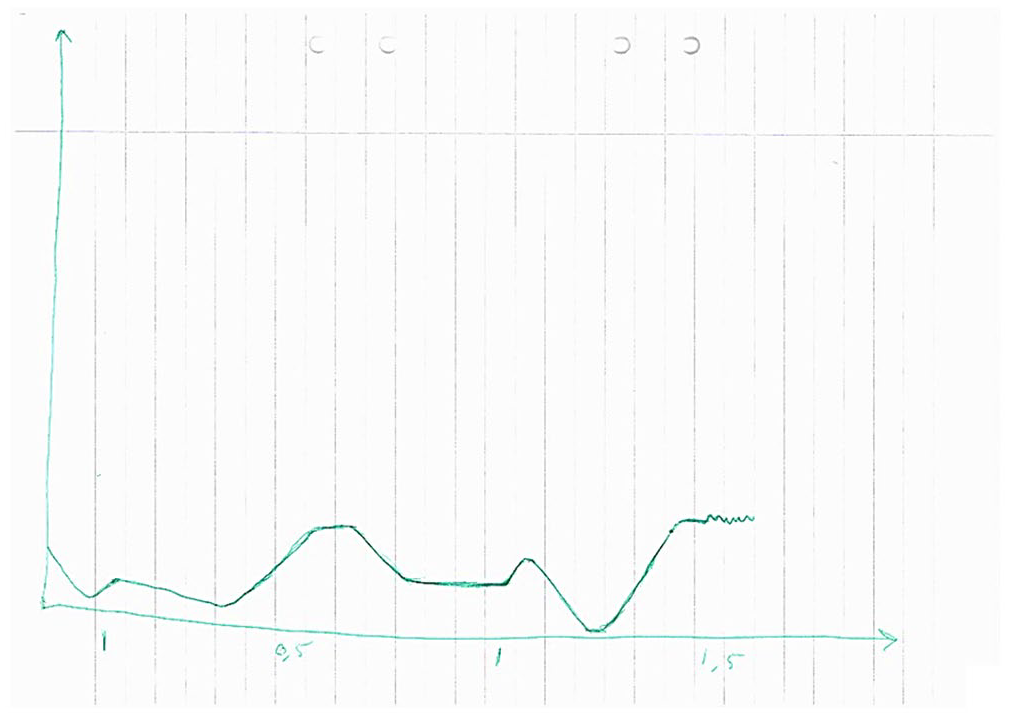
Kate’s reflection on 2 years in desistance.
Kate’s line on the graph starts low but fluctuates over time. The initial downwards slope represents her decision to discontinue heroin substitute treatment. This period was challenging, and she did not feel well during that time. She isolated herself in a deliberate attempt at ‘getting back to herself’ and find out who she is without drugs and her previous, criminally active circle of friends. Such self-isolation as a way of knifing off of the past is also a strategy to avoid criminogenic situations which has been termed diachronic self-control in previous research (Shapland and Bottoms, 2011: 274). Kate spent a year in this isolated state before it started to really take a toll on her quality of life, as signified by the sharp decline between our third and fourth interview. She said, ‘I have a hard time when I’m alone, you know? Yeah, most of the time I just shut myself in with Netflix or something’. During this period, she repeatedly tried and failed to break her isolation, which together with grinding poverty led her to a state of hopelessness. As has been pointed out in previous research, hopelessness renders desistance processes vulnerable to relapses, which is what happened to Kate as well (Halsey et al., 2017; Nugent and Schinkel, 2016):
Well, I have really been tough on myself. And hardly . . . yeah, lived, you know, at all. Been really, like, strict. And feeling awful, a lot of anxiety, stress, and PTSD. I mean, everything. And I haven’t had any help from outside [. . .] And at some point, I kind of fucked up a bit too [. . .] I fucked up, actually.
On New Year’s Eve, Kate decided to break her isolation and go to a party. At this party, she ‘fucked up’ with a hit of heroin. This experience scared her as she thought she had left that behaviour behind. In particular, she was struck by how quickly it had escalated, going immediately for a hard drug and afterwards she feared that the social services would claim her daughter, her home and her benefits if they were to find out about her relapse. The relapse thus threw Kate significantly closer to her feared future self (Paternoster and Bushway, 2009), as an outcast condemned to loneliness and destitution. Kate, like many other women who have been labelled criminalised, was reluctant to seek society’s aid as she feared that the response would be control, rather than support (see also Gålnander and Österman, 2022; Sharpe, 2015). This period marks the lowest point in her drawing, almost hitting rock bottom. However, it is important to also acknowledge that her graph outlines an equally sharp increase in quality of life subsequent to this dark experience. Reflecting on this, Kate said,
Well, it was a short period. And I don’t know, in a way, maybe it was . . . I mean, I can’t say it was good, definitely not good, but it did make me think. Like, I’m not so damn invincible, you know? I’m no damn superhero. And yet, I’ve really done so well and fought so damn hard, and very much alone. And just been stubborn really. But in the end, it just (makes a sweeping sound) exploded. I couldn’t handle it anymore, you know. I just had to find an outlet.
Here, Kate points out the persistence and stubbornness needed to maintain desistance (see also Todd-Kvam, 2019), but also how taxing the loneliness was for her. Despite it being scary, Kate feels wiser from the relapse. The social services did not find out, and Kate was able to keep working towards sustained desistance and the ‘normal life’ that she envisioned together with her daughter. She went back to school, and some years later as I met her again for another interview, she had successfully gone through job training as a supermarket cashier. Although it was tough for Kate not least mentally to be out of her home and working, this experience strengthened her sense of self as being able to belong in the mainstream. She said, ‘I like made it through without dying, but it was hard as hell I tell you!’ After completion, the staff at the Employment Services told her that they had received positive feedback from the manager she had worked for. She said,
My job coach, she was like, ‘Oh yeah, she loves you!’ [R: Oh, that’s wonderful]. And I got this ego boost. Or a boost, and I thought, ‘Well shit, I might not be such an idiot after all’. Or at least not just that. Not a complete idiot.
Kate’s low self-esteem is tangible, as is the importance of positive reinforcement (Mead, 1934). During Kate’s years of isolation, nobody was there to counter her self-conception as a complete idiot. Kate’s experience is similar to that found among participants in The Sheffield Desistance Study (Bottoms and Shapland, 2011) in that desisters who meet obstacles and overcome them will find reinforcers and go on to establish crime-free identities as non-offenders.
Concluding the analysis, Marie offers a third and final example of coping with a severe setback during an ongoing desistance process. Like Norah, Marie embarked on her desistance journey together with a man that she had shared her previous, criminalised lifestyle with. Marie’s desistance journey differs from the other women’s on several accounts as it was supported by a 12-step programme. Twelve-step programmes are popular self-help approaches in contemporary Western societies like the United States, the United Kingdom and Sweden. Much of their popularity can be derived from how they align with the individualistic narratives of the neoliberal agenda and are cost-effective (Helmersson Bergmark, 1995). While most of the women had been subjected to such treatment during various forms of incarceration, most found them unsupportive and did not pursue them on their own accord. Marie, being the exception, got employed as a treatment assistant herself as part of her desistance journey. She got married to her man, they had a child and moved into a townhouse in the suburbs. In many ways, then, Marie’s desistance process looked solid and secure. Nevertheless, when I met her for our fifth interview, after years in this stable position, Marie told me about how she had faced a serious setback leading to a relapse. She had fallen in love with ‘a very, very sick man, fully active in crime’ whom she met working as his treatment assistant. The romance escalated quickly, leading to a separation from her husband and daughter. When I asked her how she felt about this, Marie said, ‘Well, it was the worst period of my life. I relapsed into old behaviours a lot’. They moved in together, but he quickly turned violent. Marie lived in the terrors of ‘physical, psychological, material, economical – every form [of domestic violence]’ for 6 months. He wrecked their apartment, broke ‘countless cell phones’ and threatened to kill her several times; once at gunpoint and another time while strangling her with a cord. As is common for cases of domestic abuse (Holmberg et al., 2005), Marie experienced an inability to leave the violent relationship once in it:
I thought he was going to kill me [. . .] It hit me fast, like, ‘Shit, what have I done? I’ve left the most beautiful person in my life for a damn psychopath?’, you know. But I was so damn scared! I didn’t dare to leave him. And I didn’t dare to ask for help. Also, I was studying during this time. So I went there like with a heavily made-up black eye. To the workshop on ‘domestic violence’, you know. [R: Woah]. Yeah! And I just wished that someone would see me! Because I didn’t have the ability to just say, ‘Can you help me?’, you know? I had, like, chosen (the ‘psychopath’), I had chosen to give up everything, you know. And I was so damn alone in this. Plus, the shame! I’ve been telling so many women, like, ‘leave at the first hit’.
Fearing that he would kill her if she attempted to leave, together with cutting ties to her social support network due to his control and her shame, left her unable to reach out for help (Holmberg et al., 2005). In the end, ‘The pain was too much, and once again I figured that the only way out of my misery was through drugs, you know’. He was ‘A super criminal, this guy, and sold a ton of drugs’. While he was away one day, she took a hit of his cocaine. That same night, the police cracked down on him because of his dealings, and took them both into custody. Marie repeated how shameful this entire episode was to her. Despite her previous experiences as a condemned, convicted and imprisoned heroin addict, she reiterated that this was the worst time of her life:
But, like, man oh man. Man oh man oh man oh man. Oh yuck. What a horrible period in my life. Oh, what a horrible/this period was worse than all the years active in addiction. [R: How so?] Because I had built such a nice life. And my daughter, the best thing that has happened to me. And to just throw it away like this, and ruin it, you know. ‘Cause before I got clean, I had nothing [. . .] And just like normal people might build some castles in the air . . . Well I fucking moved into mine, haha! With a damn brat-gangster, you know, who was nine years younger than me? So fucking sick! So fucking sick, Robin. God damn it!
Luckily, Marie did not throw away everything and the nice life she had built for herself in desistance was not ruined beyond repair by this relapse. She got out of jail after 10 days, and immediately called her (then divorced) husband who welcomed her back with open arms. In fact, he was more eager to get back together and put the period behind them than she was. In order to get her old job back, her workplace demanded that she would go into rehab for a month, which she did. After that, she moved back into her old home with her partner and daughter. Although they now lived together again, and he wanted her back in his life, she wanted to take some months initially to work on herself. She did so, and they also ‘Sought some outside help and stuff. And it turned out really well. And then we got remarried’.
Marie’s story is another powerful example of a severe setback within an ongoing desistance journey. Importantly, Marie was convinced that the life that she had built up in desistance was ruined by her mistake. Much like for Norah and Kate, however, significant people in her newly built-up life did not turn their back on Marie but rather stepped in and showed their support for and belief in her (Halsey et al., 2017).
Concluding discussion: Setbacks as parts of desistance journeys
By following 10 women’s efforts to desist from crime and approach the mainstream, the aim for this research is to deepen the understanding of what it means to maintain processes of desistance. Drawing on the women’s experiences, this article shows how setbacks and relapses are common aspects of desistance processes (Halsey et al., 2017; Nugent and Schinkel, 2016; Shapland, 2022). Importantly, the longitudinal design of the research project captures how setbacks and relapses are not the end of these desistance journeys but rather part of them.
The road to reform and inclusion in the mainstream from a position as condemned and socially excluded other is long and bumpy, as powerfully illustrated in Norah’s drawing (Figure 1). Setbacks will happen on this obstacle course, and when isolation and repeated goal failures lead to a state of hopelessness, it is easy to understand how relapses may follow (Nugent and Schinkel, 2016). When overwhelmed by circumstances, the women reverted to old and familiar drugs since they offered comfort, relief, or presented one of few attainable ways out of painful misery (Halsey et al., 2017). The question then is perhaps not why relapses occur within desistance, but how to deal with them in a way that allows for people to pick up their desistance journeys afterwards.
Relapses were shameful and frightening experiences for the women in this study. Often perceived as ‘fuck ups’ or ‘failures’, relapsing women found themselves reverting to behaviours they thought they had left behind. Finding the old, discarded self capable of ‘fucking up’ and derail the newly formed replacement self is unsettling and a source of fear, self-doubt and shame (Fredriksson and Gålnander, 2020). Fear also seems to arise from looming repercussions from state support or more broadly in the form of other people’s reactions to their ‘failure’. The women particularly expressed fear of losing what they had achieved and built up for themselves in desistance; they feared to lose their jobs, families, homes and education – and thereby their futures. Relapses thus catapulted the women painfully closer to their feared future selves as lonely outcasts condemned to social exclusion, poverty, hope- and homelessness (Paternoster and Bushway, 2009). In line with Paternoster and Bushway’s (2009) theorising, the manifestation of a feared future could make the women see their positive possible selves more clearly. Being reminded of what they had to lose simultaneously reminded the women of what they had achieved for themselves in desistance. This experience seems to catalyst an enhanced will to fight to sustain desistance and to keep what they had built up and achieved. However, even though a will to fight may be necessary to sustain desistance, will alone is not sufficient to overcome repeating encounters with structural barriers (Elder et al., 2003; Österman, 2018; Stone, 2015). The fragility of desistance journeys is pronounced in the women’s narratives of relapses. They feared for different things, but all viewed their lives, status, and identities as precarious.
Identities are social constructs, which actualises relational aspects of desistance (Barry, 2016; McNeill, 2016; Nugent and Schinkel, 2016). Following the narratives of fear for repercussions, it is also tangible how all three instances analysed are examples of relapses that the women have ‘gotten away with’, which allowed them to pick up their desistance journeys where they had left them, stay on track and persist in their efforts to sustain desistance. While the women often kept away from official channels of support such as the social services out of fear for increased control or loss of children and homes (Gålnander and Österman, 2022; Sharpe, 2015), they did turn to more informal social support for aid. The women feared that the relapse would make significant people from the ‘new life’ that they had built for themselves in desistance see them as the hopeless or destructive forces they often viewed themselves as after such setbacks. But instead of the dreaded condemnation and punishment, such supportive people manifested their belief in the women’s ability to desist. Previous research has found that recognition of efforts to succeed, even in the face of failure, can help to neutralise hopelessness or even reignite hope (Halsey et al., 2017). Importantly, the women’s social networks often seemed to view them as changed and desisting and acknowledge their progression even when the women thought that they had ruined everything by temporarily reverting to old behaviour. This finding contributes to enhance our understanding of desistance processes. The concepts of primary, secondary and tertiary desistance have been challenged since their sequential logic might not fit desistance journeys (Nugent and Schinkel, 2016). Analysing how people deal with relapses within ongoing desistance processes has actualised how recognition of change (tertiary desistance) can be a prerequisite for a solidified change in self-image (secondary desistance; cf Mead, 1934). Similarly, since the analysis shows that setbacks and even relapses can be part of desistance journeys, crime freedom (primary desistance) cannot be a requisite for a first step of desistance.
In addition, including the women’s own illustrations of how desistance looks and feels offer a modest and exploratory contribution to the emerging field of visual criminology (cf. Brown and Carrabine, 2017; Fitzgibbon et al., 2017). Indeed, while many aspects of criminology are ever-present in news coverage and mass-media imagery, (especially women’s) desistance processes are largely invisible in contemporary cultural expressions. However, making the mental and emotional aspects of desistance processes visible is required to develop a critical understanding of the phenomena (McNeill, 2018).
In conclusion, this article discusses empirical examples of relapses within ongoing desistance journeys. The analysis shows how the women were able to sustain desistance in the face of severe setbacks and relapses. One key element found in the analysis is ‘stubbornness’ or in the language of life-course criminology, persistence. Persistence is not usually thought of as central to desistance from crime but rather conceptualised as its counterpart – that is, continued offending. However, putting persistence at the heart of desistance journeys powerfully illustrates the struggles involved. This should be contrasted to how ‘persistence’ is used to understand continuity in offending, where it might not require or imply the same kind of agency and effort, but rather captures a sense of being swept along in a criminalised lifestyle that has been normalised (cf Fredriksson and Gålnander, 2020; Healy, 2016). Moreover, the two terms carry distinct associations in relation to individual agency, as persistence is an active word for ‘keeping at it’ while desistance more passively alludes to ceasing an action (Maruna, 2001). Empirically, then, the active quality of the term ‘persistence’ may be a better fit for capturing desisters’ efforts to change their lives, compared to how it has been used to capture continuous offending. It is a recent development for criminological research to emphasise how desistance involves incessant action and struggle, an empirical finding which might hitherto have been obfuscated by terminology. Highlighting the persistence required to maintain desistance also bridges the separation between the ‘old’, criminally active life and the ‘new’, ‘normal’ and desisting identity, thus furthering the understanding of desistance as a process rather than a clear-cut event (Bersani and Doherty, 2018).
Importantly, individual stubbornness or persistence may be a necessity but is not sufficient to sustain desistance on its own. Previous research has emphasised the importance of timing of social support to overcome or even avoid relapses within desistance (Halsey et al., 2017). The women in this study perceived their relapses as shameful failures and a return to old behaviour, and were thus in need of positive reinforcement to overcome feelings of hopelessness and dare to believe in a better future. With isolation, self-stigma and fear of (continued) negative judgement being such pronounced features of desistance journeys, the women were often surprised when people met them with patience, kindness and understanding of their needs and struggles. The analysis thus offers important lessons on how such positive reinforcement can work. Timing here seems to involve both ‘getting away’ from detrimental effects (often in the form of escaping formal social control) and receiving (perhaps more informal) support from the ‘right’ place at the right time. Indeed ‘getting away with it’ stood out as a clear wish for the women as they wanted to pick up their desistance journeys where they had temporarily diverted from them. This finding has implications for policy and practice for anyone working to support people’s ability to leave a life of crime behind and approach mainstream society. A relapse does not need to mark the end of a desistance process, but it very well might do if met too harshly (Becker, 1963). It follows that the current zero-tolerance policy commonly employed for relapses within probation in Sweden and elsewhere can be outright counterproductive (Gålnander and Österman, 2022; McNeill, 2018). People’s struggle to maintain desistance shows that there needs to be some leeway to get away with reacting to adversities within ongoing desistance journeys. Viewing setbacks and even relapses as part of desistance journeys is an important step in that direction, with the potential to provide a social structure that allows for desistance to be picked up again after temporary derailment.
Footnotes
Declaration of Conflicting Interests
The author(s) declared no potential conflicts of interest with respect to the research, authorship, and/or publication of this article.
Funding
The author(s) received no financial support for the research, authorship, and/or publication of this article.
