




Abstract
Much previous research has considered experiences of bereavement and loss in a prison-based setting. This overshadows the nature of bereavement within the context of community supervision and probation delivery, resulting in inadequate explorations of the potential link to persistence and/or desistance from crime. Research into desistance has predominantly focused on relationships with those who are still alive. This article evidences an emergent theme of bereavement experiences within the context of probation delivery, relationships and desistance. It draws upon narrative research undertaken within a Community Rehabilitation Company in the north of England, collected as part of a doctoral thesis. Evidence demonstrates the similarities between the process of desistance and that of bereavement with the narratives of men and women reiterating how bereavement can influence the onset of criminal or risk-taking behaviour whilst highlighting emergent evidence on how bereavement can disrupt desistance. This enables the article to highlight the importance of resilience in the process of both bereavement and desistance.
Introduction
Bereavement, and loss, is experienced by all of us, with different responses and effects. However, the impact of bereavement on reoffending and desistance has gained limited attention within the criminal justice system (Vaswani and Gillon, 2019), and when considered the focus is often within a prison-based environment. Therefore, understanding and knowledge of individual experiences of bereavement, and loss, within community supervision and the potential links to reoffending and/or desistance from crime are limited. In addition, previous research into desistance has focused on relationships with those who are still living. This article therefore provides vital and original insight achieved through in-depth narratives where experiences of bereavement emerged as an influencing theme within wider doctoral research focused on relational networks and desistance. As previous research into desistance has focused on male perspectives and experiences, this article offers an important integration of knowledge across gender to create a stronger understanding of desistance. In addition, narratives evidence the similarities between the process of desistance and that of bereavement. The article develops our knowledge and understanding of tertiary and relational desistance, with the former recognising the importance of an individual’s sense of belonging (McNeill, 2016) and the latter considering how change is recognised by others (Nugent and Schinkel, 2016). Each highlights the fundamental role of relationships, but does not consider how this can be influenced through experiences of bereavement. Narratives reiterate how bereavement can influence the onset of criminal and/or risk-taking behaviour and highlight how bereavement can disrupt desistance. They highlight the trauma, emotion and attachment surrounding relationships with deceased individuals and also the ripple effect of bereavement when considering the wider impact of additional supportive relationships. Finally, the article draws upon narratives to evidence the importance of developing resilience to support both desistance and experiences of bereavement.
Relationships and desistance: Exploring emotion and attachment, bereavement and loss
Theories of desistance are well established within criminological literature, when considering explorations of how and why individuals move away from offending behaviour. When recognising the individual desistance research highlights maturational theories (Gottfredson and Hirschi, 1990), internal motivations (Giordano, 2010), changing identities (Maruna, 2001), the recognition of a possible self (Paternoster and Bushway, 2009) and the role of personal agency (Laub and Sampson, 2003). This resonates with existential sociological and criminological thought which explores how individuals make sense of themselves (Farrall, 2009) in their search for a meaningful identity (Manning, 1973). Structurally, desistance literature recognises strong social bonds (Sampson and Laub, 1993), the influence of social capital (McNeill, 2009) and the importance of structural ‘hooks’ such as employment or marriage (Giordano et al., 2002). These individual and structural infleunces are drawn together through an interactionist perspective of desistance which identifies the interplay between an individual and their wider social and structural circumstances (Carlsson, 2016). It is therefore fundamental desistance is understood within relational, cultural and structural contexts (Weaver, 2019), and for women there is also a recognition of harm, vulnerability and victimisation (Rutter and Barr, 2021).
Desistance is commonly recognised as a process (Maruna, 2001) summarised within literature as primary, secondary or tertiary. Primary considers short-term crime-free periods (Maruna and Farrall, 2003) and a change in behaviour; secondary focuses on how individuals assume roles as a non-offender (Maruna and Farrall, 2003) and evidences a change in identity; and tertiary is concerned with a genuine sense of belonging (McNeill, 2016).
Desistance is also recognised to involve temporary suspensions and/or a decline in frequency or severity of offending, rather than complete cessation (Blokland and De Schipper, 2016). It is therefore a continuous zigzag journey of potential relapses (Weaver and McNeill, 2010). In recognition of a far from linear process, Nugent and Schinkel (2016) have identified act, identity and relational desistance. The first relates to non-offending behaviour, the second considers the internalisation of a non-offending identity and the third highlights how change is recognised by others. This article draws upon the theoretical strengths of both explorations to consider individual and structural influences within the context of bereavement and loss to develop ideas and understanding of tertiary and relational desistance.
Relationships form part of everyday life with each of us surrounded by a unique relational network (Borgatti et al., 2009). Our relationships can represent both enabling and constraining interactions (Kadushin, 2012) and for those under community supervision are established, maintained and challenged differently depending on the individual (Rutter, 2019). Desistance should be understood and acknowledged within the context of relationships (Farmer, 2017; McNeill and Weaver, 2010), with tertiary desistance recognising that positive and valued relationships can provide feelings of inclusion (McNeill, 2009). Relational desistance also highlights the importance of others recognising and supporting an individual’s process of change (Nugent and Schinkel, 2016). In addition, relationships can influence primary or act desistance, alongside secondary or identity desistance as they can have a direct influence on offending behaviour and/or an individual’s identity. However, it may not be the relationship that influences desistance, but the meaning behind it (Jardine, 2017). Therefore, recognising trauma, emotion and attachment is fundamental when considering desistance or continued offending and the potential link to bereavement and loss.
Understanding trauma
Trauma can take many forms linked to a single event, as in the context of bereavement, or through a range of adverse childhood experiences (ACEs) which create increased risks of poor health, mental health and challenging behavioural outcomes (Fellti et al., 1998). Although research is somewhat limited in the area of trauma and offending, significant experiences of victimisation, neglect and trauma are evidenced in the lives of many individuals within the criminal justice system (Canton and Dominey, 2018). Deep-seated trauma and loss cannot be ignored as the likelihood of criminality increases when individuals are unable to connect to the right support (Halsey, 2017).
Here, the importance of strong positive, quality and valued relational bonds is vital in any process of change (Farmer, 2017). Community supervision practices and relationships which endeavour to recognise trauma and loss require displays of vulnerability, empathy and attentiveness within the dimensions of individual lives (Halsey, 2017). This highlights the importance of placing the individual at the centre of support to recognise their strengths and skills to build confidence (McCartan, 2020). Evidence suggests a variety of emotional responses are apparent both during and after traumatic events, for example, fear (Amstadter and Vernon, 2008) or difficulty regulating emotions such as anger, anxiety, sadness and shame (Substance Abuse and Mental Health Services Administration (SAMHSA), 2014).
Recognising emotion
Emotions are highly social in nature (Shott, 1979) learnt through our interactions with others (Engdahl, 2004; Giordano, 2010). While emotions are located within an individual, thoughts and reactions that express emotion arise through a continual process of interaction and communication (Mead, 1934) within relational networks. This validates the personal and social nature of emotions emphasised within existentialist thought through human experiences (Farrall, 2009) and one’s sense of self. Therefore, emotions are an important aspect of understanding how an individual desists (Farrall and Calverley, 2005). Negative emotions, such as anger and depression, can perpetuate criminality and work against desistance (Giordano et al., 2007), and when challenges occur these are often associated with the loss of emotional capacity (Halsey et al., 2017).
Within community supervision, the provision of emotional support is important through what Batty (2020) terms as ‘emotional and physical scaffolding’. Here, the relational element of community supervision is paramount, and therefore using, managing and displaying emotions are critical to effective practice (Phillips et al., 2020). Phillips et al. (2020) highlight the importance of emotional labour in creating better relationships that offer emotional safety within non-judgemental, trusting and confidential environments (Seaman and Lynch, 2016). These emotional connections enable the sharing of advice and the opportunity to achieve a sense of belonging (Nugent and Schinkel, 2016). This demonstrates the importance of cumulative social and emotional bonds (Sampson and Laub, 1993) with individuals who hold strong pro-social values being an important influence in the desistance process (Shapland and Bottoms, 2011).
Establishing attachment
Attachment, and attachment quality (Griffin and Bartholomew, 1994), is an emotional connection to others (Hirschi, 1969), and as a core human goal (Bowlby, 1982) it is critical to personal development (Ainsworth, 1973). In addition, Bowlby (1982) recognises attachment security, attained through consistent, accessible and responsive experiences. This relates to an individual’s assumptive world which grounds, secures, orients or provides a sense of meaning or purpose to life (Kauffman, 2002) alongside providing feelings of belonging and connection to others (Beder, 2005). However, no two set of assumptions are alike, structured by age, gender, ethnicity, social class and life experience (Farrall, 2009).
The work of Ansbro (2008, 2019) highlights how a supervisory relationship has the potential to develop attachment through secure base properties which enable a deeper understanding of individuals. Considering attachment recognises the emotional element (Ansbro, 2019) where positive feelings can facilitate collaboration (Bordin, 1979). The desistance literature conceptualises the importance and value of this through the ideas of co-production (Weaver and Weaver, 2013). Desistance is influenced by life events and also by the relationships between these and an individual’s attachment to them (King, 2014). However, most research considering relationships and attachment within desistance literature have focused on those with people who are still living. Research has highlighted how the onset of criminal behaviour can be explained through experiences of losing a significant relationship that represents a positive social bond and attachment (Byrne and Trew, 2008). In addition, Byrne and Trew (2008) highlight bereavement is an event which can prompt sudden changes in lifestyle through emotional and practical consequences. Recognising the role of trauma, emotion and attachment can reiterate how bereavement can influence the onset of criminal and/or risk-taking behaviour, alongside highlighting how this can disrupt desistance.
Exploring bereavement
Death occurs within a social context influencing how an individual copes with their feelings of loss (Read, 2014; Read and Santatzoglou, 2018). Responses to bereavement may be emotional, behavioural, social and/or physiological (Worden, 2009), with wider cultures creating, influencing, shaping, limiting and defining grief (Rosenblatt, 2008). It is a unique (Shear and Shair, 2005) and individual experience that cannot be predicted (Doka, 2016) and therefore mirrors the process of desistance.
The theory of grief presented through an individual’s loss of their assumptive world (Kauffman, 2002) characterises the process as confusing and disorientating (Attig, 2002). Research has shown that personal responses to bereavement follow a pattern of gradual recovery or prolonged distress (Bonanno et al., 2011; Mancini et al., 2015). Evidence suggests the intensity of the negative affect following an initial period of grief increases the likelihood of chronic, prolonged or incomplete grief which complicates the process (Shear and Shair, 2005). In addition, as outlined by Farrall (2009), this resonates with the core concerns of existentialism in that both consider how individuals make sense of their self in relation to others and wider social institutions during and following periods of uncertainty within their life.
Within the criminal justice system, research highlights individuals felt their experiences of bereavement were connected to their offending behaviour (Hammersley and Ayling, 2006) and often regarded as an indirect cause of a criminal offence (Rodger, 2004). The respondents in Vaswani’s (2014) research, based in a prison setting, indicated that bereavement exacerbated existing difficulties – for example, the structural factors of limited support, low socio-economic status and feelings of shame. Each is known to increase potential engagement in risk-taking behaviour (De, 2018) and can result in persistent offending (Read et al., 2019).
Loss of an attachment figure
Bereavement may result in disturbing the pattern of daily activities when provided by a close attachment figure (Shear and Shair, 2005), and vital regulatory input may also be lost (Hofer, 1978). Feelings of loss are an inevitable and universal experience; however, individuals facing multiple disadvantage experience loss at a disproportionate rate (De, 2018) and when left unresolved can have a cumulative effect and magnify grief (Parkes and Weiss, 1983). In Vaswani’s (2014) research, narratives expressed how it was not necessarily the loss experienced through bereavement but the wider impact on their lives and the far-reaching ‘ripples’ of losing a loved one who evidences attachment.
Stigmatising bereavement
As with offending behaviour, stigma is felt by those experiencing bereavement dependent on the surrounding circumstances (Perreault et al., 2010). Suicide (De, 2018), murder and deaths that are drug-related are regarded as traumatic and can hold a degree of stigmatisation and result in limited support for the bereaved individual (Perreault et al., 2010) alongside potential victimisation (Gekoski et al., 2013). Individuals within the criminal justice system are more likely to experience traumatic bereavement than the general population (Vaswani, 2014). Here, an individual’s sense of ontological security can be threatened undermining the stability of the relations between themselves and the outside world, invoking feelings of personal meaningless (Chapple et al., 2015). However, when traumatic deaths are experienced, individuals may also evidence resilience through survivor syndrome (Perreault et al., 2010).
Building resilience
An individual’s ability to cope often relies on their resilience (Warrilow, 2018) as bereavement can be highly stressful and may require significant social readjustment (Holmes and Rahe, 1967). Rather than defining resilience as an individual capacity, it is important to recognise this as an interaction of an individual and their environment in line with a social-ecological definition (Ungar, 2013). This highlights the connection of individual and structural circumstances in which relational networks are incorporated. Resilience is also an important factor in desistance when considering the zigzag journey of potential relapse, and relating to experiences of bereavement young men in prison tended to adopt two distinct coping strategies – that of forgetting or remembering (Vaswani, 2014).
Offering support
These experiences are a trigger to a range of different emotional responses (Vaswani, 2014) highlighting the importance of individuality. When considering support in the criminal justice system, concerns have been raised regarding the difficulties professionals face when attempting to engage in conversations about bereavement due to sensitivity, limited knowledge or training, and insufficient awareness of resources (Read et al., 2019). The role of bereavement in offending behaviour can be missed when considering historical experiences or when there are a multitude of risks and needs identified (Vaswani and Gillon, 2019). A focus on risk, and its management, can also result in neglecting experiences of bereavement and loss as welfare concern beyond the remit of those involved in rehabilitative practices (Hester and Taylor, 2011). This is increasingly likely through the current standardised, computerised practice that depends less on relationships (Tidmarsh, 2019).
Here, the connections between bereavement experiences and criminal and/or risk-taking behaviour need to be recognised through an individual and their circumstances, not only in attempts to gain an understanding, but also to recognise the complicated but subtle range of losses felt. For example, the loss of relationships, autonomy, reputation, self-esteem, identity and future-self (Read et al., 2019) which echoes the continuum of wider losses experienced by those within the criminal justice system (Read and Santatzoglou, 2018). If we are to understand these wide-ranging experiences of bereavement and loss, and the potential influence on desistance, it is important that evidence is sympathetic to the role of trauma, emotion and attachment to support resilience. Fundamentally, we need to listen to those who have direct experience to consider how bereavement can influence the onset of criminal and/or risk-taking behaviour, alongside highlighting how this can disrupt desistance in order to support stronger relationships in practice.
Narrative methodological approaches
The findings presented in this article derive from wider doctoral research which explored the gendered role of relational networks in the process of desistance for individuals subject to a period of community supervision within a Community Rehabilitation Company. Data collection took place after the implementation of the Transforming Rehabilitation agenda and concluded prior to the government announcing the early termination of service delivery contracts. Transforming Rehabilitation has raised many concerns over the service delivery and working environment of community supervision (Albertson and Fox, 2019; Canton and Dominey, 2018; HMIP, 2019; Robinson et al., 2016; Sukhram, 2015). Most notably, its depersonalisation and focus on quantity over quality, limiting the time available to staff when attempting to establish relationships (Tidmarsh, 2019) which are meaningful.
The underpinning philosophy of this research aligned with the importance of researchers and practitioners listening and attending to the views of individual service users (Burke et al., 2019). It is therefore important to note that participants were not specifically asked about experiences of bereavement and loss within the wider project, and evidence presented emerged naturally through narratives. The research was longitudinal taking place over 18 months, enabling change over time to be considered within the dynamics and properties of relationships and offending behaviour. Participant engagement varied with conversations ranging from 30 minutes to 3 hours, and voluntary participation in research session ranging from one to eight times.
The sample
Fieldwork and all contact with participants took place in a Northern city, within a single community supervision office, and for women in the contracted corresponding women’s centre. Table 1 details participant demographics and offending histories.
Participant Demographics and Offending Histories
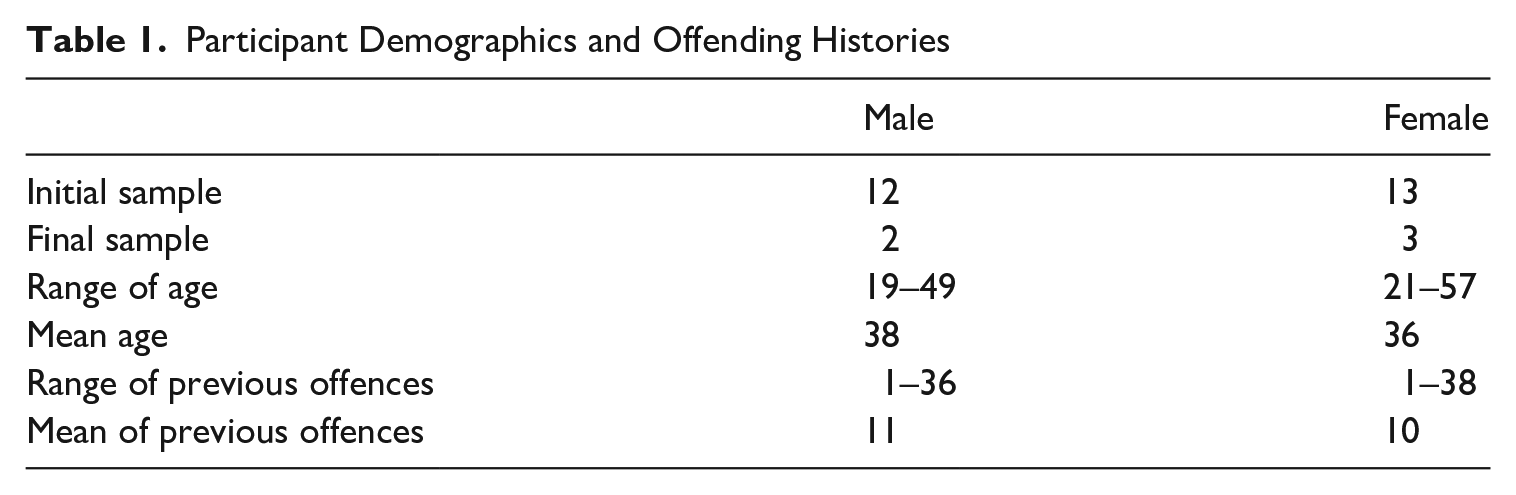
The sample was established over time where potential participants expressed interest themselves or were referred by professionals who were involved in managing and supporting their community supervision. A broad sampling criterion was adopted only requiring individuals to have at least 6 months remaining on their community order at the point of engagement to enable longitudinal involvement. The small sample is, however, not representative of the diverse population who are subjective to community supervision. In addition, this research is likely to have unintentionally excluded individuals who are disengaged in their community supervision due to difficulties in establishing and maintaining contact. However, the limitations of the small sample size are counter-balanced by the in-depth narrative approach adopted.
Narrative approaches to research
Narrative research is fundamental in establishing, developing and understanding theories of desistance, alongside how and why this process occurs for individuals. Therefore, it is important to recognise individual narratives change and evolve over time (Presser and Sandberg, 2015), and this article offers a point of reference within an ongoing story. This mirrors the dynamic nature of desistance, our relational networks and experiences of bereavement and loss. In addition, research into desistance has highlighted how sharing narratives can be regarded as an intervention in support of the process (Bove and Tryon, 2018). Within bereavement research, the role of stories is also regarded as a coping mechanism (Bosticco and Thompson, 2005; Walter, 1997). In addition, the loss of the assumptive world and the theory of grief have been conceptualised as offering ethnobiographical research that recognises the construction of narratives in relation to the meaning of an individual’s life through stories (Neimeyer et al., 2002).
The research accumulated a substantial amount of data which was recorded and transcribed verbatim, supporting the initial stages of analysis. NVivo was used to enable a careful inductive approach which provided a tool to establish and formulate of a series of themes and codes. It was through this technique that bereavement, alongside feelings of grief and loss, emerged as a recurring theme within individual narratives when discussing their relational networks and their role in desistance.
Research ethics and challenging power imbalances
Prior to the commencement of fieldwork, ethical approval was granted through the host university, and all risk assessments were completed to satisfy the Community Rehabilitation Company. This ensured potential harm to the participants and researcher was avoided with processes in place to mitigate circumstances when concerns arose. To aid in harm avoidance participants were continually reminded of all relevant information regarding the research aims and purpose, alongside how information would be recorded, stored and used.
As individual participants were central, they were offered the opportunity to decide their own pseudonym, avoiding the act of power recognised in re-naming (Guenther, 2009). These chosen pseudonyms supported anonymity and confidentially throughout and have been used within this article. To further support the recognition of power imbalance, the overarching research reflected on the ideas of trustworthiness and authenticity, especially important when conveying experiences and perspectives in a true, realistic and detailed manner (Lincoln and Guba, 1985). Recognising the work of Sharpe (2017), this research considered positionality and the potential challenges of intrusion through longitudinal research. Participants were continually informed and reminded of their right to withdraw, and when this occurred it was unquestioned to ensure integrity. The role of the researcher was considered throughout and the potential effect this may have on the information shared (Sharpe, 2017), the knowledge created and the potential for research biases (Berger, 2015). These empowering strategies supported individuals to talk openly about their experiences while ensuring their narrative remained central to the research.
Evidencing experiences of bereavement and loss in community supervision
As noted, experiences of bereavement were an emergent and prominent feature of participant narratives within the wider doctoral research. Those shared in this article provide original insight into the experiences of bereavement and loss for individuals subject to a period of community supervision.
A journey of bereavement and desistance
For many participants, bereavement was a continual process, alongside any attempts at desistance from crime or movement away from risk-taking behaviour and/or addiction. Matthew has struggled with substance abuse for most of his life, which shaped his identity and formed the basis of many of our conversations. Now in his late 40s, his narrative continually expressed no clear direction for his life, although his children provided a focus: God, two of me best mates are dead because they ended up getting into gear . . . to be fair they probably got into gear because of me and a couple of other lads. Now they’re dead, you know and its . . . me best mate, he would have been [my daughters] godfather if he was still here . . . it’s never bothered me since he died, but since a few weeks back, it’s been nearly 12 years . . . a few weeks back I was sat thinking about him and I got quite upset really. (Matthew, male participant)
This reflection from Matthew evidences incomplete grief. These resurfacing feelings demonstrate a prolonged effect and impact on Matthew’s life and complicate the grieving process (Shear and Shair, 2005). Through conversations, Matthew highlighted how emerging feelings surrounding the loss of attachment to his two friends resulted in him reconsidering his drug use as a coping mechanism. His narrative evidences how experiences of bereavement, even after a period of time, represent similarities to the zigzag nature of desistance and also the potential of engaging in criminal and/or risk-taking behaviour (De, 2018). This highlights the importance of being aware of previous bereavement and loss experiences, especially when an attachment figure evidenced relational quality and security.
Jim was estranged from his family and considered himself a ‘lone ranger’. He explained how the loss of his mother and the important emotional attachment (Giordano, 2010; Shapland and Bottoms, 2011) she provided had a negative impact on his mental health: the depression got worse after me mum passed away . . . she didn’t die of natural causes in that respect, she was married to a heroin addict . . . this . . . I have my theories on how she ended up being in hospital. However, I can’t prove it. (Jim, male participant)
Jim evidenced a limited sense of belonging, with his identity shaped by alcoholism. Jim’s social and economic circumstances were difficult and he was living in supported accommodation at the time of the research, both known factors for complicated grief (De, 2018) and challenges to desistance. The circumstances surrounding his mother’s death also highlight a traumatic element to the bereavement and loss experienced by Jim which cannot be ignored (Halsey, 2017). This is especially important when considering how grief presents periods of uncertainty (Farrall, 2009) through an individual’s loss within their assumptive world (Kauffman, 2002).
Sarah’s relational networks, and identity, demonstrate a different picture to that of Matthew and Jim. Sarah’s narrative provides further insight into the loss of a relationship where strong attachment is evidenced and how when left unresolved can have a cumulative and continued emotional effect: me girls were like you filled your life with him [father-in-law], just sitting and talking to him and then suddenly you had nothing . . . after sorting everything out . . . and changing documents . . . and she [daughter] was like I don’t think you grieved . . . it did have a massive impact on my life, and it still does. (Sarah, female participant)
Sarah’s feelings occurred even though she was continually surrounded by a strong supportive relational network of family and friends, and maintained financial stability living in privately owned accommodation. This demonstrates the unpredictable and individual impact of bereavement and loss (Doka, 2016), which mirrors the unpredictable and individual journey of desistance.
Influencing the onset and persistence of criminality
Experiencing bereavement is not only comparable with the journey of desistance, but can also influence the onset and persistence of criminal behaviour. Drawing back to the narrative of Sarah, the loss of her father-in-law, who provided strong attachment, challenged her identity and disturbed the pattern of her daily activities (Shear and Shair, 2005) through the uncertainty her life now presented. Sarah’s narrative expressed how she felt the loss of this relationship, and her role as carer, left a significant gap and purpose to her life which she replaced within gambling: You know when you look back for triggers . . . I think it could have been because of . . . when we lost me husbands dad, he died in the December and in the February, I started gambling . . .. (Sarah, female participant)
Her criminal behaviour spiralled from this addiction, which she described as a way of coping with the loss of her father-in-law and the emotional and practical consequences it presented through her sudden change in lifestyle (Byrne and Trew, 2008): My life just turned upside down nothing was normal . . . every morning when I got up nothing was normal . . . I think I had to realise at the time that I was depressed, and it want . . . I didn’t do it through . . . hate . . . and I didn’t do it as a malicious thing . . . I think I did it, but it didn’t register, and I think that’s what . . . I had to come to terms with the reasons that I did do it not the way I felt . . .. (Sarah, female participant)
Participant narratives demonstrate how bereavement was not only an explanation for the onset of criminal behaviour, but it also evidenced persistence and provided insight into the links between addiction and mental health.
Olivia shared her feelings and experiences of coping with the separate deaths of her sister, husband, granddaughter and cousin over the past 2 years. Olivia articulated how she felt unable to break the cycle of her offending, drug use and alcoholism, expressing that she did not see the light at the end of the tunnel following a significant period of uncertainty within her life (Farrall, 2009):
I just take each day as it comes. I get upset all the time . . . Yeah, been on it [methadone] years. I was nearly coming off it but I started using again.
Was that when you lost your husband?
Yeah
Olivia’s narrative demonstrates not only bereavement and loss of close personal relationships, but also the experience and impact of losing her addiction worker through suicide. This represented the loss of a regulatory relationship (Hofer, 1978) involved in her community supervision and deemed vital by Olivia for her desistance journey. In addition, suicide is regarded as a traumatic death (De, 2018) complicating her grieving process: I mean he passed away lasted year . . . they are all leaving me . . . he killed himself, I didn’t even know that till someone told me. Why would he do that, he seemed so happy . . . he was helping us . . . I was with him for 6 nearly 7 years. He reduced my meth . . . I was reducing real fast, I got to 19ml and . . . just went back up yesterday because I was using. (Olivia, female participant)
The confusion and disorientation Olivia shares (Attig, 2002) link bereavement and the onset and persistence in criminal and/or risk-taking behaviour. Coupling bereavement with addiction and mental health demonstrates it should not be neglected as an indirect cause of criminality (Rodger, 2004). The complicated links between bereavement, mental health and addiction should be regarded as a welfare concern of those involved in professional support (Hester and Taylor, 2011). Structural ‘hooks’ (Giordano et al., 2002) provided through strong relationships that evidence attachment, emotional connections (McNeill, 2009; Shapland and Bottoms, 2011) and a sense of belonging (Nugent and Schinkel, 2016) are important for desistance. When lost or altered through bereavement, this should be recognised and supported within the context of community supervision.
Disrupting desistance
Drawing back to the narrative of Olivia, further evidence demonstrates how experiences of bereavement and loss can disrupt the journey of primary and secondary, and also act and identity desistance when considering the complexities of the individualised journey. Olivia spent the majority of time with her brother after the losses she had experienced and indicated that together they engaged in risk-taking behaviour through drink and substance abuse alongside involvement in criminality: I should have finished in February just gone but then I got a new one . . . Me and me brother we had . . . er these golf clubs and this big chainsaw and the police went by . . . and it want good . . . they got me outside [drug agency]. (Olivia, female participant)
Olivia’s narrative presents additional insight to support that of Matthew’s, shared above, surrounding how a continued grieving process can result in the potential to engage in criminal and/or risk-taking behaviour (De, 2018). It is therefore important to consider both current and historical experiences (Vaswani and Gillon, 2019) and their disruption of desistance.
Participants also expressed how the loss of relationships which held strong levels of attachment and had previously provided a sense of belonging disrupted tertiary and relational desistance. This is evidenced by drawing back to the narrative of Jim: Sometimes I wish me mum was still here because she kept us all strong and once she passed away everything just went downhill . . . we had to switch the life support machine off. And then family feuds started. (Jim, male participant)
In addition, Jim’s narrative also highlights the ripple effect of bereavement (Vaswani, 2014) and the loss of additional relationships that are known to offer a supportive hook (Giordano et al., 2002) in the journey of secondary, tertiary, identity and relational desistance.
In addition, and evidenced as an important element of desistance, participants expressed shameful emotions, blaming themselves for the death of close emotional relationships, which further complicated their grieving process (De, 2018). This was evident through the narrative of Liz, who had a long history of involvement in the criminal justice system, but who was now focusing on turning her life around for her third child whom she was pregnant with at the time of her involvement in the research: Like I feel guilty that me best made died when I was in prison . . . he would have been wi me he wunt have been with the 2 lads and took them subbies because he never did nowt like that but I got sent down 2 days before . . . I just wanted to be back inside it was my safe place . . . I would purposefully do it and I did that this time and he ended up dead . . . also the last time I seen him we had a massive argument we never used to argue . . .. (Liz, female participant)
The emotional nature of bereavement, especially when death and loss were experienced through traumatic incidences, presented disruption which required navigation when considering desistance. This has been evidenced through the previous narratives of Matthew and Olivia, but also highlighted by Karen: But these dreams are like when me Grandma was murdered . . . I went real bad, I went pyscho. Like I was looking round [city] for this guy . . . her ex-bloke that beat her and killed her . . . and I wish I never broke in . . . coz there was just f**king blood everywhere . . . and I started getting real bad dreams then but I think now . . . I think it’s like I’m floating in me dreams . . . like I can’t put me feet on the ground and it’s like I’m been pulled in the other way and I am constantly holding onto things. (Karen, female participant)
During her involvement in the research, Karen was working through anger management. She was also homeless due to difficult family relationships and being evicted from her rented property. Karen spent time in bed and breakfast accommodation provided through the women’s centre which offered a degree of stability to her life. The offender victim typology is clear through the traumatic death experienced by Karen (Gekoski et al., 2013), where there are strong emotional feelings attached to the loss of her grandma and the circumstances of her death that are challenging her desistance. The anger Karen expresses was something she continued to work through and which resulted in continued criminal and risk-taking behaviour. Karen expressed how her reactions towards people when things happened to her were a huge influence on her offending.
Developing resilience
Resilience is important within the context of both desistance and bereavement. Although the loss of Karen’s grandma evidenced disruption to desistance, she also demonstrated resilience, in the context of survivor syndrome (Perreault et al., 2010) and the coping strategy of remembering (Vaswani, 2014). Karen recalled the emotional connection and positive support the relationship with her grandma offered, using this as a motivation.
Like it sounds daft but me grandma isn’t here no more but I think that she still is . . . I’ve felt her with me and she would absolutely me so proud of me. (Karen)
The feelings Karen associates with her grandma evidence a sense of belonging and recognition of change, both of which support the journey of desistance and evidence the positive emotional memories that can be attached to bereaved relationships.
Resilience was also discussed by Sarah, which demonstrates the personal responses to bereavement through both gradual recovery and prolonged distressed (Bonanno et al., 2011). This evidences the significant readjustment (Holmes and Rahe, 1967) Sarah was experiencing within her life: I think you just have to work through it all and there is no time scale . . . and I know now from experience . . . and we have all had deaths and all dealt with things like that in our lives and people deal with it differently . . . I think this has been harder to get control over . . . but this is it when someone dies and then you go through that grieving process . . . but your life carries on as normal . . . with this my life just turned upside down nothing was normal . . . every morning when I got up nothing was normal and its took me a long long time to get to that stage where I felt OK . . . it did take me so long just to get me head round everything . . . how it changed my life, how it changed everybody else’s lives . . . and I would say its took me a good 20 months easily . . . to sort of get to the stage where I am now . . . and maybe in like 6 months’ time somebody else says something and you suddenly go whoa but I think I am in a lot better place to deal with that now. (Sarah, female participant)
Through Sarah’s narrative, we can see how motivation developed over time as she engaged in her journey of secondary and identity desistance. The strong relationships Sarah described with family also evidence how her resilience is influenced by both herself and her environment (Ungar, 2013).
Concluding reflections
To conclude, this article has explored male and female experiences of bereavement and loss within the context of community supervision and how this process demonstrates similarities to that of desistance from crime. The article has also reiterated how bereavement can influence the onset of criminal and/or risk-taking behaviour and evidenced how experiences of bereavement can disrupt desistance. Finally, the article highlighted the importance of developing resilience in order to support both the process of desistance and experiences of bereavement.
What is fundamental is how ‘the place of bereavement support in preventing criminal behaviour warrants serious investigation’ (Finlay and Jones, 2000: 569). Experiences of bereavement and loss evidence one element of the complexities which can disrupt desistance through engaging or persisting in offending and/or risk-taking behaviour. To overcome and negotiate this, it is important to consider the expansion, commissioning or development of bereavement services (De, 2018) within the context of community supervision. This would support recognition of the associated feelings towards bereavement, and loss, and ensure they are not suppressed or stigmatised. When in conversation with the hosting Community Rehabilitation Company, it was suggested they consider how individual practice should offer ongoing support to those who are going through the personal process of bereavement and experiencing complex and wide-ranging emotions. To support developing strong supportive relationships within practice assessments (e.g. OASys) could better recognise the experiences of bereavement, as a potential dynamic risk factor. There are clear opportunities to consider practice-based implementation and develop a stronger understanding of the potential link between bereavement and persistence and/or desistance from crime.
Bereavement and/or loss demonstrate unique and complex experiences, with wide-ranging impacts. Recognising this within the context of criminal and/or risk-taking behaviour would enable opportunities to explore the complexities involved in this relationship. As individuals’ lives continue, this article has offered a point of reference within an ongoing story. Therefore, further research is required in an attempt to comprehensively understand experiences of bereavement and loss to develop our understanding of its influence on an individual’s desistance and/or persistence in criminal or risk-taking behaviour. In addition, research into individual intersectionalities of those under community supervision would provide thoughtful, and timely additional insight.
Footnotes
Acknowledgements
I would like to thank all those who shared their stories and experiences with me. Also thanks to Professor Chris Fox, for the continued help and support throughout my PhD and for providing support and comments for this article.
Declaration of Conflicting Interests
The author(s) declared no potential conflicts of interest with respect to the research, authorship and/or publication of this article.
Funding
The author(s) received no financial support for the research, authorship and/or publication of this article.
