




Abstract
Keywords
This special issue is devoted to a constantly growing field of interest within criminology and criminal justice: so-called collateral consequences of criminal records (hereinafter, CCCR). Criminal justice–involved individuals face burdensome legal and social barriers and disabilities that exist because of their prior contacts with the criminal legal system (Demleitner, 1999; Jacobs, 2006, 2015; Larrauri, 2014). 1 Collateral consequences can be both formal and informal in nature. The first CCCR category − so-called de jure collateral consequences − includes sanctions, restrictions and disqualifications that attach to a criminal record which have either a statutory or regulatory basis. These consequences limit the full exercise of citizenship rights and restrict, access to employment and economic opportunities, as well as welfare benefits (e.g. Love et al., 2022). To be clear, criminal justice actors are not the only authorities that may impose collateral consequences. Administrative licencing bodies, immigration authorities and other state-sanctioned actors exercising delegated functions play a key role in imposing formalised collateral consequences (e.g. Blitsa et al., 2015; Denver and Ewald, 2018). The second category of CCCR − so-called de facto collateral consequences − includes social barriers and disabilities that lack a statutory basis and do not necessarily involve any government, or otherwise state-sanctioned, actors (Kirk and Wakefield, 2018). These include restrictions inflicted by private actors, such as landlords and employers, acting upon criminal justice information obtained through criminal background checks (Corda and Lageson, 2020; Logan, 2013).
CCCR have been criticised as constituting ‘invisible punishment’ (Mauer and Chesney Lind, 2002) since they are not formally qualified as criminal sanctions, are not part of prosecutorial or sentencing decision-making and seemingly operate outside the boundaries of the criminal legal system. In fact, ramifications of criminal records represent a major facet of the lived experience of criminal justice–involved individuals who are subject, to a varying degree, to a web of discrimination, exclusion, governance and surveillance (e.g. Miller and Stuart, 2017). While the traditional focus of criminal justice scholarship and policy has been on incarceration and community supervision, CCCR affect a much broader segment of society than traditional forms of punishment resulting from criminal justice involvement. The rate of criminal record subjects per 100,000 of the general population dwarfs that of incarceration and community supervision in countries for which reliable data are available, such as the United Kingdom, Germany, Spain, Canada and the United States (see Figure 1).
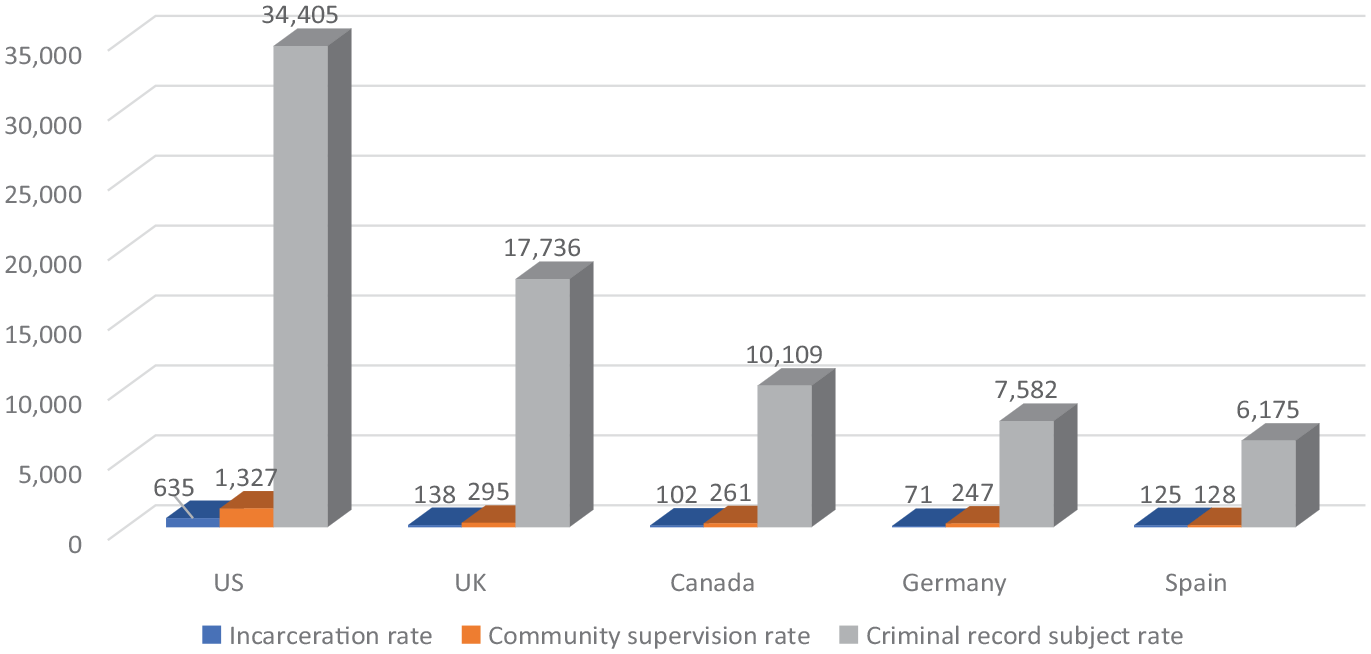
Incarceration, community supervision and criminal record holder rates per 100,000 general population (2019).
The illustrated rates of criminal record holders call for a more sustained and granular attention to the prevalence and operation of CCCR from a cross-national perspective. Most of the research on CCCR has thus far been conducted in the North American context. Policy and academic debates on the topic of collateral consequences first emerged in the United States in the 1950s but were then abandoned at the end of the 1970s due to the rise of ‘tough on crime’ sentiments and ensuing punitive policies (Love, 2003). At the turn of the century, collateral consequences gradually started to re-emerge in criminal justice policy conversations (Bushway, 2004; Chin, 2003; Demleitner, 1999; Jacobs, 2006; Mauer and Chesney Lind, 2002; Pager, 2007; Petersilia, 2003). Yet, initially, research on CCCR did not establish itself as a discrete field or subject of study; instead, it originated from the work of scholars whose primary research focus was on more traditional aspects of punishment studies, such as sentencing, incarceration, community corrections and prisoner re-entry. In recent years, a distinct and systematic literature has emerged, focusing specifically on the barriers and disabilities that exist because of a criminal record.
This area of inquiry in the past decade has encompassed work developed from different methodological and disciplinary angles. This scholarship covers a broad range of topics, including normative (e.g. Chin, 2012; Hoskins, 2019; Mayson, 2015) and socio-legal (e.g. Corda, 2016, 2018; Jacobs, 2015; Lageson, 2020) analyses that examine the punitive nature of collateral consequences, as well as criminological studies that explore the mechanisms underlying the adverse effects of having a criminal record (e.g. Denver et al., 2018; Evans, 2019; McElhattan, 2022; Stewart and Uggen, 2020; Vuolo et al., 2022). Additionally, researchers have tested strategies aimed at providing individial with criminal records with meaningful second chances (e.g. Agan and Starr, 2018; Bushway et al., 2022; Leasure and Zhang, 2021).
Interest in and knowledge about collateral consequences outside of the United States developed much later and, initially, struggled to attract sustained attention from scholars, policymakers and social justice organisations. Until the early 2010s, very few scholars engaged with the topic of CCCR (e.g. Jacobs and Larrauri, 2012; Loucks et al., 1998; Stefanou and Xanthaki, 2005). In 2011, a collection of studies was published (Herzog-Evans, 2011) with the main goal of describing current systems for the disclosure, use and expungement of prior convictions in a range of Western jurisdictions (including Australia and five European countries). In recent years, additional knowledge has been produced and greater insight has been gained into the impactful restrictions that people with criminal records face in economic, occupational, social and political settings, especially in the European context (e.g. Backman, 2012; Henley, 2017; Larrauri, 2014; Rovira, 2022; Thomas and Hebenton, 2013; Tripkovic, 2016). In addition, empirical studies have started to shed light on the discriminatory effects of using of criminal records in labour markets (Rodríguez Menés and Rovira, 2021; Van den Berg et al., 2020) and the stigmatising effects produced by the mark of a criminal record (Heydon and Naylor, 2018; Kurtovic and Rovira, 2017; Van ’t Zand-Kurtovic, 2017). A recent volume (Meijer et al., 2019) expanded the debate by providing evidence of the prevalence of collateral consequences in previously understudied European jurisdictions. Moreover, a recent collection of papers highlighted the numerous obstacles that individuals with a criminal record must face in the United Kingdom during the process of legal rehabilitation and re-entry (Henley, 2022).
Although research on CCCR is beginning to grow internationally, inquiries have mostly focused on the ‘usual suspects’, that is, the US and a few Western European jurisdictions. Outside of these regions, knowledge about CCCR is still, to a great extent, in its infancy at the scholarly and policy level, despite some limited evidence indicating that the proliferation of collateral consequences and criminal background checks is also occurring in other areas of the world where roadblocks to the social reintegration of people with a criminal record are on the rise (e.g. Baffour et al., 2020; Gaston, 2019; Rovira, 2023).
Furthermore, with few exceptions, research on CCCR outside of the US context often tends to be mostly descriptive, scattered and compartmentalised. From an American perspective, comparative analyses of policy issues and practices related to CCCR have generally been neglected or, at times, presented in an oversimplified way in their underlying assumptions. This highlights the urgent need to develop not only a more nuanced comparative analytical framework but also a more systematic and comprehensive cross-national understanding of CCCR in non-US jurisdictions − in Europe and other areas of the world − from an empirical, socio-legal and normative perspective.
The articles in this special issue of Criminology & Criminal Justice highlight and critically examine global transformations, developments and nuances related to the ‘growing practice of disclosure and notification’ of criminal history information (Garland, 2001: 180; see also Maruna, 2011; Rovira, 2023) and the burdensome ramifications that flow from having a criminal record, both at the legal and societal level. They do so by testing widely shared assumptions, identifying and discussing national and regional specificities in policies and practices (and their rationales) and providing reform proposals and caveats. Taken together, the papers aim to critically contribute to enhancing the quality of cross-national literature on CCCR and fostering new debates, research and lines of inquiry within the field. This collection of scholarship also intends to move beyond a Western-centric perspective by broadening the focus of analysis to include countries and clusters of jurisdictions which have been thus far excluded from in-depth studies and ‘mainstream’ conversations.
Alessandro Corda, Marti Rovira and Andrew Henley challenge some of the simplifications regarding collateral consequences and criminal record management in the US-Europe comparative debate. This article complicates previous assertions of the distinct and exceptionally harsh character of the American regime in the field of CCCR and cautions against the view that European policies and practices are inherently more ‘progressive’ with regard to their treatment of criminal records and criminal record subjects. Elina van ’t Zand-Kurtovic and Miranda Boone analyse the development and operation of the unique Dutch system of criminal record storage and disclosure. They explain how this model, strongly protective of privacy and confidentiality, has nonetheless triggered the proliferation of centralised state-performed criminal record screening leading to significant barriers to the re-entry process for people with a criminal record. Enshen Li presents the first comprehensive work on the framework, characteristics and developments of criminal record management and its ramifications in China. This article also analyses the pervasive Chinese Social Credit System, a form of social control and ordering that crucially incorporates, among others, criminal history information. Lili Dao discusses how the commitment of Canadian sentencing law to individualised proportionality does not seem to extend to considering immigration-related collateral consequences of a criminal conviction. Her analysis reveals and emphasises the ‘dark side’ of collateral consequences jurisprudence in the field of so-called ‘crimmigration’. Leandro Gaston and Carlos Carnevale explore the criminal records system in Argentina in the context of recent reforms on criminal record disclosure in Latin America. The article also discusses the creation of worker co-operatives established, owned and run by people with a criminal record revealing their role as a bottom-up resistance strategy against post-sentence stigma and discrimination in the labour market. Frank Baffour and co-authors explore the struggles of recruiters in conducting criminal background checks in the West African country of Ghana. Their work illustrates how, given the lack of access to reliable criminal record information through the government’s infrastructure, employers tend to rely on informal means and institutions to gather information about the character and history of job applicants. Finally, Katerina Hadjimatheou challenges the one-size-fits-all approach to the study of criminal record disclosure with regard to Domestic Abuse Disclosure Schemes (DADS). The article explores policies and regulations governing the operation of DADS in four common law jurisdictions (UK, Canada, Australia and New Zealand) and discusses their normative rationales.
With this special issue, we aim to stimulate and encourage more international discussion on the trends surrounding the creation, dissemination and use of criminal records, as well as the increasing prevalence and range of collateral consequences resulting from criminal justice involvement.
It is with heartfelt gratitude that we would like to dedicate this special issue to the late James B. Jacobs (1947–2020), Chief Justice Warren E. Burger Professor of Constitutional Law and the Courts and Director of the Center for Research in Crime and Justice at NYU School of Law. Jim’s seminal work nearly singlehandedly established the field of criminal record research, not only in the United States but around the globe. His generous and insightful mentorship, unrelenting support and constant encouragement shaped for the better the lives and scholarship of many, including ours.
Footnotes
Declaration of Conflicting Interests
The author(s) declared no potential conflicts of interest with respect to the research, authorship and/or publication of this article.
Funding
The author(s) received no financial support for the research, authorship and/or publication of this article.
