




Abstract
Domestic abuse disclosure schemes allow members of the public to request and receive information from police about the criminal histories of their partners, if they are at risk of abuse. In doing so, they open new pathways for disclosure of criminal record information beyond the spheres of employment and access to public services. This article reviews existing domestic abuse disclosure schemes and addresses their normative implications. Specifically, it examines the extent to which moral and legal criticisms that are frequently levelled at other kinds of criminal record checks apply equally to domestic abuse disclosure schemes. It is argued that, while domestic abuse disclosure schemes are less susceptible to criticisms of unfair disadvantage or disproportionate punishment than employer checks or other forms of third-party disclosure, they sit uneasily with respect for the moral agency and dignity of people with histories of abuse. These insights reveal the limits of a one-size-fits-all approach to analysis of criminal record disclosures, highlighting the need for more granular, crime-specific research in this field.
Keywords
Introduction
Domestic abuse disclosure schemes (DADS) allow members of the public to request and receive information from police about the criminal histories of their partners if they are at risk of abuse. Originally introduced in England and Wales in 2012, DADS have since been replicated in other common-law jurisdictions − Scotland, Northern Ireland and New Zealand, and in a growing number of states in Canada and Australia. Police in South Korea have reportedly introduced a dating abuse disclosure scheme (Soo-sun, 2017) and scholars in South Africa have called for a similar scheme to be introduced there too (Zazo, 2019). Despite a culture of strong privacy protections for peopple with convictions, Spanish authorities recently responded to high rates of domestic homicide by announcing that they will begin disclosing the histories of high-risk perpetrators of abuse to their partners (La Moncloa, 2023). The few existing studies of DADS are grounded in the literature on domestic abuse, which examines them from the perspective of potential victims and overlooks the potential impact on the rights and interests of people with police records of abuse. The literature on the collateral consequences of criminal records has a well-established body of analytic resources to with which to analyse the normative implications of criminal record disclosure for people with convictions, yet it has remained silent on DADS, focusing instead on disclosure in the context of employment, access to welfare benefits and education.
This article advances criminological scholarship in two ways. First, by providing a systematic comparison of all DADS currently in use, drawing on the results of desk-based research and communications with police, domestic abuse practitioners and academics across the five jurisdictions in which DADS operate to clarify their aims and divergent applications. And second, by taking the first steps towards a normative analysis of DADS as they stand today. This aim is achieved by drawing on the substantial literature on the collateral consequences of criminal records to consider the extent to which moral and legal criticisms of other kinds of criminal record disclosure also apply to DADS. Until now, this latter body of literature has treated people with criminal records as uniformly vulnerable and in need of protection from an overweening penal state. Thus, a secondary aim of this article is to highlight some of the limits of those criticisms as well as the need for more granular, crime-specific research in this field, by drawing attention to the distinctive features of the crime of domestic abuse.
DADS: Context, rationale and jurisdictional variations
Domestic abuse, or the use of physical or emotional violence and control between members of the same family − most often intimate partners − is a serious, widespread and persistent problem. In 2021, the World Health Organisation estimated that up to 38% of all murders of women globally are committed by intimate partners and that 27% of women have experienced some form of intimate partner violence (World Health Organization, 2021). 1 Today, domestic abuse is in many jurisdictions the most common violent crime reported to the police. 2 But the historical dominance of patriarchal gender norms means that the criminalisation of domestic abuse is a relatively recent phenomenon: in 1970, no country in the world had laws against domestic violence; in 2022 at least 155 do (World Bank, 2020).
The first Domestic Violence Disclosure Scheme, introduced in England and Wales in 2012, was conceived of specifically as a means of protecting victims from repeat and serial domestic abusers, who were increasingly recognised as posing a particularly serious threat (Association of Chief Police Officers (ACPO), 2009). These individuals – numbering an estimated 25,000 in 2009 in the United Kingdom alone (Moore, 2009: 8) – tend to be well known to police as dangerous, due to having multiple previous victims and recorded crimes. However, they typically go unprosecuted, for a range of reasons including a reluctance of victims to testify due to fear of reprisal, lack of confidence and trust in the criminal justice system (Frieze and Browne, 1989; Pagelow, 1984) and problems with evidence. 3 Low prosecution rates allow repeat and serial abusers to offend with impunity, but they also enable them to deny harming others and point to a clean criminal record when faced with concerns from new partners and their families about previous accusations or current behaviours.
Multiple studies have shown that perpetrators frequently misrepresent their own histories to their partners to construct a narrative in which they are innocent of wrongdoing or are even victims themselves (Henning and Holdford, 2006). Specific tactics include minimising and denying past abusive conduct (Jones and Schechter, 1993), blaming previous partners for past incidents of abuse and breakdown of relationships (Hill, 2020), justifying violence and gaslighting (i.e. using psychological manipulation to confuse and distort someone’s reality such that they must accept the perpetrator’s imposed reality in place of their own). The first DADS aimed explicitly to counteract this form of abuse, by providing those vulnerable to abuse with reliable information about the nature and severity of the risk they face, and thereby empowering them to make more informed decisions about their relationship and their safety (Hadjimatheou, 2022).
DADS sit within a relatively new field of practice known as ‘domestic abuse safeguarding’ which imposes legal duties of care on police to support, protect and empower victims of abuse, precisely because they are unable, given the distinct vulnerabilities caused by abuse, to protect themselves. 4 Safeguarding originates in social service practice with vulnerable people and has since been adopted by police specialising in the protection of these same groups. Its effectiveness is measured in terms of increases in empowerment and safety of those vulnerable, rather than prosecution rates or reductions in crime. Safeguarding practices and rationales differ from initiatives in the field of ‘preventive justice’, which seeks to pre-empt or anticipate criminal behaviour by using coercive powers on potential or suspected offenders, such as prohibitions, forced monitoring or requirements to attend rehabilitation courses (Zedner, 2016), and whose success is measured by reference to crime or reoffending rates among those who are deemed dangerous. While preventive justice represents an expansion in the criminal law, safeguarding (and DADS) typically involves the deployment of existing powers to protect the vulnerable. Both safeguarding and preventive justice are examples of fields of practice that serve a broader social aim of risk reduction (Beck, 1992).
The English and Welsh Scheme, which continues to be the model for DADS internationally, established two pathways to disclosure of criminal records: a ‘Right to Ask’ which allows members of the public to request information from police; and a ‘Right to Know’ which enables police to offer disclosures proactively when they believe someone to be at risk (Home Office, 2016). Under the Right to Ask, an application for disclosure is submitted either online or in person, then police assess the eligibility of the applicant (which in England and Wales is limited to current or former intimate partners or those with a duty of care to a person at risk, but in some other countries is limited to current partners); conduct a standardised risk assessment of the applicant, their description of their relationship and experiences; and offer support or interventions, such as referral to specialist domestic abuse support services, provision of personal alarms or applications for restraining orders. The risk assessment process is also used to uncover current behaviours that may turn out to be continuous with previous reports of abuse, thus revealing whether there is a ‘pattern of abuse’ which indicates higher risk. Police databases are then searched for ‘relevant’ information about the partner, meaning information that indicates a history of domestic abuse, including current convictions, ‘spent’ convictions and non-conviction information such as arrests, charges or reported crimes.
If relevant history is discovered, a proportionality and necessity assessment is undertaken by an authorising officer to decide whether a disclosure is warranted. This involves considering whether the prima facie legal breach of confidentiality involved in the disclosure of police records is justified by the protective potential of the information disclosed, given the circumstances of each particular case. Evidence from England and Wales suggests that in typical cases the judgement is straightforward, as most subjects of disclosure are associated with many recorded incidents of abuse, across different victims, but that police do struggle with borderline cases, where the history is limited and no conviction exists (Hadjimatheou and Grace, 2021). Broad police discretion, limited case law in the field and little scrutiny of DADS by the police ombudsman 5 mean that what is considered proportionate varies between individual police forces (Hadjimatheou and Grace, 2021) and as yet there is little guidance on what good practice would constitute, especially in relation to disclosures of non-conviction data.
If a disclosure is approved, a written summary of the information is drafted and then relayed verbally to the recipient. They must then sign a legally binding confidentiality agreement preventing them sharing the information with anybody else. Following the exchange of information, the recipient and police (or, in South Australia, specialist support workers who are always present alongside police) address risks by making a safety plan and linking up with specialist services such as refuges or mental health support as necessary.
For the Right to Know pathway (which does not exist currently in Scotland or New Zealand), eligibility checks and risk assessment are done in-house by the police, and potential recipients are then approached by police and offered a disclosure, which they are free to refuse. Right to Know disclosures are used far less often than Right to Ask disclosures, and are typically prompted when, for example, probation services alert police that a serial offender who has been released from prison following a domestic abuse-related sentence has begun a new relationship. Again, the authorisation of such disclosures involves an assessment of their necessity and proportionality.
Despite requiring something of a culture shift in policing, which has traditionally guarded criminal record data as confidential, the English and Welsh DVDS has enjoyed strong support from police and domestic abuse organisations and today is well established as a core tool of domestic abuse safeguarding by police, with 13,439 disclosures made in 2020–2021 alone. 6 Other countries facing similar challenges around the policing and prevention of serial perpetration have been quick to adopt their own disclosure schemes, especially in common-law jurisdictions which, like the United Kingdom, afford wide discretion to police to make judgements about how to exercise their law enforcement powers for the prevention of crime. The next section provides an overview of these.
DADS: An international snapshot
The information presented in Table 1 captures only those elements of DADS that are relevant to legal and moral debates around the collateral consequences of criminal records, that is, level of risk required for a disclosure and eligibility of recipients, the kind of information accessed and disclosed and consideration for rights to privacy, rehabilitation and due process of subjects. It was gathered by means of a review of legal and policy documents and 4 months of personal communications by email and informal interviews by phone between the author and police, domestic abuse services and academics in each of the relevant countries. These insights were combined with qualitative data from in-depth interviews with disclosing officers from 14 UK police forces, gathered for a previous project in 2019–2020.
Snapshot of DADS in six jurisdictions.
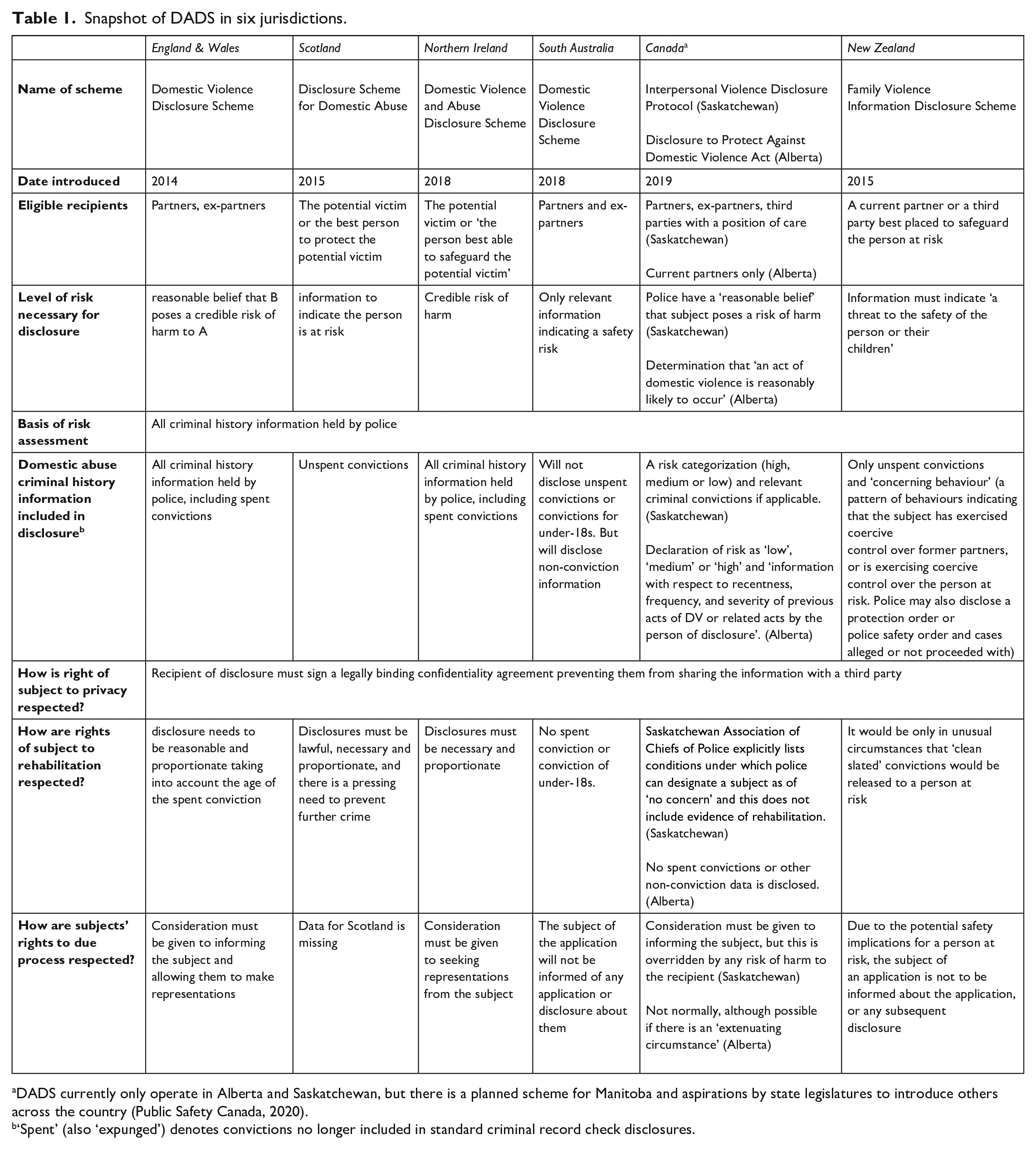
DADS currently only operate in Alberta and Saskatchewan, but there is a planned scheme for Manitoba and aspirations by state legislatures to introduce others across the country (Public Safety Canada, 2020).
‘Spent’ (also ‘expunged’) denotes convictions no longer included in standard criminal record check disclosures.
As the figure illustrates, DADS diverge significantly around the kind of information that can be disclosed, reflecting different police cultures around the sharing of non-conviction data. Most current schemes enable police to disclose information that is very detailed, including spent convictions, charges, arrests and reported crimes. Most also allow the disclosure of domestic abuse records in perpetuity, meaning that people with records of domestic abuse are potentially liable to have them shared with any current or future partner for the rest of their lives. But the New Zealand and Scottish schemes are more conservative, limiting disclosures to only those convictions that are unspent. And the Canadian scheme is an outlier in disclosing only the outcome of a police risk assessment (‘high’, ‘medium’ or ‘low’). The Australian scheme is the only one to rule out disclosures of convictions held by under 18-year-olds, indicating a greater concern with youth rehabilitation. Schemes also diverge on whether police must ‘consider’ informing or seeking representations from the subject of a disclosure (though informal conversations undertaken for this study suggest subjects are hardly ever or never informed in practice). All schemes operate some threshold of risk that must be met before a disclosure is justified, and all require that disclosures pass necessity and proportionality assessments, which are conditions of the compatibility with human rights law of the intrusion into the privacy of the subject.
The availability of reliable information about the implementation of DADS differs between jurisdictions. For New Zealand, where there is no publicly available data, police did not appear to know whether data on rates of applications were even collected. The official Guidance for the New Zealand scheme was shared only in confidence with the author. In Scotland, the official Guidance for the scheme is still not public. In Canada, the legal framework for the scheme is publicly available, but no data, for example, on rates of disclosure are published. All the UK jurisdictions publish basic statistics on the number of applications and disclosures made annually. But they do not regularly monitor people’s motivations for seeking a disclosure, the kinds of information disclosed, nor the outcomes for people. In no jurisdiction is data gathered systematically about the impact of disclosures on subjects or about rates of complaints or legal challenges from subjects if they come to know that their data have been shared.
Evidence on the impact and outcomes of DADS disclosures
Despite the relative paucity of available information on DADS, there is a small but growing body of qualitative research emerging from the United Kingdom and Australia which does yield some important insights into the potential value of disclosures for victims and survivors of domestic abuse. For example, in 2022 West Midlands Police conducted a qualitative study with 75 recipients of disclosures, which indicated strongly that the information was valuable in helping them end relationships and protect themselves (Public Protection Unit, West Midlands Police, 2022). A further quantitative case study with a different UK police force indicated that people who receive disclosures are less likely to be revictimised subsequently than those who do not (Grace, 2021: 138–139). Research for the pilot of the South Australian DADS found that the scheme was prompting victims of abuse to come forward to report their crimes and seek support for the first time: 61% of applicants were previously unknown to services (Marshall, 2020). More importantly, findings from three recent qualitative studies in the United Kingdom and Australia show how disclosures can correct false and victim-blaming narratives about past incidents of abuse and validate and confirm recipients’ concerns about their partner’s behaviour (Barlow et al., 2021; Hadjimatheou, 2022; Urbis, 2020). Specifically, by revealing ‘patterns’ in abusive behaviour over multiple victims, disclosures can expose a partner as having a propensity to abuse (rather than being misunderstood or justified) which in turn can reduce a victim’s self-blame. The results of these studies cannot be generalised, but they are nevertheless indicative that DADS can generate concrete improvements in safety. Equally importantly, in all cases where recipients of disclosures have been consulted, they have overwhelmingly emphasised the value of the information in helping them to re-evaluate their relationship and their role within it, re-assert their autonomy and make better decisions about their safety.
Taken together, this body of research suggests that DADS do yield benefits in terms of victim safeguarding. Indeed, most existing criticisms of DADS focus on concerns that police may not be disclosing as readily or in as much detail as they should (Barlow et al., 2021; Hadjimatheou, 2022) or that victims might be held responsible for their own protection following a disclosure (Fitz-Gibbon and Walklate, 2017; Wangmann, 2016). Yet this debate conspicuously excludes consideration of the potential impact of disclosures on those whose histories they reveal, thus overlooking the fact that they impose collateral consequences (deprivations or sanctions beyond formal punishment) on those with police records of abuse. An examination of these implications is therefore timely, and could help to inform their design so as to promote both the safeguarding of those vulnerable to abuse and the rights of those with histories of abuse.
Moral and legal issues with disclosure schemes
DADS are continuous with other forms of criminal record disclosure, such as employer checks, in that they use criminal histories to prevent harm. Yet they also depart from them in extending disclosure into the sphere of private relationships. Most employer disclosure regimes aim to protect the public from harm indirectly, by preventing people gaining access to opportunities to offend through their work. DADS seek to protect victims of domestic abuse directly, by offering them information that would help them to gain autonomy and confidence and thereby shifting the balance of power within intimate relationships. Most employer checks (in common-law jurisdictions) have very loose eligibility criteria for disclosure, and allow the disclosure of any kind of criminality, irrespective of its relevance to the specific job (Henley, 2019). In contrast, eligibility for a DADS disclosure is tightly restricted and disclosure itself is limited to the specific crime of domestic abuse. We now turn to consider the moral and legal implications of these differences.
There is a substantial and growing body of criminological work (and a smaller but nonetheless significant body of philosophical literature) analysing the normative implications of criminal record disclosure practices. The consensus across these disciplines is overwhelmingly critical of such practices: scholars tend to agree that – at least in common-law countries – criminal records are disclosed far more frequently and widely than is necessary for just punishment or the prevention of crime; that this results in unjust and harmful consequences for people with criminal histories; and, therefore, that there should be greater restrictions on the disclosure or accessibility of criminal records. Three kinds of argument are usually put forward in support of this position. The first focuses on conceptualising and demonstrating the harms or wrongs of visible or accessible criminal records. Thus, some argue that criminal records stigmatise those who carry them (Lageson, 2020), undermine rehabilitation and desistance (Henley, 2017; Maruna, 2001), visit disproportionate or otherwise unjust punishment or disadvantage on the subject of the record (Corda, 2016) and their families (Condry, 2006) and exacerbate unjust racial disadvantage for criminalised communities (Henley, 2017). A second line of argument claims that practices of disclosure and publicity fail to serve the purposes to which they are usually put – namely just punishment (Hadjimatheou, 2016; Lippke, 2018) and public protection (Henley, 2019) – and are therefore difficult to justify on those grounds. Finally, a third layer of critique questions the compatibility of criminal record disclosure with respect for human rights, specifically rights to privacy (Grace, 2014; Larrauri, 2014b), rehabilitation (Hoskins, 2019) and the presumption of innocence (Campbell, 2013; Larrauri, 2014a; Purshouse, 2018). To what extent can these insights help us to understand the normative implications of DADS? And how do the different models of DADS currently in use resolve or reconcile these moral problems when they do arise? The remainder of the article addresses these questions.
Disproportionate punishment
The argument that practices of disclosure and publicity visit disproportionate punishment (understood as that they ‘amplify punishment beyond the sanctions imposed by the criminal justice system’ (Kurlychek et al., 2006: 484)) on those with criminal records is difficult to make convincingly with respect to DADS. This is partly because DADS arguably do not qualify as punishment, and partly because, even if they do, they are not obviously disproportionate. Though punishment remains a contested concept (Garland, 1990; Zedner, 2016) generally accepted definitions take both ‘condemnation’ or ‘censure’ and the infliction of ‘hard treatment’ or ‘sanction’ (through deprivation or penalty) intentionally on a person to be its necessary features (Duff, 2001; Feinberg, 1970). Disclosure of a criminal record to an individual arguably does not punish, because there is no condemnation directed towards the subject in the disclosure process, nor is the intent to achieve a goal of punishment (e.g. retribution, rehabilitation) with respect to, or induce an effect (remorse) upon the subject of disclosure, in response to some act or acts of wrongdoing. Indeed, the action and the intended effects of DADS are directed only to the person who is at risk. What is more, evidence of current risk to a particular individual is a sufficient condition for disclosure, whereas evidence of past abuse is merely necessary.
However, the fact that DADS appear currently to be used to safeguard and empower victims (Hadjimatheou, 2022) does not mean they could not also or in the future be used punitively, to sanction and control people with histories of abuse. 7 The Right to Know in particular has the potential to become a measure of penal control, especially if police begin to proactively warn people of a new partner’s dark history as a matter of routine practice, rather than in response to clear evidence of ongoing risk. At present, the likelihood of this happening does seem low, not only because considerations of proportionality require an individualised risk assessment, but also because the resource burden involved in routine monitoring of any but the highest-risk perpetrators is unsustainable.
Nevertheless, even where disclosure powers are not used punitively, one might argue that a disclosure or the constant possibility of a potential disclosure could be experienced by a perpetrator of domestic abuse as punitive. Thus, for example, Grace (2021: 100) argues that a subject of a disclosure might perceive it as ‘an ongoing, non-linear and seemingly arbitrary risk of an unusual punishment: the encroachment of the state into their personal relationship with a new partner’. But even if the subjective experience of an interference with a right as punishment is one important consideration in the determination of an act as punishment, it is difficult to see how it could be the only one. To argue that subjective experience alone could become the defining feature of punishment would render the concept of punishment so excessively relative and amorphous that it loses all coherence. In any case, no actual or potential subjects of DADS have formally contested the scheme to date, nor indeed have campaign and charity organisations advocating for the rights of people with criminal records, indicating that this argument is, for the moment at least, merely theoretical.
If a DADS disclosure is not being used as punishment, then neither can it be disproportionate punishment. But disproportionality would still be difficult to demonstrate even if it were being used as punishment. As outlined in the first section of this article, most subjects of disclosures have substantial histories of abuse, but have never had to ‘pay their debt to society’ at all (see also Hadjimatheou, 2022). So, if anything, the ‘punishment’ involved in a disclosure is more likely to be disproportionately light. 8
For those who do have a conviction, the added ‘penalty’ of a potential disclosure might nevertheless be justified, according to certain theories of punishment. For example, legal philosopher Victor Tadros claims that the justification of punishment is grounded in two duties of wrongdoers: the duty to recognise that they have done wrong and the duty to protect others against future wrongdoing (Tadros, 2011). According to this ‘duty theory’ of punishment, people who have committed domestic abuse make themselves liable to rights interferences of the kind that would protect other people from being victimised by people like them, or indeed by them specifically. DADS could be justified along these lines, as a form of other-protecting punishment. Insofar as this justification is successful (and ‘success’ depends on the extent to which disclosures can be demonstrated to be effective), it also enables DADS to evade an objection levelled at other practices of disclosure and publicity, namely that these fail to serve the aims of just punishment (Hadjimatheou, 2016; Lippke, 2018).
Stigma, disadvantage, desistance and privacy
Even if DADS do not constitute disproportionate punishment, it may still be argued that they stigmatise and thereby disadvantage people with criminal histories of abuse, and harm them in this way. Stigmatisation involves the process of marking someone out in some visible and identifiable way as having a characteristic that is deeply discrediting (Goffman, 1963: 3). Here, disadvantage can be understood broadly, as hindering ‘an offender’s ability to build a legitimate life for herself’ (Hoskins, 2019: 186). Stigma is linked to disadvantage in the literature on criminal record disclosure because labelling someone visibly as criminal has been shown to result in the denial to that person of important opportunities and goods, such as prospective employment or basic public services such as credit, housing and welfare benefits (Henley, 2019: 334). Practices of criminal record disclosure that stigmatise and disadvantage in this way also often undermine desistance, because access to employment, public services and social status are associated positively with people’s capability to leave their criminal past behind and move on in life (Maruna, 2001).
Some DADS, such as the English and the Australian schemes, do quite explicitly seek to discredit subjects of disclosures, by presenting them to current partners as dangerous and irredeemable abusers as well as liars and manipulators. Still, the extent to which even the most stigmatising DADS cascade into disadvantage or undermine desistance is likely to be negligible. As described above, disclosure under all DADS is strictly limited to the single person who is at direct risk of abuse, who cannot influence a subject’s access to the kind of public and social goods that enable someone to build a legitimate life and which are positively correlated with successful desistance from crime. Certainly, one’s ability to establish and maintain an intimate relationship is also vital to one’s well-being, and has a role to play in supporting desistance, but the consent of a partner to participate in such a relationship is an essential condition of its legitimacy. The fact that one party to that relationship may withdraw that consent after having been given accurate information about the risk their partner poses to them is not a sufficient reason to deny them that information, especially if they are concerned enough about their safety to ask police for it.
Human rights to privacy
The ability to build a legitimate life also includes the right to privacy, and even where stigmatising disclosures might not disadvantage a person directly, they still interfere with that right in ways that are morally problematic. There are two ways in which DADS involve interferences with the right to privacy. The first is by disclosing information about past criminality, which some argue should be considered private and therefore presumptively confidential (see Jacobs and Larrauri, 2012). This is an interference with information privacy. The second is by disclosing information to intimate partners with the explicit aim of changing their orientation towards their relationship and thereby changing the dynamics of that relationship. This is an interference with what Larrauri (2014b) calls the ‘right to establish and develop relationships’. Of course, this latter right to privacy does not entitle people to non-interference with attempts to manipulate, violate and abuse another person, even if those behaviours take place in the context of an intimate relationship that is or was at some level consensual. Nevertheless, to the extent that DADS entail both kinds of interference with the right to privacy, this requires justification.
Most of those who argue for limits to the publicity and disclosure of criminal records recognise the need for a balance between the rights and interests of those subjected to these practices and the need to protect those who are at risk of harm (Larrauri, 2014a: 395). One of the means by which lawyers (Aukerman, 2005: 39–49) and more recently criminological theorists (Corda, 2016: 36; Larrauri, 2014c: 57) have sought to secure this balance has been by making it a condition of fair disclosure that there be a tight fit or ‘close nexus’ between ‘the nature or circumstances of an offence and the purposes of any enquiry about criminal background’ (Henley, 2019: 334). This condition helps to ensure the proportionality of the interference with the right to privacy by allowing it only in cases in which it is in fact conducive to the protection of other rights. Unlike employer record checks, which (in many of the common-law countries discussed in this article) provide access to all unspent criminal records regardless of their relevance to the role applied for, DADS only disclose information relevant to domestic abuse and they only disclose it to those for whom it can be directly protective. Therefore, they pass the ‘close nexus’ test.
However, in addition to ‘close nexus’, Henley and Purshouse have argued that the recency (Henley, 2019) or ‘currency’ of the information (Purshouse, 2018: 682) must also be factored into decisions about what it is fair to disclose. Recency is important because research shows that the predictive value of criminal history information in general as an indicator of current and future risk generally reduces with time, and indeed that after a specific time (known in the literature as ‘redemption time’ (Blumstein and Nakamura, 2009; Kurlychek et al., 2006; Weaver, 2018)) a previous conviction is no longer a reliable indicator of future risk. A frequent criticism of current practices around disclosure in common-law countries is that the law requires those with convictions to disclose them in applications for employment and so on for far longer than the point at which their risk converges with that of someone with no convictions, thus ‘over-disclos[ing] information which offers minimal benefit to public safety’ (Henley, 2019: 331). Therefore, some have argued for a more evidence-based regime around the regulation of redemption time, while others have argued that, at the very least, disclosure practices should respect redemption by only ever permitting the sharing of unspent convictions, that is convictions for which one has not (yet) been legally rehabilitated (Larrauri, 2014c: 62).
As we saw in the first part of this article, there is a divergence between DADS, with some explicitly permitting the disclosure not only of spent criminal records, but also of reported crimes, arrests, charges and even allegations, and others limiting disclosure to unspent convictions only. To what extent does the former group’s apparent disregard for any potential ‘redemption time’ for those with a history of domestic abuse constitute unfair and disproportionate ‘over-disclosure’? This question is not easy to answer definitively. For one thing, there is some evidence that the number of offences, and not only the time elapsed since the last conviction, are indicative of future risk. For example, a study by Bushway et al. (2011) showed that for all offenders with three or more prior convictions the risk of re-conviction never converges with that of non-offenders (p. 47). The authors conclude that prior offending is an important variable when considering the risk of offending after conviction and therefore explicitly counsel against using ‘one-size-fits-all’ expungement or sealing rules (Bushway et al., 2011: 52). This is relevant to DADS because evidence suggests both that domestic abuse is more likely than any other type of criminalised behaviour to involve repeat victimisation (Richards, 2004) and that serial perpetration is a distinctive feature of domestic abuse compared with other violent crimes. 9 Therefore, it is not possible to extrapolate from the limited research on general crime redemption times to redemption times for domestic abuse.
A further problem with relying on empirical data about redemption times to determine the risk posed by domestic abusers is that the data on which these studies rely often relate to actual convictions only and exclude arrests, charges and other non-conviction indicators of potential risk (but see Blumstein and Nakamura, 2009). This is problematic since, as mentioned above, it is well known that most domestic abuse crimes are never reported to the police, and that the vast majority of those that are reported never results in a conviction. This suggests that the research on redemption time is of limited use in determining currency or recency thresholds for domestic abuse, or indeed any specific crime type. Indeed, interviews with police implementing DADS show that they defend their decisions to disclose spent convictions and other non-conviction data explicitly in terms of the unreliability of conviction data alone as an indicator of current risk (Hadjimatheou and Grace, 2021).
If neither redemption times nor the distinction between spent and unspent convictions is reliable means of tracking risk of reoffending in relation to domestic abuse, then insisting on limiting disclosures to unspent convictions, as Larrauri’s position would imply, is likely to result in systematic under-disclosure. As mentioned above, research on DADS suggests that their ability to reveal a pattern of abuse is vital to their effectiveness, but a pattern becomes visible only when broader criminal history information is included in both the risk assessment and the disclosure (Barlow et al., 2021; Hadjimatheou, 2022; Urbis, 2020). A disclosure scheme like the Scottish DADS, which only permits the sharing of unspent convictions, would conceal patterns and lend disproportionately greater value to the entitlement of perpetrators of domestic abuse to assert a right to privacy with respect to their criminal history than to the rights of victims to be protected from harm. It would also risk providing false reassurance to victims of abuse that there is no evidence of risk, when in fact there is a significant history of abuse (Barlow et al., 2021). A more proportionate solution would be to apply recency or currency thresholds, grounded in evidence, to the existence of all relevant police data, rather than convictions alone, and to incorporate this into existing domestic abuse risk-assessment processes. It is unclear to what extent police in different jurisdictions actually do this in their decision-making about what to disclose under DADS, but practice is likely to be inconsistent.
Equal treatment
Including a recency criterion in disclosure practice would also provide one avenue to meeting concerns about the compatibility of disclosure practices with respect for equal treatment. This concern has been raised by both Larrauri and Hoskins although in different ways. In relation to enhanced criminal record checks, Larrauri argues that if disclosure of non-conviction data such as acquittals was permitted but disclosure of spent convictions was not (as appears to be the case with the New Zealand DADS), this would unfairly lend greater privacy protections to those with convictions than those without, because convictions become ‘spent’ whereas non-conviction data do not (Larrauri, 2014a: 392). Differently, Hoskins has argued that ‘risk reductive’ measures, such as criminal record disclosures, are appropriate for those with convictions only if ‘people without criminal convictions might also, in relevantly similar cases, be appropriately subject to such measures’ (Hoskins, 2019: 187). While Larrauri requires that people without convictions must be no worse off than people who have them, Hoskins requires parity between the two, based on risk. Larrauri’s solution to the problem of equal treatment would therefore be to prevent disclosure of non-conviction data entirely – supporting only those DADS that limit disclosure to unspent convictions. Hoskins (2019), meanwhile, argues in favour of a regime under which ‘having a criminal conviction would not render one directly liable to restrictions; rather, having a conviction would render one liable to risk assessment, and a finding of dangerousness could in turn ground certain (appropriately tailored) restrictions’ (p. 176). His proposal is in principle compatible with DADS which, like the England and Wales scheme, disclose non-conviction data, where this is indicative of current risk.
Hoskins’ account of equal treatment has merit over Larrauri’s because it recognises that the reduction of risk to the vulnerable is a legitimate aim of criminal justice law and policy, and therefore that current risk is a salient criterion that can and should determine differential treatment. In contrast, Larrauri’s is responsive only to legal proof of criminal guilt. Not only is this a radical departure from established – and largely uncontroversial – policing practices, but adopting it would deny people information about serious risks to their safety on a seemingly arbitrary basis, namely that sharing it would disadvantage the person posing the risk relative to someone with a conviction. Therefore, we can reject Larrauri’s account of equal treatment, and conclude that DADS which disclose non-conviction data are in principle compatible with respect for that moral right.
The presumption of innocence
However, DADS which disclose non-conviction data raise a separate moral concern about the rights of people not to be labelled as criminal in the absence of sufficient proof. Larrauri (2014a) has argued that practices of disclosing spent convictions and non-conviction data such as acquittals to employers seeking people to work with vulnerable adults and children violate the subject’s right to be presumed innocent, because they endorse suspicion and therefore ‘attribute stigma to people who might (later be found to) be innocent’ (Larrauri, 2014a: 385, see also Purshouse, 2018). On this account, disclosures of non-conviction data under DADS would certainly violate the presumption of innocence and be objectionable on that ground, because in the words of Grace (2021: 144) they ‘carry the weight of official confirmation of risk’. Against this, Campbell has argued convincingly that the stigmatisation included in an official declaration of riskiness or suspicion is qualitatively different from that of an official declaration of criminal guilt (Campbell, 2013). The fact that DADS only involve a declaration of risk and that disclosure is made to a single individual alone means that both the severity and scope of stigmatisation are significantly reduced compared with an official declaration of guilt. Therefore, requiring proof beyond reasonable doubt seems overdemanding for this kind of preventive interference.
Concerns about the presumption of innocence do suggest, however, that police should assess, be satisfied with and be able to demonstrate the reliability of the information they take as evidence of a propensity to abuse. The question of reliability is not often addressed in the literature on the collateral consequences of criminal records, but it is arguably important enough to be included alongside close nexus and recency as a necessary condition of disclosure. Assessing the reliability of evidence is of course something police do constantly, when making decisions about whether to investigate a crime, make an arrest and pursue a prosecution or not. Requirements for them to assess the reliability of information they include in a DADS disclosure are explicitly included in both England and Wales and New Zealand. These require police to take reasonable steps to ensure that the information disclosed is ‘accurate, up to date, complete, relevant, and not misleading’ and ‘robust and reliable to guard against malicious and unfounded allegations that would otherwise stigmatise an innocent person’ (Queensland Law Reform Commission, 2017: fn 82). Such requirements should be universal, and as well as protecting subjects from unfair privacy intrusions can also protect victims from malicious counter-allegations from perpetrators, some of whom weaponise criminal justice and legal systems to further coerce and control their partners (Douglas, 2018; Mandel et al., 2021).
Rehabilitation, moral agency and dignity
As Grace (2021: 176) points out, DADS have ‘repercussions in the longer term for a subset of reformed and reforming perpetrators’. Not all people who perpetrate domestic abuse go on to do so in new relationships. The importance of recognising and taking into account the enduring potential for rehabilitation of offenders has been recently recognised by European Courts as a positive obligation of states that is ‘grounded in human dignity’ (Meijer, 2017: 161). This legal argument has also been given philosophical grounding by Hoskins, who argues that punitive or preventive state restrictions that ‘fail to take seriously the prospect of offenders’ reform’ (Hoskins, 2019: 168) or communicate to individuals and the community ‘that the state does not really regard their redemption as a genuine prospect, or at least not a prospect that is worthy of its concern’ (Hoskins, 2019: 116) express contempt for those individuals, and are therefore incompatible with respect for their dignity.
These concerns are directly relevant to the use of DADS, as there is currently no provision in any of them for police to enable them to take into account or assess whether a potential subject of disclosure no longer poses a risk. By exposing people with histories of abuse to disclosure indefinitely. DADS arguably treat them as irredeemable and thereby fail to respect their moral agency. The proposal made above, that police should take recency into account when assessing the predictive value of previous abuse as an indicator of risk, would go some way towards addressing this problem. But some have argued (in relation to enhanced criminal records checks, which employers can request for people who want to work with vulnerable individuals and which can disclose non-conviction data) that certificates of clearance or of rehabilitation might usefully accompany the disclosure, to communicate the state’s belief that a person has reformed (Henley, 2019: 334). The process for obtaining such a certificate would itself express respect for an individual’s moral agency by providing ‘an opportunity for the individual to evidence demonstrable personal change and a recognition of the harms caused by their offences’ (Henley, 2019: 334). 10
Yet, while certificates of rehabilitation are laudable in principle, in practice real difficulties remain, reflecting deeper tensions in the conceptualisation of domestic abuse perpetrators. On the one hand, DADS reflect broader trends towards prioritising responses to vulnerability over the rights of the supposedly ‘risky’ (Ramsay, 2012) and towards viewing people with criminal histories as posing a persistent risk, and who must therefore be ‘managed’ rather than rehabilitated (Garland, 2001: 6). On the other, the fact remains that there is (as yet) no recognised means of certifying reform in relation to domestic abuse, and there are real risks that any system of certification would end up being manipulated by perpetrators, as other systems routinely are. 11 Similar problems would arise in relation to any attempt to inform a subject that their information is going to or has been shared: this would express respect for the autonomy of subjects, but it would also put those of them who remain abusive in a better position to spin a false narrative to their partners, and indeed to ramp up threats and coercion so as to reassert control. There is, therefore, an enduring tension between the need to protect people who are very vulnerable to serious harm and the need to respect the dignity and moral agency of people with histories of abuse.
Conclusion
This article has not provided an all-things-considered moral justification for DADS; rather, it has considered the extent to which a specific set of moral objections to criminal records disclosures, namely that developed in the literature on collateral consequences, also weigh against DADS. It has been argued that the tight limits on disclosure that characterise DADS, and the distinct value of reliable information for people at risk of abuse, make them far less susceptible to criticisms of unfair stigmatisation, disadvantage, disproportionate punishment or unwarranted interference with human rights than routine or enhanced employer or third-party criminal background checks. However, in their current form(s) DADS a though they fail to respect adequately the potential for rehabilitation. The discussion has revealed the limits of a one-size-fits-all approach to the analysis of criminal record disclosures, suggesting a need for more granular, crime-specific research on differences in trends in reoffending, risk and rehabilitation between crime types, including and beyond domestic abuse.
Footnotes
Declaration of Conflicting Interests
The author(s) disclosed receipt of the following financial support for the research, authorship, and/or publication of this article: This work was supported by the Economic and Social Research Council (grant no.S/M010236/1).
Funding
The author(s) received no financial support for the research, authorship, and/or publication of this article.
