




Abstract
In this article, we highlight the existence and expansion of so-called ‘collateral consequences’ (CCs) of criminal records in Europe to challenge the prevalent view that these are features of the claimed ‘American exceptionalism’ within the penal field. First, we consider how CCs have been widely presented as a quintessential example of American penal exceptionalism within extant scholarship before problematising the adoption of such a framework from a European perspective. Second, we demystify the issue of CCs within Europe by highlighting the deleterious effects which CCs have on the lives of European people with a criminal record. Third, we consider precisely what can be regarded as ‘exceptional’ about CCs in the United States as compared to Europe by analysing key areas of possible differentiation. We conclude by cautioning against the view that European penality is necessarily – and always homogeneously and consistently – ‘progressive’ in relation to its treatment of criminal records and criminal record subjects. We also suggest that far greater attention and vigilance is required from criminologists and criminal justice scholars regarding the expansion and operation of CCs in Europe.
Keywords
Introduction
Criminal records can have adverse effects whose reach goes well beyond the limits of the formal ramifications of the criminal legal system. These effects have been conceptualised as ‘collateral consequences’ (hereinafter CCs) (e.g. Demleitner, 1999). They include de jure civil and administrative regulations which may restrict access to employment, housing, voting, legal immigration status, welfare benefits and other rights and opportunities for individuals with a criminal history. A criminal record may also facilitate de facto exclusionary and discriminatory practices, for instance by employers or landlords who choose to treat individuals with a lived experience of the criminal justice system less favourably (e.g. Jacobs, 2015; Larrauri, 2014a). These adverse effects are characterised as ‘collateral’ because, although not formally conceived as part of the punishment established by sentences handed down by criminal courts, they result from having a record of a previous conviction. However, CCs are far from being minor or secondary side-effects since their impact is frequently disproportionate to the seriousness of the offence of conviction (Corda, 2016) and may lead to major obstacles in the process of desisting from crime and re-entering society (Maruna, 2011). Burdensome CCs stemming from any recorded criminal justice contact other than a conviction – most notably, a caution or an arrest – appear, if possible, even more vexatious for the individual and contentious from a criminological, policy, and rights perspective.
The prevalence and endurance of CCs of criminal records in the United States has been depicted as yet another example of ‘American penal exceptionalism’ (Demleitner, 2018; Garland, 2020). This thesis states that CCs in the United States are imposed on a completely different scale than in any other Western country, particularly European ones. Indirectly, this literature, combined with the scant attention the topic has received in Europe until recently, has led to a general consensus about a ‘progressive’ approach towards criminal records and their ramifications across European jurisdictions, assuming that in this region CCs are few in number and, insofar as they do exist, they are proportionate and time-limited. The long-term consolidation of this narrative is concerning, since it is too reassuring for European jurisdictions at both the scholarly and policy level to conceive of European CCs as moderate or proportionate without proper evidence. It is also problematic since it may falsely set the legal framework for CCs in Europe as an example to follow for countries in other regions of the world when, in fact, different models co-exist (Van ’t Zand-Kurtovic and Boone, This issue).
This article seeks to complicate the mainstream dichotomy between US punitive exceptionalism and European progressivism in the area of CCs of criminal records. Challenging this narrative, in this article, we first problematise the adoption of the American penal exceptionalism thesis with regard to CCs. Second, we demystify the issue of CCs within European countries by highlighting the deleterious effects which they may have on the lives of European people with a criminal record. Third, we analyse key areas of possible differentiation in CCs between the United States and European countries. The findings allow to situate what is precisely exceptional about CCs in the United States and cast light on the existence and expansion of CCs in Europe.
Problematising the American penal exceptionalism thesis in the CCs debate
In this section, we aim to define and then problematise the American exceptionalism thesis within the debate about CCs. We start by defining the notion of so-called ‘American penal exceptionalism’ in the realm of criminal justice. We then proceed to review and summarise the positions emerging in the US discussion regarding formally non-punitive burdensome consequences, either de jure or de facto, stemming from having a criminal record. Finally, we focus our attention on how the exceptionalism thesis negatively impacts the scholarly and policy debate on CCs both in the United States and Europe.
Defining American penal exceptionalism
Despite a very different structure of government, political culture, race relations, and levels of economic disparities compared to those of other developed Western countries (Lacey et al., 2018; Tonry, 2009), the United States did not embrace particularly harsh penal policies and practices until at least the mid-1970s (Corda and Hester, 2021). The advent of the ‘tough-on-crime’ era represented a sea change affecting not only – and infamously – incarceration rates, but also all other dimensions of the system of American criminal punishment (e.g. Gottschalk, 2009; Kohler-Hausmann, 2017; Simon, 2007; Tonry, 2009). Flash forward over two decades, in the late 1990s and early 2000s, the United States began to grapple with and reflect on mass punishment and its implications. More recent years then witnessed the rise of a renewed interest in the definition and discussion of American exceptionalism in the penal field.
The term “American penal exceptionalism” captures the notion that the United States ‘operate[s] on an entirely different scale of punitive severity from other developed societies’ (Reitz, 2018: 1; see also Corda and Hester, 2021). Especially since the late 1970s and early 1980s, US penal law, policy, and practice has emerged as an ‘outlier’ from a comparative perspective insofar as the American criminal justice system did not merely start to ‘impose more punishment’ but also to ‘punish in a distinctive way’ compared to the other Western democracies with which it is usually compared (Garland, 2020: 324). The notion of ‘American penal exceptionalism’, it is argued, does not therefore merely concern, and refer to, a quantitative dimension but also a qualitative dimension of the US penal state and its operation.
General definitions of what amounts to American penal exceptionalism are not per se exhaustive unless it becomes clear what ambits the alleged exceptional nature of American punishment refers to. Recent inquiries into the American penal exceptionalism problem have expanded their focus – traditionally characterised by a preponderant attention being paid to incarceration rates which has been overshadowing other aspects of US penality – to include penal supervision in the community (i.e. parole and probation), monetary penalties as well as collateral restrictions flowing from criminal records (Reitz, 2018).
However, ‘[e]xceptionalism has to be demonstrated before it can be discussed’ (Van Zyl Smit and Corda, 2018: 410). This implies the need to deepen our knowledge of the penal systems of other countries, both in theory and practice. Alas, this clashes with another aspect of the ratcheting-up of American punishment over the past 50 years. Decades of excess in punishment policies and practices cemented an additional distinctive facet of the current US penal context: the demise, at the scholarly as well as policymaking level (with only few notable exceptions), of any significant interest and attention for what happens, and how things are dealt with, in the criminal justice systems of other developed Western nations, including European ones. The claim goes as follows: US punishment has become so peculiar and unusual that engaging in comparative work would be largely pointless (see Corda and Hester, 2021; Tonry, 2015, 2016). This has led to rather broad-brush claims of penal exceptionalism from a US perspective which, however, are often not as self-evident as it might seem at first glance and which need to be investigated and verified more closely and in a more granular manner.
CCs in the American penal exceptionalism debate
As noted, American penal exceptionalism today is seen and understood as expanding beyond the boundaries of traditional criminal penalties (i.e. incarceration, community corrections, and fines) to include ‘the widespread social exclusion and civil disabilities imposed on people with a conviction on their record’ (Reitz, 2018: 2; see also Chin, 2012). CCs are thus now seen as ‘the dark underbelly of the US sanction regime’ (Demleitner, 2018: 512) constituting one of the main dimensions of the distinctively harsher American penal order – especially when compared to other Western penal systems, and European ones in particular (Garland, 2020; Jacobs, 2015).
In his acclaimed account of the profound and widening divide between American and European punishment policy, James Whitman (2003: 85–86) includes disabilities stemming from a criminal conviction in his analysis. As he observes, the contrasts between the United States and Europe are nothing less than ‘striking’: ‘Europeans have fully abolished “civil death”’ and ‘[t]here is none of the American notion that every felon should instantly be classed as something less than a full citizen’. This is echoed, and even broadened, in Joshua Kleinfeld’s recent classic work on comparative penality, where he claims that (1) ‘European countries simply do not impose collateral consequences at all in the vast majority of cases and never impose them on anything like the American scale’, and (2) ‘Europe engages in various measures that amount to the opposite of civil death – measures designed affirmatively to restore offenders to full social membership’ (Kleinfeld, 2016: 969, emphasis in original).
It has furthermore been argued that CCs in the United States are exceptional because, allegedly, they would have not significantly grown in reach and impact outside of the American borders, even as most Western democracies in recent decades have witnessed the passing of harsher penal policies. For example, Michael Pinard (2010: 511) noted that [w]hile Canada and England have adopted crime control policies and punishment schemes that are similar to those of the United States, they have stopped short of adopting the vast network of collateral consequences that besets individuals in the United States.
However, this is contradicted by the findings discussed in studies focusing on CCs arising from having a criminal record in those very countries (e.g. Ashworth and Kelly, 2021: Chapter 11; Dao, This issue; Von Hirsch and Wasik, 1997: 603).
A more nuanced approach is, unsurprisingly, found in the work of the few scholars with a European upbringing who devoted attention to the topic of CCs from an American perspective. These authors suggest, we think correctly, that the United States is still unparalleled when it comes to the number, extent and impact of collateral ‘civil’ sanctions but in no way alone in facing this issue if compared to European jurisdictions. In particular, they frame their analysis in terms of varying size and scope. As British-born David Garland writes, [t]he imposition of collateral consequences such as disqualifications, exclusions, banishment, deportation, and public criminal records is a routine concomitant of criminal conviction in the US. Such restrictions are more extensive, more onerous, and more enduring in the USA than elsewhere. (Garland, 2020: 324–325)
Garland (2013: 479) also discusses how an American criminal record is ‘more public, more permanent, and more consequential than it is in other nations’, resulting in ‘potential employers, landlords, and others [being] legally permitted to discriminate against an individual on the basis of his or her prior convictions, or on the basis of prior arrests, even when these were for minor offenses or offenses that occurred many years previously’. As German-born Nora Demleitner (1999, 2000, 2018) points out, collateral sanctions of criminal convictions have historically been known in Europe too but, especially as a result of the codification and penal reform processes during the 19th and 20th centuries, they have gradually become, compared to the United States, ‘more narrowly targeted, less comprehensive, usually imposed directly and publicly, not retroactive, and time-limited’ (Demleitner, 2018: 512; see also Corda, 2018b; Damaška, 1968). At the same time, some of the recent developments in Europe are not ignored, with criminal background checks growing in scope and formally non-punitive disqualifications expanding in number within the Old Continent (Demleitner, 2018: 488; see also Corda and Kaspar, 2022).
‘Collateral consequences’ of the American CCs exceptionalism thesis from a European perspective
The widely embraced characterisation of CCs of criminal records as a distinctive and defining feature of the US penal state has momentous implications, if taken at face value, for both the United States and European countries as they try to engage in meaningful, informed and evidence-based reform-oriented conversations concerning the framework and impact of their respective criminal legal systems. In particular, a macro-comparative, bird’s eye view approach inevitably tends to overlook important nuances from the spectrum of comparison, being ultimately detrimental to useful cross-national analyses and debates.
First, the commonly presented United States-Europe divide in CCs is too reassuring for European jurisdictions at both the scholarly and policy level. This may prevent tackling problems which will likely increase in severity in the near future as a result of unforeseen policy mobilities from North America (Jones and Newburn, 2021; Newburn et al., 2018). Second, such a dichotomic representation sets legislation and practices in European countries concerning CCs, whether de jure or de facto, as an example of rationality, proportionality, rehabilitation, and penal moderation for countries in other parts of the world in spite of a rather different reality on the ground. The largely ‘invisible’ nature of CCs in Europe, due to a significant extent to the scant attention this topic has received until very recently, has created a breeding ground for assuming that their presence, effects and ramifications are nearly non-existent or, at most, minimal. This way, CCs have become in the eyes of many an ideal example of how US punishment policies and practices can be regarded, in essence, as international ‘outliers’.
Demystifying the bird’s eye view of a ‘European Model’ of CCs
In what follows, we aim to demystify the picture resulting from a bird’s eye view of the CCs landscape in Europe as opposed to the (allegedly) exceptional American one. We challenge the idea that in European countries there exist only few, marginal and proportionate CCs. We first consider the breadth of formally non-punitive, yet burdensome and afflictive legal restrictions and sanctions which may flow from a criminal conviction in Europe. We then focus on the expansion of criminal record disclosure and dissemination in the European context.
The breadth of legal CCs
It is not accurate to say that in Europe formal legal restrictions triggered by a criminal conviction widely disappeared and that they do not represent ‘a relevant criminal policy issue’ (Díez Ripollés, 2016: 254). On the contrary, the existence of restrictions and disqualifications arising from a criminal conviction is a common denominator among European countries. At the same time, however, such penalties are characterised by a significant degree of heterogeneity. As noted by the EU Commission, ‘Within a single Member State, the potential range of disqualifications is broad and the nature and the way in which these sanctions are enforced can vary considerably’ (Commission of the European Communities, 2006: para. 9).
With no claim of providing an exhaustive catalogue, a few meaningful and illustrative examples of the breadth of CCs in Europe can be put forward. First, in all European countries (within and outside the European Union) an important number of regulations exist that exclude individuals with criminal records from a wide range of professions and occupations, in many cases irrespective of any close nexus requirement between the nature of the conviction and the type of employment being applied for (Larrauri, 2014a). Second, criminally convicted individuals face disenfranchisement to a variable extent in most European countries. About two thirds of jurisdictions in Europe restrict the right to run for office for some people with particular offending histories and about half of the countries restrict the right to vote (Tripkovic, 2016, 2021). For instance, in Spain those sentenced to a prison sentence are ineligible to run for election while serving their term (Larrauri and Rovira, 2019). Similarly, in the United Kingdom, convicted prisoners serving a sentence of more than 1 year are disqualified 1 from being nominated or elected to the House of Commons and there is a ban on voting for most convicted prisoners (Drake and Henley, 2014). 2 Criminal records also restrict some family and welfare rights in Europe. For instance, criminal records are considered for those wishing to become adoptive or foster parents in Spain (Larrauri and Rovira, 2019). In the United Kingdom, a criminal conviction or caution for offences against children or for a serious sexual offence operates as an automatic bar to adoption, whether held by the person seeking to adopt or a member of the household (Adoption UK, 2022). The European Convention on the Compensation of Victims of Violent Crimes 3 of 1983 opens the possibility of excluding from compensation those who have a criminal record related to organised crime or an organisation that engages in acts of violence. In England, Wales and Scotland the government-operated Criminal Injuries Compensation Authority (CICA) reduces or, in the majority of cases, refuses altogether any payment to victims of violent crime who have any type of unspent record – that is, one referring to a conviction a person is still in the rehabilitation process for under the Rehabilitation of Offenders Act 1974 (Bradford-Clarke et al., 2022). There are also instances of legislation excluding ex-offenders from public housing in the Netherlands (Van Tongeren, 2022) and Spain (Larrauri and Rovira, 2019).
However, arguably the most dramatic CCs of a conviction in European countries relate to migration. EU legislation allows that ‘third country’ (i.e. non-European) nationals with a criminal record inside the Schengen area may have denied a short-term visa or a long-term residence permit. Criminal records are also considered in the procedures for granting nationality (Blitsa et al., 2016), in denationalisation processes for those to be formally stripped of citizenship (Tripkovic, 2021) and they also constitute ground to exclude asylum seekers from protection. In the United Kingdom, applications for ‘indefinite leave to remain’ (the right to settle and work in the United Kingdom without any time restrictions) are currently subject to mandatory refusal under the Home Office’s immigration rules 4 if the applicant has ever received a prison sentence of more than 4 years. Variable waiting periods exist for other sentences before a person becomes eligible. 5 Criminal records can also be used as grounds for the deportation of non-British citizens convicted of a crime in the United Kingdom. Deportation is automatic in the case of those sentenced to more than 12 months’ imprisonment. 6
Furthermore, specific CCs are imposed on individuals convicted of a sexual offence. For example, while there is no public sex offender registry available in the UK, information about people who pose a risk to children can be given to parents and guardians in certain police service areas under the government’s Child Sex Offenders Disclosure Scheme (also known as ‘Sarah’s Law’) (Jones and Newburn, 2013). Those with sexual offence convictions may also be subject to the imposition of restrictive court orders which may, for example, prohibit – and render an imprisonable offence – unsupervised contact with children or unmonitored access to the Internet. However, the imposition of such orders has been shown to be inconsistently applied across different police force areas (Hudson and Henley, 2015). More generally, despite the so-far failed attempts to create a Europe-wide sex offender registry – frustrated, among other reasons, by the opinion that sex offenders’ registration would constitute a breach of the right to private life provision (Article 8) of the European Convention of Human Rights (ECHR) (Newburn, 2010: 571–580) – different regimes are more and more frequently starting to emerge in continental Europe. For instance, France implemented a national judicial sex offender database that has been adjudicated to be legal by the European Court of Human Rights (ECtHR) – whose judgements apply to all the 46 member countries of the Council of Europe 7 – in the 2009 Gardel v. France decision. 8 The ECtHR argued that, as a time limit exists on keeping the applicant’s data in the registry, the data would not be kept longer than necessary. The court also noted that personal data were efficiently protected from misuse and abuse as only a limited list of persons has access to the registry. Recently, in 2018, Poland implemented a public online registry with data on individuals convicted of sexual crimes against children, thus contradicting the European tradition against the public accessibility of government-held criminal record information databases (see Council of Europe, 1984). 9 As reported, deputy Justice Minister Michal Wos said the register ‘would enable parents to check if any paedophiles were living in their area’. Personal data of 768 individuals, including ID photos, could be viewed on the Polish justice ministry website at the time the registry first became available (BBC News, 2018). 10
The overall picture is further complicated by the evolution of the European Court of Human Rights’ jurisprudence on the notion of ‘criminal penalty’ for the purpose of applying guarantees provided for by Article 7 § 1 of the ECHR (no punishment without law) to formally non-punitive civil measures. While demonstrating its willingness to go beyond legislative labels and ‘assess for itself whether a particular measure amounts in substance to a ‘penalty’’ (Welch v. the United Kingdom, 1995: para. 27; see also Zedner, 2015), in recent years the ECtHR has developed a rather inconsistent approach that makes it difficult to identify a solid framework for determining whether a certain measure or sanction is punitive for the purpose of the application of safeguards under the Convention (Corda and Kaspar, 2022: 416–418). The Court seems to oscillate between a more capacious and a more restrictive interpretation of what substantively amounts to a ‘punitive measure’ beyond assigned legislative labels. In particular, a narrow retributivist interpretation has led to the exclusion from the definition of ‘criminal penalty’ of several measures found to be mainly preventive in nature (e.g. forms of confiscation and sex offence registries). This clearly contradicts the well-established and acknowledged consequentialist goals of criminal punishment (deterrence and incapacitation) and also seemingly denies that a given measure may well serve different punishment goals at the same time, being partially retributive though primarily preventive.
The increasing disclosure and dissemination of criminal history information for non-criminal justice purposes
A significant proportion of Europeans have a criminal record from at least one prior conviction either for a felony or a misdemeanour. For example, in Spain, as of January 2020, there were 2,898,215 individuals with at least one entry for a conviction in the National Convictions Registry. This number represents about 6.2% of the Spanish population (Larrauri and Rovira, 2020). In Germany, the federal register of criminal records holds criminal history data on about 6,300,000 individuals (Bundesamt für Justiz, 2022), corresponding to roughly 7.6% of the country’s population. In the United Kingdom, as of October 2022 some 12,282,131 people have a criminal record on the Police National Computer (Home Office, 2022). This is equivalent to roughly 17.9% of the population. By contrast, Shannon et al. (2017) estimated that, as of 2010, around 8% of adults in the United States have been convicted of a felony. The overall percentage is hugely increased by the fact that over 13 million misdemeanour cases are also filed each year in the country (Mayson and Stevenson, 2020: 979; Natapoff, 2018: 251). Overall, it is estimated that between 70 and 100 million people – or as many as one in three Americans – have some type of criminal record (Grawert and Craigie, 2020). That being said, while the number of individuals in the United States with a criminal record is, in many cases, much greater than those found within European jurisdictions, it would be a mistake to dismiss their salience as unparalleled from a comparative perspective.
When it comes to disclosure and dissemination, the widespread public availability of criminal history information across American jurisdictions, through both public and private platforms, is usually deemed unparalleled in European counterparts (Blumstein and Nakamura, 2009; Jacobs, 2015; Lageson, 2020). By and large, in Europe criminal records are commonly viewed as a matter of ‘internal affairs’ of the criminal justice system. The stigma associated with the publication of convictions is seen as a factor which may substantially undermine the rehabilitative framework of national penal apparatuses. Making the record of a conviction public or even selectively disclosing it, it is often said, represents the exception to the general rule. Yet, once again, macro comparisons in this area risk missing some of the nuances on the ground. In a growing number of jurisdictions some features quite contradict the standard account of criminal records as managed in Europe, that is in the spirit of an almost sacred protection of privacy rights and emphasis on the rehabilitation of criminal justice-involved individuals (e.g. Jacobs and Larrauri, 2012).
For instance, as stated, across Europe mandatory criminal background checks are a requirement for jobs regulated by the public sector entailing a high level of trust. This currently applies to as many as 84 professions in the Czech Republic (Voronin, 2021), 29 in Belgium (Service Public Fédéral Justice Belgique, 2020), 57 in the Netherlands (Van ’t Zand-Kurtovic and Boone, This issue) and 51 in Spain (Larrauri and Rovira, 2020). At the EU-wide level, Directive 2011/93/ EU on combating the sexual abuse and sexual exploitation of children and child pornography provided that convicted sex offenders ‘may be temporarily or permanently prevented from exercising at least professional activities involving direct and regular contacts with children’ and established the right of employers to be informed of criminal convictions for sexual crimes of all individuals applying for that kind of position (Article 10 dealing with ‘Disqualification arising from convictions’) (Jacobs and Blitsa, 2011). This regulation has been transposed into law in recent years in most of EU member states allowing, for the first time, private employers to request information on job applicants’ prior convictions during the hiring process (Rovira, 2022). But the background checking culture spreads well beyond regulated professions and mandatory checks. In the United Kingdom, for instance, employers routinely ask job applicants whether they have criminal records during the job application process (Larrauri, 2014a). Requests for a certificate attesting the absence of a criminal record are commonplace also in the Czech Republic (Lukács and Vig, 2019) and Poland (Durnescu, 2021).
Considering how frequently criminal records are used for non-judicial purposes (especially in matters such as employment, immigration and licencing) can also help clarify the picture. In 2018, the national registries of criminal convictions of all countries in the European Union issued more than 52 million criminal record certificates in connection with non-justice related matters. This means that in 2018 at least 10 of such certificates were issued for every 100 inhabitants in the European Union. 11 It is important to note that this value is an underestimate of the total number of certificates issued. First, no data have been gathered for Croatia or for Greek regions except for Attica (the region where Athens is located). Having said that, available data cover regions where 97.8% of the EU population lives. Second, for Ireland, the Netherlands, Poland and the UK data correspond only to the number of employment-related requests plus requests made directly from individuals without stating the purpose of the request, so this does not include background checks pertaining to immigration, gun permits or access to social welfare. 12 Third, in countries like Sweden and Poland legal loopholes are exploited by private, for-profit companies to obtain information on criminal histories bypassing the process of requesting official criminal record certificates (Corda and Lageson, 2020).
Data from the European Criminal Records Information System (ECRIS) – the EU decentralised system established in 2012, connecting national criminal history databases for information exchange purposes – offer further insight about the exponential growth in the use of criminal background checks for non-criminal justice purposes within the European Union. Under ECRIS, every Member State is obliged to provide information on criminal records on one of their national citizens in response to a request from another Member State for any purpose. Data on criminal records are requested for ‘criminal proceedings’ (i.e. requests made by criminal courts regarding information they need for ongoing investigations and trials, for example, to establish recidivism, or, post-conviction, with regard to the sentence implementation stage) as well as for ‘other purposes’, such as obtaining a permit to carry weapons, employment vetting and obtaining a driving licence (Commission of the European Communities, 2020: 12). While initially ECRIS was used almost exclusively to share information for criminal justice purposes, Figure 1 shows how, between 2012 and 2019, the volume of non-criminal justice-related requests has been exponentially growing to the extent that in 2019 it almost equated the requests pertaining to criminal proceedings (Commission of the European Communities, 2020: 11). Notably, while in 2017 there were 94,443 requests for information between EU Member States about previous convictions for ‘other purposes’, in 2019 there were 509,248 of such non-criminal justice related requests. In the same years the number of requests for criminal proceedings remained essentially stable. These data appear to clearly reject the premise that the use of criminal history information within the European Union is for the most part limited to criminal judicial matters and suggest a staggering increase in the use of criminal background checks outside criminal justice systems.
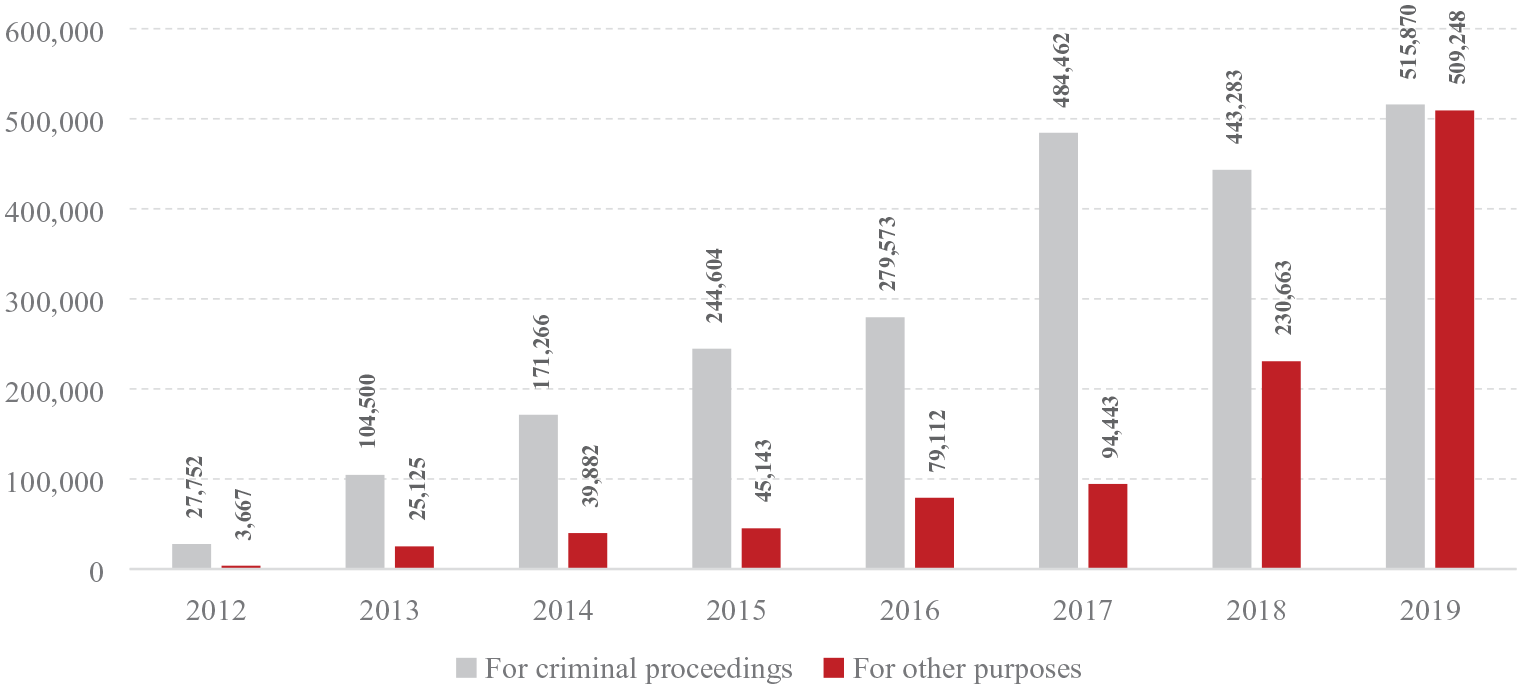
Number of requests to ECRIS by type of request, 2012–2019.
The European trend towards a constant growth in criminal record disclosure and dissemination through the use of criminal background checks outside criminal justice systems (Kurtovic and Rovira, 2017; Larrauri, 2014a; Maruna, 2011: 100–101) also taps into the increasingly central role of private actors who commodify and profit from criminal record information. In this respect, as noted, it has been evidenced that US-style background checking companies are flourishing in countries such as Sweden and the United Kingdom through the exploitation of legal loopholes in the rules governing access to and use of criminal history information stored in national and supranational criminal history databases (Corda and Lageson, 2020). Furthermore, tech companies of the gig economy are starting to export US-based practices to Europe by requesting information on previous convictions in their recruitment process (Rovira, 2022).
The mask and the face: Reasons to be fearful
As we have shown, the existence of pervasive and afflictive CCs flowing, either de facto or de jure, from a criminal conviction is far from being a peculiar characteristic of US systems. Not only do a significant proportion of individuals in Europe have a criminal record but, in several European jurisdictions, some or all types of criminal records can be accessed relatively easily. Furthermore, a growing net of legal CCs has a profound impact on the re-entry opportunities of criminal justice involved-individuals, in particular migrants and people with sexual offence convictions. In showing the burdensome character of laws, policies and practices concerning the ramifications of criminal records in Europe, we intended to demystify the bird’s eye view that a European model of CCs exists which is rooted in principles of minimalism and proportionality. Rather, our discussion of the growth and expansion of CCs across Europe shows how reality is increasingly diverging from the prevalent ‘progressive narrative’ surrounding European penality. The fact that CCs in Europe have remained until recent times mostly invisible to those within the criminal justice system as well as academic researchers and policymakers does not mean that they do not exist, are irrelevant, or that their effects are incommensurable to the ones of their US counterparts. In this section, we further interrogate the distinctions between European jurisdictions and the United States before cautioning against what we see as too heavy a reliance on the existential reassurance provided by accounts of these two spheres as inherently ‘progressive’ or ‘exceptional’.
Differentiating CCs between the United States and Europe
In evaluating claims for a distinct approach to CCs in the United States, we identify three areas of possible differentiation which could, at face value, demonstrate a contrast with Europe. However, in each of these areas we are also able to point to evidence that the United States is not necessarily unique in its approach, also noting trends of convergence that are developing. In turn, we consider: (a) dissemination/public access to criminal records, (b) the formalisation of CCs, and (c) the scope of legal provisions designed to mitigate discrimination against people with criminal records.
(a) In terms of dissemination, the United States might well be regarded as distinct from Europe in the extent to which it allows for public access to criminal record data including convictions, arrest records and mugshots. In her work on the growth of so-called ‘digital punishment’, Lageson (2020) has discussed how the data-driven criminal justice of the digital age results in the production of millions of criminal records every year, incorporating the electronic documentation of everything from a simple traffic stop by the police to a lengthy prison sentence. When combined with public records laws designed to promote freedom of information and scrutiny of government activity, the digitisation of formerly paper-based criminal records has created a culture in which employers, landlords, neighbours and others (including those with malign intent such as stalkers and blackmailers) can readily access information on arrests, court proceedings and convictions (see also Jacobs, 2015). Moreover, as already noted, a burgeoning background checking industry has emerged to exploit these data for commercial purposes under the guise of promoting public safety (Lageson, 2020). By contrast, in European jurisdictions public access to government criminal records systems has generally been strictly limited, not least due to the protections offered to citizens by Article 8 of the ECHR which safeguards the ‘right to privacy’ (Jacobs and Larrauri, 2012; Larrauri, 2014b).
Europe, however, has not been immune from the effects of ‘digital punishment’ since, as previously noted, commercial purveyors of criminal history information are beginning to emerge in European jurisdictions too (Corda and Lageson, 2020). Similarly, public access to convictions histories has been otherwise facilitated, for instance, through access to online media reports about criminal proceedings. This has precipitated legal contestation on grounds of privacy and data protection. In the Google Spain case (2014), the European Court of Justice (ECJ) established a ‘right to be forgotten’ whereby people could ask for search engine providers to delist online information about them where it was deemed ‘inaccurate, inadequate, irrelevant or excessive’. Subsequently, the EU adopted the General Data Protection Regulation (GDPR), Article 17 of which established a ‘right to erasure’ similar to that previously recognised by the ECJ under the law which the GDPR replaced. While these measures may, ostensibly, have provided a remedy for those seeking to avoid ongoing stigmatisation associated with the online publication of details of their criminal record, questions of the extraterritorial application of this right (i.e. outside of Europe) remain (Fabbrini and Celeste, 2020), as do possible tensions with freedom of expression rights (Faisal, 2021).
(b) The second alleged area of differentiation concerns the higher formalisation of CCs in the United States when compared to European jurisdictions, with scholars frequently citing the existence of nearly 45,000 state and federal laws which disqualify or otherwise restrict people with criminal records from equal treatment to non-criminalised citizens (Huebner and Frost, 2019; Miller, 2021). This tendency towards greater formal de jure codification of CCs is of an altogether different magnitude compared to that seen in even the most punitive parts of Europe, where most CCs take a de facto character and routinely arise following processes of criminal record disclosure that are generally subject to tighter regulation than in the United States.
However, as we have already discussed, formalised legal CCs are now also prevalent in Europe – in particular those targeting people convicted of sexual offences and in relation to migration status, but also with regard to civic participation. While a comprehensive database compiling legal CCs of criminal conviction does not exist to date, in this article we have provided evidence of the growing trend towards the expansion of formal civil restrictions stemming from a criminal conviction or other forms of criminal justice contact across European jurisdictions. It is, therefore, of little reassurance to observe that European countries are increasingly relying on CCs at a time when in the United States their number is slowly starting to shrink for the first time in decades (Corda, 2018a; Love, 2022).
(c) The third possible area of differentiation exists in the extent to which the United States has generally had fewer and weaker provisions for legal rehabilitation when compared to Europe, where long-established mechanisms for mitigating possible discrimination against people with a criminal record exist (e.g. Boone, 2011; Henley, 2018; Herzog-Evans, 2011; Morgenstern, 2011). This can perhaps account for the trend in many US states to introduce policies on ‘expungement’ (deletion of arrest records or convictions) or ‘sealing’ (removing criminal records from public view). Despite recognised shortcomings with the precise legal remedies, over the past decade there has been ‘a flurry of activity regarding expungement and criminal record reform at the state level’ (Murray, 2016: 369; see also Love, 2022). Public support for expungement policies in the United States has also grown significantly in recent years – particularly for those convicted of property and low-level drug offences – as has concern about unrestricted public access to criminal records (Burton et al., 2021).
By contrast, European mechanisms for legal rehabilitation are increasingly attracting criticism. We have already noted the weakening of these protections through a broadening system of criminal records disclosure at the European level, but there are also shortcomings with the measures in place in individual jurisdictions. For instance, in Spain in 2015 the expungement period for the removal of one’s name from the sex offence registry listing adults convicted of a sexual crime against a minor was set at 30 years after the completion of the sentence (Larrauri and Rovira, 2020). This means, for many, a nearly lifelong inclusion on the registry or, at least, one accounting for a substantial portion of a person’s working-age life. In the UK (England and Wales), the Rehabilitation of Offenders Act 1974 permanently excludes anyone sentenced to 4 or more years’ imprisonment from the possibility to have their conviction become ‘spent’, casting over 7,000 people each year into a state of permanent ‘civic purgatory’ (Henley, 2018). Moreover, a review of 16 jurisdictions – including New Mexico, Ohio and Texas – concluded that ‘the treatment of childhood criminal records in England and Wales is the most punitive of all’ (Sands, 2016: 7).
Conclusion: ‘American exceptionalism’ and ‘European progressivism’ as existential complacency
In summary, we recognise that the United States imposes CCs in ways which are currently both quantitatively (i.e. in their sheer number) and qualitatively (i.e. in their reach and impact) unmatched when compared to Europe. US collateral restrictions are way more numerous, apply for longer periods of time (if not for life), are unfocused in terms of triggering offences and impact a wider range of rights and opportunities. At the same time, however, we reject the representation of European penality as necessarily – and always homogeneously and consistently – ‘progressive’ in relation to criminal record consequences and treatment of criminal record subjects. CCs are a feature of penality on both sides of the Atlantic and have in common a tendency to remain somewhat less visible to criminalised populations compared to other aspects triggered by or connected to the criminal process (Kaiser, 2016); and, by imposing CCs and facilitating public access to criminal records, both United States and European jurisdictions are engaged in practices which have deleterious effects on the life chances and citizenship of those who are criminalised.
Rejecting the exceptionalist/progressivist dichotomisation of United States and European approaches does not, however, account for the differential actualisation of CCs in these respective spheres. This, we argue, can be accounted for by differences in structural characteristics and, to a greater extent, political culture. Structural differences are evident insofar as the United States is marked by greater subsidiarity of criminal justice policy and administration, with not only federal but also state-level legislatures and even local authorities imposing formalised CCs. Political-cultural orientation also takes centre stage in that overly preventive crime control policies associated with individualistic and weakly regulated economies have previously been identified as having negative implications for the inclusion of former lawbreakers, particularly in the United States but also, increasingly, in many European jurisdictions (Cavadino and Dignan, 2006; Lacey, 2008).
While Wacquant has described the United States as a ‘living laboratory of the neoliberal future’ – and thus at the extreme end of punitive responses arising from growing social insecurity – he notes that the anxieties over crime and criminals ‘rippled across the political scene of the member countries of the European Union at century’s close, twenty years after flooding the civic sphere in the United States’ (Wacquant, 2009: xi, emphasis added). It is perhaps then not too much of a stretch to predict that Europe is in grave danger of eventually catching up with the United States also with regard to the imposition of CCs and, as a result, creating a more exclusionary social environment for people with a criminal record seen as risks to be managed rather than individuals struggling to reintegrate into the social fabric. Our analysis in this article points in that direction. This trend is even more worrisome if one thinks that, historically, European penal systems had seemingly understood the importance of rationalising penalties arising from criminal behaviour and minimising the ‘collateral damages’ of direct criminal justice consequences, either de jure and de facto (Corda, 2016; Corda and Kaspar, 2022).
The critique of the exceptionalism/progressivism dichotomy presented in this article also entails a broader methodological critique about how scholars should engage in comparative research within this field of inquiry. In this article, Europe, traditionally used as a foil to explain and contrast the US model of CCs, has been given greater attention and analysed in its own terms revealing heterogeneity and nuances generally overlooked in bird’s eye comparisons. This calls for more granular cross-national comparative research getting at the tensions between, on the one hand, general principles and models and, on the other, actual policies and practices on the ground in different jurisdictions.
We conclude then by encouraging far greater vigilance within European criminology and criminal justice research with regard to the existence, growth and operation of CCs of criminal records. This requires us to recognise the inherent dangers of relying on simplistic assumptions of “American exceptionalism” and contrasting it with “European progressivism” in penal policy and practice. The latter notion, in particular, merely reaffirms, in quite a superficial fashion, normative commitments to rationality, proportionality, rehabilitation, and moderation within European criminal justice systems whereas reality, as documented in this study, is evolving in a rather different way. The existential reassurance provided by such assumptions – while comforting from a European perspective – arguably masks and creates a more comfortable environment for a significant, yet barely visible expansion of the boundaries of penality, and a corresponding contraction of the boundaries of reintegrative possibility for those members of the population who have acquired a criminal record.
Footnotes
Acknowledgements
The authors are grateful to the anonymous reviewers and to Lili Dao and Elina van ’t Zand-Kurtovic for their constructive and helpful comments.
Declaration of Conflicting Interests
The author(s) declared no potential conflicts of interest with respect to the research, authorship, and/or publication of this article.
Funding
The author(s) received no financial support for the research, authorship, and/or publication of this article.
