




Abstract
While research on supported desistance is increasing, little is known about practitioners’ experiences of facilitating change following release in Norway. This article seeks to expand this knowledge through the perspectives of probation caseworkers and staff of penal voluntary organizations. Despite their common challenges and shared ideals, the two groups experience varying ability to assist in change processes. While staff of voluntary organizations practice close to the ideal, caseworkers describe frustration at an increased risk focus and thus a decrease in desistance promotion. In this context, we discuss how two key developments in Norwegian resettlement practice, (1) increased discrepancies between ideals and realities and (2) the blurring of boundaries between penal voluntary organizations and the Correctional Services, are shifting probation work away from supporting desistance.
Introduction
Transitions from prison to society can constitute major challenges for those concerned, and many commit new criminal acts within the first year after release (Dünkel et al., 2019: 3). Imprisonment has often been shown to negatively influence health, quality of life and ties to society (Liebling, 2011; Schinkel, 2014; Todd-Kvam, 2019) and relationships with prison and probation staff have evidently frustrated people post-release and failed to help them (Todd-Kvam, 2019; Villeneuve et al., 2021). Rebuilding life after imprisonment has been shown to be demanding despite expressed desires and practical efforts (Doekhie and Van Ginneken, 2020; Nugent and Schinkel, 2016). However, imprisonment and probation have also, under some circumstances, facilitated change processes in the resettlement period. In this article, we build on conceptual frameworks of desistance and penal voluntary organizations (PVOs) to explore how caseworkers and PVO staff can support these processes.
The Norwegian context
Policies and aims in several European countries state that community sanctions following imprisonment must strive to support desistance (Dünkel et al., 2019: 6). The Norwegian Correctional Services aim for a continuous focus on preparation for release throughout the prison sentence, as well as a practice that supports change (Justis- og Beredskapsdepartementet, 2021; Kriminalomsorgsdirektoratet, 2021). Recent changes in the Norwegian penal system have affected the prison population, prison conditions and release patterns, and had a negative influence on staff members’ ability to facilitate desistance during resettlement. Increased numbers of less serious offences are now processed in the community (Kriminalomsorgen, 2021; Todd-Kvam and Ugelvik, 2019). This has caused a reduction in imprisoned people from 3968 in the peak year of 2016 to 3029 in 2020 (SSB, 2022). Despite positive aspects of these changes, they challenge resettlement practice. Imprisoned people on average serve longer sentences for more serious offences than before. These changes have caused what the Correctional Services describe as a more demanding prison population and more challenging conditions for desistance support (Justis- og Beredskapsdepartementet, 2021). Constant budget cuts, mainly related to a de-bureaucratization and efficiency reform, have caused staff reductions and decreased activity during imprisonment. Many face solitary confinement, causing reductions in contact between staff and imprisoned people (Justis- og Beredskapsdepartementet, 2021; Sivilombudsmannen, 2019). Cognitive programmes are used to strengthen motivation for change and to reduce recidivism. Recently, however, numbers of participants and completed programmes have been greatly reduced (Justis- og Beredskapsdepartementet, 2021). The Correctional Services have been criticized for insufficient rehabilitation support during imprisonment. A recent report indicates poor knowledge of imprisoned people’s needs and challenges. In a sample of 1860 persons, there was a decline in individual future plans from 10% in 2016 to 3% in 2019 (Riksrevisjonen, 2022). Several low security prisons, regarded as providing soft and well-prepared transitions to society and more manageable imprisonment experiences, have been permanently closed down (Andvig et al., 2021; Kriminalomsorgen, 2019; Mjåland et al., 2021). This is despite the Correctional Services’ goal that nobody should serve sentences at a higher security level than necessary, as appropriate progression can facilitate desistance (Justis- og Beredskapsdepartementet, 2021). There has been a proportional decline in persons assessed as suitable for early release on parole, and more people therefore serve their full sentences. In 2010, 15% completed their entire sentence in prison, compared to 21% in 2020. Early parole is intended to make transitions from prison to society less vulnerable (Justis- og Beredskapsdepartementet, 2021). However, recent developments seem to cut released persons’ connections to the Correctional Services at the prison gate, leading to more abrupt transitions from prison to society, conflicting with the Norwegian penal system’s principle of gradual progression throughout the prison sentence.
Correctional Service staff and management have expressed concern about these developments. Recently, managers of three large Norwegian prisons reported being worried about throughcare and rehabilitation. They emphasized that relationships between staff and imprisoned people suffered from budget cuts and lack of human resources (RøverRadion, 2021). Furthermore, a recent survey shows that 75% of prison staff found decreased quality of resettlement work in the past 2 years (Actis, 2020). Norwegian caseworkers have expressed concerns about the impact of budget cuts on general activity and rehabilitation work in prisons, and about how increased containment will affect prospective desistance processes (Todd-Kvam, 2020).
Within this context, the voluntary sector has taken ever greater responsibility to support people upon release and into the community. The Correctional Services aim for reliable collaboration with this sector and therefore provide annual funding through the state budget. The purpose of this funding is to prevent recidivism by reintegrating people during and after imprisonment (Kriminalomsorgen, 2021). In 2021, for the first time, almost the entire budget of NOK 36.2 million was distributed following an application procedure. This equals about NOK 10,000 per released person. The Correctional Services also recently formalized their cooperation with the Red Cross, one of their most important voluntary partners. The purpose of the agreement was to ensure binding, systematic cooperation and to encourage voluntary efforts to help people lead crime-free lives after imprisonment (Kriminalomsorgen, 2021: 41–42).
The penal voluntary sector
The penal voluntary sector comprises voluntary agencies working with pre- and post-release people, their families and victims, and community and advocacy programmes. In this previously ‘fragmented and overlooked’ research field, Tomczak and Buck (2019a: 289) present a conceptualization of various activities in the criminal justice voluntary sector. Here, we focus on non-state, not-for-profit voluntary organizations. Although not directly under the government, they receive state funding. They work in varying degrees of partnership with justice agencies and range from ‘corporate style’ registered charities with multimillion pound turnovers to grassroot style organisations (Tomczak and Buck, 2019a: 281). Voluntary organizations can be run by volunteers only, by mainly paid staff, or by various combinations of the two.
In light of a tendency towards polarized commentaries, Tomczak and Buck (2019b) present a hybrid framework to provide nuanced accounts of a broad spectrum of the sector’s activities. The framework offers various ideal types of service provision and campaigning, and illustrates the range, fluidity and hybridity of the organizations’ programmes and practices (Tomczak and Buck, 2019b: 898). It describes differences between actions to ‘fix’ people’s ‘flaws’ or to enable people to fix their own on a micro level. On the macro level, it differentiates between ‘thought changing activities’, focusing on raising awareness of personal troubles as public issues, and changes in distribution to enable fairer sharing of resources. Organizations can practise hybridity by focusing on several aspects simultaneously. The framework highlights how individual-focused therapy, despite contributing to personal change, fails to acknowledge the burden resulting from punishment and marginalized backgrounds. Structural inequalities and exclusion are reinforced by ‘providing selected individuals with sticking plaster solutions for chronic social needs’ (Tomczak and Buck, 2019b: 907). Voluntary organizations’ struggles to reduce structural barriers to resettlement have also been criticized by Miller (2014), and the resulting emotional difficulties for staff have been emphasized by Quinn et al. (2022).
The conceptual framework of desistance
Historically, desistance research mainly considered how offenders stopped committing criminal acts. In recent decades, researchers have increasingly investigated processes of moving away from a criminal lifestyle (Farrall et al., 2014; McNeill, 2016c; McNeill et al., 2012; Maruna and Farrall, 2004). Maruna and Farrall (2004) underlined that people might have crime-free periods in their lives for various reasons without making any deeper changes to their identity, and distinguished between primary and secondary desistance. The former refers to ‘any lull or crime-free gap in the course of a criminal career’ and the latter to ‘the movement from the behaviour of non-offending to the assumption of a role or identity of a non-offender or “changed person”’ (Maruna and Farrall, 2004: 174). More recently, McNeill (2016a) introduced the concept of tertiary desistance, referring to a shift in the person’s sense of belonging to a community. By moving from an understanding of desistance as merely related to behaviour or identity towards a sense of belonging, McNeill (2016a) emphasized the political and social process of desistance. The concept of social rehabilitation has been further developed, highlighting the importance of social recognition and acceptance of a rehabilitated person as a full member of a community (Arnal and McNeill, in press). To build on the necessity of tertiary desistance and social rehabilitation, we draw on McNeill’s (2016c: 277) definition of desistance as ‘. . . a dynamic process of human development – one that is situated in and profoundly affected by its social contexts – in which persons move away from offending and towards social re/integration’.
Correctional Service staff have sometimes supported desistance by introducing ‘hooks for change’ into crime-free lives (Giordano et al., 2002), and set the stage for narrative or identity change. Research has underlined the importance of honesty, authenticity, trustworthiness, concern, genuine care and freedom from prejudice to assist these processes (Farrall et al., 2014; Healy, 2012; King, 2013; Schinkel, 2014; Villeneuve et al., 2021). Correctional Service staff might also assist in identity change through supportive statements and encouragement, which has been particularly evident in the early stages of desistance (Doekhie et al., 2018; Villeneuve et al., 2021). In this period, often characterized by ambivalence and pain related to personal change (Healy, 2012; Hunter and Farrall, 2018; King, 2013; Nugent and Schinkel, 2016), staff members can provide beneficial, safe and stable foundations. Research in Norway emphasizes interaction based on staff members’ trust and belief in individual change (Todd-Kvam and Todd-Kvam, 2022; Ugelvik, 2022). Probational staff have also underlined interest, understanding and reciprocity as key ingredients in relationships with probationers (Todd-Kvam, 2020). This research has focused more on identity change and less on belonging and social rehabilitation. Here, we understand the concept of supporting desistance as working with a person, within an ongoing relationship, to develop identity change and social rehabilitation.
The relevance of this study
Despite voluntary organizations’ effects on people’s experiences of punishment and penal policies worldwide, their involvement has largely escaped public and policy attention (Tomczak and Buck, 2019b), and research on this topic is almost absent in Norway. Despite valuable knowledge on supported desistance, there is little research on caseworkers’ and PVO staffs’ preferences and experiences of this in resettlement. Research on pathways from prison to society in Norway has mainly focused on practical and collaborative challenges related to progress and normalization, work, housing and navigating the welfare system (Todd-Kvam and Ugelvik, 2019). It scarcely mentions facilitated desistance, apart from the mentioned and more recent works by Todd-Kvam and Ugelvik.
We argue that caseworkers and PVO staff find it increasingly challenging to support desistance within resettlement contexts. Particularly caseworkers see discrepancies between ideals and realities in their daily work, and thus professional difficulties. We suggest that this is partly because of recent systemic changes in the Norwegian Correctional Services. Hence, this research aims to explore and describe what caseworkers and PVO staff consider most important in facilitating desistance processes in resettlement, and their experiences of this work. We scrutinize how relationships between staff members and resettling people influence these processes. The research questions addressed here are:
What do caseworkers and PVO staff consider most important to support desistance in their relationships with resettling people?
How well are they able to support desistance in their daily work?
Methodology
The methodological approach rests on an interactionist perspective, where we understand the meaning of an action or a phenomenon as created in interaction between people. Meaning is thus a relational phenomenon, produced and understood situationally within a given context (Halkier, 2016; Järvinen and Mik-Meyer, 2005). Knowledge is seen as being co-created in every step of our research. We present our methodological choices and reflections in line with this, focusing particularly on why and how we conducted focus group interviews, and on the purpose of reflexivity.
Data construction
Given our interactionist perspective and our interest in staff members’ work experiences, focus group interviews were used to answer the research questions (Halkier, 2016; Kitzinger, 1995; Morgan, 2010). This approach was chosen to aid data construction through interaction between participants, and to encourage dialogue and discussion on the research topic. We aimed to achieve insight into staff members’ values, attitudes, work cultures and jargon to better understand their negotiated perceptions and experiences. This would have been more difficult without the group dynamics (Anvik et al., 2021; Halkier, 2016; Kitzinger, 1995; Morgan, 2010).
Focus group interviews
In line with the research questions, two different types of resettlement staff were targeted: probation officers in the Correctional Services (caseworkers) and workers in penal voluntary organizations (PVO staff). The main inclusion criterion was experience of supporting resettling people. Participants were therefore specifically selected (Halkier, 2016) and recruited from five sites (presented in Table 1) in three Norwegian cities. They worked with people released from prisons all over Norway. This enabled reflections from divergent perspectives and work cultures. Probational staff in Norway perform several kinds of correctional work and are organized in different ways in the sites represented. As we focus on resettlement, caseworkers mainly reflected around their practice regarding conditional release on parole. As PVO staff perform resettlement work more independently of their participants’ sentences, they reflected more broadly on the topic. Given our focus on experiences and perceptions and on the negotiation of priorities, values and practices between staff at the workplace, focus groups were constructed as ‘pre-existing groups’ (Kitzinger, 1995). Five in-person focus group interviews were conducted, audio recorded and transcribed before analysis.
Presentation of the sites.
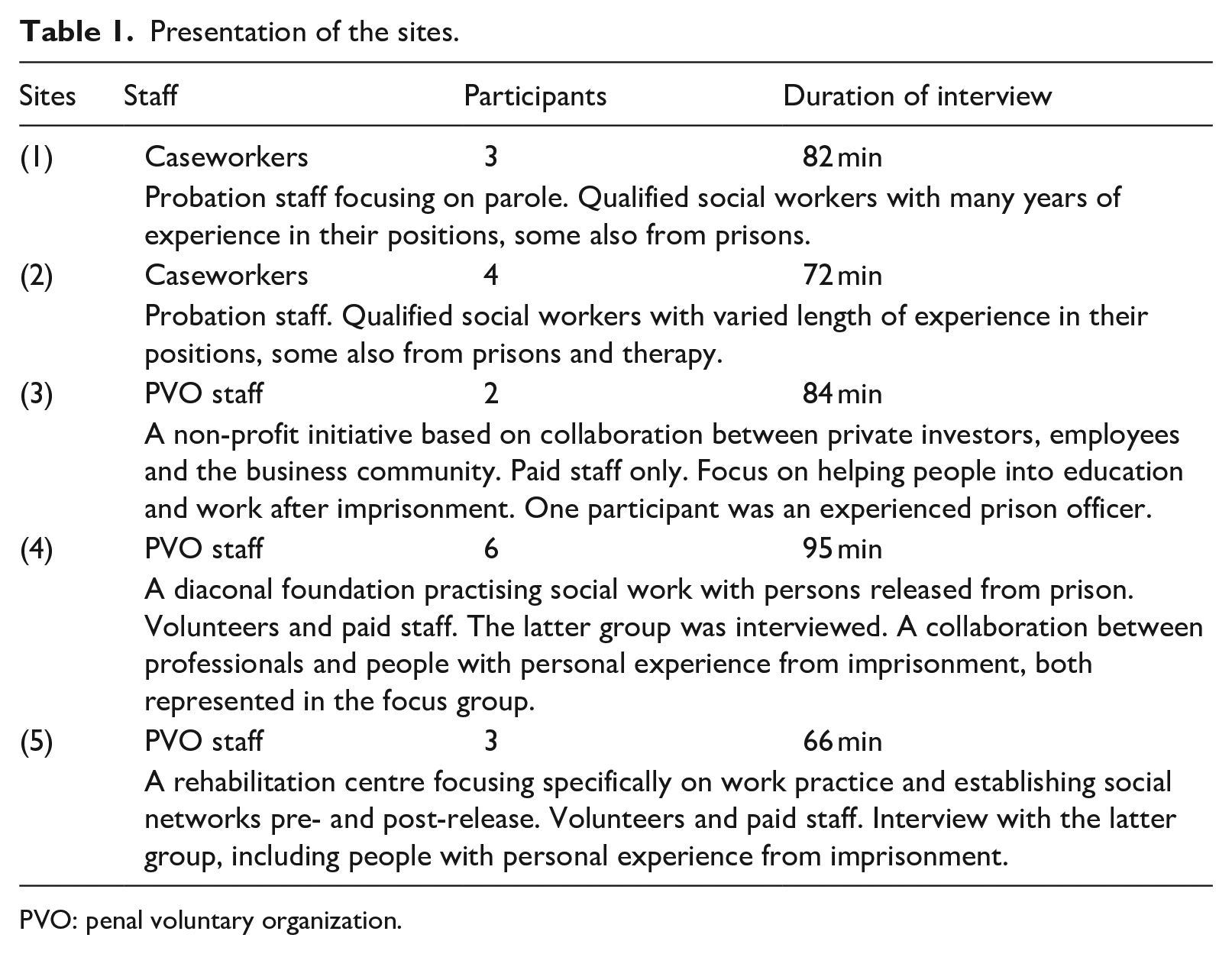
PVO: penal voluntary organization.
We reflected on data construction during our work, as our well-intentioned plans met the realities of people’s lives during the COVID-19 lockdown in 2020. The small number of focus group participants was related to various COVID-19 restrictions and sometimes to participants’ forgetfulness. The smallest group represented a voluntary organization that recently lost half its staff due to unstable funding. Their financial position differed from that of the other two participating organizations, who received large grants (Kriminalomsorgen, 2021). As this organization had many years of experience and an interesting, varied approach to resettlement work and their financial challenges, we conducted the interview despite the few participants (Halkier, 2016).
Interaction
To ensure data construction in line with the study aim, we focused particularly on group dynamics when establishing the groups. Topics and questions were presented along with the concept of desistance. Lacking a Norwegian translation of the concept, we presented desistance as a series of decisions and actions that gradually move an individual away from crime (McNeill, 2016c; Maruna, 2001). As the concept was unknown to some participants, the group elaborated on a common understanding in line with our presentation. Participants underlined the importance of including imprisonment as an important aspect of the concept. Examples of questions related to the first period after release were What are your experiences of what facilitates and frustrates desistance after release? What do you find important for people’s wishes and opportunities to leave crime behind following release, and what obstacles do they meet? How do you feel about the meaning of your relationship, related to this? What do you focus on in your communication and cooperation with people upon and after release? and What are your experiences from cooperating and communicating with other agencies on resettlement work? Questions also concerned experiences of preparation for release, such as communication and cooperation with prison staff, imprisoned people and others, and of how resettlement work could be organized to promote desistance. Since interviews took place 3 months after lockdown, which caused major changes in practice, they focused on experiences before COVID-19. Topics and questions were presented as an introduction to the interview, but other questions and topics developed during the group interaction. To enable data co-construction, participants were encouraged to discuss and reflect upon topics between themselves, rather than approaching the facilitator with ‘answers’. An interview with caseworkers included a situation which illustrates how meaning and understanding were constructed within the group. Participants compared ideal resettlement work with today’s standard. They preferred to establish relationships in prison before release, which one participant stressed that they rarely did now. Another participant added that such pre-release meetings hardly existed any longer and checked whether the others agreed. As the first participant answered with an affirmative ‘mmm’, the second one rounded off by stating that at least he thought so. Such negotiating took place in many situations in focus groups. To encourage similar group dynamics, the facilitator emphasized the value of participation by all (Braun and Clarke, 2013; Halkier, 2016; Kitzinger, 1995). One possible advantage of conducting interviews in pre-existing groups is to provide a safe and comfortable environment for all participants to be active; however, existing group norms might constrain them.
Reflexivity
In line with an interactionist framework, we consider all focus group members as participants in data construction. We therefore paid particular attention to how the group facilitator’s background from resettlement work might influence this process. Having similar experiences to the participants, she had valuable insight to understand implied content and ‘Correctional Service language’. Accordingly, this probably enabled her to understand responses in nuanced and multilevel ways. Her familiarity also risked imposing her personal values, beliefs and perceptions on the group and preventing critical distance (Berger, 2015). To address these issues, research topics were presented at the start of the meeting to allow participants to reflect and discuss on their own terms, and two researchers performed the analysis.
Data analysis
To enable an in-depth content analysis of the data and focus on communication and interaction in the groups, the first and second authors performed a thematic reflexive analysis (Braun and Clarke, 2006, 2019) followed by a Goffman-inspired analysis (Halkier, 2016; Järvinen and Mik-Meyer, 2005). A combined inductive, theoretical thematic analysis was conducted. Themes and patterns were data-driven in that the themes developed were strongly linked to reflections in the focus groups. They were also based on questions and reflections embedded in the theoretical framework. We familiarized ourselves with the data by separately reading the transcribed interviews and noting down preliminary codes related to the research questions. This constituted an initial data construction in interaction between ourselves and the texts. We then jointly reviewed the analysis process, from the initial coding, through correlation between codes, to preliminary themes and subthemes. Data were further developed through interaction between the two researchers. We focused on similarities between the preferences, and differences between the experiences, of caseworkers and PVO staff. Our initial themes based on both groups were ‘establishing close relationships’ and ‘struggling to practise in line with the ideal’, but subsequently the differences were highlighted by re-defining and re-naming themes as ‘facilitator-coordinators’ and ‘umbilical cords’ (Braun and Clarke, 2006: 91–93). The final analysis focused more on the interplay between content and group interaction (Halkier, 2016; Järvinen and Mik-Meyer, 2005). This was based on participants’ expressions of frustration and dissatisfaction and their working overtime to fulfil their ambitions, which evolved throughout the interviews.
Findings
The analysis revealed that participants experienced very similar challenges in facilitating desistance, as well as ideals of manoeuvring or overcoming them. Despite this, they presented differences in working according to these ideals. On this basis, we constructed the following themes and subthemes (Figure 1):
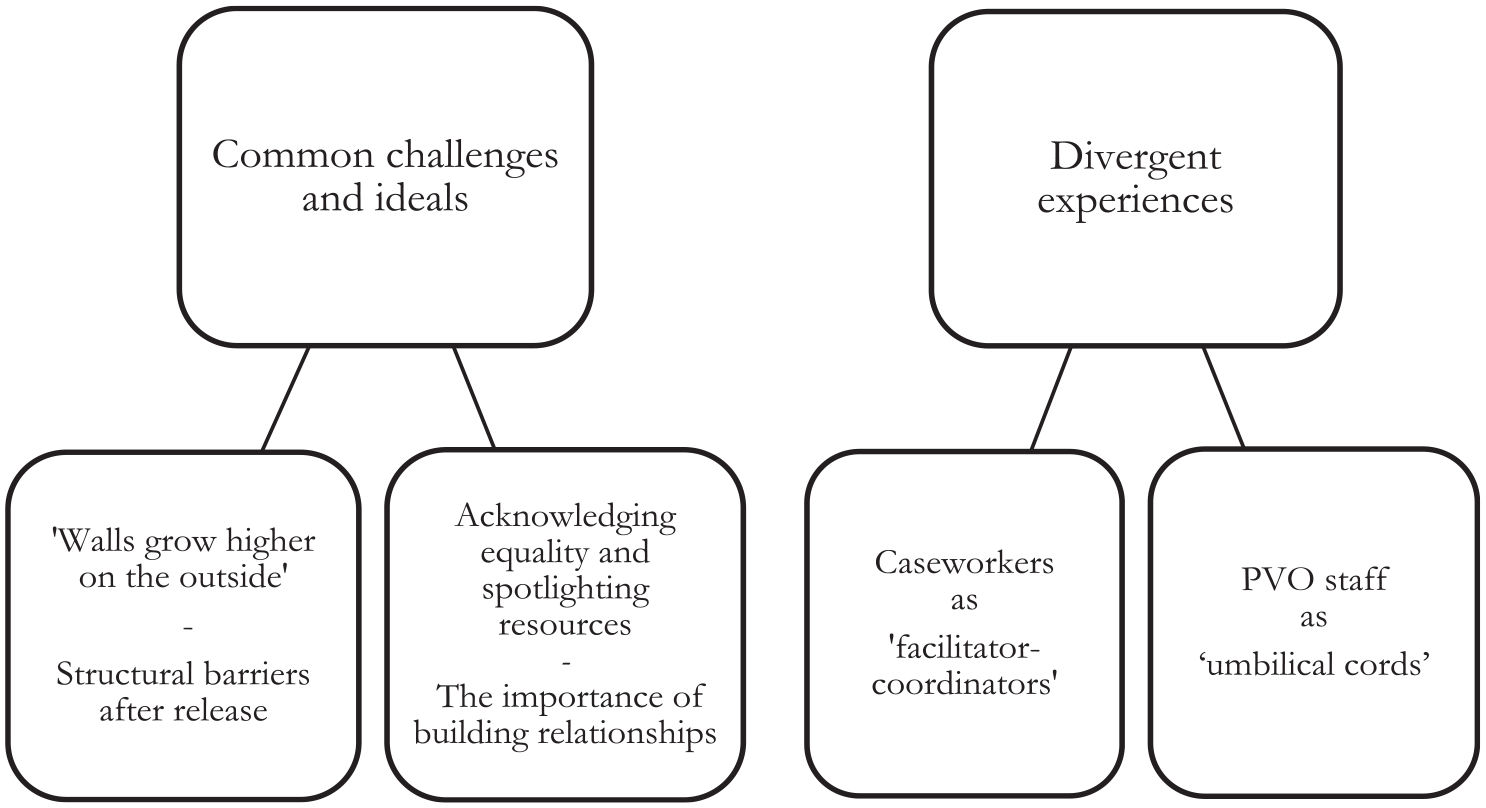
Themes and subthemes
Common challenges and ideals
Caseworkers and PVO staff described their efforts to establish lasting relationships with resettling people and to reduce challenges and barriers related to identity change, stigma and navigating the welfare system. They outlined common perceptions of released peoples’ struggles and frustrations in approaching society after release, and the significance of overcoming these. Ideals of supporting desistance intertwined with their perceptions of these obstacles. We introduce examples of and reflections on such challenges, leading to a presentation of the importance of lasting relationships.
‘Walls grow higher on the outside’: Structural barriers following release
Frustrations and challenges were mainly related to external barriers of stigma and navigating the welfare system. PVO staff at (5) stated: ‘Walls grow higher on the outside’, and all focus groups elaborated on how the external environment might frustrate desistance through closed doors, rejection, exclusion and labelling. A prominent challenge was contacting and relating to ‘NAV’ (the Norwegian Labour and Welfare Administration), illustrated in the following excerpt from the interview with caseworkers at (1).
Should we say something about NAV?
NAV, yeah.
Do we dare say anything about NAV? (laughter)
Oh my God!
It’s a bit like . . . if you say that the Correctional Services have got stricter and have less time to follow-up, that’s nothing compared to NAV ( . . . ) And it’s only got worse in recent years. It’s impossible . . .
. . . to get hold of anyone.
Yes, to get hold of anyone. And I’m thinking about people who need help from NAV, who must contact NAV themselves, be put on hold for one hour . . . well, maybe not one hour, but . . . it can take a long time to reach the switchboard, and then you’ll be transferred to a staff member who doesn’t answer the phone.
Probably with a prepaid phone card.
With a prepaid phone card. Yes.
( . . . ) I don’t know how many times I’ve had people in my office who’ve borrowed my phone to wait in the NAV queue. There’s been lots of frustration about contacting NAV.
This quote shows the group’s shared frustration with NAV. The participants did not raise this until the facilitator reminded them of the topic of external communication and cooperation. They hesitated to bring it up, which could be understood as a feeling of hopelessness in addressing an ongoing challenge. The laughter, the mention of ‘daring’ to bring it up and the exclamation ‘Oh my God!’ also indicate their general reluctance and resignation. Strong agreement was seen within this group and between the five groups. Most staff found it difficult, at least for people they worked with, to get hold of NAV employees, to obtain proper information and ensure payments upon release. Some staff highlighted this as indirectly pushing newly released persons back to crime, as many knew illegal ways of obtaining money. Difficulty in navigating the NAV system is also discussed by Todd-Kvam (2020) and Andvig and Karlsson (2021). Caseworkers elaborated on how bureaucratic ‘application processes and processing times and things that don’t work’ negatively affect motivation and frustrate change processes (Todd-Kvam, 2020: 12).
Participants found increasingly poor interaction with prison staff and imprisoned people before release. With many years of experience of resettlement work, they described current pre-release collaboration as more challenging and sometimes non-existent, as also highlighted by Andvig and Karlsson (2021). Problems in finding accommodation post-release have been related to this lack of interaction. Correctional Service staff and their partners emphasize starting this work as soon as possible. Late starts result in unnecessarily high rates of homelessness upon release (Dyb et al., 2006). Additional barriers were stigma, degrading treatment and an inefficient search for accommodation (Arnal and McNeill, in press; Ludvigsen et al., 2008). Conflicting wishes and barriers often cause hopelessness and pain of goal failure, as shown by Nugent and Schinkel (2016).
Acknowledging equality and spotlighting resources: the importance of building relationships
Our analysis emphasizes common ideals of what staff consider most important in their relationships with resettling people. It shows considerable consistency within and between groups on the importance of well-established, appreciative, continued relationships. They described change as complex and time-consuming, and considered time, patience, trust and availability crucial to support desistance. In the following, we exemplify and reflect upon the establishment of good relationships.
Caseworkers presented TOG (an initiative towards people who have committed repeated offences) as an ideal example of facilitating desistance. TOG is an expanded collaboration between prison and probation staff for resettlement of reconvicted persons. Funding is available to enable Correctional Service staff to cooperate inside and outside prison, enhancing relationship building and throughcare. Some caseworkers in both focus groups had experience from TOG. They exemplified its extraordinary practice of building trusting relationships and of supporting people through social work. They valued the fundamental cooperation with prison staff and highlighted how pre-release relationship building enabled them to challenge resettling people and support them on a deeper and more personal level. For caseworkers, close contact and continuity were mainly due to extraordinary organizational resources and priorities.
PVO staff at (3) were almost always available:
Well, you might say we have ordinary working hours from eight to four. But we’re available all the time. Even weekends and holidays. They call whenever they want, and we tell them to. So we don’t have any . . .
. . . Sunday afternoons . . . (laughs)
. . . That’s where the volunteering comes in, I think (laughs).
Yes . . .
But it’s . . .
You get personally involved in those blokes. We get to know them very well.
Yes.
This excerpt illustrates PVO staffs’ personal involvement in and care for people they work with, and how their efforts and values allow them to establish and maintain relationships. They expand their working hours to enable more contact. The importance of sustained relationships and post-release support has been emphasized by Collica-Cox (2018) and Meek and Lewis (2014). In such relationships, staff were perceived as encouraging, acknowledging and caring. Staff thus became reliable stepping stones, providing hope for crime-free futures. Sustained contact was considered key to long-term support, building social capital and motivation for life changes (Collica-Cox, 2018; Meek and Lewis, 2014).
Divergent experiences: ‘facilitator-coordinators’ and ‘umbilical cords’
Despite similarities in what caseworkers and PVO staff considered ideal support to overcome frustration and obstacles, the interviews demonstrated differences in how they approached and handled these obstacles. Caseworkers often supervised and guided people towards assistance from voluntary organizations and official agencies. PVO staff, however, tended to accompany people when dealing with obstacles. They also seemed to put more time and effort into challenging and supporting their attitudes and actions, and addressing societal barriers and stigma. Caseworkers more often advised people on how to navigate the troubled waters of resettlement, whereas PVO staff actively helped them to navigate.
Caseworkers as ‘facilitator-coordinators’
Caseworkers described their ideal of lasting relationships as fading in their everyday work. Being experienced in resettlement work, they outlined how changes evolved gradually. They disapproved of being now less involved in assessments of early release, and the fact that fewer people now had the opportunity for a gradual, supported transition to society. Unlike previous provision of support and care through face-to-face dialogue and cooperation, current resettlement work was increasingly based on written communication. Social work was vanishing, and they interpreted advice from management as emphasizing ‘statistics rather than relationships’. This is from the interview with (1):
When I get a conditional release, it’s quite hard to form a relationship. Maybe you talk to a person about poor living conditions, employment, no contact with NAV. Because they haven’t done that in prison. So some things are urgent. And perhaps it’s only a short period of conditional release.
It’s such a disadvantage that things aren’t planned and ready when they’re released. ( . . . ) They’re just released without anything outside.
Yes . . .
And there are quite different releases.
Yes. There will be chaos releases with constantly putting out small fires. You don’t have time for anything else. So then you become like a facilitator-coordinator, and you don’t get to talk to them about anything except practical stuff.
Yes.
Despite caseworkers’ ideal of close relationships, practical issues often took up most of their time. Under-prepared and time-limited conditional releases turned staff into ‘facilitator-coordinators’ with insufficient time to establish sound relationships. Similar experiences of breaking down resettlement into practical issues and needs to be met have recently been described (Cracknell, 2022). In our study, this frustrating work resulted in a focus on bridging resettling people and the welfare system and voluntary organizations, to facilitate support and practical assistance. Social capital was often built through ‘referrals’ and ‘signposting’, in making appointments or directing people to charitable organizations (Shapland et al., 2012). Caseworkers greatly appreciated how PVO staff spent time with and accompanied people, helping them to join new communities. This enabled the caseworkers to ‘wrap people up a bit’, as one of them at (2) put it. This ‘wrapping up’ appeared to be an emergency solution for under-prepared, short-term, practically focused releases, and is related to a ‘pass-the-parcel’ style of supervision (Robinson, 2005). These concepts reflect trends of fragmentation and partial breakdown of the traditional relational model of probational supervision. The following quote illustrates how caseworkers considered their usual resettlement work in contrast to the ideal:
They [TOG staff] have completely different starting points in these conditional releases than I have [in ordinary resettlement work]. ( . . . ) We used to be much more inside prisons talking to inmates before release. I hardly do that anymore. ( . . . )
Yes. Pre-release meetings, like we had before, they hardly exist now. Do they?
Mmm.
Really?
I don’t do that anymore, to put it that way.
Caseworkers pointed out that ‘old school’ desistance support was now only provided in exceptional cases and through TOG. Today’s approach was considered risk-focused assembly-line work. Similar findings from other areas of probation services have been called a ‘McDonaldization’ of probation work (Robinson, 2019), while resettlement work has been described as ‘running on a treadmill’ (Cracknell, 2022). The treadmill metaphor describes monotonous, repetitive supervision, reflecting a shift from the previous facilitation of long-term change. Caseworkers in our study found relational work to be downgraded, causing them frustration and dissatisfaction. Similar ethical, practical and emotional dissatisfaction has been presented by Cracknell (2022); experienced practitioners felt constrained and unable to effectuate change. During our interviews, caseworkers spoke warmly of PVO staffs’ ability to practise ‘old school’ relational work. Considering caseworkers’ frustration over their own daily practice, this also appeared as a longing for what PVO staff seemed to have taken over.
PVO staff as ‘umbilical cords’
Unlike caseworkers’ experiences, PVO staff practices seemed to synchronize more with desistance support. Each voluntary organization in our study focused on specific topics such as normalization, networks and employment, which were highlighted through their slogans, names or websites. Despite these differences, the interviews suggested that they all highly valued, and strove to establish, close relationships with people they worked with. The interviews showed strong appreciation for assisting them towards future pro-social selves (Hunter and Farrall, 2018). PVO staff at (4) elaborated on their ability to have close relationships:
We have very close contact. We pick the person up on the day of release. Just that pick-up is very important. Many break the law on the very first day.
First hour. Just one hour alone there . . .
Yes, then we celebrate with coffee and cake down in the café.
Many of the things we’ve talked about so far are task-oriented. They can be overwhelming. So, when we say close, we mean close. Doing things together. Living life together.
You’re connected to a new umbilical cord.
Yes, we’re very close to them.
This underlines staffs’ perception of newly released peoples’ vulnerability and the impact of the support they provide. ‘Being close’ was recently stressed by Sturm et al. (2022); both probationers and probation officers saw the development of a trusting relationship as important for their cooperation. Close contact has also been emphasized as crucial to build trusting relationships to support desistance (Ugelvik, 2022). PVO staffs’ use of the metaphor ‘umbilical cord’ visualizes how their close relationships enabled them to assist people through the vulnerable period immediately after release. They demonstrated how ‘umbilical cord’ relationships allowed them to advise people and challenge their behaviour and attitudes.
As service providers, we want to present realistic attitudes on behalf of our clients.
Yes, and as for attitudes, many have totally lost faith in the system. They’re so angry with NAV that they don’t expect to get any help. So, they start shouting at staff on the phone for no reason. ( . . . ) Maybe clients who shout don’t really realize what’s actually happening? We must reflect a bit on those attitudes. ( . . . )
Yes, and what you’re allowed to do, what is . . .
. . . what’s an OK way to behave . . .
In view of staffs’ and released peoples’ frustration at navigating NAV, this excerpt illustrates how being ‘umbilical cords’ enables PVO staff to support secondary desistance. Being present during phone calls allows them to respond to, challenge and reflect on mindsets, attitudes and behaviours. These immediate reflections illuminate resettling peoples’ thoughts of who they want to be (Maruna and Farrall, 2004), and this has been called an intermediate method of supervising desistance (Shapland et al., 2012).
Challenging stigma proved important in daily work in one PVO (3). Staff talked about ‘selling repaired cars’ when guiding people directly from prison into daily employment. Their slogan ‘From inmate to employee’ highlighted their emphasis on identity change, but further elaboration illustrated how this change rested on attitudes of potential employers:
That’s what we often do. We sell former inmates. We sell a car no one wants. We try to say: ‘Yes, but this car’s been repaired, it’s completely . . . ’. We can never guarantee that the person will never do anything illegal again. We can’t say that about anyone. But we can say something about their strengths, and we do. I think that makes it easier for former inmates to get a job.
Staff developed relationships and explored released peoples’ values and interests through shared meals, exercise sessions, conversations, meetings and courses. This enabled them to support them towards their ‘future selves’ (Giordano et al., 2002; Hunter and Farrall, 2018), by getting to know them and focusing on their resources (McNeill, 2016c) when approaching barriers in society. PVO staff at (5) underlined overcoming stigma as crucial for desistance. They found that newly released persons usually hid their pasts and considered carefully what to reveal to others. They would thus need time and support to lead normal lives in the community, and to see themselves as normal people, equal to others. The interviews showed how they strove to provide an equitable atmosphere, and how equality was fundamental in their attempts to support.
We illuminate differences between caseworkers’ and PVO staffs’ desistance support by combining the framework of the penal voluntary sector and desistance theory (Arnal & McNeill, fortcoming; McNeill, 2016a; Maruna and Farrall, 2004; Tomczak and Buck, 2019b). Staff seem to promote varying hybrid practices of secondary and tertiary desistance. In mainly practising as facilitator-coordinators, caseworkers can only provide limited and decreasing support. However, PVO staff facilitate both secondary and tertiary desistance to varying degrees. As ‘umbilical cords’ they enable personal change and may raise awareness of personal difficulties in society. Moreover, they support social rehabilitation by stressing social recognition and acceptance of released people as full members of the community. Enduring relationships and a resource focus enables them to challenge structural inequalities and exclusion.
Discussion
We asked what caseworkers and PVO staff considered most important to facilitate desistance in their relationships with resettling people, and how well they could support desistance in their daily work. We have shown how both groups of staff highlight a resource focus and close, lasting relationships to achieve individual change and belonging. Despite these common ideals, only PVO staff followed them. Caseworkers described a turn away from social work and desistance support, which they perceived as almost taken over by PVO staff. Based on these findings, we discuss two key developments in Norwegian resettlement practice: (1) increased discrepancies between ideals and realities and (2) the blurring of boundaries between PVOs and the Correctional Services. We relate these developments to recent research and reflect on how they affect desistance-informed practice.
Our findings illustrate that parts of current Correctional Service resettlement practice do not reflect policy aims and visions. This is also highlighted related to seamless through-the-gate service provision and resettlement work in Norway (Johnsen and Fridhov, 2019; Todd-Kvam and Ugelvik, 2019). Todd-Kvam (in press) presents how recent political and policy changes to the Correctional Services influence practice. Increased electronic monitoring, a tighter budget and a greater risk focus have re-shaped the penal field and probation work. A recent analysis shows that the Correctional Services’ latest strategy document emphasizes risk more than previous versions (Mjåland and Ugelvik, 2021). In line with our findings, McNeill (2016b) shows how increased risk focus hinders resettlement practice from working with and through relationships. Overall, this demonstrates how this development moves practice away from supporting desistance.
We show how daily resettlement practice reflects formalized funding and collaboration between the Correctional Services and voluntary organizations. State caseworkers are becoming ‘managers’ of resettlement work, while PVO staff are increasingly expected to, and manage to, deliver it. We illustrate how this development creates ‘blurred boundaries’ (Todd-Kvam, in press) of expectations and responsibilities between the two parties. This relates to Miller’s concept of ‘carceral devolution’, where the state transfers responsibility for resettlement work to community-based actors and organizations (Miller, 2014: 327). Like Miller, we noticed PVO staffs’ focus on transforming attitudes and cognitive processes to increase released peoples’ human capital. However, while Miller did not find that reentry organizations sought to remove external barriers, our analysis presents PVO staffs’ efforts at de-stigmatization and social inclusion. Addressing intertwined personal and social rehabilitation (Arnal and McNeill, in press) enabled PVO staff in our research to support secondary and tertiary desistance (McNeill, 2016a; Maruna and Farrall, 2004).
Mjåland and Ugelvik (2021: 229) ask what the consequences would be if the Correctional Services’ more risk-focused strategy moved from text and discourse into practice. Our findings partly answer this question, by showing how today’s practice differs from the vision to deliver ‘punishment that makes a difference’ (Kriminalomsorgsdirektoratet, 2021: 8). As the Norwegian State is transferring much resettlement work to non-governmental actors, we may question whether this reflects a desirable, well-considered and distinct development. Similar blurring of boundaries are pointed to regarding distribution of responsibility between NAV, as a representative of the Norwegian welfare state, and non-governmental organizations (Fløtten et al., 2023). The latter identify social challenges in the welfare state’s safety net and appear to be the last safety net in the welfare society. A central discussion in the report is whether this is an expression of a desirable or correct distribution of work between the public and voluntary sectors. In line with our findings, this portrays ‘the transformations of the welfare state’ (Vike, 2022), and particularly the structural change visualized through a gradual pulverization of the responsibility for realizing the welfare state’s obligations towards the population. Todd-Kvam (in press) points out the lack of debate on the changing role of community sanctions, which may mean that ‘. . . unnecessarily harmful policies and practices can operate unobserved and unquestioned’. Hopefully, our research will contribute to further reflection, debate and research regarding these developments.
Footnotes
Acknowledgements
We are very grateful to Fergus McNeill, Oana Petcu and Thomas Ugelvik for valuable comments on early draft versions of this article, and to the anonymous reviewers for comments and recommendations.
Declaration of Conflicting Interests
The author(s) declared no potential conflicts of interest with respect to the research, authorship, and/or publication of this article.
Funding
The author(s) disclosed receipt of the following financial support for the research, authorship, and/or publication of this article: This article is part of a PhD financially supported by the Norwegian DAM Foundation.
