




Abstract
While Scandinavia in general and Norway in particular have been the focus of much criminological interest, the work of probation has largely been overlooked in favour of prisons. This article seeks therefore to contribute to our knowledge of Norwegian penality and desistance by analysing how probation caseworkers describe their practice. Caseworkers have a relational, contextualised understanding of probation clients and the challenges they face. That being said, even in a Scandinavian welfare state, caseworkers see the process of reintegration and change as difficult, highlighting a lack of human and social capital and the challenges of navigating an increasingly complex and impersonal welfare apparatus.
Introduction
Probation in Norway has long existed in the shadow of prisons, be it in terms of political and media attention, sentencing practice or indeed research interest. This article comes at a key point in the development of the Norwegian penal field, where we are witnessing significant cuts to Norwegian Correctional Service budgets, increased use of electronic monitoring to enable serving short prison sentences at home and an intention to operationally integrate and erase boundaries between probation and prisons. In 2018, probation implemented more sentences than prisons for the first time ever (largely because probation implement prison sentences served at home under electronic monitoring) (Kriminalomsorgen, 2019).
When compared to Norwegian prisons, remarkably little has been written about the work of probation. The research that does address probation tends, like much penal exceptionalism research, to take a systemic, top-down perspective. Ploeg and Sandlie (2011), Johnsen and Fridhov (2019), and Todd-Kvam and Ugelvik (2019) take this perspective in providing systemic accounts of how probation should work in the eyes of policy makers, while identifying challenges to delivery of these policy goals. Similarly, Ploeg (2017) describes how central features of the Norwegian Correctional Service apply to probation, highlighting discretionary authority as a key element of community sanctions. Moving away from a top-down perspective, Norwegian probationers were included in the pilot study on experiencing supervision in Europe (Durnescu et al., 2018), where respondents reported broadly similar experiences to probationers in other jurisdictions. Still, we know little about how probation caseworkers in Norway see themselves, their clients and their practice as a whole.
Furthermore, while high-level policy documents noted the relevance of desistance research for reintegration and resettlement work as long ago as 2008 (Justis- og Politidepartement, 2008), research on desistance in Norway is still very much nascent. Probation practice elsewhere has been the focus of much desistance-inspired research, looking at how various forms of practice may help or hinder desistance. This article seeks therefore to contribute in three interrelated ways. One, it provides the first analysis of how a small sample of probation caseworkers in Norway describe their practice, thereby extending our knowledge of Norwegian penality both horizontally (beyond the prison) and vertically (from system-level analysis closer to lived experience). Two, it advances our knowledge of desistance and, importantly, its challenges in the context of a Scandinavian welfare state. Finally, it seeks to capture how caseworkers understand their role at a time of great change: this is something sought by those in probation and I consider it particularly important to crystallise this knowledge at a time when new tasks and organisational models are being introduced.
Background on probation in Norway
Originally established as a free-standing foundation in 1849, the trajectory of probation in Norway has been of increasing integration into the state, most recently in the form of merging probation offices with prisons (Kriminalomsorgen, 2020). This merging is intended to provide a ‘seamless implementation of punishment under shared leadership’ (Kriminalomsorgen, 2020), though risks attenuating probation’s social work–based professional approach. Caseworkers currently have an educational background in social work or similar and there is an ambition that all are trained in motivational interviewing. Persson and Svensson (2011) have discussed how, in Sweden, this social work background shapes organisational culture within probation, particularly through professional discretion. This would appear to apply in Norway as well, with both Ploeg (2017) and the informants in this study highlighting discretion as important. While the increasingly blurred boundaries between probation and prisons make headcounts challenging, historically at least there have been approximately 350 FTE (full-time equivalent) probation staff (compared to around 3600 prison staff). While Jill Annison (2013: 45) has highlighted that probation in England and Wales saw a shift away from being male-dominated in the mid-1990s, female employees have been in a significant majority in Norwegian probation since at least 1981 (NSD, n.d.).
Efforts to keep caseloads below 20 per caseworker for those managing community sentences and early release on probation have been successful until recently, though even a modest increase remains under the European average of 50 (Aebi and Hashimoto, 2018: 73). Probation in Norway currently manages early release on probation, community sentences, a programme for driving while intoxicated, serving prison sentences outside prison (at home under electronic monitoring or in drug treatment institutions) and community service in lieu of fine payment. Lappi-Seppala (2019) gives a useful comparative account of the development of community sanctions in Nordic countries, noting for example that, until the advent of electronic monitoring, community sanctions had little replacement effect on prison sentences in Norway. Chart 1 1 illustrates how the role of probation has changed over the past decade.
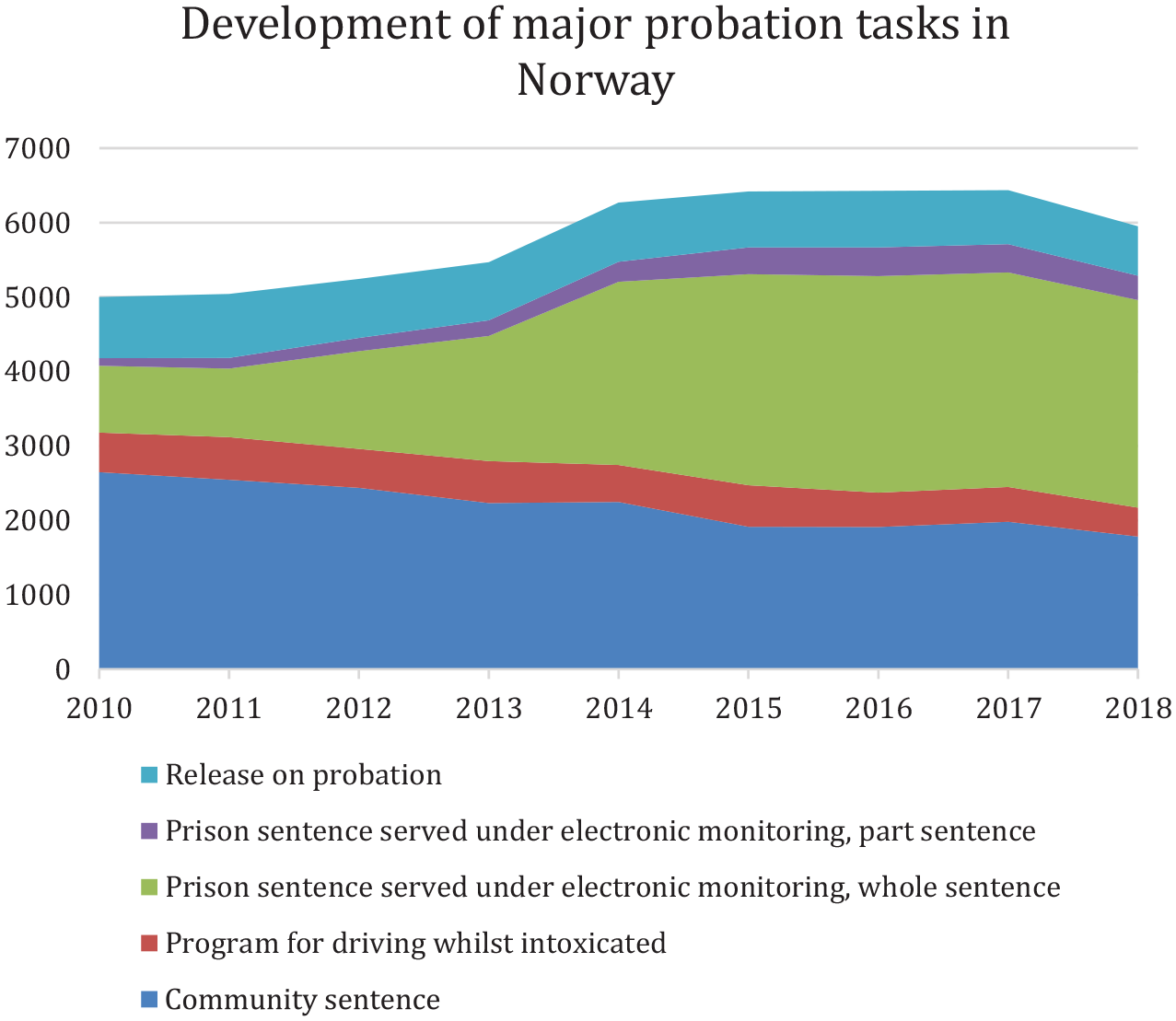
Development of major probation tasks in Norway 2010-2018.
Regarding budget cuts, the 2017 Norwegian Correctional Service annual report highlights the challenge of managing ‘highly intrusive efficiency requirements of about NOK 200 million in the period 2014–2018’ (Kriminalomsorgen, 2018a: 32). The caseworkers I interviewed highlighted the cuts’ impact, while acknowledging their effects had been mostly absorbed internally, without as yet directly affecting client engagement. They were though concerned with the impact on activity and rehabilitative engagement within prisons, demonstrating the interconnected nature of the penal field (Page, 2013), whereby changes in one subfield can make practice elsewhere more challenging.
The policy agenda that informs the operating context for prisons and probation has in some regard followed the development of rehabilitation and reintegration research, with enthusiasm for what-works-based programme delivery being gradually superseded by a model integrating both what-works and desistance thinking. This is illustrated by a significant drop in hours devoted to programme delivery over the past decade (Kriminalomsorgen, 2009: 22, 2018b: 19). The major white paper on punishment and rehabilitation published a decade ago includes expansive discussion of what-works programmes, while also acknowledging the assessment of those convicted ‘must not focus only on the needs of individual offenders, but also resources, competence, qualities and skills’ (Justis- og Politidepartement, 2008: 82). There has since been a conscious effort to integrate these two strands of research when developing a new assessment tool for prisons and probation (Hansen et al., 2014). The most recent policy initiative is directed at counteracting so-called ‘backsliding zones’ between prison and society (i.e. the particularly vulnerable period immediately post-release) through better inter-agency cooperation (Norwegian Government Ministries, 2017). This initiative seeks to address the coordination challenge identified in the systemic accounts cited above.
Analytical framework and method
A variety of models and paradigms for probation practice have sought to capture (and influence) different configurations of control, punishment, support, treatment and so on. Some are set up as binaries broadly reflecting Bourdieu’s (2000) right and left hands: correctional treatment versus welfare (McNeill, 2004a, 2004b), surveillance versus welfare (Healy, 2012), or programmes versus lives (Maruna and LeBel, 2010). In Norwegian penal practice, the binary most often invoked is between the ‘old penology’ penal-welfare approach associated with Nordic/Scandinavian exceptionalism (Pratt, 2008a, 2008b) and a more neoliberal, punitive approach (Shammas, 2016). McNeill (2006) though seeks to bring together theoretical, empirical and normative insights to both track and effect transformation in probation practice via four paradigms (non-treatment, revised, what-works and desistance). These paradigms are described in terms of probation officers’ goals (e.g. harm reduction, public protection, making good to offenders/victims), the tone of the relationship (top-down diagnosis/risk assessment or something more collaborative) and how probation work is done (e.g. compulsory interventions or focusing on human and social capital). The foundation for all these approaches is the relationship between probation officer/caseworker and client. A positive relationship has itself the potential to facilitate change (Leibrich, 1994), while also helping access other sources of help. A major theme of the analysis below is how caseworkers describe their client relationships and how this may help co-produce/co-create change.
In addition to the nature of the relationship, focusing on the content of supervision is also important. Human and social capital (i.e. how caseworkers may focus on skills and capacities on one hand and resources and opportunities on the other (McNeill, 2009)) fill a gap in Bourdieu’s (2011) typology of capital, which does not account so well for psychological aspects of change and desistance. An understanding of desistance based solely on improving economic, social and cultural capital risks eliding important internal deliberations and challenges. Conversely, a sole focus on human/social capital risks underplaying the role of practical obstacles like lack of economic capital – often identified as a major challenge by desisters (Bottoms and Shapland, 2011: 61), including in Norway (Todd-Kvam, 2019). Farrall et al. (2014: 130–132) and Shapland et al. (2012) also highlight practical advice and support’s importance. These issues were discussed in detail by the caseworkers I interviewed, so in addition to overarching analysis of the client–caseworker relationship, thematic analysis is conducted of how probation caseworkers describe their work with human and social capital and with overcoming practical obstacles – key themes present in both the literature and my empirical data. While identity-work can also be an important element of desistance-focused probation practice (Weaver and McNeill, 2010), this was rarely explicitly discussed by caseworkers.
Data collection, coding and limitations
This article is based on official statistics and policy documents and, most important, interviews with probation caseworkers (N = 8) based in Oslo. 2 These caseworkers, recruited on a voluntary basis, work with either community sentences or those released on probation. The caseworkers (seven female, one male 3 ) had from just over 1 year to over 20 years’ experience. The interview protocol was semi-structured, covering 10 topics including educational background, relationship-building, clients’ resources, obstacles and challenges met by clients, their best-case vision of a sentence implementation, if/how they experienced tension between the control and support aspects of their role, and how the job had changed over time. Interviews took approximately 45 minutes and were recorded, transcribed by native Norwegian speakers and then coded in NVivo. The coding scheme included the themes identified above (caseworker–client relationship, human and social capital, practical obstacles), with additional themes including discretion, operating context and caseworkers’ best-case descriptions. Caseworkers ranged in experience and, to a lesser extent, in educational background, but there was not major variation in their overall perspective on their role or their clients (though some expressed more comfort with the control aspect of the role). There is no direct translation of ‘desistance’ in Norwegian, so while practitioners recognise the fundamentals of desistance theory when described, the term has most purchase at the policy level: perhaps an inversion of England and Wales or Scotland. Feedback on findings was obtained at both practice and policy levels within the correctional service.
The caseworker sample implies certain limitations, given it is small and drawn from one location. The practice descriptions cannot be read as the story of Norwegian probation practice, but given Oslo is the country’s largest probation office, the descriptions do represent one important account of how probation works in Norway. It would be useful to supplement this analysis with further research in other locations beyond the capital, where local cultures and conditions (both within probation and society more broadly) may entail important variations.
Practice descriptions – Relationships, capital and practical obstacles
In analysing how probation caseworkers describe their practice, I start with discussion of the client–caseworker relationship itself, given its potential for promoting desistance (Burnett and McNeill, 2005; Farrall et al., 2014; King, 2013; Maruna et al., 2004; Shapland et al., 2012; Worrall and Mawby, 2014, inter alia) and as the framing for other aspects of probation practice. Caseworkers emphasised the importance of constructive client relationships (similar to Robinson et al., 2013, regarding England and Wales). They described relationships in terms of interest in and understanding of the client, reciprocity and balancing the care-control tension via role clarity. As one caseworker remarked, Yes I am focused on it and I know it takes a long time to build up a good relationship and to gain confidence. Because when people come to probation, most people are quite nervous [ . . . ] So then the first two-three meetings are devoted to talking a bit about this and that, and about your interests – is it cars, is it skiing . . . So you get a superficial expertise in many areas. You talk about a lot of different things, and you have to learn to be as interested in nail polish as in car tires [. . .] because it builds trust and that is important. So I spend a lot of time on it. And then there is of course the offence, which comes up early as a topic. Yeah, it is a mandatory topic to talk to the convicted person about. J: Yeah, mhm. And how is it to balance the two, like ‘getting to know you’, but also talk about the offence and . . . Yeah, because the offence is often part of the person. But it can be a small part and it can be a big part. And then it’s important to emphasize that I know you’re not just your offence, you’re also a lot of other things. You’re someone who is into nails or shoes or driving.
This excerpt sheds light on how taking an interest is seen to help overcome potential nervousness and build a trusting relationship. This interest is though combined with understanding that – as the caseworker observes – the client is not just their offence. Rex (1999: 371) has suggested that interest and understanding helps clients feel able to talk. Interest and understanding conceivably complement each other in such a way as to enable the client to feel seen as a person by their caseworker. Combining interest and understanding may be useful in considering how we constructively bring together what-works and desistance approaches. Interest without understanding risks too much focus on individual deficits and responsibilisation (McNeill, 2004b: 243), while understanding without interest in progress risks creating a sense of powerlessness and being a helpless victim of circumstance (Maguire and Raynor, 2006: 31–32). This excerpt also indicates that caseloads in Norway allow investment of time in relationship-building. In addition to interest and understanding, caseworkers highlighted reciprocity, both personal (which Trotter, 2015, describes as self-disclosure) and practical, as an important element of relationship-building. Regarding the personal, I am interested in relations, I care very much that they feel welcome. I’m also very keen that they understand that I’m genuinely interested that they will be ok, because I’m . . . I’m also focused on that if I am to know everything about my clients’ lives, which I actually nearly do, then I have to give something of myself back as well. [. . .] I think that in doing so I gain a lot in terms of building relations.
The recognition of the (power-)knowledge (Foucault and Gordon, 1980) imbalance here is noteworthy (though Foucault might observe that the sharing of knowledge is being done with a disciplinary purpose). Practical reciprocity is in many ways foundational to the social work approach that remains the overall probation ethos in Norway. One caseworker described how this practical reciprocity helps overcome resistance: Yeah, in the start, then they have to come here of course – they don’t have much choice. So then there is that control function that can be a bit difficult sometimes, very many don’t really want to come here. And they maybe don’t see the need for the follow-up we have to offer, so the first conversation can be a bit ‘I don’t need this and it’s all nonsense’. But we experience that very many need assistance in relation to NAV (the labour and welfare agency) or other actors, so we are in a way in helping-mode, like ‘OK, we can help with that’. Or we can help you make a telephone call, ringing and if you like navigating yourself round welfare-Norway, it can of course be very difficult.
How caseworkers frame their work with practical obstacles will be discussed in more detail below, but in terms of relationship-building, these excerpts chime with Weaver and McNeill’s (2015) observation that reciprocity (both personal and practical) helps build a sense of ‘we-ness’. While Weaver and McNeill focus on non-professional social relations, reciprocity in caseworker–client relationships is also important in both sparking ‘circuits of reciprocity’ into life and, as discussed below, potentially helping rebuild/begin new social relations. Paul Senior (2013) described well ‘the complex web of reciprocity that probation functions within’ (p. 8): the client–caseworker relationship forms a key anchor thread in this web.
A constructive client–caseworker relationship based on interest, understanding and reciprocity can provide the basis for co-production of desistance (McCulloch, 2016; Weaver, 2013), though with the caveat that this is certainly at the more modest, individual end of the co-productive continuum.
These relationships are though not purely supportive. Managing the tension between control/punishment and help/care was also seen as important. Here there was divergence of opinion, with some caseworkers relatively comfortable with the balance between control and care (similar to McCulloch’s, 2005, study in Scotland), whereas others experienced the tension as problematic: But if I make a really good connection with someone and we are in a good process and then we are to say have a meeting with a psychologist or another welfare agency and we have agreed ‘well then we’ll meet at 2 pm on Thursday at the psychologist’. And so the client doesn’t turn up! Then I have to register a breach and that is of course . . . it’s clearly, for the client it’s clearly a major breach [in the relationship], because there is of course a reason that he doesn’t meet up at the psychologist, it’s probably because he’s afraid to meet there. But at the same time it’s a breach in the implementation of his sentence, so there I end up very conflicted.
This excerpt exemplifies Canton’s (2018) discussion of compulsory treatment: we can see how something that should in principle be voluntary is dragged into the realm of the compulsory via probation involvement (while it is up to the client to decide if treatment is included in his or her community service or post-release supervision, if they decide to include it, it becomes a part of their sentence and actionable as such). As Canton argues, Bryant et al.’s (1978) notion of primary and secondary contracts would ameliorate this particular problem, since ‘failures’ to receive care/help are not considered a breach of the main supervisory relationship set down in the primary contract. A more tangible delineation seems particularly relevant given the repeated invocation of clarity in managing the control-care tension: Personally, I find that it works well because I’m very clear about my own role. And in the first meeting with clients here in the office, I’m very clear of what my role is and what I do as a caseworker and as an employee of probation. I experience that I have more a support role than a control role. For me, the control comes in primarily with, like . . . with suspicion of substance use, if they don’t appear for our conversation and I have to start calling them and so on. Then the control function becomes very clear. You have to be very clear about the consequence that if you do not show up and that you are released on the basis that you are going to come here, these are the conditions [of release on probation]. Also you need to be understanding, that things can happen and that someone can have a bad week and that it can be difficult to get here. Then you have to call, so we can find a solution. It’s not that we are bound to the office here, we can go out to meet them if it becomes difficult to get here. The thing about if they don’t appear, that as I was saying, they are aware of the consequences if they don’t appear, then you have to have a ‘tightening conversation’ [imposing stricter conditions]. What happens if you continue not appearing, that you may end up having to sit in prison the rest of the time that you really should be free. But we do not have very many violations, there are almost none. I have had one during a whole year.
The view that role clarity helps build legitimacy regarding the control aspects of the relationship has been observed by Schwalbe (2012: 194) in his study of juvenile probation officers in the United States. Trotter (2015: 65) similarly notes that role clarification is likely to contribute to better outcomes for involuntary clients. Clarity though is a necessary but insufficient condition for legitimacy: being crystal clear about overly tight release conditions or unrealistic expectations of the client is unlikely to help. Both issues were mentioned as problematic for some clients. The comments about the support role outweighing the control role do appear to reflect probation practice more broadly: in 2017, four-fifths of those completing early release on probation or a community sentence did so without a registered breach (Kriminalomsorgen, 2018b: 55). Regarding release on probation, caseworkers are able to take a graduated and discretionary response to breaches of release conditions that may involve verbal warnings, a formal ‘tightening conversation’ and/or setting new conditions before a petition to court for return to prison (Kriminalomsorgen, n.d.). This discretion, as highlighted by Ploeg (2017), helps manage the control-care tension inherent in the client–caseworker relationship.
The final excerpt I wish to discuss before moving to analyse issues of human and social capital describes how care can be used as control: The veiled threat for those who are on probation is the remaining part of the sentence and the conviction and to have to go back inside and serve the rest of the sentence if you don’t follow up the duty to appear at probation. So one often sees . . . it can go awry at work, they can be absent there, they don’t relate well to appointments at NAV, but still they meet here. They can be hanging on, but they don’t break the contact with probation and their duty to appear. So the fact that . . . the fact that they have to appear here and they know the consequences of not meeting. There are of course the ones who do not meet as well, but then you have a chance to rope them in via other means. One can help to restore contact via NAV, a treatment institution, join them for lunch at the Red Cross or Wayback,
4
try to rope them in again. So . . . then I wouldn’t say that there is any contradiction between the control and punishment role, and the care and helper role. It’s necessary that there is . . . that yeah there is a veiled threat.
This caseworker is clearly comfortable with the duality of the client–caseworker relationship, arguing the control element is necessary in enabling help and care, and furthermore that the caring side of the relationship can be used to ‘rope them in again’ should problems arise. From a pragmatic perspective, avoiding a breach this way might appear sensible enough. However, it creates a further muddying of the control and helping roles, to the extent that attempts to help may be experienced as punitive because they are at least partly coercive (Van Ginneken and Hayes, 2016). This excerpt is a demonstration of Smith and Ugelvik’s (2017) ‘Big Mother’ penal-welfare state in action, whereby the state acts intrusively, even coercively, in what it sees as the best interests of its subjects.
Human and social capital
When analysing how caseworkers describe their clients, two things become clear. First, caseworkers focus more on challenges than strengths or capacities (this may change as an assessment tool explicitly focusing on client resources beds in) and, second, they link issues of human and social capital together when discussing these challenges. Caseworkers saw challenges as relational and contextualised, and while there was some discussion of changing thinking patterns and accessing approved programmes, the main focus was on helping with difficulties that both stem from and have potential solutions in the social. For example, I think for rehabilitation to, to get people to stop being criminal, shelving it, is something about picking apart the offence a bit. And figuring out what was causing you to commit that offence? Why was it exactly that offence? Is this something you think you’re going to continue with? Are you done, are you there in life that you feel like now you are done? Or are you not? Trying to find out where they actually are and so work from there. Some are stuck fast, some are not ready to stop using drugs or offending and that’s just the way it is. Then you have to take that as a starting point. [. . .] I don’t have a magic formula, so they have want it themselves. To change. But then I would really like to support them along the way.
This excerpt reflects other caseworkers’ descriptions of motivation and change. The caseworker was not alone in noting the importance of support from others (another remarked ‘it’s not enough to just want it yourself, because it’s rare to make it alone’). This fits well with the latest thinking on the relational aspects of desistance (Weaver, 2015). However, the motivation itself appears somewhat as a deus ex machina, to be found by the client themselves or appearing as they age out of crime. Other caseworkers frame motivation itself more relationally (Miller, 1983), underlining King’s (2012: 321) point that motivation is conditioned by social context: We in probation are not . . . we aren’t therapists, that has been made very clear, we are caseworkers. We aren’t going to conduct conversation therapy and the like, but we end up doing it anyway because being allowed to process the memories you have and the traumas you carry, that after all is an important part of the process of preventing new offending. That they get a better understanding of themselves and their own past and not least their own future. And it is completely clear and obvious that those who grow up in burdened families, they experience a lot of challenges. [ . . . ] And its clear many of the people I work with have both fathers and mothers who have been in prison and who are in and out of prison their whole life and that is their life-cycle and one that is terribly difficult to break. The motivation I often think is also related to what else you have. What you can replace the substance abuse and crime and that network with. If you have nothing else, then it is both less motivating to change and you see . . . well, you can look at it as quite hopeless.
Once again, relational and interactional aspects of desistance come to the fore, both regarding the source of challenges faced by clients (whether dealing with a troubled upbringing or trying to find a new, pro-social network) and their potential solutions. This is of course a dilemma: relationships, which may have caused damage, distress and trauma, are also a means – and an end – to recovering from addiction and desisting from crime. Layton (2018: 8) argues ‘[t]raumas of all kinds make a person hypervigilant for a repeat, always screening for danger; the screening itself makes it very hard to have new experiences that would contest the old’. From the caseworkers’ perspective, a further dilemma is how to approach this without setting unrealistic expectations
5
or engendering a sense of hopelessness or of being pathologised. Or, to frame it another way, neither expecting too much agency nor prolonging/deepening its absence. These two dilemmas – social relations as a cause and solution, and how much agency to expect – can perhaps usefully be understood as operating like a double helix through the client–caseworker relationship. As Hoggett (2001: 42) argues, ‘our capacity to be a reflexive agent is often constrained by the difficulties we have in facing our own fears and anxieties’. It is worth highlighting that 35% of prisoners surveyed reported having received mental health treatment and 29% that they had an unmet need for treatment prior to imprisonment (during imprisonment, the figures for treatment/unmet need were 29% and 20%, respectively) (Revold, 2015: 42). This human–social capital connection and the challenges therein were repeatedly highlighted by caseworkers: Yeah and it varies a lot, some don’t have a network. Or maybe they have a network, but a very unfortunate network with lots of substance abuse and crime. Many have families who don’t want to know them, that’s also very difficult. And if drug use is part of the picture, getting out and trying to stay drug-free, but then sitting there and not having anyone in the world, just the old network, then you can . . . then you struggle. So networking is super-important and feeling supported and able to talk to someone, it’s really important. Then it’s important that at least they don’t feel rejected when they contact public services like here, NAV, or other places. It is also this network that’s incredibly difficult to work with, at least for us – when they come here an hour a week and are going to talk about networking, it becomes . . . it’s very difficult, many have to find themselves a new network. It‘s not everyone who is so very interested in including someone into their network who has been in prison. Working with family and, if they have children, very many are not allowed contact with them. To begin that process and in addition there are so many [other] things that happen when you come out, it gets very overwhelming. One expects maybe a little too much from a group of people where all research shows that they have much higher chances of having mental health problems, substance abuse problems, they have been abused when they were young. The living conditions are so bad and then very high demands are imposed. So that’s why I think it is very important that you have a probation office, that you can have someone who follows up a bit and can assist the other players outside who in a way should take over.
Taken together, the excerpts presented in this section paint a rather painful (Nugent and Schinkel, 2016) picture of desistance being ‘a struggle’, ‘very overwhelming’, a cycle that is ‘terribly difficult to break’ and ‘quite hopeless’. Frost and Hoggett (2008) address this cyclicality by building on Bourdieu et al.’s (1999) notion of social suffering to discuss ‘double suffering’, whereby someone’s response to suffering creates further suffering for themselves and others, either through suffering’s embodiment (e.g. addiction, physical and mental health issues), enactment (e.g. intergenerational cycles of abuse) or projection (becoming aggressive, resentful or suspicious of others). The authors argue that double suffering is often the object of welfare practice – and, as seen here, perhaps particularly penal-welfare practice. In terms of what caseworkers say they do when working with human and social capital, some mention programmes including for anger management and domestic violence (though caseworkers noted a decrease in programme delivery over recent years). More often though, caseworkers discussed talking things through or making referrals to others, including psychologists and drug treatment.
Practical obstacles: NAVigating the system
The practical obstacles caseworkers highlighted will be familiar: access to housing, employment, debt and navigating the welfare state (in particular, engaging with NAV, the labour and welfare agency). This fits with what we know about the Norwegian prison population, whose living conditions are consistently worse than the general population, including in terms of housing, employment, education, health, money and isolation (Revold, 2015: 62–67). Caseworkers associated solving practical obstacles with creating a sense of achievement, self-efficacy and security: To have appropriate housing, having their own, I think that for grown-up people it is pretty important to have that security and that key in the pocket is pretty decisive for self-image and self-efficacy. I think that work is one of the biggest [ways out of criminality] . . . firstly you use your time on working, you get tired in the evenings. You get another life situation [. . .] you become a bit more A4 even if you don’t have to be A4. And then there’s the achievement and feeling like you are moving forward and that things are beginning to sort themselves out.
Another caseworker described needing to get practicalities sorted to avoid a feeling of failure and create a sense of achievement, particularly for those who may have tried and failed before. Johnsen and Fridhov (2019) and Todd-Kvam and Ugelvik (2019) have though described how coordinating all the relevant services to enable a smooth reintegration process remains a challenge. As one caseworker describes, So what I often find difficult, is that they can get out of prison and they have a desire to change their lives, they have a desire to of course not go to prison again, but also to start work. They have good intentions. But then there are many obstacles along the way, and some of the biggest are the bureaucracy one encounters. There are all the public offices and agencies with their application processes and processing times and things that do not work that mean many quickly lose motivation. Then there are networks, bad networks that many have. Debts that they have got while in prison [. . .] which often create problems.
This excerpt speaks to a pragmatic aspect of tertiary desistance (McNeill, 2016): finding one’s place in society may depend on these ‘application processes and processing times’. Helping clients to navigate the Norwegian welfare state (‘the bureaucracy’) was frequently highlighted as an important element of probation practice. Caseworkers stated that as the welfare state changes, moving away from face-to-face contact towards online services, engagement becomes more difficult for their clients. NAV, the labour and welfare agency, was often mentioned in this regard. Caseworkers also underlined the importance of a good GP (primary care physician), particularly because they act as a gatekeeper to more specialised health services: Just now we have gone a few rounds with at least one [GP] where the referral had been so bad and led to refusal after refusal. So we had to have a meeting with the GP and now he’s finally got an appointment with the district psychiatric centre.
In helping with this system-navigation, caseworkers conducted both signposting and, as in this excerpt, more active referral and advocacy on behalf of their clients (see Shapland et al., 2012: 29, for more on these concepts). This would appear to be necessary given both the complexity of the Norwegian welfare state and its procedures, and that clients may lack both the human and social capital necessary to engage with the system (30% of prisoners report having literacy problems, and prisoners in general report significantly more isolation and less trust in others than the general population; Revold, 2015: 23, 59–61). Overall, the focus on practical obstacles and navigating the system is important because of both client needs and the complexity and potential frustrations of navigating an increasingly technologized (Lundberg and Syltevik, 2016) welfare state.
Operating context
This section sets out how caseworkers see their current operating context, in particular, the cuts to the correctional service budget. Caseworkers were most concerned with the impact on activity and rehabilitative engagement within the prison context: Less focus on rehabilitation and content unfortunately. From the political side, with this government now, it’s more . . . now I’m thinking prison here, that one sees the person less, that they are more concerned with getting the prison queue
6
down and thinking about budgets. And it’s clear that the financial position of the correctional service is of course . . . it is a time of crisis! . . . There’s more and more containment and not any care. I can’t understand anything else, how it will work otherwise. And I think that’s completely . . . that’s of course completely hopeless. I do see that in the correctional service in general that there has developed a greater focus on the role of control and punishment than a rehabilitative role. It’s not so good, that. And that the prison maybe, to a greater extent than before, imposes stricter probation conditions, and more conditions as well. And not allowing probation . . . there are many or at least some who are sitting until end of sentence or well over two thirds time.
These concerns about lack of activity and too much containment have also been highlighted by the Norwegian Parliamentary Ombusdman (2019) in a special report on isolation and lack of human contact within Norwegian prisons (see also Anderson and Gröning, 2017). The excerpts above highlight concerns not only about how cuts and containment affect those subject to punishment while in prison (including prospective probation clients), but also about how this may impact on release on probation via stricter probation conditions (reducing caseworker discretion) or denial of early release.
Concluding discussion
In providing the first analysis of interview data with probation caseworkers in Norway, this article broadens our understanding of penality, reintegration and desistance in a jurisdiction that has received much prisons-focused research interest. The analysis of practice descriptions depicts a relational, contextualised understanding of probation clients and the challenges they face. In this sense, practice descriptions align with recent thinking on how desistance research can inform probation practice. That being said, even in a Scandinavian welfare state, caseworkers see the process of reintegration and change as difficult, because of both a lack of human and social capital and the challenges of navigating the system. This reinforces the need to set each aspect of the penal field in context, both of the wider penal field and the bureaucratic state field. Caseworkers’ concerns about budget cuts and lack of engagement and more isolation in prison were accompanied by concerns about changes in ‘welfare state Norway’ that made their job – and, more importantly, the process of reintegration for their clients – more difficult. On a more positive note, caseworkers were committed to helping clients through these difficulties and maintained a good degree of discretion in how to do so. Commitment and discretion can be seen as important cultural characteristics (Mawby and Worrall, 2011) bound up in day-to-day probation practice in Norway. This discretion and constructive approach go some way towards what Weaver (2013) and McCulloch (2016) describe as co-productive criminal justice practice, though there are opportunities for a deeper, group-level involvement of clients in the development and delivery of probation work.
The analysis raises a number of areas for future work in Norway. First, further empirical analysis of how probation works, particularly outside Oslo, would be useful in continuing to fill out the relatively unmapped terrain of both probation supervision and community reintegration in Norway. Linked to this, the advent of electronic monitoring creates a call for research on how serving a prison sentence at home is experienced and on decision-making processes regarding electronic monitoring within the Norwegian Correctional Service.
The analysis above also contains points that may be useful for desistance research and probation practice more broadly. The first is an admittedly simple notion that interest in and understanding of probation clients complement each other in a way that could offer something to those seeking to reconcile what-works and desistance-informed practice (Maruna and Mann, 2019). Interest helps identify what needs to be done (by the desister, the caseworker or others), while understanding is important in setting these plans and actions in context, such as living with trauma or the (un)availability of opportunities and thus avoiding unrealistic expectations. The second is an unpacking of reciprocity into both the practical (the ‘assist’ in advise, assist and befriend) and the personal (a potentially important element of ‘befriend’). As one caseworker remarked above, if practitioners are to know almost everything about their clients, giving something back in terms of personal reciprocity (while respecting caseworkers’ professional role) would somewhat redress this imbalance and help build co-productive relationships. Finally, I would suggest that the recent, very welcome, relational turn in desistance research challenges us to consider carefully the double helix of a dilemma presented by relationships as both a cause and potential solution to many desisters’ problems and, as a result of this, how much agency to expect as potential desisters seek to deal with the multiple, complex challenges of trying to reengage with society.
Footnotes
Declaration of conflicting interests
The author(s) declared no potential conflicts of interest with respect to the research, authorship and/or publication of this article.
Funding
The author(s) received no financial support for the research, authorship and/or publication of this article.
