



Abstract
In Finland, prisoners can be placed outside prison with electronic monitoring up to 6 months before their regular conditional release. This supervised probationary freedom entails electronic monitoring in one’s own home, participation in productive activities (work, education and rehabilitation), and other specified forms of supervision. This article explores prisoners’ experiences of early release with electronic monitoring by analysing qualitative interviews with 18 prisoners before and after their release from prison. Using the desistance theory of cognitive transformation, the author argues that while early release with electronic monitoring can function as a ‘hook for change’, inherent elements of the programme serve to hinder change and desistance from crime. Even if the combination of control and social support characterizing the Finnish regime of early release with electronic monitoring can help to promote social integration, it creates a vast and demanding sentence less successful in integrating prisoners into the labour market.
Introduction
Electronic monitoring (EM) is today widely used as an alternative to prison. The progression of offenders towards release is one part of the sentencing process where EM has been increasingly used in later years. This article examines a Finnish programme of early release with EM (termed supervised probationary freedom or probationary liberty under supervision), where the prisoner serves the end of the prison sentence – up to 6 months prior to the regular conditional release – at home, electronically monitored. The programme was introduced in 2006 and aims to support graduated release and prisoners’ adjustment to society (Mäkipää, 2010). Programmes of early release function as a ‘forward displacement of release’ (Dünkel and Weber, 2019: 396) and similar systems of pre-release EM are used in Austria, Denmark, England or Wales, France, Norway, Lithuania, Sweden, and Switzerland (Dünkel and Weber, 2019).
The Finnish programme has an articulated rehabilitative intention, to maintain and promote prisoners’ attainment and adjustment to society (The Probationary Liberty under Supervision Act, 2013). During EM, the prisoner is required to live at home, participate in specified activities (such as work, education or rehabilitation), stay drug-free, and adhere to geographical and time-specific monitoring regulations. This variety of requirements is an essential part of EM upon release in Finland, distinguishing it from standalone measures of EM used in many other jurisdictions that function primarily as home curfew (Hucklesby et al., 2021). The multitude of requirements on one hand make EM more intrusive, and on the other hand, individuals can perceive them as supportive and profitable (Hucklesby et al., 2021).
The Finnish Act regulating early release with EM does not explicitly articulate the target group. However, the Act makes clear that the prisoner granted early release with EM must be regarded as likely to adhere to the terms of EM based on prison conduct (The Probationary Liberty under Supervision Act, 2013). Selection for EM is thus largely in the hands of the prison staff, who decide whether the programme would be advantageous to the prisoner at the moment (Mäkipää, 2010). Previous research has shown that prisoners granted early release with EM tend to be more integrated into mainstream society than the general prison population; people who complete the programme are often first-time prisoners, women and prisoners serving in open prisons (Mäkipää, 2010).
The literature on EM often distinguishes between ‘front-door’ and ‘backdoor’ strategies, depending on whether EM is imposed from the beginning or at the end of a sentence. Previous research on backdoor EM is limited. In Finland, an evaluation of the form of sentence (Mäkipää, 2010) have been made, along with studies concerning substance use rehabilitation during early release with EM (Rantanen and Lindqvist, 2018; Rantanen et al., 2016), and the interaction between supervisors and supervised (Järveläinen and Rantanen, 2019). International research has mostly focused on descriptive analysis of how backdoor EM is used (Armstrong et al., 2011; Graham and McIvor, 2015; Hucklesby et al., 2016) or its impact (Belur et al., 2020; Renzema and Mayo-Wilson, 2005). Researchers have identified a need for further investigations of people’s lived experiences with EM: prisoners, families, and victims (McIvor and Graham, 2016). This article aims at addressing this research gap by exploring how prisoners themselves see early release with EM, both before and after implementation, with an interest in how EM aids resettlement and supports desistance from crime. It seems that whether EM helps, hinders or harms desistance processes depends largely ‘on why, how and with whom it is used’ (Graham and McIvor, 2016: 15). The longitudinal qualitative data of this study reveal the advantages and disadvantages both before and after EM at the end of a prison sentence, and how these are linked to the processes of desistance from crime.
Based on thematic analysis of qualitative interviews with 18 prisoners who prepared for or experienced early release with EM, the aim of this article is to analyse how the programme can support desistance from crime. Inspired by the desistance theory of cognitive transformation (Giordano et al., 2002), the author argues that while early release with EM can function as a ‘hook for change’, inherent elements of the sentence serve to hinder change. The study adds to prior research by developing the theoretical discussion on EM and desistance from crime, highlighting how the nexus of support and control increases the complexity of desistance.
Prisoner resettlement in Finland
Release from Finnish prisons is arranged by a ‘gradual stepwise process’ consisting of four essential elements: closed prisons, open prisons, prison leaves and conditional release (Lappi-Seppälä, 2019). The programme of early release with EM functions as an extension of the conditional release. In Finland, almost every prisoner is conditionally released (on parole), while only one in four of the conditionally released prisoners are placed under supervision (Lappi-Seppälä, 2019). Prisoners are placed under supervision if the probation period is longer than 1 year, or if the offence was committed by an offender below 21 years of age. The supervision involves regular meetings between the released prisoner and a supervisor from the Criminal Sanctions Agency. The supervision aims to ‘prevent recidivism by increasing the abilities of the released prisoner to adopt a life without crime’ (Criminal Sanctions Agency, 2020).
Supervision for those serving early release with EM differs markedly from regular conditional release. Prisoners released with EM remain under the jurisdiction of prison and their supervision is administrated by the prison, not probation. EM is implemented by the use of global positioning system (GPS) technology and combined ankle-tag and monitoring phone with EM (Järveläinen and Rantanen, 2019). The supervision also includes daily supervision phone calls and announced or unannounced control visits by the supervision patrol at the prisoner’s residence or workplace (Mäkipää, 2013). Sporadically, the control visits include testing of intoxicating substances. The exact enforcement of the supervision is stipulated in each prisoner’s supervision plan, defining for example curfew hours and exclusion zones (Mäkipää, 2010).
Ideally, prisoners serving long sentences are to proceed from closed prison, through open prison, to early release with EM, before conditional release and release. With short sentences, it is only practical to accomplish one or a few of these stages. More than one-fourth of the 2752 sentenced prisoners released from prison in 2020 served the end of their sentence with EM, indicating that usage of early release with EM is an established part of the Finnish Criminal Justice System, although for a minority of prisoners. The average length of early release EM was 97 days in 2020 (Criminal Sanctions Agency, 2021).
If a prisoner violates the conditions of early release, a warning can be issued, or the EM cancelled for a fixed period or in full (The Probationary Liberty under Supervision Act, 2013). If EM is cancelled, the prisoner serves the rest of the sentence in a closed prison. In recent years, about 16% to 19% of probationary freedoms have been cancelled (Criminal Sanctions Agency, 2021). The most common reason for violations was the use of intoxicants (Mäkipää, 2010).
Besides the gradual stepwise process of release as implemented by the Criminal Sanctions Agency, foundations and volunteer organizations provide important aftercare for prisoners. Resettlement usually refers to all the ‘measures, ideas, schemes and forms of cooperation that support prisoners on their way from prison back into society’ (Dünkel et al., 2019: 7), and not only the support offered by state agencies. Aftercare is largely underfunded in Finland and released prisoners easily drop out from the communal social welfare services (Lappi-Seppälä, 2019). The contribution from volunteer organizations is therefore of great importance in prisoner resettlement.
Electronic monitoring
EM of offenders was introduced in the United States as a means of reducing prison overcrowding (Renzema and Mayo-Wilson, 2005). Today, EM is used extensively in jurisdictions all over the world and imposed at different stages of the criminal justice process; as pretrial detention, autonomous sentencing and to enable early release from prison (Hucklesby et al., 2016). The term EM generally refers to ‘forms of surveillance with which to monitor the location, movement and specific behaviour of persons in the framework of the criminal justice process’ (Nellis and Lehner, 2002: 2). The sentencing practices of EM vary greatly between jurisdictions, with differing aims, technologies and target groups. In Finland, EM is enforced as a multi-requirement measure, requiring participation in a specified activity like work, studies or a rehabilitation programme. Integrating supportive measures is typical of EM in the Nordic countries (Kristoffersen, 2019).
Besides reducing overpopulation in prison and being cost-effective, EM is often claimed to promote reintegration and reduce recidivism. Looking at meta-analyses of EM’s effect on recidivism, the empirical support is, however, weak (Belur et al., 2020; Renzema and Mayo-Wilson, 2005). Much research regarding recidivism with EM has concerned front-door strategies, and positive effects have been reported in empirical studies from France (Henneguelle et al., 2016), Australia (Williams and Weatherburn, 2022) and Norway (Andersen and Telle, 2022). The findings are however difficult to compare across jurisdictions as EM populations, implementations and programmes vary greatly (Belur et al., 2020; Renzema, 2013). Regarding backdoor strategies, some results have indicated that EM decreases recidivism after release (Shoham et al., 2015), most significantly on individuals with intermediate risk of reoffending (Marklund and Holmberg, 2009). Marklund and Holmberg’s (2009) positive results concerning reoffending in Sweden are relevant from a Finnish perspective, as there are significant similarities between Swedish and Finnish early release with EM (Danielsson and Mäkipää, 2012). Research with less decisive results concluded that early release with EM has no effect on recidivism (Marie et al., 2011; Meuer and Woessner, 2020). Altogether, available findings show that with fairly high certainty, early release from prison with EM does not increase recidivism and has other benefits, such as cost savings (Danielsson and Mäkipää, 2012).
A separate strand in the research examines how EM affects the desistance process. Contrary to recidivism studies, desistance research focuses on the changes when individuals choose to abstain from crime, and not primarily on the outcome. According to Hucklesby (2008), being electronically monitored reduces contact to situations, people and places connected to previous offending, which can play an important role for the desistance process. EM reduces antisocial capital and can encourage the monitored persons to reconnect to family and employment, which can increase prosocial capital (Hucklesby, 2008). Other positive effects of EM that may improve desistance have been reported, such as increased school completion and reduced days spent on welfare (Andersen and Andersen, 2014; Larsen, 2017). There is still no substantial evidence concerning the impact of EM on desistance. It has been debated whether EM actively can enable desistance processes, or whether it only restricts desistance less than other penal measures (Graham and McIvor, 2015; Graham and McIvor, 2016).
Despite the extensive introduction of EM across jurisdictions, it has met with criticism. Objections have concerned human rights aspects (Council of Europe, 2014), strong commercial interests, and invasion of privacy (Kilgore, 2013; Nellis, 2016b). Unintended consequences in sentencing have also been identified, such as ‘net widening’ and ‘net strengthening’, referring to an increased use of sanctions in cases where sanctions otherwise would have been more lenient or rejected completely (Andersen et al., 2020; Kornhauser and Laster, 2014; Mainprize, 1992). It has further been claimed that the massive expansion of EM, the ‘e-carceration’, maintains the social stratification and racialized marginalization characteristic of mass incarceration (Arnett, 2019). In later years, the impact of surveillance technology has been discussed, particularly the risk that this could be used for gathering intelligence rather than supporting desistance (Nellis, 2016a; Nellis, 2016b). The rigid regimes, inadequate technologies and a lacking focus on rehabilitation are other aspects of EM criticized for impeding successful resettlement (Kilgore, 2013).
Desistance as cognitive transformation
Besides ending offending, desisting from crime is a process of individual change that is socially and structurally located. While ageing, good marriages, stable work and transformation of identity have been identified to strongly correlate with desistance (Laub and Sampson, 2001), desisting offenders themselves above all see subjective change as the necessary factor (Liem and Richardson, 2014; Maruna, 2001). One desistance theory strongly acknowledging the agentic perspective is the theory of cognitive transformation (Giordano et al., 2002). Giordano and colleagues (2002) understand desistance from crime as a process of several stages, starting with ‘general openness to change’ (p. 1000) followed by exposure to prosocial events and opportunities that can function as ‘hooks for change’ (p. 992). The concept of hooks largely overlaps with the concept of turning points used in much of the desistance research (Sampson and Laub, 1993), but more strongly emphasizes offenders’ agency when they cling to a prosocial feature of their environments. Successful hooks for change can work as ‘catalysts for lasting change’ (Giordano et al., 2002: 992) that reinforce shifts in identity, which can change the desirability to offend. The most apparent hooks for change in the study of Giordano et al. were children, spouses, employment, religion and the effect of treatment or prison setting.
Desistance theories with a strong agentic perspective have been criticized for not acknowledging the structural barriers to change that offenders experience (Farrall, 2019; Farrall et al., 2010). Recently, desistance researchers have concentrated on structures and mechanisms constraining desistance processes. Besides well-known barriers connected to the lack of capital (economic, social, cultural and symbolic), researchers have identified factors such as physical and mental illness (Link et al., 2019), gender discourses (Hart, 2017), fear (Fredriksson and Gålnander, 2020), intimate partner violence (Gålnander, 2019), isolation, goal failure and hopelessness (Nugent and Schinkel, 2016) as hindrances for desistance.
Data and methods
The empirical data used here consist of qualitative semi-structured interviews with persons prior to and after being released from prison with EM. The interviews were conducted during 2019 as part of a larger longitudinal study on release from prison and desistance from crime. EM was not the main theme of the interviews, but participants brought it up when discussing release from prison. Whenever a participant did not mention early release with EM, the interviewer asked whether EM had been considered and discussed in prison (phase 1), and whether they were released through EM (phase 2). All 18 informants (15 men, 3 women, aged 22–51) in this sample had experience with preparation for or enforcement of EM. Of the 13 persons interviewed a second time, 10 had started and nine had completed early release with EM. This longitudinal data make it possible to study continuity and change in attitudes connected to EM before and after it was implemented. Besides the ability to study between-individual relationships, the longitudinal approach has great advantages for documenting life transitions and within-individual change (Fahmy et al., 2019; Sampson and Laub, 1997). Table 1 outlines the participants’ experiences with EM, with their pseudonym, age group, main offence and number of times in prison. As EM was part of the participants’ prison sentence, they are referred to as both prisoners and as monitored persons. The study has been reviewed by the Ethical Review Board in Humanities and Social and Behavioural Sciences at University of Helsinki (32/2019).
Details of interviewees.
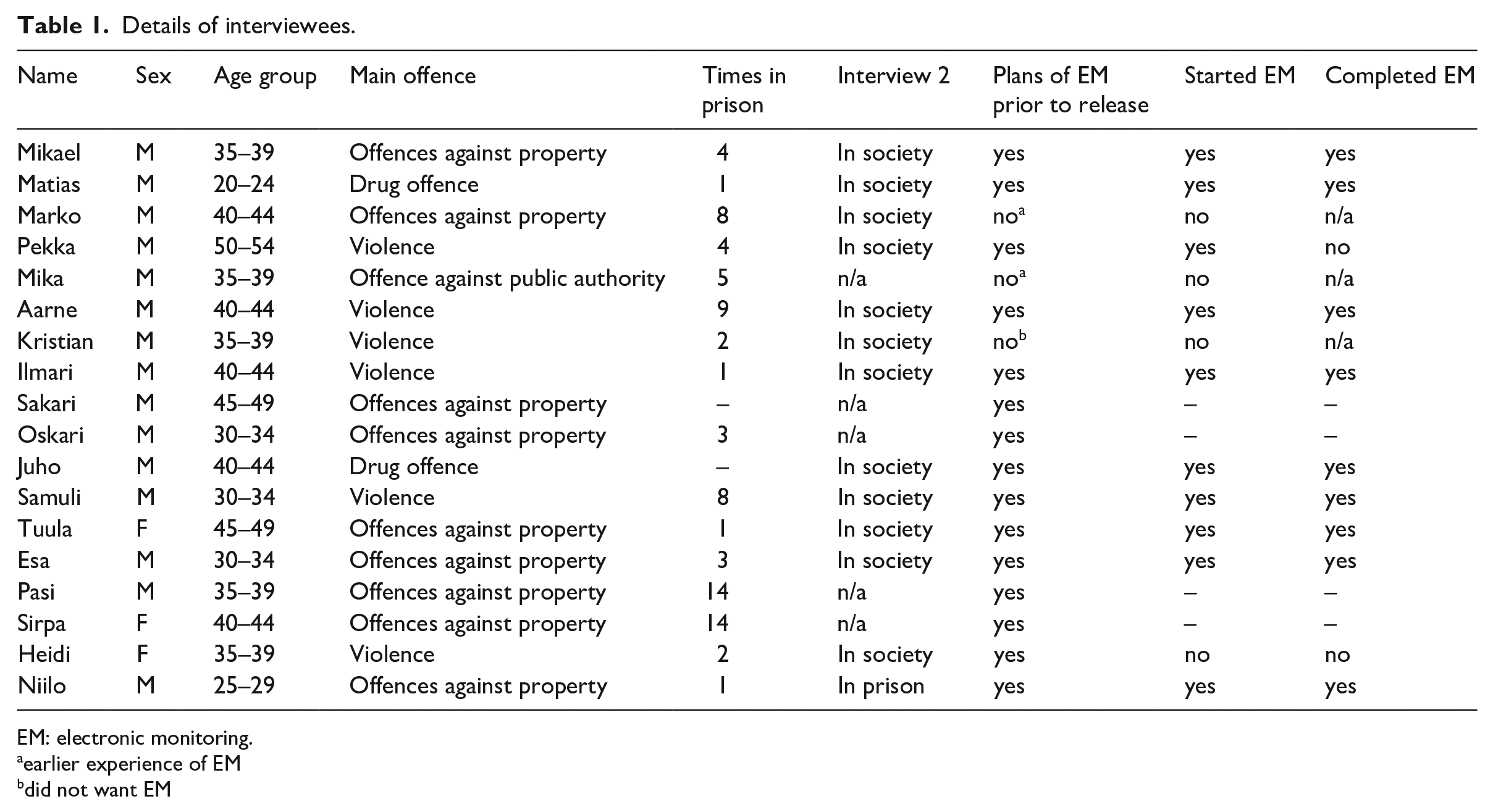
EM: electronic monitoring.
earlier experience of EM
did not want EM
Data collection
The participants were recruited from five Finnish low-security prisons. The criteria for participation were that the prisoner had less than 3 months until release (or until early release with EM), was reintegrating into society, and had a history of repeat offending. Participation was voluntary and based on informed consent. The interviews (N = 18) were held without the presence of a prison officer and lasted, on average, for 43 minutes. Participants who were willing to give a follow-up interview were asked for their contact details. The follow-up interviews (N = 13) were held about 6 months after the first interview. One was held in prison, two over the phone and the rest in cafes or public libraries. These interviews lasted on average for 47 minutes. For the follow-up interviews, the participants were given a gift voucher worth €25 to compensate for time lost when participating in the research and as an incentive to participation. It is known that retention of former prisoners in longitudinal studies is challenging, not least due to transient lifestyles (Fahmy et al., 2019). All interviews were audio recorded, transcribed and deidentified. Interview excerpts in this article were translated into English by the author, who also conducted all the interviewing.
Analysis
The data were analysed thematically, following the approach described by Braun and Clarke (2006). After familiarization with and initial open coding of the interviews, all codes relating to early release with EM and desistance were assembled. Braun and Clarke (2006: 83–84) describe the following two forms of thematic analysis: the inductive approach is data-driven without trying to fit the data into pre-existing coding frames or preconceptions and the theoretical approach is driven by a given theoretical or analytic interest. These two forms of analysis are combined here, starting with inductive identification of codes and preliminary themes, followed by analysis based on desistance theory. In the second phase, the preliminary themes were labelled and rearranged in accordance with the theory of cognitive transformation. Five themes described central trends in the material and were linked to the prisoners’ aim of desisting from crime. Early release with EM (1) prepared and eased release from prison, (2) offered unforeseen integration, (3) was extensive and demanding, (4) did not involve any ‘real work’ and (5) was a time of economic strain. While the first two themes show how early release with EM can function as a hook for change, the last three themes point at how it might hinder change, see Figure 1. The themes were not mutually exclusive, meaning that individuals might describe early release with EM as a hook for change while simultaneously recognizing that it hindered change.
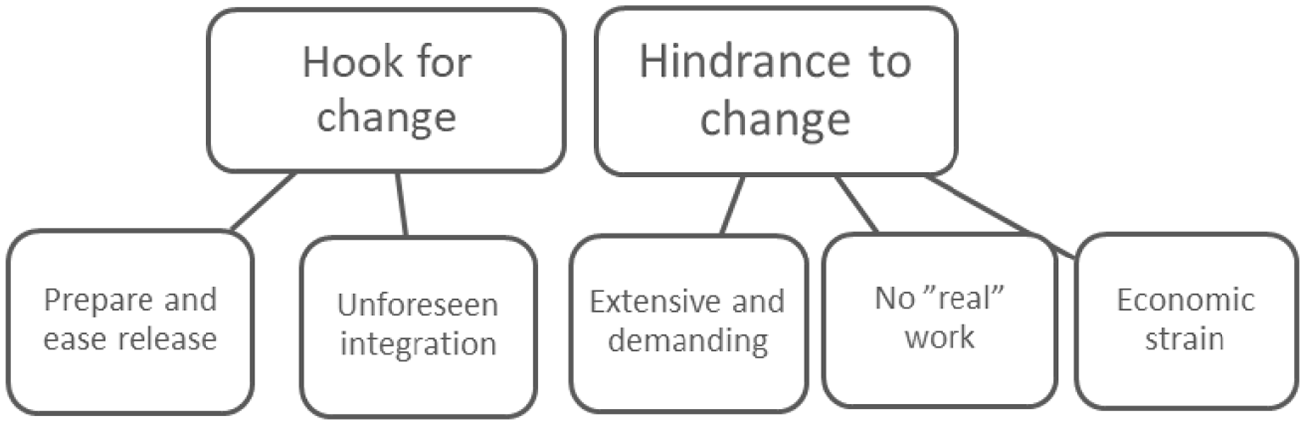
Thematic map, illustrating how early release with EM was seen to influence the prospects for desistance.
Results
A hook for change
Almost every interviewed prisoner was positive about the idea of being released early with EM. Most prisoners perceived EM as a more pleasant punishment and they highly appreciated the possibility of being at home: I’d rather serve my sentence at home than in prison. I have more rights at home. I get to go downtown, I get to be outside until 9 o’clock, I get to come in. Which all is very different from this. I get to go shopping when I like, and not only once a week. And I get to do things whenever I wish, I get to do housework. Your own home is always your own home. (Sirpa, Interview 1)
The interviewees also considered early release with EM as a possible hook for change. This was mainly because of the ways it helped them prepare for and eased their release, and offered integration to prosocial environments.
Preparing for and easing release from prison
In order to be assigned early release with EM, the prisoner needs to have a place to live and a place to carry out the required productive activity. The prison personnel made the arrangements for these with the prisoner, who was required to participate actively and plan. Several of the prisoners (n = 11) saw this as a good thing; they needed help with getting on track again, and preparation for early release with EM was more valuable to them than the general support one normally gets from prison prior to release. This was the case with Aarne. He was serving his ninth prison sentence, and this time, he declared that he needed social and practical help with resettlement, something he thought he would gain from early release with EM: It could be a kind of transition that helps me attach to society again, cause that’d be very important for me at the moment. It might be that I have to give up my apartment [before release] and then all the things that have gone missing. I have never in my life had this kind of situation. It’ll be the first time in my life that I walk out of prison with nothing else than a plastic bag on my shoulder. (Interview 1)
Even before knowing whether he would be offered early release with EM, Aarne treated it as a possible hook for change. His quote signals reliance on the form of sentencing that he needed for re-entry into society. The way he actively planned and prepared for early release signals an agentic role in selecting and moving forward with a hook of change (Giordano et al., 2002: 1034).
After EM, several prisoners described it as helping them to get back on track, get used to the normal life and ease their release from prison. Pekka was one of these interviewees. Even if he had to return to prison because of noncompliance during early release, he still considered the sentence form to be essential for resettlement upon release: it helps to surmount the re-entry, like after many, many years in prison, it helps you to see how things are nowadays. ’Cause after this many years, everything has changed; places, things, how to function in society, all these things. It changes so quickly that you are completely out of it. Early release with EM can help with those things and ease the release. (Interview 2)
The description of re-entry as a barrier to overcome, where early release with EM helped to ‘ease the release’ resonates with the intention of the sentence and with previous research that explains Finnish early release with EM as ‘a controlled framework for practicing daily life outside prison without intoxicants and crime’ (Mäkipää, 2010: 264).
Many of the prisoners felt that early release with EM made release easier and facilitated resettlement into many aspects of life, including social life, technology and more general adaptability to today’s society. It seems that for the monitored persons, the whole framework of early release with EM, with its multitude of restrictions, eased the release. Ilmari found that the programme helped him in ‘getting used to everyday life . . . all these regulations that one had to adhere to, the curfew hours and having to be home at a specific time’. At least some of the monitored persons appreciated (parts of) the controls inherent in early release with EM, seeing them as promoting change. The normative routine structured by EM could give prisoners a period to ‘grow out of offending’ (Hucklesby, 2008: 60). This was the case with Esa, who mentioned the advantages of having to adopt to clock routines and responsibilities: you all the time have to watch the clock and such, and that you need to be home at a specific time. But it’s like, it’s not harder, it only requires more initiative from you. [. . .] And what’s positive, you get used to normal everyday life at the same time, and you’re not leaving straight from closed prison – like I told you last time – that you easily slide back when a gang of friends come and pick you up, then you slide back right away, then it’s only partying and soon you’re in prison again. (Interview 2)
The recognition of the control aspects inherent in the regime resonates with the findings of Graham and McIvor (2016: 11) that monitored persons used EM as a way of ‘situational self-binding’ by avoiding undesired environments and peers.
Unforeseen integration
The second important aspect of early release with EM that hooked the prisoners to prosocial behaviour was the required productive activity. For three of the prisoners, the productive activity provided unforeseen integration and a hook for change. One of these was Tuula, a woman in her early 50s, who carried out the productive activity required for early release at a charity shop: I was at a charity shop during my early release with EM, doing my productive activity there. Four hours, two days a week. When the tracker was removed, about a month ago, I had two weeks of vacation, but since then I’ve continued going there for volunteer work one to three times a week. It was just the right timing. First I went there for compulsory voluntary work to get the productive activity carried out, but now I go there voluntarily for voluntary work. (Interview 2)
Tuula had neither the prior work experience nor the physical health to work full-time. The required productive activity at the charity shop enabled communal integration that she would not have managed without early release with EM. This unforeseen prosocial integration added value to her early release with EM.
Getting in to a good rehabilitation programme was another example of an unforeseen hook for change that fostered the prisoners’ prosocial behaviour. Niilo went through his early release with EM at a rehabilitation centre. When meeting him the first time in prison, he mentioned – without any greater interest or emphasis – the possibility of serving early release with EM on a rehabilitation programme. Due to breaches while in prison (drug use), early release with EM was only granted for the last month of his imprisonment. He went to a rehab programme for a month that came to influence him greatly: First I thought that I’d stay there only for a month, but then I realized that I need to make the most of this chance. I got to stay at the civil rehabilitation and I’ve been there since, going there daily. [. . .] like even if I only had it for a month, it was the best that has ever happened to me, like, getting into this rehabilitation. If I hadn’t been admitted early release with EM, I wouldn’t have gone there for this rehabilitation, and through this I’ve gotten a completely new life. I’ve been totally drug-free and crime-free for the last 6 months, I am 7 months sober now. The last time I was sober for this long was as an 11–12 year-old. (Interview 2)
When talking about the rehabilitation programme, Niilo adopted a strong redemption narrative (Maruna, 2001), contrasting life before and after he went into rehabilitation. His statements that treatment was ‘the best that has ever happened’, giving him ‘a completely new life’ are expressive examples of that. The treatment programme was transformative for Niilo because it provides participants with a ‘cognitive blueprint’ for their transformation, along with a ‘well-developed linguistic and cognitive guide to the change process’ (Giordano et al., 2002: 1035).
EM programmes combined with substance abuse treatment have been argued to affect recidivism rates after release positively (see Danielsson and Mäkipää, 2012). This is partly because the combination of substance abuse rehabilitation and early release with EM provides comprehensive support in reconstructing everyday life and reaches prisoners that would not otherwise have enrolled in similar services (Rantanen et al., 2016). Another reason is that the possibility of returning to prison upon noncompliance in EM effectively fosters compliance, which can positively affect tolerance for rehabilitation (Hucklesby, 2009).
These two examples of hooks for change, the charity shop and the rehabilitation programme, exemplify the difference between weak and strong hooks for change: some have potential impact, while others markedly engender cognitive transformation. While Tuula talked about working in the charity shop as ‘nice’, Niilo presented his recovery story as more far-reaching and to a larger degree affecting identity. Even if both are examples of prosocial integration and can be decisive for desistance, research suggests that individuals incorporating the hook as a subjective change, have the greatest chances of desisting from crime (Liem and Richardson, 2014; Maruna, 2001). Yet, this is not the end of the story. Even if some hooks for change are rapid and revolutionary, the continuous impact of a long-term hook for change might be just as influential for prosocial integration.
These examples show that productive activity is integral to early release with EM. This strengthens the thesis of Graham and McIvor (2015), that EM is more successful in lowering recidivism when combined with other forms of surveillance, supervision, and support. Prisoners that experienced positive effects of the productive activity, such as unforeseen integration, had previously had a weak connection to mainstream society. This argument is strengthened by looking at the ways in which early release hindered change.
A hindrance to change
Even if a majority of the prisoners perceived EM as a positive opportunity, their experiences afterwards were more diverse. Early release with EM was not unanimously considered to promote resettlement and desistance. The sentence was extensive and psychologically demanding, perceived to cause economic strain, and burdensome with its required productive activity. These challenges were reason enough for some prisoners not to apply for early release while still in prison.
An extensive and demanding sanction
The extent of the restrictions was one aspect of early release with EM that monitored persons (n = 7) considered burdensome. For instance, Samuli was positive about the opportunity, but found the intensity of the sentence psychologically demanding: I mean, it’s a good thing, but it surprised me how mentally hard early release with EM was. After all, I’ve been four and a half years in prison now. Like, after four years in prison and being released early with EM, it kinda felt like you were free, but still you weren’t. You have the tracker on all the time and you kinda subconsciously know that somebody’s watching where you’re going. It’s kinda really . . . And then you have to blow [into a breathalyser] and constantly give these urine samples. It’s somehow really humiliating, that someone comes home to you with a cup [for an urine sample], like. (Interview 2)
As becomes clear from Samuli’s account, early release with EM constitutes a complex intersection of control and social support. While some monitored persons, as expressed in the first theme, perceived the normative routines and strict controls of early release as helpful in shaping a prosocial everyday life upon re-entry, for others the intensity and extent of control might contribute to noncompliance and breach of the sentence.
The interviewees who did not want early release with EM (n = 4) shared the view that a traditional release would be just as sufficient to reintegrate into society. Mika had tried out early release during a previous sentence: I mean, it’s a good system, early release with EM, of course. But I decided that I didn’t want to go, since I didn’t go for prison leaves either. [. . .] I didn’t bother stressing with any of it, so I thought that this time I come here, do my time, and then just start from a clean slate. No need to stress with that. Now I don’t have anyone coming to take breath tests, now there’s not a damn test. (Interview 1)
Besides arguing that self-integration is working better than early release with EM, Mika described early release with EM as stressful. This is in line with previous research on EM, claiming that the ‘pains of electronic monitoring’ are perceived as more punitive after having experienced the sanction (Payne et al., 2014). For someone with a long history of criminal involvement, who has lived for the moment, the routines of everyday life imposed by EM could either bring a level of normality or become unbearable (Graham and McIvor, 2015).
No ‘real’ work
While the productive activity connected to early release functioned as a hook for change for some of the participants, this was not the case for all. Several interviewees (n = 6) found the productive activity both boring and pointless. According to the law regulating early release with EM, relevant productive activity maintains or promotes the individual’s social skills and ability to function (The Probationary Liberty under Supervision Act, 2013: §5). What the prisoners found most discouraging was that the productive activity was seldom real work, and did not meet the stated aims. Even if the prisoner was skilled and educated, finding real work to do during early release was challenging. The criteria for work to be accepted as productive activity were strictly controlled by the prison administration, often leaving the prisoner with no other option than so-called rehabilitative work, that is, initiatives intended for persons who do not have the functional capacity to work in a regular job. Rehabilitative work implies assistive duties organized at activity centres, associations, foundations or municipal offices and does not constitute an employment relationship (TE-services, 2022). Typical activities are custodial duties, cleaning and kitchen work, manual skills, and information technology (IT) and personal computer (PC) workshops. Several of the prisoners interviewed had reservations about doing rehabilitative work, and used strategies to manage or avoid this kind of work. For example, Oskari clearly differentiated himself from people doing rehabilitative work: I don’t want to go for any rehabilitative work, ’cause I don’t see that supporting my soberness. And at many of those rehabilitative workplaces, the people that go there, they are, let’s say, between normal and abnormal. I’d like to advance in my life and not only remain at this place. Education, a steady job, I want to go forward in life. And that [rehabilitative work] doesn’t support such progress. (Interview 1)
Rehabilitative work was not perceived as supporting the progress and change many of the prisoners wished for upon release. To some, this scepticism towards the rehabilitative work was reason enough for refusing early release with EM altogether. These results align with earlier research concerning rehabilitative work in Finland, showing that it only rarely leads to employment and is more effective at promoting wellbeing and participation (Karjalainen and Karjalainen, 2010). The prisoners thought they would integrate just as well on their own, or even better, without doing rehabilitative work. Others again chose to go for rehabilitative work, but were careful about not getting too involved with other people in the workplace: prisoners from [another open prison] also went there for work. But luckily I had my own work station, so I did my work there on my own and didn’t have to work with the other prisoners. (Ilmari, interview 2)
Ilmari’s strategy of keeping his distance from his co-workers and working on his own saps the rehabilitative work of much of its intended social and rehabilitative potential.
Several prisoners hoped to do their productive activity in an ordinary environment, either at their old workplace or at a new one they had been in contact with. This hope proved to be difficult to realize. For example, Samuli, who had put much effort into getting a new education while in prison and succeeded in getting hired both for his early release with EM and beyond, had to see his plans change completely:
I remember that last time you told me that you had a job lined up for your early release, in construction, right?
Yes, I was supposed to start there when my early release with EM started. But then they had inspected it, details and all, and they just told me on the day I was supposed to leave for work, they announced that it doesn’t work out anyway, get another one instead. (Interview 2)
The sudden rejection on early release turned all Samuli’s plans upside down. One month later, he was released early with EM, but into rehabilitative work. After release, he tried to contact the firm originally wanting to hire him, but by then all positions were filled. Even if Samuli had been offered the opportunity to continue the rehabilitative work, it did not meet his expectations of a ‘new start’ on release: and they never found any work for us to do, so then you just sit there twiddling your thumbs. And since I had to drive 30 kilometres to get there and get 9 euros a day, it’s not really worth it. (Interview 2)
Juho was another prisoner who had experienced how hard it was to get a ‘normal’ job to do during early release. He therefore chose rehabilitative work instead for work in his real profession, for the convenience: I was at drug rehabilitation for the whole early release with EM. I started working when my sentence ended. I just didn’t have the strength to arrange for any work during early release with EM. They are so strict with the firms and what they do, It requires terribly much work with the firms, so I just didn’t bother. It was easier to stay at the rehabilitation centre. (Interview 2)
The difficulties of accessing ‘real work’ as productive activity during early release with EM can hinder change. Prisoners perceived the support they received from prison to plan and find suitable productive activity to be inadequate. Denying access to relevant productive activity depreciates the education and skills that prisoners possess, and might foil plans and dash hopes for release.
Economic strain
The last theme that the monitored persons mentioned as hindering change was the economic strain of early release with EM. According to four of the prisoners interviewed, the economic strain of supervised probationary freedom was considerable. As Matias explained, to me it felt like a strategy for failure. [. . .] I get 830 euros a month but I need to pay rent, food and bills. How was I going to make the ends meet? On top of this, I had to wait two months before KELA [the Social Insurance Institution of Finland] sent me my payment. Every night I sat thinking whether I have to do something again to get food on the table. (Interview 2)
The prisoners reporting about financial problems had lived on relatively good salaries prior to imprisonment. To them, early release implied a return to the costs of their previous life, but without being able to get ‘real work’ with a proper salary. At least from an economic perspective, a traditional release with a job and proper salary would have been an easier solution for them than early release with EM.
The financial problems during early release were further linked to the prospects of desisting from crime. As Matias observed, ‘the money situation made it feel like things were shaped up for relapsing into old habits’. Juho was another prisoner who pointed out the risk that economic pressure could lead to committing new crime:
And has it been tempting to use or sell drugs during this time?
Not as such, not using at least. But the selling has been, like when early release with EM ended, or already during early release, when I had quite little money, and I’m not used to that, not having money, then it went through my mind on several occasions. But I got over it quite easily. Well, yes and no. Some don’t get over such thoughts easily. I get over it by thinking through the whole chain of thoughts, thinking what the end result would be. The end result is that I would have to begin all over again, and I think I have it quite good like this. But now when the EM ended and I started working I have money again. (Interview 2)
The economic strain experienced during early release with EM is linked to the problem of productive activity. If prisoners could do their productive activity at authentic workplaces, with a competitive salary, the economic strain would not be as apparent. The accounts further accentuate the need for better dialogue with prisoners concerning the economic realities awaiting them upon release. This finding adds to prior research by suggesting that a traditional release might offer just as smooth transition from prison for prisoners well integrated into society and with (good chances of getting) a job and a proper salary upon release.
Discussion
How can early release with EM promote desistance from crime? The analysis identified five themes through which Finnish prisoners linked early release with EM to their desistance process. The first two themes showed how early release with EM can function as a ‘hook for change’ (Giordano et al., 2002: 992) by (1) preparing and easing release from prison and (2) providing unforeseen integration. The three remaining themes pointed at how early release with EM might hinder change, as it was (3) perceived as extensive and demanding, (4) did not involve any ‘real’ work and (5) was a time of economic strain.
The overall perceptions of early release with EM were positive, both prior to and after having served the end of the sentence with EM. It is understandable that prisoners want and appreciate this form of sentence; to reduce the time spent in prison is undeniably an opportunity most prisoners are unlikely to refuse. In addition, early release with EM was described as a way forward in life, as a new course to pursue and thereby engage in new and prosocial areas of life. Above all, the productive activity and how the regime prepared and eased release seemed to sustain prosocial change and desistance.
Graham and McIvor (2015) have stated that ‘[i]t is not so much the deterrent or surveilling effects of EM that are associated with desistance, as it is the potential for motivation and choosing sustained compliance and pro-social change’ (p. 78). While some findings of this study support this statement, experiences of control and support connected to early release with EM can be highly ambiguous. Although EM is framed as less punitive than prison, it is nonetheless designed to monitor compliance in ways that can feel just as restrictive as a prison sentence (Hucklesby et al., 2021: 93). The combination of EM with other requirements, such as the productive activity in the Finnish regime, generates a complex nexus of control and support. Even if the absolute control characterizing life in prison was absent, making life during EM less painful, the feeling of being constantly supervised and ‘watched’ was described as stressful – a finding repeatedly reported from monitored persons (Hucklesby, 2009; Vanhaelemeesch et al., 2014). The humiliation connected to drug testing was another aspect that interviewees mentioned in this study. Even if drug testing was routine in prison, it seemed that participants found the same procedures even more degrading in their own homes.
Control was not completely and invariably negative. Some of the prisoners perceived the control as positive and supportive, helping them to reorganize their life. Similar ambiguity surrounded interviewees’ experiences of the support mechanisms connected to the sentence. Support for finding a place to live was considered to be very important. Some reported that the support was insufficient, mainly for finding suitable or ‘real’ work. The many requirements of the early release programme likewise divided the prisoners; some found it demanding and stressful, others found the support they needed to change their way of life upon release. Only rarely did the monitored persons mention solely negative or positive views of the support offered. Typically their perceptions lay somewhere between these two dimensions: important but in some aspects insufficient.
Prisoners’ ambiguous experiences of control and support connected to early release with EM are important for understanding how this form of sentencing can affect desistance from crime. The control can be experienced as support, while support can be experienced as control. This aspect is important: while early release with EM can support prisoners’ adjustment to society, this support may be insufficient and combined with control measures, the impact is complex.
Whether the reported findings are a result of EM, the conditions of the early release programme, or any other mediating factor, cannot be answered based on this study. The findings, however, indicate that being electronically monitored makes early release with EM something different compared to other resettlement programmes. The nature of supervision that EM entails is much more intensive compared to the supervision of regular conditional release in Finland. By studying EM in its context of use, this article advances desistance scholarship with a more multifaceted picture of the effects EM can have on desistance. The findings demonstrate how structural challenges that Finnish prisoners face in resettlement impede change. Even with the generous support offered in the programme of early release with EM, challenges such as labour market participation proved hard to overcome.
Studying desistance in a population with differing approaches to desistance complicates theorizing. Some of the participants in this study had already started their change process when interviewed, while others regarded desistance mere as a possible future. The article has aimed to demonstrate how early release with EM unfolds among these different approaches to desistance, as this diversity characterizes prisoner resettlement.
Policy implications
Early release from prison with EM creates important opportunities for making punishment more humane, cost-effective and directed at resettlement. The fact that people who have gone through this programme nevertheless consider it as a hindrance to desistance is worth attention. This analysis has raised two possible ways of trying to deal with the problem. First, when appropriate and justifiable concerning public safety, the criminal justice system should not rely solely on the integration offered through rehabilitative work, but aim to foster more realistic reintegration. Many prisoners had previous work experience and jobs waiting for them upon release. It is a pity to neglect these possibilities for reintegration. Second; the target group for early release with EM needs to be more clearly defined. Previous researchers have shown that prisoners granted early release with EM tend to be better integrated into mainstream society than the general prison population. Yet, as they expressed in the interviews for this study, this same group of prisoners found early release with EM stressful and a cause of economic strain. For prisoners well integrated into society and with good chances of getting a job and a proper salary upon release, the transition from prison to community might be just as successful without early release and EM. In fact, the programme might cause economic strain and impose a hindrance to reintegration. Aligned with this, the realities of early release with EM need to be better communicated, as it is not obvious that every prisoner will solely benefit from this form of sentence – on the contrary.
Conclusion
The data presented here offer a more nuanced picture of the advantages of early release with EM. Backdoor electronic monitoring systems, like the Finnish one, can clearly promote resettlement and desistance, and prisoners appreciate them. At the same time, aspects of these systems can impede resettlement. Even if the extensive regime of early release with EM implemented in Finland succeeds in facilitating social integration in some areas of life, the people being monitored describe this as a demanding sentence that does not help them integrate into the labour market.
Footnotes
Declaration of Conflicting Interests
The author declared no potential conflicts of interest with respect to the research, authorship and/or publication of this article.
Funding
The author(s) disclosed receipt of the following financial support for the research, authorship, and/or publication of this article: This work was supported by the Ministry of Justice of Finland under research grant VN/7203/2018.
