



Abstract
The controversial effect of intoxication on sentencing outcomes has received renewed attention with a series of new empirical studies. However, these studies have relied on survey data that conflate alcohol and drug intoxication and miss pertinent contextual features of the offence. This article explores how alcohol intoxication, and its social context, impact sentence outcomes for violent offences. To do so, the probability of custodial sentence severity is modelled using multilevel Cox regression using data from online sentence transcripts. Findings contribute insights into how punishment is shaped by not only the presence of alcohol intoxication in offending but also in which contexts by highlighting the significant punitive effects of reference to concomitant drug use, the defendant drinking together with the victim and if the offence occurred in a private setting. This helps clarify complex considerations taken into account by sentencers when processing cases and the need for clearer guidance.
Background
Intoxication is a contentious sentencing factor (Dingwall and Koffman, 2008; Padfield, 2011), with recent studies exploring its application in determining punishment (Irwin-Rogers and Perry, 2015; Lightowlers, 2019; Lightowlers and Pina-Sánchez, 2017). These studies have relied upon the most comprehensive national data source for scrutinising sentencing practice, the Crown Court Sentencing Survey (CCSS). The level of detail afforded by the CCSS has been praised widely (Pina-Sánchez and Grech, 2018; Roberts and Hough, 2015). However, for the specific factor of intoxication, the detail offered by the survey is limited. The CCSS questionnaire conflates alcohol and illicit drug intoxication and does not distinguish the context of the intoxication and related offending.
While recent studies find intoxicated aggressors are blamed more so than sober aggressors, earlier observational court studies offered divergent findings; suggesting intoxication can serve both as a mitigating and aggravating factor (Dingwall, 2006; Padfield, 2011; Rumgay, 1998; Shapland, 1981). Having studied appellate decisions in the Australian context, Quilter and McNamara (2018) remarked that the ‘ubiquity of the term [intoxication], the complexity of the relationship between intoxication evidence and determinations of criminal responsibility is often underappreciated’ (p. 187). They found that ‘depending on a range of site-specific and case-specific considerations, intoxication evidence may expand/contract the parameters of criminal responsibility’, yielding higher or lower criminal penalties (McNamara et al., 2017: 148).
In England and Wales, the Crown Court is responsible for dealing with more serious crimes, such as murder, rape and robbery, that cannot be heard at a magistrates court 1 as well as those ‘passed up’ by magistrates’ court for trial or sentencing and appeals associated with magistrates’ court outcomes. The Sentencing Council issued offence-specific guidelines to reduce judicial discretion and standardise sentencing. 2 The first of the revised guidelines related to assault offences (Sentencing Council, 2011), ranging from common assault to intentional grievous bodily harm and permitting sentencing ranges from a discharge, fine or community order to life imprisonment (see Sentencing Council, 2011). In the 2011 Assault Definitive Guideline, the Sentencing Council (2011) upheld the decision of the earlier sentencing guidelines on Overarching Principles: seriousness (Sentencing Guidelines Council (SGC) 2004) that alcohol (and illicit drug) intoxication ought to aggravate assault offences on the basis of their seriousness; thus, making intoxicated offenders more culpable.
The rationale for intoxication serving to aggravate sentence outcomes is not clarified by the Sentencing Council (Dingwall, 2006; Dingwall and Koffman, 2008), and this factor applies only to voluntary intoxication and in circumstances where intoxication has contributed to the offending (both of which are challenging to determine), they offer little practical guidance as to when and how to apply this aggravation (Lightowlers, 2019; Lightowlers and Pina-Sánchez, 2017). The guidance is thus subject to varied interpretation in the case of addicted and intoxicated offenders (Sinclair-House, 2018). The underlying assumption is ‘that offenders who voluntarily become intoxicated are more culpable, presumably because they realise (or ought to realise) that this may lead to uninhibited conduct with unpredictable results’ (Ashworth, 2015: 172).
Quilter and McNamara (2018) argue that determining whether a person was relevantly intoxicated is commonly based upon ‘lay knowledge’ (‘a mixture of “facts,” opinions and attitudes . . . ’) held by jurors and judges about the effects of intoxicants (p. 205). As sentencing is shaped by normative moral and social judgements about blameworthiness, there are many divergent ways alcohol’s role in offending can be interpreted; especially as sentencers are also left to determine the relevance of sentencing principles (laid out in Section 142 (1) of the Criminal Justice Act 2003) and the relative weight that should be afforded (if any) to mitigating and aggravating factors (including intoxication). Dingwall (2006) suggested that ‘intoxication is dealt with in something of a haphazard manner by sentencers, depending on their personal sentencing philosophy and with consequent issues about consistency and fairness’ (p. 144). Rumgay (1998) found that there exists ‘a plurality of intoxication excuses, capitalising on the plurality of lay beliefs about alcohol, selectively and powerfully applied to explain and attribute responsibility for different kinds of criminality’ (p.164). As such, the application of intoxication as an aggravating (or mitigating) factor serves (alongside other potential mitigating and aggravating factors) as ‘a kind of moral assessment of the offender and his or her prospects’ (Ashworth, 2015: 199).
The lack of clarity pertaining to how (and when) the aggravation of intoxication ought to be applied suggests a level of ‘instinctive synthesis’ (Hutton, 2013) in the interpretation and application of guidelines. This ‘instinctive synthesis’ is likely shaped by lay beliefs about alcohol and its role in offending, including the settings in which the alcohol consumption and offence took place – as well as varied interpretations concerning the purposes of sentencing (Dingwall, 2006; Lightowlers, 2019; Lightowlers and Pina-Sánchez, 2017). This has also been noted by Ashworth (2015), who concludes that alcohol intoxication has been found to aggravate or mitigate according to the context (and prospects of future rehabilitation). Intoxication is thus framed as problematic differently in different contexts – impacting perceptions of culpability and blame and shaping the severity of punishment accordingly. This exposes potential for unwarranted disparities and bias in sentencing outcomes.
National studies based on survey data have helped identify how contextual (isolated incidents; Lightowlers and Pina-Sánchez, 2017) and demographic factors (sex of the defendant; Lightowlers, 2019) serve to shape sentence outcomes for violent offences involving intoxication. CCSS data conflate illicit drug and alcohol consumption, as this variable pertains to cases in which ‘intoxication’ is applied as an aggravating factor in legal terms. The lack of distinction between intoxicant represents a challenge for social scientists trying to disaggregate cases relating specifically to alcohol (or illicit drug) intoxication. Without further scrutiny of how intoxication shapes sentence outcomes, we miss the divergent ways in which intoxication is determined relevant and thus run the risk of erroneously assuming intoxication impacts outcomes homogeneously.
Literature exploring the effects of substance use on behaviour finds considerable differences in the relation of different substances to aggression, with alcohol being the most strongly associated (Haggård et al., 2006; Kuypers et al., 2018; Leidenfrost et al., 2017). Moreover, drug and alcohol intoxication are distinct in many ways notwithstanding their legal status, availability and the settings in which they are consumed. So too are perceptions of the acceptability of their use and the extent to which they are expected to impact comportment (Room, 1996; Rumgay, 1998) and perceptions of culpability. Distinction is necessary in trying to unpick the subtleties of how intoxication stemming from alcohol consumption may be impacting sentencing outcomes (and how it differs from drug intoxication). It is useful to understand whether illicit drug intoxication serves to additionally aggravate sentence outcomes, given it represents an additional substance and further illicit behaviour.
Sentencing transcripts and remarks offer an opportunity in this regard – having been described as the ‘intersection of subjectivity and objectivity in the court process’ (Jacobson et al., 2016a: 55). They represent a rich source of narrative data from which to explore contextual detail of alcohol use and any impact sentencing. Summaries of such transcripts (available at www.thelawpages.com) were used to explore the impact of contextual drinking factors upon sentence outcomes. Hitherto, these court transcripts have only been used in qualitative and doctrinal research (Jacobson et al., 2016b; Lavorgna, 2015) and to examine discrimination against Muslim-named offenders (Pina-Sánchez et al., 2018) as well as to estimate between judge disparities (Pina-Sánchez et al., 2019). Using content analysis of the narrative data within the transcripts, we created a data set relating to cases of violence with which to explore the role of alcohol intoxication in shaping punishment. This novel approach has provided more contextual detail than was previously possible.
Alcohol, violence and the importance of context
It is well established that a large proportion of violent offences involve alcohol – 40% in England and Wales last year (Flatley, 2018). However, despite falling under the homogeneous banner of ‘alcohol-related violence’, cases are known to vary in their nature and the contexts in which they occur. They differ in many important ways, including whether the defendant and victim are known to each other (acquaintance vs stranger violence), were drinking together or whether the offences occurred in public or private settings. The locations of violent crimes are also known to vary by victim–perpetrator relationship; with the majority of domestic violence incidents occurring around the home (79%), and incidents of stranger violence more commonly occurring in pubs and clubs (27%) or work (21%) (Flatley, 2018).
The divergent characteristics of alcohol-related offences outlined above point to a range of factors that interact with alcohol intoxication which may be considered by judges when sentencing such offences. However, there is little guidance available to practitioners on how to deal with such interactions. Sentencing guidelines do permit the location of the offence to be considered as an aggravating factor (Sentencing Council, 2011), but as with intoxication, there is little clarity on how this ought to be applied and to which settings. Similarly, relationships between the accused and complainant may also serve to aggravate on offence where they deem the offender to have abused ‘power and/or position of trust’ (Sentencing Council, 2011). Essentially, sentencers are left to determine the ‘appropriate mix’ of sentencing considerations.
While the impact of social and contextual factors on intoxicated behaviour is well established (cf. Lightowlers, 2017; Plant et al., 2009; Zinberg, 1986), little is known about how alcohol intoxication impacts sentence outcomes, in which circumstances and for whom. Without empirical research, this question remains unanswered and hinders insights into unwarranted disparities in sentencing, including discrimination, that is, whether certain types of drinking and associated criminal behaviour in certain settings and among certain populations are treated differently or whether more complex and tailored interpretations of alcohol drinking in its context are being applied by sentencing practitioners. Earlier research found perceptions of culpability among the general population depend upon further situational and contextual details of the case (Wild et al., 1998). Here, we exploit the potential of a new data source to tease out this contextual detail. Namely, whether sentence outcomes for violent offences in which alcohol consumption is referenced are conditional upon the environment (setting) in which the offence occurred, for example, with whom a person drinks and where an offence occurs.
With reference to Violence Against the Person offences incurring injury, we elicit insights into how and when sentencers determine alcohol intoxication as aggravation (or mitigation); responding to the need for ongoing monitoring of how intoxication shapes sentencing practice (Lightowlers, 2019; Lightowlers and Pina-Sánchez, 2017). In particular, we explore whether the context in which the alcohol-related offending occurred (public/private), the defendant and victim were drinking together when the offence took place and any concomitant illicit drug use on the part of the defendant impact the length of prison sentence. These insights are essential for offering guidance and practical direction to practitioners and to understand whose intoxication is understood as problematic in which contexts; namely, the cultural and psychological processes affecting the labelling of deviance (Wild et al., 1998) and how punishment is used to communicate disapproval (Canton, 2018; Garland, 1990; Lukes and Scull, 2013).
Data preparation and coding
The Law Pages contains summaries of sentence transcripts of offences sentenced in the England and Wales Crown Court. These records are believed to be derived from Her Majesty Courts and Tribunals Service (HMCTS) since they capture the unique identifier used by HMCTS (Pina-Sánchez et al., 2018), representing the most comprehensive source of publicly available sentencing remarks for Crown Court decisions. The records capture information relating to sentence outcomes (the disposal type, sentence length and whether the sentence is indeterminate), characteristics of the defendant (e.g. sex and age), the court at which the case was heard and remarks offered at sentencing, which note other relevant distinguishing features of the case.
Cases heard in courts in England and Wales where the principal offence was one of Violence Against the Person was obtained from 20 February 2007 to 15 June 2016, (n = 4705) in line with Home Office counting rules and in accordance with Office of National Statistics (ONS) and Ministry of Justice (MoJ) crime reporting conventions. 3 These records were scraped from the Law Pages website. 4 They comprised a range of offences, including common assault, wounding, grievous and actual bodily harm, manslaughter and murder among others (see Home Office, 2018). Once downloaded, records were individually parsed to search for specific keywords, from which relevant variables could be derived in what constituted an unsupervised data coding approach (see Pina-Sánchez et al., 2018). Following this process, Pina-Sánchez et al. (2018) were able to capture various case-relevant variables. It was also possible to code defendant characteristics, including sex and age, and differentiate between specific offence types. Differentiating cases by offence type allowed for consideration of offence-specific sentencing practices, as well as controlling for the seriousness of the offence (a proxy for harm).
The records also offer qualitative information describing the case hitherto unavailable in previous quantitative sentencing datasets. This includes commentary on offence features considered in arriving at the sentence, which can include observations on the type of intoxicant, the nature and setting of the drinking and associated offending behaviour, among others. To date, no previous study has made use of these data with which to conduct content or quantitative analysis of large samples or to interrogate how alcohol drinking impacts sentence outcomes specifically. To exploit this information, further variables relating to alcohol intoxication and the context of the offending were derived using supervised coding methods; namely, pre-specified search terms and content analysis, respectively. The resultant detail surpasses previous quantitative studies on this topic and allowed us to examine how intoxication is framed.
Using content analysis to code information available in the records allowed us to scrutinise judge remarks to distinguish more subtle features of the case. The content of the sentencing remarks was analysed and coded based on insights from the literature. Earlier findings and theory guiding our research questions (e.g. likely importance of drinking in public vs private setting) were used to generate manifest codes relating to alcohol or illicit drug use and the contexts in which the drinking or offence occurred. This was achieved by systematically reading sentencing remarks to identify words or terminology noted as distinguishing features by the judge. Coded data were subsequently interrogated quantitatively using statistical methods.
The resultant manifest codes included whether or not the judge explicitly remarked upon the offence occurring in a public or private place. Examples of the former included pubs, clubs or in the street, and in the latter, explicit mention of a dwelling. Examples of public places having been mentioned included ‘stabbed her [. . .] to the stomach at a pub’ and ‘stabbed a drunk man who shouted unprovoked abuse at him in the street’. Examples of a private place having been mentioned included ‘having drunk all day you went to her home’ and ‘attacked their victim following an argument in the flat’.
Manifest codes also included the mention of concomitant illicit drug use or problems (namely, mention of the defendant using illicit drugs at the time of the event or otherwise has problems with drugs) as well as whether the defendant and victim had been drinking together. The former included examples such as ‘You are a man with a long history of inflicting violence on innocent people, fuelled by abuse of Class A drugs and alcohol’ and ‘XXX had been drinking and taking drugs in the company of his victim’s partner’. The latter included examples such as ‘He and his co-defendant had been drinking with the victim at a house’ and ‘His victim had been a friend and the men had been drinking together when . . .’.
Cases were coded to capture multiple features (e.g. where illicit drugs were mentioned and the domestic setting was remarked upon). Cases were also coded to include a measure of whether the offence took place in public and/or in private. As such, cases could be coded as having occurred in both settings – although this was rare. Where a case featured twice or more in the dataset (multiple defendants), each was coded so as to ensure details of each defendant were captured and retained as the unit of analysis.
We filtered cases of Violence Against the Person by those with the mention of alcohol or drinking using search terms ‘drunk’, and derivations of the terms ‘drink’, ‘intoxication’ and ‘alcohol’ (e.g. ‘drink*’, intoxicat*’ and ‘alcoho*’). This yielded 511 cases (10.9% of the full sample of Violence Against the Person offences). 5 The chosen terminology is similar to that identified in studying Australian statute and appellate court decisions (McNamara et al., 2017; Quilter and McNamara, 2018). These alcohol terms were remarked upon with reference to aggravation but also as a neutral or mitigating factor. While further terms could have been added to this list, they did not return many more cases in which one of these four terms did not already feature.
While it would have been useful – and in some cases possible – to discern between different levels of alcohol intoxication and/or categories of intoxicated offenders (e.g. one-off drinkers/binge drinkers/people suffering from alcoholism) for most cases, this detail was not available. To enable comparisons between cases that did and did not involve reference to alcohol, a random sample (n = 510) of cases of Violence Against the Person without reference to alcohol consumption was also coded using content analysis (as outlined above), resulting in a total of 1021 cases for analysis.
Although there is no information on the sampling strategy by the Law Pages, Pina-Sánchez et al. (2018) cross-checked its generalisability by examining the spread of cases across Crown Court locations more generally. They suggest, that while the Central Criminal Court is over-represented, the spread is otherwise deemed broadly representative; ‘the higher concentration of cases from the Old Bailey is likely a reflection of the overrepresentation of serious offences in our sample’ (Pina-Sánchez et al., 2018: 722). Our sample also seems to over-represent more serious cases, with homicides comprising over half the cases (54.75%), other violent offences causing injury accounting for over a third of cases (37.31%) and the remaining cases being death or serious injury caused by unlawful driving (7.94%).
The quality of our data is impacted by several factors beyond our control, as is common in secondary data analysis. And we cannot rule out other forms of selection bias that we have not been able to identify. There was considerable variation in the length and detail offered in the sentencing remarks, and while we are unable to establish clear trends, it is conceivable this could introduce bias – for example, locations with higher volumes of cases to process might, as a result, produce shorter summaries with sparse detail and be the very jurisdictions in which high-volume alcohol-related violence occurs most commonly. It is also possible that remarks about alcohol/drugs are only recorded in cases where this was considered as a particularly significant aggravating factor.
Modelling strategy
Our analysis is based on the examination of differences in sentence length. Durations of custodial sentences were modelled under hierarchical proportional hazards Cox models, using the ‘coxme’ package (version 2.2-10; Therneau and Clinic, 2018) in R (version 3.5.1). This is a semi-parametric form of event history analysis, ‘in which the outcome denotes the time to the occurrence of an event of interest’ (Austin, 2017: 186); in this instance, release from prison. The outcome variable consists of two parts: a binary indicator as to whether the case was right-censored or not (indeterminate and life-time vs determinate) and a measure of time (duration of sentence in months). The Cox model allowed the specification of custodial sentence length in months appropriately accounting for the right-censored durations for indeterminate life sentences (for which only the minimum term of the sentence is known, accounting for 17.3% of the sample, n = 177), while controlling for a range of legal and extra-legal factors (detailed below). A random intercepts term is introduced in the model to account for the unobserved variability between courts (68 Crown Court locations in the final sample).
We explored the association between alcohol having been mentioned in the sentencing remarks and sentence severity (measured as custodial sentence length). And, within a latter subset of alcohol-related offences, whether sentence length was dependent upon (1) concomitant illicit drug use, (2) the defendant and victim having been drinking together and/or (3) whether the offence occurred in a private setting.
Given the proportional hazards specification, regression coefficients obtained for each of the covariates should be understood as the effect of each of those variables on the hazard rate (i.e. representing the ‘risk’ of prison terms being terminated). Hence, negative coefficients are associated with the imposition of longer sentences, while positive coefficients indicate a shorter sentence. Taking the exponential of these coefficients will result in hazard ratio values between 0 and 1 representing negative effects and those above the value over 1 indicating positive effects.
After examining sample descriptive statistics, the event history models are presented in two distinct stages. First, all cases of violence are modelled to assess the impact of a binary measure of whether these cases were alcohol-related or not. Second, only those cases identified as alcohol-related cases of violence were modelled to examine influence of contextual variables, as described above. This allows for an assessment of which case characteristics are associated with longer sentence lengths and whether they contribute to improve the model fit (using log-likelihood ratio tests).
Results
Of the 511 alcohol-related violence cases 13.7% were associated with a female offender, compared with 7.1% of the 510 non-alcohol-related cases. The age range of defendants was between 14 and 92 years with a mean of 31 years for alcohol-related cases and 31.5 years for non-alcohol-related cases.
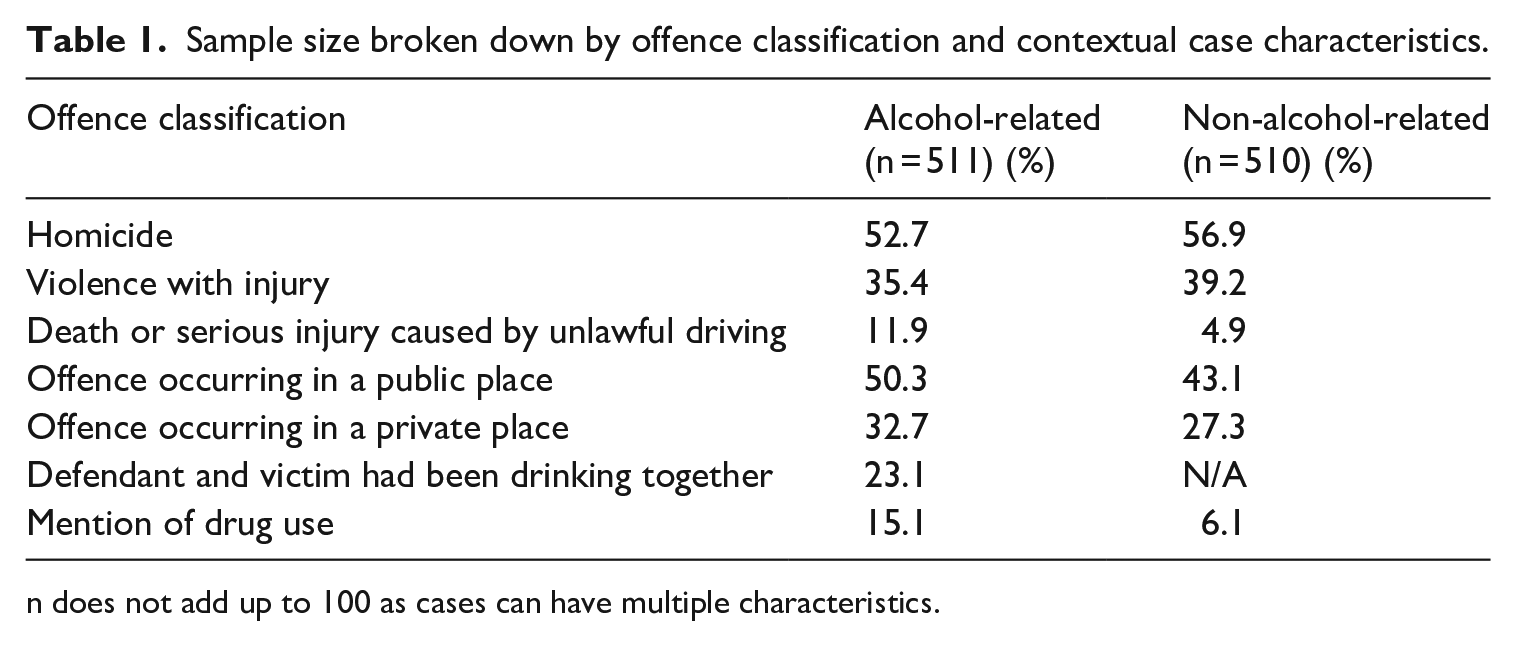
Alcohol- and non-alcohol-related cases do not seem to differ substantially in terms of offence seriousness. Over half of both the alcohol-related cases and non-alcohol-related cases comprise homicide offences (see Table 1), followed by just over a third (35.4%) and nearly two-fifths (39.2%) of violence with injury offences, respectively. The proportion of death or serious injury caused by unlawful driving comprises the smallest proportions in each subset – although there were twice as many of these offences in the alcohol-related cases (see Table 1).
Sample size broken down by offence classification and contextual case characteristics.
n does not add up to 100 as cases can have multiple characteristics.
Table 1 displays a breakdown of cases by the contextual characteristics identified in the coding of sentencing remarks. This is shown for the alcohol-related and non-alcohol-related cases. The most common of these pertained to the public or private setting in which the offence occurred. Around half (50.3%) of alcohol-related cases were remarked upon as having occurred in a public place compared with around one in four (43.1%) non-alcohol-related cases. Nearly a third (32.7%) of alcohol-related cases were remarked upon as having occurred in private compared with just over a quarter (27.3%) of non-alcohol-related cases. Reference to concomitant illicit drug use was less common although more frequently cited among alcohol-related cases (15.1%) when compared to non-alcohol-related cases (6.1%). In just under a quarter (23.1%) of alcohol-related cases, the judge remarked upon the defendant and victim having been drinking together.
Modelling
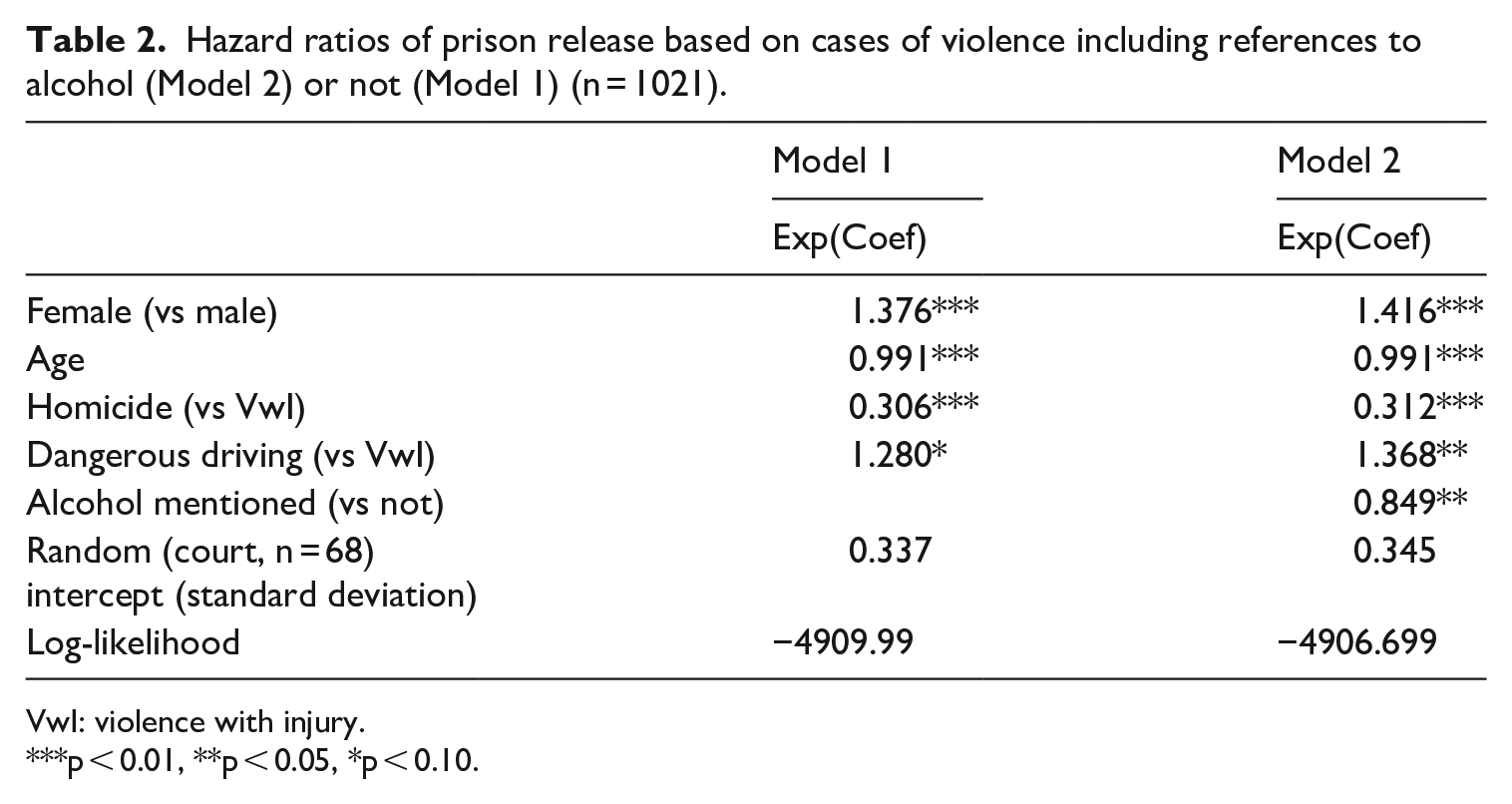
Two models were initially compared. The first modelled the length of time incarcerated (hazard ratio (HR) of prison release) – controlling for gender, age and offence type. Results (Table 2) highlight sentence length generally shorter for females (HR = 1.38, p < 0.01) and for younger persons (HR = 0.99, p < 0.01) in line with findings as to women receiving shorter or less severe sentences (Lightowlers, 2019; Pina-Sánchez and Harris, 2020). The strongest predictor of sentence severity is the offence type. Homicide offences are 70% more likely than cases of violence with injury (reference category) to receive longer sentences (HR = 0.31, p < 0.01). Those serving terms for dangerous driving offences were 28% more likely to receive a shorter sentence (HR = 1.28, p < 0.10) when compared with cases of violence with injury. The random intercepts term for court location was significant, suggesting that sentence severity also varies between courts. The second model introduced an additional coefficient for whether alcohol was mentioned or not, which improved the model’s fit, as confirmed by a likelihood-ratio test (p < 0.05). In the second model, we see that the ‘risk’ of a longer sentence is 15% higher with the mention of alcohol (HR = 0.85, p < 0.05). The presence of alcohol is thus a relevant factor in determining sentence length as it aggravates the severity of the sentence.
Hazard ratios of prison release based on cases of violence including references to alcohol (Model 2) or not (Model 1) (n = 1021).
VwI: violence with injury.
p < 0.01, **p < 0.05, *p < 0.10.
Modelling was subsequently performed on the subsample of 511 alcohol-related cases to explore the role of contextual factors. After specifying a base model which controlled for the crime type and demographic characteristics (age and sex), case characteristics were introduced in a second model, pertaining to: (1) the illicit drug(s) used; (2) whether the defendant and victims were drinking together; and (3) whether the offences occurred in a private or public setting. The results of these models are displayed in Table 3 below. 6
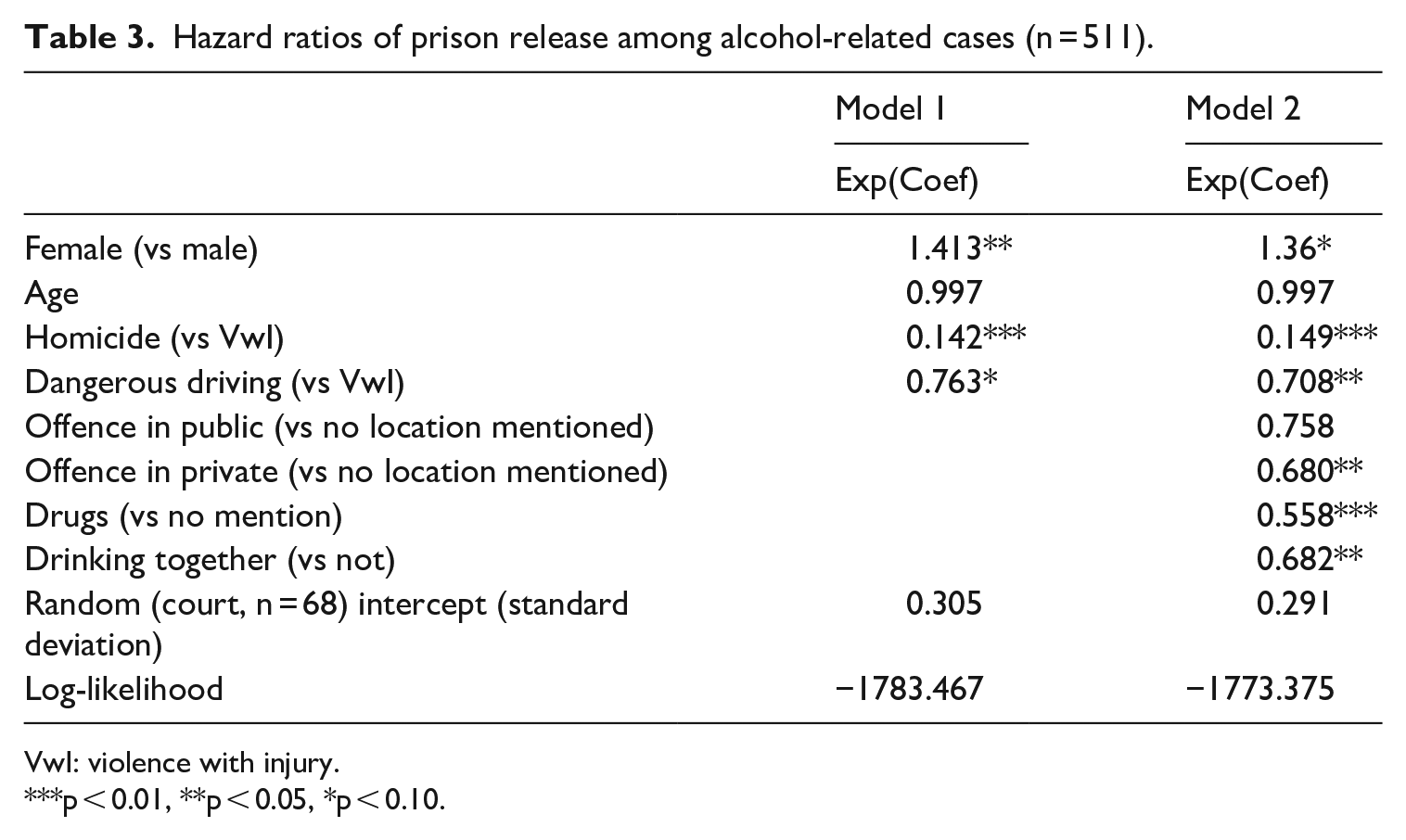
Hazard ratios of prison release among alcohol-related cases (n = 511).
VwI: violence with injury.
p < 0.01, **p < 0.05, *p < 0.10.
The initial model (Model 1, Table 3) identified females as receiving shorter sentences (HR = 1.41, p < 0.05), as in the models based on a more generic sample; however, age was no longer significant when focusing on alcohol-related offences. The fact that models using both the full sample and alcohol-related subsample yielded remarkably similar coefficients for age and gender suggests independent interrogation of the alcohol subsample is not biased in terms of these demographics. As in the analysis of all cases of violence, the strongest predictor of sentence severity is the offence type. However, what changed in the alcohol subsample (when compared with the full sample) is the extent to which the severity of the offence is perceived. Homicide offences are once again more likely than violence with injury (reference category) to receive longer sentences (HR = 0.142, p < 0.01). However, when compared with violence with injury offences, dangerous driving offences in the alcohol subsample are subject to much harsher treatment (HR = 0.76, p < 0.01) than in the full sample. These findings suggest that cases of dangerous driving involving alcohol are considered more serious, as we might expect given the additional criminal component of driving while intoxicated. The presence of alcohol thus not only aggravates the severity of the sentence, but also helps estimate differences between offence types more precisely.
In the second model (Model 2, Table 3), coefficients for the contextual factors were entered, improving the model’s goodness of fit as confirmed by a likelihood-ratio test (p < 0.001). Drugs being cited increased the likelihood of longer sentence by 44% (HR = 0.56, p < 0.01). Whether the defendant and victim had been drinking together was also associated with a 32% increase in the likelihood of a longer sentence (HR = 0.682, p < 0.05). A categorical variable indicating whether offence took place in a public or private setting (compared to a base category in which neither were remarked upon) was also added. Offences having occurred in public were not found significant; however, offences having occurred in private were increasing probability of a longer sentence by 32% (HR = 0.68, p < 0.05).
Discussion
This study responded to the need to explore how intoxication shapes sentencing practice (Dingwall and Koffman, 2008; Lightowlers, 2019; Lightowlers and Pina-Sánchez, 2017; Padfield, 2011). In combining content analysis of sentencing transcripts with further statistical interrogation, this mixed methods study harnessed the potential of online sentencing data to illuminate how contextual features associated with alcohol drinking impact sentence outcomes. Findings confirm that alcohol intoxication plays a role in shaping severity of punishment for violent offences. And that sentence outcomes are also contingent on the social context of the alcohol intoxication. That is, the presence of alcohol does not exert a uniform effect for all cases but varies depending on the context. Consequently, there remain potential challenges to ensuring consistency in sentencing practice if judges are interpreting contextual factors in different ways, and conceptual concerns about the framing of intoxication as problematic in different contexts. It is simplistic to assume that intoxication will always be applied as an aggravating factor and while they allow for a degree of discretion, the Sentencing Council may wish to provide further guidance to judges.
This study’s starting point was social-psychological, suggesting ‘the effects of drinking depend upon the alcohol consumed, the drinker and the setting in which consumption occurs’ (Plant et al., 2009: 207). As such, the way in which courts process alcohol-related cases represents an expression of when, and in which circumstances, alcohol intoxication and associated offending are deemed to be deviant and justify punishment. Our approach responds to concerns expressed by Quilter and McNamara (2018) about practical challenges and conceptual concerns associated with relying on ‘common knowledge’ about the effects of alcohol and illicit drugs in determining whether a defendant was ‘relevantly intoxicated’. In this study, the emphasis on social and physical settings in which offending and related alcohol intoxication occured, allowed us to explore how this sentencing factor is being interpreted and applied in practice. Namely, how punishment is currently used to express disapproval of intoxicated comportment. This is particularly important in the context of insufficient guidance as to how intoxication ought to aggravate and in which circumstances.
Recent studies in England and Wales, making use of survey data, have been restricted by a simple binary variable pertaining to the presence of either illicit drug and/or alcohol intoxication (Lightowlers, 2019; Lightowlers and Pina-Sánchez, 2017) that obscures nuances to which sentencers give regard in arriving at decisions, which has been demonstrated here. This study has overcome this limitation by exploiting sentencing decisions available online, with which to – first, separate out cases of alcohol intoxication from those featuring illicit drug intoxication and, second, allow for further detail concerning the drinking context, concomitant illicit drug use and location of the offence to be considered in the analysis.
This innovative approach using both supervised and unsupervised coding processes to make the most of the rich detail available in sentencing records for further quantitative analysis could also be used when exploring other sentencing factors that are not intended to be applied uniformly, such as remorse (Maslen, 2015a, 2015b; Weisman, 2016) and other mitigation (Belton, 2018) as well as previous convictions (Hester et al., 2018; Roberts and Pina-Sánchez, 2014; Roberts and Von Hirsch, 2010), among others. Especially, as the required level of detail has hitherto only been available through resource intensive court observations and transcript analysis. Indeed, there is broader scope to capitalise on new natural language processing methods in this regard as has been done in computational criminology – for example, for identifying hate incidents in social media data (Lightowlers et al., 2018) as well as more generally in identifying crime and alcohol consumption patterns using Big Data (e.g. Hilbig, 2018; Williams et al., 2017).
In line with expectations, homicides tended to attract the longest sentences and females were associated with shorter sentences than males. The mention of alcohol served to aggravate offences in line with the direction of the sentencing guidelines in operation in England and Wales and was, on occasion, explicitly referred to (e.g. ‘‘The aggravating features are you were drunk, you repeated attacked with your foot and you kicked him on the ground when he was unconscious’). Cases of dangerous driving involving reference to alcohol were seen as worthy of longer sentences than when compared to dangerous driving cases in general, according with increased severity of such offending. Among the subset of alcohol-related violent offences, further reference of concomitant illicit drug use or drug problems was also associated with longer sentences. This seems to accord with the fact that such drug use is not only illegal but likely attracts harsher judgement as a result.
Contextual case characteristics relating to the defendant and victim drinking alcohol together and offences having occurred in private settings aggravated sentences. If an offence was remarked upon as having occurred in public, it was not found to significantly impact sentence length. This seemingly contrasts with McNamara et al.’s (2017) finding that offender intoxication may be an aggravating factor where the crime in question takes the form of ‘random’ street violence. Without expressly naming public intoxication as an aggravating factor, courts have indicated that such cases give rise to a greater need for specific and general deterrence. (p. 183)
For example, when a judge remarked that the victim in an attack ‘was effectively an innocent bystander at the time of the attack which led to a wasteful loss of life of a student of promise,’ they went on to say, ‘it is a sad fact in society today that the incidences of violence are frequently fuelled by excess alcohol. It is a worrying feature for all strands of the public, no more so than for parents of students who go away from home to study’. However, the fact that the defendant and victim drinking together served to aggravate sentence outcomes resonates with another of McNamara et al.’s (2017) findings; namely, that ‘victim intoxication may be regarded as an aggravating factor where it increased her/his vulnerability, especially where there is evidence that the offender exploited this vulnerability’ (p. 184). Combined, the current findings seem to suggest that offences with characteristics akin to acquaintance or domestic/intimate partner violence or taking advantage of vulnerable victims were subject to more severe sentences (compared with those occurring in public which are more likely to comprise a larger proportion of stranger violence). It is perhaps the case that the guidance allowing for the location of an incident to be considered as an aggravating factor is in practice serving to aggravate offences occurring in private and/or domestic settings; where abuse of power may also feature (and aggravate).
7
This is illustrated in the following remarks: She was drinking at her co-defendant’s home with her [. . .] victim when she took part in the unprovoked attack. [. . .] The judge said: ‘This was a nasty example of bullying and humiliation of someone who was overwhelmed because he was intoxicated and outnumbered. It was a sustained and repeated assault of a vulnerable victim’.
And Neighbours said she was easy-going, kind, house-proud and lonely. [. . .] she wanted someone to talk to. She would invite anyone into her house for company. There lay her vulnerability and downfall. Children, such as you, [. . .] took advantage of her.
While a degree of latitude is beneficial to judges in considering how to apply mitigating and aggravating factors in determining sentences, there may be undesirable variation in its interpretation and application at arriving at sentencing decisions and further clarification as to how intoxication is envisaged being used would thus be beneficial. Potential undue variation is alluded to in the current study by the significant random effect of Crown Court location (with some courts appearing to impose harsher sentences than others after taking into account case characteristics). However, such variation does not show up in aggregate analysis when controlling for all aggravating and mitigating factors using nationally representative data (Lightowlers and Pina-Sánchez, 2017) and when differences between cases are much more precisely accounted for.
Our analysis highlighted the importance of considering sentencing practice as situated in the wider construction of alcohol-related crime as a problem. Findings allude to sentencing outcomes being shaped by moral and social norms about alcohol intoxication and violent offending, which seemingly interact with interpretations of the purpose of punishment and sentencing principles, for whom and in what contexts. After all, ‘intoxication is not merely unmediated “common sense,” but rather, a set of understandings that are validated and given “capital” by authoritative voices, including police, lawyers, magistrates, and judges’ (Quilter and McNamara, 2018: 195). And it is often the ‘wrong forms of drinking done by the wrong people and occurring in public places’ that are subject to most scrutiny (Yeomans, 2018: 22).
Study limitations
There are other important contextual and socio-demographic factors we would have liked to include. In some instances, these comprise further detail on measures employed, such as discerning between drinking levels, problem drinking and types of drinker, history of drug/alcohol use and drug type/class, as well as further breakdowns of the detailed contexts in which this or the offending occurred. In others, these are details not remarked upon by judges in a way that would yield reliable data – such as measures of ethnicity, class, sexuality, history of drug/alcohol use and mental health conditions and whether the defendant had dependent children, among others. Such additional variables could further refine our approach and findings in future studies. However, capturing such detail may be less likely in the near future, as judges have been advised to keep sentencing remarks brief (The Secret Barrister, 2020). Clearly, this is inopportune for gaining insight into why judges have passed particular sentences across a broader range of offence types and associated contextual factors.
This is a particular shame, given our study also highlights the need to examine specific sentencing practices in an offence-specific and, indeed, factor-specific manner to unpick further how these are being applied in specific contexts. Future work to ascertain how these are applied among specific populations to ascertain the need for further guidance addressing potential unwarranted disparities is encouraged. We also encourage further data collection on sentencing and the role of intoxication therein (including conditions attached to sentences) and transparent access to an open digital repository of court judgements, as advocated in Byrom’s (2019) Digital Justice report, to assist such research.
There are further limitations associated with our study. The sentencing process and expressed reasoning are shaped by preceding practices in criminal justice system before they arrive at court. These can include earlier decisions by the police and Crown Prosecution Service to arrest, charge and prosecute – which may be influenced by perceived harm and culpability associated with intoxication in which bias and discrimination can take effect. Furthermore, the Law Pages repository is not representative of the criminal cases seen in court in England and Wales, as it seems to over-represent more serious cases. Nevertheless, sentencing transcripts remain key data for the analysis of the way in which interpretations of intoxicated (criminal) behaviour are upheld and reinforced in society, namely the specific contexts in which alcohol intoxication is perceived to aggravate offending, hitherto unavailable in studies using survey data. Using these allowed us to move beyond merely ‘counting’ features of offences to examine specific interpretations of the role of alcohol drinking within offences and among those involved. There is scope to further interrogate these data qualitatively to explore the beliefs and norms at play underpinning reasoning offered by judges, and such work is encouraged.
There may be cases that involved alcohol intoxication either not captured by our search terms or that were not remarked upon by judges or those paraphrasing their comments for these records. As such, it may underestimate cases involving alcohol intoxication and any consequent associations identified in the statistical analysis. Indeed, the proportion of cases associated with violent offending determined to be ‘alcohol-related’ using our method (10.9%) is significantly lower than the proportion of violence that is estimated to be alcohol-related by the Crime Survey for England and Wales (CSEW) (which suggested perpetrators in 39% of violent crimes were reported by victims to have been under the influence of alcohol in 2017/2018; Office for National Statistics (ONS), 2019). Many less serious incidents not coming to the attention of the Crown Court are picked up using the CSEW, whereas our methodology captures more serious alcohol-related cases in which the ‘saliency’ of alcohol as a relevant case characteristic is likely higher – that is, where judges perceive it to be especially relevant. As a result, we may overestimate the aggravating effect of alcohol, but that is a question to be tested in future research.
Finally, the data do not allow for systematic identification of several other features which may have been useful to incorporate into our analyses (including those referred to previously). They are unable to identify whether court mandated alcohol treatment was required as part of the sentence and do not enable exploration of how ethnicity and socio-economic status might be interacting with case characteristics to shape sentence outcomes. Indeed, the possibility of omitted relevant variables bias is always present in non-experimental quantitative sentencing research (Anderson et al., 1999; Brantingham, 1985; Hofer et al., 1999; Pina-Sánchez and Linacre, 2013, 2014; Waldfogel, 1998).
Conclusion
In offering an exploration of how drinking and the social context impacts practitioners’ sentencing decisions, findings highlight the influence of contextual factors upon sentence length in cases of violence involving alcohol. This helps us understand how alcohol intoxication is understood in determining culpability and thus how it is shaping punishment in practice. Concomitant illicit drug use, the defendant drinking with the victim and the offence having occurred in a private setting all contribute to further aggravation associated with the alcohol intoxication. This offers insights into the frameworks and ‘lay knowledge’ (Quilter and McNamara, 2018) on which sentencers draw to justify their decisions and on which their perceptions of culpability and deviance are based.
It is not known the extent to which these practical interpretations accord with the Sentencing Council’s vision for how the aggravation of intoxication ought to be applied; 8 however, this research provides the first empirical analysis upon which the Sentencing Council could rely in order to provide such guidance. The role intoxication plays in offending behaviour is the subject of notoriously complex and contentious debates concerning blame and culpability in the eyes of the law (see Ashworth, 2015; Dingwall, 2006; Sinclair-House, 2018). There is, hence, scope for greater clarity in the sentencing guidance with respect to intoxication, and it is hoped that these findings can inform further policy debate and revisions to sentencing guidelines. For example, more explicit rationale not only as to when and in which circumstances intoxication is thought to (or should) aggravate offending but also why (i.e. the reasoning behind any such rationale).
The Sentencing Council may want to consider clarifying when to apply or in which circumstances intoxication is thought to aggravate offending, as divergent interpretations may result in disparity in the way in which intoxication is used to aggravate sentences – with the potential to undermine consistency of justice. This is no simple task, given that there ‘is no single characterisation that can account for [. . .] the divergent ways in which it [intoxication] impacts on criminal case adjudication’ (McNamara et al., 2017: 185). Such direction must also be balanced against the flexibility required by sentencers to be ‘responsive to the unequal situations and opportunities of those who come before them’ in an effort to introduce social justice to sentencing (Raynor, 2018: 339), as the lead author has also argued elsewhere in relation to gender and the sentencing of intoxicated violent offenders (Lightowlers, 2019).
Footnotes
Acknowledgements
We would like to offer a special thank you to Dimitrios Sferopoulos, who facilitated access to these data, and Professor Robin Room and Dr Cheneal Puljević for their valuable comments on an earlier draft. We would also like to thank the School of Law and Social Justice at the University of Liverpool who contributed financial support from their research development fund to getting this work underway.
Declaration of Conflicting Interests
The author(s) declared no potential conflicts of interest with respect to the research, authorship and/or publication of this article.
Funding
The author(s) received no financial support for the research, authorship and/or publication of this article.
