




Abstract
Sentencing studies have stressed the importance of looking beyond between-court sentencing disparities by also observing within-court sources of variation. In the current study, we examine court- and judge-level variation in aggravated driving under the influence sentences (N = 10,481) in Finnish district courts using a three-level regression approach. Results indicate that 6.4% of the variance in the decision to incarcerate are explained by the differences between judges and 4.3% by the differences between courts. Consequently, our results suggest that sentencing disparities cannot be attributed solely to differences between courts but also to the individual judges within those courts. In addition, certain extra-legal factors on all three levels are associated with the outcome, namely the mode of conviction, position of the judge, court’s driving under the influence caseload, crime rate of the court jurisdiction and the urbanization of the court jurisdiction. Implications of the findings for both future research and policies are discussed.
Introduction
While it is a major principle in most justice systems that similar cases are treated alike (e.g. Johnson, 2011), empirical research on consistency of sentencing has repeatedly reported disparities beyond legitimate variation in sentencing outcomes (see Ulmer, 2012). Particularly, research on between-court or between-area variation in sentencing has documented inconsistencies in sentencing that do not revert back to legitimate case characteristics. These types of disparities have been observed in multiple justice system contexts such as common law United States (Johnson et al., 2008) and England and Wales (Pina-Sánchez et al., 2019), civil law post-communist Czech Republic (Drápal, 2020) and Poland (Mamak et al., 2022) and Nordic Norway (Sandøy et al., 2023) and Finland (Malin and Tanskanen, 2022).
However, while between-court or between-area disparities in sentencing are relatively well documented as such, less is known about the source of these disparities. Research beyond court-level disparities has been called for to understand the more specific sources of the detected variation – one important centre of focus being on the role of judges (Brunton-Smith et al., 2020). Still, only a few studies have been able to simultaneously look into both the court-level variation and the role of judges in observed sentencing disparities, finding the disparities on the judge level sometimes even larger than on the court level (e.g. Johnson, 2006, 2014; Pina-Sánchez et al., 2019). However, these studies have been conducted in common law jurisdictions. In most legal contexts, such as in Finland and other Nordic countries, this type of research has been entirely lacking to date. These jurisdictions have some predominant differences that are expected to be reflected in the sentencing practices (see the ‘Legal context’ section). Understanding the mechanisms behind disparities in the Nordic civil law context would be crucial in terms of practice and policy, particularly considering that enhancing sentencing consistency is a legal principle in Finland.
Research on sentencing disparities often separates legal and extra-legal factors connected to sentence outcomes. Legal factors are the ones that, according to the law, should be taken into account when deciding the punishment. In turn, extra-legal factors come outside legislation and should not be considered as part of the sentencing. Studies examining sentencing disparities should be able to take into account the legal factors to draw conclusions on extra-legal disparities (Pina-Sánchez and Grech, 2018). Indeed, observed variation in sentencing could in fact result from variation in legal factors, in which case the variation is likely to be legitimate and justifiable. Extra-legal factors, on the other hand, can be defined on multiple levels of observation. While court- and judge-level variation may be considered extra-legal as such (if all legal factors are controller for), other possible sources of illegitimate variation in sentencing could relate to extra-legal case characteristics as well as judge or court characteristics. On the judge level, the extra-legal factors considered in prior studies have been, for example, the experience and the sex of the judge (e.g. Johnson, 2014). On the court level, studies have found disparities in sentencing outcomes related to the court caseload and size of the court (e.g. Ulmer and Johnson, 2004). The current study expands on previous research by looking into the role of both court- and judge-level factors in the Finnish context.
Recent studies have highlighted the importance of analysing different crime types separately rather than combining them in the same analysis, as has traditionally been done when studying sentencing disparities (Crow and Goulette, 2022). Following this recommendation, our examination focuses on driving under the influence (DUI) sentences – similar to several prior studies on sentencing disparities (Brå, 2017; Goodall and Durrant, 2013; Kääriäinen et al., 2022). In the Finnish context, examining DUI sentences has been motivated by the fact that it is a relatively explicit crime type to judge (Kääriäinen et al., 2022). In legal practice, only a few factors should be considered in the judge’s decision-making (see the section titled ‘Legal context’). One key question for judges in sentencing for aggravated DUI (ADUI) is whether the offender will be incarcerated or not (Lappi-Seppälä and Ojala, 2022).
The present study focuses on sentencing disparities in the incarceration of ADUI offenders in Finnish district courts. We use the term incarceration to refer to unconditional imprisonment, as in the Finnish context, conditional imprisonment (or suspended sentence) is also widely used. Our data include information on both the courts where the sentence was given and the judges who gave the sentence. This allows us to study disparities on judge and court levels. We also have information on the essential legal factors that, on the case level, should be related to sentence severity. In our analysis, we examine the court- and judge-level sentencing disparities while controlling for these legal factors. In addition, we examine and control for central extra-legal factors, as suggested by prior research, on all the three levels of our analysis.
Sentencing disparities on the court and judge levels in prior studies
Studies focusing on regional sentencing disparities, either on the court level or on the judge level, have often relied on the ‘courts as communities’ perspective by Eisenstein et al. (1988). The authors developed the perspective as part of their empirical studies on between-court disparities, as its name suggests, to describe courts functioning metaphorically as communities. Based on the work of Eisenstein et al. (1988), Hester (2017) discussed courts as communities that are affected by the organizational contexts of the court, outside environmental characteristics and the individual actors working in the courts. In the current article, we empirically assess whether these dimensions are connected to sentence outcomes in Finland. Already at this point, it is necessary to note that the majority of the most relevant prior studies come from jurisdictions that differ greatly from our context. Furthermore, different organizational contexts call for different emphases on research, noting, for example, the roles of guidelines departures (e.g. Johnson, 2005) or the role of mode of conviction (see Johnson, 2014). Next, we introduce previous research focusing on themes that are relevant to our research context and design, starting with research from common law jurisdictions.
Some prior studies have found substantial between-court variation in sentences (e.g. Johnson et al., 2008). When examining the extra-legal factors connected to this variation, two often-used court-level variables have been the court’s caseload pressure and size. Higher caseload pressure is positively associated with more lenient punishments (Hester and Sevigny, 2016; Pina-Sánchez and Grech, 2018; Ulmer and Johnson, 2004). One possible explanation for this finding is that, in a rush, it is more efficient to opt for less severe sentencing decisions that may require less justification. Court size has often been measured with the number of judges in the court, and studies have documented more lenient sentences, or less incarceration, within larger courts (e.g. Ulmer and Johnson, 2004). As for environmental or contextual characteristics of the court or area, studies have reported associations of the sentencing outcomes with, for example, crime rate and ethnic composition of the area (Johnson et al., 2008).
The role of individual judges on sentencing disparities has often been hard to locate, as information sources where the data have been gathered do not typically include judge identifiers (Pina-Sánchez et al., 2019). Some studies have adapted new analytical tools to capture within-court differences. For example, Brunton-Smith et al. (2020) used a location-scale model to examine the range of sentences within courts in England and Wales, and their findings pointed towards substantial between-court differences in the within-court variability. When the data allowing for identification of individual judges have been available, several studies have even gone beyond merely assessing the between-judge variability by examining the associations between judge characteristics and sentencing outcomes (e.g. Johnson, 2006, 2014). Several studies have emphasized the role of the judge’s experience, and the results have often showed that more experienced judges are more likely to give severe sentences (Johnson, 2014; Pina-Sánchez et al., 2019) or impose more prison sentences (Drápal and Pina-Sánchez, 2023).
In the civil law context, there has been significantly less research on variability in sentencing outcomes and its sources. There is evidence of between-judge sentencing disparities from, for example, Czechia (Drápal and Pina-Sánchez, 2023), but analyses taking into account both the court and judge levels are lacking completely. In the Nordic context, most research to date concerns experimental approaches to between-judge differences in decision-making. The results from a vignette survey directed at Finnish district judges showed that the choice between conditional and unconditional imprisonment varied largely between judges (Kääriäinen, 2018). Conversely, a Swedish vignette study found large consistency between judges and courts but suffered from a low response rate, which, according to the authors, might affect the results (Brå, 2021). Some Nordic studies, on the other hand, have assessed and taken advantage of between-judge variability in sentencing to use it as an instrument for some other variable. A Norwegian study on recidivism used an instrumental variable approach to estimate the effect of incarceration on recidivism, as they found judges to have different incarceration rates (Bhuller et al., 2020). Similarly, a Finnish study has found differences in judge stringency that were employed to examine the impact of different punishments on criminal and labour market outcomes (Kaila, 2023). As for research on the role of judge characteristics in sentencing disparities in the Nordic context, existing studies are close to non-existent. However, an empirical study from Iceland found a connection between judges’ age and sentence outcome in civil cases: older judges were more likely to find in favour of the defendant (Sólnes et al., 2022).
Overall, there have been only a few studies examining between-court and between-judge disparities at the same time (Pina-Sánchez et al., 2019). Moreover, studies that have taken into account contextual factors related to the area and/or judge level mostly come from the United States or United Kingdom. Even though comparisons between different jurisdictions are difficult, scholars have called for analyses from different jurisdictions to strengthen the reliability of the prior findings (Pina-Sánchez et al., 2019). Moreover, prior between-court studies have been criticized for not adequately controlling for the offence seriousness (see Pina-Sánchez and Grech, 2018). Specifically, these issues should be addressed in research, as dismissing them might lead to overestimating sentencing disparities. On the other hand, Brunton-Smith et al. (2020) noted that not taking the within-court sources of variability into account might lead to underestimation of disparities. Our study considers all this criticism directed at previous research, and by doing so, fills in several critical gaps in the field.
The current study
The main goal of the current study is to assess sentencing disparities in Finnish district courts by taking into account variation between courts and judges within courts. As for the particular crime type, the current study uses data of sentences for ADUI offences. The rationale for choosing this offence type relates to its commonness in addition to the relatively explicit informal sentencing guidelines, introduced in the next section, that facilitate accounting for legitimate variation in sentencing and help to detect unwarranted disparities. Specifically, we study consistency of sentencing by using incarceration as our outcome of interest. By using data that allow for identifying (a) the court where the sentence has been given and (b) the judge that has given the sentence, our study looks into both between-court and between-judge variations in sentencing. The empirical examination builds on the courts as communities framework, which highlights the role of courtroom actors and their social environments to sentencing practices (Eisenstein et al., 1988). In particular, our research questions are formulated as follows:
Can between-court and/or between-judge variation in ADUI convictions be observed in our data set after controlling the most relevant legal factors?
Do extra-legal factors on case-, judge- and court-level contribute to sentencing?
Legal context
The Finnish legal context differs from more extensively studied common law countries in some crucial ways. One of the most fundamental differences lies in the core principles of sentencing rationales: Tonry (2016) argues that despite the widespread use of sentencing guidelines, the US legal context lacks the value of equality, whereas in Finland, sentencing consistency is explicitly recorded in criminal law. 1 Conversely, the Finnish context lacks sentencing guidelines, and studies from non-guidelines jurisdictions have been called for (Hester, 2017). Finnish judges primarily enhance consistency by following case law and courts have themselves produced informal guidelines based on legal practice. Regarding DUI offences, these informal guidelines describe the length of the penalty in relation to the blood alcohol content (BAC) of the offender in typical cases. As for the main focus of the current study, the decision between conditional and unconditional imprisonment, there are different legislative recommendations but not regarding DUI offences in particular (Helsinki Court of Appeal, 2007). Despite these informal guidelines, Finnish judges exercise great independence, with the system emphasizing the assessment of each case on its own, considering all the circumstances.
Finnish judges are career judges. After studying law at the university for approximately 5 years, individuals may apply for judge training, which includes a 1-year training period in court work. During this training, trainees, titled as district notaries, are authorized to issue certain judgements, including for DUI offences. Our analysis will explore the role of judge position. In addition, there is evidence that sentencing habits differ between career judges and elected judges (Lim, 2013). A central factor behind this difference might be that elected judges are more influenced by ‘county-level politics and local community attitudes’ (Hester, 2017: 229). In other words, courts as communities framework may apply more strongly in contexts where judges are elected, such as in many parts of the United States. This underscores the theoretical importance of examining the connection between the environmental factors of the court and sentencing in civil law context.
The focus of the current study is on the decision to incarcerate ADUI offenders. To reliably examine the determination of the punishment, we need to consider some relevant legal aspects, starting with the legal definition of DUI. The Criminal Code of Finland grades many offences into different categories based on the seriousness of the offence. DUI is divided into two categories: standard DUI and ADUI (Criminal Code of Finland 39/1889, chapter 23, sections 3 and 4). A person is guilty of DUI when operating a motor vehicle when their BAC is at least 0.5 per mille and of ADUI when their BAC is at least 1.2 per mille. 2 In ADUI, the circumstances of the act should be such that the crime is likely to endanger the safety of another person. In ADUI, the penalty scale ranges from 60 day-fines to imprisonment for 2 years. However, in practice, the penalty is in most cases imprisonment – 98% in the year 2017 (from which 76% were conditional 3 and 22% unconditional 4 ; Statistics Finland, 2023d). Thus, a key question in court is often whether the imprisonment should be imposed as conditional or unconditional.
In the Finnish context, the court first considers whether the imprisonment is conditional or unconditional and, only after this choice, if some alternatives for unconditional imprisonment might be suitable for the case. Instead of unconditional imprisonment, the offender may be convicted to community service or a monitoring sentence (Criminal Code, chapter 6, sections 11 and 11a). Imposing these alternative community sanctions is often based on offender characteristics and thus creates a challenge for the examination of sentencing disparities. Community sanctions are not applied similarly for similar crimes. Factors preventing the usage of community sanctions are, for example, a substance abuse problem or homelessness – aspects we could not explicitly account for in our analysis. Our outcome variable will thus include all cases where the offender was sentenced to unconditional imprisonment even if a community sanction was later applied as an alternative (see the ‘Data’ section). In the Criminal Code (chapter 6, section 9), three factors are listed as possible requirements for unconditional imprisonment. These are: the seriousness of the offence, the guilt of the offender as manifested in the offence and the criminal history of the offender. Also, sentencing offenders younger than 18 years to unconditional imprisonment would require heavy reasons.
In DUI crimes, if the offence is conducive to causing danger to others, the offender is also convicted for endangering traffic safety (Criminal Code of Finland 39/1889, chapter 23, sections 1 and 2). In our study, this allows us to control for the seriousness of the offence. As more severe acts are also convicted as endangering traffic safety, judgements with only one convicted offence largely depend on the prior criminal record of the offender. In the Finnish legislation, it is not strictly defined how the offender’s prior crimes should affect the sentence. However, some rules of thumb are generally followed. If the offender has been convicted to conditional imprisonment in recent years, the second imprisonment may still be conditional. Primarily, the third imprisonment should be unconditional. However, the application of this ‘rule’ is largely dependent on the time that has passed since the last convictions and also the types of offences (have they been similar or not; Helsinki Court of Appeal, 2007).
Current study focuses on district court judgements. In Finnish legal system, district courts are first instance courts that handle all the criminal matters except the few most lenient ones, which can be fined by the police or the prosecutor. In courts, most of the more severe criminal offences are convicted in trial, but less severe ones such as traffic offences are often convicted in written procedure 5 (Criminal Procedure Act (689/1997), chapter 5a). In our study, we will also examine the mode of conviction, although we will focus on a different aspect compared to the United States, where the mode of conviction is used to distinguish between trials and guilty pleas (e.g. Johnson, 2014). In written procedure, the judge rules on the case without an oral hearing. In trials, the composition of the court may vary. The most common composition is one judge, but in some cases, there may be a judge and two lay judges or three judges. Information on the composition of the judges was not available for our data, but prior statistics generally point to only around 5% of ADUI judgements that have been given by some composition other than one judge only (Statistics Finland, 2023a).
Data
The data set used in our analysis is based on data on all convictions given in Finnish district courts between May 2013 and April 2017 where the most serious offence was ADUI. The data also cover offenders’ criminal history 5 years prior to the ADUI sentence. The data are collected from the database maintained by the Institute of Criminology and Legal Policy. The database consists of all the full-text decisions given in courts and some numerical variables from these judgements. Most of the basic information, such as the offender’s criminal history, convicted punishment and court information, is included in the database in numerical form. However, information on the decision-maker and more specific information about the offence are only available in textual form. In our case, the BAC of the offender needed to be collected from the full-text decisions. Specifically, a uniform mass of text was formed from the files, from which specific strings were searched using R. To do this adequately, the data were restricted to alcohol-related cases. In other words, cases involving other substances were excluded. 6 For the sake of comparability and consistency, the data were limited to convictions that included only one DUI offence (N = 20,154) in the same judgement document.
For the main analysis, we restricted the data set to cases where the ADUI offence was the offender’s only convicted offence (N = 10,484). This was done to allow for the comparability between the cases and to control for the severity of the offence. There were 27 district courts in Finland during the timeframe from which the data were retrieved. After removing cases with missing information and one court with only one conviction, the final data set consisted of 10,481 cases in 26 courts.
Identification of individual judges was based on the name of the judge given in the judgement documents automatically collected from the database. The names were manually checked, and some obvious typing errors were corrected. Overall, 731 individual names occurred in the data. Some of the names appeared in several courts; specifically, 60 names appeared in two courts and 2 names in three courts. Our analysis treats judges in different courts as different individuals, which is the most justifiable strategy when we cannot be sure whether these cases concern the same individual or a different individual with the same name. Thus, our judge-level analysis includes 795 different judges. The most likely explanations for the appearance of judges in different courts are fixed-term employments and job changes in the early stages of careers. We will run a sensitivity analysis to consider the effect of this on the results.
Outcome variable
The outcome variable in the analysis was a dichotomous variable indicating whether the offender was convicted to incarceration (1) or to another sanction (0). Despite some limitations (see e.g. Pina-Sánchez and Gosling, 2020), this outcome is common in sentencing studies. In the context of the current study, choosing this outcome was justified to (a) minimize the need to limit the data and (b) reliably compare the severity of the punishment in relation to the offence. Using another outcome, such as the length of the sentence, would be difficult because unconditional and conditional imprisonments are not comparable in that sense. Furthermore, in most cases of our data where conditional imprisonment was imposed, an additional fine was also sentenced to the offender. The amount of these fines varies and would be hard to take into account together with the length of the imprisonment in the current analytic strategy. As mentioned in the previous section, addressing the choice of community sanctions reliably would require more information on offender than we have. Thus, we adjusted our outcome variable, incarceration (1), to include all cases where the court first decided that unconditional imprisonment is a sufficient sanction, even if a community sanction was later applied as an alternative.
Independent variables
Case-level variables
To examine illegitimate sentencing disparities, it is crucial to control for the legal case characteristics that legitimately affect the sentence (see Pina-Sánchez and Grech, 2018). One of the most crucial factors in assessing the seriousness of the ADUI offence is the BAC of the offender, which, in a standard DUI, is the most notable predictor of the punishment (Kääriäinen et al., 2019).
In the Finnish legal context, the offender’s criminal history has a significant role in determining the possible incarceration. We aimed at taking into account the most relevant factors in the offender’s criminal history for the given sanction. Drawing from the legal praxis, we included three criminal history variables into our analysis: prior conditional sentences, prior unconditional sentences and prior DUI sentences. All these variables were dichotomous and indicated whether the offender had any record of such sanctions from 5 years prior to the current sentence. Our theoretical framework emphasizes that, in addition to case-related factors, offender-related factors may also influence legal decision-making. Prior findings have suggested that female and older offenders are less likely to be incarcerated (Johnson, 2006, 2014). Therefore, we included variables indicating the offender’s sex and age at the time of the trial.
As prior research from other contexts points to the relevance of the mode of conviction to the sentencing outcome (e.g. Johnson, 2014; Ulmer et al., 2010), we use the mode of conviction variable to separate trials and written procedures. In the Finnish context, even though the usage of written procedure expects the offender to confess the crime, it has not been legislatively considered similar to plea bargaining in the sense that the offender would be entitled to a penalty reduction. On the case level, we also controlled for the year when the sentence was given.
Judge-level variables
Courts as communities theory underlines the role of judge characteristics, with one often-studied aspect being the sex of the judge. Findings on the relationship between a judge’s gender and sentencing have been mixed: several studies have not found a connection (Johnson, 2006; Pina-Sánchez et al., 2019) while Johnson (2014) found that, in trials, female judges were less likely to incarcerate offenders. Theoretically, it has been argued that female judges are more sensitive and liberal, which leads to less severe sanctions compared to male judges (Johnson, 2006). Thus, we aimed to address the role of judge’s gender also in our examination. Our variable was manually coded based on the first name of the judge. Prior studies have emphasized the role of the judge’s experience, often finding more experienced judges imposing more prison sentences (e.g. Drápal and Pina-Sánchez, 2023; Johnson, 2014). We used the position of the judge as an indicator of the experience of the judge in three classes: district notaries (judicial trainees), district judges and chief judges (chiefs of the district courts).
Court-level variables
We collected court-level variables from annual court statistics (Ahola et al., 2014, 2015, 2016, 2017, 2018) and from Statistics Finland (2023a, 2023c). Theoretically, size is a highly relevant factor for court communities as it reflects several aspects of the court’s social environment: larger court communities may, for example, be less influenced by local politics (Eisenstein et al., 1988) and more tolerant of crime (Ulmer and Johnson, 2004). Consequently, studies have used the number of judges working in a court as a proxy for its size and found that smaller courts tend to give more severe sentences (e.g. Johnson, 2006). The Finnish annual court statistics do not report the number of judges working in courts, but they provide even more precise information on actualized full-time equivalent (FTE). FTE describes the annual labour input of a person converted to a full-time employee 7 (Statistics Finland, 2023b). We used judge FTE to describe the size of the court as it describes the labour input of the judges.
In addition, we included a variable measuring the caseload pressure of the court, which measures the number of judgements given in trials per judge. It has been found that courts with heavier caseloads give more lenient sentences – perhaps due to time constraints and the need for expedited case processing (Johnson, 2006). Besides the number of cases judges hear, the types of cases may also influence decision-making (Johnson, 2006). Therefore, we also wanted to separate the DUI caseload, which represents the total number of DUI judgements given in each court based on the information from the courts’ work statistics.
In addition, we included a variable describing the proportion of people living in cities in the court’s area. The courts as communities framework indicates that in cities, sentences would be more lenient compared to rural areas, as urban areas might exhibit greater tolerance towards crime (Eisenstein et al., 1988). Finally, we included a variable on the crime rate of the court, referring to the number of criminal cases arrived in each court in relation to the population size of each court’s jurisdiction (per 100,000 inhabitants). The theoretical rationale for controlling the crime rate relates to the fact that crimes affect perceptions and attitudes towards crime (Hester and Sevigny, 2016) which is somewhat similar to court urbanization. Indeed, it is worth noting that several court predictors seem to be theoretically associated with each other; Johnson (2006) even had to remove crime rate from his analysis due to problematic correlations among contextual predictors. We will address the multicollinearity of our control variables shortly in the next section.
Method
Our data have a hierarchical structure, as illustrated in Figure 1, that we needed to account for in our analysis. Consequently, our analysis employed a mixed-effects modelling approach that allows for both fixed and random effects to be incorporated into the same model (e.g. Bates, 2010). These types of models are also referred to as multilevel models, as they can be used to account for a hierarchal structure of the data (e.g. Gelman and Hill, 2006) and they have been frequently used in studies on consistency of sentencing (e.g. Johnson, 2006; Malin and Tanskanen, 2022; Pina-Sánchez et al., 2019).
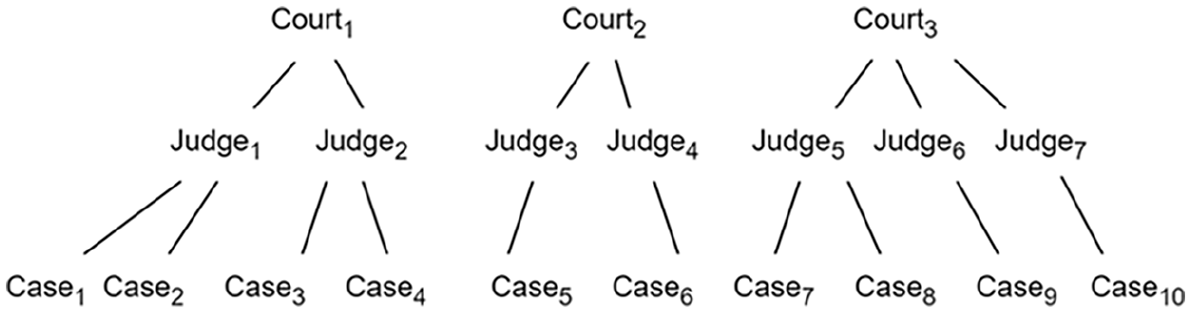
The hierarchical structure of the data.
Specifically, the current study takes a three-level random intercept approach (e.g. Goldstein, 2011), which is a logistic model, due to the binary nature of the outcome variable, where intercepts are allowed to vary on court and judge levels. Each court is allowed to have its own intercept, and each judge is allowed to have their own intercept relative to the court. The intercepts thus account for and allow for examination on the variation in sentencing between courts and judges within courts. This type of strategy is taken to adequately assess the role of both court- and judge-level variation in convictions of incarceration for ADUI, while also simultaneously assessing the role of various case-, judge- and court-level factors (fixed effects).
In addition, we calculated the intracluster correlation coefficients (ICCs) for both the court and judge levels by dividing the random effect variances by the total variances; this was implemented with the ‘icc’ function of the ‘performance’ package in R (Lüdecke et al., 2021) that defines the distribution-specific variance of a logit model as π 2 /3 (e.g. Lüdecke et al., 2019; Nakagawa et al., 2017). The ICCs were used to assess and compare the role of variation on the two levels while controlling for the variables included in the model as fixed effects. We also examined the multicollinearity using a variance inflation factor and detected no multicollinearity issues as the highest value was 3.32.
All analyses have been conducted with RStudio (v 4.2.1). The main packages used were the lm4 package (e.g. Bates et al., 2015) for the multilevel modelling and the performance package (e.g. Lüdecke et al., 2021) for calculating the ICC.
Results
Descriptive results
The descriptive statistics for all the variables used in the analysis are presented in Table 1 on case, judge and court levels. Importantly, 11% of the cases led to incarceration sentences. As for the structure of the data in terms of its levels, the number of cases per judge varied from 1 to 157, and the number of cases per court varied from 127 to 893. The number of judges per court varied from 11 to 91.
Descriptive statistics for the case, judge and court levels.
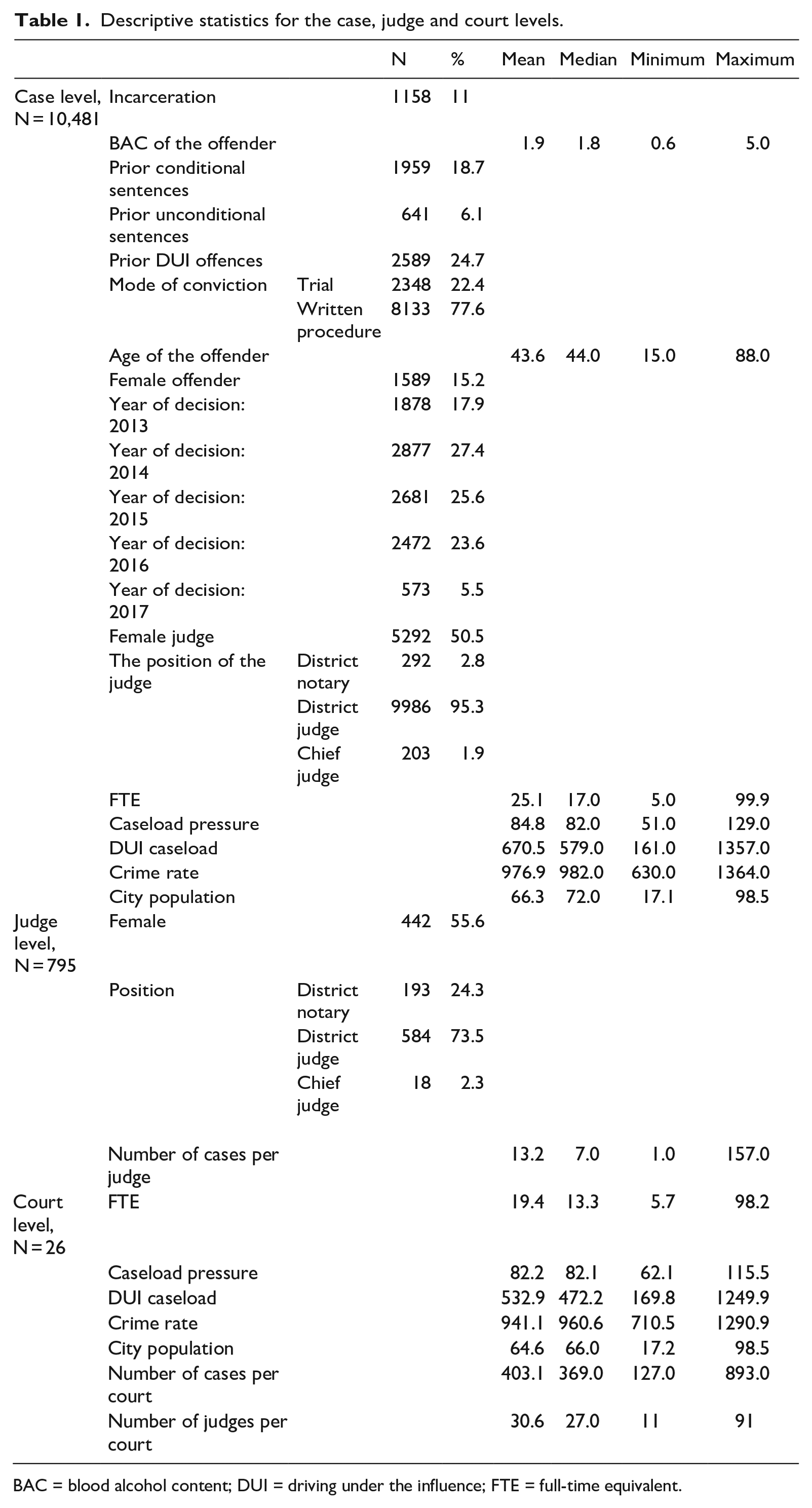
BAC = blood alcohol content; DUI = driving under the influence; FTE = full-time equivalent.
The proportions of incarceration sentences convicted in courts (from all the convictions in the data) are presented in Figure 2. Each percentage describes each court. The figure also includes information on the total number of ADUI convictions given in each of the courts. The proportion of incarceration for ADUI convictions varies notably by court, from 4% to 16%.
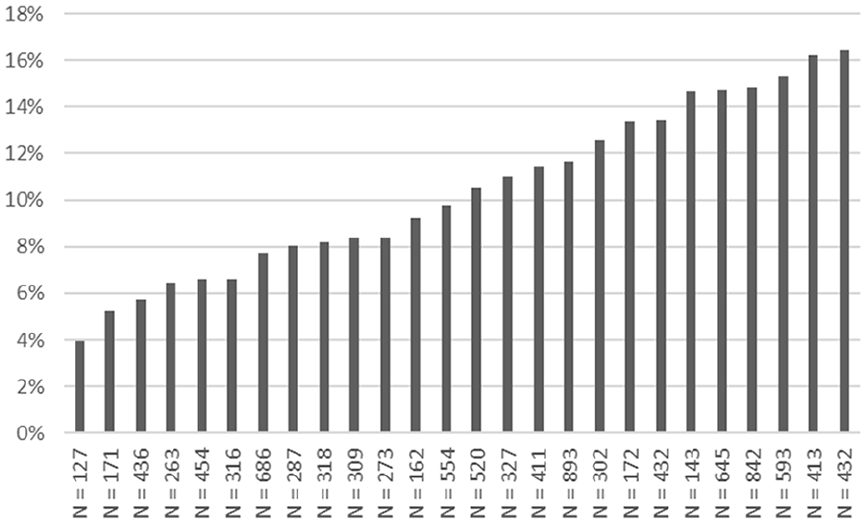
Proportions of incarceration in aggravated driving under the influence convictions in Finnish district courts (N = 10,481).
Multilevel regression analysis
First, we conducted a multilevel regression analysis including only case-level legal variables (offender’s BAC and criminal history) to assess the magnitude of the judge- and court-level variances when none of the extra-legal factors are taken into account. The results of this analysis are presented in Table 3 (Appendix 1). The ICCs indicate that 6.2% of the variance in the decision to incarcerate are explained by the differences between judges, and 8.3% by the differences between courts.
The results of the multilevel regression analysis including both legal variables and extra-legal factors are presented in Table 2. The legal case-level explanatory variables – the offender’s BAC and all of the criminal history variables – were, as expected, positively associated with the decision to incarcerate. These legal factors also have the strongest effect sizes. In addition, the fact that the conviction was handed down in trial had a positive association with incarceration. On the judge level, judges’ positions were associated with incarceration; specifically, district judges were more likely to decide to incarcerate compared to less experienced notaries. On the court level, the DUI caseload was positively associated with incarceration, and the crime rate and the proportion of the city population were negatively associated with incarceration.
Multilevel logistic regression model estimates on the decision to incarcerate (N = 10,481).
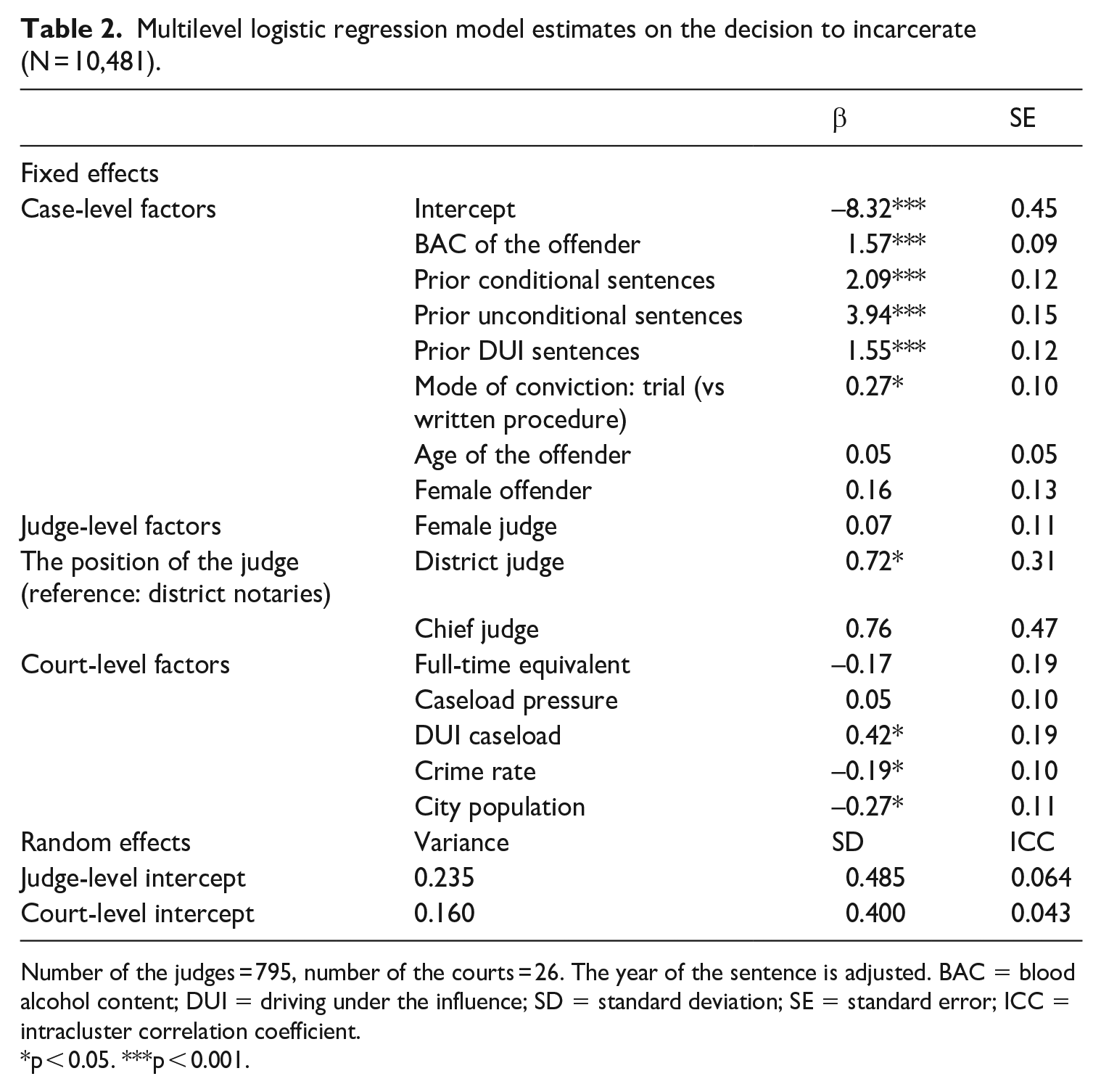
Number of the judges = 795, number of the courts = 26. The year of the sentence is adjusted. BAC = blood alcohol content; DUI = driving under the influence; SD = standard deviation; SE = standard error; ICC = intracluster correlation coefficient.
p < 0.05. ***p < 0.001.
According to the ICCs, 6.4% of the variance in the decision to incarcerate are explained by the differences between judges, and 4.3% by the differences between courts. When comparing these results to the model including only case-level legal factors (see Appendix 1), we observe that the ICC for judges remains roughly consistent, while the ICC for courts decreases after introducing the extra-legal variables. This is expected, as the full model includes more court-level than judge-level factors and thus seems to better capture the court-level variance.
Moreover, we conducted several additional analyses to validate our results. Descriptions of these analyses and their results can be found in Appendix 2. The findings from all these analyses were largely consistent with our main results.
Discussion
The current study provides novel information on sentencing in both the Finnish legal context and in a larger framework of sentencing research. In the Finnish context, earlier studies have indicated court-level variation in sentencing practices related to DUI (Kääriäinen et al., 2022) and child sexual abuse (Malin and Tanskanen, 2022) offences but have not provided more evidence on the backgrounds of the variation. The results from the current analysis show that 4.3% of the variance in the incarceration of ADUI offenders are explained by the differences between courts and 6.4% of the variance by the differences between judges even after controlling for multiple relevant legal and extra-legal factors. Thus, the results show the between-judge variation to have a more substantial impact on decisions on incarceration than between-court variation – prior Finnish research on sentencing disparities addresses only the latter. Our results suggest that sentencing disparities cannot be attributed solely to differences between courts but also to the individual judges within those courts.
Findings revealing more variation on judge- than court-level are in line with prior studies (Johnson, 2006; Pina-Sánchez et al., 2019). The magnitude of the ICCs is similar to findings by Johnson (2006) who considered them to be substantial. Given especially that our analysis fairly reliably controls for the offence severity by both restricting the sample and adjusting for observed variables, the magnitude of court- and judge-level variance may even be considered surprisingly large. Furthermore, the findings on more disparities originating at the judge- than court-level might reflect the independent role of judge, highlighted in Finnish legal principles. Some prior studies have identified judge rotation as an essential factor in reducing disparities between courts (Hester, 2017; Pina-Sánchez et al., 2019). In fact, our data set included judges who had worked in multiple courts, likely due to the initial phase of their careers, during which judges often have fixed-term employments. However, while investigating the impact of this practice on sentencing disparities in Finland would be relevant, it would necessitate a larger data set, as judges with experience across multiple courts constituted only a small minority in our sample.
Importantly, the results reveal that certain extra-legal factors are associated with the decision to incarcerate individuals on all three levels: case, judge and court. On the case level, the legally relevant case characteristics were associated with incarceration, as expected. Prior unconditional and conditional sentences had the strongest effect sizes, even compared to the BAC of the offender. This confirms our expectations that when considering incarceration, judges give a lot of weight to offender’s criminal history. Cases handled in trials seemed to be associated with the decision to incarcerate. Prior research from the United States has suggested that judges could reward plea bargaining offenders for making the procedure more efficient with less severe sanctions (e.g. Ulmer et al., 2010). In our research setting, a more plausible explanation for our results is that offenders who are more likely to receive a prison sentence either do not accept the written procedure or cannot be reached by authorities when their permission for written procedure is needed. This might lead to selection bias, even though our analysis does control for some relevant factors that could drive this selection (e.g. offender’s criminal history). Furthermore, on the judge level, our results imply that the position of the judge is associated with the incarceration decision, which is in line with prior research proposing the experience of the judge to be associated with more severe sentencing outcome (e.g. Drápal and Pina-Sánchez, 2023; Johnson, 2014; Pina-Sánchez et al., 2019). However, our finding should be interpreted with caution, as the additional analyses did not entirely support the robustness of the association, and the title we used is only rather loose proxy of the experience. Clearly, more research on the effect of the judge’s experience to the sentencing outcomes, preferably with more precise variables, is needed in the Finnish legal context.
On the court level, the number of DUI judgements given in court was positively associated with incarceration, whereas the crime rate and the proportion of the city population were negatively associated with the outcome. The courts as communities perspective highlights the role of the court’s size and urbanity. Research from that framework has suggested that sentences would be less severe in large urban courts (Eisenstein et al., 1988; see also Ulmer and Johnson, 2004) because, in cities, people tend to be more tolerant towards crime. Furthermore, the theoretical rationale behind the association of crime rate to sentences is similar. Our results are consistent with these notions, although the exact mechanisms behind our results are unclear. On the other hand, Fearn (2005) found that population density was no longer associated with incarceration when controlling for a large set of community-level variables. In our case as well, it is possible that the city population acts as an indicator of some other feature of the area that we were not able to include in our analysis.
Some of the differences in our results compared to previous studies could be attributed to organizational differences. It has been argued that elected judges would be more prone to the environmental factors (e.g. Hester, 2017). Courts as communities perspective suggests that court’s size is related to the level of influence the court has from local politics (Eisenstein et al., 1988), potentially explaining why studies in the United States have found size significant (see e.g. Johnson, 2006), whereas our study did not. Moreover, the election system may exert stronger pressure on judges, so similar mechanisms might explain our results regarding court’s caseload pressure differing from some findings in the United States (Ulmer and Johnson, 2004). Regarding our other non-significant results, the role of gender, both of the offender and the judge, in sentencing has been rationalized with gender roles and stereotypes, although previous results on gender’s role have been mixed as well (e.g. Johnson, 2006). Nevertheless, it could be argued that these roles vary between societies or even over time (Kruttschnitt and Savolainen, 2009). Similarly to our findings, an Icelandic study did not find judge’s gender to be relevant for sentence outcomes (Sólnes et al., 2022).
While our study provides novel findings on sentencing disparities and examines variation in sentencing from a significantly more comprehensive point of view than the majority of prior research, our examination is far from all-encompassing. Most importantly, our examination focused only on one offence type, and the generalizability of the results to other offences can be challenged. We justified our choice of offence type by arguing that it allows us the most reliable way to analyse disparities. Furthermore, as argued by Drápal (2020: 155–157), there should be even greater consistency in handling common offences, given that judges encounter them frequently. Yet, there is need to conduct analyses on other offence types as well. This would require data allowing us to control for legal factors, something that is currently not available in our legal context. Collecting such data will remain a goal for future studies.
Furthermore, although sentences for ADUI offences should relatively directly depend on the legal variables (BAC, criminal history measures) that our analysis accounted for, it is still possible that there are sources of legitimate variation that we were not able to control for and that could, to some extent, explain the detected variation on the court and judge levels. In addition, it is possible that unobserved legal factors bias the estimates for the extra-legal variables used in our models, as some variables within the models may be correlated with some unobserved legal factors. One potential unobserved legal confounder could be the time since the offender’s previous conviction, which we were not able to fully control for in the analysis. On the other hand, it should be noted that the possible unobserved confounding also has some advantages – indeed, given that the potential unobserved legal factors correlate with some of the variables within the model, the observed variables indirectly also control to some extent the unobserved legal variation. In addition to potential sources of legitimate variation, there are other potential sources of sentencing disparities that we were not able to examine in the current analysis. For instance, the courts as communities perspective and prior studies (see e.g. Kim et al., 2015) suggest that other legal actors besides judges, such as prosecutors, should be examined as they could also play an essential role in determining the sentencing outcome. Further research on sentencing disparities should thus address not only judges but also other relevant actors.
Overall, the results of the current study imply that individuals who commit similar offences may receive drastically different punishments, which goes against the core principles of most justice systems. Even though the courts as communities perspective was developed in the United States, it appears to function to some extent within the Finnish legal context as well. As our findings point towards sentencing disparities contributable to both courts and individual judges, it is likely that both system-level and micro-level approaches are needed to fight unwarranted variation in sentencing outcomes. One possibility is that the practices vary in applying the informal guidelines. The role of these should be clarified and their usage should be made consistent between courts and judges. Furthermore, the background factors behind the detected disparities should be identified to give more precise policy implications. The theoretical framework might benefit from studies using other research settings as well, as the backgrounds of associations of aggregate variables to sentencing outcomes are hard to explain. Ultimately, future research should continue to rigorously examine the mechanisms producing disparities in sentencing, as that is the first step in establishing practices that strive for similar treatment under the law, regardless of where or by whom the sentence is given.
Footnotes
Appendix 1
Multilevel logistic regression model estimates on the decision to incarcerate (N = 10,481).
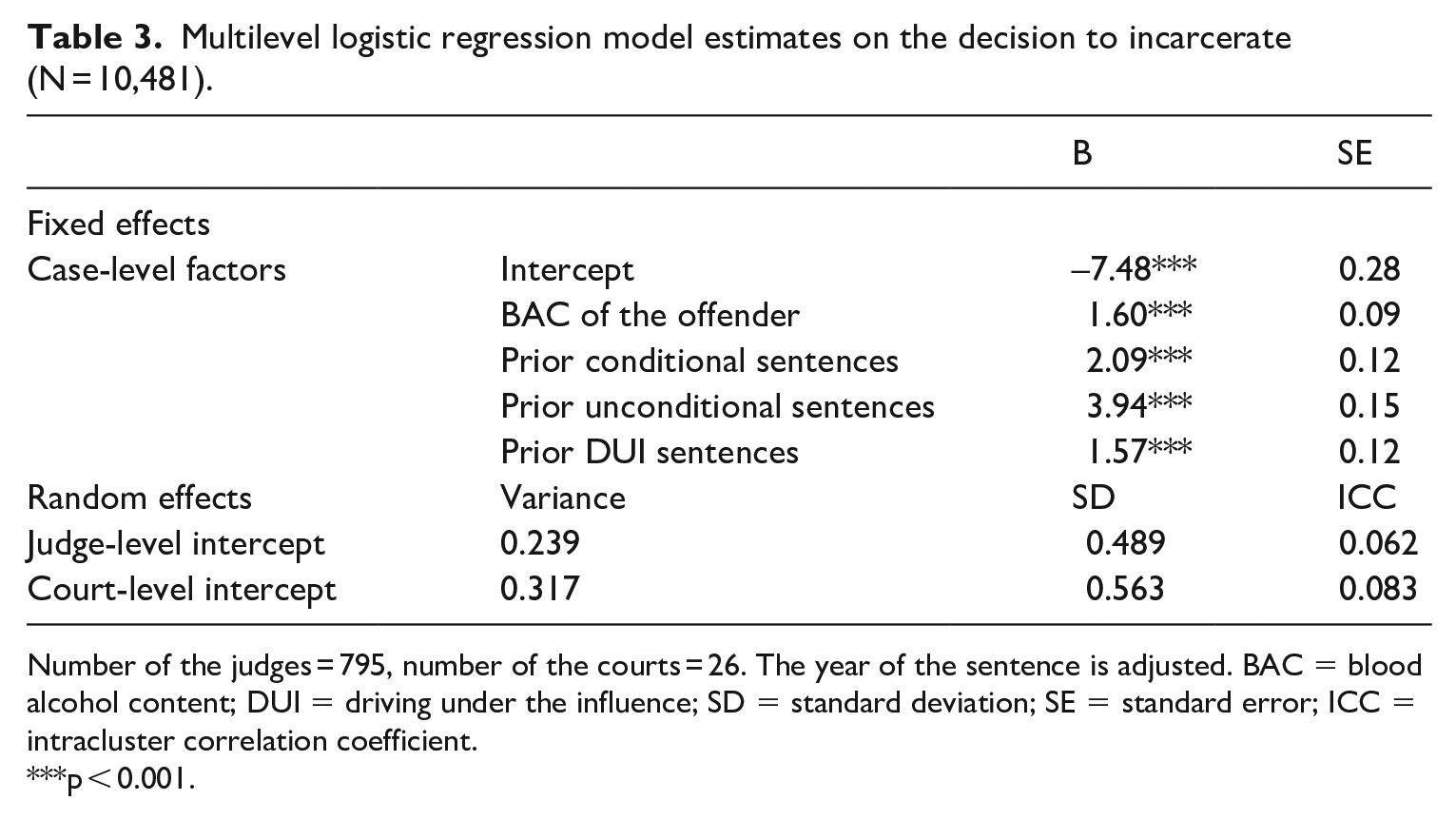
| B | SE | ||
|---|---|---|---|
| Fixed effects | |||
| Case-level factors | Intercept | –7.48*** | 0.28 |
| BAC of the offender | 1.60*** | 0.09 | |
| Prior conditional sentences | 2.09*** | 0.12 | |
| Prior unconditional sentences | 3.94*** | 0.15 | |
| Prior DUI sentences | 1.57*** | 0.12 | |
| Random effects | Variance | SD | ICC |
| Judge-level intercept | 0.239 | 0.489 | 0.062 |
| Court-level intercept | 0.317 | 0.563 | 0.083 |
Number of the judges = 795, number of the courts = 26. The year of the sentence is adjusted. BAC = blood alcohol content; DUI = driving under the influence; SD = standard deviation; SE = standard error; ICC = intracluster correlation coefficient.
p < 0.001.
Appendix 2
Declaration of Conflicting Interests
The author(s) declared no potential conflicts of interest with respect to the research, authorship, and/or publication of this article.
Funding
The author(s) received no financial support for the research, authorship, and/or publication of this article.
