




Abstract
For energy-limited networks with real-time constraints, long-distance transmission, complex calculations, and limited delay are problems to be faced in service applications. The cloud-based mobile edge computing framework is proposed in energy-limited networks to solve these problems. Under certain power and delay conditions, source node and destination node in adjacent cells, respectively, can select the appropriate relay node to complete the communication process. The mobile edge computing brings a novel idea for the application of auto-regressive and moving average model and further improves transmission efficiency and reduces transmission delay. Historical energy information of potential relay nodes can be predicted through auto-regressive and moving average model in edge computing server. Then, source node selects appropriate relay node by the proposed relay selection algorithm. Power objective function with signal-to-noise ratio that satisfies the limited delay is formulated to optimize the power allocation of nodes in terms of reducing energy consumption. The results show that our proposed relay selection algorithm under mobile edge computing architecture in energy-limited networks with real-time constraints could effectively improve the performance of networks on energy consumption and delay.
Introduction
As a kind of energy-limited network, lower energy consumption is critical for sensor nodes, and nodes are confined in terms of batteries for wireless sensor network (WSN).1,2 That is because nodes cannot be recharged in the process of network operation. 3 To reduce energy consumption of network, many technologies are proposed to achieve this goal, such as relay technology,4–6 power allocation technology,7,8 etc.
Relay technology could enlarge transmission range of communication and reduce transmission power consumption for data link. Specifically, the relay node builds a bridge between two long distance communication nodes. So far, many related works focused on relay communication in energy-limited networks.9,10 Under low complexity and high SNR conditions, Laneman et al. 9 studied a classical cooperative diversity protocol and analyzed the performance of networks with outage probability. Wu et al. 10 proposed a relay selection algorithm and further analyzed the outage probability performance with amplified-and-forward (AF) protocol in two-hop vehicular networks. In addition, power allocation technology has also attracted more attention in the last few years on relay networks.11,12 Si et al. 11 proposed a relay selection algorithm and power allocation scheme based on the decode-and-forward (DF) protocol in cooperative wireless networks. Otherwise, a novel simplified relay selection algorithm is also designed in cooperative cognitive radio systems, and power allocation method is also proposed to improve the performance of this system. 12 It is not difficult to see from the previous research works that traditional relay selection schemes and power allocation methods are often combined to analyze the characteristics of system and reduce energy consumption for energy-limited networks. These methods observed channel state and computed estimated value and further distributed equally power resources due to many technical restrictions. But these research works are based on the fact that the node has a small amount of computing power. Complex calculations will limit the application of these technologies and increase energy consumption. Fortunately, the emergence of cloud computing technology helps us to find ways to handle complex service applications.13–15
The advent of cloud computing technology brings new development and opportunity for precise but computationally complex model with wireless networks. 16 That is because traditional techniques are not sufficient to support the application of such models, such as time series model. The idea of time series model is accurately a prediction on future data at time t. Energy is a precious resource in the energy-limited networks, and rigorous energy management could maintain stable network operations. In energy-limited networks, a suitable energy prediction model could provide accurate judgment of the residual energy state of the node. Given the characteristics of energy consumption, the energy values at different time are treated as a stationary time series. ARMA model can be well applied to energy prediction as a stationary time series model in energy-limited networks. 17 Although this model has a high computational complexity, the cloud computing technology provides preeminent platform for the complex technical models.
Vehicular cloud computing (VCC) takes advantage of cloud computing to serve the vehicular networks. Hence, VCC provides tremendous computational services, real-time services, storage capabilities, and so on. The biggest challenge is the increasing demand for services. Many applications have strict requirements on latency. Facing the explosive growth of data, the complexity of data and runtime of sensor nodes become a serious problem, especially in delay-limited service applications. Finding a new solution to defeat these problems becomes a top priority. As a special kind of the cloud computing, the MEC technology can help solve these problems. 18 The MEC is at the edge of the network close to the object or data source. It integrates the open platform of network, computing, storage, and application core capabilities, provides edge intelligent services nearby, and focuses on real-time and short-cycle data analysis to better support local services with real-time intelligent processing and execution.19–21 Mahmoodi et al. 22 adopted load-balancing concept between mobile devices and servers to design a heuristic decomposition algorithm to minimize the completion time of mobile applications. Zhang et al. 23 studied the problem of minimizing delay under the constraints of specified resources and proposed a polynomial time approximation algorithm that can guarantee the unloading performance. There are also many researchers who model mobile applications as having multiple sub-task systems and aim to minimize energy consumption under task completion time constraints and to build tasks offload problems into nonlinear 0–1 planning problems. 24 These research works illustrate the advantages of MEC for processing service applications and reducing latency.
In this paper, we aim to explore relay transmission under MEC in energy-limited networks with real-time constraints. To solve long distance transmission between source node and destination node, a novel relay selection algorithm assisted by ARMA model is designed to increase transmission distance. In the process of this algorithm, the MEC technology is introduced to process complex calculations generated by ARMA model. Meanwhile, the transmission efficiency and delay will also be improved under certain power and delay conditions. In addition, the power objection function with SNR is formulated to optimize the power allocation of nodes to improve the energy consumption in energy-limited networks. As a result, the relay node selection has become the research focus in energy-limited networks with real-time constraints. Thus, the main contributions of this paper are summarized as follows:
We design the framework of cloud-based MEC merges to energy-limited networks to respond to long-distance transmission, complex calculations, and limited delay. We innovatively adopt ARMA model to predict historical energy information of potential relay nodes in MEC server. We propose relay selection scheme by means of power objective function to reduce energy consumption of networks. We validate the proposed relay selection scheme in terms of energy consumption and delay.
The remainder of this paper is organized as follows: “System model” section provides the network model, communication model, and ARMA model analysis. Then, the relay selection scheme and optimal power allocation scheme based on the ARMA energy prediction model are described in detail in the “The proposed relay-assisted scheme’ section. In “Performance evaluation’ section, the proposed methods in “The proposed relay-assisted scheme” section are validated and compared with ordinary relay selection and power allocation schemes, followed by conclusions in the final section.
System model
In this section, we first present the network model, followed by the communication model. Then, the ARMA model is presented.
Network model
Driven by the development of the quality of life, more service applications are required in the WSN. Figure 1 shows the framework of integrated networking and MEC server for connected terminal nodes. We consider two adjacent areas, which have many deployed sensor nodes in each area. At the edge of each area, there is one road side unit (RSU). Two RSUs have the same coverage range. Each RSU provides wireless access service for the sensor nodes within its transmission range. Each sensor node working within a communication area can only access the RSU located in the corresponding area.

A framework of integrated networking and edge computing for connected terminal nodes.
The RSUs transmit message with each other through wire backhaul to avoid interference by wireless transmission. Each RSU equips with an MEC server with computation resource. The RSU and the MEC server communicate with each other through wireless link. For some service applications, such as real-time data collection, compared with the final effective result, the size of the gross computation data is very large.25,26 The original data received from sensor nodes cannot be transmitted between two RSUs in order to improve transmission efficiency of the wire backhaul. In other words, each MEC server has the own computation task which is from the connected RSU to process. As of the size of output result by the MEC server is small, the computation result can be transmitted with less energy consumption between two RSUs through wired link, as shown in Figure 1.
In the energy-limited networks, all nodes are homogeneous and have limited computation resource. In addition to simple instruction transmission, all tasks of nodes are transmitted to the MEC server to accomplish through RSU. In Figure 1, the source node S in the area wants to communicate with the destination node D which is in adjacent area. Limited by communication range, the source node S cannot communicate with the destination node D directly. Nodes in the gray-shaded area (crossed line) are the alternative secondary nodes, denoted as the relay selection set
Communication model
The communication process in networks can be divided into two parts: node to MEC server through RSU communication and node-to-node communication.
Node to MEC server through RSU communication
Driven by the development of the WSN, many service applications are required to meet application requirements of people. Some of these applications require complex computation and have strict delay constraints, especially for the applications with real-time collection, analysis, and interaction. To meet the increasing computation demands of these applications, some complex computations are off-loaded to MEC servers through communication between node and MEC server through RSU. This process can improve communication efficiency in networks.
From Figure 1, when the source node S wants to build communication connection to the destination node D which is in adjacent area. Direct communication between the source node S and the destination node D is unable to achieve as out of communication range. Facing this case, the source node S needs to choose an appropriate node from the relay selection set
Node to node through relay node
For the sake of the convenient calculation, we assume that all nodes have same transmission power, defined as 1. In this section, we take one type of service application as an example, and other service applications calculations are similar. In the node-to-node communication process, the process of the source node S and the destination node D communication can be divided into two phases.
In the first phase, the source node S transmits data to the selected relay node in the set


In this communication model, the AF protocol is adopted to finish the communication process. The amplification gain for AF protocol and the output signal at the relay node can be described as follows


Then, the received signal at the destination node D by substituting equations (3) and (4) into equation (2) can be described as follows

The SNR of the received signal by the destination node D is defined as

When the channel SNR is higher, the equation (6) can be simplified to

ARMA model
The ARMA model is suitable for short-correlation prediction and has a certain algorithm complexity. It is highly accurate when to be used to predict short-correlation flows and is suitable for online prediction or energy-limited networks. The ARMA model can effectively analyze the data sequence correlation for stationary data sequences in service applications. 27
In energy-limited networks, the energy consumption rule of nodes could guide us to rationally choose communication node to realize network energy balance and prolong the network life cycle. According to the actual situation, we assume that the process of node energy consumption is a stationary process along with time in network. Hence, energy values at different time constitute a stationary time series. In order to know the energy consumption status of nodes in real time, the energy prediction model is a good tool to observe the remaining energy of the nodes.28,29 According to the collected energy data characteristics, researching on ARMA model becomes a good choice. This section designs an ARMA model in the MEC server according to the historical energy data with nodes. All nodes transmit their energy data in time to the MEC server. The MEC server trains original ARMA model according to historical data from potential relay nodes. When the model parameters are established, we can predict accurately the energy value for each potential relay node in next time. Finally, the MEC server will perform the proposed relay selection algorithm and inform the output result with the best relay node to the source node S. As a result, the source node S could know which node is the relay node. The specific model building process will be given out in the following.
The


As a result, the difference equation with

The ARMA model is also embodied by the equation (10), which satisfies the stationary time series. It is also expressed as abbreviated as ARMA(p,q) model. Note that ARMA(p,q) model is AR(p) model when q = 0, and ARMA(p,q) model is MA(q) model when p = 0. For research, the collected data sequence is assumed to be
The value of p and q in ARMA model is determined by the AIC order criterion, which is a standard for measuring the goodness of fit of statistical models.
17
The AIC criterion function follows that

When the sample length n is large enough, the likelihood function of the ARMA(p,q) model is approximately given by



When n is sufficiently large, the minimum information criterion for ARMA(p,q) model fitting by substituting equations (13) and (12) into equation (11) is equivalent to minimizing the following equation, which is

Through data analysis and experimental verification, the ARMA(p,q) is modeled as ARMA(2,1) to make predictions. The experiments also proved our results in “Performance evaluation” section. The model is given by


Then, the expression of the ARMA prediction model can be obtained by using the inverse function method, which is given by


The proposed relay-assisted scheme
Relay selection algorithm
We have learned from the previous description that there are various service applications in energy-limited networks. Some service applications are time-constrained in communication process. We assume that there are
In the single relay node transmission process, the source node S selects the best relay node with the largest energy value under time-limited conditions to carry out relay communication. Mathematically, we can model the proposed relay selection algorithm problem as follows

The details of the relay-assisted selection scheme, named as Algorithm 1, are in the top left corner of this page according to the above description. The operation is running in MEC server to reduce node energy consumption. The proposed relay-assisted selection scheme based on ARMA model could ensure the selected relay which is the best relay node to forward the source node S with the largest remaining energy value under time-limited conditions. The MEC technology can solve the complex computing problems of ARMA operational process. This further guarantees the network performance. Algorithm 1. Pseudo-code of the relay selection algorithm. 1: 2: S transmits messages via Relay 3: 4: 5: 6: Record the historical energy information for ith node and type-j service application, ERi,j, in the candidate relay set 7: xi,j ← ERi,j; 8: Ψ ← xi,j; 9: Upload to MEC server with Ψ; 10: Running ARMA prediction model according to the proposed ARMA(2,1) model on MEC server; 11: L ← ARMA(2,1) at time t + 1; 12: U = sort(L); 13: Q = fliplr(U); 14: n* = Q(1); 15: n* is denoted as the best relay-assisted node for one service application. 16: 17: S is unable to communicate with D.
Optimal power allocation algorithm
On the basis of the above-mentioned communication process in “System model” section, reasonable power allocation is another important measure to improve energy performance of networks after operating the proposed relay-assisted selection algorithm. In this section, we assume the power of source node S for type-j service application is
In this paper, we take the total power of the energy-limited networks as our objective function for type-j service application, which consists of the power of the source node and the power of the relay node. The destination power is temporarily ignored in this paper. Using the optimization theory, we build the total power objective function with type-j service application. The MEC server action determines how much power will be gained. Therefore, the specific optimization problem can be modeled as follows
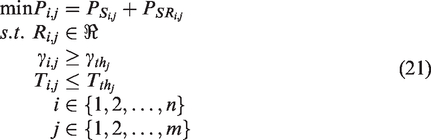
Submitting equations (6) and(20) into equation (21), the determined expression can be given by equation (21). It can be judged that this problem is a convex optimization problem. In other words, we can solve the equation (21) to optimize the variables

By equation (22), the minimum total power consumption of the energy-limited networks in the case of the optimal relay

From equations (22) and (23), we can know that the relay node
Performance evaluation
In this section, we use computer simulations to show the performance of the proposed relay-assisted scheme on the energy-limited networks with the integrated MEC architecture under the real-time constraints conditions. In our simulation experiment, the accuracy of the ARMA energy prediction model, the effectiveness of the proposed relay-assisted scheme and the transmission delay by adopting MEC is focused and verified.
The experimental simulation platform uses MATLAB platform, and initial data acquisition chooses the way of random for verifying the feasibility. In the network system, we assume that the selected relay node adopts the AF protocol, and then the performance comparison in terms of network energy between the selected ARMA energy prediction model and the traditional random relay selection algorithm is implemented. After that, simulation analysis of the determination for the ARMA energy prediction model is carried out in detail.
As we all know, energy data collection work is difficult to carry out in the actual networks. Without affecting the final results, stochastic simulation of energy values allows us to validate the proposed theory in an easy way. During the experimental process, the random energy values are generated at different time in energy-limited networks for nodes. Combining with the analysis process in “ARMA model” section after repeating the ARMA energy prediction model 10 times, 10 groups of experimental data were randomly generated in this process. Through continuous debugging and experimentation of parameters, p and q in ARMA(p,q) model affect the prediction accuracy of the model. The final results on parameters are determined, denoted as p = 2, q = 1. In order to verify the correctness of the results, the different network energy values at the ARMA(2,1) and ARMA(2,2) energy prediction model are compared with the raw energy data, as shown in Figure 2.

The comparison of network energy between two methods.
Compared with the raw data, the energy prediction models on the ARMA(2,1) and the ARMA(2,2) have some deviation from Figure 2, especially for the ARMA(2,2) energy prediction model. That is because the simulation results are affected by the simulation scenario, selected experimental data, random factors, etc. However, it is not difficult to see that the ARMA(2,1) energy prediction model can better reflect the changed energy state of the original data for the nodes to compare with the ARMA(2,2) energy prediction model.
In order to improve the prediction accuracy of the prediction model, forecast is divided into one-step prediction and multi-step prediction. We can see from the previous experimental description that the deterministic ARMA(2,1) energy prediction model is also no exception. Figures 3 and 4 show the results of one-step prediction and two-step prediction, respectively, on the ARMA(2,1) energy prediction model.

The network energy with one step.

The network energy with two step.
From Figures 3 and 4, the relationships between network energy and time (h) on prediction data of ARMA(2,1) model and original data for one-step prediction and two-step prediction are given out, respectively. Obviously, we can see that the ARMA(2,1) energy prediction model that adopts one-step prediction way could have better prediction values of network energy with the different time from Figure 3. However, the ARMA(2,1) energy prediction model that adopts two-step prediction shows great fluctuations on prediction values of energy on different time in Figure 4. In addition, the prediction accuracy deteriorates as the number of prediction steps increases through the offline experiments. Therefore, one-step ARMA(2,1) energy prediction model is selected to perform predictive analysis of data for the proposed relay selection scheme in our simulations.
So far, the application of time series model in communication networks is still in the exploration stage. Despite reading a large amount of academic literatures, we have not found the application of time series model in communication networks, especially for the ARMA model. In this paper, we will start from the basic work that comparing the proposed relay selection scheme with random relay selection scheme. Considering the case of a single source node, a single-selected relay node and a single destination node, the method of selecting a single appropriate relay node is divided into two cases: random selection and the proposed algorithm through ARMA(2,1) model. For the ease of description, this paper deals with the simple processing of network energy, focusing on the power consumption of relay nodes. To facilitate the description and simplify the processing, the power consumption of the relay node is focused. The comparison of network energy between the random selection method and the proposed method is shown in Figure 5 when the historical values are randomly generated. From Figure 5, we can see that the proposed relay selection scheme for the energy-limited networks can more effectively use the energy of the network nodes, meanwhile reducing the network energy consumption and extending the network life cycle.
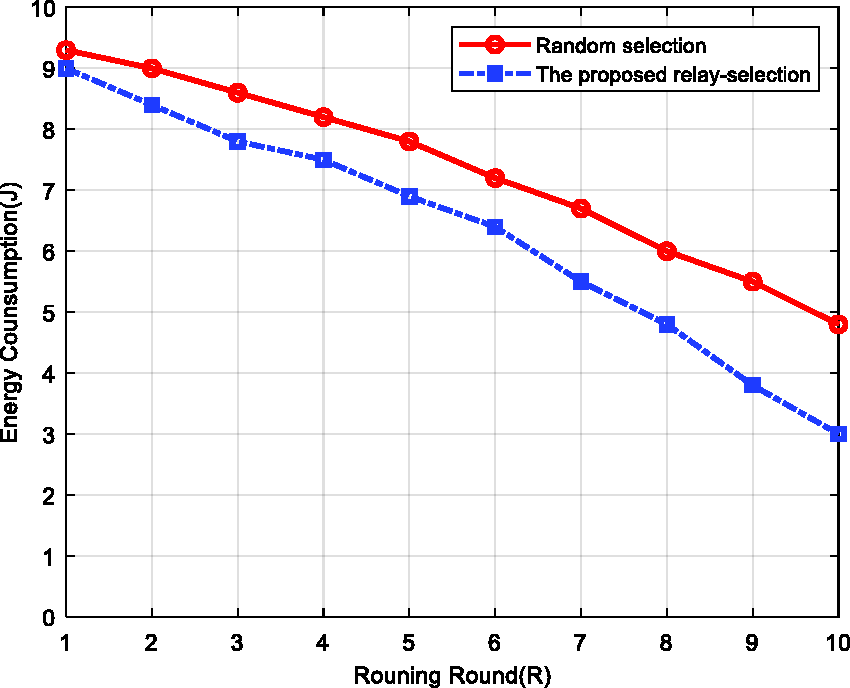
The comparison of network energy between two methods.
For the energy-limited networks, the architecture of MEC is designed to reduce transmission delay when it applies for the real-time constraints services. Compared with traditional networks, the MEC server is deployed at the edge of the network as of reducing transmission time. In addition to this, the computation resources in MEC could handle complex computing tasks and improve communication efficiency, as shown in Figure 6. Under integrated edge-computing networks and traditional networks conditions, Figure 6 depicts the comparison situations of computing time in three service types: heavy service, medium service, and light service.

The comparison of computing time for different service between MEC and no MEC.
It is easy to see that MEC technology could reduce computing time at the case of heavy service and medium service, but the computing time caused by MEC on light service is inferior to the no MEC situation. This is because the MEC server has a good effect on complex computing. Additionally, the traditional network has almost the same functionality to the network with integrated MEC architecture and lacks transmission time to upload computing tasks to the MEC server.
Conclusions
For the energy-limited networks of integrated networking for connected terminal nodes, the joint relay-assisted selection scheme and power allocation algorithm are proposed with the MEC architecture. Historical data help us train the ARMA(p,q) energy prediction model and ensure the values of p and q. Although this training has a complicated calculation process, the MEC server can finish it and effectively operate the selection process of suitable relay node. In the end, an optimal power allocation scheme is obtained based on the proposed relay selection scheme through the optimization theory. Simulation results indicate that our relay selection scheme could improve the energy consumption of the network. Meanwhile, the MEC technology could help nodes reduce data computing time for different service, especially for heavy service and medium service.
In future work, one interesting extension of this work is to consider performance comparisons of varying relay selection schemes. For this case, one may analyze the advantage of different relay selection schemes for energy-limited networks. Another interesting extension of the analysis is to consider the other time series models on communication networks. Different time series models have different application conditions in networks. In this case, we can analyze the performance of networks with different time series models.
Footnotes
Acknowledgements
The authors would like to thank the anonymous reference and reviewers for their helpful comments that have significantly improved the quality of the presentation. This work has been published in part at the 2018 17th International Symposium on Distributed Computing and Applications for Business Engineering and Science (DCABES), Wuxi, China, October 2018.
Declaration of Conflicting Interests
The author(s) declared no potential conflicts of interest with respect to the research, authorship, and/or publication of this article.
Funding
The author(s) disclosed receipt of the following financial support for the research, authorship, and/or publication of this article: National Natural Science Foundation of China (Grant No. 61801227), Natural Science Foundation of the Jiangsu Higher Education Institutions of China (Grant Nos. 18KJB510022 and 18KJB413007), the open research fund of National Mobile Communications Research Laboratory, Southeast University (Grant No. 2020D17), and by the Jiangsu Key Construction Laboratory of IoT Application Technology.
