




Abstract
This article investigates the impacts of relay selection schemes on cooperative underlay cognitive radio non-orthogonal multiple access networks, where the partial relay selection scheme, the max–min relay selection scheme and the two-stage relay selection scheme are applied in the network. Moreover, decode-and-forward protocol is used at the transmission relays. What’s more, in order to show the effect of the schemes on the considered network, the closed-form expressions and asymptotic expressions for the outage probability of the system are derived. Furthermore, the outage performance under the effect of perfect and imperfect successive interference cancellation is analysed. Numerical results are given to illustrate the impacts of the relay selection schemes, the number of relays, the residual interference factor and the power allocation factor on the outage performance. Finally, Monte Carlo simulations are presented to validate the accuracy of the numerical results.
Keywords
Introduction
Non-orthogonal multiple access (NOMA) has been proven as a promising multiple access technique to improve spectral efficiency (SE), enhance cell-edge throughput and decrease transmission latency, where multiple users with different power allocation (PA) levels are allowed to share the same frequency/time/code resources. 1 The transmitter utilizes Superposition Coding (SC) to distribute the power of user signals, and the receiver employs successive interference cancellation (SIC) to distinguish different signals. 2 Saito et al. 3 investigated the system-level performance of NOMA taking into account practical aspects of the cellular system. The results showed that the overall cell throughput, cell-edge user throughput and the degree of proportional fairness of NOMA are all superior to that for orthogonal multiple access (OMA).
Cooperative relaying technology can combat multipath fading and improve the reliability of wireless networks. Using relay nodes in NOMA can significantly improve SE and outage performance. Ding et al. 4 proposed a cooperative NOMA scheme, where the users with good channel conditions operated as relays. The results showed that the cooperative NOMA scheme outperforms both the non-cooperative NOMA and cooperative OMA. Abbasi et al. 5 considered a cooperative NOMA network in which the relay works in amplify-and-forward (AF) mode. Also, the approximated ergodic rate and asymptotic outage probability (OP) were derived. Pei et al. 6 investigated cooperative NOMA with a dedicated decode-and-forward (DF) relay, in which both full-duplex (FD) and half-duplex (HD) protocols are considered for the relay.
Relay selection (RS) techniques also remain an important issue due to the fact that the best relay can achieve performance improvements in reliability and throughput. Ding et al. 7 proposed a two-stage RS scheme for NOMA relay networks with fixed PA and derived closed-form expressions for the OP, besides, the authors demonstrated that the two-stage RS scheme can achieve minimal OP than other RS schemes. Xu et al. 8 further proposed two-stage weighted-max–min and two-stage max-weighted-harmonic-mean RS schemes in the case of fixed and adaptive PA at the relays, respectively. The outage probabilities of the two proposed RS schemes were also derived. In the research work, Yang et al. 9 proposed a new two-stage RS scheme and combined DF and AF relaying with this two-stage scheme, respectively. Besides, PA factors are related to the source–relay and relay–destination channels. Some works focus on the partial RS scheme on NOMA networks.10,11 Lee et al. 10 considered the AF protocol and derived the closed-form expressions for the OP of terminal users. Asymptotic analysis at high signal-to-noise ratio (SNR) was also carried out. The simulation results showed that there is almost no gain in outage performance when the number of relays exceeds two for partial RS scheme. Hoang et al. 11 combined NOMA with radio frequency (RF) energy harvesting (EH), besides, the closed-form expressions for the ergodic capacity and the OP were derived in the case of perfect and imperfect SIC. The results showed that the performance of the system is significantly influenced by the level of residual interference. The max–min RS scheme in NOMA system was studied in Kim 12 where the candidate relay forwards the information to destination user in the presence of direct path. The results showed that the outage performance with max–min RS outperforms the random RS. Lee et al. 13 applied NOMA to an underlay cognitive radio (CR) scenario, where a user with strong channel gain was selected as a relay for assisting another user with poor channel gains. Besides, the impacts of the multiple antennas and the number of cooperative NOMA users on the system outage performance were investigated. Zhao et al. 14 proposed an NOMA-based joint relay-and-antenna selection scheme for Hybrid Satellite-Terrestrial Relay Network. The considered scheme can achieve the maximum communication rate of the secondary user when the primary user maintains the optimal outage performance.
With the rapid growth of data traffic, the shortage of spectrum resources will become the bottleneck of the development of wireless communication. The emergence of CR can improve spectrum utilization. 15 Particularly, underlay CR enables secondary users to access the spectrum of the primary network if the quality of service (QoS) of the primary users is guaranteed. 16 Hence, it can be foreseen that incorporating NOMA into underlay CR networks has the potential to increase SE and system capacity. The outage performance of the cooperative underlay cognitive radio non-orthogonal multiple access (CR-NOMA) networks was studied in some schemes,17,18,19,20 where the interference temperature constraint (ITC) at the primary network was considered. In the research work, Chu and Zepernick 17 investigated the OP and ergodic capacity for secondary users and the whole system, what’s more, the impacts of the ITC, channel power gains and PA on the system performance were analysed. Im and Lee 18 considered the imperfect SIC in cooperative underlay CR-NOMA networks. Arzykulov et al. 19 showed that NOMA achieves better OP results compared to OMA, in which the OP of secondary users with imperfect channel state information (CSI) was investigated. In the research work, Nauryzbayev et al. 20 considered the Nakagami-m fading channels and the closed-form expressions for the OP of user messages were derived.
The application of RS in underlay CR-NOMA networks has also been studied. Do and Le 21 discussed the AF-based opportunistic RS scheme and partial RS scheme. In addition, the influence of hardware imperfections on the outage performance is considered. The DF-based RS schemes have also been investigated.22,23,24 Sultan 22 considered two NOMA transmission scenarios according to whether the near user assists transmission and proposed three RS schemes, besides, the closed-form expressions for the OP and bit error rate of the system are derived. In the research work, Sultan 23 proposed a reactive RS scheme and derived the closed-form expressions for OP. The proposed RS scheme aims to maximize the second-hop SNR for the far user. Simulation results reveal the impacts of PA factor and interference threshold on outage performance. Do et al. 24 considered an uplink–downlink CR-NOMA network, in which the partial RS scheme is exploited for both uplink and downlink communications. In the proposed model, the relays can exploit at FD or HD mode. The expressions of OP and ergodic capacity were also provided.
This article is the extension of Ding et al. 7 and Do et al. 24 To the best of our knowledge, the max–min RS selection in CR-NOMA networks has not been discussed, and this is one of the main focuses of this study. In this article, we derive the closed-form expressions and asymptotic expressions for the OP of the system based on the proposed RS selection schemes. Besides, the imperfect SIC case is also investigated. The major contributions of this article are summarized as follows:
First, three RS schemes in the underlay CR-NOMA network, namely, the partial RS scheme, the max–min RS scheme and the two-stage RS scheme are investigated. Moreover, the interference from the primary user to the secondary network is considered.
Second, the closed-form expressions for the OP of the system are derived. Based on the numerical results, the outage performance of the three RS schemes is investigated. It is worth pointing out that an outage floor which depends on the ITC can be observed in the OP.
Third, the asymptotic expressions for the OP are derived (1) when the transmit SNR goes to infinity and (2) when the ITC goes to infinity.
Fourth, the outage performance under the effect of perfect SIC and imperfect SIC is analysed.
Finally, the effect of the PA factor on system OP is analysed. Furthermore, Monte Carlo (MC) results are provided to validate the accuracy of the numerical results.
Performance analysis is the basis of engineering practice and is of great significance to guide the design of practical communication systems. From the theoretical and simulation results, it can be concluded that the two-stage RS scheme can achieve the best outage performance. Besides, the outage performance can be improved by increasing the number of relay nodes, while the performance gain can be neglected when the number of relays exceeds 2 for the partial RS scheme. In addition, the outage performance is severely affected by residual interference factor and PA factor.
The rest of this article is organized as follows. Section ‘System model’ illustrates the system model and the three RS schemes. The OP results achieved by the three RS schemes are shown in section ‘Formulation analysis in the case of perfect SIC’ and section ‘Formulation Analysis in the case of imperfect SIC’, respectively. Section ‘Performance analysis’ provides MC simulation results and necessary discussions. Finally, the conclusions are given in section ‘Conclusion’.
System model
As illustrated in Figure 1, consider a downlink DF underlay CR-NOMA network which includes a primary user

Illustration of the system model.
In the underlay CR network, the secondary users are allowed to use the frequency band of


where
RS schemes
Partial RS scheme: the best relay is selected based on the channels of the first hop 10

Max–min RS scheme: this scheme considers the channels of the first hop and the second hop which can be formulated as follows 7

Two-stage RS scheme: the first stage is to select the relays that can guarantee user 1’s targeted data rate 7

In other words, the QoS requirements of
On the basis of satisfying the above condition, the second stage is to choose the relay which can maximize user 2’s data rate

Based on the principle of NOMA, the communication from

where
The transmit SNR at


During the second time slot,

where

Correspondingly, the SINR for


It should be noted that the required condition to decode
Formulation analysis in the case of perfect SIC
In this part, we consider the scenario that SIC is perfect at
Formulation analysis of partial RS
This section focuses on the outage performance of the partial RS scheme. The cumulative distribution function (CDF) of the random variable

where
To derive the close-form expression in equation (14), it is required to get the probability density function (PDF) of
First, the PDF of the ordered variable
26

where

As
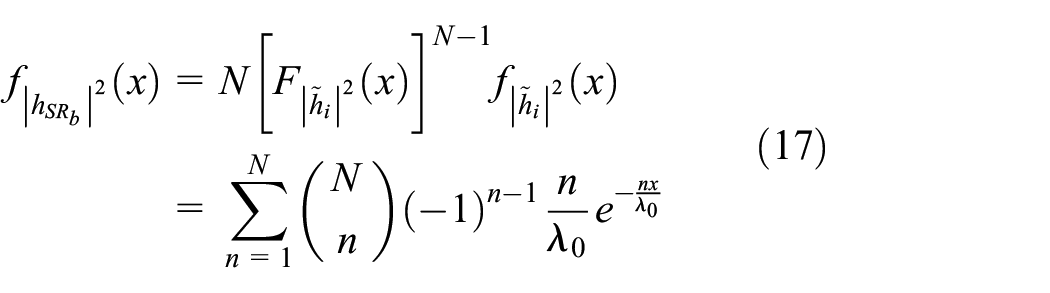
Next, the PDF of

Then, by substituting equations (17) and (18) into equation (14), the CDF of random variable

Similar to equation (14), the CDF of random variable

where
The OP of the system can be expressed as

where

Asymptotic analysis with
for partial RS
The exponential function can be approximated as

Therefore, the following simplifications can be performed


The CDF of random variable X in equation (19) can be approximated as

The CDF of random variable

Using the above approximations, the asymptotic expression for the OP of the system is given by

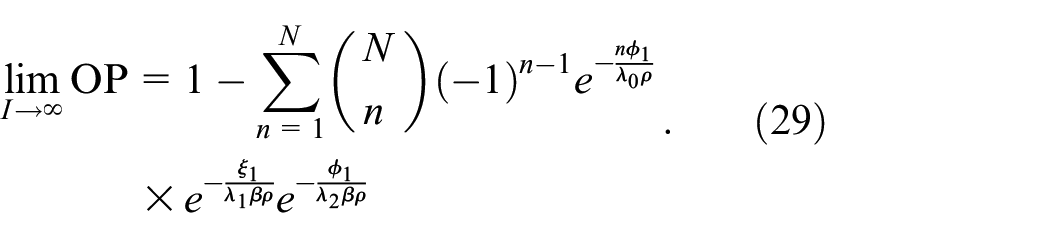
Asymptotic analysis with
for partial RS
When the ITC
Formulation analysis of max–min RS
The PDF of

where
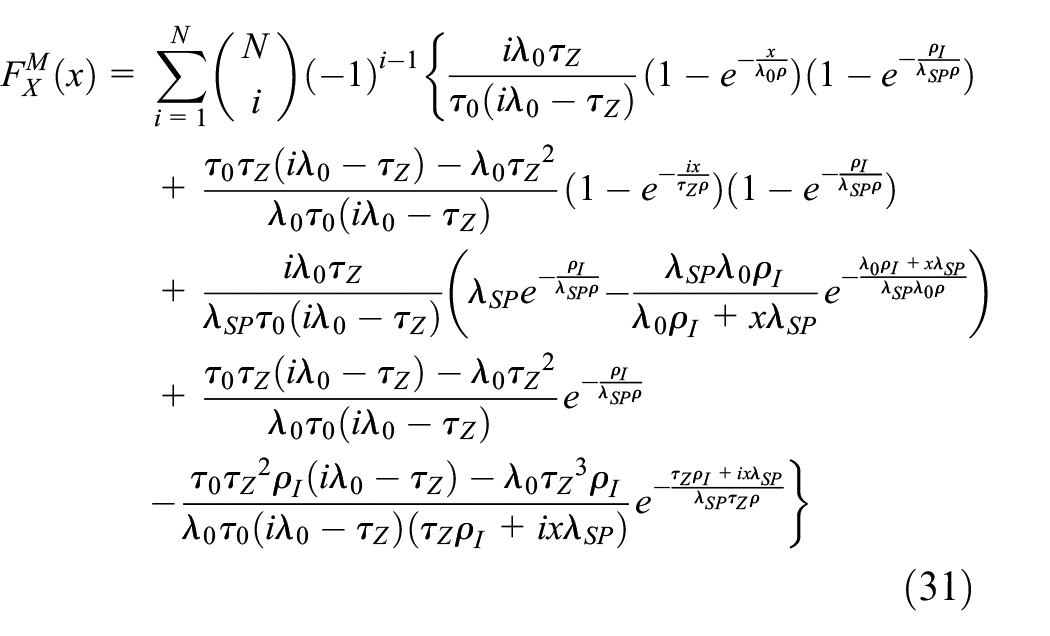
In the same way, the CDF of

The OP of the system can be expressed as

By substituting equations (31) and (32) into equation (33), the OP of the system can be obtained.
Asymptotic analysis with
for max–min RS
Based on equation (23), the asymptotic expressions for


By substituting equations (34) and (35) into equation (33), the asymptotic expression for the OP of the system is given by

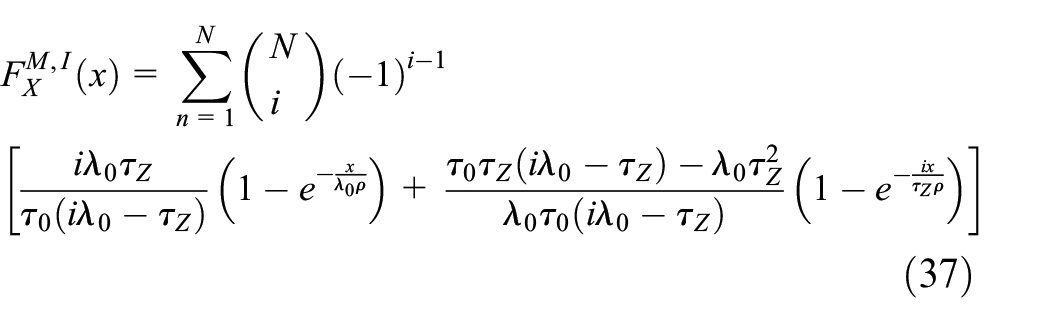
Asymptotic analysis with
for max–min RS
When the ITC

Therefore, the asymptotic expression for the OP of the system is given by

Formulation analysis of two-stage RS
The CDF of

Accordingly, the CDF of random variable

Defining

Term
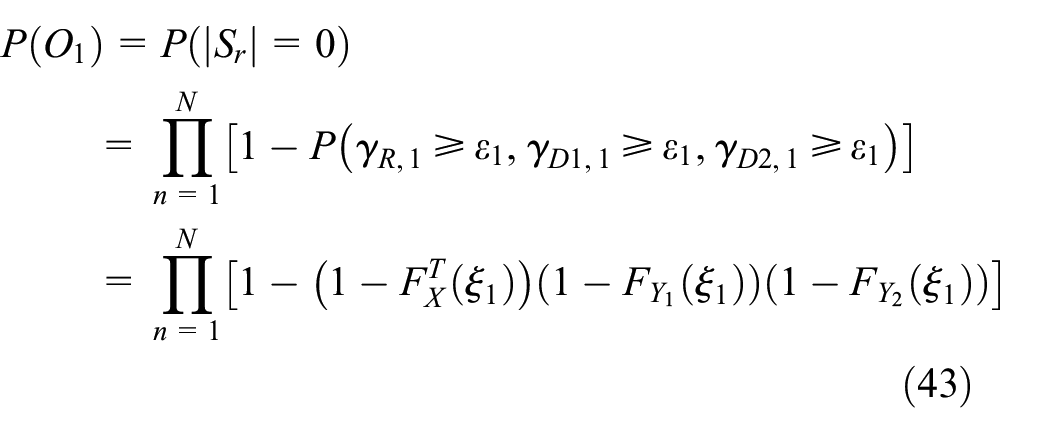
where
Term

Defining

and

The CDF of

Thus,

In the following, the probability that
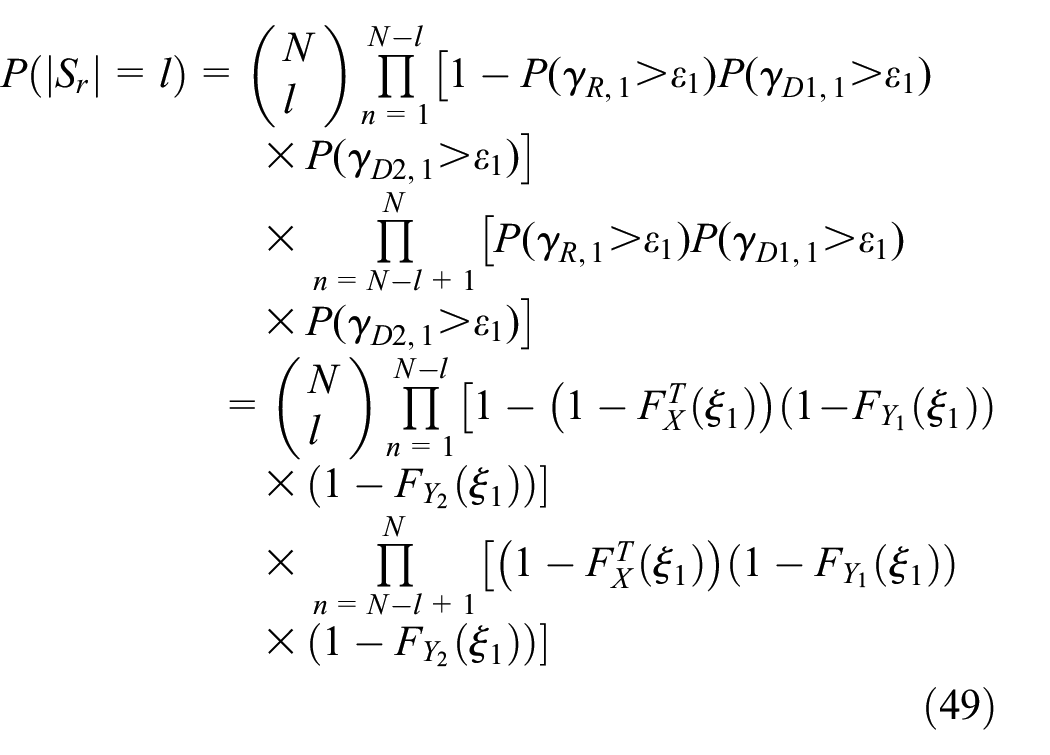
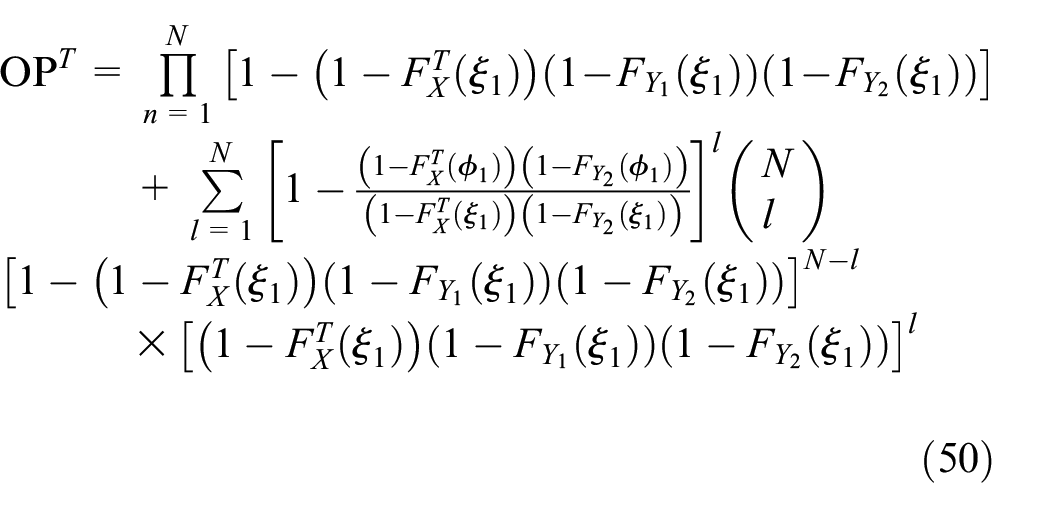
Finally, from equations (42)–(49), the OP of the system can be derived as in equation (50), which is
Asymptotic analysis with
for two-stage RS
Based on equation (23), the asymptotic approximation for

The asymptotic approximation for

Then, by substituting equations (51) and (52) into equation (50), the asymptotic expression for the OP of the system is obtained.
Asymptotic analysis with
for two-stage RS
The asymptotic approximation for

The asymptotic approximation for

By substituting equations (53) and (54) into equation (50), the asymptotic expression for
Formulation analysis in the case of imperfect SIC
In this part, we consider the scenario that symbol


where
Formulation analysis of partial RS
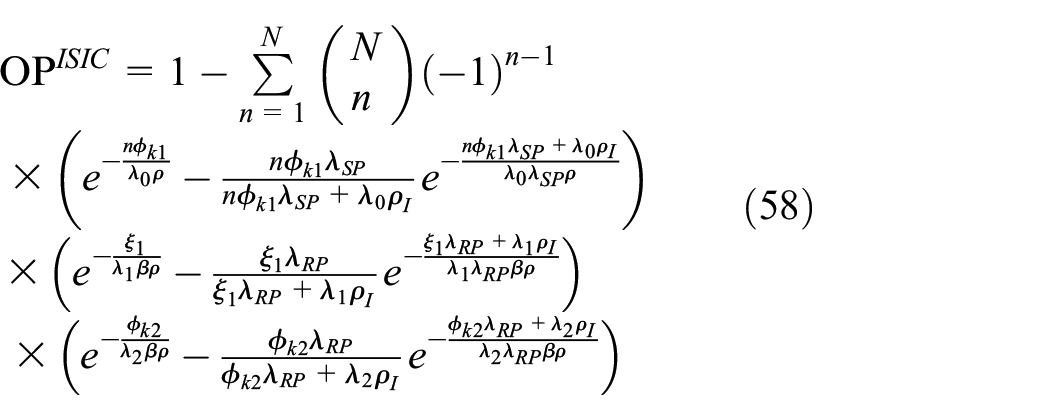
From equations (55) and (56), the OP of the system in the case of imperfect SIC is given by

where
Finally, by substituting equations (19) and (20) into equation (57),
Formulation analysis of max–min RS
From equations (33), (55) and (56), the OP of the system in the case of imperfect SIC is given by
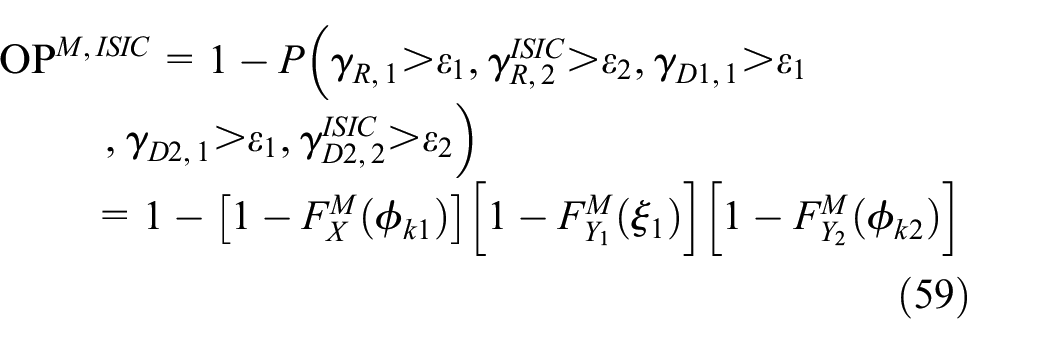
By substituting equations (31) and (32) into equation (59), the OP of the system can be obtained.
Formulation analysis of two-stage RS
For the two-stage RS scheme in the case of imperfect SIC, the expression (6) is given as


and

The CDF of

Therefore, we have

From equations (42) and (64), the OP of system is derived as in equation (65), which is

Performance analysis
This section presents MATLAB simulations to investigate the impacts of system parameters on outage performance. All the simulations are obtained by performing
Figure 2 shows the OP results versus the transmit SNR for the three RS schemes in the case of perfect SIC, where the number of relays
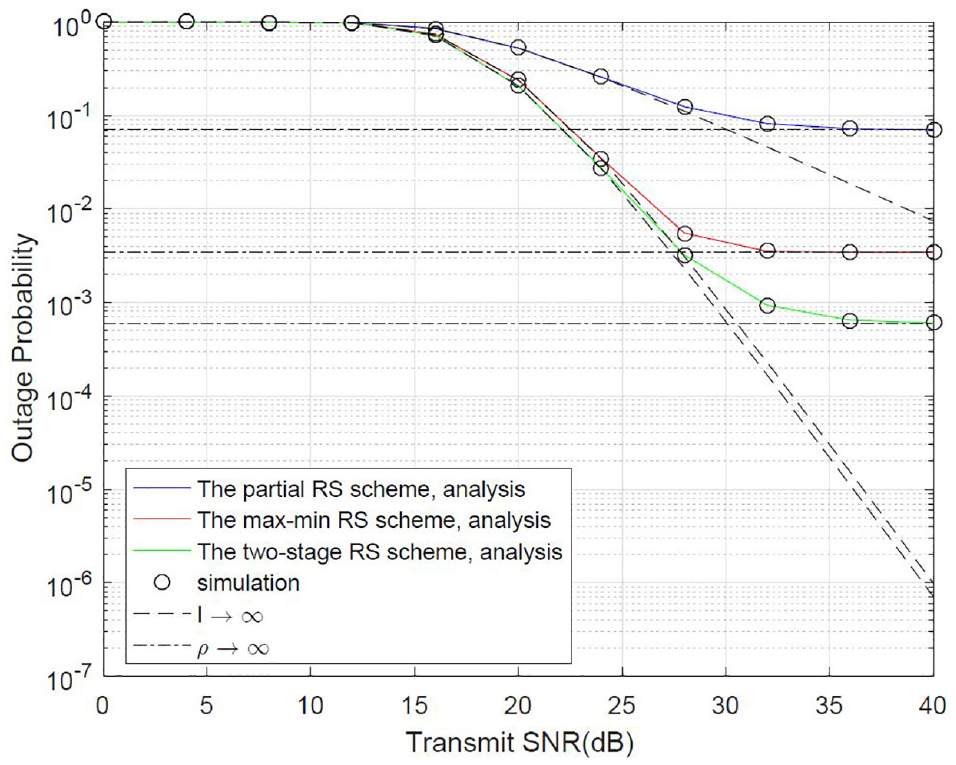
OP versus transmit SNR with different RS schemes, where
To compare the outage performance in the case of perfect SIC and imperfect SIC, in Figure 3, the OP results are depicted based on the partial RS scheme, assuming

Comparison of OP for the perfect and imperfect SIC, where
In Figure 4, the OP versus the number of relays in the case of perfect SIC is illustrated, where the SNR is

OP versus the number of relays with different RS schemes, where
The impacts of the PA on the outage performance with different RS schemes are investigated in Figure 5 in the case of perfect SIC, where
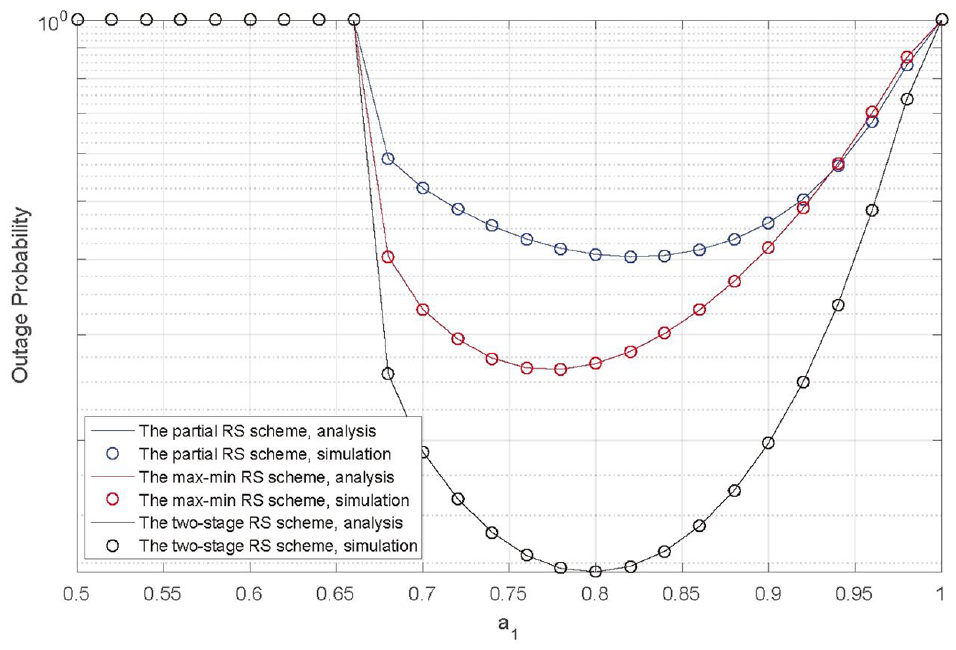
OP versus
Optimal PA factors for different RS schemes, where
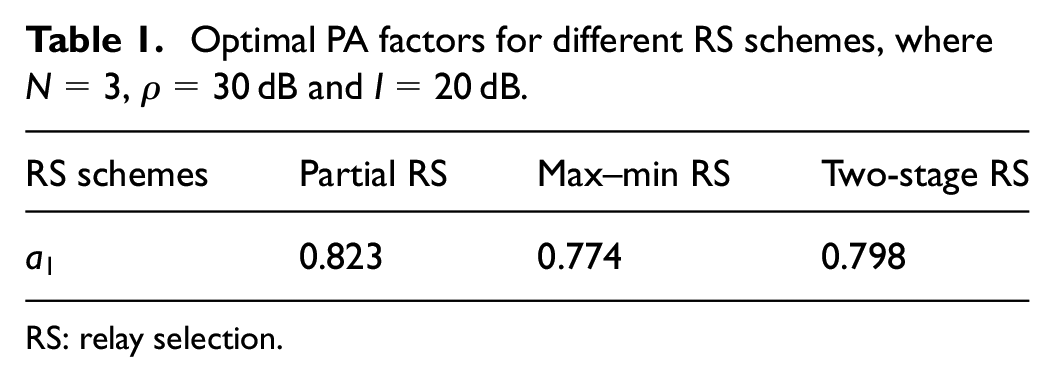
RS: relay selection.
Conclusion
This article investigated the impacts of RS schemes on DF cooperative underlay CR-NOMA networks. Particularly, the partial RS scheme, the max–min RS scheme and the two-stage RS scheme were studied, where the closed-form expressions and asymptotic expressions for the OP were obtained. Moreover, theoretical and simulation results revealed the impacts of ITC, PA factor, residual interference factor and the number of relay nodes on the outage performance. Some important conclusions can be summarized from the results. (1) The two-stage RS scheme outperforms the other two schemes in outage performance. (2) The outage performance of the system can be improved by increasing the number of relay nodes, but for the partial RS scheme, the performance gain can be neglected when the number of relays exceeds 2; therefore, the large number of relay nodes is unnecessary for the partial RS scheme. (3) Selecting the appropriate PA factors for different RS schemes can significantly improve outage performance. (4) The outage performance is severely affected by residual interference. When the residual interference factor is large, the outage performance of NOMA is even worse than that of OMA. The above conclusions can guide the design of practical communication systems.
Footnotes
Appendix
The PDF of
where
According to the fundamental knowledge of statistics, it can be derived that
The joint CDF
From equation (20) in Tourki et al.,
27
the conditional PDF
Therefore, it can be derived that
The CDF of
and the PDF of
Accordingly,
Finally, by substituting (67)–(75) into (70), equation (23) can be derived.
Handling editor: Peio Lopez Iturri
Declaration of conflicting interests
The author(s) declared no potential conflicts of interest with respect to the research, authorship and/or publication of this article.
Funding
The author(s) disclosed receipt of the following financial support for the research, authorship and/or publication of this article: This work was supported by the China Postdoctoral Science Foundation under grant 2020M673687.
