




Abstract
Cooperative cognitive radio networks use cooperative relays to forward signal from the source to the destination. In cooperative cognitive radio networks, the transmission power of each relay is limited by the interference constraint of the primary user receiver. Thus, it is essential to optimize power allocation and multi-relay selection jointly to maximize the secondary system throughput. Optimizing multi-relay selection and power allocation requires an exhaustive search for all possible relay combinations, since this approach uses a large amount of valuable resources and entails high computational complexity. A suboptimal solution for power allocation may reduce the computational complexity but still involves high implementation complexity. Thus, for an efficient utilization of resources to support the applicability of cognitive radio for the Internet of things, we propose a low-complexity timer-based multi-relay selection that determines a forwarding relay set before the source begins to transmit its data. This allows the source to know the instantaneous channel state information of the relays, which helps the source to assign appropriate transmission power to the relays. By simulation, we show that the proposed scheme achieves near-optimal secondary system throughput performance to the optimal multi-relay selection as well as provides a significant secondary system throughput gain when compared to conventional and random relay selection scheme with equal power allocation.
Keywords
Introduction
Cognitive radio (CR) is a wireless technology with promise to resolve the growing scarcity problem of crucial electromagnetic spectrum resources by adaptively changing its transmitter parameters based on the interaction with the environment. In cognitive radio networks (CRNs), while primary users (PUs) use their particular licensed spectrum bands, secondary users (SUs) detect and utilize spectrum holes in the radio environment for their data transmissions. 1 Self-adaptation and self-organization are the essential properties of Internet of things (IoT) that allow communication among nodes, continuous change of context, and join and leave the network spontaneously. Therefore, CRs at physical and link layers, self-organizing network protocols at the application layer are important candidates for the self-adapting IoT. CR platform is a promising solution for improving the connectivity, and its applicability for future IoT is limited due to high implementation cost and high energy consumption. 2 In CRNs, the SUs often pay the cost of opportunism to access the spectrum of PUs in terms of their energy consumption. Moreover, the operational environment awareness is driven from the interference requirement of the PU receiver, which consumes much energy as compared with general radio platform. Nevertheless, energy consumption is an important issue for IoT-based applications. Therefore, cooperative communication scheme (CCS) is a technique in CRNs to reduce the transmission power of the SUs to avoid the interference to the PU receiver. The implementation of cooperative relaying strategy in Xia and Aissa 3 reflects that it can effectively reduce the transmission power of the SUs to protect the interference to the PU receiver. In CCS, the source exploits cooperative relays to transmit its signal to the destination. In order to support the applicability of CR for future IoT, cooperative cognitive radio networks (CCRNs) is a promising approach which can reduce the interference of the PU receiver and energy consumption in transmission. CR techniques for spectrum access (SA) are generally classified as underlay SA, overlay SA, and interweave SA. 4 Among them, interweave SA is the most conservative and challenging because it strictly prohibits the SU access to a spectrum while a PU is utilizing it. In overlay SA, SUs exclusively and opportunistically use a spectrum when it is not utilized by a PU. Underlay SA allows simultaneous transmission of SUs with PUs, as long as the interference from the SUs to the PUs is kept below a tolerable level. In CCRNs, the cognitive relay can improve the cognitive throughput, extend the coverage, and improve the spectral efficiency in the wireless communication.5,6
Motivated by the promise of these two techniques, CR and the CCS, researchers have been investigating CCRNs as an emerging approach to improve secondary system throughput under interference threshold of the PU system. In underlay CCRNs, the transmission power of secondary source and the secondary relays is limited by the interference requirement of the PU receiver. Transmission power control to avoid the interference to the PU receiver is critical in CCRNs. Moreover, in CCS, participation of all relays may unnecessarily waste valuable spectrum resources. Therefore, an improved CCS for IoT was studied in Lee et al., 7 where a decoding scheme according to the transmission structure was proposed to enhance the communication throughput under a low bit error rate. To prevent unnecessary wastage of valuable spectrum resources, joint relay selection and power allocation in CCRNs were presented in Yu et al., 8 where the SU relays are operated on amplify-and-forward (AF) mode, and optimal power allocation (OPA) and suboptimal power allocation schemes were derived for secondary system throughput maximization under a PU receiver interference threshold. Similarly, in Choi et al., 9 a low-complexity multi-relay selection (MRS) scheme for CRNs through an exhaustive search (ES) with an OPA and suboptimal MRS was proposed to maximize the secondary system throughput, where the transmission power of each relay was inversely proportional to the interference of that SU relay to the PU receiver. In Niemen et al., 10 a low-complexity interference-aware MRS scheme using ES for CRNs was proposed in which the SU relays were selected to maximize the signal-to-noise ratio (SNR) of their transmission to the destination under the PU receiver interference constraint. To reduce the CC of the ES, a simplified suboptimal power allocation to the SU relays is derived in Choi et al., 11 to achieve secondary system throughput maximization. Although the suboptimal power allocation has advantages in reducing the CC required by the optimal scheme, it still faces high implementation complexity (IC). Therefore, a lower complexity MRS and power allocation schemes are essential for improving the secondary system throughput under the interference constraint of the PU system. Specifically, resources are severely limited for SUs when employing underlay SA. Thus, we propose a scheme that jointly uses a lower complexity timer-based MRS with sequential power allocation to achieve efficient utilization of resource in underlay CCRNs.
In this article, we propose a scheme to maximize the secondary system throughput using a timer-based MRS with low IC, which determines a forwarding relay set by the SU source via handshaking mechanism between the SU source and the surrounding SU relays. In our proposed scheme, the SU source sends a request to send (RTS) for the SU destination. After receiving an RTS from the SU source, the SU destination will respond by sending a clear to send (CTS) back to the SU source. Due to the broadcasting nature of wireless communication, multiple SU relays can overhear an RTS and the CTS which are sent by the SU source and the SU destination. Therefore, the SU relays can learn the channel state information (CSI) of the (relay-to-destination) link by overhearing the CTS from the SU destination, which helps the SU relays to get channel quality and further calculate the utility function. Each SU relay can calculate its own offset time based on the utility function. Subsequently, according to its offset time, each SU relay can send CTS sequentially to the SU source. Also, it gets assigned of transmission power by the SU source, and later, it can forward the SU source signal to the SU destination with assigned transmission power. This proposed sequential power assignment algorithm by the SU source maximizes the secondary system throughput under interference threshold level of the PU receiver while entailing a much lower IC compared to the optimal MRS. It shows near-optimal throughput performance to the optimal MRS with respect to (a) the maximum allowable transmission power of SU relays when the interference threshold of the PU receiver and the number of the SU relays are fixed, (b) the number of SU relays when the maximum allowable transmission power of the SU relays is fixed, and (c) the interference threshold of the PU receiver when the maximum allowable transmission power of the SU relays is fixed. In the simulations, we used the optimal MRS scheme, 9 the conventional relay selection scheme,12,13 and the random relay selection scheme to compare the secondary system throughput performance of the proposed scheme.
The main contributions of this article are as follows:
We propose a low-complexity timer-based MRS that avoids an ES over all possible relay combinations. In particular, the SU source determines a forwarding relay set via RTS/CTS handshaking before transmitting its signal to the destination at the beginning of the time slot.
We have designed a sequential power assignment algorithm for the SU relays with a low IC approach that offers better secondary system throughput performance, reducing the complexity of optimal MRS that does an ES over all possible relay combinations.
The rest of this article is organized as follows. In section “Related works,” we discuss related for detailed background and motivations of the article. The system model and description are introduced in sections “System model” and “System description.” The proposed timer-based MRS and the sequential power assignment algorithm and the energy consumption analysis are analyzed in sections “The proposed timer-based MRS,”“The proposed sequential power assignment,” and “Energy consumption analysis.” The simulation results are given in section “Simulation results,” and finally, the article’s conclusions are provided in section “Conclusion.”
Related works
To maximize the secondary system throughput in CCRNs, the relay selection and power allocation play important roles. We describe the related research literature regarding power allocation to the SU relays having the aim of secondary system throughput maximization and the relay selection strategies of IoT. Therefore, enabling technologies of energy-efficient cooperative machine-to-machine (M2M) networks were studied in AbuAli. 14 More specifically, SNR-based selection strategy, distance-based selection strategy, and remaining energy selection–based strategy (RESBS) in M2M communication were studied in Xia et al., 15 where the authors proved that the RESBS can extend the lifetime of the M2M CCS at the expense of transmission power. Energy efficiency–oriented access point (AP) selection for cognitive sensor in IoT was proposed in Ju and Shao, 16 where a game model for AP selection in a multi-AP scenario and a distributed learning algorithm were derived for global optimal solution to the problem in a distributed manner. Budhathoki et al. 17 utilized maximum ratio combiner (MRC) at the SU destination with a single antenna in an AF-based CCRNs to evaluate the secondary system throughput performance. The SNR at the output of the MRC is equal to the sum of the received SNR from the direct and the relay links. Anghel and Kaveh 18 utilized MRC with a single antenna at every radio station to evaluate the system error rate performance for an AF-based cooperative wireless network. They considered that the transmissions of the radios are orthogonal in time and utilized MRC scheme at the destination to combine the SNRs from all relay links to calculate the error rate of the cooperative wireless network. The outage probability of CRNs with cooperation between the SUs based on the underlay SA technique was evaluated in Lee et al., 19 demonstrating that CRNs achieved the full selection diversity order, like conventional relay networks, by employing an ES over the surroundings to maximize the link SNR from the source to the relays and from the relays to the destination. A closed-form solution for the outage probability and the symbol error rate for cognitive amplify-and-forward relay networks (CAFRNs) based on the switch-and-examine diversity relaying was studied in Salhab and Zummo. 20 In CAFRNs, the SU relay is being selected based on satisfying a predefined switching threshold to forward the source message to the destination. Similarly, signal-to-interference-plus-noise-ratio (SINR) analysis for underlay CRNs with multiple PUs in Nakagami-m fading channel was studied in Bithas et al. 21 Moreover, the exact and asymptotic analytical expression for the cumulative distribution function (CDF) of the output SINR at the secondary destination node of the cognitive network was derived for investigating the outage probability. Furthermore, the OPA for CRNs with direct and relay-aided transmissions was studied in Lu et al., 22 where a PA algorithm was derived to maximize the overall data rate of CRNs under a PU receiver interference constraint. Binary particle swarm optimization–based low-complexity relay assignment for multi-user CRNs with discrete power controls was studied in Pareek et al., 23 where optimal power was allocated through ES over all possible relay combinations. The complexity of an ES increases with the number of cooperative SU relays, their discrete power levels, and the number of SUs. Joint relay selection and power allocation with limited interference to the PU receiver in CRNs were investigated in Li et al., 24 where an optimal approach and suboptimal approach were used for maximizing the secondary system throughput. They showed that the suboptimal approach had lower CC than the optimal approach. The OPA for an AF full-duplex relay scheme in CRNs was studied in Shi et al. 25 with full interference channel information from the cognitive source to the PU receiver and from the cognitive relay to the PU receiver, with partial knowledge of the interference channel information from the cognitive source to the PU receiver and from the cognitive relay to the PU receiver and without having the interference channel information from the cognitive source to the PU receiver and from the cognitive relay to the PU receiver.
In addition, most of the existing studies of cooperative communications have relied on math or computer simulation so far. However, some recent papers have dealt with the implementation of a cooperative communication strategy such as Naito et al., 26 Murphy and Sabharwal, 27 and Zhang et al. 28 More specifically, Naito et al. 26 showed the implementation of cooperative communication strategy for wireless networks in a test bed based on click modular router. They have evaluated the feasibility of CCS on IEEE 802.11a standard devices. The experimental evaluation was performed with universal software radio platform (USRP B200). The results showed that the CCS could work well on IEEE 802.11a standard devices and improve communication performance in practical situations. Murphy and Sabharwal 27 presented a design and implementation of a complete cooperative PHY-layer transceiver and the real-time PHY-layer cooperation among distributed nodes for a cooperative communication system. They used distributed Alamouti space-time block code based on the deployment of AF and decode-and-forward relaying which clearly demonstrate significant performance gains provided by physical layer cooperation. Zhang et al. 28 showed complete-function test-bed framework based on USRP and GNU Radio to support MRC-based cooperative communication. The implementation was performed to reveal the real system performance of CC, which showed significant throughput gain of cooperative transmission with the direct transmission. Likewise,26,27,28 the proposed scheme can be realized as a feasible CCS with CRNs.
System model
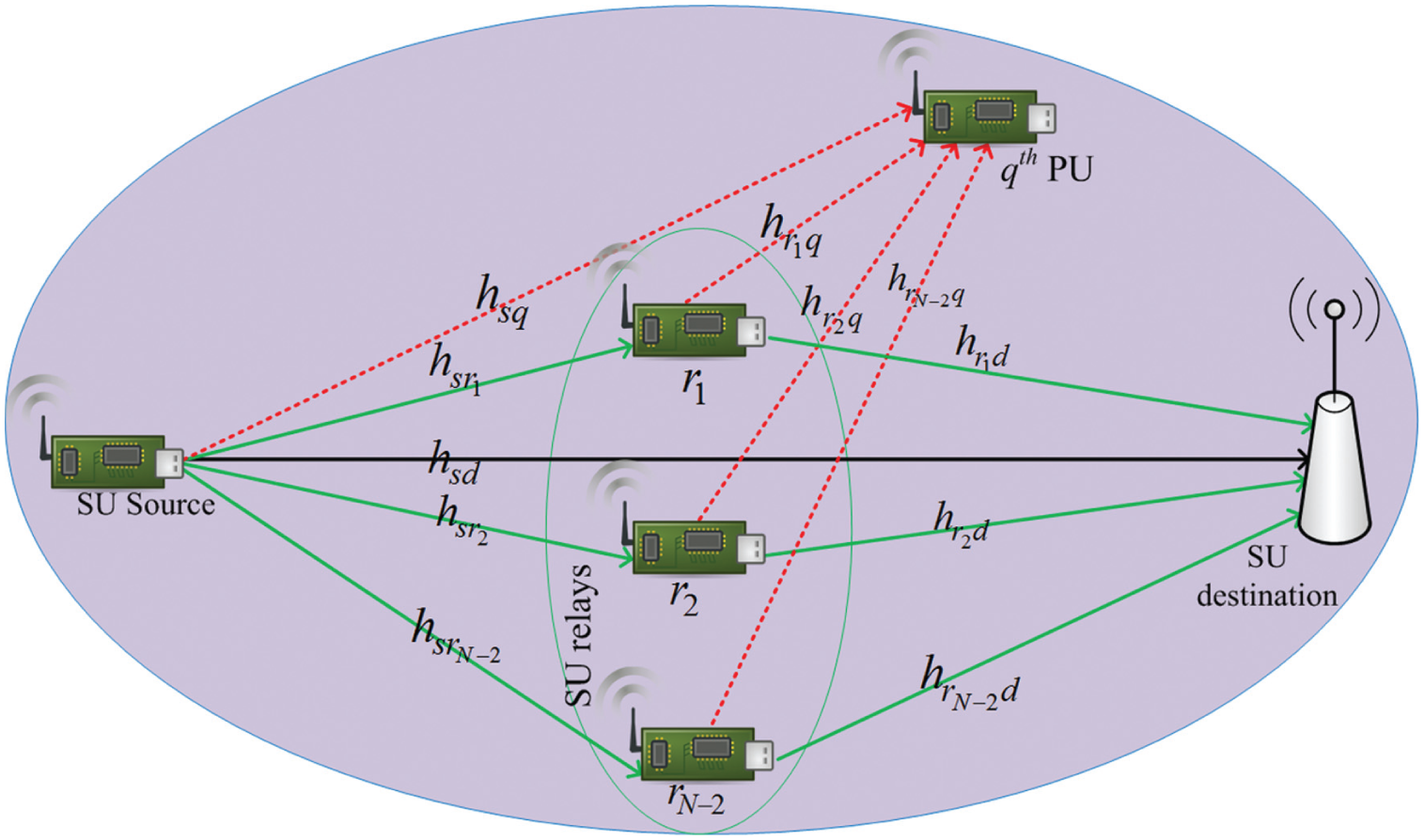
As shown in Figure 1, an underlay CCRN is taken into account, which coexists with N SUs and one PU receiver. The PU receiver is labeled as the qth PU (q = 1). The SU utilizes the spectrum of the PU under its tolerable interference. Among N SUs, one SU will be source node, and one SU will be destination node, and the other jth SUs are the SU relay node denoted as
System model.
Each SU and PU receiver is equipped with a single antenna, the SU relays forward the signal to the destination by adapting AF protocol, and the SU destination exploits the MRC to combine the signals that are received due to the direct link between the SU source and the SU destination and the relay link between the selected SU relays and the SU destination. Thus, the SU destination receives copies of signal from the SU source as well as the SU relays.
Time frame structures of the proposed MRS are composed of three phases, as shown in Figure 2, which are defined as forwarding relay set determination and transmission power assignment phase, data broadcasting phase, and data forwarding phase. At the first phase, the SU source sends an RTS for the SU destination, and after receiving an RTS from the SU source, the SU destination responds by sending a CTS back to the SU source. Due to the broadcasting nature of wireless communication, multiple SU relays can overhear an RTS and the CTS which are sent by the SU source and the SU destination. Therefore, the jth SU relay can learn the CSI of the (relay-to-destination) link by overhearing the CTS from the SU destination which helps the jth SU relay to get channel quality and further calculate the utility function. Moreover, the jth SU relay also learns the maximum transmission power of the SU source from an RTS which is sent by the SU source. The jth SU relay can calculate its own offset time based on the utility function. Consequently, the jth SU relay can send CTS sequentially to the SU source based on the offset time.

Time frame structures of the proposed multi-relay selection.
For sequential CTS, the jth SU relay can calculate the difference in capacities between the maximum and minimum transmission powers of the jth SU relay based on the interference requirement of the PU receiver and the outage capacity of the SU relay. Therefore, the jth SU relay sends CTS back to the SU source only if the difference in capacities of the jth SU relay is greater than zero; otherwise, the jth SU relay will remain silent for sending CTS back to the SU source. Moreover, the jth SU relay can calculate its offset time based on the utility function. The utility function is composed of the difference in capacities between the maximum and minimum transmission powers of the jth SU relay and the ratio of the channel gain from the jth SU relay to the SU destination and from the jth SU relay to the qth PU receiver. The SU source receives CTS sequentially from the SU relays based on the offset time. The jth SU relay with having minimum offset time will send CTS first to the SU source, and the SU source assigns transmission power to the SU relay in the time slot
The system model of the proposed MRS is shown in Figure 1, where in the data broadcasting phase, the SU source broadcasts its signal to the SU destination (black line) and the SU relays which are being selected at the first phase will receive the signal due to the broadcasting nature of the wireless communication. In our proposed scheme, the selected SU relays will amplify the received signal and forward the received signal to the SU destination through orthogonal channels as in Nicholas Laneman and colleagues.29,30 Finally, at the SU destination, all signals transmitted by the selected SU relays as well as the direct signal by the source node are combined by the maximum ratio combining (MRC) technique.
System description
Let


where
In the data broadcasting phase, the SU source broadcasts its data, and the SU destination receives the data. Let x be the transmitted data symbol from the SU source and the received signal at the SU destination due to the direct link between the SU source and the SU destination, which is given by

where
The received signal at the jth SU relay from the SU source is
We assume that,

where

The SNR from the SU source due to the direct link is expressed as follows

The SNR due to the relay link between jth SU relay and the SU destination is defined by Ray Liu et al. 31 as follows

By applying Shannon’s channel capacity theorem, the SU system capacity due to the relay link can be expressed as follows

It is known that MRC at the destination in an AF-based CCS maximizes the link SNR from the source. Therefore, we utilize MRC to combine the received signals from the SU source and from the jth SU relays. As the instantaneous SNR at the output of the MRC equals to the sum of the SNRs of the incoming signals,
31
the instantaneous SNR

The instantaneous secondary system throughput of the CCRNs by employing MRC is expressed as follows

With a fixed transmit power of the SU source, the secondary system throughput depends on the relay transmit power. Therefore, in the next section, we propose a relay selection and power assignment scheme to maximize the instantaneous secondary system throughput of the CCRNs, represented in equation (10).
The proposed timer-based MRS
At the beginning of a time slot, the SU source sends an RTS to the neighboring SU relays. Due to the broadcasting nature of wireless communication, the surrounding SU relays overhear the RTS and can detect the maximum allowable transmission power of the SU source. Therefore, the maximum allowable transmission power of the SU source under the PU receiver interference requirement can be given as follows

The maximum transmission power of each SU relay is calculated in Mietzner et al. 32 as follows

As the SU relays know the maximum transmission power of the SU source by an RTS, and the outage capacity

Let us put that

By substituting the value of

By considering the maximum allowable transmission power of each SU relay, the maximum system capacity of the jth SU relay is given by

The minimum system capacity of the jth SU relay by considering the minimum allowable transmission power each relay is given by

The capacity difference of the jth SU relay can be expressed as follows

The jth SU relay sends CTS back to the SU source only, if the capacity difference of the jth SU relay will satisfy the condition of equation (18); otherwise, the jth SU relay remains silent for transmission. As the CSI from the jth SU relay to the SU destination is obtained through the CTS of the SU destination, by applying Shannon’s channel capacity form, the ratio of the channel gain from the jth SU relay to the SU destination and from the jth SU relay to the qth PU receiver is

where
The proposed sequential power assignment
As the CTS from the jth SU relay is received at the SU source, the SU source assigns transmission power to the jth SU relay. The assigned transmission power to the jth SU relay is formulated as follows

where dp is the small given value, and

After the power assignment to the jth SU relay, the SU source broadcasts data and the selected SU relays receive the data on time slot

The stop message will be sent by the SU source to the SU relays, if the total interference by transmission power assignment is greater than the maximum interference threshold of the qth PU receiver, and the total instantaneous secondary system throughput by transmission power assignment is less than or equal to zero; otherwise, the weighting value will be increased as
Example of the proposed timer-based MRS
Figure 3 shows an operation example of the proposed timer-based MRS, where the SU source selects SU relays from its surroundings based on the interference and system capacity criteria. For example, after the

An operation example of the proposed timer-based multi-relay selection.
Energy consumption analysis
As well known, the optimal MRS, which was proposed in Choi et al., 9 requires an ES over all possible relay combinations for secondary system throughput maximization. Moreover, it requires all SU relays’ information to allocate the optimal power to the SU relays, which may increase the energy consumption in transmission.
The energy consumption of CCRN can be expressed as follows

where
Figure 4 shows the energy consumption per transmission for the optimal MRS and the proposed schemes, according to the number of SUs. Our proposed scheme has lower energy consumption than the optimal MRS, since it does not require the full information of the relays for power assignment. In contrast, the optimal MRS requires high energy consumption per transmission because it must wait for all the SU relays’ information for power assignment. Our proposed scheme has lower energy consumption than the optimal MRS because it does not require the information from all the relays for power allocation. In contrast, optimal MRS requires high energy consumption per transmission because it must wait for the information of all relays to allocate the transmission power. Therefore, the proposed scheme spends lower energy cost for MRS and power allocation than optimal MRS, which can be applicable for the future IoT.

Energy consumption per transmission according to the number of secondary users.
Simulation results
Throughout the simulations, all the channels are assumed to be Rayleigh fading. We also consider that the frequency for the large-scale propagation model is 700 MHz, the average path loss exponent 4, the maximum time threshold
For simulation comparison, we use the proposed scheme (denoted as Proposed scheme) with other schemes: optimal MRS (denoted as Optimal MRS), 9 conventional relay selection (denoted as ConventionRS scheme),12,13 and the random relay selection (denoted as RandomRS scheme). In simulation, Proposed scheme and Optimal MRS are evaluated by considering MRC at the SU destination and without MRC at the SU destination. When MRC is utilized at the SU destination, the secondary system throughput increases because it combines the signals from the direct link and from the relay link. In Optimal MRS, the relays are selected through an ES over the surroundings based on maximum SNR level of the SU relays by satisfying the interference threshold of the PU receiver. In RandomRS scheme, the SU source selects an SU relay randomly from the surroundings. ConventionRS scheme is a single best relay selection scheme, where the SU source selects one of the surrounding relay based on maximizing the minimum SNRs in the source-to-relay and the relay-to-destination links. Moreover, we compare the performance of RandomRS scheme and ConventionRS scheme with equal power allocation in Lu et al., 22 as follows

The relay selection criterion in conventional relay networks is defined in Bletsas et al. 12 and Muller and Speidel 13 as follows

Figure 5 shows the secondary system throughput performance of Proposed scheme in comparison with Optimal MRS, ConventionRS scheme, and RandomRS scheme for different values of the maximum transmission power of the SU relays when the interference threshold is 15 dBm. The secondary system throughput performance of Proposed scheme and Optimal MRS is evaluated with MRC and without MRC at the SU destination. It is observed that Proposed scheme with its much lower IC shows near-optimal throughput performance to the Optimal MRS in both situations. The secondary system throughput increases as the maximum allowable transmission power of the SU relays increases. In the high maximum transmission power region, the secondary system throughput is restricted by the interference threshold of the PU receiver. As a result, the secondary system throughput is not restrained to the maximum transmission power. Also, we can observe from Figure 4 that Proposed scheme achieves a significant secondary system throughput gain over ConventionRS scheme and RandomRS scheme with equal power allocation (EPA). RandomRS scheme shows very low secondary system throughput performance due to the randomness in relay selection.

Secondary system throughput performance according to the maximum transmission power of SU relays.
Figure 6 shows the secondary system throughput performance of Proposed scheme according to the number of candidate SU relays when the interference threshold is 10 dBm and the maximum transmit power of the SU relays is fixed at 15 dBm and compares the secondary system throughput with Optimal MRS, ConventionalRS scheme, and RandomRS scheme. We observe that the secondary system throughput increases as the number of SU relays increases. Proposed scheme with its much lower IC shows near-optimal secondary system throughput performance to Optimal MRS when compared with MRC at the SU destination and without MRC at the SU destination. Furthermore, Proposed scheme outperforms ConventionalRS scheme which selects the best relay based on the criterion in equation (25). RandomRS scheme with EPA does not provide any throughput improvement because the relay is selected randomly from the surroundings.

Secondary system throughput performance according to the number of candidate SU relays.
Figure 7 shows the secondary system throughput according to the interference threshold of the PU receiver when the maximum allowable transmission power of SU relays is 10 dBm. We observe that the secondary system throughput performance increases as the interference threshold increases. Proposed scheme achieves near-optimal secondary system throughput performance to Optimal MRS and outperforms ConventionalRS scheme and RandomRS scheme. This is reasonable because a larger interference threshold allows more transmission power to the SU relays, which can improve the secondary system throughput. RandomRS scheme shows lower secondary system throughput, whereas Proposed scheme shows near-optimal secondary system throughput to Optimal MRS in both low and high regions of interference threshold of PU receiver and outperforms ConventionalRS scheme and RandomRS scheme with EPA.
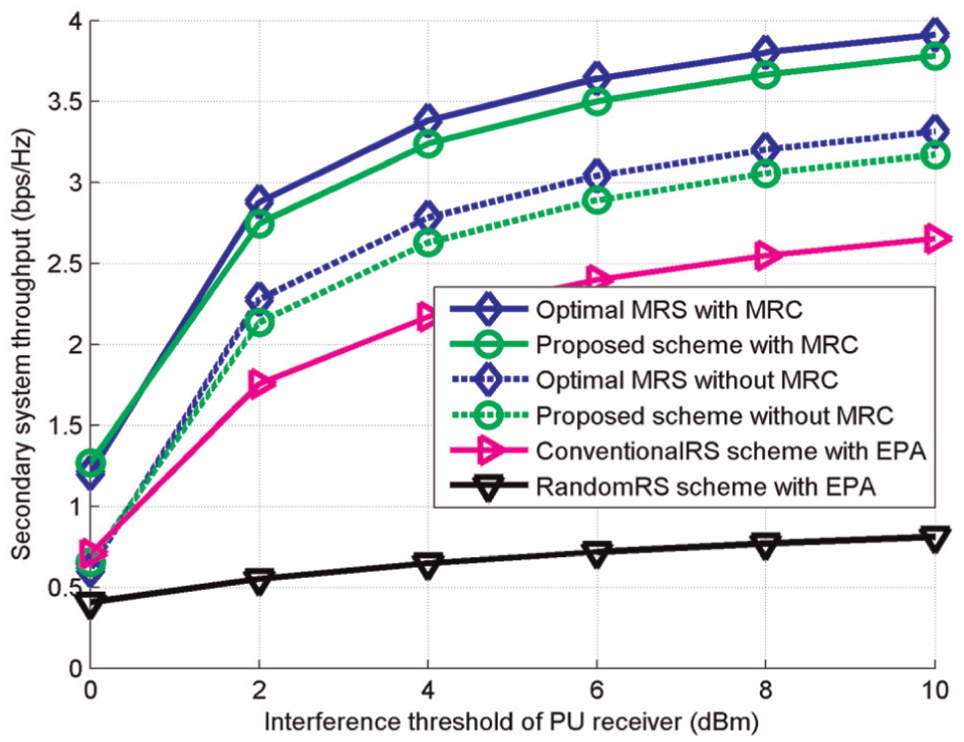
Secondary system throughput performance according to the interference threshold of the PU receiver.
Conclusion
In this article, we have proposed a relay selection and a sequential power allocation scheme to improve the secondary system throughput of CCRNs for future IoT under PU interference and SU power limitations. To maximize the secondary system throughput, we first developed timer-based MRS to create a relays’ order before the SU source starts transmitting its signal, and we then developed a sequential power assignment algorithm considering only the relays’ order for forwarding the signal to the SU destination. The optimal MRS requires ES over the surroundings, whereas our proposed scheme avoids the ES and efficiently assigns transmission power to the SU relays with lower energy consumption. By simulation, it was shown that the proposed scheme provides a near-optimal secondary system throughput performance to the optimal MRS and also provides a significant gain over conventional and random relay selection scheme with EPA.
Footnotes
Academic Editor: George P Efthymoglou
Authors’ contributions
I.K. provided the guideline to focus on issues, requiring solutions, and reviewed the overall manuscript. M.A.R. and Y.L. conceived the study, drafting the article, revising it critically for intellectual content of the whole manuscript. They reviewed the technical contribution of the work and approved the final. All authors read the full manuscript and approved for final submission.
Declaration of conflicting interests
The author(s) declared no potential conflicts of interest with respect to the research, authorship, and/or publication of this article.
Funding
This work was supported by the National Research Foundation (NRF) of Korea funded by the MEST (nos. NRF-2015R1A2A1A15053452, 2015R1D1A1A09057077). Dr Youngdoo Lee was also supported by Basic Science Research Program through the National Research Foundation (NRF) of Korea funded by the Ministry of Education (2013R1A1A2063779).