




Abstract
A modified truncated singular value decomposition method for solving ill-posed problems is presented in this paper, in which the solution has a slightly different form. Both theoretical and numerical results show that the limitations of the classical TSVD method have been overcome by the new method and very few additive computations are needed.
Introduction
The research of theories and algorithm for inverse problems is a hot topic in computational and applied mathematics. The main difficult of inverse problems is that they are usually ill-posed problems, i.e. arbitrarily small error in the input data may cause huge errors in their approximate solutions. 1 In the past years, many methods have been reported to treat the ill-posedness of inverse problems. These works mainly fall into four categories: Tikhonov regularization methods, iteration regularization methods, mollification methods, and spectral regularization methods.1,2 Because the spectrum of infinite dimensional compact operators is hard to calculate, spectral regularization method does not attract much attention in practical computation. However, in the process of computation, we have to discretize the problems into finite dimensions. And there are already quite mature algorithms for calculating the singular systems of finite dimensional operators.3,4 So the spectral regularization methods deserve further attention. In this paper, we present a modified truncated singular value decomposition (mTSVD) method, which is a kind of spectral regularization method.
We consider linear operator equations of the form



Let


The TSVD is commonly used to solve ill-posed problems. Hanson 5 have used it to solve the Fredholm integral equations of the first kind in the early stages. Hansen pointed out that the use of the TSVD has certain similarities with the use of regularization in Tikhonov form and investigated the connection between the two methods. 6 Hereafter, the TSVD method and its generalized forms are widely used in various ill-posed problems.7–12
In this paper, we present a mTSVD method. The solution with a slightly different form is used in the new method and very few additive computations are needed. We have proved that the error bound of the new method is better than the old one. Moreover, we should not worry about how to choose the parameter τ in the discrepancy principle for the new method when the smoothness of the solution is greater than
This paper is organized as follows. The new method and its convergence result are presented in the next section. Then, a theoretical comparison between the new method and the classical one is presented. Then, some numerical comparisons are given to show the advantages of the new method.
The mTSVD method
The mTSVD approximation solution of equation (3) is defined as: Let




For the mTSVD solution of equation (3), we have the following theorem:


Let

It can be verified that

From equation (10)

Moreover


In terms of equations (17), (19), (20) and (21), we have

Therefore

On other hand
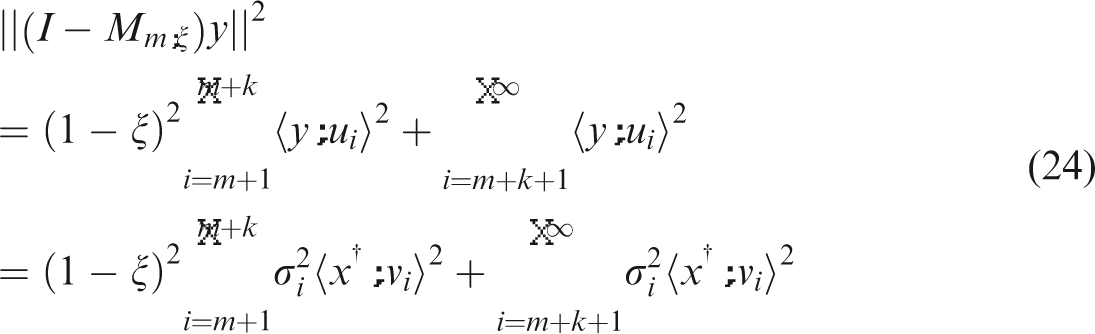
Owing to


We have

Combining equations (25) and (27) with equation (23), we have

Hence

Moreover, by using the Hólder inequality

Substituting equation (23) into equation (30), we obtain

The assertion of the theorem follows from equations (18), (29) and (31).
Theoretical comparison with the classical method
It is well known that the following theorem holds for the classical TSVD solution


1. For any

2. If

1. Note that

Hence

By using the monotonicity of exponential function

So we have

On the other hand

Therefore

The assertion of the theorem follows from equations (39) and (41).
2. For

We now estimate I1 and I2 separately. If we let


On other hand, it is obvious that

So we can get

Moreover, if

This finishes the proof of theorem 2.
Numerical comparison with the classical method
In this section, we give some numerical tests to compare the new method with the classical one. All examples are taken from the Matlab package by Hansen.
14
We take the number of nodes N = 200,

1.

2.

3.

Example 1

Example 2

The explanations of Matlab functions
From the above figures, we can see that when ϵ decreases, the relative errors of the mTSVD solution almost always become smaller but the relative errors of the classical TSVD solutionis rebound in Figures 1(a) and (b) and 2(a) to (c). So we can conclude that the mTSVD method is much stable than the classical one.
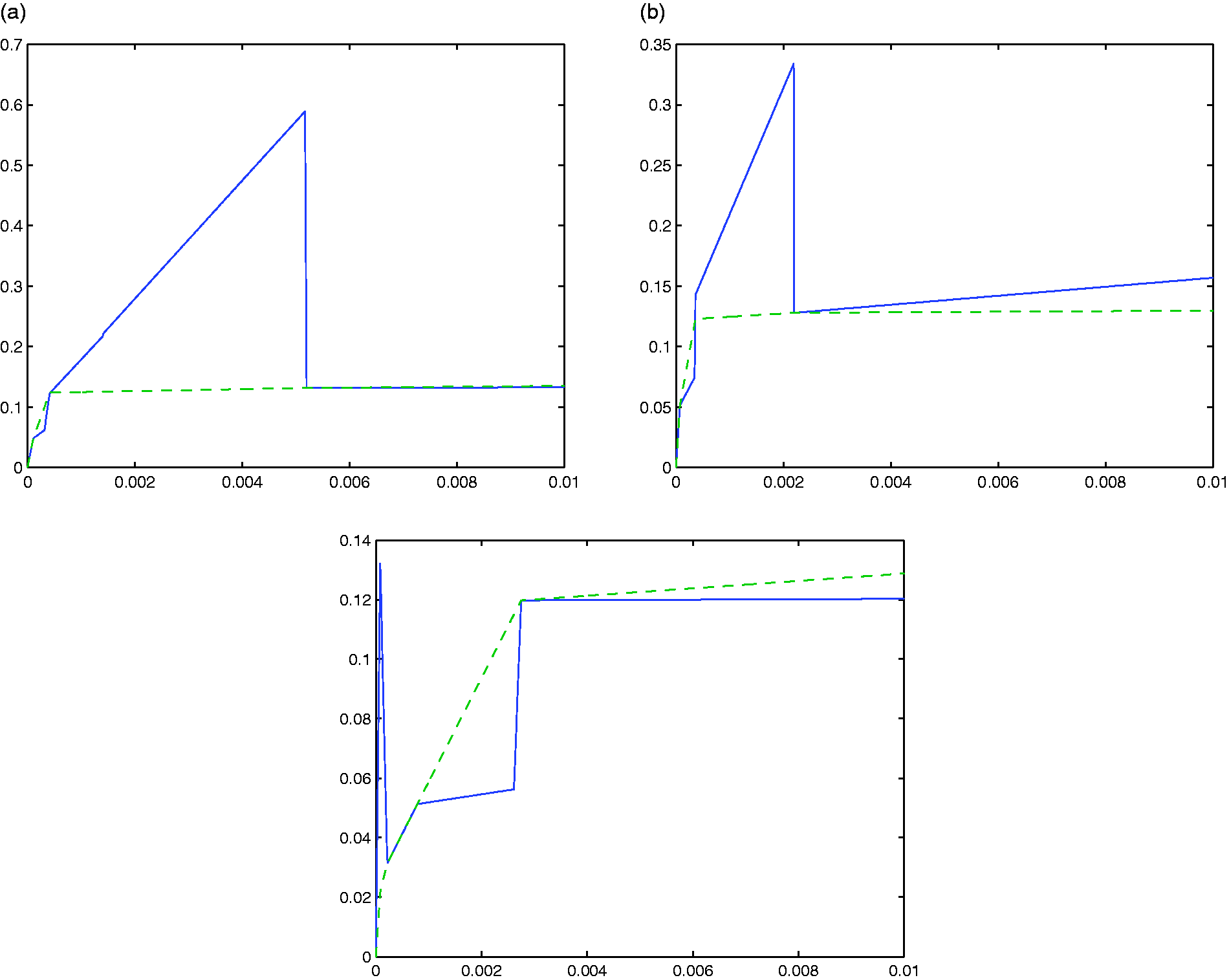
The relative errors of numerical solutions (Example 1). (a) δ1 = 0.1, α = 1.1. (b) δ1 = 0.01, α = 1.1. (c) δ1 = 0.1, α = 1.5.

The relative errors of numerical solutions (Example 2). (a) δ1 = 0.1, α = 1.1. (b) δ1 = 0.01, α = 1.1. (c) δ1 = 0.1, α = 1.5.
Conclusion
In this paper, we present a mTSVD method for solving ill-posed problems. A slight modification in form is made and very few additive computations are needed, but both theoretical and numerical results show that the new method has unique advantages than the classical one.
Footnotes
Declaration of Conflicting Interests
The author(s) declared no potential conflicts of interest with respect to the research, authorship, and/or publication of this article.
Funding
The author(s) disclosed receipt of the following financial support for the research, authorship, and/or publication of this article: The project is supported by the National Natural Science Foundation of China (No.11201085) and the project of enhancing school with innovation of Guangdong Ocean University (2016050202).