




Abstract
Finite element analysis is the most powerful tool to predict the behavior of a structure in engineering practice. Generally, the initial finite element model must be corrected with experimental data due to its complexity. Thus, it is very necessary to study a finite element model updating method with high precision and high efficiency. To this end, this article presented an improved spectral decomposition flexibility perturbation method for structural finite element model updating. The improvements of the proposed method lie in two aspects. First, using the uniform correction model, the proposed method is more economical in computation than the initial method because the spectral decomposition and reorganization of elemental stiffness matrices can be avoided. Second, using the twice singular-value-truncation method, the proposed method has better performance than the initial method in combating data noise. A beam structure is employed to demonstrate the proposed method for model updating in a noisy environment. It was found that the result obtained by least squares estimate is seriously distorted and the result obtained by the first singular value truncation is also not entirely satisfactory. Only the result obtained by the second singular value truncation is the most stable and accurate. Overall, the improved spectral decomposition flexibility perturbation method is robust and effective in small modification case, large modification case, adjacent modification case, and multiple modifications case. The proposed method may be very useful for structural finite element model updating in the noisy environment.
Introduction
The finite element model (FEM) with high accuracy is required to predict the static and dynamical behaviors of the engineering structure during analysis and design. Once a structural FEM is constructed by software, its accuracy should be verified by comparing the analytical response parameters (such as displacements, natural frequencies, and mode shapes) obtained from the FEM with those obtained from the actual structure by static or dynamical experiments. If the agreement between the two is poor, the analytical FEM should be updated so that the correlation between predictions and test results is improved. The modified FEM can then be deemed to be a better representation of the actual structure than the original analytical model and will be used to analyze the static or dynamic responses of the actual structure for future design. This process of modifying the system matrices is called as FEM updating.
One important group of FEM updating techniques is the perturbation methods (also known as the sensitivity methods). In last few decades, the perturbation methods have been widely used in model updating,1–5 damage detection,6–13 structural reanalysis,14–20 vibration control,21–25 nonlinear mechanics,26–30 and so on. The traditional perturbation techniques are all the linear approximation methods based on the series expansion (Taylor series or Neumann series). Therefore, the first-order perturbation analysis can only be used for the small variation of the perturbation parameters. When the changes of structural parameters are relatively large, the high-order perturbation analysis or the iteration scheme is usually performed. But the high-order perturbation or iteration will tremendously increase the computation effort, especially for the large-scale complicated structures. To avoid expensive computing costs, Yang31,32 proposed a new flexibility perturbation method based on matrix spectral decomposition (SD) technique recently. The basic idea of the proposed method is to decompose a structural flexibility matrix into a matrix representation of the connectivity between degrees of freedom (DOFs) and a diagonal matrix containing the magnitude information. Using spectral decomposition and reorganization, the direct relationship between the parameter variations and the flexibility perturbation can be established without any high-order analysis or iteration. According to author’s previous works, it has been shown for the statically determinate structures that the SD flexibility perturbation technique can provide the exact relationship between parameter variations and structural flexibility perturbation quantity. For the statically indeterminate structures, the SD flexibility perturbation method also has good estimate precision.
This article presents a further study of the SD flexibility perturbation method for structural FEM updating. The aim of this research is to increase the computational efficiency and accuracy of the SD flexibility perturbation method in the noisy environment. It is known that the ill-posed least square problem often arises in structural FEM updating due to the complexity of the actual engineering structure. This means that little errors in testing data may lead to very large errors in the results of model updating. The existing regularization methods33–37 can partly improve the robustness and accuracy of the solutions of the ill-posed equations, but there is still much room for improvement in the calculation accuracy and efficiency. For the FEM updating problem, the elements that need to be corrected in the FEM are often only a small minority. This particularity of FEM updating has not been considered in the previous regularization methods.33–37 In view of this, a twice singular-value-truncation (SVT) method is proposed in this article to solve the ill-posed problem existed in the SD flexibility perturbation method for structural FEM updating. The particularity of FEM updating is fully considered in the proposed procedure by removing many elements that need no modifications in the second SVT. With the help of twice SVT, the SD flexibility perturbation method can quickly achieve satisfactory results using incomplete noisy modal data. Besides, this article also puts forward a simplified SD flexibility perturbation technique in order to reduce computational effort further. By employing the uniform correction model, the computation operations of spectral decomposition and reorganization in the initial SD flexibility perturbation method can be successfully avoided. This leads to a significant reduction in the computational complexity of the proposed method. The presentation of this work is organized as follows. In section “Theoretical developments of SD flexibility perturbation,” the SD flexibility perturbation theory is briefly reviewed and then a simplified SD flexibility perturbation technique is proposed for model updating. Subsequently, the twice SVT algorithm is proposed to tackle the potential ill-conditioned least square problem in section “The twice SVT technique.” The verification of the feasibility and superiority of the developed method is illustrated in section “Numerical example” with a beam structure. The conclusions of this work are summarized in section “Conclusion.”
Theoretical developments of SD flexibility perturbation
The SD flexibility perturbation method
The SD flexibility perturbation theory provides the direct relationship between the structural parameter variations and the flexibility perturbation quantity. Central to the SD flexibility perturbation method is the spectral decomposition and reorganization of structural elemental stiffness matrices. As is well known, the global stiffness matrix K in structural FEM is a sum of the elemental stiffness matrices, that is

where
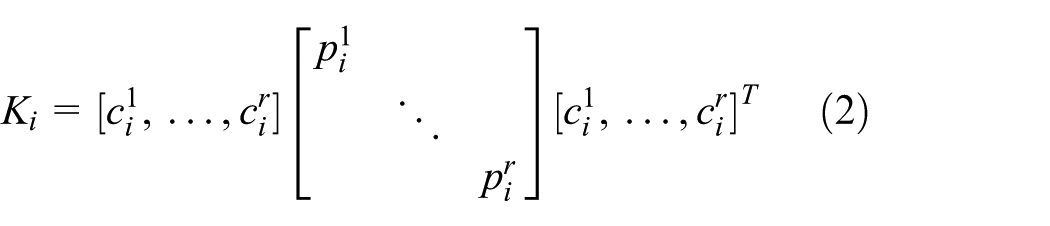
where


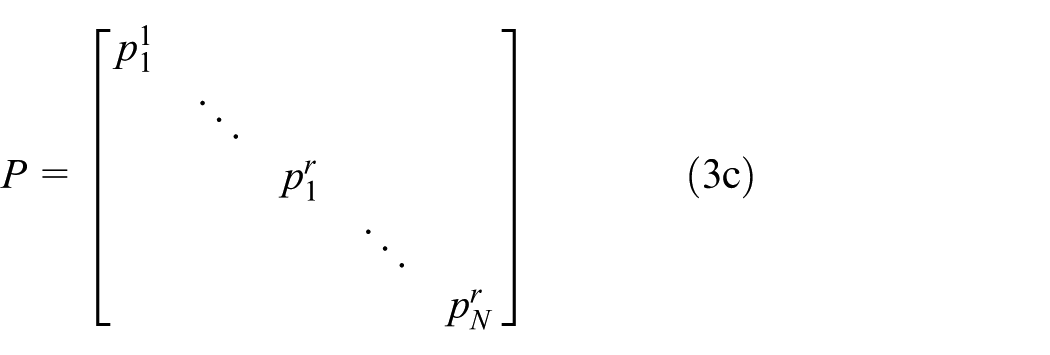
where the dimensions of the stiffness connectivity matrix C and the diagonal matrix P are

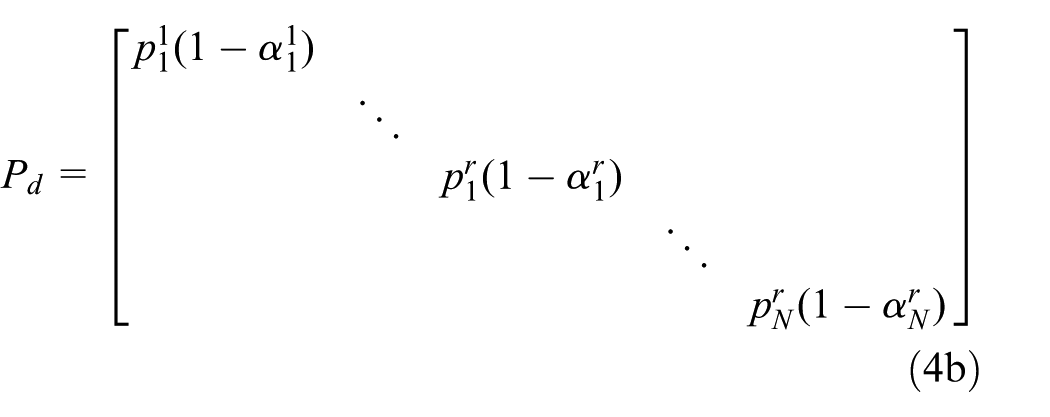
where


On the basis of equations (3) and (4), the SD flexibility perturbation theory can be established according to the interconversion of stiffness and flexibility. The next derivation should be divided into three cases:
For the case of


where F is the initial flexibility matrix and



where D is the

Equations (6) and (7) can be expressed as


Subtracting equation (12) from (13), the flexibility change




From equations (3a), (4a), (12), and (13), one can see that the stiffness and flexibility matrices have the similar decomposition formulas. From equations (5a) and (14a), the stiffness change

and

From the above derivation, the SD flexibility perturbation technique has been obtained for the statically determinate structures. That is, if the stiffness modified parameter
For the cases of


In equation (17b),


The simplified SD flexibility perturbation for the uniform correction model
As stated before, the uniform correction model will be used in this article in view of the complexity of actual structure. This means that the stiffness perturbed ratios


Equation (14a) can be further simplified for the convenience of application. From equation (14b), one has


Substituting equation (20a) into (14a) yields

Equation (21) can be rewritten as

From equations (8), (9), and (12), equation (22) can be simplified as

From equations (2), (3a), and (18b), equation (23) can be rewritten as

In addition, the relationships similar to equations (15) and (16) between

and

From equations (24)–(26), the simplified SD flexibility perturbation approach has been established. That is, if the stiffness modified parameter
The twice SVT technique
As stated before, for structural model updating, the correction factors

where
With



where

where the superscript “+” denotes the Moore–Penrose generalized inverse. According to the matrix theory, the generalized inverse of a matrix can be computed by singular value decomposition (SVD) technique. The SVD of




where U and V are the orthogonal matrices and

In most cases, the matrix

where z is the number of remained singular values. These remained singular values

where

where
Numerical example
A single span beam shown in Figure 1 is used as an example to verify the feasibility and superiority of the proposed method. The beam was modeled using 32 equal Euler–Bernoulli elements giving 64 DOFs (31 translational and 33 rotational). The physical parameters of this beam are cross-sectional area

A single span beam.
Theoretically, any correction scenario can be simulated to validate the proposed method. Without the loss of generality, four correction categories as shown in Table 1 are studied in this example. Note that these four correction cases are designed to represent the common types of FEM updating. Case 1 is designed to simulate the single small correction case. Case 2 is designed to simulate the single large correction case. Case 3 is designed to simulate the correction case of adjacent elements. Case 4 is designed to simulate the multiple corrections case. In the following discussion, the first-order frequency and mode shape are used to compute the flexibility change
Correction categories of the beam structure.

For correction case 1, Figures 2–4 present the calculation results of

The calculation results for correction case 1 obtained by LSE (no noise).

The calculation results for correction case 1 obtained by the first SVT (no noise).

The calculation results for correction case 1 obtained by the second SVT (no noise).
When 5% noise is added to the mode shape, Figures 5–7 give the calculation results obtained by LSE, the first SVT, and the second SVT. From Figure 5, one can see that LSE fails to indicate that only element 13 needs to make a modification. It has been shown that LSE is very sensitive to noise and may lead to wrong modification results. From Figures 6 and 7, the first SVT and the second SVT both have good ability to resist noise and can indicate that only element 13 needs to make a modification. Using equation (26), the correction factor

The calculation results for correction case 1 obtained by LSE (5% noise).

The calculation results for correction case 1 obtained by the first SVT (5% noise).

The calculation results for correction case 1 obtained by the second SVT (5% noise).
When 10% noise is added to the mode shape, Figures 8–10 provide the calculation results obtained by LSE, the first SVT, and the second SVT, respectively. Again, the result obtained by LSE in Figure 8 is completely distorted. The result obtained by the first SVT in Figure 9 is also not entirely satisfactory since elements 13, 14, and 17 are all identified as the elements need modifications (

The calculation results for correction case 1 obtained by LSE (10% noise).

The calculation results for correction case 1 obtained by the first SVT (10% noise).
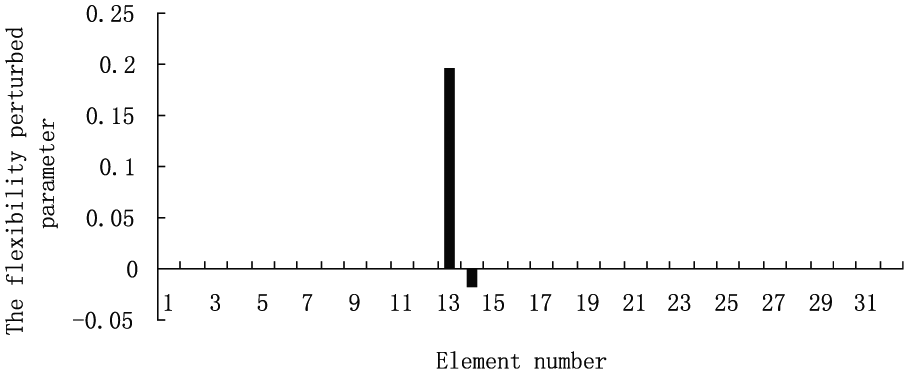
The calculation results for correction case 1 obtained by the second SVT (10% noise).
For correction case 2, Figures 11–13 present the calculation results using LSE, the first SVT, and the second SVT, respectively. Apparently, the results obtained by the second SVT are the most stable and accurate. The correction factor
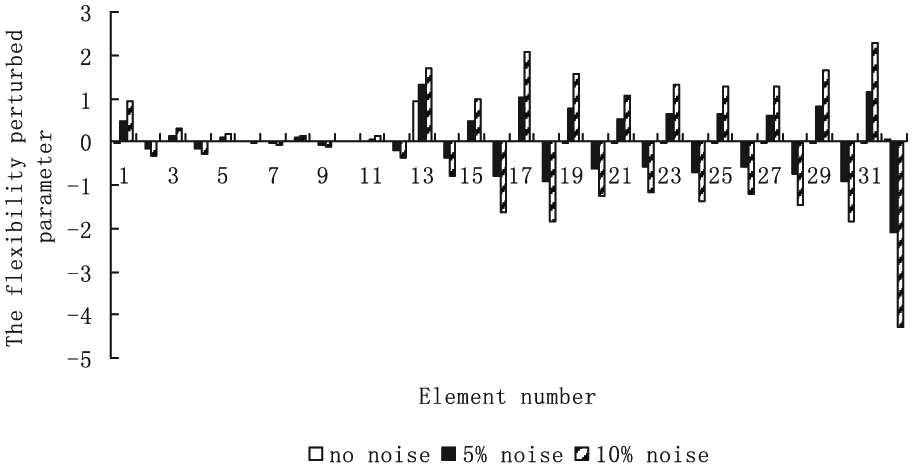
The calculation results for correction case 2 by LSE (no noise, 5% noise, and 10% noise).
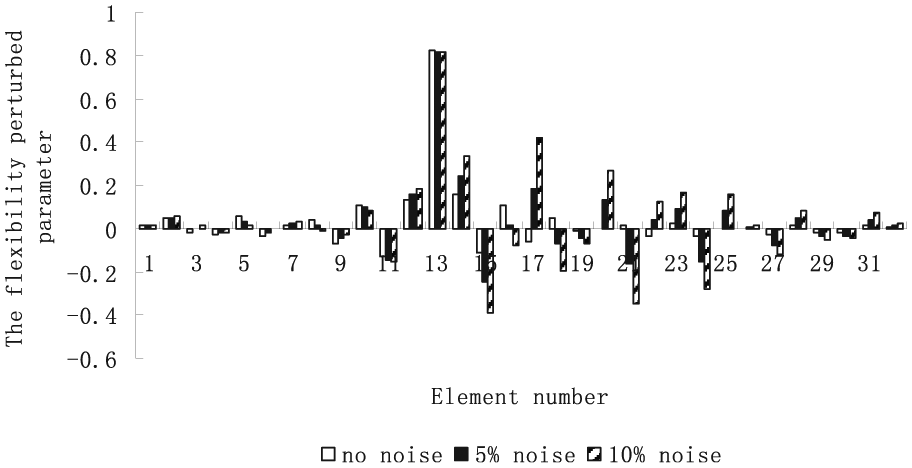
The calculation results for correction case 2 by the first SVT (no noise, 5% noise, and 10% noise).
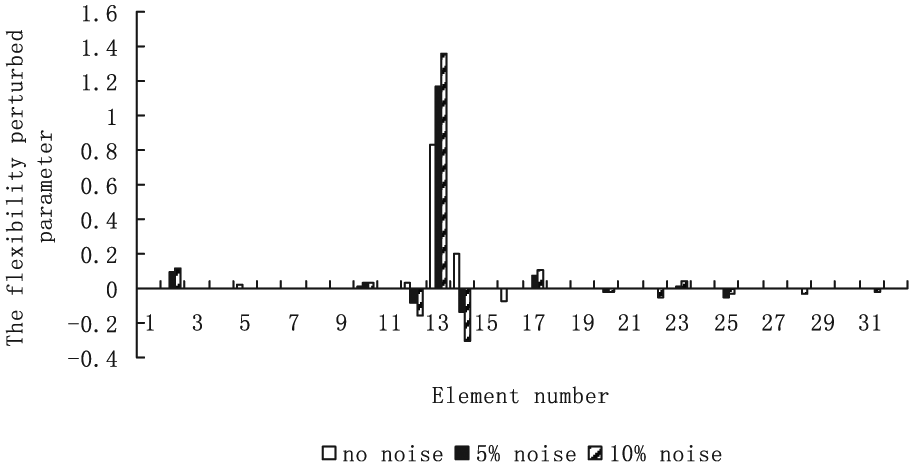
The calculation results for correction case 2 by the second SVT (no noise, 5% noise, and 10% noise).
For correction case 3, Figures 14–16 present the calculation results using LSE, the first SVT, and the second SVT, respectively. Once again, the results obtained by the second SVT are the most stable and accurate. The correction factors
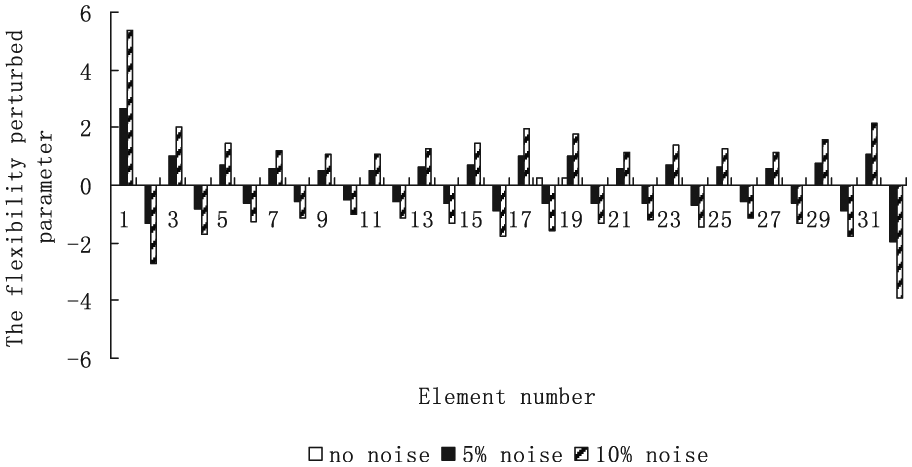
The calculation results for correction case 3 by LSE (no noise, 5% noise, and 10% noise).
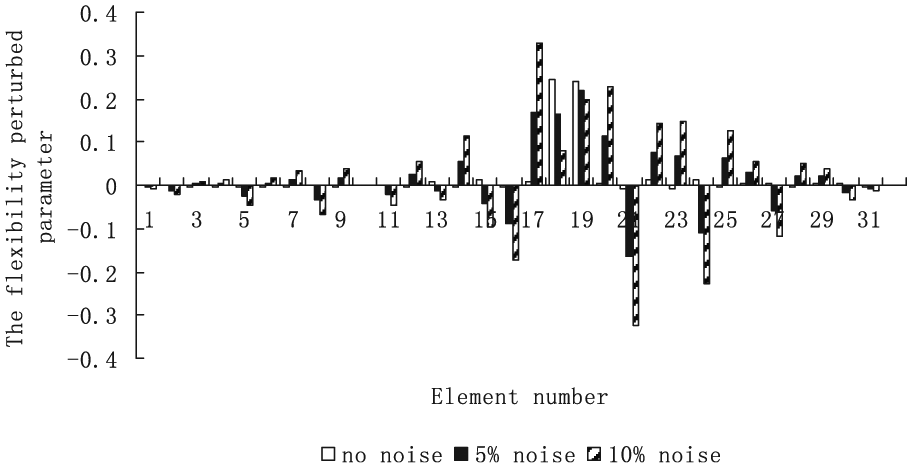
The calculation results for correction case 3 by the first SVT (no noise, 5% noise, and 10% noise).
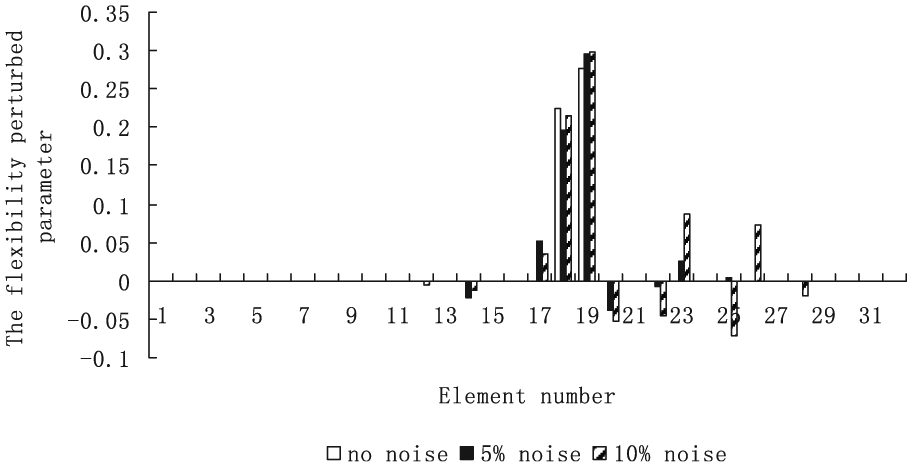
The calculation results for correction case 3 by the second SVT (no noise, 5% noise, and 10% noise).
For correction case 4, Figures 17–19 present the calculation results using LSE, the first SVT, and the second SVT, respectively. Apparently, only the results obtained by the second SVT in Figure 19 can clearly indicate that elements 7, 15, and 24 need to make modifications. The correction parameters

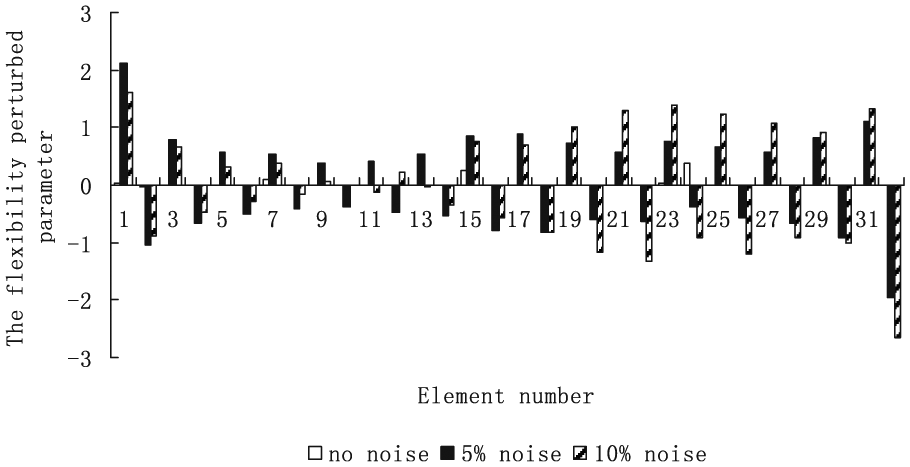
The calculation results for correction case 4 by LSE (no noise, 5% noise, and 10% noise).
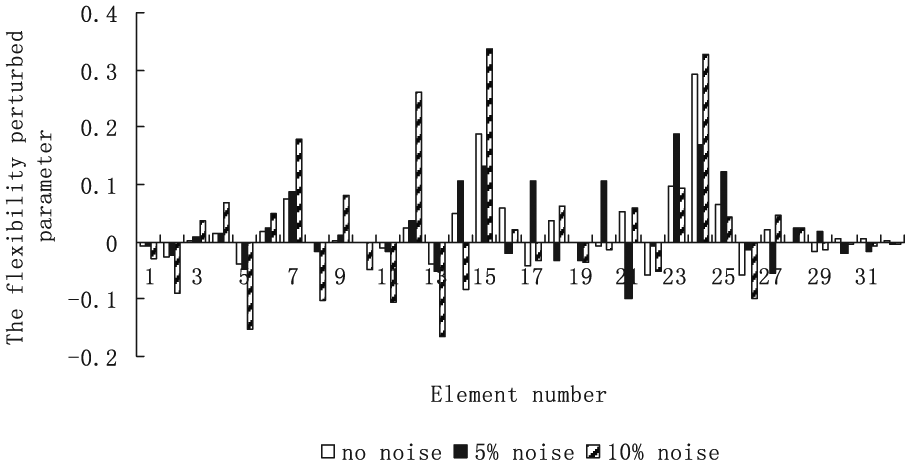
The calculation results for correction case 4 by the first SVT (no noise, 5% noise, and 10% noise).
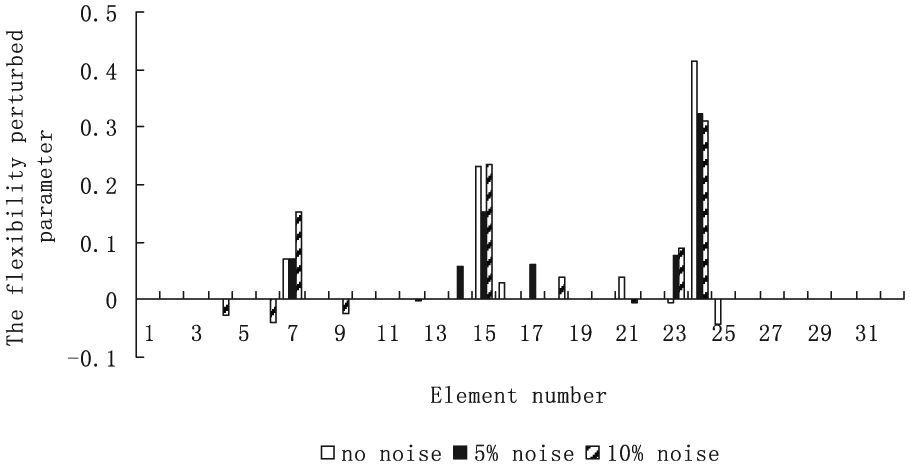
The calculation results for correction case 4 by the second SVT (no noise, 5% noise, and 10% noise).
It has been shown that the proposed method can achieve good model updating results for the multiple corrections case.
To further investigate the ability of the proposed method to resist higher noise, Figures 20–23 give the calculation results for cases 2 and 4 under 15% noise, respectively. When 15% noise is added to the mode shape, the result obtained by LSE in Figure 20 is completely distorted. The result obtained by the first SVT in Figure 21 is also not entirely satisfactory since it indicates that many elements besides element 13 need to be corrected. Only the second SVT performs well because that its result shown in Figure 21 clearly indicates that only element 13 needs to be corrected. Using equation (26), the correction parameter
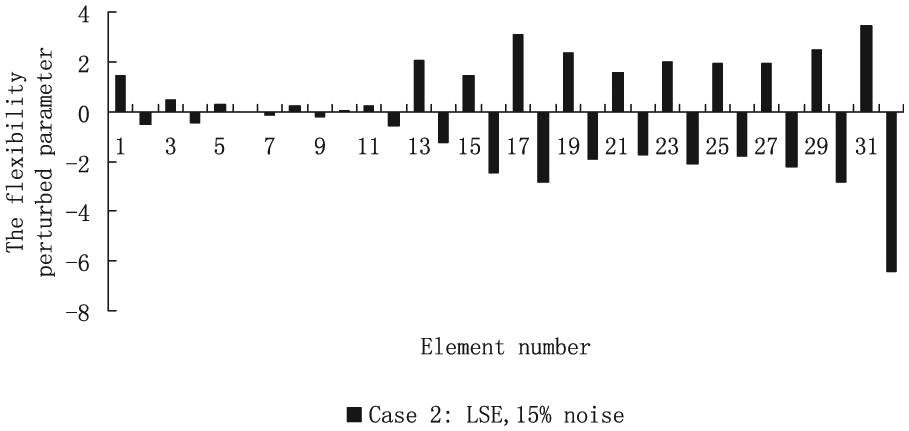
The calculation results for correction case 2 by LSE (15% noise).
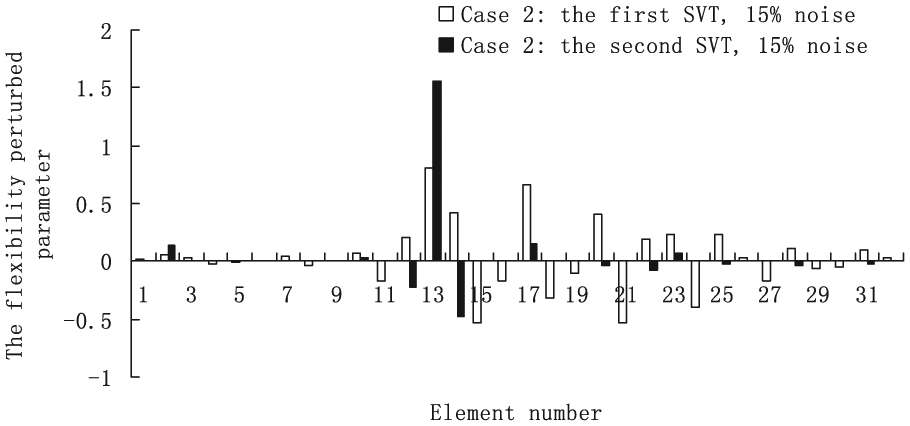
The calculation results for correction case 2 by the first and second SVTs (15% noise).
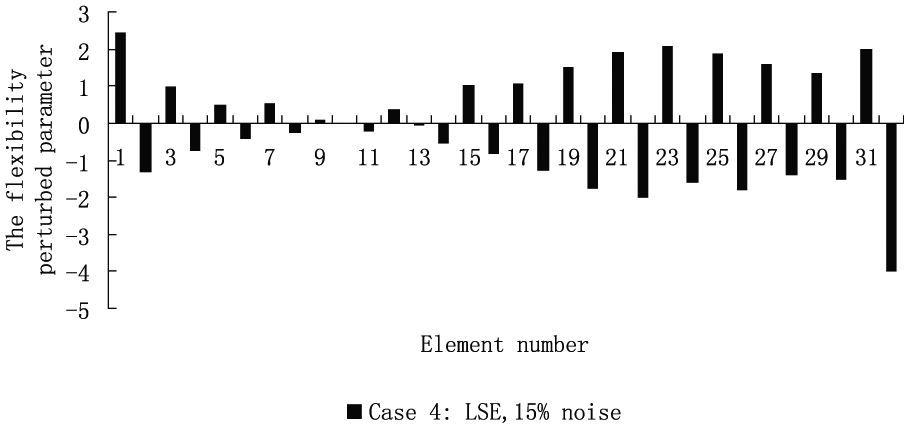
The calculation results for correction case 4 by LSE (15% noise).
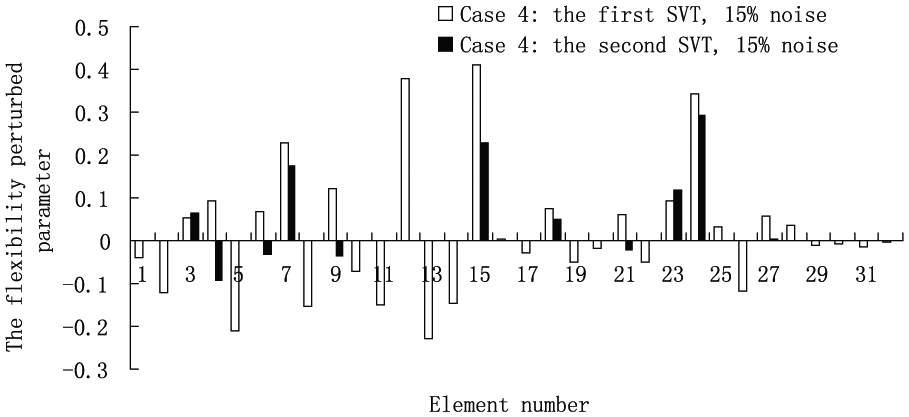
The calculation results for correction case 4 by the first and second SVTs (15% noise).
According to the above results, it has been shown that LSE is very sensitive to data noise. The reason for this is that the linear equation (28) for FEM updating has serious morbidity problem. In other words, there is stronger multicollinearity among column vectors in the coefficient matrix
Conclusion
An improved SD flexibility perturbation method for structural model updating has been developed in this study. Using the uniform correction model, the proposed method is more economical in computation than the initial method because the spectral decomposition and reorganization of elemental stiffness matrices can be avoided. Using twice SVT method, the proposed method has better performance of combating data noise. A beam structure is used as an example to validate the proposed method for model updating. The results show that the proposed method performs well in small correction case, large correction case, adjacent correction case, and multiple corrections case. It has been shown that the improved SD flexibility perturbation method could be a very promising approach for structural model updating or structural damage detection.
Footnotes
Handling Editor: MA Hariri-Ardebili
Declaration of conflicting interests
The author(s) declared no potential conflicts of interest with respect to the research, authorship, and/or publication of this article.
Funding
The author(s) disclosed receipt of the following financial support for the research, authorship, and/or publication of this article: This work was supported by the National Natural Science Foundation of China (41272345, 11202138, and 41572305).
