



Abstract
In September of 2017, two former Google employees announced the launch of a start-up in the U.S. called Bodega, a human-less convenience kiosk designed with machine learning capabilities that was named after small, neighborhood brick-and-mortar convenience stores in New York City. Using a textual analysis approach, this article explores the critical discourse that emerged on social media, blogs, and online news outlets in the aftermath the start-up's launch. It suggests that the narrative constructed about bodegas in urban communities reified a brand of multicultural urban authenticity and immigrant determination and grit. The branding of bodegas distances them from the very communities they historically served and obscures the complex realities of labor, precarity, and gentrification in New York City.
Introduction
At 2:00 a.m. in many neighborhoods in New York City, if you suddenly decide you want a bowl of cereal but are out of the necessary ingredients, you can walk downstairs or down the street to your neighborhood bodega. It is, after all, the city that never sleeps, and local grocers are there to help keep their neighbors and strangers alike stocked up on beer, coffee, sandwiches, cake mix, rolling papers, and laundry detergent while the city stays up all night. In New York, corner stores, known as bodegas, dot many of the sidewalks and street corners across the city with characteristically bright, yellow awnings announcing the availability of “cold cuts and cold beer” (Gothamist, 2014: para. 4).
The word bodega means cellar or storeroom, typically a wine cellar, in Spain. In parts of Latin America, it can also refer to a bar or restaurant. According to historian Carlos Sanabria (2016), in the 1950s and 1960s, the word bodega came to be associated with small grocery stores owned by Puerto Ricans serving the growing Latine communities in New York City, particularly the migrant population from Puerto Rico that grew significantly after World War II (Sanabria, 2016). Similar to establishments created by immigrant groups that came before, such as Jewish delis in New York City (Merwin, 2015) bodegas played a vitally important role in Puerto Rican and Latine communities; they were social gathering or community forum spaces in the neighborhood where cultural ties were maintained, and where migrant communities could access familiar foods that were otherwise hard to find (Regalado, 2016, 2020; Sanabria, 2016). They also fostered local leadership within the diasporic Puerto Rican community. Bodegas were and continue to be important sites of immigrant labor and entrepreneurship in urban communities (Sanabria, 2016). Since the mid-twentieth century, other immigrant groups have also opened and run bodegas in New York City, and the name stuck regardless of the owner's country of origin (Regalado, 2020; Sanabria, 2016).
Today, bodegas are a ubiquitous part of the cultural imaginary of the city. As this article demonstrates, they have their own mythology tied to authenticity, identity, and community in New York City. They have to come to represent a certain idea of urban authenticity propelled by narratives of hardworking (im)migrants in pursuit of the American dream – in essence, the quintessential New York City immigrant story. Vociferously supporting your local bodega becomes a form of performative politics in a progressive city like New York. It makes someone a “real” New Yorker; they are part of a community, whether a community in practice or an imagined community based on a political and collective ideal (Anderson, 1983; McBride, 2005). These are ever-evolving notions of urban authenticity, as identities shift in response to history, culture, geography, and socio-political conditions. Bodegas and their place in the popular imaginary are spaces that represent those shifting narratives and politics.
The potency of this imaginary became evident in September of 2017 when two former Google employees announced the launch of a start-up called Bodega. The “store” consisted of a human-less convenience kiosk designed with machine learning capabilities, which a headline by Fast Company said aimed to “… Make Bodegas and Mom-and-Pop Corner Stores Obsolete” (Segran, 2017). The response was loud, swift, and extremely critical. It provides an instructive case study of critical public discourse on technological disruption (Shahaf and Ferrari, 2019) and an example of the collision of the analog with the digital. More importantly for the purposes of this article, the Bodega start-up was also a disruption of the bodega's brand identity as demonstrated by the protective impulses this disruption provoked in the public response to the start-up. There was such a significant backlash to the start-up when it was first announced that by July 2018, the company rebranded itself from Bodega to Stockwell (McDonald, 2018) before eventually shutting down at the height of the COVID-19 pandemic.
In this article, I explore this notion of “disruption” of the brick-and-mortar bodega's brand through the critical discourse surrounding the launch of the Bodega start-up. Using a textual analysis approach (Brennen, 2021), I analyze the responses and critiques that emerged on social media, blogs, and online news outlets in the aftermath of the start-up's launch, how they tried to recapture the community-connected imaginary of the bodega's brand, and what the limits of these approaches are. From the outset, the company was accused of engaging in cultural appropriation and insensitivity by naming their start-up Bodega and using a cat logo, and doing so while simultaneously proposing a form of automation that puts those same institutions at risk of obsoletion. I argue that the narratives constructed in response to the Bodega start-up serve to brand bodegas as sites of racialized urban authenticity that become consumed and reproduced by writers and commentators. Following this, I analyze the ways that the critiques of the start-up reinforce notions of immigrant determination, grit, and individual uplift and largely overlook concerns regarding the material conditions of the bodega, the people who work in them, and the communities that most depend on them. I draw on Banet-Weiser's (2012) work on authenticity and branding; theories of culture, identity, and diaspora by Hall (1990, 1996); and Portwood-Stacer's (2013) concept of lifestyle politics to undergird these arguments. The branding of bodegas distances them from the very communities they were historically meant to serve and obscures the complex realities of labor, precarity, and gentrification in New York City, highlighting tensions regarding both the structures that produce the bodega and those that produce the bodega imaginary.
The launch of the start-up: (Re)branding bodegas
On September 13, 2017, Paul McDonald, a former product manager at Google, published a blog post on Medium announcing the launch of his new start-up venture called Bodega. In the blog post, McDonald shared some of the inspiration behind the creation of Bodega: In places like NYC, there's a store on nearly every corner serving local neighborhoods 24/7. “Getting to the store” is easy when it's right downstairs or next door. But not everyone has that luxury and stores aren’t always open 24 hours a day when you need them. (2017: para. 1)
McDonald and his co-founder Ashwath Rajan, another former Google employee, marketed Bodega as “the world's first autonomous store” (Stockwell, n.d.). As the above quote suggests, they created their start-up based on the perception that corner stores like the bodegas in New York City are an urban “luxury” that not everyone has access to, and they were seeking to capture its function and repackage it to make the amenity of 24/7 convenience at your doorstep more accessible for everyone. The technological innovation undergirding Bodega was the use of camera vision and machine learning programs. Consumers used the proprietary app to access the kiosk and select their items, getting charged directly through the app, which was intended to optimize the purchase experience. Machine learning purportedly served to streamline the restocking of products based on the most preferred consumer purchases at the site where the kiosk was located (Segran, 2017; Stockwell, n.d.). This data was likely to facilitate what may have been Stockwell's now unfulfilled future development, according to Parmy Olson (2017) writing for Forbes – to license the technology to large retailers and sell consumer behavioral data to the highest bidder.
At first glance, Stockwell kiosks seemed relatively benign from a technological perspective; their resemblance to what amounts to something akin to twenty-first century vending machines and their supposed conveniences facilitated people's acquiescence to their presence not just in public space, but in private space. The company's promotional video opened with an image of an empty kiosk and the words “This is a store” (Figure 1). Before consumers could be sold on Stockwell's approach to corner store-style shopping, the start-up first reframed what a “store” is, quite literally working to “disrupt” our perspective on a basic, functional, commercial space. A piece of furniture was now a store “[m]inus the whole ‘store’ thing” (Stockwell, n.d.).
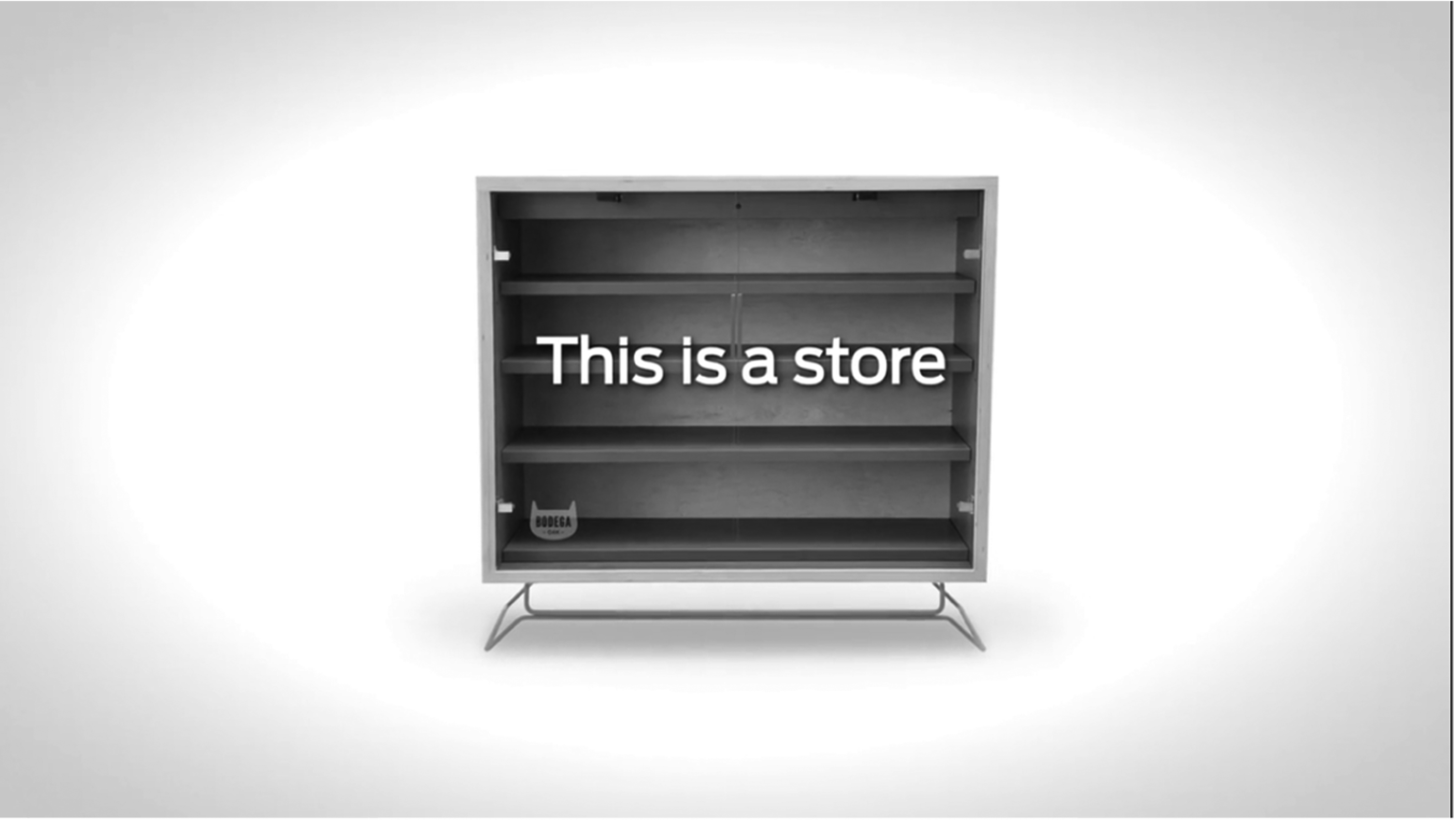
Opening image from bodega's promotional video (Stockwell, n.d.).
According to news sources, the word “bodega” was trending on Twitter on September 13, 2017, the day that Fast Company published its profile of the start-up online (Griggs, 2017; Heine, 2017). Much of the social media backlash and subsequent reporting by various sources focused explicitly on the use of the name Bodega by the start-up company, as well as the use of a cat logo, with accusations that the company engaged in a form of cultural appropriation. In the midst of the techno-deterministic panic that suggested the end of bodegas as we know it, there was a great deal of fervor over the name.
In response to the announcement of the Bodega start-up by Fast Company, many of the articles attempted to define and paint a portrait of “real” bodegas, in essence recasting or rebranding (Banet-Weiser, 2012) bodegas for its readers. The writers largely did this from their own point of view, particularly in opinion pieces, and some included personal anecdotes about their individual experiences with bodegas (Babu, 2017; Capps, 2017; Chandler, 2017; Fermoso, 2017; Kircher, 2017; O’Neil, 2017; Santiago, 2017). Whether it was a news article or opinion piece, however, in their sometimes ardent defense of bodegas, the vast majority of the articles described them in exceedingly similar ways: bodegas are almost exclusively associated with cities like New York, though some articles referenced other large U.S. cities like Los Angeles and Oakland (Fermoso, 2017; Levin, 2017); they are by and large owned and staffed by immigrants, though many articles did not venture beyond this descriptor; they offer convenient access to food, sundries, and human connection, often twenty-four hours a day, seven days a week; and as frequently mentioned in these articles, many have cats that live in the store which has captured the attention of tens of thousands of people on social media, as evidenced by the estimated 543,000 followers of Bodega Cats of Instagram (Bodega Cats of Instagram, n.d.) as of the time of this writing.
In various instances, writers attempted to define the bodega and articulate its cultural brand. According to an article by Adi Robertson in The Verge, bodegas are “known as charming local small businesses frequently staffed by adorable cats, providing a variety of minor necessities at semi-reasonable prices” (2017: para. 1). Similarly, Maya Salam and Christina Caron of The New York Times write that “bodegas are a place, often featuring a friendly neighborhood cat, to order breakfast sandwiches and coffee. A place to buy lottery tickets, cigarettes and foreign language newspapers” (2017: para. 13). The breakfast sandwich figured strongly in profiles of bodegas, reminding us how central the services and labor of bodega workers are for a particular class of urbanites. Indeed, Kate Bratskeir of Mic writes of bodegas as “typically immigrant-run and -owned, sometimes passed down through generations, bodegas are central to New York communities” (2017: para. 6). In what might be considered an ode to bodegas in Esquire, Luke O’Neil (2017) makes broader connections to the corner store and its relatives as they are known outside of New York City, but that still exemplify a form of urban ethos of on-demand goods and services when you need them: Call it a corner store, or a packy, as we do in New England, or a Korean grocery, or a deli, but each one is roughly the same: It's small, cramped, chock-full of the most insane bric-a-brac imaginable, and it's there for you when you need, well, almost anything, literally right there on the corner. It's everywhere. (para. 1)
The critiques being leveled at the Bodega start-up both by the writers of the articles themselves and by social media users on which they reported raised the question of narrative authority over the bodega's brand. Accusations of appropriation were common. When Maura Judkis (2017) writes in The Washington Post that “to think that this box of tampons and Cheez-It can replace a bodega is a fundamental misunderstanding of what a bodega is” (para. 5), the implication in this sentence and in the piece more broadly is that this writer does understand. Beyond offering a critique of Silicon Valley's latest attempt at disruption, the articles served the purpose of reinforcing narratives of what bodegas are for audiences who, quite possibly, have never set foot in one, and (self)identifying who truly understands their value. Yet, notably, relatively few articles included the perspective of current bodega owners or workers or their long-time patrons. This reveals layers of power over voice that exist in urban and immigrant narratives.
“My bodega guy”: The consumption of urban authenticity
Journalists and social media users alike expressed their indignation towards the Bodega start-up through their defense of bodegas, with statements like “don’t mess with the beloved bodega” (Salam and Caron, 2017: para. 1) and “few things make a New Yorker defensive like an assault on bodegas” (Chandler, 2017: para. 3) as prime examples. The unapologetic defense of bodegas belies a dehistoricized understanding of corner stores in New York and other cities while also celebrating a romanticized view of bodegas as primarily unique, idiosyncratic sites of authenticity and community. There is limited to no accounting of the complex material realities of immigrant labor (Hong, 2006) the twin phenomena of urban dispossession and displacement (Dantzler, 2021), and the role of racial capitalism in everything from gentrification (Rucks-Ahidiana, 2021) to supermarkets (Mayorga et al., 2022) in U.S. cities that inform the very existence and necessity of the bodega. In a decidedly neoliberal spin on solidarity (Harvey, 2005), the loudest defenders might unwittingly be contributing to the bodega's demise in more material ways than the start-up – by consuming goods from arguably bigger threats to small businesses, such as Amazon, or through their participation in the neighborhood gentrification that inevitably make rent prices unsustainable for bodega owners. The media's commentary was reserved largely for the moral panic coming from Twitter, with seemingly earnest and humorous questions like “where am I supposed to get my egg and cheese?” (Capps, 2017). In his attempt at comedic irony, Capps, writing for Bloomberg CityLab, reveals a version of class and racial consciousness that cracks the veneer of community solidarity with bodegas, their owners, and their patrons, by poking fun at items he's presumably found at a bodega that he finds amusing: Things that this startup Bodega probably won’t sell that any good corner bodega definitely sells: durags, burners, Hot Cheetos, the latest advances in synthetic drugs, votive candles, undershirts, scratch-off tickets, fake gold, fake Rolexes, fake RayBans—fake everything, really—dominoes, air fresheners, porn, malt liquor, and decent fresh coffee. (para. 25)
What Capps dismisses as a quirk is more likely reflective of the central role that bodegas have played in communities where commerce has been historically limited through structural and racialized disinvestment (Rucks-Ahidiana, 2021).
Several writers positioned themselves as consumers of authenticity through their relationship with their local bodega. There are two intertwining elements at play in the how journalists, bloggers, and social media users aligned themselves with a racialized brand of urban authenticity that bodegas represent. Drawing from Hall's (1990, 1996) analyses on the process of identification and cultural identity, the writers, perhaps migrating in and out of cities like New York, begin to identify themselves with a constructed and shifting idea of a consumable authenticity and urban cultural identity. Authenticity, in this context, functions in multiple ways for the individuals who are consuming it. As Banet-Weiser (2012: 11) argues, in this context “authenticity itself is a brand, and … ‘authentic’ spaces are branded”; bodegas serve as precisely this branded, authentic space. Beyond staking a claim on “real” bodegas on behalf of “real” New Yorkers everywhere, the overwhelmingly negative media reactions to the Bodega start-up reinforced the notion of brick-and-mortar bodegas as sites of community belonging. A piece of furniture, ostensibly, cannot replicate the valuable function of a central neighborhood establishment and unofficial hub of community connection. Importantly, immigrant narratives of progress and entrepreneurship are deeply imbricated in the affective construction of this brand identity. The relationships between and among the consumption of authenticity, community, and immigrant uplift is baked into this complex assemblage.
Immigrants keeping the dream alive
In this defense of the bodega that came in response to Stockwell, the narrative of immigrants pursuing the American dream played a starring role. In the context of a global, anti-immigrant political climate rife with xenophobic rhetoric, children being separated from their families and placed in detention centers, and images of the military and, more recently, armed militia at the U.S.-Mexico border facing off against asylum-seekers, the mere suggestion of a target on bodegas could be seen as a de facto target on immigrant-owned and run small businesses and the workers who depend on them. The resulting media narratives promoted an image of a noble, hard-working immigrant striving for “a better life” – narratives that I argue promote a neoliberal and U.S. nationalist ideal of a strong work ethic, meritocracy, and individual uplift (Anguiano and Chávez, 2011) while glossing over concerns about labor, race, and precarity.
In The Washington Post, Judkis (2017), for example, goes so far as to suggest that bodegas themselves are the very definition of the American dream, almost implying that the start-up was downright un-American because of its attempt to compete with the sort of small business on which immigrants depend to “make it” in the U.S. The theme of dreams came up frequently in association with immigrants and bodegas. Bratskeir (2017) writes in Mic that bodegas are “where immigrants with dreams for better opportunities for their families often get their start” (para. 6). Santiago (2017), writing for Mitú, declares emphatically that “bodegas are the original start up. Immigrants working hard and making something for themselves. Bringing up neighborhoods and creating community. Bodegas are already a brand” (para. 14).
In his writing on the concept of diaspora, Hall (1990) posits that cultural identities contain histories and are in constant movement because history is not static but rather dynamic; like history, cultural identities change and shift and “are subject to the continuous ‘play’ of history, culture and power” (225). What is missing from much of the media narratives around immigrants and bodegas is this movement among contexts of history, culture, and power. While Gramsci's concept of civil society alliances offers an opening for conceptualizing solidarities between immigrant bodega owners and progressive writers and critics of the Bodega start-up (Agustín and Jørgensen, 2016), their limited interrogation of racialized urban space and upholding of the nationalist project of American individual uplift limits the political potential of such an alliance.
As the analysis shows, the neoliberal narrative of hard-working immigrants chasing after dreams only locatable in a U.S. American setting potentially undermines opportunities for such an alliance in several ways. First, as previously noted, the immigrant narrative reinforces for the writers a sense of identification with a particular version of multicultural, urban authenticity. They are amused or charmed by the “bric-a-brac,” “durags,” “foreign newspapers” and “fig bars,” perhaps forgetting that for those large numbers of New York City transplants, these establishments existed, and continued to exist, by and for immigrant and cash-poor communities before their arrival because they were the main places of commerce to which community residents in certain neighborhoods, particularly communities of color, had access. This continues to be the case in urban communities across the country while they simultaneously experience what Banks (2023) evocatively refers to as “white people's magpie-like obsession with filling their lives with another's culture” (94).
Closely related, it reinforces the “nobility” of hard-working immigrants and supports the common rhetoric perpetuated that the United States is a “nation of immigrants.” While providing an important and perhaps urgent counter-narrative to the current iteration of nativist political rhetoric being deployed in the U.S., the long historical view allows us to recognize that the “nation of immigrants” story obscures an American history of settler colonialism, indigenous genocide, and forced migration whether for the purposes of chattel slavery from the African continent, or as a result of foreign policy decisions that made life dangerous or otherwise extremely precarious for generations of migrants.
Third, the bodega immigrant narrative could also be seen to reinforce a performative form of political self-representation, or what Laura Portwood-Stacer refers to as lifestyle politics (2013: 4). In other words, saying and doing those things that align with one's political affinities for the purposes of public consumption. Thus, there was not merely moral outrage at the Bodega start-up, but various performances and expressions of moral outrage on digital media platforms, where the willingness to express indignation at a Silicon Valley start-up also might serve – intentionally or unintentionally – the purpose of reinforcing who gains visibility by performing their politics in particular ways. As noted earlier, there were few mentions of the opinions of bodega workers or long-time residents, much less a broader platform offered for them to share an insider's point of view despite being at the center of the bodega discourse.
Additionally, extolling the virtues of their local bodega proprietor provides a useful comparative framing to other, one-dimensional narratives of corner stores in contexts where it is deemed necessary to justify surveillance and over-policing especially, but not exclusively, of Black residents in cash-poor communities. Finally, these immigrant narratives obscure the role of capital in pushing owners of small businesses like bodegas and their workers, often family members, to work around clock, seven days a week to eke out a living while pursuing the “American dream.”
Conclusion: The future of bodegas
In an episode of the podcast called “Still Processing” hosted by The New York Times and featuring hosts Wesley Morris and Jenna Wortham, they engage in a critical conversation about the Bodega start-up and the ensuing response (Morris and Wortham, 2017). Their conversation was a particularly incisive critique of the performative politics I referred to previously. Wortham identifies what she sees as a disconnect between the level of outrage expressed on Twitter and other mediums and the acknowledgement that everyone's complicity with Silicon Valley sets the stage for a start-up like Bodega. …I think it's worth looking at why mostly Twitter and new, newly entistled media gets extremely upset about something like this and yet has nothing to say about Nestle buying Blue Bottle. About Amazon working its way into Whole Foods. About Fresh Direct. About Instacart…You don’t get points just because you’re willing to call evil evil. You actually have to do something about it. (Morris and Wortham, 2017: 8)
Wortham gets to the crux of the issue regarding media responses to the Bodega start-up. Moral outrage functions as a form of currency that people are engaged in online, to the potential detriment of making social injustice visible and actionable. Indeed, the enthusiastic and symbolic performance of support for bodegas does not necessarily result in material changes for bodegas, the people who work in them, or the communities most dependent on them. Beyond rebranding, Stockwell did not change its approach as a result of the criticism levied against it.
The Bodega start-up was an attempt to disrupt both the bodega and the bodega's brand by engaging in a process of technological and logistical (re)structuring of urban life through the last 100 feet of the supply chain, from retail loading docks or supply delivery to the point-of-sale. Ultimately, important questions raised by the start-up controversy are about precisely how bodegas are disrupted, how the brand relates – or does not relate – to the material and social structure of the bodega, and whether this multitude can be disrupted at all. Will they become – or perhaps are they already – anachronisms, destined to be relegated to a not-too-distant future-historical imaginary of New York City or other cities in the U.S.? The responses to the start-up reveal nuances about the role that brick-and-mortar bodegas play – particularly in communities of color – that complicate concerns about Big Tech in cities. Since the mid-twentieth century, bodegas have served as cultural gathering spaces or commons for Latine migrant communities (Regalado, 2016, 2020; Sanabria, 2016). For certain Black and Latine communities in the U.S., bodega workers often engage in forms of care work (Pine, 2010, 2015) and mutual aid. I offer that bodegas have always been, and continue to be, essential to communities on the margins in ways that exceed the narratives constructed about them in the wake of the start-up.
Footnotes
Declaration of conflicting interests
The author declared no potential conflicts of interest with respect to the research, authorship, and/or publication of this article.
Funding
The author(s) disclosed receipt of the following financial support for the research, authorship, and/or publication of this article: This work was funded by University of Pennsylvania Libraries.