




Abstract
This study examines the news media’s coverage of intraregional immigration issues in three Latin American countries –Colombia, Chile, and Mexico– from 2014 to 2018, when immigration became a salient political issue in these nations. We examine the news coverage by utilizing a novel sample of approximately 20,000 news articles and relying on a Structure Topic Modelling (STM) analysis to detect the most prevalent topics in the news. Our findings reveal that policy issues and stories related to human rights constitute the primary focus of news media coverage on immigration in those countries. We also investigate whether there are differences in the coverage between legacy and non-traditional news outlets. The results show differences among traditional and non-traditional/digital-native media regarding immigrant stories, and across the three countries analyzed, different patterns of news coverage emerged. These findings advance our understanding of immigration reporting in developing democracies and shed light on the role of media in Latin America.
The intraregional migration in Latin America has gained significant attention in recent years (Cerrutti and Parrado, 2015; Garcia, 2016). This interest is driven by the region’s increasing involvement in the “globalization of migration” (De Haas et al., 2019), where developing countries have a larger share of the sending-receiving migration dynamic than in the past. For instance, the migration of millions of Venezuelans to Colombia and other nations in the region, Central Americans crossing to Mexico, and Haitians journeying down to Chile constitute a new phenomenon.
Research on news media reporting and representation of intraregional migration in the Global South, particularly in Latin America, indicates similarities and differences with news coverage of immigration in the Global North. Although the evidence is still limited, this research shows the prevalence of the humanitarian or dramatic individual narrative and the stickiness of the discourse around the “otherness” of the newcomers, but less about racial differences than national origin (Scherman and Etchegaray, 2021). In contrast, issues such as the reliance on governmental voices in shaping the narrative and political debates about the short-term policy solution to address the “crisis” originated by these migratory influxes emerge more clearly in the case of Latin America media coverage (Severino and Salas, 2022; Valenzuela-Vergara, 2019).
Research on immigration news has largely focused on traditional or legacy media, especially newspapers and television (Eberl et al., 2018). However, the emergence of non-traditional and digital-native outlets is reconfiguring the media landscape. Studies highlight some differences between these outlets and legacy media, such as tone and content strategies, with digital-native outlets prioritizing current or last-minute event stories, while traditional outlets focus more on conflict and controversy (García-Perdomo et al., 2018). In Latin America, Harlow and Salaverría (2016) show that digital-native news websites serve as alternatives to mainstream outlets, using innovative digital tools and reaching audiences typically excluded by traditional media. The characteristics of legacy media and new non-traditional news outlets in regions such as Latin America raise questions about whether immigration coverage differs between legacy and digital native media outlets.
We contribute to these discussions by examining news media coverage of intraregional migration issues in three Latin American countries: Chile, Colombia, and Mexico. Although these countries have experienced distinct migration patterns in recent years, we focus on a period when immigration became a salient issue due to the growing number of migrants arriving in these nations, driven by the political crisis in Central America and Venezuela (UNHCR, 2024). Additionally, the three countries have a mix of well-established legacy and digital-native and non-traditional media outlets. This diversity allows us to evaluate differences and similarities in media coverage among countries and news outlets.
To conduct our analysis, we gathered an original sample of more than 20,000 news stories from legacy and non-traditional news outlets in the three countries over 5 years. To classify the news, we employ a topic modeling approach. Specifically, we rely on Structural Topic Modeling (STM), a variation of the traditional LDA model that allows for incorporating metadata as covariates that help estimate the topics (Roberts et al., 2019).
Our analysis indicates important differences in the coverage of immigration issues across the three countries, with a prevalence of policy and political concerns, as well as a focus on the humanitarian or victimization approach to the reporting on immigration. Additionally, the analysis highlights relevant differences between legacy and non-traditional news outlets with idiosyncratic emphasis in each country. Taken together, these findings reveal different preferences in the coverage of migration within each country and offer insights into the role played by legacy media and non-traditional news outlets in the reporting on this issue, shedding light on recent news coverage of immigration.
These findings offer a two-fold contribution to researchers interested in comparative research. First, they allow us to examine different realities within Latin America, shedding light on how distinct media environments and migration dynamics might shape news coverage. Second, they invite a broader comparison with existing literature from the Global North. By doing so, this research offers a fresh look into the reporting of immigration in developing democracies, such as the reliance on official voices and press releases, the centrality of a policy debate, and the weak presence of race and illegality as a discourse preference in the cases analyzed for this article.
The common ways to depict immigrants and immigration in the news
The study of news representation of immigrants and immigration is extensive, particularly in the Global North. A large body of research reveals recurring trends and findings across countries (Chouliaraki and Zaborowski, 2017; Mancini et al., 2021). For instance, news media coverage in Europe and the United States often underrepresents immigrants and immigration as topics (Sui and Paul, 2017), and when reporting, news stories commonly lack immigrant voices. This situation contributes to a sense of a lack of agency from the main subject of the reporting (Thorbjørnsrud and Ustad Figenschou, 2016). Another common trend is the reliance on a “humanitarian approach,” where dramatic single-case narratives are used to portray the events (Benson, 2013). Although this narrative is a common strategy in journalism worldwide, its application to immigration coverage often intertwines with the victim representation of migrants (Somaini, 2019). By depicting migrants as passive subjects and excluding their voices, the media render them invisible and leave policymakers, politicians, and interest groups to dominate the discourse about immigration. Additionally, news media often portray migrants in connection with crime, “illegality,” violence, security concerns, and economic threats to host communities. Such portrayals are linked to increasing opposition toward migrants and can hinder their assimilation into the host society, particularly in cases of South–North migration from developing to developed nations (Eberl et al., 2018; Harris and Gruenewald, 2020).
News media in Latin America employ diverse framing strategies when covering migration, often reflecting the complexities of regional and national contexts. In the case of Chile, Scherman and Etchegaray (2021) find that the most common frames used to represent immigration are conflict and political discussion, rather than criminality. They also find preferable treatment from the press to Venezuelan nationals compared to other Latin American and Caribbean migrants. Valenzuela-Vergara (2019) suggests that Chilean newspapers create a dual image of migrants, either criminals or victims, who deserve protection from the Chilean authorities. Similarly, Venezuelans fleeing to Colombia are depicted in major national newspapers using this dual lens of victims or villains, oversimplifying the nature of a complex migration crisis (Aliaga Sáez et al., 2022). In the case of Central American migration to Mexico Severino and Salas (2022) show that Mexican newspapers portray Central Americans as victims of human rights violations and rely heavily on the official voice of the government (e.g., press releases), which highlights the “in transit” nature of these groups whose goal is to reach the United States.
Taken together, research on news media coverage of immigration, along with emerging studies on intraregional migration in Latin America, allows us to pose our first research question: RQ1: What are the most prevalent topics in immigration news reporting in three Latin American countries from 2014 to 2018?
Emerging trends in legacy versus non-traditional news in Latin America
Over the last decades, the region has seen a significant increase in digital-only and non-traditional outlets, driving major changes in journalistic practices. These outlets have emerged as disruptive actors, introducing new norms, practices, and journalistic routines (de-Lima-Santos et al., 2023). Prior research identifies differences between digital-native and legacy media (Harlow and Salaverría, 2016), including tone and content strategy (García-Perdomo et al., 2018), among others.
In Latin America, digital-native and non-traditional media have emerged as transformative forces in the media landscape. For instance, Harlow (2022) highlights how digital-native and non-traditional news media engage in public affairs, social justice, and human rights from perspectives often overlooked by legacy media. Harlow further explains that, in some cases, digital and non-legacy media adopt a more critical stance toward authorities, openly support social protests, and perceive themselves as agents of change, unafraid to take clear positions on issues affecting the public. Similarly, Salaverría et al. (2022) argues that a defining feature of these digital outlets is their focus on covering angles and topics neglected by traditional or legacy media. This feature is closely tied to their intention to counterbalance media concentration in the region and to emerge as new players contributing to investigative reporting (Trujillo and Montero, 2019).
Despite limited academic research on the role of “new” media in Latin American countries, evidence suggests that these outlets offer alternatives to traditional or legacy media. This is not only in terms of format and their use of technological innovations but also in their role as alternative disseminators of diversified content. However, less attention has been given to understanding how specific differences emerge regarding content and news topic preferences. This is significant because bridging the literature on immigration representation in news and journalism studies on non-legacy media highlights how comparative research can broaden our understanding of immigration and journalism.
Based on the emerging literature on how digital news sites are shaping the news landscape in Latin America and proposing new angles and topics in the coverage, we pose the following hypothesis:
H1: Legacy news media coverage will focus more on security, policy, and economics topics, while digital-native and non-traditional media will emphasize other topics.
Immigration in context: Chile, Colombia, and Mexico
The three Latin American nations examined in this study have experienced unprecedented influxes of immigrants over the past decade. Colombia and Mexico’s cases reflect aspects of a “refugee crisis,” marked by a sudden influx of people fleeing instability and violence in their home countries, many of whom initially seek refuge in neighboring nations (Council of Foreign Relations, 2018).
The economic and political turmoil in Venezuela created a large exodus of Venezuelan nationals to many other countries in Latin America and the world. However, initially, Colombia received millions of them in a short time. Although the border between Venezuela and Colombia is active and fluid, since 2015, the exodus of Venezuelans has become increasingly larger. For example, in 2015, 0.7 million Venezuelans were fleeing the country; by 2022, there are estimated to be more than 7 million, with close to 3 million in Colombia alone (Council of Foreign Relations, 2018; Rossiasco et al., 2023).
In the case of Mexico, the larger share of new immigrants during the period studied in this research is Central Americans from the Northern Triangle region: Guatemala, Honduras, and El Salvador, becoming a highly visible phenomenon in 2014 with the US President Barack Obama labeling it a “Humanitarian Crisis,” because this influx was characterized by unaccompanied minors and family units, which represented a shift on the demographic (single Mexican males) that crossed the US Southern border (Hiskey et al., 2016; Segob Secretaria De GobernaciónMexico, 2020). The violence in Central American countries such as Honduras, Guatemala, and El Salvador has been characterized as the main pushing factor for part of the population in these countries to journey North into Mexico and the United States (Hiskey et al., 2014).
Chile is slightly different from Colombia and Mexico because most of the new migrants are not from border nations (i.e., Peru, Bolivia, Argentina) but rather nationals from Venezuela, Haiti, and Colombia. Economic development and relative political stability during 2010- 2019 attracted immigrants to this South American country at an accelerated rate that set historical records (Doña Reveco, 2018). For instance, in 2013, immigrants in Chile represented 2.1% of the total population; by 2018, 6.9%, and in 2022, about 9% of the country’s population was immigrants (LyD Libertad y Desarrollo Chile, 2023).
Research design
Data
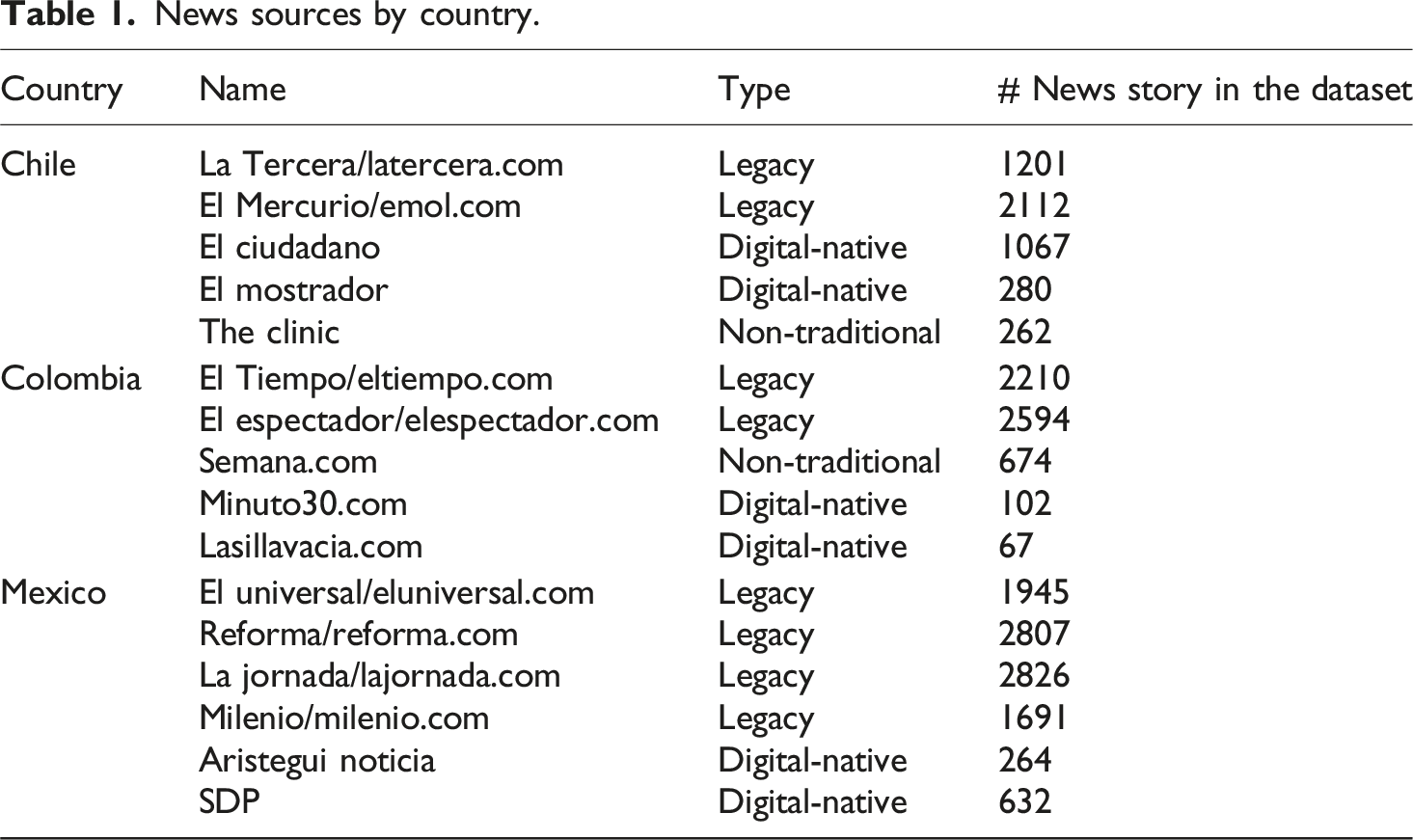
To test our hypothesis and answer our research question, we use a novel dataset that includes news articles about immigration in Chile, Mexico, and Colombia. The dataset contains around 20,000 news stories covering 5 years, from 2014 to 2018, when immigration became a salient issue in these three countries (Selee et al., 2023). In each country, the dataset contains news articles published in legacy news outlets, both in print and online formats, and in digital-native and non-traditional ones. We define legacy or traditional newspapers as those with a standing tradition in the country and that have historically dominated the print media market. We understand non-traditional news media as ones that could be digital-native and/or news media that deviate from the traditional newspaper model in content and audiences 1 . The news media were selected based on circulation, tradition, reputation, and data availability in each country.
News sources by country.
Procedure
To analyze the corpus, we conduct a topic modeling analysis. Topic modeling is a group of unsupervised methods for analyzing textual data (Blei, 2012). The main goal of topic modeling is to discover hidden patterns within a collection of documents that allow researchers to identify topics. Topics are sets of frequency distributions of words based on the probability of co-occurrence. In topic models, every word has a probability of belonging to each topic, and every document is composed of a mixture of all topics (Grimmer et al., 2022). Topic modeling is a bag-of-words model, meaning that other relevant factors in the production of texts, such as narrative, the text’s location, and syntax, are not considered when estimating the topics (Wallach, 2006). The decision to focus our analysis on topics rather than news frames is based on two arguments: (1) topic modeling methods are much more effective at identifying topics in large datasets, which would be otherwise unfeasible to analyze, and they provide valuable new insights about migration reporting in this case; (2) there is little consensus on whether framing analysis can be conducted using topic modeling approaches. For those reasons, we choose to be conservative in our claims and stick with topics instead of frames (see Eisele et al., 2023; Nicholls and Culpepper, 2021).
In this study, we employ the Structural Topic Model (STM) developed by Roberts et al. (2019). STM is a generative model of word counts that incorporates document metadata as covariates in estimating topics (e.g., date and news outlet). The metadata helps estimate the model by providing insight into how topics are discussed or how often they are discussed. Therefore, in the STM, the topical prevalence is a function of words and document metadata incorporated into the model.
Before conducting the analysis, we prepare the data following conventional procedures (see Grimmer et al., 2022). First, we tokenize words, remove numbers, stopping words and other characters. Second, we reduce the final matrix by including words with a minimum frequency threshold. Infrequent words may provide little useful information for detecting strong patterns. Removing them helps reduce the size of the matrix and decreases the estimation’s computational cost. We opt for a relatively low threshold, excluding words with fewer than 30 occurrences across all documents. We chose not to use two other standard practices -lemmatization and stemming-because they could negatively affect the stability of the topic (Mimno and Lee, 2014).
Since we are interested in identifying differences between legacy and non-traditional media outlets, we include two covariates in the estimation process: a binary variable indicating the type of media outlet (traditional vs non-traditional) and the month of the publication of news articles. We consider non-traditional outlets to be those that are digital-native, non-legacy news media, and not an online version of legacy media. We estimate separate models for the three countries considered in the analysis.
We adopted an iterative process combining a data-driven approach and human judgment to find the number of topics in the dataset. We began the estimation using a data-driven approach, using the algorithm developed by Mimmo and Lee (2014). The initial algorithm topic solution for each country ranges from 66 to 70 topics. Then, we reduced the number of topics by 10, identifying similarities between topics by carefully analyzing the proposed solutions. After several iterations, we opted to find a total of 20 topics in each country, a number that allowed us to manage the information reasonably.
To interpret and label the topics, we looked at three types of information: the words with the highest loading for each topic, the words that are both common and unique to each topic –as defined and calculated using the FREX method (see Roberts et al., 2019) –, and samples of the most representative documents of each topic based on the theta coefficient. As is common in topic modeling, the final solution for each country yields some topics that are not strictly related to immigration. As such, not all generated topics were relevant to our analysis. This probably stems from the data collection process, which was based on some keywords that captured news related to international topics, but not immigration (see Severino, 2020). We remove those topics from the analysis, yielding a different number of topics for each country. Finally, we implement the analysis of the STM using the stm package in R.
Results
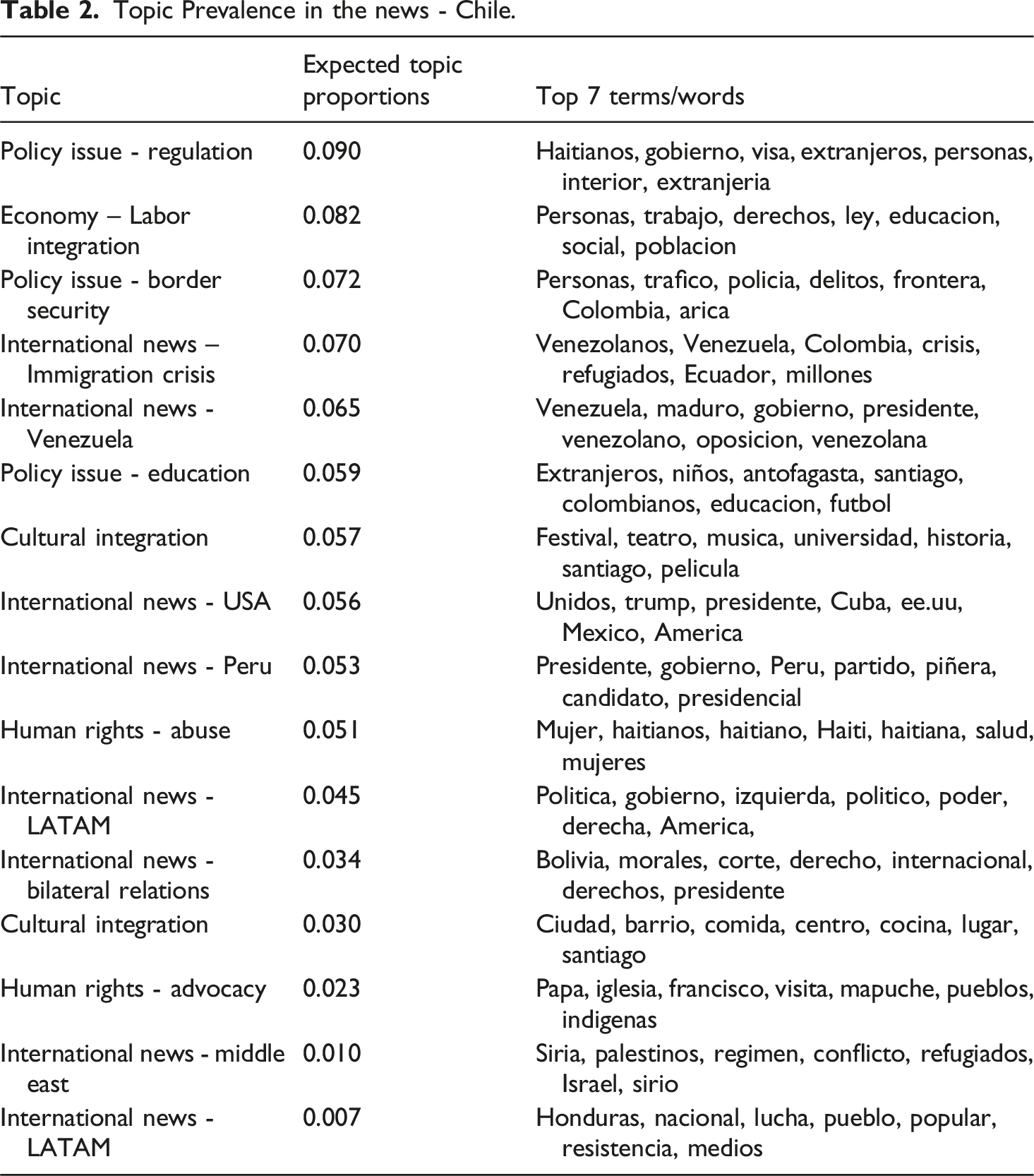
Topic Prevalence in the news - Chile.
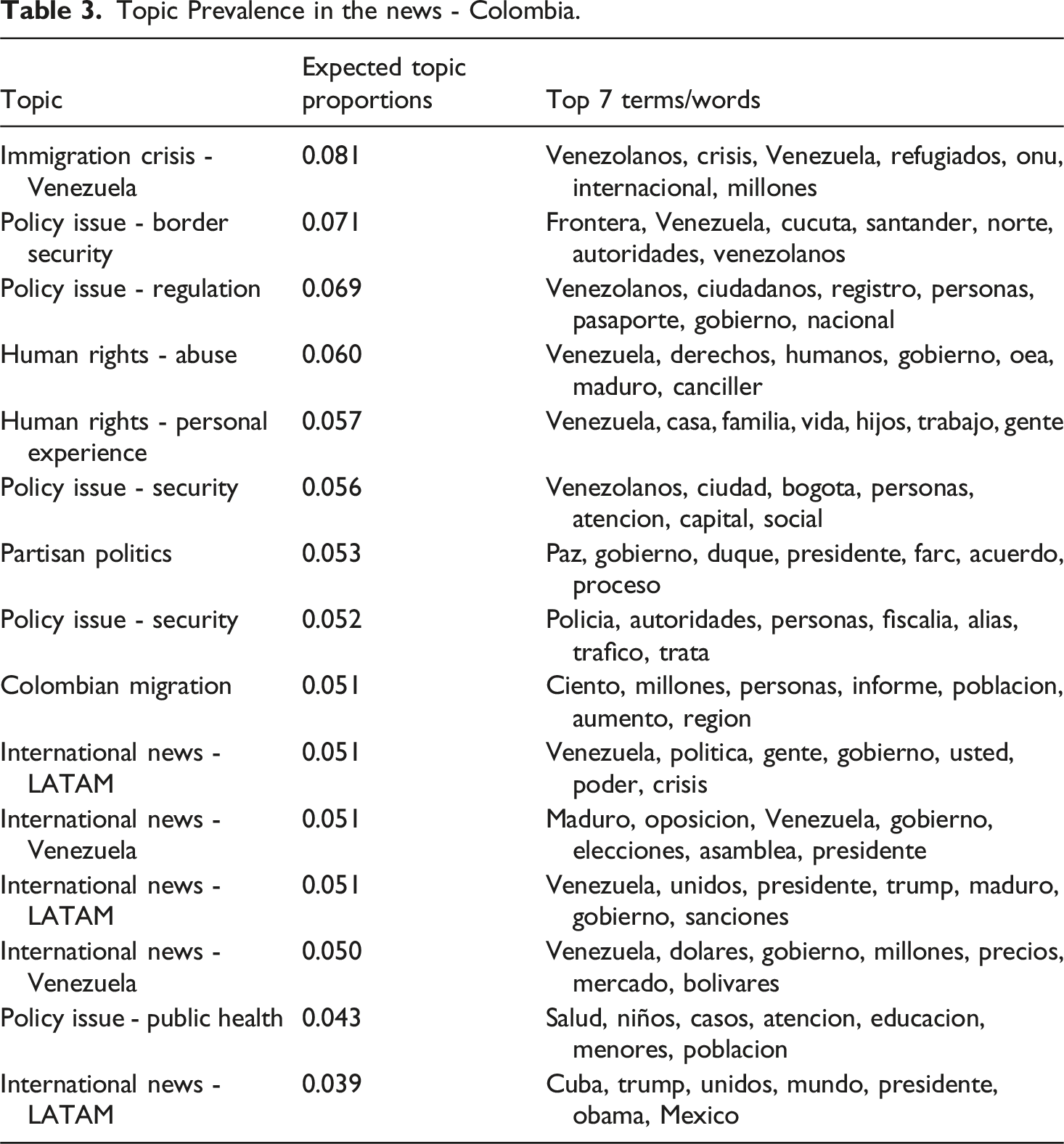
Topic Prevalence in the news - Colombia.
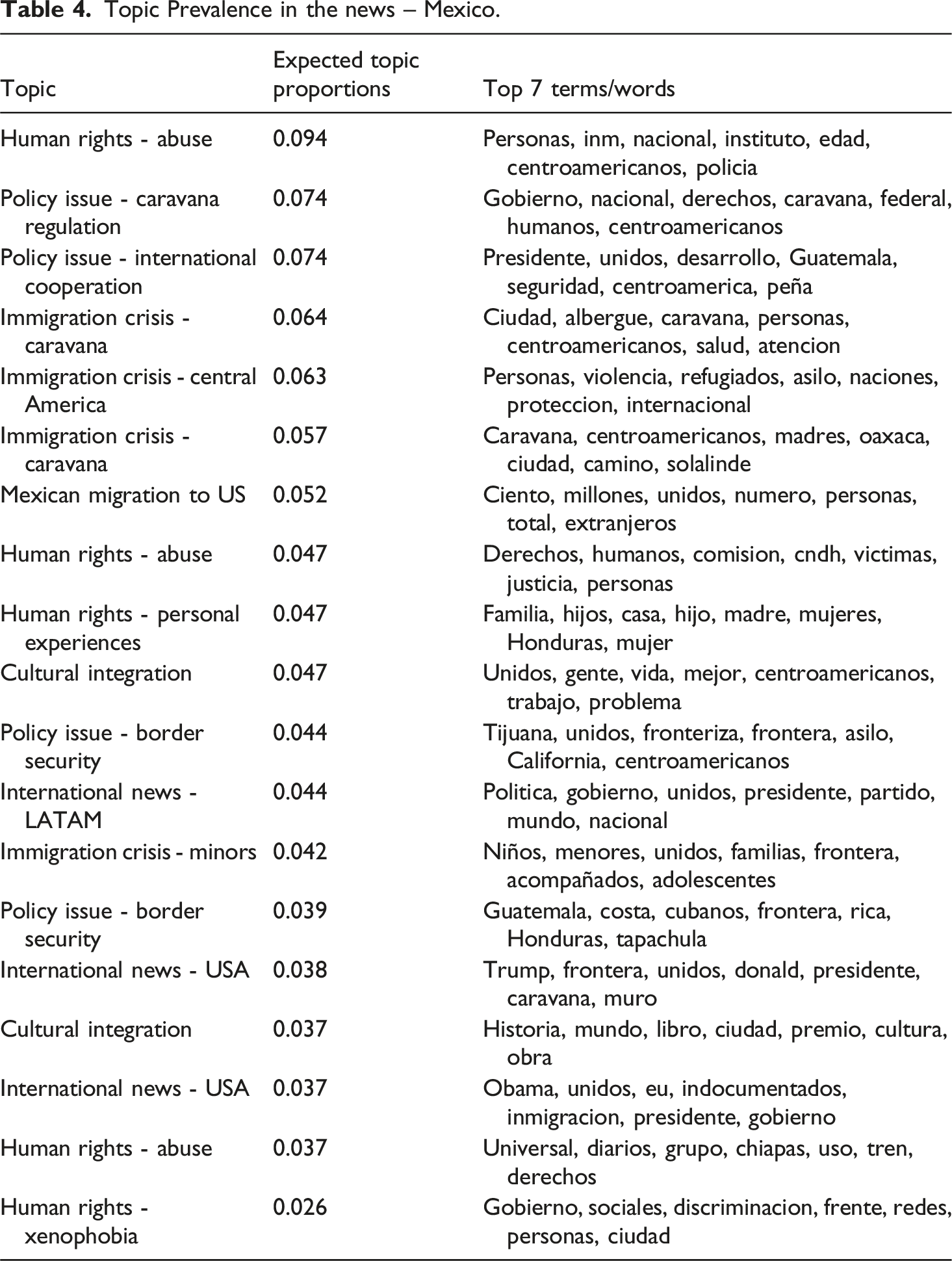
Topic Prevalence in the news – Mexico.
We begin our analysis by examining Chile. The model’s solution consists of 16 unique topics. We will focus on the five more important topics in our analysis, representing about 40% of all news included. The country’s most relevant topic refers to a policy issue, specifically policy regulation. The topic accounts for about 9% of the total news. A headline from Emol.com in Chile illustrates this type of coverage: “The steps and deadlines for the unique regularization of immigrants start today. From now on, foreigners in Chile irregularly since April 8 th last year should start the regularization process announced by the Government.” (Emol, 5/18).
The second most important topic refers to the economy, specifically integration, as evident in the relevance of words such as jobs, development, and rights. For instance, El Mostrador reports that “Foreign workers in Chile are in jobs not wanted by Chileans. Peruvians are the majority. Immigrants represent close to 2% of the workers in the country, and they are mostly concentrated in the commercial sector.” (El Mostrador 08/2016).
The third topic in importance mentions words such as persons, traffic, policy, border, and Colombia. A qualitative examination of the news articles associated with this topic suggests that this topic refers to another policy issue, specifically, border security. The fourth and fifth topics are international news reporting on the immigration crisis in Venezuela and the political situation inside Venezuela (internal politics).
Table 2 presents the 15 most important topics from Colombia. As observed, the most prevalent topic is the immigration crisis because of the Venezuelan political crisis (8.1%). A paragraph from El Tiempo provides an example of this type of coverage: “The border between Colombia and Venezuela, which had been closed for almost a year, was reopened this Saturday for pedestrian crossing, and thousands of Venezuelans crossed into the city of Cúcuta to buy food and medicine.” (El Tiempo 8/2016).
Then, like Chile, policy issues associated with border security (7.1%) and regulation of immigration (6.9%) emerge as the most relevant topics from the data, as this fragment from the newspapers shows: “[…] In an effort to restore order and avoid the situation getting out of control with the invasion of Venezuelans in a lot near the El Salitre transportation terminal, the district carried out the relocation of 38 families yesterday” (El Espectador, 11/2018). Similarly, Minuto 30 explains that “[…] The Colombian government announced that starting today, Venezuelan citizens can apply for the Border Mobility Card to enter the country temporarily on the website of Migración Colombia.” (Minuto 30, 11/2018).
The fourth and fifth topics address human rights issues, namely abuses and personal experiences of immigrants. The first five topics account for roughly 34% of all news analyzed in this sample.
Finally, Table 3 displays the 19 most important topics in Mexico. As observed, human rights abuse emerges as the most prevalent topic in the sample (9.4%) with news reporting like these: “NMI rescue 121 Central Americans crammed in a truck in Tabasco. The National Migration Institute (NMI) rescued on Thursday a group of 121 Central American migrants with symptoms of asphyxia and dehydration when they’ve been transported in a cargo truck in poor conditions on a Tabasco’s highway.” (Aristegui Noticias, 10/2016).
Two policy issues are among the top 3 topics: international cooperation initiatives to mitigate the effects of migration waves in Mexico (7.4%) and the regulation of the migrant caravan traveling from Central America to the Mexico–United States border (7.4%). The reporting is illustrated in these examples: “[…] Out of the 2697 members of the migrant caravan, 566 applied to the ‘Estás en tu Casa’ governmental program, and this Friday they received their first salary of 2262 pesos” (La Jornada, Mexico 11/2018).
Finally, the immigration crisis, originating from the caravan of Central American citizens, especially those from Guatemala, who attempted to make their way into the US, also emerged as one of the five most important topics in our sample of Mexican news. In this case, the first five topics account for approximately 37% of all news.
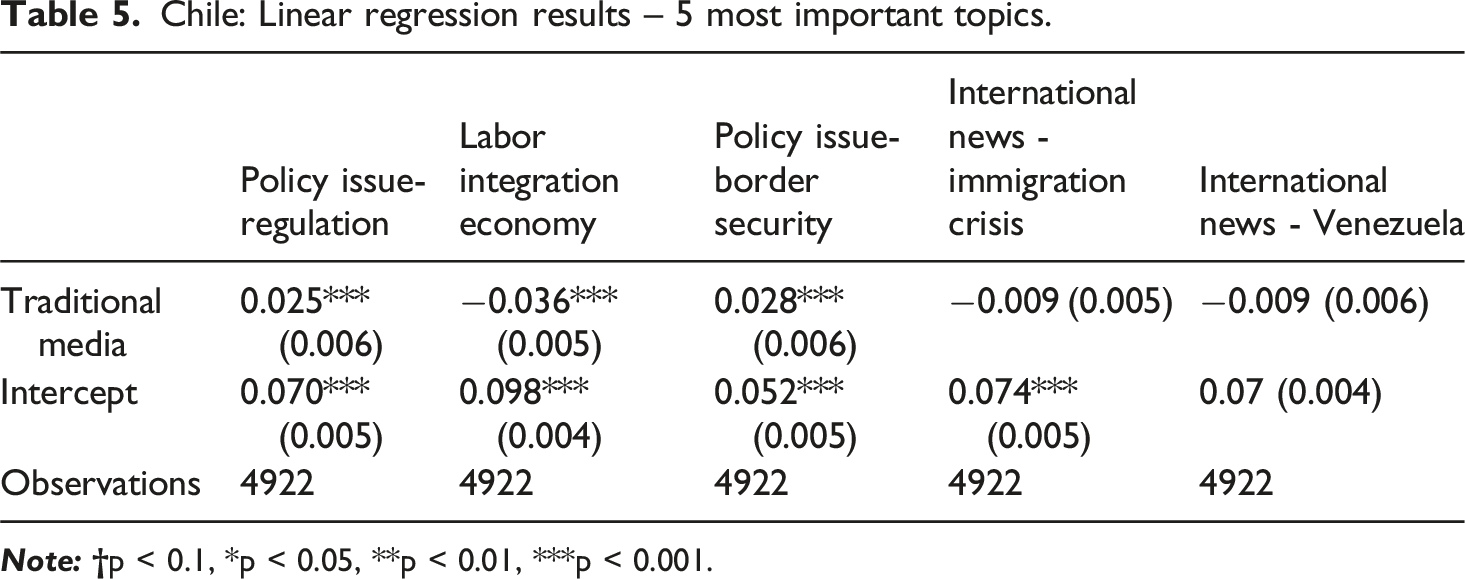
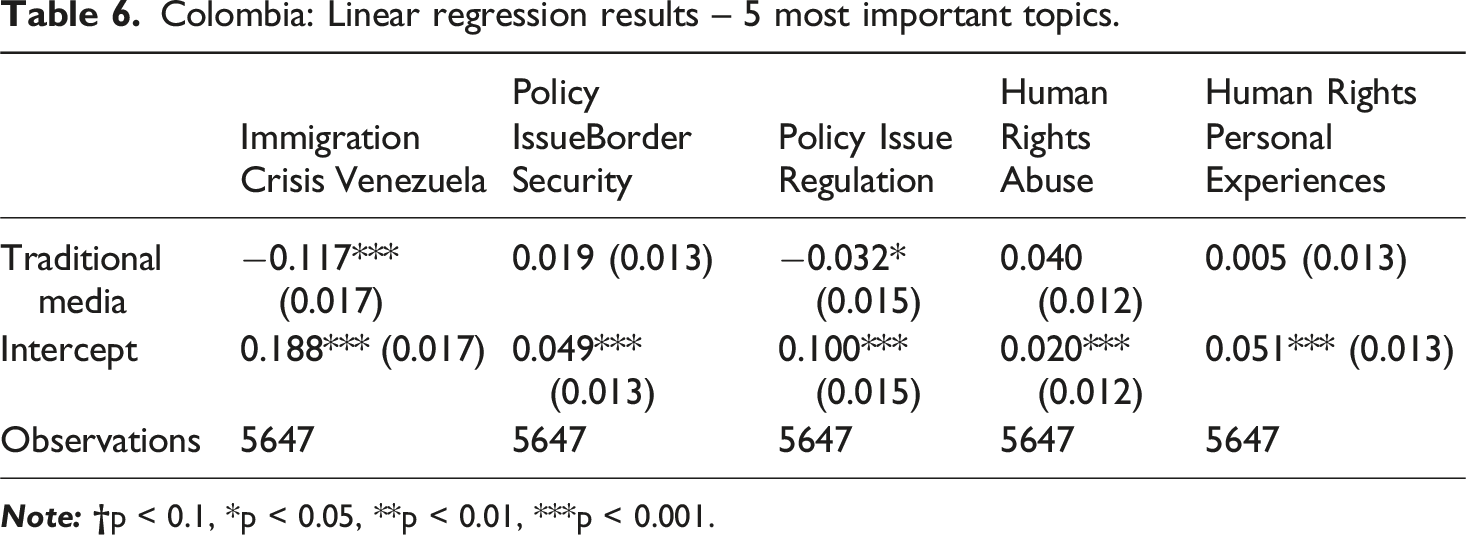
To evaluate differences in immigration coverage between legacy and digital-native/non-traditional media outlets, we conduct regression analyses. For this analysis, we focus on each country’s five most important topics. The decision to use the five more prevalent topics was made for simplicity, as they represent over one-third of the total news sample in each country, making comparisons between subgroups possible.
Chile: Linear regression results – 5 most important topics.
Colombia: Linear regression results – 5 most important topics.
Mexico: Linear regression results – 5 most important topics.
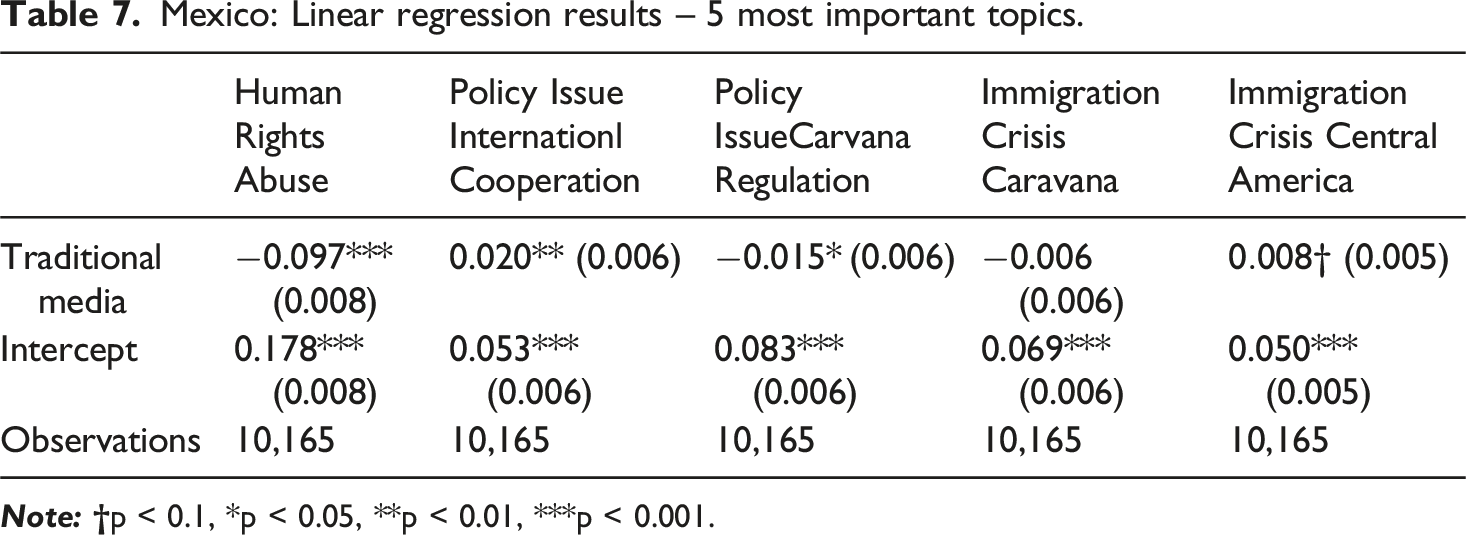
For example, the most relevant topic in the news sample, Human Rights - Abuse, shows substantial differences in the magnitude of that topic’s coverage. While non-traditional newspapers have an expected proportion of 17.8%, traditional outlets only have an expected proportion of 8.1%. In Policy Issue – Caravana Regulation, again, non-traditional media covers more of that type of news than traditional outlets. The opposite occurs when we examine the coefficients of Policy Issue - International Cooperation and Immigration Crisis – Central America. Traditional legacy media cover more such stories than non-traditional ones in both cases, although the differences between both media types are relatively small.
Discussion
The findings suggest that one of the predominant topics across the three countries is Policy Issues, although with different accents. The news reporting on this topic covers immigration with an emphasis on governmental and political voices driving the narrative on how to deal with the influx of newcomers, trying to find short-term solutions to the current situation, such as new types of visas or permits for immigrants, or the need to shelter the immigrants. Policy issues emphasizing Regulation and Border Security (e.g., Chile and Colombia) highlight news coverage with a political/partisan debate about immigration, proposing policy to face what is framed as a crisis by the news media, and the importance of regaining control and securing the borders.
Policy issue topics are prevalent in all three countries, but in the case of Mexico, there is a prominence on policy issues related to International Cooperation. The government and mainly official voices drive the narrative to allocate shared responsibility and to find collaborative solutions for the Central American migration to other countries, particularly the United States and other Central American nations. This topic highlights the nature of “in transit” migration, a narrative prevailing among the Mexican governmental discourses about the influx of Central Americans. Additionally, the Policy issue of the Migrant Caravan emerged as a predominant one in Mexico, and it is based on the executive and law enforcement measures taken to deal with the group of organized migrants coming on their journey through Mexico to reach the United States Southern border.
In Chile, for instance, policy issues on immigration address the problem of new visas for Haitian and Venezuelan populations, a measure proposed by the government and political actors to manage the influx more effectively. This policy issue is also linked with the other relevant topic of Policy Issue – Border security, which presents the immigration debate based on the importance of securing the country’s northern border. Colombia, like Chile, emerged with the same Policy issues (Border Security and Regulation), and the topic shared the news media emphasis similar to the situation in Chile: the relationship between securing the border with Venezuela and the need for temporary visas for these groups of people.
Colombian and Mexican news coverage includes topics absent in the Chilean case: Human Rights and Immigration Crisis. The Human Rights topic highlights the hardships migrants face when crossing borders, emphasizing their victimization through human rights violations and abuses committed not only by smugglers but also by governmental actors, particularly evident in Mexican coverage. The Immigration Crisis topic, present in both Colombia and Mexico, focuses on the unprecedented movement of people across borders and the urgent challenges this creates. Unlike the Policy Issues topic, which addresses political debates and proposed solutions, the Immigration Crisis topic underscores the demographic impact and immediacy of these events rather than the policy responses under discussion.
Although the topics of the Immigration Crisis and Human Rights are present in Colombia and Mexico, idiosyncratic nuances are visible. In Colombia, the Immigration Crisis -Venezuela topic is the largest one and deals in more detail with the situation in Venezuela, triggering the migratory crisis that Colombian media describe as a “refugee crisis,” echoing governmental and politicians’ voices and how the crisis advanced from the border towns to other places in the country. Furthermore, in Colombia, besides a prevalent topic addressing Human Rights -Abuses like Mexico there is a Human Rights topic emphasizing the Personal Experiences of Venezuelans crossing into Colombia. In particular, the life they are trying to build in Colombia and the one they left behind in their home country. This feature in the news reporting is different from the Human Rights – Abuses topic (the one prevalent in Mexico) that centers the narrative on the myriad violations of rights migrants experienced, which is the most prominent topic in Mexican news reporting. Additionally, in Mexico, the Immigration Crisis topic has two specific focuses: one is the Migrant Caravan, and the other is the Central Americans coming into Mexico. In both cases, the news coverage centers the narrative on the sense of urgency of the novel challenges these movements of people are creating for several institutions in Mexico and the overwhelming situation news media describe in towns receiving the migrant influx.
Other differences exist among the three countries’ most prevalent topics. For example, Chile’s second most prominent topic is economy-related, which we labeled Labor Integration. This topic addressed the role of immigrants in the labor market and the significance of this new workforce for the country’s labor composition. This topic is not prevalent in the case of Mexico or Colombia. The topic of Immigration News – Venezuela is one of the most important in Chile. It focuses on the internal Venezuelan crisis and its spillover effects on neighboring countries like Colombia, particularly the displacement of people along the border.
When compared with news coverage in the Global North, our analysis does not reveal a strong association between migration and crime, nor does it highlight “illegality,” a common frame used to depict migration and migrants in that context (Harris and Gruenewald, 2020). Additionally, the issue of race is less relevant than in the reporting of immigration in the Global North. For instance, in the case of Chile, receiving a significant influx of Black Haitians, the depiction of this group is not anchored in a racialization of this demographic. However, our findings relate to previous findings in the Global North regarding the humanitarian approach (Benson, 2013), as the Human Rights topic emerged strongly. This is also consistent with findings arising from Colombia and the victim/villain dynamic reported in previous research (Aliaga Sáez et al., 2022). Furthermore, research on news reporting of immigration in Chile shows that political debates are predominant, a pattern that aligns with the Policy Issue topic (Scherman and Etchegaray, 2021).
When examining differences in immigration news coverage between legacy and non-traditional outlets, we hypothesized that traditional media would focus more on issues of security, policy, and economics, while non-traditional outlets would emphasize alternative topics. Our findings provide partial support for this expectation. Although there are some differences between traditional and non-traditional/digital-native media, there is no clear and unique pattern. For example, traditional media covers more policy issues in Chile, while the opposite occurs in Colombia. In Mexico, it depends on the topic: whereas International Cooperation appears more in legacy outlets, another policy issue, such as Caravana Regulation, has a more significant presence in digital-native outlets.
Conversely, Chile’s non-traditional and digital-native news outlets tend to provide more information and reporting about Labor Integration and less on policy issues about Border Security and Regulation. In Mexico, non-traditional media places greater emphasis on human rights abuses than legacy media. This narrative of immigrants as victims mirrors findings from immigration patterns in the Global North. However, in Mexico, we argue that this discourse is largely shaped by official government voices, which heavily influence media coverage through press releases and varying degrees of governmental actors’ sway within the Mexican media environment (Márquez Ramírez and Guerrero, 2014).
In Colombia, the Immigration Crisis – Venezuela topic is more significant in traditional and digital-native media. This finding, although like “crisis” narratives (Heidenreich et al., 2019) that emerged in the Global North research, offers an interesting distinction because Colombia and Venezuela are neighboring nations, and the border has been fluid in the past. Additionally, Venezuelans moving into Colombia represent a South-South migration pattern. Considering this context, the “crisis” narrative about immigration remains pervasive in news reporting when influxes are a stress test for the institutional capacity of a country to receive and accommodate larger and sudden movements of people into their territory. Furthermore, as the research on digital and new media in Latin America shows (Harlow, 2022; Salaverria, 2022), the irruption of non-traditional and digital-native news media allows the emergence of topics and angles typically overlooked by legacy media (e.g., Labor Integration or Human-Rights abuses). However, our analysis suggests that non-traditional outlets might also cover immigration using topics such as policy and regulation and crisis narrative (e.g., Colombia). Nonetheless, the “new” news environment in the region makes the immigration coverage more complex and less dominated by a few actors and voices.
Conclusion
This study contributes to the literature on immigration news by analyzing a 5-year sample across three Latin American nations experiencing unprecedented influxes of newcomers within a South-South migration dynamic. In a high-choice media environment, examining granular examples of coverage is crucial to avoid overgeneralizations about news reporting, especially on sensitive, divisive, and polarizing topics like immigration.
A central finding of this study is that while similar topics emerge across Chile, Colombia, and Mexico, there are also noticeable differences. Our contribution has been to map out these similarities and differences across countries and to assess whether legacy and digital-native outlets diverge in their coverage. These patterns are somewhat surprising. While Chile, Colombia, and Mexico share broadly comparable media structures, journalistic norms, and levels of professionalization –allowing us to hold media system characteristics relatively constant–, the observed differences in immigration coverage appear more closely aligned with the specific contexts in which immigration unfolds than with media system variation. For example, Chile’s emphasis on visa regulation and border security resonates with policy responses to recent arrivals from Haiti and Venezuela, whereas Colombia’s focus on a Venezuelan “refugee crisis” reflects its proximity and historical ties with that country. Mexico’s concern with migrant caravans and international cooperation, in turn, points to its position as both a destination and a transit corridor toward the United States. While one might have expected greater similarity based on research in other settings, our results underscore important distinctions. Taken together, this research highlights the analytical value of examining immigration coverage across countries facing different migration dynamics to understand variation in immigration news reporting better. Future research can build on this comparative effort to examine more directly the underlying factors that account for such variation.
This research also examines differences in how legacy and non-traditional/digital-native media approach immigration coverage. These differences matter because variation in coverage may shape public perceptions of immigration, potentially fostering more polarized and fragmented debates in high-choice media markets, where individuals may interpret information in ways that reinforce their pre-existing beliefs. Our findings suggest that, even when digital-native outlets might be expected to depart more sharply from traditional news media agendas, they still rely on elites and official sources, portraying migration mainly through a policy and humanitarian lens. Cultural proximity to immigrants (i.e., shared language and roots) and the novelty of large-scale migration may explain the lack of emphasis on illegality and crime across outlet types. By identifying these patterns, this study highlights the importance of developing media system theory that considers the specific conditions shaping journalism in developing countries, which are facing new challenges, such as influxes of immigration. Our results call for new research that accounts for structural and professional constraints in developing countries, where journalistic autonomy and resource availability shape coverage irrespective of outlet type.
When putting our findings in dialogue with research conducted elsewhere, particularly in the Global North, we observe both convergence and divergence. Immigration coverage in these cases often centers on policy debates, crisis narratives, and a human rights perspective, aligning partially with existing literature. At the same time, large-scale, sudden migration inflows that strain state responses are more likely to be reported through humanitarian and crisis lenses than through frames emphasizing criminalization or illegality. The relatively weak emphasis on crime, race, and illegality contrasts with patterns documented in many Global North contexts. By framing immigration primarily through humanitarian and policy lenses, news in these cases may contribute to less stigmatizing portrayals of migrants. This suggests that dominant narratives in the Global North are not necessarily transferable to South–South migration contexts.
This study has some limitations that are worth mentioning. First, the number of traditional and non-traditional news outlets analyzed is limited. Although the sample includes the most influential traditional media in each country, the non-traditional/digital-only ecosystem is dynamic, and newer outlets could be included in future research. Second, we explicitly decided not to refer to topics as frames, despite the ongoing discussion on whether topics are being analyzed as such (Eisele et al., 2023; Nicholls and Culpepper, 2021). While topic modeling is a powerful unsupervised technique for identifying prevalent topics across a large number of documents, it is not well-suited for analyzing how specific concepts are employed, contested, or framed within news stories as typically conceived in the communication literature.
Despite these limitations, this study provides a clearer picture of the overarching themes in immigration coverage across outlet types and countries. We consider this a first step toward understanding recent comparative immigration coverage in Latin America. Future research should address why certain topics are emphasized, how meanings are constructed by political and social actors, and why common narratives observed in other contexts, such as linking immigration to criminality and illegality, are less prominent in these cases. Particularly in the case of crime and the use of “illegal”, we suggest that novelty and cultural proximity might be deciding factors in these journalistic decisions.
Similarly, more research is needed to explore how race is constructed by news media in the coverage of immigration across countries and outlets. Finally, extending the analysis to additional platforms, including broadcast and social media, would provide a more comprehensive understanding of how immigration is represented within the evolving media ecosystem.
Footnotes
Declaration of conflicting interests
The authors declared no potential conflicts of interest with respect to the research, authorship, and/or publication of this article.
Funding
The work of Sebastián Rivera was supported by Iniciativa Milenio (ANID) - Núcleo Milenio para el Estudio de la Política, Opinión Pública y Medios en Chile (MEPOP) (Grant NCS2024_007).
