




Abstract
Our study refers to what the communication of city networks looks like regarding mentions and frames and if the digital communication activities of city networks could primarily serve as collaborative diplomacy of governance or are motivated by self-interests such as city branding. Our theoretical frame integrates Castells’ (2010, 2009) networked society and communication power and combines various concepts from the public (digital) diplomacy, public relations, and strategic communication. In a semantic network analysis of Tweets, we analysed the communication strategies of three city networks according to their digital content (n = 47,226) and more specifically each network's top 50 hashtags and mentions therein. We find that city networks use three different Twitter communication strategies. We propose a model describing topic-, city/mayor-, and hybrid-oriented strategies. The analysis of the three city groups undertaken here has extended our knowledge of global urban governance communication strategies in burgeoning city diplomacy.
Introduction
Cities are assuming an increasingly important role on the international diplomatic stage (Acuto, 2013; Gordon, 2020), particularly by joining together in networks of cities, or city networks. City networks are defined as formalised organisations constituted by cities communicating and interacting in a mediated way, which results in collaboration, policymaking, and exchange (Acuto and Rayner, 2016; Acuto et al., 2017).
The fact that diplomacy is today no longer reserved for state actors (Melissen, 2005) may be explained by a changing social structure in recent decades. From the perspective of political economy, world urbanisation has emerged as a global trend that empowers city-level actors (Manfredi Sánchez, 2022). Indeed, cities play increasingly important economic, social, and political roles as urban agglomerations responsible for approximately 70% of global GDP. Cities are also home to the most important institutes for innovation and research and act as venues for international trade. Moreover, cities form international treaties independent of international agreements. Treaties that may impact politics and the handling of global issues resulting from today's networked risk society (Castells, 2010). One of those challenges is climate change, which served as the object of investigation in our study.
Cities are becoming ‘highly influential in the new global order by taking a lead in seemingly grey areas like climate change’ (Manfredi Sánchez and Seoane Pérez, 2021: 76). Being judged on their governance of global processes, nation-states struggle to manage the climate issue due to highly bureaucratised regulations and limited authority to act outside their national borders (Yang et al., 2017). By contrast, cities can more easily implement changes and act as ‘an open space for dialogue and a test bench’ (Manfredi Sánchez and Seoane Pérez, 2021: 58). Thus, there has been a ‘shift from power concentrated at national and state levels towards power concentrated at regional, metropolitan and city levels’ (Ye and Björner, 2018: 29).
Such new power has resulted in so-called city diplomacy. City diplomacy is generally defined as ‘institutions and processes by which cities engage in relations with actors on an international political stage with the aim of representing themselves and their interests to one another’ (van der Pluijm and Melissen, 2007: 6). That common definition offers some compelling insights. First, it highlights that city diplomacy related to processes of institutionalisation, as observable in cities’ recent creations of formal city networks. Second, it shows that the international commitment of cities not only contributes to international dialogue and collaboration but also involves self-promotion and self-interest, which shifts the discussion to linkages between public diplomacy and activities of place branding. Third and last, the definition suggests that cities’ power is chiefly based on the communication of ideas and interests (La Porte, 2013).
Despite the relevance of those three insights, the communication strategies of cities (Gumpert and Drucker, 2008) and their respective branding or diplomatic goals, especially within city networks, have hardly been studied. Therefore, in our study, we sought to investigate the roles that city networks play in digital city diplomacy and whether cities tend to use such infrastructure for self-promotion or diplomatic exchange.
In this article, to elucidate the communication of city networks, we present a basic understanding of the social and media structures and channels in which cities communicate. To that purpose, the concept of communication power and Castells’ understanding of the network society are discussed. On that basis, the different communication frames that cities use and which strategies they reflect are addressed, particularly by showing how activities of city diplomacy and city branding relate to each other. Last, by analysing the Twitter communication of the three largest city networks—C40 Cities, ICLEI, and the Global Covenant of Mayors—in semantic network analysis (SNA), we aim to offer new insights into the digital communication of city networks and city digital diplomacy.
City branding versus city (public) diplomacy
As mentioned, the common definition of city diplomacy suggests that cities’ activities of diplomacy and branding are somehow linked. Many authors have already worked to describe the relationship between nation branding and public diplomacy and how both might be integrated (Dinnie and Sevin, 2020). For instance, to develop his recent framework, Dos Santos (2021) compared the theoretical ground and activities of city diplomacy and city branding. As the broader category within which city branding falls, place branding can be defined as ‘the application of the philosophy and methods of branding to the development of cities’ (Kavaratzis, 2019: 1). Dos Santos shows that both concepts have strong synergies (e.g., both include advocacy, listening, and culture and value promotion) and that unique features of one concept can complement, enrich, and improve the other. Thus, as Ginesta and San Eugenio (2021: 642) indicated, ‘place branding and public diplomacy are spheres of knowledge in constant intersection’. For instance, whereas recent public (city) diplomacy heavily focuses on relationships, collaboration, and social responsibility (Cowan and Arsenault, 2008; Fitzpatrick, 2017), definitions of place branding put strong emphasis on competition, differentiating places from each other, and the uniqueness of each (Eshuis et al., 2014). Such place branding is particularly important in today's era of globalisation, for cities need to make themselves stand out through their communication. However, city branding today also has to consider stakeholders and the environment. Recent studies have characterised place branding not as simple visualisations or logos of places as products, as past marketing scholars did (Kotler et al., 1993), but shown that cities have their own identities, are multifaceted, have numerous stakeholders (e.g., companies, politicians, and NGOs), and need to demonstrate social responsibility and political engagement (Ginesta and San Eugenio, 2021; Kavaratzis and Ashworth, 2005). Although such social responsibility can encompass action against climate change, Kaefer (2021: 8) has highlighted that only recently have definitions of place branding and city branding been extended to include a city's ‘contribution to the global community and the well-being of our planet’. Despite the new trend of including climate change and sustainability programmes in cities’ branding strategies, very little research exists on what Wang (2019) has called ‘green city branding’. In the following sub-section, greening strategies in the context of public diplomacy and branding are discussed.
Cities’ greening strategies
The interplay between city diplomacy and city branding is particularly interesting to consider in the context of cities’ greening activities, especially within city networks. Cities are considered to be both defenders of global values such as sustainability (Leffel, 2018) and risk managers of climate change. However, cities act and collaborate in networks not only for idealistic and altruistic reasons but also for their own interests (Amiri and Kihlgren Grandi, 2021). First, at the local level, cities will continue to experience and be highly impacted by the consequences of global warming that huge urban agglomerations have been responsible for as a result of their massive share of CO2 emissions in past decades (Acuto et al., 2021; Kihlgren Grandi, 2020). Difficult living conditions in cities, including high levels of air pollution and staggering populations, are more likely to lead cities to become involved. Cities have thus an interest in not only acquiring knowledge about prospective scenarios owing to climate change but also in integrating resilience in adapting their urban structures and citizens’ behaviours.
The reasons why cities participate in green city networks and generally pursue greening strategies can be manifold (Matson et al., 2016; Pablo-Romero et al., 2015). In the spirit of the new public interest in public diplomacy, cities’ greening activities in city networks may be used to exchange best practices in combatting climate change, improving the quality of living, and/or creating international consensus on how to tackle global challenges. However, cities’ actions against climate change can also be used to develop soft power (Manfredi Sánchez, 2022) and can thus be useful in cultivating a positive city brand. Thus, as Gustavsson et al. (2009) have shown, participating in global climate networks enables cities to position and brand themselves on the global map as green cities. As a case in point, Wukich (2020) has shown that the motivation of mayors to communicate and connect with each other on Twitter is not to exchange best practices as much as to promote their cities. Therein, post-industrial cities, for example, may want to shed their images as dirty, polluted places. Cities with high unemployment rates and/or an under-exploited property market also see opportunities in pursuing sustainability and international cooperation because they hope to attract investment. However, cities may also become involved in green city networks through social and competitive pressure, such as when other cities in the region join networks and position themselves as being sustainable.
It thus seems that to gain roles of power, cities need to join networks. Such development is typical of today's network society (Castells, 2010), which is characterised by interconnections and the use of digital technologies. Indeed, a great deal of any city network's actions occurs in the digital sphere. The activities of such networks are not only limited to the organisation of summits but also include the regular production of outputs and calls to action, including on social media (Acuto and Leffel, 2021, Asdourian and Ingenhoff, 2020). Because a city's influence and success rest mainly on the communication of ideas, especially via digital technology (La Porte, 2013), city leaders have integrated multimedia and social media in their communication strategies and city branding, especially upon recognising the capacities for city branding and empowerment available, when entering into relationships with nations, and/or by positioning themselves as international exemplars of good practices on some issues.
Until now, however, very few studies have addressed the branding or diplomatic role of (digital) green city networks. According to Acuto and Rayner (2016), to fill those gaps in the research, a comparative network analysis of city networks is greatly needed in order to detect the patterns and properties of their structures and to better understand their role in the international sphere. One of the few studies dealing with that topic is Busch and Anderberg's (2015), which involved analysing different city networks’ potential for place branding. They found that city networks differ in their potential for city branding. For example, whereas the C40 Cities network has a high potential for city branding because individual members can distinguish themselves and be awarded prizes, the Covenant of Mayors exhibits only moderate potential. Although the results of their study indicate a low level of city branding in city networks, the situation was investigated only concerning cities in Germany and only by conducting content analyses of cities’ websites and interviews. Therefore, it is important to analyse city networks to a greater extent, especially in relation to social media platforms such as Twitter (Porter, 2015). Doing that, however, first requires understanding how digital city networks develop and how digital technology such as social media can be used for branding and diplomatic purposes.
Cities’ communication power in Castells’ network society
The rise of digital city diplomacy and, in particular, digital city networks and their role in climate communication is arguably best explained by Castells’ communication power theory (2009). According to Castells, power arises primarily from influencing minds that control information and communication, which is most easily achieved by exerting influence on the media agenda. In today's world, however, the media agenda encompasses more than mere legacy mass media, for globalisation and digitisation have not only made transportation and trade transnational but also changed communication systems worldwide. Today's society, which Castells (2010: 3) terms the network society, is ‘a society whose social structure is made of networks powered by microelectronics-based information and communication technologies’. The social web is the best example of the realisation of that interconnected society, where the public sphere is formed by ‘many-to-many configurations’ (Bjola et al., 2020: 406). The internet and the technology of Web 2.0 and higher are forming ‘mass self-communication’ (Castells, 2009: 65), which combines mass communication (i.e., the potential to reach a global audience) and self-communication (i.e., the self-selection of content and how it is posted and directed). Castells describes that new virtual sphere as a ‘space of flows’, which is built around the exchange of information in many informal networks related to different topics such as finance, the economy, and/or, in our case, climate protection.
The new type of communication described enhances opportunities for social change and action in society. In those ways, it is possible for non-state actors, both international and national and including cities, to shape international discourse by communicating using digital technology with low costs of access, including social media (Chariatte and Ingenhoff, 2021). In doing so, cities and their mayors can gain power by spreading information and interacting with various stakeholders such as international organisations, (local) governments, NGOs, and companies (Acuto, 2013; Bjola et al., 2020; Stren and Friendly, 2019).
Because today's society is built around networks, power comes from gaining control over those networks. As a consequence, the success of city diplomacy and branding is less about international laws and foreign policies than about selecting appropriate new digital information and communication technologies and communication strategies (Manfredi Sánchez and Seoane Pérez, 2021) in today's networked world. According to Castells (2009), such efforts include first being part of the networks, or at least not being excluded from them (i.e., networking power), and helping to shape the content of the networks (i.e., network-making power). Those two aspects are defined in the following sub-sections.
Building city networks as a strategic communication tool in digital diplomacy
Regarding networking power, Castells, whose work is particularly interested in the influence of non-state actors on political processes, has posited that dominant political agendas may be challenged by insurgent political actors who intervene in existing networks or build their own networks around an issue to give it attention. In the digital sphere, for instance, cities need to take advantage of the co-creational and interactive characteristics of social media to shape the discourse of digital diplomacy (Dinnie and Sevin, 2020). Along those lines, public digital diplomacy today should be understood as a ‘strategy of managing change through digital tools and virtual collaboration’ (Holmes, 2015: 15). In the context of city diplomacy, that conceptualisation goes hand in hand with the building of city networks. If cities have a long history of collaboration (e.g., long-term partnership) between two communities in two countries, then they have increasingly joined forces in recent years, formed networks, and become institutionalised in order to gain influence internationally. Especially regarding climate issues, city governments and mayors have begun establishing networked global city governance (Pejic and Acuto, 2021). That trend is especially relevant for small and midsized cities, which do not have enough influence on their own. Even so, through their connections and collaboration online, they can gain international visibility.
Framing power of cities (networks) through digital affordances
As part of networks, cities use network characteristics to create relationships to distribute their messages. That dynamic refers to network-making power, which refers to shaping the content and the agenda in communication networks. Per the logic of digital media, and social media in particular, it means that diplomatic actors may use common affordances such as hashtags and mentions to magnify and expand the reach of their content (Collins et al., 2019).
On the one hand, mentions are fruitful affordances that offer insights into the network structure and who is connecting and interacting with whom and to what extent (Strauss et al., 2015). Mentions showcase who the major players are in the climate discourse of city networks and reveal which type of actors are involved in the networks (e.g., nations, cities, regions, NGOs, and/or associations). On the other hand, hashtags are used to classify messages. They provide an index of topics discussed in digital media with the capability to ‘shape the collective mood’ (Postill and Pink, 2012: 10) and the ability to ‘mark key phrases for searchability’ (Foust and Hoyt, 2018: 42). Examining the use and the co-occurrence of hashtags provides interesting insights into the framing and prominence of topics (Bjola et al., 2020; Chang, 2010). Hashtags, initially proposed by Twitter, are inscribed in the participatory culture (Jenkins, 2006), in which they promote the communicative and creative activities of organisations, social movements, and citizens. The affordance allows deciding which topics have to be highlighted and disseminated in conversations on digital media.
Common frames, understood as ‘organizing principles that are socially shared […] over time […] to meaningfully structure the social world’ (Carter, 2013, p.1), in communication about the risks of climate change are diagnostic, prognostic, and motivational frames that respectively highlight issues, solutions, or motivational actions in messages (Snow and Benford, 1988). However, those frames can be differentiated to an even greater extent. In a study on the #MeToo movement, Xiong et al. (2019) identified hashtag frames generated by activists on social media, including frames related to not only the presentation of issues (diagnostic) and solutions (prognostic) but also frames that spotlight the actors concerned and/or involved.
According to Xiong et al. (2019), a directly related hashtag is another iteration of the original topic (e.g., #UsToo), whereas an indirectly related hashtag may be tangentially related but not central to the movement (e.g., #1BillionRising). Along those lines, the literature identifies issues central to the conversation (e.g., #RapeCulture). Therein, action-oriented hashtags promote specific actions and changes to be made related to the movement (e.g., #TeachThem); event-specific hashtags promote both (non-)predictive engagement opportunities (e.g., #FeministFriday and #GoldenGlobes); victim-related hashtags are impacted by the movement (e.g., #SilenceBreakers); and various type of actor mentions refer to a person's having a central role in or active support of the movement (e.g., #RoseArmy).
Because cities can also be regarded as sub-state activists – they want to strengthen their positions and opinions on the international stage and stimulate changes in policies – and because we specifically addressed social media communication in our study, it made sense for us to consider those categories as well.
Research questions
Against that background, in our study, we aimed to examine the different communication strategies of city networks regarding climate change by applying a co-creational approach based on Castells’ communication power theory. Our research questions were:
RQ1: Does the communication of cities in city networks focus on topics of climate change or the goals of city branding?
RQ1.1: What frames emerge around hashtags used by city networks?
RQ1.2: What frames emerge around mentions used by city networks?
Method
Data
Our study on the communication of city networks focused on three of the world's largest city alliances in environmental city networks (Heikkinen et al., 2020; Kihlgren Grandi, 2020) – C40 Cities, ICLEI, and the Global Covenant of Mayors for Climate and Energy – considered by many researchers to be key global networks. Those city networks are regarded as strategic advocates of international action and communication on climate change by promoting the development of sustainable cities around the world. Since a variety of city networks exist today, it is important to consider different networks in the study. This allows not only to achieve a broader validity of our results, but also to check possible differences between networks as noted by Busch and Anderberg (2015).
C40 Cities is a global network of nearly one hundred of the world's leading cities with a strong environmentalist commitment (C40 Cities, 2021). This network is linked to Bloomberg Philanthropies’ international charity and aims to design strategies to create more resilient, just, and sustainable city economies and to expand best practices, such as low and no-emission public transport vehicles, at the international level. The ICLEI network comprises more than 2500 local and regional governments active in more than 125 countries (ICLEI, 2021). It is the broadest coalition of local authorities engaged in sustainable urban development and providing numerous sustainability initiatives and joint projects. And the Global Covenant of Mayors for Climate and Energy (GCoM, 2021) is the largest global alliance addressing climate change, with more than 10,000 cities and local governments in 140 countries, working towards the goals of the Paris Climate Agreement. The GCoM assists ‘its member cities in assessing the local impact of climate change and tracking their progress transparently’. (Kihlgren Grandi, 2020: 118).
As argued before, city diplomacy is strongly linked to the idea of communicating ideas, and in the context of the network society, using digital media technologies like social media to create networked relationships. Therefore, the communication of the cities’ networks will be analysed on Twitter.
We chose to examine Twitter in our study for several reasons. For one, aside from Facebook, Twitter is the only social media platform used by all three networks. For another, Twitter is considered to be the most-used social media platform for public diplomacy activities (Manor and Bjola, 2021). Twitter's data are also easily accessible through recent Twitter API v2, which allows scraping a large quantity of Tweets over a long period.
The period selected started from the Paris Agreement (12 December 2015) and ended on 17 September 2021, just a few weeks before COP26 in Glasgow started. The number of Tweets selected for each group was: C40 Cities (n = 27,186), Global Covenant (n = 12,081), and ICLEI (n = 7999). However, in order to filter out the most influential relations and content frames from this large data set, the 50 most important hashtags and mentions in each case were selected. The focus on affordances like hashtags and mentions is due to their specific potential to build frames and analyse connections, as described in the theoretical section. Thanks to the R Packages AcademicTwitter and Quanteda, data were collected and analysed thanks to a theoretically based categorisation and with an SNA.
Semantic network analysis
SNA is a research method that combines content and network analysis by showing the frequency and co-occurrence of words. The method fits well with Castells’ (2010) theoretical assumptions that information today is structured in networks. Due to its inductive method of extracting insights from data, SNA is particularly useful in exploratory research, as in the hitherto little-examined area of city networks’ diplomatic and branding communication (Acuto and Rayner, 2016; Sevin, 2014). SNA allows not only extracting the most prominent words in big corpora such as social media data but also pinpointing underlying structures, frames, and biases in text in the form of word networks. In our study's context, SNA was used to determine the major players entering in relation to each city’s network and the topics strategically and voluntarily highlighted by each city’s network in relation to the communication on the issue.
A semantic network comprises edges and nodes. In a graph, an edge is a connection between entities (i.e., nodes) in the relational structure. In the graphs in this article, the nodes are either hashtags or mentions. A unidirectional edge appears between two nodes when those nodes are present in the same Tweets, and the more that those two nodes appear together, the wider the edge. A co-occurrence matrix was thus calculated and is graphically represented in this article.
Categorisation of hashtag frames
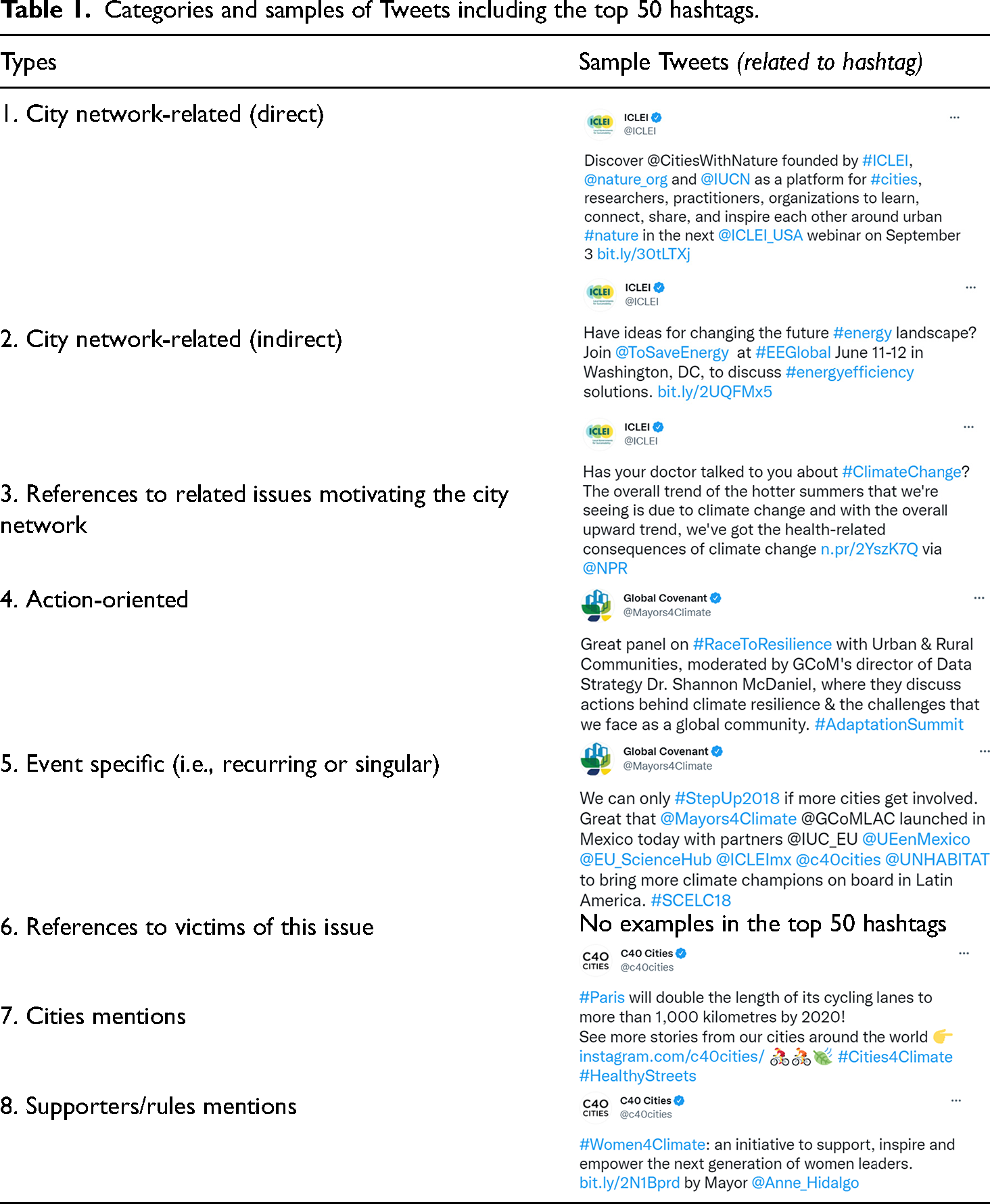
In addition to visualising hashtags in semantic networks, the hashtags were coded and classified according to their respective contributions to the frames with reference to Xiong et al. (2019), developed as described in the theoretical section above. For the specific case of hashtag analysis, Xiong et al.'s (2019) framework defining six primary communication frames that may emerge in hashtag activism around social movements and issues was adapted for our study's purposes. Tweets were of nine types: (1) city network-related (i.e., direct, such as #c40awards), (2) city network-related (i.e., indirect, such as #resilient), (3) references to related issues motivating the city network (such as ##climateemergency), (4) action-oriented (such as #racetoresilience), (5) event-specific (i.e., recurring or singular, such as #oneplanetsummit), (6) references to victims of the issue, (7) city names (such as #seoul), (8) names of supporters or rules (#women4climate) and (9) irrelevant. Table 1 presents some examples of those categories. For instance, the ICLEI used the hashtags #resilience, #water and #energy as indirect elements that reflect conversations tangentially related to the city network (i.e., Type 2) and #citieswithnature or #together4climate as calls to action (i.e., Type 4).
Categories and samples of Tweets including the top 50 hashtags.
Results
The results of the three city networks compared are presented below. For each network, the hashtags relevant to research RQ1.1 are discussed first, followed by the mentions relevant to RQ1.2. For more detailed results, please look at the results table in the appendix.
Key results for the ICLEI group
As far as the use of hashtags is concerned, it can be observed that ICLEI mainly uses hashtags to address topics related to the network's activities, such as showing solutions (e.g., #naturebasedsolutions, #circulareconomy). Indeed, city network-related hashtags (N = 22 Frame Type 2) appear in 40.86% of the top 50 hashtags. Second, action-oriented hashtags (N = 10 Frame Type 4), motivating to take action are present in 18.69% of the top hashtags (e.g., #climate action). In terms of degree centrality measures, the graph highlights numerous individual co-occurrences between Type 2 topic-oriented hashtags. ICLEI hashtags related to Type 2 “City network related (Indirect) are strongly used in groups into Tweets (degree = 255). This information means that when ICLEI used such general terms they integrated many of these terms into each Tweet, as shown in Example 1. 1. @ICLEI: How ready are cities for #climate #change? “Data speak louder than words” tells the story: 70% of #cities rely exclusively on their own funding. In the global north, agriculture isn't the only sector at risk. Learn why: http://bit.ly/2DrJ1Tq @UNHABITAT @sdinet @100ResCities
If two hashtags are often used together in Tweets, this is also apparent on the network. The more often both hashtags are used together, the stronger the connection line between both hashtags in the network. Frame categories such as city names (Type 7), which are particularly interesting for branding, are few. There is only only one reference to #Bonn – where ICLEI headquarters is located – which establishes a co-occurrence network with various Type 2 hashtags such as #resilientcities, #resilient, or #sdgs.
Regarding the second research question related to mentions, Figure 2 shows that most of the ICLEI mentions are related to their other Twitter accounts that are not present in the hashtag content strategy (e.g., @iclei_usa, @iclei_europe, or @icleiafrica). These self-mentions revealing a higher personal group branding, are often combined with mentions of other institutions or members of these institutions (e.g., Patricia Espinosa C. @pespinosac, the executive secretary of UN Climate change or @wrirosscities, a programme of World Resources Institute), or to some citation of international climate change events (e.g., @cop26). Thus, there are a lot of connections to possible collaborators in the sense of public diplomacy.
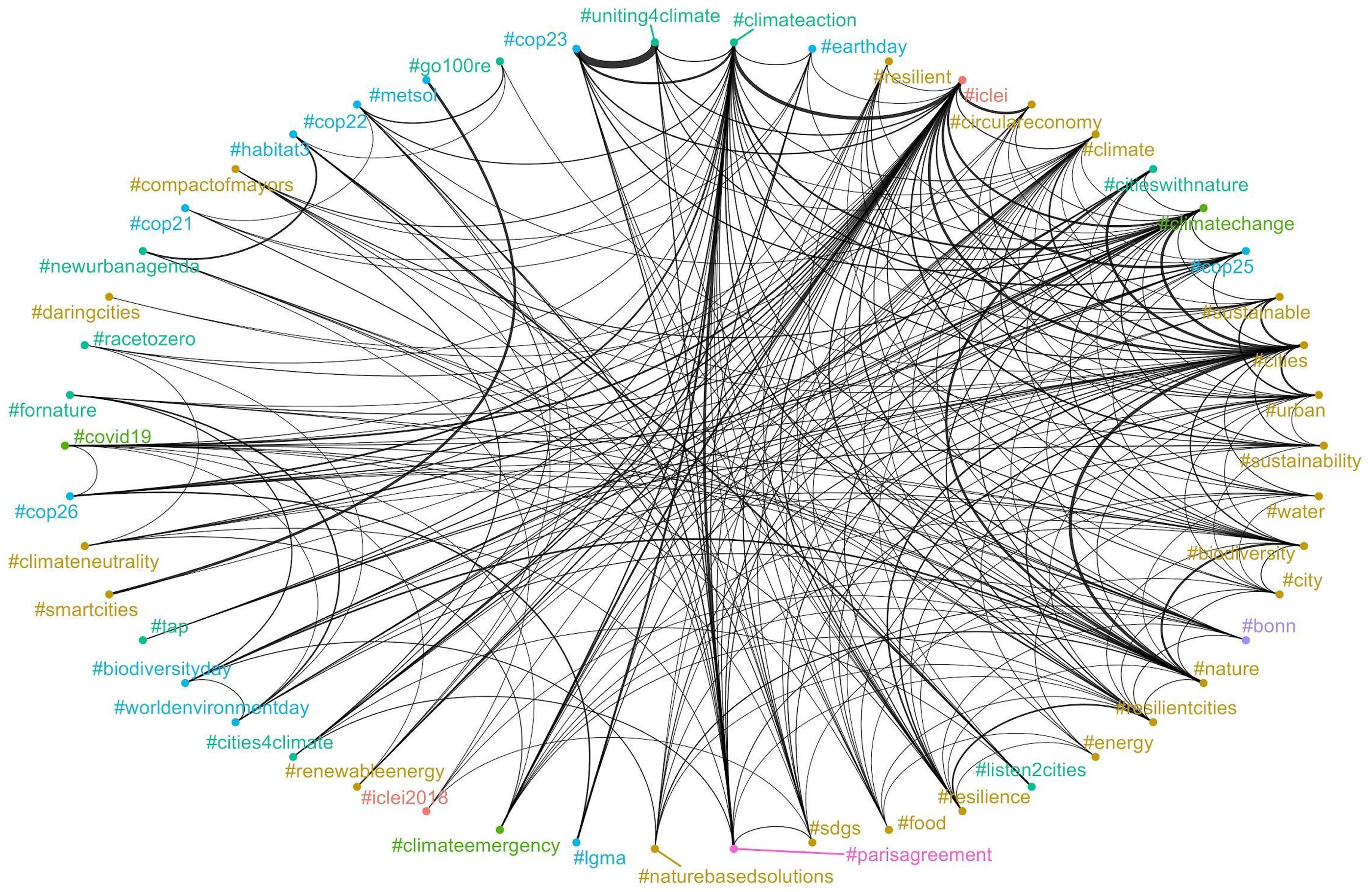
Top 50 ICLEI hashtags network.
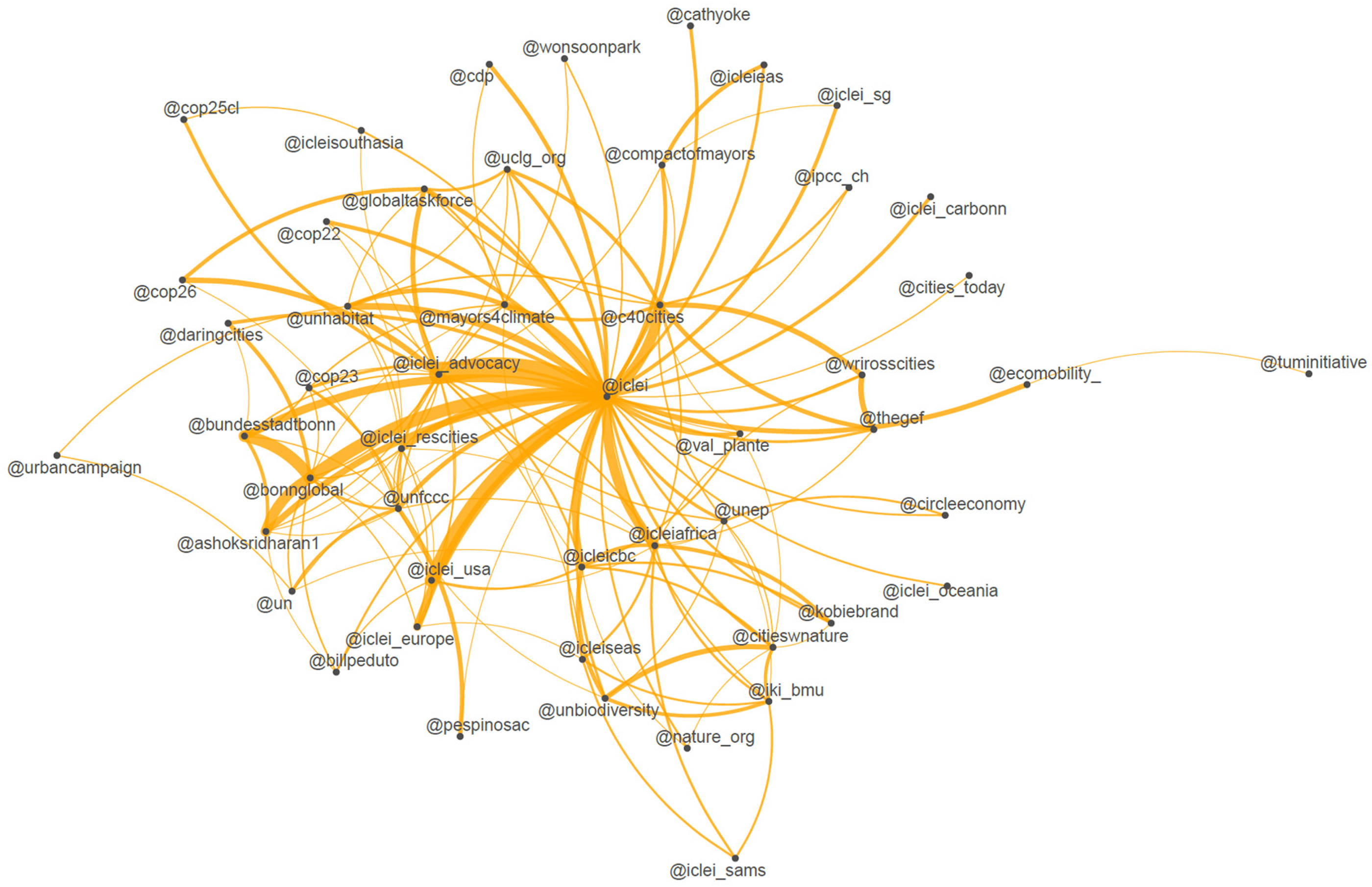
Top 50 ICLEI mentions network.
It is noticeable that the ICLEI frequently quotes C40 Cities and Global Covenant, facilitating communication among a variety of city networks aiming to tackle the same issue. This kind of citation is also present in the two graphs of mention's networks from C40 and from Global Covenant, as shown in Example 2. 2. @ICLEI: The future is #netzero & we need #ClimateAction now. From @SBT_Network's core cities partners @CDP, @C40cities, @Mayors4Climate, @ICLEI, @WRIRossCities & @WWF a new guide explains the process of setting science-based climate targets & joining #RaceToZero
1
Regarding individual city branding, very few cities or city mayors are mentioned; instead, it concentrates on some of the strongest edges (e.g., Bonn is associated with mayor Ashok Sridharan @AshokSridharan1 and to the general accounts @bonnglobal or @bundesstadtbonn).
Key results for C40 Cities group
When looking at the C40 networks, we can observe a different picture. The graph in Figure 3 shows the importance of three hashtag types, namely direct C40 network-related hashtags (Type 1), city names (Type 7) and supporter names and rules (Type 8). Here, we can observe the most important presence and centrality of the cities names of our three groups comparison. Specifically, the cities of Paris and Mexico collect the most hashtag co-occurrences, with 27 co-occurrences with other hashtags for Paris and 16 co-occurrences for Mexico. This is out of a total of 95 edges for the city-type hashtags, representing 12.65% of the total of co-occurrences for the C40 Cities group. In another specificity for these two cities, #paris is present in Tweets with a large variety of other types of hashtags when compared to #mexico, which is strongly related to #cities4climate and #women4climate hashtags. This means the #paris hashtag is potentially more present on a large variety of hashtag stories and followers than #mexico, which is more closely related to a shorter spectrum of dissemination on Twitter, as shown in Example 3. 3. @c40cities: EVP of @MastercardNews Enterprise Partnerships to headline C40 Summit in #CDMX Nov. 30 to Dec. 2. #Cities4Climate https://mayorssummit2016.c40.org
2
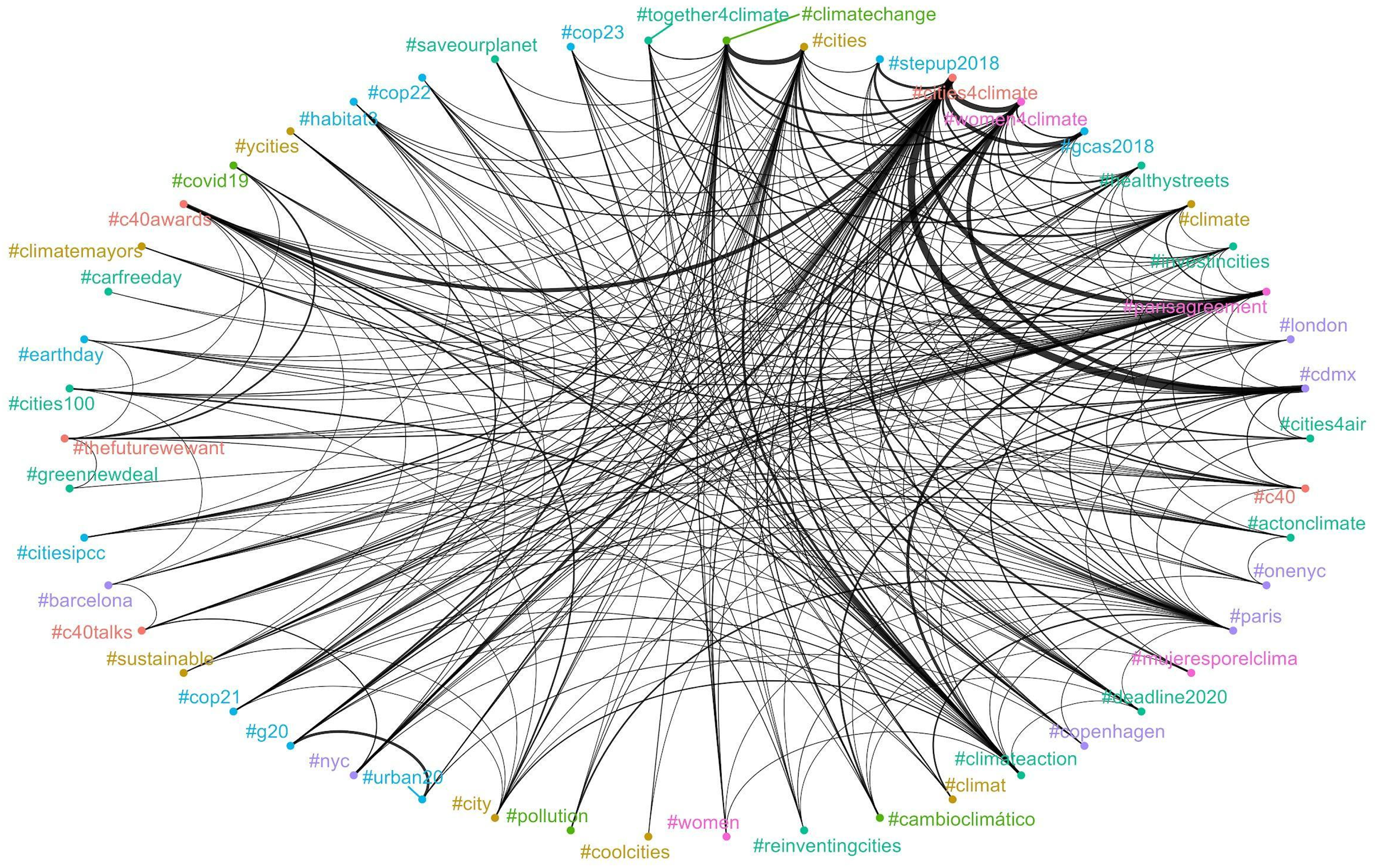
Top 50 C40 Cities hashtags network.
With regard to our second research question, one of the key elements of the graph in Figure 4 shows that a majority of the C40 Cities mentions are, in contrast to the ICLEI group, related to cities or mayors’ Twitter accounts. Cities such as New York @nycmayor, London @mayoroflondon, or Bogota @bogota, but also mayors such as Anne Hidalgo @anne_hidalgo from Paris, Lori E. Lightfoot @chicagosmayor from Chicago, Beppe Sala @beppesala from Milan, or Frank Jensen @frankjensenkbh from Copenhagen are present and often have a strong centrality with large width of edge, indicating that the C40 Cities group quoted them in many Tweets or with a strong co-occurrence edge between them, for instance with @anne_hildago and @frankjensenkbh as shown in Example 4. 4. @c40cities: C40 Chair & Mayor of @Paris @Anne_Hidalgo & Lord Mayor of Copenhagen @FrankJensenKBH urge all national governments to join cities and act on climate. http://bit.ly/2ms9PeQ #ClimateActionSummit
3
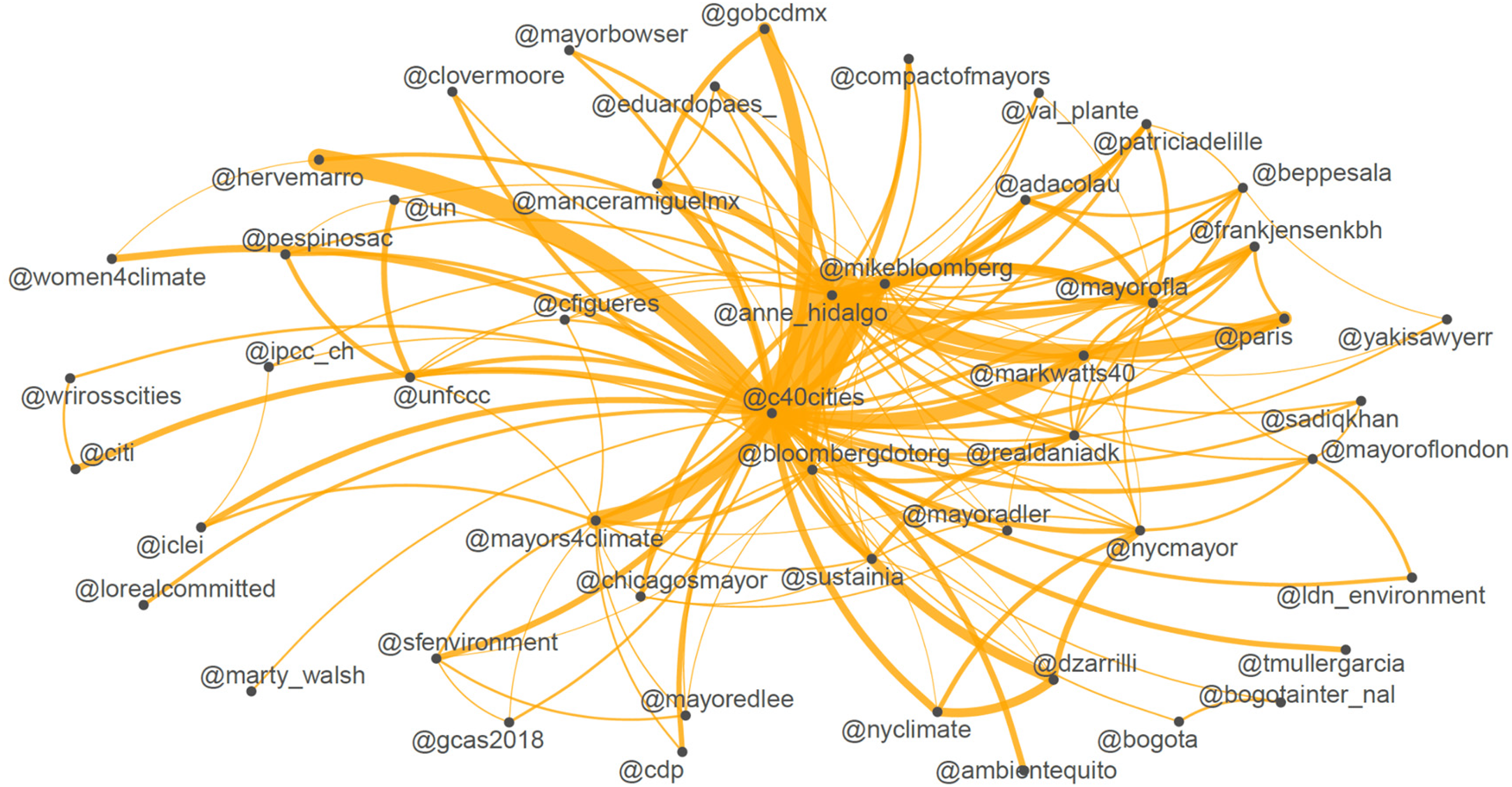
Top 50 C40 Cities mentions network.
As past presidents of this city group, Anne Hidalgo and Mike Bloomberg are strongly referred to in this graph, forming a triple centre with the @c40cities account. This networked structure forms a clear difference between the ICLEI mentions’ network and their mentions strategy.
Key results for the global covenant group
The graph in Figure 5 shows a homogeneous representation of hashtag types that are all at an intermediary frequency of apparition between the ICLEI and C40 Cities. This means the variety of hashtags in this figure is more diverse than in Figures 1 and 3. Thus, Global Covenant uses a more diverse spectrum of subjects than the two other city groups. With regard to direct city branding, the city-related hashtags are more present than in the ICLEI group, but less than in the C40 Cities group with cities that have a moderate level of centrality (i.e., less than 10 links for each city compared to more than 10 links, or to the 27 for #paris in the C40 hashtags of cities).
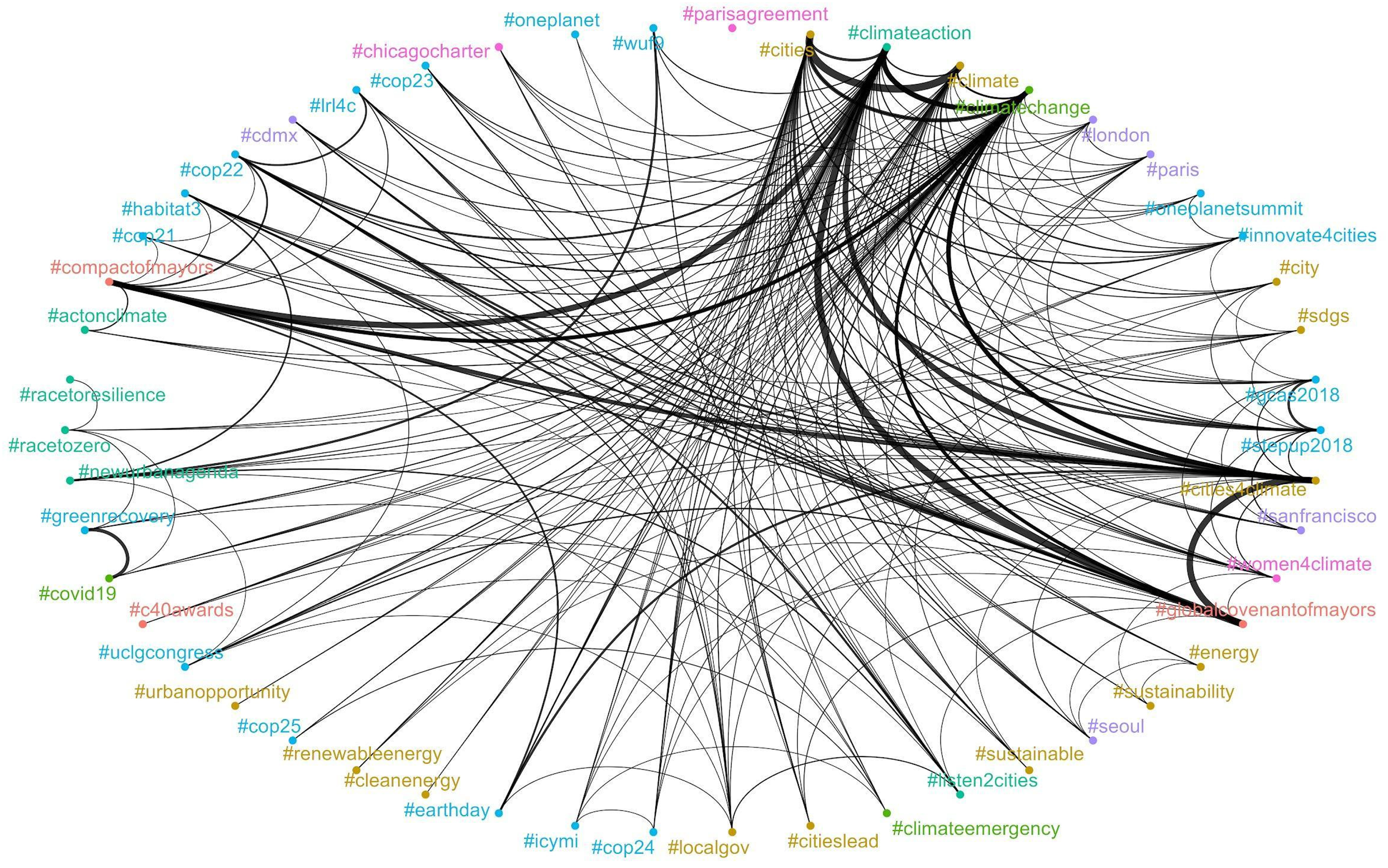
Top 50 global covenant hashtags network.
One of the key elements of the graph in Figure 6 shows a global homogeneity of mentions type, placing this Global Covenant group communication in an intermediary and hybrid type of communication. Indeed, the Twitter account refers, in a moderate and quite equivalent number, to their own groups (with high centrality given to @mayors4climate, @compactofmayor, or @eumayors, which is the European account of Covenant of Mayors), but also to mayors cited with a low level of centrality (Kasim Reed from Atlanta @kasimreed or Bill Peduto from Pittsburgh), institutions (UN Climate Change @UNFCCC), events (@gcas2018), world bank (@worldbank, European Bank for reconstruction and development @EBRD), or to other groups of a city network (i.e., @uclgafrica).
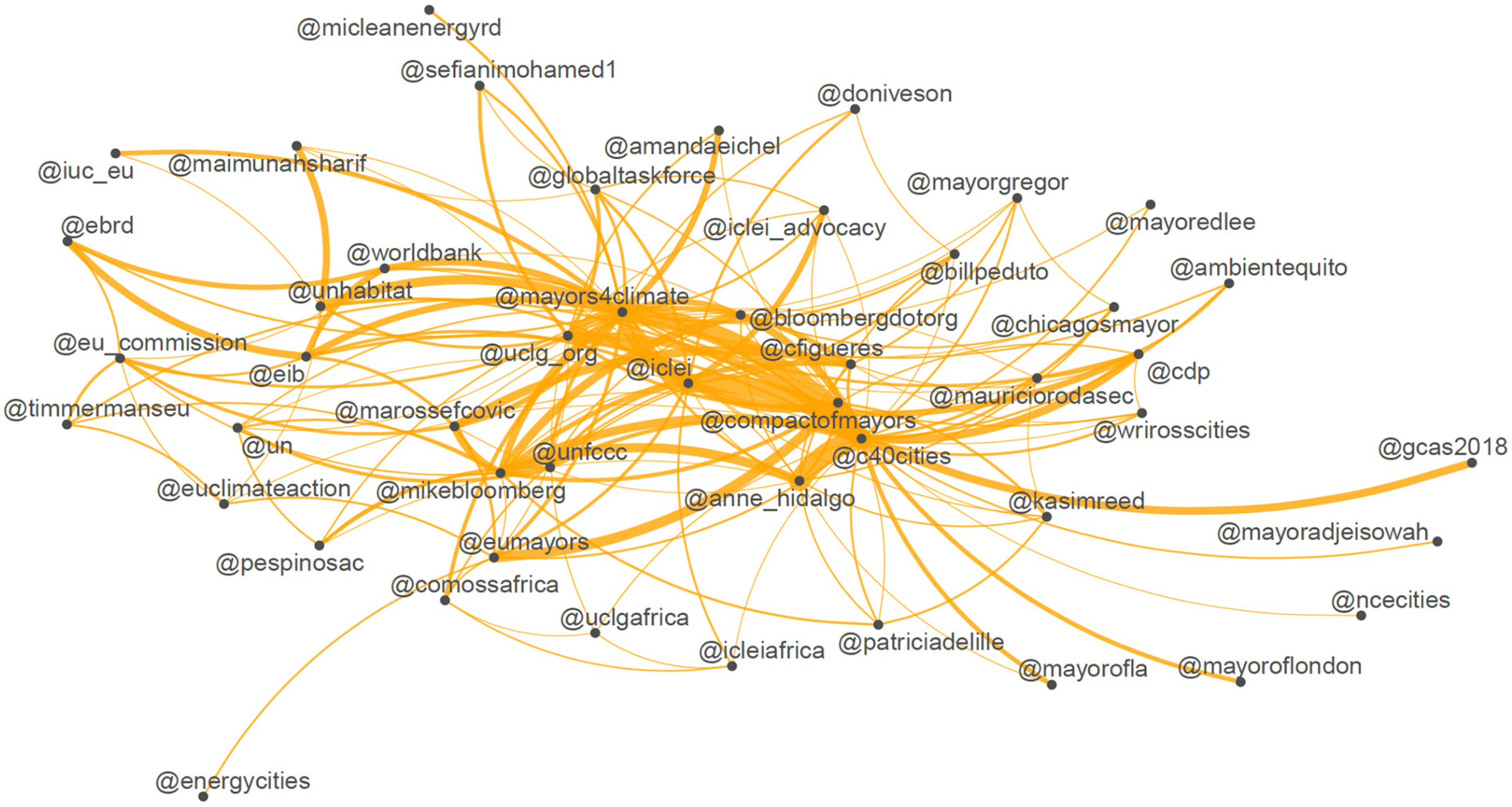
Top 50 global covenant mentions network.
Communication strategies of city groups: A descriptive model of city digital diplomacy
In the spirit of Castells’ network theory (2009, 2010), this study investigated the extent to which cities connect and communicate through digital media and digital affordances to increase their power on the international stage. We observed that the number, frequency, and co-occurrence of the affordances of hashtags and mentions in Tweets vary between the three groups and do not follow any unique repartition. In that way, the networked graphs afford valuable insights for understanding global communication strategies.
The three city networks seem to follow their own communication strategies. They not only communicate about climate issues and interact by mentioning each other but centre their cities and mayors’ actions in the discourse. As our analysis revealed, they have indeed used different mentions and hashtags in their Tweets and framed climate issues in different ways, even if all three city groups communicated about the same issue and were linked well on Twitter, as particularly shown in networks of mentions. Affordances were used by the city groups to promote themselves, discuss topics related indirectly to their groups, call for action, relate their Tweets to international events, recognise cities and mayors for their engagement in city groups and/or climate change, and refer to supporters and international rules.
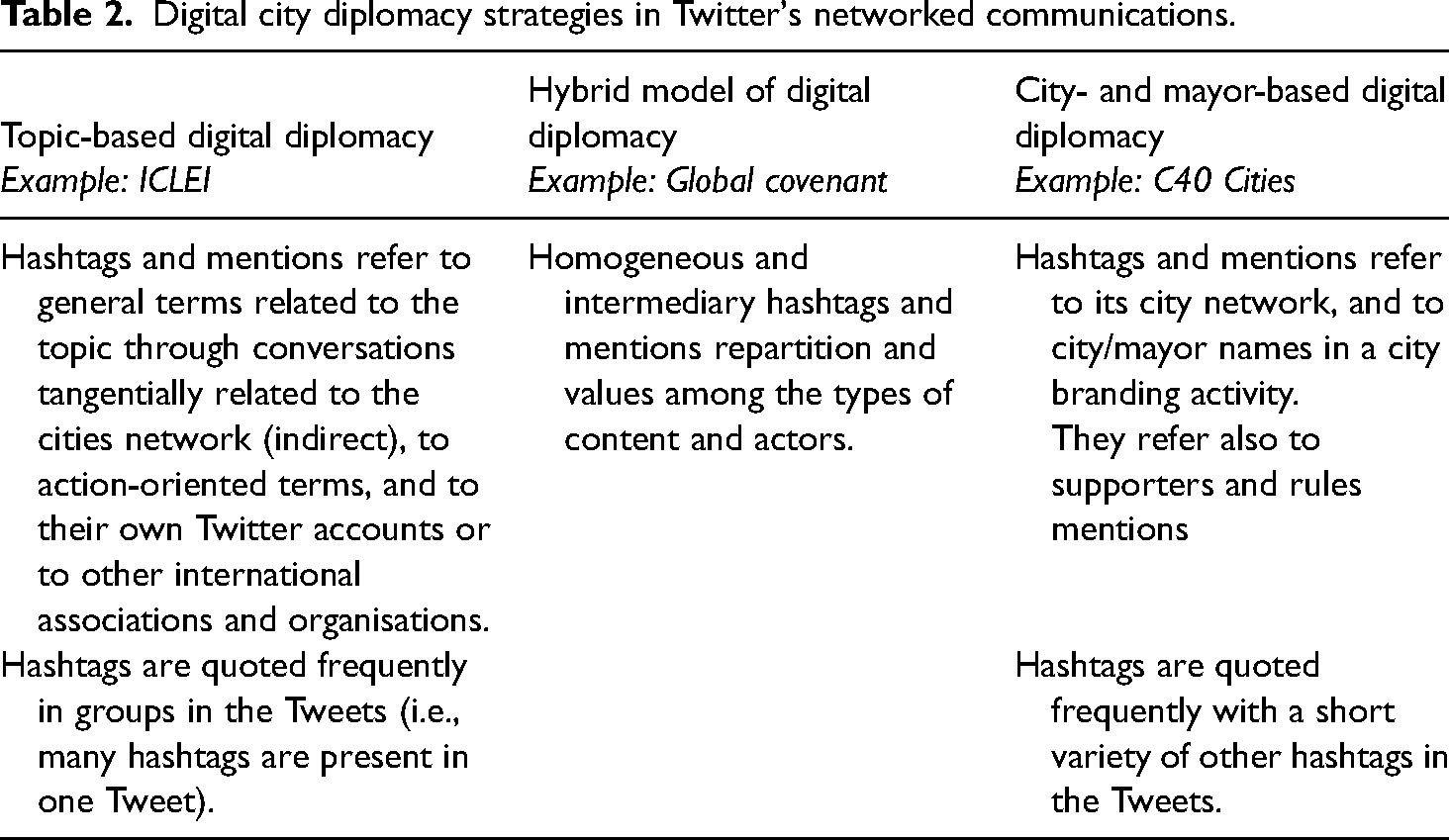
We propose a descriptive model of city digital diplomacy as presented in Table 2 and schematised in Figure 7. Both the table and figure describe three ways of using content to pursue the same issue on climate change: topic-based digital diplomacy, a hybrid model of digital diplomacy, and city- and mayor-based digital diplomacy. The three strategies show different degrees of city branding and diplomacy activities, as detailed in the following sub-sections.
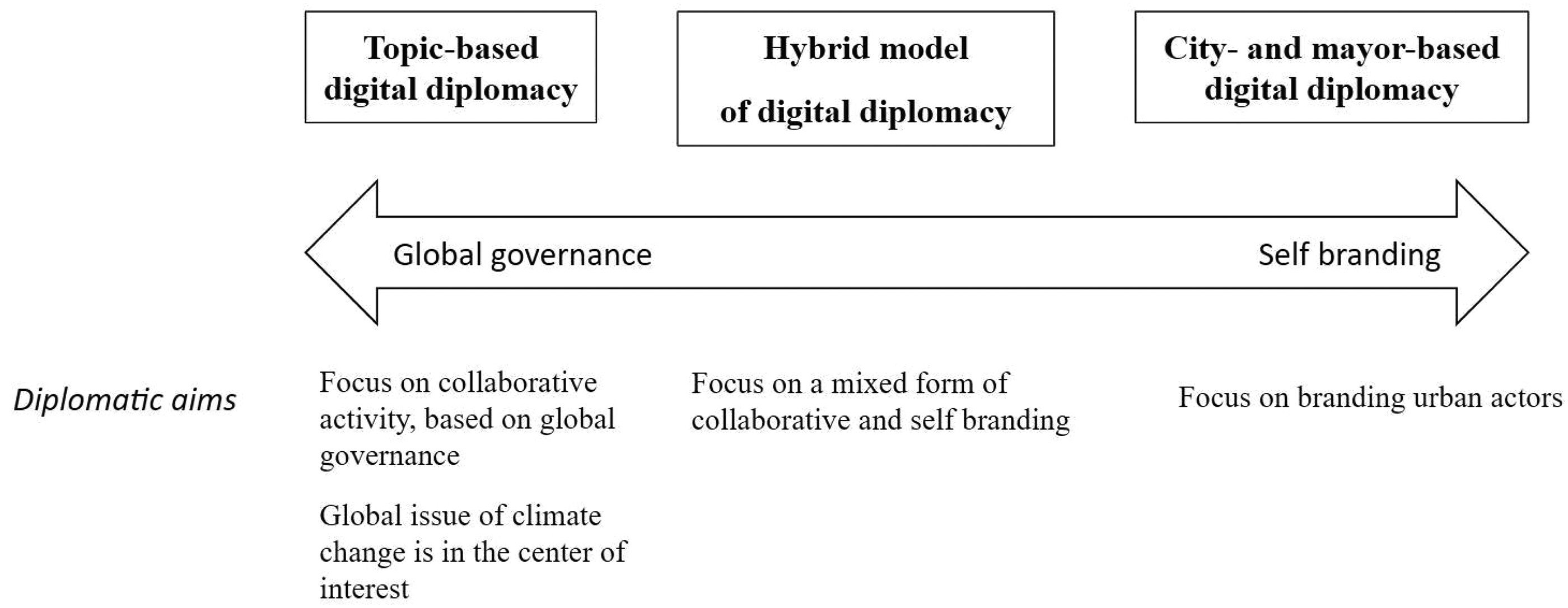
Continuum of city diplomacy digital communication strategies in cities networked context.
Digital city diplomacy strategies in Twitter's networked communications.
Collaborative activities through conversations on topics tangentially related to the network issue: The topic-based digital diplomacy strategy
Topic-based digital diplomacy is based on the idea of using network-making power to highlight the issue, namely climate change. It is hoped that this will increase the relevance of the topic on the political agenda. Thus, this diplomatic communication type is based on global governance, which centres the interest on the global issue of climate change through collaborative activities and conversations about topics tangentially related to the city network. In a typical example, the ICLEI network's strategy involves using many hashtags to have collective conversations on various topics impacted (e.g., #water), new ways of thinking (e.g., #resilience) or solutions (e.g., #naturebasedsolutions) to address the related issue. Those kinds of city networks are defenders of global values such as sustainability (Leffel, 2018), which call for actions and refer to international events such as UN Climate Change Conferences (i.e., COP series). That communication strategy shows many action-oriented terms that encourage collaborative engagement in dealing with pollution and the challenges of climate change. That trend goes along with the understanding of public diplomacy as a collaborative activity (Cowan and Arsenault, 2008; Kihlgren Grandi, 2020: 54).
In this diplomatic strategy, mentions are used to establish connections with other networks, like connections to international Organisations like the UN (see also Bjola et al. 2020) or to give more visibility to the network's own sub-divisions (e.g., ICLEI Europe or ICLEI USA). This also serves to expand the networking power, and thus to achieve a greater reach and more collaboration opportunities. In that digital communication strategy, content could marginally refer to the branding of individual cities or mayors. In this sense, following a collaborative strategy, the cities’ network acts, as indicated by Fitzpatrick (2017) or Cowan and Arsenault (2008), by focusing on relationships, collaboration, and social responsibility.
Self-branding communication frame: The city- and mayor-based digital diplomacy strategy
The city- and mayor-based digital diplomacy strategy is an opportunity for international city groups to show how some city residents or mayors engage with climate change to build the future of their cities (Mendizabal et al., 2021). Messages often integrated only one specific hashtag related to those non-state actors: one city or one mayor. That observation aligns with the findings of Wukich (2020), which show that mayors are less likely to exchange their concrete actions and best practices than to promote themselves. The city- and mayor-based strategy places focus on branding urban actors. Indeed, thanks to online platforms, individuals such as mayors can become especially visible in the international arena (Acuto, 2013; Stren and Friendly, 2019)
Following Mendizabal et al.'s (2021) study exposing the numerous triggers needed to create change at a city level, city leaders face strong barriers to transformational change (e.g., leadership, regulation, culture of change, and/or long-term vision). Because city leaders feel a high level of responsibility for climate change action, they arguably prefer to communicate about the fact that they are present and active (i.e., at the municipal and mayoral levels) in city network groups and that they address the problem locally, as shown in Example 5, rather than about their actions: 5. @c40cities: #Copenhagen aims to be the first carbon-neutral city by 2025  Mayor @FrankJensenKBH and his peers urges the EU to do so by 2050. If cities can do it so can you
 ! Read our open letter: https://goo.gl/sbPT74 #Cities4Climate #United4Climate @EUClimateAction @EU_Commission
4
! Read our open letter: https://goo.gl/sbPT74 #Cities4Climate #United4Climate @EUClimateAction @EU_Commission
4
As far as the use of mentions and thus the networking power is concerned, it can be seen that it is primarily cities that communicate with each other here. There is less exchange with other political actors in this communication strategy; communication remains in a closed network.
In that specific city- and place-branding orientation, key content and the co-occurrence of digital affordances afford the possibility of digitally evolving into the new networked individualism described by Rainie and Wellman (2012). That insight more deeply develops Castells’ (2010) network society and results in greater visibility for cities and/or mayors. The different connections and occurrences of topics and the names of cities and mayors underscore how digital communication fosters city diplomacy and personal branding in the city- and mayor-based strategy.
Intermediary position: The hybrid model of digital diplomacy strategy
The hybrid model of digital diplomacy strategy, which is used by the Global Covenant of Mayors, is an intermediary position between the previously presented strategies. Between those two strategies, a city network can navigate its content and activities to a more equal repartition between the two extremes of the descriptive model of city digital diplomacy (Figure 7). Following that strategy, the city network focuses on a mixed form of collaborative and self-branding communicative behaviour. Types of hashtag- and mention-oriented communications both refer to topic, action, events, or the specific group's visibility, while also including a middle strategy regarding mentions of cities and mayors.
Therefore, on the one hand, city actors heavily focus on the topic of climate change and try to interact and mention various actors, which supports the idea of collaborative public diplomacy. On the other, more individualisation and direct city branding emerges in the mentions of mayors and cities.
In general, we found that city networks can and do use different communication strategies online. Within those strategies, place branding and public diplomacy activities can overlap (Dos Santos, 2021; Ginesta and San Eugenio, 2021) but are pronounced to different degrees. Regarding the city networks analysed in our study, our results confirm and extend the findings of Busch and Anderberg (2015) that not all city networks equally engage in direct city-branding activities.
Conclusion
As climate issues become increasingly central at a sub-national level, notably with a burgeoning diplomacy role of cities, it is important to understand how international city networks define and facilitate digital communication and connection among cities and mayors, as well as look at their city branding and climate issue goals.
By examining the digital communication of three key global city networks regarding content, frames, and the digital communication activities of city networks, this study unveiled that digital content strategies differ among city networks, notably in terms of communication frames, and hashtag and mention use. Our analyses suggest that Twitter content reflects the strategic choice from cities’ networks to either primarily serve collaborative diplomacy of governance or to be more motivated by self-interests with city branding-related content and networking activities. Three models of communication were highlighted: topic-based diplomacy, a communicative strategy oriented towards personal mayor branding and city-based diplomacy, and an intermediary hybrid digital content strategy with moderate use of the two previously mentioned extreme strategies.
Thus, city networks do not use a single communication strategy which focuses on the global governance of climate issues. Our study clearly revealed that some cities’ networks adopt a more self-branded digital communication strategy, highlighting their own city and mayor messages and climate change engagements, even if those cities act on the same global issue.
Our study innovatively contributed to the topical debate about the connection between place branding and public diplomacy by empirically showing their intersections in the digital sphere and in climate issue governance, which has, in this context, been little researched so far. It should be emphasised that the present study examined and observed the communication strategies of the city networks, particularly over a long period of time and numerous Tweets, which is rare in previous place branding and city diplomacy research. Meanwhile, some limitations appear in this study, such as the choice of using only one social media platform, and regarding the examination of only the top 50 hashtags and mentions, even if they are the top of numerous Tweets.
The findings of this study have practical implications. First, the study brings important insights for urban practitioners in which digital networks they should take part and invest their resources. Today's big challenge for cities is to choose between the multitude of sustainable city networks and evaluate which is most relevant to them depending on their goals, such as branding themselves or exchanging best practices. Second, for city networks’ community managers, who can benefit from the hashtag and mentions frames but also the descriptive model proposed to implement digital affordances according to the diplomatic aim of city networks (e.g., with calls to action or a supportive group such as women). And third, for a mayor from a specific city to implement more self-oriented content (such as city hashtags and personal mentions) into the digital content of their city groups to highlight their personal messages in junction with national leaders or to show their local engagements on climate change.
Future research on the use of digital affordance should be theoretically framed by combining urban studies, data science, public (digital) diplomacy, and international communication but also by concepts from fields such as public relations, strategic communication, and conceptual frames (such as networked society and networked individualism) to describe the communicative and diplomatic actions of a city into non-state networked relationships. We encourage further media studies that include more than one social media platform to discuss the effects of the uses of various digital platforms on international communication. Additionally, it would be interesting to compare the three identified strategies regarding their impact: even if simple metrics cannot give comprehensive insights into the impact of digital diplomacy activities, it would be interesting to compare the three identified strategies with regard to likes and retweets.
