




Abstract
The COVID-19 pandemic has uncovered prejudices, systemic inequities and critical feelings about governmental institutions around the globe. Since the start of the pandemic, the 12 nations that make up South America have had more than 67 million cases and 1.3 million fatalities. Public trust in and willingness to speak out about government responses to COVID-19 in each nation have differed vastly. Using spiral of silence, this study (n = 1248) explored support for governmental COVID-19 response and willingness to speak out about that response in four South American nations: Argentina, Brazil, Chile and Peru. Results revealed Chileans are more likely to speak out on government response to COVID-19 than other South American participants. In addition, climate of opinion and support for government response positively predict willingness to speak. These results further our international and cross-cultural understanding of spiral of silence.
The COVID-19 pandemic has uncovered prejudices, systemic inequities and critical feelings about governmental institutions around the globe. Latin America has been hit particularly hard by the pandemic. Since the start of the pandemic, the 12 nations that make up South America have had more than 67 million cases and 1.3 million fatalities (Coronavirus Resource Center, n.d.). The COVID-19 response in South America has varied drastically by nation. The focus of this study is to explore how government trust in the COVID-19 response and willingness to speak about the response are related. This is an important context and a timely issue since Latin American nations are currently in varying stages of pandemic recovery.
Latin America is a large region with various ethnic, cultural and linguistic groups (Berryman, 2016). Although there are similarities in demographics, we cannot assume a uniform impact or response. Martinez-Valle (2021) conducted a multi-national study in Latin America to better understand how nations in the region have reacted to the pandemic. He studied the impact of COVID-19 in Argentina, Brazil, Chile, Colombia, Mexico and Peru. Overall, he found quicker and more rigorous policies helped nations cope better during the pandemic. As every government was faced with rising case numbers, each government responded to the pandemic differently. Peru, Uruguay and Argentina responded relatively well to the pandemic in 2020 (Misculin, 2020; Molteni, 2020). These three nations with relatively newly elected presidents made scientifically based decisions that enjoyed broad public support. Various political crises, including mass protests in Chile (Myers, 2021), the deposition and subsequent election of a new president in Peru (Tegel, 2021), as well as challenges to democratic systems in Bolivia and Brazil led to disjointed and ineffective responses in these nations (CBS News, 2021; Filho & Feil, 2021). All nations saw increases in case numbers and deaths in 2021. However, the responses from the public were different in each nation depending on the relationship between the publics and the ruling government.
In Uruguay, Chile and Argentina, the publics were in general supportive of the governments, as the governments took responsibility, recognised the place of science in decision-making and sought public support for individual and collective restrictions (mask mandates, lockdowns, etc.) (da Rocha et al., 2020). The publics in nations such as Peru, Bolivia and Brazil were less accepting of government mandates, and in some cases, the governments were accused of not acting at all to protect the people (da Rocha et al., 2020; Filho & Feil, 2021). Brazil was dealing with both political and economic crises (Cardoso & Peres, 2021) as the pandemic struck the country. In December 2022 (NPR, 2022), Peru inaugurated its fifth president in only 25 months, a sign of instability in the nation. As many South Americans are historically critical and distrustful of governmental institutions (Parra Saiani et al., 2021), it is not surprising that publics throughout South America have questioned governmental responses to varying levels. However, the extent to which individuals have openly spoken out against governments has not been fully explored. South American publics have a history of fear of speaking out on governmental issues and falling into a spiral of silence (Conaghan, 1995; Etchegaray et al., 2019). This study explores the silencing phenomenon in the context of the pandemic.
The current study examines the extent to which South American publics in Argentina, Brazil, Chile and Peru are willing to speak out on governmental COVID-19 responses, and to what extent these publics have fallen into a spiral of silence (Noelle-Neumann, 1974, 1977, 2004). These four nations were chosen for comparison due to the varied governmental responses, levels of public support for the government responses to the pandemic, and the differing levels of COVID-19 within the community at the time of data collection. Spiral of silence is a theoretical construct that allows scholars to examine willingness to speak at a specific moment in time on a particularly salient issue.
COVID-19 in South America
The severity of the COVID-19 virus differed among Argentina, Chile, Brazil and Peru. According to Worldometer (n.d.), in February of 2021, at the time of data collection, the number of daily cases ranged from 3330 in Chile, 6400 in Peru and 7900 in Argentina to 58,000 in Brazil. Daily deaths ranged from 140 in Argentina, 175 in Chile, 540 in Peru, to 1350 in Brazil. At the time of data collect, Chile had 784,314 cases and less than 25,000 deaths, Argentina had 51,112 deaths and 2.05 million cases, Peru had 119,640 cases and 1.3 million cases, and Brazil had 243,610 deaths and more than 10.09 million deaths (Worldometer, n.d.).
Spiral of silence
Spiral of silence (SOS) seeks to explain how we make collective opinions on important and significant political issues and why people might not speak out against the perceived majority viewpoint on those same issues, essentially falling into a spiral of silence. SOS theory was developed by Noelle-Neumann (1974, 1977, 1985, 2004) to determine when people will or will not share their opinions on salient issues. The theory has proven relevant in a variety of political contexts. In the past couple of decades, studies have been conducted in what might be considered traditional areas of SOS research including: U.S. Presidential elections (Croucher et al., 2014; Kushin et al., 2019) and freedom of expression issues (Carter Olson & LaPoe, 2018). However, there has also been more internationalization of SOS research in areas such as: media diversity in China (Zhao, 2016), women serving in the Kuwaiti military (Al-Kandari et al., 2021), ETA in the Spanish/French Basque country (Spencer & Croucher, 2008; Varela-Rey et al., 2018) and gay marriage in Taiwan (Chia & Tu, 2021), as well as cross-national studies on political issues (Thurre et al., 2020). Spiral of silence research has gained popularity in Latin America in the last couple of decades, with notable studies coming from Brazil (Ortiz, 2019), Chile (Etchegaray et al., 2019), Mexico (Neuwirth, 2000) and Peru (Conaghan, 1995). However, only 1% of citations on spiral of silence come from South or Central American researchers/collaborators (Donsbach et al., 2013). This project extends the internationalization of SOS research. This cross-national study focuses on three Spanish-speaking countries and Portuguese-speaking Brazil. The authors acknowledge there are minority and heritage languages spoken in these nations; however, Spanish and Portuguese are the main languages of government and commerce.
Spiral of silence tenants
There are four central tenants to the theory (Neumann, 1974, 1977, 1984), which include: (1) people have a fear of social isolation, (2) they observe the attitudes of others, (3) the fear of isolation causes people to decide which opinions can be expressed without creating isolation and (4) the climate of opinion surrounding an issue impacts what opinions people share. Although the original theory posited traditional media effects and face-to-face interpersonal interactions such as the train test, the theory has since taken off in new ways in both face-to-face and online environments. Scholars have since found ways to modify Noelle-Neumann's original “train test” to test for willingness to speak (Liu & Fahmy, 2011; Salmon & Glynn, 2014) to update the context to provide real-world scenarios.
Climate of opinion
The climate of opinion is a quasi-statistical sense or a feeling of how to gauge a general opinion on important issues (Noelle-Neumann, 1991). This comes from observations in an individual's own social circle and consumption of news media. The assumption is that between these observations and media reports people ascertain if their opinion is the majority opinion or the minority one. Neubaum and Krämer (2017) refer to interactions as mediated interpersonal interactions framing interpersonal communication in a public or semi-public mediated environment. Spiral of silence is located at the intersections of social norms and media effects research (Fung & Scheufele, 2014), which helps us better understand public opinion research. The theory is timely for research conducted during the pandemic as people are negotiating a climate of opinion surrounding information about COVID-19 and news related to the pandemic. The pandemic also provides a salient political issue to test the theory across national boundaries.
In the early development of the theory, Taylor (1982) brought up the question of pluralistic ignorance when people mistakenly gauge the climate of opinion. Media consumers might think they are in the majority and speak out or feel they are in the minority and remain silent. In fact, in many instances, people create the “looking glass” effect where they anticipate others will have opinions like their own (Glynn et al., 1997; Scheufele et al., 2001). This looking-glass effect is particularly important in today's social media world where we often create online worlds to mimic our own beliefs. That is why in today's online-mediated world, it becomes increasingly difficult to gauge the climate of opinion on controversial issues. Social media outlets have become more personalized and more fragmented, particularly as we post about and discuss important political issues (Bright, 2018). We essentially create the online world that we want.
Bodor (2012) noted it is often difficult to find the spiral of silence effect because of the transitory nature of public opinion. That is why it is essential to conduct research at the appropriate moment to ascertain the impact; particularly when examining political issues (Kushin et al., 2019; Spencer et al., 2012), as the feelings people hold might fluctuate. In today's socially mediated world, we face a constant barrage of information and opinions. Thus, surveys were conducted in each nation in early 2021 to capture this snapshot of public opinion during the COVID-19 pandemic.
Fear of isolation
If a person holds a minority opinion on an issue, they either become part of a vocal minority or fall into a spiral of silence (Noelle-Neumann, 1974, 1977) because they fear isolation from the mainstream. We often are hesitant to express opinions that we perceive to be unpopular. It is this fear of isolation that keeps many from expressing what they perceive to be unpopular beliefs. Noelle-Neuman notes fear of isolation is more important than an individual's own judgement on an issue. People feel there are incentives and benefits associated with speaking out or remaining silent, and they generally do not want to go against the majority opinion (Noelle-Neumann, 1984). As Salmon and Glynn (2014) note interpersonal communication plays an important role in understanding the climate of opinion when it comes to people not speaking out and remaining silent. Croucher et al. (2014) noted that often salient issues about one's own identity such as race, sex and religiosity influence a person's willingness to speak.
Research questions and hypotheses
The COVID-19 pandemic has significantly impacted South America. Not only has each government responded to the pandemic in different ways but also publics in each nation have responded to the governments differently. Peru is still dealing with the effects of a vaccination scandal that put high-level government officials higher on the vaccination list, changing leadership and political instability. The pandemic has contributed to an already dubious level of government trust. In neighboring Portuguese-speaking Brazil, President Bolsonaro's handling of the pandemic has been widely criticized. He has called the virus the “Chinese virus,” blamed the media for fear of the virus, scapegoated the Afro-Brazilian (Croucher et al., 2022) population for its spread and cut funding for vaccinations to lower-income regions of the nation (AFP, 2020; Martins-Filho et al., 2021).
In a recent (2021) study on government trust in Latin America, Parra Saiani et. al. explain that as a region there is less government trust in Latin America compared to other parts of the world. Nations such as Peru have a prolonged distrust of institutions. Chileans have the highest levels of governmental trust in Latin America, though starting in 2019 Chile was the scene of a 2-year massive government protest. Chile was also the location of a divisive 2021 Presidential Election (Albertus, 2021), which was the first election after the start of the pandemic. While in neighboring nations such as Argentina, Peru and Brazil, trust in government has remained low (Albertus, 2021). Overall, the COVID-19 pandemic has revealed fissures between governments and publics in Latin America. As government responses to the pandemic have differed, so have the public responses. Although publics in Chile have tended to be more vocal about the government's response, due to more trust in the government, publics in Brazil, Argentina and Peru have not spoken out as openly, possibly falling into spirals of silence Therefore, to better understand the relationships between public opinion towards government COVID-19 response, climate of opinion and spiral of silence, the following are put forth: H1: Chileans are more likely to speak out on the government response to COVID-19 than other South American participants.
RQ1: To what extent does climate of opinion predict willingness to speak during COVID-19?
RQ2: To what extent does support for government response to the COVID-19 pandemic predict willingness to speak during COVID-19?
Method
Participants
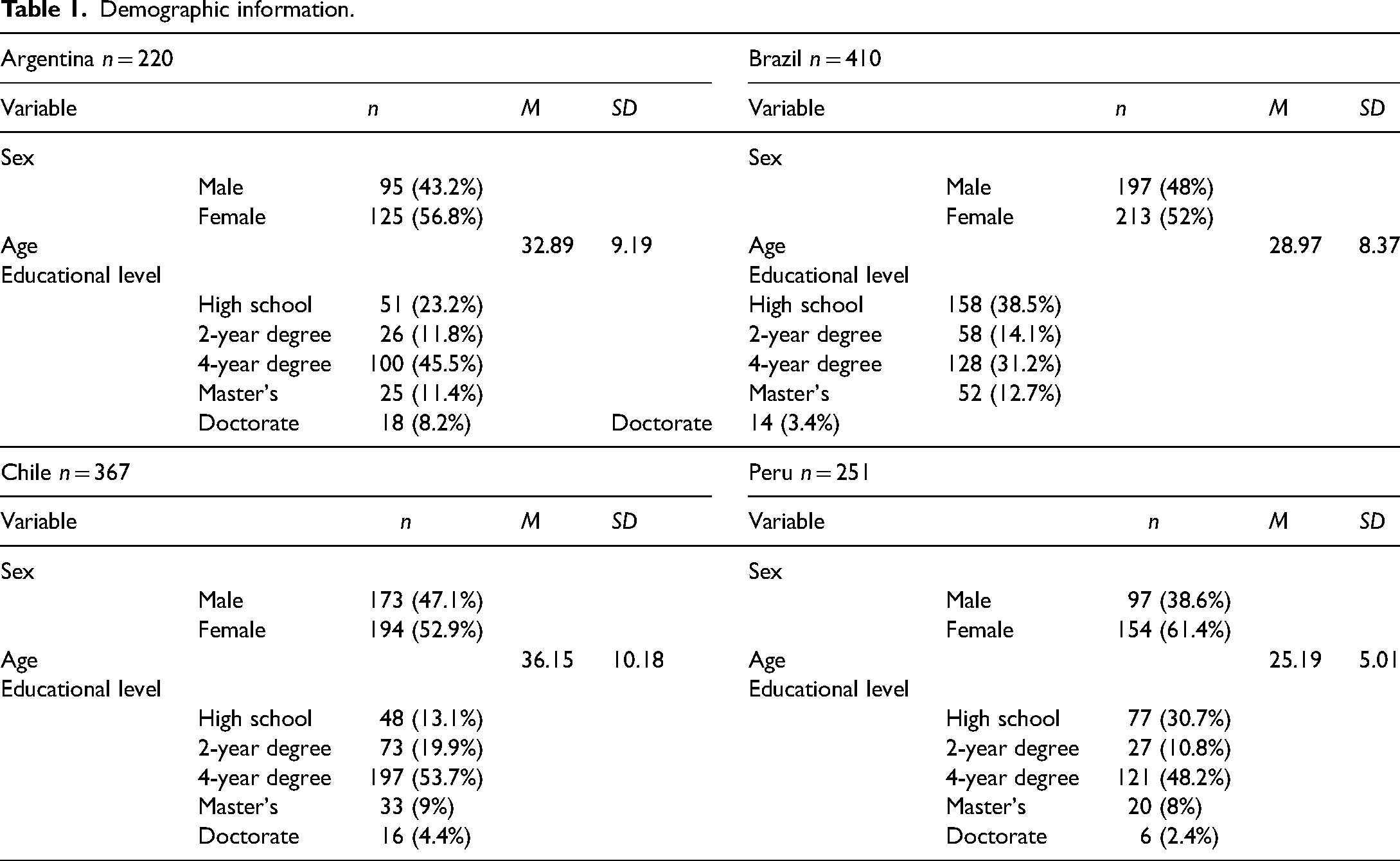
After appropriate ethical approval, data were collected in Argentina (n = 220), Brazil (n = 410), Chile (n = 367) and Peru (n = 251) via an online survey using Qualtrics. Online data panels from companies such as Qualtrics are comparable to other samples in published research (Troia & Graham, 2017). Participants received a small financial incentive for participation. See Table 1 for participant demographics by nation. Not all participants were paid.
Demographic information.
Measures
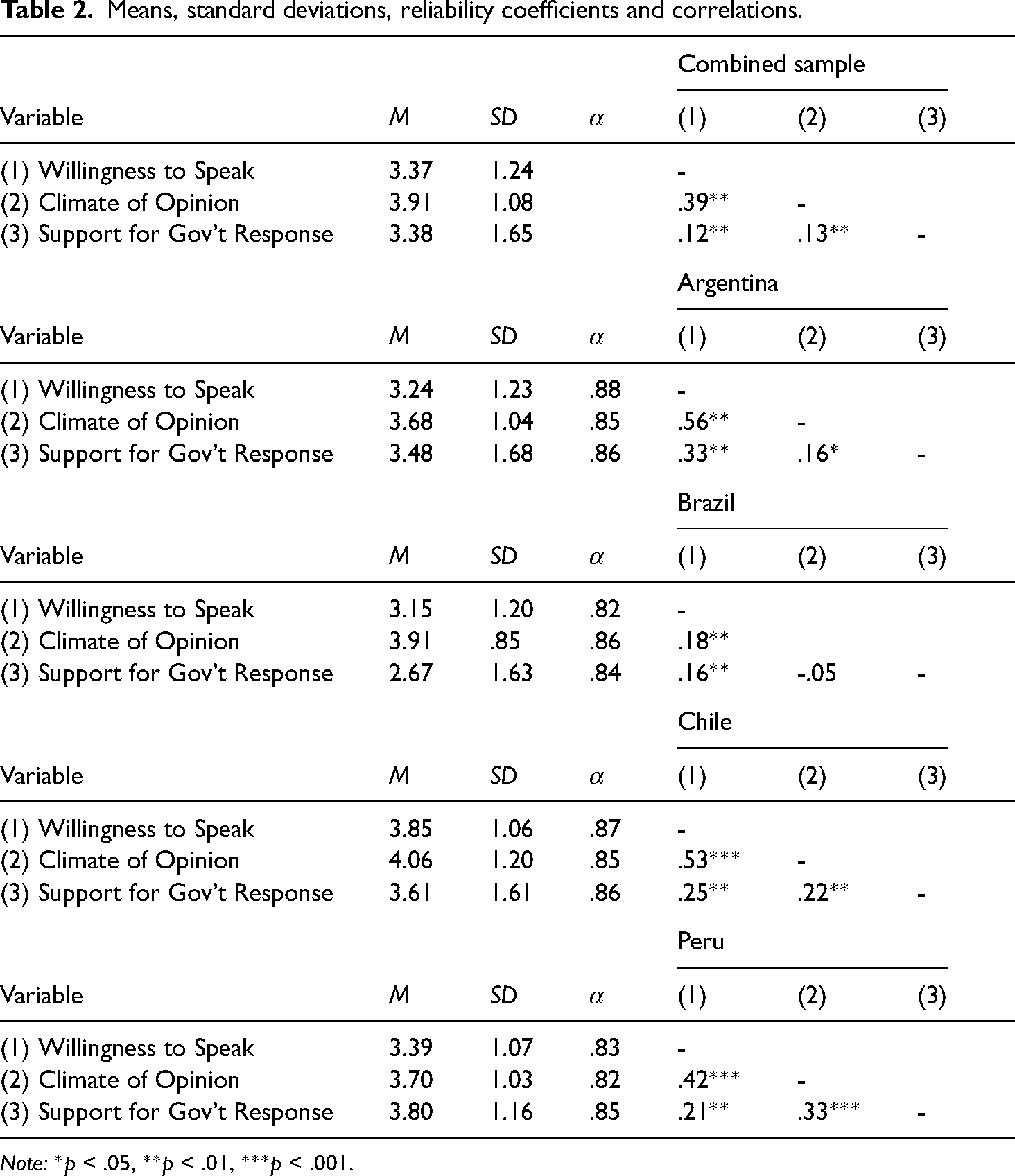
Surveys were distributed in Spanish (Argentina, Chile and Peru) and Portuguese (Brazil). The translations involved a three-step process. First, the surveys were translated from English into Spanish and Portuguese by native bilingual speakers. Second, the translations were checked by professional translators for denotational and connotational issues. Third, the professional translator discussed all issues with the lead researchers and the bilingual speakers to reach consensus and amend the translations. The reliability for the Portuguese translation was 0.89 and 0.91 for the Spanish translation. The surveys included demographic questions and the following measures: A measure of climate of opinion and measure of willingness to speak, and a measure of support for government COVID-19 response. Confirmatory factor analyses were conducted on each measure following criteria set by Hu and Bentler (1999). See Table 2 for the means, standard deviations, correlations and alphas associated with the study variables.
Means, standard deviations, reliability coefficients and correlations.
Note: *p < .05, **p < .01, ***p < .001.
Willingness to Speak. To measure willingness to speak on government response to COVID-19, six items from Spencer and Croucher (2008) were used. Sample items included: “If you were in a public place and heard a conversation supporting the government response to COVID-19, how likely would you be to enter the conversation?” “If you were in a public place and heard a conversation opposing the government response to COVID-19, how likely would you be to enter the conversation?” “If you were at work and heard a conversation supporting the government response to COVID-19, how likely would you be to enter the conversation?” Responses were rated from 1 very unlikely to 7 very likely. 1
Climate of Opinion. To measure climate of opinion regarding government response to COVID-19, four items from Spencer and Croucher (2008) were used. Sample items included: “To what degree do you believe your opinion about the government's COVID-response is shared by the majority of people you know?” “To what degree do you believe your opinion about the government's COVID-response is shared by the majority of people in Peru/Brazil/Chile/Argentina?” Responses were rated from 1 very unlikely to 7 very likely. 2
Support for Government COVID-19 Response. Support for the government's COVID-19 response was measured using six semantic differential items. Participants were asked: “To what degree do you believe the government's response to COVID-19 is: bad/good, wrong/right, unacceptable/acceptable, negative/positive, unfair/fair and unwise/wise.” The scale was measured on a 7-point scale, with 1 being the negative end and 7 being the positive end of the continuum. 3
Analysis and results
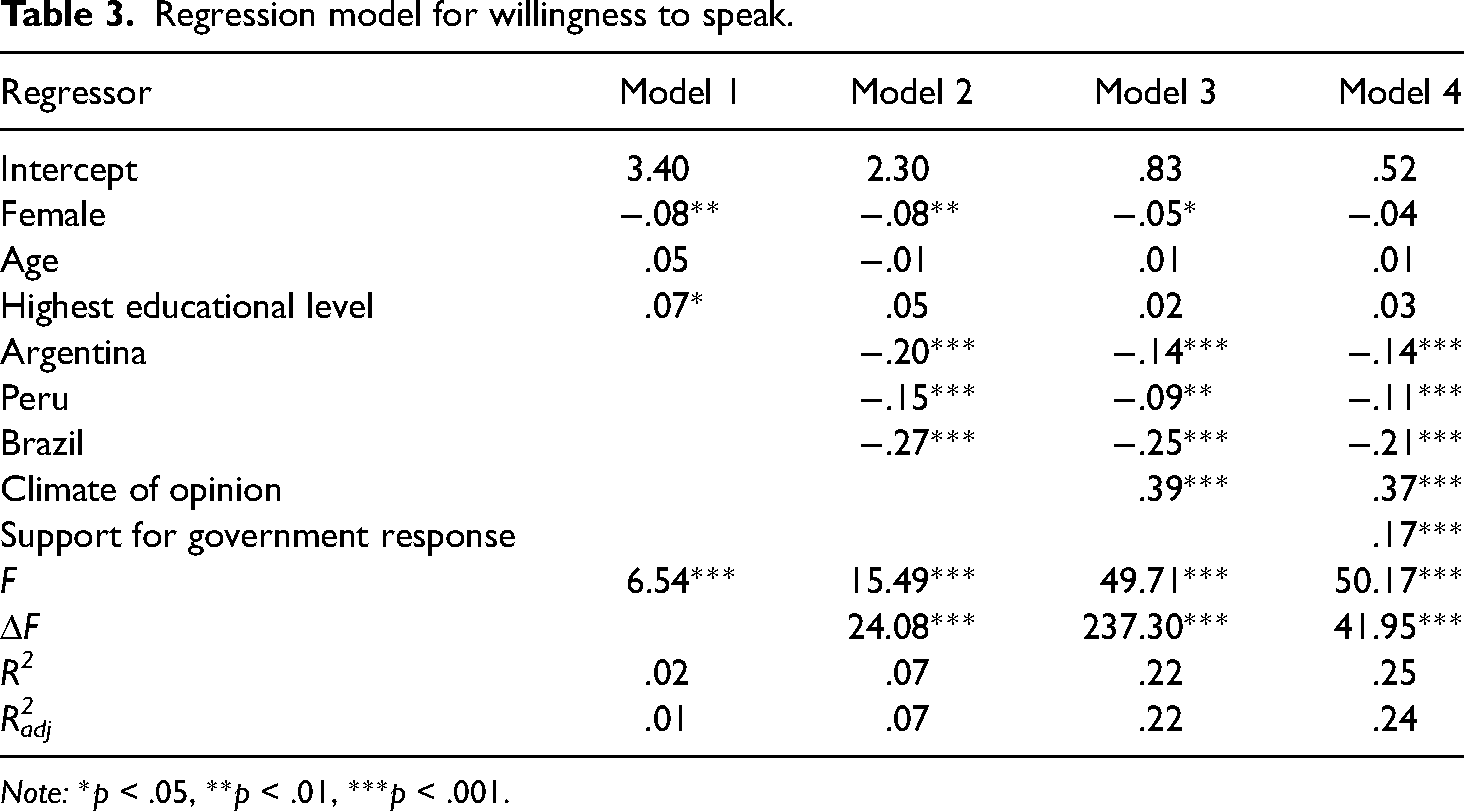
To examine the hypothesis and answer the research questions, a multiple regression was constructed using the willingness to speak out on government response to COVID-19 as the criterion variable, and the following predictors: sex (male, female and other), educational level, age, nation, climate of opinion and support for government COVID-19 response. In model 1, control variables were entered: sex, educational level and age. Each of these variables has been shown to influence the spiral of silence effect in politically salient issues (Kim et al., 2014; Willnat et al., 2002). In model 2, nation was entered with Chile serving as the reference group. In model 3, climate of opinion was added. The relationship between willingness to speak and climate of opinion is well-established (Kushin et al., 2019; Spencer et al., 2012). The climate of opinion is no longer created by a few select media environments, in a digital age both diversity of platforms and fragmentation of media likely make it more plausible to gauge a local opinion more than a large-scale one (Sohn, 2022). In model 4, support for government COVID-19 response was added. The relationship between support for government response and willingness to speak has been established as well. Interest in institutions and civic engagement impacts survey participation for many people (Silber et al., 2022).
Four models were generated, and the results are presented in Table 3. In model 1, control variables were entered as predictors (R2 = .02). In model 2, nation was entered as a predictor variable. This model was a significant improvement over model 1 (ΔF = 24.08, p < .001, R2adj = .07). In model 3, climate of opinion was added to the regression. This model was a significant improvement over model 2, (ΔF = 237.30, p < .001, R2adj = .22). In the final model, support for government COVID-19 response was added. This model was a significant improvement over model 3 (ΔF = 41.95, p < .001, R2adj = .24) and was thus retained for final analysis. Based on model 4 in Table 3, Chileans are more willing to speak out on the government response to COVID-19 than Argentinians (b = −.14), Peruvians (b = −.11) and Brazilians (b = −.20) (H1). In addition, climate of opinion positively predicted willingness to speak (b = .37), as did support for government response to the COVID-19 pandemic (b = .17).
Regression model for willingness to speak.
Note: *p < .05, **p < .01, ***p < .001.
Discussion
The results of this study present timely and interesting findings relevant to government responses to the COVID-19 pandemic. It is imperative researchers and policy makers understand how people respond to government pandemic policies. The data also illustrate the applicability of the spiral of silence theory in multiple nations of South America.
Findings
Hypothesis 1 asserted Chileans are more likely to speak out on government response to COVID-19 than other South American participants in this study. This finding is important because of the contexts of the recent Chilean protests and the historical relationship Chileans have maintained with their government. Although Chileans have a high level of support for their government institutions, people in Chile have shown they are willing to mobilize en masse to make their voices heard in times of crisis or when there are important political issues under consideration.
This study posed two research questions. RQ1 asked to what extent does climate of opinion predict willingness to speak during COVID-19? The data illustrate that climate of opinion is highly related to willingness to speak out across South America. RQ2 asked to what extent support for government response to the COVID-19 pandemic predicts willingness to speak during COVID-19? The results indicate support for government response positively predicts willingness to speak.
Theoretical implications
This study nuances the spiral of silence theory by testing the relationship between climate of opinion and willingness to speak (Noelle-Neumann, 1974, 1977) across South American nations. The data illustrate a relationship between the climate of opinion related to the COVID-19 pandemic and how willing people are to make their views known about pandemic-related issues. It is also important to note people who support the government's response are more likely to speak out in favor of the response. Similar to Noelle-Neumann's original conceptualization of spiral of silence (1974, 1977), individuals who are more supportive of how the government is handling the response, are more likely to speak out in favor of the response, as they are more likely to not feel as though they are in the minority. At the time of data collection, there was a strong relationship between government support in the Spanish-speaking nations of Argentina, Peru and Chile. However, in Brazil, at the time of data collection, and since then, as demonstrated with the highly contested election in 2023, there is a strong divide towards the perception of government actions. Thus, it is not surprising that participants were skeptical of government actions. Thus, the results of this study further support the spiral of silence hypothesis.
Scheufele and Moy (2000) advocated for more cross-national SOS research two decades ago. This project furthers our knowledge of SOS across political borders. This study allows us to test SOS in some of the largest and most populated Latin American nations. It also explores the theory in both Spanish and Portuguese-language contexts. It is important to test SOS theory outside of the “traditional” contexts of North America and Europe. This paper not only explores the theory in Latin America but in four national contexts.
Scholars are just now beginning to publish results exploring how the COVID-19 pandemic impacts a person's willingness to speak out or fall into a spiral of silence (Dam et al. 2021). This project nuances our understanding of mediated communication and the spiral of silence effect during the pandemic, as it relates to a government response during the COVID-19 pandemic. It is important to note pandemics do not take place in isolated environments; they are connected to how many people are infected, death rates, job losses and other important factors. The results of this study help us better understand why we speak up and/or remain silent about pandemic issues.
Limitations and future research
One limitation of this study is the use of self-report measures. This type of survey relies on the individual's ability to both gauge the climate of opinion and express a genuine and authentic response to willingness to speak. However, while self-reporting has limitations this is the best way to explore the SOS phenomenon. A second limitation is the potential lack of racial diversity in the sample. This study did not ask participants racial identity, nor did it purposefully seek out marginalized populations. There are many types of Latinidad and much racial and linguistic diversity in Latin America (Spencer 2018). A third limitation is that the samples in each nation are in general highly educated. With each sample consisting of more than 40% of individuals with at least a 4-year university degree, it is possible that the results are not fully representative of these socially and economically diverse populations. However, in an age of online data collection, more highly educated people might have an interest in completing surveys that focus on public opinion issues. It is also important to note how more females participated in the project, ranging from 52 to 62 percent of respondents per nation.
Future studies could examine how groups in Latin America are silenced depending on race, language and social class. This is a diverse region in terms of political systems, linguistics, cultural backgrounds and media systems. This project serves as a call for scholars to explore more about why people in Latin America are silenced on salient political issues. One of these issues is the COVID-19 pandemic. There are many other topics related to COVID-19 and pandemic communication in general that should be studied in the region.
No matter the methodological underpinnings, the results in this analysis illustrate clear evidence for the SOS effect in South America. The data also clearly demonstrate a relationship between support for government response to the COVID-19 pandemic and willingness to speak across South American nations. This research explores the SOS affect in countries that speak both Spanish and Portuguese and in a particular region of the world. The COVID-19 pandemic has affected Latin American media, politics, healthcare and government institutions. Scholars must continue to explore these important topics as they intersect and affect peoples’ daily lived experiences.
Footnotes
Declaration of Conflicting Interests
The author(s) declared no potential conflicts of interest with respect to the research, authorship, and/or publication of this article.
Funding
The author(s) received no financial support for the research, authorship, and/or publication of this article.
