




Abstract
We study how leaders of parliamentary democracies attempt to trigger the “rally-around-the-flag” effect through the mass media. We have collected news articles on North Korea and Iran published by liberal and conservative newspapers in Japan and Israel from 2009 to 2018 and analysed them in terms of their emphasis on threats, employing semi-supervised quantitative text analysis techniques. We find that both Japanese and Israeli conservative newspapers overemphasised nuclear threats before important political events (enactment of Japan's National Security Laws and Israel's 2014 General Election). We argue that leaders of countries that lack opportunities or capabilities often attempt to manipulate perceived threats through the mass media, calling such actions discursive diversion. We explain the similarity between the Japanese and Israeli cases by the following factors. Firstly, the diminishing political gains from the successful economic reforms in the earlier years; Secondly, the increasing opposition in the legislature or competition in the elections; Thirdly, the lack of the countries’ ability to solve the security issues unilaterally; Finally, the diplomatic and military relationship with the United States.
Introduction
Governments shape their security policies to protect their countries from foreign threats. One of the most important security issues is the nuclear capability of hostile countries that threaten the very existence of the nation, but people's understanding of nuclear threats is usually limited as they rely on information from the government through the mass media (Farnsworth et al., 2010; Lytle & Karl, 2020). Such an information advantage of governments on security issues allows them to manipulate public perception of threats for their own political interests (Downs & Rocke, 1994). An example of such manipulation could be found before the United Kingdom's invasion in Iraq in 2002. In order to gain public support for their foreign policy, Tony Blair's government published dossiers, claiming that weapons of mass destruction could be used within 45 minutes of Saddam Hussein’s order, and deployed the army at Heathrow Airport to prevent alleged terrorist attacks (Hayes, 2016; Tumber & Palmer, 2004).
International relations scholars have long believed that political or economic turmoil motivates leaders to initiate wars to trigger the “rally round the flag” effect (DeRouen, 2000; Enterline & Gleditsch, 2000; Levy, 1989; Parker, 1995; Tir & Jasinski, 2008). However, empirical studies have only produced inconclusive results: American and British leaders are more likely to use force when domestic discontent is high, but such patterns are rarely found in other democratic countries (Gent, 2009; Leeds & Davis, 1997; Miller, 1995; Mitchell & Prins, 2004; Russett, 1990). The mixed results can be explained by the lack of opportunities for leaders: most countries can deploy their military only close to home, but their neighbours do not always provoke when the leaders need to divert domestic discontent (Enterline & Gleditsch, 2000; Tir & Jasinski, 2008). With the lack of opportunity, the leaders would attempt to trigger the rally effect by manipulating people's perceptions of the security environment (Alrababa’h & Blaydes, 2020).
Governments can control the media coverage of security issues by selectively offering stories to news organizations (Farnsworth et al., 2010; Herman & Chomsky, 1995). Exploiting news organizations’ dependency on official sources, governments create certain media frames of foreign countries that emphasise threats to increase the sense of fear among the public (Entman, 2004). The limited amount of resources available to news organizations for independently gathering information often means that governments can easily set the national media and public agendas (Schudson, 2011). Since Bernard Cohen (1963, p. 120) argued “editors attach relative significance to particular foreign policy stories and thus tell their readers what to think about”, the relationship between media coverage and public perception of international environment has been central to the agenda-setting theory (McCombs & Shaw, 1972). Scholars believed that such an agenda-setting effect is stronger in foreign issues than domestic issues because the audience lack direct experience or expert knowledge (Manheim & Albritton, 1984; Page & Shapiro, 1992; Wanta & Hu, 1993). In fact, earlier studies revealed that media coverage influences the public perception of foreign countries (Besova & Cooley, 2009; Kiousis & Wu, 2008; Segev & Hills, 2014; Zhang & William Meadows III, 2012). Further, a recent study has shown that greater media exposure makes people experience stronger nuclear anxiety, prepare for nuclear attacks and discuss the risk with others (Lytle & Karl, 2020).
The tendency of the mass media to reflect the opinions of policymakers is also known as the “indexing function” (Bennett, 1990). It is particularly important for security issues, where journalists rely on politicians and bureaucrats. In fact, a cross-national study showed that the newspapers in multi-party democracies represented more diverse views on the government's policy on Iraq (Baum, 2013). Critical newspaper coverage on government's security policy is even less common in democracies facing geo-political instability such as India and Pakistan (Rasul et al., 2016). In autocracies such as Russia and Syria, newspapers are often employed to blame domestic social and economic problems on western countries (Alrababa’h & Blaydes, 2020; Rozenas & Stukal, 2019). It is also known that the mass media promote the opinions of certain political parties and readers in democracies based on their organizational affiliation and commercial consideration (Hallin & Mancini, 2004, 2011).
Although Jack Levy (1989, p. 271) suggested that diversionary actions can “fall short of actual war” in his classic work, this possibility has not been considered seriously in empirical studies. Scholars sought stronger evidence of diversionary actions by including various variables along with domestic political and economic conditions in their models, but their dependent variables were almost always overt military actions (e.g. militarized interstate disputes). This is problematic not only because it focuses on a limited number of countries that have high military capabilities (Leeds & Davis, 1997), but also because it ignores people's perception of security environment. While only such “objective” measurement of threats had been available for long, recent methodological developments made more “subjective” measurement of threats available through a systematic analysis of media content (Trubowitz & Watanabe, 2021).
Aiming to bridge the literature on diversionary wars, agenda setting and press-state relationship, we study how leaders of parliamentary democracies use the mass media instead of actual force to trigger the rally effect. We chose Japan and Israel as cases because both countries have regional adversaries with nuclear ambitions: North Korea and Iran, respectively. Yet, their leaders have distinctive military options: the Israeli Prime Minister can deploy the Israeli Defence Force (IDF) to attack targets in other countries without declaring war, which requires the parliament's approval (Krasna, 2018), while the Japanese Prime Minister cannot mobilize the Japan Self-Defence Forces (JSDF) unless the country faced an invasion due to the pacifist constitution. 1 The difference between the two would offer stronger evidence for leaders’ tendency to employ discursive diversion, which is based on manipulation of the media coverage of security issues.
We focus on the period from 2009 to 2018, during which North Korea and Iran's nuclear programs attracted international attention and both Japan and Israel had conservative prime ministers (Shinzo Abe and Benjamin Netanyahu, respectively). 2 We have collected and analysed Japanese and Hebrew news articles from the period in terms of emphasis on threats of North Korea or Iran's nuclear programs using quantitative text analysis techniques. We argue that the newspapers’ greater emphasis on threats reflect the governments’ speeches and press conferences, that are aimed at gaining the “threat-induced political support” (Segev et al., 2022); these leaders resorted to rhetoric instead of force because of the countries’ institutional or diplomatic constraints, namely Japan's pacifist constitution and the US opposition to Israel's use of force.
Hypotheses
We assume the signs of discursive diversion to appear in how newspapers with different political orientation cover North Korea or Iran, because the literature on press-state relationship suggests that media outlets affiliated with the government would follow the official positions on security issues more closely. Specifically, we expect that conservative (center-right) newspapers emphasize security threats more than liberal (center-left) newspapers. Both Japan and Israel have conservative governments in our study period and these governments made a series of claims to emphasize the security threats to the country. H1: Conservative newspapers emphasize security threats more than liberal newspapers.
We also expect that conservative newspapers emphasize security threats before important electoral or legislative events, because the alignment between the conservative political parties and newspapers would become even closer when the conservative political parties need the mass media to gain public support: H2: Conservative newspapers emphasize security threats more than liberal newspapers before important electoral or legislative events.
Nonetheless, we expect that occurrences of diplomatic or military events related to North Korea or Iran affect the coverage of security issues by both liberal and conservative newspapers most strongly, because the governments cannot fully manipulate the commercial news outlets: H3: Both liberal and conservative newspapers emphasize security threats more after military events but less after diplomatic events.
Methodology
We measure the emphasis of threats by liberal and conservative newspapers in each country using quantitative text analysis techniques. Then, we correlate the threat scores with event variables by multiple regression analysis to detect overemphasis of threats by conservative newspapers.
Key events
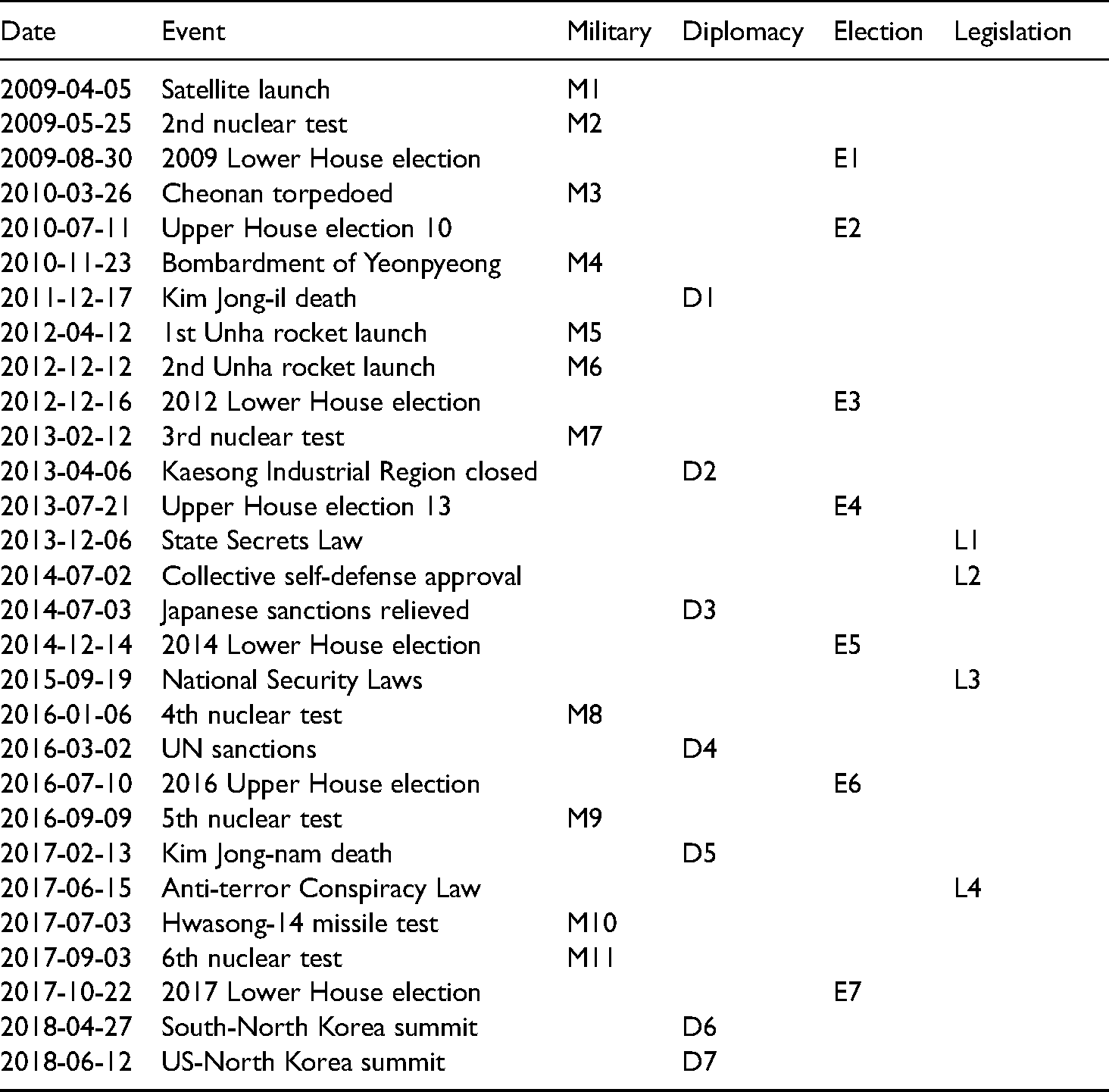
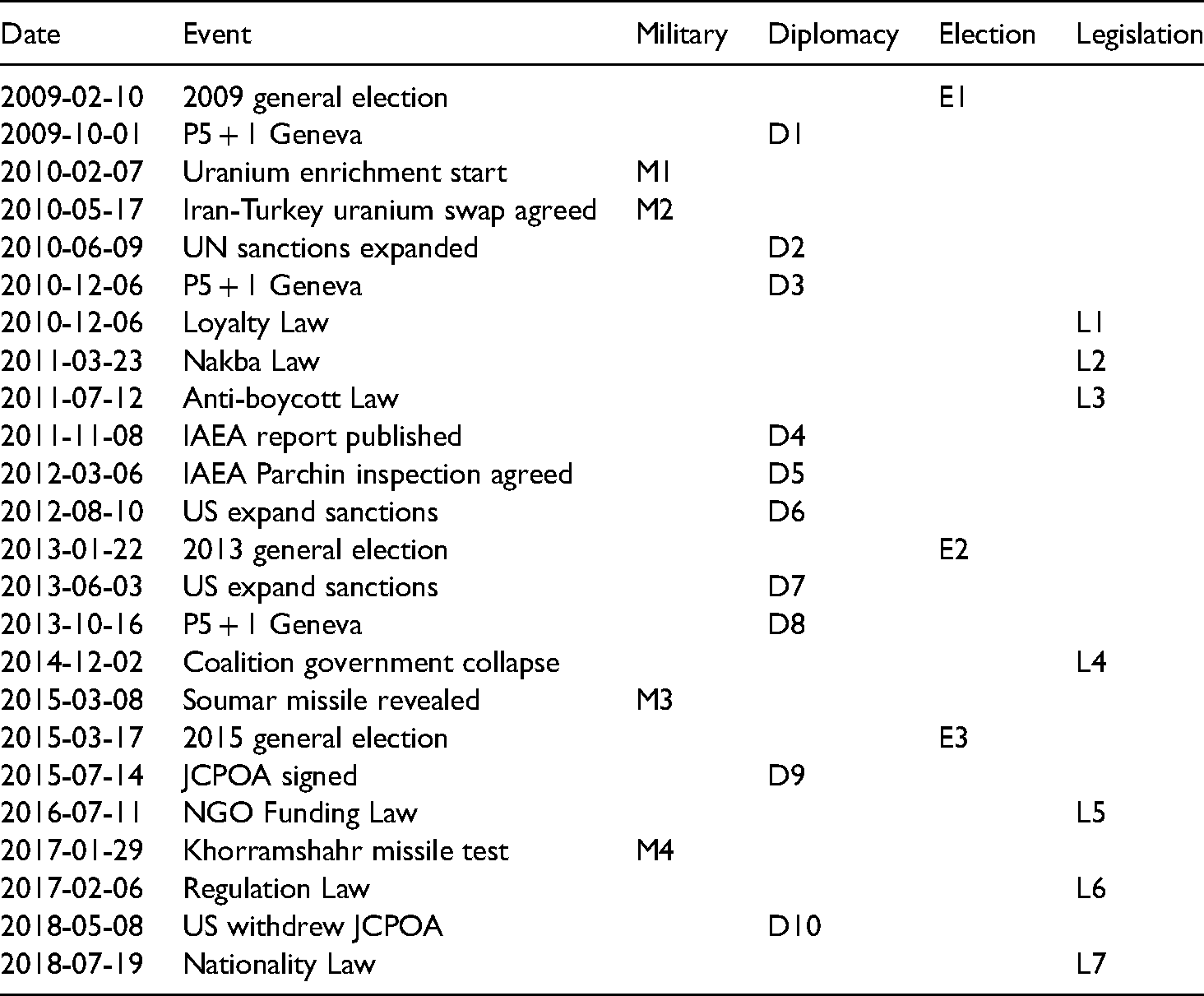
We have identified important national and international political events related to Japan and Israel that occurred during the study period and classified them into four categories: military (‘M’), diplomacy (‘D’), election (‘E’), and legislation (‘L’) (Tables 1 and 2). 3
Key evens for Japan. Events are classified into four categories and given serial numbers.
Key events for Israel. Events are classified into four categories and given serial numbers.
Events for Japan
North Korea launched rockets (M1, 5, 6) and tested nuclear bombs (M2, 7, 8, 9, 11) between 2008 and 2016. The successful launching of satellite (M1) by an Unha rocket that shares its delivery system with Taepodong-2 and detonation of nuclear bombs implied that North Korea is acquiring a ballistic nuclear missile capability (M10). North Korea also showed its aggression by sinking a South Korean naval ship (M3) and shelling Yeonpyeong Island (M4).
North Korea's repeated hostile actions led to the closure of Kaesong Industrial Region, where South Korean companies employ North Korean workers (D2). Abe attempted to solve the abduction issue diplomatically and relieved sanctions on North Korea (D3), but its hostility invited sanctions by the United Nations members, including Japan (D4). 4 During the study period, the leadership of the country was inherited from Kim Jong-il to Jong-nam (D1) to Jong-un (D5), who met with South Korean President Moon Jae-in (D6), and US President Donald Trump (D7) after their elections.
Abe's coalition government (LDP plus Komei) ruled Japan through the period by winning four Lower House elections (E1, 3, 5, 7) and two Upper House elections (E4, 6). He also approved the JSDF of collective self-defence (L2) and enacted three sets of security-related bills: the State Secrets Law (L1), the National Security Law (L3), and the Anti-terror Conspiracy Law (L4). The State Secrecy Law, which restricts access to classified information, raised concerns about government transparency and accountability; the National Security Laws, which permit mobilization of JSDF to protect Japan's allied forces overseas, was criticized as unconstitutional; the Anti-terror Conspiracy Law, which criminalizes formation of groups for illegal activities, was considered to undermine civil liberty.
Events for Israel
From the beginning of the study period, Iran started enriching Uranium (M1, 2) to acquire nuclear capability and developing cruise and ballistic missiles that can reach Israel (M3, 4) based on the technology imported from North Korea. The five permanent members of the United Nations Security Council and Germany (P5 + 1) attempted to prevent Iran from acquiring nuclear weapons through a series of meetings (D1, 3, 8) and sanctions (D2, 6, 7). As a result of the diplomatic effort, the multilateral deal on Iran's nuclear programs, the Joint Comprehensive Plan of Action (JCPOA), was signed (D9) despite Netanyahu's strong opposition. However, the United States under the Trump administration withdrew from the deal (D10).
Netanyahu as the leader of the Likud party formed a coalition government with the nationalist party (E1), but the required number of coalition partners increased to four as he lost his popularity (E2). He announced his opposition to the two-state solution and circulated anti-Arab videos in his election campaign, but the number of nationalist coalition partners increased further to five (E3). He presented controversial bills to the Israeli parliament: the Loyalty Law, which requires a loyalty oath to those who seek Israeli citizenship (L1); the Nakba Law, which defunds Palestinian institutions that commemorate the establishment of Israel a tragedy (L2); the Anti-boycott Law; which prohibits boycotts against West Bank settlers by Israeli citizens and organizations (L3); the NGO Funding Law, which demands NGOs to reveal their sources of funding (L5); the Regulation Law, which retroactively legalizes settlements in the West Bank (L6); the Nationality Law, which makes Hebrew the sole national language, grants autonomy only to Jews, and encourages expansion of Jewish settlement (L7). However, the Loyalty Law was rejected by MPs and disputes over the Nationality Law led to the collapse of the coalition government (L4).
Sources
We selected leading liberal (centre-left) and conservative (center-right) daily newspapers with the largest circulation in Japan and Israel. The Asahi Shimbun and the Yomiuri Shimbun are liberal and conservative national broadsheets in Japan. Yomiuri has been more supportive of the LDP than Asahi historically, but this became even more so during Abe's second term: Yomiuri supported Abe's security policy reforms and promoted Abe's nationalist agendas (Nakano, 2016).
Yedioth Aharonoth and Haaretz are Israel's major daily newspapers. Yedioth has been the largest newspaper in Israel and is considered a mainstream-center newspaper. Haaretz is the longest running print newspaper in Israel and has a liberal political inclination. While Israel Hayom is the most widely circulated and more tightly aligned with the right-wing government, we did not choose it as a conservative outlet because it is a free newspaper that appeared only in 2007.
In 2019, Netanyahu and Arnon Mozes, the owner of Yedioth, were indicted for allegedly discussing a deal to exchange favorable treatment of the newspaper for positive media coverage in 2017 (Freedman, 2019a, Bandel, 2019). Netanyahu was legally required to relinquish his ministry positions other than prime minister, and his trial officially began in May 2020.
Data collection
We collected news articles by searching newspaper publishers’ databases for “North Korea OR Iran” (“北朝鮮 OR 朝鮮民主主義人民共和国 ORイラン” for Japanese, “צפון קוריאה OR אירן OR איראן” for Hebrew). We included news articles about both North Korea and Iran in the two languages to statistically identify word semantics as closely as possible, but news articles not mainly about North Korea or Iran were excluded from the Japanese and Hebrew corpora, respectively, by a geographical classifier, which is explained below. The number of articles we collected are as follows: 34,219 from Asahi; 26,360 from Yomiuri; 17,899 from Haaretz; 9787 from Yedioth. 5 After removing duplicated or very short articles (comprising only of one sentence) and those containing many symbols, marks and digits (more than 20% of tokens), the number of articles in our corpus became 22,686 for Asahi, 18,727 for Yomiuri, 11,390 for Haaretz, and 6292 for Yedioth.
Text pre-processing
We pre-processed the collected news articles following the standard procedure in quantitative text analysis. We employed the Quanteda package (Benoit et al., 2018) for its ability to handle Asian languages and tokenize Japanese texts into individual words without the whitespace between them. We further improved the tokenization of both languages by identifying strongly associated words with collocation analysis and compounding them to form selective n-grams. We employed the Marimo stop-words list that extends the Snowball stop-words list and covers many Asia languages, including Hebrew and Japanese languages. 6 Throughout the pre-processing, we made handling of the two different languages as similar as possible to obtain directly comparable results.
Security threat scaling
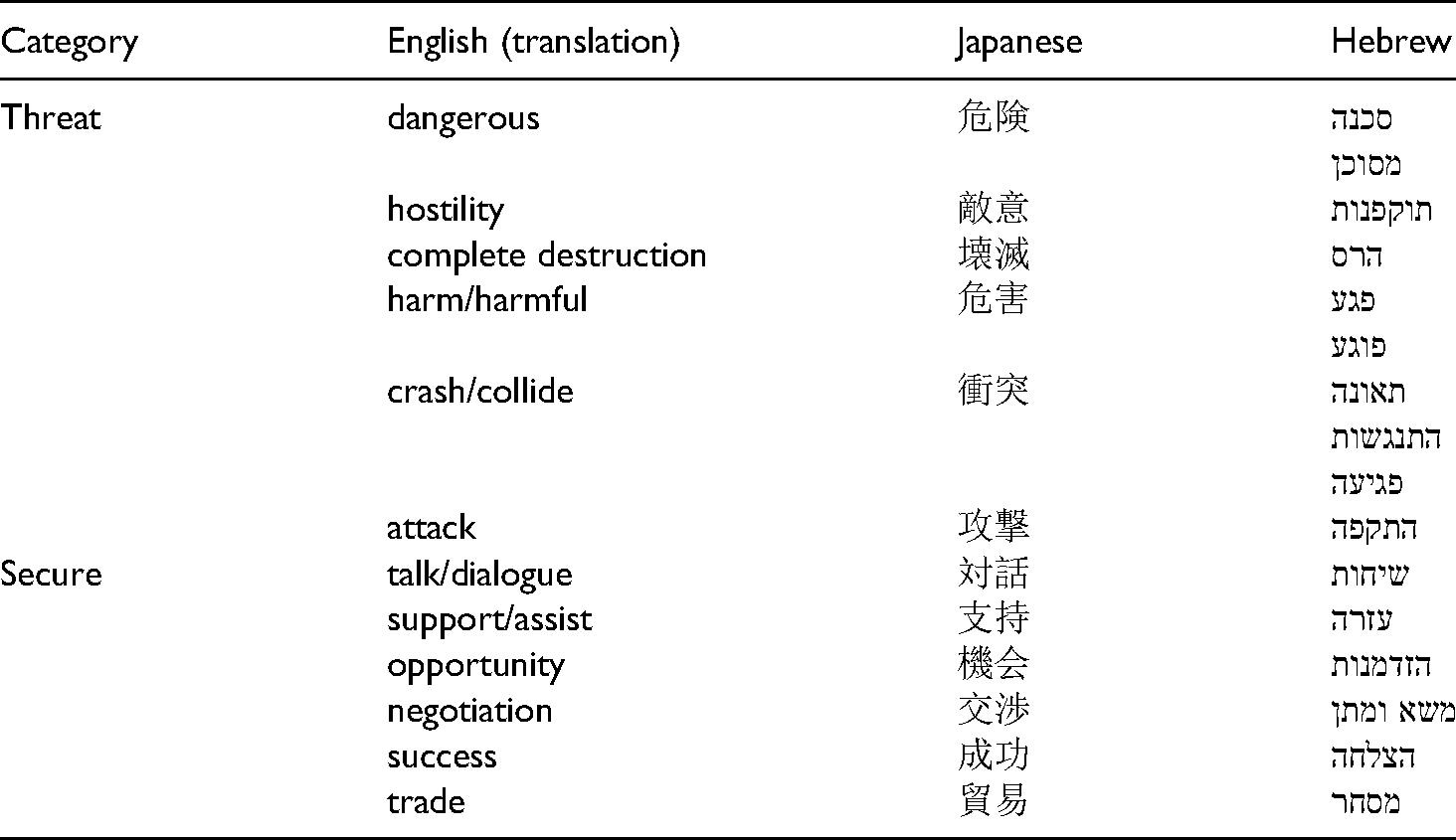
We employed Latent Semantic Scaling (LSS) to score news articles in terms of how much they emphasize security threats. LSS allows us to measure the specific quantity in the text without a large lexicon, because the algorithm automatically identifies synonyms of keywords (‘seed words’) (Watanabe, 2021). Since there was no earlier study that analysed security threats using LSS in Japanese and Hebrew, we selected our seed words based on our knowledge of the political discourse (Table 3). In selecting seed words, we first created candidate words in English and selected equivalent words in the native language of the authors. We selected seed words that were both general and unambiguous from the candidate words, but the final list of seed words was created after testing candidate words against the manually coded documents as explained below.
Security threat seed words in Japanese and hebrew. .
First, we computed polarity scores of words that were related to nuclear programs based on their proximity with the seed words in the latent semantic space. 7 We confirmed that words related to high threats (e.g. immediate military actions) received high polarity scores, while those related to low threats (e.g. diplomatic dialogue, international cooperation, and nuclear technology) received low polarity scores in both Japanese and Hebrew (Figure 1). 8
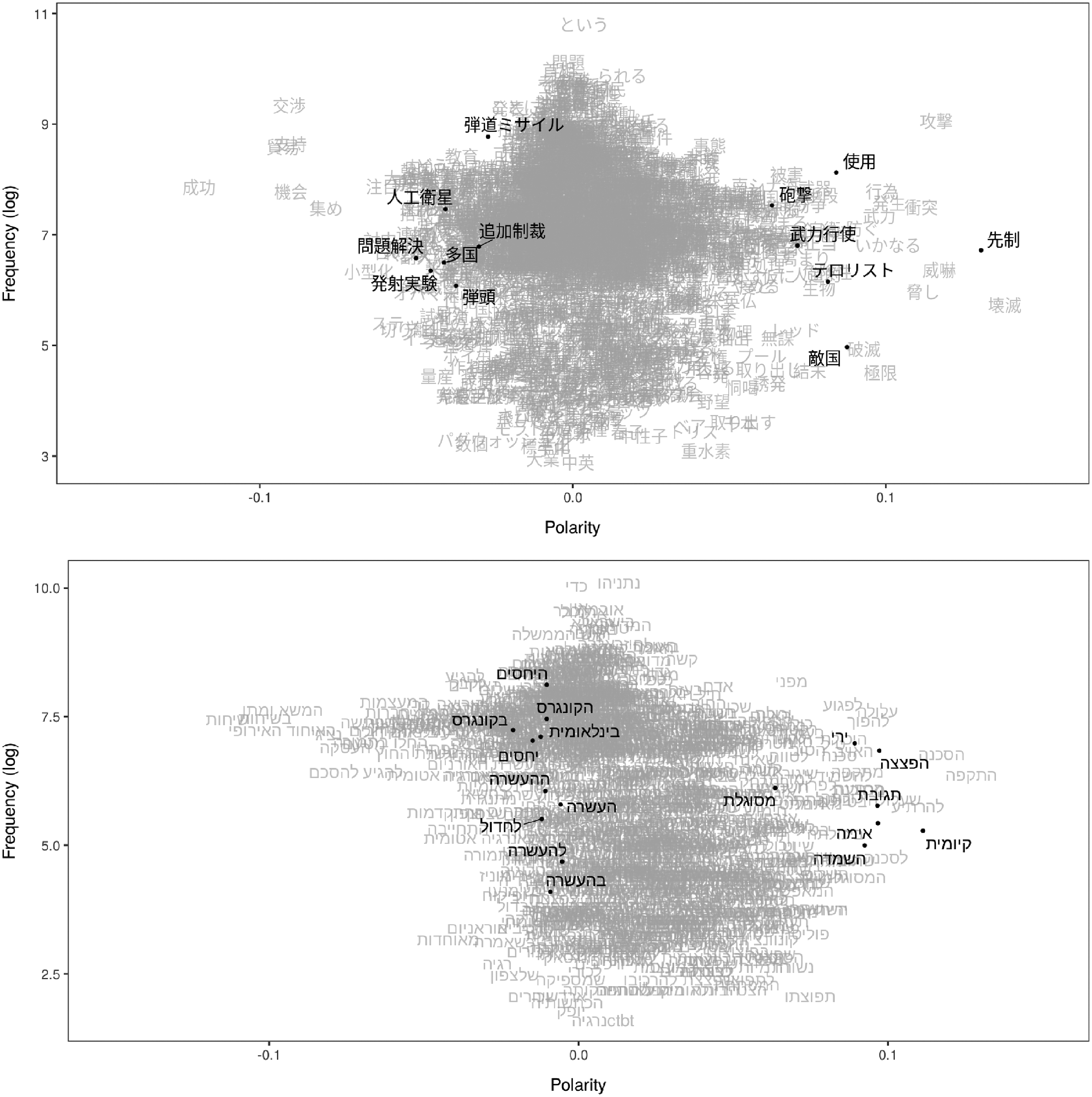
Polarity scores of words in the fitted LSS models in Japanese (above) and Hebrew (below). In Japanese, “先制” (preemptive), “敵国” (enemy country), “テロリスト” (terrorists), “武力行使” (use of force), “砲撃” (shelling), “使用” (use) are on the right-hand side, while “問題解決” (solve problems), “発射実験” (launch test), “弾道ミサイル” (ballistic missiles), “弾頭” (warhead), “人工衛星” (satellites), “追加制裁” (additional sanctions), “多国” (multilateral) are on the left-hand side. In Hebrew, “הפצצה” (bombing) , “ירי” (fire), “מסוגל” (capable) , “השמדה” (destruction), “תגובה” (reaction), “אימה” (terror), “קיומית” (existential) are on the right-hand side, while “יחסים” (relationships), “קשרים” (ties), “לחדול” (stop), “העשרה (enrichment), “בינלאומית” (international), “קונגרס” (congress) are on the left-hand side.
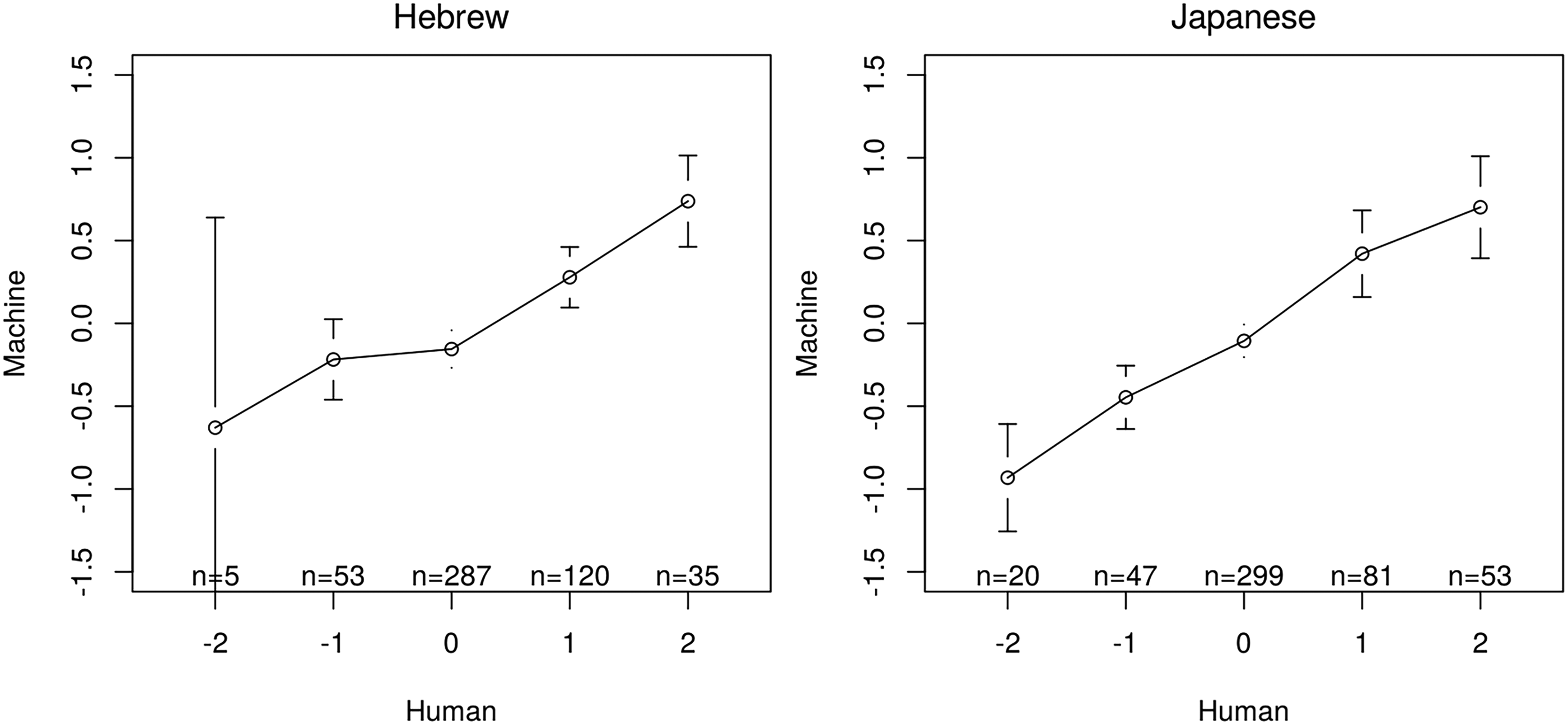
Correlation in mean polarity scores between machine and human. Vertical bars are 95% confidence intervals.
Second, we computed polarity of news articles with the fitted LSS models by weighting the polarity scores of frequent words in the documents. The polarity scores are centred around zero and normalized by the standard deviation to make interpretation easy. Although the absolute zero does not have substantive meaning, the changes in polarity scores indicate changes in emphasis on threats by the newspapers.
We also manually coded samples of 500 articles employing three native Japanese and Hebrew speakers to assess the accuracy of the polarity scores. They were asked to read at natural speed and classify articles into one of three categories (“threat”, “neutral”, or “safe”) depending on how events and figures mentioned pose threats to the normal lives of Japanese or Israeli people. Unlike traditional content analysis, we did not provide detailed instruction on how to classify news articles to allow the coders to respond in a similar way to the general audience of the newspapers. Such natural reading of news articles is important because we will incorporate the result of content analysis from this study with survey experiments in other studies as part of our larger research project (Segev et al., 2022).
The result of manual classification was turned into discrete scores ranging from − 2 to + 2 based on the agreement between the coders, following the work by Young and Soroka (2012). 9 The individual predicted polarity scores only weakly correlate with the manual scores (r = 0.37 in Japanese and r = 0.26 in Hebrew; p < 0.001), but their means within each group strongly correlate with the manual scores (r = 0.99 and r = 0.97 respectively; p < 0.001) (Figure 2). We adopt the latter scores as the accuracy of our computational analysis because we are interested in news coverage only on the group level. 10
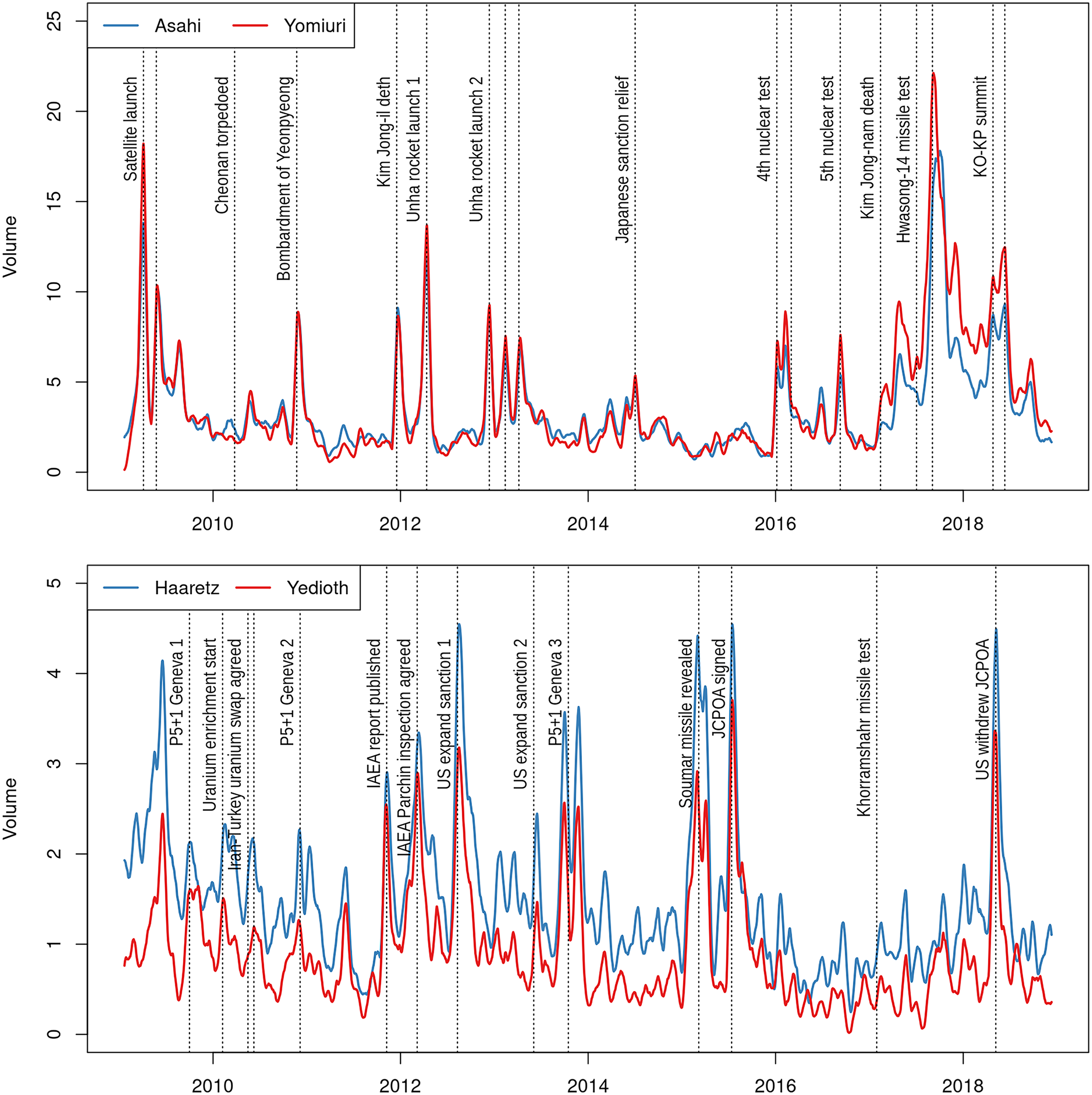
Volume of articles published by Japanese newspapers about North Korea (above) and Israeli newspapers about Iran (below). Vertical lines indicate occurrences of the military and diplomatic events in Table 1 or 2.
Classification
Not all news articles mentioning Iran or North Korea focus on these countries. Therefore, we applied Newsmap, which can accurately identify the main geographical focus of the news articles. In this technique, we first train the classifier on the news articles labelled by a geographical dictionary to collate words related to countries (e.g. names of places, people, organizations etc.), and then predict the country that is most strongly associated with the news articles (Watanabe, 2018). We included news articles only mainly about North Korea or Japan in the analysis of Japanese newspapers, and Iran or Israel in Israeli newspapers; Gaza and the West Bank are treated as separate territories from Israel and excluded from the analysis. After the selection, the total number of news articles included in our analysis are 26,835 in Japanese and 9597 in Hebrew. 11
Analysis
First, we analyse the volume of articles published by the newspapers and their emphasis on threats to gain an overall picture of the data. Second, we apply OLS regression analysis with the LSS scores as the dependent variable and event dummies as independent variables to gauge the changes in intensity of threats over time.
Volume of news
Figure 3 shows that the volume of articles published by the newspapers corresponds to the occurrences of the military and diplomatic events from 2009 through 2018. The number of articles concerning North Korea published by the Japanese newspapers are nearly identical until late 2017. Across the same period, Haaretz published more news articles about Iran than Yedioth did, but both newspapers covered the military and diplomatic events extensively. The correlation of the volume of articles are r = 0.86 in Japan and r = 0.45 in Israel.
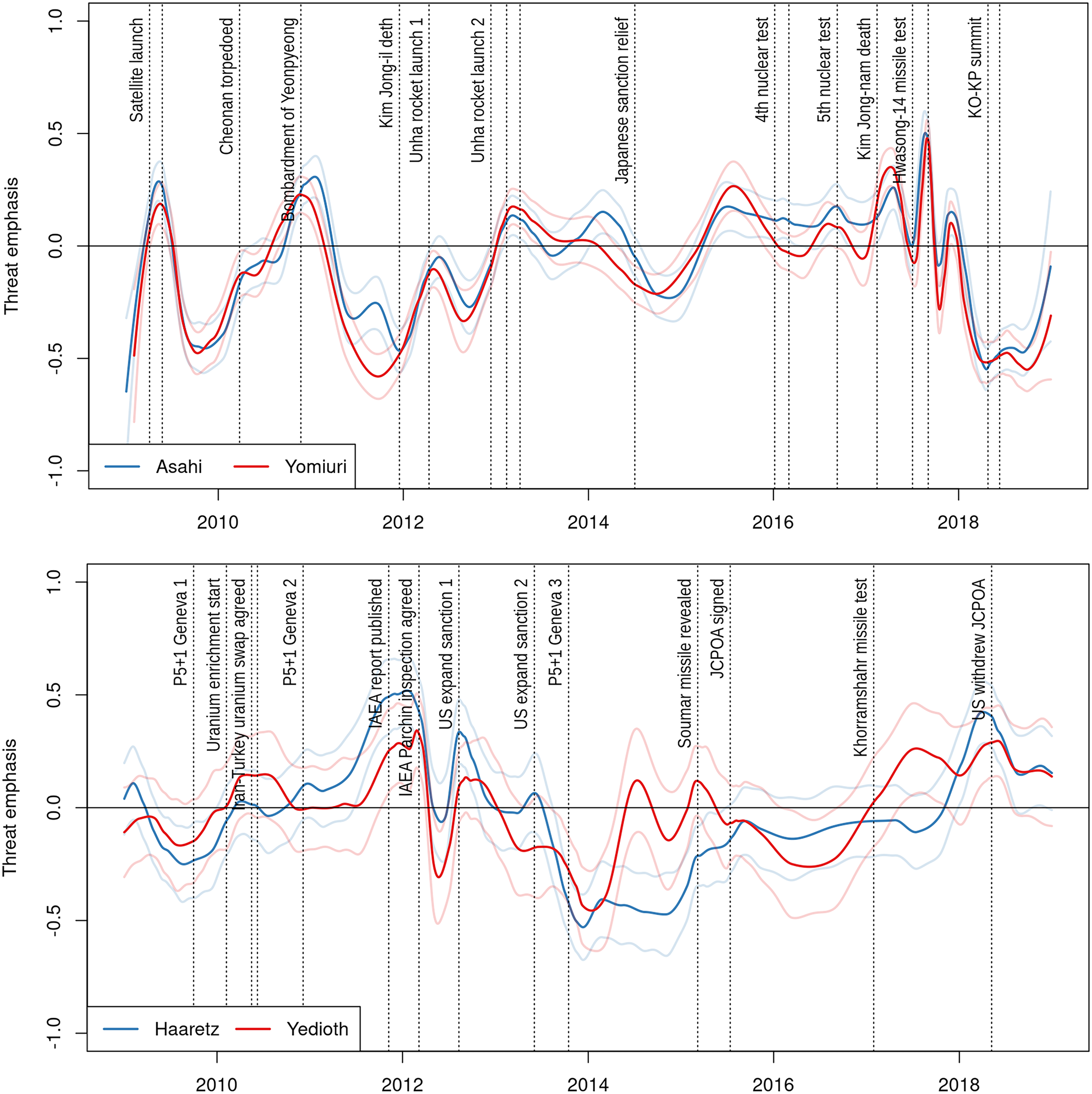
Threat emphasis in Japanese (above) and Israeli (below) news articles. Moving average (dark) and 95% confidence band (light) of LSS scores are computed by the local regression (LOESS).
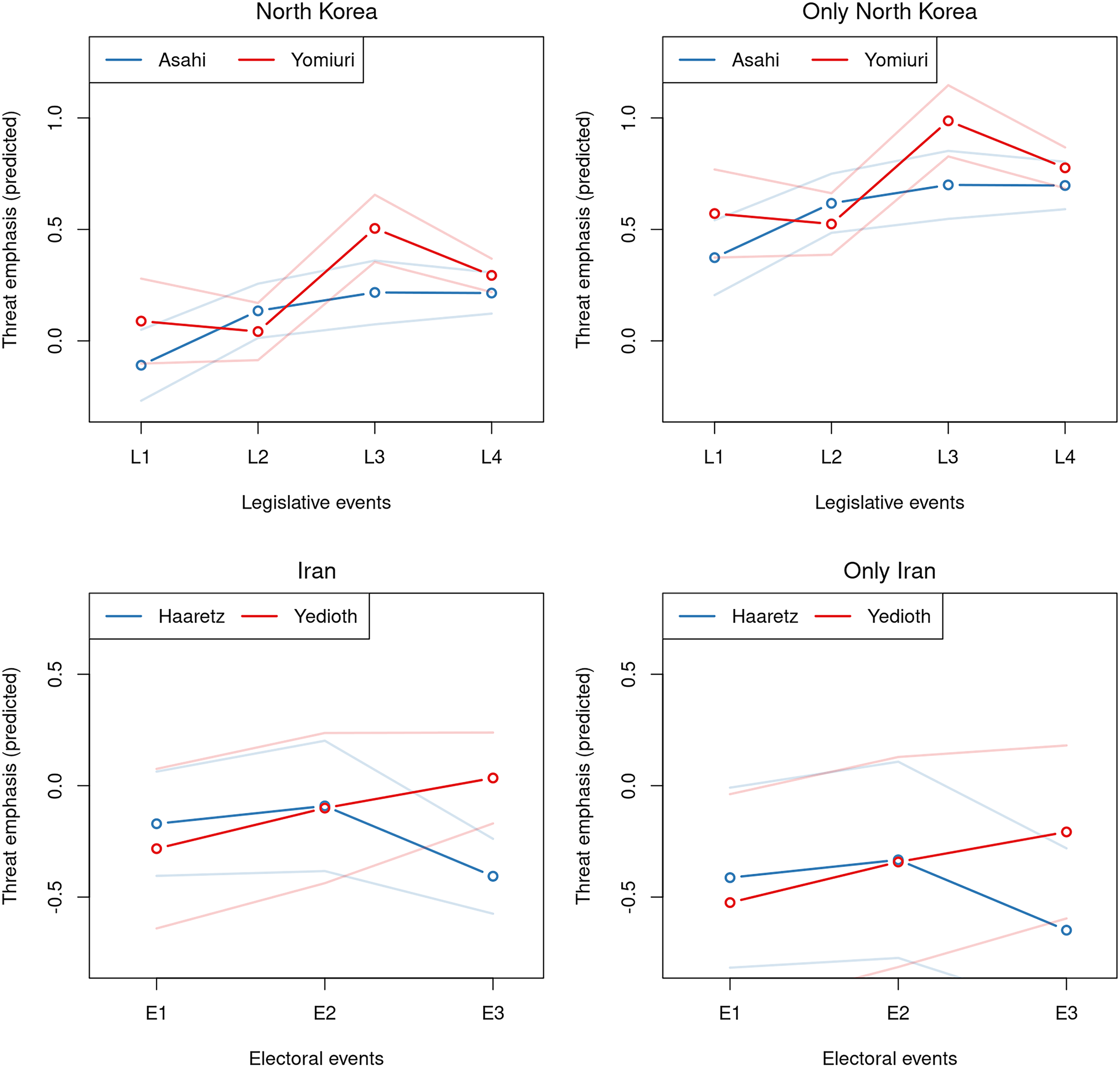
Emphasis on threats in Japanese (above) and Israeli (below) news articles predicted by Model 7. Their geographical focus is on North Korea or Iran. Other dummy variables (“government”, “military”, “diplomacy” and “election” or “legislation”) are set to zero. Light-coloured lines are 90% confidence intervals (the confidence level is low because of the large standard error of insignificant variables in the model).
Emphasis on threats
In Figure 4, Japanese newspapers emphasised threats only after occurrences of the key events until 2012, but the high threats persisted from 2014 to 2017. Asahi and Yomiuri correlate but there are noticeable differences during this period: Asahi emphasized threats more than Yomiuri in 2011, 2014, and 2016. In the Israeli newspapers, threats were high at the end of 2011, but decreased rapidly afterwards, although they increased gradually towards 2018. Haaretz and Yedioth correlate only until 2013, and they differ greatly between 2014 and 2017.
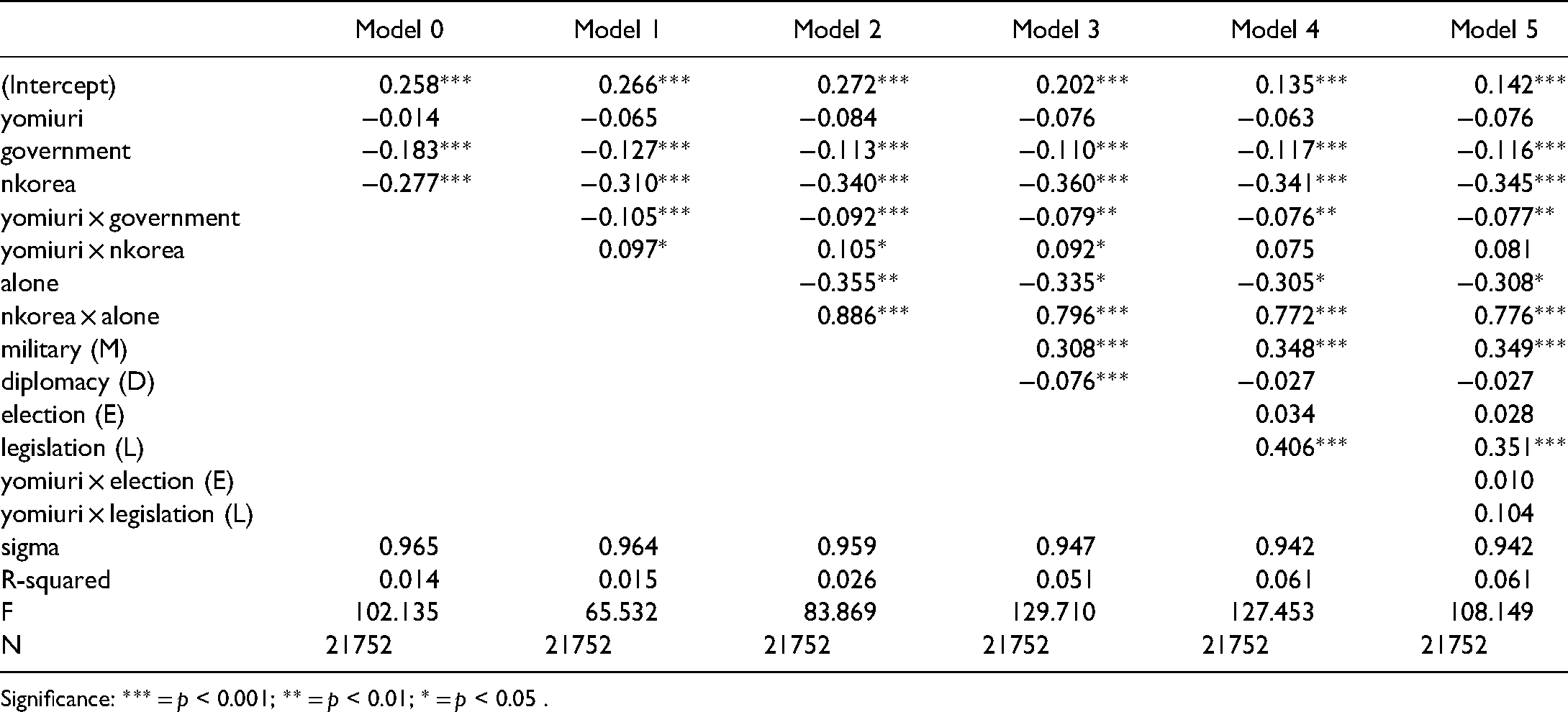
We tested the statistical significance of the changes and the differences between the newspapers by OLS regression analysis with multiple dummy variables. In the models for the Japanese newspapers (Table 4), the variable ‘government’ refers to mentions of cabinet members, including the Prime Minister (“*首相”) or other ministers (“*大臣” and “*長官”); ‘yomirui’ is the newspaper indicator; ‘nkorea’ is the focus on North Korea; ‘alone’ is the focus on a single country; ‘military’ and ‘diplomacy’ are aggregated time indicators within 60 days after the military and diplomatic events; ‘election’ and ‘legislation’ are within 60 days before the electoral and legislative events. 12 The basic model (Model 0) shows that threats are weaker in articles that mention the cabinet members or focus on North Korea than others (p < 0.001), but there is no difference between Asahi and Yomiuri. When the interactions between ‘yomiuri’ and ‘goverment’ and ‘yomiuri’ and ‘nkorea’ are added (Model 1), Yomiuri appears different from Asahi: the conservative Yomiuri emphasized threats less in articles that mention the cabinet members (p < 0.001) and more in articles about North Korea (p < 0.05) than the liberal Asahi. The consistently weaker emphasis on threats (p < 0.001) in news articles about North Korea (‘nkorea’ in Model 0–5) is puzzling, but the interaction term between ‘nkorea’ and ‘alone’ in Model 2 indicates that threats are strongest in articles that mention only North Korea (‘nkorea × alone’, β = 0.88, p < 0.001). The dummy variables in Model 3 show that the newspapers emphasized threats more after the military events (‘military’, β = 0.30, p < 0.001) but less after the diplomatic events (‘diplomacy’, β = − 0.07, p < 0.001). However, the effect of the diplomatic events no longer appears to be significant when the legislative events are added (‘legislation’ in Model 4). Model 5 includes interaction terms between ‘yomiuri’ and the dummy variables for electoral and legislative events, although they do not appear to be significant.
Japanese newspapers’ emphasis on threats with aggregated event indicators.
Significance: *** = p < 0.001; ** = p < 0.01; * = p < 0.05 .
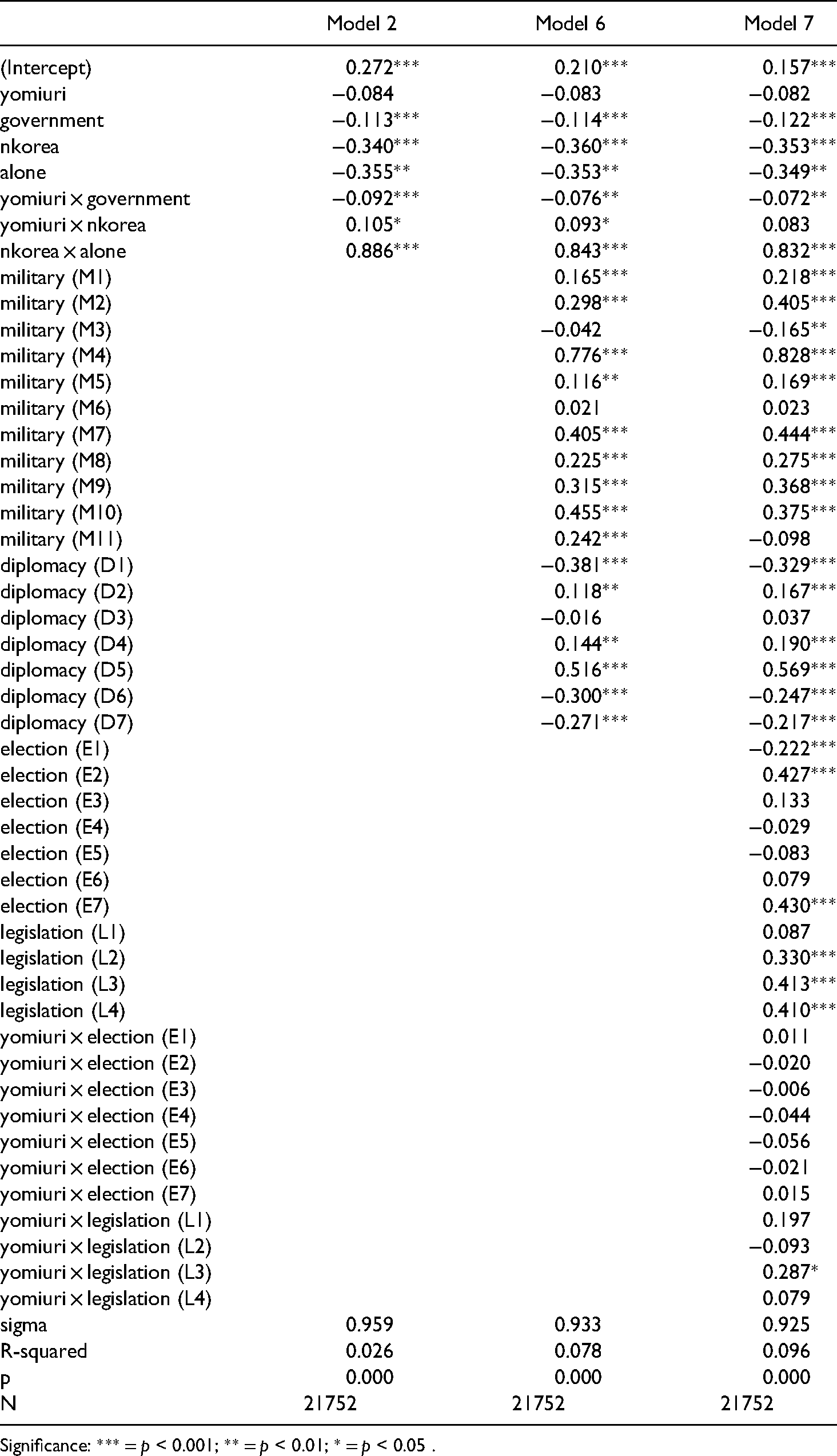
We performed an additional regression analysis by disaggregating the event dummies to capture different degrees of changes in emphasis on threats before or after individual events (Table 5). We confirmed that the effects of basic variables in Model 6 are roughly the same as Model 2, despite the large number of dummies for the military and diplomatic events. The event dummies indicate that all but the sinking of Cheonan (M3) and the second Unha rocket launch (M6) increased the newspapers’ emphasis on threats. The diplomatic events affected newspapers in either two ways: threats increased after the closure of Kaesong Industrial Region (D2), the UN sanctions (D4), and the death of Kim Jong-nam (D5); or decreased after the death of Kim Jong-il (D1), the Inter-Korean summit (D6) and the US-North Korean summit (D7). All these changes are statistically significant (p < 0.01).
Japanese newspapers’ emphasis on threats with disaggregated event indicators. Model 2 is inserted for comparison.
Significance: *** = p < 0.001; ** = p < 0.01; * = p < 0.05 .
Further, we have added dummy variables for the electoral and legislative events to reveal the newspapers’ coverage of security issues during the domestic political debates (Model 7). The newspapers emphasized threats significantly more before the 2010 Upper House election (E2); the 2017 Lower House election (E7); the approval of collective self-defence (L2); and the passing of the National Security and Anti-terror Conspiracy bills (L3 and L4). The interaction terms between the newspaper indicator and event dummies show that the conservative Yomiuri emphasized threats more than the liberal Asahi during the debate on the National Security Laws (‘yomiuri × L3’, p < 0.05). Figure 5 shows that such a difference between the two newspapers appeared in articles about North Korea only in this period (L3).
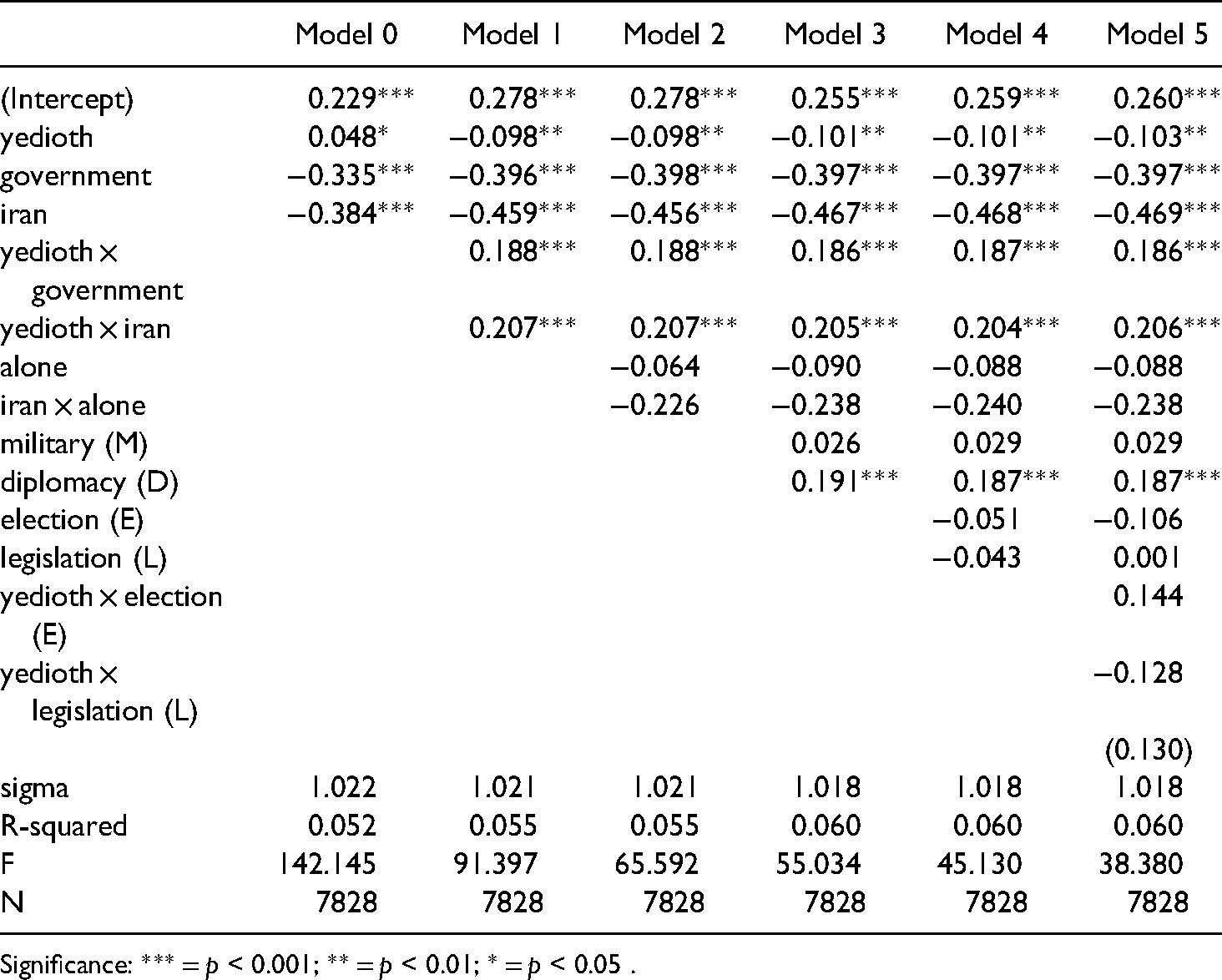
We applied the same regression analysis to the Israeli newspapers (Table 6). In these models, the variable ‘government’ refers to mentions of cabinet members (“ראש ממשלה”, “ראש הממשלה”, “שר ה*”, “השר”), ‘yedioth’ is the newspaper indicator; ‘iran’ is the focus on Iran; ‘military’, ‘diplomacy’, ‘election’ and ‘legislation’ are aggregated time indicators with 30 days before or after the events. We decreased the window sizes for Israel to achieve a better model fit (see Appendix 2).
Israeli newspapers’ emphasis on threats with aggregated event indicators.
Significance: *** = p < 0.001; ** = p < 0.01; * = p < 0.05 .
The basic model (Model 0) shows that Israeli newspapers emphasized threats less in articles that mention cabinet members (‘government’) and focus on Iran (‘iran’) (p < 0.001) than in other articles, but the interaction terms in Model 2 reveal that the conservative Yedioth emphasized threats in such articles more than the liberal Haaretz (p < 0.001). Unlike Japanese newspapers, Israeli newspapers emphasized threats more after the diplomatic events (‘diplomatic’) (Model 3, 4, 5).
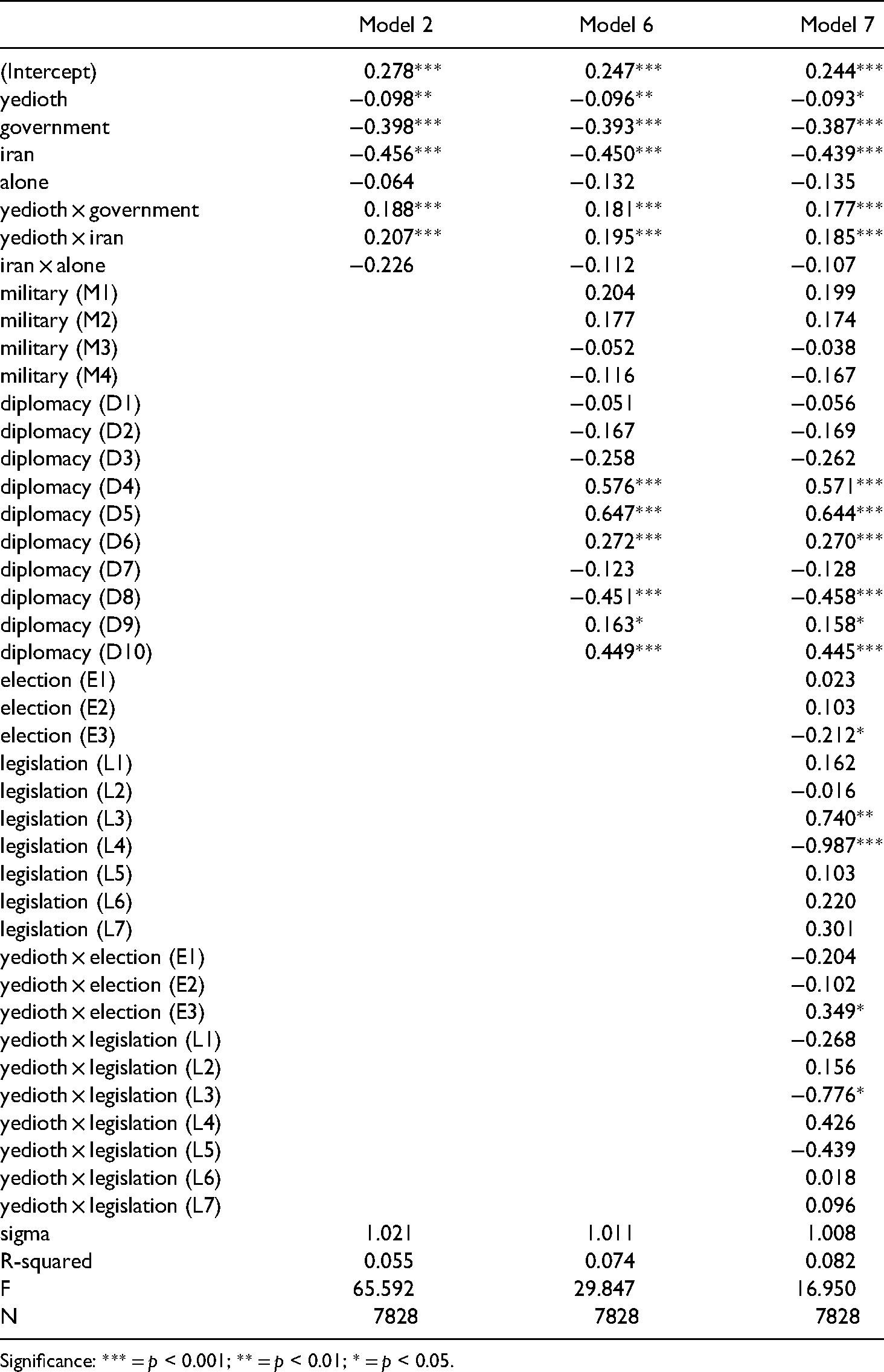
Our regression models (Model 6 and 7) with disaggregated event dummies show roughly the same effects of ‘government’, ‘yedioth’ and ‘iran’ but they reveal different directions of effects within ‘diplomacy’ and ‘legislation’ (Table 7). The level of threats in news coverage was lower after the third P5 + 1 meeting in Geneva (D8) but higher after the publication of IAEA report (D4); the agreement on IAEA inspection of the nuclear facility in Parchin (D5); the first expansion of the US sanctions (D6); and the US withdrawal from JCPOA (D10) (p < 0.001). Both newspapers emphasized threats less before the collapse of the coalition government (L4) than other times (p < 0.001). However, the interaction terms in Model 7 reveal that the conservative Yedioth emphasized threats more than the liberal Haaretz before the 2015 general election (‘yedioth × E3’, p < 0.05). Figure 5 summarizes that the difference between the two newspapers is significant in articles about Iran during this period (E3) but not in articles that mentioned Iran without any other countries.
Israeli newspapers’ emphasis on threats with disaggregated event indicators. Model 2 is inserted for comparison.
Significance: *** = p < 0.001; ** = p < 0.01; * = p < 0.05.
Discussion
Based on the literature on press-state relationships, we predicted that conservative outlets support the conservative leaders in power. The overall tendency of the newspapers to emphasize threats supports Bennet's indexing hypothesis that media coverage is strongly influenced by the government's positions. This is true in security issues because national newspapers often lack the ability to gather information independently (Soroka, 2003). The high correlation in terms of the volume of news between newspapers further means that there is a general agreement on the agenda in foreign news. Yet, the conservative newspapers differentiate themselves from liberal rivals by emphasizing threats in articles featuring North Korea or Iran alone. Furthermore, conservative newspapers’ closer relationship with the conservative governments is clearly observed during specific events, when politicians need mass media's support to survive challenging legislative processes or election campaigns.
Our analysis indeed revealed significant differences between the conservative and liberal newspapers when North Korea or Iran was the only focus of the articles. Yet conservative newspapers did not always emphasize threats when covering North Korea or Iran in broader international contexts. Our first hypothesis (H1) is therefore only partially supported. Still, we found that conservative newspapers overemphasized threats before important political events: the enactment of Japan's controversial security bills and Israel's 2015 general election. These finding support the second hypothesis (H2).
The direction of changes in the newspapers’ emphasis on threats after military and diplomatic events varied between Japan and Israel. The Japanese newspapers emphasized threats more after 9 out of 11 military events, but the Israeli newspapers did not emphasize threats more after any of the four military events. The Japanese newspapers emphasized threats less after 3 out of 7 diplomatic events, but The Israeli newspapers emphasized threats even more after 5 out of 10 diplomatic events. Therefore, the third hypothesis (H3) was supported only in Japan. These results indicate that newspapers’ coverage of security issues is more complex than the literature suggests.
The Japanese newspapers’ coverage of North Korea after military and diplomatic events often changed as expected: the emphasis on threats rose after military events but waned after diplomatic events. This pattern was not observed in Israel. We explain the difference between Japan and Israel by the nature of threats: North Korea was highly provocative and seemingly close to deploying nuclear missiles, while Iran was restrained and still far from obtaining nuclear capabilities. The closure of Kaesong Industrial Region (D2), the UN sanctions (D4) and the death of Kim Jong-nam (D5) increased the Japanese newspapers’ emphasis on threats because they indicated North Korea's continued aggression against neighbours and ambition to possess nuclear weapons, or the potential instability in and around the country.
The periods during which we discovered the conservative newspapers’ emphasis on threats are consistent with the anecdotal evidence for collision and collusion between the conservative governments and the news media in Japan and Israel. Abe's government increased pressure on the liberal media over the country's historical issues in 2014; this tension further intensified a year after, when the liberal media opposed the national security legislation while conservative media supported it (Nakano, 2016). Netanyahu allegedly asked the owner of Yedioth for favourable news coverage in exchange for blocking publication of its rival newspaper in meetings between 2008 and 2014; the prime minister was indicted for breach of trust, accepting bribes and fraud in 2019.
Despite the difference between Japan and Israel in the security environment and the institutional constraints on the leaders, Abe and Netanyahu appear surprisingly similar in terms of their rhetorical use of nuclear threats by regional adversaries. The reasons behind the similarity are the following common factors: the (1) diminishing political gains from their successful economic reforms in the earlier years; the (2) increasing opposition in the legislature or competition in the elections; the (3) lack of the countries’ ability to solve the security issues unilaterally; and the (4) diplomatic and military relationship with the United States. The first two factors agree with the diversionary war thesis that the leaders attempt to divert domestic turmoil by the rally effect, while the last two factors explain why the Japanese and Israeli leaders resorted to political rhetoric instead of actual force. That is to say, Abe could not use force against North Korea due to the country's constitution; Netanyahu only used limited force (e.g. cyber-attacks and assassination) against Iran due to Obama administration's policy (David, 2019; Freedman, 2019b).
Netanyahu's opposition to the JCPOA and emphasis on the nuclear threats were consistent with his known political strategy to spread fear (Lochery, 2016). However, his subsequent loss of popularity suggests that he did not manage to trigger the rally effect because of the lack of clear distinction between in-group and out-group in his rhetoric: his narrative that the US-led nuclear deal will pose threats to Israel is equivalent to claiming that the US foreign policy threatens Israel. In contrast, Abe's threat narrative was better received and he remained popular despite the corruption scandals in the following years. He was successful in discursive diversion because North Korea was hostile to both Japan and the United States and reached no agreement on its nuclear program with Japan's allies. There is no direct evidence that Yomiuri intentionally emphasized North Korea's threats to support Abe, but its tendency to focus on threats and isolate North Korea in the international community could be the result of its close relationship with the government. Regardless of the publisher's intention, such coverage of North Korea could have assisted Abe to gain public support and pass controversial bills to complete his sweeping security policy reforms (c.f. Hughes, 2015; Kagotani 2015; Ryu, 2018). This possibility has been shown in our study based on psychological experimental (Segev et al. 2022).
Conclusions
We found that Japanese and Israeli conservative leaders attempted to divert domestic discontent by manipulating people's perception of nuclear threats through the mass media. Such discursive diversion is an attractive option for leaders of countries that have limited opportunity or capability to use force because it is much less risky and less costly than the actual use of force. Leaders of the ruling party can manipulate people's fear by their emphasis on threats in speeches and press conferences, which are the main sources of information on security issues for the news media. Conservative outlets do not necessarily collaborate with the conservative government, but they often reflect their views because of their partisanship or clientelism (Hallin & Mancini, 2004).
We believe that discursive diversion as an action “fall short of actual war” (Levy, 1989, p. 271) is very common in countries across the world, but it has not attracted much research attention presumably because systematic content analysis in non-European languages has been too challenging. Nevertheless, we have demonstrated that the analysis of news articles written in two unique Asian languages is possible using the recently developed tools. If discursive diversion is included, much clearer relationships between domestic turmoil and leaders’ diversionary actions would be found in cross-national analysis.
Our study contributes to the understanding of the relationship between the state and the mass media over security issues, but there are also limitations. First, we have only studied Japan and Israel despite there being other interesting cases of democracies or semi-democracies in geo-politically unstable regions, such as South Korea, India, Philippines, Turkey. Second, we have analysed only news articles on North Korea despite China being a major source of threat to Japan. Third, we did not include non-state actors that are immediate security threats for Israel in our analysis, such as Hamas, Hezbollah and ISIS. While we chose to focus on nuclear capabilities as the most important security issue, future studies should include broader types and sources of threats.
Supplemental Material
sj-docx-1-gaz-10.1177_17480485221097967 - Supplemental material for Discursive diversion: Manipulation of nuclear threats by the conservative leaders in Japan and Israel
Supplemental material, sj-docx-1-gaz-10.1177_17480485221097967 for Discursive diversion: Manipulation of nuclear threats by the conservative leaders in Japan and Israel by Kohei Watanabe, Elad Segev and Atsushi Tago in International Communication Gazette
Footnotes
Replication data
The dataset, codebook, and R scripts for the analysis in this article, along are available at https://doi.org/10.7910/DVN/NT28D8. All analyses were conducted using the stats, quanteda, LSX and newsmap packages.
Declaration of Conflicting Interests
The author(s) declared no potential conflicts of interest with respect to the research, authorship, and/or publication of this article.
Funding
The author(s) disclosed receipt of the following financial support for the research, authorship, and/or publication of this article: This work was supported by the Japan Society for the Promotion of Science, (grant number JP19H01450).

Supplemental material
Supplemental material for this article is available online.
Notes
Appendices
References
Supplementary Material
Please find the following supplemental material available below.
For Open Access articles published under a Creative Commons License, all supplemental material carries the same license as the article it is associated with.
For non-Open Access articles published, all supplemental material carries a non-exclusive license, and permission requests for re-use of supplemental material or any part of supplemental material shall be sent directly to the copyright owner as specified in the copyright notice associated with the article.
