




Abstract
This study offers a futsal-specific account of how elite Portuguese coaches conceptualize and operationalize talent identification and development. Adopting an ecological dynamics perspective, we conducted semi-structured interviews with seven elite male coaches (Liga Placard and national teams) and analysed transcripts thematically (NVivo 14). Findings are organised across three domains. (1) Athlete constraints: coaches framed physical capacities as non-limiting baselines, emphasising instead psychological robustness (e.g., resilience, intrinsic motivation, emotional regulation) and technical–tactical adaptability (e.g., game intelligence, rapid decision-making under pressure) as key markers of potential. (2) Task constraints: coaches prioritised representative learning design (e.g., small-sided games), adaptive task complexity, and the developmental value unstructured play alongside formal practice (3) Environmental constraints: family support, peer interactions, and school context were identified as critical factors shaping long-term development. Coaches conceptualise talent in futsal as an emergent property arising from the continuous interaction between athlete, task, and environment, shaped by the sport's specific demands. This study advances talent identification and development in futsal by grounding ecological theory in the lived expertise of coaches within one of the world's most successful futsal systems.
Introduction
Futsal is a fast-paced, high-intensity, and tactically demanding sport that requires the integration of technical skills, perceptual-cognitive processing speed, tactical understanding, and adaptability under time-pressured and space-constrained conditions. 1 Thus, player development should not focus solely on the improvement of isolated physical or technical abilities, but rather on a complex integration of attributes shaped over time through context-specific learning environments. Accordingly, talent identification and development (TID) in futsal remains a core challenge due to the multidimensional interactions between performance, player characteristics, and the context of practice.2,3
Research comparing expert and novice players in futsal has highlighted the importance of technical, tactical, and psychological competencies for elite performance, while anthropometric and physical attributes may also influence player selection and development. For example, agility, speed, and coordination can complement technical skills and enhance performance in high-intensity situations. 4 Similarly, psychological attributes such as mental resilience, composure, and self-regulation are critical for sustaining high-level performance under pressure5. Importantly, these competencies should not be considered in isolation, as they emerge from the interaction between individual resources, task demands, and environmental constraints.5,6
Traditional approaches to talent identification and development have often relied on reductionist models that prioritise isolated physical or anthropometric attributes, potentially overlooking the dynamic and context-dependent nature of performance. As a result, such models may provide a limited understanding of how talent develops within complex sporting environments. In contrast, recent research has increasingly recognised that talent cannot be reduced to a fixed set of attributes, but should instead be understood as an emergent phenomenon arising from the dynamic interaction between the individual athlete, task demands, and the surrounding environment.7,8 This holistic and systemic perspective has contributed to the growing adoption of ecological approaches in talent research.1,7,8 Evidence further suggests that effective talent development requires multifactorial and long-term strategies that integrate training experiences, competitive exposure, physiological support, and continuous evaluation.7,9 Accordingly, the diversity of practice contexts (e.g., structured training and informal play) plays a critical role in athletic development, highlighting the importance of considering how different experiences and environments interact over time.
Throughout the talent development process, coaches are central to talent selection, identification and development, drawing on a combination of professional knowledge, experiential learning, and contextual understanding to shape and support athlete progression. 10 However, most existing research has focused on futsal players, with limited emphasis on the lived experiences and decision-making processes of coaches. 11 This is particularly relevant in futsal, where coaches may prioritize different markers of potential compared to other sports, due to the game's spatial-temporal complexity and constant transitions. 11 Within this perspective, influential factors are commonly organized into three interacting domains: athlete, task and environmental constraints.3,12 This framework provides a useful approach to understanding the dynamic systems that shape talent development, encompassing individual characteristics, training and competition demands, and broader socio-cultural and organisational influences.
From this perspective, coaches are not merely implementers of training, but active interpreters of the ecological complexity underpinning talent development. 13 However, there remains a lack of research exploring these phenomena within the specific context of Portuguese futsal, a sport with a distinguished record of international success. 8 Indeed, Portugal has become a reference in global futsal, winning the FIFA Futsal World Cup in 2021 and the UEFA Futsal Championship in 2018 and 2022. This sustained success is supported by a structured and evidence-informed development system, alongside high standards of coach education.
Given the centrality of coaches in shaping talent pathways, the aim of this study was to explore how elite Portuguese futsal coaches perceive and implement talent identification and development processes. Adopting a qualitative approach, the study captures nuanced coach perspectives and decision-making processes, with particular focus on how talent is conceptualised and operationalised within context-specific environments. This contributes to advancing both the theoretical understanding and practical application of TID frameworks in high-performance futsal.
Methods
Study design
This study adopted a qualitative, interpretivist approach to explore elite coaches’ perceptions of talent identification and development in Portuguese male futsal. Considering the contextual, experiential, and subjective nature of the topic, a qualitative design was deemed appropriate to capture the nuanced, situated understandings that coaches develop through their lived practice. 14 Specifically, the study followed a thematic analysis framework informed by Braun and Clarke's six-phase model,15,16 which enabled systematic identification and interpretation of patterns across the data.
Participants
Seven male elite futsal coaches, all working with male teams, were purposefully selected for this study using criterion-based sampling. 17 Inclusion criteria required that participants: (a) registered in Portugal First Division (Liga Placard) and/or with national futsal teams, (b) had a minimum of 5 years of experience at the elite level, and (c) had direct involvement in talent identification and development processes (e.g., youth scouting, academy coordination, or performance coaching). The final sample included two national team coaches and five coaches from Portuguese League. This purposeful sampling ensured both expertise and contextual relevance, allowing for an in-depth understanding of how talent is perceived and operationalized in elite Portuguese futsal. Participants were coded anonymously (e.g., FC1 to FC7) to protect confidentiality and ensure impartial interpretation of the data.
Data collection
Data were collected through semi-structured interviews, conducted individually between January and March 2025. Interviews were held online or in person, depending on participant availability, and lasted between 45 and 75 min. An interview guide was developed based on existing literature in TID2,3,7 was organized around three overarching areas: (1) Conceptualizations of talent in futsal; (2) Key factors influencing talent identification and development, including athlete, task, and environmental constraints; (3) Experiential reflections on the challenges and successes of talent development in practice. Probes and follow-up questions were used flexibly to elicit deeper reflections and allow participants to elaborate on their experiences. All interviews were conducted in Portuguese, audio-recorded with consent, and transcribed verbatim for analysis. The interview guide is provided as Supplementary Material. Illustrative questions included: (1) “The literature presents different definitions of ‘talent’. In your view, what defines talent in futsal?”; (2) “Given the growing importance of physical performance in modern futsal, how do you consider it in training planning for the development of younger players?”; (3) “To what extent is the psychological component considered in athlete development, and how is it addressed?”; and (4) “To what extent do you consider athletes’ family and social context to influence their development, and is any form of monitoring or support provided in this regard?”.
Data analysis
The transcribed interviews were analyzed thematically using NVivo 14 (QSR International), following Braun and Clarke 16 six-phase framework: familiarization with the data, generation of initial codes, searching for themes, reviewing themes, defining and naming themes, and producing the report. Thematic coding was both inductive and deductive: while initial coding emerged organically from the data, the structure constraints model was used as a guiding framework to organize themes into athlete, task, and environmental constraints.7,12 This tripartite division is widely recognized within sport science as a valid and insightful way to articulate the complex, nonlinear, and interactive nature of talent development and skill acquisition processes.
By considering the athlete (e.g., physiological, psychological, and technical–tactical attributes), task (e.g., type and structure of training and practice), and environmental (e.g., family, school, competition milieu) constraints, the framework offers a comprehensive lens to understand how talent can be identified and expressed across developmental stages within an ecological dynamic system. This conceptual structure, is consistent with international frameworks for sport expertise development, provides a theoretically robust and practically meaningful lens for organizing and interpreting coaches’ perspectives in futsal. It enables a nuanced exploration of how talent is identified, nurtured, and supported through the reciprocal interaction of athlete-specific traits, training demands, and socio-environmental contexts. This approach has already demonstrated empirical relevance in prior research within Portuguese futsal, 3 where a similar structure was used to examine the existing literature. In the present study, the same framework underpins the thematic presentation of results, allowing for theoretical continuity and analytical depth.
To enhance credibility, an iterative coding process was followed. The lead researcher first coded all data, and then thematic maps were reviewed and discussed with a second researcher experienced in qualitative sport research. Discrepancies were resolved through discussion until full agreement was reached.
Trustworthiness and rigor
To ensure the trustworthiness of the data, several strategies were implemented in line with contemporary qualitative research standards 18 : (1) the first author reviewed all transcripts to correct potential transcription errors; (2) the first author facilitated communication among coders through regular documented meetings and shared analyses; (3) codes generated by different researchers were cross-checked by comparing independently derived results. For replicability, all interviews were conducted by the first author. Each interview was transcribed verbatim before analysis. The first author also compiled the written findings, meticulously reviewed all coded transcripts, and collaborated with the co-authors to interpret and refine the data.
Member checking 18 is a key quality control strategy in qualitative research. To strengthen credibility and trustworthiness, the data were returned to participants for validation and accuracy, ensuring consistency with their perspectives. This process took place in two stages: first, during the information session at the end of each interview, when participants were invited to clarify or adjust their responses; and second, by sending them the full interview transcripts for final review, giving them the opportunity to amend, filter, or withdraw any comments. Participants were encouraged to contact the researcher with any requested changes. None were submitted, suggesting that the transcripts were regarded as accurate representations. Peer review or debriefing involves the evaluation of the data and research process by an individual with expertise in the study or the phenomenon under investigation. 18 Finally, reflexivity was considered throughout the study, with the researchers acknowledging their backgrounds and potential influence on data interpretation and engaging in ongoing critical reflection during data analysis.
Ethics
This study was reviewed and approved by the Scientific Council and the Ethics Committee of the University of Coimbra (CE/FCDEF-UC/00842021).
Results
The findings of this study are presented according to the three categories: athlete constraints, task Constraints, and environmental Constraints. Each section integrates the perspectives of elite Portuguese futsal coaches, supported by illustrative quotes and thematic syntheses. The results are first introduced through an overview of the general patterns identified across interviews, followed by a detailed exploration of each category.
Athlete constraints
The athlete constraints dimension encompasses the individual characteristics and capacities that contribute to talent development, including physical, psychological, and technical–tactical attributes. 16 Results highlighted that while physical capacities are increasingly important at elite levels, they must be integrated with psychological resilience, motivation, and adaptability. Furthermore, technical–tactical understanding was frequently described as a distinguishing factor among elite futsal players. Coaches emphasized game intelligence (the capacity to perceive and interpret play scenarios in real time) as well as decision-making, referring specifically to the ability to select and execute appropriate actions under pressure and time constraints. While conceptually related, the former was associated with broader perceptual-cognitive processes, and the latter with the capacity to act upon those perceptions effectively.
Figure 1 summarizes the coaches’ novel insights into athlete constraints, illustrating that in Portuguese elite futsal, talent is viewed as the dynamic integration of physical efficiency, psychological resilience, and tactical adaptability.
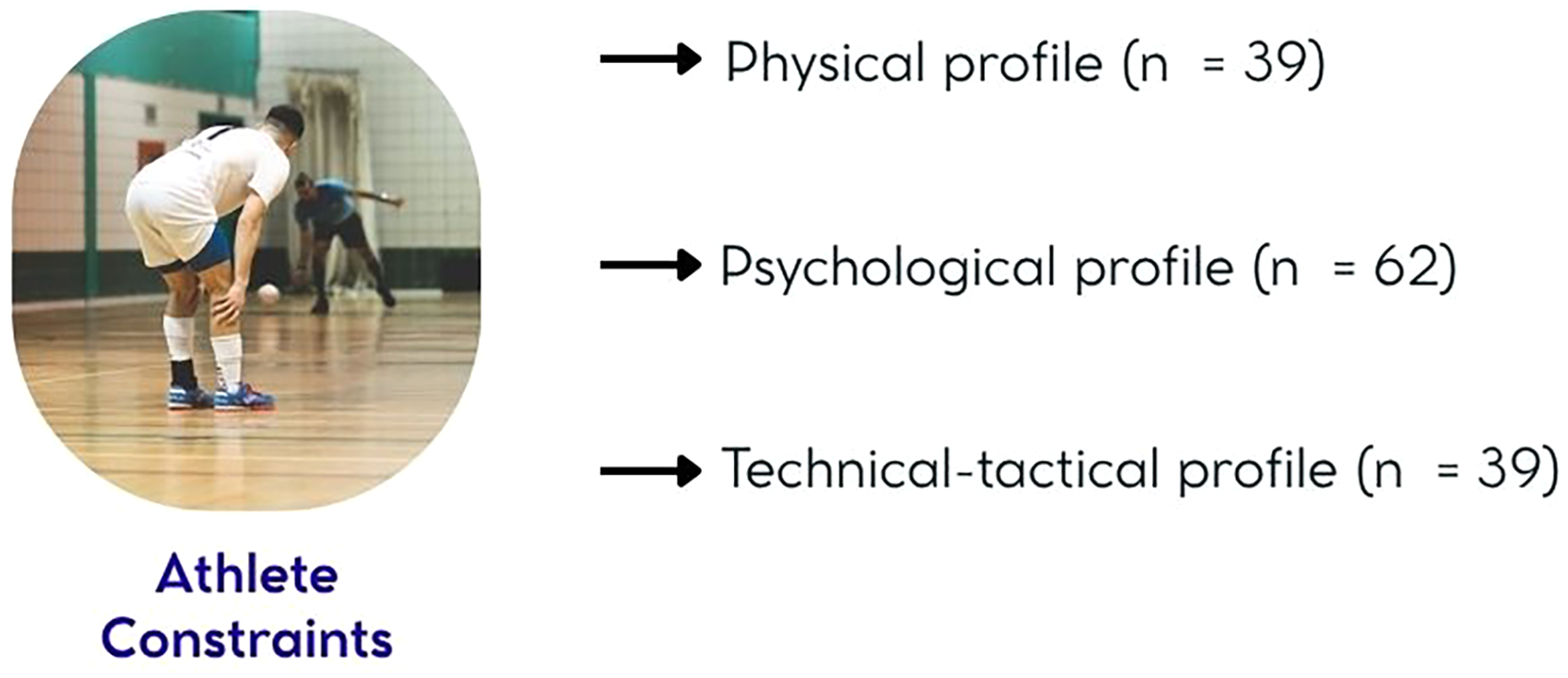
Graphical representation of the categories for the dimension “athlete constraints”.
Athlete constraints: Physical profile
Within the athlete constraints dimension, the physical profile refers to the physiological, neuromuscular, and anthropometric attributes that underpin competitive futsal performance. Coaches emphasized that although the Portuguese development pathway emphasizes technical-tactical proficiency, elite-level demands require athletes to reach minimum thresholds in metabolic power, muscular force, and endurance. The interviewed coaches noted that physical capacities should function as a supportive baseline rather than a dominating factor. “Physical components are fundamental; they don’t need to be enhancing factors, but they must stop being limiting ones.” (FC6) “The physical dimension can’t be the reason a player doesn’t reach the top. It must be adequate - even if it's not exceptional.” (FC4)
Additionally, coaches associated physical attributes with match-related performance indicators such as high-intensity accelerations, repeated sprint ability, and change-of-direction speed. “Our players need to be physically prepared to withstand the demands of international competitions.” (FC3) “Explosiveness, change of direction, speed of recovery - those are essential at top level.” (FC1)
The interviewed coaches believe that elite futsal requires integrated development of anaerobic capacity, muscular power, and movement efficiency, all integral to optimizing performance and resilience.
Athlete constraints: Psychological profile
Psychological attributes were widely considered by coaches as foundational components of talent, particularly in terms of sustaining progression toward elite levels. Across the interviews, three core dimensions emerged: resilience, motivation and self-determination, and emotional regulation under pressure.
A prominent theme was resilience. Coaches stressed that talented players must tolerate moments of exclusion, adapt to changing roles, and cope with delayed recognition. “The athlete must develop resilience, patience to wait for their opportunity, and team spirit.” (FC5) “They need to be able to go through hard moments, not playing, being left out, and still keep training at 100%.” (FC3)
Another critical component was motivation and self-determination. Coaches valued players who displayed intrinsic commitment, long-term ambition, and autonomy in pursuing their development. “A lot of it is about mindset. The talented ones are self-driven; they push themselves because they want more.” (FC1) “It's not just about talent - it's about the desire to improve, to stay after training, to compete with yourself every day.” (FC6)
Additionally, the ability to regulate emotions and perform under pressure was seen as a clear differentiator at elite levels. This included managing anxiety, maintaining focus, and expressing confidence in challenging match contexts. “Some players collapse under pressure, others shine. That mental control makes all the difference.” (FC2) “We look for players who don’t lose themselves in adversity - who stay emotionally balanced, even when the game gets tough.” (FC4)
Coaches perspectives illustrate that psychological readiness is not merely complementary but central to the development and expression of talent, especially in environments marked by high performance demands and competitive volatility.
Athlete constraints: Technical-tactical profile
The interviewed coaches unanimously emphasized that technical execution (e.g., ball control, passing, shooting) must be developed in tandem with tactical understanding, particularly under the temporal and spatial constraints characteristic of elite futsal. Coaches highlighted the importance of perceptual-cognitive skills (e.g., anticipation, pattern recognition, and situational assessment) which enable players to interpret complex game dynamics and make adaptive decisions under pressure. “What sets Portuguese players apart is their capacity to interpret and understand the game - that's learned, not innate.” (FC2) “You can have technique, but if you don’t know when or how to use it, it's useless at high level.” (FC3)
Task constraints
On the specificity and amount of futsal-specific practice coaches emphasized some main aspects, namely: the importance of the amount of practice or playing time, which must be carefully managed to optimize development without compromising well-being; the type of training tasks, emphasizing creativity, contextual learning, and decision-making under pressure; the type of practice, advocating for varied, playful, and unstructured environments alongside formal training. Summarizing, coaches stress that talent is not merely identified but cultivated through purposeful engagement with tasks that challenge and improve the athlete's capacities (Figure 2).
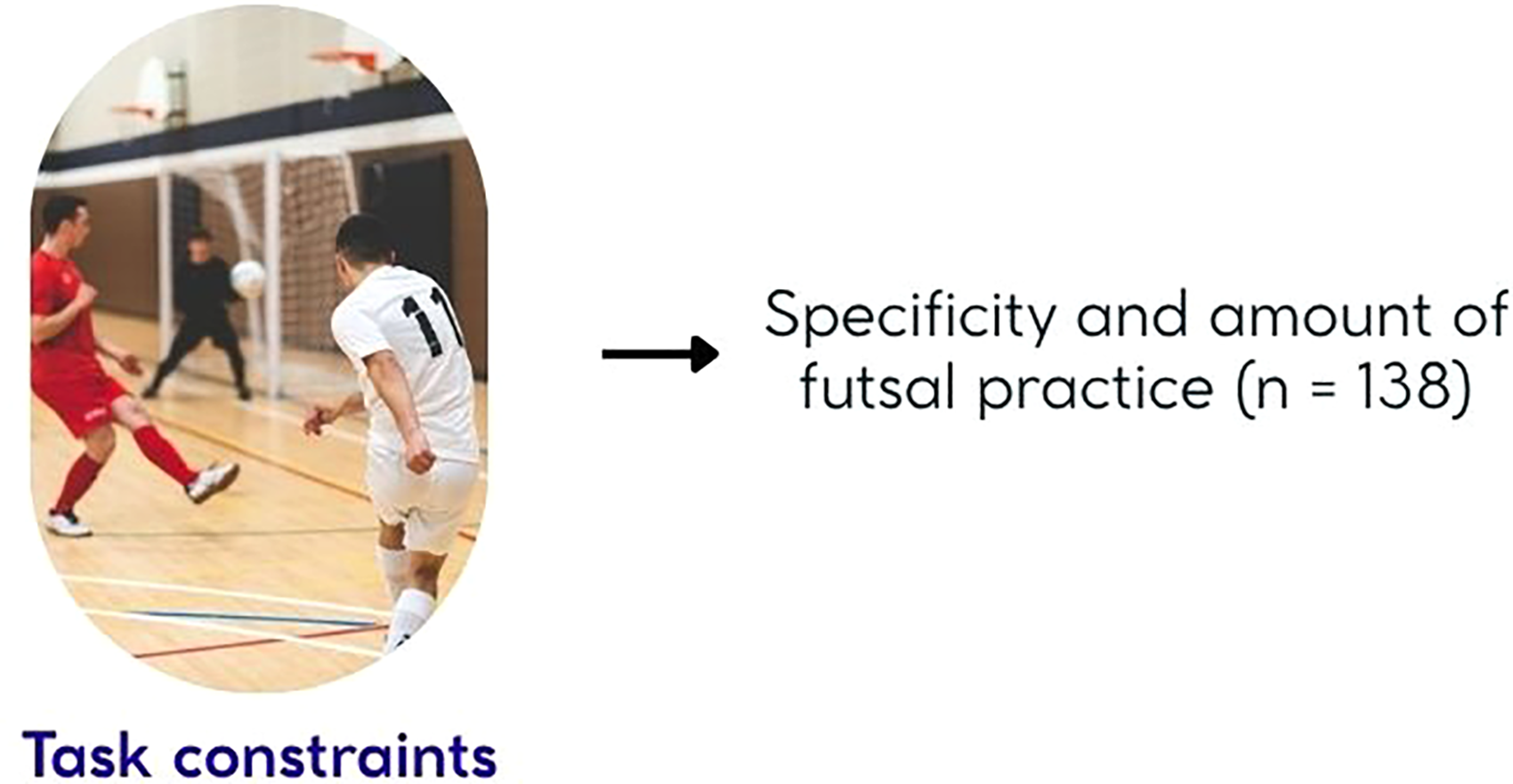
Graphical representation of the categories for the dimension “task constraints”.
Task constraints: Specificity and amount of futsal-specific practice
Coaches emphasized the importance of balancing deliberate practice (structured, goal-oriented, effortful training designed to improve specific performance aspects) with deliberate play (informal, intrinsically motivating activities characterized by flexibility, creativity, and exploratory learning). “This player growth from that reality of combination of possibilities and practices - not just from the club, but from playing in the street.” (FC1) “To develop talents, first of all, he has to do, be doing in a free, arbitrary way, building his action, exercise, task or conditioning. The athlete has to be free, free, make mistakes, stumble, fall, get up alone and continue.” (FC3) “Players who grew up playing freely in the street often show different solutions - we can’t lose that.” (FC4) “They spend a lot of minutes in the ring playing freely, without supervision, which leads them to improve without any correction. Now it seems to me that with the appropriate correction and the appropriate exercises to enhance athletes, they will greatly facilitate the development process.” (FC5)
This highlights the developmental value of non-organized play settings, where athletes encounter rich variability of movement patterns, social interactions, and problem-solving demands that are difficult to replicate in formal settings. Coaches cautioned against over-reliance on formalized training at early stages, echoing concerns in the literature regarding early specialization, which has been associated with increased injury risk, burnout, and reduced long-term potential. “Kids need to make mistakes, and we have to give them room for that.” (FC4) “When it's all structured from too early, they become robotic and lose intuition.” (FC6) “Street play gives players a sense of freedom and creativity that we often can’t replicate in formal training.” (FC2) “There's something about those unstructured games that sharpens perception, creativity and inventiveness.” (FC5)
The amount of futsal-specific practice refers to the accumulated volume, frequency, and intensity of training and competitive exposure throughout an athlete's developmental trajectory.19,20 Coaches emphasized that while high volumes of structured practice are critical for developing expertise. Such accumulation must be managed carefully to account for the athlete's chronological age, biological maturation, and psychological readiness. “Playing time must be adjusted to the athlete's developmental level, not the team's need to win.” (FC2) “Each athlete has their rhythm. We can’t force everyone into the same structure.” (FC3) “Overload can lead to injuries and even dropout from sport.” (FC7) “It's not just about training more - it's about training better and knowing when to stop.” (FC5) “It's crucial to find a balance between training intensity and recovery, especially during sensitive growth periods.” (FC6) “Some phases demand more caution. The player is growing, and we need to be attentive.” (FC1)
Overall, the coaches underscored that optimizing the amount of practice is not simply about accumulating hours, but about ensuring that practice is progressively structured, individualized, and developmentally sensitive, supporting long-term athlete development without compromising health or motivation. “There's no point in training more if they lose motivation or get injured. That's not sustainable.” (FC4) “Without balancing intensity and enjoyment, you lose them. They’ll disconnect from the game.” (FC2)
The main task of the coach is to design and structure of training exercises that, in this case, can help the development of players’ capacities. Coaches emphasized the importance of designing training sessions that go beyond isolated technical drills, focusing instead on contextualized, game-representative activities that integrate decision-making, perception, and action. “I have to offer as many exercises as possible that allow the highest degree of creativity and ball contact.” (FC1) “We try to reproduce situations close to what they will find in the game, because that's where the best learning happens.” (FC6)
Coaches highlighted that drills emphasizing variability, problem-solving, and adaptability foster creative movement solutions and atonement to affordances - key elements in the development of adaptable, high-level performers. “There's no point doing closed drills if the game asks for open, unpredictable behavior.” (FC4) “You don’t teach decision-making by repeating the same thing. It has to be dynamic, with uncertainty.” (FC3) “Depending on the age group, we emphasize different things - coordination, perception, or intensity.” (FC2) “There are phases when you can’t skip motor development. That comes first.” (FC5) “We need to propose exercises that simulate game contexts to develop their capacity to solve problems and decide under pressure.” (FC5) “You must challenge them but also let them feel competent. Otherwise, they give up or stop enjoying.” (FC6)
Environmental constraints
Coaches underscored the importance of family support, highlighting how stable and balanced home environments can facilitate or hinder progress. They also reflected on the role of social settings, including peer interactions and cultural attitudes toward play and sport, and emphasized the need to harmonize academic and athletic demands. Recruitment practices and the structural dynamics of competition were further identified as critical factors shaping opportunities for development. Collectively, these categories illustrate that talent development is situated within a complex ecosystem where environmental influences can significantly enable or constrain potential (Figure 3).
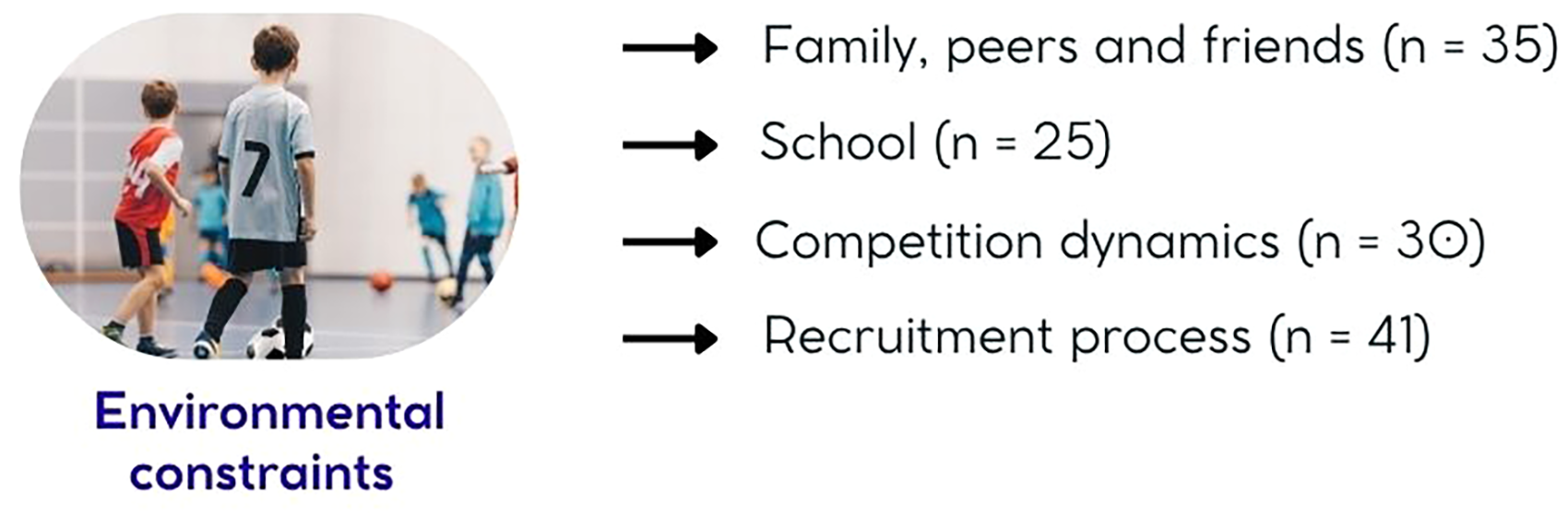
Graphical representation of the categories for the dimension “environmental constraints”.
Environmental constraints: Family, peers and friends
The family environment plays a central role in shaping athletes’ developmental trajectories, particularly by providing emotional, logistical, and motivational support across formative years. Coaches consistently emphasized the importance of a balanced parental involvement, where parents act as facilitators of opportunity, by providing access to sport, encouraging effort, and promoting enjoyment, rather than as sources of pressure or overcontrol. “A consistent family structure usually reflects in the athlete.” (FC3) “When parents support but don’t interfere too much, the athlete grows more autonomous.” (FC1) “Parental overinvolvement can sometimes create stress and performance anxiety.” (FC2) “Sometimes parents want results too early, and that creates unnecessary pressure.” (FC4) “Not all families can take their kids to training or afford the same resources.” (FC6) “Family organization plays a big role. If there's no support system, the kid misses chances.” (FC5)
Overall, coaches portrayed the family environment as a foundational layer in the athlete's ecological system, influencing access, engagement, and resilience across stages of development. The broader peer and community context in which young athletes develop, encompassing interactions with friends, teammates, coaches, and the informal networks surrounding sport participation can play an important role in this context. Coaches emphasized that informal play settings, particularly peer-led play in schoolyards, neighbourhoods, or streets, serve as important contexts for fostering intrinsic motivation, creativity, and social adaptability. “Kids who used to live in the street with the ball are now locked at home, and they end up less creative.” (FC1) “You’d see kids playing in any free space, and that shaped their relationship with the game.” (FC6) “Having friends to play with outside of formal settings used to be a huge motivator.” (FC4) “The social part (being around others, competing, creating rules) was essential.” (FC5)
Importantly, the social environment was not portrayed solely as a facilitator but also as a potential constraint, particularly when opportunities for informal play diminish due to modern lifestyle changes (e.g., increased screen time, urbanization) or when negative peer influences emerge. “Nowadays, most kids are glued to screens, and that's reducing their time in active play.” (FC2) “Sometimes peer pressure can go the wrong way—skipping training, bad habits.” (FC7)
Overall, coaches viewed the social environment as a dynamic layer of the athlete's ecological system, capable of amplifying or constraining the developmental potential created by family, training, and competition contexts.
Environmental constraints: School
The school environment can play an important role in shaping athletes’ developmental experiences by influencing their capacity to balance academic and sporting commitments. Coaches emphasized the importance of maintaining a dual career approach, ensuring that educational progress is not sacrificed in pursuit of athletic excellence. “While they are school-aged, school is the priority. Training comes after.” (FC3) “School should never be sidelined. It's part of their development.” (FC2) “We try to maintain an open dialogue with schools to adjust schedules when needed.” (FC5) “There are cases where we have to intervene with the school to make things more flexible.” (FC7) “Being in school gives them balance. It's not healthy to think only about futsal.” (FC6) “The school environment protects them. It’. is a parallel world that keeps them grounded.” (FC1)
Environmental constraints: Competition dynamics
The competition dynamics dimension refers to the structure, scheduling, and quality of competitive opportunities available within the athlete development system. Coaches expressed concerns about the limited competitive calendar in Portuguese youth futsal, noting long off-season periods and uneven exposure to high-level match play. “For teams that don’t make the playoffs, the season ends in May and only resumes in September - almost four months off.” (FC1) “There are kids who go for months without real competition. That slows down their development.” (FC6 “We need more competitive opportunities year-round to keep players engaged and growing.” (FC4) “If they don’t play regularly, they lose rhythm and competitiveness.” (FC2) “Some coaches coach to win, not to develop. That changes everything.” (FC5) “We need structures that encourage player growth, not just results.” (FC7)
Environmental constraints: Recruitment process
Coaches described recruitment as a continuous, dynamic process, rather than a one-time event, requiring ongoing observation and evaluation across different contexts and developmental stages. “We often detect talents early, but they don’t always materialize later.” (FC1) “It's not just seeing them once and deciding - it takes time and follow-up.” (FC5) “The earlier we identify, the more time we have to develop and address potential issues.” (FC6) “We try not to exclude anyone too soon, because development happens at different paces.” (FC3) “Recruitment is not just about who stands out now but who has the potential to develop.” (FC2) “Sometimes kids are picked too early based on results, and then they disappear two years later.” (FC4)
Discussion
The aim of this study was to examine how elite Portuguese futsal coaches perceive and operationalize processes of talent identification and development, with particular attention to the interplay between athlete, task, and environmental constraints. Consistent with the ecological dynamics framework, the findings indicate that coaches conceptualise talent in futsal as an emergent property shaped by game demands, including frequent transitions, spatial-temporal constraints, and the need for rapid yet adaptive decision-making under pressure. Rather than privileging isolated physical or technical traits, coaches highlighted the interdependence of psychological robustness, technical-tactical adaptability, and sufficient physical readiness as decisive for sustaining performance. They also highlighted that talent should be developed through purposeful engagement with practice tasks that replicate the perceptual-cognitive demands of futsal, while being embedded within broader systems of family support, education, talent identification, and competition structures. Collectively, these findings underscore that talent in futsal should not be viewed as a fixed attribute, but as a dynamic and context-specific phenomenon that emerges through the continuous interaction between individual, task, and environmental constraints. The following sections elaborate on these dimensions, situating coaches’ perspectives within the existing literature and highlighting the distinctive developmental ecology of futsal.
Athlete constraints
The athlete constraints identified by elite Portuguese futsal coaches reflect a multidimensional understanding of player potential, aligning with integrative frameworks in the literature.2,6 Coaches emphasized that elite- players must present physical, psychological, and technical-tactical attributes, with none acting in isolation but rather as interdependent components of performance. This perspective aligns with recent findings by Lethole et al. 21 who demonstrated that soccer coaches prioritize holistic profiles during talent recruitment, including decision-making ability, psychological stability, and physical readiness. These aspects are particularly relevant in futsal, as the sport is characterised by an accelerated tempo, restricted space, and constant transitions, which demand players capable of sustaining high-quality performance under extreme space–time constraints.
Concerning the physical aspect, the interviewed coaches emphasised the importance of achieving non-limiting thresholds in parameters such as speed, agility, and repeated sprint ability. This stance reflects a developmentally informed approach in which physicality serves as a facilitator of performance progression rather than a simple selection criterion. Mendes et al.3 highlighted the importance of physical and physiological indicators; however, these factors appear insufficient to predict long-term performance at the adult level. Therefore, such indicators should not be used in isolation to identify or select futsal players. Notably, previous studies6,17 in futsal have often examined physical and physiological outcomes in isolation, typically by comparing youth and adult players or athletes across competitive levels, thereby overlooking the multidimensional framework underpinning player development and selection. This limitation reinforces the integrated perspective adopted by coaches in the present study.
Regarding psychological attributes, the interviews revealed their critical role in shaping long-term developmental trajectories. Coaches emphasized the value of resilience, intrinsic motivation, autonomy, and emotional regulation. These traits were considered essential for sustaining progression through the demands of elite sport. Within futsal, these psychological skills are particularly relevant for coping with the stress associated with frequent role changes (attacking vs. defending), constant transitions, and decision-making under severe time pressure. These findings align with the model proposed by Fuhre et al., 17 which positions psychological factors as critical enablers of successful transitions across youth-to-senior pathways. In addition, Gledhill and Harwood 22 identified risks associated with early psychological burnout and over-pressurization, emphasizing the importance of nurturing adaptive psychological skills from early stages. The present findings are also consistent with previous research in futsal. For example, Do Nascimento et al. 23 found that professional Brazilian futsal players exhibited psychological profiles marked by high levels of extraversion, conscientiousness, and emotional stability. These traits were associated with effective coping, leadership, and performance consistency. Likewise, Álvarez-Kurogi et al. 19 concluded that psychological profiles varied according to playing position among youth futsal players, with pivots demonstrating greater emotional regulation and self-confidence. These findings reinforce the need to consider position-specific psychological competencies.
Regarding technical and tactical factors, coaches consistently identified decision-making speed, anticipation, tactical versatility, and game intelligence as key differentiators of elite players. This supports the broader literature in futsal, which highlights the role of perceptual-cognitive expertise in regulating behavior under time-space constraints.6,20 Mohammed et al. 24 found that expert futsal players display higher frequencies of technical actions (such as passes and shots) under fatigue, suggesting that technical quality must be sustained during critical moments of the match. This aligns with the emphasis on developing players capable of making rapid, high-quality decisions under dynamic, high-intensity conditions. Silva et al. 25 further demonstrated that expertise in futsal is not only related with motor execution, but also to the ability of players to perceive relevant affordances and adapt their passing decisions to contextual variables. Coaches also emphasised the importance of developing game understanding through the use of representative training tasks. This is supported by ecological dynamics theory, which argues that tactical adaptability and decision-making emerge from meaningful interactions with affordance-rich environments. 9 Mendes et al. 4 also noted that talent development programs should embed perception–action coupling and game-based constraints into daily practice, to foster transferable tactical intelligence.
Together, these findings suggest that athlete constraints in futsal are not fixed attributes, but emergent, modifiable capabilities shaped through continuous interaction with task and environmental conditions. Crucially, Portuguese coaches view futsal talent as less dependent on exceptional physical prowess and more on the capacity to consistently maintain technical–tactical quality and psychological stability under the demands of the sport.
Task constraints
The interviewed coaches attributed considerable importance to the design and structure of training and practice environments, particularly emphasizing representativeness, variability, and individualization. This perspective is strongly aligned with the principles of nonlinear pedagogy and representative learning design, which advocate for practice scenarios that replicate the perceptual, cognitive, and motor demands of the competitive futsal environment.5,26 Coaches viewed learning not as the accumulation of isolated technical skills, but as a dynamic process emerging from continuous interaction with affordance-rich environments. In futsal, this translates into preparing players for rapid transitions, restricted space–time conditions, and continuous role changes, where adaptability and perception–action coupling are critical for performance.
The widespread use of small-sided games and contextualised drills underscores the view that skill adaptation emerges through perceptual attunement and decision-making under game-like pressure. This approach is supported by empirical studies showing that small-sided games enhance tactical performance, physical conditioning, and technical execution.27–29 Notably, these findings are further supported by Mendes et al., 3 who emphasised that training environments in futsal should reflect match-specific constraints, thereby promoting the integrated development of technical, tactical, and physical dimensions.
An important element emerging from the interviews was the value of play practice, particularly in early developmental stages. Coaches emphasized that informal, unstructured play environments (such as street football) play a foundational role in cultivating creativity, motor versatility, and enjoyment. This futsal-rooted practice tradition reinforces the idea that many of the sport's most talented players develop their game intelligence and resilience in unsupervised, culturally embedded environments. These views are consistent with findings from Güllich, 30 who argues that early diversification, rather than early specialisation, supports long-term athlete engagement and creative problem-solving.
When addressing the volume and structure of practice, coaches highlighted the risks associated with early overspecialization, excessive training loads, and rigid, competition-focused models at young ages. Instead, coachasadvocated for developmentally sensitive periodization, calibrated to account for biological maturation, psychological readiness, and academic commitments. These concerns reflect best practice recommendations in youth athlete development, 31 which warn that inappropriate load management can contribute to dropout, injury, and decreased motivation. Recent work by Arede et al. 32 reinforces the need for individualised load monitoring. Their study of Portuguese U15 futsal players demonstrated that physical outputs must be interpreted relative to biological maturation and competitive level. This evidence supports the coaches’ emphasis on tailoring practice intensity and volume according to individual needs, rather than applying uniform models across development stages.
Taken together, the findings reveal that elite futsal coaches in Portugal adopt a sophisticated understanding of practice design. Their strategies reflect a blend of scientific knowledge and experiential insight, prioritising ecological validity, adaptability, and athlete well-being. Importantly, by valuing both culturally embedded practices, such as street futsal, and scientifically grounded methodologies (e.g., small-sided games), Portuguese coaches advocate for a futsal-specific developmental model that balances creativity, resilience, and tactical intelligence with structured training. Rather than adhering to linear or prescriptive models, coaches embrace dynamic, context-sensitive approaches that foster the emergence of adaptable, intelligent, and resilient performers prepared for the demands of futsal.
Environmental constraints
The influence of environmental constraints, particularly related to family, peers, school context, recruitment systems, and competition structure, emerged as critical determinants of athlete development in Portuguese futsal. This aligns with ecological models of talent development,33,34 which emphasize that talent does not emerge in isolation, but through the dynamic interaction between athletes and the systems that surround them.
Coaches highlighted the central role of family in facilitating early access to sport, providing emotional and logistical support, and promoting consistent engagement. This is consistent with research by Gledhill and Harwood22, which highlights autonomy-supportive parenting as a key determinant of talent development and the quality of the learning environment. Notably, several coaches raised concerns about parental overinvolvement and pressure. Within futsal, where early competitive exposure and strong cultural identification with sport are common, maintaining a balance between support and pressure appears particularly influential in shaping long-term engagement. Furthermore, the influence of peers and informal social networks was noted as essential to maintaining enjoyment, creativity, and self-initiated engagement in sport.
The school environment was identified by coaches as both a potential facilitator and constraint to athletic development. While education was consistently emphasized as a priority, particularly during early and middle adolescence, there were also references to the lack of coordination between schools and clubs in managing dual career demands. These concerns are aligned with recommendations of Ryba et al., 35 which highlight the importance of structured dual-career pathways to safeguard long-term well-being and identity development. In futsal, where many players emerge from community-based clubs with limited academic support structures, schools can act as protective environments that ensure social stability and safeguard career transitions. 3
Finally, competition dynamics were described as both a developmental driver and a structural constraint. 8 Coaches expressed concern about long off-season periods and insufficient exposure to high-intensity, developmentally appropriate match play. especially for athletes not involved in playoff phases or national teams. Although direct evidence in futsal is limited, these concerns align with broader perspectives suggesting that reduced competitive exposure may limit opportunities for technical–tactical consolidation under pressure and adaptation to match demands.
Taken together, these findings highlight the complex, interdependent nature of environmental constraints in futsal talent development. Rather than viewing these domains as isolated factors, coaches in this study adopted an integrated perspective seeing family, peers, school, recruitment, and competition systems as interlocking components that either support or hinder athlete progression. These insights reinforce the value of ecological and systemic models of talent development and suggest that optimizing futsal pathways requires not only improving training practices but also reforming the broader social and structural environments that shape young players’ opportunities.
Conclusion
The present findings were derived from a specific context (Portuguese futsal) and should therefore be interpreted with caution. Nevertheless, the results of this qualitative study provide a valuable perspective on talent identification and development processes within an elite context. As such, the findings contribute meaningfully to the understanding of talent identification and development. Although the transferability of these results to other national contexts may be limited, the principles identified may still inform practice in other high-performance environments where similar developmental challenges and structural characteristics exist.
The interdependence between athlete, task, and environmental constraints underscores that talent development in futsal is not a linear or isolated process, but an emergent outcome of continuous adaptation within a dynamic system. The three dimensions discussed throughout this study, illustrating how Portuguese elite futsal coaches perceive talent as co-constructed through the interaction between individual capacities, practice design, and environmental structures (Figure 4). This integrative model represents the culmination of the findings, emphasizing the futsal-specific ecology that shapes players’ long-term development.

Integrated model of athlete, task, and environmental constraints in Portuguese elite futsal, summarizing coaches’ novel insights into the ecological dynamics of talent identification and development.
Supplemental Material
sj-docx-1-spo-10.1177_17479541261452433 - Supplemental material for From potential to performance: Coaching practices in futsal talent development
Supplemental material, sj-docx-1-spo-10.1177_17479541261452433 for From potential to performance: Coaching practices in futsal talent development by Diogo Mendes, Bruno Travassos, Diogo V. Martinho, Élvio R. Gouveia, Joel Barrera-Díaz, Pedro Campos and Hugo Sarmento in International Journal of Sports Science & Coaching
Footnotes

Ethical considerations
This study was reviewed and approved by the Scientific Council and the Ethics Committee of the University of Coimbra (CE/FCDEF-UC/00842021).
Consent to participate
Verbal consent was obtained from all coaches that participate in the present study.
Consent for publication
Not applicable. The information of participants was anonymized.
Funding
The authors disclosed receipt of the following financial support for the research, authorship, and/or publication of this article: DM is funded by the FCT (Fundação para a Ciência e Tecnologia): 2021.04738.BD. DM, DVM, JB, HS gratefully acknowledge the support of support from CIPER – Portuguese National Funding Agency for Science, Research, and Technology (FCT) pluriannual funding 2025–2029 (Reference: UID/06349/2025). https://doi.org/10.54499/UID/06349/2025 https://doi.org/10.54499/UID/PRR/06349/2025. HS gratefully acknowledge the support of a Spanish government project LINCE PLUS: Multimodal platform for data integration, synchronization and analysis in physical activity and sport [PID2024- 156051NB-I00] (2025–2027) (Ministerio de Ciencia, Innovación y Universidades, Agencia Estatal de Investigación and European Union).
Declaration of conflicting interests
The authors declared no potential conflicts of interest with respect to the research, authorship, and/or publication of this article.
Data availability
The data will be available under a reasonable request from the corresponding author.
Supplemental material
Supplemental material for this article is available online.
References
Supplementary Material
Please find the following supplemental material available below.
For Open Access articles published under a Creative Commons License, all supplemental material carries the same license as the article it is associated with.
For non-Open Access articles published, all supplemental material carries a non-exclusive license, and permission requests for re-use of supplemental material or any part of supplemental material shall be sent directly to the copyright owner as specified in the copyright notice associated with the article.
