



Abstract
From an ecological dynamics perspective, careful manipulation of task constraints can provide opportunities for action, exploited by functional movement variability of participants. The constraints-led approach (CLA) induces functional movement variability in practice designs, supporting athlete performance in satisfying task constraints and finding performance solutions to achieve intended task goals. Young male volleyball players were randomly assigned to either a traditional approach (TA) or CLA practice group. Selected spatial-temporal movement coordination variables were recorded, to explore their relations to successful performance outcomes in the attacking phase. Binomial logistic regression was used to verify the association of spatial-temporal movement variables with the percentage of successful attacks. Six spatial-temporal variables were included, and a manual backward stepwise regression was used to remove those which did not contribute to the best predictive model of successful performance. After a 6-week intervention programme, the CLA practice group displayed a significantly higher percentage of successful attack actions, when facing the opposition block. The TA group showed a small increase in successful attack actions after the intervention. The final binomial logistic regression model revealed that the variables ‘lateral deviation of the participants’ centre of mass’ at the planting step and ‘longitudinal deviation of the participants’ centre of mass’ at point of ball contact were the main predictors of successful attacking outcomes. To overcome the opposition's block in volleyball, infusing functional variability in a CLA task design, promoted superior performance in practice. Presumably, greater movement pattern variability emerged in participants to satisfy performance constraints in successful volleyball attacks.
Introduction
Traditional theories explain motor learning based on an information-processing, computational process. 1 From this perspective, expertise is achieved by the frequent repetition of an ideal technique until it becomes stable or programmed and performed ‘automatically’.2,3 Predicated on this idea, traditional coaching approaches typically result in the design of practice environments focused on rote repetitions, technical rehearsal and attempts at movement automation. This approach to motor learning is putatively attained with unopposed drills (e.g., unopposed technique training, footwork and cone drills), practicing movement components in isolation (e.g., striking a volleyball without the presence of an opposition block, repetitive digging of a ball), to perfect ‘technique’ (e.g., the performer adopting an ‘ideal’ movement execution, following explicit verbal instructions prescribed by a coach). Part practice (i.e., training components of a skill in isolation) is often used in the training process.
The rationale underpinning such an approach to performance preparation is to ‘automate’ movement responses, in which athletes perform actions in accord with an internally stored representation or motor programme, in order to execute the ‘right’ movement at the ‘right’ time.4,5 This focus on coaching to ‘automate’ movements by enhancing skill and performance expertise is a direct implication of the so-called ‘automaticity principle’ in cognitive psychology. 6 For example, a volleyball player is often required to perform repetitive drills rehearsing the horizontal approach phase to the spike (i.e., the steps taken before jumping to hit the ball at the net) without actually striking a ball. Traditional practice task designs like this are often organised into blocks where all trials of one training condition are performed, sometimes decomposed and in isolation, before switching to another technique to practice. 7 The result may be too much certainty and stability of performance conditions for developing players through rote repetition. 8 However, a growing body of research has shown that learning and performance enhancement are nonlinear processes where exploratory motor behaviour during practice is crucial to achieve functional solutions to goal-directed movement tasks. 9 These findings are explained by an ecological dynamics theoretical framework, 10 which rejects the prevailing belief that, with increasing expertise, human interactions within a performance environment can become ‘automatically regulated’ through internally stored mental representations of the world. 11
Alternatively, an ecological perspective advocates the need to attend to the functional reciprocity between the performer and performance environment. 12 Through constant interactions of the individual and practice/performance environment, learning evolves over a long timescale which differs for each individual. 13 Ecological dynamics proposed the notion of representative task design, that is, advocating how coaches need to carefully manipulate task constraints to make affordances (opportunities for action) 14 available that learners can explore, finding their own functional performance solutions. 15
Pedagogical principles of the constraints-led approach (CLA) seek to provide learning and training opportunities that: (i) encourage self-organisation of behaviour under constraints, 16 (ii) induce movement pattern variability (strategic and execution variability) in representative task designs,17–20 (iii) promote the coupling of information and movement as skill develops, (iv) support adaptive skill performance and (v) empower athletes to explore functional performance solutions during practice.21,22
Because ecological dynamics proposes that actions are continuously re-organised and regulated by information from the environment, context is everything in practice designs. For this reason, to reduce complexity and manage the learning processes, tasks need to be simplified, rather than decomposed (broken up into components) or trained in isolation. 23 Consider the example of a volleyball player practicing the horizontal approach to the net to spike the ball. An ecological perspective suggests that task space and time (i.e., ball flight) can be manipulated by coaches to allow the player to couple their actions with relevant information sources (i.e., the flight of the ball, the location of the net and the positioning of the blocking players’ hands).
Nikolai Bernstein 24 stated that ‘practice is a particular type of repetition without repetition’ (p. 134), highlighting the role of movement consistency and variability to meet task demands. The emphasis is on repeating the ‘process of solving’ rather than the ‘means of solution’ of a motor problem. In the CLA, functional task variability potentiates the formation of movement synergies as relevant coordinative structures which can facilitate task goal achievement.25, 26 By manipulating constraints in training session, coaches could promote skill learning and performance, as shown in studies of different sports. 27 For example, Fitzpatrick et al. 28 compared match-play and tennis-specific skills acquired when scaling task constraints, such as court dimensions, rules and scoring format, and when using a traditional technique-based coaching approach with young tennis players. After an 8-week training programme, the spatially scaled constraints group was more symmetrical in stroke performance (backhands vs. forehands), decreased their errors (14.9% fewer in backhand strokes) and displayed higher scores on a tennis-specific skill test. 28 Other examples of positive outcomes from implementing the CLA to pedagogical practice have been observed in hurdling performance, 29 learning the volleyball serve, 30 field hockey skills, 31 soccer tactical behaviours, 32 strength training 19 and volleyball training. 33 Despite this growing body of work, there is a need for more applied research implementing interventions to study how a CLA and traditional coaching approaches may differ in terms of performance outcomes in sports. In the present study, we compared the effects of a traditional blocked-practice approach in training and the CLA on attacking performance outcomes with blocking opposition in volleyball. In addition to the attack outcome (successful spike or not), an exploratory analyses of spatial-temporal variables of participants’ movements was performed to determine whether movement pattern variability was related to successful attacks.
Methods
Participants
Skilled male volleyball players (N = 12; mean age: 17 years, standard deviation (SD) = 7 months) who played at national (9 players play in the Portuguese championship) and international levels (3 players play for the Portuguese national team) participated in the study, randomly assign to either a traditional approach (TA) or CLA group. Table 1 presents demographic data on both groups in terms of height, weight and years of volleyball experience. Independent samples t-test revealed no group differences, prior to the intervention, for height (t (10) = 0.773, p = 0.47), weight (t (10) = −0.379, p = 0.71) and experience levels (t (10) = −0.659, p = 0.52). The statistical significance level for analyses was set a priori at p < 0.05. This study was approved by the Ethics Council of the Faculty of Human Kinetics, University of Lisbon. Participants were asked to read and sign a consent form.
Comparison of the TA and CLA groups with respect to height, weight and volleyball experience.
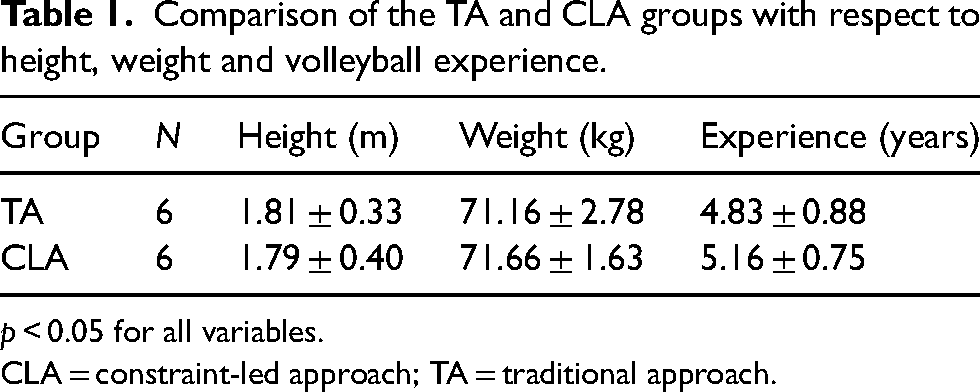
p < 0.05 for all variables.
CLA = constraint-led approach; TA = traditional approach.
Experimental design
Attacking performance in volleyball was evaluated in three time periods: before the intervention (t1), after the intervention (t2) and in a follow-up test (t3) performed 3 weeks after the post-test. In a situation contextualised by performance constraints (i.e., attacking after a serve-reception-set sequence; see Figure 1) each group, at each moment, performed a total of 108 attacks of zone 4 with block opposition. Each player performed 18 attacks, one at a time, to avoid fatigue. The maximum number of blockers in each trial was 2. Participants did not know the type of block coverage they would face since they were presented randomly. Although presented randomly to the attackers, the order of defensive block actions was previously defined for the blockers before each trial.
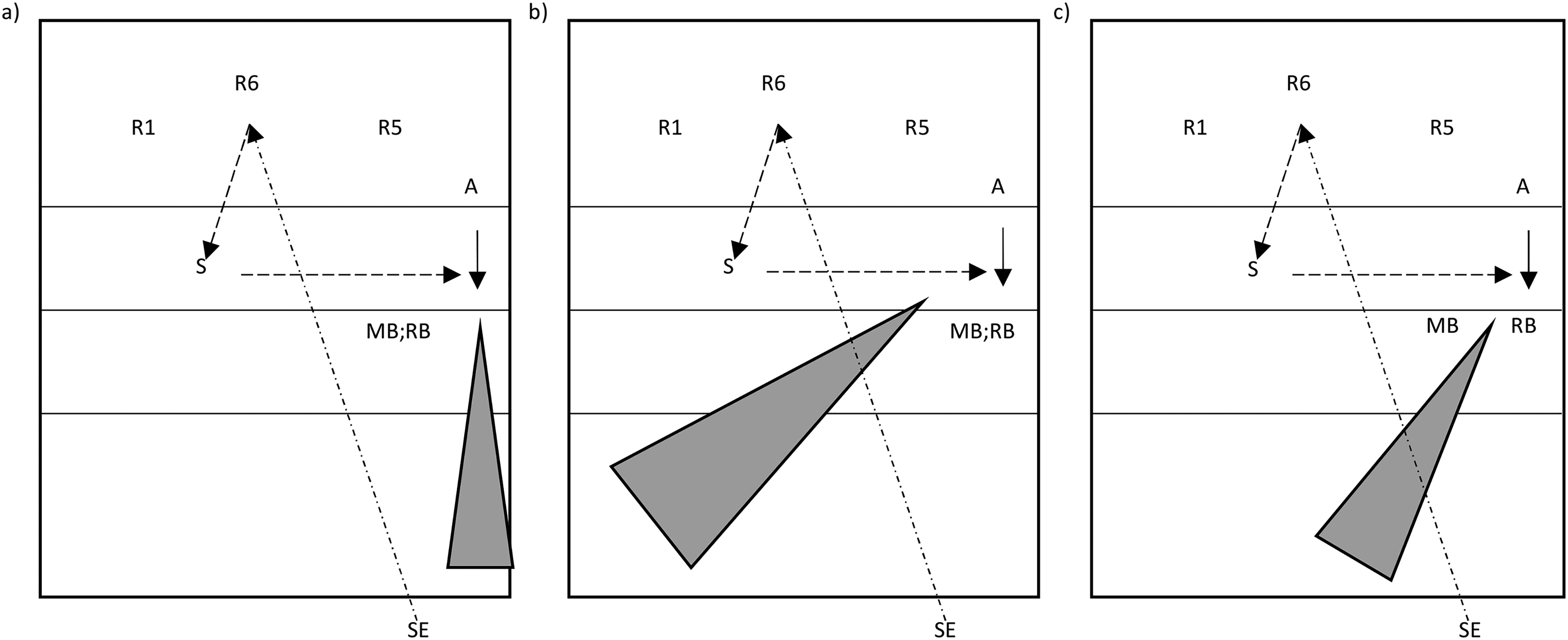
Intervention task: the player A performs a zone 4 attack (bold arrow) from serve (SE) – reception (R1, R6, R5) – set (S). Ball trajectory (dashed arrow). The type of opposition provides a preferable target area (gray triangle) to successfully overcome the block. Court a) represents the task with block covering diagonal. Court b) represents the task with block covering the line. Court c) represents the task with “open block.” Each court represents the attack with a type of block opposition.
Intervention procedure
Both TA and CLA groups practiced for 6 weeks (2 times a week) the zone 4 attack facing 3 types of block opposition, typical to the game of volleyball (Figure 1). The block situations presented were ‘line coverage’, ‘diagonal coverage’ or ‘open block’ (i.e., with space between the two blockers). The TA trials were performed in blocked practice (i.e., participants performed the same attack to each opposition block sequentially in blocks of trials). Participants knew beforehand what type of opposition to expect, before they moved to the next opposition block until they finally performed the last of the three block contexts in the same way. In contrast, the CLA group practiced the same three block situations randomly (ensured by using a latin square design with the three block situations), not knowing which opposition block would emerge in each trial. Therefore, the TA trials were performed in a blocked part-practice organisation, while in the CLA trials all the three opposition contexts were possible (avoiding training each one in isolation) and randomly presented to the athletes (infusing task variability). Throughout the 6-week intervention each player in both groups performed 72 trials facing each block opposition context in a total of 216 trials.
Dependent variables
Attack performance
The first aim of the study was to compare the effects of CLA and TA on the attacking performance of the zone 4 hitter. Successful attack was defined as the proportion of spikes that overcame the block (not being stopped by the block), with the ball landing inside the court. Percentage of Successful Attack Actions (%SAA) was the variable considered for analysis.
Spatial-temporal variables
The second aim of the study was to observe whether the variability of movement (re)organisation during attacking performance. Specifically, what spatiotemporal measures of execution variability best relate to successful and unsuccessful attacks. To that effect the deviation from the group average of six spatial-temporal movement organisation variables was calculated. The horizontal approach in volleyball (Figure 2) can be divided in the phases of ‘orientation step’, ‘planting step’ and ‘take-off’. 34 Considering the end of the planting step (EPS) and the moment of ball contact (BC), as well as lateral, longitudinal and vertical planes (Figure 2), the spatial-temporal variables considered for analysis were: (i) lateral, longitudinal and height deviation of the participants’ centre of mass from the group average at EPS (X_EPS, Y_EPS, Z_EPS) and (ii) lateral, longitudinal and height deviation of the participants’ centre of mass from the group average at BC (X_BC, Y_BC, Z_BC).
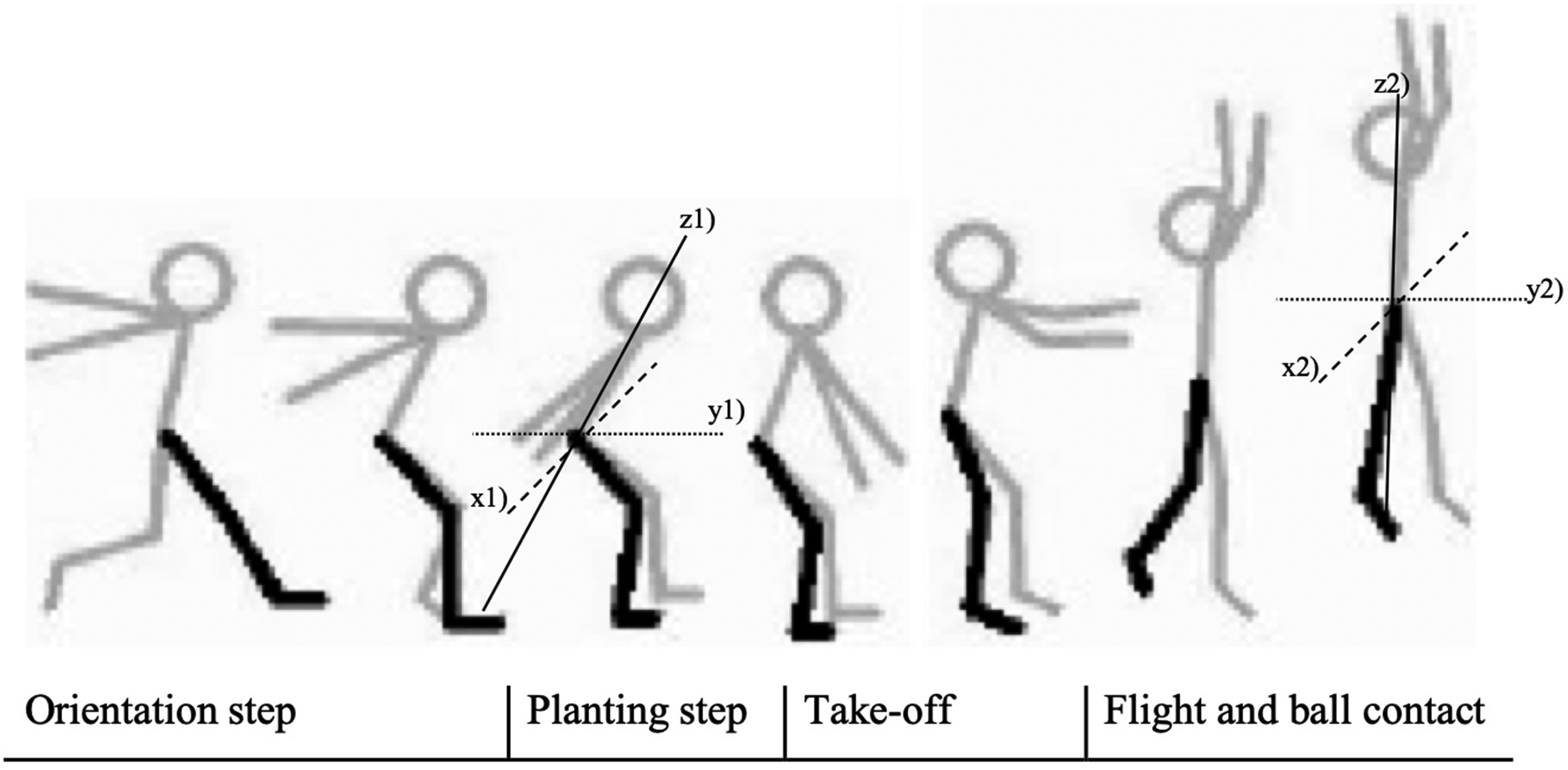
Horizontal approach (orientation step, planting step, and take-off), flight and ball contact. z1) – Vertical plane at the end of the planting step, y1) – longitudinal plane at the end of the planting step, x1) – lateral plane at the end of the planting step, z2) – vertical plane at ball contact, y2) – longitudinal plane at ball contact and x2) – lateral plane at ball contact.
Data collection and analysis
Two Panasonic HC-V10 cameras set on tripods (1.75m high), one placed longitudinally at the end line, and the other placed laterally to the court (lateral line at 1.5m from the net), were used to record participant performance at a frame rate of 50Hz. One hundred and eight attacking actions for each group (18 per player) at each test were observed to determine attack performance. Repeated measures analysis of variance was used to compare performance between and within groups. Percentage of %SAA was compared between and within groups followed by the post hoc Bonferroni corrections. Statistical significance level was set at p = 0.05. Effect size (Cohen's d), with a correction factor for samples <50, 35 was computed between (at t1, t2 and t3) and within groups (t1–t2, t2–t3 and t1–t3).
From a total of 216 attacks (108 from each group) recorded at t2, and following the same criteria used to classify successful and unsuccessful attacks in the performance analyses, 25 video clips (from both cameras) of successful and 25 of unsuccessful attacks from both TA and CLA groups were randomly selected and the motion capture system Ariel Performance Analysis System (APAS – Ariel Dynamics Inc., CA, USA)36,37 was used to extract the spatial-temporal variables.
The procedures to conduct the analysis in APAS were: (i) video trimming to synchronise video footage of both cameras; calibration using known points resorting to a metre stick, with 5 markers in height (0m, 1m, 2m, 3m and 4m) in 4 different court locations that created a square around the attack and block area and (ii), manual digitisation in each frame using both cameras of 16 anatomical points on estimated bony landmarks of each participant (left/right foot, left/right ankle, left/right knee, left/right hip, left/right shoulder, left/right elbow, left/right fist, left/right hand) from the end of the planting step to the moment of ball contact by the attacker, two anatomical points of the blockers (middle blocker's left hand and zone 2 blocker's right hand) at the moment of ball contact by the attacker and also the ball from the moment of the set to the moment of the ball contact. APAS 3D-Linear Transformation software was used to extract real coordinates and a 4° order low pass filter (Hamming window) with a cut-off frequency of 5Hz for coordinates X, Y and Z was applied. Six attacks were digitised throughout twice and coefficient of reliability (R) and technical error of measurement (TEM) data 38 were used to assess intra-observer accuracy and reliability. Results depicted good levels for intra-observer accuracy and reliability in the digitisation process (TEM = 0.09, R = 0.99). Binomial logistic regression was used to relate the spatial-temporal variables with successful outcomes of attacks. All variables were first included in the analysis and a manual backward stepwise procedure was used to remove those which did not contribute to the most predictive model. Since the considered range of all spatial-temporal variables was <1m distance, values were entered into the model in decimetres. The final model was then selected according to procedures followed in previous studies. 39 Statistical significance level was set at p = 0.05. To further confirm the discriminatory power of the model, we performed a receiver operating characteristic (ROC) curve analysis. 40 Results of the ROC analysis were interpreted as follows: Area under the curve (AUC) <0.70, low discriminant accuracy; AUC in the range from 0.70 to 0.90, moderate discriminant accuracy; and AUC ≥0.90, high discriminant accuracy. 41
Results
Attacking performance
Attacking performance data at t1, t2 and t3 in the intervention are presented in Figure 3. After the intervention, the %SAA was significantly higher in the CLA group (F (1,34) = 4.173, p = 0.05) compared with the TA group. At t1, %SAA was equal for both groups, TA = 46.29, SD = 14.63 and CLA = 46.29, SD = 21.04. At t2, %SAA was higher in the CLA group (59.25, SD = 25.70) than the TA group (47.22, SD = 15.39), with a moderate effect size (d = 0.5 SD). At t3, %SAA was also higher in the CLA group (62.03, SD = 26.07) than the TA group (48.14, SD = 19.71), with a moderate effect size between groups (d = 0.5 SD). There were no significant differences within groups.
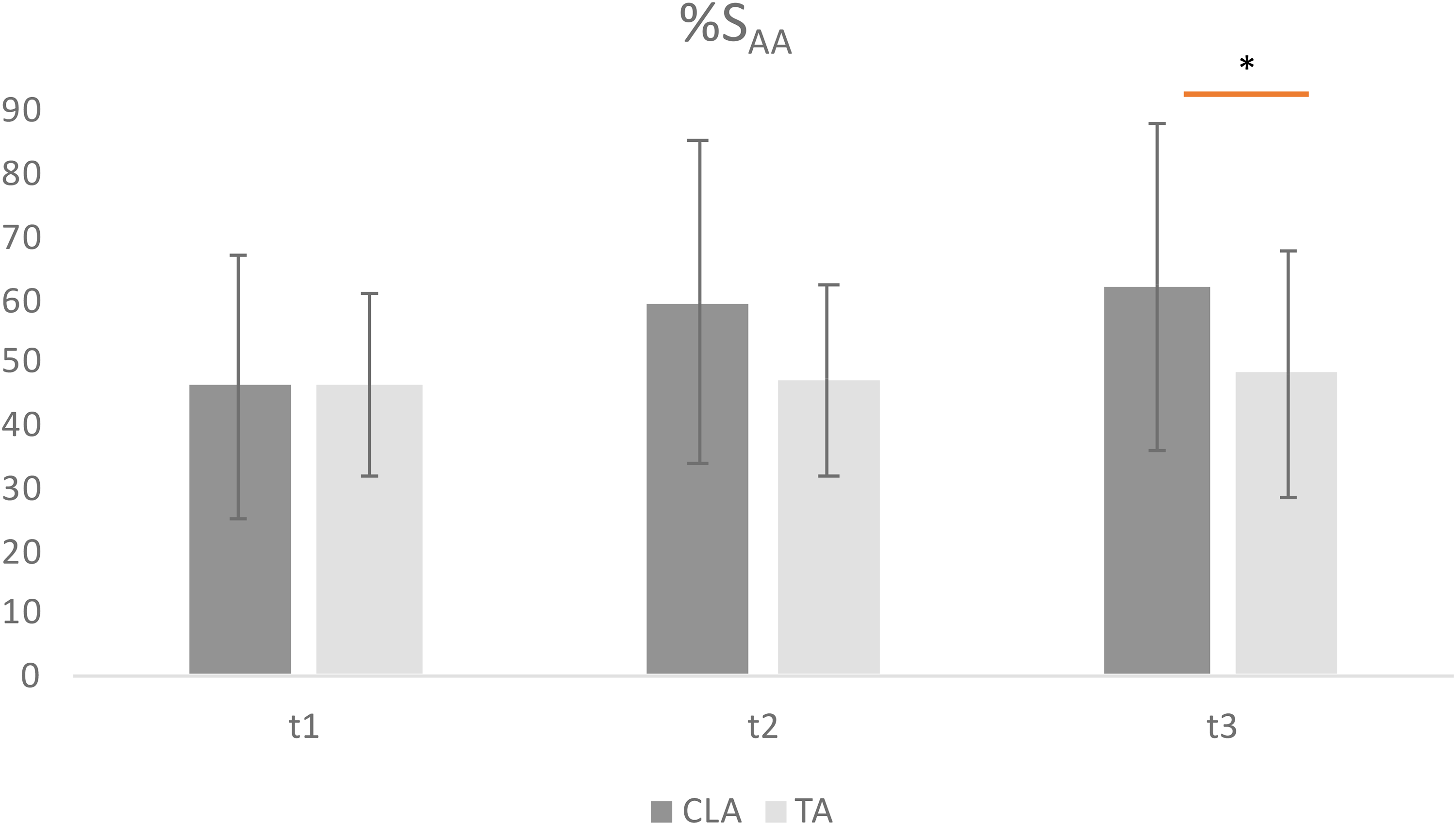
Percentage of successful attack actions (%SAA) and standard deviation. t1 – before the intervention; t2 – after the intervention; t3 – follow-up test. CLA = constraint-led approach; TA = traditional approach. *Significant difference p ≤ 0.05.
Movement pattern variability
The final model of attacking performance movement organisation was achieved by first entering all the considered spatial-temporal variables (X_EPS, Y_EPS, Z_EPS and X_BC, Y_BC, Z_BC) depicted in Table 2. Next, there was step-by-step removal of those variables which did not contribute significantly to performance outcome predictions (Table 3). The final model revealed two spatial-temporal variables that predicted the successful performance of the spike in the evaluation task: lateral deviation of the participants’ centre of mass from group average at the end of the planting step (X_EPS, p = 0.020) and longitudinal deviation of the participants’ center of mass from group average at ball contact (Y_BC, p = 0.034).
Spatial-temporal variables entering the logistic regression model (values in decimetres).
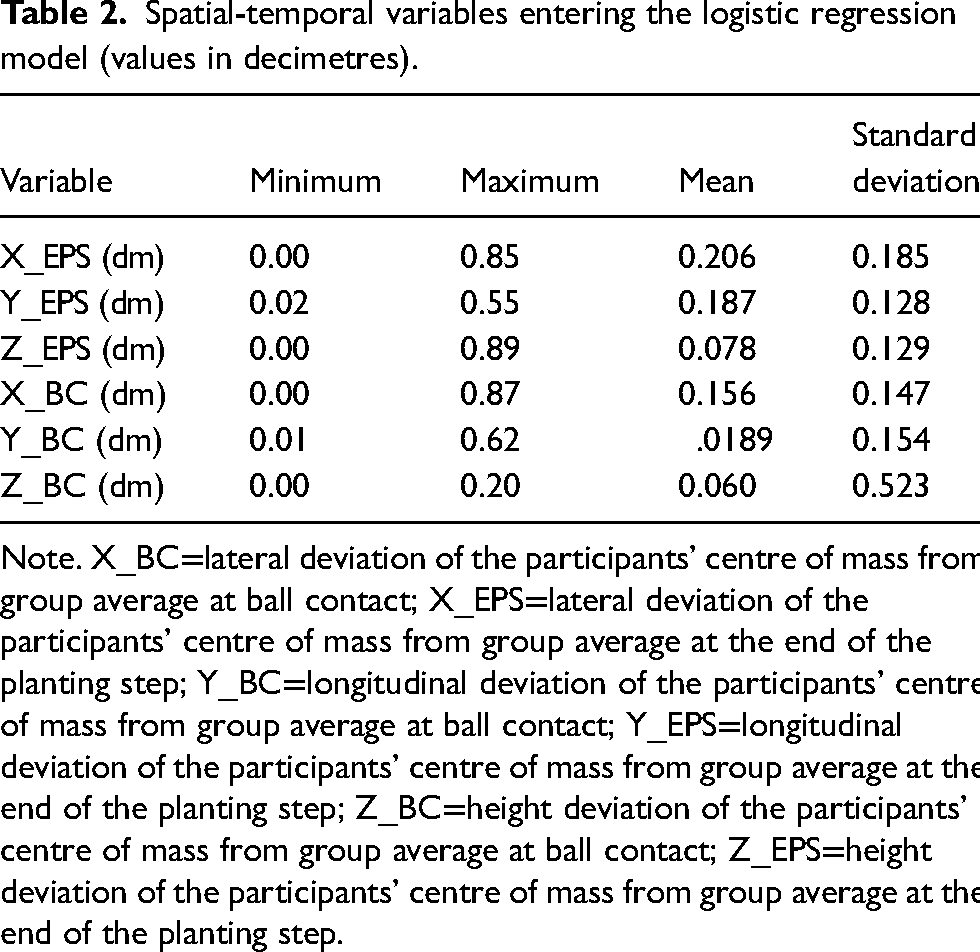
Note. X_BC=lateral deviation of the participants’ centre of mass from group average at ball contact; X_EPS=lateral deviation of the participants’ centre of mass from group average at the end of the planting step; Y_BC=longitudinal deviation of the participants’ centre of mass from group average at ball contact; Y_EPS=longitudinal deviation of the participants’ centre of mass from group average at the end of the planting step; Z_BC=height deviation of the participants’ centre of mass from group average at ball contact; Z_EPS=height deviation of the participants’ centre of mass from group average at the end of the planting step.
Final logistic regression model of attack performance.
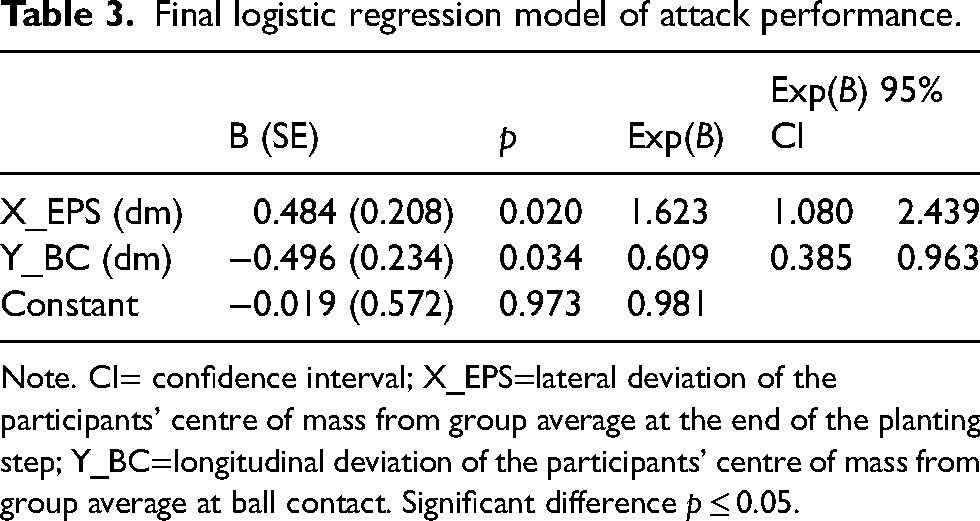
Note. CI= confidence interval; X_EPS=lateral deviation of the participants’ centre of mass from group average at the end of the planting step; Y_BC=longitudinal deviation of the participants’ centre of mass from group average at ball contact. Significant difference p ≤ 0.05.
A random sample of 50 attacks was considered for analysis: 25 successful attacks and 25 unsuccessful outcomes, according to the same criteria used to analyse %SAA. The final model retained X_EPS and Y_BC as predictor variables. The model performed significantly better than the constant-only model (G2N = 50 = 10.410, p = .005), satisfying goodness-of-fit criteria (X 2 N = 50 = 3.822, p = 0.873), resulting in a Nagelkerke r2 of 0.25 (modest effect). The model correctly classified 19 of 25 unsuccessful attacks (76%) and 16 of 25 successful attacks (64%), with an overall correct classification rate of 70%. The ROC analysis revealed a moderate discriminant accuracy of the model (AUC = .75 p = .003; 95% confidence interval (CI) [0.61, 0.89]). According to our model, an increase of one unit (1dm) in X_EPS will heighten to 62% the chances of a successful attack, and a one-unit decrease (1dm) in Y_BC will heighten to 39% the chances of a successful attack.
Discussion
The present study sought to compare effects of the traditional blocked approach and the CLA to practice of the volleyball attacking action (spike) with blocking opposition. After a 6-week practice intervention, the CLA group showed a significant improvement in attacking performance, compared to the TA. Importantly, both groups displayed the same %SAA at pre-test, and while the CLA group performed better in the subsequent tests (post and follow-up), the TA had also marginally increased their performance outcomes.
The volleyball attack involves intercepting a passed ball in the air near the net, hitting with power and accuracy while avoiding obstacles such as the net and the opposition block. The results suggested that the task manipulations implemented for the CLA group provided a more representative training context, supporting the athletes’ exploratory actions, guided by available performance environment information. Pinder et al. 42 previously illustrated the importance of representative task design in cricket batters when they comparatively analysed movement organisation when batting against either a ‘live’ bowler or a ball projection machine. The use of the projection machine withdrew key environmental information sources from the practice context (i.e., advance visual information of a bowler's actions before ball release), leading to an increased difficulty of the batters to regulate their own actions and key changes in movement organisation. 42 In our task manipulations for the CLA group, the task variability provided by the unknown, but yet limited, actions of the block, guided the athletes to become perceptually attuned to the blockers’ actions, and channelled them to find functional movement solutions under rapidly changing performance constraints. An important aspect of the task manipulation was to limit the number of blocking actions. By doing so it provided a simplification (rather than a decomposition) of the task, maintaining relevant information of the performance context for participants. 30 Given the task design that facilitated the coupling of attacker's movements to relevant information sources (i.e., blocking actions), performance solutions emerged according to specific constraints in an individualised manner. To exemplify, the three block contexts of the experimental task had theoretically ‘optimal’ recommended solutions (Figure 1). However, visual observation from post and follow-up tests revealed that participants went beyond those recommended solutions to overcome the opposition (e.g., attacking a sharp diagonal with diagonal block coverage). Presumably, perceptual attunement of participants to blocking actions also increased movement pattern variability. The capacity to rapidly re-organise movements by skilled performers is founded on degeneracy in the movement system (i.e., the same functional performance achievement can be achieved by structural variations in movement organisation). 43 The relationship of movement system degeneracy with adaptive skilled behaviour, is an important concept in the ecological dynamics perspective of motor learning and performance. Degeneracy is a property of neurobiological systems that has been observed at the molecular level of biological organisation 44 as well as in complex multi-articular actions. Our findings are aligned with data from skilled ice climbers showing adaptive behaviours predicated on a higher degree of degeneracy and on the climbers’ perception of climbing affordances. 45 Here, our findings suggest how it underpins the movement pattern variability displayed by skilled volleyball players in adapting to blocking actions of opponents at the net. Our results suggest how adding context and variability to practice task constraints could support learners in exploiting inherent tendencies for system degeneracy. In volleyball serve reception, it has previously been shown that players act according to local constraints instead of the theoretical ‘optimal solution’ 39 and the same seems to apply to the attack.
A second aim of the study was to determine whether inherent movement pattern variability, perhaps predicated on system degeneracy, predicted successful outcomes of attacks. Observation of Figure 4 highlights how lateral variability of participants’ centre of mass at the EPS (X_EPS) and longitudinal consistency of participants’ centre of mass at BC (Y_BC) are predictive of successful attacks and an inverse relationship exists for unsuccessful attacks. These findings suggest that, under dynamic performance constraints (i.e., different blocking actions), in order to contact the ball at a preferable location to overcome the block, attackers have to be adaptive to their movement performance solutions. 46
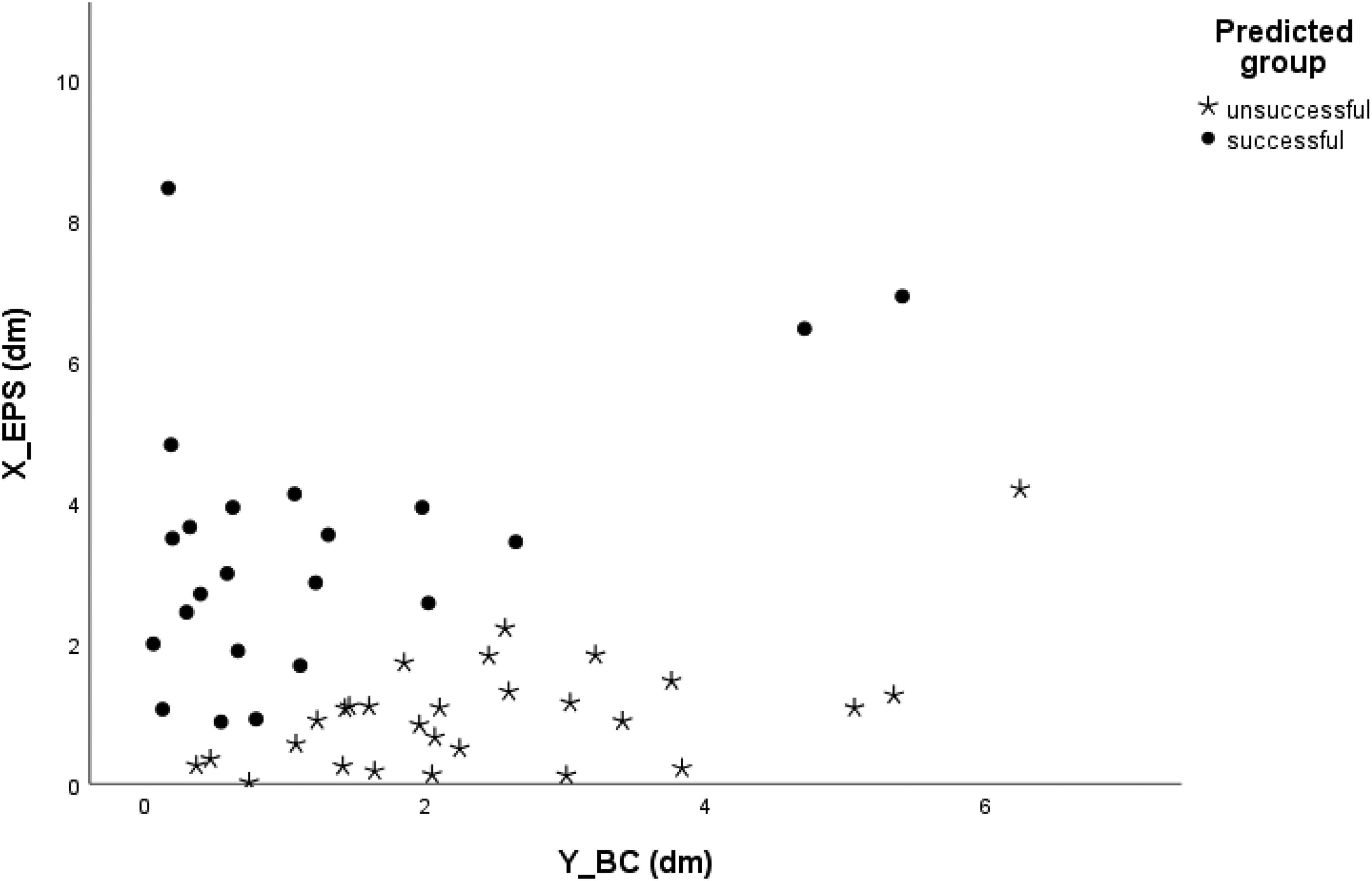
Model's predicted group membership for attack performance with respect to X_EPS (lateral deviation of the participants’ centre of mass from group average at the end of the planting step) and Y_BC (longitudinal deviation of the participants’ centre of mass from group average at ball contact) values.
Bernstein's work 24 on how the human movement system dynamically (re)organises degrees of freedom to provide the necessary consistency and variability to meet task demands has been verified a posteriori in coordination of movements in sport. 45 Recently, Glanzer et al. 47 studied baseball pitchers, at an individual level of analysis, measuring the variability of 20 kinematic parameters and consistency of pitch location. Consistency of most kinematic parameters and shoulder horizontal abduction variability predicted higher consistency of pitch location. 47 In the present study, in a group level of analysis, variability of one spatial-temporal variable (X_EPS) predicted a successful outcome of the attack. This may have emerged because the blocking actions guided re-organisation of the attacking players’ movements. When an attacker goes through the horizontal approach to hit the ball, the blocking actions only vary in height or laterally (see Figure 1 to visualise lateral differences between block actions). Attacking over the block would involve a large difference in height between point of BC by the attacker and the blockers hands, which leaves lateral adjustment as the preferable movement adaptive strategy. Also, low variability of longitudinal participants’ centre of mass at BC (Y_BC) might be related to volleyball-specific constraints the attacker has to attend. The attacker has to consider that the net cannot be touched and the ball to attack tends to be at a ‘safe’ distance from blocker's hands (a ball to close to the block will favour block success). Previous work47–49 has showed that low outcome variability can be predicted on a set of variables displaying high variability while others exhibit low variability.
These results can help coaches and teachers to understand how to adopt representative task designs in all aspects of volleyball training. Specifically, the findings suggest that coaches could implement whole task practices (which can be simplified and not decomposed) that maintain relevant information and include variability in task constraints that promote exploratory behaviours in learners.
The present study was deliberately designed to limit attention to only attacking from zone 4 and attacks from other zones are usually performed with different, usually faster, tempos. Also, to avoid intruding too much on the performers in the task, defense was not included in the testing procedures making analyses of successful attacks only related to overcoming the block opposition. Another limitation may have been the number of trials per attacker, not allowing an additional individual level of analysis for movement pattern re-organisation (e.g., by means of artificial intelligence, see Araújo et al. 50 ) in participants. Future work would benefit from assessing block performance, strategies to increase sample size (e.g., cross-over designs), appropriate methods 51 of inter-individual analyses of performance and linear mixed-effects models using random by-participant intercepts.
Conclusion
In conclusion, CLA has been advocated to promote better skill learning outcomes than traditional approaches in several sports. 27 The findings of the present study align with previous research, indicating that inducing functionally constrained variability in practice task designs, as advocated by CLA, allows volleyball players to explore inherent system degeneracy, promoting superior effective goal achievement when compared to previously known tasks design (constraints). Practicing attacking tasks with unknown, yet limited, number of block actions resulted in better performance outcomes than separately rehearsing scenarios of block opposition (known in advance). Successful attacking outcomes can be predicted by the value of the lateral variability of the centre of mass of the attacker at the end of the planting step and longitudinal consistency at the instant of hand–ball contact.
Footnotes
Author's contribution
PC, JI and DA conceived the study, participated in its design and coordination and helped to draft the manuscript. AP, AV and KD helped to analyse the data and draft the manuscript. All authors contributed to the manuscript writing. All authors have read and approved the final version of the manuscript and agree with the orders of presentation of the authors.
Declaration of conflicting interests
The authors declared no potential conflicts of interest with respect to the research, authorship, and/or publication of this article.
Funding
The authors disclosed receipt of the following financial support for the research, authorship, and/or publication of this article: PC, AV, JI and DA were partly funded by Fundação para a Ciência e Tecnologia, grant number UIDB/00447/2020 attributed to CIPER–Centro Interdisciplinar para o Estudo da Performance Humana (unit 447).
