



Abstract
This study aimed to explore how technical directors working in elite youth football academies understand and interpret players’ developmental pathways. Through a qualitative interpretive approach, it examines how they understand and interpret different routes towards expertise, including the interplay between early specialisation, and early diversification across players’ developmental trajectories, as well as the role of late specialisation and informal play. It further seeks to capture the reasoning and practical logics that underpin their approaches to player development within the academy context. Eight technical directors participated in semi-structured interviews, which were subsequently analysed using thematic analysis. Findings revealed a persistent tension between the perceived developmental value of early diversification and the structural pressures favouring early specialisation. Participants viewed multisport and informal play experiences as crucial for fostering broad motor, cognitive, and psychosocial competencies that support long-term football development. Nonetheless, early specialisation was seen as the prevailing and advantageous pathway for acquiring complex technical and perceptual–motor skills. Concerns were raised about the associated risks of burnout, overuse injuries, and dropout, while external pressures from parents, coaches, and agents were identified as key factors reinforcing premature specialisation and a results-driven culture in youth football. The results suggest a disconnect between developmental assumptions and practical realities, raising important questions about the sustainability and inclusiveness of existing talent development pathways. This study underscores the need to critically revisit current developmental practices in youth football, advocating for coach education and development frameworks that prioritise long-term, holistic, diversified, and context-sensitive approaches to youth football.
Keywords
Introduction
Youth sport development is increasingly characterised by a paradox: while scientific evidence consistently warns against the risks of accelerating children into narrow performance pathways, the structures and cultures of contemporary sport continue to push athletes towards earlier, more intensive forms of commitment.1–3 This tension is especially visible in football, where despite decades of scholarship scrutinising the developmental trajectories of young athletes, prevailing practices still appear to reproduce a logic of precocity, early selection, and performance-oriented specialisation.4–6 Talented children are not simply “developed”; they are navigated through institutional systems whose assumptions about what constitutes an optimal pathway remain both powerful and largely uncontested.7–9
Two dominant developmental trajectories have shaped much of the debate: the Early Specialisation (ES) and Early Diversification (ED). Although these concepts are well established,1,10 the tendency to frame them as opposing models often obscures how they function in practice. ES, typically characterised by exclusive, high-volume, coach-led engagement in a single sport at a young age,1,3,11 is frequently justified in football academies through narratives of competitive urgency and early advantage. Yet the risks associated with premature specialisation (including injury, burnout, motivational decline, and restricted psychosocial growth) are now widely acknowledged.12,13 Conversely, ED is promoted as a more developmentally robust approach, emphasising varied early sporting experiences, broader motor skill acquisition, adaptive decision-making, and the psychosocial benefits of a more playful and flexible introduction to sport.1,11,14 Nonetheless, the ES–ED debate has arguably reached a point where reiterating its binaries adds little conceptual novelty; what remains under-examined is how these ideas are interpreted, operationalised, or resisted within real organisational systems.
Football offers a particularly compelling context for interrogating this issue. As one of the world's most practised and culturally saturated sports, marked by early talent identification, highly competitive density, and globalised performance pressures, football academies institutionalise early developmental decisions in ways few other sports do.4,10,15 Despite growing evidence that multiple pathways can lead to expertise, and that early success does not reliably predict long-term excellence,1,3,16 the football system continues to privilege early selection and increasingly structured training loads . Notably, most developmental research in football has focused on the athlete's pathway, namely their practice volumes, their transitions, their psychosocial influences, and their milestones.4,6,8 Far less is known about the practitioners who conceptualise, justify, and enact these pathways, especially those situated in leadership roles whose decisions have cascading effects across entire academy structures.7,10
Among these actors, Technical Directors (TDs) occupy a particularly influential yet understudied position. They are the architects of club-wide developmental philosophies, the mediators between organisational expectations and coaching practice, and the gatekeepers of how ES, ED, or alternative trajectories are envisioned and implemented.17–19 TDs determine not only what is valued within the academy (be it early performance indicators, long-term adaptability, or experiential diversity), but also how these values are translated into practical structures such as training design, selection policies, coach education, and player monitoring systems.17–19 Despite this centrality, TDs’ beliefs, rationales, and interpretations of developmental pathways have received remarkably limited empirical scrutiny. Existing research has rarely examined how TDs make sense of ES and ED, how they integrate (or struggle to integrate) scientific knowledge into practice, or how they navigate the structural pressures of professionalised football environments. This absence is particularly noteworthy given the possibility that TDs may experience, reproduce, or seek to reconcile contradictions between what they endorse theoretically and what they apply in practice. For instance, a TD may articulate the importance of long-term development, informal play, or diversified early experiences, yet simultaneously oversee systems that institutionalise early selection, rigid categorisation, or training volumes that implicitly favour ES.17–19 These tensions, between philosophy and implementation, evidence and tradition, or ideal and operational constraint, represent a critical but understudied dimension of football development.
Moreover, most research on developmental pathways in sport remains anchored in quantitative designs that reconstruct athletes’ histories through numerical indicators of participation, practice volume, and competition exposure.2,4,8,20 Although such work has mapped broad developmental patterns, it offers limited insight into the lived, negotiated, and institutionally shaped nature of these pathways, especially within complex systems such as football academies. However, these designs cannot capture how practitioners, and particularly TDs, interpret, prioritise, and operationalise developmental principles, or how they navigate the organisational tensions that arise between scientific recommendations and structural demands. This gap highlights the pressing need for qualitative approaches capable of illuminating the cultural assumptions, strategic reasoning, and practical constraints that underlie decision-making in youth football development.1,10 By foregrounding meaning-making rather than measurement, qualitative research provides the depth required to understand not simply the routes athletes take, but the mechanisms through which those routes are conceived, justified, and enacted by the leaders who shape the academy environment.
Accordingly, the purpose of this study is twofold. First, it aims to explore how TDs in elite Portuguese youth football academies understand, interpret, and rationalise players’ developmental pathways, including their conceptualisations of ES and ED, as well as the reasoning underpinning their endorsement of developmental routes. Second, it seeks to examine how these conceptualisations are translated into practice by investigating the organisational, structural, and cultural conditions that enable or constrain the implementation of TDs’ developmental ideas within academy systems. By foregrounding the perspectives of those who design and regulate the developmental environment, the study aims to illuminate the often-hidden decision-making processes and institutional dynamics that shape the lived reality of youth football development.
Methods
Philosophical perspectives and study design
A qualitative design 21 was used to examine how TDs conceptualise developmental pathways. Informed by an interpretive–constructivist paradigm, the study viewed meanings as socially and contextually constructed through participants’ accounts. The study was grounded in an interpretive-constructivist paradigm, underpinned by ontological relativism and epistemological constructivism, whereby knowledge is viewed as socially and contextually produced through language, interaction, and lived experience. 21 This approach aligns with a growing body of qualitative research in football that has foregrounded the importance of exploring practitioners’ subjective meaning-making, decision-making, and professional practice within complex organisational environments.22–24 The study was conducted in the Portuguese youth football system, characterised by highly structured, performance-oriented academies shaped by federation policies, early talent identification, and competitive pressures. This setting supported analysis of how TDs’ professional positioning informed their interpretations and how they negotiated tensions between developmental aims and institutional constraints. 21
Participants
Eight TDs from nationally certified Portuguese youth football academies participated in this study. Participants were aged 33–55 years and had between 10–30 years of experience in football coaching and technical coordination. They held academic qualifications in Physical Education or related fields and possessed UEFA coaching licences (C, B, or A). The sample was regionally diverse, including TDs from mainland Portugal and the autonomous regions, and some had international experience. A purposive and convenience sampling strategy 21 was used to recruit participants. Inclusion criteria were: 1) currently holding a TD position; 2) a minimum of ten years’ experience as a technical coordinator; 3) affiliation with clubs holding the highest classification in the Portuguese Football Federation's certification system for youth academies; 4) representation of clubs with at least two teams (U15, U17, or U19) competing in the top division of their respective national championships over the past five years; and 5) a history of at least one player selected annually for inter-association youth tournaments over the same period.
The study was conducted in accordance with the Declaration of Helsinki and received ethical approval from the authors’ Institutional Research Ethics Committee (CEFADE 3_2023). Participants were contacted via email, phone, or in person and received information about the study's aims and procedures. Written informed consent was obtained. All identifying information relating to participants and clubs was anonymised, and pseudonyms were used in reporting the data.
Data collection
Semi-structured interviews were conducted to explore how participants understand and interpret player developmental pathways within football academies. This format was selected for its suitability in eliciting participants’ perspectives and facilitating in-depth discussion of complex topics. 25 Interviews were guided by a flexible script organised around pre-identified themes while allowing space for emergent issues and participant-led narratives, consistent with the study's epistemological stance and enabling co-construction of meaning through dialogue. 21 The interview guide is provided in Appendix A. Interviews began with introductory questions aimed at building rapport and collecting background information. Subsequently, more focused prompts addressed participants’ views on appropriate developmental pathways in football, the timing and nature of specialisation, and the types of practice considered most effective for long-term development. Probing questions were used to encourage elaboration and reflection. Prior to each interview, participants received verbal and written information outlining the study, including definitions of core concepts and ethical considerations such as confidentiality and voluntary participation. Interviews were conducted one-to-one via Zoom due to geographical constraints and lasted between one and two hours.
Data analysis
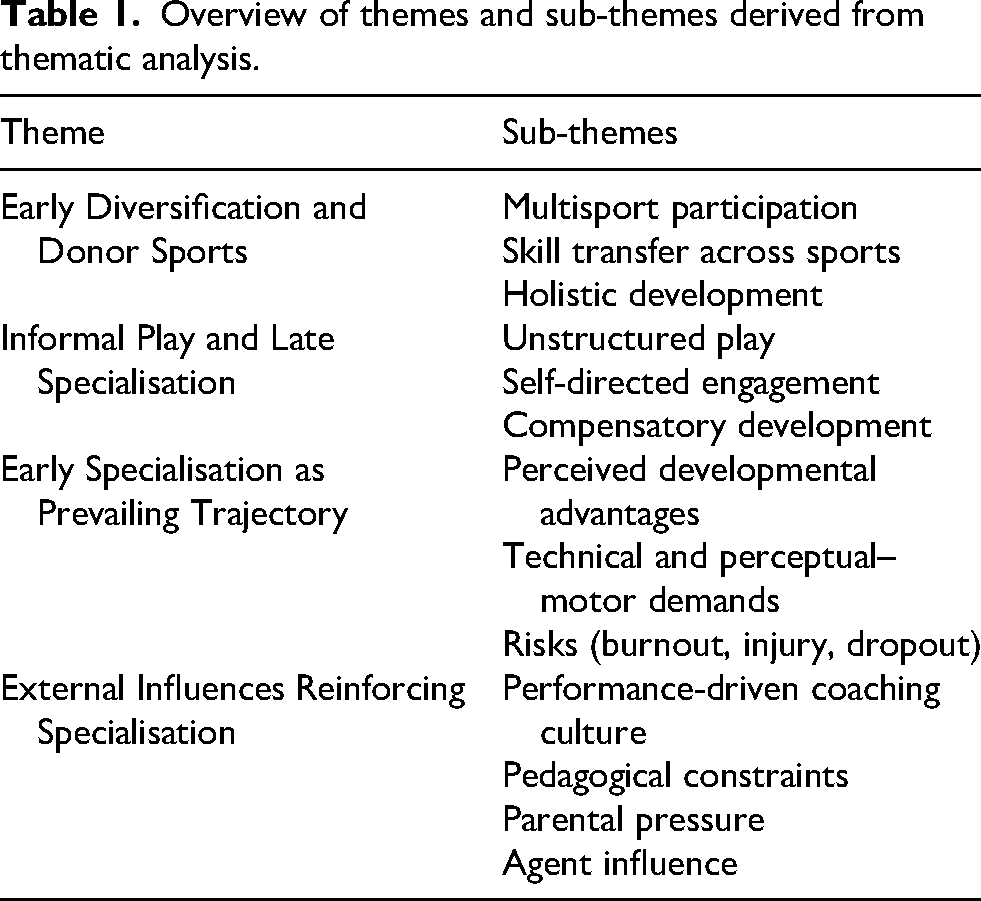
All interviews were audio-recorded, transcribed verbatim, and checked for accuracy. Pseudonyms were used to ensure confidentiality. Data were analysed using thematic analysis following Braun and Clarke's 26 six-phase framework. This approach was selected for its interpretive flexibility and its suitability for identifying shared and divergent meanings in participants’ accounts, consistent with the study aim. Transcripts were repeatedly read and re-listened to for familiarisation, with initial analytic ideas and reflexive notes recorded. Meaningful data segments were then systematically coded using a hybrid deductive–inductive approach, guided by the research questions while remaining open to emergent insights. Codes were subsequently collated into preliminary themes by identifying patterns, contrasts, and contradictions, attending to both semantic content and latent meanings in relation to wider institutional discourses. Themes were iteratively reviewed for internal coherence and relevance across the dataset using constant comparison. During theme refinement, themes were defined and named and organised hierarchically (general, main, and subthemes) (Table 1). Finally, illustrative excerpts were selected to support analytic claims and demonstrate alignment with the research aims and theoretical orientation. Consistent with a constructivist stance, analysis focused on how meanings were contextually constructed, negotiated, and at times resisted within youth football academies.
Overview of themes and sub-themes derived from thematic analysis.
Methodological rigour
Trustworthiness and interpretative validity were ensured through multiple strategies. 25 Pilot interviews with experienced youth football professionals were used to refine the interview guide. The interviewer's background as a coach facilitated access and rapport and was addressed through ongoing reflexivity, supported by reflexive notes kept before and after interviews to monitor positionality. Member checking was conducted by returning transcripts to participants for validation. Data analysis was undertaken collaboratively by a multidisciplinary research team through peer debriefing and dialogical coding to challenge interpretations and enhance analytical transparency. Disagreements regarding theme development were resolved through iterative re-examination of the data until consensus was reached. Together, these procedures enhanced the credibility and confirmability of the findings by grounding interpretations in participants’ accounts while subjecting them to critical scrutiny from multiple perspectives. 25
Results
Early diversification and donor sports: foundations for holistic player development
A prominent theme across all interviews was the unanimous endorsement of ED as a cornerstone for holistic player development. TDs emphasised that engagement in multiple sports during childhood contributes to the development of more adaptable and well-rounded athletes. Multisport participation was perceived to foster broad motor skill acquisition and cognitive versatility, which, in turn, enrich football-specific competencies: “It gives them other stimuli, other references to what sport is, and it only benefits their development. Sport, in general, is more important that specialising in football…” (TD F) “We have several examples of players who started late. We have Nélson Semedo, who only started playing football when he was 15 or 16, we have several examples of this.” (TD D) “We've had players come to football later. We also have an athlete who has never played and in the context of the game, it's a tremendous thing. I don't see it being a problem at all, not least because if they like it they'll practise in whatever way they can, and then it's something that, the talent being there, as we're talking about, the physical conditions being there, from then on, they're able to skip stages that, perhaps, athletes who practise for 10 years can't manage.” (TD F) “For example, in dance, I see a brutal transition, a transition in terms of knowledge, body rhythms, coordination, timing…” (TD D) “We have, for example, the kids who play handball, and we can clearly see that there is concern and rigour, for example, in terms of movement and tactics, and that they are very disciplined kids. So, it also has to do with what we know about handball training, obviously.” (TD H) “I also think that individual sports are important in this respect, because self-overcoming, self-knowledge, resilience are also worked on in these sports. In swimming, we commonly say (…) ‘counting tiles’, (…) you need to have a very high resilience capacity. And all this transported to a team sport, in this case football, clearly brings more benefits, without a doubt.” (TD E) “If we look at individual sports like judo, I think the principles and values that judo can pass on to a football player are brutal. If we look at a sport like rugby, I think the principles and values of that sport would also bring a lot to football, a lot…” (TD D) “I believe in coordinative capacity. Let's take my experience as an example… I've always adapted very well to all the disciplines. Why was that? Because the experiences were so varied, the motor coordination was there and I was able to get by quickly, to have the fundamental and simple skills of all the disciplines…” (TD A)
Informal play as a scaffold for late specialisation
There was widespread recognition between participants concerning the developmental value of informal football engagement. Participants consistently emphasised that early unstructured experiences, such as street football or play with friends, can significantly contribute to the acquisition of technical and motor skills required at more advanced stages: “If he starts practising football in a serious way, in a rigorous way, having already practised it in an amateur way, in an informal way, in the street, with friends (…), these experiences, together with other motor experiences and other skills, I don't see why he can't reach excellence later on, I don't see a problem with that.” (TD E) “I think that if they experience it at school, in the playground, on the street, in the neighbourhood, they'll end up making up for that lack of competition, because competition at those ages is inherent, kids even playing against each other or with their parents will always be looking for ‘I beat you!’, so I think that's going to stimulate a lot.” (TD B)
Early specialisation as prevailing trajectory: perceived benefits and emerging risks
Participants expressed concerns about the potential limitations of an ED pathway grounded in the belief that, when players join academies solely around the typical age of specialisation (13–16), they may be at a disadvantage compared to their peers who have been involved in structured programmes from a younger age. A lack of accumulated practice and experience is seen as a critical gap that can hinder progression: “We develop many skills during the early years of formal football practice. If a child misses this period, they may not develop the fundamental skills required to play the sport.” (TD B) “When he joins the sports club, he's lagging behind his classmates, so what happens when he's lagging behind? He'll either go to less developed groups or he'll eventually train, but he won't play. Then the coaches won't put him in the game, he’ll have fewer experiences, he’ll become demotivated and he’ll end up dropping out, that's almost certain.” (TD C) “If one starts playing at 8, and the other starts playing at 14, the likelihood of the one started playing earlier being more successful seems high to me.” (TD D) “Three and a half years is the year we're starting at [the club]” (TD F)
A predominant view among the TDs was that ES is essential for developing the technical and perceptual–motor skills required in football. Participants argued that, unlike many other sports, football demands complex motor coordination involving the feet, an action that is not commonly performed in daily life. They believed that an early start provides players with the time needed to acquire ball control, touch sensitivity, and the technical fluency that underpin future performance. “Football is played with the feet, and that's not a natural action for us in everyday life. So, the sooner you start working on that coordination, the better. It takes time for players to develop sensitivity and control with the ball.” (TD B) “If they begin early, they get used to the ball sooner. They learn to feel it, to control it, and that makes all the difference later on. It's not something you can easily catch up with if you start at 13 or 14.” (TD H) “I've had athletes who joined at the age of five and then probably gave up at 15 because of their experiences in some clubs, which led to a lot of strain in terms of transport, workload, (…) they lost their enthusiasm for sport.” (TD B) “…what's certain is that as it's an asymmetrical sport, and footballers only play this sport, they can develop certain pathologies or severe injuries like ACL.” (TD D)
External influences reinforcing early specialisation
ES is not solely the product of internal coaching philosophies but is amplified by external influences operating within the youth football environment. Participants explained that the competitive nature of youth football leads early-career coaches to prioritise short-term results as a means of gaining recognition and credibility within the coaching community, making competitive success the main measure of competence rather than holistic player development. “The youth coaches want to win, which is wrong. They want to be champions; they want to win…it's a way of showing they’re good coaches, of being recognised by others.” (TD H) “Coaches with younger players don’t always know how to adapt training. They do things that are too specific, tactical work, systems of play, and they forget the basics: coordination, creativity, enjoyment. They forget that at these ages the goal should be to develop the person and the athlete, not to prepare a mini version of an adult player.” (TD G). “We have parents who want their kids to start at three or four, because they believe the sooner they begin, the better they’ll be. Some genuinely think they might have the next Cristiano Ronaldo at home.” (TD D) “Parents are constantly pushing. They tell the kids they have to train hard, concentrate, and perform better. Sometimes the children feel more pressure from home than from the coach.” (TD A) “In games, you see everything: parents shouting at the referee, arguing with coaches, getting angry because their child isn’t playing enough. It creates a very negative environment for the kids.” (TD E) “The environment that surrounds the development of athletes at the level of agents and so on (…) this is an issue that greatly influences what youth training is, what our work is. This is very conditioning for what our daily work is. An athlete at U13 and U11 who already begins to live in this climate will find it difficult to impose himself, he will find it more difficult to reach a higher level.” (TD E)
TDs stressed that agents are often driven by financial motives rather than genuine concern for player development. Their focus on identifying and promoting early talent as a potential economic asset was viewed as detrimental to the players’ long-term growth, as it shifts attention away from learning and enjoyment toward performance outcomes and market value. “Agents are not worried about how the player develops; only about how much they can earn from him. They want to spot talent early, sign the boy, and then hope he becomes profitable. That completely distorts the process.” (TD C)
Discussion
This study examined how TD working in elite Portuguese youth football academies perceive and operationalise long-term developmental pathways. In doing so, it sought to examine how these practitioners understand ES and ED within the specific institutional, pedagogical, and cultural logics of football academy environments. Through an interpretive lens, the findings reveal a persistent tension between TDs’ developmental beliefs and the structural pressures that shape academy environments, a contradiction not unique to Portugal but characteristic of contemporary talent development systems. These voices provide insight into how such beliefs are embedded within, and often constrained by, broader institutional logics, cultural traditions, and performance-driven expectations.
Results highlighted strong support for ED as a concept, albeit one with limited practical expression in academy settings. All participants endorsed the idea that engaging in multiple sports supports the development of motor versatility, creativity, and tactical awareness, a position well supported by existing literature.1,3,11 Participants described how “donor sports” could enhance the transfer of learning to football through shared perceptual, cognitive, and physical demands. 27 These include decision-making under pressure, problem-solving, coordination, and physical conditioning. Such sports may occupy adjacent fields of an affordance landscape, 28 foster adaptability and holistic development, and thus support functionality at the point of specialisation.2,8,27 Nonetheless, most TD admitted that the current structure of academy football leaves little room for genuine diversification. This disconnects points to a broader systemic contradiction: while theoretical models promote ED for long-term success, institutional realities favour early, exclusive commitment to football.4,6,20
The findings also revealed strong recognition of informal play and late specialisation as viable, if undervalued, components of development. The TD frequently referenced players who entered structured football relatively late but reached elite levels, often attributing their success to rich histories of informal play. This finding supports a growing body of literature suggesting that self-directed, informal and unstructured football experiences can contribute meaningfully to technical fluency, perceptual attunement, and tactical understanding by exposing players to varied affordance-rich environments that foster adaptability, creativity, and decision-making.5,14,29 However, despite the appreciation for informal pathways, participants also highlighted barriers to late entry in football, including reduced playing time, delayed tactical integration, and lowered institutional confidence in players. This illustrates an ongoing bias towards early visibility and conformity within talent systems, raising questions about the inclusiveness and flexibility of current development models.3,16
Indeed, results are clear in showing the prevailing dominance of ES in the developmental cultures of Portuguese football academies. While participants acknowledged the theoretical benefits of diversified experiences, ES was largely perceived as a pragmatic necessity shaped by institutional and competitive realities. These results align with existing research in football,4,6,20,30 highlighting the normalisation of early and intensive engagement in football across high-performance systems. The TD perceived ES as advantageous for developing sport-specific skills, believed to be critical for early selection into elite pathways. However, these findings must be situated within the context of performance-oriented structures, where early indicators of skill and physical maturity are often used as proxies for long-term potential.1,3,16 Despite acknowledging risks such as burnout, dropout, or overuse injuries,13,31,32 many TD still rationalised early entry and specialisation as necessary trade-offs in a competitive ecosystem. This suggests a tension between what is known to be developmentally ideal and what is institutionally expected and applied. This performance-driven logic can also be understood in light of the broader micro-political and organisational dynamics of football environments, where coaches’ practices are often shaped by pressures for short-term results, professional recognition, and career progression, rather than solely by developmental considerations.23,24,33
The findings also highlighted a complex network of external influences reinforcing early specialisation, including parental pressure, coaching ambitions, and the growing role of external stakeholders such as agents.7,34 Participants depicted a culture in which short-term performance is prioritised over long-term development, with early success serving as a benchmark for social validation among these actors. Such pressures were perceived to constrain optimal sporting development, fostering premature professionalisation and undermining holistic growth.7,35 Moreover, the influence of parents and agents was seen to accentuate this tendency, driven more by economic or status-related motives than by developmental concerns.35,36 Overall, the findings suggest that TD operate within a web of relational, institutional, and socio-cultural pressures, a complexity often overlooked by models that reduce player development to individual attributes or training volume.
The current study contributes to a more nuanced and practice-oriented understanding of how developmental pathways are interpreted and enacted within football academies, reinforcing calls for more context-sensitive and relational approaches to player development that account for the structural, cultural, and political forces shaping practitioner decision-making.1,3,36 Despite these contributions, some limitations must be acknowledged. The sample was relatively small and geographically bounded, focusing solely on TD within Portuguese youth football academies. As such, the findings may not capture the full diversity of developmental practices across contexts. Future research would benefit from comparative cross-cultural analyses examining how developmental pathways are constructed within different institutional and cultural systems, as well as longitudinal designs exploring how practitioners’ beliefs and practices evolve over time. Further work is also warranted to examine specific structural mechanisms within football systems, such as B team models, loan systems, and transitional pathways between youth and senior football, and how these shape the balance between development and performance. In addition, greater attention should be given to the role of external stakeholders, including agents and families, in shaping developmental trajectories, as well as to how cross-sport knowledge and experiences might be more intentionally integrated into coach education and practice.
In conclusion, while the developmental benefits of ED were widely acknowledged, practitioners frequently found themselves compelled to implement ES due to the structural imperatives and performance-oriented cultures that characterise academy football. This divergence between belief and practice reflects broader tensions within football systems, where short-term competitive outcomes and evaluative pressures often prevail over long-term athlete development, a dynamic consistently highlighted in the literature on football culture and organisational practice.1,8,14 Addressing these tensions requires not only revisiting the foundations of coach education and player development models, but also critically interrogating the systemic conditions and micro-political dynamics that sustain ES as the dominant pathway. Greater alignment between developmental principles and institutional practices may enable more holistic, flexible, and sustainable pathways, better supporting both player development and well-being across the lifespan.
Supplemental Material
sj-pdf-1-spo-10.1177_17479541261443383 - Supplemental material for The misalignment between developmental pathways assumptions and enacted practice in youth football: Perspectives of technical directors in elite academies
Supplemental material, sj-pdf-1-spo-10.1177_17479541261443383 for The misalignment between developmental pathways assumptions and enacted practice in youth football: Perspectives of technical directors in elite academies by Patrícia Coutinho, Belém B Pedroto, Mariana Vieira, João Lenha, Gustavo Brenha and Isabel Mesquita in International Journal of Sports Science & Coaching
Footnotes

Ethical considerations
The study was conducted in accordance with the Declaration of Helsinki and received ethical approval from the authors’ Institutional Research Ethics Committee (CEFADE 3_2023). Written informed consent was obtained from all participants.
Consent to participate
Written informed consent to participate in this study was obtained from all participants.
Consent to publication
Not applicable.
Author contribution
PC led this paper from inception, development, writing and editing. All other authors MV, JL, GB, BBP and IM contributed to the development, writing, and editing of all versions of this paper.
Funding
The authors received no financial support for the research, authorship, and/or publication of this article.
Declaration of conflicting interests
The authors declared no potential conflicts of interest with respect to the research, authorship, and/or publication of this article.
Data availability
The qualitative data supporting the findings of this study are not publicly available due to ethical and confidentiality considerations. Anonymised data may be made available from the corresponding author upon reasonable request.
Supplemental material
Supplemental material for this article is available online.
References
Supplementary Material
Please find the following supplemental material available below.
For Open Access articles published under a Creative Commons License, all supplemental material carries the same license as the article it is associated with.
For non-Open Access articles published, all supplemental material carries a non-exclusive license, and permission requests for re-use of supplemental material or any part of supplemental material shall be sent directly to the copyright owner as specified in the copyright notice associated with the article.
