




Abstract
Sports-friendly and elite sport schools seek to support pupils by providing balanced support which is intended to facilitate success both in sport and in academic work. This study investigates how ambitious football players in Norway experience the advantages and challenges of undertaking a ‘dual career’ as student-athletes. Eight players and five coaches (two club coaches and three school coaches) in total were interviewed from two sports-friendly schools and two elite sports schools, and the data were analysed using thematic analysis. In the Elite Sport Programmes, the close integration of the school and club settings enabled coaches and student-athletes to plan and manage the overall workload and development of the student-athletes more easily. In contrast, players in the less structured Sports-Friendly Programmes experienced more concerns related to workload coordination but were also given more responsibility for their own decision making. This helped to facilitate better self-determination among the student-athletes but also increased their risk of overuse injuries. Our results indicate how different dual career development environments offer varying benefits, risks and developmental opportunities for student-athletes.
Secondary educational institutions that provide sport-school programmes need coordinated, balanced approaches to ensure that both the academic and sport development of their students are managed in holistic, appropriate and effective ways. 1 This is especially pertinent because many student-athletes are involved simultaneously in different sport settings, including club teams, school practices and formalised talent development programmes that are promoted by sport federations. 2 Well-developed coordination mechanisms and good communication between educational institutions and the other key actors involved are therefore vital to prevent overuse injuries and to facilitate the student-athletes overall development. 3
Stambulova, Engström 4 define the optimal dual career balance as “a combination of sport and studies that helps the student-athlete achieve their educational and athletic goals, live satisfying private lives and maintain their health and wellbeing” (p. 12). A balanced dual career can have a profound positive influence on student-athletes. Empirical findings suggest, for example, that balanced dual career programmes can better prepare student-athletes for future academic and sport requirements, provide intellectual stimulation, promote a healthy lifestyle (e.g. with better physical heath, psychological wellbeing and reduced stress), develop important psychosocial skills (e.g. motivation, confidence, self-discipline, teamwork), and expand student-athletes’ social networks and support systems.5–7 By sustaining the development of a multidimensional identity through sport and school, dual career programmes can help student-athletes to achieve success in education, sport and life. 8
Support is important because student-athletes need to negotiate many demands and expectations both in their school and sport settings, some of which are in conflict. 9 The pressure to perform well in sport and school, for example, can reduce the amount of personal time that student-athletes have,10,11 and such time pressures can be especially intense when activities across the club-school spectrum are insufficiently coordinated. 2 Research in Scandinavia has shown, for example, how student-athletes often need to: coordinate the sometimes conflicting demands of their academic, sport and social lives 12 ; cope with injuries and overuse13,14; navigate a variety of sometimes conflicting self-identities15,16; negotiate gender norms that may, for example, restrict the development of young female student-athletes through the construction or promotion of discriminatory discourses that favour male student-athletes;17,18 handle both their own expectations of athletic development and the expectations of others 19 and manage the pressure of social comparisons during regular evaluations (e.g. physical performance testing) or when competing for selection to sport activities. 10
Successful Dual Career Developmental Environments (DCDEs) are, ultimately, those that are characterised by the successful integration and coordination of stakeholder roles and responsibilities, rather than conflicting pressures and interests. 1 Successful DCDEs rely on the interplay of stakeholders on a micro-level (e.g. student-athletes’ reciprocal interactions with coaches, teachers, peers, family and friends), a meso-level (study programmes, university administrations, sport clubs, home arrangements, sport federations), and a macro-level (e.g. national sport culture, educational and societal structures). Successful DCDEs also rely on the coping strategies of individual student-athletes.20–22 Exploring how practitioners at different organisational levels could work together in such environments is potentially an important way to prevent or reduce sources of stress, and maximise positive outcomes while minimising negative outcomes. 23 Successful dual careers can be achieved through collaborative philosophies, collaborative decisions and collaborative actions between stakeholders, 24 and incremental coordination could be a key to providing flexible solutions for individual student-athletes. 25
Morris, Cartigny 26 distinguish between different types of DCDEs, based on the different structures and approaches that are used to provide both athlete development and academic support. For the purposes of this study, two types are of interest: firstly, Sports-Friendly Programmes which allow the pursuit of an elite sports career while also providing regular academic support; and, secondly, Elite Sport Programmes which are purposefully developed for student-athletes who wish to pursue a career in elite sport by providing structured and coordinated support for sport and school activities. Typically, these two types of DCDEs recruit student-athletes from the same student-athlete populations. However, Elite Sport Programmes are more competitive and student-athletes are recruited based on formal selection procedures that are focused on sport performance. In contrast, the Sports-Friendly Programmes recruit student-athletes based on their regular academic performance. Both Sports-Friendly and Elite Sport Programmes are embedded within larger educational and societal structures and may vary between different national contexts. 27 A careful analysis of how sport and academic development is achieved across national contexts and within different educational programmes is therefore important to understanding what makes DCDEs successful. 1
The Norwegian sports model represents a clear point of difference from the national elite sport systems or academy-based models that are common in other countries outside of Scandinavia. 28 In Norway, the less structured, non-commercial, and voluntary-based sports model has resulted in exceptional levels of sport participation for children and youth (75% of youth between the ages of 13–18 years, e.g. participate in organized sport activities). 29 Within this model, sport school programmes have become an important contributor to athlete development and are offered both by public and private schools as a way of better accommodating the dual career aspirations of student-athletes. 30 Since 2006, the number of upper secondary schools providing sport-specific practice in Norway has increased significantly: more than 110 public and private schools now offer elite sports in their educational programmes and many club coaches are employed part-time as coaches within the schools. Most Norwegian private sport school programmes are Elite Sports Programmes which have been purposefully developed for (selected) elite student-athletes and provide a combination of sport and academic support. These programmes, characterised by clear, formal arrangements with clubs and sporting federations, include daily school training sessions. 31 In contrast, most public sport school programmes are Sports-Friendly Programmes and consist of a three-year general and flexible academic education (approximately 190 days per year), and five hours of sport training a week during school hours. However, they generally do not include any formal collaboration with clubs or sporting federations, and there is also little or no communication between coaches who work across school, clubs, and association settings. Recent research on players’ experiences has revealed differences in the level of ambition and motivation between student-athletes pursuing professional football careers in Sports-Friendly Programmes and those in Elite Sport Programmes. 32 In addition, larger differences have been observed in the levels of ambition among students within Sports-Friendly Programmes compared to those in the Elite Sport Programmes.
The aim of the current study was to examine dual career support in Sports-Friendly and Elite Sport Programmes in Norway. Context-sensitive studies of DCDEs are important because programmes are shaped by wider societal contexts and cultural values; the stressors and demands of sports development and education are shaped both across and within specific organisational and national contexts. We therefore sought to explore how these settings are experienced both by ambitious student-athletes and their coaches and have focused particularly on student-athletes’ everyday experiences and the support that coaches in clubs and schools offer for dual careers. We contend that an examination of the interplay between education and sport can help researchers and practitioners to identify ways to improve the social, psychological, academic, and athletic development support that is provided to young student-athletes within dual career systems.
Methods
The study investigates dual career support for student-athletes in Sports-Friendly Programmes and Elite Sport Programmes in Norwegian upper secondary schools. Our study is positioned within a social interactionist ontology and utilises an interpretivist approach. 33 The focus of this study is on the everyday interactions that occur between individuals, and how the meanings associated with these interactions are managed and transformed through peoples’ interpretative processes as they try to make sense of, and adjust to, their social worlds. The study was approved by the Norwegian Centre for Research Data [reference number 626843] prior to the data collection.
Cases and participants
We sampled four sport school programmes purposefully from two mid-size cities in Norway: two were Sports-Friendly Programmes (one public and one private school) and two were Elite Sport Programmes (one public and one private school) (13). These DCDEs in the Norwegian setting were selected because both types have had a successful history of developing youth players that have been able to transition to adult sports. The types of programmes were distinct: the Elite Sport Programmes included collaboration with two professional football clubs – in both instances, the club coach was also the school coach of the student-athletes. In the Sports-Friendly Programmes, no formal collaboration with professional clubs took place, and the student-athletes had different coaches in their club and school settings. The ‘schools’ administrators were asked if their coaches and pupils would like to participate in the study. All the coaches we interviewed had worked for a minimum of three years in the school programmes. The players in the Elite Sport Programmes represented Norwegian Premier League clubs; players in the Sports-Friendly Programmes represented senior clubs in the second and third divisions of the Norwegian football league system. All players were 17 or 18 years (M = 17,5; SD = 0.5) and agreed to participate in the study.
Sports-Friendly Programme
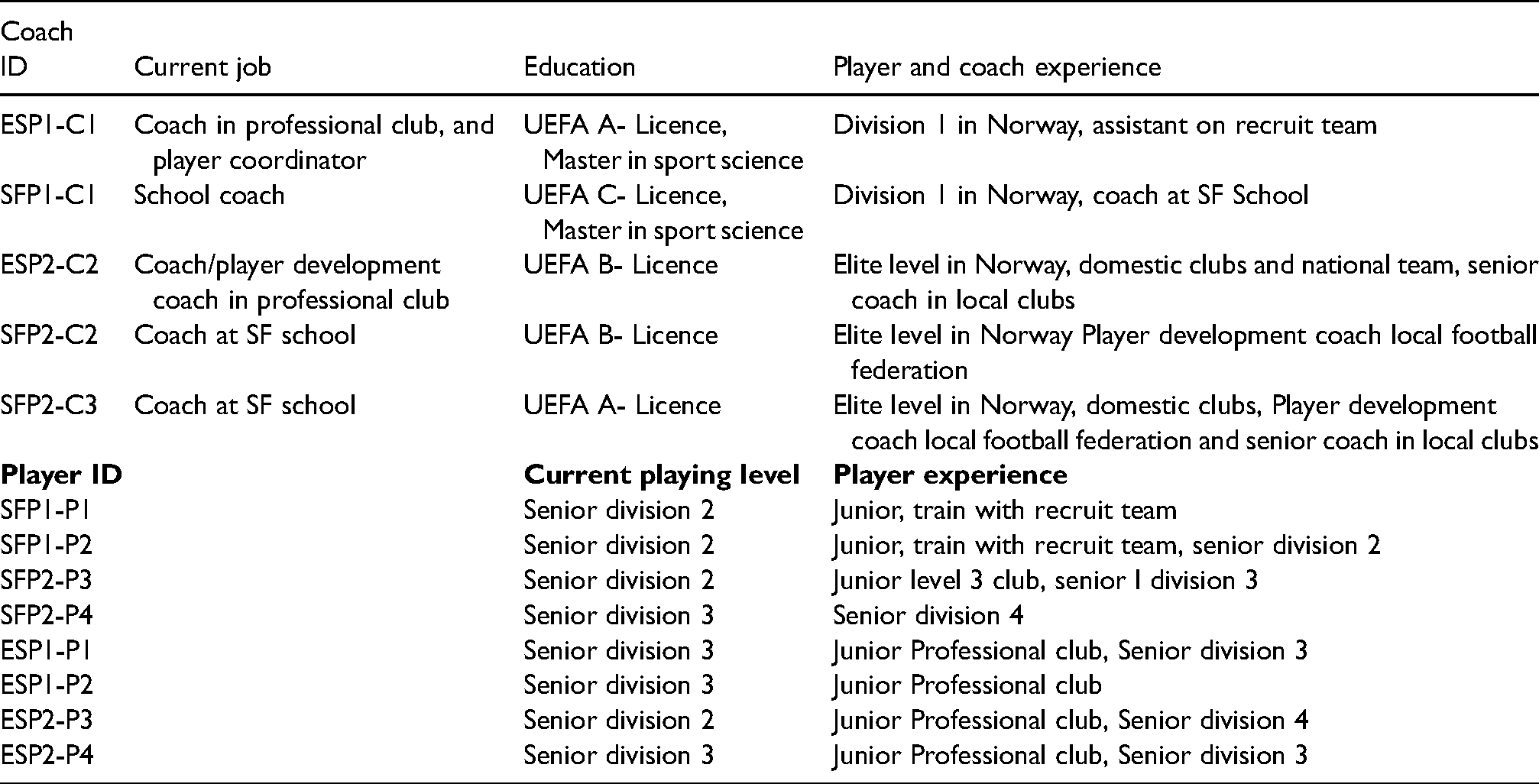
The two Sports-Friendly Programmes included in this study were at schools in different regions of Norway. The players at these schools represented non-professional clubs and played football in the second or third football division in the Norwegian league system. The school coaches were not employed by the clubs the players represented. The players in the two Sports-Friendly Programmes had a training load of five sessions (300 min) per week, and the players who trained the most had more self-organised training sessions (see Table 1 for more information). In each of the study settings, we recruited one club coach, one school coach, and four players for the interviews. The players who were chosen were nominated by their club coaches and/or by the school coaches because they were thought of as players who were especially career ambitious, putting in a lot of time and effort in pursuing a professional football career. This player profile was important since previous research has observed larger differences in the levels of ambition among students within Sports-Friendly Programmes. 32
Participants in the study.
Elite Sports Programme
The Elite Sport Programmes we examined were offered by a total of two other schools in the same two different regions. The players at these schools played in professional clubs and in the second or third football divisions. The participating school coaches were all employees both at the school and at associated professional clubs. The players in the Elite Sport Programmes took part each week in four training sessions (360 min) at their club during school hours, and a total of ten sessions. We interviewed one club coach involved in player development, two school coaches and four players from these schools.
Interviews
The interviews took place at the four schools during February 2020 and lasted between 32 and 74 min. On average, the interviews with the coaches were 65 min long; the interviews with the student-athletes were approximately 45 min each. The interviews were conducted face to face, and each participant was interviewed only once. All the interviews at the schools were conducted in a quiet area which was chosen by the participants, with only the interviewer and participant present. The interviews used a semi-structured approach, as detailed by Brinkmann and Kvale, 34 and were audio recorded and later transcribed verbatim. To ensure confidentiality, all the participants were anonymised in the transcriptions. Each was assigned a category code that consisted of an acronym for the type of school programme (SFP for a Sport-Friendly Programme, and ESP for an Elite Sport Programme) and a number defining the school. An additional letter/number combination was added to identify the role and anonymised identity of each interviewee.
Adopting a social interactionist ontology and interpretivist epistemology enabled us to frame our interviews as a relational space. This meant that both the participants and the interviewers could explore themes together and co-construct knowledge. 33 The interview guide we used to structure the interview process, both for the coaches and players, included the following topics: education, coach-athlete relationships, workload, and the developmental environment (see Appendix A for the complete interview guide).
Data analysis
We examined all the interview materials using a six-step thematic content analysis developed by Braun et al. (19). In the first step, the study's third author transcribed, read and re-read the data. In the second step, the third author generated initial thematic codes by analysing the data inductively (e.g. “absence from school subjects”) and presented these to the first author whose role was to act as a ‘critical friend’ who then reviewed and challenged the third author's descriptions and reasonings for these initial codes (20). In the third step, the two remaining study authors joined the analytical process and all four study authors discussed how the findings should be categorised and structured into higher-order themes (e.g. ‘academic flexibility and support’). We all then jointly elaborated on the analytical themes in a fourth analytical step, in which we returned to the raw interview data to clarify questions (e.g. how the players had developed their social relationships with their peer schoolmates in both types of school programmes). In the fifth step, we reviewed and refined the sub-themes and final categories. The sixth and final step intertwined the analytical process and the categorisation process. During this step, we often went back to the categories that we had defined during the report writing process. We also returned to the raw data to ensure that the content was fairly and accurately reflected in the final categories we chose.
To ensure meaningful coherence between the purpose of the study and the procedures that were followed, we tried to be as transparent as possible about the processes that lead us to our analytical findings. To do this, we attempted continually to verify our analysis and our critical interpretations of the data. Doing so enabled us to test both our procedures and our data analysis. It also enabled us to make explicit our pre-conceptions, our sensitivities to the research contexts in which we were working, and to establish an analytical distance that would allow us to better reflect on our interpretations. During the data collection processes, we discussed our results and our own interpretations to ensure peer agreement and validity (22).
Results
The results here focus both on the experiences of players and coaches in dual-career Sports-Friendly Programmes and Elite Sport Programmes using four main themes: (a) academic flexibility and support; (b) coordination of the training loads across club and school practice settings; (c) variations in skill levels and (d) the role of coaches.
Academic flexibility and support
A common core feature underpinning the focus of both types of dual academic-sport programmes was the understanding among the coaches we interviewed that achieving good academic results could have a positive influence on the sports development of the student-athletes. This view was expressed by all the participating coaches. ‘It is positive if players can master both school and sports’, noted coach SFP2-C2: If you do schoolwork properly, you will also do your training properly. You will be serious when it comes to your diet and sleep. I think there is a strong connection. If you see someone who is sloppy with their schoolwork, it can be transferred to their exercise, rest, and diet. It's about the attitudes to the work you must do.
All the players we interviewed, both in the sports-friendly and elite sport programmes, reported that the programmes provided them with enough time and flexibility to tend both to their education and to their football careers. As one player (SFP2-P4) from an Elite Sport Programme noted: “I feel [it] is well arranged so that I can play club football, participate in the school programme, and I have not had any problems with my schoolwork”. The elite programme coaches shared similar views and one (ESP2-C2) observed that the level of support for dual careers had even improved significantly in recent years: “The students have a school system that is arranged in such a way that they can perform optimally,” he commented.
The interviews revealed, however, some clear differences in the scope of academic flexibility and formalised support that existed in the Sports-Friendly Programmes and the Elite Sport Programmes. The players in the Elite Sport Programmes, for example, experienced more academic flexibility in their academic programmes and were offered more leave of absence compared to the players in the Sports-Friendly Programmes. At Norwegian upper-secondary schools, all students are required to attend 80% of their academic classes to qualify for graduation. The flexibility offered to players in the Elite Sport Programmes was therefore significant because their attendance at club training sessions was regarded as a valid reason for academic non-attendance. Players were permitted to receive more homework instead of attending classes, and their absences were not registered on their graduate diplomas. In this system, as one of the players (ESP2-P3) observed: As long as you do the duties and assessments … [you] are supposed [to], you can make many different agreements. […] For example, if I have to go to a senior team training and they train early [in the] afternoon, I have to leave here at half past one because it takes an hour to drive. Then [I] just … have a dialogue with the sports director or principal, and they give me homework instead. They want us to focus on football.
In contrast, players attending the Sports-Friendly Programmes were not given the same degree of flexibility, as one of the players (SFP2-P3) reported: I have never asked for any exemption in school when it comes to my education or absence due to football. It is entirely possible to have a dialogue [with the school]. But it is often the case that you have to be a top-level player, such as [one who is] being selected to the youth international team, if you are to get a leave of absence. Usually, only those who play for Premier League clubs get this.
Players in the Sports-Friendly Programmes had to contact their teachers, on their own initiative, to discuss making special scheduling arrangements. Players in the Elite Sport Programmes, in contrast, received assistance with their scheduling from a sports coordinator who was an employee both at their school and at their club. The coordinator's role was to reduce the pressure that students faced when navigating their schoolwork and football commitments, and to ensure that their schedules were appropriately adjusted to the students’ deadlines and submissions. As one of the players (ESP1-P1) from an Elite Sport Programme explained: We have an intermediary: he makes sure that everything goes as it should by being employed by the school and club. […] He is also our contact teacher. He takes care of all messages between the school and club. He makes my everyday life easier. He can help us get a postponement of deadlines or take the test another day and [he] facilitates so that we can get sports absence if we are travelling [with the club or football association].
The absence of a sports coordinator in the Sports-Friendly Programmes settings did not necessarily cause problems for the players. “The school here is good at facilitating for me,” observed one player (SFP2-P3), “but I have to go directly to the subject teachers to make arrangements. But they have a great understanding of my everyday life as an elite athlete.”
Coordination of the training loads across club and school practice settings
Further structural differences between the Sports-Friendly Programmes and the Elite Sport Programmes were also apparent. These variations influenced both how the student-athletes and the coaches attempted to manage the student-athletes’ training and competition loads in the practice and competition settings. Most significantly, players from the Elite Sport Programmes had the same coaches in both their school and club settings, and this meant that they felt that their school and club practice sessions were more closely integrated within an overall plan of development. One of the players (ESP1-P1) praised this closely-knit system: It is nice to have club training during school hours as well. This allows the coach to follow us more closely. I have a close relationship with the coaches. The coach asks me a lot how I feel. He also gives a lot of feedback on what I can improve on and what I need to address to develop.
In contrast, players attending the Sports-Friendly Programmes had different coaches in their school and club settings. As noted, in the latter settings the responsibility for the communication and coordination between the clubs and schools was left to the individual players. Sometimes this led to inadequate coordination, as player SFP2-P4 described: “It sometimes happens that the schedule could have been better planned. For example, we did a running test at school practice, and I ended up in a situation where I did not feel ready for club training.” The presence of different coaches in the club and school settings resulted, too, in poorer and less-coordinated communication between the school coaches and the players in the Sports-Friendly Programmes, and between other participants in the school and club settings. As a Sports-Friendly Programme coach (SFP1-C1) explained: There has been little direct contact between the school and local clubs, so most communication is between us and the player, and then between [the] player and club coach. It is possible to have meetings with club coaches, but the clubs must show interest No matter what they do in club practice, we try to adapt the school programme.
Similar observations were made by other players in one of the Sports-Friendly Programmes, for example SFP1-P1, who noted: “The school coaches have no direct dialogue with my club. The dialogue between club and school is through me.”
The close link between the club and school settings in the Elite Sport Programmes meant that the student-athletes found their workload management to be significantly less complicated. However, the advantages afforded by this closeness were mostly limited to sport-related issues, as a player (ESP1-P1) from an Elite Sport Programme observed: “There is no dialogue between the school and club related to the academic [work], but in relation to sport-specific issues the dialogue is very good.”
Variations in skill levels
A third key difference between the Sports-Friendly Programmes and the Elite Sport Programmes was the composition of the training groups. Compared to those who took part in the more skill-homogeneous training groups of the Elite Sport Programmes, both the skill levels and the career ambitions of the student-athletes in the Sports-Friendly Programmes varied more widely. On occasion, this caused frustration for some of the more ambitious players in the Sports-Friendly Programmes. Player SFP2-P4 expressed his disappointment: In our programme, it feels like the rest of the players do not want the same as me… There are many players here who will never become very good football players. They know that, too. I miss better players around me, who want to become the best
The level of skill heterogeneity was also found to be higher among older players and, occasionally, this became a source of frustration, as player SFP1-P2 observed: You follow players on a higher level and want to get better and thereby create a very good development. Here, it's a bit like that, it's maybe the one thing I think is a bit crap. When you start in [the] first year, most people want something with football, while when you go to the third year, there are many who do not want so much anymore, there are very few who are motivated.
The coaches in the Sports-Friendly Programmes recognised the impact that the skill variations had on the perceptions of the players: “They all go from being ambitious football players to becoming more reality-oriented in three years. This is the transition from junior to senior,” commented coach SFP1-C1. Inevitably, this meant that coaches could be confronted with dilemmas, such as having to decide whether to focus more on those players who were more motivated instead of those who were less keen. Such a focus, as one coach (SFP2-C3) quipped, might help to “develop the very best [players], but it will also make my relationship with the rest of the group worse.” Other coaches in the Sports-Friendly Programmes, such as coach SFP2-C2, admitted to providing more attention to the most ambitious players they worked with, regardless of the risks: I should not hide the fact that it is easier to support these players to a greater extent. Those who show that they really want [to learn and develop] are the players we try to follow closely by giving them special focus areas and a customised arrangement.
As noted earlier, the greater skill heterogeneity among the SFP players was problematic, but also had unintended, positive consequences. Ambitious players, for example, tended to take more responsibility and ownership for their own development: I try to take responsibility for being a leader in the group and develop technically. I know that due to the level, not everything that happens at the training will be the same high level. […] To contribute positively and develop my individual skills is my focus on school training.
In other words, the skill variations within the training groups of the Sports-Friendly Programmes had neither inevitable nor universal positive or negative consequences for the sports and psychosocial development of the student-athletes, when compared to the more homogenous skill sets found in the ESP settings. Coaches emphasised that despite the challenges faced by the players, those who were surrounded by other talented players were able to find opportunities at appropriate skill levels, and that this enabled the student-athletes to develop continually. Coach SFP1-C1 reflected: For those players who want to go far, it is the competitive level they play at that is most important. Many of our best players choose to go to a club in the Premier League if they are given the opportunity. In most cases, I’m not so sure if that's the best solution for the players, because they become one out of many and they get a less appropriate arena for competitive play. […] We have a few players who have chosen differently: they get the opportunity to train with a Premier League club and continue [to] play for their local club. We have seen several times that it is perhaps those latter players who reach the farthest in the long run. Because they belong to a senior team at the appropriate level.
The role of coaches
In both the programme settings we studied, the relationships between peers, and between the players and the coaches were important influences on athlete development. Players highlighted the social and caring nature of the high-quality coaching, and one (SFP1-P1) noted the extent of the support that was offered: “The coach wants to know a lot and he asks us a lot. I think he speaks with me almost every workout.”
Coaches, too, recognised the importance of the social interactions they had with players, both on the personal and the athletic development of the players. We, as coaches, strongly influence players. We look at players and the potential of players differently. You often see that a player in a club who does not get trust and regular playing time at a high level can change clubs and get regular playing time, which in turn leads to him flourishing. It has something to do with self-confidence, opening a space for development and [being] allowed to make some mistakes. This in turn could lead to great player development.
Players spoke, too, about the important role of their coaches and how their coaches helped them to create an environment in which their athlete school practice complemented their club practice. The school coaches are important support persons in relation to being able to give me advice on technique, how I perform exercises, and what goals I can work on to get better. […] We often have different technical focus areas where we can choose which part of our game we want to work on. Here I have worked a lot with the technical part of my game, the coaches have a lot of experience with this. […] I notice that when I play matches, I can do things faster and with greater precision.
The relationships between peers, players and the coaches were a key influence on athlete development, and strongly shaped their experiences and their social milieu. “A good training environment is […] most important […],” noted player SFP1-P2, The unity in the group has a lot to say. Better unity leads to better relationships, and it becomes more fun to train. You push each other. The fact that you have good players to train with means that you develop. The fact that I have been moved up [a level] makes it physically tougher and I have something to strive for.
However, despite this evident commonality, the coaches in the Elite Sport Programmes and the Sports-Friendly Programmes had very different understandings about the purpose of the coaching within each setting. Those in the Elite Sport Programmes, for example, focused primarily on the student-athletes’ careers in elite sport rather than the student-athletes’ academic work: We have ambitions to get everyone through [school]. But every time we must put up a hard fight, we prioritise football. There is nothing to hide. We will develop football players. That is also what my position is, first and foremost, about.
In contrast, the coaches in the Sports-Friendly Programmes saw their role more as facilitators, who had a wider range of responsibilities: My main role as a coach is to make the players more conscious, [to] be an advisor or guide who explains [to] the players why we train the way we do…. That is perhaps our most important role. And, furthermore, facilitating for them. That's our primary task, to make them aware of the type of training they are doing and why they are doing it. Our primary task is not to make them professional football players
Coaches in both settings strived to influence the self-confidence and motivation of the student-athletes they worked with. However, these benefits were highlighted more in the Sports-Friendly Programmes, both by the coaches and the players.
Having the same coaches in both their club and school enabled student-athletes in the Elite Sport Programmes setting to access help with coordinating the demands of the academic and athletic programmes. However, this role overlap did not always have positive effects. On occasion, because the evaluation and monitoring of the student-athletes were more constant, tensions occurred between the student-athletes and the coaches. One athlete (ESP1-P2) noted that it was his coach who ultimately determined the extent of the playing opportunities he received: The coaches have a lot to say for my mood. They decide if I get to play and, in that sense, they have a lot to say for my development and opportunities. It can be difficult if I am not allowed to play, at least if they do not provide me with a reason.
In contrast, coaches in the Sports-Friendly Programmes were unable to provide the same level of coordination, but their influence, nevertheless, extended beyond simply providing coaching. Not having an affiliation with, or vested interest in, a specific club enabled them to offer more independent guidance and advice to the players about the decisions and the choices the student-athletes needed to make within the club contexts. As one of the Sports-Friendly Programme's coaches (SFP2-C2) explained: We also provide guidance for players in relation to club changes. Then we operate as a type of conversation partner. We try to act as neutrally as possible. But if I am asked directly, I share my honest opinion with the player.
Another coach (SFP1-C1) recalled how he had ‘tried several times to find alternative clubs and other solutions for the player’ when it became necessary. The more independent position of such coaches effectively allowed coaches to be more supportive of the career choices of the players. In the process, the coaches were able to provide a more supportive role in fostering the autonomy and independence of the players.
Discussion
We examined how ambitious student-athletes and their coaches experienced dual career support in both Sports-Friendly Programmes and Elite Sport Programme settings. In our analysis, we identified four main themes: academic flexibility and support; the coordination of training loads across club and school practice; variations in skill levels; and the role of coaches. The core purpose of most DCDEs is to provide better, simultaneous support both for academic and sport development. In the Norwegian context, Sports-Friendly Programmes and Elite Sport Programmes are committed to providing an equal focus on education and sports development. Our study showed that the players in both types of DCDE settings regarded the developmental opportunities in their programmes as positive, both for their sports development and for their education. The critical insights from our study show that appropriate athlete workload monitoring may be easier to manage within the highly structured context of Elite Sport Programmes, while the less structured Sports-Friendly Programmes may better support the agency and co-determination of student-athletes. This suggests that there is not a one-size-fits-all approach to achieving successful school-based athlete development.
Student-athletes’ perceptions of the two different types of sport-school programmes were shaped strongly by the degree of coordination and communication between the clubs and schools. Recent research of Norwegian sport school programmes by Bjørndal and Gjesdal 35 has showed how school coaches have tried to improve the integration between sport and education by focusing on individual athlete development and complementary practice. In these programmes, both formal and informal communication were identified as important elements in the successful coordination of athlete development across club, school, and association settings.
Through our interviews, we observed that coaches and players in the Elite Sport Programmes operated in environments which offered significant academic flexibility, compared to players in the Sports-Friendly Programmes. Practically, this helped student-athletes in the Elite Sport Programmes by lessening the pressures associated with coordinating different activities and enabling them to access more opportunities to develop their own sport career interests. Our finding that some of the students in the Elite Sport Programmes had become more focused on their sports careers than their education mirrored similar findings in studies of dual career support in Danish men's football.9,36 This is an important concern because it suggests that if dual career support is not very carefully managed, the preferences of the students within Elite Sport Programme environments could become amplified at the expense of other, equally or more important, development focus areas. 37 The assumption in Elite Sport Programmes that development occurs at a particular pace and sequence could be particularly problematic given that athlete development and learning are, in fact, nonlinear and usually determined in relation to the level of other talents in the group. 19
The most prominent difference we identified between Sports-Friendly Programmes and Elite Sport Programmes was that in the Elite Sport Programmes a specific person was appointed to coordinate the school and club-based activities of the student-athletes. In comparison, the coordination of the Sports-Friendly Programmes was left to the individual student-athletes themselves. The student-athletes in the Sports-Friendly Programmes were more likely to face increased time pressure and increased workloads. Athlete development research in Norwegian youth sport has consistently and increasingly pointed to a problematic lack of coordination, and shown that this increases the risk of injuries, may decrease student-athletes’ motivation for sport, and negatively influence student-athletes’ likely success of transitioning from a junior to senior level.2,3,10–14,35,38 Current athlete development and coaching models, it can be argued, do not adequately mirror the dynamic nature of sports coaching. 25 Bjørndal, Andersen 12 have argued that the complex coordination needed across different club, school and association settings requires flexible adaptations that extend beyond the adjustments that individual coaches need to make to optimise the performance of particular teams and players. Instead, coaches need to be able to adjust their own decision making and their own choices in relation to the actions of other coaches who are also involved with training the same student-athletes. This recognition has potential significance for coach education programmes and suggests the need for a new modus operandi of more incremental coordination, planning and action.25,39
Academic resilience, according to Renström and Stenling, 40 is “a disposition towards learning that helps pupils mediate between their understanding of learning situations as challenging and their continued engagement in those situations” (p. 135) and fundamental for the learning considered necessary in DCDEs. In one sense it is possible to argue that too much overt and structured support for school-sport collaborations could make players potentially less able to handle adversity. 41 However, the coaches from the Sports-Friendly Programmes in this study recognised that the challenges student-athletes faced also created opportunities for the student-athletes to develop greater ownership over their own development. The challenge for both players and student-athletes in talent and athlete development systems is therefore to find the ‘sweet spot’ between having too much or too little support – a space, in other words, in which structural support is offered that also provides opportunities for successful individual development and agency. 42
Within-group variation in skill levels was also perceived in notably different ways in the Sports-Friendly Programmes and the Elite Sport Programmes. Larger variations in skill levels, for example, were reported among the players in the Sports-Friendly Programmes, and larger variations were found, too, in the degree of career focus that these student-athletes had. For some ambitious players who wanted opportunities to improve their skills, this was a source of frustration. However, the coaches in the Sports-Friendly Programmes also reported that such players did receive structured and ongoing support. The coaches explained to us that the players that they supported in this way were able, ultimately, to develop stronger ownership of their own developmental processes. In contrast, players received comparatively less individual attention in the Elite Sport Programmes because they were surrounded by other, equally ambitious players. In their case study of a talent development environment in track and field, Henriksen, Stambulova 22 suggest that inclusive training groups which have higher levels of skill variation can benefit athlete development. Such groups, for example, can allow for more overall social cohesion and support compared to than the negative consequences of competition found in more homogeneous, competitive groups. 43
Sport-school coaches act as essential gatekeepers in talent development environments, by enabling or limiting access to resources, and deciding on who can participate. 44 It was notable to us therefore that the role of the coaches differed distinctly between the Sports-Friendly and the Elite Sport Programmes. Players in the Sports-Friendly Programmes, for example, indicated that they used their school coaches as conversation partners to discuss both their own individual development needs, and received guidance from them related to club transfers and transition decisions. Players in the Elite Sport Programmes also reported strong and positive relationships with their coaches. However, we observed that the school coaches in the Sports-Friendly Programmes focused exclusively on the concerns of the individual pupils and athletes, while coaches in the Elite Sport Programmes also had to focus their attention on team performance and selections. In the latter system, coaches maintained strict control in determining what kind of playing opportunities players were given in the club matches. Moreover, the coaches in Elite Sport Programmes tended to interpret the concept of a dual career as a process in which the values of elite sports were further reinforced within the school setting, a finding which is similar to those from Danish and Finnish DCDEs where coaches and players have been found to be more focused on optimizing players’ sports performance as compared to their academic development.36,45,46 Coaches in both settings acted as important gatekeepers for players who wanted to transition to higher levels. However, the more independent support and conversational partner roles of the coaches in the Sports-Friendly Programmes appeared to be especially important and impactful on the youth players. Players in Elite Sport Programmes face constant pressures on the path to athletic development, including having to live up to their own expectations and the expectations of others, and the pressure of constant social comparison.10,19 It was our impression that the players we interviewed in our Sports-Friendly Programme settings experienced less pressure because of the supportive role of the coaches in such settings.
Each type of programme, we suggest therefore, has its own distinct advantages and trade-offs: Elite Sport Programmes provide a better potential solution to workload concerns because less coordination is needed, and attention is focused primarily on development within a more uniform, high-performance setting. In contrast, Sports-Friendly Programmes are characterised by more challenging coordination issues, but are better able to facilitate individual agency support and self-determination.
Limitations and future research
The focus of the current study was restricted because of its exclusive focus on DCDEs within football, and the experiences of male players only. Recent research has shown that youth football in Norway is shaped by strong gender bias which favours male players, both in terms of participation and allocated resources. 47 On this basis, it is probable to assume that the nature and extent of dual career support could differ and be experienced differently within the context of female football (e.g. the level of variation in the degree of support within sport and academic settings, the availability of qualified coaches, the degree of academic flexibility offered, and the level of coordination offered in different settings). The current paper should therefore be seen as a starting point for an examination of how different dual career support programmes could influence athlete development in other Norwegian sports and similar contexts.
Further, much of the research on athlete development in Norwegian youth sport has focused on female student-athletes. We therefore recommend that future research should examine how both male and female student-athletes experience dual career support differently and if, and how, such variations differ across sports and different types of DCDEs. Future research should consider comparative case study designs, which are especially well-suited to this purpose. Action research which examines and evaluates different types of coordination within and across school, club and association-based athlete development settings could provide other fruitful avenues for future investigations.
Conclusion
In this study, we examined how players and coaches experience dual career support in two distinct types of sport school programmes, namely Elite Sport Programmes and Sports-Friendly Programmes. Overall, all the players we interviewed were satisfied with the support offered in these programmes, both for their academic and sport careers. However, the closer integration of the school and club settings in the Elite Sport Programmes helped coaches and student-athletes to better plan and coordinate their workload pressures more easily. In the less structured Sports-Friendly Programmes, greater responsibility for the planning and coordination was placed on the student-athletes themselves. The less team-oriented role of coaches (e.g. coaches in this setting had no club team to select or club objectives to achieve) within this latter type of system, meant that the coaches were able to support student-athletes in other ways, such as facilitating more independent decision-making and self-determination. Further studies should examine the benefits and disadvantages of different DCDE programmes, and how to improve the coordination between sport and academic life in ways that do not compromise either athlete autonomy or independence. The examination of dual career support will enable researchers and practitioners to identify contextualised ways to improve the social, psychological, and athletic development support that is offered to young people.
Footnotes
Declaration of conflicting interests
The author(s) declared no potential conflicts of interest with respect to the research, authorship, and/or publication of this article.
Funding
The author(s) received no financial support for the research, authorship, and/or publication of this article.
