



Abstract
Sport officials’ (i.e., referees, umpires, judges) talent identification and development remain under-examined relative to athletes. Existing pathway models provide limited guidance on the capabilities that distinguish officiating talent across contexts. This study examined officials’ perceptions of the importance of (i) attributes underpinning effective officiating and (ii) sport background and environmental factors contributing to talent development, and aimed to understand whether perceptions differed by gender, sport, and performance level. Active officials (239 males, 33 females) from soccer (n = 106), cricket (n = 71), rugby union (n = 47), and hockey (n = 48) completed an online survey to rank 13 officiating attributes and eight development factors, separately. Rankings were analysed using Kruskal–Wallis tests with Dunn post hoc comparisons revealing making decisions under pressure, communication skills, and knowledge of the rules were the most important attributes. The highest-ranked development factors were number of games officiated, formal training, and time interacting with other officials. Attribute rankings were largely consistent across gender, sport, and performance levels, indicating substantial cross-context agreement. Notable differences emerged for selected items, including females prioritising understanding players more highly than males, sport-specific variation across communication, knowledge of the rules, personality factors, goal setting, teamwork, and games officiated. Finally, community-level officials placed greater emphasis on prior playing experience. These findings highlight shared foundations of officiating expertise alongside nuanced, context-specific priorities that should inform targeted, evidence-based officiating talent identification and development systems.
Introduction
Sport officials are a vital part of the sporting ecosystem, yet have received significantly less exploration in the scientific literature, in comparison to athletes and their coaches. 1 To have the best quality officials, it is important to identify talented individuals and develop them in supportive, well-designed environments. Officials, like athletes, require a high degree of skill and training, and talent identification and development of athletes have long been a key discussion in both the literature and practice, referring to the identification and selection of individuals with potential for elite performance, followed by the implementation of a suitable environment to develop their skills. 2 While this is an important consideration for all officiating organisations, the identification and development of talent is rarely studied in sport officials.3,4 The notion of ‘talent’ in sport officiating remains conceptually ambiguous, particularly given the unique cognitive, interpersonal, and contextual demands of officiating compared to athletic performance. This is further demonstrated within the literature, with the majority of officiating research focused on topics such as physiology, decision making (including potential biases), stress/psychology, and recruitment/retention, with limited exploration of officiating talent and its development.4,5
Officiating can be defined as a craft developed over time. 6 However, a limitation of many sport officials′ development is the acknowledgement that in-game performance is a key developmental activity.7,8 Yet there is limited opportunity for game-based practice outside of formal competition, and thus sport officials’ organisations need to understand how to promote skill development within training environments which are mainly self-led and unguided. 9 Given these challenges, it is important to understand the developmental and environmental factors which contribute to the growth of sport officials’ key performance attributes. Understanding this may help guide learning and development opportunities which are currently underdeveloped in the broader officiating literature, 10 and subsequently facilitate evidence-informed practice in talent identification and development of officials.
To help understand the officiating development environment and process, several conceptual models have been developed. For example, the FTEM-O (Foundation, Talent, Elite, Mastery applied to Officiating) 11 builds on an athlete development model and provides a linear, stage-based perspective of development from starting as an official (Foundation) through to officiating at the elite level (Mastery). Similar to this, Mack and colleagues provided an overview of development factors in officiating, 8 specifically within an Australian sporting context (including Australian football, basketball and soccer). The model includes five tiers, 1) playing participation (e.g., playing through junior years); 2) focus on officiating (e.g., may be more opportunities to progress to higher levels as an official); 3) junior officiating (theory-based training initially followed by decrease in coaching once competence increases); 4) senior officiating (coaching becomes more individualised, mentors become more prevalent, and greater confidence in own ability); and 5) elite officiating. Another model is the hierarchical and holistic perspective of interactor officials, which focuses on soccer and basketball referees. 12 This model has three tiers related to development, beginning with officiating motives, then career development encompassing training/practice and transitions, mediated by organisational and psychological support systems and work-life balance. The top of this model focuses on performance skills such as decision-making, mediated by factors such as match preparation, personal characteristics and performance evaluation. Taken together, these models largely describe pathways, stages, and support systems, yet offer limited guidance on the critical capabilities that distinguish officiating talent and inform talent development across diverse officiating contexts. This may be due to the limited knowledge on officiating talent and development across a variety of contexts, particularly understanding officials across different performance levels from beginner to professional.
In addition to these developmental models, researchers have also attempted to understand the attributes which contribute to officiating performance. For example, Morris and O’Connor 13 reported decision making to be the most important attribute for rugby league refereeing, with reading the game, communication, game understanding, game management and rule knowledge ranked as the top attributes necessary for effective performance. Akin to this in Australian football umpires, knowledge of the laws, decision making and composure were ranked as the top three attributes, respectively. 14 These studies emphasise knowledge of the laws and the associated decision-making skills as most important, which is not surprising, as an officials’ decision making has been considered the most important skill, as this can have significant impact on the outcome of a match.13,14 While decision-making in officials can often be to accurately call fouls or penalties, 15 officials must also balance accuracy with entertainment, safety and fairness of the game. 16 Expanding on this, a study with soccer referees identified similar findings, with accurate decisions a leading factor, but also being physically capable leading to correct positioning, and psychological factors such as composure, focus, mentally tough all highlighted as important attributes for successful performance. 17 Interestingly, while decision-making is acknowledged as one of the most important skills, research indicates officials (specifically soccer referees) continue to dedicate a high proportion of structured training time to physical fitness training, 18 rather than developing decision-making performance. In terms of measuring attributes, decision-making is the predominant attribute to be measured in officials, 3 and is often does so using video-based tests. 19
To date, studies have typically explored key performance attributes of elite sport officiating in a specific team sport, such as soccer, 17 rugby league, 13 or Australian football. 14 Although these studies provide insight into the factors and attributes relevant to officials in a particular sporting context, these are very homogenous samples. However, officials represent a heterogenous group (different sports, different performance levels), and much of the research is considered transferable within this broad domain, with Westbrooks, Low and Brownlee 17 commenting on this limitation. In addition, Hancock and Pizzera 20 highlight the limited diversity of research on officiating performance, where much of the research has focused on soccer referees and in elite populations.
Therefore, the aim of this study was to examine officials’ perceptions of key performance attributes and the experiential and environmental factors contributing to their officiating talent development. In addition, this study aimed to determine whether the ranking of these attributes and development factors differ between gender of participants, sport officiated and performance levels, as previous studies in this area have mainly focused on single sport elite settings only.13,14,17,21
Methods
Research design
The research design for this study was a cross-sectional quantitative survey of active sport officials. This study adopted a post-positivist philosophical perspective, where we acknowledge that talent attributes and development factors are measured quantitatively, but there are contextual factors which mediate the measurement of these. Participants ranked items to enable direct prioritisation and comparison between attributes in line with the study aims; where ranking responses reflect the relative rather than absolute importance of each attribute.
Participants
369 active sport officials consented to participate in this study, however, only 272 completed the entire online survey and were therefore included in the final analysis. The sample comprised of 239 male and 33 female officials, with participants predominantly from four countries (Australia: n = 115; USA: n = 73; United Kingdom: n = 58; Canada: n = 22). The participants were predominantly from four sports (Soccer: n = 106; Cricket: n = 71; Rugby union: n = 47; Hockey: n = 48), and four different performance levels (Professional: n = 10; Semi-professional: n = 89; Talent n = 35 [defined as officiating in the youth talent pathway/development program for their sport]; Community n = 138), similar to recent recommendations for sport officiating sample reporting. 5 Ethics approval was granted by the lead researcher's institutional human research ethics committee (HREC22-08) and informed consent was obtained prior to data collection.
Procedures
This study is part of a large-scale project exploring officials’ recruitment, retention and development, which attempts to provide an understanding of officials across different sports and levels of performance. This data was collected through an online survey distributed to active sport officials, encompassing demographics information, recruitment/entry reasons into officiating, reasons to continue officiating, sport motivation, and talent development factors. This study will be focused on the data related to talent identification and development factors (including attributes for talented officials).
This study followed a purposive convenience sampling approach, whereby the survey was distributed to soccer, rugby union, cricket, and hockey officials. These sports were selected for investigation due to the ability to recruit a sample large enough to conduct between-sport comparisons. The survey was distributed through diverse recruitment channels, including the research team's personal networks, mailing lists of sport organisations, and targeted social media posts on relevant officiating social media groups. Data was collected across 2023 and early 2024. The emails and social media posts which were distributed contained a link to the survey, which if interested, participants could click and read the plain language statement. Following reading this document, participants could then indicate they were willing to participate in the study and were subsequently taken to the survey. Overall, the survey took approximately 20 min to complete. The survey was presented using Qualtrics software.
Measures
First, a list of key attributes underpinning officiating performance was developed based on prior officiating research.13,14,17 In total, 13 attributes were identified to provide a broad, yet focused representation of the attributes deemed important for effective officiating performance across a diverse representation of sports. Specifically, these attributes cover a range of conceptual domains, such as performance-related skills, defined as task-specific and trainable capacities (e.g., knowledge of the rules, making accurate decisions under pressure, communication skills); cognitive and psychological attributes, conceptualised as relatively stable but developable characteristics (e.g., personality factors, coping with pressure), and self-regulatory attributes, referring to capacities related to managing one's own learning, feedback engagement, and self-management (e.g., taking criticism, seeking advice, goal setting). Consistent with previous research,13,14 the attribute selection focused on attributes directly related to performance and development, as these factors have been shown to be more influential than physical (e.g., fitness) or game-related skills (e.g., positioning) in differentiating officiating performance. Within the survey, participants were provided with the attributes and the associated definition and were asked to rank each attribute in terms of their importance to officiating performance in their sport, from 1 (most important) to 13 (least important). The number of attributes selected for this section of the survey was deliberately limited to balance conceptual coverage with cognitive load in the ranking task.
Second, a list of eight sport background and environmental factors was developed based on frequently identified contributors to officiating expertise and development. These factors included ‘Being a former player’,6,22,23 ‘Amount of games’, 24 ‘Amount of training’, 18 ‘Amount of time interacting with other officials in group meetings and training’.21,23 Other exploratory factors were included where there is less knowledge, yet have anecdotally been suggested as relevant to the complex career trajectories of sport officials: ‘Being a former coach’, ‘Experience outside their sport, ‘Experience with other sports’.25,26 Participants were provided with the list of factors and their associated definitions and were asked to rank each factor in terms of their importance to officiating performance from 1 (most important) to 8 (least important).
The items in each list were assessed for face validity through consultation with three expert officiating developers and coaches from Australia and the United Kingdom. These individuals were asked to evaluate the relevance and definition clarity of each factor. Based on this consultation process minor refinements were made prior to the survey being distributed to participants. Due to the unique nature of data collection across different sports, there is no standardised measure of skills or talent development factors for officials across multiple sports. Therefore, these variables were based on the researchers’ knowledge drawing on past literature highlighted above, and an informal assessment of face validity.
Statistical analysis
All data was collected with Qualtrics software, and following this was transferred to a customised Microsoft Excel spreadsheet for data cleaning. Descriptive data were summarised using frequency counts, means, medians, and interquartile (IQR) ranges. Data is presented as a Mean Ranking (MR). The Kruskal-Wallis test was employed to analyse survey outcomes, with chi-square statistic (χ2) presented. Independent variables included gender, primary sport, current level, and age. Statistical significance was set at p < 0.05. Where significant effects were identified, post hoc analyses were conducted using Dunn's test with adjustments for multiple comparisons (Holm-Bonferroni correction). All analyses were conducted in RStudio (Posit Software, version 2024.12.1) using the dunn.test package. 27
Results
Officiating attributes
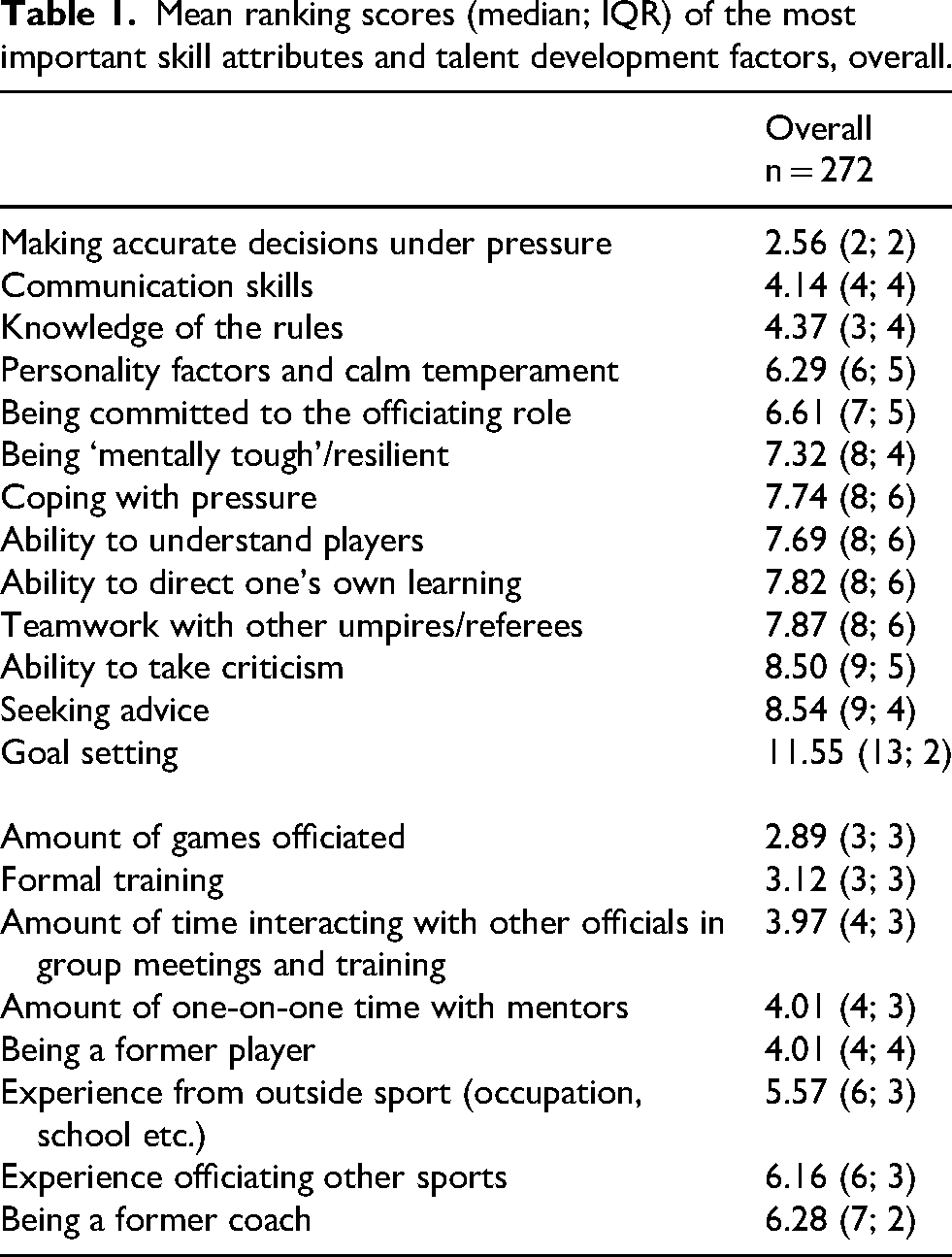
The highest ranked attributes were ‘Making accurate decisions under pressure’ (MR = 2.56), followed by ‘Communication skills’ (MR = 4.14), and ‘Knowledge of the rules’ (MR = 4.37). The attributes are presented in Table 1 from most to least important.
Mean ranking scores (median; IQR) of the most important skill attributes and talent development factors, overall.
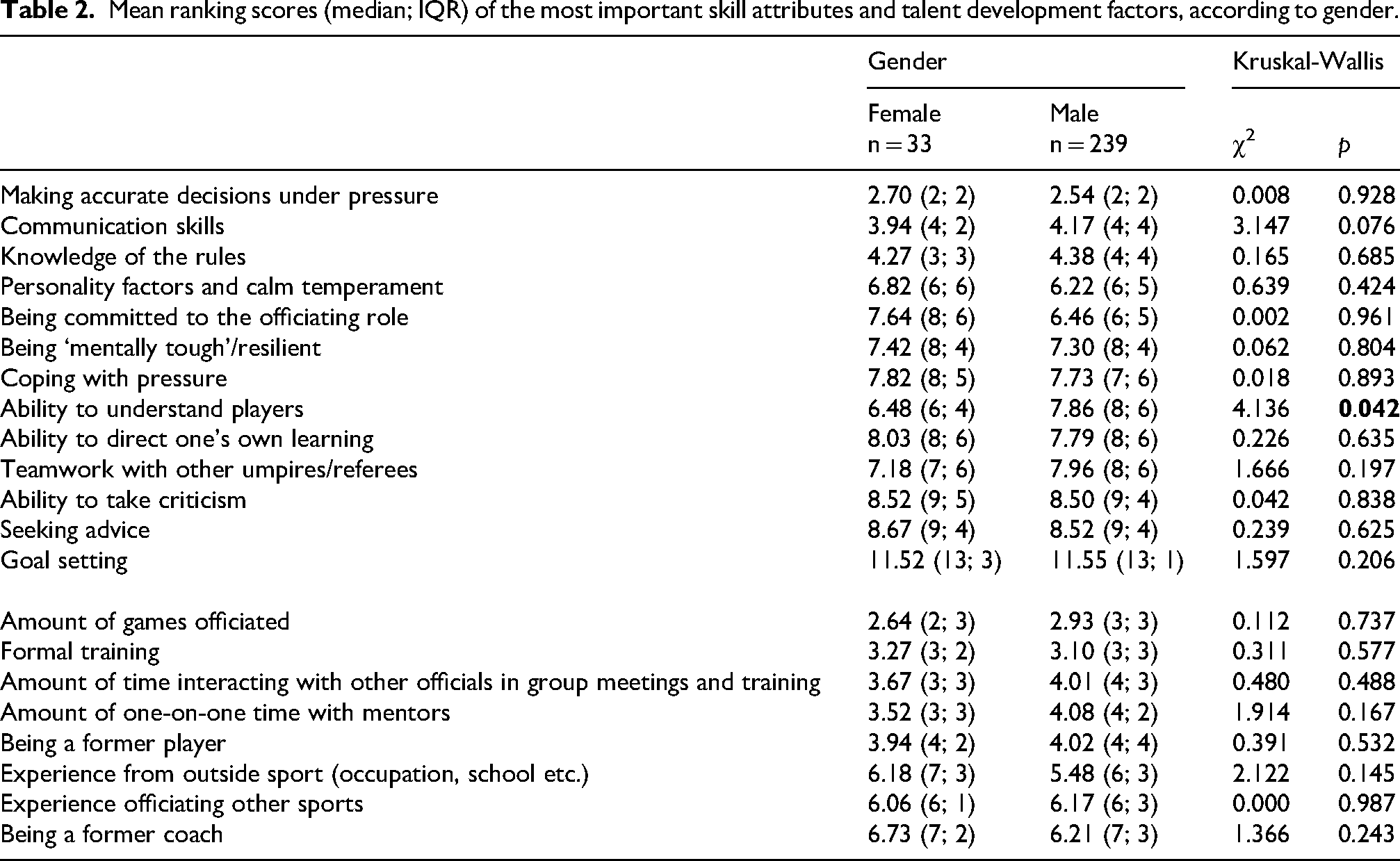
When considering the attribute rankings relative to gender, female officials ranked ‘Ability to understand players’ (MR = 6.48) significantly higher than their male counterparts (MR = 7.86; χ2 = 4.136, p = .042). Table 2 presents the rankings for male and female officials. With respect to attribute rankings relative to the sport officiated there were multiple significant main effects. There was a significant main effect for ‘Communication skills’ (χ2 = 14.219, p = .003), whereby post-hoc analyses revealed soccer officials (MR = 4.77) ranked this significantly lower than cricket (MR = 3.70; p = .031), rugby union (MR = 3.74; p = .013) and hockey (MR = 3.77; p = .041) officials. A significant effect for ‘Knowledge of the rules’ was also revealed (χ2 = 13.189, p = .004), with post-hoc analyses revealing soccer (MR = 3.86; p = 0.002), and cricket (MR = 4.22; p = 0.031) officials ranking ‘Knowledge of the rules’ significantly higher than rugby union officials (MR = 5.70). Kruskal-Wallis outcomes identified a significant difference for ‘personality factors and calm temperament’ (χ2 = 13.465, p = .004) whereby post-hoc analyses revealed that soccer referees (MR = 7.15) ranked this attribute significantly lower than all other sport officials (cricket: MR = 5.73, p = .017; rugby union; MR = 5.74, p = .045; hockey: MR = 5.73, p = .038). It was also revealed ‘Teamwork with other umpires/referees’ was significantly different between sports (χ2 = 13.572, p = .004), with post-hoc analysis identifying that rugby union referees (MR = 9.45) ranked teamwork significantly lower than all other sport officials (soccer: MR = 7.64, p = 0.008; cricket: MR = 7.45, p = 0.007; hockey: MR = 7.40, p = .010). Table 3 presents the rankings of performance attributes relative to the sport officiated. When examining differences between level officiated, the only significant main effect identified was ‘the ability to take criticism’ (MR = 9.70; χ2 = 9.781, p = .021), however post-hoc analysis did not reveal any significant pairwise comparisons between levels (all p > 0.05). Table 4 presents the performance attribute rankings by competition level.
Mean ranking scores (median; IQR) of the most important skill attributes and talent development factors, according to gender.
Mean ranking scores (median; IQR) of the most important skill attributes and talent development factors, according to sport officiated.
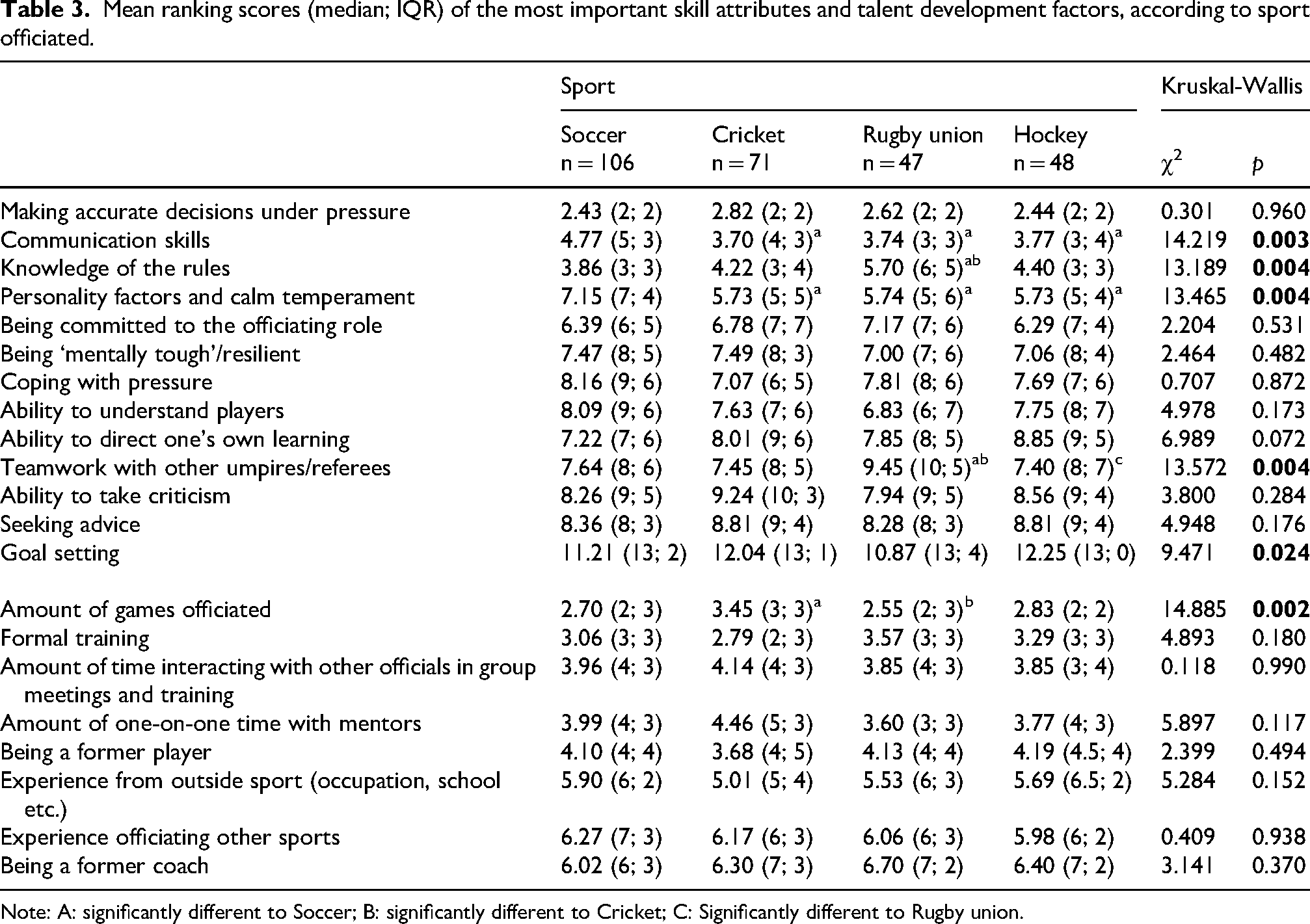
Note: A: significantly different to Soccer; B: significantly different to Cricket; C: Significantly different to Rugby union.
Mean ranking scores (median; IQR) of the most important skill attributes and talent development factors, according to level officiated.
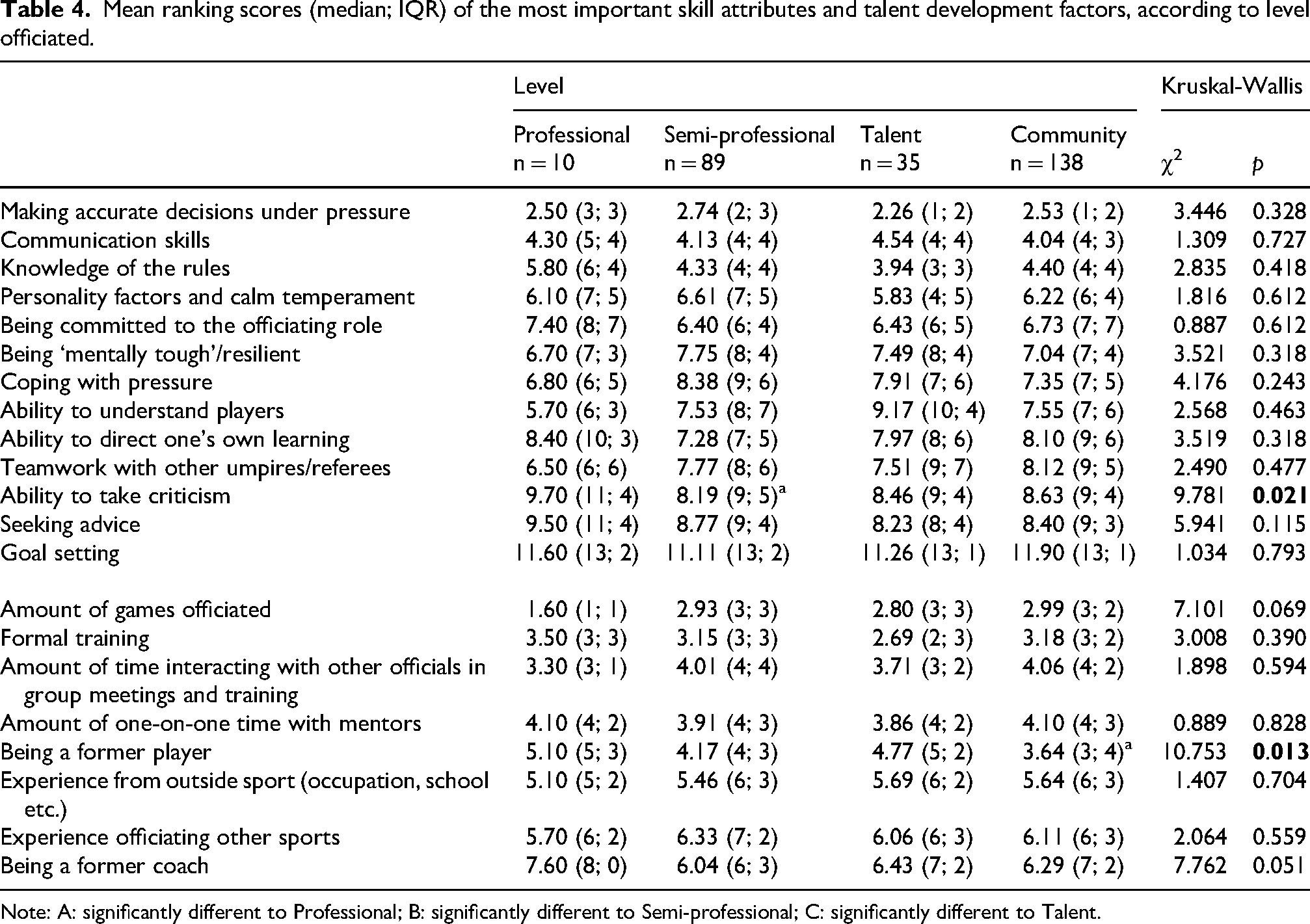
Note: A: significantly different to Professional; B: significantly different to Semi-professional; C: significantly different to Talent.
Talent development factors
The highest ranked talent development factors were ‘Amount of games officiated’ (MR = 2.89), ‘Formal training’ (MR = 3.12), and ‘Amount of time interacting with other officials in group meetings and training’ (MR = 3.97) (see Table 1). When exploring talent development factors relative to gender, there were no significant differences identified (all comparisons p > .05) (see Table 2). In terms of sport officiated, ‘Amount of games officiated’ was significantly different between sports (χ2 = 14.885, p = .002), with post-hoc analysis revealing soccer (MR = 2.70; p = 0.010) and rugby union (MR = 2.55; p = .013) officials ranking this significantly higher than cricket (MR = 3.45) (see Table 3). In relation to level officiated, there was a significant difference for ‘Being a former player’ (χ2 = 10.753, p = .013). Post-hoc Dunn tests with Holm-Bonferroni correction showed community level officials ranked ‘Being a former player’ (MR = 3.64) significantly higher (p = .042) than professional level officials (MR = 5.10) (see Table 4).
Discussion
This study aimed to examine how sport officials prioritise officiating attributes and developmental influences identified within officiating research, and to explore differences in perceptions across gender, sport officiated, and performance level. The factors reflect multiple domains of talent development including psychological, social, experiential, environmental and educational influences. The highest ranked attributes were decision-making under pressure, communication skills, and rule knowledge. The highest ranked talent development factors included number of games officiated, formal training, and amount of time interacting with other officials in meetings and training. The prioritisation of match exposure, mentoring, and peer interaction aligns with talent development models emphasising experience accumulation and social learning as central mechanisms of talent development.28,29
It is not surprising accurate decision-making was the highest ranked attribute, given this has been reported in previous sport-specific studies.13,14 The current finding is however important to highlight, as it indicates that irrespective of the sport decision-making is one of the most important attributes for officials.15,30 It is important to note this finding was also consistent across performance levels. Therefore, the current study reinforces the importance of decision-making within a sport official's role. It is interesting to note though that decision-making was consistently ranked higher than knowledge of the rules in this study, as previous research in elite Australian football umpires reported knowledge of the laws to be more important than decision-making. 14 The second most important attribute was communication, with this attribute potentially seen as an important attribute to assist with managing the game.31,32 Surprisingly, participants rated being mentally tough/resilient moderately despite the fact sport officials generally face a challenging role often experiencing abuse from the crowd, players and coaches.33–36 This finding is in contrast to previous research, particularly in elite level officiating, indicating that mental toughness is a key attribute for performance at that level.13,14,21 It should be noted, the high rankings of psychological attributes provide support to existing development conceptual frameworks such as hierarchical and holistic perspective of interactor officials, 12 which highlights psychological support systems as a key element of officiating development. As such, existing frameworks such as this which emphasise psychological support align with the most important skills for officiating.
As highlighted earlier, the officiating literature exploring talent identification and development has focused on predominantly male officials, and within a single sport and at an elite level, however this study sought to explore across a more diverse sample of officials. When considering the attributes ranking with respect to gender, the only significant difference was female officials ranked the ability to understand players higher than their male counterparts. Previous research has reported the negative experiences female officials have in their officiating role,37–39 and while speculative, this emphasis on understanding players may be a strategy for female officials to navigate this challenging role. From a talent identification perspective, female officials are more likely to begin officiating as a deselected athlete, than what male officials are. 40 Deselected female athletes may be an important pool of potential officials that can be targeted through a talent identification/recruitment strategy, particularly given the ability to understand players would speculatively have a positive impact on the broader sport.
A strength of the current study is the ability to explore the perceptions of key attributes across different sports, namely invasion and striking/fielding sports. As such, the results highlight that the attributes perceived to be important for effective performance may be generally consistent across sports, with some important differences noted. For instance soccer referees ranked communication skills lower than other sports, which is interesting considering the role that soccer referees have in co-creating the game with players. 41 However, soccer referees did note that knowledge of the rules to be significantly more important than rugby referees, which may indicate that this foundational knowledge for soccer referees is considered vital to this co-creation process. 41 An additional difference identified was that soccer referees ranked personality factors and calm temperament to be lower than the other sports. Again, this is interesting given the importance of psychological skills for effective soccer refereeing.42,43 A key outcome based on these results is confirming the existing research related to the key attributes for effective officiating,13,14,21 while also highlighting the general consensus that the role and importance of key attributes of performance is consistent across sports. This may enable knowledge sharing between sports about how best to identify and develop talented officials, given there appears to be a degree of similarity across sporting contexts.
Furthermore, there were minimal statistical differences between performance levels and attribute rankings. This suggests that perceived key attributes for effective performance does not differ across skill levels. Therefore, the performance attributes for effective officiating performance may be consistent across the officiating development pathway. While there was no significant difference between performance levels, it is interesting to note professional officials ranked ability to understand players as the third most important attribute, with these being ranked sixth most important or lower in other levels. In addition, semi-professional officials ranked ability to take criticism significantly higher than professional level officials. A potential reason for this may be where semi-professional officials are aspiring to reach the professional level, and see this as a critical element of their career path.25,44 When developing semi-professional officials, coaches of this level may look to work closely with their officials around receiving feedback constructively as officials at this level appear to place an emphasis on taking criticism. Future work may consider interviewing officials of different levels (such as through the lens of a linear framework such as the FTEM-O) 11 to understand how they view specific attributes such as ability to understand players in the context of their overall performance. This will build on an emerging body of research exploring the role of communication in officiating.31,32
When considering the talent development factors for sport officials, it is not surprising that officiating games and formal training were recognised as the highest rated. This is consistent with past research indicating in-game officiating is a key development activity for sport officials,7,9,24,45 however, it should be noted most of these studies have been conducted in soccer referees. This current finding does however indicate that officials from sports such as rugby and hockey also consider competition experience as the most important talent development factor. Interestingly, cricket umpires viewed the amount of time training to be more important than amount of time officiating competition. While this study did not qualitatively ask officials to explain their reasons for the rating, speculatively this could be due to the nature of cricket compared to the more dynamic sports of rugby, soccer, hockey, where cricket umpires can gain representative practice experiences through net practice (i.e., in cricket nets). 46 This highlights that although there may be some similarities between sports in terms of how officials view competition and training for development, there are also sport-specific nuances that need to be uncovered.
Curiously, the results indicate that officials appear to value time interacting with other officials over time with mentors. While mentoring in officiating is somewhat common, most of the literature has focused on mentoring through a lens of retaining, rather than developing officials. 47 Past research has indicated officials develop through a ‘hidden curriculum’, 48 which involves experiential learning and informal guidance from peers and mentors. While this study was specific to rugby union referees, it is likely applicable to officials of other sports. There can be different mentoring experiences between male and female officials, 37 however the female participants in this study ranked mentoring to be marginally more important than interacting with peers, the opposite of males. This may be due to the challenging social environments female officials may face, which has been a key focus area for sport organisations to address.37,49 Being a former player was considered more important for community level officials than other levels. This may be because at this level, officials have not yet specialised into their role (or recently have), such as the transition from playing experience to focusing on officiating. 8 This exploratory study does highlight the need for more research exploring the role of mentoring and peer interactions for officiating development, and also how past experiences such as playing the sport, may contribute to officiating performance and development.
While the results provide an understanding of the key attributes and developmental factors associated with officiating performance in several sports, the results should also be considered in relation to several limitations. First, this was an exploratory study investigating the key attributes and talent development factors of sport officials across several sports, addressing a gap in the literature where most studies have investigated a homogeneous population (i.e., within a specific sport, at a specific performance level).13,14,17 As such, we developed a generic list of attributes focusing on cognitive and psychological components, plus talent development factors. Although these measures were informed by existing literature and underwent initial face validation with industry experts, they did not undergo comprehensive psychometric validation, which should be considered when interpreting the findings. Future work could explore the development of a standardised list of officiating attributes for talent identification and development of officials that can be used across different sports. Second, we only explored four specific sports, with these officials predominantly representing interactor officials. 50 The majority of research exploring talent development in officials has focused on this population, 3 and further studies are required exploring more diverse officiating groups such as judges (i.e., monitors). Additionally, this study analysed these factors from a quantitative view only, where open-ended responses were not collected to allow participants to justify their ratings or explain how specific attributes are relevant for their context (e.g., the competition level they officiate). Future research should qualitatively explore, such as through interviews, how officials individually operationalise specific attributes such as communication or the ability to understand players. Finally, it was not possible to balance the participant group, with several groups, such as professional and female officials, having relatively small participant numbers. However, this imbalance may reflect the broader officiating landscape, where professional officials comprise a small proportion of the overall population, and males may be more prevalent. 4
With a limited amount of research on officiating, particularly in comparison to athletes, there is often a need to generalise findings reported in a specific officiating group. Our results suggest that this type of generalising may be suitable, given most of the comparisons in this study, especially between sports, were non-significant. For example, making accurate decisions under pressure was consistently ranked as the highest attribute across officials, regardless of their gender, sport officiated or performance level. More between-sport collaboration of ideas and approaches to facilitating officiating development would help advance the field of sport officiating, particularly on these skills that are consistently important regardless of context.5,15 This may also assist governing bodies which may centralise resources for officiating across varied sports. This has been considered within the applied setting, with the Australian Sports Commission being one example of a governing body providing centralised resources to officials of any sport.
Conclusion
To our knowledge, this is the first study providing a comparison between sports and their performance levels for understanding the key attributes and developmental factors that influence effective performance of sport officials. Decision-making, communication and knowledge of the rules were ranked as the most important officiating attributes across the cohort investigated in this study. Amount of games officiated and formal training opportunities were identified as the most important talent development factors, emphasising their importance particularly as officials may lack enough game and training opportunities to develop. This study adds to the officiating literature, specifically the areas of talent development and skilled performance, capturing the perspectives of a wide range of officials from numerous sports than what has previously been explored. Future work should build on this to understand nuances between and within sports.
Footnotes
Acknowledgements
Thank you to Dr Joshua Adie and Dr Stirling Sharpe for their assistance with this study with recruiting participants.

Ethical considerations
Ethics approval was granted by the lead researcher's institutional human research ethics committee (HREC22-08).
Consent to participate
Informed consent was obtained prior to data collection.
Consent for publication
Not applicable.
Funding
The authors received no financial support for the research, authorship, and/or publication of this article.
Declaration of conflicting interests
The authors declared no potential conflicts of interest with respect to the research, authorship, and/or publication of this article.
Data availability
Data is available upon request.