




Abstract
This study explores how on-field referees (REF) and Video Assistant Referees (VAR) collaboratively accomplish decision-making during in-match video review sequences in professional football. While VAR was introduced to increase accuracy and reduce error, discrepancies between the VAR's recommendation and the REF's final decision remain a persistent feature of match officiating. This paper investigates in detail these moments of agreement and disagreement, focusing on how shared decisions are sequentially organized, epistemically negotiated, and visually constructed in real time. Drawing on 107 official VAR recordings released by the Turkish Football Federation during the 2024–2025 Premier League season, the study employs an ethnomethodological and conversation analytic approach. Three episodes are analyzed in depth, one instance of agreement and two of disagreement, making available and accountable how decisions unfold through embodied actions, video-guided talk, and institutional protocols. The analysis reveals that even with shared access to identical video evidence, VAR and REF may interpret incidents differently due to divergent professional vision, distinct epistemic stances, and differing orientations to accountability. The study demonstrates that VAR reviews are not neutral, technocratic processes but complex interactional practices involving negotiated authority, contested categorizations, and moment-by-moment decision trajectories. The findings from the detailed sequential analysis challenge assumptions about the objectivity of video technology and emphasize the interactional work required to transform visual data into institutional decisions. By emphasizing the social organization of seeing, recommending, and deciding, this paper contributes to broader conversations in sport officiating, technology-mediated judgment, and the sociology of institutional interaction.
Introduction
Diego Maradona's infamous “Hand of God” incident occurred during the 1986 FIFA World Cup quarterfinal match between Argentina and England, held on June 22 in Mexico City's Estadio Azteca. Early in the second half, with the game still scoreless, Maradona attempted to score by leaping to meet a high ball in England's penalty area. As he jumped, he subtly used his left hand to punch the ball into the net. The Tunisian referee, Ali Bin Nasser, failed to notice the handball and awarded the goal to Argentina despite protests from the English players (Burns, 2021, p. 156).
During the 2014 FIFA World Cup Group D match between Uruguay and Italy on June 24, 2014, Luis Suárez bit Italian defender Giorgio Chiellini in the 79th minute as they jostled for position inside the penalty area. As Suárez leaned forward and sank his teeth into Chiellini's left shoulder, the Italian defender immediately recoiled in pain, pulling down his jersey to show the referee the bite marks while furiously protesting. However, Mexican referee Marco Rodríguez did not penalize Suárez, and play continued. Just two minutes later, Diego Godín scored the winning goal for Uruguay, knocking Italy out of the tournament (Martinkova & Parry, 2015, pp. 214–216).
These cases, along with many other instances of controversial or erroneous referee decisions, are an inherent and indispensable part of the decision-making process in refereeing in professional football (also known as soccer). Since referees must make quick judgments while processing multiple sources of information (Spitz et al., 2016), various factors can introduce biases that may lead to errors (Plessner & Haar, 2006). These errors may arise from misperception, where referees fail to see an incident entirely (Lex et al., 2015). Or, because the laws of the game allow for some degree of interpretation, referees often take the broader context into account when making decisions (Kolbinger & Lames, 2017). Also, external factors such as crowd noise (Nevill et al., 2002), home advantage (Unkelbach & Memmert, 2010), and previous calls (Plessner & Betsch, 2001) can influence their judgments. Other contextual elements, such as a team's aggressive reputation (Jones et al., 2002) or a player's physical appearance (Van Quaquebeke & Giessner, 2010), may also contribute to biased decision-making.
To reduce judgment errors and bias, the Video Assistant Referee (VAR) was officially incorporated into the Laws of the Game by FIFA (da Silva et al., 2024). It is designed to assist referees in reviewing decisions using video footage. Its use is limited to three key match situations (i.e., goals, penalties, and red card incidents) as well as one administrative case involving mistaken identity. The system works by having the VAR review video footage and communicate its findings to the on-field referee via a headset, allowing referees to make more accurate and informed decisions (IFAB, 2025). The VAR team, consisting of a VAR, an Assistant VAR (AVAR), and a Replay Operator (RO), operates from a remote Video Operations Room (VOR), analyzing multiple camera angles to identify clear errors. When an incident occurs, the VAR team reviews it automatically, and if a potential mistake is found, they communicate with the on-field referee, who can either accept the recommendation or conduct an on-field review (OFR) by watching replays on a pitch side monitor. The referee makes the final decision and signals it using hand gestures, such as drawing a “TV screen” to indicate a review (Held et al., 2025).
During a football match, communication among referees, both on the field and between the VAR and the on-field referees, is facilitated through an integrated audio communication system. Typically, the referee team includes the main referee, two assistant referees on the touchlines, and the fourth official. All four can communicate with each other throughout the match via a wireless headset system. This system enables open-microphone, real-time communication so that any of them can speak and listen simultaneously. In addition, the VAR team communicates with the on-field referee via the same technology. However, during a VAR review, only the main referee and the VAR speak directly to coordinate the decision-making process. Meanwhile, the assistant referees and the fourth official listen but typically do not intervene unless requested. The communication system is based on encrypted digital radio technology (such as Vokkero Squadra or Riedel Bolero), ensuring minimal delay, high audio quality, and resistance to external interference. According to FIFA's VAR protocol, all such communications are recorded for transparency and potential review (TFF, 2024).
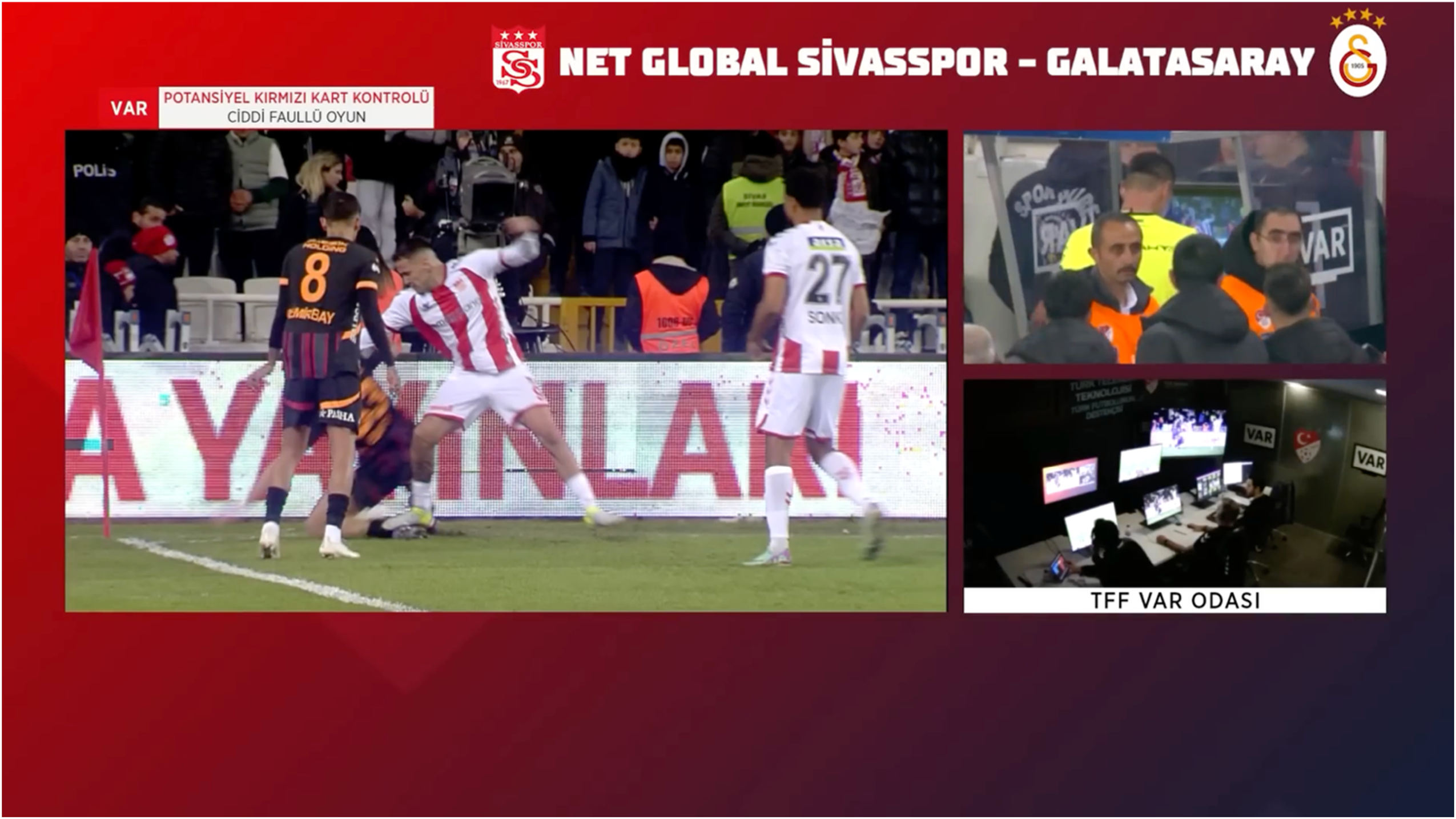
However, although VAR has been playing a great role in decreasing some major referee mistakes, there are still some problems in decision-making process in the game (Carlos et al., 2019). One of those problems is disagreement between VAR's assessment of the position and REF's. A good illustration of this is the foul in the match between Galatasaray and Sivasspor on December 8, 2024, as part of Week 15 games at Turkish Premier League (see Episode 2 in this paper). In the closing moments, Galatasaray's Barış Alper Yılmaz suffered a severe foul by Sivasspor's Rey Manaj. In stoppage time, Manaj forcefully stepped on Yılmaz's left ankle near the corner area. Despite the aggressive nature of the tackle, the referee, Turgut Doman, issued only a yellow card, even after a VAR review. Yılmaz was visibly in pain and had to be carried off the field on a stretcher (Türkiye Today, 2024).
Toward the end of the VAR review, Turgut Doman disagreed with the VAR's intervention (suggesting red card for Sivasspor's Rey Manaj) and upheld his original decision (yellow card), as shown in Episode 2. 1

The incident drew widespread condemnation, with Galatasaray's coach, Okan Buruk, criticizing the referee's decision not to issue a red card. The Turkish Football Federation (TFF) expressed deep regret over the unsportsmanlike conduct and pledged to conduct a thorough investigation to ensure appropriate disciplinary actions are taken (Tetik, 2024). Some football critics expressed their comments. Bülent Yıldırım, a former Turkish referee and famous commentators in Turkish football, stated his comment in a newspaper (Fanatik, 2024): The ball was stuck there. Time was running out, the match was 2-3, and that's quite normal. Manaj, frustrated by this, came over. The referee should have sensed something from the way he approached. This is about understanding football. I'm talking about the logic of the game. There was anger. He came in with rage and stomped with all his strength. There's no need to look for criteria. It's a direct red card. A red card involves bad intent and a cruel approach. You give the red card and close the matter. God gave him another chance with the VAR system. VAR has clearly shown all the evidence for a red card. Show the red card, my friend. It's a lack of awareness.
As reflected in Yıldırım's comment, VAR has not eliminated controversy in refereeing decisions. Rather, it has made visible that decision-making in football remains an interactional accomplishment. That is, although VAR is implemented to reduce clear and obvious errors, such errors persist and continue to trigger public debate, precisely because decisions are produced moment-by-moment within the unfolding course of play. The primary motivation for this work stems from this puzzling yet common occurrence in professional football: Two expert referees, VAR and REF, can arrive at different conclusions while watching the same video footage. Both parties share access to identical visual material and operate under a shared rule-based framework, yet they may diverge in how they interpret the same incident, whether in terms of foul play, disciplinary action, or the application of advantage. This discrepancy invites closer inspection of the interactional mechanics of officiating: How judgments are not merely based on what is seen, but on how what is seen is rendered relevant, reportable, and accountable within an institutional exchange (Corsby & Jones, 2020). It is precisely this divergence, despite shared perceptual access, that makes decision-making in VAR protocols a compelling site for analysis.
This study investigates a central question in contemporary refereeing: How do REFs and VARs accomplish shared decisions during VAR review sequences? Drawing on naturally occurring REF–VAR interactions from official match footage, the study focuses on both agreement and disagreement episodes, analyzing how decisions are sequentially produced, negotiated, and ratified. While VAR protocols are designed to reduce error and promote alignment, discrepancies between the VAR's recommendation and the REF's final decision continue to emerge. These moments of convergence and divergence present valuable opportunities to examine how decision-making is collaboratively and interactionally achieved in high-stakes, time-sensitive institutional settings.
Beyond its technical and procedural dimensions, the VAR system represents a profound social transformation in the governance of sport. Introduced to enhance fairness and transparency, VAR simultaneously redistributes the authority and accountability historically vested in the on-field referee. The system creates a new hierarchy of decision-making, where visual technologies and off-field experts intervene in what was once a sovereign domain of embodied judgment. This reconfiguration raises questions of power, trust, and professional legitimacy within the officiating community and, more broadly, in the cultural imagination of justice in sport. By examining how REFs and VAR officials negotiate, accept, or resist one another's recommendations in real time, this study also explores how authority is interactionally accomplished, rather than institutionally guaranteed. In doing so, it situates VAR not merely as a technological innovation but as a site where institutional power, identity, and accountability are constantly produced and contested, reflecting broader social concerns about the balance between human discretion and technological control in contemporary sport.
Data and Method
This study is based on official VAR recordings published by the TFF through its official YouTube channel during the 2024–2025 Premier League season. 2 In total, 107 video-recorded VAR interventions were collected and analyzed from the official TFF channel. These video recordings provide synchronized audio-visual data, including the interaction between the REF and VAR officials during match incidents. The dataset is comprised of publicly available, openly accessible institutional recordings published by the TFF. A significant development in this dataset is the mid-season shift in the institutional language of communication (Icbay, under review). From Week 20 onwards, the TFF introduced international VAR officials, and all subsequent VAR–REF exchanges were conducted in English as a lingua franca. This shift was largely implemented in response to strong public criticism regarding the decision-making of Turkish VAR officials (Atabay, 2024).
The recorded interventions covered a variety of match-changing outcomes. A total of 54 penalties were awarded following VAR review: 32 for defender foul play and 21 for handball offenses. VAR decisions also led to the issuance of 20 direct red cards for serious offenses such as violent conduct or denial of an obvious goal-scoring opportunity. VAR was instrumental in reversing on-field decisions as well. A total of 10 goals were canceled due to attacking foul play, 4 goals for offside, and 2 for attacker handball. Penalties were overturned in 4 cases of no defender foul, 3 cases of no handball, 2 cases of offside, and 1 case of deceptive foul play. Additionally, one disciplinary card was canceled due to offside interference. Importantly, seven disagreements between VAR officials and the main referee were recorded across the season. The disagreement cases refer to instances where the REF rejects the VAR's intervention and maintains their original decision. These disagreements, though infrequent, highlighted the interpretive nature of officiating and the challenge of achieving alignment in fast-paced decision-making environments.
The video recordings were systematically collected from the TFF's official YouTube channel during the 2024–2025 season. Each recording was downloaded and examined in its entirety to extract: (1) match week, (2) clubs involved, (3) match time of the VAR intervention, (4) type of intervention and decision outcome, and (5) whether there was agreement or disagreement between VAR and the main referee. The data was coded manually by the author, using a structured spreadsheet to ensure consistency across all 107 interventions. Disagreements were identified when the on-field decision and VAR recommendation diverged, based on audio exchanges and visual cues provided in the official recordings. The complete list of VAR incidents is presented in Appendix 1.
This study adopts EMCA (Ethnomethodology and Conversation Analysis) as its foundational approach to understanding how REFs and VARS collaboratively produce the orderliness of decision-making in football. Originating with Garfinkel (1967), ethnomethodology (EM) investigates the members’ methods: the everyday reasoning practices through which participants make their actions intelligible and accountable to one another (Icbay, 2025). The decision-making practice in referee officiating as a form of social order, from this perspective, is not a structure that exists prior to action, but a practical accomplishment of those who participate in it. Conversation analysis (CA), developed by Sacks et al. (1974) within the ethnomethodological tradition, offers the analytic procedures used in this study. CA provides the tools to describe how participants organize their talk and embodied conduct turn by turn, moment by moment. Through CA, the analysis focuses on the sequential organization of the VAR communication: how each turn displays an understanding of the prior one and projects a relevant next action (Schegloff, 1992).
In the context of the VAR system, EM provides a lens to examine how institutional order (i.e., the fairness, authority, and legitimacy of officiating) is achieved through the concerted activities of REFs and VARs. Their talk, gestures, and coordination make visible how “seeing” video evidence becomes transformed into a socially recognized decision (see Turcotte, 2025). Following EM's insight that institutional procedures depend on members’ local interpretive work, this study treats the VAR protocol not as a fixed script but as an interactional achievement continually negotiated across turns, technologies, and embodied actions. Similarly, CA's methodological strength lies in its insistence on naturally occurring data and on participants’ orientations. Following this analytic approach, the video-recorded VAR protocols enable close examination of both talk (transcribed using Jeffersonian conventions) and embodied conduct (gestures such as the rectangular “TV signal,” head movements, and gaze shifts). Each analytic claim is grounded in what the participants demonstrably treat as meaningful in their moment-to-moment coordination.
Through EMCA, the VAR sequences are examined as institutionally organized interactional practices in which professional tasks are accomplished through talk-in-interaction rather than the simple application of rules (Drew & Heritage, 1992). Each stage of the VAR protocol (initiating the review, framing and inspecting evidence, negotiating interpretations, and closing the sequence) constitutes an ordered activity with recognizable turn-taking patterns and conditionally relevant actions. Within these sequences, participants display epistemic stances (i.e., claims to differential access to relevant knowledge, perception, and interpretive competence), alongside deontic stances, which index rights, authority, and entitlement to determine courses of action and make binding decisions (see Drew & Curl, 2008; Heritage, 2012; Heritage & Raymond, 2005; Stevanovic & Peräkylä, 2012).
These epistemic and deontic asymmetries are closely intertwined with what Goodwin (1994) conceptualizes as professional vision: The socially organized ways in which experts are trained to see, categorize, and render events intelligible through institutionally sanctioned coding schemes. It “consists of socially organized ways of seeing and understanding events that are answerable to the distinctive interests of a particular social group” (Goodwin, 1994, p. 606). In VAR interaction, epistemic authority is enacted through practices such as directing attention to specific replay angles, invoking rule-based categories (e.g., “point of contact,” “serious foul play”), and framing visual evidence as consequential. Deontic authority, in turn, is displayed through the allocation and recognition of decision-making rights—most notably, the VAR's entitlement to recommend and the REF's entitlement to decide.
Importantly, these rights are not fixed by the protocol alone but are continuously achieved and ratified through sequential interaction. In this sense, VAR talk exemplifies institutional talk as a domain in which participants orient to role-based constraints and asymmetries while nonetheless negotiating authority turn by turn (Drew & Heritage, 1992). The analysis thus shows that professional authority in VAR is neither purely epistemic nor purely deontic but emerges from their dynamic alignment within interaction, as experts collaboratively transform visual data into accountable, institutionally legitimate decisions.
Findings
The findings presented in this section are based on a detailed examination of video-recorded communications between REFs and VARS during official matches. Each selected episode represents a complete VAR review sequence, beginning with the initiation of a possible review and ending with the REF's decision to either maintain or overturn the original call. The analysis proceeds turn by turn and action by action, attending to both verbal and embodied conduct (i.e., speech, prosody, gesture, gaze, and use of the headset and replay screen). These multimodal details are treated as the resources through which participants display their understanding of one another's actions and accomplish the institutional tasks of reviewing, negotiating, and finalizing decisions.
The findings are organized according to the sequential unfolding of the VAR protocol, which was inductively derived from repeated viewings and close transcription of the data. Three recurrent phases were identified across all review sequences: (1) establishing recipiency, (2) framing evidence, and (3) ending the protocol. Each phase will be illustrated with selected excerpts that exemplify how participants accomplish these interactional tasks in situ. Through these analyses, the study demonstrates how refereeing decisions are not merely determined by what is “seen” on the screen but are interactionally achieved through the participants’ locally organized reasoning, turn-taking, and embodied coordination (see Corsby & Jones, 2020; Turcotte, 2025).
The Agreement Between VAR and REF—Episode 1 (W15TK-TA)
The first episode was recorded during the second half of the match between Trabzonspor and Kasımpaşa, at 72:14 on the match clock. The sequence began when the ball went out of play near the advertisement banners and the match was briefly paused. Players were positioned across the field, with a Trabzonspor player crouched on the ground, in the lower right of the image, most likely due to a recent physical incident. REF, positioned upright near the center of the field, was observing the situation near the advertisement banners (see Figure 1).
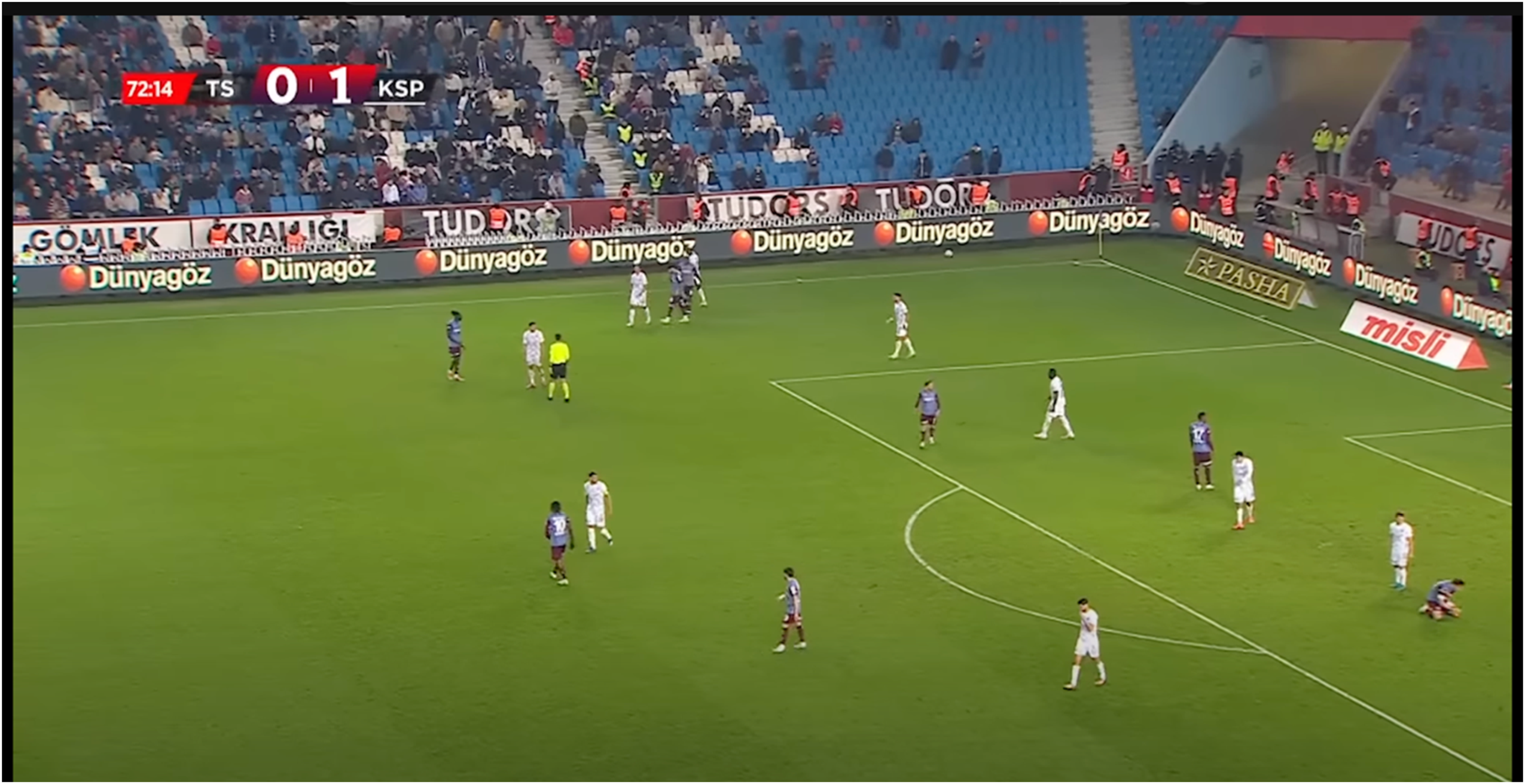
The scene before the VAR review.
VAR initiated communication with REF and reported that the ball had remained in play, and that Kasımpaşa player number 77 had made contact with Trabzonspor player number 94. REF verbally acknowledged the information. VAR then indicated that the situation involved a potential penalty and recommended an OFR. In response, REF performed the formal VAR signal (TV signal as required in the Laws of the Game), blew his whistle, and ran toward the pitch-side VAR monitor (see Excerpt 1).
Excerpt 1—W15TK-TA (total 67 s) 3
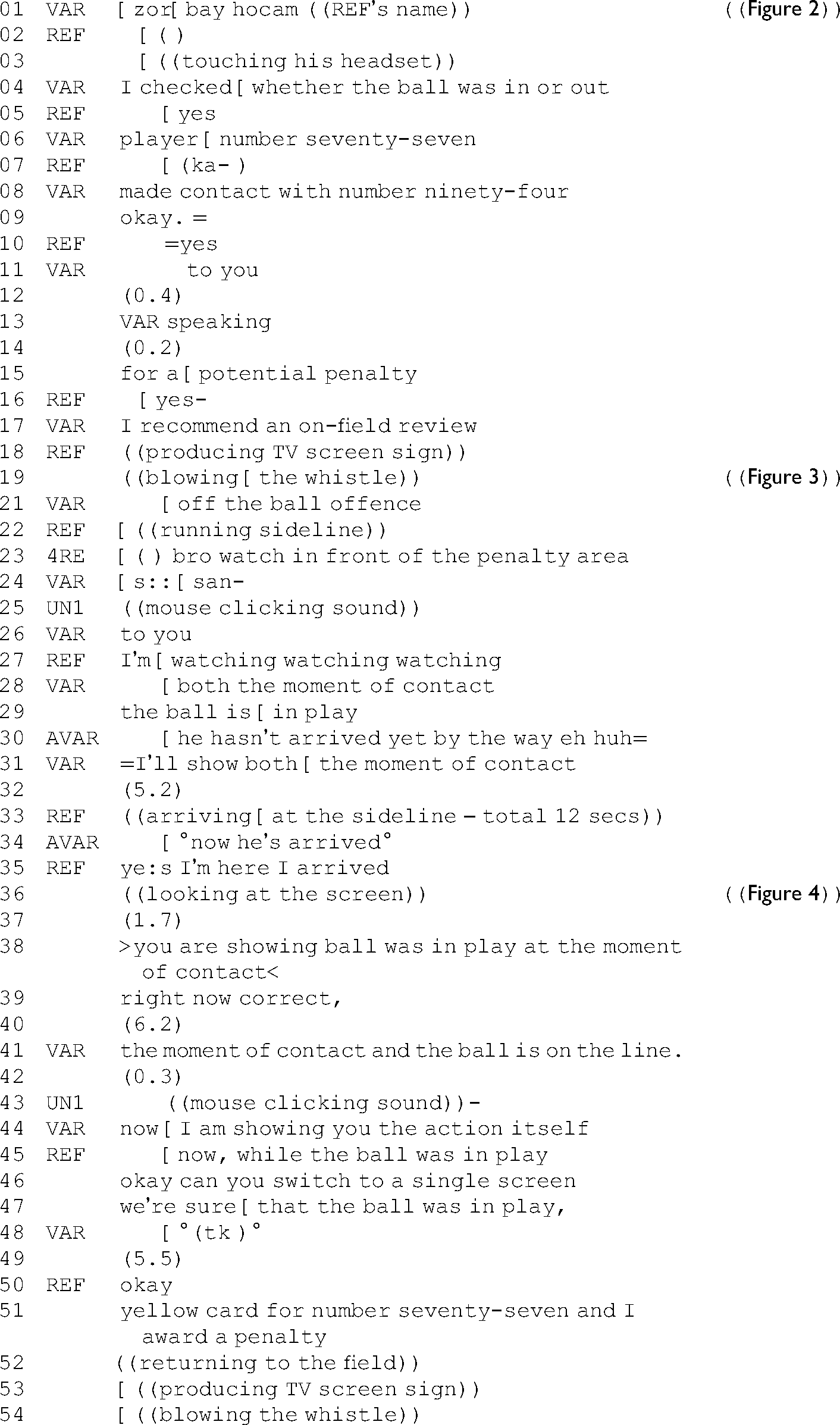
The running time for REF from signaling the VAR review to reaching the VAR monitor was approximately 18 s. Upon arrival, REF reviewed the video footage prepared by the VAR team. Two camera angles were shown: First, both angles simultaneously on a split screen, and then one angle alone on a single screen for focused review. REF and VAR team spent 46 s reviewing the looped footage. During this process, REF confirmed that the ball had been in play at the moment of contact and then reviewed the contact between the players in detail. After completing the review, REF announced his decision: a yellow card for Kasımpaşa player number 77, and the awarding of a penalty. REF then returned to the field, repeated the TV signal sign, and blew his whistle to communicate the final decision. The entire VAR review sequence, from REF beginning his run to the sideline to his return to the field and signaling the decision, lasted around 67 s (see Büyükçelebi et al., 2022).
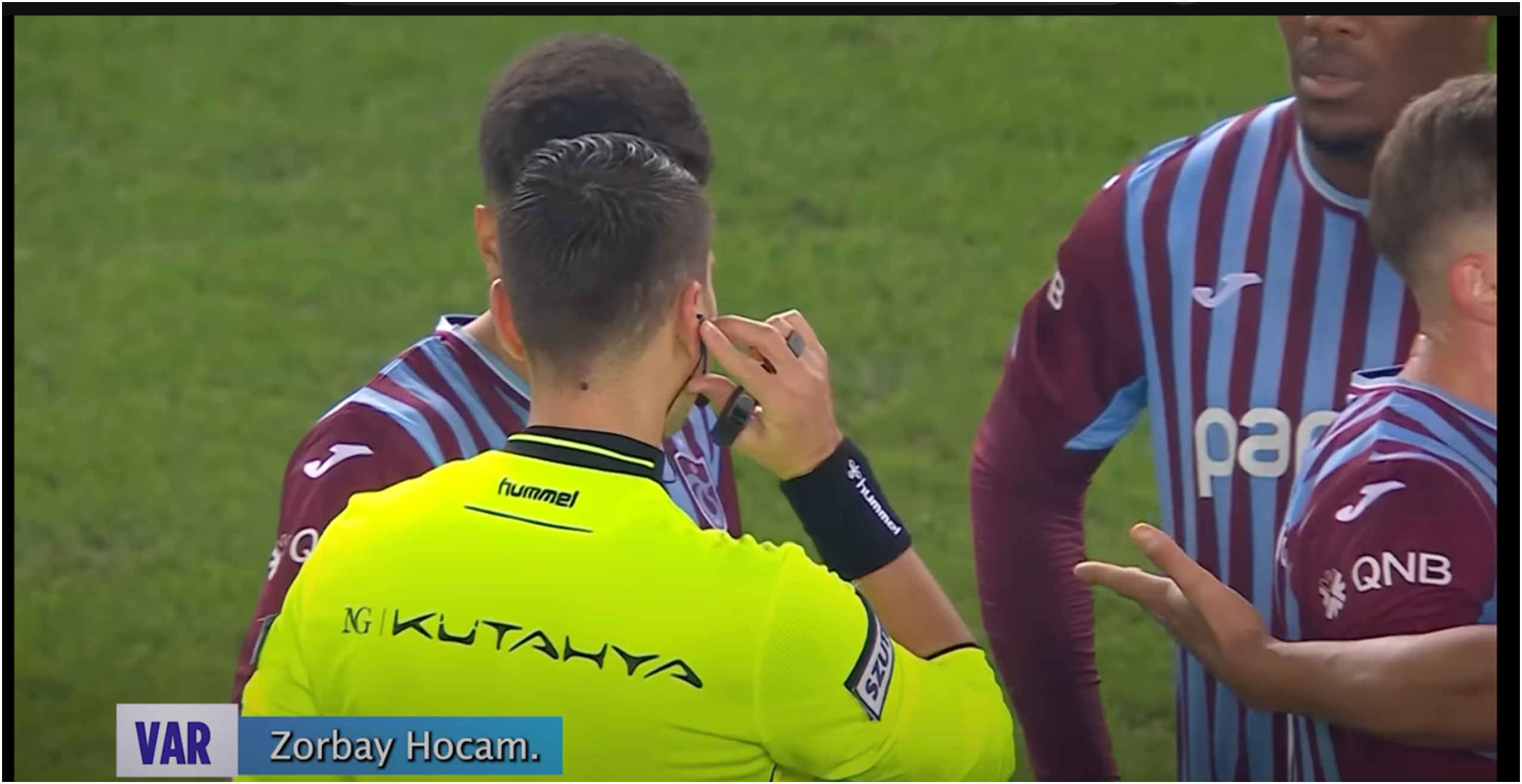
REF touching his earpiece.
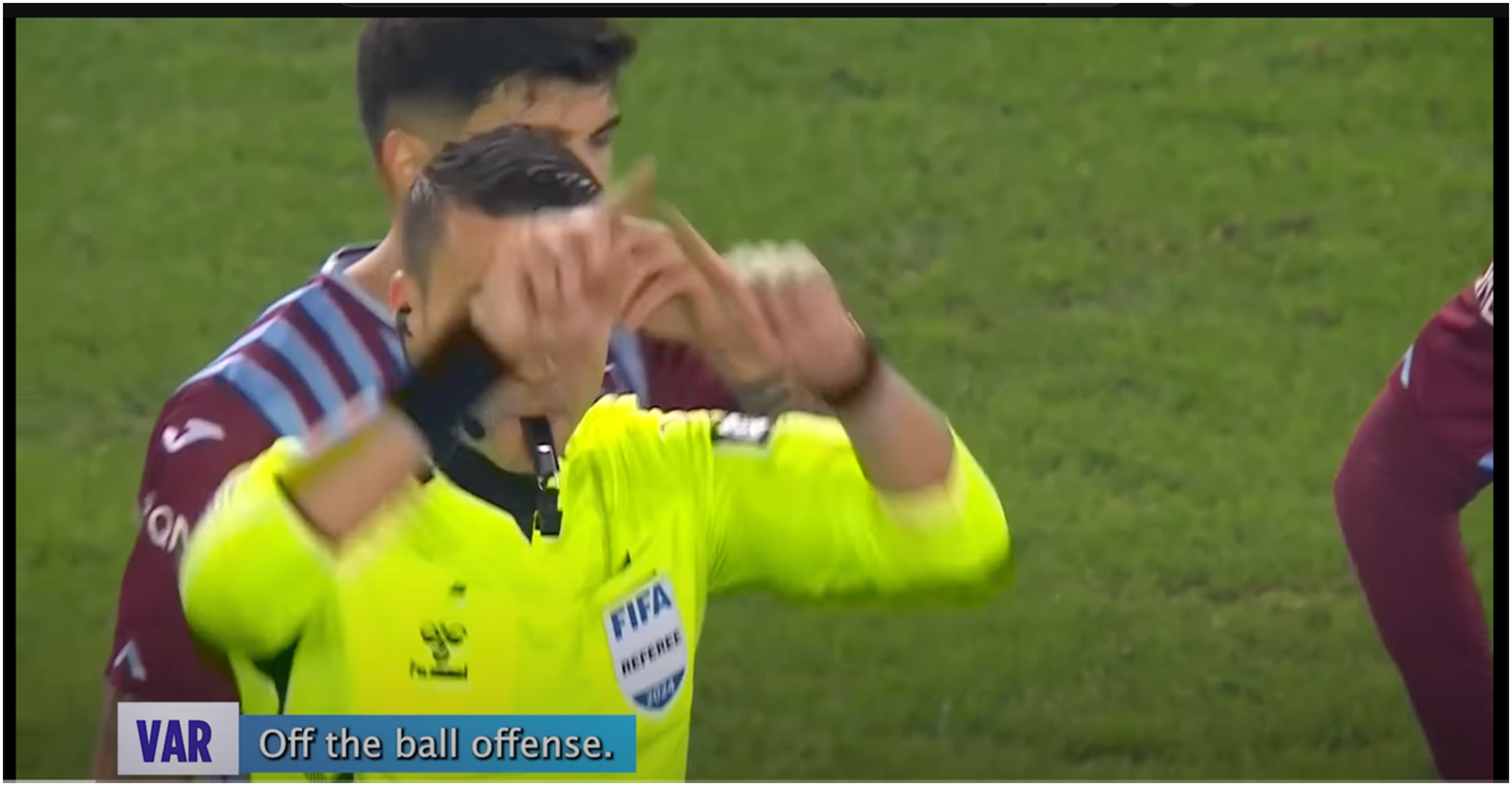
REF making the VAR signal.
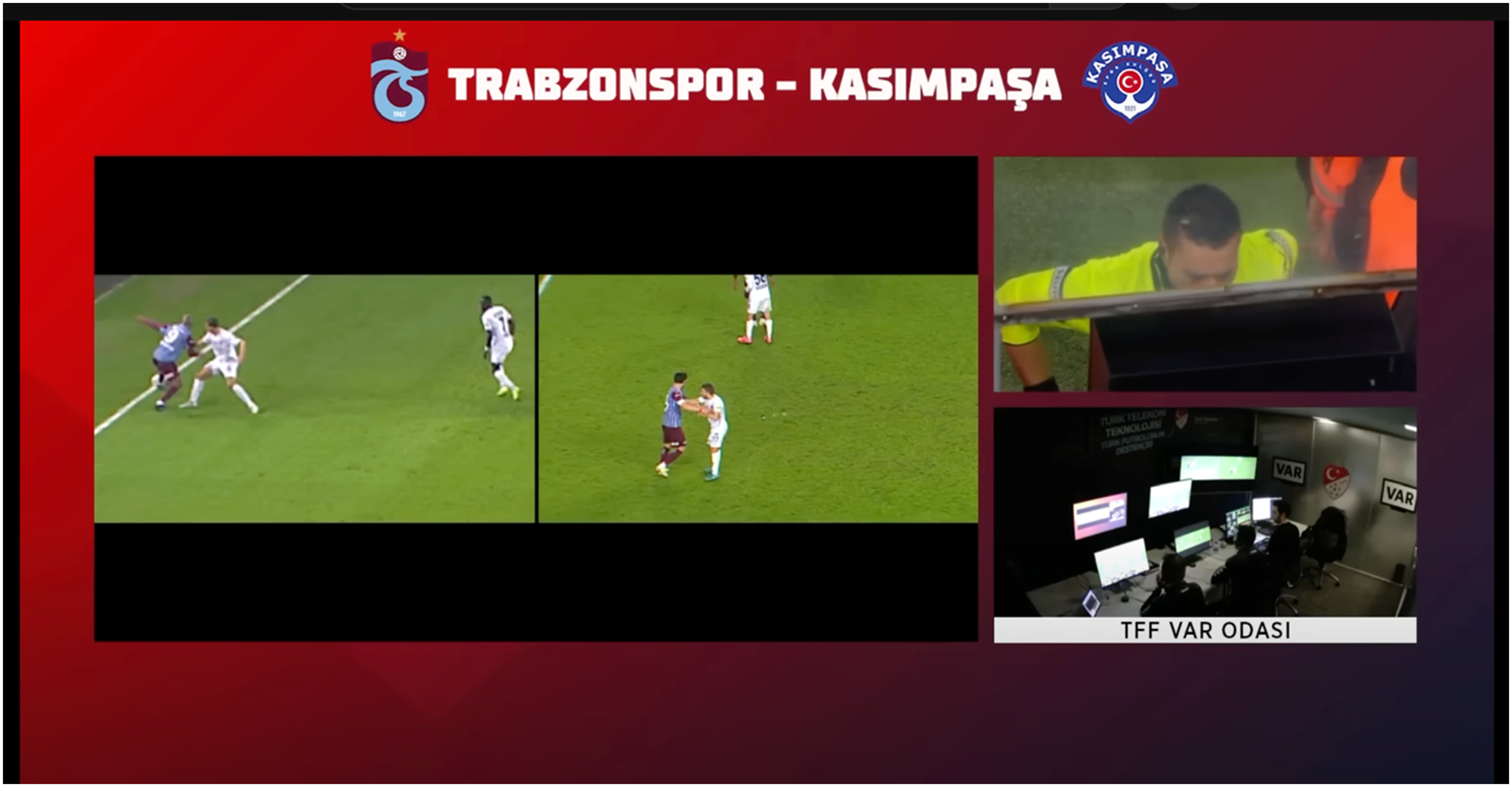
REF in the upper right corner, the VAR officials in the lower right corner, and the shared review screen displaying the relevant match footage on the left side.
Decision-making in this episode is structured through a three-part assessment sequence, characterized by sequential positioning of claims, recommendations, and ratification. Each turn serves as a recognizable position in an emergent institutional sequence, allowing for interactionally managed agreement. The episode opens with an incident that is not immediately clear to REF, particularly as the interaction happens away from the ball (Tamir & Bar-eli, 2021). REF makes an initial judgment (the ball has gone out of play) and signals accordingly. This first-position assessment is consequential in establishing the representational field (Heritage & Raymond, 2005) in which the upcoming assessments will be embedded and evaluated: “[…] the initial assessment provides the relevance of the recipient's second assessment” (Pomerantz, 1984, p. 61).
Although REF does not provide an explicit verbal account in this moment, his embodied action, signaling throw-in, functions as a public epistemic claim about what just occurred. In other words, the referee's physical movement (raising his arm to signal a throw-in) is not just a body gesture but a meaningful action that displays his understanding and stance about the event. Through this embodied action, he shows what he knows and how he interprets the situation, even without using words. The decision indicates that, based on what he could observe, the incident did not involve foul play and that the ball was out of play. In doing so, REF displays both an actional and epistemic stance (i.e., how knowledge claims and rights are displayed and negotiated across turns): He acts within his rights as the on-field authority but implicitly acknowledges limitations in perceptual access to off-ball activity (Stevanovic & Peräkylä, 2012).
VAR's intervention constitutes the second-position assessment. VAR contacts REF, and begins by issuing a factual correction and elaboration. That is, VAR finds the first assessment a relevant condition for providing their assessment:
“I checked whether the ball was in or out” (line 04) “Player number seventy-seven made contact with number ninety-four” (lines 06–08) “For a potential penalty I recommend an on-field review” (lines 15–17) “Off the ball offence” (line 21)
This formulation is incremental. Rather than delivering a single packaged assessment, VAR's design involves sequential delivery of elements necessary to build a reportable, accountable, and observable event:
Establishing the condition (ball in play—line 04) Identifying the actors (players 77 and 94—lines 06–08) Stating the contact (a physical act—lines 06–08) Delivering the second-position assessment (recommend on-field review—line 17) Framing the action as potentially penalizable (off the ball offence—line 21)
VAR first checks and affirms that the ball was in play at the moment of contact. Then, VAR names the involved players (numbers 77 and 94) and describes physical contact, further framing this as a potential penalty. This culminates in the recommendation: “for a potential penalty, I recommend an on-field review” and further categorization: “off the ball offence.”
This talk is incrementally structured and sequentially upgrades the diagnostic status of the event, transitioning from observation to recommendation. The VAR's utterances also serve to recalibrate epistemic authority, acknowledging the REF's role as final decision-maker, while asserting superior access (i.e., representational field) to video evidence (Heritage & Raymond, 2005). At the same time, the recommendation to conduct an on-field review is institutionally formatted: It invites, but does not mandate, a ratification of the second-position assessment. The fact that it is offered as “recommendation” preserves REF's deontic authority, while projecting an epistemic preference for revision.
The REF's actions (blowing the whistle, forming the TV screen signal, and running to the sideline) constitute the transition to a third-position assessment. These embodied responses signal that he treats VAR's recommendation as accountable and worthy of further investigation. This movement to the monitor represents a new phase of sequential organization: One in which REF publicly reopens his earlier assessment in light of new evidence (see Mondada, 2019).
The 46-s loop viewing starts with REF positioned in front of the monitor on the sideline and saying: “yes I'm here I arrived” (line 37). At the monitor, the interaction unfolds as a series of confirmation checks and co-analysis:

This alignment enables REF to reframe his understanding. Next, VAR presents the key footage, and REF follows up with:

This repetition and confirmation mark the point at which REF integrates VAR's observations into his own epistemic stance. Having verified the factual basis, REF now evaluates the foul action itself and concludes: 4

This third-position assessment serves multiple functions: It ratifies VAR's second-position assessment. It replaces REF's first-position “out-of-play” decision. And, it transforms the activity: from collaborative review to institutional enforcement (penalty and card).
That the sequence unfolds as a triadic agreement (first-REF, second-VAR, and third-REF) explains its efficiency and closure. As agreement sequences tend to be preferred in interaction, and when assessments align, the resolution proceeds rapidly (Buttny, 1990). Unlike disagreement episodes that require elaborate accounting, justification, and sometimes concession (Icbay & Koschmann, 2015), this episode requires minimal elaboration beyond evidential confirmation. The shared epistemic trajectory, anchored in video replay, allows for swift convergence.
The Disagreement Between REF and VAR—Episode 2 (W15TK-TA)
The following episode is taken from the match between Sivasspor and Galatasaray. The match stands at a score of 2-3 in favor of Galatasaray, with the clock showing 95:25, extending into added time. A Galatasaray player is positioned at the right corner flag, preparing to take a corner kick. Another Galatasaray player is stationed a few meters away near the touchline, appearing to offer a short-pass option. Four Sivasspor players are positioned near these two Galatasaray players, focused on defending the corner. Inside the penalty area, players from both teams are gathered in anticipation of the delivery. The referee (REF), wearing a yellow shirt and black shorts, is positioned outside the penalty area to the left (see Figure 5).
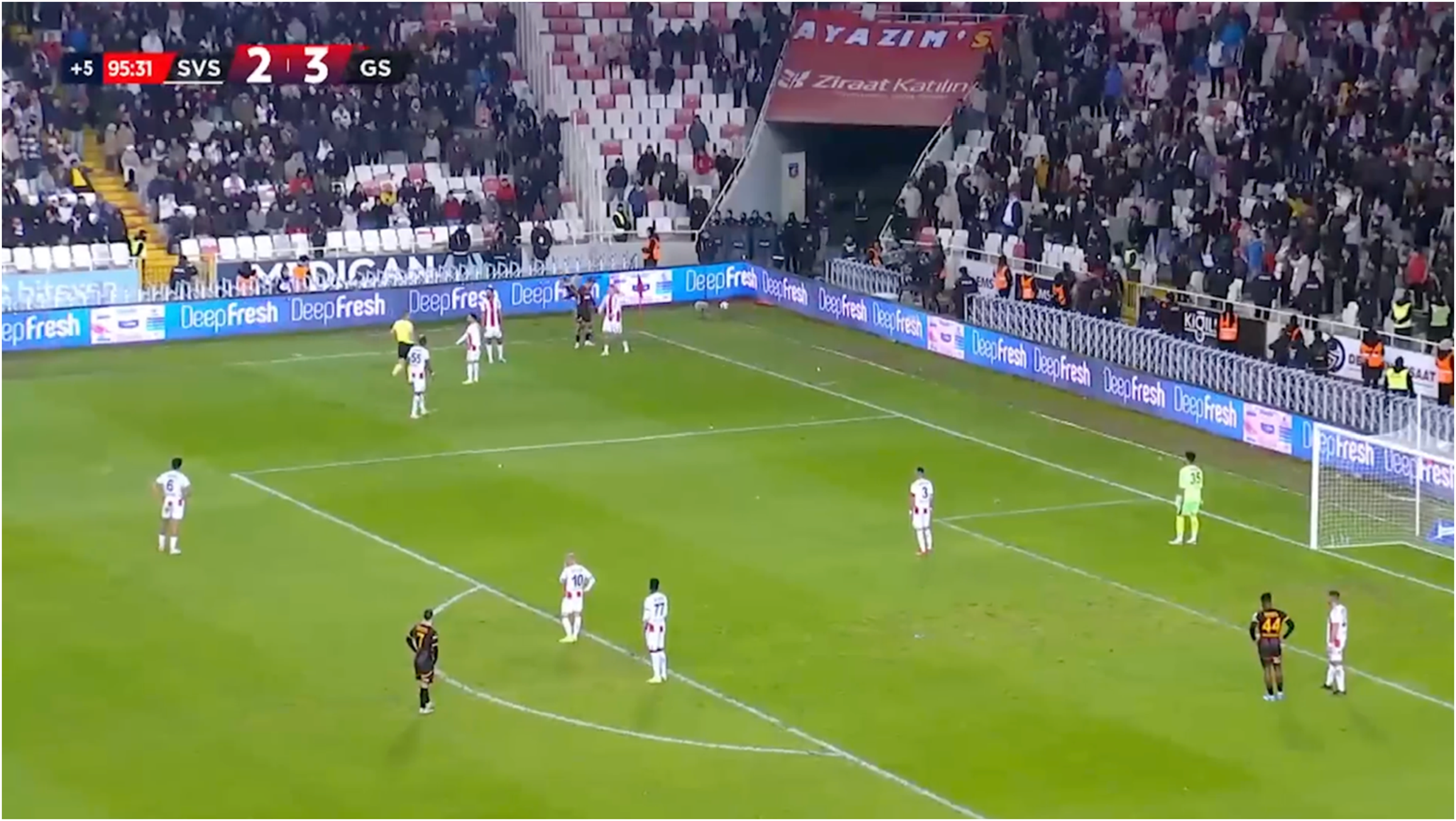
The scene before the VAR review.
REF took approximately 17 s to reach the pitch-side monitor after signaling for a VAR review. Once there, he examined the video footage arranged by the VAR team. The review began with an angle shown on the main screen, followed by a closer inspection of another angle. The video analysis lasted 32 s, during which REF focused on the incident in question, paying particular attention to the player contact and the sequence of actions. After concluding the review, REF ran back onto the field, repeated the VAR signal, and blew his whistle to deliver the final verdict. The entire sequence from initiating the VAR check to announcing the decision took roughly 77 s.
Episode 2 exemplifies how decision-making in the VAR–REF interactions is fundamentally an interactionally constructed, technologically mediated, and epistemically organized practice, rather than a simple extraction of objective evidence (Dufner et al., 2023). The episode is initiated through a VAR recommendation for an on-field review, which creates a structure of “conditional relevance” (Schegloff, 1968), suggesting the referee to inspect video evidence and publicly deliver an accountable renewed decision. That is, the episode begins with the VAR's recommendation for an on-field review, which makes the referee's response (either accepting or rejecting it) expected and relevant. The original on-field decision (no penalty by REF) operates as a first-position assessment (Pomerantz, 1984), claiming primary epistemic rights rooted in the referee's embodied, real-time experience. In contrast, the VAR's review invitation and video-guided commentary constitute a second-position assessment, challenging and seeking to revise the referee's stance through technologically enhanced vision:

In moments of disagreement during officiating episodes, REF and VAR officials often provide explicit accounts of their assessments in order to manage or resolve emerging conflicts (see Icbay & Koschmann, 2015). These explanations function as interactional resources (i.e., evidence) for maintaining professional legitimacy and restoring alignment when conflicting interpretations arise (Goffman, 1972; Scott & Lyman, 1968). As a result, disagreement typically surfaces when REF and VAR offer divergent decisions regarding the same incident: creating both an interactional and institutional dilemma (Sacks, 1987).
Such divergences present a practical problem: football officiating demands a single, authoritative ruling on each incident. Competing assessments, whether expressed implicitly or explicitly, threaten the coherence of the decision-making process and challenge the institutional expectation for decisiveness and procedural clarity. To reconcile this, the officials engage in negotiation, where their decisions are examined, justified, and revised through interaction.
This negotiation is not merely about reaching consensus. It involves making transparent the reasoning and evaluative criteria behind each official's judgment. In doing so, officials demonstrate their professional competence, not only by showing their sensitivity to the rules and interpretive frameworks of the game but also by constructing themselves as accountable and credible decision-makers. The interactional work of explanation, then, becomes a key practice through which officials uphold both the epistemic integrity of their individual decisions and the institutional authority of the refereeing system as a whole.
The episode starts with VAR's contact with the referee, calling him by name (“Turgut hocam” line 2), thereby transitioning into a formal institutional communication sequence. In lines 7 and 8, VAR explicitly initiates their assessment by saying, “to you for a potential red card, I suggest a field review.” VAR's turns here, establishing a second-position assessment, creates a post-hoc evaluative intervention challenging the REF's original, implicit decision (i.e., not having called a red card in real-time). However, the formulation in VAR's second assessment, “I suggest,” is particularly significant: It indexes a procedural norm in the VAR protocol that maintains the REF's deontic authority over final decisions, even while epistemically preferring a reconsideration of the incident.
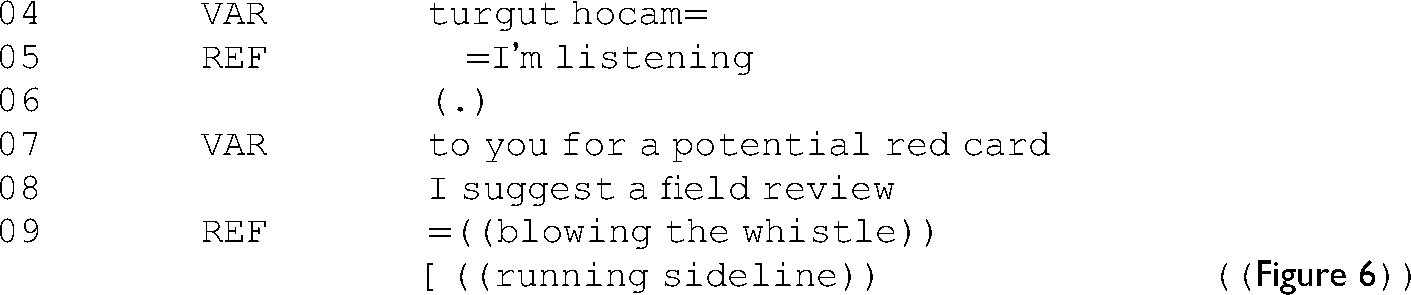
In response to this second-position assessment, REF immediately blows the whistle and begins to run toward the sideline monitor. This bodily movement, performed without verbal hesitation, demonstrates an orientation to the conditional relevance (i.e., how a prior action makes a next action expectable and accountable) created by the VAR's recommendation (Schegloff, 1968). In institutional terms, this is the first visible ratification of VAR's concern, treating the suggested red card as a matter worthy of public review and further scrutiny. The blowing of the whistle and the act of leaving the pitch signal to players, viewers, and officiating colleagues that the match has entered a special procedural phase: a review. Thus, the disagreement is not hidden but rendered visible and accountable within the match's progression.
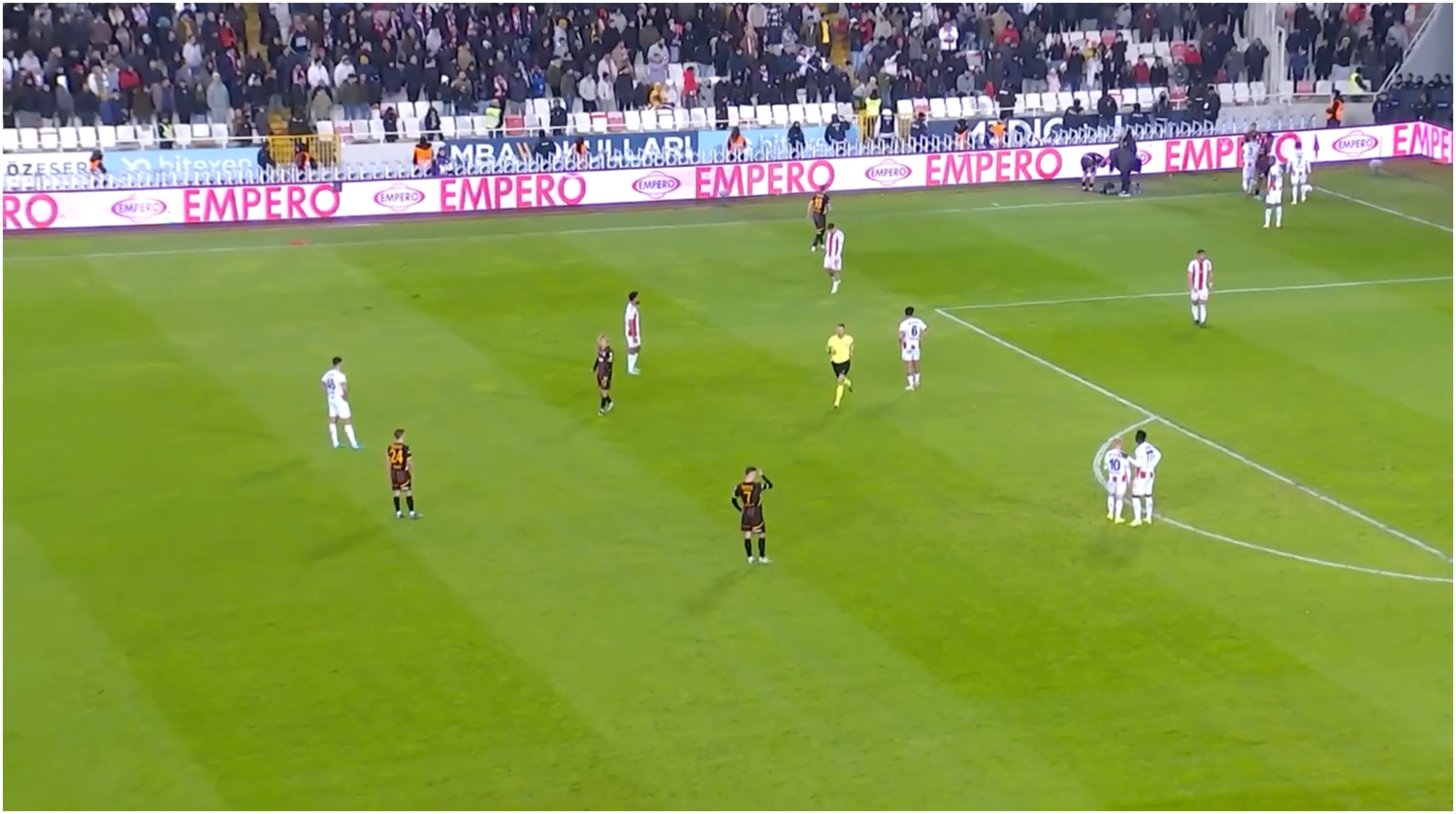
REF running to the sideline.
During the transition to the monitor, VAR continues to build its case by highlighting visual evidence: “I want this on the broadcast” (line 11). AVAR supplements this with a formal classification, “serious foul play” (line 13). These accounts are interactionally and institutionally significant. They do not simply label the offense but help organize the perception of the act for both REF and the viewing public. “Serious foul play” is not a neutral observation. It is a legally codified category within football's disciplinary framework. Naming the offense escalates the perceived severity and guides the referee's attention toward considering a red card (see Goodwin, 1994).
Upon reaching the monitor, REF takes on the role of the final assessor. His first questions are precise and diagnostic:

These are not just clarifying inquiries. They are strategic requests that seek to re-establish epistemic control over the decision-making process. While VAR controls access to the footage, REF controls how the footage will be interpreted. This moment reflects a complex epistemic negotiation: VAR has initiated a re-evaluation, but REF now steers the inquiry into which perceptual cues will determine the outcome.
The request for different angles and specific visual markers (e.g., ankle, stud) functions as a move to verify the material conditions of the foul. The request for another angle is particularly important: It implicitly suggests that the first footage shown might not provide sufficient grounds for a red card decision. At this point, VAR provides the requested angle (line 19), and a pause follows as the referee inspects the footage silently for over 14 s. This silent analysis is dense with institutional meaning: It indexes REF's deliberation, his careful re-engagement with the evidence, and his assumption of full accountability for the eventual ruling.
The crux of the disagreement is publicly resolved in lines 25–26 when REF declares: “I keep my decision. I see that he steps on the boot with his foot.” This announcement is a clear third-position assessment, in which the REF reasserts the validity of his original stance after considering the VAR's input. Importantly, REF provides an account to justify his stance. Rather than simply rejecting the red card suggestion, REF explains that the contact occurred on the boot, not the ankle, and thus presumably lacks the excessive force or endangerment required for a red card offense. This move is interactionally delicate. It both acknowledges the VAR's contribution and maintains the integrity of the referee's in-the-moment judgment.
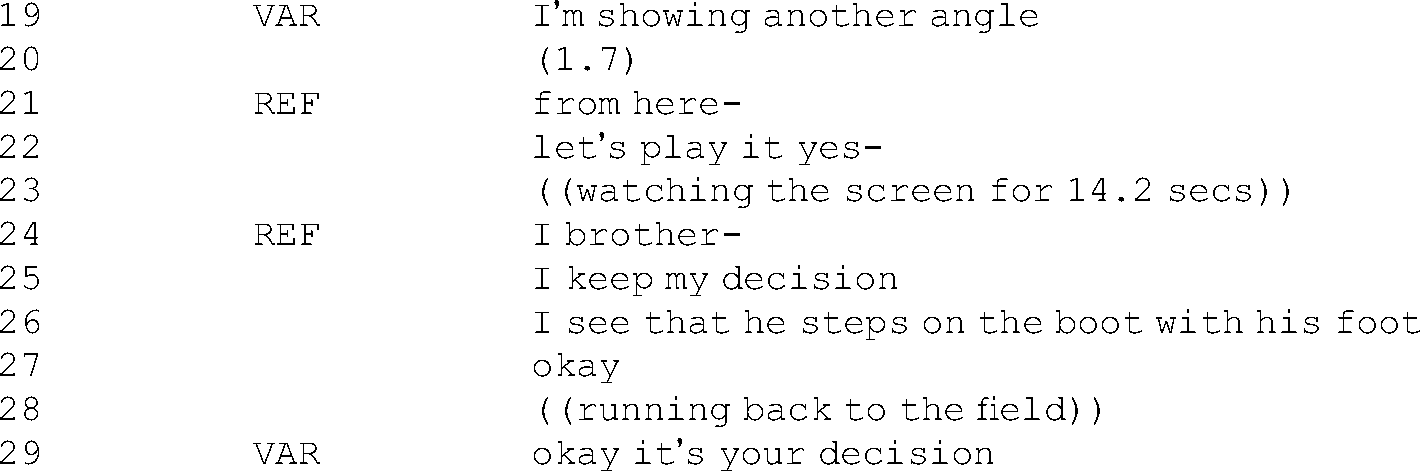
This justification helps manage the dispreferred nature of disagreement (Pomerantz, 1984) in an institutional setting. By explaining his decision in detail, REF minimizes the threat of appearing inattentive, biased, or uninformed. As a result, his justification (account) serves two audiences simultaneously: his officiating colleagues (especially VAR), and the broader public who may scrutinize the decision. In doing so, he positions himself as both an efficient decision-maker and a procedurally accountable official (Buttny, 1990).
The VAR's follow-up—“okay it's your decision” (line 29)—is equally important. This acknowledgment marks the institutional closure of the episode. It reaffirms the hierarchy of decision-making authority while still preserving the procedural transparency introduced by the review. VAR's acceptance of the outcome without further pushback helps restore harmony within the officiating team and prevents the escalation of the disagreement.
The EFL Disagreement Between REF and VAR—Episode 3
This episode is drawn from the early minutes of the match between Konyaspor and Alanyaspor. Unlike the two preceding episodes conducted in Turkish, in this episode the REF, who is Turkish, and the VAR, an international referee, used English as a lingua franca (EFL). The match is in its 7th minute when Alanyaspor's forward, wearing jersey number 9, advances with the ball into Konyaspor's defensive third. As he approaches the penalty area, he is physically challenged by Konyaspor's number 15, resulting in the Alanyaspor player falling to the ground inside the attacking zone (see Figures 7 and 8). The scene unfolds near the top-left quadrant of the screen, with other players maintaining their spatial positions without immediate intervention.
VAR monitor and video operation room (VOR).
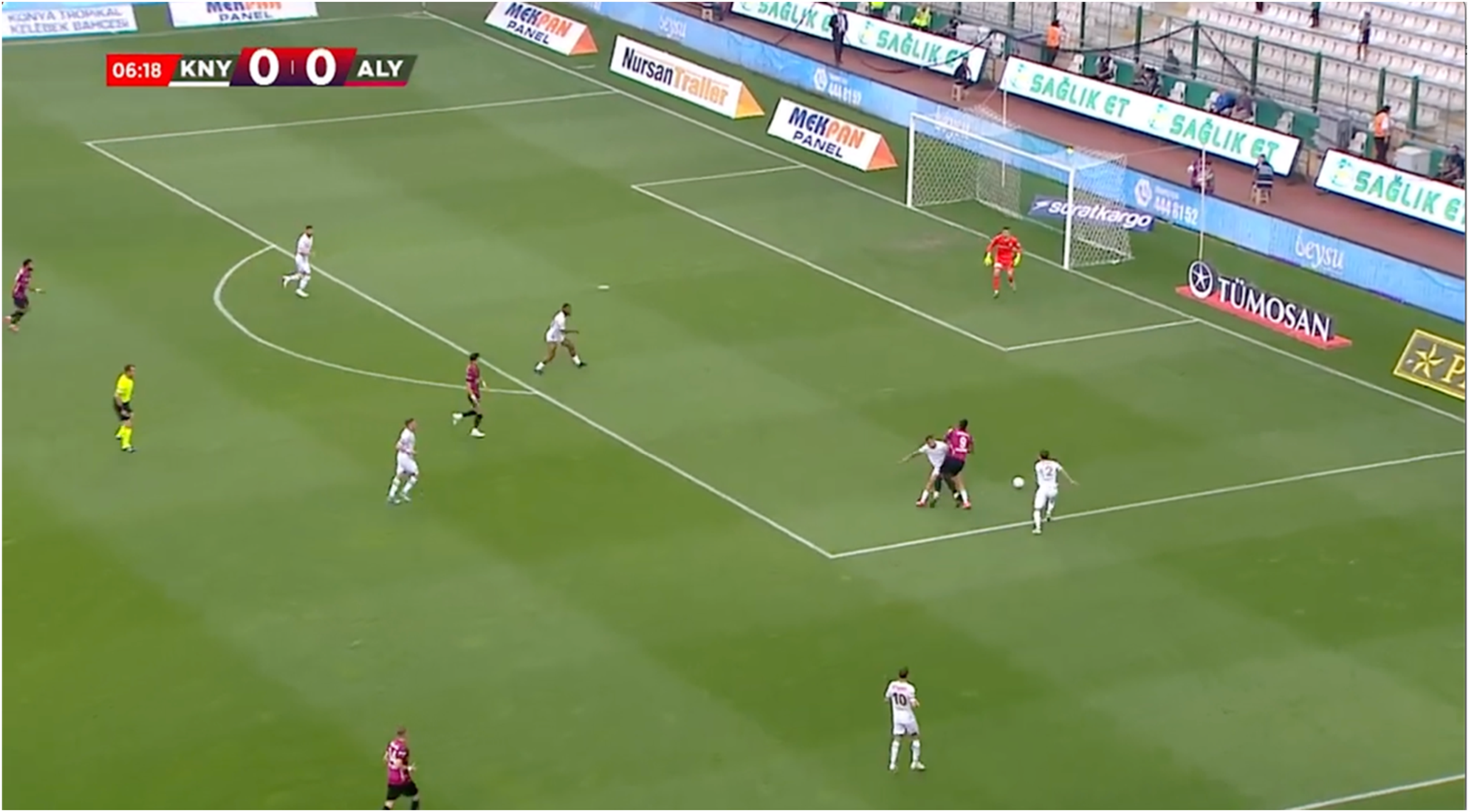
Number 9 and Number 15 in the defensive area.
Upon the fall, REF is approached by at least three Alanyaspor players who appeal for a foul. REF raises his hands in an open-palm gesture, verbally and bodily instructing the players to maintain distance, indicating the preservation of his decision-making space (see Figures 9 and 10). Shortly after, VAR initiates contact with REF, recommending an OFR for a possible penalty. This recommendation sets in motion a structured interactional sequence marked by multimodal action: REF blows his whistle, performs the TV screen signal, and runs to the sideline. The entire review sequence lasts approximately 107 s, during which multiple camera angles are presented by the VAR team, including offside, goal-behind, and side-view perspectives.
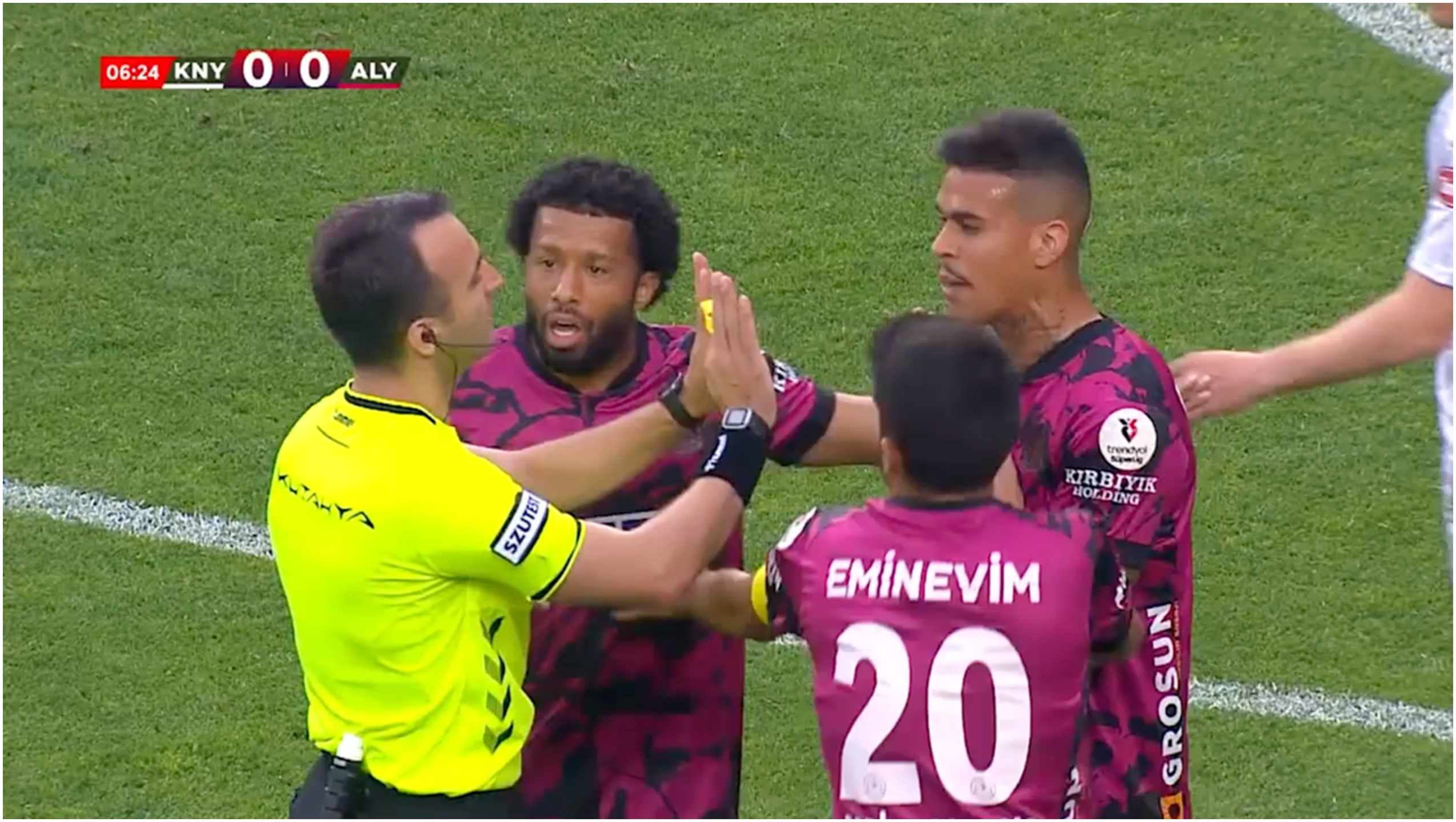
REF maintaining the distance.
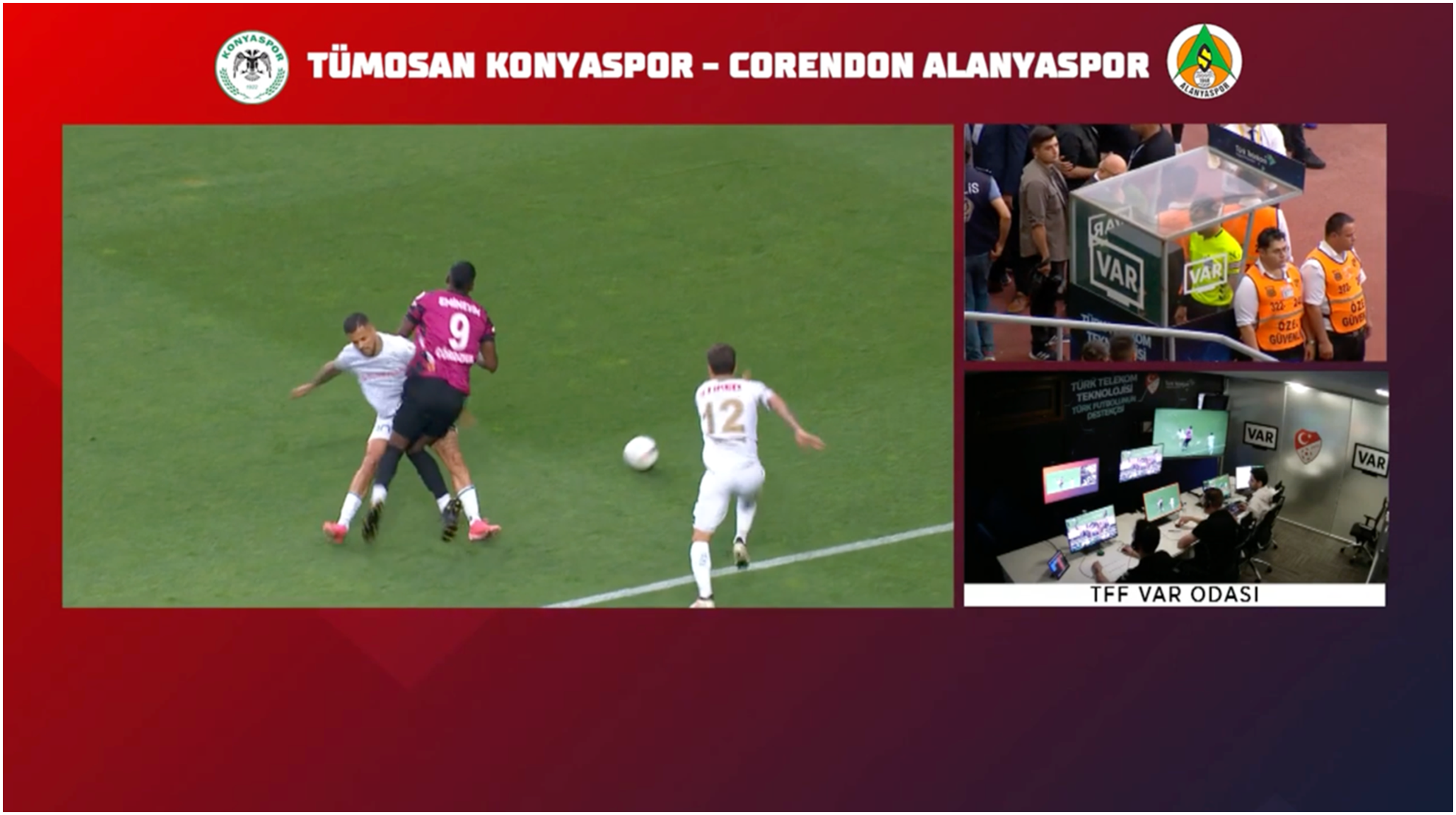
VAR monitor and video operation room (VOR).
The sequence is initiated by VAR with a formal recommendation in lines 4 and 5:

REF's immediate embodied compliance (blowing the whistle, forming the TV screen signal, and running to the sideline) signals alignment with the VAR's recommendation. He accepts VAR's projected trajectory and initiates a transition from field-embodied judgment to screen-based scrutiny.
Following the invitation-acceptance sequence, VAR employs Goodwin’s (1994) “highlighting” practice to draw attention to a specific moment in the visual stream. Highlighting here is part of “professional vision” practices which institutional actors highlight, code, and build relevant “objects of knowledge” from a visual field. “Point of contact” (lines 13, 16 and 18) thus is a professionally coded category indexing the critical evaluative feature of a possible foul. This is part of the shared semiotic system through which the officials (REF and VAR) render the visual field legible.
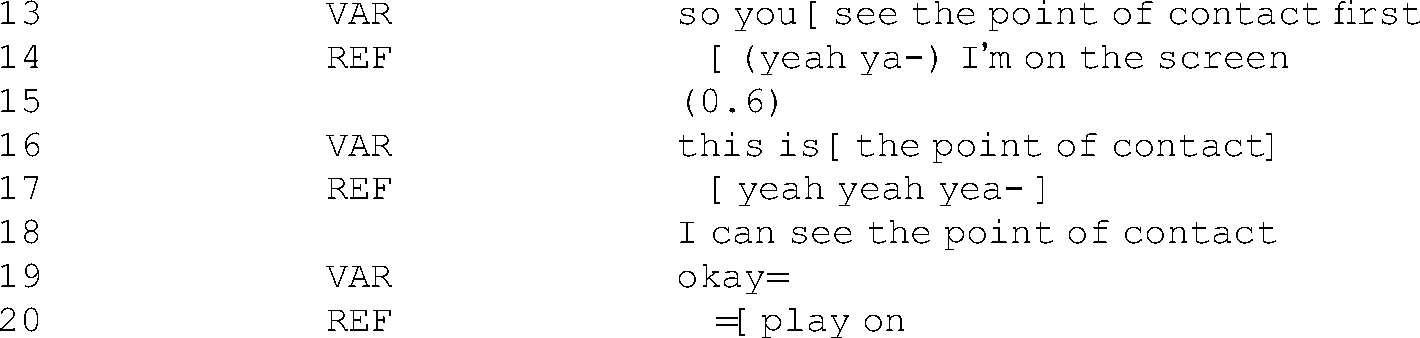
Yet REF quickly responds with “play on” (line 20), a decisive evaluation that preempts further elaboration from VAR. This utterance is remarkable: It marks an early resistance to the trajectory suggested by VAR, and a rapid reassertion of epistemic independence. Despite seeing the “point of contact,” REF interprets it as non-foul, displaying a differential professional vision. The negotiation of foul-penalty decision through the visual fiend continues with REF's requests for additional three angles from the VAR room: watching the second angle (lines 29–33), watching the third angle from offside camera (lines 34–37), and watching the third angle from goal behind camera (lines 40–43).
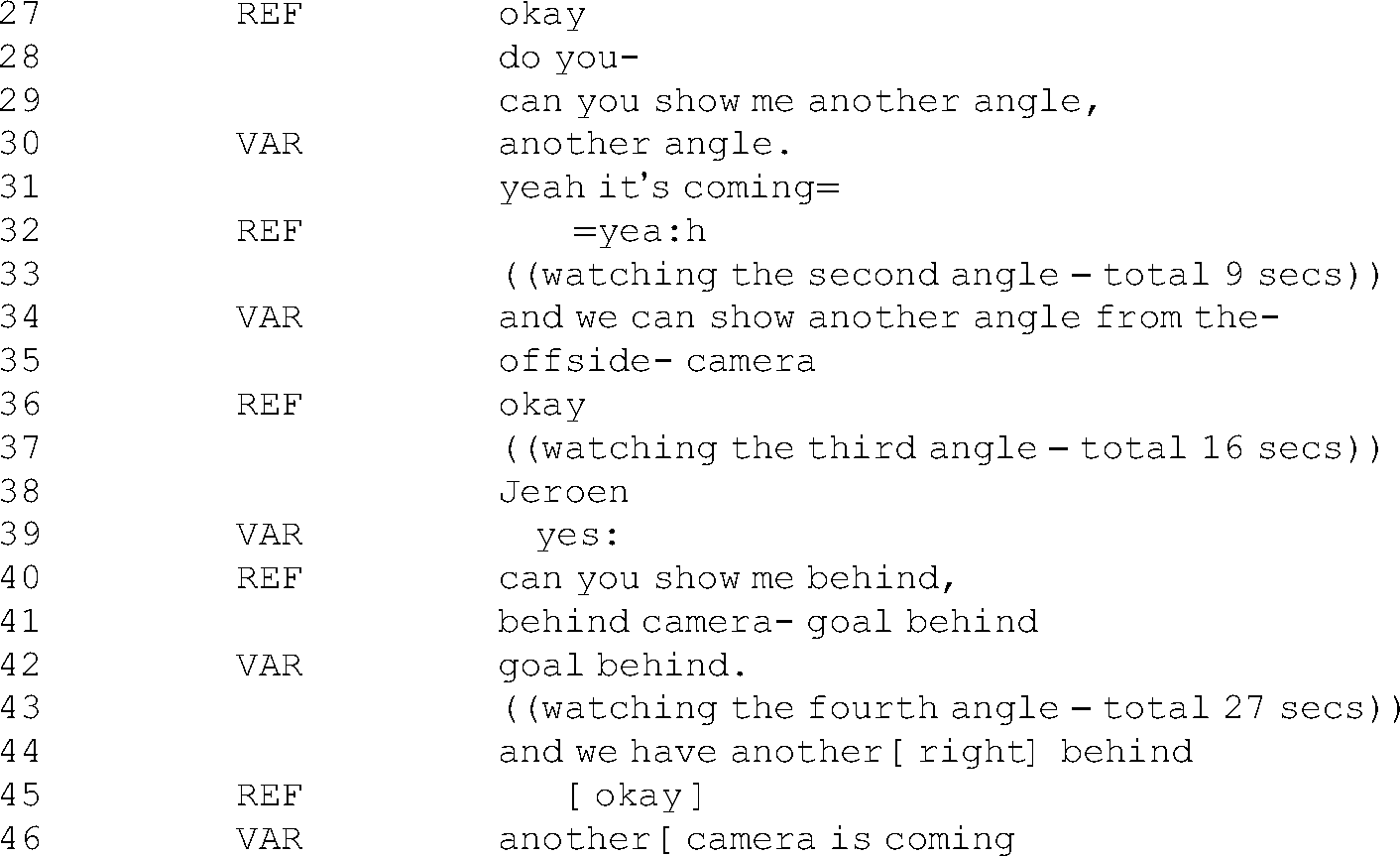
Here, REF reclaims the right to define the evidence. His repeated requests for “another angle,” “behind camera,” “behind goal camera,” and continued orientation to visual precision signal a discursive and perceptual resistance to VAR's framing. Rather than passively absorbing VAR's coded highlight, REF constructs a counter-visual trajectory. This is the heart of Goodwin’s (1994) argument: even shared perceptual access does not guarantee shared professional vision. What counts as relevant or decisive in the footage is co-constructed and interactionally situated. REF's emphasis on “goal behind” is not trivial. Rather, it reflects his search for a different visibility that supports his embodied judgment.
Next in the review comes REF's resistance through re-analysis (i.e., professional reframing). It starts with REF's directive “stop” in line 47, constituting a projectable closure, and cutting off further VAR presentation. The stop directive here refers to the pause in the footage. Together with the next turn, “yeah” in line 48, REF gathers enough evidence to support his re-analysis. Then, the following turns mark a full reassertion of authority: “I’ll keep my first decision” (lines 49–50) is not only a verdict, but a public rejection of the VAR's preferred reading.

This is followed with REF's accounts for his insistence on his previous decision: no penalty. REF claims that the defender “just steps on the ground” (line 58), thus not an “extra movement (line 57) while “the attacking player goes to the opponent” (line 59). These formulations invoke intentionality and agency, refocusing the interpretation from defensive aggression to attacker-initiated contact. This reflects Lynch’s (1988) notion of selective perception, where visual traces are animated by interactionally organized inferences.

The analysis also shows REF's use of professional coding in reverse: while VAR oriented to “point of contact,” REF orients to “extra movement” (line 57) and agency (“the player goes to the opponent” in line 59), reclassifying the same footage under a different interpretive framework.
The REF's sequential closure (repeating his original decision and publicly signaling it) is a final enactment based on his own accounts, but incongruence with VAR. Notably, the VAR does not pursue further challenge but instead responds with minimal alignment:

Notably, in accordance to FIFA rules, VAR does not pursue further challenge but instead responds with minimal alignment. This closure format suggests an institutionalized asymmetry also: Although the VAR team provides epistemic input, ultimate finality remains with the REF. The VAR's “okay” confirms that the system recognizes this authority, despite potential internal disalignment.
Conclusion
This study explored how refereeing decisions are interactionally accomplished in the context of VAR protocols in professional football. Specifically, it aimed to uncover the sequential, epistemic, and multimodal practices through which REF and VAR officials negotiate alignment and handle disagreement during in-match review sequences. Drawing on naturally occurring data from official Turkish Premier League VAR recordings, this study offered a detailed analysis of selected episodes where VAR and REF either reached agreement or diverged in their judgments. The study sought to go beyond a surface-level assessment of correctness and error, instead focusing on the practical reasoning and interactional organization that shape officiating decisions in situ.
To this end, 107 documented VAR interventions were analyzed, of which a subset of three episodes were selected for detailed interactional analysis: two disagreement sequences (the first one in Turkish and the second in EFL) and one agreement sequence in Turkish. The first episode (W15TK-TA) served as a baseline example, illustrating how decision-making unfolded smoothly through a triadic sequence of first, second, and third assessments, resulting in institutional closure and ratified alignment. In contrast, the second and third episodes (W15SG-TD and W37KA-ED) uncovered the interactional work required when disagreement emerges: Where the VAR's recommendation is resisted, reframed, or overridden by REF after careful review of the footage. These disagreement sequences were not simply failures of visual access or rule interpretation. Rather, they involved subtle negotiations of epistemic authority, accountability, and institutional roles. In particular, Episode 3, where both VAR and REF communicate in English, provided a compelling case of negotiation, multimodal contestation, and the situated enactment of referee authority.
A key empirical finding of this study is that even in the presence of shared video evidence and a common institutional mandate, professional vision among referees is not necessarily aligned (see Corsby & Jones, 2020; Turcotte, 2025). Instead, alignment is something to be interactionally accomplished. To this end, the study demonstrates how VAR and REF draw on professional coding schemes (e.g., “point of contact,” “extra movement,” or “intent”), employ highlighting practices, and manipulate material representations (camera angles, playback speed, freeze frames) to render events interpretable in institutionally relevant ways (Goodwin, 1994). These practices are not neutral or objective. They constitute the very means by which facts are constructed as recognizable, reportable, and sanctionable within the officiating ecology. This reinforces the ethnomethodological insight that institutional knowledge is not merely applied but produced through practical action (see Garfinkel, 1967).
The study contributes to VAR-related scholarship in several significant ways. First, it foregrounds the interactional infrastructure of VAR decision-making, showing that decisions are not the product of individual judgment but of distributed, coordinated, and often contested practices. Second, it provides empirical grounding to theoretical concepts like epistemic authority (Heritage & Raymond, 2005) and professional vision (Goodwin, 1994) in a high-stakes, real-time sporting context. Third, it highlights the practical limits of technological intervention. That is, while VAR aims to ensure fairness and accuracy, it does not eliminate interpretive variability or epistemic asymmetry. Instead, VAR introduces new layers of accountability and new interactional roles, particularly in moments of disagreement where referees must publicly reconcile video evidence with their embodied judgment.
Taken together, the analysis demonstrates that institutionalisation in REF–VAR interaction is not a background condition but an interactional accomplishment that is produced and sustained through participants’ situated practices. First, institutional order is enacted through role-structured rights and obligations, whereby VAR officials are interactionally positioned to frame evidence and issue recommendations, while the referee retains the final deontic authority to decide—an asymmetry made visible turn by turn in formulations such as “I recommend…” and receipts such as “okay, it's your decision.” Second, institutionalisation is achieved through the use of professionally coded lexical items (e.g., “point of contact,” “serious foul play,” “penalty,” “play on”), which do not merely describe events but transform embodied, contingent conduct into rule-relevant objects that are reportable and sanctionable within the regulatory framework of football. Third, the interaction displays procedural legitimacy through sequential organization: VAR communication unfolds in recognizable phases—initiation, evidence framing, assessment and recommendation, review, and closure—thereby generating conditional relevancies that make certain next actions normatively expectable and accountable. Finally, institutional authority is made publicly consequential through embodied-visual practices, such as the TV-signal and the referee's movement to the monitor, which convert an otherwise internal professional exchange into a visible, publicly intelligible decision-making process. In this sense, refereeing decisions emerge not simply from what is seen on the screen, but from how vision, talk, embodied conduct, and institutional roles are sequentially assembled to produce decisions that are legitimate, accountable, and recognizably “official.”
Perhaps most importantly, this study shows that disagreement between VAR and REF is not a dysfunction, but a structurally intelligible and socially organized feature of the officiating system. By explicating how such disagreements are managed in practice, through requests for additional angles, re-framings of player actions, and public rationalizations, the study invites other scholars to reconsider the nature of decision-making in institutional settings. Refereeing, as shown here, is not a matter of simply seeing and sanctioning. Rather, it is an ongoing process of producing order, accountability, and legitimacy through the situated coordination of vision, talk, and technology.
The analysis in this paper shows that what counts as an “objective” decision is not given by technology itself but is interactionally achieved through sequential talk, embodied conduct, and professional categorizations. In this sense, VAR-supported decision-making exemplifies what Liberman (2013) describes as practical objectivity: objectivity as a locally produced, accountable achievement of professional practice rather than a property of tools or representations alone. Practically, these findings have implications for referee education and professional training. They suggest that training programs should attend not only to rule knowledge and technological competence but also to the interactional skills through which REFs and VAR officials negotiate evidence, authority, and responsibility in real time. More broadly, the study illustrates the value of EMCA for illuminating technology-assisted judgment in high-stakes institutional settings, offering a framework for understanding how expertise, accountability, and decision-making are collaboratively produced under conditions of visibility, scrutiny, and time pressure.
However, there are some limitations: The data impose important analytic limitations. First, the recordings systematically begin only once the VAR intervention has already been initiated. As a result, the internal deliberations within the VAR room—such as the interactional work through which VAR officials decide whether an incident warrants intervention—remain analytically unavailable. Consequently, this study does not examine the pre-intervention phase of VAR decision-making or the possible institutional, hierarchical, or situational pressures that may shape those internal processes. Second, while the clips include some contextual information (e.g., match time, score, and immediate on-field events), they do not capture longer-term professional relationships, prior shared histories, or off-camera communications between referees and VAR officials that may also inform their orientations to one another. Finally, because the data focus on sequences following VAR intervention, the analysis cannot systematically address how referees may anticipate VAR involvement or adjust their on-field decision-making prospectively. These limitations are not treated as deficiencies but as defining the analytic scope of the study, which focuses on how refereeing decisions are interactionally accomplished in situ once VAR–REF communication becomes publicly accountable.
As debates over VAR's efficacy and authority continue within football communities and beyond, this study offers a detailed, in-depth, accountable, visible, and observable account of how decisions are accomplished rather than merely reached. In doing so, it opens up new directions for the study of decision-making under technological mediation, not only in sports, but in any domain where human judgment and machine vision must interact to produce authoritative outcomes.
Footnotes

Funding
The author received no financial support for the research, authorship, and/or publication of this article.
Declaration of Conflicting Interests
The author declared no potential conflicts of interest with respect to the research, authorship, and/or publication of this article.
Declaration of Generative AI and AI-Assisted Technologies in the Writing Process
During the preparation of this work the author used ChatGPT 4o in order to check the readability. After using this tool/service, the author reviewed and edited the content as needed and takes full responsibility for the content of the publication.
Notes
Author Biography
Appendix 1
The list of VAR recordings available on the official Youtube channel of Turkish Football Federation.
Appendix 2
The Transcription Convention
Appendix 3
Episode 1—W15TK-TA