



Abstract
Teachers and coaches are key figures in promoting and sustaining injury-preventive behaviors among youth athletes. Although previous studies have demonstrated the effectiveness of injury prevention interventions in floorball, little is known about how these practices are implemented in elite floorball high schools. This study explored how teachers in school sports at Swedish certified elite floorball high schools integrate injury prevention into everyday coaching, focusing on their experiences and strategies. Semi-structured interviews with 15 teachers across Sweden were analyzed using qualitative content analysis to identify themes and underlying categories. Our analysis resulted in one overarching theme: “Facilitating students' development to become their own best coach,” reflecting teachers' efforts to strengthen autonomy and competence through progression in injury-preventive training. Three sub-themes captured this process: navigating challenges and opportunities in the school-context, promoting students' own learning and sense of responsibility, and leading with intentionality. Teachers varied exercises, used open communication, and encouraged responsibility, while managing a major challenge—helping students balance total load from school training, club training, and academic stress. Findings highlight injury prevention as an inherent part of the school sport context and underscore the need for coordinated efforts among teachers, team coaches, and sport federations to manage athlete load effectively. These insights offer practical implications for coaching practice and contribute to critical reflection on how pedagogical strategies can support both performance and well-being.
Introduction
In Sweden, it is common for young athletes with elite aspirations to enroll in certified sport high schools. These schools offer students the opportunity to combine a standard academic curriculum with additional time allocated for sport-specific training and general strength and conditioning, with the aim of enhancing their athletic development and future career prospects. This dual-career pathway—supporting both education and athletic development—has been formally established since the 1970s 1 and remains a central ambition of the Swedish school system. 2
For youth floorball players, two types of programs are currently available: one national elite sport high school (RIG) and approximately 30 certified regional elite floorball high schools (NIU). Staff at these schools, often referred to as “teachers in school sports” (from now on in this article referred to as teachers), typically include a mix of physical education (PE) teachers, subject-specialist sport teachers, sport-specific instructors, and physical trainers. 1 These staff members are responsible for both academic and athletic development, effectively blending teaching and coaching roles.
While this structure offers opportunities for athletic and academic development, it also poses challenges for physical health and mental well-being. Higher training loads may increase injury risk, 3 and our recent research has shown that about half of students sustained at least one injury during the school year's floorball season, 4 consistent with previous injury rates among youth floorball players.5,6 Combining elite sport with high school studies can create high demands and students report greater stress after enrollment than before. 7 A recent study among Swedish athletics students in sport high schools found many felt unsupported regarding injury prevention, 2 highlighting potential gaps in support structures.
Given these physical and psychological demands, injury risk—and its consequences—becomes a critical concern. Sports injuries negatively impact participation, 8 development, 9 mental health, 10 and performance, 11 while imposing substantial societal costs through healthcare, rehabilitation, and productivity loss. 12 To address these significant risks, a range of injury-prevention programs have been developed and evaluated, demonstrating decreases in the incidence and severity of sports injuries. Previous research has identified effective neuromuscular injury-prevention methods, such as the FIFA 11+, 13 and Knee Control.5,14 The Knee Control program is widely spread in the Swedish team sport context, used in sports like football, handball, and floorball, and has been shown to reduce the risk of severe sports injuries, particularly ACL injuries, by 45–64% when performed regularly.5,14 Furthermore, psychological preventive interventions focusing on stress response reduction such as mindfulness and Acceptance and Commitment Therapy (ACT) have also proven effective. 15
Despite the proven effectiveness of these injury prevention programs, several studies have shown that maintaining adherence to injury-preventive behaviors over time remains a significant challenge.16,17 Low-quality motivation and the relatively less enjoyable nature of injury-preventive exercises compared to sport-specific training have been identified as key barriers to adherence among athletes.18,19 Similar findings were reported in a qualitative interview study, in which youth players described injury prevention as boring and less engaging than regular training. 20 From a coach's perspective, injury-prevention interventions are often considered too time-consuming,21,22 making them a lower priority compared to other components of training and difficult to implement in regular practice routines. 15 Prior research in floorball has revealed that preventive exercises are often executed incorrectly, and the quantity of exercises performed frequently falls short of the recommended levels, 23 highlighting ongoing challenges in the effective delivery and uptake of injury-prevention programs in everyday practice.
To address these barriers effectively, the integration of behavioral theories and contextual understanding has been increasingly advocated for when developing, implementing, and evaluating injury-preventive interventions in sport settings.24,25 A growing body of research highlights that understanding the specific context in which injury prevention is implemented is crucial for achieving long-term adherence and success. 24 This includes exploring how key individuals within the sport environment interpret, adapt, and integrate prevention strategies into everyday routines. Building on this understanding, coaches have gained increased attention as key facilitators in promoting injury-preventive behaviors among athletes.21,26,27 Research suggests that coaches play a vital role in introducing and maintaining injury-preventive practices, 28 and that leader behaviors can enhance athletes’ motivation and improve adherence to these practices.19,27,29,30
In Swedish sport high schools, the role of the coach is filled by teachers who carry dual responsibilities, as educators and performance developers. 1 In this dual role, teachers play a central part not only in sport-specific and physical training, but also in educating students on injury prevention and incorporating preventive routines into their practice. Despite growing recognition of coaches’ and teachers’ influence on athlete adherence, little is known about how these responsibilities are carried out within the unique environment of Swedish sport high schools. This study aims to fill that gap by exploring high school floorball teachers’ experiences and strategies regarding injury prevention in the school setting, thereby contributing to the development of more informed and context-sensitive approaches to injury prevention in school-based sport environments.
Methods
This study adopts a qualitative, inductive research design underpinned by a pragmatic approach that emphasizes practical relevance and seeks to understand how and why individuals experience and respond to real-world challenges in certain ways. 31 Pragmatism supports methodological flexibility and is particularly suitable for applied research in social science, 31 including educational and sport contexts. Data were collected through digital semi-structured interviews 32 and the analysis followed the principles of qualitative content analysis.33,34
Participants and procedure
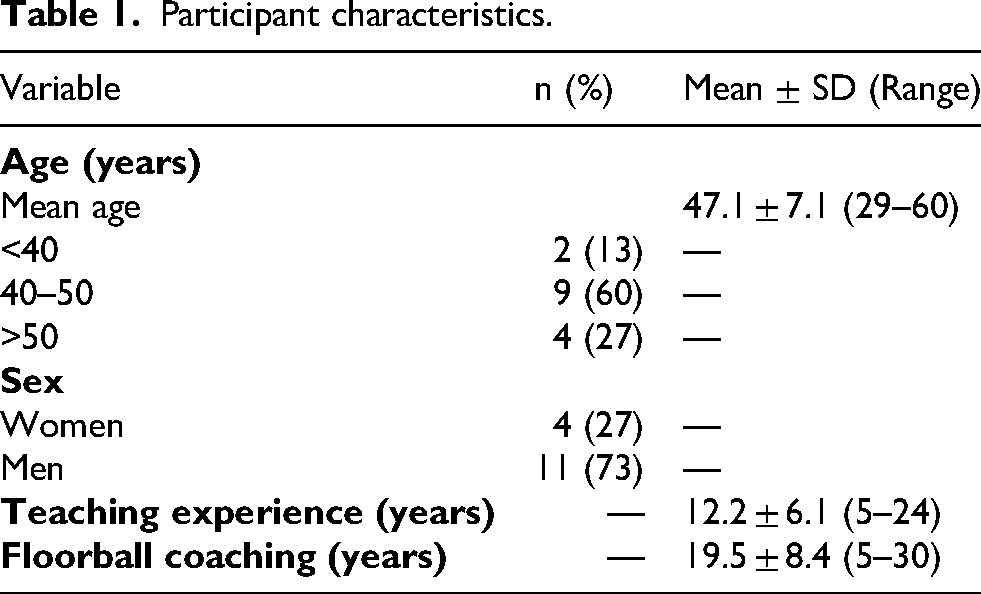
Fifteen floorball teachers were recruited through purposive sampling 35 to ensure diversity in age, gender, and nationwide geographic representation. The last author (TT) emailed invitations to 20 certified regional elite floorball high schools (NIU) and the national elite floorball high school (RIG) and 15 teachers responded. All respondents met inclusion criteria (≥1 year of school experience and fluency in Swedish). Participants represent different schools located across the country (i.e., in southern, central, and northern Sweden). All participants provided informed consent and completed online demographic forms before interviews. Four participants identified as women and 11 as men, aged 29–60 years, reflecting NIU/RIG floorball teacher demographics in Sweden. All had at least two years’ experience at their current school, with overall school experience ranging from 3–24 years and floorball coaching experience from 5–30 years. Most had played floorball from youth to semi-elite level; some had competed nationally. Twelve held university degrees, and most had completed Swedish Floorball Federation coaching programs, which include age-relevant strength training and injury prevention components tailored to floorball. See Table 1 for an overview of participant characteristics. This study was approved by the Swedish Ethical Review Authority (Reference number: 2023-06730-02).
Participant characteristics.
Data collection
Semi-structured interviews 32 were conducted using an interview guide developed by SL, ET, and TT. The guide consisted mainly of open-ended questions and the main question areas included: utilization, preconditions, perceived competence, motivation, and attitudes (see Appendix for the translated interview guide). The starting questions in the interview guide included: “Can you tell me what injury prevention is to you?” and “What are your experience of conducting injury prevention in the school context?”. Various open-ended follow-up questions and probes covered experiences and strategies from different aspects of injury-preventive elements in the high school context.
A pilot interview with a coach of a similar athlete group was conducted to assess the clarity and relevance of the interview guide. No major structural changes were needed, but the pilot highlighted the need for more detailed examples. Consequently, minor wording adjustments were made to better prompt elaboration. The interviews were conducted by the first author (SL), a psychologist with prior research experience in floorball and sports injuries, as well as personal experience of attending a certified elite sport high school. All interviews were carried out individually via a digital platform during the spring semester of 2024 and were scheduled at a time convenient for each participant. The interviews lasted between 32 and 50 min, with a mean duration of 44 min. All sessions were audio-recorded and transcribed verbatim, either by the first author or a professional transcriptionist.
Data analysis
Interviews were analyzed using qualitative content analysis in accordance with Graneheim and Lundman 33 and later developments concerning interpretation levels and trustworthiness.34,36 NVivo 12 37 supported the analysis. The method focuses on identifying similarities and differences at manifest (categories) and latent (themes) levels. The analysis followed recommended steps in the literature: (1) familiarization, (2) segmentation into meaning units and condensation, (3) coding, (4) categorization, (5) theme development, and (6) integration with existing knowledge.34,38,39
First, the first author read all transcripts for enhanced familiarization. Three authors (SL, ET, and TT) independently coded one interview (i.e., conducting step 2 and 3), compared interpretations, and discussed differences to enhance rigor. In the analysis process, a meaning unit was defined as a piece of text (e.g., words, sentences, or paragraphs) that shared some common content and contextual meaning. 33 Categories reflected manifest content with a low degree of interpretation, whereas sub-themes and themes represented a higher level of abstraction, capturing an underlying latent meaning across categories. 36 After the first collaborative steps, the first author then condensed meaning units in all interview transcripts (step 2), coded them close to the original data (step 3), and grouped codes into categories by finding manifest similarities and differences between codes (step 4). Subsequently, categories were abstracted into sub-themes by evaluating underlying meaning or “read threads” in the data (step 5), and finally, sub-themes were further interpreted into one main theme. All analysis steps were conducted through an iterative process involving comparison across transcripts, codes, categories, and themes, and repeated discussion among the authors. Our analysis involved a moderate level of abstraction and latent interpretation.34,36
By using repeated discussions and triangulation among researchers with diverse competencies during the analysis process, the trustworthiness of the study was enhanced.33,40 From a clinical perspective, SL is a psychologist, while ET and TT are physiotherapists with expertise in sports medicine; all three have prior research experience in floorball, injury prevention, or rehabilitation. AS and AI contributed to the later stages of the analysis, drawing on their expertise in sport psychology, sport injuries, and motivation, as well as their experience in both research and applied practice.
Following the data analysis, a form of member check was conducted involving both original study participants and individuals from a similar population. Preliminary findings were presented by the first author in an online seminar, during which attendees were invited to critically reflect on the findings and to offer oral or written feedback, either during the seminar or afterward, with particular attention to potential misinterpretations or omissions. This process aimed to evaluate the extent to which the findings resonated across a wider practitioner context. None of the participants indicated that the results had been misrepresented or that any significant aspects were missing, thereby enhancing the confirmability and credibility of the study.
Results
The analysis resulted in one overarching theme: “Facilitating students’ development to become their own best coach,” emphasizing autonomy and competence. It reflects how teachers aimed to equip students with knowledge and the ability to apply it across contexts, fostering independence through gradually increasing responsibility aligned with growing maturity and skills. Teachers sought to make injury-prevention education relevant and engaging, supported by dialogue and feedback, while recognizing that their own attitudes influenced student motivation.
Three sub-themes illustrate this process. Teachers were “Navigating challenges and opportunities in the school context” through collaboration with clubs, use of support functions, and alignment with curriculum requirements. They were “Promoting students’ own learning and sense of responsibility” by teaching theory and practice, encouraging exploration of preventive strategies, and fostering ownership. Finally, they were “Leading with intentionality,” strengthening motivation through leadership behaviors, open communication, and ongoing professional development. An overview of the main theme, sub-themes, and categories is presented in Figure 1.
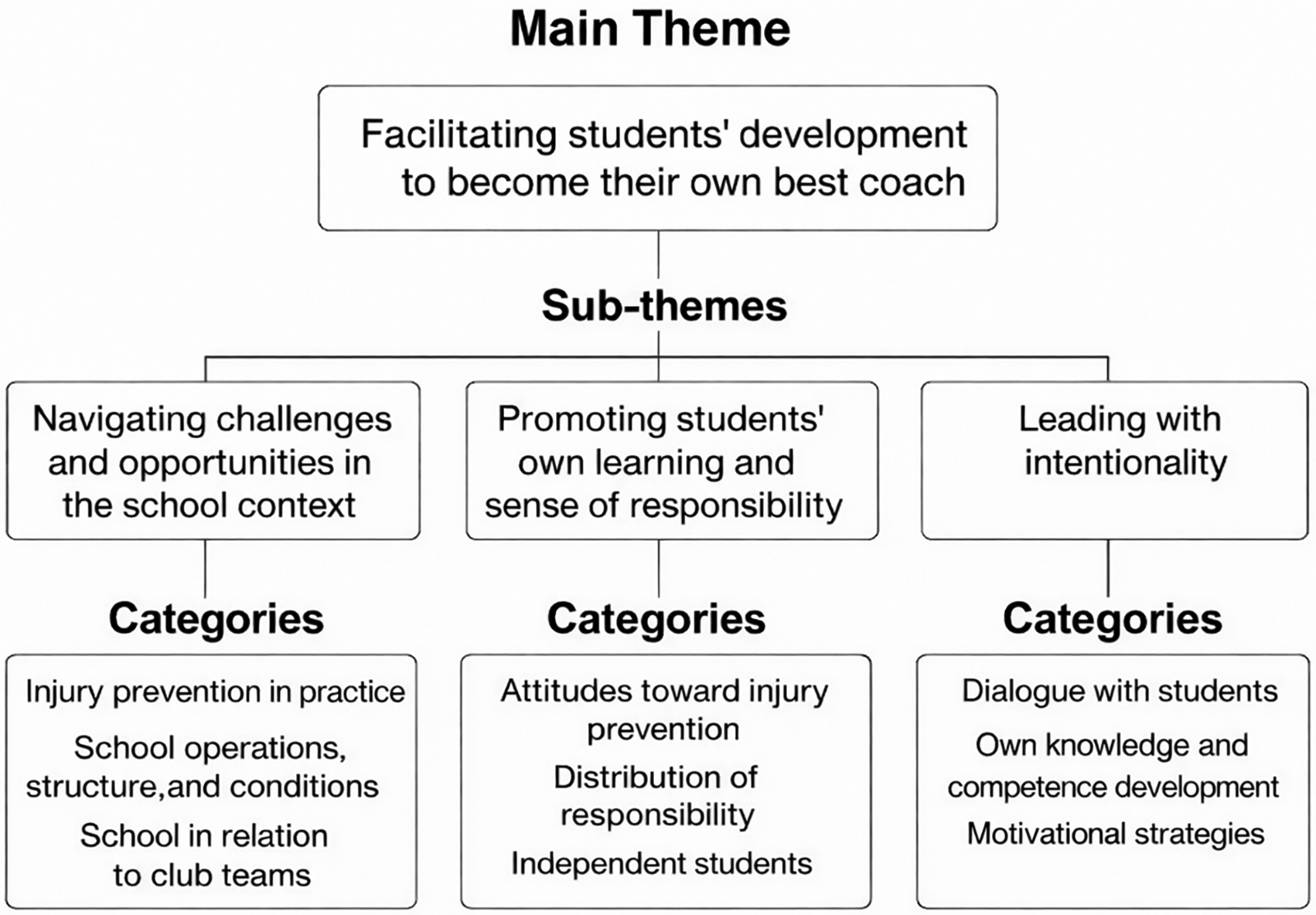
Overview of the main theme, sub-themes and categories.
Navigating challenges and opportunities in the school context
This sub-theme concerns the teachers’ practical application of injury prevention within the school setting. It is supported by three categories: Injury prevention in practice, School operations, structure and conditions, and School in relation to club teams. The sub-theme is characterized by how teachers adapted and taught injury prevention in response to various internal and external conditions, expectations, and demands.
Teachers emphasized that injury prevention was an inherent part of the school's operations. They provided examples of how they made use of the school's resources—such as regular lessons “ then it sort of becomes a habit” (P1), access to facilities, and collaborations with support services like student health teams, physiotherapists and strength coaches both within and outside the school—to promote and develop injury prevention efforts. Across schools, however, the conditions for this work varied. Some had a gym at the school, while others relied on collaborations with community facilities, and teachers highlighted that having the gym, indoor sports hall, and school close to each other made it easier to integrate injury-prevention routines into the school day. Similar differences were noted between schools located in larger and smaller municipalities, where the closer proximity to external care and stronger personal networks in smaller communities were described as naturally facilitating collaboration. Variation was also evident in access to internal student health staff, with most schools having personnel on site but some relying on limited weekly hours, which shaped the extent to which teachers could engage in collaborative injury-preventive work.
Injury prevention was carried out with the aim of preparing students for the physical demands of floorball. A central focus was on developing basic physical strength through gym training. Teachers also worked to prevent serious injuries, such as ACL tears, by implementing research-based programs like Knee Control. In addition, they incorporated influences from other sports, including ice hockey and athletics, and introduced additional health aspects, such as recovery routines. One teacher expressed the kind of inner reasoning they want students to adopt: …. linked to what my body is exposed to in training situations, that's what I'm protecting myself from. So that my physical ability, but also my motor skills, are switched on because I am rested, because my energy batteries are recharged by food and sleep and things like that. But also because I feel good, mentally, and because I have a sense of calm and peace inside me. (P4)
Gaining a comprehensive overview and managing students’ total training load emerged as the greatest challenge in the injury prevention within the school setting: Those who have NIU students have their students here during the day, training with them, and then they [the students] go out to different clubs and play. And that can, that has, yeah, I mean, you don’t really have a clear picture of how they practice in the evenings, what kind of games they have, and, well, the total load. … I think quite a few people in NIU programs feel that they cannot put too much strain on their students during school hours because they’re already so worn out from all the evening practices and games and so on. (P15)
Effective communication with club coaches was described as essential for maintaining focus on students’ best interests in regard to their floorball activities and development. However, differing priorities among stakeholders and limited time were reported as challenges to achieve this. Conflicts could arise when club coaches wanted students to prioritize club practices and games, while the teachers emphasized school attendance as crucial for academic grading. Moreover, some teachers expressed concern over what they perceived as a lack of sufficient knowledge and systematic use of injury prevention practices within the club environment: I also notice that the level of knowledge in the evenings is quite low when it comes to this, so we may be the only ones, for some students, who can actually increase their knowledge. That's how I would put it. (P1)
Promoting students’ own learning and sense of responsibility
This sub-theme focuses on the teachers’ strategies for enhancing students’ competence and understanding of injury prevention. It consists of the following categories: Attitudes toward injury prevention, Distribution of responsibility, and Independent students. The sub-theme encompasses how teachers worked to gradually increase students’ responsibility and autonomy. The sub-theme also addresses teachers’ experiences of students’, other coaches’, and their own attitudes toward injury prevention, and how this influences their preventive work.
When describing students’ attitudes toward injury prevention, teachers generally noted that most students did not find it fun but accepted it as a necessary part of training and understood its importance. Particularly, teachers observed that ambitious students tended to be more motivated toward this type of training, however, the most motivated were the students who had previously experienced injuries themselves. On the contrary, many previously non-injured students were seen as neglecting that an injury could happen to them or not recognizing that injury prevention could be an investment in a long-term athletic career: “one challenge is probably that, well, they kind of feel a bit invincible when they’re sixteen.” (P14)
To change students’ attitudes and enhance awareness, teachers highlighted the importance of talking about not only injury prevention's role in reducing injury risk but also its performance-enhancing benefits—such as increased strength and optimized recovery. While not implemented in all schools, some invited role models to share personal injury experiences and perspectives on prevention, which was described as an effective way to engage students.
Several teachers reported that students’ motivation for injury prevention varied by school year. In the first year, students were described as curious and eager to learn. In the second year, many intensified their athletic efforts, but in the later stages of high school, motivation sometimes declined—especially among those whose development in floorball had stalled. Meanwhile, students playing at a higher level appeared to continue prioritizing injury prevention more consistently. Attitudes toward injury prevention held by teachers and club coaches were also highlighted as important for shaping students’ engagement: when leaders signaled that injury prevention mattered, students tended to engage more, whereas de-prioritization by teachers or coaches risked reducing engagement: If you just say as a coach, like, okay now we’re going to do this, this, and this, and then you don’t really care whether they do it or not, then I think it's easy for someone to maybe kind of cheat a little. That shows it's not that important, and I think that really rubs off on the players. (P3)
Most teachers agreed that starting with a coach-led approach to injury prevention was essential. When training was initially led by the coach, teachers felt that it created a solid foundation and sense of security, rather than placing too much responsibility on young students who were not yet ready for it: “And we know that, I mean, students at this age, there are just too many who aren’t really able to take that kind of responsibility.” (P12)
Teachers viewed their role as introducing injury prevention, allocating time for it, providing necessary conditions, delivering knowledge, and following up on students’ training. Meanwhile, the students were expected to take responsibility for completing the training. The introduction of knowledge occurred both through theoretical content linked to specific curriculum components and through the regular implementation of injury prevention during school lessons. This structure allowed for a gradual transfer of responsibility to the students over time. We often do it like this too, that in year three we let them take more control over their own education. In year one, we guide them a lot because we need to make sure they’ve got all the basics. But in year three we ease off, and then they get time to work on those elements. And that can be physical training, it can be floorball, like, different parts and so on. They manage that themselves. (P11)
Key elements in students’ development towards becoming independent in their injury prevention included gradually increasing the difficulty level, individualizing parts of the training, and learning to balance load with recovery. Teachers reported that they discussed with students how to listen to their bodies—both physically and mentally—and how that understanding could inform what kind of recovery or preventive action was needed. This also included developing the ability to communicate effectively with both school and club members regarding their training load, well-being, and needs. We work with the person, take care of yourself, you don’t have to be elite today. We have a long-term goal that maybe you’ll be elite when you’re twenty-five. In school we learn to take care of ourselves, we try to educate them to become elite players. But you don’t have to be fully developed as a player when you’re in high school. (P7)
Leading with intentionality
This sub-theme is characterized by conscious strategies for motivation and learning, both in terms of teaching students how to gain and apply knowledge, as well as the teachers’ own learning. It comprises the categories: Dialogue with students, Own knowledge and competence development, and Motivational strategies. The sub-theme addresses teachers’ use of behavioral components, such as relational skills and motivation enhancing strategies, to support students learning and adherence to injury prevention.
The teachers highlighted dialogue with students as perhaps the single most important component in their injury-preventive strategies. Through conversations, they were able to assess the current training load, identify potential injury symptoms, and gain insight into students’ physical and mental well-being. Sometimes it can be good to skip, especially games, when you're not feeling well mentally. …some of the injuries we've had in recent years have been people who were basically devastated and still tried to train and play in poor psychological condition. So I think that factor is really important too, and it's easy to forget because people mostly focus on the physical aspects. (P2)
The amount of time available for student interactions varied depending on the number of students per cohort, the number of instructors at the school, and teachers’ additional responsibilities. Some teachers felt they had enough time to see and communicate with every student daily, either at practices or at other times during the school day, whereas others struggled to find sufficient time for communication due to staff limitations, large groups, or not being employed full-time at their school. As in teaching more broadly, teachers observed and aimed for progression in their dialogues with students and acknowledged that their approach differed between newer and more experienced students: But I would say that's the challenge in year one, because that's when they come in, they don’t know us, and it's important for us to build a relationship really quickly and, like, have conversations and emphasize the importance of making contact. What saves us and allows us to have a dialogue is relational leadership. It's incredibly important. (P1) For example, we’ve had interns from the physiotherapy program who have been fantastic at, like, in that prevention or rehab area, they can really meet the student where they are. They notice, okay, this exercise didn’t work well for you, you could do it like this instead. (P5) And sometimes they get to come up with their own exercises too, ones they think are good, and then we do those exercises. Some of them aren’t good, definitely not, but they’ve still gotten to do them, they’ve tried them out. Because for us, 25 percent of the training is supposed to go a bit off track, so to speak. That's how you develop. (P8)
Discussion
This study aimed to explore high school floorball teachers’ experiences and strategies regarding injury prevention in Swedish elite sport high schools—responding to calls for research that integrates behavioral approaches and contextual understanding into injury-prevention practices.24,25,41 While we know much about what constitutes effective injury prevention, less is understood about how these strategies are interpreted and applied in real-world educational and elite sport contexts.41,42 Our findings contribute to this practice-oriented gap by showing how teachers anchor prevention in a broader pedagogy of athlete development, summarized in the main theme, “Facilitating students’ development to become their own best coach.” This student-centered orientation underscores teachers’ efforts to aim for progression and growth rather than to deliver isolated exercise routines.
All teachers described prevention as an inherent part of school-based floorball training, but their definitions varied widely, from gym-based strength and conditioning and standardized neuromuscular programs (e.g., Knee Control) to sport-specific, game-like drills. This mirrors the diversity in the literature regarding how injury prevention is defined and operationalized.41–43 The teachers also said that they did not always use the wording injury prevention for these exercises, suggesting that youth athletes may not always recognize which components of training are intended as prevention.2,20 These observations highlight a practical need to explicitly label prevention content and purposes for students. Clear labelling may help link experience to knowledge, increasing students’ perceived competence and may also support the internalization of the value and importance of injury prevention, consistent with self-determination theory.29,44
Our findings also indicate that teachers aimed to influence students’ preventive behaviors beyond school, reflecting an ambition to shape habits that persist in club environments. This resonates with the trans-contextual model, 45 which proposes that autonomy support in one context can foster autonomous motivation via satisfaction of basic psychological needs—autonomy, competence, relatedness—that in turn can transfer to other contexts. 46 Teachers described strategies such as providing rationales, offering variation or choice, and listening to students’ perspectives—behaviors aligned with need-supportive strategies.29,47 Importantly, teachers did not necessarily frame these strategies in theoretical terms; however, they appear to create conditions that can strengthen students’ sense of autonomy and competence around prevention, which is crucial for sustaining behaviors outside school.
A prominent strategy concerned progression of responsibility: more teacher-led structure in the first year, followed by a gradual shift of responsibility to students to perform, adapt, and plan prevention work. This resembles scaffolding and aligns with need-supportive strategies shown to be effective for adherence to new behaviors.27,29 By using dialogue, individualized feedback, and progressive training, teachers aimed to build capability and confidence—mechanisms that reflect TCM constructs influencing intention and behavior, including perceived behavioral control, attitudes, and social norms. 46 Teachers generally perceived themselves as primarily responsible for injury prevention in the school setting, ideally in collaboration with club coaches, and deliberately transitioned responsibility to students as they matured. This stance partially contrasts with previous research, 20 where youth players and coaches suggested coaches should have the main responsibility. Our participants’ focus on older athletes (often in transition to senior levels) likely contributes to this difference, as expectations of self-management increase with age and competitive level. This reflects the delicate balance teachers face in providing enough responsibility to foster growth and ownership, without exceeding students’ current capacity, which could hinder motivation and perceived competence.29,46
Teachers noted that many students did not particularly enjoy preventive exercises, but most accepted them as necessary to remain injury-free and keep playing, consistent with research that questions the ‘fun’ aspect of prevention and advocates focusing on identified regulation rather than intrinsic motivation for youth athletes. 41 Teachers addressed this by framing prevention in performance terms (e.g., movement quality, robustness, speed), a strategy supported in other sports contexts.20,42 However, unlike in some elite sport settings where performance can overshadow prevention, 42 the teachers in our study tended to focus on safe participation and prevention as a value in itself, while still tailoring content to sport-specific risk situations to prolong engagement. Additionally, normalizing prevention through routines, so that “it's no longer up for debate” (P1), illustrates how repeated practice and environmental cues helped establish injury prevention as a habit. The latter aligns with habit-formation principles—repetition in stable contexts and clear cues to reduce deliberation demands.48,49
Importantly, the discussion of controlled motivation (e.g., doing prevention because it is required) needs careful positioning alongside autonomy-supportive strategies. Our interpretation is that, in this setting, habit formation and certain structure elements (clear expectations, routinization) can coexist with autonomy support, particularly early on, to ensure enactment while competence and autonomous motives are still developing.18,19 Moreover, combining theoretical and practical instruction was seen as beneficial for student learning, resembling findings from elite sport schools where students valued this approach. 2 Integrating knowledge about why and how prevention works may strengthen autonomous motivation and long-term commitment, 29 consistent with the TCM's emphasis on motivational transfer across contexts. 45 Teachers also reported that high-achieving students appeared more motivated to engage in prevention, which supports the idea that autonomous motivation can transfer from one activity domain to another (e.g., from sport participation to prevention 28 ;). Likewise, in line with earlier research, previously injured students were seen as more motivated to adopt prevention behaviors to not become injured again. 42
Despite valuing collaboration, teachers reported limited visibility into club practices, time constraints on club coaches, and uneven competence in prevention outside school—concerns supported by prior research.20–22 A recurring worry was the inability to monitor and balance total training load across school and club training, with potential risks for insufficient recovery. 3 Teachers emphasized the need for clearer communication structures and policies between school and club environments. We suggest that federation-level guidance clarifying roles, communication efforts, and shared load-monitoring practices could help align expectations and safeguard athlete well-being.
Contrary to previous findings, 2 which reported student concerns about inadequate support and systemic shortcomings, most teachers in our study described having access to dedicated time, facilities, and medical support (e.g., physiotherapists, counselors). This discrepancy may reflect contextual variability (e.g., school size, funding models, urban–rural differences). We also noted differences in whether resources were internal (embedded within the school) or external (requiring referrals), potentially affecting timeliness and equity of access. These observations highlight the need for context-sensitive implementation guidance that reflects differences in resource availability and referral structures.24,25
Although teachers mainly discussed physical routines, many of their strategies implicitly targeted psychological factors influencing behavior. Teachers noted that students’ attitudes toward prevention were not always positive initially, and a part of their role as teachers was to help shift these attitudes over time. Efforts to normalize prevention and “reduce debate” can help minimize decision fatigue, create a shared sense of responsibility, and reduce stigma around taking precautions, which is important in adolescent sport environments where risk-taking may be socially reinforced. 50 A few schools had participated in psychological interventions (e.g., communication skills with mental health focus), which were perceived as enlightening but too time-consuming. However, none of the schools had implemented a systematic, integrated psychological prevention component targeting known risk factors such as stress responses, despite literature suggesting its effectiveness.10,43 Future research could bridge this gap by integrating brief and feasible psychological components (e.g., stress management, reflection, communication skills) into prevention programmes, aligned with need-supportive practices to support internalization of injury-preventive behaviors.
Methodological discussion/strengths and limitations
This study has both methodological strengths and limitations. A notable strength is the diverse sample, which includes variations in gender, age, geographical location, and years of experience in both floorball coaching and the school context. This diversity allows for a broad range of perspectives and experiences to be captured. While the higher number of male coaches in the study reflects the overall population of teachers and coaches in Sweden, including more female informants could have provided additional perspectives and facilitated a comparison of potential differences between male and female teachers’ experiences and strategies.
Interviews were conducted online, utilizing semi-structured formats that enabled informants to elaborate on topics of their interest, while being guided by an interview guide created and agreed upon by the authors. The video format made it possible to reach participants nationwide and allowed for the first author to observe non-verbal behaviors during the interviews. 32 A pilot interview was conducted prior to the study to test the questions and assess informants’ experiences with the digital format. Beyond confirming the technical feasibility, this step contributed to the study's trustworthiness by enhancing credibility and dependability, particularly through the refinement of the interview guide and the evaluation of question clarity and relevance. 51
Triangulation between authors was used during the analysis process to enhance trustworthiness, where SL, ET, and TT independently read and coded transcripts and then discussed it together. During the analysis, the authors went back and forth and reflected upon their own background, experiences, and prior knowledge and how that might affect the analysis in line with recommendations about reflexivity. 52 These discussions included critical examinations of whether emerging interpretations were grounded in the interview data or influenced by the authors’ prior knowledge of the context. In particular, the authors reflected on the risk of implicitly filling in information that was not explicitly articulated by participants, due to familiarity with how such contexts typically function. Through these reflexive discussions, interpretations were challenged and, when necessary, re-anchored in the empirical material through repeated comparison with the interview transcripts. At the same time, the authors also reflected on how their contextual knowledge and diverse scientific and clinical backgrounds functioned as analytical strengths, particularly when assessing the relevance of interpretations and the feasibility and practical application of recommendations. A detailed description of the context, the characteristics of the informants, sampling procedure as well as data collection and analysis are provided, which facilitate transferability. Results are presented with quotations to highlight the informants’ voices to enhance transferability, confirmability, and credibility. 36 In addition, member checking was used to enhance the study's trustworthiness. The feedback received was limited but consistently confirmed that the findings were recognizable and aligned with participants’ experiences. This process increased transparency in the analysis and supported the confirmability and credibility of the findings through reflexive dialogue with participants.
The result of qualitative research is highly related to the specific context 38 ; however, experiences of high school floorball teachers might be similar and transferable to other teachers working in sport schools across Sweden and most likely other countries with a similar school system, making the findings from this study useful in such contexts as well.
Conclusions
Teachers in Swedish elite floorball high schools approached injury prevention as part of a development-oriented teaching strategy, combining (a) introducing prevention content, (b) autonomy-supportive instruction with a planned progression of responsibility, (c) routinization and habit formation to increase adoption, (d) performance-relevant framing to strengthen perceived value, and (e) active—though sometimes challenging—coordination with club environments. We recommend strengthening explicit labelling and need-supportive instruction, incorporating routines to bridge the intention–action gap, and establishing clearer communication structures with clubs to coordinate recovery and training load as part of injury prevention, ideally supported by federation-level guidance.
Supplemental Material
sj-pdf-1-spo-10.1177_17479541261435455 - Supplemental material for From leadership to autonomy: How teachers in school sports (floorball) facilitate students’ competence in injury prevention
Supplemental material, sj-pdf-1-spo-10.1177_17479541261435455 for From leadership to autonomy: How teachers in school sports (floorball) facilitate students’ competence in injury prevention by Sofia Levin, Eva Tengman, Andreas Stenling, Andreas Ivarsson and Taru Tervo in International Journal of Sports Science & Coaching
Footnotes
Acknowledgements
The authors would like to thank all participants for generously sharing their experiences and perspectives, which were essential to this study. We would also like to thank Anncristine Fjellman-Wiklund (Umeå University) for her valuable input on the qualitative data analysis and for insightful suggestions regarding the structure of the results section, which greatly improved the clarity of the manuscript.

Ethical considerations
This study was approved by the Swedish Ethical Review Authority (reference number 2023-06730-02).
Consent to participate
Following the principles of the Declaration of Helsinki, 53 participants were given written and verbal information about the aim of the study and were informed that they could withdraw at any time without having to specify the reason. Written informed consent was obtained from all participants prior to their interview.
Funding
This study is based on data collected in the research project “Risk factors for sport injuries in floorball players”. The project is funded by the Industrial Doctoral School at Umeå University, the Swedish Floorball Federation, and the Floorball Research and Development Centre at Umeå School of Sport Sciences.
Declaration of conflicting interests
The authors declared no potential conflicts of interest with respect to the research, authorship, and/or publication of this article.
Data availability statement
The participants of this study did not give written consent for their data to be shared publicly, so due to the sensitive nature of the research supporting data is not available.
AI statement
The authors acknowledge the use of Microsoft Copilot, an AI-based writing assistant, to support language clarity and readability during the preparation of this manuscript. The authors take full responsibility for all content, and no AI tools were used to generate original ideas, analyses, or conclusions.
Supplemental material
Supplemental material for this article is available online.