



Abstract
Scotland has a proud footballing legacy marked by famous European successes and world-class players, yet recent decades have witnessed a sustained period of underperformance both domestically and internationally. Back-to-back European Championship qualifications, coupled with Scotland's qualification for the 2026 World Cup, suggest a revitalised development pipeline, but it remains unclear whether these outcomes reflect systemic progress or isolated performances. This study provides a 24-season longitudinal analysis (2000–2024) of elite player development in Scotland's top-tier, with the aim of identifying the key success factors that enable Scottish players to break through, survive, and thrive at the elite level. Drawing on a large sample (n = 2671) of players, a stepwise analytical approach was employed that centred on multinomial logistic regression to test predictors of elite player progression. Results showed that debut age, debut-season involvement, and U21 representation were the strongest predictors of becoming an established professional at the elite level. In contrast, debut club type, academy pathway, and U16–20 caps were not significant. Typology modelling distinguished four distinct player progression pathways, from short-lived “early flickers” to enduring “thriving pros.” Follow-up analyses confirmed that greater debut-season minutes and earlier debuts were consistently associated with established elite playing careers and progression through the national pathway to senior international representation. These findings suggest that ‘early trust’ – operationalised as meaningful debut-season involvement – is a core success factor underpinning elite player development at both club and international levels. Practical implications are offered for coaches, clubs, and governing bodies to strengthen academy player pathways and bolster Scotland's national player development pipeline.
Introduction
The volume of research in professional football focused on elite player development in the sports sciences has grown considerably over the past two decades. Within this ever-increasing body of work, a broad range of factors have been examined. These include coaching styles and behaviours, 1 the influence of psychological attributes,2,3 the role of the development environment,4,5 relative age effects, 6 perceptual-cognitive skills, 7 anthropometric and physiological characteristics, 8 injury prevention and risk factors, 9 and training load and bio-banding. 10 Alongside this, macro-level policies and regulatory shifts, such as the Bosman ruling, Financial Fair Play, and UEFA's home-grown player rule, have also been examined for their influence on elite player development across Europe.11,12 While this research has extended our knowledge of the factors associated with effective player development, the mainstay of these investigations have focused on Europe's major leagues, the so-called ‘Big 5’ which include the English Premier League (EPL), La Liga, Serie A, Bundesliga, and Ligue 1. Consequently, smaller European leagues operating outside the ‘Big 5’ remain largely underexamined in comparison, despite presenting noteworthy football landscapes for inquiry. Scotland is one such case. The country has a rich footballing heritage marked by iconic players, historic European club triumphs, and deep community roots. 13 Despite its proud historical impact on the global game, the past few decades have witnessed a period of underperformance both at a national and domestic level. At a national level Scotland has struggled to remain competitive with its last World Cup appearance in 1998. Within the domestic game, the last major club success in UEFA's elite club competitions was Celtic's European Cup (Champions League) triumph in 1967. From a player development perspective, concerns have emerged around the accessibility and effectiveness of talent pathways. These concerns are largely twofold: (i) the dominance of the Old Firm clubs (i.e., Celtic and Rangers) which has resulted in a structurally imbalanced league where opportunities for emerging Scottish footballing talent may be unevenly distributed14,15; and (ii) the growing reliance on overseas recruitment by top-tier clubs which has complicated the development landscape for domestic players. 16 These concerns have been highlighted in one of the comparatively few studies that have focused on player development in Scottish football. In this research, Dugdale et al. 17 identified systemic constraints that extend beyond individual clubs, including financial fragility, limited upward mobility into elite environments, and a reliance on smaller clubs with constrained resources. Together, it was posited that these factors create bottlenecks that restrict the long-term conversion of early promise into established elite careers.
More recently however, there are signs of renewed optimism. The national teams’ back-to-back qualifications for the European Championships in 2020 and 2024, as well as Scotland's qualification for the 2026 FIFA World Cup (their first in 28 years) point towards a potential resurgence in the Scottish game. At the club level, promising UEFA competition performances, including Rangers’ run to the 2022 Europa League Final, demonstrate that Scottish clubs are capable of competing on the elite European stage. Moreover, at an individual level, several high-profile Scottish players (e.g., Andrew Robertson, Billy Gilmour, and Scott McTominay) excelled in Europe's ‘Big 5’ leagues in the 2024/25 season. This raises an important question central to the present investigation: is this renewed optimism indicative of a stronger, more resilient domestic player development pipeline, or do these outcomes reflect external dynamics? While recent performances at individual, club, and national levels suggest progress, it remains unclear whether these are underpinned by long-term, systemic improvements within the Scottish player development system. Against this backdrop, the present study undertakes a 24-season longitudinal analysis of elite player development in Scotland. Beyond addressing the question of whether domestic opportunities have contracted or revitalised, the study aims to identify the key success factors that enable Scottish players to break through, survive, and thrive at the elite level, both domestically and internationally. In doing so, the investigation seeks to provide a clear analytical understanding of the developmental conditions that underpin sustained elite playing careers within Scotland's complex football system. Ultimately, the goal is to generate actionable insights for coaches, clubs, and governing bodies into the factors that not only facilitate break through but also support sustainable, long-term playing careers.
From a broader sports science and coaching perspective, this study builds on the extensive body of player development research by applying a novel inquiry that combines predictive modelling with longitudinal playing career data. While previous work has integrated multidimensional and data-driven approaches to examine predictors of selection, progression, and injury risk,6–9 such approaches have rarely been applied to whole-career datasets spanning multiple decades. As such, this study aims to provide a unique macro-level perspective on developmental success factors in elite football. By working toward a predictive and integrative model of developmental success factors, it is anticipated this investigation will offer an explanatory, evidence-informed framework to guide coaching practice, inform talent development strategy, and support system-level decision-making. To that end, while Scotland provides the case context, the wider implication of this research is to advance understanding of development pathways and player archetypes within European youth academy systems.
Method
Study design and sample
This study employed a longitudinal predictive modelling design to examine elite player development in Scotland's top-tier league over a 24-season period (2000–01 to 2023–24). The design combined whole-population longitudinal player data with statistical modelling to identify the factors that predict sustainable elite playing careers. The sample included all professional footballers, regardless of nationality, who made at least one league appearance in Scotland's top-tier domestic competition during the study period. The top-tier comprised the Scottish Premier League (SPL; 1998–2013) and its successor, the Scottish Premiership (2013–present). In total, the dataset included 2671 players, of whom 1080 were Scottish.
Data collection
A custom dataset was compiled using publicly accessible online databases, primarily TransferMarkt and FBref, with national team appearance records cross-verified against official publications from the Scottish Football Association. This multi-source approach corroborates club data and uses national association records for international representation. The procedure mirrors prior work that has quantified playing opportunities and pathway throughput in elite football systems.18,19 Recorded variables included player demographics (e.g., name, date of birth, nationality), playing data (e.g., academy, debut year/season, debut club, debut-season minutes, debut-season appearances, career club(s), total career appearances, total career minutes played), and national team data (e.g., U16–20 caps, U21 caps, senior caps). For academies, players were classified as single- or multi-academy if they were registered with one or more youth academies from age 12 until their debut top-tier appearance.
Procedure
The procedure followed a systematic, stepwise predictive modelling framework within a longitudinal design. Initial analyses established foundational trends in Scottish player representation across the 24-season period. Specifically, linear regression was used to examine changes in domestic debuts and playing time, while correlation and group-comparison tests (i.e., independent-samples t-tests and Mann–Whitney U tests) were used to explore associations with structural factors such as the influx of foreign players and the introduction of the UEFA home-grown player rule. Predictive modelling was then undertaken using multinomial logistic regression to identify factors associated with effective player development and sustainable elite level playing careers. The dependent variable was career tier, classified by cumulative elite-level playing minutes, with ‘Limited breakthrough’ players serving as the baseline category. Career tiers were defined using cumulative elite-level minutes as an objective indicator of long-term developmental consolidation. Thresholds were set at <1000 min (Limited breakthrough), 1000–4999 min (Fringe), 5000–9999 min (Reliable), and ≥10,000 min (Established). These cut-offs were derived with reference to professional playing benchmarks, where ∼10,000 cumulative minutes equates to approximately five full seasons of consistent involvement at senior level (i.e., ∼200 appearances averaging 45–60 min per match). In this sense, the ≥10,000 tier reflects sustained elite careers, while the <1000 tier captures players whose exposure was minimal and short-lived. The intermediate thresholds provide a transparent framework for distinguishing between peripheral contributors and those who progressed into dependable professionals. Predictor variables included: debut age, debut-season involvement (minutes, appearances), debut club type (Top 2 (Old Firm) vs. other), academy pathway (single vs. multi-academy), playing position, and national team representation (U16–20, U21). Regression-derived predictor patterns were subsequently used to construct player typologies, providing an applied framework of distinct developmental personas and trajectories. Follow-up analyses were conducted to test whether any significant predictors identified in the modelling were also reflected at the domestic club and national levels. Specifically, non-parametric tests (e.g., Kruskal–Wallis, Mann–Whitney) were applied to examine any between-club variations, and logistic regression models controlling for debut age were used to assess developmental progression through the national team pathway.
Data reliability
Data accuracy was ensured through triangulation across multiple independent sources. The data collection method deployed to assess playing opportunities has developed over the past two decades and utilises reliable, publicly available databases. TransferMarkt and FBref, which are widely recognised in sports science research for their accuracy and comprehensive coverage of professional football career statistics20,21 informed the primary datasets. Cross-verification with official Scottish FA records further strengthened reliability. The use of youth and senior international caps as developmental indicators is consistent with prior longitudinal studies on elite talent progression. 22 Comparison of TransferMarkt and FBref datasets (covering variables such as playing data, age, and nationality) showed >99% consistency. The small proportion of discrepancies were limited to the minute's column, typically involving players with a single one-minute appearance in a season recorded as “1” in one source and “–” in the other. These were cleaned to ensure full consistency.
Results
To contextualise the predictive modelling analysis, foundational trends in Scottish player representation were first examined. Longitudinal analysis revealed a significant contraction in opportunities for Scottish players across the 24-season study period. Linear regression indicated a significant decline in the number of Scottish player debuts per season (β = –0.75, p < 0.001, r = –0.78) and in the percentage of total minutes played by Scottish players (β = –0.84, p < 0.001, r = –0.84). By contrast, the proportion of minutes played by foreign players increased significantly over the same period (β = 0.86, p < 0.001, r = 0.80). A strong negative correlation was also observed between the number of foreign players in the league and the annual number of Scottish debuts (Spearman's ρ = –0.79, p < 0.001). The introduction of UEFA's home-grown player rule between 2006 and 2009 coincided with this downward trajectory but did not abate the decline, with an independent-samples t-test confirming that the percentage of minutes played by Scottish players was significantly lower in the seasons following the rule compared with those preceding it (t = 4.16, p < 0.001). A Mann–Whitney U test corroborated this effect (p < 0.001). Together, these findings highlight a growing reliance on foreign talent coinciding with diminishing opportunities for Scottish players to accrue meaningful playing time at the elite level.
Elite player development success factors: regression modelling
A multinomial logistic regression was conducted on the Scottish player dataset to identify predictors of career progression, with Limited players used as the reference category. The results of these analyses are displayed in Table 1. Results revealed that Limited players debuted at a mean age of 19.5 ± 3.8 years, compared with 21.2 ± 4.1 years for Fringe, 19.3 ± 4.7 years for Reliable, and 20.1 ± 5.6 years for Established players. Debut age significantly predicted outcomes, with each one-year increase associated with reduced odds of reaching the Reliable (OR = 0.90, 95% CI [0.83, 0.98], p = .015) and Established tiers (OR = 0.83, 95% CI [0.77, 0.90], p < .001). Debut-season involvement was also a significant predictor of player development success, with additional appearances increasing the odds of reaching the Reliable tier (OR = 1.21, 95% CI [1.11, 1.31], p < .001) and greater debut-season minutes predicting successful progression across all tiers (Fringe p < .001; Reliable p = .001; Established p = .013).
Multinomial logistic regression predictors of elite Scottish player development progression.
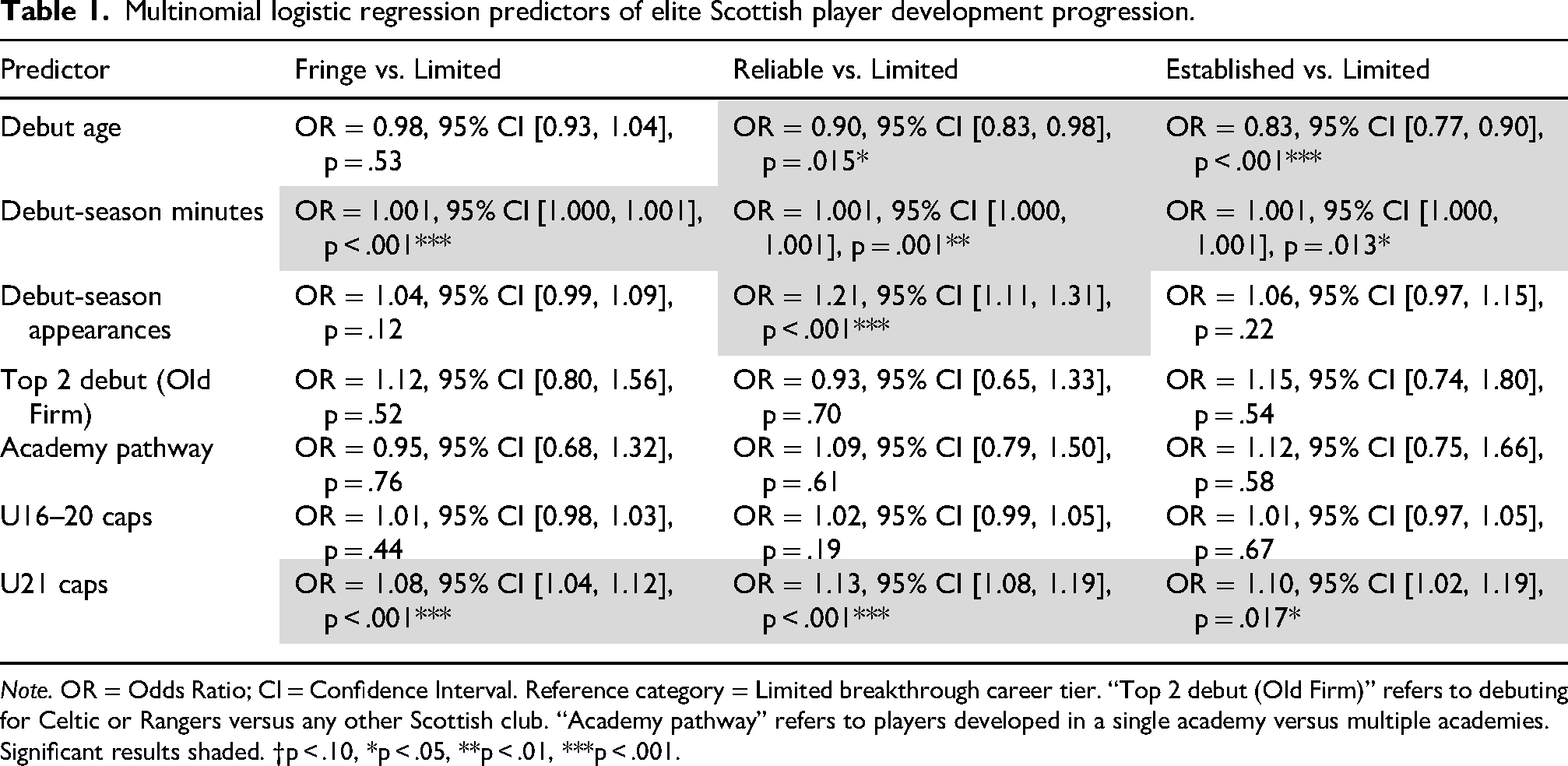
Note. OR = Odds Ratio; CI = Confidence Interval. Reference category = Limited breakthrough career tier. “Top 2 debut (Old Firm)” refers to debuting for Celtic or Rangers versus any other Scottish club. “Academy pathway” refers to players developed in a single academy versus multiple academies. Significant results shaded. †p < .10, *p < .05, **p < .01, ***p < .001.
National team representation was also strongly associated with developmental success, with U21 caps significantly increasing the odds of reaching the Fringe (OR = 1.08, p < .001), Reliable (OR = 1.13, p < .001), and Established tiers (OR = 1.10, p = .017). In contrast, debut club type, academy pathway (single vs. multi-academy), and U16–U20 caps were not significant predictors (all p > .05). Some positional contrasts were observed, with forwards less likely than midfielders to reach the Fringe (OR = 0.52, p < .001) and Reliable tiers (OR = 0.25, p < .001), and defenders less likely to progress to Reliable (OR = 0.55, p = .032) and borderline Established level (OR = 0.52, p = .050), although these effects were comparatively weaker than those linked to age, debut-season involvement, and U21 representation. Together, these results demonstrate that earlier debut age, greater debut-season involvement, and U21 national team appearances were the strongest and most consistent predictors of successful player development, while debut club type, academy pathway, and youth caps at U16–U20 were not significantly associated with sustained playing careers at the elite level.
Modelling player archetypes
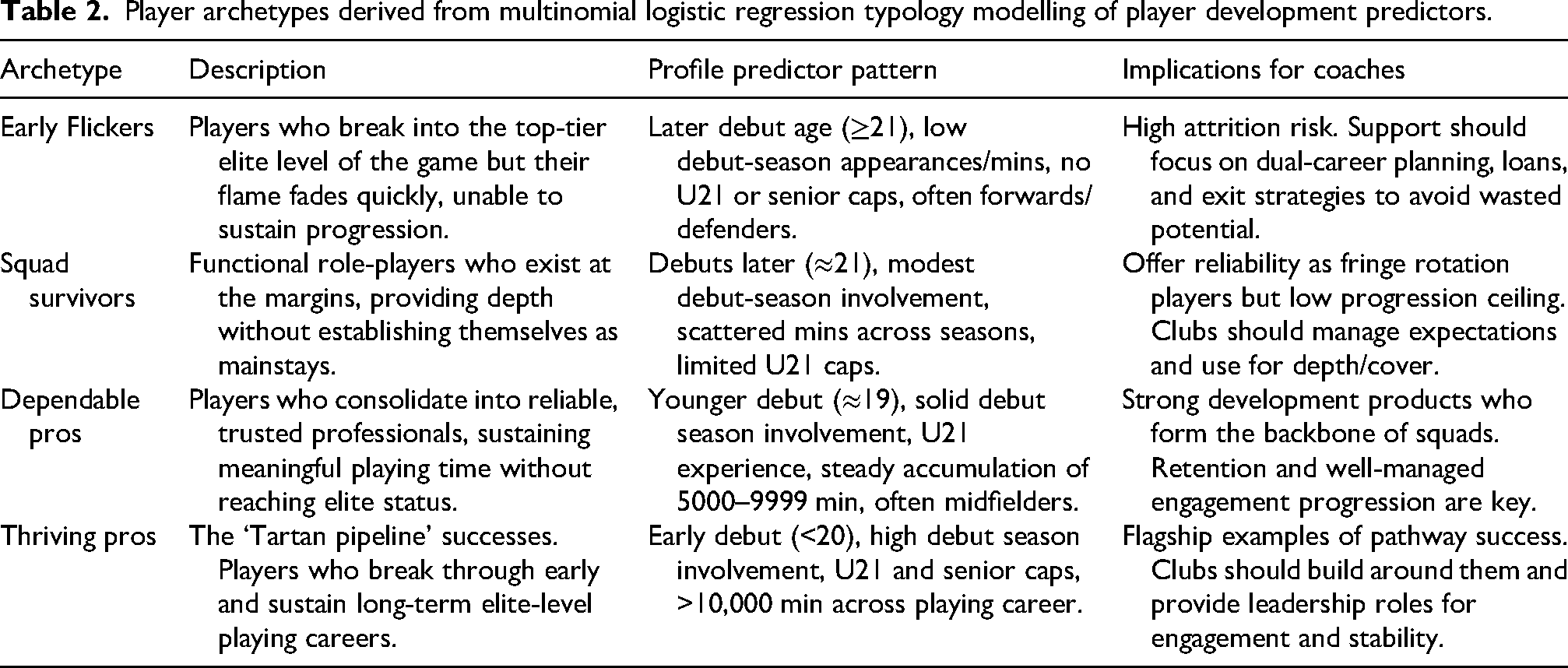
Drawing on the outcomes of the multinomial logistic regression, typology modelling was undertaken to classify players into distinct developmental trajectories. Four archetypes emerged that are presented in Table 2. As displayed in Table 2, the ‘Early Flickers’ represent players who gain initial exposure but, with later debuts and low debut season minutes, are unable to sustain progression and do not move beyond limited appearances. ‘Squad Survivors’ remain functional but peripheral, debuting later and accumulating scattered minutes without meaningful international recognition, whose role lies predominantly in offering squad depth in the playing group. ‘Dependable Pros’ appear as the strongest products of the Scottish player development pipeline, typically midfielders who debut young, gain early U21 recognition, and consolidate into consistent and reliable multi-season professionals at the elite level. Finally, ‘Thriving Pros’ represent the success cases of the player development system, breaking through early, amassing extensive minutes, and translating youth promise into senior international careers (Table 2).
Player archetypes derived from multinomial logistic regression typology modelling of player development predictors.
Early trust and club success
Follow-up analyses explored whether the debut-season predictors identified in the regression model were also reflected in patterns across different debut clubs within the Scottish top-tier league. For the purposes of this analysis, early trust was operationalised as the extent of meaningful first-season involvement at senior level, measured by debut-season minutes. A Kruskal-Wallis test revealed significant variation in debut-season minutes across clubs (H = 105.83, p < .001) as displayed in Figure 1. A Mann–Whitney test also revealed that debuting at one of the Old Firm clubs (i.e., Celtic or Rangers) was associated with significantly fewer debut-season minutes than debuting elsewhere (U = 693,259.5, p < .001). To directly test whether these variations in early exposure were consequential, a follow-up logistic regression was conducted. Results showed that higher debut-season minutes were significantly associated with increased odds of achieving a Reliable or Established career tier (B = –0.000173, z = –1.98, p = .048, 95% CI [–0.00034, −0.00000]). This finding confirmed the earlier regression analyses, providing further validation that meaningful early trust is a key predictor of player development success. Together, these results demonstrate that debut-season environments vary considerably in the extent of early trust afforded, with smaller and mid-table clubs typically offering greater opportunities than the Old Firm, and that this early exposure is a factor that influences the likelihood of sustaining an elite playing career.
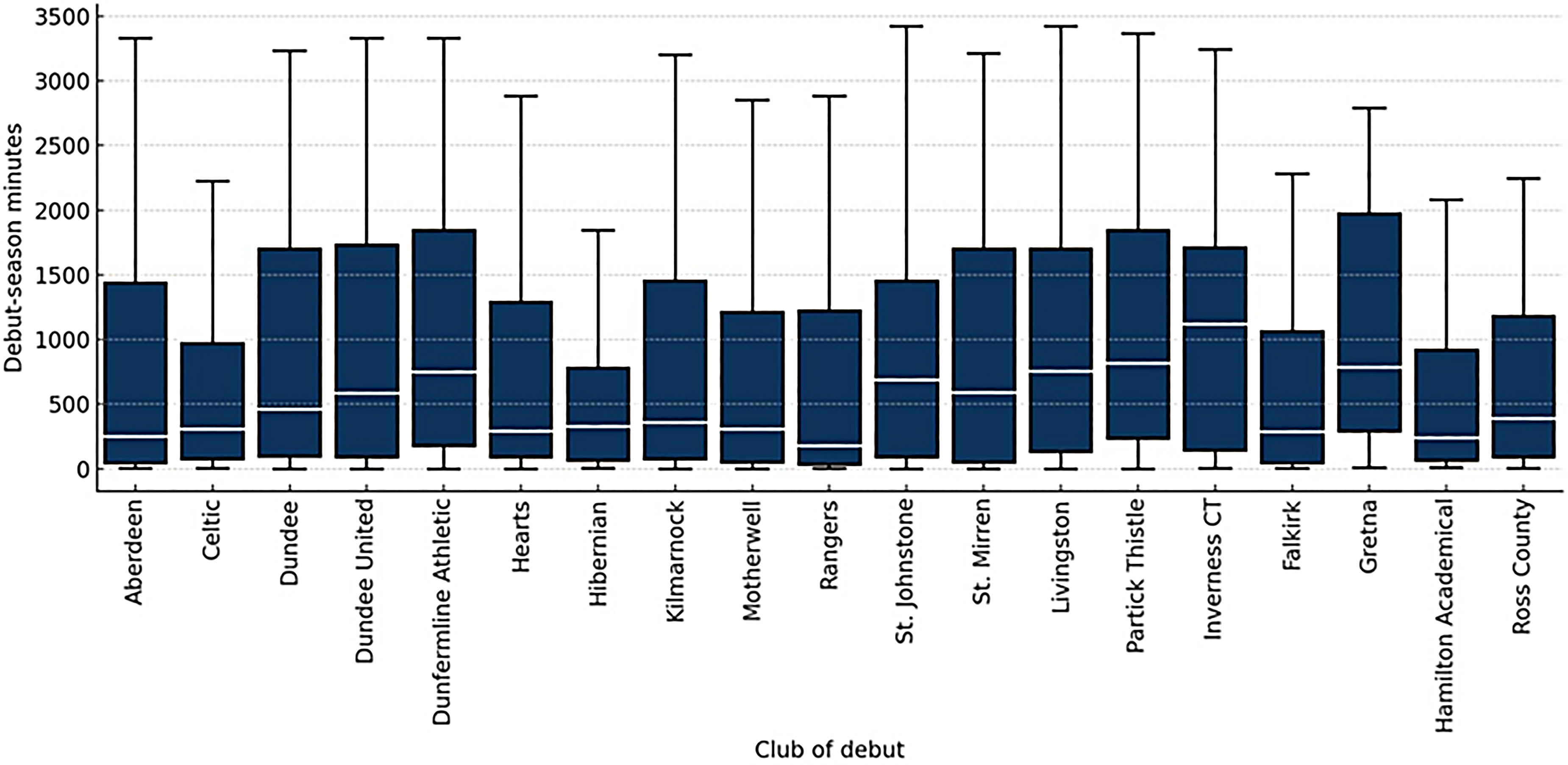
Distribution of debut-season minutes by club of debut in the Scottish top-tier.
Early trust and national team success
To extend these analyses to the national pathway, debut-season involvement was examined to explore whether early trust at club level predicted progression through the national pathway (see Fig 2). Controlling for debut age, logistic regression analysis revealed that greater debut-season minutes were significantly associated with higher probability of U16–20 representation (B = 0.000243, z = 4.32, p < .001, 95% CI [0.000133, 0.000354]), U21 representation (B = 0.000363, z = 8.61, p < .001, 95% CI [0.000280, 0.000446]), and senior national team representation (B = 0.000283, z = 6.48, p < .001, 95% CI [0.000198, 0.000369]), while debut age was negatively associated with all three outcomes (U16–20 B = –0.443, p < .001; U21 B = –0.162, p < .001; Senior B = –0.056, p < .001).
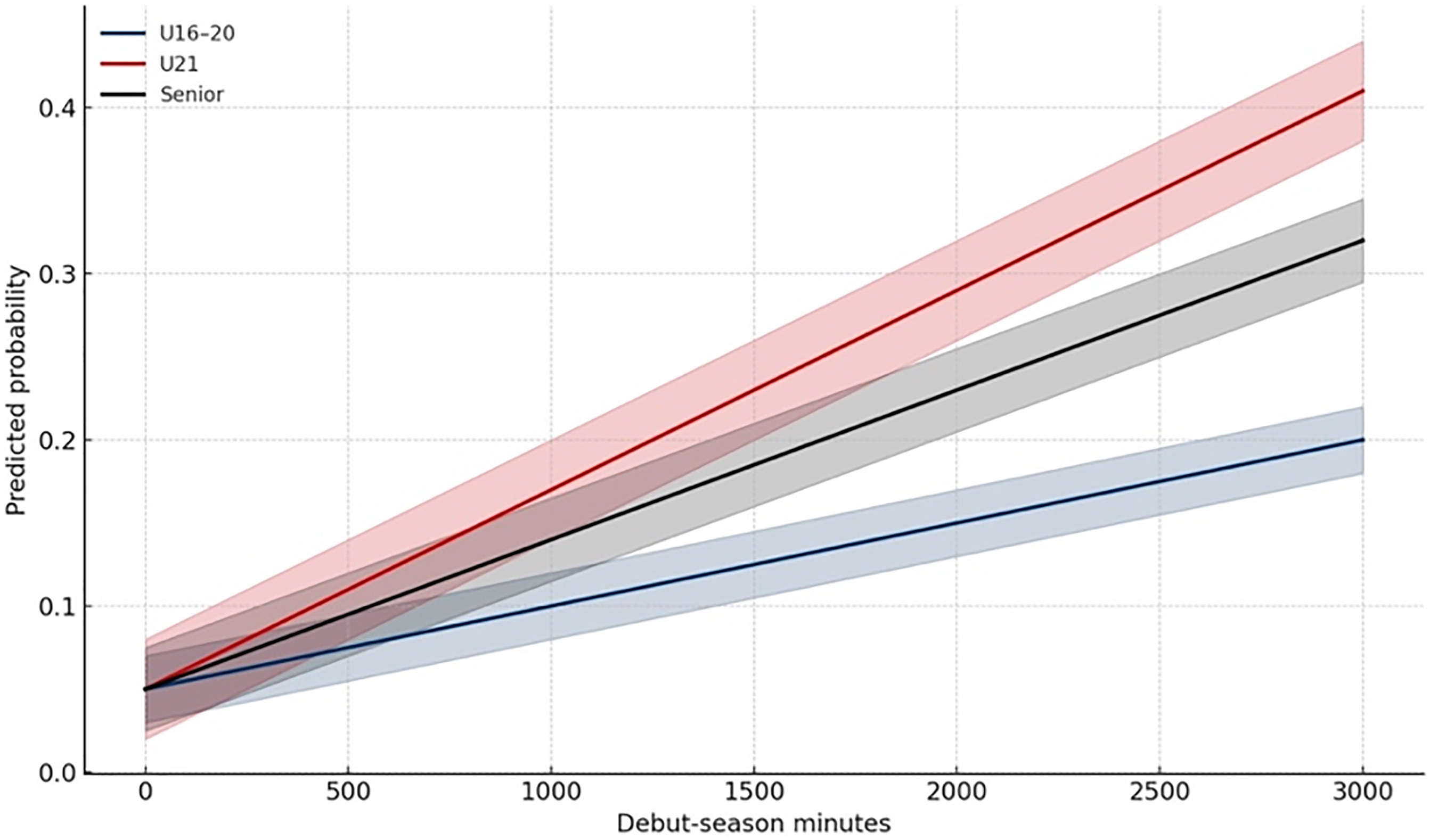
Predicted probability of U16–20, U21, and senior national team representation as a function of debut-season minutes.
Taken together, these results provide confirmatory evidence that the success factors identified earlier extend beyond club careers: players who debut younger and are trusted with greater debut-season club involvement (i.e., mins, appearances) are more likely to progress through every stage of the national pathway, culminating in senior national team representation. In doing so, these findings confirm a consistent pathway effect observed across analyses: early trust multiplies the chances of surviving and thriving at the domestic club level and of progressing through the national player development pipeline, compared with those players who received little or no early exposure.
Discussion
The present study examined elite player development in Scotland's top-tier league across 24 seasons with the aim of identifying the factors that enable Scottish players to break through, survive, and thrive at the elite level. The results demonstrated that early trust, defined as a younger debut age combined with meaningful debut-season involvement, emerged as the strongest factor predicting long-term success. Players entrusted with substantive first-season minutes were significantly more likely to consolidate their first-team place and also progress through the national pathway to senior team representation. In contrast, those debuting later or receiving minimal early exposure were more likely to experience limited breakthroughs, occupying fringe peripheral roles that were not sustained. Importantly, the analyses showed that while debut age was a significant predictor of progression, debut-season minutes and appearances were the stronger and more consistent factors across the models. This highlights that these two elements interact to shape the broader developmental impact of early trust. The archetypes derived from the modelling reinforced this distinction, with the Dependable and Thriving Pro archetypes sustaining elite careers because they carried both factors in their favour, whereas Early Flicker and Squad Survivor archetypes typically possessed only one or neither. The significance of early trust lies not only in accelerating physical, technical, and tactical adaptation but also in fostering the psychological strengths that underpin elite performance. Previous research has shown that exposure to meaningful responsibility at formative stages helps to cultivate confidence, courage, self-efficacy, and self-determination. Indeed, these intrapersonal attributes are recognised as essential to ‘make it’ and subsequently sustain elite level performance.2,23,24 In this way, early exposure acts as a catalyst that enables promising players to convert potential into sustainable achievement, even within structurally constrained systems. This interpretation also aligns with the work of Dugdale et al., 17 who also identified early debuts and meaningful exposure as critical facilitating factors for Scottish players, while also highlighting how such opportunities were frequently constrained by systemic barriers.
This finding is particularly salient in the wider structural context. Across the study period, results revealed that opportunities for Scottish players significantly declined, while reliance on foreign imports significantly increased. Indeed, the analyses demonstrated that seasons characterised by higher numbers of foreign imports were associated with fewer domestic debuts, underscoring the competitive pressures that limit opportunity for local talent. Previous research has suggested that such systemic pressures encourage clubs to recruit ‘ready-made’ players who require less developmental investment, 25 while coaches working under short-term performance demands often perceive the integration of young players as a competitive risk. 26 Yet the present findings indicate that taking this risk is associated with stronger long-term outcomes, both in terms of sustained careers and international progression. However, it is important to bear in mind that ‘correlation does not equate to causation’. Indeed, underlying player characteristics (e.g., natural ability, physical maturity, psychological readiness) may influence both the likelihood of receiving early opportunities and later progression. This includes the practical reality that coaches may afford early trust to players they judge to be exceptionally capable. This principle is often summarised by the coaching maxim, ‘if they’re good enough, they’re old enough’. Nevertheless, while we are not suggesting that simply accumulating more debut-season minutes is inherently better, the broader developmental pattern observed in the data suggests that talent is most effectively realised when clubs are willing to extend meaningful early trust.
Interestingly, at the domestic club level, the findings revealed that early trust was unevenly distributed across Scottish top-tier clubs. Smaller and mid-table clubs typically entrusted players with greater debut-season involvement, while those at the bigger clubs, particularly the Old Firm (i.e., Celtic and Rangers), afforded players significantly fewer debut-season minutes. This variation reflects how organisational philosophies and competitive priorities shape opportunity structures.25,26 A central factor lies in the concentration of financial and competitive power within the Old Firm. These clubs continue to prioritise short-term success and European qualification through the recruitment of experienced international players, often at the expense of sustained domestic talent development. In contrast, smaller clubs rely more heavily on domestic players, yet lack the financial resources, infrastructure, and exposure to consistently develop talent to elite standards. This bifurcation creates a bottleneck, where opportunities to debut exist, but progression into elite environments remains limited.27–29
At the same time, the results revealed a paradox. Although the Old Firm provided the least opportunities and the lowest debut-season minutes, those players who did break through and were entrusted with involvement were more likely to consolidate into established careers and progress to senior national team representation. In this sense, while developmental chances at the dominant clubs were scarce, they carried greater leverage when realised. This underlines a dual reality: smaller clubs offer more frequent playing opportunities, but the pathway to enduring professional status and international recognition remains disproportionately channelled through the elite environments of the dominant clubs. This supports evidence from other small football nations suggesting that progression may be shaped not only by talent scarcity but also, and perhaps more consistently, by systemic barriers that limit the conversion of early promise into elite achievement. 30
The influence of early trust also extended to the national team pathways. Again, the analyses demonstrated that players who debuted earlier and were afforded substantive involvement in their first season were more likely to progress through youth squads and reach senior national team representation. This developmental pattern is evident among several members of Scotland's squad that recently qualified for the 2026 World Cup. For example, Andrew Robertson, John McGinn, Kenny McLean, and Liam Kelly each accumulated more than 1000 min for their clubs during their debut Scottish top-flight season. This reflects a multiplying effect: once early trust is extended, its benefits accumulate across successive levels of competition. Early exposure enables players to adapt more quickly to senior demands, strengthens their visibility to selectors, and fosters the psychological readiness required to handle higher levels of responsibility. The result is a cascading outcome where the practices of clubs directly shape the strength of the national team. For a structurally constrained player development pipeline such as Scotland, the significance of this finding is notable. Indeed, with a limited player selection pool, the national team is heavily dependent on whether clubs create the conditions for talent to be trusted. Without such trust, the pathway narrows sharply, and promising players might fail to convert early potential into international achievement. This pattern is consistent with wider research showing that international-level players typically accumulate greater senior match experience earlier in their careers compared with peers who plateau.22,31 A comparative lens reinforces this point: while England has achieved repeated success in youth international tournaments, many of those key players (e.g., Harvey Elliot) appear to struggle to sustain senior team appearances in part because of limited opportunities in the Premier League's elite clubs, where competition for places is exceptionally high. In contrast, young players in nations such as Portugal may achieve less at youth international level but are afforded early trust in their domestic leagues, enabling them to accumulate first-team experience and transition more effectively into sustainable professional careers where the senior national team ultimately benefits. Collectively, these comparisons emphasise that the strength of national teams might, in part, be associated with the extent of early trust embedded within their domestic player development systems.
A further layer to this developmental picture concerns player migration. The findings showed that a notable proportion of Scottish players (n = 49) bypassed the domestic league entirely, instead entering Big 5 systems overseas. Prominent examples such as Scott McTominay illustrate how players who progressed through youth academies outside Scotland (i.e., Manchester Utd) often sustained successful careers at the elite level and contributed consistently to the senior national team. This pattern suggests that foreign environments may, in some cases, not only afford early trust but also a higher standard of developmental conditions that enable players to convert raw potential into realised potential. For the Scottish national team, such migration presents both strength and vulnerability. On one hand, the presence of players competing in elite foreign leagues enhances the quality and competitiveness of the national squad. On the other, it highlights persistent limitations in the domestic system, where constrained opportunities and uneven extensions of early trust push some of the most talented players abroad. Comparative examples, such as Belgium, 19 demonstrate the strategic value of cultivating strong domestic development pipelines while also leveraging external systems to provide complementary opportunities. From this perspective, migration should not be viewed solely as a loss of talent, but as a compensatory mechanism that reflects how opportunity is distributed across different developmental environments. Ultimately, the success of Scottish players abroad reinforces the central thesis that talent meets opportunity: when early trust is embedded within a high-quality development environment, whether domestic or foreign, the likelihood of sustained success and international impact increases.
Applied implications
The findings of this study highlight several practical implications for coaching practice, clubs, and governing bodies seeking to strengthen Scotland's development pipeline. For coaches, the results underline the importance of viewing senior team debuts not as an developmental endpoint but as the beginning of a critical transition phase. Young players entering senior professional football remain in a formative stage and require structured support to consolidate their place in the first-team squad. Transition plans that encompass technical refinement, tactical maturity, psychological readiness, and holistic recovery management can help ensure that early promise translates to realised potential. The most successful clubs for youth development recognise that breakthrough players are far from the finished article and manage this stage carefully. Therefore, coaches should adopt a mindset that treats debut-season game involvement as ‘meaningful minutes’ that provide genuine, progressive developmental exposure. In doing so, they extend responsibility in ways that build both performance capacity and the psychological strengths associated with players who survive and thrive at the top level.2,23,24 For clubs and youth academies, the evidence points to the value of establishing development environments that promote early trust. This requires greater alignment between academy and first-team coaching, with clear readiness indicators and coordinated handover processes for smooth pathway transitions. As part of this, consistency of language, expectations, and playing identity across the pathway would ensure players experience continuity rather than a developmental reset when stepping into first-team senior football. For the Scottish Football Association (SFA), the central implication is to incentivise environments that espouse early trust in young Scottish talent. In this study, smaller top-tier Scottish clubs played an important role as incubators of opportunity, and their contribution should be recognised not only as transitional but as vital to the national player pipeline. Practical measures might include outcome-based incentives that reward meaningful minutes for domestic players, or structured support for transition planning at the academy-to-senior interface. The SFA might also play a key role in facilitating international opportunities where domestic trust is constrained, ensuring that top Scottish talent who migrate abroad are supported in ways that align with national team objectives. Taken together, these implications emphasise the crux of the study: talent must meet opportunity in environments designed to nurture and challenge. Building trust into developmental practice through deliberate planning, alignment, and a willingness to take calculated risks is central to ensuring that Scotland's most promising players not only break through but also survive and thrive in the long term.
Strengths and limitations
A key strength of this study lies in its longitudinal design, spanning 24 seasons of Scotland's top-tier football competition. This extended timeframe enabled the identification of structural trends and developmental shifts that may be obscured in shorter or cross-sectional studies. The dataset was large, cross-verified, and multifaceted, capturing key performance indicators such as minutes played, appearances, debut age, migration patterns, and national team progression. This breadth supported a nuanced, ecosystem-level analysis of the Scottish player development pipeline. A further strength was the use of a stepwise analytical framework, which integrated foundational trend analysis, predictive modelling, and archetype development. This approach not only identified significant predictors of career progression but also translated them into practical typologies with applied relevance for coaching and development practice.
Nonetheless, the study is not without limitations. First, the dataset included only players who reached the top tier, potentially omitting those who exited the pathway early or succeeded through non-traditional routes. This introduces a survivor bias, which may underrepresent the systemic barriers faced by less successful or later-developing players. Second, while international progression data offered valuable insights into career trajectories, the study did not account for moderating variables such as injury history, playing position, or socioeconomic background, all of which may shape developmental outcomes in important ways.
Future research could address these limitations through the integration of qualitative methodologies, such as in-depth interviews with players, coaches, and technical staff, to better understand how development systems are experienced in practice. Mixed-methods designs may further illuminate how structural patterns intersect with psychological, cultural, and contextual influences on player progression. Lastly, future investigations could model the effectiveness of targeted interventions such as outcome-based incentives or coaching alignment strategies and extend this line of inquiry to other player development systems across Europe.
Conclusion
The central finding of this large-scale, longitudinal analysis is clear: early trust afforded to young players that centres around meaningful and substantive debut-season involvement, appears to be a significant factor underpinning their capacity to survive and thrive at the elite level. Creating development environments that afford such early trust might prove essential if Scotland is to overcome its apparent development bottleneck. Ultimately, the robustness of the ‘Tartan pipeline’ might be contingent on a simple principle: Future Scottish talent must meet with future opportunity.
Footnotes

Ethical considerations
This study was approved by the Sheffield Hallam University's Research Ethics Committee (approval no. ER87974108) on January 20, 2025.
Consent to participate
Not applicable.
Consent for publication
Not applicable.
Declaration of conflicting interest
The author(s) declared no potential conflicts of interest with respect to the research, authorship, and/or publication of this article.
Funding statement
The author(s) received no financial support for the research, authorship, and/or publication of this article.
Data availability
The datasets generated during and/or analysed during the current study are available from the corresponding author on request.