



Abstract
Netball presents a high incidence of anterior cruciate ligament (ACL) injuries, with evidence suggesting that catching a ball overhead, and lowering it below the pelvis, may exacerbate injury risk. This study investigated the biomechanical effects of ball position on landing mechanics during a 180° rotational countermovement jump. Sixteen female participants (mean age: 17 ± 1 years; height: 167 ± 5.87 cm; weight: 74 ± 17.57 kg) performed jump-landing tasks while holding a ball in four conditions: Down towards the leading limb (Down Leading), trailing limb (Down Trailing), chest-height, and centrally low. Portable VALD force plates and dual-plane video captured landing kinetics and kinematics. Variables included rate of force development (RFD) (N/s/cm), impulse (N.s/cm), and peak vertical ground reaction force (PvGRF) (N/cm), normalised to jump height. Repeated-measures ANOVAs with post hoc tests and Greenhouse-Geisser/Bonferroni corrections determined significance. The Trail limb exhibited consistently higher RFD (1158.17 N/s/cm) and PvGRF (97.55 N/cm) compared to leading (1012.84 N/s/cm, 90.49 N/cm), possibly due to participants braking with their trailing limb when rotating clockwise. Impulse did not differ significantly across conditions. Video analysis suggested low ball positions may have increased valgus knee collapse, trunk rotation, wider landing stance, and temporary loss of balance that required saving actions. A high incidence of failed jumps in moderately experienced (∼8yrs of exposure) players indicates potential need for further training of controlled jump rotation actions. Similarly, the findings highlight the importance of bilateral turning training to mitigate asymmetrical loading and indicates avoiding excessively low-ball positions, which may affect trunk control and balance.
Introduction
Introduced in 1906 as “Women's basketball”, 1 Netball was heralded then, as a “game suitable for every girl”. 2 Since its creation, the sport's popularity and participation among Commonwealth women has been growing, particularly amongst 13 to 18-year olds.3,4 Netball is a high-intensity game played on a court, with two opposing teams of seven players competing for control of the ball to score goals at their end. 1 The physical demands of the sport often vary between positions played, due to the rules that dictate the area of play each position can access (see Figure 1 below). 4
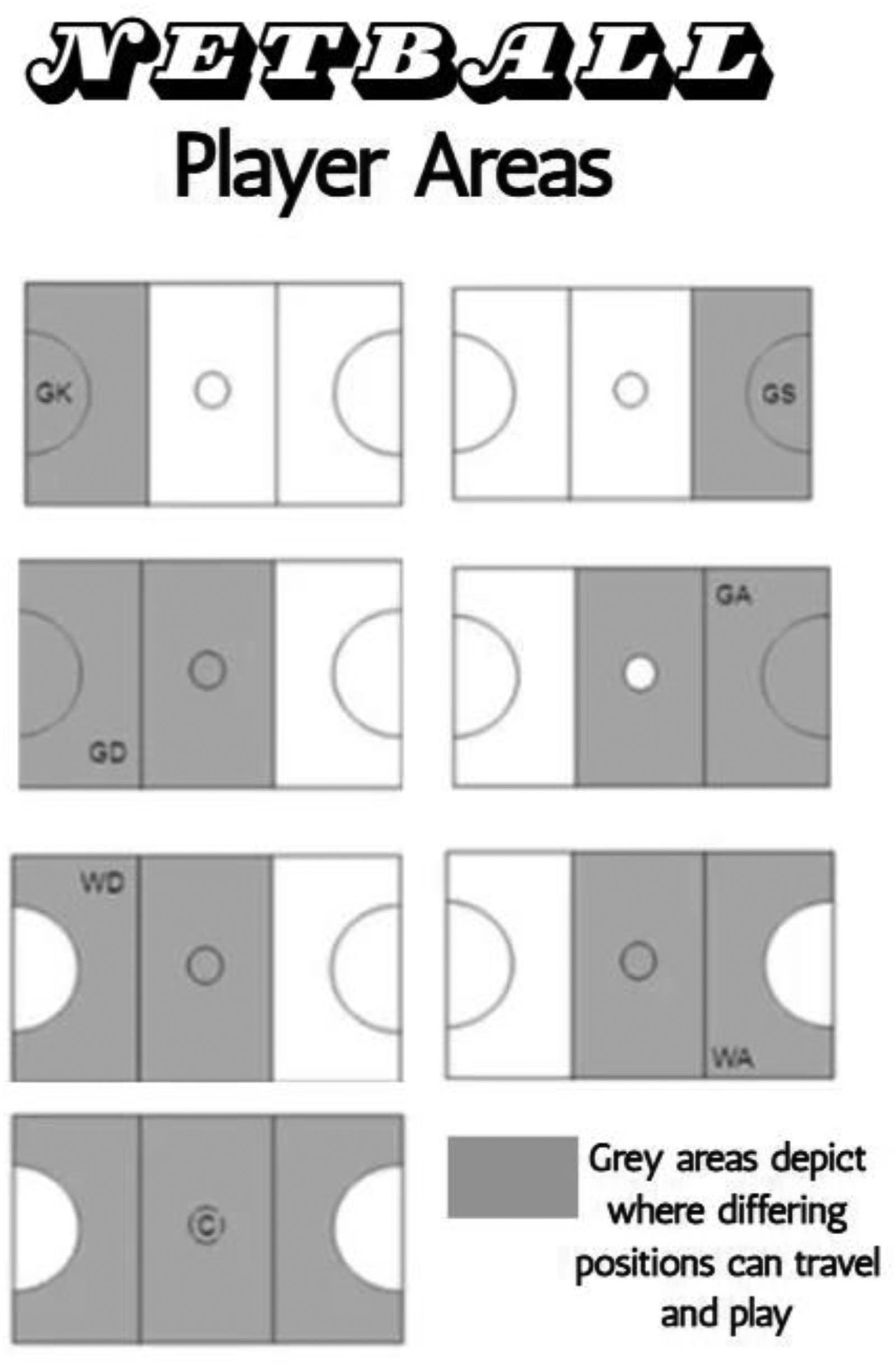
Designated areas of play for each player position.
Netball requires a range of explosive anaerobic movements, including repeated sprints, changes of direction (CoD), cutting, jumping and landing; often performed under pressure from the opposing player.5–7 During a 60-min game, netballers are believed to perform around 58 multi-directional jumps.5,8 Likewise, literature has shown during a game, players perform a CoD or cutting manoeuvre approximately every three to six seconds.5,9 Moreover, to avoid violating the unique rule of no-stepping whilst in possession of the ball, players must rapidly decelerate during the tasks above, creating significant braking forces through the lower-limbs.4–6
The primary body areas of injury concern in Netball are to the ankles, and knees, usually occurring from landings, impacts (with equipment or players), or falls.3,10 A knee injury of particular concern, is the Anterior Cruciate Ligament (ACL) tear or rupture. ACL injuries in Netball contributed to 14% of the total ACL injuries reported in NZ in 2023. 11 According to Accident Compensation Corporation (ACC) (NZ's non-profit national insurer) data, the average cost per ACL injury between July 2017 to June 2018 was $10,089.41. 12 There is also evidence to indicate ACL injury can cause players to retire early, cause emotional distress, hinder academic and athletic achievement 10 and lead to associated menisci damage with increased risk of osteoarthritis. 13
The most common mechanism of ACL injury in netball was found to be sudden deceleration from landing after catching a ball with a wide base of support, the injured knee in apparent extension and the foot planted.10,14,15 It has been suggested that clinical ACL peak strain and thus, injury, occurs during the first 50 to 70 milliseconds (ms) of peak vertical ground reaction force (PvGRF), dependent on contributing valgus deformity being placed on the tissue.16,17 Similarly, PvGRF limb asymmetries on landing may also increase injury risk, as little as 10 to 15% difference may significantly increase stress through a limb. 18 A study by Belcher et al., 14 suggested that a previously unexplored movement behaviour of bringing the ball low over an extended limb whilst landing from a 90°–180° turn, may play a role in ACL injury. It was speculated that these player actions may be performed to slow rotational momentum and break the force of landing. The Belcher et al. 14 study and others also agreed; a negative effect of poor trunk stabilisation (seen as increased lateral trunk flexion and/or extension), either with or without perturbation, leading to some loss of balance and potentially exacerbated forces through variable areas of the lower-limbs, henceforth increasing risk of injury.15,19–21 Finally, anatomical and post-pubertal differences in landing mechanism likely contribute to greater (4–8 times) ACL injury in females compared to males. 22 Females display greater landing forces and loading rates, lower recruitment of hamstrings to quadriceps torque ratios at high angular velocities, subsequently challenging ACL tissue overload increasing ACL injury risk.22–24
Overall, It is agreed that many sporting ACL injuries occur during complex and dynamic situations, requiring rapid decision-making and movement adaptations to unexpected external stimuli, with the player often having very little time to allow feedback-based replanning.22,24 Understanding injury mechanisms is an integral step in injury prevention research. 10 Therefore, the aim of this study was to investigate limb-specific kinetics and kinematics, when placing the ball in four commonly seen positions after the completion of a 180° counter movement (CMJ180). The hope is that the findings, in conjunction with future studies linking force to observational movements, may subsequently inform coaches, players, and support training staff on how to potentially improve jump-landing technique and/or behaviours. Ultimately, reducing ACL/lower limb risk and potentially game-specific performance.
Methodology
This observational study utilises quantitative data to explore landing forces from a repeated 180° counter movement jump (CMJ180) task.
Ethical approval
All participants provided informed written consent, and ethical consent for the research was granted by the Wintec Human Ethics in Research Group (HERG) on the 23rd of May 2024 (WTFE05080523-A), thus meeting the principles of the Declaration of Helsinki.
Participants
To meet this study's inclusion criteria, participants were required to be born of/or assigned the female sex at birth. With the increasing number of transgender female participants in sports, particularly in female-dominated community sports such as netball, determining the participant's sex prior to testing was essential. 25 There are several biological differences between transgender females and cis females (born of the female sex) that could ultimately alter the results of biological or biomechanical data outcomes of previous and current data. 25
Participants needed to have competed in at least one season of netball for some form of familiarity with the task and to reduce in-test injury occurrence. Participants had to be between 16 and 25 years of age, as this represented the demographic with the highest rate and significant cost of lower-limb injury in NZ. 3 Finally, participants should not have received a lower limb injury in the past six months that resulted in non-participation in sport or training for more than a week, as post-injury changes in strength, proprioception, and kinematics may lead to alterations in results. 26
Testing preparation
Testing was conducted at the participants’ regular training venues, with the surface (sprung or hard) recorded for data analysis purposes. This was done to confirm any impact of surface differential on the data recorded through the force plates, as softer surfaces have been found to affect the standard deviation and mean of jump force phases by increasing overall PvGRF and reducing RFD. 27 Field-testing at the participants’ regular training venue was chosen to improve ecological validity and reduce seasonal training routine interruptions or barriers. 28
Each participant completed health questionnaires to confirm inclusion prior to testing. Demographic data was gathered for each participant, including their most common position played (any specific positional differences), number of years playing (experience) and level of play (skill). Anthropometric data were collected using a stadiometer (Rod stadiometer; SECA 213, Hamburg, Germany) to the closest 0.1 cm. To take this measure, participants were instructed to remove their shoes and stand flat-footed, with their heels flat to the back of the stadiometer. Weight (kg) and an approximation of jump height calculated via the imbedded VALD FDLite force deck algorithm for flight-time. 29 Approximate jump height was measured using the algorithm h = (t2*g)/8, with h as jump height (m), t as flight time (s) and g is the gravitational acceleration (9.81 m/s2) and then converted to centimetres. 29
Prior to completing the task, the participants undertook a netball-specific short-form warm-up (see supplementary material). Participants were asked to wear a light or dark black t-shirt and preferably shorts or for their cultural or religious comfort, skintight leggings, and their usual training shoes.
Task testing protocol
For the task, a standardised netball was placed in the participants’ hands, and they then stood on two (left and right foot) VALD Force Decks 29 and faced towards a netball goal post. On command of a netball call ‘here’, they squat jumped, lifted the ball above their head, rotated 180° in the air, before landing back on the plates, facing away from the goal post. The participants performed a series of twelve 180° countermovement jumps with a ball in hand and, upon landing, brought the ball to either chest height, central but low (defined as below pelvis level), 14 low over the trailing limb or low over the leading limb. For example, if jumping clockwise, the leading limb would be the right and the trailing limb the left and vice versa for an anticlockwise jump. Participants would perform three jumps for each ball position, the order of which was randomly devised to reduce the training effect. The participants were given up to four test jumps to offer familiarity, so as not to cause increased fatigue and offered a suitable rest period between jumps. The results of all three jumps for each landing ball position were used for the data analysis.
Outcome measure
Video analysis captured observational movement behaviours via two 2D (sagittal and frontal) video recorders set one-meter high and three-meters distance from the force decks. To aid observational video analysis of lower limb joint angles and positional distances, biomechanical (9 mm sticky dot) markers were attached to the anterior superior iliac spine (ASIS), palpation of joint line was performed to approximate the knee joint centre, commonly found near the inferior pole of the patella, and the midpoint between the malleoli (to approximate the ankle joint centre). Finally, a further marker was placed 3 cm above the approximate ankle joint centre marker, to help the analysts better determine approximate ankle position in the case of highly reflective colour or obscuring trainer design. The placement of the markers was performed by the primary researcher, with >15 years of experience in human anatomy, surface palpation of anatomical landmarks and placing markers for motion analysis data collection.
Raw video was analysed through Kinovea, 30 the in-built software line and angle tools were used to help determine joint positions, apparent valgus collapse, knee extension, width and position of the players feet on landing. To help the analysts determine a response to the 17th characteristic on the screening tool “Use of arms, trunk or feet to correct apparent loss of balance”, the centre of pressure (CoP) trail from the VALD force decks was interpreted for sudden spikes in directional pressure that concurred with movement responses in the video. The cameras also aided the determination of incomplete or failed jumps where a participant's foot/feet did not remain on the force deck due to missing or losing balance and stepping off the plate.
The video analysis screening tool was adapted from Belcher et al., 14 and alterations were added to evaluate injury risk movements, rather than movements at the time of ACL injury (see supplementary material). The screening tool was developed in collaboration with the whole research team, plus the fit-for-purpose advice of one experienced Netball NZ physiotherapist (A.F = >8 years high-performance clinical role and >14 years of anatomical knowledge and netball coaching) and one physiotherapist (S.B) with extensive injury prevention/risk research and motion capture experience (>14 years). The same two authors (A.F & S.B) who developed the tool, independently viewed the videos and screened the jumps. If agreement between the two primary analysts could not be found, a third author (F.vM) and an experienced (>14years) high-performance strength and conditioning and movement analysist was utilised to offer a consensus vote of 2 versus 1.
Force outcome measures were normalised to jump height (cm). Therefore, the mean outcome reported represent values per 1 cm of jump height; for example, a mean value of 100 N corresponds to 1000 N at a 10 cm jump. RFD (first 50 ms from landing) (N/s/cm), and impulse (from landing to peak landing force) (N.s/cm) and PvGRF given as Newton-centimetres (N/cm), were measured via the two FDLite force decks. Each plate surface area is 30 × 48.5 cm, weight capacity is 2000 kg and data collected at a sampling rate of 1000 Hz. 29
Statistical analysis
All statistical analysis was performed using IBM SPSS Statistics 31 predictive analytics software. Descriptive data is presented as means, standard deviation (±) and standard error (SE). Effect size was reported as omega squared (ω2), a statistic that offers a less biased interpretation of effect size than partial eta-squared, reducing the chance of overestimating the population effect, especially in smaller sample sizes. 32 Omega squared thresholds are interpreted as small (≥0.01), moderate (≥0.06), and large (≥0.14). 32
Mauchly's assumption of sphericity was conducted across all pairs of conditions, if this assumption failed (p < 0.05), a Greenhouse-Geisser correction was applied. In addition, the assumption of normality was assessed by examining Q-Q and box plots and conducting Shapiro-Wilk tests. Normality was deemed acceptable if Q-Q plots showed approximate linearity and Shapiro-Wilk tests were non-significant (p > 0.05). To remove extreme outliers in force outcomes identified as non-normally distributed, the data was ‘trimmed’ using Winsorization process. In this instance, we set our Winsorization boundaries to manipulate data that was above the 95th and below 5th percentile, correcting the scores to read as ± 0.10 higher or lower than the next score within the 6th-94th inter-quartile range. 33
Initial analysis was performed using a two (limb: Leading, Trailing) by four (ball position) repeated-measures ANOVA test, to examine the relationship between the two independent variables (limb and ball position) on the dependent variables (RFD, Impulse or PvGRF). Potential confounding variables (surface, position, experience, skill) were explored to determine any significant variance that might affect the model, if this was determined to be the case then ANCOVA test results were reported instead. Further, Bonferonni-adjusted post-hoc comparisons were applied to control for multiple comparisons, if significant (p < 0.05) main effects were found on results. 34
Video analysis of each participant's jumps applying the observational movement screening tool is presented as descriptive frequency data in the form of incidence (number of times the observation occurred) and as a percentage against the possible number of chances the movement action could be observed for each jump position. Cohen's Kappa was performed to measure interrater reliability between observers for each jump and represented as a mean score for each ball position and across the tool. Interpretation of Cohen's Kappa results were interpreted as values 0–0.20 (none to slight), 0.21–0.39 (minimal), 0.4–0.59 (weak), 0.60–0.79 (moderate), 0.80–0.90 (strong) and >0.90 (almost perfect). 35
Results
Sixteen participants were enrolled in the study (age: 17 ± 1 years; weight: 74 ± 17.57 kg; height: 167 ± 5.87 cm), with an average of eight years of netball playing experience. When potential confounding variables, such as age, skill level, leg dominance (participants all indicated their right limb), or years of experience were added to the ANOVA modelling, no significant effect was found. Of note, only 18% of the jumps were performed anticlockwise.
Force outcomes
For all three force outcomes, RFD (p = 0.236), PvGRF (p = 0.202) and Impulse (p = 0.228), the 2 × 4 repeated ANOVAs indicated no interaction effect for Ball Position * Limb.
Ball positions
The RFD values indicate that the 2 × 4 repeated ANOVA Ball Position did not violate Mauchly's assumption of sphericity (p = 0.734) and produced a significant, large effect size (df = 3, F = 9.51, p = <0.001, ω2 = 0.15). Likewise, PvGRF also indicated a significant and large effect size between ball positions (df = 3, F = 12.56, p = <0.001, ω2 = 0.20), whilst impulse indicated a significant but moderate effect size (df = 3, F = 7.51, p = <0.001, ω2 = 0.12). Table one shows the post-hoc testing outcomes for each ball position separated by force outcome.
The Chest ball position had a significantly (p = <0.001–0.009) higher RFD (1247.38 N/s/cm) compared to all other ball positions (Down Leading = 1060.78 N/s/cm; Down Trailing = 996.91 N/s/cm; Central Low = 1036.94 N/s/cm). Similarly, for PvGRF Chest ball position had a significantly (p = <0.001–0.005) higher mean (106.28 N/cm) compared to all other ball positions (Down Leading = 92.37 N/cm; Down Trailing = 87.66 N/cm; Central Low = 89.77 N/cm). As Table 1 indicates, impulse showed several significant differences between positions, with the Down trailing position having a marginally higher score (4.09 N.s/cm) than the other positions (Down Leading = 3.13 N.s/cm; Chest = 4.07 N.s/cm; Central Low = 3.83 N.s/cm).
Post-Hoc tests for mean differences between ball positions.
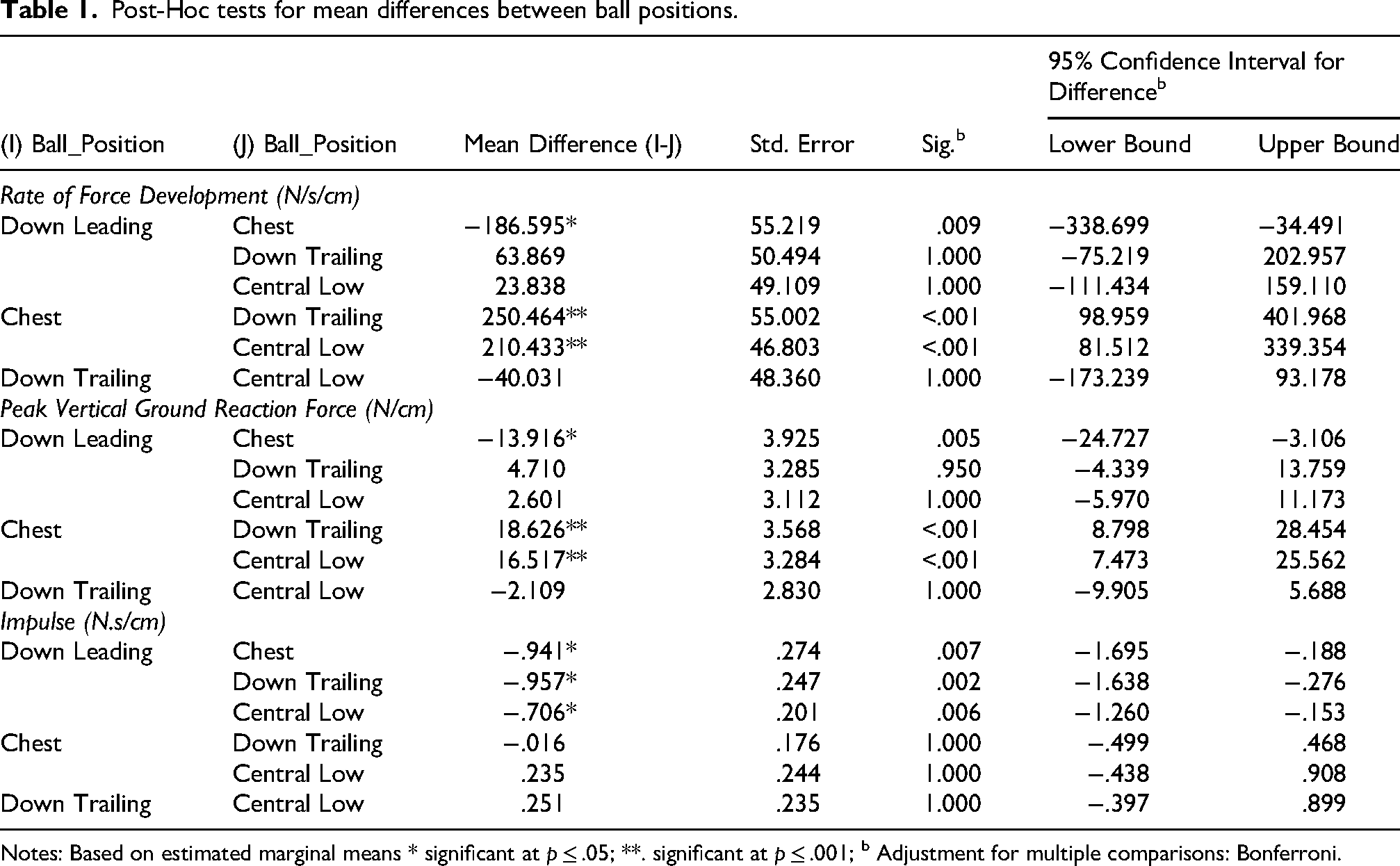
Notes: Based on estimated marginal means * significant at p ≤ .05; **. significant at p ≤ .001; b Adjustment for multiple comparisons: Bonferroni.
Limb differences
Table 2 shows the descriptive data for each limb by ball position. Across all ball positions, the mean RFD was significantly (df = 3, F = 5.72, p = <0.021, ω2 = 0.09, moderate) greater in the trail limb (1518.17 N/s/cm) compared to the lead limb (1012.84 N/s/cm). Similarly, this was the case for the mean PvGRF (df = 3, F = 7.64, p = <0.008, ω2 = 0.13, moderate), greater in the trail limb (97.55 N/cm) compared to the lead limb (90.49 N/cm). In contrast, for impulse, the lead limb exhibited greater mean forces (3.84 N.s/cm) across the ball positions compared to the trail limb (3.73 N.s/cm) but were not significantly (p = 0.509) different within the ANOVA results.
Descriptive data for each limb by ball position.
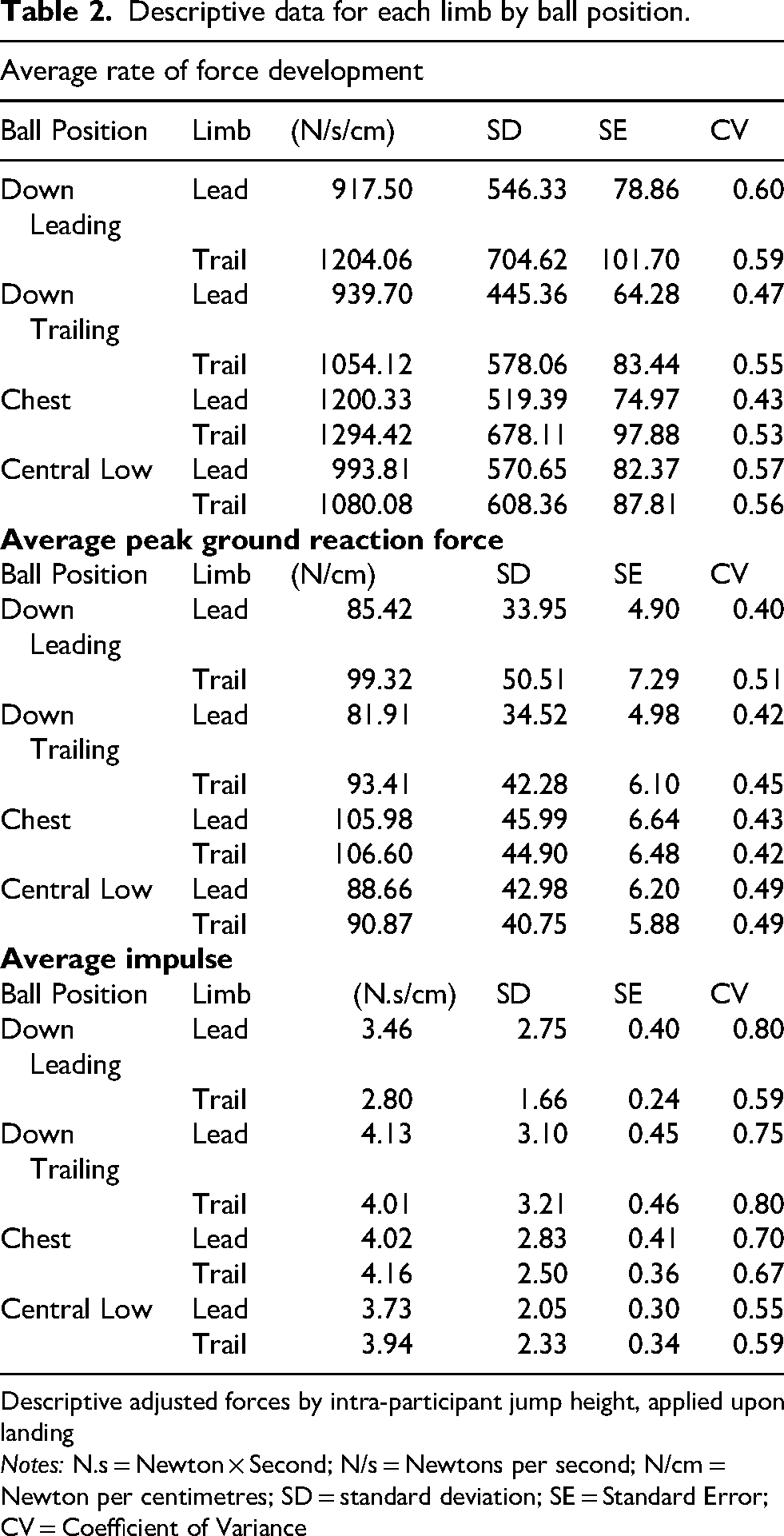
Descriptive adjusted forces by intra-participant jump height, applied upon landing
Notes: N.s = Newton × Second; N/s = Newtons per second; N/cm = Newton per centimetres; SD = standard deviation; SE = Standard Error; CV = Coefficient of Variance
Analysis of observational movement behaviours
As there were 16 participants, the total number of opportunities an observational movement behaviour could have been seen on video analysis for each ball position was 48 (16 × 3 jumps). At the bottom of Table 3 the inter-rater reliability score for each position and as a mean for the observational screening tool can be seen. Video analysis indicated 12 failed jumps for the down trailing leg position (9×lost balance and stepped off plates, 3×too wide and missed plates), four failed jumps for down leading position (3×lost balance and stepped off plates, 1×shifted too far right and missed plate) and two fails each for chest and central low position (due to shifting too far to the right and missing the plates). This accounts for 20 failed jumps or 41.6% failure rate of the required 48 successful jumps. Table 3 below details the frequency by which each movement behaviour occurred.
Video analysis screening tool frequency data and inter-rater reliability.
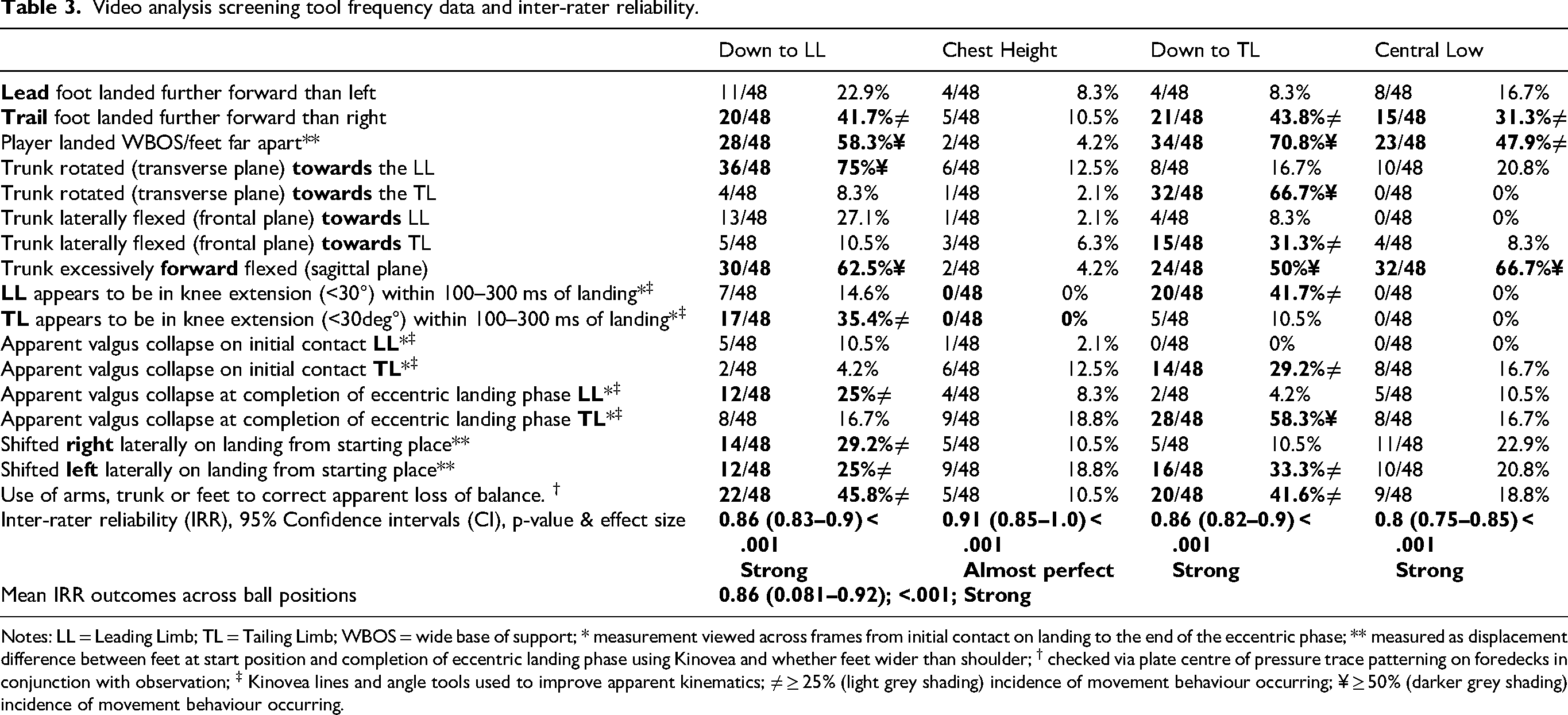
Notes: LL = Leading Limb; TL = Tailing Limb; WBOS = wide base of support; * measurement viewed across frames from initial contact on landing to the end of the eccentric phase; ** measured as displacement difference between feet at start position and completion of eccentric landing phase using Kinovea and whether feet wider than shoulder; † checked via plate centre of pressure trace patterning on foredecks in conjunction with observation; ‡ Kinovea lines and angle tools used to improve apparent kinematics; ≠ ≥ 25% (light grey shading) incidence of movement behaviour occurring; ¥ ≥ 50% (darker grey shading) incidence of movement behaviour occurring.
The table indicates that the Chest height position appears to be the most risk-averse and likely stable. It is the only position that did not require a wide base of support (WBoS), although to counteract the often-clockwise rotation movement of the participants, the trail foot was often placed beyond the right (10.5%). Although this was more pronounced in the second least scoring position (Central Low), where 31.3% of the time the participants trail limb ended beyond the lead limb. Like the chest height position, the central low position did not score above ≥25% on many of the observational actions, but participants tended to end with their trunk excessively flexed forwards (66.7%) to accommodate the low-ball and a WBoS (47.9%).
Analysis of both the Down Leading and Trailing positions showed some similarities, in that participant's ≥ 50% of the time ended with their trunk flexing too far forwards. Also, when landing in both positions, >65% of the time, participants rotated towards the side they were bringing the ball down, and >40% of the time indicated some form of immediate sway/saving actions, either using their arms, feet (heels brought down) or trunk movement to apparently re-balance. Which was further supported by following the CoP trace from the VALD force decks to look for concurrent spikes in directional shift, that linked to the visual movement saving actions on video. Both positions showed on completion of landing an apparent valgus ipsilateral to the side they were dropping the ball, though it was twice as prevalent on the Down Trailing side (58.3%) to the Down Leading position (25%). The final similarity between these positions was that participants showed apparent knee extension (<300 in the first 100–300 ms) 35.4% (down leading) and 41.7% (down trailing) of the time on the contralateral side to which they were dropping the ball. Participants also tended to shift left across the plates (33.3%) when bringing the ball down to the trailing limb, more so than any other position (18.8–25%). Visual representation of the typical landing position for all three positions can be seen in Figures 2(a)–(d).
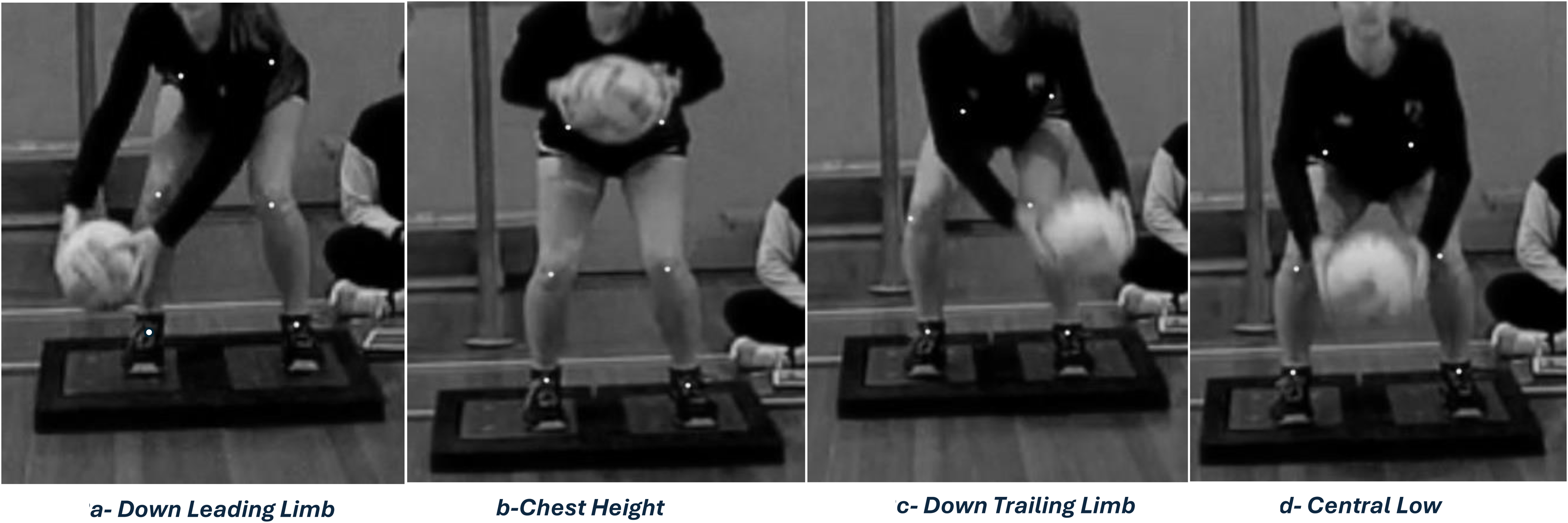
(a–d) Effects of ball position on landing mechanics after completion of a 180-degree jump in female netball players.
Discussion
This study's results show a clear trend of increased PvGRF and RFD in the trail limb when compared to the lead limb. These results indicated a mean increase in RFD of 12.5% in the trail limb (1158.17 N/s/cm vs 1012.84 N/s/cm) across all positions compared to the lead, although only a 7.3% mean difference of PvGRF was found in the trail limb (97.55 N/cm vs 90.49 N/cm). This increased force in the trail limb may be attributed to the participants’ trying to negate rotation during their 180° turn, to ascertain landing on the force decks, they likely used their trail limb to decelerate (brake) their rotational momentum. This need to suddenly reduce momentum and come to a stop somewhat replicates the action in netball when a player goes from receiving a ball in defence and rotating to a forward attacking position, whilst avoiding the violation of the stepping rule.5,14,15
The Down Leading ball position has the second-highest trail limb PvGRF (99.32 N/cm) and RFD (1204.06 N/s/cm). The Down Leading position likewise had the highest asymmetrical percentage limb difference (14%) for combined PvGRF and RFD compared to down trailing (11.5%), Central Low (5%) and Chest 3.3%. This may further support the theory that the increased force development and rapid rate of deceleration in the trail limb may be partly acerbated as a product of the player trying to negate largely clockwise rotational momentum by braking/decelerating. In this case, to propagate the even greater effect of the ball direction, which may be further dragging the player around in the clockwise direction at a higher velocity. Suggesting that ball position, especially bringing the ball down towards the leading limb when turning clockwise, may place the participant at greater asymmetrical inter-limb forces. Literature has suggested that an inter-limb asymmetry in force production of even 10–15% may result in additional stress being placed on one leg, ultimately increasing an individual's injury risk and potentially inhibiting their performance.18,36
A higher energy absorption (EA), especially within the first 50–100 ms, is when ACL injury is believed to occur,16,17 and even more so if a frontal plane forward loading landing profile bias transpires.18,36,37 Though research recognises that high moment through the ACL created by a high RFD may increase injury risk, perhaps, contrastingly, low decelerative RFD may also cause some risk.36,37 A low RFD may indicate poor early activation of eccentric muscles that could control and protect joint stability.36,37 Regardless, inadequate shock attenuation during landing has been linked to injuries such as articular cartilage damage, ligament ruptures, bone bruises and meniscal tears. 23 36–38 Norcross et al., 36 found women to be 3.6 times more likely to use a landing strategy that increased greater frontal-plane EA during the initial 100 ms of landing, which ultimately led to an associated less favourable frontal-plane biomechanical profile (greater peak knee valgus angle and hip adduction).
The current study showed that overall, EA represented by landing impulse (initial contact to the peak landing force) did not significantly differ between limbs but did between ball position. The Down Leading position indicated a lower mean impulse score than all the other positions (Chest −0.94 N.s/cm; Down Trailing −0.96 N.s/cm; Central Low −0.71 N.s/cm). The lack of a significant difference in impulse between limbs may be accounted for by examination of the observational video findings. These findings resulted in most positions ending with a deep hip and knee flexed profile and bar the chest height, excessive forward trunk flexion to accommodate the low-ball placement. These flexed landing profiles likely absorbed the impact of landing more equally over time.
Contrastingly, in terms of the initial EA impact expressed via RFD (first 50 ms of initial contact), this study presented significant differences both between limbs and positions. As discussed previously, the greater PvGRF in the trail limb was likely due to the decelerative braking action of the trail limb to reduce rotational momentum, logically, if the participants are attempting to reduce momentum, this may explain the greater RFD in the trail limb also. However, more likely a greater RFD in conjunction with unfavourable landing biomechanics or joint moments may produce higher risk for a player. Literature has shown that hip, knee and ankle joints contribute to shock absorption via energy dissipation by the joint muscles.36,37,39 Future studies that can offer more quantifiable joint position measures of the trunk and lower limb, in conjunction with muscular activation correlated at different RFD may better describe energy dissipation for these previously unanalysed rotational ball landing positions. Subsequently, offering coaches, support persons and health providers a better understanding of the potential risk profiles from these jump-landing actions.
Finally, the observational video analysis showed that some ball positions appeared to require some players to perform a quick saving motion to counteract an apparent loss of balance. These saving actions occurred concurrently with spikes in CoP directional patterns produced on the force decks. The patterns showed largely a shift of CoP from anterior to posterior, where players appeared to be falling forward as they lowered the ball, then attempting to right themselves leant back. This is in keeping with the finding that most failed jumps (60%) came from leaning too far forward with the momentum of the ball coming down, losing balance and stepping off the plates. Additionally, the positions where the ball was brought from high to low largely generated landing profiles that included a WBoS and a flexed forward postures. 19 Literature has indicated a relationship between a greater loss of balance and proprioception in bilateral or unilateral limb landings, subsequently increasing risk of lower-limb injury.14,15,19 Likewise, for the coach and player, a loss of balance may also lead to violating the ‘stepping’ rule called by the umpire as ‘travelling’. Other than stepping off the plate when they lost balance, the other failed jumps occurred when players shifted too far laterally to the right or landed with an extreme WBoS, missing the plates, which, if occurring in game, could have a player landing off-side or out of bounds. Finally, the general high incidence of failed control of jumps (41.6%) from moderately experienced (∼8yrs of exposure) cohort indicates potential need for further training of controlled jump rotation actions, which are regularly performed throughout the game.
Another observation is that for both positions that brought the ball down to their side, increased signs of trunk collapse, laterally, anteriorly and transversely towards the ball occurred. Trunk collapse has been highlighted as increasing subsequent ACL injury risk, propagating greater ipsilateral valgus collapse and increased frontal and sagittal loading profiles, detrimental to EA.14,19,21,36 Contrary to this, the two ball positions with the least asymmetry and trunk collapse are the chest and central-low positions.
The positive effects of training to reduce poor biomechanical profiled landing have been deemed achievable in previous literature.26,40 Therefore, to help reduce inter-limb asymmetrical loading, trunk collapse, alongside the potential effects of loss of balance, coaches and support staff (exercise conditioners and physiotherapists) could improve landing by hitting the targeted space correctly with a more upright but bent knee position. Similarly, our results suggest they could encourage players not to drop the ball to low on landing and offer added variation of rotation in all directions for more equal bilateral limb loading. This could be coupled with targeted strengthening of the lower limbs and trunk to counteract the effects of any asymmetrical or poor landing profiles.19,26,37 This may not only be beneficial in reducing injury risk but also performance, as players who drop the ball low increase the chance of interception of their next pass. Likewise, reducing the chance of losing balance may stop players from having to take saving step movements, which break game rules.
Limitations & strengths
There are some limitations to the study, firstly, the number of participants. With a lower number of participants, the likelihood of a Type II error potentially obscures true effects. Although, appropriate statistical corrections were applied to mitigate this limitation. 41
Secondly, concessions for the task itself must be made. The study task attempted to replicate movements enacted by players during a netball game, essentially rotating from defence to attack. However, participants were offered a choice on which direction they wished to rotate, with only 18% of the jumps being performed anticlockwise. This may have been attenuated by all the participants perceiving themselves as right limb dominant. The methodology in the future should perhaps control for direction of turning, to offer the opportunity to more equally explore the effects of the rotational direction on these ball positions. Although it is noted that as the participants were able to choose the direction they wished to jump, it did offer some more ecological valid observation of common behaviour. If normal player populations are largely choosing to rotate in one-direction, this further propagates the need for coaches and players to train variations of jumping rotation to reduce the asymmetry discussed within this study.
Recognition is also made that the current algorithms imbedded within VALD FDLite force decks, calculate jump height via flight time with the underlying assumption that participants land with the same lower limb configuration as the take-off. In other words, it assumes that the centre of mass starts flight and ends flight at the same location. 42 However, as our jumping task imposed a change in the jump and landing foot position occurred on a different plate from take-off, there is the potential that there are errors introduced to the jump height calculation. 42 Thus, jump height must be considered an approximation throughout the study.
We acknowledge that the use of 2D video meant that exact joint moments and positions could not always be accurately identified. Critical observable features (i.e., trunk position, valgus knee, joint angles) were determined via a combination of unified expert opinion and the use of the Kinovea in-built line and angle tools to offer some level of simplistic quantitative suggestion, which may reduce the reliability of findings. However, the observational screening tool did offer some signs of usability and reliability, which is represented by a strong inter-rater reliability of d = 0.86. Though, the authors recognise that the observations were performed by two experienced clinicians with extensive biomechanical analysis skill and may not be as reliable when utilised by a less experienced or knowledgeable coach. However, of consideration is that the observational screening tool was designed and adapted from previous video analysis literature studies which similarly were unable to utilise 3D biomechanical joint moment analysis or force outcomes.14,15 Likewise, it offers a similar opportunity to qualitatively suggest landing mechanic behaviours as previously validated tools such as LESS. 43
Future studies
Future research should consider the use of portable inertial measurement units, with marker less 3D video analysis systems and muscle activation through wireless electromyography, to replicate greater ecologically valid game-specific manoeuvres. These could include some form of short-distance high-intensity run-up prior to jumping, alongside aspects of horizontal action with concurrent rotation.14,15 Future studies might also wish to explore the effects of rotation direction against the dominance of the participants’ limb. Finally, an interventional study that investigated the effectiveness of a targeted strengthening programme on reducing inter-limb asymmetrical overloading and high EA landing profiles may also be beneficial.
Conclusion
Greater PvGRF and RFD were observed in the trail limb across most positions when compared to the lead limb. Observationally, with participants turning clockwise, their trail limb likely acted as a braking force, often placed into extension to decrease the moment of turning regardless of ball position. This was accentuated further by bringing the ball low and particularly to the Down Leading position. It may be, therefore, beneficial for coaches to look at offering variation in the rotational direction of jumps in training, to reduce overloading of the asymmetrical limb.
Chest position and central-low, however, showed the least asymmetrical force between limbs and, therefore, perhaps reduced the effect of asymmetrical loading on the risk of injury. However, some consideration must be made to the fact that there may be greater familiarity with the chest position, as it is often taught as an early correct handling position by netball coaches.
Likewise, it would seem prudent in match-play conditions, whether game play or in training, to discourage dropping the ball low once received above the head from a jumping catch, particularly when dropped low to either side. These low ball and to the side positions tended to increase trunk collapse and create some apparent loss of temporary balance control. Instead, a central chest position likely remains the most appropriate if the player flexes their knees and hips, along with some plantar flexion at initial contact to improve EA. These training changes will hopefully reduce lower-limb injury risk and improve some performance outcomes.
Supplemental Material
sj-docx-1-spo-10.1177_17479541251411069 - Supplemental material for Effects of ball position on landing mechanics after completing a 180-degree jump in female netball players
Supplemental material, sj-docx-1-spo-10.1177_17479541251411069 for Effects of ball position on landing mechanics after completing a 180-degree jump in female netball players by Suzanne Belcher, Ryan Overmayer, Frans van der Merwe and Amanda Foster, Barry Cavanagh in International Journal of Sports Science & Coaching
Footnotes
Acknowledgements
We are grateful to the research participants who contributed to the success of this study. No external grants were received.

Ethics
Human Ethics in Research Group of Waikato Institute of Technology (WTFE05080523-A 23rd of May 2024).
Funding
The authors received no financial support for the research, authorship, and/or publication of this article.
Declaration of conflicting interests
The authors declared no potential conflicts of interest with respect to the research, authorship, and/or publication of this article.
Data availability statement
Further data is available upon reasonable request.
Supplemental material
Supplemental material for this article is available online.
References
Supplementary Material
Please find the following supplemental material available below.
For Open Access articles published under a Creative Commons License, all supplemental material carries the same license as the article it is associated with.
For non-Open Access articles published, all supplemental material carries a non-exclusive license, and permission requests for re-use of supplemental material or any part of supplemental material shall be sent directly to the copyright owner as specified in the copyright notice associated with the article.
