



Abstract
The enhanced visibility and support for women's sports, represented by events including the 2023 FIFA Women's World Cup, and gender parity at the 2024 Paris Olympic Games (half of the competing athletes were women) are noteworthy. Despite these gains research with and for cisgender female athletes remains underdeveloped. Presently the majority of sports science research is based on male athletes. Accordingly, these studies do not address the intersectional experiences of cisgender females, contributing to significant knowledge gaps. Currently, testing and training protocols do not adequately address their efficacy among cisgender female athlete cohorts, especially in relation to fluctuating hormones, differences in body composition and biomechanics, and sociocultural influences including overall training history and movement literacies. Accordingly, this commentary identifies and critically discusses the complexities associated with this research and knowledge gap (including gender inequities, biological differences, and environmental influences), while urging a more inclusive, intersectional approach to research, training, and policy to better support cisgender female athletes’ health and athletic performance.
Keywords
Introduction
Globally the spotlight on women's sport continues to increase with events like the 2023 FIFA Women's World Cup and the 2024 Paris Olympic Games attracting unprecedented media coverage and financial investment. Despite this increased visibility and investment in women's sport, research addressing the factors shaping cisgender female athlete performance remains underdeveloped. Problematically, it has been widely documented in recent years that most of this sports science research has been conducted on male cohorts, typically non-elite athletes. This is problematic for any athlete regardless of sex or gender as the evidence base informing athletic training protocols infrequently reflects athlete attributes. 1 This issue is amplified for cisgender female athletes where the opportunity to train and compete, enter developmental pathways, and access to performance staff and resources remains vastly different to their male counterparts. Reflecting this tendency, sports performance protocols and guidelines can and often neglect the physiological and psychological effects of issues specifically pertaining to cisgender females, such as the menstrual cycle and intersecting differences tied to fertility, pregnancy, mothering and athletic performance. 2 Positively in the past five years a significant number of studies have centred on cisgender female athlete performance, many of which replicate male based studies. While studies have drawn attention to greater consideration of research methodologies, 3 and the more accurate use of terminology e.g., sex versus gender, 4 we posit that intersectionality related to the cisgender female athlete experience must be central to the research design, training and competition. It is therefore the intersectional influences that we identify and critically discuss through the proceeding commentary.
As an interdisciplinary group of female researchers, from various institutions and areas of disciplinary expertise (sociology, health and exercise science, sport management) we extend an intersectional lens to critically discuss the nuanced effects of the aforementioned identified research gaps pertaining to female elite and sub-elite athlete health, wellbeing and performance. In so doing we conceptualise how interlocking systems of power shape athletes’ experiences in ways that (re)produce inequities across gender and other categories of difference including but not limited to race, ethnicity, sexuality and ableism.5,6
Drawing from the following key themes, (a). Gender equity and intersectional differences, (b). Biological differences, representative evidence, and practice (c). Environmental enablers and Psycho-cultural factors, we identify and problematise absences and priorities, acknowledging the multiple and intersecting determinants of health and performance for female athletes in elite and sub-elite environments.
Female and women athletes – terminology
Through this commentary and with the aim of not perpetuating the erroneous use of gender- and sex-based terminology, we have endeavoured to use words that reflect the simultaneously sex- and gender-based influences on the athletes that we focus on through this commentary. As described by Walton et al. 7 we understand ‘sex’ (female/male/intersex) to refer to the physiological, anatomical, and biological characteristics of an individual. ‘Sex-based differences’ include reproductive anatomy, body size, and hormonal profiles. We understand ‘gender’ (woman/man) to be a social construct that encompasses societal norms regarding men's and women's perceived ‘normative’ and ‘appropriate’ roles and actions. ‘Gender-based differences’ include the influence of oftentimes-restrictive beliefs about women's bodies and physical activities, including ‘appropriate’ body size and shape and access to ‘masculine’ sports and physical activities. To acknowledge the intersections of sex and gender in the construction of athletic performance, we use the term “cisgender females” to describe the population we discuss herein. These are female athletes whose gender identity aligns with their assigned sex and thereby are more likely to share several gender- and sex-based experiences of sport. In the instances wherein we use the terms “female” or “woman,” we do so to denote that the influences we discuss are predominantly biological or sociocultural in nature, rather than a combination of the two.
Extending an gendered intersectional lens originally articulated by Crenshaw 8 on behalf of black women, we recognise how disadvantage or discrimination does not exist independently but intersect and overlap with attributes such as age; disability; ethnicity; gender identity; race; religion; and sexual orientation. In relation to the present commentary we understand that binary sex and gender categories can inaccurately construct male and female bodies and gendered identities as homogenous and oppositional categories. 9 For example, not all people who experience menstruation, or menstrual cycle disorders, are female or identify as women. Transgender men, intersex individuals, and non-binary and gender-diverse people also experience menstruation and disorders of the menstrual cycle, facing unique yet potentially similar challenges to cisgender female athletes. Therefore, although we focus on cisgender female athletes in this commentary, the gaps in research that we highlight may be relevant to the experiences of transgender men as well as intersex, non-binary, and gender-diverse people who are also managing their reproductive health and sport performance, a discussion that we return to in the conclusion.
Gender equity and intersectional differences
“Equality of opportunity” for women athletes has long been framed as a noble and important goal to be achieved in sport.
10
Despite promising equal access to resources, expertise, training opportunities, and competition, “equality of opportunity” can nevertheless unintentionally obscure and perpetuate gender inequities that impact cisgender female athletes’ performances, experiences of menstruation in sport, and overall well-being. For example, women's participation is still undermined by outdated assumptions regarding the impact of physical exertion on reproductive health.
11
“I get the comments of being called a man, being called too masculine, because I have muscles,” Maher said. “I know that it's from very sad, insecure people online. But I know they’re saying it to other girls as well. And that's what I don’t like.” Ilona Maher (USA Rugby Olympian)
Relatedly, women navigate accusations of being “unfeminine” that are amplified by the media, particularly in traditionally masculine sports like rugby. 12 These narratives, which inaccurately assert women's physical inferiority, can invalidate women's athletic skills while simultaneously placing disproportionate scrutiny on their bodies. 13
Discourses of gender equality further complicate the performances and sporting experiences of cisgender female athletes, with menstruation providing just one pertinent example. Indeed, long-needed changes such as menstrual-friendly uniform designs, have only recently and often against the backdrop of backlash, been introduced in sports like tennis, rugby and soccer. 14 Coaches, many of whom are men, persistently lack education about menstruation and the menstrual cycle, which can negatively affect the health, well-being and performance of cisgender female athletes. Further, a focus on gender equality over equity also shapes the research environment. As an example, Findlay et al. 15 highlight how even well-meaning equality discourses can lead to oversight, such as the absence of menstruation-specific research in collision sports.
While increased athlete advocacy, including the “Sport Your Period” campaign, usefully highlight efforts toward addressing menstrual taboos. 16 Often and problematically the labour of this advocacy rests on the athletes themselves. Further still, many athletes do not engage others about their menstrual cycle due to a desire for privacy, while others remain hesitant to discuss or disclose menstrual disorders like endometriosis or heavy bleeding, fearing they may be perceived as liabilities, especially in team environments. 17 The prevalence of these conditions in addition to relative energy deficiency in sport (RED-S) and other disorders further underscore the adverse effects of menstrual knowledge gaps among athletes and coaching personnel. 18
Yet women are not a homogenous group. Rather, women in sport are characterized by a myriad of sociocultural differences, including but not limited to ethnicity, class, religious affiliation, and sexuality, which contribute to nuanced and layered subjectivities and affect their sport performance in different and complex ways. For example, scholars are increasingly exploring how cultural and religious norms may exacerbate menstrual stigma and taboo, requiring coaching strategies and training practices sensitive to these differences. 14 Drawing from this literature, we note that gender-equitable practices in sport and research involving cisgender female athletes require nuance and sensitivity, inducing researchers and practitioners to move away from a ‘one size fits all’ approach to understanding and improving cisgender female athletes’ sport experiences and performances.
Biological differences, representative evidence, and practice
Research in sport and exercise science is overwhelmingly male dominated. Indeed, only 6% of studies focus exclusively on (ostensibly cisgender) female participants, 1 and while approximately 35% of the broader sport science literature includes females, it is often in comparison to males as the default body. Similarly, Pandit et al. 19 observes that most sport science research is conducted by men, with male athletes, leaving cisgender female athletes, who are increasingly present in both recreational and elite sport- underrepresented and/or overlooked. Women's absence from these settings hampers the development of evidence-based guidelines for female athlete training and performance such that it remains unclear to what extent cisgender males and females require differentiated training guidelines. Sex differences in muscle fibre composition, 20 lung and heart size, 21 and maximal strength appear to impact performance outcomes across sports, with research finding male athletes outperform cisgender female athletes by 10% to 30%, depending on the sport. 22 Injury rates and types also appear to differ based on athlete sex and might suggest the need for sex-based training and prevention strategies. Notably, sex-based injury rates and types may diverge due to gendered influences including sport participation levels and movement preparation,23,24 an area of research that is overlooked yet is vital for improving performance.25,26
Two frequently discussed areas of purported biological difference between male and female athletes relate to the mechanisms of Anterior Cruciate Ligament (ACL) injuries, and concussion. However, an emerging narrative suggests that gendered considerations may also play a role. For example, female athletes sustain a greater number of concussive episodes and frequently have worse outcomes than their male counterparts. 27 However, whether this is due to innate differences such as differences in neurobiology, 28 or differences in neck strength28, 29 attained through training is unclear. Some research indicates that neck strength and training of this muscle group is likely impacted by gendered factors and is not an inherent biological difference. Similarly, the increased likelihood of ACL injury in female athletes was previously ‘explained’ through biological differences such as wider hip structure and increased ligament laxity. However, Parson's and colleagues suggest that the gendered sporting environment (sub-par playing surfaces, ill-fitting sports equipment, and lack of athletic preparation) may have a more pronounced impact on this type of injury. 26 Furthermore, Ronca et al. 30 posited a cognitive basis for injury rates for females as they found visual spatial skill differences throughout the menstrual cycle. Such a change could lead to females misjudging position or distance thus effecting movement execution.
As demonstrated here, many of the suggested biological influences on performance and injury, cannot and should not be considered in isolation without consideration of the influence of gendered environments both current and historical. We suggest addressing these gaps through targeted, longitudinal studies to advance women's sport and improved female athlete short- and long-term health and wellbeing. 31
Environmental enablers and psycho-cultural influences
Over the past decade, as sport professionalism has expanded, so has the global investment and interest in women's sports. Greater funding from federations, clubs, and organizations, enhanced media coverage, and increased commercial activity have collectively elevated the visibility and valuing of female sports. Importantly this growth has also improved access to support staff, such as sports scientists and coaches, who are critical for athlete training and performance.
32
Despite these changes, few female athletes generate sufficient income from their sport and supplement their income through additional paid employment placing further material and psychological demands that affect their health, wellbeing and performance. “We are the best in the world, have three World Cup championships, four Olympic championships, and the men get paid more to just show up than we get paid to win major championships,” Hope Solo, (American Women's Soccer, goalkeeper)
Further, significant disparity persists between the resources available to female and male athletes.32,33 We observe how, when compared to their male counterparts, many professional women's sports teams (some of whom we work with) do not employ full-time staff required to appropriately support women's sport performance and wellbeing. Further, those appointed to support roles for women's teams are often men, constructing further barriers, including a reluctance for male coaches to engage in conversations unique to female athletes, 34 or that male coaches do not think to ask. These contextual influences or considerations relate to what Emmonds et al. 32 classify as ‘female sporting environment’ factors, as opposed to ‘female athlete’ which relates to the biological differences. Importantly, Emmonds et al. 32 emphasize that both the environment, and the athlete must be considered together in relation to the research used to inform training. Specifically, those working with and for female athletes should appraise and evaluate the available research to ensure it is representative of elite or sub-elite sport requirements.3,35 However, due in part to the historical tendency to appoint men to leadership, managerial, and support roles, women's numerical and cultural representation remains inequitable and deeply resistant to change. 35
In a more detailed and nuanced approach, Pascoe et al. 11 applies Brofenbrenner's ecological systems to outline the key psychological stressors influencing the mental health of women athletes, inclusive of both elite and sub-elite levels. Some key diverse and intersecting factors were raised in this work regarding the myriads of potentials (or existing) gender-specific factors causing stress, strain, or tension on the female athlete, and thereby negatively impacting their mental health and wellbeing. 35 Grouped according to individual, interpersonal, organisational, and sociocultural systems, specific psychosocial stressors affect women athletes. Specific stressors may include any or a combination of fertility, mothering, care responsibilities, postpartum return to sport, violence, abuse, sexual harassment, and exploitation. Moreover, negative media attention or lack of media representation, wage disparity, lack of support (structural or other), and the under-representation of women in leadership roles also contribute to the challenges female athletes negotiate.36,37
Implications and summary
The extant literature illustrates how the daily life, training, and competing environments of female athletes form a multidimensional, nuanced, intersecting, and interrelated system that frames the performances of cisgender female athletes (Figure 1). As a result, researching and working with female athletes is complex and demands a broad and holistic approach with a gendered intersectional lens attentive to the sociocultural, biological, and psychological experiences of cisgender female athletes. Owing to vast differences within this population, future research must be unshackled from tendencies toward positioning female athletes as homogenous. Data and the cohorts from which they are drawn, together with approaches to analysis, must relatedly look beyond binaries and homogeneity. Given the increased interest and participation in women's sport, there is a growing need and trend (albeit slower) to consider the female athlete's experience in research, practice, and policy and with methodological difference.
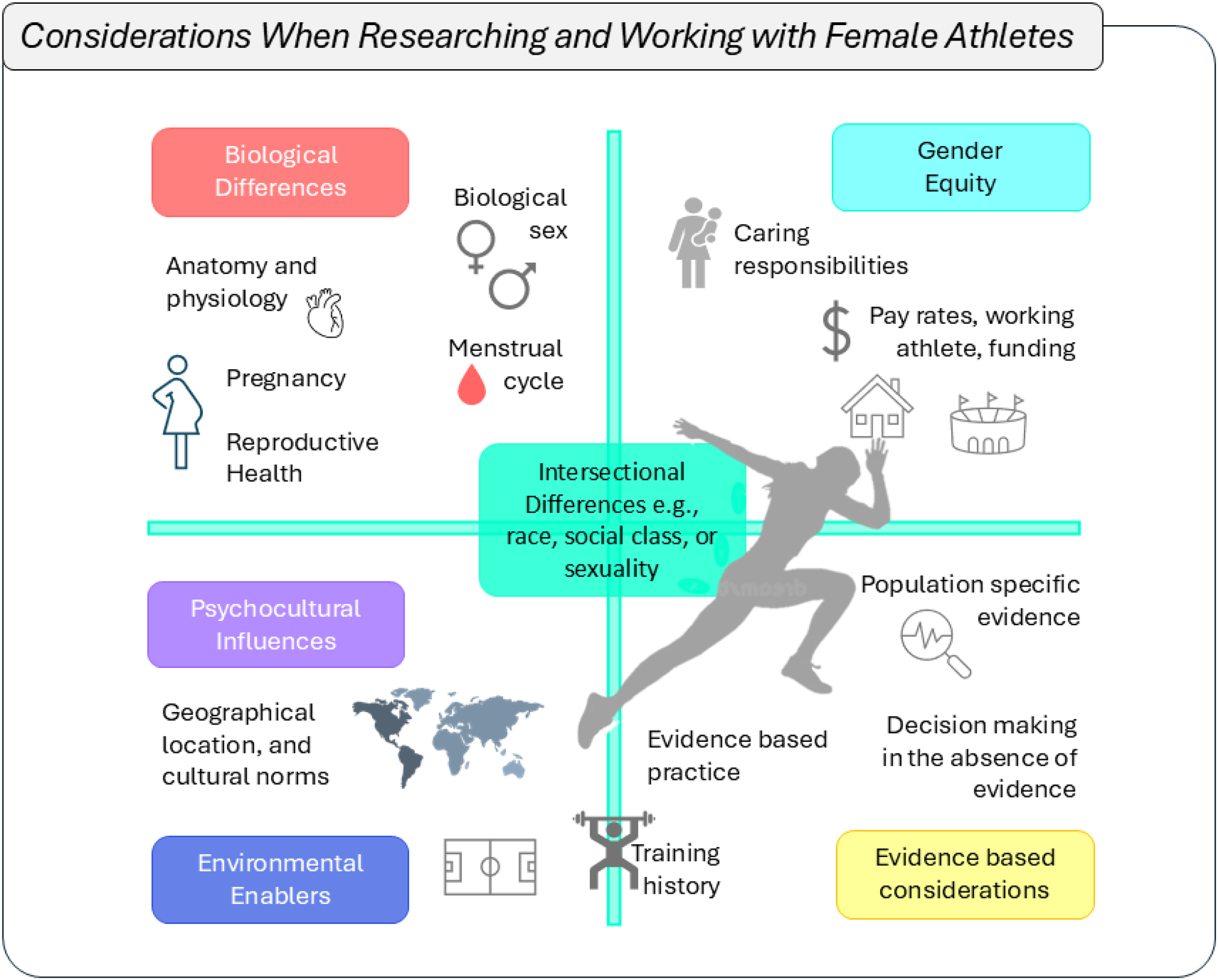
Intersectional considerations when working with and for female athletes.
To advance research and practice for cisgender female athletes’, a more holistic set of key influences need to be considered by researchers, coaches, managers, and athlete's themselves. These key influences include, when a biological question is proposed in research, the use of accurate gold standard measurements of hormonal profiles. 3 Assumptions concerning the influence of hormonal variation, without accurate quantification will continue to undermine our understanding of the impacts of female biology on health and performance outcomes. Second, and of perhaps more importance to the cisgender female athlete is the inclusion of methods that support the understanding of the intersection of sex and gender, requiring a new methodological approach.4,31,38 Third, women should not be researched in relation to their male ‘counterparts’. 38 Fourth, and most importantly, coaches working with women should consider the athlete holistically rather than using sex or gender as the sole indicators for their training strategies and practices. Not only do sex- and gender-based coaching practices frequently draw on stereotyped, essentialist, and inaccurate beliefs about sex and gender, 39 but at present there is insufficient data to indicate that women will adapt differently from men in response to exercise programming, or the demands of sport. As such, there is no evidence of a requirement to train or treat women differently, or with a ‘less than’ approach. Yet as we have argued in this commentary, cisgender female athletes occupy sport environments with different experiences and opportunities which inequitably shape their development and progress. We therefore advocate that athlete sex and gender must be considered as just two factors among many that influence athletic performance. Finally, we advocate for dedicated efforts in the form of funding commitments that must be made to advance cisgender female athletes and women's sport more broadly, pushing fore equity in treatment that has long been vital.
Footnotes
Acknowledgments
None.
Author contribution
KAS led this paper from inception, development, writing and editing. All other authors MO, CB, ADH, and MN contributed to the development, writing, and editing of all versions of this paper.
Declaration of conflicting interests
The authors declared no potential conflicts of interest with respect to the research, authorship, and/or publication of this article.
Funding
The authors received no financial support for the research, authorship, and/or publication of this article.
