



Abstract
The aim of this study was to monitor changes in vertical jump force-velocity-power (FVP) profiles following hypertrophy (HYP) and combined maximal strength and power (CMSP) training in youth Australian Football athletes. This study implemented a single group, within-subject, non-randomised crossover design, prescribing sequential HYP and CMSP training to improve countermovement jump (CMJ) performance measured with FVP profiles. Twenty-one males (age: 17.2 ± 0.7 years; height: 183.8 ± 6.6 cm; body mass: 76.9 ± 6.2 kg) completed pre-testing, four-week HYP-mesocycle, midpoint-testing, four-week CMSP-mesocycle, and post-testing. The 8-weeks training comprised 2-sessions per week (16 sessions total). Pre-mid-post-testing involved unloaded (bodyweight) and loaded (50 kg) CMJ's on dual-force plates to create FVP profiles using Samozino's method to calculate raw (mean concentric force, velocity, and power) and theoretical (maximal force [F0], maximal velocity [V0], force-velocity relationship slope [Sfv], and maximal peak power [Pmax]) variables. One-way ANOVA assessed changes in all variables. Unloaded and loaded CMJ heights significantly increased after HYP and CMSP-mesocycles (post-testing, p ≤ 0.001), with only loaded CMJ height improving after HYP-training (mid-testing, p = 0.034). There was no change in raw variables after HYP training (mid-testing). However, mean concentric force, velocity, and power significantly increased in unloaded and loaded CMJs following HYP and CMSP-mesocycles (post-testing, p ≤ 0.001). Of the theoretical variables, only F0 significantly improved after HYP training (mid-testing, p = 0.023), yet after HYP and CMSP training, F0 and Pmax were significantly improved (post-testing, p < 0.001). Sequential HYP and CMSP block periodised training significantly improved unloaded and loaded CMJ height, all raw FVP variables, and theoretical F0 and Pmax in youth Australian Footballers.
Introduction
Vertical jumping plays an important role in team sports like Australian Football (AF), where jumping higher to win offensive and defensive aerial duels can affect contests that influence game outcomes. 1 Jump height profiling is commonly used to evaluate jump performance, and is frequently included in a battery of tests used to assess and rank athletic ability during the talent identification process for elite sports. 2 In the AF talent pathways, superior vertical jump height is strongly linked with successful selection in both state (Development Academy, Colts Level or Talent League under 19 competitions) and national (i.e., state representative under 16 and state under 18) teams. 2 While jump height alone is a common metric, it poorly reflects lower body power, as it ignores the force-velocity (FV) trade-off critical to power production, which has implications for other aspects of player performance (i.e., sprinting and change of direction).3,4
In contrast, vertical jump force-velocity-power (FVP) profiling provides a more comprehensive assessment by evaluating an athlete's ability to produce both force and velocity. FVP profiles are generated using anthropometric data and loaded vertical jumps, progressing from bodyweight to a load reducing jump height to ∼10 cm.5,6 Four key variables derived from an individual FVP profile are theoretical maximal force (F0), theoretical maximal velocity (V0), the slope of the FV relationship (Sfv), and maximal power (Pmax).5,7 These variables demonstrate high reliability, with intraclass correlation coefficients (ICC) of 0.89–0.99 and coefficients of variation (CV) typically below 5% for assessing neuromuscular capabilities of athletes.8,9 FVP profiling enables coaches to identify individual strength, monitor training effectiveness, and target areas for improvement by assessing F0, V0, and Pmax.5,10 For large squads, the validated two-point method offers a time-efficient alternative to the multi-load FVP profiling protocol, using two loads (i.e., bodyweight and 50 kg) to estimate the FVP relationship with minimal fatigue.11,12
Jump performance in youth athletes is influenced by multiple factors through a combination of biological maturation, motor skill learning, and structured resistance training interventions, which are among the more effective modifiable and developmental factors. 3 To optimise these improvements, a well-structured block periodisation model, sequentially incorporating hypertrophy followed by combined maximal strength and power (CMSP) phases, is recommended. 13 Hypertrophy training, involving high volume and moderate loads, effectively enhances fatigue resistance and muscle cross-sectional area, supporting muscular endurance for sport-specific tasks like sprinting and jumping.14,15 However, the resulting increase in body mass may hinder movements requiring high relative power output. In contrast, CMSP training, low volume with varied loads performed at maximal concentric effort, optimises neuromuscular adaptations for explosive strength and power.16,17
Resistance training in youth athletes has primarily focused on improving vertical jump height through hypertrophy or CMSP methods. However, hypertrophy alone may not sufficiently develop the high-velocity force production needed for sports performance.15,16,18 McKinlay et al., 15 reported that hypertrophy training improved squat jump height, while power training enhanced squat jump and countermovement jump (CMJ) height in youth soccer players. Chelly et al., 16 reported power training significantly improved CMJ, squat jump, drop jump height, and sprint time in youth track athletes. Additionally, Lloyd et al., 17 demonstrated that CMSP training enhanced CMJ height by improving neuromuscular coordination and rate of force development. However, no studies to date have investigated resistance training's impact on vertical FVP profiling in youth athletes, representing a critical gap in the literature. Block periodisation, commonly utilised in seasonal team sports, structures sequential mesocycles targeting hypertrophy, maximal strength, and power development to optimise performance before competition. 19 While hypertrophy provides the structural foundation for movement, it does not always translate directly to enhanced neuromuscular performance during a task like jumping, highlighting the importance of specific neural stimuli from CMSP training. 18 Conversely, CMSP training improves functional strength, force production, and explosive capabilities critical for CMJ performance. 20 Integrating a CMSP training block into pre-season can enhance one's ability to generate force rapidly (i.e., power), which is key to improving CMJ height and overall athletic proficiency. 21
While previous research shows resistance training enhances jump performance and FVP profile variables, there are limited investigations within a block periodisation framework. This is pertinent for youth athletes, where combine testing, inclusive of jump testing, is frequently conducted at various points throughout the season for talent identification. To our knowledge, this study is the first to investigate the effects of a pre-season block periodised training programme, including two distinct mesocycles, on unloaded and loaded jump height and FVP profiles in youth athletes. We hypothesised that both unloaded and loaded jump height, as well as vertical FVP profiles, would improve after completing both the hypertrophy and CMSP mesocycles, but not after the hypertrophy mesocycle alone.
Materials and methods
Subjects
Twenty-one development academy AF athletes from the same club (age: 17.2 ± 0.7 years; height: 1.83 ± 0.07 m; body mass: 76.9 ± 6.2 kg) participated in this study, ensuring consistency in their regular training environment. Body mass was recorded at the start of the research and measured on each occasion at pre, mid-, and post-testing to ensure accurate data for performance assessments. A homogenous sample of male subjects was selected due to accessibility. A post-hoc power analysis based on the primary outcome (CMJ peak power) confirmed the sample size (n = 21) provided sufficient statistical power >0.80 to detect medium effect sizes (d = 0.5), supporting the adequacy of the sample for the chosen within-subjects design. Inclusion criteria included a minimum of six months of resistance training experience. Seven out of twenty-eight volunteers were excluded due to unrelated injuries, release from the academy, or being statistical outliers (± 3 standard deviations (SD) from the mean for concentric power).22,23 All subjects (and parent or guardian, if under 18) provided written informed consent. Pre-exercise training history and health screening questionnaires confirmed eligibility. All subjects had at least 6 months of prior resistance training experience under supervision. Subjects were verbally instructed to refrain from any external and strenuous lower body resistance training outside of the study protocol to control for additional training load. The study was approved by the University's Human Research Ethics Committee (ethics registration 20247275-18824).
Design
A within-subject, single-group, non-randomised crossover trial was conducted to assess the effects of hypertrophy (HYP) and CMSP training on jump height and vertical FVP profile in youth AF athletes. Each subject completed pre-testing, four-week HYP-mesocycle, midpoint-testing, four-week CMSP-mesocycle, and post-testing (Figure 1). Pre-, mid- and post-testing of jump performance comprised maximal concentric effort unloaded and loaded (broomstick and 50 kg) CMJ's using a two-point approach to develop vertical FVP profiles.12,24 Comprehensive assessments during each testing phase included unloaded and loaded countermovement jumps (CMJs) using a two-point approach to develop vertical FVP profiles.11,12 Testing sessions involved performing maximal effort CMJs with a broomstick (0.5 kg) and a 50 kg load. The highest jump height from each condition was used to calculate individual FVP profiles. An independent familiarisation session was conducted to collect anthropometric measurements and ensure correct CMJ technique before the pre-testing. Each mesocycle included eight supervised sessions (two per week), scheduled on consistent days every week for each subject.
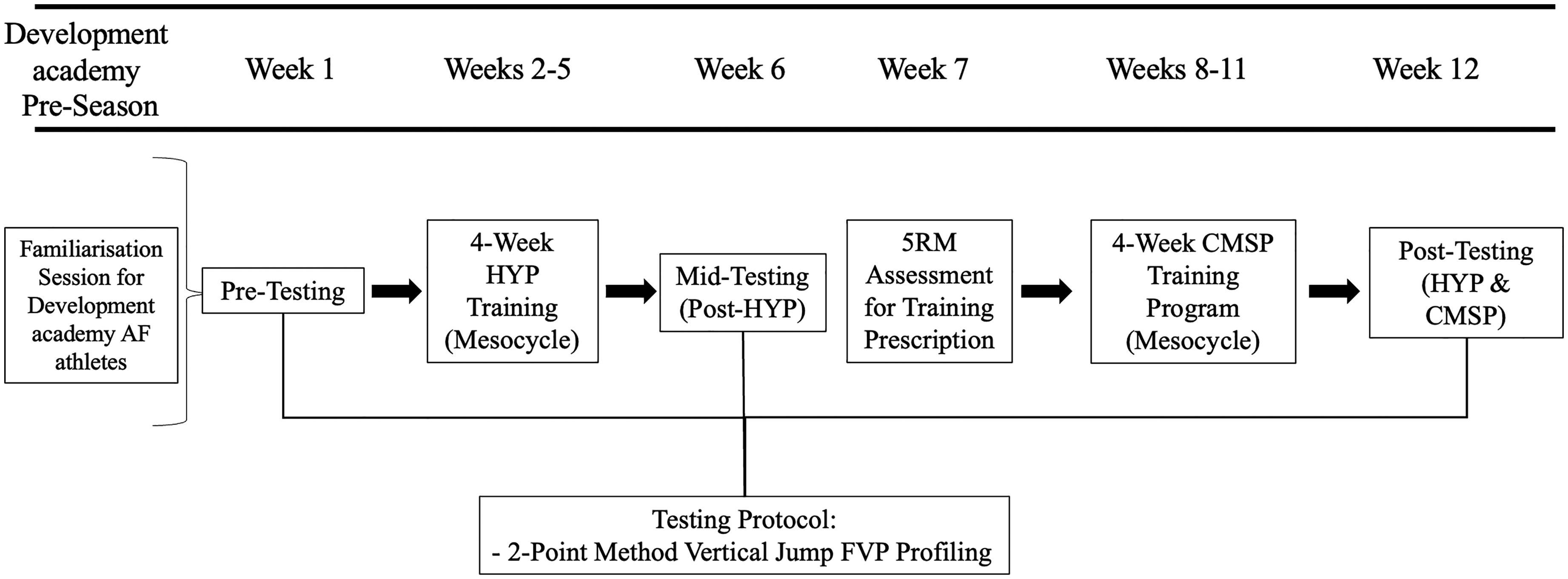
Overview of the study protocol flow diagram, illustrating the experimental design and timeline for testing and training interventions, including hypertrophy and combined maximal strength and power mesocycles.
Methodology
Familiarisation session
The familiarisation session was conducted three to seven days before pre-testing. We collected subjects’ anthropometric measures including standing height, body mass, and relevant CMJ variables necessary for calculating the FVP variables using the Samozino method.11,12 These measures included leg length (measured with fully extended foot plantar flexion), initial squat depth (90° knee angle), and push-off distance (range between leg length and initial squat depth). Following a standardised ten-minute warm-up, featuring five minutes of stationary cycling, dynamic mobility exercises, and preparatory CMJs, each subject performed two maximal effort free-weight CMJs with a broomstick, followed by two maximal effort CMJs with an additional 50 kg load, allowing two minutes rest between attempts.
Testing session
Countermovement jump testing (Vertical force-velocity-power profiling)
In all three testing sessions (pre-, mid-, and post-testing), we assessed each subject's jump performance by having them perform unloaded and loaded free-weight CMJs to measure jump height and develop FVP profiles. Three to five days of recovery was ensured before each testing session. In each testing session, subjects performed the same standardised 10-min warm-up as the familiarisation session. Subjects then completed two unloaded and loaded CMJs on dual-force plates (Force Decks, VALD Performance, Newstead, QLS, Australia), with each jump performed in a randomised order (sequence maintained for each subject across all testing sessions). Two minutes rest was provided between trial attempts. For each CMJ, subjects were instructed to stand upright with the broomstick or barbell on their upper trapezius using a supportive attachment (Manta-Ray, Advanced Fitness Inc., Cincinnati, OH, USA), and maintaining a firm grip on the bar. Standardised verbal instructions of ‘jump as high as you can in 3, 2, 1, go’ were given, before each attempt. Subjects performed a countermovement to a 90° knee angle before jumping vertically with maximal concentric effort. A customised stringline was used as a guide to ensure consistent depth. The highest jump height for each load was analysed to develop each subject's vertical FVP profile.
The Samozino method, 5 along with unloaded and loaded CMJ heights were used to generate vertical FVP profiles.11,12 During the familiarisation session, subjects were required to demonstrate consistent and reliable CMJ performance at both light and heavy loads (CV <5%). as a criterion for inclusion in the study cohort. Broomstick and 50 kg load were selected based on pilot testing and previous research by Fessl et al., 25 indicating that loads exceeding 80% of body weight (∼60 kg) yield a > 5% CV across sessions, to represent the FV spectrum. Pilot testing confirmed youth AF athletes successfully perform CMJs and land correctly with a 50 kg load, aligning with established loading CMJ protocols. In line with established guidelines for vertical force-velocity profiling,11,26 subjects who failed to achieve a minimum jump height of 10 cm under loaded conditions were excluded from analysis, as such efforts compromise the accuracy of FVP modelling and interpretation.
Jump height data were collected using force plates operating at 1000 Hz. Before each jump, the force plates measured subject's weight over four seconds with the external load (i.e., 0.5 kg or 50 kg) to determine total weight. The start of the CMJ was defined as the first time point when vertical ground reaction force was 10 N below the total system weight. Additionally, takeoff impulse is calculated by integrating the vertical force-time curve during the concentric phase, starting when net force exceeds body weight until takeoff. Jump height and takeoff impulse were automatically calculated using the ForceDeck software. The Samozino method was utilised to calculate raw mean concentric force, velocity, and power relative to each load, as well as theoretical FVP profile variables (F0, V0, Sfv, and Pmax).5,11,12 This validated approach is based on reliable jump height data from force plates, 11 enabling sports practitioners and coaches across all levels to reproduce the study findings with accessible jump height measurement tools.
Training interventions
The training comprised two four-week mesocycles using block periodisation targeting the lower body, performed within the competition pre-season: a HYP-mesocycle, followed by a CMSP-mesocycle. Each training mesocycle incorporated eight supervised gym sessions, featuring five lower body exercises that coincided with the development squad training sessions. All subjects engaged in standardised AF-specific sessions consisting of technical and tactical drills, skill training, and match simulation, ensuring relative uniformity throughout the squad. All gym sessions were supervised with at least 48 hours rest between sessions. Each gym session began with a standardised warm-up consistent with the testing sessions (∼10 minutes total) targeting lower body activation.
The initial four-week HYP-mesocycle focused on resistance training exercises performed to near concentric muscular failure during each set. HYP-focused resistance training sessions consisted of five exercises targeting the lower body: 1) Barbell Back Squat, 2) Kettlebell Swings, 3) Dumbbell Split Squat (Rear Foot Elevated), 4) Walking Dumbbell Lunges, 5) Barbell Romanian Deadlift, with each exercise employing four sets of ten repetitions. Throughout the HYP-mesocycle, weight increased progressively, and subjects self-allocated their lifting loads, allowing for control over their training intensity. Subjects were verbally advised to choose suitable loads that allowed them to complete all ten repetitions per set while leaving two repetitions in reserve, based on the validated rating of perceived exertion scale with a desired RPE of 8. 27 All subjects were already familiarised with the repetition in reserve scale, as it is routinely used in their development academy programming. The familiarity was further reinforced during the familiarisation session to ensure consistent and accurate self-regulation of training intensity.
The subsequent four-week CMSP-mesocycle focused on high-force development, with loads prescribed as a percentage of the 5RM for four of the five intervention exercises. This training mesocycle consisted of the following five exercises targeting the lower body: 1) Barbell Back Half Squat to Box, 2) Trap Bar Deadlift, 3) Barbell Bench Hip Thrusts, 4) Leg Press, 5) Barbell CMJ. For the first two weeks, subjects performed four sets of six repetitions with 80% of 5RM, and for the remaining two weeks, they performed four sets of five repetitions with 90% of 5RM. 20 The CMJ exercise was executed with loads of 30% and 50% of each subject's body mass during the respective two weeks of this mesocycle. In both mesocycles, subjects were instructed to perform all exercises as fast as possible during the concentric phase with maximal effort against all loads. A two-minute recovery period was provided between sets throughout both training mesocycles. Each session lasted approximately 75 minutes.
Statistical analyses
Statistical analyses and assumption testing were conducted using SPSS statistical package version 29 (SPSS Inc, Chicago, IL), with data visualisation using ggplot2 package in Rstudio. Normality of error residuals was confirmed visually with Shapiro-Wilks tests where potential breaches to the assumption of normality were identified (a threshold of p < 0.05 was used to guide statistical interpretation). Homogeneity of variance and normality of residuals were also checked, and detectible violations were observed for absolute and relative mean concentric power output. Three subject's data points were identified as outliers and excluded. Assumptions tests were re-analysed, and no violations were observed.22,23 Takeoff impulse and jump height were extracted from force plate data, with jump height serving as the primary input variable used to calculate each subject's vertical FVP profile. These data computed by the Samozino method for CMJ variables underwent analysis using a repeated-measure one-way ANOVA across pre-mid-post-testing (Figure 1), to identify differences across testing sessions. All data are expressed as mean ± SD unless stipulated otherwise. Statistical significance was set at p < 0.05. Cohen's Dz effect size (ES) and 95% confidence intervals (CIs) determined the magnitude of performance change and were interpreted as trivial (<0.20), small (0.21–0.60), moderate (0.61–1.20), large (1.21–2.0), very large (2.1–4.0), and extremely large (>4.0), 28 with percentage differences calculated.
Results
Jump height and mechanical impulse
Mean ± SD values for jump height for pre-, mid- and post-testing are shown in Figure 2. Following HYP training (mid-testing), subjects significantly improved loaded CMJ height by 1.86 ± 2.00 cm (p = 0.034, ES = 0.93), while no significant change was observed in unloaded CMJ height with a 0.02 ± 3.07 cm increase (p = 0.986, ES = 0.01). Following both training blocks (post-testing), unloaded and loaded jump heights increased significantly by 8.16 ± 5.08 cm (p ≤ 0.001, ES = 1.61) and 6.58 ± 2.09 cm (p ≤ 0.001, ES = 3.15), respectively.
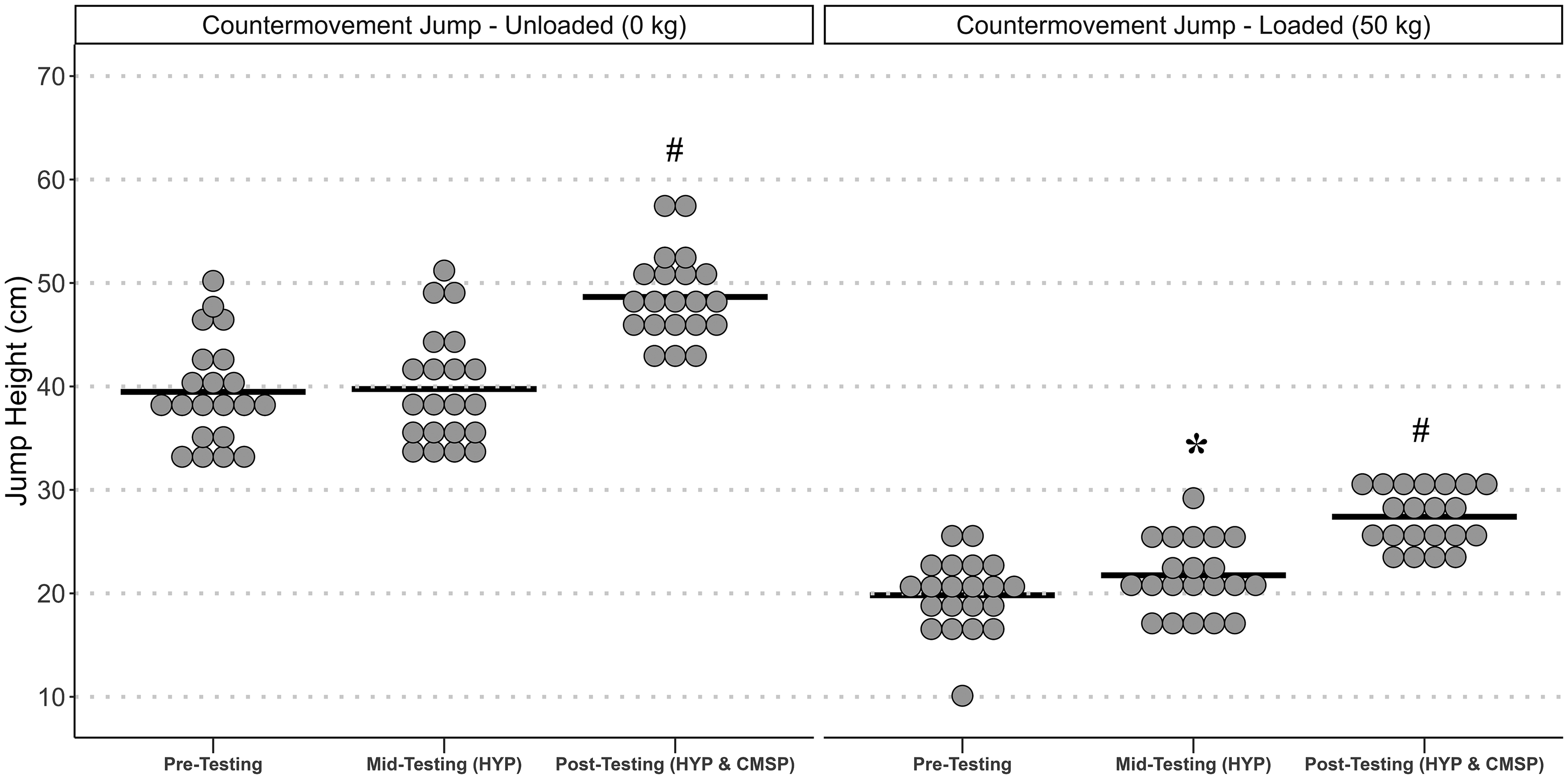
Comparison of jump height pre and post the 4-week hypertrophy and combined maximum strength and power training mesocycles.
Mean concentric variables of countermovement jump
Mean ± SD raw values for both relative load (0 and 50 kg) CMJ performance variables (Samozino method: mean concentric force, velocity, and power) are shown in Table 1. Following HYP training (mid-testing), no significant changes were observed in mean concentric force or power for either unloaded or loaded CMJ conditions. However, mean concentric force (p = 0.004, ES = 1.95; p ≤ 0.001, ES = 2.55, respectively), velocity (p ≤ 0.001, ES = 1.59; p ≤ 0.001, ES = 3.23, respectively), and power (p ≤ 0.001, ES = 1.80; p ≤ 0.001, ES = 2.98, respectively) showed significant improvements in both CMJ conditions following the completion of both training blocks (post-testing). No significant changes were observed in takeoff impulse after HYP training (mid-testing) or after both training mesocycles (post-testing) for unloaded or loaded CMJ conditions.
Comparison of raw countermovement jump performance variables of each loaded jumping condition, calculated with the force plates and Samozino method across pre-, mid-, and post-testing comparison following 4-week hypertrophy and 4-weeks of combined maximum strength and power training.
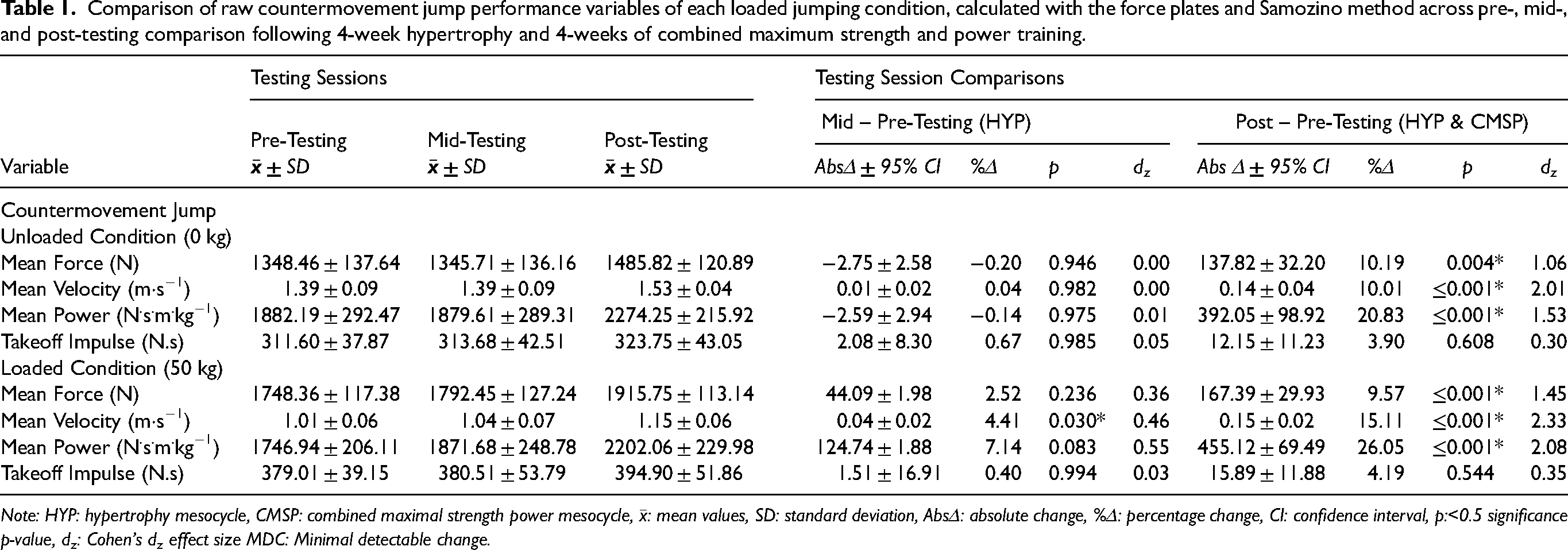
Note: HYP: hypertrophy mesocycle, CMSP: combined maximal strength power mesocycle,
Vertical FVP profile theoretical variables
Mean ± SD values for all theoretical mechanical variables related to CMJ (i.e., FVP profile) pre-, mid-, and post-testing for HYP and CMSP training mesocycles are presented in Table 2. There were no changes in relative and absolute Pmax following HYP training (mid-testing: p = 0.959, ES = 0.02, p = 0.963, ES = 0.02, respectively). However, relative and absolute Pmax significantly improved after both training blocks (post-testing: p ≤ 0.001, ES = 1.23 and p ≤ 0.001, ES = 1.21, respectively). Interestingly, F0 significantly improved after HYP training (mid-testing: p = 0.023, ES = 0.67) and this improvement was maintained following both training mesocycles (post-testing, p = 0.036, ES = 0.88).
Comparison of key theoretical variables for vertical jump force-velocity-power profiles developed using the two-point method with free weights and force plates across pre-, mid-, and post-testing following 4-weeks hypertrophy and 4-weeks of combined maximum strength and power training.
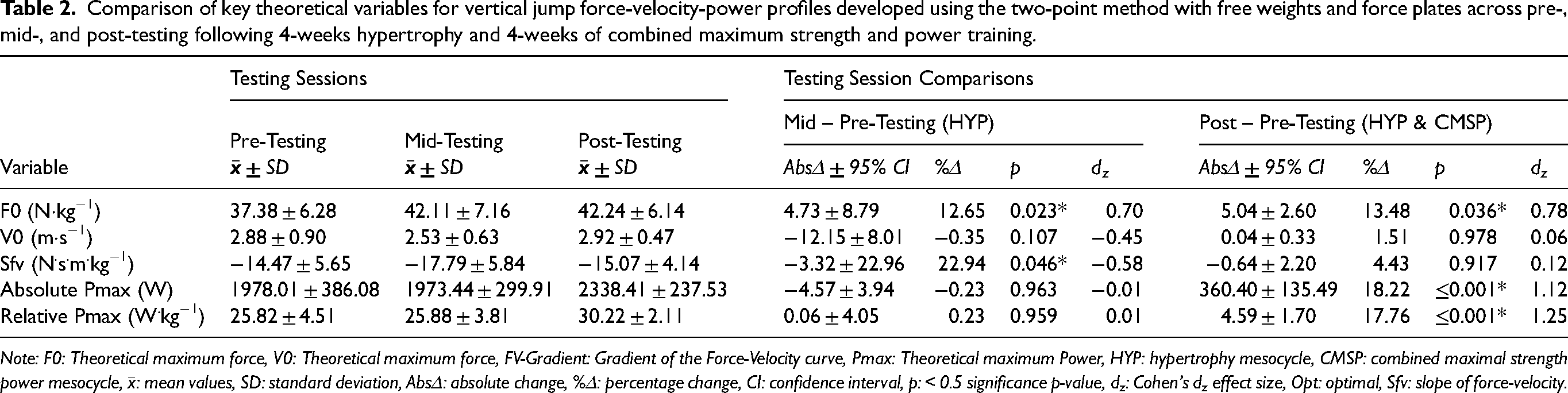
Note: F0: Theoretical maximum force, V0: Theoretical maximum force, FV-Gradient: Gradient of the Force-Velocity curve, Pmax: Theoretical maximum Power, HYP: hypertrophy mesocycle, CMSP: combined maximal strength power mesocycle,
Discussion
This study examined the effects of a pre-season block periodised training programme, comprising sequential hypertrophy and CMSP mesocycles, on unloaded and loaded CMJ performance and vertical FVP profiles in youth Australian football athletes. The main findings include: I) jump height and Pmax
Sequencing mesocycles of hypertrophy followed by CMSP training led to significant improvements in both unloaded and loaded CMJ heights. These findings support previous research on the efficacy of high-force training in optimising force-related attributes and CMJ performance. 29 There was also an increase in loaded CMJ height at mid-testing following the HYP-mesocycle. This jump height increase suggests that hypertrophy training enhanced strength, thereby improving loaded jump performance. However, the larger standard deviations observed in unloaded CMJ changes indicate greater variability in individual responses. This may reflect the differing impact of hypertrophy training on reactive strength and neuromuscular coordination, particularly among youth athletes at varying stages of physical development.30,31 This is consistent with studies showing that high-volume, moderate-load resistance training promotes muscle hypertrophy and strength in adolescent athletes.14,15,18 However, this training may be less effective for improving unloaded jump height, as it relies more heavily on the rate of force development. 16 The block periodisation model incorporating hypertrophy followed by CMSP training, allows for an athlete to first increase their muscle size to lay the foundation for subsequent CMSP training to enhance jump performance. The CMSP training, characterised by high-load, low-volume training, was associated with improvements in explosive lower body power across the FV spectrum. 17 These outcomes may reflect enhanced neuromuscular adaptations, such as improved rate of force development. 20 While our findings demonstrate positive adaptations following CMSP training in youth AF athletes, the study design does not permit conclusions regarding the effectiveness or ordering of different training blocks.
Significant increases in mean concentric force, velocity, and power for both unloaded and loaded CMJ conditions following sequential hypertrophy and CMSP mesocycles (post-testing) are likely attributed to enhanced neuromuscular development, 20 improving jump height capabilities. Both training blocks likely promoted large motor unit recruitment, consistent with Henneman's size principle and the intent to lift concentrically as fast as possible. 32 However, the greater CMJ height improvements following CMSP may reflect additional neural adaptations associated with higher loads, such as enhanced rate of force development and motor unit synchronisation, contributing to increased power output. 33 Additionally, high-load, low-volume training stimulates fast-twitch muscle fibres, which are more effective at generating high power outputs during explosive movements. 20 In summary, implementing both hypertrophy and CMSP training blocks have shown to effectively improve mean force, velocity, and power in both unloaded and loaded CMJ conditions.
Our vertical FVP profiling results showed that hypertrophy training significantly increased F0, resulting in a more force-oriented FV profile in youth AF athletes. However, hypertrophy training did not significantly enhance in Pmax, likely due to the decrease in V0. Conversely, sequential hypertrophy then CMSP training significantly improved Pmax, resulting in more optimised FV profiles, which may be attributed to notable increase in V0 and stable F0. Our findings align with recommendations of de Villarreal et al., 34 who emphasise the pivotal role of neuromuscular adaptations, including motor unit recruitment, enhanced intermuscular coordination, and optimised FV relationships, in augmenting Pmax. Consistent with previous research, CMSP training effectively increases power output and neuromuscular performance in adolescents but does not significantly impact static measures of maximal force production. 30 Thus, CMSP training primarily improves dynamic strength and power output rather than static FV characteristics, through training with maximal intended concentric velocity. Additionally, a structured approach using block periodisation starting with hypertrophy training to enhance muscle cross-sectional area to serve as a base for CMSP training to more effectively support neuromuscular adaptations for developing lower body power within youth athletes.17,35
It is important to note the potential limitations of our study design. While a between-subject control group was not included, logistical constraints during pre-season and the potential disadvantage of performing hypertrophy training block (high metabolic stress and muscle damage) immediately before competition made a crossover design impractical and potentially detrimental to players. Despite this limitation, using a within-subject design helped mitigate individual variability and increased statistical power. This approach allowed us to focus on the changes over time within individuals, providing a robust analysis of the block periodised intervention effects (hypertrophy and CMSP). Moreover, the mid- and post-testing measurements ensured that any observed changes in performance could be attributed to the subsequent interventions. Another potential limitation was the use of only two arbitrary loads (0.5 kg and 50 kg) to represent the FV spectrum. This two-point approach has been validated with jump height as the key dependent variable.12,25 Due to the use of a fixed external load (50 kg), some subjects with lower body mass were unable to consistently achieve the minimum 10 cm jump height, resulting in the exclusion of these data. This highlights a limitation in applying standardised loading protocols across youth athletes with varying levels of maturation and strength. Aside from this, our results demonstrate favourable enhancements in CMJ performance and Pmax attributes following block periodisation applying both hypertrophy and CMSP training. Therefore, while our findings suggest that sequencing a hypertrophy-mesocycle prior to a CMSP-mesocycle may be associated with improvements in CMJ height and Pmax in youth AF athletes, offering practical methods to optimise training outcomes.
Conclusions
This study monitored changes in countermovement jump (CMJ) performance and vertical force-velocity-power (FVP) profiles in youth Australian Football (AF) athletes throughout pre-season, assessing at three key points: pre-testing, mid-testing (after a four-week hypertrophy mesocycle) and post-testing (after an additional four-week combined maximal strength and power [CMSP] mesocycle). Over a 12-week within-subject, single group, non-randomised crossover trial we observed significant increases in theoretical maximum peak power output (Pmax) and CMJ height (unloaded and loaded) following both the hypertrophy- and CMSP-mesocycles, with improvements in loaded CMJ height also observed after hypertrophy-mesocycle. Mean concentric force, velocity, and power for both unloaded and loaded CMJs significantly improved only after CMSP-mesocycle. These findings support block periodisation, where an initial hypertrophy phase builds a foundation of force production, followed by a CMSP phase focusing on heavier loads and maximal concentric velocity, thereby enhancing Pmax and CMJ performance. This periodised approach provides practical applications for sports science practitioners and coaches, allowing them to refine pre-season training to optimise CMJ performance and power output in youth AF athletes.
Footnotes
Acknowledgements
The authors would like to acknowledge the subjects for volunteering to partake in this study.
Ethical considerations
The study was approved by the University's Human Research Ethics Committee (ethics registration 20247275-18824)..
Consent to participate
All subjects (and parent or guardian, if under 18) provided written informed consent.
Declaration of conflicting interests
The authors declared no potential conflicts of interest with respect to the research, authorship, and/or publication of this article.
Funding
The authors received no financial support for the research, authorship, and/or publication of this article.
