



Abstract
We assessed the fluid balance, whole body sweat rate (WBSR) and sweat sodium concentration ([Na+]sweat) of English Premier League (EPL) soccer players during pre-season training and used predictive modelling to determine theoretical changes in plasma sodium concentration ([Na+]plasma). Players (25 ± 4 years, 1.83 ± 0.06 m, 81.1 ± 7.4 kg) were monitored during two training sessions (n = 14, Session 1; n = 17, Session 2) in temperate climates (19–23°C, 45–67% relative humidity). Training load was monitored via global positioning system, sweat loss was assessed from changes in body mass (BM) after correcting for fluid intake, and [Na+]sweat was measured using absorbent patches. Mean BM loss was 1.08 ± 0.72% and 1.28 ± 0.65%, with sweat losses of 1.67 ± 0.49 L and 1.88 ± 0.59 L in Sessions 1 and 2, respectively. Mean [Na+]sweat was 51.3 ± 14.6 mmol·L−1 (Session 1) and 39.9 ± 15.3 mmol·L−1 (Session 2), with total sodium losses of 1929 ± 771 mg and 1730 ± 813 mg, respectively. Predictive modelling indicated 4/14 (∼29%) players in Session 1, and 1/17 (∼6%) players in Session 2, would have mildly reduced [Na+]plasma following training (all <2 mmol·L−1), due to either near-complete fluid replacement or high [Na+]sweat. Although substantial interindividual variations were observed in fluid and sodium balance among players, modelling indicates that Na+ supplementation is unnecessary for soccer players during training in a temperate climate. Measuring [Na+]sweat is therefore unlikely to inform practical recommendations under these conditions.
Introduction
Hypohydration has been demonstrated to adversely impact soccer players’ technical skills, 1 cognitive performance, 2 intermittent running capacity 3 and repeated jumping ability, 4 thereby diminishing overall performance on the field. Moreover, disturbances to fluid and/or electrolyte balance, including Exercise Associated Hyponatraemia (EAH) caused by over-consumption of fluid relative to sodium (Na+), may increase the likelihood of exercise-associated muscle cramp (EAMC) occurrence during exercise. 5 Current hydration guidelines advise players to consume 5–7 ml·kg−1 body mass (BM) of fluid 2–4 hours prior to a match, and to maintain adequate hydration during match play to avoid a fluid deficit >2–3% of their pre-exercise BM. 6 Additionally, ad libitum/drink to thirst strategy appears to be sufficient in maintenance of fluid balance within ±2% BM loss, particularly during exercise in a cool or temperate environment. 7 However, opportunities for fluid intake during matches are frequently limited, 8 while elevated perceptions of gastrointestinal fullness associated with larger fluid volumes may further inhibit voluntary intake. 9 Consequently, achieving an optimal hydration status prior to both training and competition is critical, yet remains a consistently reported challenge in elite soccer settings. 10 However, these general recommendations fail to account for individual variability in hydration requirements, suggesting that personalised hydration strategies are crucial for elite soccer players based on fluid availability, environment and exercise intensity. 11
A wide range of the mean whole body sweat rate (WBSR) (0.55–1.70 L·hour−1) has been documented among male professional soccer players during training sessions and matches.12–19 This significant variability in WBSR could be attributed to several factors, including training intensity,14,19 environmental conditions13,14 and inherent individual differences. 20 Generally, higher WBSR and the likelihood of experiencing hypohydration (>2% BM loss), are significantly increased when players train and compete at greater intensities and in warmer climates.19,21 Similarly, a broad range of mean [Na+]sweat, from 16.1 to 66.5 mmol·L−1, have been observed among professional male soccer players.12–14,16–19 However, unlike WBSR, [Na+]sweat tends to remain consistent regardless of training intensity and environmental conditions.14,19 Only one study has assessed WBSR and [Na+]sweat of English Premier League (EPL) soccer players, and was conducted two decades ago. 16 Since then, match demands have drastically increased, particularly the distances covered at high speed22,23 and training loads have also increased to mimic the demands of the game. 24 As a result, maintaining fluid balance during training has become equally important, as it supports preservation of training intensity, technical performance, cognitive function and helps to delay onset of perceived fatigue. 20 Therefore, it is helpful for practitioners working with EPL soccer players and those in similar leagues to have access to up-to-date data concerning fluid and sodium balance in this population.
Sweat Na+ testing is routinely conducted in professional soccer; however there remains limited evidence supporting the need for Na+ replacement during training and matches, which may explain the absence of clear, evidence-based guidelines in this area.6,25,26 The current rationale for Na+ replacement during exercise focus on optimising fluid compartment volume, preventing EAMC, and avoiding exercise associated hyponatremia (EAH).26–28 However, no intervention studies have shown a direct link between these issues and excessive sweat Na+ losses in team sports. 5 Thus, Na+ replacement during exercise should primarily aim to contribute (where necessary) to the maintenance of total body water (TBW), plasma volume (Pv), plasma sodium concentration ([Na+]plasma) and plasma osmolality (Posm), 29 or to positively influence fluid consumption behaviours that support optimal hydration strategies. 30 Changes in [Na+]plasma during exercise, given expected fluid intake, fluid losses and electrolyte losses, can be predicted via mathematical modelling, 31 an approach that has been validated during exercise. 32 Application of this model to hypothetical sporting scenarios suggested that Na+ replacement is unnecessary in all realistic scenarios for a 90 minutes soccer match where fluid deficits equate to 2% BM. 30 However, the original modelling was based on hypothetical fluid balance and Na+ losses, and no studies to date have applied this model to actual measurements in professional soccer players during training sessions, which may include net fluid balance outcomes that are substantially different to what was previously modelled. Consequently, it remains unclear whether the predicted direction and magnitude of change in [Na+]plasma would justify targeted Na+ intake for some athletes during team sport training or competition, to promote favourable changes in fluid balance through reduced diuresis and/or increased thirst drive. While Na+ balance has been widely investigated in professional soccer, no studies to date have quantified Na+ requirements during training.13,14,16,33 The predictive model outlined above addresses this gap by facilitating the estimation of individualised Na+ needs during training.
With this in mind, the aims of this study were two-fold: (1) to evaluate the fluid balance, WBSR and [Na+]sweat of EPL soccer players during pre-season training, and; (2) to determine the expected impact of fluid and Na+ balance on [Na+]plasma using predictive modelling, 30 and the implications for practical recommendations. The findings from this study can provide valuable insights into the hydration and Na+ needs of the EPL soccer players, potentially informing if there is a rationale for routine sweat composition testing in the elite soccer environment.
Materials & methods
Participants
Thirty-one first team players participated in this study. This represented the entire first team squad, excluding players who were unable to take part due to illness, injury, or transfers to other clubs during the study period. Fourteen players (Goalkeepers (GK): n = 3; Defenders (DEF): n = 5; Midfielders (MID): n = 4; Attackers (ATT): n = 2) took part in the first testing session, while seventeen players (GK: n = 1; DEF: n = 7; MID: n = 5; ATT: n = 4) participated in the second session. The mean ± standard deviation (SD) of participant characteristics were as follows: age 25 ± 4 years, height 1.83 ± 0.06 m and BM 81.1 ± 7.4 kg. All players provided written consent to partake in the study. The study protocol adhered to the principles of the Declaration of Helsinki and received approval from the Research Ethics Committee of Liverpool John Moores University (24/SPS/018).
Study design
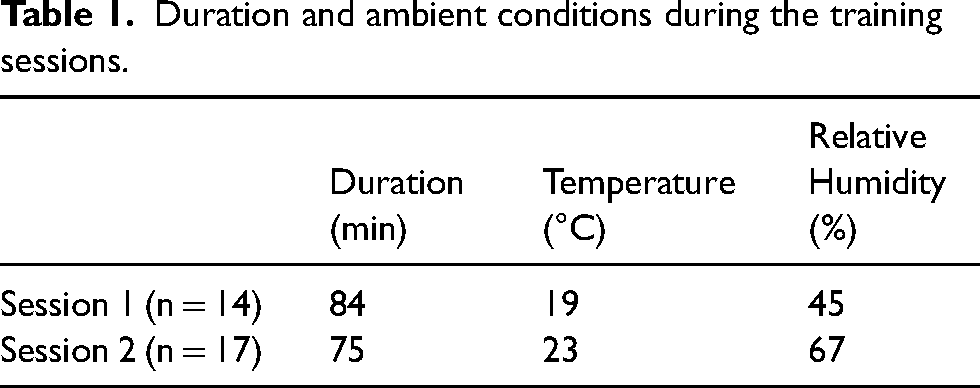
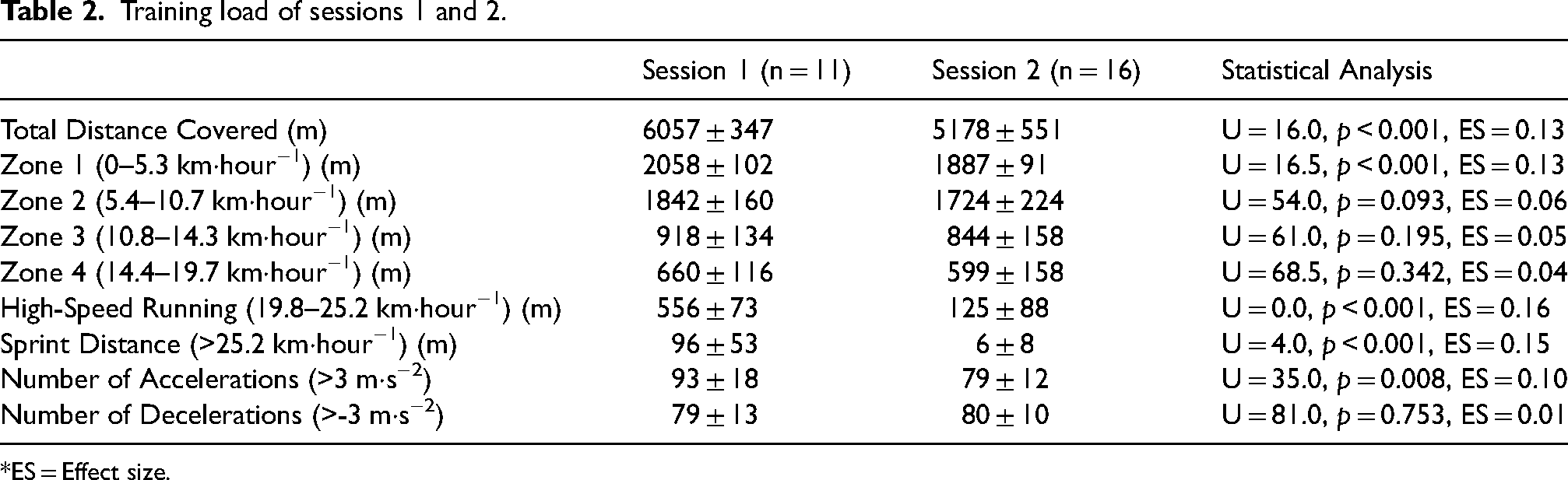
Testing and data collection were completed during two separate training sessions, both conducted in a temperate environment during the pre-season period (Table 1). The first training bout (Session 1) was a high intensity conditioning session, whereas the second bout (Session 2), occurred two days before a match (Match Day-2) and was lower intensity. Session intensity was pre-determined by the coaches and quantified using Global Positioning System (GPS, STATSports, APEX Athlete Series, Northern Ireland). Physical output was only available for outfielders (Session 1: n = 11; Session 2: n = 16), as club practices dictate GKs do not wear GPS units in training. Physical output was coded as Zone 1 (0–5.3 km·hour−1), Zone 2 (5.4–10.7 km·hour−1), Zone 3 (10.8–14.3 km·hour−1), Zone 4 (14.4–19.7 km·hour−1), high-speed running (19.8–25.2 km·hour−1), sprinting (>25.2 km·hour−1). Accelerations were defined as the number of accelerations >3 m·s−2 whereas decelerations were defined as the number of decelerations > -3 m·s−2. These training sessions were not modified for this study and were typical of those routinely conducted by the team on their regular training days and at the usual times of the season. Both sessions comprised a warm-up, interval running, ball drills and small-sided games, and took place between 10:30 am and 12:00 noon.
Duration and ambient conditions during the training sessions.
Study protocol
Sweat fluid loss and body mass changes
Players were towel dried before and after the training sessions and weighed in minimal clothing using a digital electronic scale (SECA, 875 Electronic Class III, Dorset, UK). Percent BM loss was calculated as the net BM loss during training divided by pre-training BM:
Sweat loss was determined from BM loss after adjusting for fluid intake and for urine losses
34
:
WBSR was determined from sweat loss divided by training duration:
Minor fluctuations in BM due to substrate oxidation and other sources of water loss (primarily evaporative loss from the lungs) were ignored. 12
Prior to the pre-training measurements, players were instructed to empty their bladders and bowels, and no players urinated during training. Each player received two individually labelled, 800 mL water bottles: one containing water only, and one containing an electrolyte drink (400 mg Na+ per 800 mL, 0 kcal, and 0 g carbohydrate, from the Science in Sport PLC, London, UK) to consume ad libitum during the training sessions. The bottles were weighed using a kitchen scale (Salter, 1066 BKDR15, Manchester, UK) before and after training sessions to determine fluid intake. Extra bottles were available during training if required. Players maintained their habitual hydration practices during training sessions, with no specific encouragement or recommendations given regarding fluid intake. Players were instructed to refrain from expectorating the fluid or applying topically (i.e., pouring over the head) during training sessions. Adherence to these instructions was closely monitored by the nutritionists throughout each session. No solid food was ingested during either training session.
Total Na+ losses
Sweat samples were collected during both training sessions from two body sites (ventral forearm and mid-thigh) using absorbent patches (3 M TegadermTM +Pad, Bracknell, UK) applied directly onto the surface of the skin. Prior to application, the target sites were cleaned with deionised water. The patches were applied before the training sessions and remained in place throughout the sessions. Upon completion of the session, the patches were carefully removed from the adhesive tape using sterile tweezers before inserting into the barrel of a single use syringe. Each patch was compressed in the syringe to extract a 5 mL sweat sample into a tube. The [Na+]sweat of all three sweat samples was promptly analysed using a portable Na+ metre (Horiba LAQUAtwin Na-11, Kyoto, Japan) previously assessed for validity and reliability.
35
The device was calibrated with known Na+ concentrations of 6.52 mmol·L−1 before sample analysis, following the recommendations by Goulet et al..
36
Regional [Na+]sweat was standardised to estimated whole-body sweat Na+ concentration (WB[Na+]sweat) using published regression equations,
37
where:
However, thigh [Na+]sweat was missing for one participant; therefore, WB[Na+]sweat was standardised for that individual using the regression equation based on forearm [Na+]sweat:
Total sweat Na+ losses (mmol) were calculated from estimated WB[Na+]sweat and total sweat loss. 34
Modelling plasma Na+ change and Na+ replacement requirements
The post-training plasma sodium concentration (Post [Na+]plasma) was also calculated using the original version of the equation
31
:

Sweat potassium concentration [K+]sweat was assumed as 3.5 mmol·L−1, the median value within the range reported in previous literature. 37 K+ loss was subsequently calculated by multiplying total sweat loss (L) with [K+]sweat. No K+ was consumed during training sessions. Total body water before training (TBW pre ) was assumed to be 62% of total BM, consistent with values observed in adult men with normal BM. 38 Total body water post training (TBW post ) was then calculated by accounting for BM changes during training. Previous hypothetical modelling has demonstrated that altering TBW (as a % of BM) does not affect the outcome of the equation, and changes in [K+]sweat, within the normal range observed in athletes, has very small (and practically inconsequential) effects on the calculated outcome. 31
The theoretical Na+ intake required to maintain [Na+]plasma stability was estimated using the equation of Kurtz & Nguyen,
31
as applied by McCubbin
30
:
Data analysis
All data were analysed using SPSS for Windows (version 29, SPSS Inc, Chicago, IL) with statistical significance accepted at an α level of p < 0.05. A Shapiro-Wilk test was used to determine the normality of distribution. All data were normally distributed except for high-speed running distance in Session 2. The significance of the measured BM changes during training was assessed using a paired t-test. Due to an unequal sample size between Sessions 1 and 2, a Mann-Whitney U test was used to compare the differences in training load between sessions. Effect sizes for the Mann-Whitney U test were calculated and interpreted as follows: trivial (≤ 0.20), small (0.20–0.59), medium (0.60–1.19), large (1.20–1.99), and very large (≥ 2.00). 40 Pearson's correlation coefficients were calculated to determine the relationships between fluid intake and total sweat loss, WBSR and estimated WB[Na+]sweat, as well as total distance and total sweat loss relative to BM and Na+ loss relative to BM. Due to the violation of normality, Spearman's rho non-parametric test was used to assess the relationship between high-speed running distance and total relative sweat loss and relative Na+ loss. Confidence intervals at the 95% level (95% CI) were calculated and reported alongside the correlation coefficients. The data presented in text, tables and figures were expressed as mean ± SD, with the range of data given in parentheses, unless otherwise specified.
Results
Training session's characteristics
Training sessions’ characteristics were presented in Table 2. Total distance covered, distance covered at Zone 1, high-speed running distance, sprint distance and total number of accelerations were significantly greater in Session 1 when compared to Session 2 (all p < 0.01). No significant differences in distance covered in Zones 2, 3 and 4 and total number of decelerations were observed between Sessions 1 and 2.
Training load of sessions 1 and 2.
*ES = Effect size.
Body mass loss, fluid intake, sweat fluid loss and WBSR
Participants’ pre-training and post training BM for Sessions 1 and 2 are presented in Table 3. Significant BM loss was observed in both (Session 1: 0.86 ± 0.58 (0.00–1.40) kg; Session 2: 1.06 ± 0.56 (0.20–2.60) kg, p < 0.001), which corresponded to %BM loss of 1.08 ± 0.72% (0.00–1.90%) and 1.28 ± 0.65% (0.28–2.91%), respectively. Two out of seventeen players lost >2% of their pre-training BM during Session 2, while none experienced such loss during Session 1.
Pre- and post-training BM, fluid intake, sweat loss, net fluid balance, [Na+]sweat, Na+ intake, sweat Na+ loss and net Na+ balance (Mean ± SD (range)).
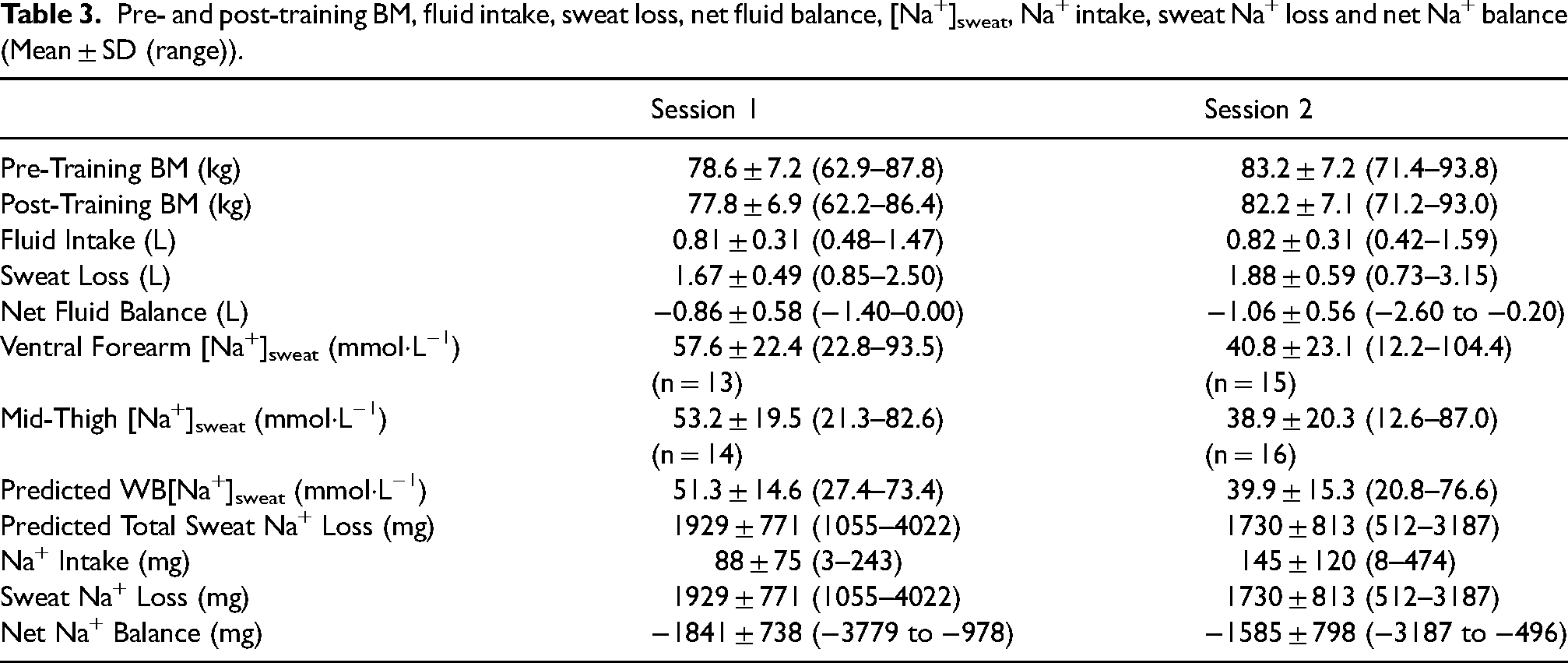
The mean fluid intake during Sessions 1 and 2 was 0.81 ± 0.31 L (0.47–1.47 L) and 0.82 ± 0.31 L (0.42–1.59 L), respectively. There was no significant correlation between sweat loss and fluid consumption in Session 1 (r2 = 0.009, 95% CI = -0.524 to 0.537, p = 0.976) and Session 2 (r2 = 0.367, 95% CI = -0.149 to 0.715, p = 0.147) (Figure 1). After adjusting for fluid ingestion, the mean sweat loss was 1.67 ± 0.49 L (0.85–2.50 L) in Session 1 and 1.88 ± 0.59 L (0.73–3.15 L) in Session 2, corresponding to WBSR of 1.20 ± 0.35 L·hour−1 (0.61–1.78 L·hour−1) and 1.51 ± 0.47 L·hour−1 (0.58–2.52 L·hour−1), respectively. Individual and mean fluid intake, total sweat loss and net fluid balance in both training sessions are presented in Table 3.
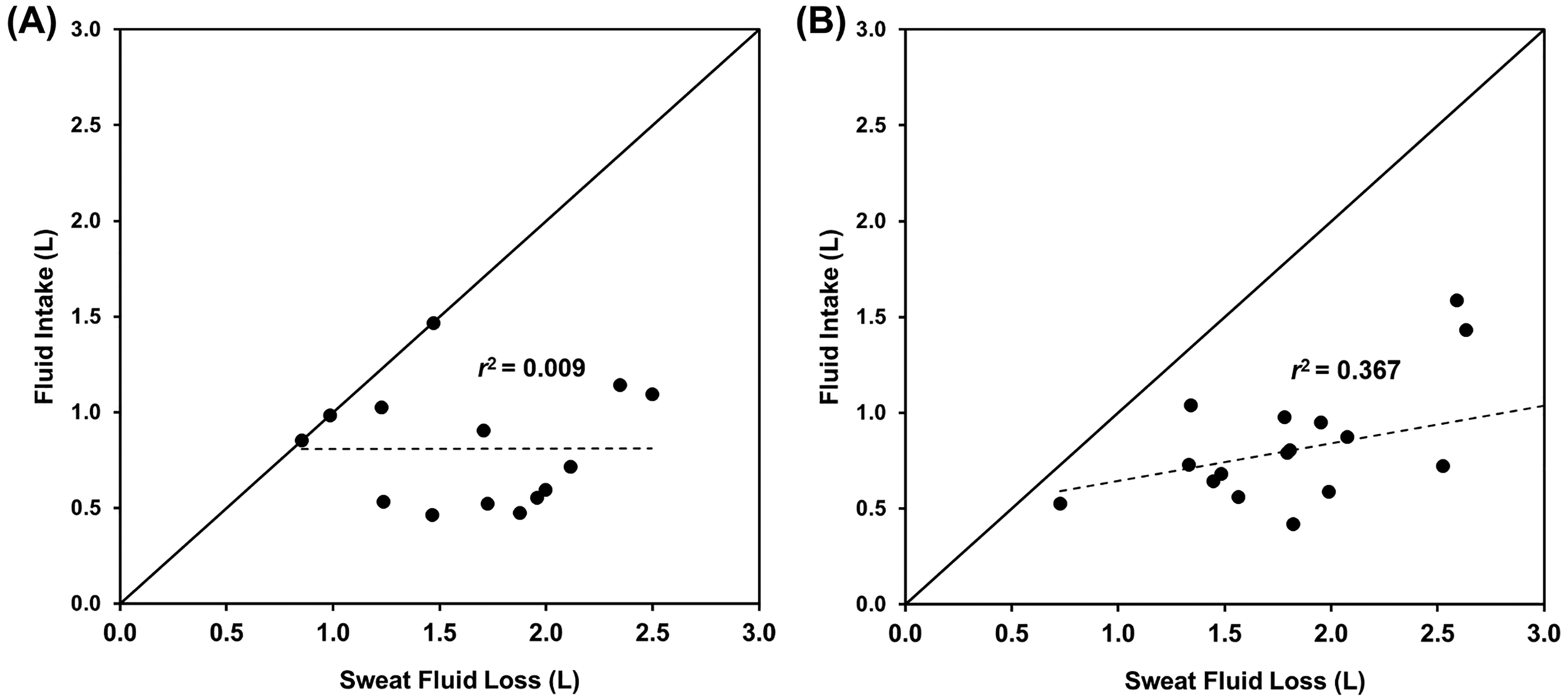
Relationship between the fluid intake during training and the total sweat loss in session 1 (A) and session 2 (B). There was no statistically significant correlation.
WB[Na+]sweat and sweat Na+ losses
The mean regional and predicted WB[Na+]sweat and sweat Na+ losses are presented in Table 3. There was no significant correlation between WBSR and WB[Na+]sweat in Session 1 (r2 = -0.304, 95%CI = -0.713 to 0.281, p = 0.291) and Session 2 (r2 = 0.009, 95%CI = -0.474 to 0.487, p = 0.972). Table 3 presented the individual and mean Na+ intake, sweat Na+ losses, and net Na+ balance.
Relationship between training load, total relative sweat and relative Na+ losses
The total relative sweat loss measured during both training sessions showed no significant correlation with training load, including total distance covered (Session 1: r2 = 0.294, 95%CI = -0.372 to 0.760, p = 0.381; Session 2: r2 = 0.434, 95%CI = -0.079 to 0.765, p = 0.093) and high-speed running distance in Session 1 (r2 = -0.191, 95%CI = -0.720 to 0.478, p = 0.574). However, a significant correlation was found between the total high-speed running distance and total relative sweat loss in Session 2 (r2 = 0.555, 95%CI = 0.066 to 0.829, p = 0.026). Similarly, Na+ loss relative to BM did not correlate significantly with total distance covered (Session 1: r2 = 0.050, 95%CI = 0.567 to 0.631, p = 0.884; Session 2: r2 = 0.169, 95%CI = -0.357 to 0.557, p = 0.747) and high-speed running distance (Session 1: r2 = -0.582, 95%CI = -0.881 to −0.048, p = 0.060; Session 2: r2 = 0.299, 95%CI = -0.246 to 0.700, p = 0.261) (Figure 2A-2D).
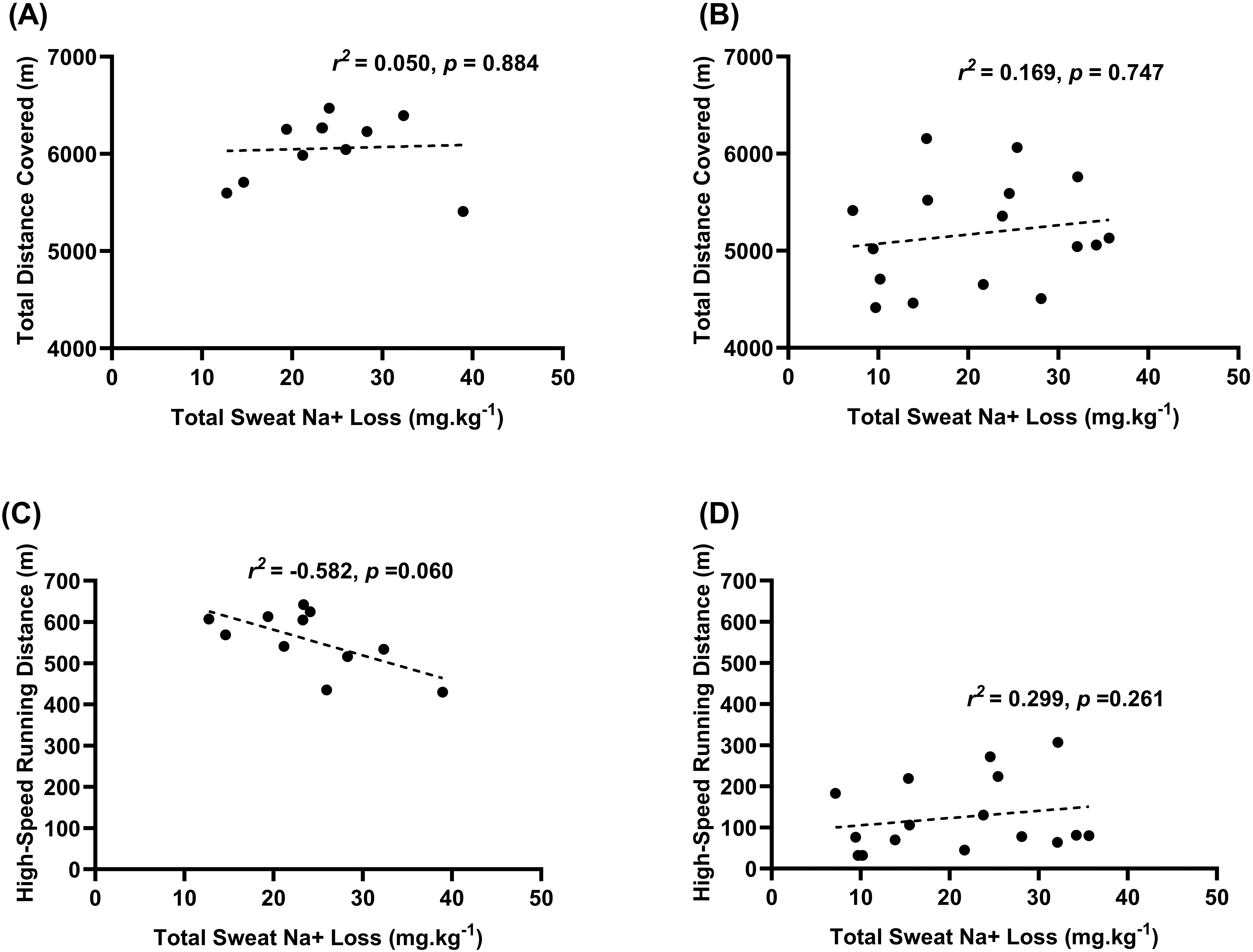
Relationship between total distance covered and total sodium loss in session 1 (A) and session 2 (B), and between high-speed running distance and total sodium loss in session 1 (C) and session 2 (D).
Modelling [Na+]plasma change and sodium requirements for [Na+]plasma maintenance
Predicted post-training [Na+]plasma was presented in Figure 3, with 4/14 players (28.6%) predicted to have reduced [Na+]plasma following Session 1, but only 1/17 players (5.9%) following Session 2. Predicted post training [Na+]plasma in both sessions was strongly positively correlated with %BM loss (Session 1: r2 = 0.944, 95%CI = 0.829 to 0.983, p < 0.001, Session 2: r2 = 0.934, 95%CI = 0.821 to 0.976, p < 0.001) (Figure 3A & 3B), and strongly inversely correlated with the proportion of fluid losses replaced (Session 1: r2 = -0.920. 95%CI = -0.975 to −0.760, p < 0.001, Session 2: r2 = -0.804, 95%CI = -0.926 to −0.526, p < 0.001) (Figure 3C & 3D). All players predicted to have reduced [Na+]plasma had % BM loss <0.5% in Session 1 and <0.9% in Session 2. Furthermore, predicted post-training [Na+]plasma was not significantly correlated with WB[Na+]sweat (Session 1: r2 = -0.489, 95%CI = -0.810 to 0.056, p = 0.076; Session 2: r2 = -0.184, 95%CI = -0.611 to 0.326, p = 0.480) and total Na+ loss (Session 1: r2 = 0.175, 95%CI = -0.392 to 0.645, p = 0.550; Session 2: r2 = 0.392, 95%CI = -0.110 to 0.734, p = 0.120). For the players with a predicted reduction in [Na+]plasma, the mean Na+ requirement to maintain stable [Na+]plasma was 1355 ± 362 mg (968 ± 259 mg·hour−1) in Session 1 and 352 mg (258 mg·hour−1) in Session 2 (95% and 11% Na+ replacement required, respectively) if fluid balance was unaltered.
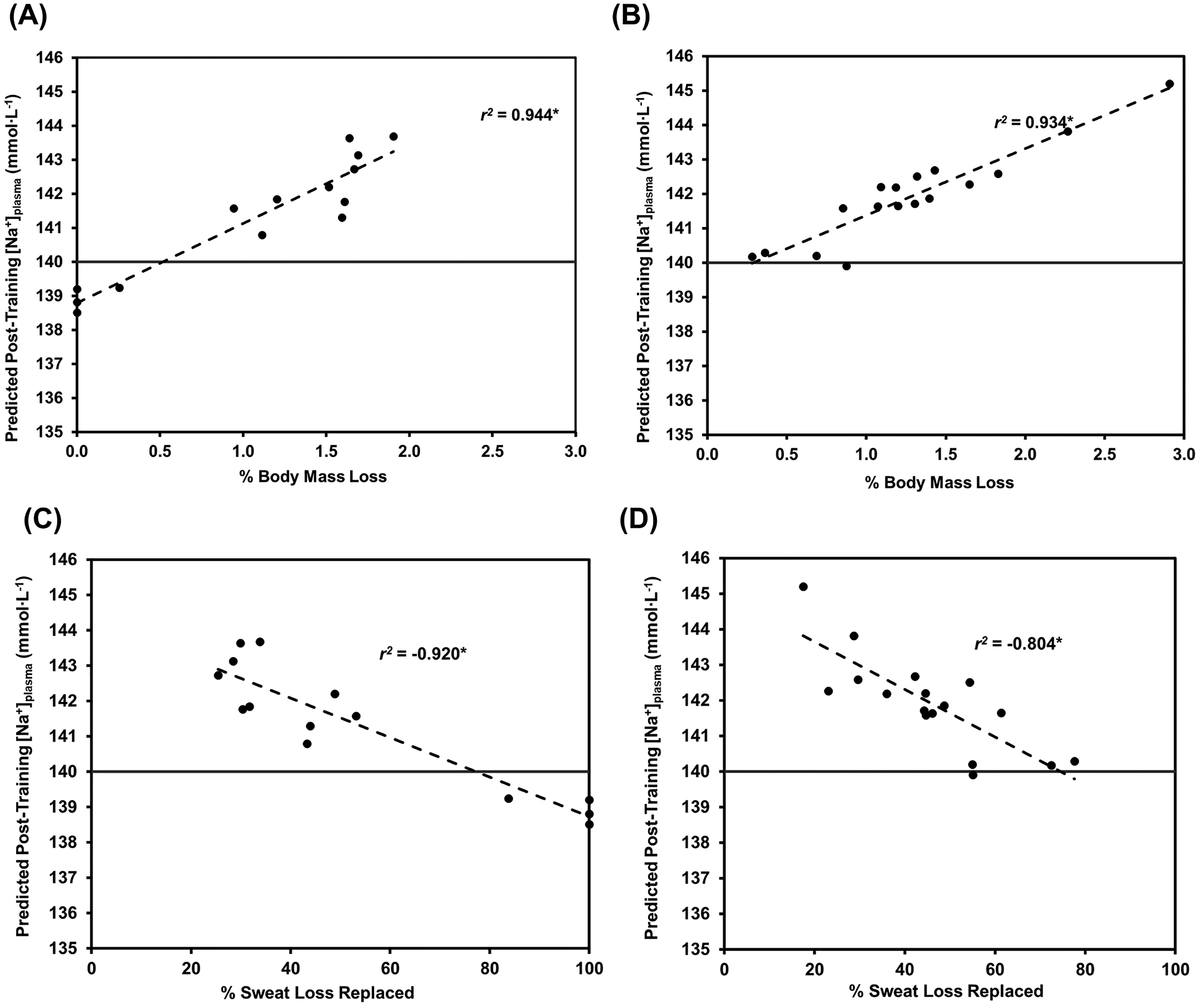
Relationship between predicted post-training [Na+]plasma and % BM loss in Session 1 (A) and Session 2 (B) and between predicted post-training [Na+]plasma and % sweat loss replaced in Session 1 (C) and Session 2 (D). *Significant correlation (
Discussion
The aim of the present study was to investigate the fluid and Na+ balance of professional male soccer players during pre-season training. Consistent with the previous literature in this population, the majority of the players experienced a reduction in BM over the duration of the training sessions. The main findings of the present study were: (1) the majority of players adequately adjusted ad-libitum fluid intake to prevent hypohydration greater than 2% of pre-exercise BM without the need for substantial Na+ replacement to increase thirst drive; (2) there were considerable inter-individual variations in WBSR and WB[Na+]sweat; (3) mathematical modelling suggested that a group (∼6–29%) of players from this cohort replaced enough fluid to cause an expected fall in [Na+]plasma, although this reduction was minor and would not justify targeted Na+ replacement, and; (4) the majority of players in this cohort would be expected to experience increased [Na+]plasma during training due to the low proportion of fluid losses replaced, despite minimal Na+ replacement.
In the present study, the observed WBSR (∼1.20–1.51 L·hour−1) were similar to those reported in a previous study on EPL soccer players during pre-season in a warm climate (1.36 ± 0.28 L·hour−1). 16 Additionally, these WBSR were consistent with values reported for La Liga male soccer players training in warm conditions during pre-season (1.46 ± 0.27 L·hour−1). 17 However, the current findings exceeded the WBSR observed in Eredivisie professional soccer players training in a cool environment during pre-season (1.13 ± 0.3 L·hour−1). 12 This discrepancy aligns with the established understanding that professional male soccer players exhibit higher WBSR in warm conditions compared to cool conditions.13–15,19 Moreover, we observed significant interindividual variations in WBSR during training sessions, similar to previous studies on professional male soccer players.12,14 This variability can be attributed to numerous factors including clothing, hydration status, circadian rhythm, heat acclimation, aerobic training, BM, body composition and genetics. 41 Therefore, it is recommended that players be tested under a range of environmental conditions to develop personalised hydration strategies.11,42 A moderate positive correlation was observed between total relative sweat loss and high-speed running distance in Session 2; however, this finding should be interpreted with caution as the absolute volume of high-speed running distance was low (Table 2), potentially limiting the thermogenic stimulus required to meaningfully influence sweat loss. Furthermore, this relationship was not evident in Session 1, despite players covering greater distances at high speed. This is consistent with previous research showing no association between sweat rate and indicators of high-intensity activity in warm and cool conditions. 13 Collectively, these findings indicate that training load indices such as high-speed running distance may not reliably reflect individual sweat responses during training in temperate climates. As such, hydration strategies should be informed by regular, individualised monitoring of sweat rate and fluid balance rather than relying solely on external load measures.
The mean WB[Na+]sweat observed in this study (39.9–51.3 mmol·L−1) aligns with the regional values reported in previous studies among professional male soccer players12,14,16–19 and falls within the normally reported physiological range of 20–80 mmol·L−143. There was no apparent correlation between WBSR and WB[Na+]sweat when comparing between athletes, consistent with previous earlier findings in professional male soccer players.16,18 There is both evidence and a theoretical rationale for a positive correlation between WBSR and WB[Na+]sweat at an intra-individual level, due to decreased Na+ reabsorption efficiency as WBSR increases. 44 Most studies, however, do not observe this relationship when comparing data on an inter-individual basis, apart from large datasets with significant heterogeneity in athlete profile and exercise type. 45 Instead, the significant inter-individual variation in the mean WB[Na+]sweat (range 20.8 to 76.6 mmol·L−1) can likely be attributed to some combination of habitual Na+ intake, 27 the degree of heat acclimatisation, 44 and other, as yet determined, factors. 46 Factors such as energy expenditure, season of the year (proxy for heat acclimatisation), exercise mode, air temperature and sex only accounted for ∼17–23% of the variation in WB[Na+]sweat, 46 indicating that other significant determinants of the inter-individual differences in WB[Na+]sweat remain unidentified. Additional research is therefore required to uncover these factors and improve our understanding of the mechanisms behind the regulation of WB[Na+]sweat in response to varying environmental and exercise conditions.
The mean total sweat Na+ losses (∼1.7–1.9 g) observed in this study were comparable to the regional values reported for professional male soccer players during pre-season (∼1.5–1.7 g).12,17 However, higher sweat Na+ losses (∼2.5–2.9 g) have been reported when players engage in high intensity training in warm climates.13,19 This increased Na+ loss observed in the warm environment is likely due to significantly higher WBSR,13,14 as the WB[Na+]sweat tends to remain constant regardless of environmental temperature and training intensity.14,19 Similar to WBSR, no significant correlation was observed between sweat Na+ loss and any of the training load indices, suggesting that other factors such as environmental conditions, individual heat acclimation levels and dietary Na+ intake may be more influential in determining Na+ loss during exercise.
Via mathematical modelling, 31 only ∼29% of players after Session 1 and ∼6% after Session 2 were predicted to experience reduced [Na+]plasma, and by <2 mmol·L−1. Of these players, 3/4 were those who aggressively replaced their fluid losses (84–100% fluid replacement for <0.3% BM loss), which aligns with the strong correlation found between %BM loss and predicted Δ[Na+]plasma. The remaining player only replaced 55% of fluid losses (0.9% BM loss) but was found to have an exceptionally high WB[Na+]sweat (76.6 mmol·L−1) when compared to the other three players (50.5 to 60.3 mmol·L−1). Player drinking habit/preferences, or a need for fluids to also provide adequate carbohydrate for performance, may mean that some players and/or support staff prefer a BM loss of <1% during training or competition. In that case, it appears that such a small predicted reduction in [Na+]plasma does not warrant specifically targeted Na+ replacement for soccer players during training. Instead, practitioners can focus on preventing the over-consumption of fluid, while Na+ intake can instead be based on food and fluid palatability.
In contrast, 29% of players in Training Session 1, and 47% of players in Training Session 2, had a total fluid and Na+ balance suggestive of an increase in [Na+]plasma of > 2 mmol·L−1 by the end of the training session, despite replacing ≤ 20% of Na+ losses. Although only one participant was predicted to finish with [Na+]plasma outside the clinical reference range (i.e., > 145 mmol·L−1), the data does suggest that more aggressive Na+ replacement, anecdotally advocated by many athletes, coaches and producers of electrolyte products, would serve to exacerbate the rise in [Na+]plasma if not accompanied by similarly aggressive fluid replacement. While the impact would be minor in the present study, mild-to-moderate hypernatremia (>150 mmol·L−1) 47 could occur when Na+ and fluid turnover are greater (e.g., hot environments, longer duration, higher intensity sessions). Such a scenario is conceivable with a session duration of 2.5 hours, WBSR of 2 L·hour−1, fluid intake of 0.4 L·hour−1 (i.e., 20% fluid replacement, final deficit of 2.1% BM), [Na+]sweat of 30 mmol·L−1, and 70% Na+ replacement. In this scenario, an athlete with a starting [Na+]plasma of 140 mmol·L−1 and the assumptions used in this study, would be predicted to finish the session with a [Na+]plasma of 154 mmol·L−1 31 .
While neither appears common under the conditions studied, hypernatraemia appears more likely than hyponatraemia in soccer players, and the small reductions in [Na+]plasma observed were mostly driven by over-consumption of fluid rather than lack of Na+ replacement. Together, these findings suggest that routine use of sweat composition testing is unlikely to add value to practitioners working in elite soccer, and monitoring fluid balance alone is sufficient to make sound recommendations for optimising hydration status. The findings of this study align with previous research 30 which suggested that Na+ replacement is unnecessary for a hypothetical 90 minutes soccer match unless the WBSR is high (2.5 L·hour−1), the fluid replaced to limit loss to 2% BM (1.55 L·hour−1), and the WB[Na+]sweat ≥60 mmol·L−1. The data from the current study extends that work across a broad range of fluid balance outcomes (0.0–2.9% BM loss) obtained from the players during actual training sessions. Future research is encouraged to determine the predicted Δ[Na+]plasma and theoretical Na+ replacement needs of professional soccer players during training or matches under different environmental conditions and exercise intensities, especially those where greater fluid and Na+ losses are expected.
While the predicted changes in [Na+]plasma generated from this study do not cause concern for the development significant hyper- or hyponatraemia, one might argue that Na+ replacement based on measured losses could still be beneficial. Such arguments centre around intentionally replacing Na+ to increase [Na+]plasma and therefore thirst drive, while simultaneously reducing diuresis, with the aim of achieving a more optimal fluid balance. 48 Fluid replacement in team sport environments, however, is also influenced by non-physiological factors such as fluid availability, and opportunities for drink breaks during the session, both of which are not commonly within the athlete's own control. 49 In cooler conditions, it has been observed in rugby players that fluid intake was not associated with the pre-post exercise change in thirst sensation, mouth dryness, or thermal comfort following multiple small-sided games with short rest breaks 50 and that players consumed fluid in excess of both thirst sensation and homeostatic requirements. In the present study, no players needed to pass urine during the session, even when [Na+]plasma was theoretically stable or reduced slightly. Collectively, these findings suggest that for soccer players during training in a temperate environment, Na+ replacement based on measured losses is unlikely to contribute to optimising hydration status. Instead, practitioners can focus on providing Na+ to enhance food and beverage palatability, which does not require sweat collection and measurement for [Na+]sweat.
The current study was primarily descriptive, and hence we acknowledge several inherent limitations. Notably, sweat K+ concentrations were not analysed, a parameter crucial for both ensuring the quality of sweat samples, 41 and for calculating predicted Δ[Na+]plasma. Nevertheless, adherence to recommended protocols for sweat collection, as outlined by Baker, 41 including maintaining clean skin, avoiding patch saturation, employing multiple patches and preventing cross contamination – instilled confidence in the validity of the findings, and the small variability in [K + ]sweat within and between individuals means that any effect on the predictive modelling is minimal. Furthermore, other influential factors on WB[Na+]sweat such as variations in testosterone 51 and dietary Na+ intake 39 were not accounted for or controlled prior to testing, given the nature of field-based descriptive studies. Another limitation pertained to the sole assessment of fluid intake during exercise, neglecting measurements of first morning urine specific gravity, 24-h urine volume and Na+ excretion, and 24-h fluid intake prior to training. Furthermore, the lack of direct measurement of pre-exercise TBW and [Na+]plasma is a limitation, however the effects of these variables on the modelling outcomes described is negligible 30 and would not alter the interpretation of these findings. Moreover, players may have altered their drinking behaviours due to awareness of being observed; however, the effect is likely minimal given the restricted opportunities to drink during training. Additionally, the regression equation employed to estimate WB[Na+]sweat from regional [Na+]sweat has not yet been validated in elite soccer players, highlighting a need for future research in this area. Despite these limitations, this study contributes valuable information on the fluid balance, WBSR, WB[Na+]sweat and potential Na+ replacement requirements among elite soccer players in a real-world setting. These findings hold significance for practitioners and players alike, optimising hydration strategies within professional soccer setting.
Conclusion
The present study demonstrated significant interindividual differences in fluid balance, WBSR, WB[Na+]sweat and sweat Na+ loss among the EPL male soccer players during pre-season training. Furthermore, only players with very aggressive fluid replacement behaviours or extremely high WB[Na+]sweat are at risk of mildly reduced [Na+]plasma, which is unlikely to benefit from targeted Na+ replacement. Collectively, these findings support recommendations that fluid intake strategies should be tailored to individual needs of each player. Na+ supplementation is not universally required during pre-season training in a temperate climate and therefore the assessment of sweat Na+ losses during training appears to have limited practical value in elite soccer players, as it does not inform practical recommendations.
Footnotes
Declaration of conflicting interests
The authors declared the following potential conflicts of interest with respect to the research, authorship, and/or publication of this article: WLF, ET and PM provide sports nutrition support to the senior squad of the English Premier League soccer club that participants were recruited from. JPM is a consultant for Science in Sport (plc). GLC is a past and present consultant to several English Premier League soccer clubs, current consultant to Nutrition X and a previous consultant to Gatorade Sport Science Institute. Other authors declare no conflict of interest.
Funding
The authors disclosed receipt of the following financial support for the research, authorship, and/or publication of this article: This study was dual funded by Tottenham Hotspur Football Club and Science in Sport (plc).
