



Abstract
The environments in which coaches help create have a significant influence on the development of talented players. Therefore, this study investigated perceptions of talent development environments (TDEs) and coach-created motivational climates among South African youth football players. A total of 112 male amateur players (Mage = 16.2 ± 1.1 years; Mplaying experience = 8.6 ± 2.1 years) voluntarily completed the Talent Development Environment Questionnaire-5 and the Empowering and Disempowering Motivational Climates Questionnaire. The results showed that empowerment in coach-created motivational climates correlated strongly with three TDE dimensions: communication (r = .65, p < .01), long-term development (r = .61, p < .01) and alignment of expectations (r = .56, p < .01). There was also a strong relationship between disempowerment in coach-created motivational climates and the holistic quality dimension of TDE (r = .67, p < .01). Through multiple linear regression, long-term development (β = .37, p < .01) and communication (β = .41, p < .01) were found to be significant predictors of empowerment in coach-created motivational climates. Furthermore, holistic quality (β = .64, p < .01) and alignment of expectations (β = .22, p < .05) were found to be significant predictors of disempowerment in coach-created motivational climates. These results suggest that coaches should emphasise an atmosphere that supports learning and development pathways to create an environment with long-term goals that are clear, consistent, and coherent.
Introduction
To achieve excellence, sport associations and clubs invest significant resources to find the best players and nurture talent.1,2 In football, emphasis is placed on talent development programmes to identify and cultivate the next generation of talented players. 3 Talent development is concerned with providing the most appropriate learning environments to realise players’ potential. 4 This suggests that to effectively support athletes and their development, talent development environments (TDEs) would benefit from being carefully thought out, comprehensive, and evidence-based. 5 In TDEs, individuals participate in regular structured training and learning activities intended to assist them in achieving excellence.6,7 Because of their role in supporting young players to advance towards the elite level, the effectiveness of TDEs is essential to the ongoing development of competent and healthy athletes who compete on the global stage.3,8
Effective TDEs
To achieve proficiency in their chosen sports, talented athletes must attune to outside influences, including demanding training regimens. 9 Several essential aspects of effective TDEs have been identified in review studies.10,11 In particular, the literature has consistently identified the following five environmental elements as important to talent development: (1) alignment of expectations (e.g., goal setting and review), (2) communication (e.g., continuous feedback, rationale for training), (3) the holistic quality of preparation (e.g., balanced training and life outside sport, caring coach), (4) a long-term development focus (e.g., fundamental training and development pathway, de-emphasising of winning), and (5) support networks (e.g., parental support, sport science support).12,13
The Talent Development Environment Questionnaire (TDEQ) developed by Martindale et al. 13 has been widely used as an instrument for assessing players’ perceptions of TDEs. The TDEQ has undergone continuous development to enhance its psychometric properties, 14 with the ‘TDEQ-5’ being the most widely used version. 12 For example, Mills et al. 15 used the TDEQ to investigate elite youth football academy players’ perceptions of the quality of their development environment in the UK. The results showed that the academies excelled in aspects pertaining to quality coaching, organisation, and sport-related support. However, academies seemed to be lacking in areas such as player understanding, critical stakeholder partnerships, and links to senior progression.
Previous studies employing the TDEQ-5 have reported that athletes typically rank long-term development as a key TDE dimension, with an emphasis on player training and advancement.16,17 Gesbert et al. 18 who examined the perspectives of Swiss elite youth football players regarding the quality of their TDEs, found that long-term development focus, alignment of expectations, and communication were rated as the highest factors, whilst support networks and the holistic quality of preparation were considered lowest dimensions. Elements pertaining to holistic development have generally been regarded as lacking in a variety of surveyed TDEs. 18 Holistic quality of preparation tends to be characterised by low coach concern for players’ health and well-being, their lives outside sport, and how they manage their training and competition.19,20 Furthermore, research has demonstrated that psychological skills play an important role in the development of talented athletes. Specifically, Andronikos et al. 21 highlighted that psychological skills (e.g., relatedness, intrinsic goals and mastery-approach goals) of athletes were positively associated with the long-term development focus dimension of TDEs. Thus, a better understanding of the talent development experience which can predict psychological skills (i.e., coach-created motivational climates) would be useful in helping provide guidance to coaches and those in charge of operationalising TDEs. 22
Coach-created motivational climates
Most studies on the coach-created social psychological environment have been underpinned by the self-determination theory. 23 Building on this research, Duda 24 proposed a hierarchical conceptualisation of the motivational climate created by coaches that incorporates the main social environmental feature that SDT emphasises. Research has shown that a variety of coach-related factors effect players’ performance, motivation, well-being, and sustained engagement in sport. Specifically, there is strong evidence that coaches’ motivational climates influences players’ thoughts, emotions, and behaviours. 25 According to Duda's 24 conceptualisation, the coach-created motivational climate should be viewed as multifacet in nature and can be either ‘empowering’ or ‘disempowering’. 25 The motivational climate that a coach creates can be classified as either empowering or disempowering. An empowering climate is marked by task-involving, autonomy-supportive, and socially supportive characteristics. 26 When using a task-involved climate, the focus is placed on effort, personal mastery and/or individual improvement.25,27 In sport, a task-involving environment is defined by the coach's emphasis on skill development, teamwork, and effort. 27 In an autonomy-supportive environment, the coach acknowledges the athletes’ preferences and considers their viewpoints, gives them meaningful choices and acknowledges their feelings, welcomes their input in decision-making, and justifies any behaviour they ask of them.26,28 Lastly, in a socially supportive environment, athletes feel that their coach values and cares about them as individuals irrespective of their performance.28,29
In contrast, a disempowering climate is characterised by ego-involving and controlling features. 24 Adopting an ego-involved of competence makes the person appreciate ‘being the best’ in comparison to others. It is believed that a coach-created environment that is highly ego-involving will support this idea of competence. 25 An ego-involving climate is typified by athletes’ believing that their coach penalises their faults, treats them differently according to their respective skill levels, and fosters rivalry among team members. 27 A controlling climate occurs when coaches coerce, pressure, and intimidate their players. 30 Additionally, a controlling coach expresses dissatisfaction and lower tolerance for athletes who have performed poorly, comparable to the penalising of errors by an ego-involving coach. Studies have found that a controlling coaching environment is associated with higher levels of psychological need thwarting among athletes.30,31
Association between TDEs and coach-created motivational climates
Whilst previous studies have investigated athletes’ characterisations of TDEs and coach-created motivational climates in isolation, there has been little research into the relationship between the two. One of the few relevant studies was conducted by Hauser et al., 32 who assessed the relationship between TDEs and coach-created motivational climates among German elite youth athletes. Hauser et al. 32 found that the holistic quality dimension was negatively impacted by disempowerment and positively impacted by empowerment created by coaches. Therefore, it suggests that coaches are important for promoting TDEs that are conducive to athletes’ growth and can significantly impact their developmental outcomes. 32 Whilst this study provided some baseline information on the relationships between TDEs and coach-create motivational climates, such information is sparse.
Current study
Research within the South African context has focused on athletes’ perceptions of TDEs 33 without investigating the potential role of coach-created motivational climates among youth athletes. 22 Given that coaches play a considerable role in motivating athletes; enhancing their skill development; and helping them to feel autonomous, valued, and capable in their sport, 34 further research is needed to examine the possible relationship between TDEs and coach-created motivational climates among youth players. This is particularly important in countries such as South Africa, where little research exists in this area compared to Western countries.32,35 Like many other nations, South Africa places high importance on sport achievement and the development of promising athletes using scientific methods. However, cohesive and integrated trajectories for player development are typically lacking in this country. 36
Understanding how the environment affects players is essential to identify what qualities are essential for successful talent development. 21 Therefore, the aim of this study is threefold: (1) to examine South African youth football male amateur players’ perceptions of their TDEs, (2) to assess those male amateur players’ perceptions of the coach-created motivational climates in which they train, and (3) to examine the relationship between the male amateur players’ perceptions of their TDEs and coach-created motivational climates. Investigating TDEs on amateur players is essential as footballers in this level are at an important stage of learning the skills needed for the game to support their talent development pathway. The findings of this study are anticipated to be useful for informing coaches on how to create optimal environments for players’ learning and development.
Methods
Participants
A total of 112 male amateur youth football players (Mage = 16.2 ± 1.1 years; Mplaying experience = 8.6 ± 2.1 years) were recruited from two South African football academies. These two academies were chosen because of their reputation in developing and producing players to football professional clubs in the South African Premier Soccer League. Participants were purposively selected on the basis that they were currently participating in formal leagues affiliated with the South African Football Association.
Measures
Questionnaires were used to gather demographic information (e.g., age, playing experience) and players’ assessments of their TDEs and coach-created motivational climates.
Talent development environment questionnaire-5 (TDEQ-5)
The TDEQ-5 12 was used to assess the perceived quality of players’ TDEs. This 25-item questionnaire incorporates the following five factors: (1) long-term development focus (five items; e.g., ‘My training is specifically designed to help me develop effectively in the long term’), (2) holistic quality of preparation (seven items; e.g., ‘My coach rarely talks to me about my well-being’), (3) support network (four items; e.g., ‘Currently, I have access to a variety of different types of professionals to help my sports development’), (4) communication (four items; e.g., ‘My coach and I often try to identify what my next big test will be before it happens’), and (5) alignment of expectations (five items; e.g., ‘My coaches make time to talk to my parents about me and what I am trying to achieve’). Each item is measured using a seven-point Likert scale from 0 (strongly disagree) to 6 (strongly agree).
Empowering and disempowering motivational climates questionnaire (EDMCQ-C)
The 32-item EDMCQ-C 25 was used to assess empowerment and disempowerment in coach-created motivational climates as perceived by players. The empowering climate items measure the extent to which coaching is task-involving (nine items; e.g., ‘My coach encouraged players to try new skills’), autonomy-supportive (five items; e.g., ‘My coach gave players choices and options’), and socially supportive (three items; e.g., ‘My coach really appreciated players as people, not just as athletes’). The disempowering climate items measure the extent to which coaching is ego-involving (seven items; e.g., ‘My coach substituted players when they made a mistake’) and controlling (eight items; e.g., ‘My coach was less supportive of players when they were not training and/or playing well’). Each item is scored on a five-point Likert scale ranging from 1 (strongly disagree) to 5 (strongly agree).
Data collection
Before data collection, ethics approval was obtained from the local university ethics committee. Permission to conduct the study was also sought from the South African Football Association. After explaining the purpose and nature of the study as well as how information would be anonymised and used, informed assent was obtained from players’ parents or legal guardians. Each participant was also required to sign an informed consent form if they opted to participate. Participants were made aware that their involvement in the study was entirely voluntary and that they could withdraw at any time without consequences. Data were gathered over a period of two months, during which two members of the research team visited the two academies attended by the participants on mutually agreed dates. During these visits, hard copies of the two questionnaires were supplied to participants. These were filled out at the football teams’ practice or game locations and returned to the researchers for secure transportation and storage.
Statistical analysis
Descriptive statistics (means and standard deviations) were computed for dimensions of the TDEs and empowerment and disempowerment in coach-created motivational climates. Pearson product-moment correlation was used to assess relationships between the TDE dimensions and (dis)empowerment in coach-created motivational climates. The correlation coefficients were categorised as follows: small (.10 to .29), medium (.30 to .49), and large (.50 to 1.0. 37 Additionally, two hierarchical multiple linear regression analyses were conducted to determine whether TDE dimensions predicted coach-created motivational climates. For each regression model, players’ age and playing experience were treated as control variables and entered in step 1. The predictor variables of interest were long-term development, holistic quality of preparation, support networks, communication, and alignment of expectations. Since no theoretical causal sequence could be found, the main predictors were entered together in step 2.
Empowerment and disempowerment in coach-created motivational climates served as the respective dependent variables for the two regression models. Prior to the evaluation of final models for each dependent variable, assumptions of regression were checked. There was no evidence of multicollinearity among the variables, as all tolerance statistics were higher than 0.1 and variance inflation factor statistics were below 10. 38 The Cronbach's α coefficient was used to assess the internal consistency of the TDEQ-5 and EDMCQ-C. The level of significance was set at 0.05. All statistical analyses were conducted using the Statistical Package for Social Sciences (SPSS) version 28.
Results
Descriptive statistics
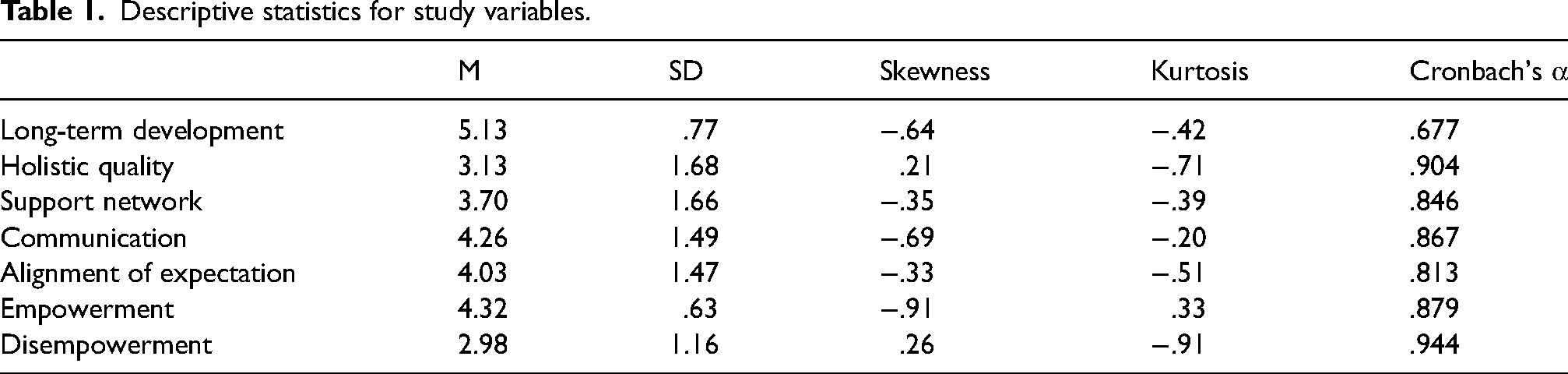
Table 1 shows the descriptive statistics and reliability analyses for the studied variables. Skewness and kurtosis values for all subscales were less than 1, demonstrating that the data were normally distributed. 39 Cronbach's α coefficient values for all subscales were considered acceptable. 40 Of the TDE dimensions, players considered long-term development, communication, and alignment of expectations to be most important. Overall, players rated the empowering aspects of their motivational climate as high and the disempowering aspects as low.
Descriptive statistics for study variables.
Correlation analysis
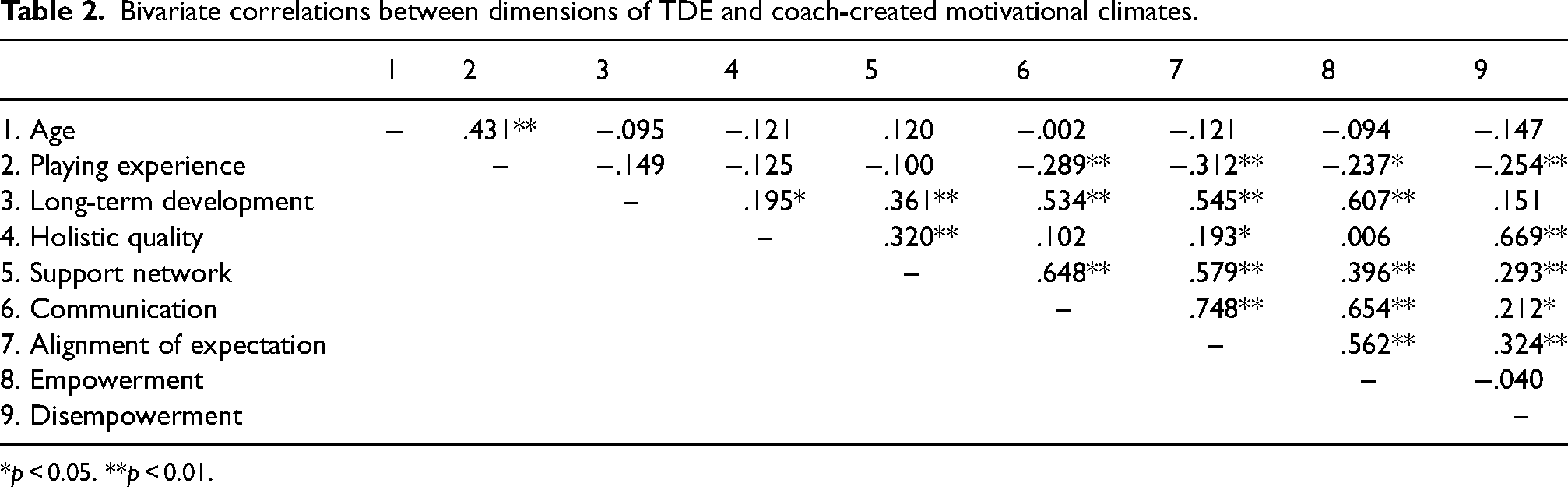
The results of the Pearson correlations between TDE dimensions and coach-created motivational climate ratings are displayed in Table 2.
Bivariate correlations between dimensions of TDE and coach-created motivational climates.
*p < 0.05. **p < 0.01.
Empowerment in coach-created motivational climates correlated strongly with three TDE dimensions: communication (r = .65, p < 0.01), long-term development (r = .61, p < 0.01) and alignment of expectations (r = .56, p < 0.01). Furthermore, there was a strong relationship between disempowerment in coach-created motivational climates and the holistic quality dimension of TDE (r = .67, p < 0.01).
Hierarchical multiple linear regression analysis
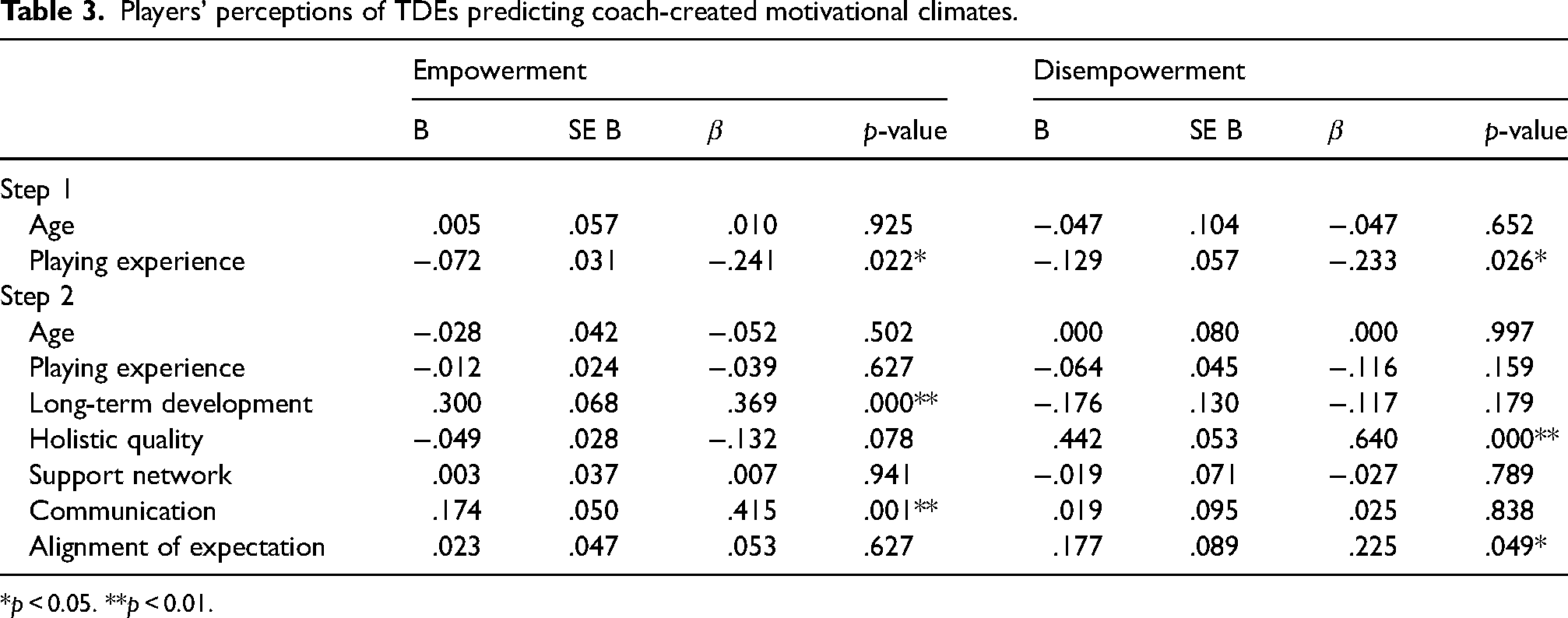
Table 3 shows the results of hierarchical multiple linear regression analyses on whether TDE dimensions predicted coach-created motivational climates. In the first hierarchical regression analysis, playing experience was the only significant predictor of empowerment in coach-created motivational climates in step 1 (t(107) = −2.32, p < 0.05). The step 1 model was significant (F(2, 107) = 3.19, p < 0.05), explaining 5% of the variance in empowerment. In step 2, the addition of the five dimensions of TDE accounted for a further 49% of the variance (R squared change = .49; F change (5, 102) = 21.62, p < 0.01). The complete model thus explained 54% of the total variance (F(7, 102) = 17.23, p < 0.01). In the final model, two variables were significant predictors of empowerment in coach-created motivational climates: long-term development (β = .37, t(107) = 4.23, p < 0.01) and communication (β = .41, t(107) = 3.52, p < 0.01).
Players’ perceptions of TDEs predicting coach-created motivational climates.
*p < 0.05. **p < 0.01.
In the second hierarchical regression analysis, playing experience was the only significant predictor of disempowerment in coach-created motivational climates in step 1 (t(107) = −2.25, p < 0.05). The model in step 1 was significant (F(2, 107) = 3.78, p < 0.05), accounting for 7% of the variance in disempowerment. In step 2, the inclusion of the five TDE dimensions explained an additional 44% of the variance (R squared change = .44; F change(5, 102) = 18.51, p < 0.01). The whole model was significant (F(7, 102) = 18.51, p < 0.01), accounting for 51% of the total variance in disempowerment. The holistic quality (β = .64, t(107) = 8.37, p < 0.01) and alignment of expectations (β = .22, t(107) = 1.99, p < 0.05) dimensions of TDE were significant predictors of disempowerment in coach-created motivational climates in the final model.
Discussion
This study builds on extant literature by investigating talent development and coach-created motivational climates within a South African youth football context. Specifically, it explored (1) South African youth football male amateur players’ perceptions of their TDEs, (2) players’ perceptions of the coach-created motivational climates in which they train, and (3) relationships between players’ perceptions of their TDEs and coach-created motivational climates.
The first aim of the study was to investigate youth football players’ perceptions of their TDEs. Among the TDE dimensions, long-term development was identified as the most prominent subscale and hence should be a core area for coaches to focus on when designing their environments. This finding aligns with Gangsø et al. 41 who reported that Norwegian under-19 football players rated long-term development highest, believing that their environment was of outstanding quality. This could be due to the fact that academy coaches’ priorities are to create and implement training plans that support players’ long-term success. In contrast, holistic quality was rated the lowest-ranked TDE facet, contradicting a previous study Gangsø et al. 41 This discrepancy might be due to the focus of the current study on players at non-elite academies. However, this low rating for holistic quality is concerning, as it suggests that the sampled South African academies do not prioritise players’ mental health, well-being, and lives beyond football 12 and therefore should be an area for coaches to focus upon further. Although this study did not examine coaches’ perceptions of TDEs, coaches should be equipped to develop players holistically, fostering their psychological preparation and overall life balance.
The second aim of the study was to assess players’ perceptions of coach-created motivational climates. Football players identified task involvement as the most important factor in a coach-created empowering motivational climate. This aligns with Cooper, 42 who reported that task involvement has the greatest impact on player development in youth academies. Research suggests that positive coaching techniques, particularly with younger players, yield the best outcomes, as coaches can influence players’ actions and behaviours. 43 Moreover, Appleton et al. 25 found that a task-involved approach promotes personal mastery, effort, and growth. The present findings also demonstrate that autonomy support is a key component of a coach-created motivational climate. Athletes whose autonomy is encouraged tend to show the most favourable motivational reactions, including competence and integrated motivation. 44
Our finding that the football players gave the lowest rating to controlling and ego-involving coaching is noteworthy. Bartholomew et al. 30 describe a controlling climate as one where coaches threaten, intimidate, or pressure players. Bartholomew et al. 30 argue that a controlling coach who punishes players is similar to an ego-involving coach who expresses displeasure and has little tolerance for poor performance. Hence, football coaches in South Africa may benefit from programmes that teach them how to create more empowering climates. 45 Relevant knowledge can be obtained through coaching classes, seminars, and workshops where coaches learn how to foster environments that encourage players to give their best effort.
The third aim of the study was to examine relationships between players’ perceptions of their TDEs and coach-created motivational climates. Significant relationships were found between the three TDE dimensions (long-term development, communication, and alignment of expectation) and an empowering coach-created motivational climate. Hierarchical regression analysis further confirmed that long-term development and communication were significant predictors of such an empowering climate. These findings suggest that coaches should allow athletes to make mistakes and provide them with frequent progress updates, feedback, and justifications for training drills and activities. 32 These factors appear to foster psychological safety, which encompasses athletes’ beliefs that they can discuss problems, ask for help, and receive feedback from coaches without negative consequences. A mastery- and needs-oriented atmosphere could help coaches foster athletes’ growth into socially proficient and well-rounded people. 32
Holistic quality was significantly correlated with both ego-involving and controlling coaching climates. Hierarchical regression analysis confirmed holistic quality as the only TDE facet that significantly predicted disempowerment in coach-created motivational climates. Since holistic quality reflects the extent to which the TDE supports player development both inside and outside the athletic setting, 32 this finding suggests that coaches may neglect players’ well-being, their lives outside sport, or their balance between training and competition.19,20,46 Therefore, coaches who create a more ego-involving and controlling environment may not only neglect the overall development of athletes but may also prevent them from developing important skills, including time management, effective communication, decision-making, and problem-solving, because athletes feel unable to use these skills independently. 32
Strengths, limitations and future research
The findings of this study contribute to understanding of how to foster an environment that effectively supports player development within the South African youth football context. However, participants were recruited from non-elite academies, hence further work is required to understand contexts that focus on higher levels of football ability. Finally, the cross-sectional design prevents causal inferences, offering a snapshot of data at one point in time. Longitudinal research using various techniques is required to investigate the long-term impacts of TDEs and coach-created motivational climates for South African youth football players.
Conclusion
This is the first study to investigate the perceptions of TDEs and coach-created motivational climates among youth football players in South Africa. These perceptions were generally positive. Long-term athlete development was the highest-rated dimension, whereas holistic quality had the lowest rating. Players rated empowering coach-created motivational climates positively and disempowering climates negatively. Holistic quality was a key predictor of disempowering motivational climates, and long-term development and communication were both significant predictors of empowering climates. This study offers important information to help coaches better prepare their players by frequently providing feedback on their training and overall development. It also highlights the need for coaches to cultivate the overall growth of athletes by helping them to balance the demands of practice, competition, skill development, well-being, and their personal lives.
Footnotes
Declaration of conflicting interests
The authors declared no potential conflicts of interest with respect to the research, authorship, and/or publication of this article.
Funding
The authors received no financial support for the research, authorship, and/or publication of this article.
