




Abstract
In youth sport, coaches often rely on subjective assessments of current ability and future potential, which may favor players advanced in biological maturation. This study evaluated the accuracy of coaches’ maturity assessments and their impact on perceptions of player ability and potential, as well the inter-coach agreement on talent and maturity evaluations. Maturity timing (discrepancy between biological and chronological age) was assessed using the Khamis-Roche method for 247 male players aged 13 to 17 years. Eighteen coaches provided estimations of their players’ maturity timing, ratings of current ability and long-term potential, and selections of top and bottom 5 players. Inter-rater reliability was calculated using weighted Kappa (k) and percentage agreement. Kendall correlation analyses (τ) examined relationships between maturity and coaches’ perceptions, while a Kruskal Wallis test examined differences in maturity between players classified by coaches as top, middle and bottom performers. On average, coaches underestimated the presence of early maturers and overestimated on-time and late maturers. Maturation timing showed weak correlations with current ability (τ = 0.075) and future potential (τ = 0.021). Coaches’ selected “top” players did not differ in maturity from their peers (H2 = 4.844, p = 0.89). Agreement between coaches ranged from none to weak. These findings suggest coaches’ eye may be inaccurate for estimating maturation. Additionally, there is poor inter-coach agreement in identifying talented athletes, indicating the “coach's eye” is subjective and variable. These results may have significant implications for future talent identification research and processes in sport organizations.
Introduction
Within many sports, adolescent athletes who have been identified as having the potential to excel as adults are recruited to talent academies. The talent identification (TID) process is predicated upon coaches’ ability to detect players with the highest potential for long-term success; decisions on selection during adolescence may be critical to longer-term participation and success in sport.1,2 This process of coaches identifying and selecting ‘talented’ players is commonly referred to as the ‘coach's eye’ and has been described as intuitive, subjective, experienced-based, and holistic in nature.1,3
The process of identifying a small pool of athletes with the potential to achieve elite levels of performance is complex and challenging.4,5 Coaches who select talented players at a younger age may be concerned with or deceived into choosing the best current performers, rather than the player with the greatest potential for future success. 6 Thus it is no surprise that youth success is often a poor predictor of success at senior level.7–9 For example, German professional football players emerged from a process involving repeated selection and de-selection throughout youth rather than from early selection and long-term continuous nurture in development programs. 10 Given that there is a high turnover of players in talent development squads, and a limited link with long-term success,8,10,11 it is worth investigating other factors which may deceive the coach's eye during TID.
Individual differences in the growth and maturation of young athletes confound the process of identifying and developing talented young athletes.12,13 In talent programs, players are generally grouped by chronological age (typically in one-year age bands) in the interest of promoting fair and developmentally appropriate environments and competition. 14 Despite this intent, single year age groups have been shown to result in relative age and maturity selection biases within annual cohorts.15,16 However, many young athletes experience non-linear development and mature at varying ages and rates. 15 A failure to recognize and accommodate for individual differences in athletic and skill development is a barrier to talent identification and development, and ultimately limits the pool of talented youth athletes. 17
While the terms growth and maturation are often used synonymously, these processes are distinct.15,18,19 Growth refers to measurable changes in size, physique and body composition, and various systems of the body. 20 Biological maturation refers to the progress towards the adult or mature state. 21 The effects of maturation are amplified in boys between ∼13–16 years by the timing and tempo of adolescent growth spurt. 21 Research in soccer indicates a difference of up to 6 years in biological age may exist among players within the same chronological age group. 22 The physical and functional advantages associated with advanced maturity 15 afford marked advantages in sports that require greater size, strength, speed, and power. The adolescent growth spurt has also been linked with numerous potential adverse effects for players such as an increase in susceptibility to specific types of injuries (i.e., growth-related), which can ultimately affect short-term performance. 23 Although the maturational advantages are pronounced for early maturing players, and may confound coaches’ perceptions of long-term potential, it is crucial to acknowledge that these advantages are transient and diminish by early adulthood when on-time and late maturing individuals attain full maturity.12,24
While coaches play a major role in identifying talented athletes, there is limited research on the accuracy of the coaches eye as a subjective process to make accurate selections on talent 25 and physical qualities associated with talent. 26 Several studies have evaluated coaches’ and scouts’ ability to estimate biological maturity however caution is required when interpreting these studies due to the diversity of the methods used. The categorization of players as early, on-time or late has been shown to vary relative to the methods and criteria employed. 27 For example, these studies have used different methods to estimate maturity status, including x-ray, 28 ultrasound machines 29 and various prediction equations (e.g., Mirwald; Khamis-Roche). The coaches studied have varied in coaching experience level from 2 30 to 5 + years’ experience 28 and also varied in their degree of familiarity with the study participants. Furthermore, different statistical approaches (Kappa, 28 ; Interclass Correlation Coefficient, 29 ) have been used to analyse levels of agreement. This diversity of methods and procedures makes it difficult to draw overall conclusions from the limited number of studies that have investigated this question.
A study involving regional players selected for the Swiss U15 national selection day, utilized skeletal age (X-ray) with the Tanner-Whitehouse 3 (TW3) method, age at peak height velocity (APHV) and assessments from six coaches estimating biological maturation (early, on-time, late). 28 An evaluation of academy players from the U12-U16 age group at a German Bundesliga club, using skeletal age (ultrasound using the BAUSTM system) with the Tanner-Whitehouse 2 (TW2) method. 29 Twelve coaches (with an average of 6.9 years’ experience) were asked to predict players’ skeletal age (± 0.1 years). In both studies, moderate to excellent inter-class correlation coefficients were reported indicating generally high levels of agreement between coaches. While Romann et al., interpreted a kappa of 0.48 as indicative of moderate agreement between the coach's eye and analysis of x rays, 28 under the criteria proposed by McHugh 31 this level would be classified as weak agreement. If coaches are making decisions on which team a young player should play with in a bio-banded format (i.e., maturity-matched 32 ), it would be important to have more robust measures of agreement underpinning decision making. In contrast, Ruf et al. 29 reported that coaches skeletal age predictions were, on average, close to the actual skeletal age derived using the BAUSTM system. The contrasting procedures and results illustrated by these two studies illustrate the complexity inherent in investigations of this question.
Despite the increased investment in talent pathways and academies in youth sports, poor pathway progression may suggest flawed talent identification outcomes throughout the pathway that maybe heavily influenced by coaches’ subjective perceptions.1,7 Understanding the relationship between the maturational status of players and the perceptions of coaches would be very useful to aid longer-term modification of criteria to make talent academies more open and efficient. In addition, providing education to coaches on the most suitable method to identify and consider a player's maturation status during the selection process could be useful in addressing the existing selection biases.16,18,24 In light of the preceding discussion, the first aim of this study was to explore the accuracy of the coach's eye as a method to estimate maturity timing. The second aim was to examine if maturational variation in Gaelic football influenced coaches’ perceptions of players’ current ability and future potential. The third aim was to explore the inter-coach agreement on the assessment of both talent and maturity timing. It was hypothesized that coaches would accurately categorize players’ maturity timing. Furthermore, it was hypothesized that coaches’ perceptions of players’ current ability and future potential would be positively associated with objective measures of biological maturity. Finally, it was hypothesized that coaches would demonstrate strong levels of inter-rater agreement in relation to talent and maturity timing.
Methodology
Participants
Ethical approval for the study was obtained from the Faculty of Education and Health Sciences Research Ethics Committee (2020_10_09), with approval from the county academies. Participants included coaches (N = 18 males) from two prominent Gaelic football academies. Coaches’ experience ranged from 3–25 years (x̄ = 12 years), and they were currently coaching the Under 14 (U14) - Under 16 (U16) age grades. Each coach had spent a minimum of twelve sessions coaching their respective squads to ensure familiarity with players. Coaches were provided with a study information sheet and provided informed consent.
The players to be assessed included male Gaelic football players (N = 247) from the aforementioned two academies, aged between 13 and 17 years (M = 15 years, SD = 0.87). The sample represents the Gaelic football talent pathway, from academy entry at U14 and the successive U15 and U16 age groups. 33 Parental/guardian consent for participating in the study and participant assent was obtained.
Maturity assessment
Players were measured once, prior to a standard training session, in the middle of the season. Height (cm) and weight (kg) were assessed by a single tester following procedures described by the International Society for the Advancement of Kinanthropometry (ISAK). 34 A pilot study conducted with similarly aged players established excellent intra-investigator reliability. The height of each participant's biological parents was self-reported by the parents through an online form, and adjusted for overestimation using sex-specific equations for adults. 35
Percentage of predicted adult stature was employed as an estimate of somatic maturation, using the Khamis-Roche (KR) method for the prediction of adult height. The KR method uses chronological age, height and weight of the youth, and mid-parent height (mean of the heights of biological parents). 36 The median error (50% error bound) reported between actual and predicted adult height (%PAH (Current height/PAH * 100)) using the KR method is 2.2 cm in males, from 4 to 17.5 years of age. 36 To express maturational status as an index of biological age (BA), the participants percentage of predicted adult stature was rounded to the closest percentage of attained adult height, and corresponding decimal age, from the reference values in the UK1990 growth data set. 37 For example, a %PAH of 91.1% would be rounded to the closest value of PAH for boys in the UK1990 data set, 90.9%, and corresponding age (BA) of 13.92 years. 38 This value was then compared against their chronological age (CA) to create a discrepancy score (BA-CA) representing the degree to which each participant was advanced, on-time or delayed in maturation for their age (i.e., relative maturity). It can be assumed that for children of the same chronological age, those closer to their predicted adult height are more advanced in maturation for their age. 39 Consistent with sector previous practice (i.e., Premier League 38 ;), the criteria of >+0.5 and < −0.5 years BA-CA were used to categorize participants as early and late maturing, respectively. This criterion is less conservative than the traditional criteria used to categorize youth as early and late maturing (±1 year) yet allows practitioners and researchers to more effectively differentiate between early and late maturing youth.
Coaches’ eye assessment of maturity timing
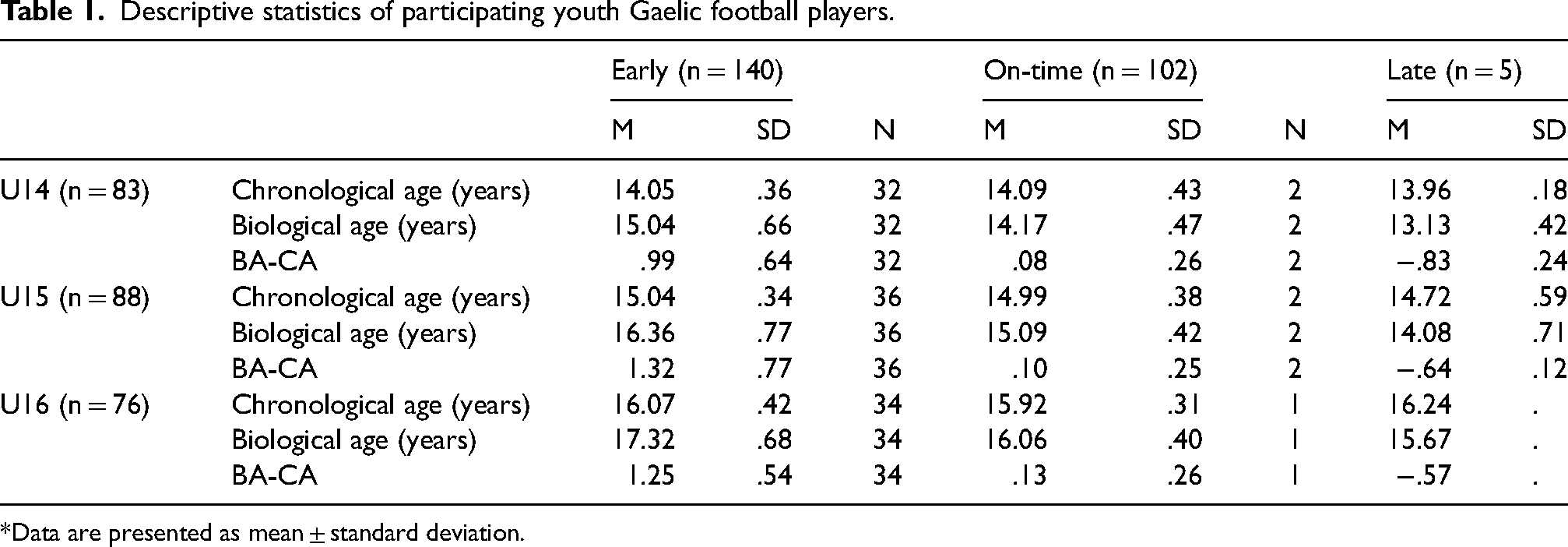
Eighteen coaches assessed 247 players in the middle of the season, through an online form (Table 1). Two coaches were recruited from each of nine squads (N = 18); each coach assessed all players on the squad they coached (between 24 and 34 players). Coaches were given a brief overview of the study and were not provided with the player maturity information prior to the data collection. All the coaches conducted their estimations independently, and they had no conflict of interest (i.e., were not related to the players). For each player on the team they coached, coaches were first required to estimate each player's biological maturity timing as Early, On Time or Late. 28 Coaches were provided with no criteria to base their judgement on and asked to rely on their own personal opinion and understanding of growth and maturation. Secondly, coaches provided a rating of each player's current ability on a 1–5 scale (1= Weak, 2 = Below average, 3 = Average, 4 = Above average, 5 = Exceptional 40 ;). The rating scale for each player's long-term potential was modified from the generic rating provided by Figueiredo et al., 41 to be more specific to the Gaelic football context: 1 = Recreational player, 2 = Adult club level (Senior team), 3 = Inter-county minor/U20, 4 = Senior inter-county squad player (fringe player), 5 = Senior inter-county regular starter (main player), 6 = All-Star 1 potential). Coaches were also asked to select the top 5 and bottom 5 players in their group. In addition, coaches provided ratings of how important they perceived both relative age and physical maturity to be in relation to both current ability and future potential (1 = Not important at all, 2 = Unimportant, 3 = Neither important or unimportant, 4 = Important, 5 = Very important). 42
Statistical analysis
The data were analysed using SPSS version 29.0. Cohen's Kappa (k) coefficients (weighted) were calculated to investigate inter-rater reliability between the Khamis-Roche prediction of maturity timing and the coaches’ estimates of somatic maturation, current ability, and future potential. Weighted kappa was used as it takes into consideration the different levels of disagreement between multiple categories 43 ; that is, a coach rating an Early Developer as a ‘On Time’ is more accurate than a coach rating the same player as a Late Developer. Values of Kappa below 0.6 indicated inadequate agreement among raters, with values of .60–.79 indicating moderate agreement, .80–.89 indicating strong agreement, and above .90 indicating almost perfect agreement. 31 Guided by McHugh, percentage agreement was also reported alongside Kappa. 31 A series of Kendell correlation coefficient analyses (τ) were conducted to investigate the relationships between maturity estimated using the Khamis-Roche procedure maturity and (a) coaches’ perceptions of player maturity; (b) coaches’ perceptions of players’ current ability and (c) coaches’ perceptions of players’ future potential. Values of τ between 0.0 to 0.195 were classified as trivial, 0.195 to 0.33 as low, 0.33 to 0.495 as moderate, 0.495 to 0.71 as high and 0.71–1.00 as very high.44,45 As the data was not normally distributed and from a small sample, a Kruskal Wallis test was used to examine whether maturation timing influenced coach's classification of players as amongst the top, middle or bottom players in their cohort. As there were two coaches with each team, to assign a player into the top, middle or bottom category, according to coaches’ judgements, the following process was used. If either coach assigned a player to the top category, the player was assigned top. Likewise, if either coach assigned a player to the bottom category the player was assigned bottom; all other players were assigned to the middle. Wilcoxon signed ranks tests were used to examine coaches’ rating of the relative importance of maturity and relative age, on both current ability and future potential. Descriptive statistics were conducted to investigate the magnitude and orientation of coaches perceived and true stage of maturity. 2
Results
Coaches’ eye as tool for assessing maturity timing
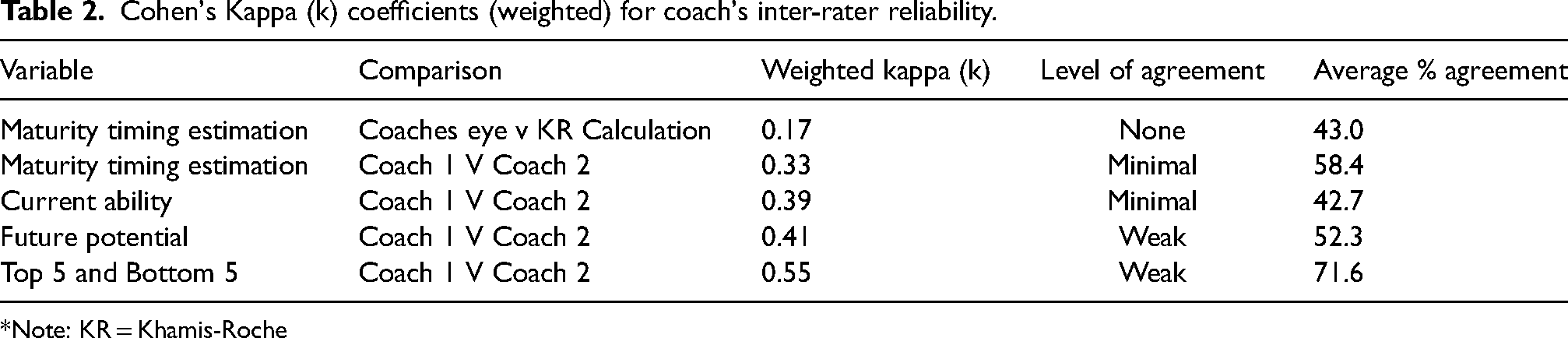
The average agreement between coaches’ estimation of biological maturity and Khamis-Roche (KR) estimation was 0.17 (Range = −0.22–0.38). The weighted Kappa coefficient, indicates an absence of agreement between perceived and observed maturity timing suggesting that coaches were unable to accurately categorize players as early, on-time or late (Table 2). This interpretation is support by the percentage agreement calculation which ranged from 27.3% to 64% (x̄ = 43%). Agreement between coach on the estimation of maturity timing was 0.33 (Range = −0.29–0.64). The weighted Kappa coefficient indicates inadequate agreement between coaches regarding their categorization of players as early, on-time or late. The percentage agreement ranged from 38.1% to 76.5% (x̄ = 58.4%).
Descriptive statistics of participating youth Gaelic football players.
*Data are presented as mean ± standard deviation.
Cohen's Kappa (k) coefficients (weighted) for coach's inter-rater reliability.
*Note: KR = Khamis-Roche
As illustrated in Figure 1, the majority of players classified as early maturing by the KR method were perceived by the coaches as on time (56.8%); 34.6% were correctly identified as early maturing while 8.6% were categorized as late maturing. Conversely, the greatest proportion of players classified as on time were correctly perceived as being on time by the coaches (58.3%), however 12.3% of players classified as on time by the KR method were classified as early maturing by coaches, while 29.4% of players classified as on time by the KR method were classified as late maturing by coaches. Most players classified as late maturing were correctly identified as late maturing by the coaches (60%), with the remainder equally likely to be classified as early or on time.
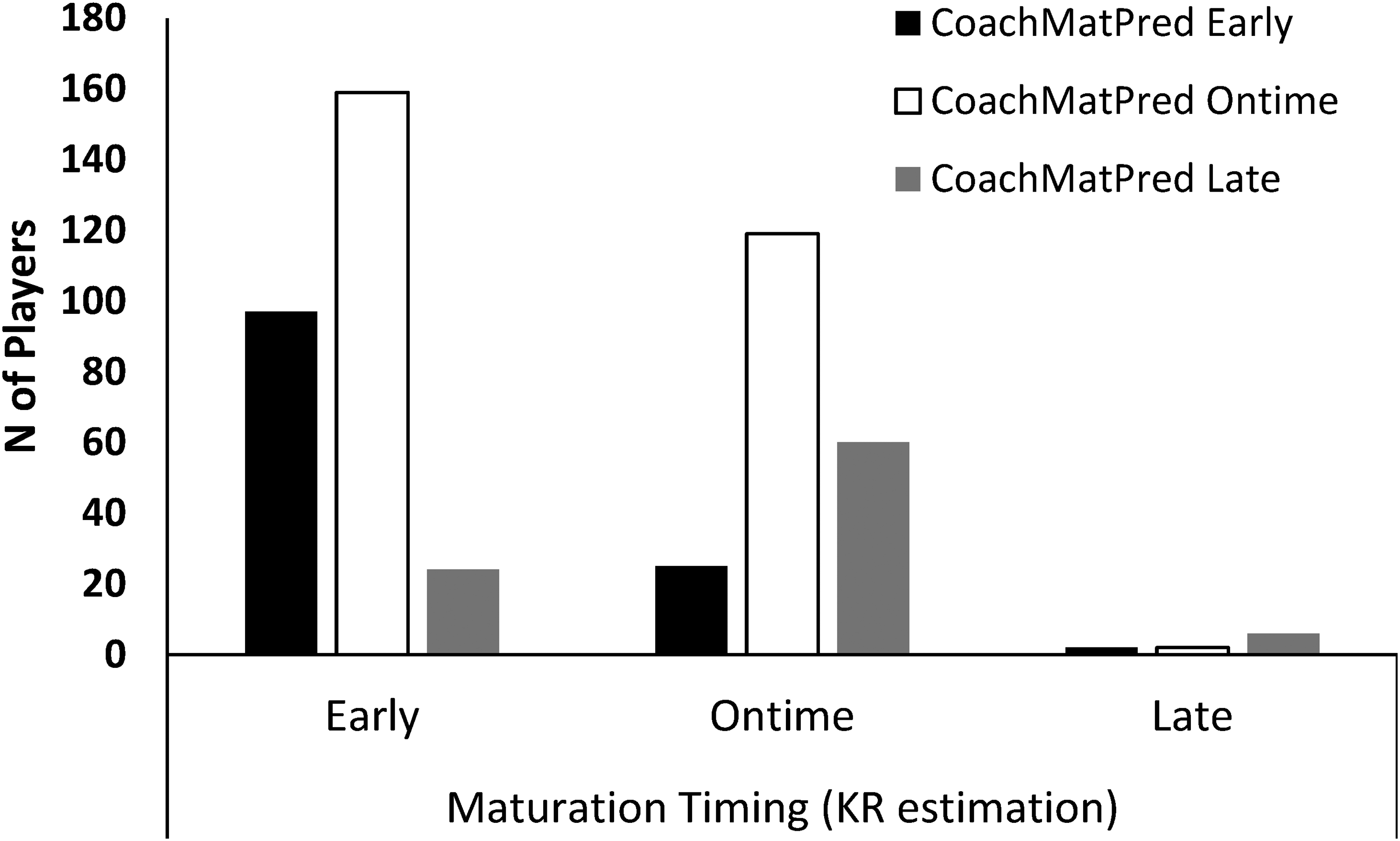
Coaches maturation prediction and the KR estimation. *Note: KR = Khamis-Roche; CoachMatPred = Coach Maturation prediction.
Inter-coach agreement on talent
The level of agreement between the coaches ratings of player current ability was minimal (k = 0.39; Range = 0.05–0.6), while the level of agreement on players perceived future potential was weak (k = 0.41; Range = 0.11–0.72). Similarly, the levels of agreement between coaches when asked to identify their top 5 and bottom 5 players on current playing ability (k = 0.55; Range = 0.2–0.8) was weak (Table 2). The percentage agreement on coaches’ rating of current ability ranged from 7.1% to 68.2% (x̄ = 42.7%), future potential ranged from 18% to 79.3% (x̄ = 52.4%) and top 5 and bottom 5 players ranged from 52.4% to 86.2% (x̄ = 71.6%).
Talent perceptions and maturity timing
Kendell correlation indicated trivial relationships between the objectively assessed estimates of maturity timing from the Khamis-Roche equations and (a) coaches rating of current ability τ = .08, (95% CI = −0.1 to 0.16) and (b) coaches ratings of future potential τ = .02, (95% CI = −.6 to .1). Similarly, a Kruskal Wallis test identified that players rated as being in the top 5 of the cohort were not more mature than bottom 5 players (H2 = 4.84, p = 0.89) (Figure 2).
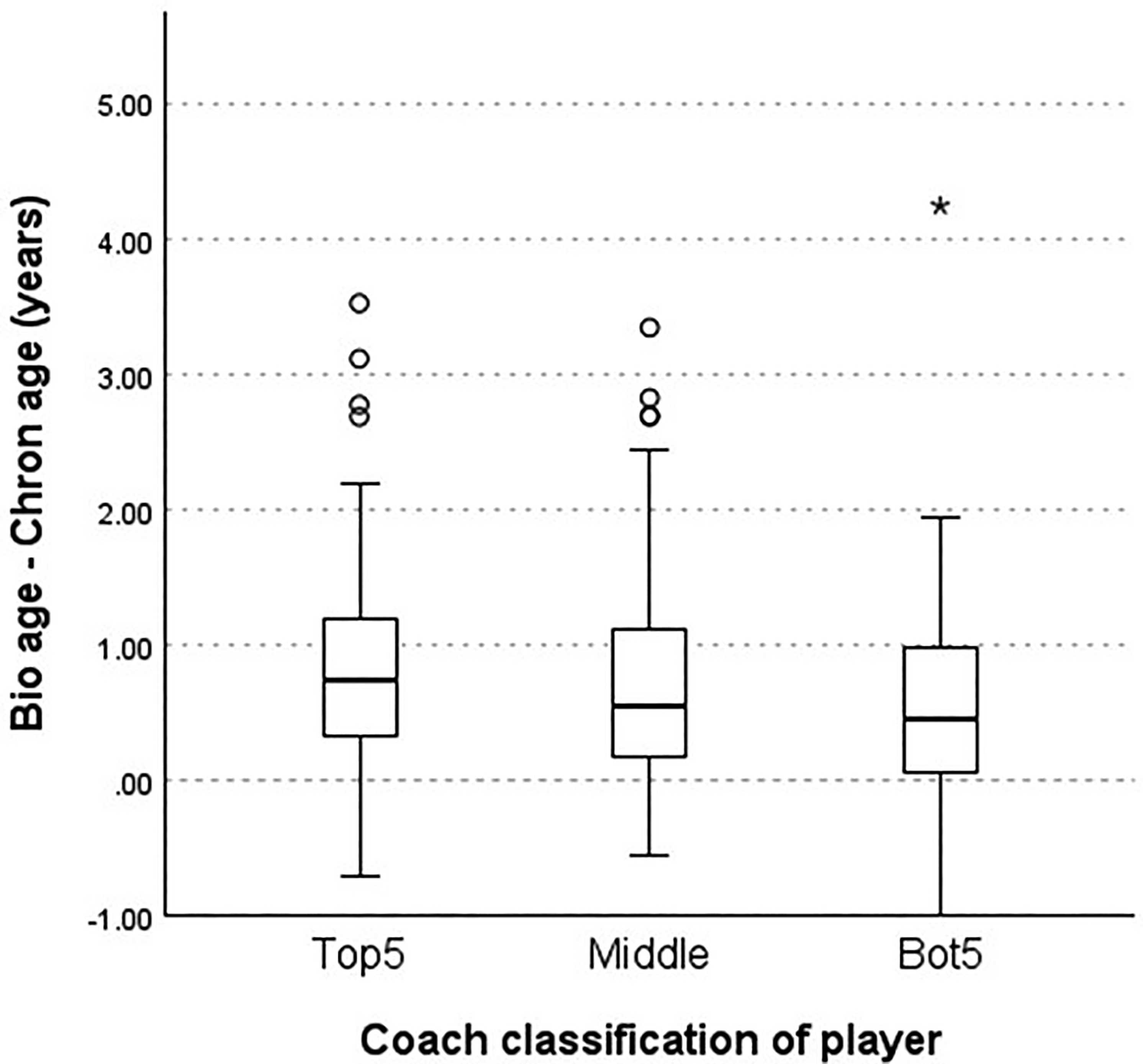
The influence of maturation on coach's classification of players current performance level. Note: Bio age = Biological age; Chron age = Chronological age; Top5 = player rated in the top 5 of the cohort by either coach; Bot5 = player rated in the bottom 5 of the cohort by either coach; Middle = all other players.
Wilcoxon singed rank tests showed that coaches rated maturity and relative age equally on level of importance in relation to current ability (z = −1.667, r = −0.39, p = 0.096) but perceived maturation to have a greater impact than relative age on future potential (z = −2.931, r = −0.69, p = 0.003).
Discussion
The current study explored the coach's eye as a tool to evaluate maturation timing, current ability, future potential, top 5 and bottom 5 players within Gaelic football academies. The results of the current study suggest that the coaches were unable to accurately categorize male Gaelic football players as early, on time or late maturing when compared to an objective estimate of maturity timing. Furthermore, there was little evidence to support the contention that coach perceptions of player current ability and future potential were associated with perceptions of maturity timing. These findings were compounded by low inter-coach agreement on estimates of both maturity and talent.
On average, coaches underestimated the maturity timing of early maturing players and overestimated the number of on-time and late maturing players in their squads. The correlations between maturation timing and (a) current ability and (b) future potential were minimal and weak, respectively. Players whom coaches identified as top, middle or bottom five from their teams did not differ in terms of their maturation timing. Agreement between coaches ranged from none to weak on maturity timing estimation, current ability, future potential, and identifying top 5 and bottom 5 players. The current results emphasize the need for additional coach education on growth and maturation, particularly in relation to objective methods of estimating maturity timing. In addition, the results suggest that consensus between coaches should not be assumed in relation to current ability and future potential.
The current study contributes significantly to the ongoing discussion regarding the assessment of biological maturation in youth sports. While previous research has shown promising results in coaches’ abilities to estimate maturity,28,29 our findings with a larger sample of coaches from a volunteer context reveal a lower level of agreement between these assessments and objective measures, highlighting an important area for development and training in coaching practices.
There are a limited number of studies to directly compare the present results with. Although Roman et al. 28 described coaches eye as a valid method to assess biological maturation, this was based on an interpretation of Kappa using generous cut offs. 31 Romann et al. found that in 74% of cases coaches assigned a player by eye to the correct category. Similarly, Ruf et. al., using both coaches and sports science and medical staff found on average, predictions of maturity were close to the actual skeletal age, with sports coaches slightly more accurate than then sports science and medical staff. 29 Within the current study, a much lower level of agreement was found between coaches’ eye and the equation-based estimation. The variation in results may be explained by two critical factors. Firstly, the current study used different methods and criteria to estimate players’ maturity timing. For example, in the current study biological age – chronological age and the criteria of >+0.5 and < −0.5 years was utilized, whereas Romann et al., used skeletal age – chronological age >+1 and < −1 years to categorize participants as early and late maturing. While the stricter criteria used within the present study might explain some of the differences with the results from Roman et al., Ruf et al. asked coaches to predict players’ skeletal age to within ±0.1 years; thus, the criteria used does not explain all the differences in outcomes between studies. A second factor which should be considered is coaches’ experience with maturation.25,28 In Gaelic football, despite their years of experience, coaches are volunteers with little or no formal coaching education/education on growth and maturation. 33 On the other hand, the professional coaches were at national 27 and Bundesliga level, 28 who have a high level of sport specific education. The majority of Gaelic games coaches are volunteers 46 and findings from professional coaches may not generalize to volunteer coaches. Given the ease of administering measurements, it is crucial for volunteer coaches in particular to employ more objective methods rather than relying solely on visual assessments to estimate biological maturation.
In the current study the coaches tended to underestimate the number of early maturing players (−31.6%) yet overestimated the numbers of on-time (+14%) and late maturing players (+16.8%). This trend mirrors findings from recent research conducted in the Bundesliga 29 and suggests that coaches have a skewed perception of what entails early, on-time and late maturation in youth. 14 This is perhaps not surprising given than that Gaelic football players are not representative of the general population. It is important to recognize the complexity of biological maturation as system, which includes factors such as status, tempo and timing. 21 While in general young athletes advanced in maturity may be taller and heavier, this is not universally applicable. 47 Consequently, rather than relying on the coach's eye, academies should incorporate more objective methods of maturity estimation. Moreover, these findings further highlight the importance of focused educational strategies, especially regarding the identification of very early and very late maturing players. 29 Therefore, using objective maturity assessments can improve the TID processes and provide a fairer approach to evaluating youth athletes.
Within the present study coaches rated maturity and relative age as equally important in determining current ability, but rated maturity as more important than relative age when judging future potential. This finding suggests a limited awareness of the differences between relative age and maturity and the strength of the effects at various stages of adolescence. A recent study in Gaelic football found a greater selection bias to academies for players advanced in maturation than for those born earlier within the competitive year. 16 This finding is consistent with research in soccer which found maturity to have a much stronger influence on the selection of U17 players than relative age during adolescence. 22 The findings highlight a critical gap in understanding among coaches regarding the distinct impacts of relative age and maturity on player assessment, suggesting the need for further education on assessments and strategies that account for same.
In the current study, coaches predicted that only four players (out of 247) would go on to be an established senior intercounty player, suggesting that coaches may be excessively conservative in their estimation of future potential. Additionally, there was significant variation in how coaches assessed talent. Specifically, the inter-coach agreement on ratings of current ability and future potential were low. One possible explanation is that in the current cross-sectional study, only one measure of each of the talent measures was recorded and coaches did so independently, without an external influence, with previous research found it took until the fourth time point in the season for coaches to improve agreement on assessment of talent. 25 This is an interesting facet of the current research, as it highlights the potential wide discrepancies that may arise from assessing talent using a one-off measure, even in situations where coaches are familiar with the players. It further underscores the reasons why in many sports coaches may disagree with other's evaluations of players, often causing friction in teams around selection. The current results suggest that coach's ability to assess top and bottom player may be slightly more accurate, as evaluations may be easier with players at the extremes. In light of the current research, it is recommended that coaches incorporate regular opportunities for detailed discussions on player performances, with the aim of enhancing agreement and insight into talent evaluation among coaches.
Our current research suggests a weak relationship between ratings of player maturation and (a) current ability and (b) future potential. Additionally, the results indicate that there is no difference in maturity for individuals that coaches rated as top 5 and bottom 5 players. In other words, coaches think less mature players in the current study have just as much ability as their early maturing teammates. The present findings are surprising, as research in Australian football suggests coaches’ perceptions of players long-term talent potential1,12 and short-term performance 15 may be biased in favor of early maturing players. In support of this point, research on short term effects of early maturation include advantages in strength, speed, and power, 21 which may confound coach perceptions of long-term talent and complicate the process of TID 24 However, coaches did not rate any very early maturing player (BA-CA >2 years) as having intercounty player or All-star long-term potential. Additionally, no late maturing player was rated as senior intercounty potential which is more aligned to the findings in Cripps et al. 12 It is essential to recognize that the current findings have a restrictive range; as players were already in the academy, the distribution of players mainly consisted of early and on-time maturing players, with only a handful of late maturing players out of 247 players. 16 Biological maturation appears to have a considerable influence on a player's initial selection to a representative squad. 16 However, our findings suggest that once a player has been selected, coaches may consider a wider range of factors when evaluating current performance and future potential.
Visual cues to identify differences in maturation and/or relative age may help coaches become more aware of and sensitive to developmental differences in youth. Building on similar work on relative age biases, 48 a recent study in soccer, although focusing on scouts rather than coaches, demonstrated that maturation-ordered shirt numbers helped alleviate a bias towards players advanced in maturation. 49 Additionally, evaluating performance in light of developmental curves and maturity status could provide a more comprehensive/in-depth method of monitoring long-term athlete development.50–52 At present, education on growth and maturation is lacking in the Gaelic Games coaching system. 53 In short, educating coaches to identify players’ maturity status accurately and considering both chronological and biological age when assessing the physical and physiological attributes of young players may alter the selection process.49,50 It may also help with predictive accuracy in TID, 1 which is traditionally poorly correlated with long-term performance and senior success.7,10 Further research is warranted to explore the potential impact of educational interventions on improving the maturity predictive accuracy, which may support player development pathways.
Limitations
The results are limited to this group of players and coaches in Gaelic football only. Further research across a larger sample, including a range of academies and sports is recommended to develop these findings. In particular, the current research only focused on male adolescent Gaelic footballers and may not apply to the female game, highlighting the need for independent future research. It is equally important to note that we did not assess several factors which could have influenced the coaches’ assessments of maturity, ability and future potential, including experience levels, previous education, coaching styles, and cultural differences. Future research with a larger sample of coaches could consider how some of these variables may influence the accuracy of the coach's eye. Although the Khamis Roche method for estimating maturity has demonstrated both construct and concurrent validity within athletic populations, 54 it should be noted that it is an estimate of biological maturation and possesses inherent error. Previous studies have demonstrated low to moderate concordance between estimates of maturity timing as determined by the Khamis Roche and Fels methods (Skeletal age). 55 It should however be noted that estimates of maturation will naturally vary across biological systems as maturation does not progress in parallel across different systems. Accordingly, researchers and practitioners should ideally consider multiple sources of information when assessing and monitoring the growth and maturation of young athletes.
Conclusion
In summary, the current study examined the coach's eye as a tool to evaluate maturation timing, current ability and future potential, top 5 and bottom 5 players within Gaelic football academies.
The findings highlight that the coach's eye is not an accurate method of estimating maturity timing with the current population. Coaches on average underestimated the maturity timing of early maturing players and overestimated the number of on-time and late maturing players. Additionally, there was limited evidence that coaches’ perceptions of player current ability and future potential was linked with perceptions of maturity timing.
It is recommended that coaches need to consider biological maturation when supporting youth athletes, utilizing practical and non-invasive methods, such as somatic estimation equations (i.e., Khamis-Roche). Additionally, the current research suggests, that coaches may need more regular and structured discussion around player performances and potential to achieve consensus in ratings in isolation, there is poor inter-coach agreement in the identification of talented athletes (ranged from low to moderate) and suggesting that the “coach's eye” is subjective and variable. These results shine a light on potential issues with selection of players in TAs using coaches’ eye. Coaches and GAA policy makers should be made aware of the transient benefits of advanced maturation for players and explore ways to integrate maturation into long term player development.
Footnotes
Acknowledgments
The authors gratefully acknowledge the participants and coaches in both county talent academies for their assistance in completing this study. No funding was received for this research. The authors declare no conflict of interest in the production of this research.
Data availability statement
The participants of this study did not give written consent for their data, even anonymised data, to be shared publicly. Consequently, consistent with the Institutional Ethical Review Policy, supporting data is not available.
Declaration of conflicting interests
The authors declared no potential conflicts of interest with respect to the research, authorship, and/or publication of this article.
Funding
The authors received no financial support for the research, authorship, and/or publication of this article.
