



Abstract
Goldschmied et al. (2025) have conducted a longitudinal survey of three sports where the winner must win three sets to win a match. This note investigates their results in a simple statistical model.
Goldschmied et al. (2025) have conducted a longitudinal survey of three sports where the winner must win three sets to win a match: American collegiate volleyball, international table tennis, and international men’s tennis. The paper has been written with a descriptive emphasis, but their results are worth investigating in a simple statistical model.
The model
Assume that a contestant wins a set with a probability
Then the probability that
one contestant wins the first two sets is the result after the first two sets is 1-1 equals one contestant wins by 3-0 is one contestant wins the first two sets but loses the third is the result is 3-1 after the match starts with 2-0 equals one contestant wins the first two sets but loses the subsequent two is a comeback is made equals one contestant wins the first two sets, loses the next two and still wins the match is
The value of parameter
Frequencies of different results in sports that require winning three sets to win the match.
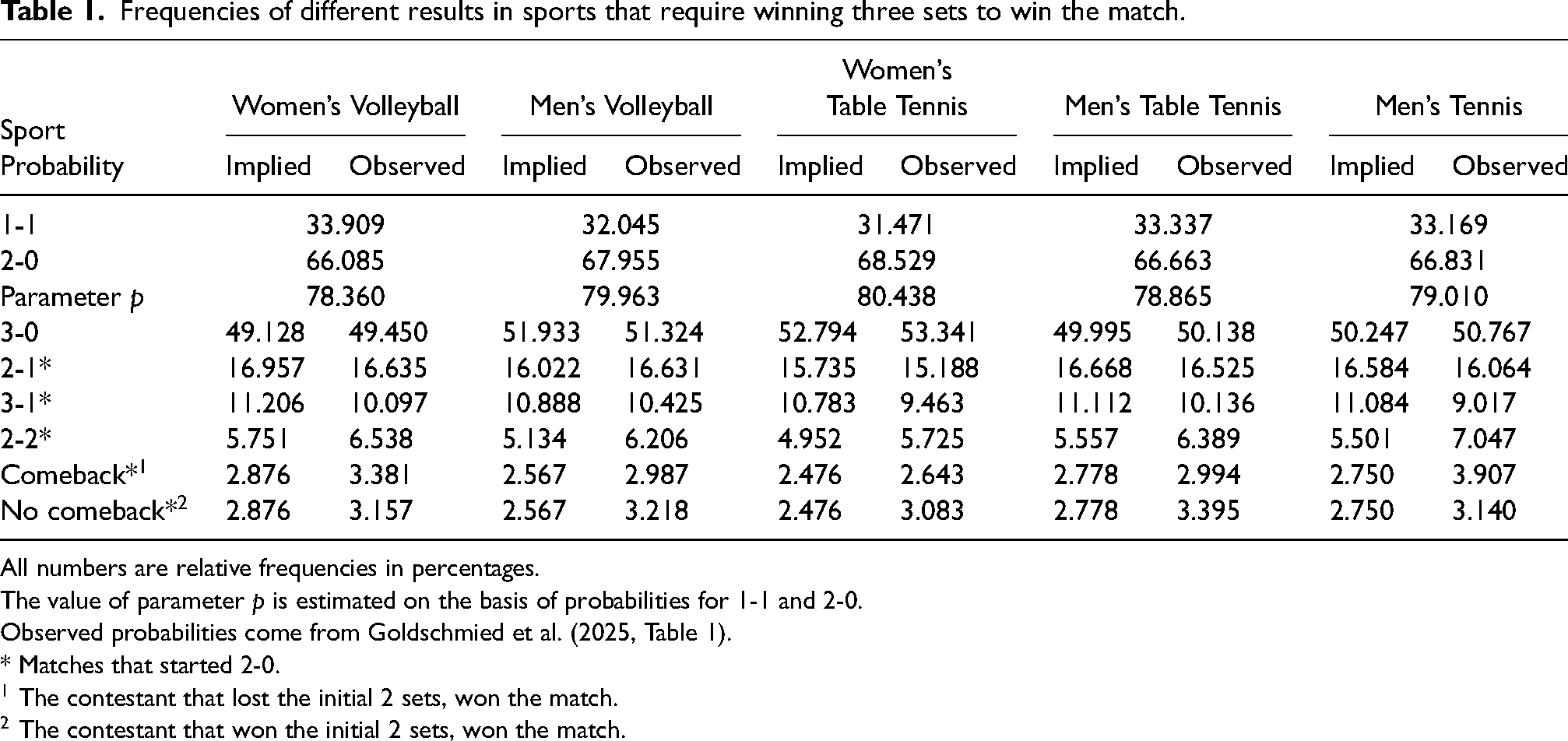
All numbers are relative frequencies in percentages.
The value of parameter
Observed probabilities come from Goldschmied et al. (2025, Table 1).
* Matches that started 2-0.
1 The contestant that lost the initial 2 sets, won the match.
2 The contestant that won the initial 2 sets, won the match.
Implications
Even though the suggested one-parametric mathematical model cannot fully reproduce field observations, its goodness of fit is surprisingly high. For example, the probability of 3-0 is over/underestimated by no more than 1.5%. The result of 2-1 after one contestant wins the first two sets is underestimated for all sports except men’s volleyball. This shows that luck is partially responsible for winning the first two sets, which is reinforced by the overestimation of the result 3-1 after one contestant wins the first two sets. The extent of upward bias exceeds 9.5% other than men’s volleyball and reaches 22.9% in men’s tennis.
Analogously, the probability of 2-2 after one contestant wins the first two sets is underestimated by at least 12%, with the worst performance for men’s tennis, where the downward bias is 22%. Finally, the model is independent of the outcomes of previous sets, therefore, the implied probabilities of a comeback and no comeback coincide. The relative frequency of both events is underestimated between 6.3% (comeback in women’s table tennis) and 29.6% (comeback in men’s tennis). The distortion is higher for a comeback in two sets of data—women’s volleyball and men’s tennis—and for no comeback in sets of data.
Overall, it seems that luck and psychological factors such as crowd support affect volleyball to the smallest and men’s tennis to the highest degree. The conclusion that skills and training have more impact on team sports than on individual sports makes sense.
