



Abstract
Performance Lifestyle (PL) services have the potential to make a novel contribution to athlete development, yet has limited research, notably examining the experiences of PL practitioners. This study explored PL practitioner perspectives to highlight current barriers and limitations in service delivery, whilst highlighting good practice. Six semi-structured interviews were conducted. Each participant supported athletes competing at professional, international, or Olympic levels. All participants were employed to deliver PL services with an average of 10.83 (±6.71) years’ experience. Reflexive thematic analysis was chosen to analyse the data with three main themes constructed. ‘Creating an informed environment’ illustrates environments that lack understanding regarding the nature, scope and value of PL services. ‘Optimising the role of PL practitioners’ seeks to identify best practice and explore common issues faced by practitioners. ‘Improving practitioner and coach education’ indicates a need for enhanced competencies and contemporary training for future practitioners and coaches. Findings provide unique insights into the experiences of practitioners and suggest that PL delivery, and its impact, is limited by several factors. This study discusses the contemporary implications of these issues and applied recommendations for future PL provision within high-performance sport environments.
Introduction
High performance (HP) settings have seen a rise in the integration of Performance Lifestyle (PL) practitioners. Driven by the need for a holistic approach to athlete support caused by continued evolution of HP and external societal demands.1–3 A holistic approach to athlete support includes physical, mental, and emotional elements, and consequently influenced the rise of interdisciplinary ‘teams of performance’. 4
PL succeeded the Athlete Career and Education programme, a pioneering career assistance programme, originally created by the Victorian Institute of Sport in Melbourne (1990) and then adopted by the Australian Institute of Sport (1995). Career assistance programmes are designed to support athletes in personal and sporting development as they transition through life in HP5,6 and have been a research topic for decades due to the wide range of athlete concerns.5,7–9 This includes performance demands which may lead to negative athlete mental health outcomes. 10 Effective career assistance programmes produce positive outcomes for athletes11,12 indicating that their inclusion within HP is appropriate and beneficial. A holistic approach to athlete personal development, dual career and wellbeing may also provide a competitive advantage and other organisational benefits to clubs e.g., aiding player recruitment.13–15
UK Sport rebranded from Athlete Career and Education to PL in 2004 with the intention to ensure focus on performance 16 and to further integrate HP disciplines. 17 In the UK, significant investment specifically targeting PL commenced in 2009 and totalled close to £1million for the London 2012 Olympic Games, equating to 18 practitioners for 1400 funded athletes indicating a ratio of approximately 1:78. 3 Current figures are not established in research; however, recent research indicates that the number of PL practitioners employed by the UK Sports Institute (UKSI) has grown to 35 18 yet these are mostly hired part-time indicating that current provision remains modest.19,20 Despite this increase, the rebrand may be considered unsuccessful as research suggests that current provision is delivered inconsistently and with difficulty in understanding what PL is and does. 17
UKSI, previously titled the English Institute of Sport, states that PL aims to ‘support athlete wellbeing and to encourage and facilitate their personal and professional development alongside their competitive sporting careers as they move onto, through and beyond the World Class Programme’. 21 However, research indicates significant diversity in PL roles including supporting athletes to develop other interests including hobbies and volunteering. 20 This would appear contradictory to the commonly head view of coach's that athlete lifestyle should be all-encompassing and involve complete immersion in their sport. 22 Furthermore, it is also recognised that PL functions (e.g., transitions and person-centred holistic needs) overlap with other workstreams, such as Performance Psychology or Mental Health, and are therefore not strategically aligned. 23 Recent research demonstrates that PL continues to experience difficulty in demonstrating performance impact 18 resulting in an ongoing reliance on athlete testimony, 17 which lacks objectivity. The wider evidence base is limited with few studies highlighting PL involvement in positive athlete outcomes.17,20,24 Furthermore, there is little empirical understanding conducted with PL practitioners. For example, practitioner availability is considered important in the effective support of youth athletes 25 highlighting the importance of exploring current working practices. A recent study explored the experiences of a number of PL practitioners within UKSI 18 however, the findings of this study are limited within the organisational context. Broader understanding of PL as an independent discipline across various contexts is required as opposed to an institutional role.
These issues question whether PL is clearly defined, its connection to sports performance and its place within a multidisciplinary team (MDT). This is concerning as the ability for MDTs to apply their services properly can only be done holistically and in an interdisciplinary fashion. 4 Furthermore, successful athletes consider multidisciplinary teamwork among the most important characteristics to their success. 26 As such, researchers need to examine PL scope and integration with other disciplines. Developing knowledge will help to position PL better within the MDT, avoid overlap, improve MDT synergy, and add depth to existing athlete testimony.
To examine these factors, exploring experiences of PL practitioners is warranted. By exploring the potential barriers and limitations to service delivery, applied recommendations to support future practice may be developed. Given this context, a qualitative approach allows for the investigation of practitioner experiences, offering more complex, rich data, upon which we can develop in-depth understanding. 27 Specifically, use of interviews allows researchers to explore the content of discussions and any associated analytical meaning and value. 27 Therefore, this study aims to establish the nature and remit of optimal delivery that provides a framework on which applied practice can be based.
Materials and methods
Research strategy
Given the research questions, a pragmatic research strategy was adopted. Pragmatism emphasizes practical problems experienced by people, 28 in this case PL practitioners, and seeks to bridge the gap between theory, i.e., what previous literature indicates PL does, and ‘real-world’ practice, i.e., what PL practitioners tell us. 29 Pragmatism allows for the development of practical recommendations which aim to make a positive contribution in applied settings of athlete support.28,30
Pragmatism argues that a continuum exists between objective and subjective viewpoints, which are influenced by the research question. 28 Against the backdrop of poor understanding, overlapping workstreams and poor definition, it is appropriate to use pragmatism to explore the views of PL practitioners with their consensus suggesting objectivity and allowing for recognition of practical-level truths. 28 Pragmatism uses an abductive approach, allowing researchers an active process of inquiry which moves back and forth between practitioners’ belief and actions. 30 This was important given the research objective of establishing key purposes and functions of PL.
Participants and sampling
Industry contacts were used to contact potential study participants. A mixed sampling approach incorporating purposive and voluntary sampling was used. An industry forum of approximately 150 PL, welfare, and personal development practitioners was purposively selected to recruit relevant study participants. A voluntary sampling approach was used allowing forum members to volunteer, ensuring that appropriately knowledgeable and experienced practitioners were recruited while eliminating selection bias by researchers.
A total of six PL practitioners (3 Male, 3 Female) volunteered to participate (Mage = 39 ± 10.89) who were currently supporting professional, international, or Olympic level athletes. Two practitioners were employed with their relevant national sports institute, two were employed directly by a national governing body, and two were employed on a consultancy basis supporting professional clubs. Participants had an average of 10.83 (±6.71) years’ experience within PL. The sample includes the highest quality of PL practitioners currently operating in HP and represents an expert sample. Practitioners had athlete engagement ratios ranging from 1:49 to approximately 1:200. Given the current framework of PL support in elite environments, the potential participant pool is limited and dictated the sample size.
The Swann model 31 was used to indicate the performance standard of the athletes supported by the participants in this study. This model considers the athlete's highest standard of performance, amount of experience at that level and success at that level. One practitioner supported “successful elites” i.e., athletes competing at the highest level and with some infrequent success. The remaining five practitioners supported “world-class” elites i.e., athletes with sustained success at the highest level. While each practitioner had a specific remit, the nature of PL means that practitioners support athletes currently competing at varying points within HP i.e., supporting both podium and podium potential athletes, junior and senior levels etc. Sample expertise is therefore enriched by practitioner's experience working with athletes who correspond to various categories of the Swann model. This experience enriches sample expertise by adding depth and breadth to their perspectives enhancing the quality of the data collected.
Procedures
Qualitative methods were chosen using semi-structured interviews to gather views and perceptions of individual PL practitioners. Interviews were appropriate as these aligned with pragmatism and facilitated abductive inquiry. Furthermore, interviews allowed researchers to identify emotional components within discussion, 32 i.e., a feeling that something is problematic, which allowed advancement of inquiry. ‘Key informant semi-structured interviews’ utilising key considerations from Gill et al. 33 were used allowing participants to elaborate and lead discussion. Open-ended explorative questions were prepared in advance to guide conversation towards intended discussion while allowing participants freedom for further exploration, and for researchers to pursue responses in further detail. An interview schedule was developed, and pilot tested on three PL practitioners currently delivering services to athletes. This allowed for schedule alteration and development to improve data collection. The schedule began by establishing context of practitioner roles including the sport(s) they support and their work mode. Interviews ranged in duration from 84 to 137 min (M = 106.8). The researcher conducted all interviews remotely, between February and October 2021. All interviews were automatically transcribed verbatim using video conferencing software. Transcripts were manually reviewed by the researcher to correct any errors and amend the flow of the text. All practitioner names were removed and replaced with a number (e.g., Participant 1) to ensure anonymity. Only this affiliated number is referenced in the results. Full ethical approval (Unique Reference Number: BAHSS2 0195) was provided by the University of Central Lancashire Ethics Review Panel (BAHSS; Science & Health).
Data analysis
Reflexive thematic analysis (RTA) was used as it allowed for identification of commonalities within the data, driven by participants perceptions. 34 RTA was selected above other types of analyses due to its alignment with pragmatism and the research objectives. RTA is concerned with themes, rather than content, enabling focus on ‘where we’re aiming to get to’, 35 i.e., to produce applied recommendations for future PL practice. RTA was performed using qualitative analysis software and followed the six-stage model by Braun and Clarke. 36 This involves moving forwards and backwards through stages with active deliberation and analysis to improve the quality of insights produced, ultimately providing more impactful recommendations. 37 Sections of text and specific quotes were highlighted and coded with brief descriptions that captured the essence of the data. All codes were thoroughly reviewed, refined, and grouped into higher and lower order themes that were reflected across the entire data set. The second (CY) and third authors (DR) reviewed the coding presented enhancing reflexivity and interpretative depth, generating insights from nuances in the data. 34 Researchers discussed their observations and repeated the analytical process to develop a final set of themes that were mature and reflective of the data set. 35
Quality considerations
The study seeks to evidence rich rigour through the coherence of the research methodology combined with an appropriate sampling method. Pragmatism recognises that interactions and biases of researchers are unavoidable, and act as a key source of abduction. 29 Therefore, pragmatists view knowledge as co-constructed between researchers and participants. While the researcher's experience and qualifications in the subject matter may indeed influence constructed themes, it is accepted that this knowledge improves, rather than invalidates, the depth of findings through supporting the analytical process. 30 Second and third authors were used to offer triangulation and confirmability of initial study themes, 38 to encourage deeper reflection, highlight identified biases and develop further interpretations of the data. Both study supervisors are familiar with qualitative studies and have vast experience in related fields. Researchers have recorded and tracked the development of the coded data throughout the reflective process as themes have been generated, developed, and refined. Final themes have been presented with a variety of examples from different study participants evidencing consensus and resonance.
Results
Data analysis constructed three main themes: ‘Creating an informed environment’, ‘Optimising the role of PL practitioners’, and ‘Improving practitioner and coach education’ with subthemes highlighting an important facet of the respective theme. 37 The constructed topics reflect factors indicating areas of future development in PL. A thematic map (Figure 1) has been designed to highlight connection between themes and areas of overlap.
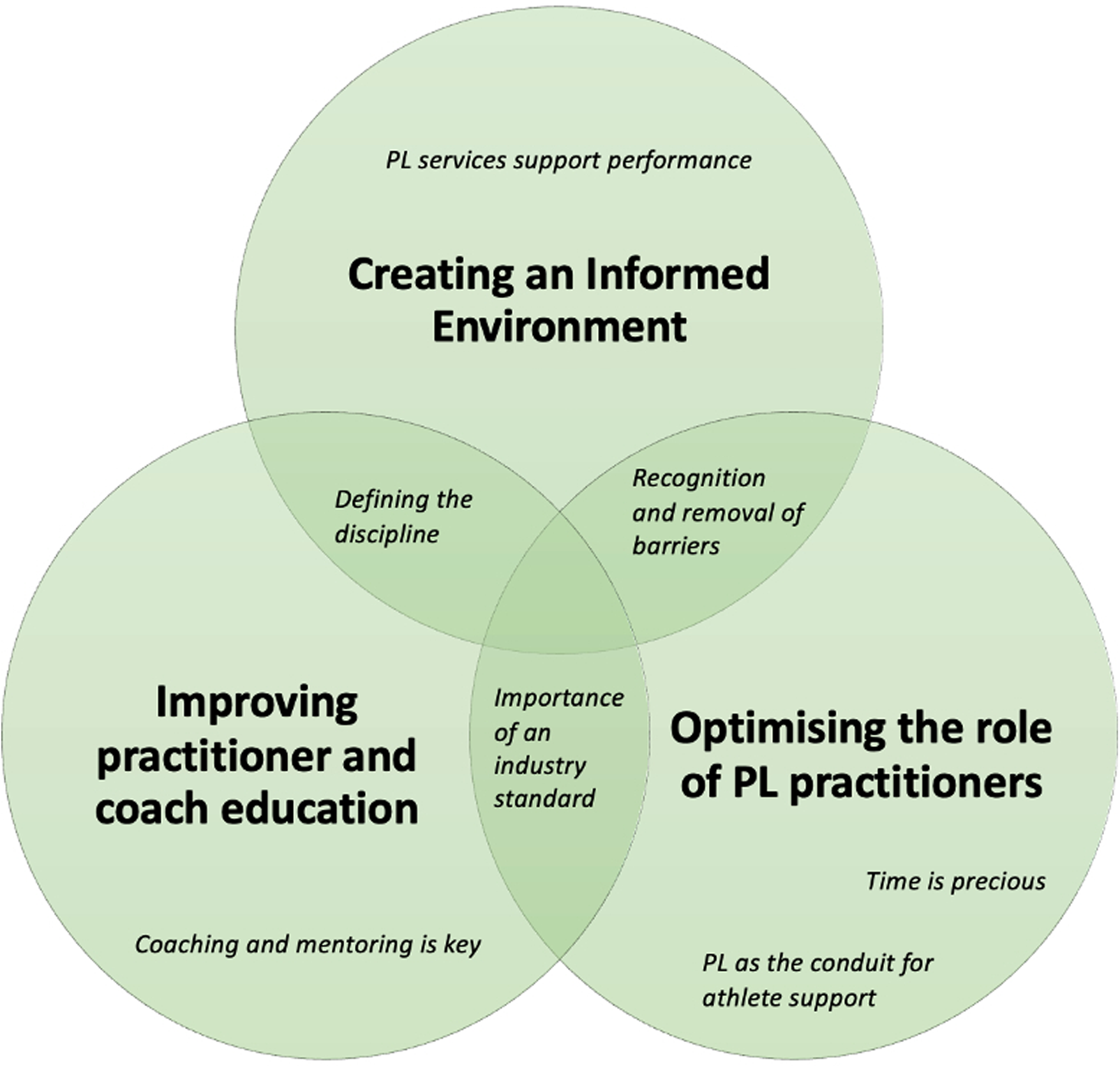
Thematic map of findings.
Creating an informed environment
All participants indicated that the requisite level of PL understanding doesn’t exist within their specific environments. Researchers felt this to be important as role clarity and equal expertise are important factors in the effectiveness of an MDT. 4 Participant 1 (P1) exemplified this issue by stating ‘the limitation always comes to that recognition of PL being just as important as sports psychology, sport nutrition, and you know operations manager, team manager, etc.’.
Lack of understanding results in various issues for stakeholders. The most significant relates to a philosophical clash between PL as an athlete care service, i.e., wellbeing, and supporting performance, i.e., winning. Research suggests this is common with athletes sacrificing physical and mental wellbeing in pursuit of sporting success.39,40 Participant 2 (P2) illustrated the potential implications if balance of these goals is not achieved: ‘So, for some of them, it will be a realization that they don't want to pursue that sporting career further’.
Lack of education creates misinformed MDTs resulting in barriers to PL development which are discussed as a subtheme below.
Recognition and removal of barriers
Participants identified several issues in accessing and engaging with PL services, and the broader acceptance of those services within the MDT. Researchers noted that practitioners discussed these barriers with frustration, suggesting the strength and frequency of these problems, and a desire for more support. Notably, most practitioners identified coaches as a significant cause of these limitations. I have regular conversations with him [coach]. I think he kind of gets PL, gets what I’m about etc. but then, if you look at it more bluntly. Does he give PL time to run a workshop during a camp? No. (Participant 5)
The issue of conflict between PL and coaches is recurring, specifically in relation to the level and nature of coach support. However, most participants also stated that coaches can actively facilitate PL engagement. If they’re on board with what you’re trying to do, then it's helpful with the [athletes]. If we asked the [athletes] or we tried to sell something [PL] to them, they might listen, whereas if the coach does it, then they will listen. (Participant 3)
Defining the discipline
Most practitioners discussed that the nature, scope, and value of PL is not clearly understood: ‘I don’t feel that they understand the breadth of the discipline and the whole range of services that we provide for our athletes’ (P3). Researchers considered this important as it suggests PL ought to be more clearly defined and better communicated to stakeholders.
All practitioners positioned Athlete Wellbeing and Duty of Care as the absolute priority of PL. P3 exemplified this stating ‘First of all you've got a duty of care and my duty of care is to the athletes. It's not to coaches or to the support staff’.
Participants were further asked to discuss the services provided to athletes which all connected to sports performance.
PL services support performance
All practitioners stated direct benefit of their work to sports performance. This was considered vital in developing understanding and support for PL by coaches and other MDT staff. P1 explained that ‘You’ve supported their performance on the field by taking all the distractions away off of it’. In addition, most participants described that sports performance improved as a result of producing happier/better athletes. Participant 4 (P4) exemplified this point: ‘…we have to support the human being to be the very best that they can be in order to help the athlete be the very best that they can be’.
PL also supports performance by retaining talented athletes. All practitioners referenced services which prepare athletes for their lives post-sport with most practitioners noting that these services help extend athlete careers. If they've been upskilling themselves and kind of getting experiences along the way, then they won't necessarily feel like they're exiting sport here, entering the real world here. It's more of a sideways move… That means that they can move more sideways and actually think no I could stay on to Paris and I could stay on to LA. (P5)
Optimising the role of PL practitioners
This theme focusses on improving PL delivery and establishing best practices for athlete engagement. Such practices were considered necessary by practitioners to ensure positive impacts from athlete interactions, support individual performance, but also to demonstrate disciplinary expertise and contribute to broader programme goals. These factors are also needed to address previously identified issues.
Clarity is considered a prerequisite to effective PL delivery. All practitioners ensure clarity for athletes, usually through a formal induction process. So, again through those conversations that I’d have with newer [athletes] there would be many times where we’d discuss the performance lifestyle role and kind of what it is, what it does and how it can benefit them specifically. (P3) …being in and around training and just on the [training venue] when they’re warming up or cooling down. There's absolute golden opportunities to engage in some early conversations that can then spur into should we sit down and talk about what you’re thinking about education or what you're thinking about next steps of your career. (P4) We went out for a cycle together and I felt like he just was opening up on a different level, and he was kind of like I just prefer seeing someone in person and he's certainly not alone in that kind of opinion and approach. (P5) Every other discipline that I work with in the [organisation] are gatekeepers, they can be the difference between selection or deselection… And then PL doesn’t really sit in that space, which is such a benefit where then the athlete's more willing to trust you and more willing to open up because they know they can trust you. (P3)
Time is precious
Time was considered a significant issue, with the part-time nature of practitioner roles and high caseloads leading to limitations in effectiveness.
Half of the study participants specifically described difficulties in supporting large caseloads. P1 illustrated this when saying ‘One minute I’m one to 70. Next, I’m one to 250. And it's like whoa whoa whoa this can’t work’. This is compounded by the part-time nature of PL further reducing the time practitioners have with athletes. While most practitioners referenced operational limitations caused by part-time roles, P5 indicated a reduction in perceived value of PL support, which appears counterproductive to developing the recognition of disciplinary expertise: I’m not going to be able and probably never going to be able to do as much as I want to do. So, they're kind of like, it's almost… like everything I do is a bonus, you know, like wherever I can help is really good.
PL as the conduit for athlete support
Most practitioners positioned PL as a central hub for athlete support which may be influenced by PL's poor definition, and overlap with psychosocial factors of performance, psychology, mental health and holistic needs. This would allow awareness of the breadth of athlete issues and to either provide support directly or refer elsewhere. P4 exemplified this when stating ‘we need to change the narrative around what this support is really, essentially the glue that brings everything else together’.
While such a change may contribute to optimising PL roles, participants indicated a further need to review education pathways for practitioners and other MDT staff.
Improving practitioner and coach education
Practitioners indicated that improving education would make a significant contribution to informed environments, hence the crossover highlighted in Figure 1. Several participants indicated that coaches and MDT staff learn about PL through direct engagement with the service. P4 stated ‘I think the way we deal with it is, we have to coach the coach’. This suggests that PL does not currently exist on the same footing as other disciplines and cannot be considered as equal expertise.
Additionally, reviewing PL postholder requirements should be a priority as current training pathways are inadequate. This represents a priority area as the ability of PL practitioners to gain traction and support in their environments currently relies on their individual skillset and not existing qualifications: ‘I don't think there's actually any qualification I would say is necessary to have’ (P6). Half of the participants indicated training needs relating to Athlete Wellbeing and Duty of Care: ‘I would say that mental health first aid should be an absolutely needed qualification’ (P2). Furthermore, all practitioners discussed the relevance of coaching and mentoring (C&M) skills to their roles, forming a new subtheme.
Coaching and mentoring are key
All practitioners valued C&M skills which may indicate the specialism PL brings to HP: ‘since I’ve been in the discipline, it's been apparent that the best way to support an athlete is to help them find their own solutions’ (P4). The importance of C&M was also described in relation to efficacy of delivery: ‘that's only since I’ve completed the ILM you realize how important those skills and techniques are to effectively do your job’ (P3).
Developing appropriate qualifications would act as an initial step in setting a benchmark for future practitioners.
Importance of an industry standard
Practitioners suggest that recognition of PL expertise is developed themselves through their interactions with athletes, coaches and MDTs. However, recognition is likely developed inconsistently, and therefore a professional standard is needed to provide disciplinary validation, standardisation and recognition. If you go to an S&C guy, you know that he's gone through UK strength and conditioning qualifications, and he's got the certificate to prove it sort of thing. With PL, there's still not that quality assurance. (P1) There needs to be some consistency, I think, so that it's fair for the athletes and also to legitimize the discipline and to make it easier to comprehend for other practitioners, coaches, etc. And to make it more repeatable. (P5) There's a little bit of confusion around how you’re defining these player care roles and I think that's when that brings us on nicely to get to a point where performance lifestyle is recognized by an organizing body so you can’t just use that title. (P3)
Discussion
This study aimed to explore the scope of PL provision and current integration with other HP disciplines. Study findings indicate key services which PL provides and several factors that influence delivery, supporting the development and integration of this service. Findings have allowed for recommendations to future HP training and service provision, including practitioner and coach education, and role clarity.
Creating an informed environment
Understanding practitioner skillsets promotes effective performance and collaboration of HP teams. 41 Increased levels of role ambiguity and conflict leads to impaired performance. 42 To provide clarity and assist in resolving identified issues, a new definition of PL is proposed: ‘PL is a duty of care focused service which prioritises the holistic wellbeing of athletes. This care is underpinned by qualified coaching and mentoring practitioners who support athlete personal and professional development’. This definition captures service priorities, specialist methods and the targeted outcome. Using the proposed definition uniformly may support greater understanding of PL in future and assist in removing associated barriers.
HP programmes are under more scrutiny than ever before. High profile duty of care cases continue to punctuate sport providing evidence of need for effective provision in athlete support.43,44 This study suggests current provision is suboptimal, with little progress made since the publication of the Duty of Care in Sport review. 45 Continued inaction raises questions regarding what conditions and outcomes HP is prepared to accept for athletes. As such, duty of care aspects of PL need greater recognition. The ‘Winning vs Wellbeing’ issue will continue to challenge HP cultures. Other disciplines are also affected such as physiotherapists who are at times expected to ‘coerce athletes to play injured and through pain’. 46 PL practitioners face challenging scenarios with conflict between HP demands and the duty of care owed to athletes. However, this study suggests performance is secondary to supporting athletes’ wellbeing within pressurised environments. The proposed definition intentionally excludes terms indicating sports performance to highlight PL's independence from performance.
Study findings are consistent with previous research outlining conflict between performance goals and athlete needs.2,47 Coaches and MDT staff still look to cultivate broader outcomes, however, these are considered complementary to sports performance and not key objectives. 4 Establishing the proposed definition should foster greater understanding of PL, improving service support and engagement.
Optimising the role of PL
Positive wellbeing is vital for sports performance 48 and includes hedonic wellbeing (HW), e.g., attaining happiness, and eudaimonic wellbeing (EW), e.g., self-actualisation. 1 PL contributes to both categories.5,7–9 However, this study indicates PL scope is either unknown or unvalued limiting referral and engagement. As such, findings provide a framework to promote PL value including through improving coach education.
There is also need to relay the entire breadth of service benefits. Clearly communicating sports performance contributions is necessary to develop credibility and should be promoted to stakeholders. Beyond this, new frameworks may improve provision by incorporating transparent staff responsibilities alongside enhanced qualification criteria. These developments should improve disciplinary synergy and allow for clarification between disciplines in areas of potential crossover e.g., psychology (Figure 2). Contemporary HP complexity means that issues are supported by numerous practitioners; a contributing factor in the rise of PL as an independent discipline. Clarifying staff roles, particularly in areas of overlap, is important to develop effective MDTs. 49 PL is influenced by positive psychology, which is person-centred and aligned with EW, and focuses on developing positive personal traits, e.g., perseverance. 17 One framework for consideration is a psychosocial model whereby PL (or similar roles, e.g., personal development practitioners), psychology, and others related staff sit within the same ‘team’ ensuring clarity and synergy through shared understanding. 50 Disciplines share their experience and understanding of athlete needs to create a more complete picture. Each discipline maintains a specific remit but recognises purposeful overlap to achieve team objectives and better support. Clarity in disciplinary boundaries or delivery models may promote greater support and referral among the MDT.
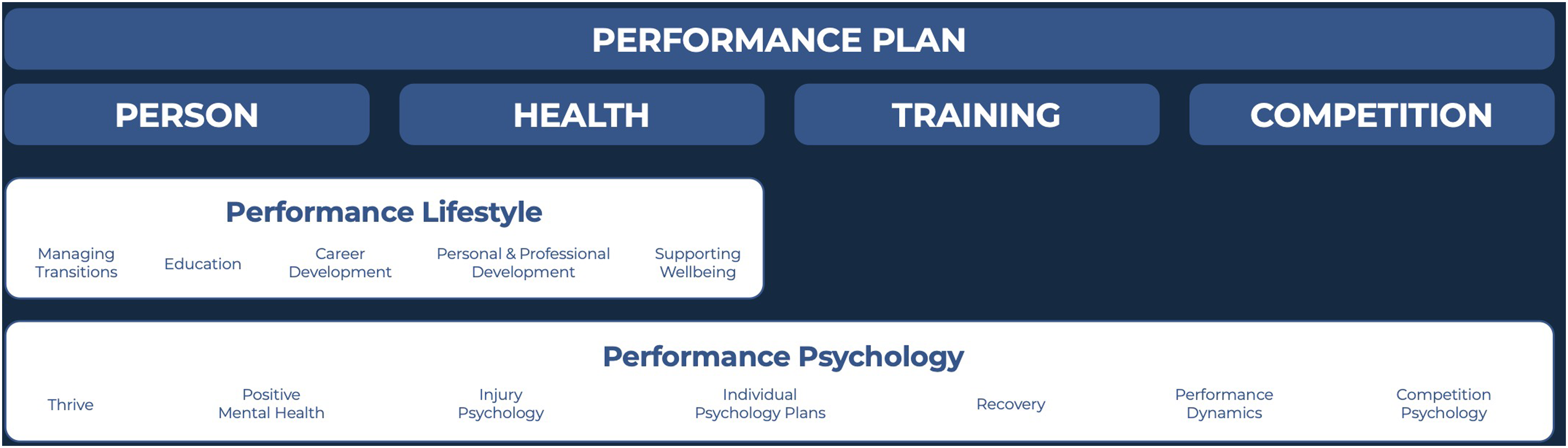
Scope of practice of services provided to athletes. 63
“Performance Directors and people running sports talent programmes should encourage the uptake of the Performance Lifestyle service by participants and ensure sports performance doesn’t limit its role and influence”. 45 This study finds that current practice does not meet this recommendation. Effective HP delivery is driven by functional integration through collaborative planning, mutual respect and collective responsibility. 51 Effective integration would see PL support planned alongside and fully aligned with programme milestones e.g., selection decisions. The importance of having structured support for deselected athletes is well referenced.52,53
Engagement ratios are particularly concerning considering research highlighting their significance.54–56 Related research in psychology, therapy and mental health are helpful to demonstrate that higher caseloads lead to poorer client outcomes and lower quality care,57,58 while lower caseloads produce better client outcomes. 59 Other considerations include practitioner burnout and job dissatisfaction.58,60 Other related research in education shows lower teacher-student ratios produce better tailored instruction and improved student outcomes. 61 This study finds that PL fails to meet industry best practice as none of the participants met the suggested standard for practitioner to athlete engagement ratio of 1:40. 62 Practitioners in this study supported a mean of 81.6 athletes and highlighted concerns about supporting such large numbers. While UKSI recognise this problem in their latest strategy, 63 their targeted engagement ratio of 1:60 indicates that suboptimal investment will continue throughout the next cycle. Furthermore, it is worth noting that during recent PL recruitment none of the 11 available roles were offered on a full-time basis. 19
When discussing engagement ratios, it is worthwhile to consider other HP disciplines to gauge how stretched PL support may be. Engagement ratios within HP medical and performance departments are not well documented across literature, perhaps due to variation in provision across organisations. Although, within the public sector physiotherapists carry an average caseload of 73, with most practitioners having less than 50. 64 A more appropriate example is coaches where maximum engagement ratios typically range from 1:8–1:30. 65 These comparisons are not faultless, as the nature of roles and environments are highly unique. However, they do pose a practical question of what is achievable for a single PL practitioner. It may be unrealistic to effectively guide up to 60 athletes through tailored holistic development, while having full understanding of each athlete's wellbeing and to do so while employed part-time.
Current UKSI provision uses a performance leadership triad (Figure 3) with a Head of Performance Support representing sports science and medicine disciplines (including PL), and their view in the performance planning process. 63 This role, and indeed model, appears geared towards performance outcomes, and it may not be possible for duty of care responsibilities to be effectively enacted under this system. This study highlights the importance of practitioner independence to ensure trust and confidence as essential to effective delivery 66 with a lack of independence limiting athlete disclosures due to fears of non-selection. 67 Therefore, delivery models must ensure clear independence from selection to support provision.
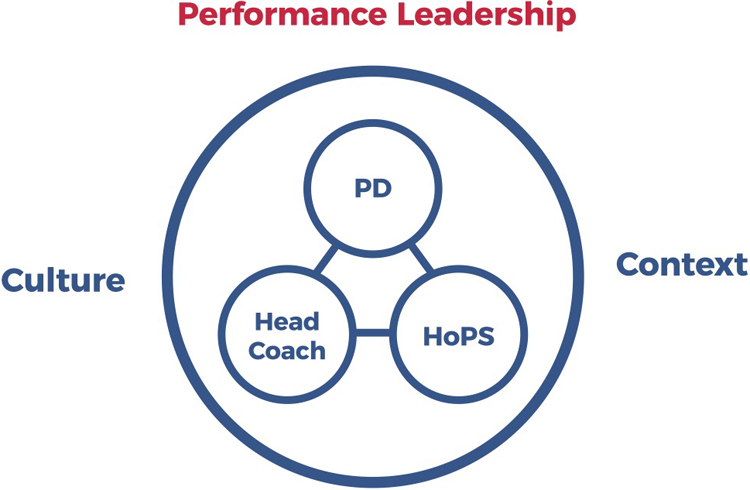
Performance leadership triad 63 .
Given our findings, it is pertinent to propose an alternative delivery model, Figure 4, which creates a new domain to highlight the importance of wellbeing and duty of care needs. This model recognises that certain disciplines are primarily intended to support wellbeing, with performance goals recognised as equally important but secondary. This model also places shared responsibilities alongside coaches for planning and goal setting may increase the probability of predictable high performance. 41 Figure 4 shows how existing support disciplines could be reallocated under separate Performance Support and Duty of Care domains. However, we don’t claim for this to be fixed and recognise this is open to debate.
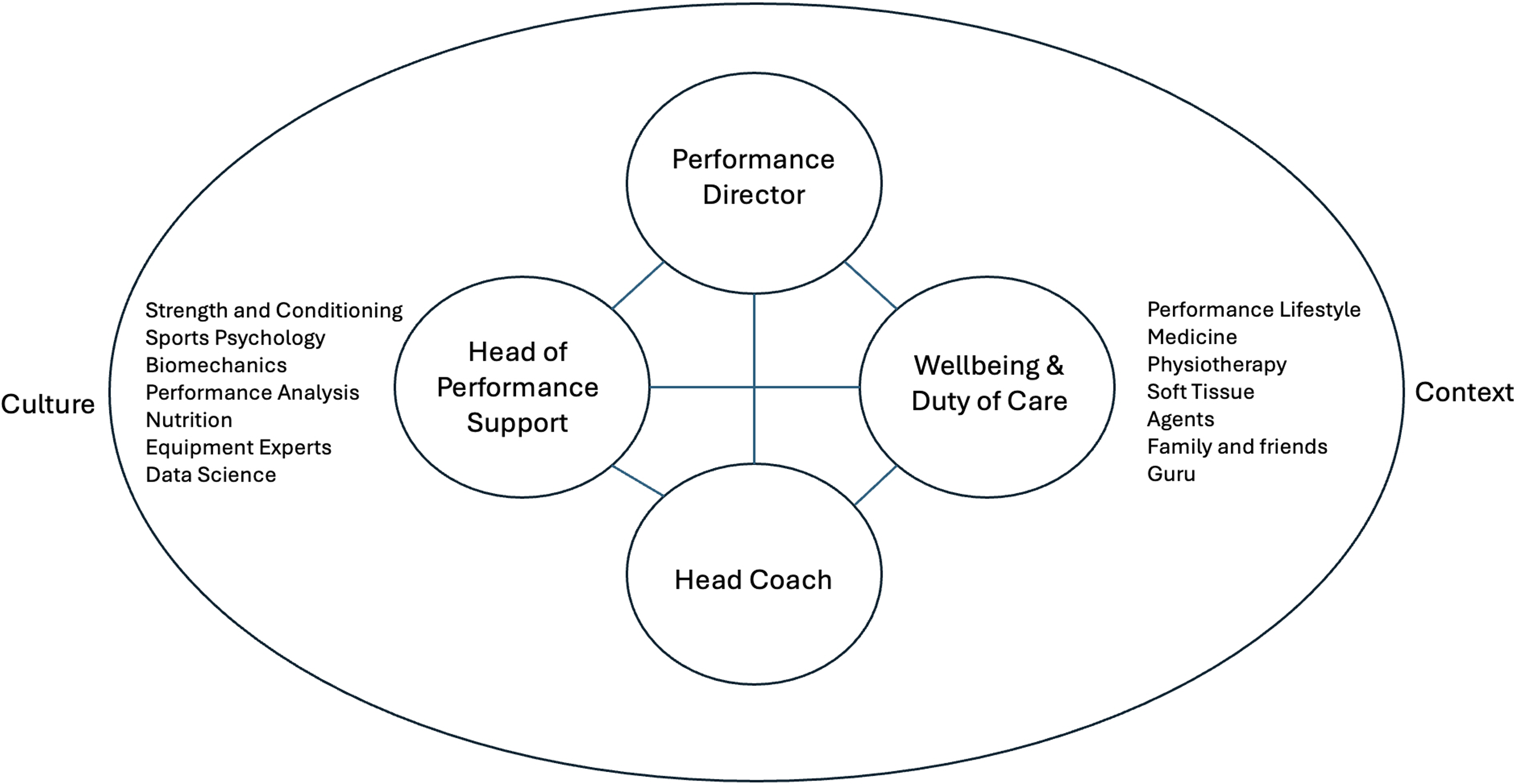
Proposed performance delivery model.
The proposed model would represent further evolution in PL, however it would be useful to consider associated training requirements.
Improving practitioner and coach education
Coaches’ experiences of performance MDTs indicate that they would benefit from better education around support disciplines, and how to lead and support them. 68 This study, from the opposite perspective of MDT practitioners, produced the same finding. Contemporary educational content for HP coaches is necessary to develop respect for PL, and for its integration into coaching practices. 69 Duty of care training as a minimum should be mandatory for HP coaches. A more diverse syllabus including mental health should be developed to create ‘lifestyle informed’ coaches who are better prepared to handle issues generated from performance cultures. 45
This study finds that current practitioner education and associated qualifications are inadequate. Currently, applicants for PL jobs can secure employment with low level qualifications that do not contain any C&M skills which is perhaps why practitioners valued relevant experience above any existing qualifications. Newly introduced courses which include industry practicum and coaching skills are positive developments, however further research is needed to establish how well these qualifications prepare individuals for PL roles.
This study finds that C&M skills are the specialism of PL, however, a more tailored qualification may be needed to meet the complexities of sporting environments. New qualifications should be domain specific facilitating practitioners to have in-depth understanding of contemporary challenges in supporting HP athletes. This may include recent suggestions to educate PL practitioners in the power dynamics of coaches and associated impacts on athletes and MDT staff. 18 While duty of care and athlete wellbeing are core PL functions, mental health forms an increasing amount of practitioner workload and therefore ‘Mental Health First Aid’ should be an essential qualification. Establishing new qualifications is one step towards professional standards for PL with this study indicating that certification by an organising body is necessary to achieve recognition and credibility. Aligning professional standards and new qualifications will provide a coherent educational pathway for future practitioners.
Conclusion
This study has identified several areas whereby PL requires development. Without this, PL will continue to experience difficulties in establishing its place as a specialist service. PL is ‘competing’ against the rise of other similar professions including player care and other related job titles, 18 however, there is significant variation in the scope of these roles and further investigation is needed to establish commonalities and differences. HP environments continue to increase in complexity and interdisciplinarity, creating greater need to clearly define PL. Clarifying the specialist nature of PL, establishing both duty of care functions and performance benefits, is necessary to ensure distinction between PL and other roles. This will facilitate MDT synergy and enable decision makers to actively recruit PL practitioners that deliver optimal support. Education of PL practitioners through enhanced qualifications, and coach development will support connectivity, improving knowledge and augmenting performance.
Footnotes
Data availability statement
Study participants did not give written consent for their data to be shared publicly, so research supporting data is not available.
Declaration of conflicting interests
The authors declared no potential conflicts of interest with respect to the research, authorship, and/or publication of this article.
Funding
The authors received no financial support for the research, authorship, and/or publication of this article.
