



Abstract
This study investigated the experiences of youth footballers as they made their transition from club football to the England youth international football teams. The club-to-international transition focuses on the movement of an individual from club sport to international representation, a within-career transition that comes with its own specific demands, characterised by the dual stakeholders of club and national governing body. The authors completed semi-structured interviews with 11 current youth footballers to better understand the type of coaching support they were provided by both club and national team coaches before, during and after international representation. Through thematic analysis, it was found that there was ambiguity as to the support offered to youth international footballers, with players explaining that feedback provided post-training camp did not support them in their development. Players also suggested the importance of sharing performance data between the domains (club and international) as good practice that helped them to have a more successful transition. These novel results suggest that the transition into youth international football should be seen as an important step in the development of the young footballer, however, clubs and national governing bodies need to work closer together to use this transition as a developmental opportunity. Several practical applications are discussed, including the importance of key stakeholders clearly outlining their responsibilities to the player during international representation.
Introduction
In 2017, the England men's professional youth football teams recorded an unprecedented year of success, with the under 17s and under 20s winning their respective FIFA World Cups, whilst the under 19s won their first UEFA Championships in 37 years. In responding to such success, academics have sought to understand the youth professional football environment in England, and, recently, have endeavoured to identify in what ways stakeholders can more efficiently harness the country's potential.1,2 The need to ensure the effective progression of youth footballers is something that has been shared by football governing bodies across England – most notable of which is the Football Association (FA), the body for amateur and professional football in England. Such a concern is not only due to the men's senior national team failing to win a major trophy since defeating West Germany in the 1966 World Cup final, but also because, at present, it has been estimated that England has the lowest number of indigenous footballers playing in the English top tier of football compared to indigenous nationalities playing in their respective highest national leagues. In the 2020–2021 season, for example, only 12.8% of minutes played in the Premier League – England's highest professional league – were given to ‘home-grown players’, that is, individuals trained for at least three seasons between the ages of 15 and 21 years at a domestic English club. 3 This is the lowest of the five big European football leagues (England, Spain, Italy, Germany and France) with the consequence of this being that countries with fewer playing minutes given to indigenous footballers may result in having less footballers eligible to represent the senior men's national team. In turn, this has meant that finding effective developmental solutions for those relative few remains paramount to a country's future success.
In adding to understandings of the professional football environment in England, this paper focuses on the transition of footballers from club to youth national team representation. There is a large body of research focusing on coaching support in youth football; however, crucially, one area that has yet to be explored concerns the type of support offered by both club and national coaches during youth international representation, and players’ perception of how this affects their development during transition into, and out of, the international football environment. Understanding the support players receive from their coaches during this crucial transition process is of paramount importance, particularly given how previous research has shown that coaches play an integral role in overall athlete development, especially during times when athletes move through the (often challenging) stages of the development system. 4 Furthermore, throughout youth development, the role of the coach is often not only to develop sport-specific attributes, but also to act as a key stakeholder in the network of social support that the athlete is provided. 5 Here, social support can be defined as ‘the perceived comfort, caring, assistance, and information that a person receives from others’. 6 (p. 102) Although social support is an important predictor of sporting success, 7 this is not an aspect of coaching practice that is currently represented in mainstream coach education. Recently, coach education in English football has experienced changes in structure and a shift in the organisations that deliver it (see The Elite Coach Apprenticeship Scheme, by the English Premier League).
Alongside coach education reforms, English football has undergone a restructure in recent years due to the introduction of the Elite Player Performance Plan (EPPP) by the Premier League in 2011. The EPPP provides regulatory guidance and a grading system for youth academies in England, updated annually through the publication of what the Premier League term The Youth Development Rules. 8 The aim of the policy document is to improve the efficiency of youth academies to develop more ‘home grown players’, measure effectiveness and quality assure the development programme. 9 As proposed by the EPPP, as part of an academy programme, all players must go through a review process, this process takes place every 6 weeks for 12–18-year olds and as necessary for 19–21-year olds. 10 The EPPP suggests that best practice in multidisciplinary review meetings is that they ‘should not only measure the academy player's progression against his own performance targets, but also benchmark his development against that of his peers’. 10 (p. 24), O’Gorman et al. 11 suggested that coaches within English youth football academies are now required to take part in activities such as this, including benchmarking, tracking progress and wider administrative duties. In addition, since the introduction of clubs have begun to outsource player support to other stakeholders such as player care managers or sport psychologists. Although these stakeholders will offer support to a developing player, coaches are also integral in offering support during a transition from a sporting performance perspective and, therefore, must be effectively prepared on how to do so.
For coaches to offer effective levels of support to a player during a transition, it is first important to understand the different transitions that can occur in an athletic career. In pulling together the career transition literature in sport, there have been three key approaches used. The first centres on what we call ‘out of sport transition’, focusing on how athletes cope with athletic retirement. Early research pulled upon the human adaptation to transition model as a dominant framework, assuming that career transition can be defined as the ‘occurrence of one or more specific events that brings about a change in assumptions about oneself, but also a social disequilibrium that goes beyond the ongoing changes of everyday life’. 12 (p. 8) The next conceptualisation grew from a need for a sport-specific approach to career transition. Stambulova 13 defined an athletic transition as phases within the career that will come with specific demands for the athlete to cope with and the ability for the athlete to cope with these demands will influence the success of the transition, introducing the athletic career transition model as the dominant framework. Through this concept, transitions are seen as a process rather than a singular event, with ‘positive transitions’ referring to times where one makes a quick adjustment to the demands of the transition; and ‘negative transitions’ denoting times when the individual struggles to adjust from one environment to another. The third conceptualisation assumes that the athletic career is dictated by different change events that can cause instability, with ‘positive’ and ‘negative’ change events having different influences on the individual. 14
Recently, research has recognised the importance of offering support during ‘within-career transitions’, referring to transitions an athlete makes during their career, with the outcome of the transition dependent on the athletes’ level of preparation, and their social and cognitive resources. Athletic career transitions can refer to a range of transitions throughout the athlete’s career: 15 there is the ‘amateur-to-professional’ transition, focusing on the emotional traits of athletes when they make the jump from being an amateur to a professional athlete (see 15 ); then there is the ‘youth-to-senior’ transition, which focuses on the movement of youth athletes into professional sport where there is no age banding restricting participation (see 16 ); and finally is the ‘migratory transition’, where research has focused on how athletes adapt to new sociocultural surroundings (see 17 ).
Research that has previously focused on the movement into international representation comes from the transition into Olympic sport. Poczwardowski et al. 18 interviewed Olympic athletes transitioning to the Olympic Training Centre, USA, finding that within-career transitions of athletes occur long before they enter the new environment, highlighting the importance of preparing them for the transition in order to nurture effective coping strategies and supporting athletes to overcome adversity. Further research has focused on the dual careers of youth Olympic athletes to understand the psychological implications of competing at a large-scale event alongside full-time education – Kristiansen, 19 for example, highlights the importance of sports organisations/clubs in understanding the role of schools and parents in managing athletic well-being, particularly regarding workload and the pressures of performing well within both arenas.
This paper is concerned with the club-to-international transition, defined as ‘a temporary within-career transition that occurs when an athlete is selected to represent their country in international competition’. 20 (p. 3) The paper is aligned to the Scheme of Change for Sport Psychology Practice framework in viewing the transition as a change event 14 where the athlete decides how to respond to a change in circumstance. This research takes the probabilistic view, as proposed by Stambulova and Samuels, 21 that the athletic career is determined by transitions, coping and environmental influences, with social and professional support being integral to whether the athlete will cope with the transition. Career transitions are often divided into either ‘normative’, predictive transitions or ‘non-normative’ transitions, which are unanticipated (such as a sudden injury leading to de-selection). 12 This paper assumes the club-to-international transition to be quasi-normative, where the transition is predictable for a certain group of athletes 22 – in this case, English youth international footballers.
Preparing athletes to cope with an upcoming transition has been well represented in the extant literature. Baillie, 23 for instance, found that, in the majority of cases, athletes tend to be ill-prepared for retirement, and thus face numerous difficulties adjusting to life outside of the athletic career. Building on this, Lavallee et al. 24 found that such ‘difficulties’ denoted feelings of low self-esteem, decreases in life satisfaction, and, ultimately, a loss of self-identity, all of which contributed to emotional challenges when dealing with the transition. Furthermore, Webb et al. 25 found that those forced to retire early as a result of injury suffered most with the transition process, in part, due to the unexpected nature of this form of retirement. More recently, research in this area has been compounded by greater specificity on issues beyond the athletes themselves: note, for instance, Lally and Kerr, 26 who investigated the impact athletic retirement has on an athlete's parents.
Prior research into career transitions has done well to explain the challenges that individuals face, detailing too how the consequences of a negative transition can be varied – related to, issues of identity crisis, 27 decreased life satisfaction leading to drop-out, 28 failure to balance academic, sporting and social roles 29 and the failure to reach the highest levels of performance. 30 Crucially in the context of this paper, however, is that research has largely ignored the voice of the players on the type of support they require during the club-to-international transition. Documenting this is of vital importance when we consider that previous research has identified how positive youth development experiences lead to long-term athletic success (see31,32). Furthermore, the path to success in sport is rarely linear, and to avoid the previously mentioned possible consequences of negative transitions, key stakeholders – such as coaches – must understand how to best support the individual, potentially leading to a growth in sporting performance.
Research focused upon what we may call ‘support-for-performance’ is underpinned by the notion that positively coping with transition can add to an athlete's performance and talent development. Prior research within this area has focused on problematising the way in which high-performance athletes are represented in scientific literature, 33 uncovering alternatives to the performance narrative within specific sociocultural contexts. 34 This shift towards athletic talent development environments has seen a focus on the characteristics within a sociocultural context that support successful transitions, of which includes coach and stakeholder performance support, the training process and organisational culture, highlighting the role of the career development environment in successful sporting transitions. 35
The only research to date into the England youth team environment that has sought to understand sporting performance comes from Pain and Harwood 36 who interviewed staff and players across a range of squads, providing them with a holistic overview of the team environments. This research did not focus specifically on the transition into the environment but gave an insight into player's experiences of youth representation, namely, that in an international environment, team cohesion, clear coach feedback and avoiding boredom ‘on camp’ were key factors leading to positive performances at international tournaments. Although the research provides an overview of performance-related factors in the environment, it crucially fails to identify the coaching support provided to players during this transition and does not account for the multifaceted nature of performances within youth football when the player is not ‘on camp’ with the England team. Documenting the ‘off-camp’ experiences of players is crucial, as national team coaches will only have face-to-face contact with their squads for up to 50 days per year – therefore, it is important to understand how the requirements of positive performance, such as clear coaching feedback, are supported by national team staff whilst the players are at their clubs.
In light of this, this paper aims to understand the coaching support provided to young footballers during the transition into, and out of, the youth international football environment, an area neglected within the wider transition and coaching literatures. In doing so, and as detailed further in the next section, we interviewed 11 Category One academy footballers who represent English Premier League teams about their current experiences of youth international football. Most specifically, through engaging with said players, this study sought to fill existing gaps in the literature by answering the following research questions:
What are players’ perceptions of the type of support that club coaches provide to players during, and after, international representation? What are players’ perceptions of the type of support national team staff provide international players before, and after, international representation? What are players’ perceptions of the support that is provided by both club and national coaching staff during the transition in and out of international representation?
Methods
Methodological orientation
This study was situated within a ‘social constructivist’ ontology and ‘interpretivist’ epistemology. Such a position views ‘reality’ as a multiple, apprehendable process, whereby social phenomena are actively and continuously being shaped and reshaped by actors’ subjective and contextual experiences, meanings and interactions (see37,38). From this angle, a key role of research is to try to grasp these subjective meaning of action in order to locate how reality is ‘constructed’ by actors; thus, in this sense, knowledge of this reality can only be grasped from the cultural, historical and/or political perspectives and understandings of those individuals who are participating in it.39,40 A constructivist orientation was considered to be most applicable for this study – indeed, one of our key research questions was to locate the understandings participants had of their own, subjective experiences of transitioning between club and international elite participation. Crucially, we believed, a constructivist methodology would be of particular use when it comes to placing participants in a position reflection vis-à-vis what they had learned during specific transitions, how they felt, as well as how they overcame the various challenges they faced.
Given such a philosophical orientation of science and reality, and of course strongly considering the nature of our objectives/research questions, we decided that a qualitative methodology would act as the most suitable form of data collection for this study. This is because a qualitative methodology is more suited to those studies that seek to ‘understand a phenomenon within its own context or to emphasise the immersion in and comprehension of human meaning ascribed to some set of circumstances or phenomena’. 40 (p. 376) The goal of qualitative research is to uncover the ‘life-worlds’ of individuals and the meanings they attach to the (culturally- and contextually specific) world around them (see 41 ). Consequently, we decided to draw on the use of qualitative semi-structured interviews, due to the flexibility and structure they allow, as well as their capacity for rapport building vis-à-vis other interviewing techniques. 42 Prior to conducting each interview, the authors constructed an interview guide (Appendix 1) which consisted of open-ended questions. The interview guide as shown in Appendix 1 was initially created based on the research questions of the study, as well as on previous research in this area; however, as is common with the qualitative interview process, this guide developed as the interview process progressed, with questions added/amended as the authors became more familiar with the youth club-to-international football environment, and as new themes/issues inductively emerged from each interview (e.g. see 43 ).
Participants
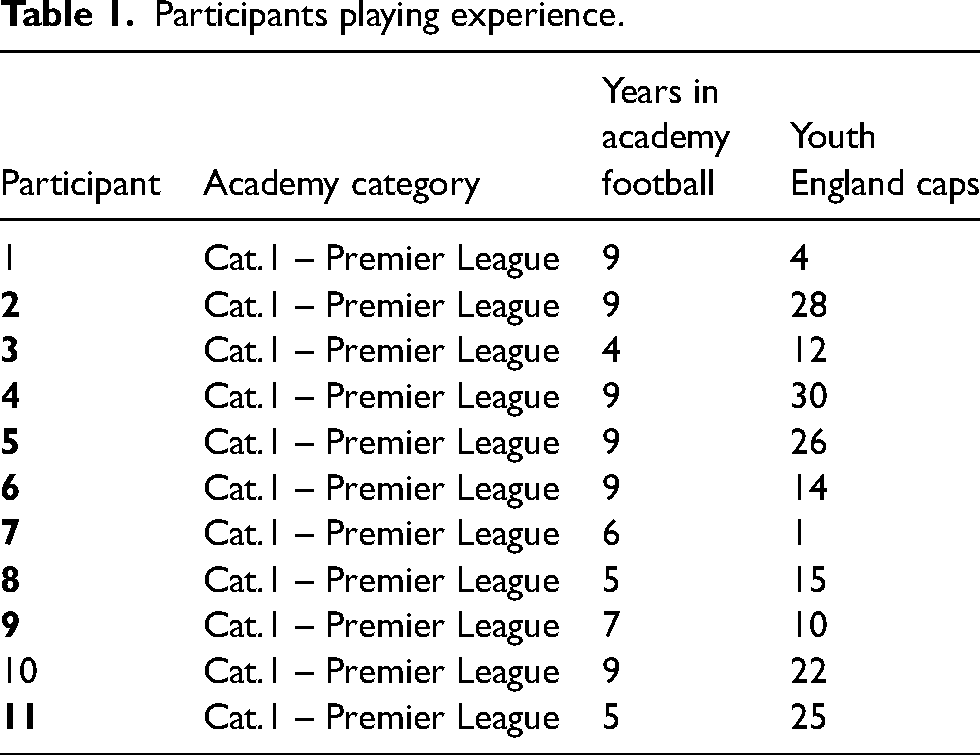
In total, we interviewed 11 professional youth footballers, building on previous research by Pain and Harwood. 36 In doing so, we chose a purposeful sampling approach to data collection. In doing so, we ensured all of our participants were male, aged between 16 and 18 years of age (mean = 17.6 years old). Each participant had previously played in at least one competitive youth fixture for the England national team in the under 15s – under 19s squads (mean = 17 youth England caps), and at the time interviews were conducted, each of our participants were contracted to a Category 1 football club academy from the English Premier League (mean years spent at the academy = 8.2 years). Important to note is that football academies are categorised from 1 to 4 based on specific performance indicators. Category 1 football academies are those that have received the highest possible evaluation through an external auditor. This model receives the most funding from the Premier League and academy footballers are provided with up to 8500 coaching hours, if they are present at the academy between the ages of 9 and 18 years, as well as a range of additional developmental support (Table 1).
Participants playing experience.
Procedure
Having gained institutional ethical approval in October 2019, we then reached out to those we knew who worked in youth professional football. After discussing the aims of the research with two Premier League clubs, coaches of said clubs then spoke to their players to ask who would be interested in partaking in the study. Those who agreed to be part of the research were then sent a participant information sheet that described the full objectives of the research. Having been provided further information, those who still agreed to partake in the research were then introduced to the lead investigator (via email), upon which a time and date for an interview was agreed with each player; at this time, each player was then sent – and required to sign – an informed consent form. All interviews were conducted face to face at the players’ respective academies. Interviews lasted up to 62 min (mean = 57 min, SD = 3.37). All interviews were recorded via the use of a Dictaphone and were then transcribed verbatim into written form.
Data analysis
Once interviews had been transcribed and checked, we then set about subjecting our data to a thorough thematic analysis. Here, the first author independently adhered to the following five stages of Braun and Clarke's
44
6-stage process. Both authors then contributed to the writing up process:
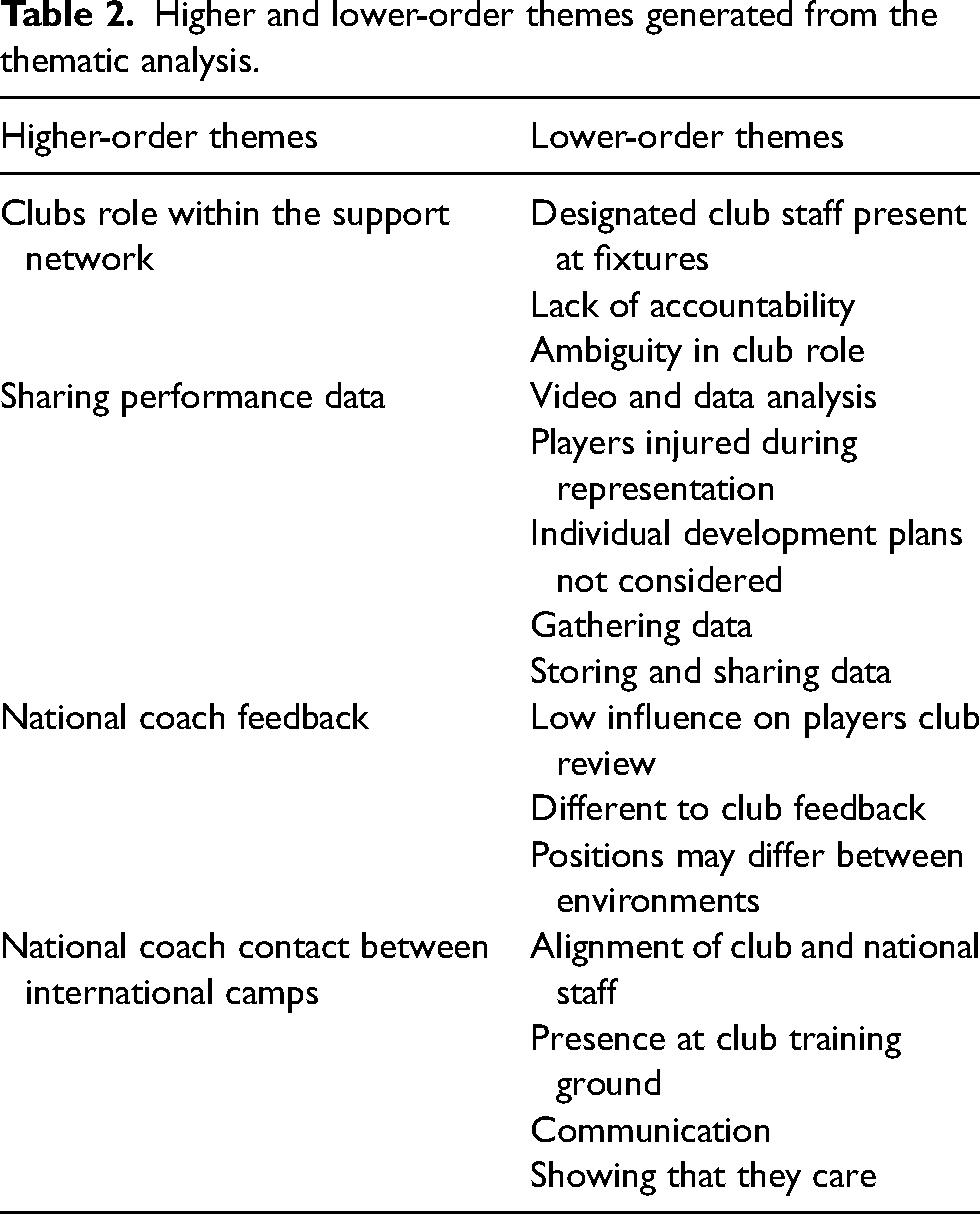
Read and reread the transcribed interview data. This occurred until it was felt the author had become familiar with the breadth and depth of the content we were dealing with. Initial codes were then created. Working through each transcript, any key points/aspects/issues – were pinpointed and colour-coded and each highlighted passage was allocated a few words of text which briefly captured the key points of the highlighted passage. Once all data had been coded, themes were then identified. Here, all the various codes were sorted into categories, providing consideration towards how various codes could be combined to form overarching and sub-themes. In doing so, significant attention was paid towards the relationship between codes, between themes and between different levels of themes (e.g. main overarching themes and sub-themes within them). This stage was complete once there was a collection of initial candidate themes and sub-theme. The first author then looked to ensure that each theme consisted of coherent data that came together meaningfully; whilst also ensuring that each theme was significant and unique in its own right (compared to other themes). Here, the second author acted as a critical friend. Once all the codes and themes had been through this review process, a thematic map was created, which provided a visualisation of the themes and their corresponding sub-themes. Next, themes were defined and refined. Here, the focus was on defining and refining the essence of each theme. This saw the writing of a detailed analysis for each theme, identifying and making notes of the story each theme told. An example of refining a higher-order theme was through the development of the theme ‘sharing performance data’. Initially, the lower-order themes here were deemed to express the importance of performance data informing the transition process, however, through the process of re-defining, the themes the first author identified the need for a separate higher-order theme to explain players perceptions around sharing performance data within this transition (Appendix 2). This aligned with the aims of this research surrounding player support as helped to understand the players perception of the use of performance data in both club and national team domains. By the end of this stage, the first author was able to provide a concise account of the content and significance of each overarching and sub-theme. Upon completion of this, we then felt in a position to start writing up our findings. Once we had a set of well-defined themes, the final stage of the analysis saw us produce the final written report. At this stage, we sought to produce ‘a concise, coherent, logical, non-repetitive and interesting account’ of the data, and, in doing so, provide the reader with enough empirical evidence/examples of each of our themes to support the various arguments we were making.
44
(p. 93) (Table 2)
Higher and lower-order themes generated from the thematic analysis.
Research quality
To enhance research quality, once we had transcribed our interview data, we then sent each respective transcript back to its corresponding participant to check for accuracy, as part of a member-checking process. All participants were sent a copy of the transcript and asked to read the transcript in order to add a second layer of reflective analysis where they were given the opportunity to add any additional information. Each participant declared they were happy with the transcription, with one participant adding more detail on their experiences of first being selected to the international environment. Systematically obtaining feedback on our data, analytic categories and interpretations helped to ensure our final research findings were both accurate and of a high quality (see 45 ). Furthermore, whilst allowing each participant to ensure the data generated was accurate, realistic and made sense, member checking also allowed each participant the chance to reflect, react, add or reframe what they had previously disclosed. Once accuracy had been confirmed by each participant, and we had signed off each completed transcript, each interviewee was then assigned an interview number to protect their identities. Finally, throughout the research process, we relied on several research colleagues who acted as ‘critical friends’ to help ensure credibility and best practice. Each critical friend was based in the Sports Faculty of our university, and all had previously published in various sports journals. The feedback provided only related to our presentation of our final report (inclusive of literature review, methods and findings), and no raw data was shared with anyone outside who was not an author of this paper. Our research procedure and design were also presented at an internal research seminar, whereby we received constructive feedback from Faculty colleagues on the originality, significance and rigor of our report/paper.
Researcher reflexivity
Prior to presenting the findings of our thematic analysis, of not is to mention the potential role of the researchers in the analysis and presentation of our findings. Research reflexivity refers to ‘the constant awareness, assessment, and reassessment by the researcher of the researcher's own contribution/influence/shaping of intersubjective research and the consequent research findings’. 46 (p. 99) In offering up our own critical reflexivity, it should be noted that both authors have previously conducted qualitative research prior to this study and are more familiar with qualitative methods and procedures than they are with quantitative ones. Thus, we may suggest that this previous experience may well have influenced our decision to choose a qualitative methodology for this paper. Furthermore, both authors share an interest in the more sociopsychological aspects of sport and athletes, and this will likely too have had an impact on our desire to study and choose the aims of this study, and how these more sociopsychological aspects can inform coaching practice, as well as our analysis and presentation of the findings themselves.
Results
Player perceptions of their transition into the international environment were gathered and discussed in accordance with understanding the support they were provided by both national and club coaching staff. The themes generated from the thematic analysis were the ‘clubs’ role within the support network of youth international football’, ‘sharing performance data’, ‘national coach feedback’ and ‘national coach contact between international camps’.
Clubs role within the support network of youth international football: Players provided differing responses regarding the support they were provided by their club when transitioning into the youth international domain. On the one hand, some players described what they considered to be good practice offered by their clubs in the way of support, as described by the below interviewee: …there is a coach that goes and watches, travels with the international boys. He used to be the under 15s and 16s coach. He is quite experienced; his job role now is when players go on international break, he's flying out to wherever they’re playing to be a scout for [the club] and report back to you. So, when we played Germany he went out and watched it and when I got back here, he sits down with you and speaks about how he thought I done. I have a really good relationship with him because I worked with him at 15s and 16s, so I know that he's honest with his feedback. It's quite informal, just a chat. (Player 1)
On the other hand, it became evident that this level of support was not offered by all clubs. One player, for instance, suggested that their club offer support to players during the international representation that is less focused on offering developmental feedback to the player but to act more as an ambassador for the club: ‘Neil [pseudonym] comes down and watches my England games sometimes, but I don’t really speak to him about it, he’ll go and just speak to parents and that’ (Player 11).
Crucially in this regard is that several players suggested that the contact from club coaches after international representation felt like they were being tested, rather than being supported from a developmental perspective: …sometimes you get a message from [academy manager] asking how I did…when he might of sent a scout out to watch and the scout might have already given him feedback… he wants to hear your feedback … we might talk one-to-one about it, like a bit of a test, but he just wants to see how you evaluate the game to see if you remember everything…so he might give you a message an hour or two after the game and then maybe when you come in he will talk to you after a few days or something. (Player 3)
International footballers must meet the objectives of dual ‘policy actors’ as both the club and international coaching staff will have their own micro-level policies dictated by their organisations and the youth international footballer is at the centre of this. This was demonstrated by the following interviewee, who stated: ‘they asked me how it went and that but not one to one where you’re sitting down, it was in the corridor. They asked me how I done but they probably got feedback from England themselves’ (Player 2). It is clear that when undergoing a career transition, the athlete will require social support from key stakeholders in order to focus on improving their sporting performance. As such, by failing to offer a formal review following international representation, the club may be missing an opportunity to support the athlete's development.
Sharing performance data: A significant finding that emerged from the data was that the majority of players suggested that they were unsure whether national staff had access to their technical and tactical development plans from their clubs: Sometimes you turn up [to international duty] and they speak to you about things and you’re a bit like, that isn’t what the club say, I get it's all opinions, but you wonder if they know what the club think about you as a player. (Player 7)
There was a time when I was injured, the club put you on managed minutes when you’re coming back. I got called up and was buzzing for it but when I got there they just played me like normal and I ended up getting a tweak again… the club weren’t happy with that. (Player 9)
The club have a lot of info on you as a player, they know what you need to do and work on, sometimes I feel like at England, they do know you as a player, but they might say something that the club don’t want you to do and you wonder if they talk. (Player 5)
From the above comments, it is clear that there is a disconnect between the club and governing body regarding the progress of the player, both from a performance and medical standpoint. By failing to share performance data, there may be an increased chance of injury as well as a reduced opportunity for player development. A further element of sharing information that was discussed by players was the use of international video footage post-camp. A player explained, ‘I’ve probably still got access to it on my phone somewhere, they’ve got their own video thing’ (Player 2) but described that he would not be likely to watch it as it wasn’t mentioned by his club. This was also highlighted by other current England youth internationals: I haven’t really watched a video of me playing for England with a coach at the club. I think they do care but they’re more bothered about what you do here and not with England. It's just like, an extra for them but they don’t really talk about it. (Player 5)
This admission shows the dichotomy between who is responsible for player development during international representation, with clubs often viewing the international domain as an area of the young players career that does not feed into their work with the player.
National coach feedback: The majority of current footballers discussed the feedback they were provided as lacking detail, therefore, failing to affect the players’ development upon return to the club: …they say like a summary but they don’t give you individual feedback for each game so I wouldn’t know [what to improve] they might say you did well at this during the camp. They said, for example, passing through the lines, I don’t know if they mean in the first game I played or the second time we played. I need to know more specific stuff. (Player 9)
I think for me, you get detail overall, like how you did, but I wouldn’t say it helps me at the club. My whole thing is about how I want to keep getting better as a player and I’m not sure if the feedback I get from them always helps me do that. (Player 2)
This comment details the cause for concern regarding where youth international football sits in the development of the young footballer. Although there was an admission from players that they felt the environment was enjoyable and gave them the opportunity to participate in high-level competition, it is evident that unless the feedback provided is applied in the players club environment then there may not be an effect on their performance levels.
In addition, each of the current international footballers interviewed commented that they were aware that their club received feedback on their international performances, however, similar to the findings on sharing performance data, the players were unclear on the feedback the club were given and did not know whether the club nor the FA had communication about their performance. From the players’ perspective, there appears to be a perceived lack of communication between governing bodies and professional clubs regarding international footballers’ development during the international representation. This has been shown by players explaining that they were not aware whether their national coach had access to their club's independent development plan, and this led to feedback that the players felt did not support their development when they returned to the club environment: …they play me in a different position at England so the stuff I work on there is different to the club, its good, cos like, it gives me the chance to learn different things but sometimes it's like, you’re working on something at club then go away and you don’t work on cos you’re doing something completely different and you have to kind of re-learn it when you go back [to the club]. (Player 8)
I’ve been a full-back for years [at the club] but for the country I’ve played all over the place. I think they get a bit of a feel of you and want you involved so sometimes you play different positions than you’re used to. It does help my game understanding but if it's not where I’m going to play long-term then I don’t know if it will help me cos I’m older now, I feel like I should be a specialist [in a position]. (Player 4)
We have loads of stuff at the club, like IDPs (individual development plans), where the coaches give you targets and things like that. When I go away on camp they don’t speak to me about any of that. It’d be good if they did, that just shows they talk, and all have your best interests [at heart]. (Player 7)
Perhaps not surprisingly, there were many examples where players explained that the differences in technical and tactical information provided made it difficult to transition between environments.
National coach contact between international camps: Each of the youth footballers explained that although they felt supported by the national coaches on camp: ‘the way they lookout for us, especially in training is quite nice’ (Player 6), on return to their parent club, following international duty, they did not receive additional support or contact from national coaches: I would like some contact definitely, it shows that like, you know, I think they obviously do care for me but it would show they care for me, and still wanna make contact, and it would make me a better player and look at feedback on me and what I done good and that would help. They have done that before, but I would like contact as well. (Player 5)
obviously at the end of the camp they give you what they thought of the performance, what you did well and what you can improve on but after that you don’t really hear from them unless you go back. (Player 2)
Although the players made it clear that there are times during the season that the national setup may send scouts to their club fixtures, they suggested that they would rather see representation from coaching staff: ‘one scout could think one thing and someone else could think another, and then the managers like “I don’t know what to think”, I’d rather hear what he thinks’ (Player 1). The challenge for national coaches lies in the ability to offer support to such a large pool of players but also to provide different levels of support at different times throughout the season or competitive phase: ‘If the Euros are coming up then I wanna hear more what's going on’ (Player 5). This suggests the importance of national team coaches understanding the needs of their players and providing contextual information outside of the international camp environment as well as during. The youth footballers interviewed each had a clear understanding of their own career journey to date and each showed a desire to progress and learn. As they were aware of the competitive nature of the international sport, they also explained how contact from the national coach prior to a camp could help them to meet their objectives: I think that sometimes before camps it would be nice to get a heads up in terms of a little phone call from the head coach just to notify why you get called up on the Saturday. If you get called into the squad you wanna know why you are being called up, you wanna know what you’ve been doing well so you can keep doing that. (Player 8)
These comments are the first within the wider literature to show the often-strained relationship between clubs and national governing bodies regarding youth international football, placing the players voices at the heart of the process to understand their experiences.
Discussion
The purpose of this study was to explore players’ experiences of the club-to-international transition and to better understand the coaching support they were provided during this transition. The findings of this study provide the first in-depth understanding of the players perceptions of their transition into the youth international environment and the coaching support that they receive. The discussion focuses on the players perceptions of stakeholder support; the high levels of social support required to support players to cope with the transition; the importance of reflecting on performance post-camp; and sharing performance data.
First, players explained the ‘clubs role within the support network’ during the transition and outlined the importance of both stakeholders (professional club and governing body) working closer together to ensure the athlete is supported during the transition from club to international. This is important as the social support provided by both teammates and coaches is a significant factor in the success of a transition within football. 47 A consistent finding within transition research is the importance of social support during retirement or de-selection to avoid negative consequences of the transition. 48 Through the data analysis, it became clear that the players clubs adopted their own methods of how to support players and the role of the individual managing the international transition was club dependent. The lack of identification of the key stakeholders at each club who are responsible for effectively disseminating the information from the player on the camp is likely to lead to difficulties in how the club can support player development at this time.
From a club perspective, it is important for the player to be supported during this transition, as if insufficient social support is provided, the athlete is likely to experience loss of confidence and increased stress. 29 If this was to occur during international representation, then it would be fair to assume that performances at the club would be affected post-representation. Moreover, when a player perceives their environment to be supportive and focused on their long-term development, they are more likely to have higher levels of well-being and as a result suffer from less stress. 49 Hence, practical implications such as club representatives attending international fixtures, informal conversations with players post-camp and managing parent expectations are all important tools to better support players at this time.
Players discussed the importance of receiving social support from the coaching staff. High levels of social support have been found to increase the likelihood of a successful transition due to support staff able to help the athlete cope with any potential setbacks that occur – for example, de-selection or injury. 30 It has also been shown that an increased social support structure improves the prospect of a successful senior sport transition. 50 Crucial to note too in this regard is that the role of the professional youth football coach has changed since the inception of the EPPP, with coaches now required to take part in additional tasks on top of their traditional player performance duties, such as report writing and, notably, taking responsibility for player well-being. 11 Well-being and the support provided by the sporting environment are important factors in player development, 51 therefore, without high-quality social support from key stakeholder's athletes may be less likely to successfully transition. 4 This is supported by Morris et al. 52 who found that there is a paradox between those individuals who put the most pressure on the athlete to perform are also those that are perceived by players to be the most important in the support system (e.g. coaches) and therefore more research may be needed to understand the specific relationship between coaches and players during the club-to-international transition.
It is clear that talent development programmes must provide congruent support networks and messages to athletes. Although the organisational priorities of professional clubs and the FA differ, each stakeholder has an interest in the continued development of the player and therefore, there is an incentive to cooperate in order to support each other to meet their objectives. 53 In order to achieve this, it would appear important for national associations to build relationships with clubs to source as much information on the players as possible and, if aiming to help the players develop, ensure that clubs are aware of the feedback that has been provided.
This is in line with stakeholder theory which suggests that a good system of governance should be where individuals consider the interests of the different stakeholder groups 53 and that governing bodies must cooperate with other organisations whom have similar interests. 53 Due to the high stake both stakeholders have in the players development, a more comprehensive approach may be needed to safeguard their assets. 52 This is important as recent research used case studies of athletic talent development environments to propose that an environment is most successful when there is an integrated approach to development and there is a long-term development focus and a holistic view of the athlete. 54 In practical terms, this may be through clubs ensuring player's independent development plans are shared with national coaches but also through national coaches providing feedback which can then inform the development plan on return to the club. Pedagogically, this would avoid feedback from national coaches which is considered to be tokenistic in nature and would encourage players to reflect upon their international performances, particularly as during transition, athletes are likely to make more mistakes and therefore reflection on their performance is vital to future development. 4 A solution to embed national team performance data into the player development process would be for each club that has international footballers incorporating the feedback from national coaches into their individual development plans as part of the multi-disciplinary review process.
Another notable finding of the study was that players perceived there was a lack of interaction from the club coaches post-camp regarding either informal or formal reviews of their international performance. The club staff are missing an opportunity to encourage reflective skills in their players to create an environment where athletes are empowered to engage with their technical and tactical development. 55 This increased self-awareness through reflecting on performance is integral to career development 56 and provided alongside increased levels of social support during the transition may result in a positive impact on player development, in part because the ability to reflect on performances was deemed as an important skill for players to cope with the demands of transitions. 4
Remaining focused on long-term development is important during a transition 57 and therefore through clubs and national governing bodies becoming more transparent with performance data, including video, this enables the partner organisation to continue conversations with the player around their progress. This is important as research suggests that successful talent development environments are characterised by an alignment between organisational objectives. 54
A further finding surrounded the desire, or lack of, for clubs to take part in ‘sharing performance data’ with the FA prior to an international camp. This leads to players entering an environment where coaches and medical staff may not be aware of their recent physical load, individual programmes – from a tactical or technical perspective – or psychological profile. Since the introduction of the EPPP, clubs are required to collect large swathes of data from their academy players on a daily basis. However, the EPPP does not currently incorporate any guidance or policy on the requirements of clubs to share performance data with external parties. In a study by McCunn et al. 56 sport science and medicine staff across a number of different professional football academies suggested the importance of sharing injury data with the national team, however, only 49% of practitioners remarked that coaches would formally review this data. Having said this, sharing player data between organisations would also come with complex ethical considerations regarding data protection, particularly concerning how the data is shared and who should provide consent for this – club or player. Alongside ethical concerns the football environment is imbued with a disciplinary framework where consistent monitoring of performance can result in players struggling to adapt to transition demands. 58 As such, the data that is shared should not be used for national team selection or de-selection but to safeguard the development, well-being and long-term health of the young person. In this way shared data may include recent playing minutes, physical loading (e.g. GPS data), strength and conditioning plans and qualitative data from individual development plans, rather than data such as psychological profiles or sleep monitoring.
Practical implications
The findings have been used to inform the following suggestions to aid player development. First, clubs should look to share their performance data with the national team, ensuring that there is alignment between areas such as medical, coaching and sport science departments. This would help to ensure that the information given to the player will be appropriate to their current physical and sporting performance as well as in line with the individual development programme provided by their club. This would help to ensure that the player can recognise the role of the international environment in their professional and sporting development.
Second, clubs may benefit from using a specified staff member to manage club to NGB relationships during the international representation. Good practice was shown as using the Loans Manager to provide in-situ feedback to the player whilst on international duty as well as acting as an ambassador for the club with parents. Players suggested that this approach helped them to integrate the information they are provided during international representation with their development back at their club.
Finally, policy development would benefit from clearly outlining the role of the organisations in the international transition. The responsibility of preparing players to cope with a transition lies in the talent development environment itself, and not in one person or organisation 59 and therefore both clubs and the FA have a responsibility for providing the players with the resources to help them to improve during this period. This integrated approach to sport policy would enable stronger ‘support structures [in order] to develop an optimal micro-climate in which the athlete can develop’. 59 , 60 (p. 206) The microclimate of elite youth sport is highly competitive, with approximately 2% of youth athletes reaching a senior international level in their chosen sport. 61 British football is no different where only 0.012% of youth footballers currently playing organised football will get the opportunity to make it as a professional in the Premier League. 62 This adds further support to a reciprocal approach to policy development between key stakeholders to ensure optimal talent development environments can be developed.
Limitations and future directions
There were certain limitations of the study that should be noted. First, the participants selected had a greatly differing number of international appearances. Although the interviews did not specifically focus on their first transition into the environment some participants may have been subject to recall bias 63 due to being involved in the process for a longer period and therefore becoming indoctrinated into its customs. This could have resulted in participants recognising certain behaviours as norms and therefore failing to reflect upon this in the interview. Additionally, a longitudinal case study would have offered a better understanding of the effect of the level of coaching support provided to the players and whether this aided or inhibited the success of the player from club to international.
Future research worthy of investigation would be to understand the perception of national coaching staff as to their role in the talent development process of the youth international footballer, identifying the rationale for the feedback provided and the level of support they offer between international camps. This research would help to explain whether there are organisational barriers to achieving some of the practical implications mentioned above and would go a long to better understanding the holistic environment of youth international football.
Conclusions
The aim of this paper was to better understand the type of support offered to youth international footballers during their transition from club to national team. The findings are unique in the field of transition scholarship as they put the current international footballer at the heart of the research process, and thus this paper acts as the first of its kind to clearly outline players’ experiences of international transition from a coaching support perspective. We suggest that clubs and the FA work closer together to offer bespoke coaching support during the international transition, in order to prioritise player development.
The players explained that there is a mixed level of coaching support, dependent on the club, with some clubs attending international fixtures and others not. They suggested that they would like to have more contact from national coaching staff between camps, not only as it showed they were ‘cared for’, but also that it could help them to embed the feedback they were given into their club environment. This was supported by other players who questioned the feedback provided by national coaches’ post-camp, explaining that they would benefit from more specific feedback that was related to their individual development plan.
Footnotes
Declaration of conflicting interests
The author(s) declared no potential conflicts of interest with respect to the research, authorship, and/or publication of this article.
Funding
The author(s) received no financial support for the research, authorship, and/or publication of this article.
