



Abstract
In sport there are negative aspects of technology use and its innovation that includes concerns about reducing athlete skill diversity. To address this, reconceptualization of the product design process and the position of business models during technology innovation is needed. This paper explores ways in which theories of skill acquisition can be integrated with product design and entrepreneurship, using the interdisciplinary research base on creativity to bridge these domains. Intersecting concepts used to explain creativity are used to evaluate how shared constraints under which members of transdisciplinary teams interact might enhance coordination, communication, and integration of skills during technology innovation. A key gap that we address is how to conceptualize the role that the commercial perspective should have on technology innovation in sport, and the position of users (athletes, coaches, and sport scientists) therein. We propose using ‘sport technology incubators’ as vehicles to integrate business, design, and motor learning frameworks to examine empirical questions surrounding ways of optimizing sport technology innovation while sustainably supporting athlete skill in contexts of training and competition.
The evolution of sports performance is intricately linked with technological advancements, where the innovative design and application of technology have historically spearheaded improvements across various levels of athletic engagement—from development and training to competitive execution. 1 Encompassing equipment enhancements, sophisticated training machinery, detailed performance tracking, and nutrition management, sport technology's scope has vast impact2,3 (italicized terms are also defined in the glossary table in Appendix 1). This expansive definition underscores technology's deep integration not just within the athletes’ performance regimes but also within their broader sports ecosystems—shaping interactions with coaches, peers, and the wider sports community. As technology becomes increasingly entwined with the fabric of sports, identifying and refining frameworks to maximize its benefits while mitigating any downsides have become paramount.4–6 This necessity has pushed the design and utilization of sports technology to the forefront of research, requiring a multi-faceted approach.3,6–15
It is crucial to remain aware of the potential pitfalls of sport technology.3,7 Woods, Araújo 7 have critically examined the negative aspects of technology in sports, pinpointing disengagement, overreliance, and a trend towards conformity as principal factors that could inadvertently lead to the deskilling of athletes. They outline a scenario where the use of technology can erode the athlete's direct engagement with their performance environment. Rather than serving as a tool that augments performance, technology, in some instances, can interfere with important learning processes, ‘replacing and intervening in direct human perception–action interactions with the environment’. 7 For example, consider the use of GPS and heart rate monitors during training. While these tools provide valuable data on an athlete's performance, 16 in certain contexts overreliance on them might lead athletes and coaches to focus excessively on numerical feedback rather than on adapting to internal and real-time environmental conditions. 17 In other words, technology can begin to mediate the athlete's perception of their surroundings and shape their responses, fostering a dependency that could diminish their ability to navigate the unpredictability and inherent uncertainties of sports environments with autonomy. Such over-reliance on technology risks deskilling the athlete, particularly their capacity to adapt and innovate in the face of varying performance conditions. 7
These ideas would predict that an empirical examination of the role of technology in sports would demonstrate a tension between its potential to expand or restrict perceptual-motor workspaces - observable in the impact on athletes’ skill diversity. Ideally, technological interventions should foster a broader array of skills, enhancing the range and variability of motor behaviors observable in athletes. Alternatively, misapplication of technology in sports may lead to a homogenization (or standardization) of athlete skills, as athletes increasingly conform to technology-driven norms. This trend towards conformity has significant implications at the social level, suggesting a movement towards uniformity in skill sets among athletes. Such a shift would not only diminish the potential of talent development ecosystems but also restricts the scope for exploration, individualization, and creativity within athletic practices. 18 Woods, Araújo 7 attribute this trend towards increased conformity to fundamental ‘design errors’ in the commodification process of sports technologies. These errors prioritize the widespread marketability and profitability of sports technologies, potentially at the cost of stifling the diverse, exploratory, and creative engagement with these tools that is essential for advancing athletic performance and skill development. Figure 1 gives a broad representation of possible enskilling and deskilling effects of sport technology taking into consideration the social scale of these impacts.
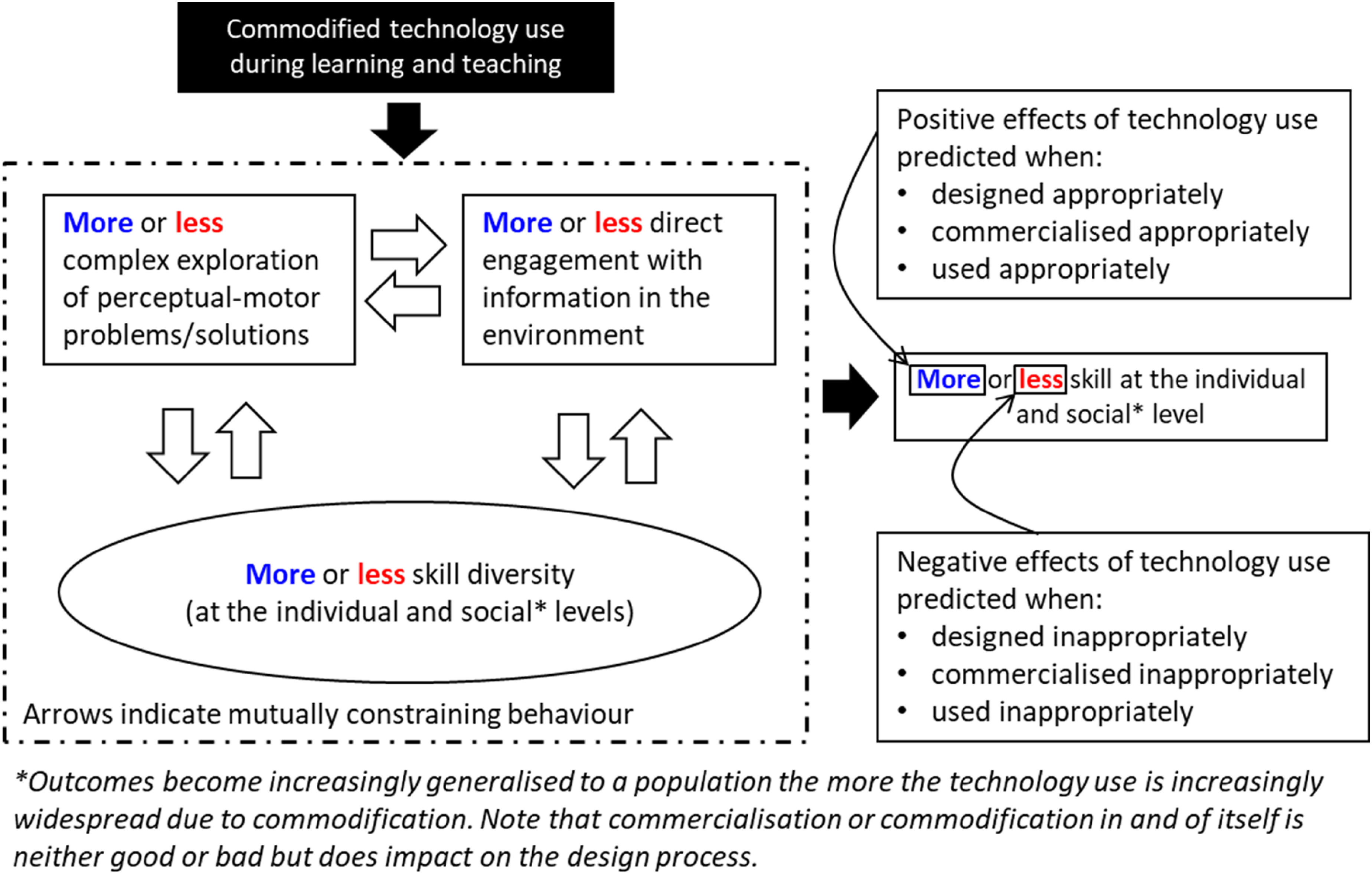
Predicted positive and negative aspects of technology use include broader/narrower exploration of the perceptual-motor problems and solutions and a more or less direct coupling between information and movement during training. This subsequently enlarges or diminishes the distinctive functional coordination and control solutions within and across learners/athletes within a given sport ecosystem.
According to Van Boeijen, Daalhuizen, 19 product design is concerned with understanding and intervening in the world through the creation of products that help satisfy individual and/or social needs and wishes. From a design perspective, commercial interests are inextricably intertwined with technology innovation.20,21 For instance, Buijs 20 presented a complex systems approach to design that positioned the company at the center, and design processes as constantly interacting with and constrained by the company (Figure 2). Presumably, from these interactions an innovative product can emerge. The priority given to the company and its strategic concerns in the design process, as shown in Figure 2, reflects the importance given to commercial feasibility (the ability to design a product enough people want) and technical feasibility (the ability to design a product that can be made and delivered at scale cost effectively). 22
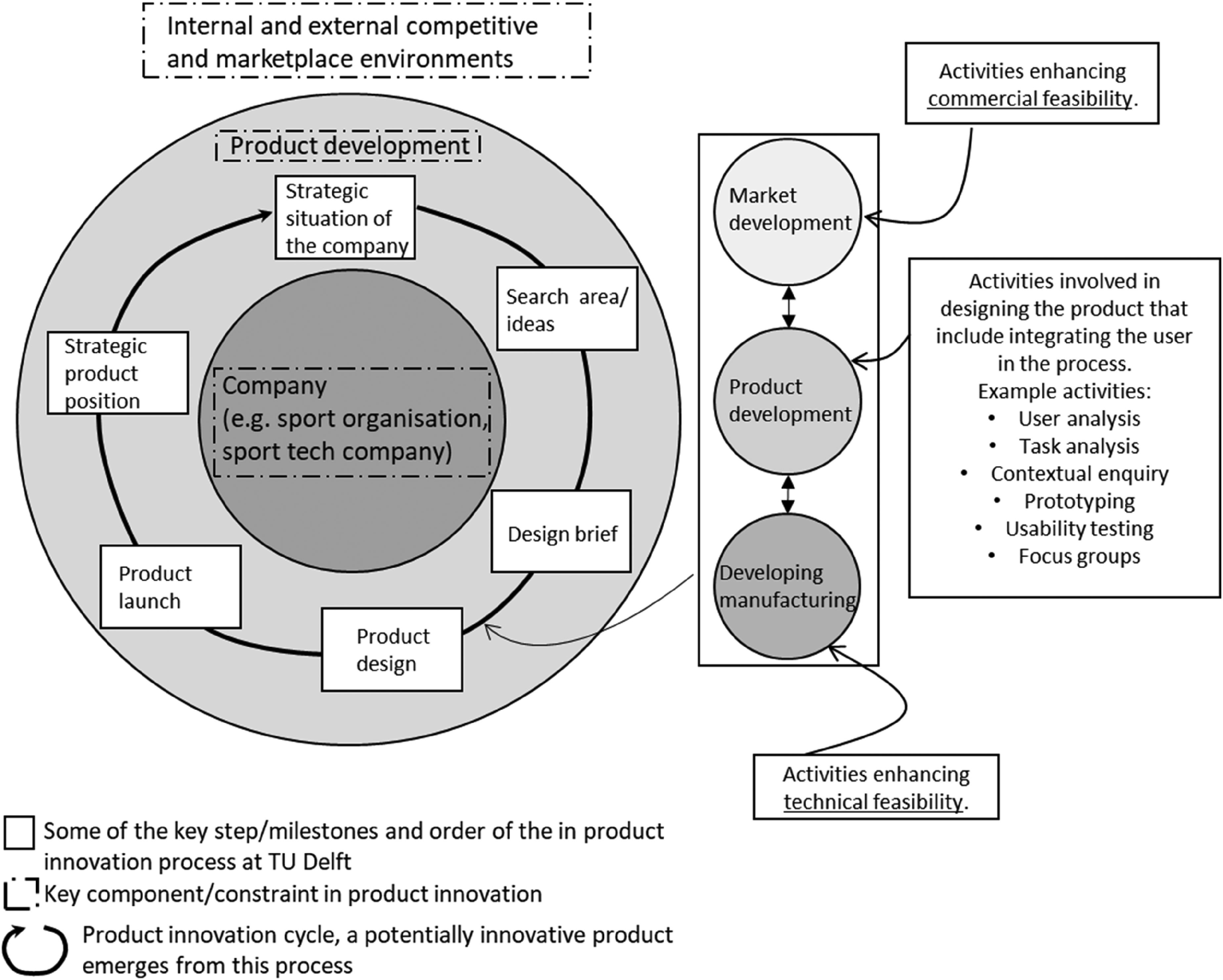
Model of product innovation adapted from Buijs. 20
As depicted in Buijs, 20 and adapted in Figure 2 the company's need to sell the product to a broader market has been placed at the heart of the design process and there are limited periods during which user input is involved. A criticism is that the user needs, and wishes are not really at the center of the design process. While recent design philosophies such as user-centred design provide a framework for involving technology users (i.e., athletes, coaches, sport scientists), because of the central/dominant position of the business perspective in design models, they might be insufficient to address technology design problems that address deskilling. For instance, when the business perspective is dominant, user testing (even if it is ‘user-centered’) primarily serves commercial needs. In this case, the product is more likely to be designed toward influencing users to make a purchasing decision, where these decisions are not necessarily aligned with improving skill.
To counteract the unintended consequences of technology use in sports (i.e., deskilling), it has been suggested that incorporating learning and coaching theories during technological engagement in skill acquisition phases could serve as a corrective measure against design flaws.3,7,14,23 However, this intervention may come too late in the technological adoption cycle to be fully effective. True transdisciplinary collaboration goes beyond merely acknowledging diverse disciplinary perspectives; it requires their active integration into a technology innovation process. 24
We propose an approach that embeds principles of learning at the inception of the sports technology innovation process and continuously characterizing and refining this integration through research, development, and commercialization cycles. This strategy necessitates a collaborative effort aimed at shaping the development pathways of sports technologies, to ensure they are designed with the end-user's needs in mind, long before they are introduced to the market (such during the start-up phase), and continue to be as the product is refined during later stages (such as when improving feasibility becomes critical).
The primary aim of this review and opinion, unfolding across three sections (Box 1), is to critically evaluate the intersection of sport technology design, commodification, and its use, specifically addressing how current ideas in motor learning may contribute to and counteract design and utilization errors. Our broader objective is to reorientate narratives within sport sciences that often cite commercialization as a root cause of design flaws. Instead, we advocate for a proactive approach where potential challenges in the commercialization process can be anticipated, empirically assessed, and mitigated. This approach aims to provide a scaffold for cross-disciplinary efforts within the sports technology sector, encouraging stakeholders to embrace a shared theoretic perspective on technology innovation that integrates motor learning, design, and commercialization, thereby enhancing the applicability of technology's used to augment sports training and performance while also being commercially successful.
Section overview
Section 1. The interplay between foundational concepts of learning and coaching theory and the field of entrepreneurship is explored. The discourse is anchored around core tenets derived from ecological dynamics, which is a learning and coaching framework that provides insights into the nature of athlete-task-environment interactions. 25 Motor learning concepts are used to develop a basis for a common framework for stakeholders involved in sport technology innovation.
Section 2. The principles of ecological dynamics are used to develop predictions on how to enhance technology innovation across early phases (from start-up to scaling up) of entrepreneurial activities. Activities examined include collaborative teamwork, market research, and business model validation.
Section 3. An operational framework is outlined that positions sport technology incubators as research vehicles. Incubators operate to support the development of start-ups (early stage business ventures) by providing resources, mentorship, and networking opportunities. Incubators (which are increasingly prominent in university environments) are discussed in terms of how they might be utilized for applying and testing the hypotheses derived from the proposed sport technology innovation framework. Ultimately, the section is concerned with opening up new avenues for undertaking sports technology innovation research that is both theoretically grounded and practically viable.
What aspects of motor learning theory should be considered alongside entrepreneurship and design during technology innovation in sport?
Implications of an ecological dynamics characterization of expertise for design and entrepreneurship
The concept of constraints plays a significant role in learning and coaching frameworks because of its applied, and transdisciplinary value.26,27 Constraints are principally used to characterize how humans learn to coordinate and control the complex movement system by virtue of changing constraints.28,29 The main proposition is that interactions among the individual (e.g., the athlete, their capabilities, and experiences), environment (e.g., surfaces, objects, events, others), and task (e.g., objectives, rules) place boundaries on the coordination solutions available (i.e., they define the perceptual-motor workspace).
Through repeated exploration/practice to satisfy the dynamic constraints a destabilization and re-organization to a new stable organization in coordination takes place as the learner transitions to more skilled behavior.1,30,31 In these respects, intentional manipulation of constraints influence the individual's search process towards transitioning to a new stable organization/state. Technology is a type of intentional constraint manipulation, helping channel the athlete through the learning process to transition to a more skilled state.3,32
A skilled athlete is characterized by their adaptive capacities under the highly complex and dynamic constraints representative of their sport.
33
Skilled athletes are attuned to what information is important;
34
actively pick-up that information,
35
and; manage their actions to maintain the behavioral opportunities afforded by that information.
36
Their experience also grants a diversity of ways to manage constraints as actions unfold.37,38 Hence, technology-use supports athlete enskilling (i.e., as opposed to deskilling) when it facilitates the following capacities:
to manage increasingly complex (or sport representative) constraints;5,39 to engage and act directly with information to perceive affordances,40,41 and; to increase the diversity of perceptual-motor activities for maintaining a variety of behavioral opportunities (affordances) relevant to their performance.3,42
Because the above capacities are preconditions to an individual's transition to more skilled behavior, technology use is deskilling when it reduces any one or a combination of these (summarized to Figure 3).
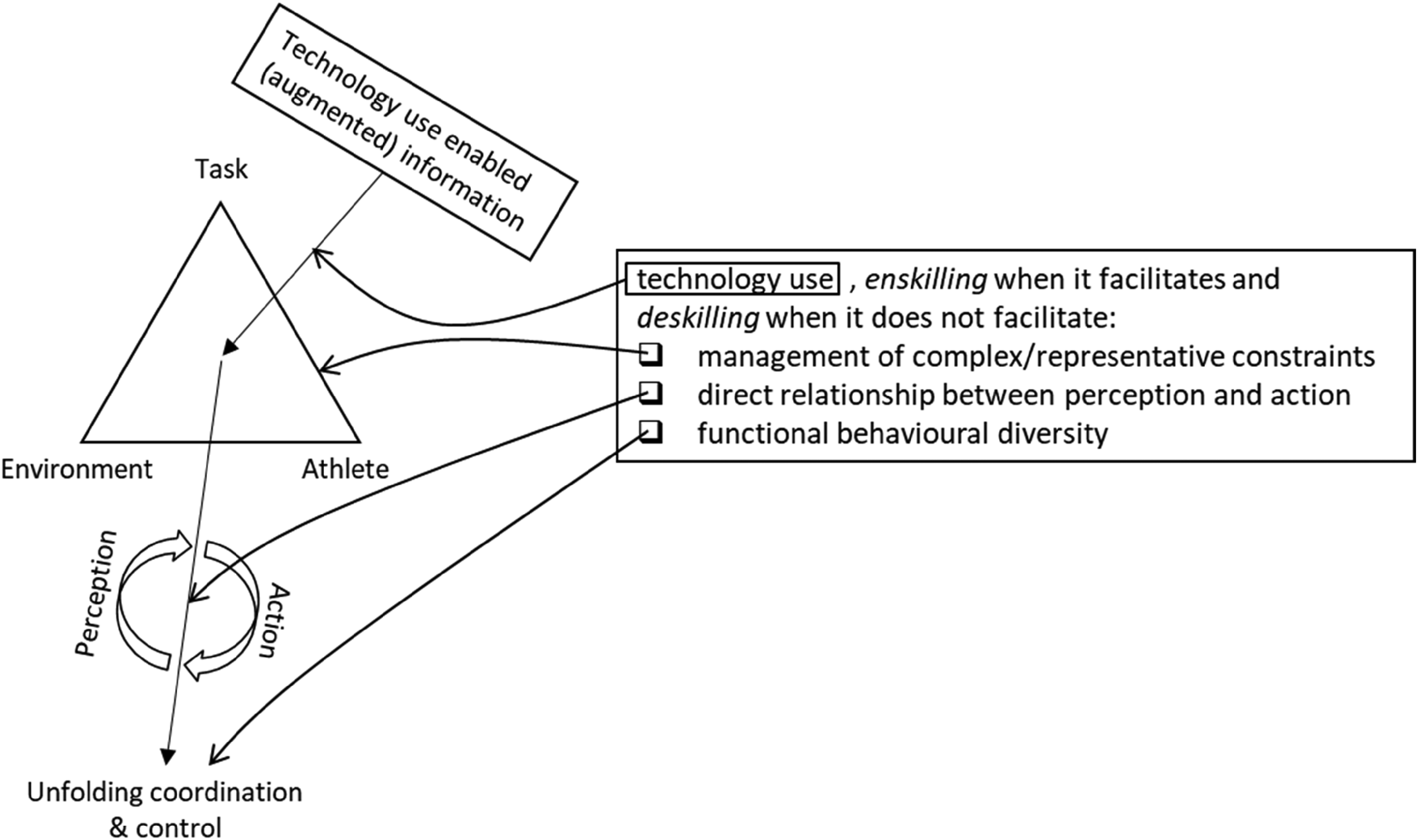
Proposed ecological dynamics model (and predictions) for technology enskilling/deskilling use at the level of the athlete's action during training or competition. The constraints model integrated with technology use and perception-action coupling (left) is adapted from Newell and Rovegno 43 and Davids, Glazier 44 respectively.
Currently, whether technology use is enskilling or deskilling can be measured across each of the capacities outlined above in Figure 3 using a broad range of experimental approaches that target specific aspects of the model. For instance, evaluating the extent to which the diversity of behaviors in a training context correspond to those in competition setting can be used to address whether or not a technology facilitates functional movement variability. (These ideas have also been framed as assessing a technology's capacity to facilitate transfer of skill and learning, for which a range of valuable methodologies can be used.5,6,45–47) Being able to meet enskilling outcomes should be a key quality standard (for similar arguments see4,48) acting as shared task constraint on stakeholders involved in technology innovation.
Shared constraints as a mechanism for effective transdisciplinary coordination
The idea of shared constraints has roots in the concept of a ‘Department of Methodology’. 27 Rothwell, Davids 27 argued that by having sport scientists across sub-disciplines (such as strength and conditioning, nutrition, performance analysis, psychology) utilize a common conceptual framework, the effectiveness of support would be improved based on how it should enhance: the coordination of activities of members; communication coherence, and; the integration of ideas (across domains) during the design of athlete learning tasks and environments – and in doing so, athlete learning and performance is accelerated.
Besides theoretical frameworks – technology quality assessment tools, common physical spaces, team-based activities can also represent potential shared constraints that might impact interactions among members of transdisciplinary teams and the technology innovation solutions that emerge (considered in some way as a constrained solution space of technologies). 4 Similarly, the notion of constraints as influencing technology innovation has recently been extended into the domains of design, and entrepreneurship.49–52 Following Glăveanu, 53 creative outcomes (such as innovative technologies) are explained as somehow distributed across multiple people, actions, locations, and times as opposed to uniquely originating from an individual actor (see also 54 ). In entrepreneurship, the focus is on inventing new products or services and bringing them to market, while navigating through the challenges of making these solutions viable both technically and commercially. This process is inherently about adding value—whether financial, social, or environmental. 55 Constraints, in the field of entrepreneurship, are used to emphasize how the challenges and limitations faced by entrepreneurs—their tasks, environment, and members—play a crucial role in shaping technological advancements 51 (further developed in Section 2).
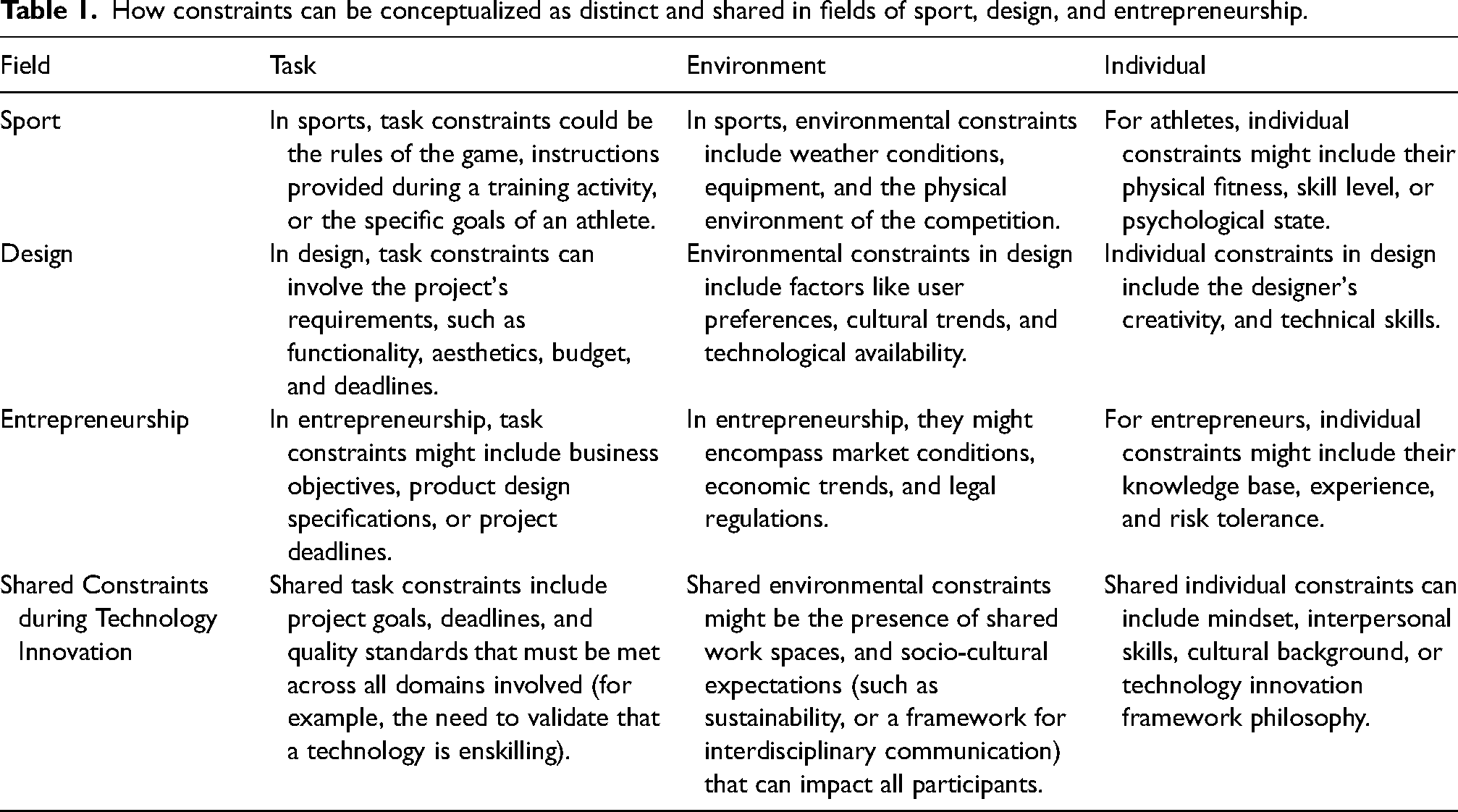
Table 1 provides a broad summary of constraints and how they have been conceptualized independently across contexts of athlete performance, product design, and technology-based entrepreneurship. Also identified are potential shared constraints that might be used to enhance outcomes across domains during technology innovation.
How constraints can be conceptualized as distinct and shared in fields of sport, design, and entrepreneurship.
Exploring the role of constraints on sport technology innovation: model predictions across early stages of entrepreneurship
We propose a framework for understanding the interaction dynamics among users, designers, and entrepreneurs within the context of sport technology innovation, where new and functional technology outcomes are significantly influenced by shared constraints. Our model identifies three potential states (uncoordinated interaction, co-adaptive interaction, and rigidly coordinated interaction) of technology innovation systems, each dictated by how constraints influence interactions among stakeholders (refer to Figure 4). Each state proposes testable predictions about the nature of member interactions and the degree to which outcomes might be considered innovative based on particular constraint configurations.
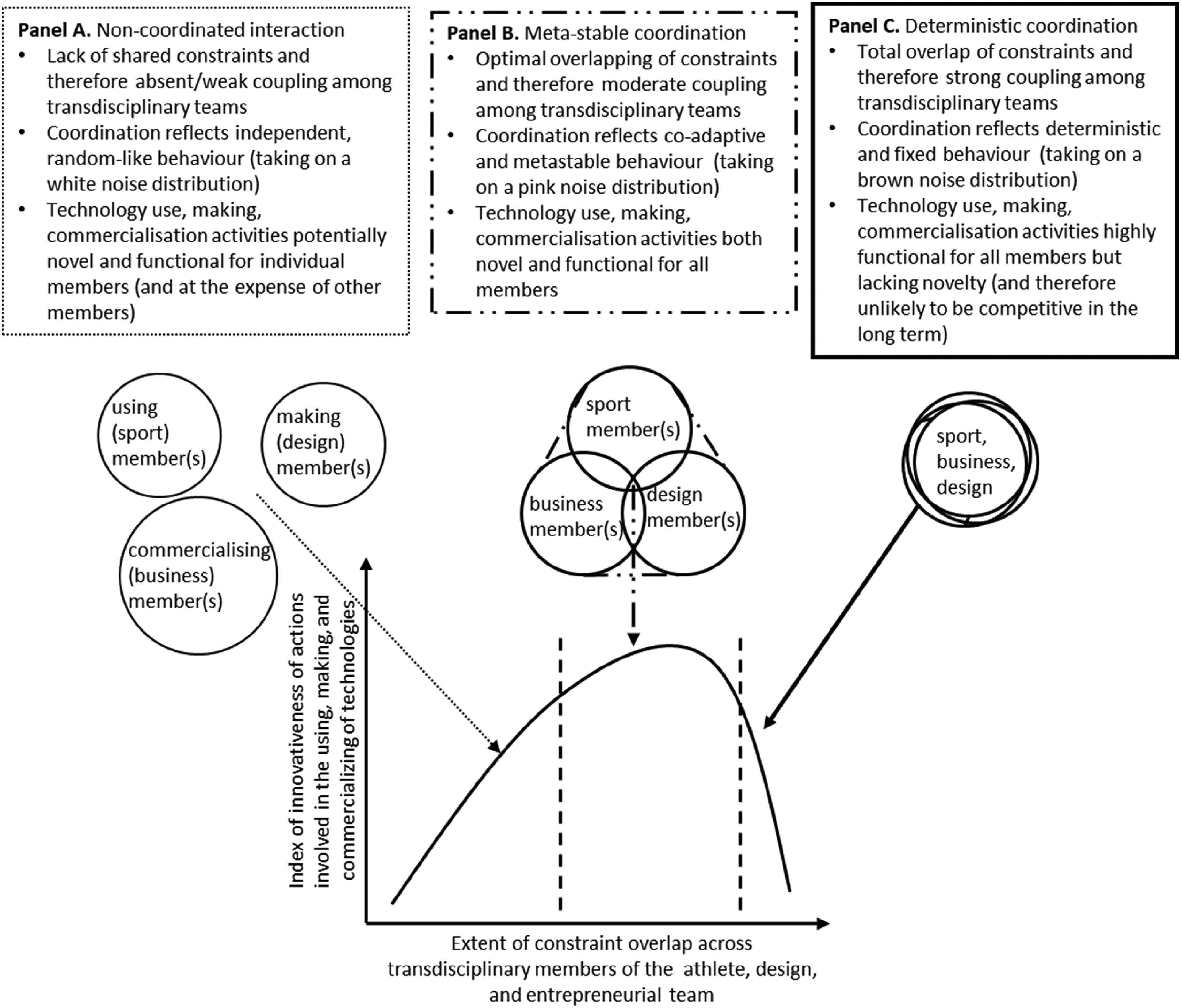
Model conceptualizing how constraints increase or decrease technology innovation at the level of using, making, and commercializing activities.
How constraints can lead to non-, co-adaptive, and rigidly-, coordinated interaction and related impact on technology innovation outcomes
On the one end of the continuum, when constraints are not shared across stakeholders, each member operates independently (Figure 4, Box A). Otherwise referred to as ‘silo working’, 27 a lack of shared constraints results in an absence of coordination (e.g., all stakeholders have the different objectives, work in different environments, and have entirely different skills and backgrounds), causing the activities of stakeholders to appear random with respect to one another. While random processes can sometimes yield novel outcomes,56–58 unstructured approaches to technology innovation will fail to produce results that are functionally optimal across stakeholders, although they might benefit individual members, for example designers/engineers focused on developing distinctive products, likely at the expense of the athlete and coach users. For instance, efforts to integrate sensors into balls (such as for basketball, Australian football, or cricket) demonstrate considerable novelty, these tools have so far been unsuccessful at scale such as because of challenges around effects on ball dynamics and weight or fragility. 59
When constraints among stakeholders are effectively shared (e.g., such theoretical frameworks, mindset, design activities), their actions become increasingly interdependent and coordinated (Figure 4, Box B). More creative outcomes are expected because the interaction among members generate new information (or knowledge) on which to act, providing a mechanism for a co-adaptive technology innovation processes to unfold 60 (a dynamic referred to as reciprocal compensation). Ensuring that key constraints are adequately shared enables all members to work cohesively towards a common objective. This (optimal degree of) sharing of constraints supports the technology innovation process as members are able to leverage new knowledge derived from their interaction. For example, scaling equipment to match the physical development of young athletes has proven to be effective in fostering functional movement variability, 61 enhancing skill performance, 62 player comfort, 63 and possibly injury prevention. 62 An emerging real-world example of the integration and commodification of these principles is Tennis Lab (tennislab.com.au) – an innovation hub in partnership with Tennis Australia that is a physical space that brings together experts in biomechanics, material science, and tennis coaching to create custom racquet solutions tailored to individual player needs, and is building toward a commercially successful platform.
In technology innovation, particularly in dynamic sectors like sports, a degree of flexibility is required to adapt changes (such as unforeseen market trends or changes in competition rules). Overly coordinated systems (analogous to what Rothwell, Davids 27 described as ‘system capture’), are therefore, likely to be limited in their innovation potential. While it may seem counterintuitive, that a totally coordinated system might be less than optimal, some degree of variation (e.g., disagreement) among members can be functional. For instance, in systems where coordination is rigid and tightly controlled, there tends to be a high degree of functionality with respect to specific task constraints. This means the system is well-tuned to achieve predetermined goals efficiently. However, this kind of stringent coordination may stifle creativity and adaptability, leading to solutions that, while functional, are devoid of novelty. Such solutions may meet immediate needs, but will fail to be able to address longer term objectives or will lack the flexibility required to maintain a competitive advantage in rapidly evolving sports and business environments. A recent example might be considered the development of the Nike Vaporfly running shoes which ultimately led to breaking the 2-h barrier for marathon. When Nike first introduced shoe, they featured a novel design with a carbon-fiber plate and advanced foam technology intended to enhance running efficiency and speed. While performance was considerably enhanced, the product has ultimately failed to achieve a broader market appeal for various reasons, such as environmental sustainability (the shoes are typically discarded after about 250 kilometers) and uncertainties around injury risk. 64
The model presented in Figure 4 suggests there are ‘sweet zones’ for technology innovation based on the extent to which constraints are shared by members. Similarly, studies across entrepreneurship, 51 product design, 65 and athlete skill development 1 suggest there is an optimal level of constraint on creative behavior and outcomes. This balance is often described through the use of an inverted U-shaped effect, where either minimal or excessive constraints can stifle creativity by underutilizing or over-limiting functionality and originality. 1
Notably however, constraints also change over time during technology innovation, for example tasks change as a start-up transitions to scaling up. Hence, constraints need to be strategically managed to maximize effective coordination among stakeholders such as when a project transitions through different states (e.g., from ‘start-up’ to ‘fit-finding’ phases).
How task, environmental, and individual constraints in the start-up phase can be established to facilitate technology innovation
In entrepreneurship, the ‘start-up’ phase involves the formation of a team with the goal of inventing a product and commercializing it. 66 When individuals are drawn together (in a start-up) to work in a shared environment on technology innovation, success might be predicted by increased similarity of so-called ‘mind-set’ among members (i.e., a particular cognitive and emotional orientation toward problem solving).52,67,68 Alternatively, reduced similarity of the team members backgrounds and capabilities (i.e., their intrinsic dynamics) are considered important for giving the team a breadth of experience from which to flexibly address challenges. 69
Team diversity (in entrepreneurship commonly portrayed using the 3H model or ‘hacker’, ‘hipster’, and ‘hustler’ mode), should be sufficient to be able to address the variety of tasks a start-up needs and to enable a division of labor across team members based on their particular skills.50,70,71 The 3H model, for instance, proposes that the more each team member is similar to one another in terms of capabilities and background experiences, the less flexibility is possible when acting to address unexpected challenges, and vice versa.50,51,70,71
The diversity of skills among users, makers, and entrepreneurs might function in similar ways. Users (athletes, coaches, sport scientists) provide practical insights and feedback on the functionality and usability of new technologies. Makers (designers, engineers) are responsible for the development and refinement of these technologies, ensuring they meet the practical needs identified by the users while meeting feasibility demands (such as cost-effective production). Entrepreneurs (business developers, marketers) focus on the commercialization aspects, ensuring the technology is marketable and can reach a broad audience effectively. The interaction between these roles is crucial for successful innovation. For example, users might identify a specific need or problem, which makers then address by creating a prototype. Entrepreneurs ensure that this prototype can be produced and sold at scale. This iterative process relies on effective communication and knowledge transfer between all parties involved.
Task and environmental constraints also need to be shared across team members to the extent that it appropriately balances integrating and segregating tendencies among team members. Acar, Tarakci and Van Knippenberg 51 identified a ‘social route’ to innovation based on the application of task constraints that can facilitate segregating tendencies. These included sharing rules to mediate interactions to broaden exploration such as during group brain-storming work using a local rule like ‘no-idea is a bad idea’.72–74 Alternatively, integrating tendencies can be facilitated by adopting ‘resource limiting’ constraints such as sharing capped physical and financial resources or adhering to standards, regulations, and product design requirements. 75 The later constraints for instance, can support innovation by drawing attention to new knowledge and social trends that encourage making technologies that fit within social sustainability expectations, leading to a product that is competitive over longer time scales.76,77
Fit finding in the validation phase: using representative co-design to ensure key information is uncovered during market research
To survive, a start-up needs to demonstrate traction–proving that enough people want the product and that it can be delivered cost effectively. To achieve traction, start-ups need to make appropriate adjustments so that the product fits the needs of users and the broader market. This process of validating traction involves employing qualitative and quantitative techniques to make iterative data driven adjustments. 78 Typically, qualitative approaches are used early, transitioning to quantitative measures at some later stage. 78 Parallels can be drawn with how learners transition from using predominantly exploratory to performatory behavior, to initially act to uncover useful information before focusing on the most useful to supporting performance.79–81 Particularly important to start-ups when validating traction is the context in which these assessments are made.
Representative co-design, rooted in Brunswik's notion of representative design (a methodological pilar of ecological dynamics), 82 provides principles that can be used for designing validation experiments to ensure that valid information for traction is yielded. 83 Briefly, according to representative design, by sampling the constraints and their degree of variation on sport performance, and designing these constraints into the training context, the learner's capacity to translate practice into competitive performance is enhanced.6,33,84 Extending this to technology innovation that involves multiple stakeholders, representative co-design is useful in that is emphasizes understanding and representing interpersonal interactions among individuals—such as users, developers, and marketers—during the innovation process. 83 These interactions unfold within a set of constraints that need to be accurately represented and understood to support effective learning and decision-making during technology innovation.
Applied to technology innovation, representative co-design offers a framework for integrating the diverse objectives and constraints of different stakeholders into the design and commercialization process. This approach facilitates the creation of a mutually constraining system, where the needs and goals of users, makers, and commodifiers are integrated into the product development cycle. Furthermore, by aligning these stakeholders’ objectives with measures used to determine traction, representative co-design helps ensure that the product meets user needs (supports the broader goal of enskillment in the relevant performance contexts), and that the product is desirable and cost-effective in real-world conditions.
Proposed operational framework and future research
Sport-technology incubators as research vehicles
This article set out to address the problem of design and commercial causes of technology-based deskilling by developing a technology innovation framework that can be tested and refined. The proposed transdisciplinary framework for enskilling technology innovation in sport is underpinned by the uncovered assumptions summarized in Table 2.
Hypothesized causes of optimal technology innovation and technology supported enskillment in sport.
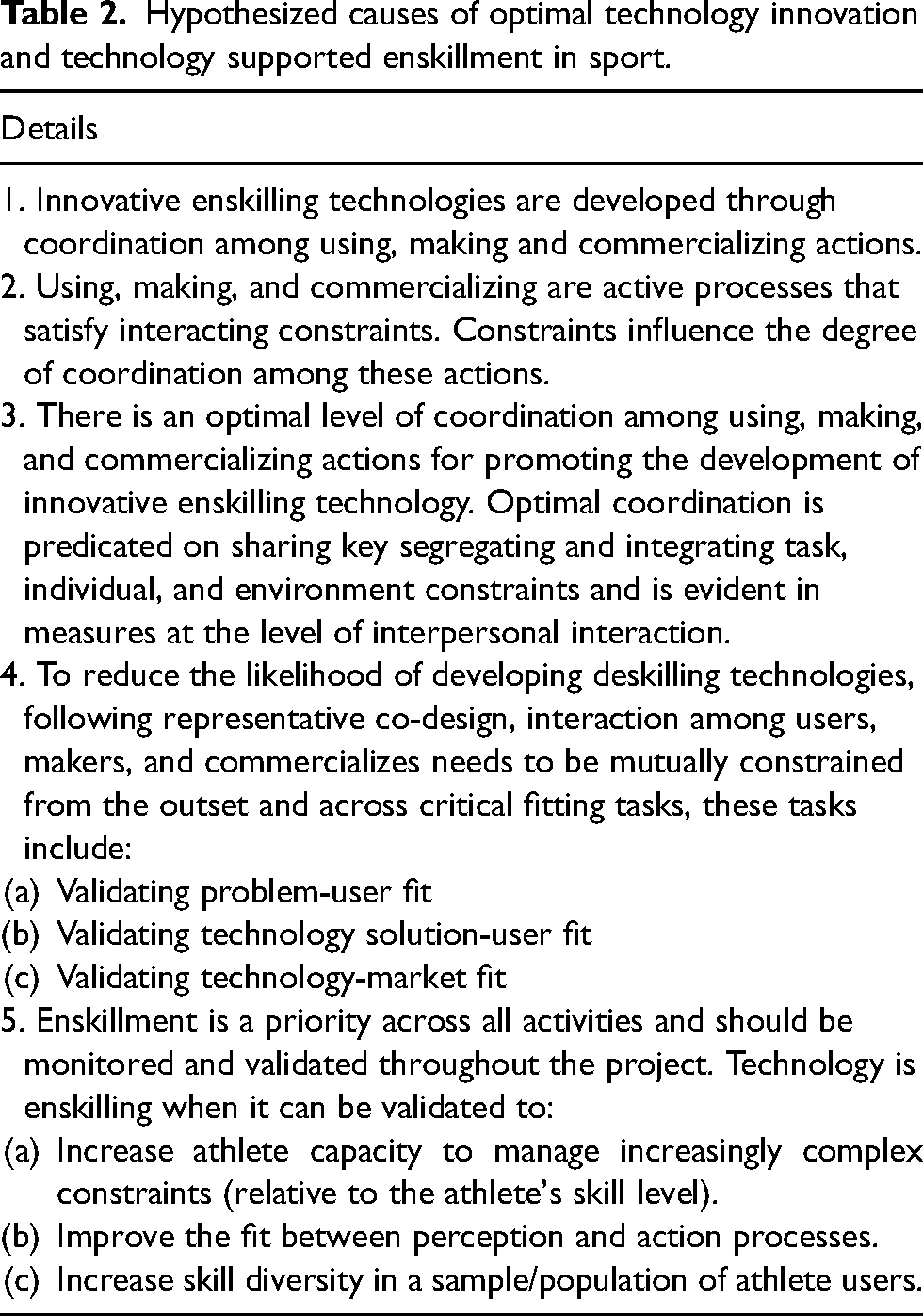
To test these assumptions, we propose to use sport technology incubators as a research vehicle. 55 Following Bergek and Norrman, 85 an ‘incubator’ is a broad term for organizations that are dedicated to supporting new ventures (i.e., start-ups). In the sport context, such organizations can include, but are not limited to, government, universities, institutes, philanthropies, for profit enterprises and so on. 55 For example, university incubators offer a location, network, resources (e.g., financial, equipment, knowledge, interns), and activities to facilitate the valorization process of students and staff. 86 An objective of research on incubators is to establish evaluation frameworks to measure incubator performance and link activities of incubators to the performance outcomes. 85 Performance measures of incubators have included items such as number of new firms, jobs, and firm survival. Unfortunately, these measures give no bearing on the positive or negative impacts of innovation on users. 85 Another challenge has been to develop measures that link the activity of incubators to outcomes and to do so in a manner that is context-sensitive. 87
Here, an incubator can be considered an environmental constraint on the start-up, shaping the coordination of the members by providing resources and physical context for interaction. In the model presented above (recall Figure 4), the scale of analysis needed to link activities to performance is at the level of the interactions of members making up the start-up. Outcome performance would be measured in terms of how traction evolves, allowing performance dynamics to be assessed with respect to critical fitting tasks (i.e., activities related to improving problem-user fit, technology-user fit, and technology-market fit). Innovative/new outcomes are cause by structured variability (rather than random or deterministic) of the interactions during using, making, and commercializing activities of the start-up related to increasing traction. When the coordination among members of the start-up is optimized by constraints, the better the subsequent fit/traction.
The start-up as a research vehicle: the meta-grip as a case study
To exemplify these ideas in practice, we will use a sport technology start-up case study called ‘meta-grip’. Meta-grip is a start-up that began at a university where a technology-solution was needed by a sport scientist to assess finger-tip strength across a variety of grip positions and conditions – hypothesized as critical for supporting capacity for adaptive/skilled performance. 88
However, the existing instruments were specifically designed to assess finger-tip strength of a single grasp type and condition (a horizontal edge, using a single hand position). These traditional approaches were based on assumptions that variance in climbing ability (i.e., the maximal route difficulty that can be climbed) could be best explained by maximal force production of the finger-tips on small, horizontally aligned edges. The scientific problem was that skilled athletes use a much broader variety of grasping actions that may impact performance. 37 Hence, the meta-grip was developed to begin addressing theoretical links between grip strength variability capability to functionally vary actions during performance as needed.
To address this challenge, a side project was initiated by a sport scientist (DO under the supervision of JVK). Movement science students who were interested to work on the project as a thesis could choose to do so as part their (MSc) thesis. Among people that expressed interest was an elite competition climber and coach who had recently completed a Master's in Human Movement Science. The scientist, had offered the project without having a tool to measure finger-tip strength across a range of grip types. When the issue came up, a rough drawing was put together on the back of sketch pad of what might be suitable. This was taken to a technical support engineer who was asked if they could piece something together that could do the job. At this point a team of consisting of a user (the athlete and coach), maker (the technician), and commodifier (the sport scientist) was established (Figure 5). In coming together under constraints of the project task and university environment (and its resources), their respective interactions gave rise to new opportunities and actions to solving the problem. These interactions further constrained their behavior overtime (Figure 5).
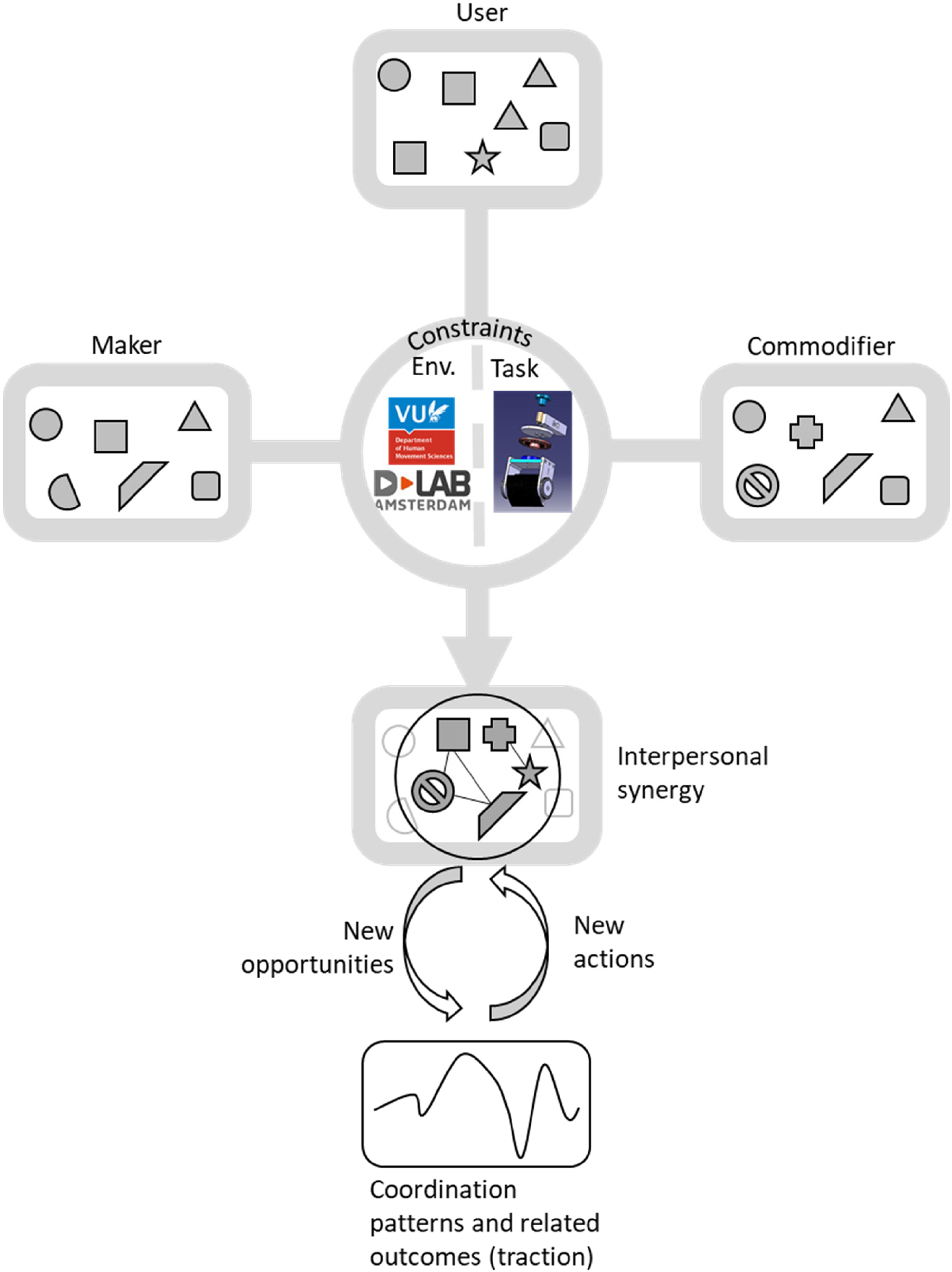
A depiction of reciprocal compensation of the meta-grip start-up. In forming a synergy (as caused by constraints) the members behavior emerges over time based on temporary perceptual-action couplings concept adapted from. 60 Env. = Environment.
There were various iterations of the instrument, but in all cases, when decisions needed to be made, these involved the climber, the scientist, and technician. This evolved into a prototype that allowed the student to proceed to data collection for their thesis. Within the context of the university, aspects such as exploring new ways of doing things and confirming reliability and validity of instruments are valued – they can be seen as vehicles to help students learn these critical skills, are important to demonstrate in a thesis, and can be publishable.37,88,89 Hence, the resources and time to develop these aspects are available (i.e., notably to build and test out the first prototype did not require seed funding, there was discretionary budget for these aspects, and knowledge support is part of the academic culture).
As the project matured, a yearly National grant call to support novel sport technology applications was announced and the project was able to be supported in a financial capacity and more extensive prototyping could be funded. The fact that reliability and validity data had been established with athletes and was situated in a fertile environment made the grant proposal competitive. This grant provided a new level of traction that was then leveraged to join the local university incubator. The incubator provided an environment dedicated to exploring the commercial potential of the instrument. This opened new activities and funding opportunities to evaluate if a business model could be developed and validated (Figure 6, Panel A). Throughout this process, the athlete, the scientist, and engineer have been an integral part – although at many points through the journey they of acted independently on specific tasks that fit their skills. Recently the sport scientist needed to find a position and left the department. Hence, currently the meta-grip sits at a transition point along the path to traction. A new team member is needed to replace the scientist, or new team needs to be established to get behind the concept at the new institution (Figure 6, Panel B).
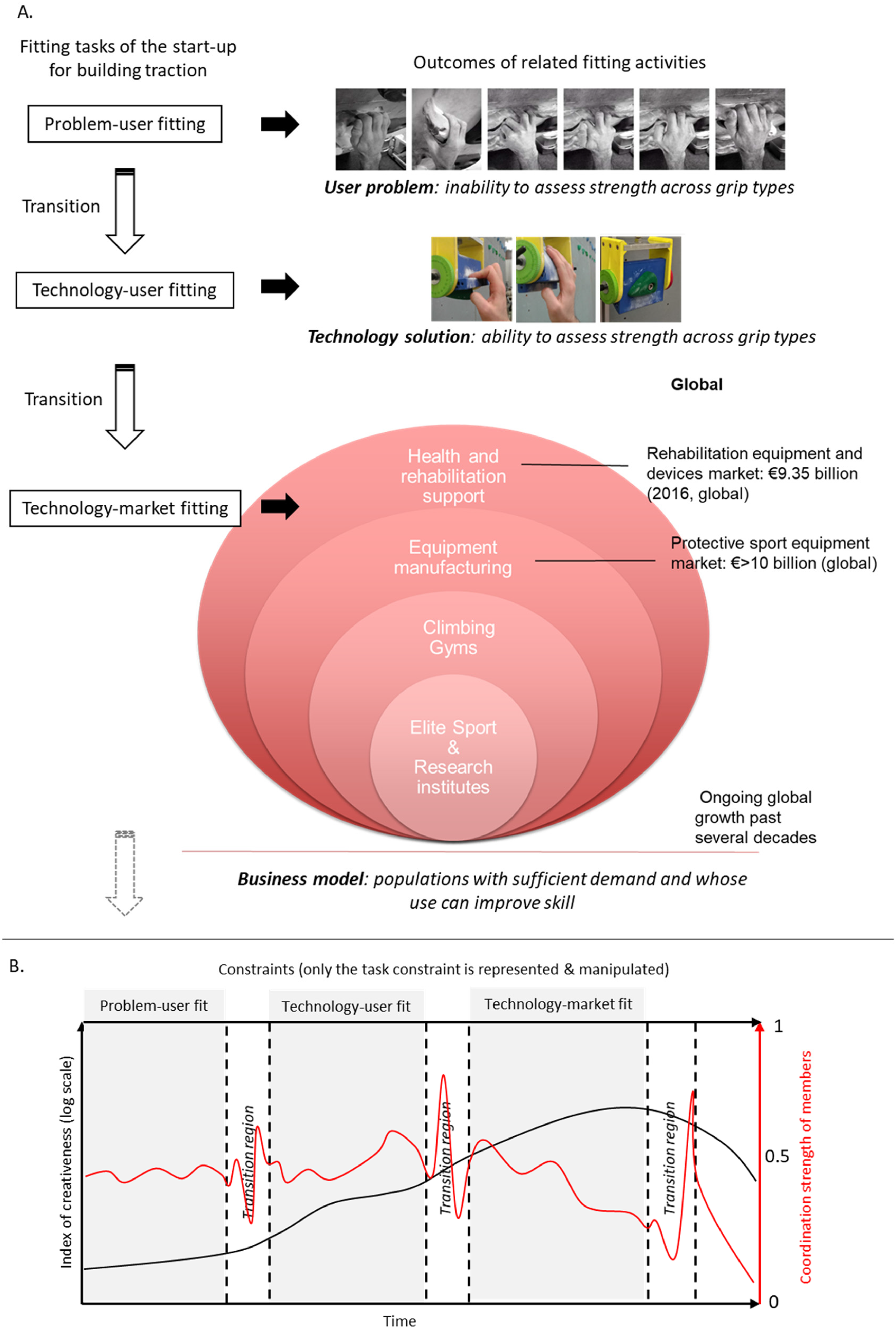
Upper panel: different phases in building traction of the meta-grip represented as transitions. Outcomes/artifacts emerging from each are presented along the right side. Lower panel: Hypothetical measures of the constraints, creativeness, and coordination of members over time. Note how across both panels the fitting tasks represent a changing task constraint.
Viewed through the lens of ecological dynamics, important issues that need to be addressed in the meta-grip case study include how to understand and measure:
What What is a suitable measure of the (in)stability of the How might the
In the final section we present methods to address these questions (i.e., using retrospective, observational, or experimental designs to observe start-ups in sufficient numbers to be able generalize findings), with the goal to understand how to dynamically optimize constraints on coordination among members of sport-technology start-ups to improve innovative outcomes.
Operational approach to understand optimal constraints on sport-technology innovation: future research, tools, and techniques
In the case-study above, key environmental, task, and individual constraints can be identified as having important roles in the formation of the start-up and how it transitioned through the various fitting states from problem-user fit to technology-user fit, and then to technology-market fit.
Retrospective studies performed on a larger scale can yield consistencies in the sorts of constraints and transitional states that can explain activities and outcomes of start-ups.51,90 For example, Azimzadeh, Pitts 91 undertook retrospective interviews of 18 individual entrepreneurs in the small and medium sized enterprises. They found that certain factors (including individual, environment, and financial) were associated with an index of innovation (a consensus judgment made by a panel of three experts), for a similar approach see. 90
Perceptual-motor learning studies have shown that identifying key constraints can also be identified using systematic review 92 or observational studies.93,94 Furthermore, verifying important constraints requires experimental approaches that manipulate key constraints to determine causal relationships on the (in)stability of the coordination among members of the start-up and the related outcomes for approaches in perceptual-motor learning experiments see.95,96 For example, experimental manipulation of constraints on sufficient numbers of start-ups could be done in a sport technology incubator where start-up groups might be provided differing levels of financial support or, the diversity of the group members could be manipulated – the subsequent impact of constraint manipulation on coordination and innovativeness then tested.
The coordination among the sport scientist, athlete/coach, and engineer can be assessed by importing a broad variety of techniques widely used for complex systems analysis. For instance, a tractable measure of coordination could involve analysis of the communication patterns among members over time.97–99 The time interval or directions of successive interactions of members can be subjected to a suite of complexity measures entropy, recurrence quantification analysis, fractal analysis, and so on, for examples refer to. 100 We would expect that more optimal communication patterns would reveal properties consistent with complexity/adaptability such as high information, and long-term correlations. If a more detailed picture of the communication networks of members were to be sampled, these can also reveal varying degrees of complexity that might forecast robustness of the start-up to perturbation and transitional behavior.101,102 The more adaptive the startup, the more likely innovative outcomes will be yielded as it reflects the capability to improve fit and drive traction.
Finally innovative outcomes can be monitored using metrics linked to traction. In the start-up and entrepreneurship literature, a broad array of variables proport to indicate traction.103–105 In the context of developing technologies that support perceptual-motor learning in sport, traction should have a fundamental link to improving the skill of the users. In any case, an index of traction (or innovative potential at any given time) could include some measures of:
Resources available for making (equipment, time, diversity and depth of the members’ capabilities, space, money); Impact of the technology on athlete enskillment (new skills developed and performance enhancement of athletes); Capability to generate demand of the technology (number of paying customers, customer loyalty, network effects).
As mentioned earlier, to quantify and experimentally manipulate the above-mentioned aspects (constraints, coordination, and innovation) the use of sport-technology incubators is suggested. University-based or industry-based sport technology incubators provide a context in which constraints and the activities of members of start-ups can be monitored, and real-world problems can be set and supported (e.g., offering competitive grants related to a given sport technology innovation challenge). Constraints can also be experimentally manipulated to test predictions from the framework developed in this paper, and contrasted against alternative frameworks such as.105,106
Conclusion
A weakness in current work to address technology (mis)use in sport is that design and commercial perspectives have not been integrated with motor learning and teaching frameworks. For example, there is no empirical evidence that can be identified that one or another technology innovation approach (whether that be informed by motor learning theory or not) can lead to more or less complexity, engagement, and/or skill diversity in an individual or group as a consequence of technology use. This paper has extended substantively on ways in which learning and teaching theory can and should be integrated with product design and commercialization processes in sport technology innovation. For instance, facilitating optimal coordination among users, designers, and commodifiers during technology innovation requires a balance of segregating and integrating constraints. We have argued that users, designers, and commodifiers should be meaningfully involved members of sport technology start-ups. Important integrative constraints identified include sharing project goals and requirements, growth mind-set, and physical and financial resources. These should be balanced with important segregating constraints, such as increasing team-member diversity in terms of skills, backgrounds, and social professional networks. Finally, to test these ideas, we have proposed an operational approach to integrate commercial, design, and use frameworks using technology incubators with a view to empirically study these ideas.
Supplemental Material
sj-docx-1-spo-10.1177_17479541241309559 - Supplemental material for The role of constraints in sport technology development for improving perceptual-motor learning and coaching, design, and commercialization outcomes: An ecological dynamics approach to transdisciplinary innovation in start-ups
Supplemental material, sj-docx-1-spo-10.1177_17479541241309559 for The role of constraints in sport technology development for improving perceptual-motor learning and coaching, design, and commercialization outcomes: An ecological dynamics approach to transdisciplinary innovation in start-ups by Dominic Orth, John van der Kamp, Kevin Tissera and Amanda Benson in International Journal of Sports Science & Coaching
Supplemental Material
sj-docx-2-spo-10.1177_17479541241309559 - Supplemental material for The role of constraints in sport technology development for improving perceptual-motor learning and coaching, design, and commercialization outcomes: An ecological dynamics approach to transdisciplinary innovation in start-ups
Supplemental material, sj-docx-2-spo-10.1177_17479541241309559 for The role of constraints in sport technology development for improving perceptual-motor learning and coaching, design, and commercialization outcomes: An ecological dynamics approach to transdisciplinary innovation in start-ups by Dominic Orth, John van der Kamp, Kevin Tissera and Amanda Benson in International Journal of Sports Science & Coaching
Footnotes
Declaration of conflicting interests
The authors declared no potential conflicts of interest with respect to the research, authorship, and/or publication of this article.
Funding
The authors received no financial support for the research, authorship, and/or publication of this article.

Supplemental material
Supplemental material for this article is available online.
References
Supplementary Material
Please find the following supplemental material available below.
For Open Access articles published under a Creative Commons License, all supplemental material carries the same license as the article it is associated with.
For non-Open Access articles published, all supplemental material carries a non-exclusive license, and permission requests for re-use of supplemental material or any part of supplemental material shall be sent directly to the copyright owner as specified in the copyright notice associated with the article.
