




Abstract
Addressing global sustainability challenges requires a mainstreaming of business models for sustainability (BMfS) in mature industries. However, the presence of an already dominant mainstream business model in an industry tends to hold back BMfS. This article investigates how new types of BMfS can become generally accepted and widely adopted in an industry. It presents a qualitative study of the mainstreaming of BMfS in the Dutch electricity industry. The findings show that this process depends on entrepreneurs’ capacity to (1) incorporate alternative institutional logics into the design of BMfS to achieve optimal distinctiveness and (2) to directly alter the dominant institutional logic of the industry to make it more conducive to BMfS. Furthermore, successful BMfS act as anomalies that indirectly alter the industry’s dominant institutional logic. Anomalies support a self-reinforcing loop that accelerates the mainstreaming process. We integrate these findings into a dynamic model of the mainstreaming of BMfS.
Keywords
Introduction
Addressing global sustainability challenges such as climate change, biodiversity loss, and plastic pollution requires a major transformation of industries, markets, technologies, and consumer behavior (Geels & Schot, 2007). Sustainable technologies often fail to scale beyond the niche (Hockerts & Wüstenhagen, 2010). Recent studies suggest that this is due to their lack of a business model that makes them attractive to mainstream customers and economically viable for the firms that sell them (Bohnsack et al., 2014). Mainstreaming business models for sustainability (BMfS) in mature industries is therefore imperative for sustainable transitions to take place (Schaltegger et al., 2016). By mainstreaming, we refer to the emergence of new types of BMfS which become generally accepted and widely adopted in an industry, both by incumbents and new entrants. Mainstreaming BMfS is challenging because they are more demanding than traditional business models in terms of the value they seek to create and the stakeholders they aim to benefit (Lüdeke-Freund & Dembek, 2017). That is, BMfS require a fundamental rethinking of the value proposition, comprising economic, social, and environmental value, and an extended network of stakeholders involved in value creation, delivery, and capture (Schaltegger et al., 2016). However, mass markets do not reward social and environmental value in the same way they reward economic value. For BMfS to have a role in making mature industries more sustainable, they need wide support from business, policymakers, and consumers to be considered an economically viable alternative to current business models. But how do entrepreneurs developing BMfS garner such support?
A major impediment for BMfS to become accepted and adopted in a mature industry is that they deviate from the industry’s mainstream business model which has proven successful for incumbents (Bohnsack et al., 2014). The mainstream business model refers to shared understandings and frameworks that firms in the same industry rely on to create, deliver, and capture value (Baden-Fuller & Morgan, 2010; Chesbrough & Rosenbloom, 2002). It is the type of business model most used in an industry and captures a learned behavior of how to do business (Chesbrough & Rosenbloom, 2002; Sabatier et al., 2010). The mainstream business model constrains BMfS in two ways. First, it prevents the design of BMfS because it provides the default cognitive template that entrepreneurs use when creating their business model (Chesbrough & Rosenbloom, 2002). Deviating from the industry’s mainstream business model is risky whereas relying on the one that has proven successful provides a sense of economic viability. Second, it prevents the adoption of BMfS. As BMfS challenge the mainstream perception of value and unsustainable business practices, adoption would require radical changes in consumer preferences, production systems, and revenue models (Schaltegger et al., 2016). Our article sheds light on how entrepreneurs garner support for the mainstreaming of BMfS in mature industries despite such constraints.
Existing research found that entrepreneurs can use two strategies to support the mainstreaming of BMfS. First, entrepreneurs can design BMfS that are both distinctive—and therefore appealing to mainstream customers—and legitimate in the eyes of other industrial actors such as business partners and competitors (Zhao et al., 2017). What is less clear, though, is what resources entrepreneurs can leverage to design BMfS that are both distinctive and legitimate. Second, entrepreneurs, in isolation or in collaboration with other industry actors, can purposefully work to alter the dominant institutional logic of the industry (Cohen & Winn, 2007; Dean & McMullen, 2007; Hockerts & Wüstenhagen, 2010). Research suggests that entrepreneurs employ both strategies, but how these strategies interact and support the mainstreaming of BMfS is less well understood.
In this article, we examine how both strategies operate and interact to support the mainstreaming of BMfS in mature industries. For this purpose, we conducted a qualitative study of the electricity industry in the Netherlands. Since the liberalization of the electricity retail market in 2001, BMfS have emerged in the Dutch electricity industry despite constraining pressures from the mainstream business model. We find that the mainstreaming of BMfS in this industry pertains to the ability of entrepreneurs to (1) incorporate alternative institutional logics into the design of BMfS to make them distinctive and borrow business models that are mainstream in other industries to make them legitimate, and (2) alter the dominant institutional logic to make it more conducive to BMfS. We find that both activities coalesce into a self-reinforcing loop that accelerates BMfS mainstreaming. When BMfS start being adopted more widely, they act as anomalies that both disconfirm that only the industry’s mainstream business model can bring economic success and confirm the relevance of the alternative institutional logics that they incorporate by design. Our article contributes to the literature on BMfS (Boons & Lüdeke-Freund, 2013; Lüdeke-Freund & Dembek, 2017; Schaltegger et al., 2016) by unveiling the nature of the resources, that is, alternative institutional logics, that entrepreneurs use to design distinctive and legitimate BMfS. It also contributes to the institutional literature on transformational change (Micelotta et al., 2017) by conceptualizing the role of anomalies at the industry level (Hoffman & Jennings, 2011).
Theory
Firm-Level Business Models, Mainstream Business Models, and Institutional Logics
At the firm level, business models are a strategic device that allow firms to create, deliver, and capture value. There are many definitions (and associated ontologies) of what a business model is. In this article, we define business models as attributes of real firms (Massa et al., 2017) and managers’ strategic choices on how to create, deliver, and capture value from a product or service (Teece, 2010). A firm uses a business model to commercialize products or services (Chesbrough & Rosenbloom, 2002; Teece, 2010). The three fundamental dimensions of a business model are as follows: (1) the value proposition, which is the value that the firm creates around the product or service, to make it appealing to users—for instance, a platform that connects producers and consumers of energy could either craft a value proposition around prices (“Choose the cheapest producer!”) or around ethics (“Choose the producer that matches your personal values!”); (2) the value chain, which refers to all the activities and actors involved in delivering this value to the users (e.g., energy producer/production and energy transporter/transport); and (3) the revenue model, which refers to how a firm captures the value it creates in the form of a cash flow (e.g., subscription or pay-per-use).
Firms develop business models that mirror the mainstream business model of the industry they operate in. That mainstream business model is a shared cognitive schema that firms within the same industry rely on to create, deliver, and capture value (Massa et al., 2017; Sabatier et al., 2012). It is the master model (Baden-Fuller & Morgan, 2010) from which all the business models in this industry draw (Bidmon & Knab, 2018; Chesbrough & Rosenbloom, 2002). The mainstream business model is a collective understanding of the effective business model in a specific industry (Sabatier et al., 2012). Firms rely on this collective understanding to craft their value proposition, position themselves in the value chain, and determine the best revenue model to monetize their activity.
The mainstream business model instantiates the dominant institutional logic that operates in that industry. It is a reflection of the higher-level cultural order that shapes the industry. Institutional logics are the socially constructed principles that guide how organizations and individuals assign meaning and value to the social world (Friedland & Alford, 1991; Thornton & Ocasio, 1999). They define how we should behave, what we should attend to and care about, and from what we should derive our pride and identity (Lounsbury et al., 2021). Institutional logics such as the community and the market logic (York et al., 2016), which are the two institutional logics of interest in this article, constitute a society’s cultural-cognitive backdrop. The market logic is based on the idea that social relations are defined based on cost-benefit analysis, emphasizing exchange of value (Friedland & Alford, 1991). It confers a central position to private sector organizations that grant efficient and effective provision of goods (Friedland & Alford, 1991; Townley, 1997). The community logic often manifests as an alternative institutional logic in industries that are highly regionalized (Lee & Lounsbury, 2015; York et al., 2018), such as the electricity industry. It can be generalized as a set of principles that value the local over the global (Marquis & Lounsbury, 2007) or advocate reciprocity and solidarity over self-interest (Lee & Lounsbury, 2015; York et al., 2018).
Having defined the three core concepts of the article—business models, mainstream business models, and institutional logics—next we explain how the dominant institutional logic in an industry hampers the mainstreaming of alternative business models, such as BMfS.
How the Dominant Institutional Logic Hampers the Mainstreaming of BMfS
At the industry level, there are two ways in which the dominant institutional logic hampers the mainstreaming of BMfS. First, institutional logics have an indirect effect on the mainstreaming of BMfS. The dominant institutional logic shapes the industry’s mainstream business model, which, in turn, adversely affects the mainstreaming of BMfS (Bidmon & Knab, 2018; Bohnsack et al., 2014; Chesbrough & Rosenbloom, 2002; Massa et al., 2017) because (1) it tends to restrain entrepreneurs’ ability to invent new business models and (2) shapes markets in a way that is not conducive to alternative business models. The mainstream business model creates cognitive barriers that filter how firms define the best ways to create and capture value in a given industry (Chesbrough & Rosenbloom, 2002), and it shapes collective interpretations of what a viable business model looks like (Massa et al., 2017). Therefore, entrepreneurs rarely engage in radical business model design. When they do, they often lack the resources to do so, driving them back to the dominant institutional logic’s cognitive templates. Instead, every time firms rely on the mainstream business model, they enact and reinforce the industry’s dominant institutional logic (Cabantous & Gond, 2011; Jarzabkowski & Kaplan, 2015).
Furthermore, the mainstream business model shapes the industry in a way that it is not conducive to BMfS. Entrepreneurs who design a business model that deviates from the norm are less likely to receive funding than the ones who abide to it (DiMaggio & Powell, 1983). Compliance increases perceived legitimacy and reassures investors that entrepreneurs have done their homework and know the key success factors of the industry in which they operate. In addition, while entrepreneurs developing BMfS might believe that markets welcome social and environmental value (Schaltegger et al., 2016), incumbents are often resistant. They serve customer segments where such value does not drive demand (Bohnsack & Pinkse, 2017; Christensen, 1997; Gauthier & Gilomen, 2016). In mature industries, customers are so used to a certain type of value that they have developed stable preferences around it. This is why BMfS are initially confined to niche markets when they emerge in any industry (McGrath, 2010). The potential to move beyond niche markets is surrounded with uncertainty (Andries & Debackere, 2007). BMfS’ requisites for sustainable production and consumption of goods and services also call for a value chain reconfiguration (Schaltegger et al., 2016), which departs from the mainstream business model when it involves new, nontraditional stakeholders (Hart & Sharma, 2004). In terms of value capture, there is uncertainty surrounding BMfS’ economic performance (York et al., 2016). The value capture, or “monetization,” cannot rely on proven revenue models because BMfS create social and environmental value for a broad network of stakeholders (Lüdeke-Freund & Dembek, 2017).
Second, institutional logics have a direct (negative) effect, too, on the mainstreaming of BMfS. Practitioners in an industry are personally committed to that industry’s institutional logics. Such commitment goes beyond practitioners’ belief in the superior economic efficiency of the mainstream business model. Such commitment derives from their emotional attachment to the cultural values (Sadeh & Zilber, 2019; Toubiana & Zietsma, 2017) embedded in the dominant value proposition. Similarly, practitioners care about implementing the practices and activities aimed at delivering this dominant value proposition. Such practices and activities are captured in the dominant value chain of the industry. In the French wine industry, for instance, wine-makers care about delivering value that is linked to “terroir” (the taste of a wine depends on the place where it was made) and are emotionally committed to enacting wine-making practices and activities that nurture and protect this terroir (Shrivastava & Kennelly, 2013). This value derives from a community logic, present in all French regional wine industries, that values the local over the global and tradition over modernism.
The above reasoning captures how institutional logics hamper the mainstreaming of BMfS. We now turn to how entrepreneurs can garner support for BMfS despite these constraining pressures.
Mainstreaming BMfS Despite the Dominant Industry Logic
The literature identifies two ways in which entrepreneurs can counteract prevailing institutional logics: (1) design BMfS that are both distinctive and legitimate to have a high potential to become mainstream, and (2) alter industry-level institutional logics so they are more conducive to BMfS.
First, entrepreneurs can design business models which are both distinctive and legitimate (Zhao et al., 2017). They can reconfigure the value proposition to increase or match customers’ perceived value compared to the industry’s mainstream business model (Bidmon & Knab, 2018; Bohnsack & Pinkse, 2017; Bohnsack et al., 2014). With a sustainable value proposition, entrepreneurs make BMfS distinctive by focusing on social and environmental value (Roome & Louche, 2016; Vernay & Gauthier, 2017) and incorporating alternative norms of appropriate business practices (Laasch, 2018; Randles & Laasch, 2016). However, BMfS require leveraging untapped sources of social or environmental value which are not appealing to mainstream customers who are used to being delivered economic value. Entrepreneurs are therefore faced with a paradox. They must incorporate new sources of value to make their BMfS distinctive. But if they do so, customers might fail to perceive that new value as attractive, and entrepreneurs risk being ignored or sanctioned by stakeholders (Zuckerman, 1999). We seek to understand how entrepreneurs deal with this paradox as they seek optimal distinctiveness (Zhao et al., 2017).
Second, entrepreneurs can support the mainstreaming of BMfS by purposively trying to alter industry-level institutional logics. Through political activities such as lobbying for government support (Pinkse & Groot, 2015), entrepreneurs can influence how markets reward social and environmental value (Pacheco et al., 2010). Entrepreneurs can create entrepreneurial opportunities from the market failure of not rewarding environmentally desirable behavior (Cohen & Winn, 2007; Dean & McMullen, 2007; Hockerts & Wüstenhagen, 2010). Sustainable energy entrepreneurs in the Netherlands, for example, used collective action by forming industry associations to lobby the government to change laws and regulations (Pinkse & Groot, 2015). The emergence of wind energy in Colorado shows how entrepreneurs instead benefited from lobbying activities of nongovernmental organizations (NGOs; York et al., 2016). While sustainability research has considered such institutional work as a way to create and exploit entrepreneurial opportunities (Cohen & Winn, 2007; Dean & McMullen, 2007; Schaltegger et al., 2016), there is still a lack of empirical research showing how such behavior supports the mainstreaming of BMfS.
To summarize, then, the question how BMfS can become mainstream in mature industries depends on the ability of entrepreneurs to design distinctive and legitimate BMfS and use agentic behavior to influence a change in industry-level institutional logics. Next, we present our empirical analysis on how both processes operate and interact, eventually supporting the mainstreaming of BMfS.
Data and Methods
Empirical Setting
The study’s empirical setting is the mainstreaming of BMfS in the Dutch electricity industry (2000–2019). This setting is appropriate for studying this phenomenon because this industry’s mainstream business model has long remained stable, but its future viability has been questioned with the emergence of BMfS, adopted both by new entrants and incumbents.
The Dominant Institutional Logic of the Dutch Electricity Industry
Since the industry’s liberalization, following the adoption of the European Commission’s 96/92/CE directive, the Dutch electricity industry has been dominated by a market logic (Verbong & Geels, 2007). By 2001, the regional utilities had merged to form three large utilities together capturing 87% of market share (ECN, 2001), of which two were later bought by foreign firms. In the Netherlands, efforts have been made to make the electricity market transparent and facilitate consumers to switch contract (Mulder & Willems, 2019). This gave rise to a dynamic market. There are now more than 50 energy suppliers present in the country (ACM, 2016) and a relatively high switching rate among Dutch consumers (16% in 2018 which is far above the European average of about 6%, ACM, 2018).
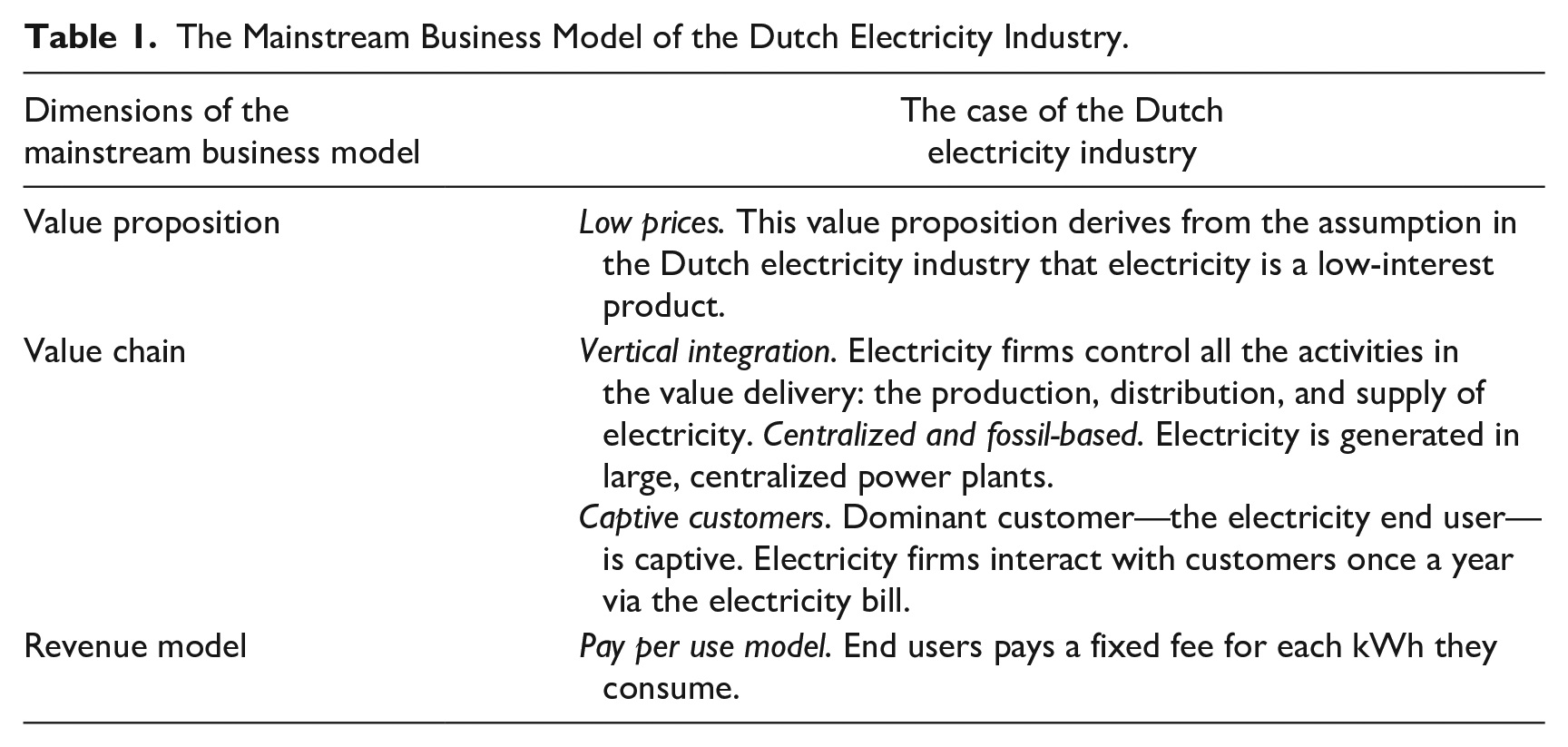
As a result, the mainstream business model of the Dutch electricity industry has been built around the duty to deliver affordable and reliable electricity (Verbong & Geels, 2007). This is reflected in a value proposition which focuses on low prices. It used to be a widely shared belief in the industry that customers think of electricity as a low-interest product and only interact with suppliers when they receive their electricity bills. Only price was seen as making a difference in the value that customers perceive. The value chain is vertically integrated and electricity providers perform three activities: they produce, distribute, and supply electricity using large-scale, fossil-fuel-based power plants. This value chain avoids double margins and allows delivering affordable electricity. Customers are assumed to be captive. The revenue model is based on volumetric tariffs that depend on how much electricity is used. Table 1 summarizes the mainstream business model of the Dutch electricity industry.
The Mainstream Business Model of the Dutch Electricity Industry.
The Mainstreaming of BMfS in the Dutch Electricity Industry
Recently, BMfS, which deviate from the mainstream business model, have become more widely adopted and accepted. While the value proposition of energy suppliers used to be homogeneous, based on low prices, energy suppliers are now using various value propositions (see Table 2). First, supplying green electricity has become standard practice among Dutch electricity suppliers (Mulder & Willems, 2019). Green electricity supply contracts went from half a million customers in 2001 (Novem, 2002) to 69% of customers by 2017 (ACM, 2017). Second, various firms, including new entrants (Vandebron, Om Nieuwe Energie), established alternative suppliers (Greenchoice, NLE), and incumbents (Essent, Eneco) have started to adopt BMfS that are shaped by a community logic rather than a market logic. We observe the following value propositions instantiating three elements of the community logic: a place-based value proposition (with a focus on providing locally produced renewable electricity to the end user), a reciprocity-based value proposition (with a focus on facilitating exchanges of green electricity among prosumers—prosumers are consumers that also produce [part of] their electricity), and a solidarity-based value proposition (with a focus on solidarity between producers and users of green energy). Some of these BMfS were already present in the 1990s but only captured a small market share. In the 2000s, the liberalization of the electricity retail market catalyzed the emergence of new BMfS, which are now becoming widely adopted and accepted. Table 2 provides evidence of the mainstreaming of BMfS (we use year of adoption as a proxy).
The Adoption of BMfS in the Dutch Electricity Industry.
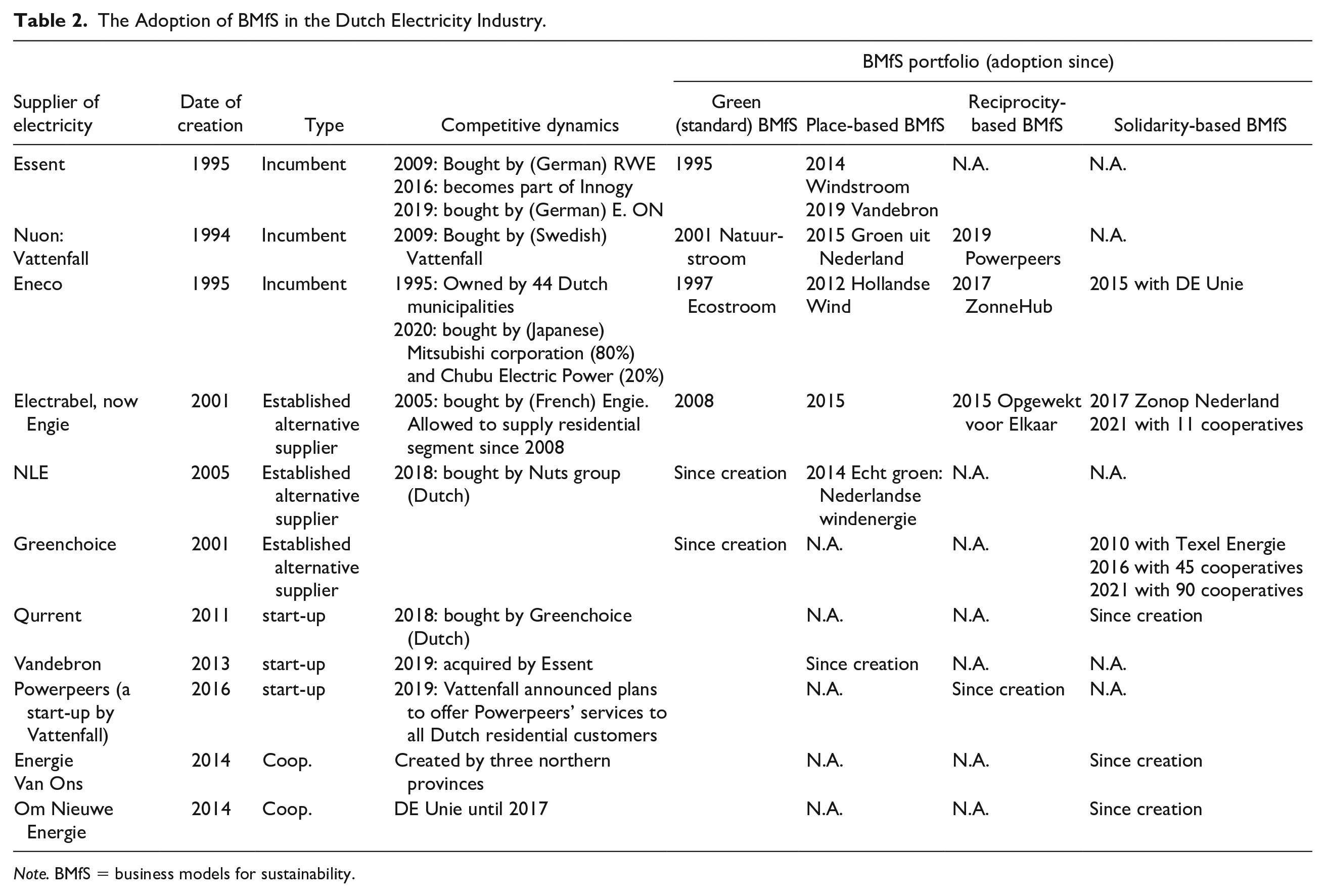
Note. BMfS = business models for sustainability.
Data Collection
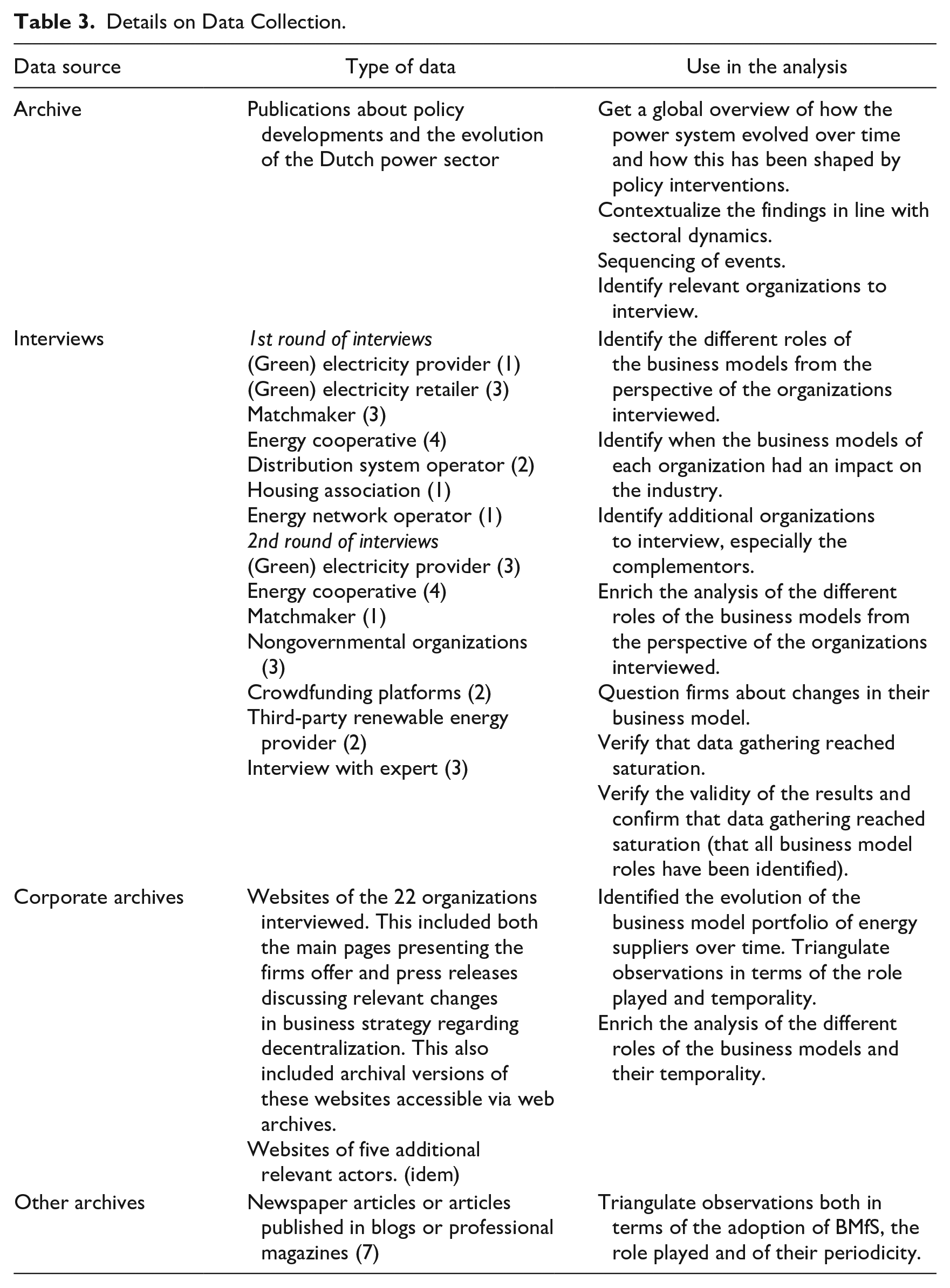
We used four types of data to understand the political context in which the industry change has been taking place and identify how entrepreneurs have used the design of their BMfS and other agentic behavior to prompt a change in the dominant institutional logic: (1) archival documents including institutional reports and academic papers that discuss energy policy in the Netherlands and the evolution of the Dutch energy sector, (2) 35 semi-structured interviews, (3) corporate archives including webpages presenting the firms’ offers and press releases discussing relevant changes in business strategy regarding decentralization, and (4) other archives from the media including press and blog articles discussing BMfS (see Table 3).
Details on Data Collection.
Interviews were conducted in two rounds. The first round of interviews focused on the emergence of BMfS that were based on new definitions of value creation, delivery, and capture. This round revealed the importance of organizations that provide complementary assets to those that develop BMfS. The second round focused on the activities of entrepreneurs engaged in BMfS and of complementors. We interviewed representatives of organizations (e.g., start-ups) identified as key players in creating BMfS in the Dutch electricity industry as well as incumbents, including founders, managing directors, heads of strategy departments, innovation managers, account managers, and project leaders. For some organizations, we conducted more than one interview, either to get a more complete overview of the creation and adoption of BMfS or to understand the reasons behind strategic changes. We also interviewed experts to gain additional knowledge about industry specificities and to validate that all the important types of organizations had been interviewed.
When interviewing representatives from organizations involved in creating BMfS, we asked them to describe their business model and explain why they chose to define value creation, delivery, and capture differently from prevailing definitions and why these differences were important to them. We also asked them to reflect on their organization’s role in proposing alternatives to the industry’s mainstream business model and identify and reflect on the role of other organizations in the ongoing change. If organizations had been active in the industry for many years, we asked them to explain what their initial intent was, and how and why their business model had changed over time. When interviewing incumbents, questions were aimed at understanding how they reflected on the industry’s sustainability transition. Table 3 presents the data sources and explains how they contributed to our analysis. Table 4 shows which organizations were interviewed, when these were established, the role of the person interviewed, and the date of the interview.
List of Interviews.
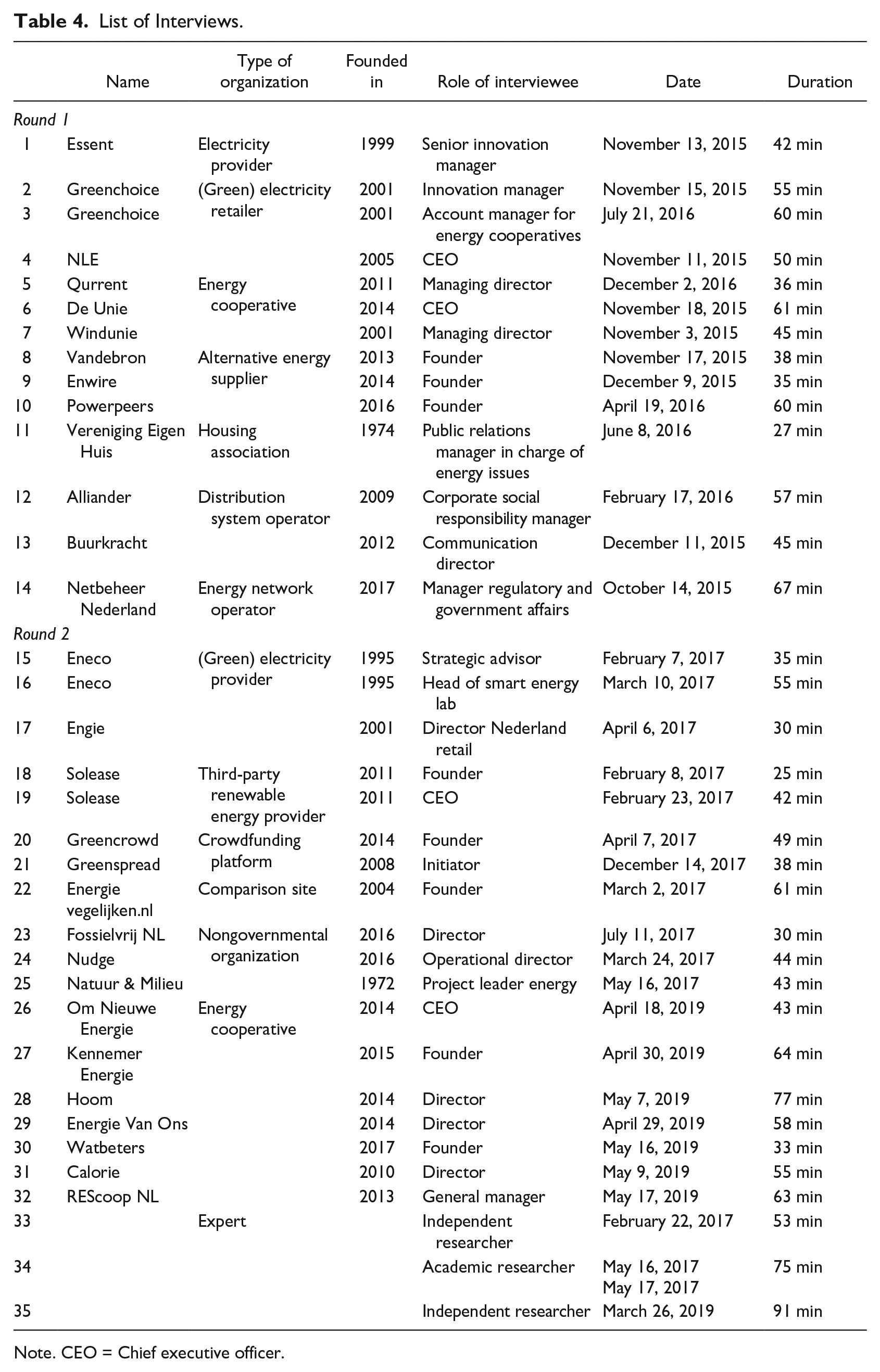
Note. CEO = Chief executive officer.
Data Analysis
To make sense of ongoing changes in the Dutch electricity industry, we first captured the main events that shaped the industry (e.g., the launch of the energy supplier ranking: important regulations) and information about market dynamics (e.g., market share of incumbents, number of suppliers, number of customers with a green electricity contract). We then coded our data in the following three steps (see Figure 1).
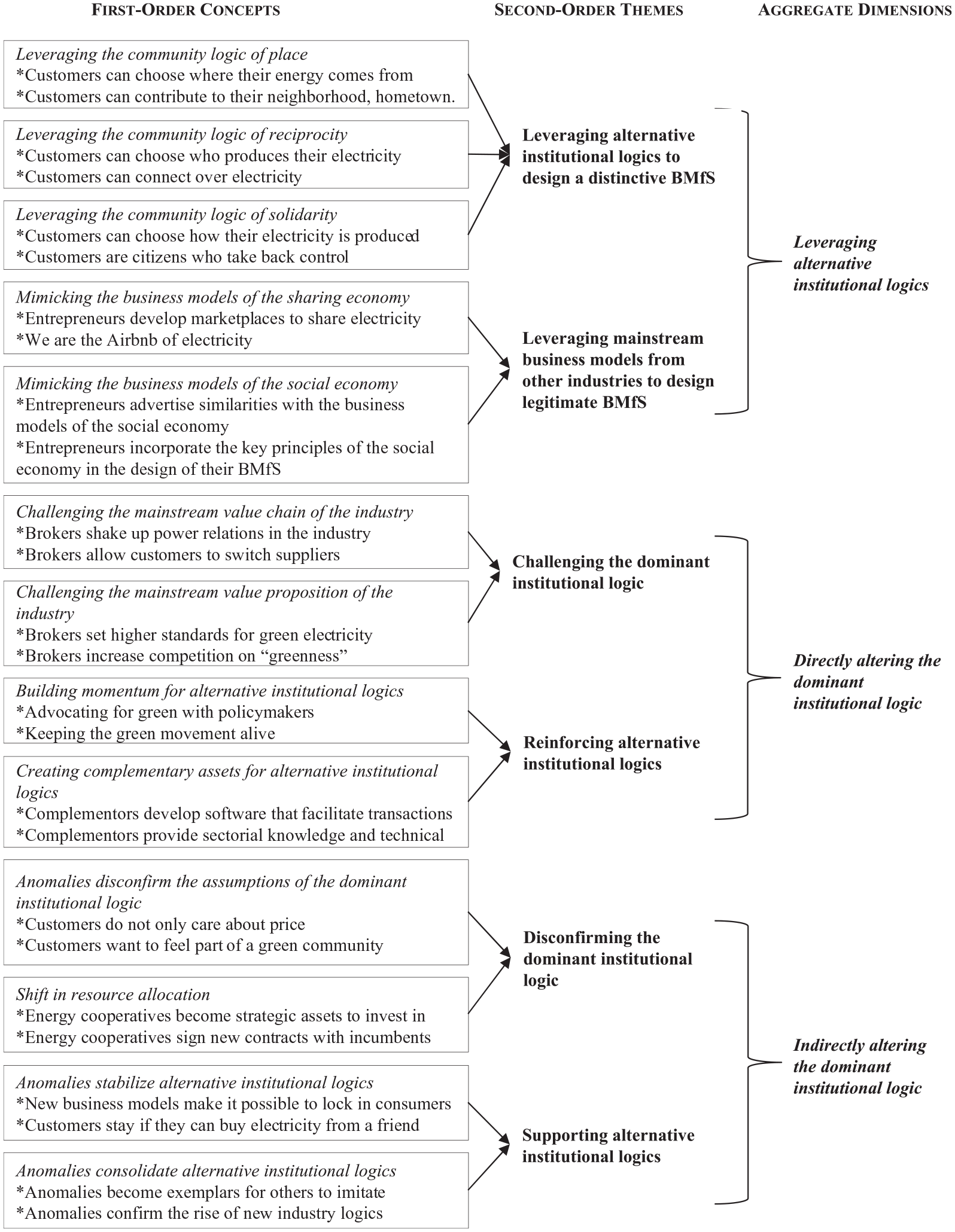
Coding Structure.
Step 1
Two researchers coded the data to identify which resources entrepreneurs leveraged to design BMfS. First, we analyzed how entrepreneurs (1) designed a distinctive value proposition and (2) built legitimacy for their business model. Our analysis generated a considerable number of first-order codes, which remained as close to the data as possible. We then clustered those first-order codes into first-order concepts. For instance, we combined the first-order codes Customers can choose windmill and You can choose where your energy is coming from into the first-order concept Customers can choose where their energy comes from. Figure 1 features all the first-order concepts. This data reduction process, while staying in the “informant realm” (Gioia et al., 2013), allowed us seeing more clearly patterns in the data.
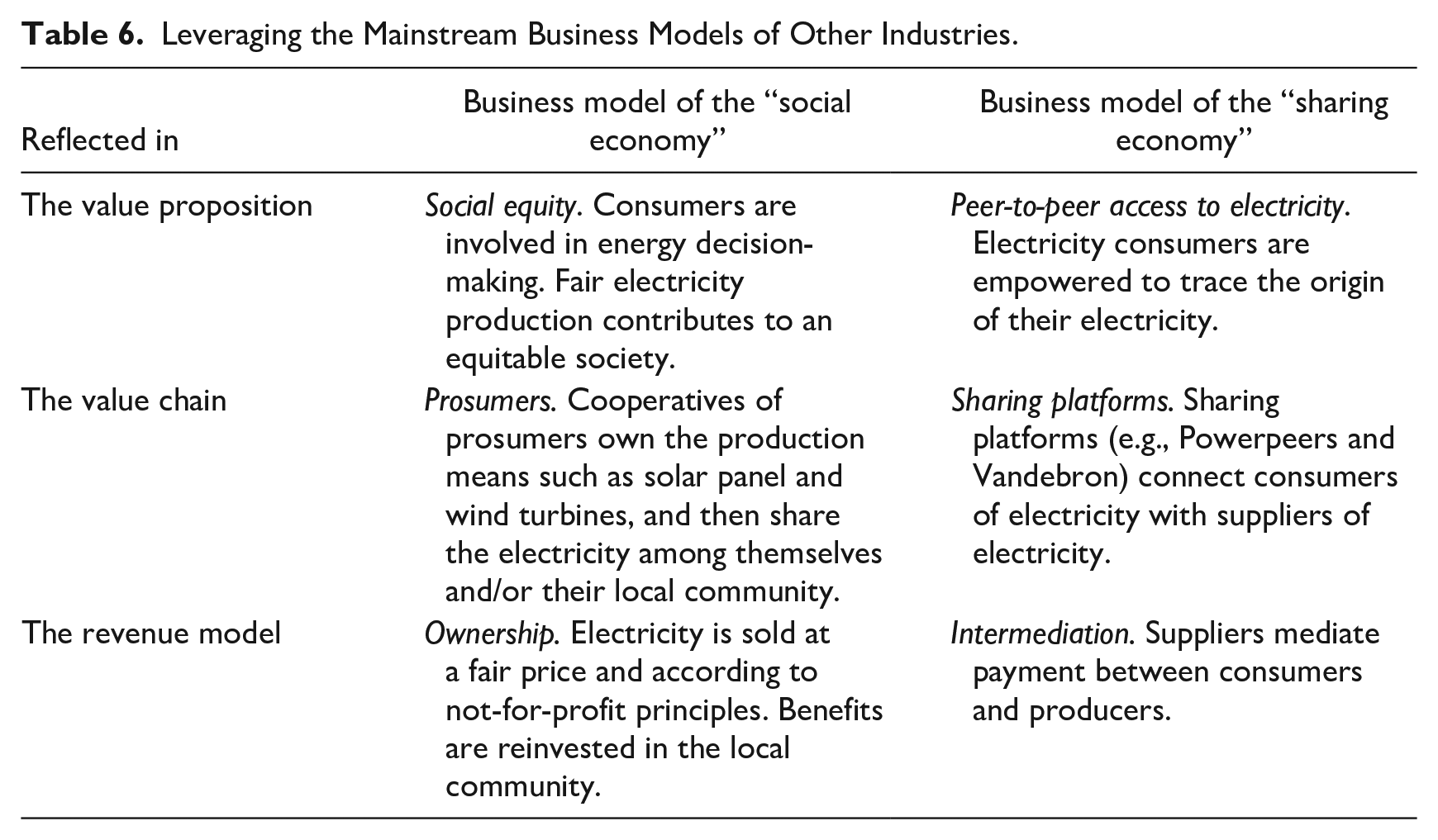
We then engaged in axial coding, going back and forth between the theory and the data, grouping the first-order concepts into intermediary categories (in italics in the boxes in Figure 1). For instance, we clustered the first-order concepts Customers can choose where their energy comes from and Customers can contribute to their neighborhood, hometown into the intermediary category Leveraging the community logic of place. Table 5 provides evidence of entrepreneurs leveraging three elements of the community logic. Similarly, this first step of abstraction revealed that entrepreneurs Mimicked the business models of the sharing economy and Mimicked the business models of the social economy to build legitimacy for their BMfS. Both these intermediary categories are represented in italics in the boxes in Figure 1. Table 6 provides indicators of those mainstream business models being leveraged from other industries. We followed a classic abstraction process which yielded the aggregate dimensions in Figure 1: Leveraging alternative institutional logics. This aggregate dimension provides a high-level answer to the question what resources entrepreneurs leverage to develop distinctive and legitimate BMfS.
Indicators of Entrepreneurs Leveraging the Community Logic to Build BMfS.
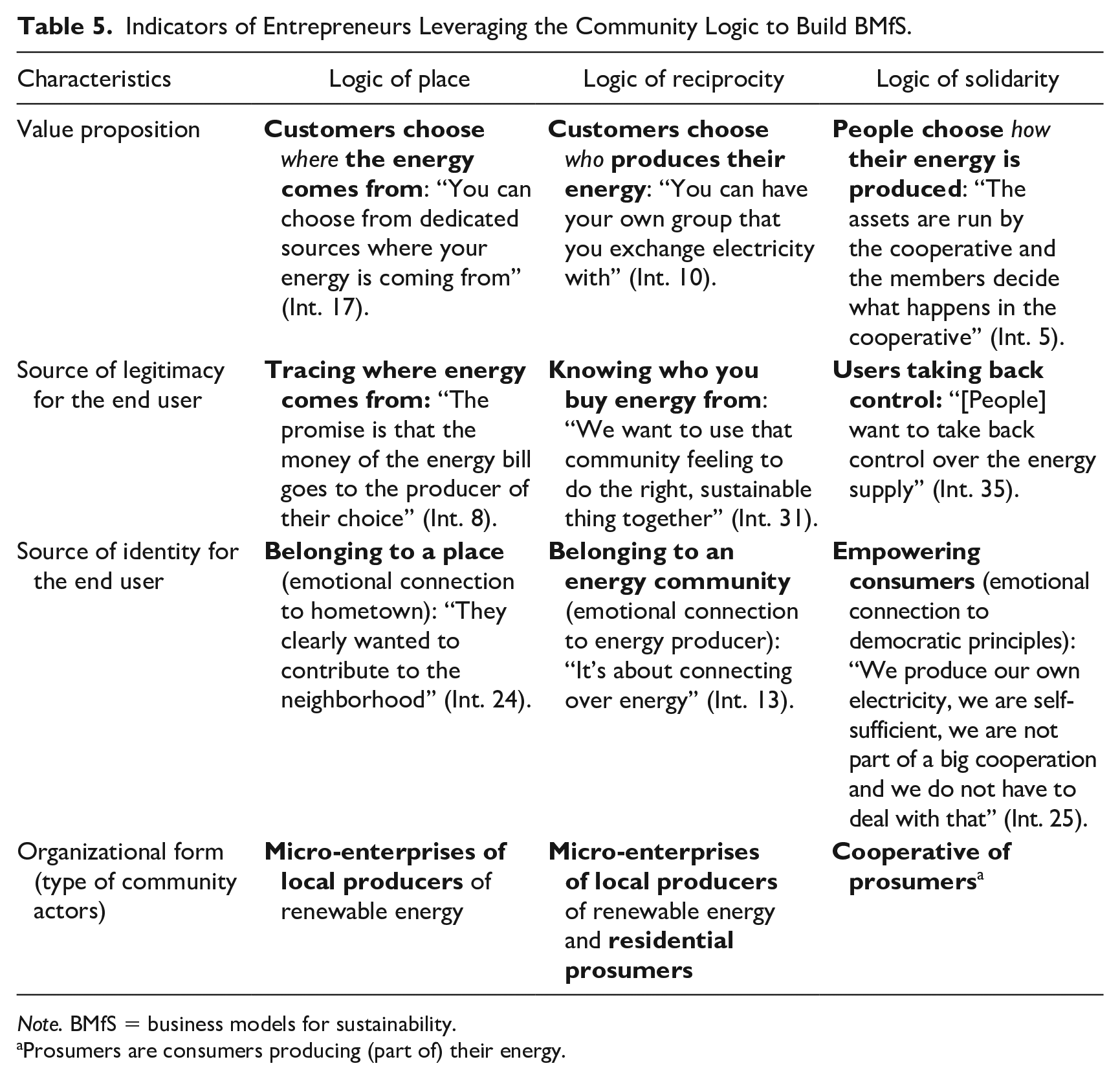
Note. BMfS = business models for sustainability.
Prosumers are consumers producing (part of) their energy.
Leveraging the Mainstream Business Models of Other Industries.
Step 2
The analysis showed that early attempts to introduce BMfS had been unsuccessful, indicating that leveraging alternative institutional logics is necessary but insufficient for BMfS to be adopted throughout the industry. It also revealed interesting dynamics in power relations slowly shifting away from incumbents. We started coding for power relations and other activities directed at altering the institutional context of the electricity market, looking at who was involved and in what way. Interviews pointed to many interdependencies between actors to deliver their value proposition. To grasp these, we coded all complementary assets that actors provided to each other, highlighting the type of complementary assets, how important these were, and who provided them. This coding process led to the second aggregate dimension: Directly altering the dominant institutional logic.
Step 3
The analysis of archival documents revealed many similarities between BMfS proposed by new entrants and more established actors. Interviewees often commented on the apparent success of BMfS in capturing market share. We analyzed how actors interpreted the increased market share of BMfS which highlighted that BMfS indirectly impacted the dominant institutional logic by pushing incumbent actors to question its legitimacy, too. This process revealed that BMfS, if they start being adopted more widely, have acceleration effects, leading to our third aggregate dimension: Indirectly altering the dominant institutional logic. Table 7 provides evidence for the second-order themes that compose our three aggregate dimensions.
Quotation Table With Evidence From Interviews and Secondary Data.
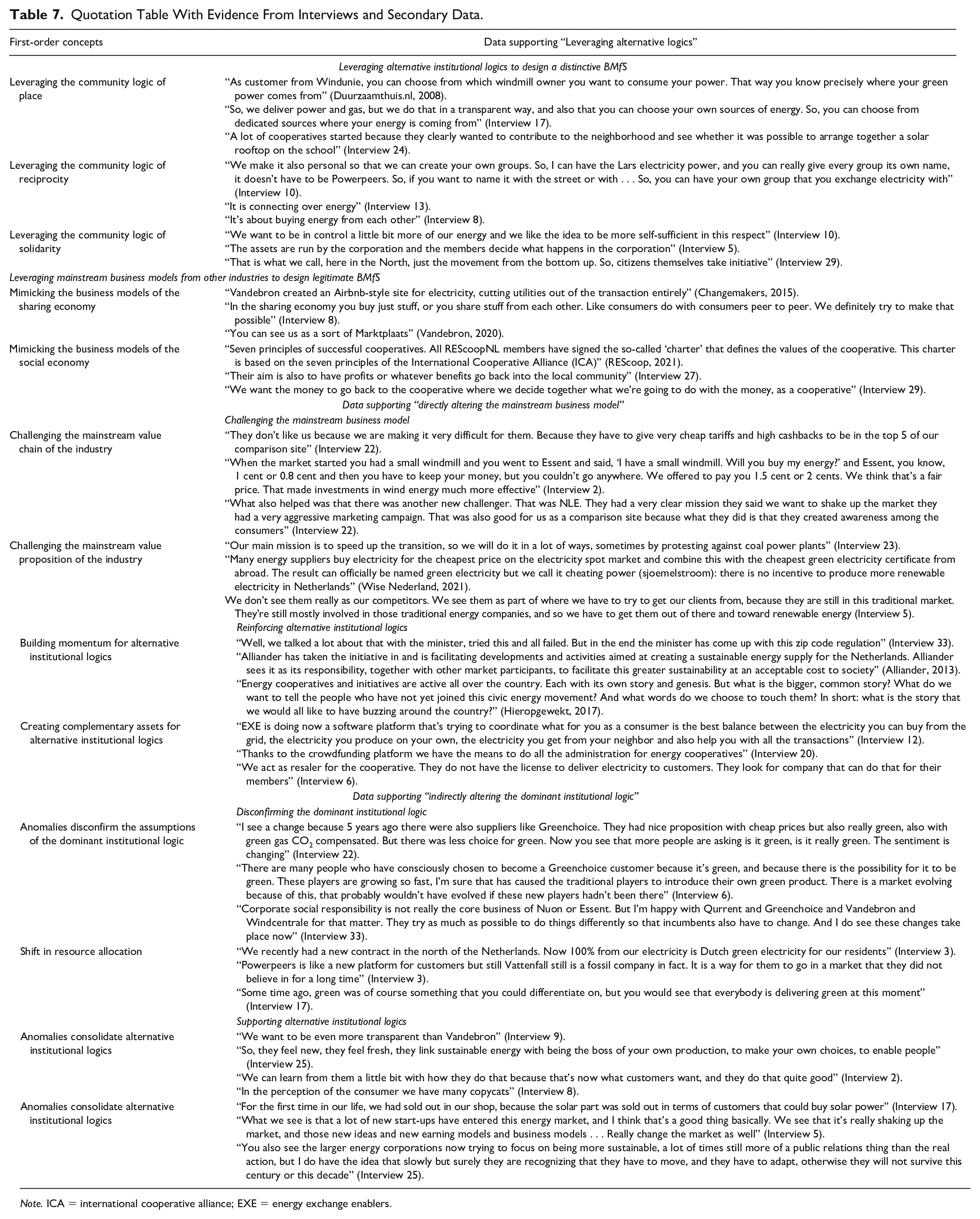
Note. ICA = international cooperative alliance; EXE = energy exchange enablers.
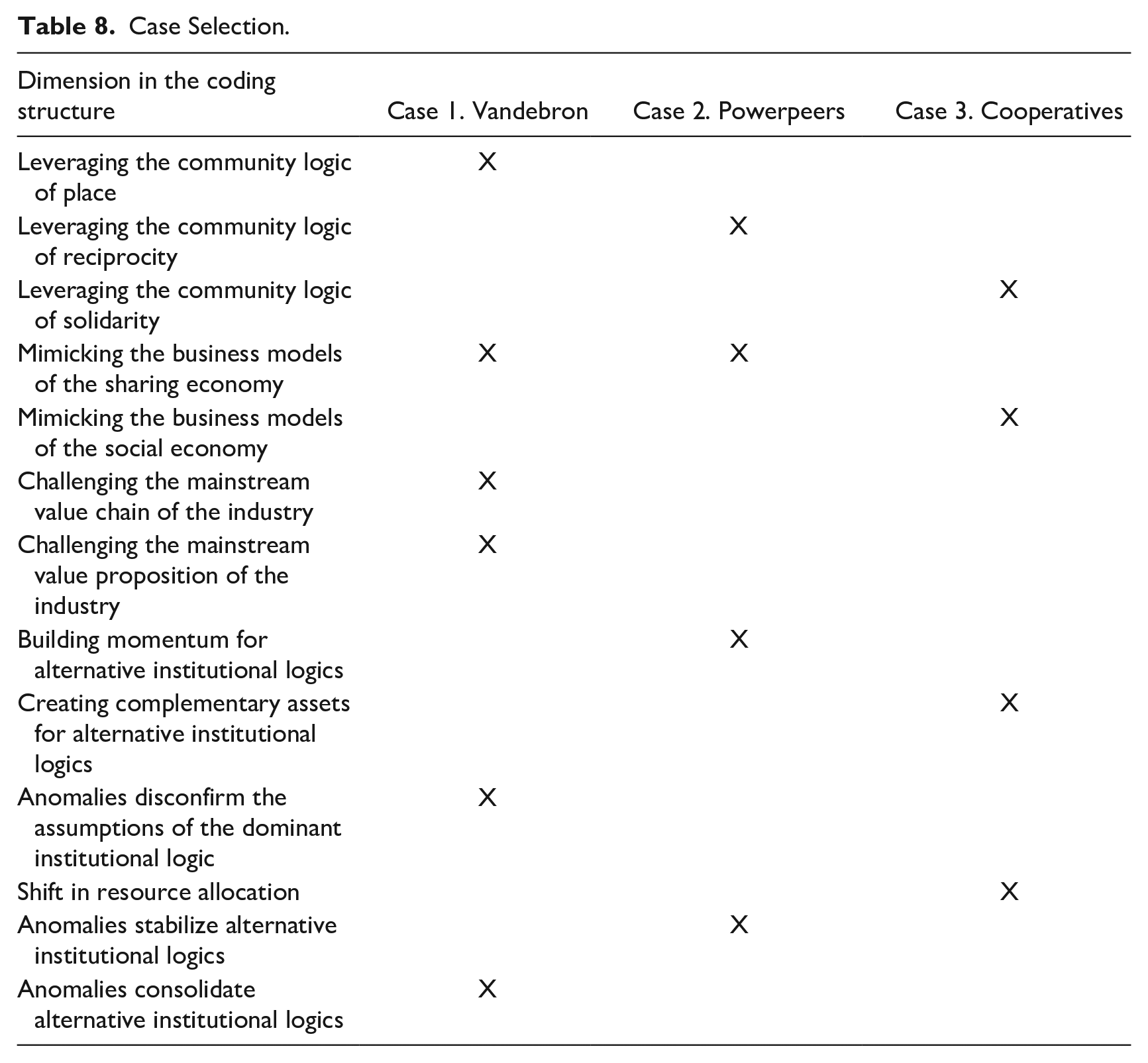
Finally, we derived a dynamic model that explains the mainstreaming of BMfS in a mature industry (see Figure 2). According to our model, (1) entrepreneurs leverage alternative institutional logics to design BMfS that are both distinctive and legitimate, (2) entrepreneurs directly alter the dominant institutional logic to make it more conducive to BMfS, and (3) as they diffuse, BMfS indirectly alter the dominant institutional logic, thereby accelerating their mainstreaming. In the section “Findings,” we present our model through three exemplary cases. All the second-order themes captured in Figure 1 are present in all three cases but with variations around the second-order themes’ salience in each case. Vandebron can be considered an exemplary case for the intermediary category Challenging the mainstream value chain of the industry within the second-order theme Challenging the dominant institutional logic, while Powerpeers can be considered an exemplary case for the intermediary category Building momentum around alternative institutional logics within the second-order theme Reinforcing alternative institutional logics. Similarly, cooperatives can be considered an exemplary case for Shifting resource allocation within the second-order theme Disconfirming the dominant institutional logic. Table 8 provides a synthesis of the dimensions of our coding structure and how they are reflected in each case. Together, the three cases combine into a rich empirical illustration of all the second-order themes in our model.
Case Selection.
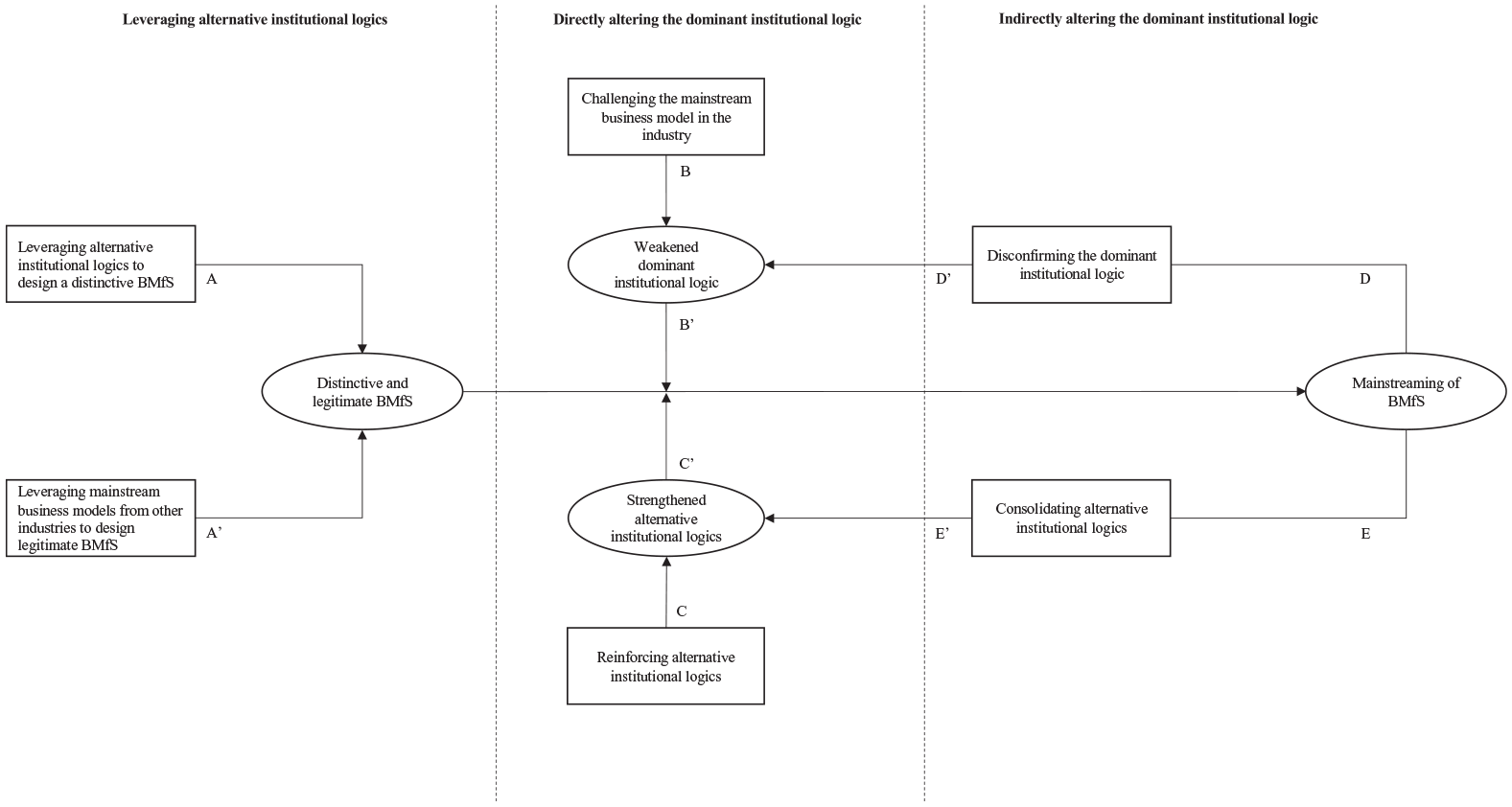
Dynamic Model of the Mainstreaming of BMfS in Mature Industries.
Findings
Mainstreaming Place-Based BMfS: Giving a Color to Electrons
Vandebron—which translates as “From the source”—is a start-up, founded in 2013, that allows customers to choose where their electricity comes from. Vandebron only offers green energy, but this is not what makes its business model distinctive. As one founder explained, Vandebron “empowers consumers by making it possible for them to make their own choice on where their energy bill is going” (Interview 9). It provides transparency in tracing the geographic origin of electricity. Vandebron has created a type of BMfS (place-based) which is now becoming mainstream in the Dutch electricity industry (see Table 2). In 2017, Vandebron had grown into a serious challenger with 100,000 consumers, eventually leading in 2019 to its acquisition by Essent, one of the incumbents. The current mainstreaming of place-based BMfS is surprising because in 2004 Windunie—a farmer cooperative owning wind turbines—had developed a BMfS with such a value proposition but failed. Why did Vandebron’s BMfS succeed while Windunie’s failed?
Leveraging Alternative Institutional Logics
Vandebron leveraged the community logic of place to design a distinctive BMfS. Providing transparency in relation to where electricity comes from is what makes their value proposition distinctive (see Table 5). Customers are willing to pay for this feature because it resonates with deeply seated needs to protect their hometown, region, or country (Tuan, 1974). Vandebron incorporated the community logic of place into its value proposition by empowering customers to support local consumption and place-bound economic activities. Vandebron redistributes customers’ money directly to the producer of their choice. The assumption is that “Alongside the trend of people wanting to know where their food is coming from, you also want to know where your energy is coming from” (Interview 17). Vandebron gave a color to the electron. Renewable is not enough. Electricity is greener when it is produced locally. As they commute to work, customers pass the windmill from which they source their energy and feel good about it.
Vandebron enhanced its BMfS’ legitimacy by mimicking business models of the sharing economy. The mainstream business model of the sharing economy, informed by a sharing logic, has produced successful ventures such as Airbnb in hospitality and Uber in urban mobility. Vandebron created a platform that mimicked Airbnb’s business model. On Vandebron’s platform, each electricity producer has its own page, and customers can choose from whom to obtain electricity based on the generation technology, the location, and the producer’s storytelling. Customers only pay Vandebron for access to the platform and the intermediary services it provides, not for the electricity. Vandebron became “the AirBnB of green power.” Mimicking Airbnb’s business model provided Vandebron with legitimacy in the Dutch electricity industry, where they could more readily present themselves as the new generation of business models for electricity supply.
Directly Altering the Dominant Institutional Logic by Challenging the Mainstream Business Model
Vandebron succeeded where Windunie failed because, around 2013, the mainstream business model which used to prevail in the Dutch electricity industry was under far more pressure than a decade before. Vandebron’s BMfS benefited from collective efforts to challenge the mainstream business model and the underlying dominant institutional logic. Since 2001, NGOs and entrepreneurs had been working in concert to challenge two aspects of the dominant logic: its value chain and value proposition.
Challenging the Mainstream Value Chain of the Industry
In 2001, when the retail sector was first open to competition, it was an oligopoly as the three largest utilities combined had 87% of total market share (ECN, 2001). Customers hardly switched supplier because they had limited understanding of what they could gain. Over the years, though, the market matured. In 2013, more than 14% of consumers switched supplier, and this percentage kept increasing. Comparison websites played an important role in making the market more transparent by highlighting the differences between the offers of incumbents and new entrants and by simplifying switching (Mulder & Willems, 2019). They challenged existing power relations in the industry’s mainstream value chain. As one comparison website founder explained, “Our mission is to make the market transparent but also the service of the suppliers transparent. We want people to make the best choice. When we started our line was: switch easily, make informed decisions” (Interview 22). The comparison websites helped challenging a key component of the industry’s mainstream value chain—marketing and sales—by offering new marketing channels to new entrants who gained a more powerful position in the value chain.
In 2013, existing power relations between value chain actors were further reshuffled. Various associations started organizing collective buying of electricity to increase consumers’ bargaining power. As a project manager of the association of homeowners explained about when the energy market opened, Energy suppliers could compete with their prices, but they didn’t, their prices were high. So, we thought we can lobby for better prices but that wouldn’t work. So, we decided to start a collective buying of energy. It was successful because many of our members were interested. (Interview 11)
In 2014, Vandebron won one of the bids. Although they had to bid at a low price, it provided access to a few thousand customers. Comparison websites and associations that organized collective buying of electricity thus created opportunities for new entrants to capture market share by making customers mobile and providing access to a pool of customers.
Challenging the Mainstream Value Proposition of the Industry
During the 2010s, NGOs and entrepreneurs such as Vandebron worked to demonstrate that incumbents were selling gray, not green electricity. Since 2001, incumbents had attempted to green their value proposition by adding renewable electricity. In 2012, a consortium of NGOs contested the “greenness” of this value proposition. To raise consumer awareness, they introduced the term “sjoemelstroom” which translates as “cheating power” as the green electricity incumbents sold was not truly green. Most came from “green certificates” related to hydropower imported from Scandinavia and failed to contribute to greening the Dutch electricity system. As Vandebron’s website explained, incumbents found a way to make “‘gray’ electricity greener by sticking cheap green certificates from abroad on black energy—generated by burning coal” (Vandebron, 2018). By introducing the colors black, grey, and green to qualify a value proposition, NGOs and entrepreneurs undermined the mainstream value proposition of the electricity industry by framing it as illegitimate.
In 2013, the same NGOs further challenged incumbents’ value proposition by launching a ranking of electricity providers showing the proportion of Dutch green electricity produced. The ranking gave visibility to energy suppliers such as Vandebron, Om Nieuwe Energie, and Powerpeers, which all featured high up the ranking due to their value proposition of selling locally produced green electricity. As one comparison website’s founder argued, the ranking raised awareness among consumers and led them to ask critical questions about green energy: “Is it green, is it really green. Is it green from Holland or is it only with certificates?” (Interview 22). By raising awareness about the color of electricity, the NGOs created space in the market for start-ups like Vandebron. In a blog interview, one Vandebron founder stated as follows: “Because you buy energy directly from the farmer, there is no more room for shadowy cheating practices (sjoemelpraktijken)” (Vandebron, 2020).
Indirectly Altering the Dominant Institutional Logic
As it gained traction among customers, Vandebron’s business model indirectly disconfirmed the industry’s mainstream business model, hence undermining its dominant institutional logic, while supporting the community logic emerging around place-based BMfS.
Anomalies Disconfirmed the Assumptions of the Mainstream Business Model
The commercial success of Vandebron’s place-based BMfS constituted an anomaly that disconfirmed the assumption that electricity is a low-interest product and that the only way to be distinctive is with price. Before Vandebron’s success, incumbents had been discussing how customers might be interested in knowing where their electricity comes from. However, at the time, incumbents believed that customers were not ready to pay for this feature. Vandebron proved them wrong and provided evidence disconfirming these widely shared assumptions. A representative from Engie claimed as follows: “We were also thinking about this project. We decided . . . let’s say that the retail market was not ready for it yet. And, then came Vandebron” (Interview 17). In July 2015, Engie launched a marketing campaign presenting a value proposition just like Vandebron’s. Customers could choose between three energy sources: a Dutch wind park, a Dutch solar park, and hydropower from the French Alps. This experiment was successful, further confirming economic viability of alternative—more sustainable—value propositions in the Dutch electricity industry.
Anomalies also consolidated community logics emerging around place-based BMfS. As other energy suppliers started imitating Vandebron’s BMfS, it became a business model exemplar for the emerging community logic in the Dutch electricity industry. Exemplars are highly successful instances of a new type of social entity (Cartel et al., 2017; Jones & Massa, 2013). They provide templates that others can imitate. The more energy suppliers copied Vandebron’s exemplar, the more that supported place-based BMfS, and the community logic emerging around them, as a legitimate alternative to the dominant institutional logic. The cooperative energy supplier Energie Van Ons (“our energy”) developed a value proposition like Vandebron’s. Questioned whether Vandebron inspired them, their director said, “Yes. I think that Vandebron has created a beautiful concept, to indicate that you get it from the source. The way Vandebron works, that’s an appealing way” (Interview 28). The mimicry of place-based BMfS by others added to the initial anomaly. In turn, place-based BMfS became a taken for granted alternative to the mainstream business model which contributed to the rise of the community logic in the Dutch electricity industry. It is now a widely shared belief in the Dutch electricity industry that customers care about the origin of their energy. Energy providers know that they can monetize this alternative value (see Table 6).
Mainstreaming Reciprocity-Based BMfS: Connecting Over Energy
Powerpeers is a peer-to-peer electricity platform founded in 2016 that allows customers to choose who produces their green energy. The platform connects sellers (residential or independent power producers) and individual buyers of green electricity. With Powerpeers, individuals can buy green electricity from their mum and dad, their best friend, or even their favorite speed skating team. While Powerpeers’ platform bears some similarity to Vandebron’s, it has a stronger focus on the individual as producer and consumer (prosumer). Powerpeers has shown great promise in mainstreaming their BMfS (see Table 2). In July 2019, the incumbent Vattenfall decided to integrate Powerpeers in their standard offer for Dutch residential customers. Why did Powerpeers’ BMfS become mainstream despite the antagonistic pressures of the dominant institutional logic?
Leveraging Alternative Institutional Logics
To build a distinctive BMfS, Powerpeers leveraged the community logic of reciprocity. Powerpeers’ value proposition resonates with people’s desire for meaningful connection: “It’s really about people, it’s about you and me, it’s our connection. We now have a connection and so we know each other and perhaps we also would like to exchange our electricity” (Interview 10). Powerpeers incorporated the norms and values of reciprocity into its value proposition by allowing its customers to produce and consume electricity with people they know, trust, and with whom they already have a meaningful connection. They reinforce and nurture preexisting social relations (family, community). Powerpeers’ assumption in designing their value proposition is that people enjoy a socializing experience and feel good when they know who is producing their electricity (Grinevich et al., 2019). It monetizes the positive feeling customers get from buying green electricity from family members, friends, or local community, in the expectation that they will stay longer with their supplier if they have an emotional connection with the person who provides their electricity.
To build a legitimate BMfS, Powerpeers mimicked the mainstream business model of the sharing economy. Powerpeers advertised similarities with the business models of the sharing economy. On its website, Powerpeers (2020) stated as follows: “We believe in sharing. In platforms such as AirBnb, Snappcar [a car-sharing platform] and Peerby [a platform to borrow things from neighbors]. We wanted to make sharing possible for energy as well and so Powerpeers was born.” Powerpeers used the analogy with other business models from the sharing economy to explain what they were doing, to gain prospective customers’ trust and capture their interest. Without legitimate precedents such as Airbnb, it is likely that mainstream customers would have judged peer-to-peer electricity platforms as risky and strange. The analogy provided Powerpeers with a template that customers and industrial partners were already familiar with.
Directly Altering the Dominant Institutional Logic by Reinforcing Alternative Institutional Logics
As it started being adopted throughout the industry, Powerpeers’ BMfS benefited from collective efforts to reinforce the community logic of reciprocity in the Dutch electricity industry. Both firms and NGOs built momentum around the community logic of reciprocity by letting consumers socialize through energy.
Building Momentum for Alternative Institutional Logics
For more than a decade, cooperatives, NGOs, and social activists supporting citizen-led energy initiatives observed that many people were excluded from contributing to the energy transition because they rent their home or have a roof that is not suitable for solar panels. To empower people to participate in the transition, they lobbied the government to allow consumers to buy and consume renewable energy capacity produced nearby as if it was installed on their own roof. As one interviewee explained, “If citizens would take responsibility for their own energy, then this is just a very good way” (Interview 33). However, regulatory frameworks at the time did not allow this and out of fear of missing out on tax income, the Ministry turned a deaf ear. In 2012, these actors were joined by new ones (i.e., energy suppliers Greenchoice and Eneco, Netbeheer Nederland, two political parties, housing corporations, and the association of Dutch municipalities). Together they wrote a letter to Parliament asking for fairer conditions for collective production and consumption of renewable energy. Eventually, the government was forced to give in and propose a scheme to support local citizen initiatives. In 2013, the so-called postcode scheme was born which allows benefiting from tax reductions on consumed electricity produced in the same or a nearby postal code. The scheme created leverage for value propositions that aim to allow consumers to connect over electricity. It built momentum for the community logic emerging around reciprocity-based BMfS. It is facilitated by established energy suppliers such as Greenchoice, Eneco, and Engie as well as newcomers such as OM Nieuwe Energie and Energie Van Ons.
Moreover, in 2013, Alliander, one of the distribution system operators (DSOs), launched a subsidiary—Energy Exchange Enablers (EXE)—that enabled people to socialize around electrons by facilitating peer-to-peer exchanges. Alliander decided to build momentum for the then nascent community logic emerging around reciprocity-based BMfS because they expected that this would become part of the new energy reality. Alliander wanted to anticipate, facilitate, and speed up changes. Incumbent energy suppliers criticized Alliander for going beyond what they could legally do given their monopolistic position as DSO. To this, the representative we interviewed responded as follows: “We are telling the commercial companies that we will take up all kind of new services if the market goes too slow. And if sustainability is not accessible to everyone, we are allowed to invest” (Interview 12). With EXE, Alliander purposely threatened the position of incumbents by reinforcing the community logic emerging around reciprocity-based BMfS in the electricity sector.
Indirectly Altering the Dominant Industry Logic
The success of Powerpeers’ business model indirectly supported the rise of the community logic emerging around reciprocity-based BMfS. The case of Powerpeers illustrates how anomalies can help stabilize and consolidate alternative institutional logics.
Anomalies Stabilize Alternative Institutional Logics
The success of Powerpeers’ BMfS constituted an anomaly that highlighted how much users wanted to connect over electricity. The anomaly further stabilized the community logic emerging around reciprocity-based BMfS. Powerpeers’ value proposition socializes electricity by building an emotional bond between sellers and buyers which creates loyalty. This emotional bond helps keep the customer captive despite the newly introduced fluidity in the electricity retail market. Earlier, we described how comparison sites created more fluidity in the market, allowing consumers to easily switch from one supplier to the other. This fluidity created pressure for energy suppliers that were used to having captive customers. Powerpeers has introduced a method to increase customer retention, not based on competing on price but on an emotional commitment to the community: There is a lot of interest about how the platform works, not only because of the sharing of energy and the origin of energy, but it also has a contribution to the fact that if you take power from a friend and you have a good price then you don’t leave so fast. Energy is a low-interest product but you like to be able to consume electricity produced by the solar panel of your friend. (Satoshi Radio Podcast, 2019)
Powerpeers’ BMfS offers the possibility for energy suppliers to lock customers in without having to invest much in marketing. As the reciprocity-based value proposition helps retain customers, it helps stabilize the community logic built around reciprocity-based BMfS.
Anomalies Consolidate Alternative Institutional Logics
The anomalous success of Powerpeers’ business model demonstrated that electricity customers care about reciprocity, as value, and that incorporating it into the value proposition is a powerful way to attract customers. Other energy suppliers such as Eneco or Engie have also started incorporating the community logic of reciprocity in their value proposition as it lets them develop long-term customer relationships. Hence, Powerpeers’ BMfS has become an exemplar for other energy suppliers: “Powerpeers has proven to be successful, and we believe that even more customers want to connect to each other and share renewable energy. Therefore, we have decided to make this offer available to all our Vattenfall customers in the Netherlands” (Vattenfall, 2019).
Mainstreaming Solidarity-Based BMfS: Creating a Fairer Energy System
Since the 1980s, many energy cooperatives have been created with the ambition for citizens to take back control of their energy supply and make sure money generated can be reinvested locally. Energy cooperatives emphasize energy autonomy and democratic decision-making. The movement’s growth is accelerating, and this BMfS has now become more mainstream (see Figure 2). At the end of 2019, the local energy monitor listed 582 renewable energy cooperatives (85 of which were created in 2019), located in 80% of all Dutch municipalities (Hieropgewekt, 2018).
Leveraging Alternative Institutional Logics
To build a distinctive BMfS, energy cooperatives leveraged the community logic of solidarity to incorporate equity, fairness, and due process in their value proposition (see Table 5). A value proposition that stresses how energy is produced is what makes energy cooperatives distinctive. Such a value proposition appeals to customers who wish for social justice in the form of a fairer energy system. The assumption is that people value an energy system that “fairly disseminates both the benefits and costs of energy services, and one that has representative and impartial energy decision-making” (Sovacool & Dworkin, 2015, p. 436). As one expert explained, “[People] want to take back control over the energy supply. Also, over the money, over the cash flows which is very important. The fact that you invest locally, that the return is local” (Interview 35). Energy cooperatives try to serve customers who are looking for social justice in the energy supply. They want to be personally involved in the production of their electricity, do that together with others in their community, and make sure their ethical standards are met when their electricity is produced: “We have a community feeling already and we want to use that community feeling to do the right, sustainable things together” (Interview 31). By leveraging the community logic of solidarity, energy cooperatives developed a value proposition that resonates with people’s desire to be part of an energy system where citizens can be active participants.
To enhance the legitimacy of their BMfS, energy cooperatives mimicked the mainstream business model of the social economy. The institutional logic of solidarity has produced mainstream business models that are successful in making a positive contribution to local communities across various sectors of the economy (see World Cooperative Monitor, 2019). These mainstream business models are legitimate because they operationalize the institutional logic of solidarity by complying with the seven cooperative principles of the International Co-operative Alliance (a global body for cooperatives). Energy cooperatives gain external recognition and legitimacy by mimicking these mainstream business models. As the president of an NGO that represents energy cooperatives explained, “Before becoming a member, cooperatives have to subscribe to the charter—the 7 international cooperative principles we have in a charter. They have to subscribe it” (Interview 32).
Directly Altering the Dominant Institutional Logic by Reinforcing Alternative Institutional Logics
Leveraging the community logic of solidarity cannot, on its own, explain the recent success of energy cooperatives. The literature shows that the business model of energy cooperatives is vulnerable to constraining pressures from the dominant institutional logic to deliver affordable and reliable electricity (Oteman et al., 2014). While early energy cooperatives such as Texel Energie designed business models around social justice that failed to diffuse, currently energy cooperatives such as OM Nieuwe Energie, Energie Van Ons, and Agem use almost the same business model more successfully to capture customers. NGOs and entrepreneurs collectively working to challenge the dominant logic of the electricity retail industry have contributed to this recent success. This meant changing the regulatory framework and providing complementary assets that reinforced the logic of solidarity.
Creating Complementary Assets for Alternative Institutional Logics
The adoption of BMfS leveraging the community logic solidarity faces regulatory obstacles because the electricity market is strictly regulated. Producers and suppliers need to comply with multiple rules and standards and understand procedures to obtain permits, certifications, and licenses: “The energy delivery side, and administration side is pretty complicated, it requires a lot of investment, a lot of knowledge, which is too much for just local initiatives to have in-house” (Interview 6). Like any volunteer-based organization, energy cooperatives have limited access to a skilled workforce, which hampers their ability to comply with such regulatory complexity. Moreover, managing the regulatory side of the market puts them in a vulnerable position in relation to more established actors. The former head of the cooperative, Windunie, explained that to be able to supply electricity they had to work with an incumbent supplier to obtain licenses and organize a back office that met regulatory requirements: “This proved to be a kiss of death really. They never treated Windunie customers as our customers” (personal email exchange). As another interviewee explained, “The pain that cooperatives have is that they need to cooperate with a utility. What typically happens is they also lose their identity by doing so” (Interview 9).
To gain more independence from incumbents and develop BMfS that incorporate their norms and values, in 2013, Windunie and Texel Energie “together set up a company that has these capabilities [to do the back office] in-house” (Interview 6). The ambition was to allow cooperative energy producers to supply electricity to their members and “to facilitate these local initiatives to become self-sufficient” (Interview 6). Energy cooperatives also got organized to increase their autonomy in relation to established actors, arguing that “all the energy communities will be better off” (Interview 28). In 2016, cooperatives created the complementor Ecode to develop information and communications (ICT) solutions to provide “a widely supported, independent, uniform and integrated system for all civil energy initiatives in the Netherlands” (Energie Samen, 2020). With a similar ambition, the project developer Bronnen VanOns (2020), initiated by Energie Van Ons, develops projects before “transferring ownership to the cooperative. In this way, ownership always remains local.” The creation of such complementary assets by BMfS entrepreneurs themselves ultimately reinforced the community logic of solidarity in the electricity sector.
Indirectly Altering the Dominant Institutional Logic
The success of energy cooperatives solidarity-based BMfS induced a shift in resource allocation that contributed to disconfirm the mainstream business model.
Shift in Resource Allocation
As they saw solidarity-based BMfS growing in popularity, incumbents progressively shifted resources to providing complementary assets that BMfS needed to scale. The success of energy cooperatives provided confirmation that working with cooperatives can provide leverage for incumbents to access locally produced renewable electricity and improve their market position. Greenchoice was one of the first established suppliers to develop symbiotic relations with energy cooperatives (Vernay & Sebi, 2020). For Greenchoice, working with energy cooperatives was a strategic choice to secure access to local renewable energy capacity and improve their position on the NGOs’ supplier ranking mentioned earlier: We don’t see our work as a consultancy. We invest in cooperatives; we want to work together with them. All electricity companies now are looking at new sources of renewable energy. We can connect customers to these projects. That’s the new source of renewable electricity. That’s the most interesting for us. (Interview 3)
To convince energy cooperatives to sell them electricity, energy suppliers started to shift resource allocation and offer energy cooperatives to diversify their sources of revenue and potentially move to an employee-based organization. An interviewee from Greenchoice explained how they created a special sales flow: “For each customer we pay the cooperative a fee. With that fee the cooperative can fund their own projects or finance employees” (Interview 3). Over time, more incumbents followed. Interviews revealed an ongoing competition in the fee that suppliers pay to energy cooperatives suggesting that cooperatives have gained bargaining power. One interviewee explained having chosen to cooperate with Engie because “they pay on average 50 euros per customer per year. Other suppliers do not manage to make a similar offer” (Interview 30).
This shift in resource allocation disconfirmed the market logic that only the delivery of affordable and reliable electricity matters in the Dutch electricity industry. The market logic prioritized resource allocation toward activities that fit this logic: buying electricity in the spot market or developing production capacity internally. The mainstreaming of solidarity-based BMfS, however, showed that allocating resources to activities that deviate from established patterns (e.g., in collaboration with energy cooperatives) can be an efficient way to access locally generated green electricity. Incumbents, by repurposing resources and visibly deviating from established patterns, further disconfirmed that only the mainstream business model can bring economic success and thus facilitated solidarity-based BMfS.
A Dynamic Model of the Mainstreaming of BMfS in Mature Industries
Our empirical study highlights three mechanisms that, together, are key to explaining the mainstreaming of BMfS despite antagonistic pressures from the dominant industry logic. The first mechanism, leveraging alternative institutional logics, supports the creation of BMfS that are both distinctive and legitimate. The second mechanism, directly altering the dominant institutional logic, alters the institutional context of the industry in a way that is conducive to BMfS. The third mechanism, indirectly altering the dominant institutional logic, accelerates the mainstreaming of BMfS. We now explain our model and the three mechanisms (see Figure 2).
First, entrepreneurs can use elements of alternative institutional logics as cultural resources (Durand et al., 2013) to design BMfS that are both distinctive and legitimate. We find that achieving optimal distinctiveness is a precondition for BMfS to become mainstream. On one hand, entrepreneurs leverage alternative institutional logics to design distinctive BMfS (Arrow A in Figure 2). Entrepreneurs incorporate the values associated with alternative institutional logics (Durand & Jourdan, 2012) into the value proposition, to make it more appealing to potential customers (Randles & Laasch, 2016). Values are an important cultural resource that have previously been identified in processes of institutional change (Swidler, 1986). Leveraging alternative institutional logics helps develop a competitive advantage, distinguishing BMfS from the dominant value proposition in the industry. On the other hand, entrepreneurs leverage mainstream business models from other industries to design legitimate BMfS (Arrow A’). Mainstream business models are instantiations of the dominant institutional logics of the industry they are borrowed from and constitute an important cultural resource. To design legitimate BMfS, entrepreneurs can mimic distinctive features of dominant business models of other industries. This imitation process provides legitimacy by facilitating analogical reasoning and allowing BMfS to resemble business models that are already familiar to customers and industry actors (Gregan-Paxton et al., 2002). It enables designing BMfS that strongly deviate from mainstream business models while avoiding an illegitimacy discount that would compromise their viability (Zuckerman, 1999). In summary, leveraging alternative institutional logics allows entrepreneurs to design BMfS that achieve optimal distinctiveness (Zhao et al., 2017). However, we find that achieving optimal distinctiveness is insufficient for BMfS to become mainstream. Without further action, the dominant institutional logic would confine such BMfS to the niche.
Second, entrepreneurs, in concert with NGOs, can work to directly alter the dominant institutional logic (Battilana et al., 2009; Lawrence & Suddaby, 2006) to make the institutional context of the industry more conducive to BMfS. To that end, entrepreneurs work to challenge the mainstream business model in the industry which, as a result, weakens the institutional logic that this model instantiates (Arrow B). They can raise doubt around the appropriateness of the mainstream value proposition of the industry. Is it really what customers want? Can we design a value proposition that answers the challenges that our current societies face? In turn, the dominant institutional logic being weakened facilitates the adoption of BMfS that feature distinctive value propositions (Arrow B’). Conversely, entrepreneurs and NGOs work in concert to reinforce alternative institutional logics (Arrow C). They can advocate for new regulatory infrastructures, needed for certain BMfS to scale beyond the niche. They can also provide complementary assets to decrease the perceived costs (technical, learning) of adopting BMfS that deviate from the dominant industry logic. Strengthened alternative institutional logics, in turn, support the adoption of associated types of BMfS (Arrow C’).
Third, as they become more widely adopted, BMfS indirectly alter the dominant institutional logic in two ways. Highly successful BMfS constitute anomalies which disconfirm the dominant institutional logic (Arrow D) and support alternative institutional logics (Arrow E). Anomalies are highly visible cues that (1) challenge the dominant institutional logic and (2) confirm alternative institutional logics (Hoffman & Jennings, 2011). As anomalies accumulate, they weaken the dominant institutional logic (Arrow D’) and strengthen alternative institutional logics (Arrow E’). A self-reinforcing loop forms where the adoption of BMfS constitute anomalies that indirectly alter the dominant logic which further supports the adoption of BMfS. By altering the dominant logic, BMfS also start changing stakeholders’ perception of what is optimal distinctiveness (Zhao et al., 2017), making it increasingly important for firms in the industry to leverage alternative logics when designing business models. After a certain point, the adoption becomes self-reinforcing which supports the BMfS as being seen as part of the mainstream.
Conclusion
Contributions to the Literature
Our article makes several contributions to debates in the literature on BMfS, optimal distinctiveness, and institutional change. Our first contribution is to the BMfS literature. Previous studies have identified that entry into mass markets pertains to entrepreneurs’ ability to design distinctive and legitimate BMfS (Bohnsack et al., 2014; Roome & Louche, 2016; Vernay & Gauthier, 2017). We contribute to these studies by identifying what resources entrepreneurs use to design such BMfS and how collective action supports their adoption throughout the industry.
Previous research showed that BMfS are often confined to niche markets because they build on environmental or social value that does not resonate with customers in mass markets (Bohnsack et al., 2014; Roome & Louche, 2016). Our study suggests that entrepreneurs can strategically leverage cultural resources (Durand et al., 2013) to design BMfS that are both distinctive and legitimate and appeal to a larger share of the market. Entrepreneurs draw on alternative institutional logics that resonate with customers’ deeply seated values and beliefs to design distinctive BMfS. By imbuing electricity with moral values and affect (fairness, caring for the local community, electricity from my friend), BMfS provide value to electricity that goes beyond its physical materiality (Bansal & Knox-Hayes, 2013). Electricity changes from being a low-interest product to one that incorporates novel values and narratives around locality, reciprocity, and solidarity. Moreover, entrepreneurs can use the legitimacy of mainstream business models prevailing in other sectors to build legitimate BMfS. The legitimacy that these business models have acquired elsewhere makes them more readily recognizable for consumers and industrial partners. Alternative institutional logics represent an interesting pool of resources in the entrepreneurs’ repertoire (Duymedjian & Rüling, 2010). This is an important contribution because an industry’s mainstream business model creates a cognitive lock-in which obfuscates what resources entrepreneurs can leverage.
Previous studies also pointed to the need to consider the role of the wider business environment in the mainstreaming of BMfS (Schaltegger et al., 2016). This article builds on this idea by showing that leveraging alternative logics to design BMfS that are both distinctive and legitimate alone is not sufficient to allow for their adoption in the mass market. We show how mainstreaming BMfS strongly depends on collective and sustained efforts to weaken an industry’s mainstream business model and reinforce alternative institutional logics. Mainstreaming BMfS is contingent with broader societal and industrial changes that help decrease entry barriers for BMfS. We observed that the political activity of NGOs and other organizations played a crucial role in changing the perception of consumers and policy makers, which values the electricity system should reflect. The mainstreaming of BMfS also strongly depended on the presence of organizations providing complementary assets that make it easier for BMfS to penetrate the market. Beyond showing that timing is important, these observations highlight the need for BMfS entrepreneurs to combine technical competences necessary to operate in a technically driven system and social skills to sense how cultural values are changing and develop BMfS that resonate with these values.
We contribute to the literature on optimal distinctiveness which is interested in understanding how entrepreneurs balance conformity and differentiation and convince stakeholders that they adequately reconcile both (Philippe & Durand, 2011) by providing insights into two questions raised in this literature. The first question concerns how highly distinctive business models manage to avoid an illegitimacy discount (Zhao et al., 2017). We suggest that, by leveraging business models which are mainstream in other industries, entrepreneurs can benefit from the legitimacy these have acquired and reassure consumers that the business model has proven its viability. Borrowing business models creates room to compensate for the perceived risk of being different. The second question concerns the temporality of optimal distinctiveness and how it relates and co-evolves with contextual factors (Zhao et al., 2017). Our longitudinal analysis shows that mainstreaming BMfS is strongly connected to changing stakeholder perceptions about optimal distinctiveness. To mainstream, BMfS need to find the right balance between conformity and distinctiveness (Zhao et al., 2017). In our empirical context, for many years being distinctive concerned attributes related to price and consumer services, reflecting the prevalence of the market logic. Recently, optimal distinctiveness shifted, following a hybridization of the institutional logic around market and community logics (York et al., 2016), which led to multiple points of optimal distinctiveness. The community logic represented an overarching umbrella that firms could conform to. It created new opportunities for firms to differentiate based on various interpretations of community (local farmer, friends, and neighbors) and the values which matter to the community.
Finally, we contribute to the institutional change literature. Transitioning to sustainable industries requires for shared beliefs and values that constitute the dominant institutional logic to be significantly altered; that is, it requires institutional change (Micelotta et al., 2017). Recent work in institutional theory has investigated how an industry’s dominant institutional logic can change (Gawer & Phillips, 2013) and how institutional complexity prompts the creation of hybrid organizations which further promote field-level change (York et al., 2016). These studies assume a high level of agency. Our study highlights an agentic process that is highly practice-driven (Smets et al., 2012). It is a mindful deviation from the mainstream business model that initiates transformational change. Our study reveals the role of anomalies in this process. In the philosophy of science, anomalies refer to observations that violate the dominant scientific paradigm and lend support to alternative paradigms (Kuhn, 1970). In organizational contexts, the notion of anomalies has been adapted to refer to observations that challenge a field’s dominant institutional logic and lend support to alternative institutional logics (Hoffman & Jennings, 2011). In our study, anomalies—in the form of highly successful BMfS—are key to the transformational change of an industry’s mainstream business model and its institutional logics. BMfS informed by the community logic visibly outperformed the market. The anomaly supported the rise of the community logic in the Dutch electricity industry, therefore altering the balance between industry-level institutional logics (market logic and community logic).
Anomalies do not only highlight the pragmatic legitimacy (economic return) of new business models but also the alternative institutional logics that inform them. Studies contend that anomalies can perform a paradigm shift because they constitute proof that the new paradigm “works better” (Marti & Gond, 2018). The power of anomalies in inducing change lies in their pragmatic meaning (this is more efficient or economically viable). Our case instead highlights the normative dimension of anomalies. The power of anomalies resides in anomalies being value laden, indicating moral legitimacy. Anomalies arise because people buy local electricity, their mum’s electricity, and electricity that is produced fairly, instead of buying cheap coal-based electricity produced by big, centralized power plants. Anomalies may be considered as societal markers of appropriateness. They indicate the novel values that practitioners consider when they make business choices. They provide information about what new values guide customer preferences. This normative aspect of anomalies is key to the transformation of the mainstream business model.
Limitations and Directions for Future Research
This study has several limitations which point to directions for future research. Some limitations pertain to its research design. We have developed our dynamic model of the mainstreaming of BMfS by focusing on one mature industry—electricity—in the Netherlands. This industry has peculiarities that might have led to some mechanisms playing a larger role, perhaps, than we might have found if we had studied other industries. For example, despite liberalization efforts, the electricity industry remains highly regulated. For entrepreneurs to create space for their BMfS, it is almost inevitable to attempt to directly alter the institutional context—for example, through lobbying—as the government plays such a pivotal role. In other industries, the mechanism of directly altering the dominant institutional logic might be less important as regulatory institutions do not shape (and buffer) the mainstream business model as strongly. Even if this study focuses on a single industry, we believe that our dynamic model can inform how mainstreaming of BMfS could take place in other industries, too. The model’s three mechanisms help identify what is holding back the mainstreaming of BMfS in other industries. It would be interesting to examine which elements of an industry’s dominant institutional logic protect the mainstream business model from competition of BMfS and what the implications are for the strategies that entrepreneurs use to challenge this business model.
Furthermore, in our article, the community logic plays a central role. We found that different elements of the community logic provided the cultural resources that entrepreneurs used to create distinctive and legitimate BMfS. Elements of the community logic like local, fairness, and solidarity are important for industries such as energy or food, but in industries such as fashion or manufacturing, these elements might be less important in swaying customers to accept BMfS. Future research could investigate whether the community logic can be a cultural resource for entrepreneurs in other industries as well or if they need to leverage other logics.
Due to the inevitable incompleteness of our data—collecting data on the business model of an entire industry over a 16-year period necessarily entails missing data—we cannot have a dynamic account of “when” each mechanism is present the most. We only infer a dynamic model and suggest the presence of interaction effects. Future research could investigate the relative impact of the three mechanisms on an industry’s mainstream business model over time. It would be interesting to study how entrepreneurs balance efforts to weaken the dominant institutional logic, protecting the mainstream business model, and efforts to strengthen the alternative logics, lending legitimacy and distinctiveness to BMfS. There is the risk for entrepreneurs to overshoot, for example, by focusing too much on weakening efforts, thereby forgetting to develop a viable alternative business model.
Finally, with our data, we could only study the mainstreaming of BMfS, not the full sustainability transition of the industry as this is still under way. It could be that BMfS become mainstream but still fail to fully overtake the mainstream business model. But what would be the continued role of social and environmental value once BMfS have further penetrated mature markets? Perhaps, entrepreneurs only leverage alternative forms of value to create optimal distinctiveness for their business model when entering the market. Future studies could examine which distinctive BMfS elements are maintained over time once they are scaled up and which are used only as leverage to break into the market.
Footnotes
Declaration of Conflicting Interests
The author(s) declared no potential conflicts of interest with respect to the research, authorship, and/or publication of this article.
Funding
The author(s) disclosed receipt of the following financial support for the research, authorship, and/or publication of this article: This study was partly supported by the scientific program The Future of Energy of the Tuck Foundation.
