




Abstract
Background
Sports related concussions are a common injury in field-based contact sports including Gaelic games. Even though accurate data on concussion in Gaelic games is currently limited, it is well documented that concussion is a common injury in Gaelic sports. The purpose of this current research was to discern the psychological impact of concussion on Gaelic games athletes as in many instances, recovery from concussion focuses mainly on physical recovery.
Methods
A grounded theory methodology was used to explore the experiences of a cohort of adult male and female amateur and elite amateur Gaelic games athletes (n = 22) and their experiences involving psychological recovery post-concussion and eventual return to play. The data for this study were gathered through a series of individual semi-structured interviews.
Results
Two major themes were identified, (1) lack of psychological recovery management for concussion in Gaelic games athletes and, (2) non-standardised concussion protocols and concussion education within Gaelic games. These themes were further divided into categories and subcategories.
Conclusion
Recovery from concussion in Gaelic games is broadly a non-standardised process, whereby recovery processes are haphazard and lack enforcement. There are no directives or guidance for recognising the need for psychological recovery, or assistance to recover from concussion in the acute or chronic phases or for those with long term post-concussion syndrome.
Introduction
Gaelic games are a highly popular cluster of native sports in Ireland and on a global scale due to presence of the Irish diaspora in many countries.1,2 These types of sports, such as Gaelic football (male), camogie (female), hurling (male) and ladies Gaelic football are played by all ages, from children to adult grades.3,4 Similar to most field-based sports where physical contact is inevitable and virtually impossible to avoid, injury risk is prevalent. 5 Due to the physical nature and high speeds of the games being played, head injury, including concussion is common, but widely unreported. 6
The current unstructured management of concussion in Gaelic sports is well documented and consequently, there are poor concussion management protocols leading to varied practices across local community-based teams (amateur) and regional representative teams (elite amateur).7,8 As a result, these inconsistencies can lead to inadequate levels of concussion recognition, thorough assessment, and ongoing monitoring of concussed athletes. 9 It is widely accepted that there are large knowledge gaps amongst athletes, which leads to underreporting or non-disclosure of concussion and worryingly, a poor understanding of the short- and long-term consequences of sub-standard concussion treatment. 10
These inconsistencies in identification and treatment can result in premature return to play (RTP) for athletes, which may expose athletes to risks of long-term cognitive and neurological impairments.11,12 One of the consequences of inconsistent or poorly managed concussion management protocols may result in athletes choosing not to disclose their symptoms. 13 There are a multitude of reasons why athletes fail to report concussion, for example, not wanting to disappoint teammates because they are injured, or athletes may feel stigmatised by admitting to being concussed and may want to avoid being isolated from the team environment.14,15
The ethos of participating in Gaelic games is characterised by strong connections to the local community teams (amateur), or regional teams (elite amateur). These engrained links may be perceived to be temporarily disjointed when athletes are injured, which in turn, can amplify feelings of isolation.16,17 Consequently, athletes may develop feelings of separation when they are isolated from their peer group and these feelings can have a psychological impact on the athletes. One rationale to explain this phenomenon is that recovery from concussion normally means removal from the sport itself. Oftentimes, this can translate into limited interaction with fellow team members during the injury recovery process.18,19
These added stresses can have negative effects on an athlete's identity, particularly in Gaelic games, where an athlete's sporting life and social life are heavily intertwined. In addition, many athletes’ levels of self-esteem are closely connected to their sporting involvement which can add further stress to an athlete's recovery. 20 This combination of cognitive issues and the stress of missing out on sport, can lead to further concerns such as anxiety, depression, and other associated mental health issues. 21
A factor which can be neglected once an athlete is injured are the anxieties and fears associated with reinjury.22,23 These fears can affect an athlete's confidence and performance even after they have been medically cleared to return to play. These latent fears and anxieties can contribute to a cautious playing style, which potentially may make athletes hesitant to engage in contact situations, affect their overall performance and their overall enjoyment of their sport. 24
In some cases, athletes may develop long-term cognitive symptoms such as difficulties with memory, attention, and executive function which can interfere with daily life, and academic or occupational performance.25,26 Chronic symptoms can affect not only the athlete's sports performance but also their social interactions and professional life. These longer-term emotional symptoms can range from irritability to depression and can affect an athlete's overall quality of life. 27 This study sought to understand the current landscape for the complexities associated with the psychological recovery from concussion and determine the lived experiences of existing concussion RTP protocols in a cohort of amateur and elite amateur Gaelic games athletes.
Methods
Study design
This research applied a grounded theory methodology 28 to investigate the lived experience of current and retired Gaelic Athletic Association (GAA) athletes on the psychological recovery process associated with concussion in their respective sport. The study sought to determine their opinions on their personal experiences with current RTP processes and the current levels of concussion and/or head injury education in Gaelic games. These interviews aimed to gather data through semi-structured interviews from male and female athletes across the full spectrum of field based Gaelic sports (e.g., hurling (male), camogie (female), Gaelic football (male), and ladies’ Gaelic football (female).
Participants were comprised of individuals with experience playing Gaelic games at either the amateur (community club) or elite amateur (regional) level. The semi structured interview questions were designed to obtain detailed responses about concussion incidence in their careers and to elicit opinions on psychological recovery from concussion recognition and concussion education in within Gaelic games.
Ethics & procedure
Ethical approval for this research was obtained from the Research Sub-Committee of the Academic Council at Atlantic Technological University (ATU). Preliminary meetings were conducted to allow prospective participants to discuss the study and understand how their recorded information would be managed in a confidential manner.
Data collection for the interviews was facilitated via online interviews using Microsoft Teams (Microsoft, USA), with interview durations ranging from twenty minutes to sixty-one minutes. Each interview session started with an open discussion to further clarify the study's rationale and outline the format for the interview. Approximately one week before each interview, the participants were provided with a detailed participant information sheet and once satisfied, they were asked to provide written consent to the primary researcher. On the day of the interview, the research team gained verbal consent once any remaining questions were addressed.
The interviews followed a standardized battery of questions to ensure a consistency of questioning across all interview sessions. At the conclusion of each interview, it was reiterated that all information would be treated confidentially and fully anonymised for the purposes of this research.
Participants characteristics
The participants in this study had extensive experience playing Gaelic games at various competitive levels throughout their careers. Most participants (n = 18) were actively involved at either the amateur or elite amateur level during the data collection period. The regional distribution of participants included the following counties: Tyrone (n = 3), Clare (n = 7), Tipperary (n = 1), Cork (n = 1), Limerick (n = 1), Galway (n = 4), Wexford (n = 2), and Mayo (n = 3). Of the total participants (n = 22), eighteen had represented their respective counties (elite amateur) at an adult senior level in their specific codes (82%).
The participant cohort consisted of fourteen males (64%) and eight females (36%), with an average age of 31 years (SD ± 5) for males and 28 years (SD ± 5) for females. All participants in this study had experienced at least one concussion which was diagnosed by a member of the medical profession. The majority of participants were ambiguous regarding the total number of concussions or suspected concussions they had experienced. Among the participants, 14% had retired from all sports due to concussions endured while playing Gaelic games, and 55% of the cohort reported experiencing long-term symptoms following the initial concussive event.
Sampling and eligibility criteria
This research study employed an exponential non-discriminative snowball sampling method 29 whereby participants provided referrals for subsequent participants. Recruitment continued until data saturation was achieved. Participants were reminded that they were not obligated to refer additional individuals for the research. Semi-structured interviews were conducted, facilitating standardized responses from participants. This approach enabled the researchers to identify common emerging themes from the lived experiences within the group of athletes. Through these interviews, participants detailed their experiences of concussion recovery in a physical and psychological capacity and in addition they discussed their experiences of existing concussion education programmes within Gaelic games.
Data analysis
Transcription and categorisation
The recordings from Microsoft Teams (Microsoft, USA) were used to generate transcripts of the interviews. The lead researcher initially reviewed and transcribed these transcripts, in turn each transcript was compared against the original Microsoft Teams video recordings and a secondary audio recording to identify and correct any discrepancies. This iterative process ensured the accuracy and reliability of the final transcripts for all participants (n = 22).
The decontextualization process of each interview allowed the lead researcher (ED) to fully familiarize themselves with the content of each transcript. This process involved repeatedly listening to the audio recordings while simultaneously reading the corresponding transcripts to ensure that the questions and responses accurately matched the audio files. This verification was performed approximately 4–5 times per transcript, depending on the level of editing required for each interview.
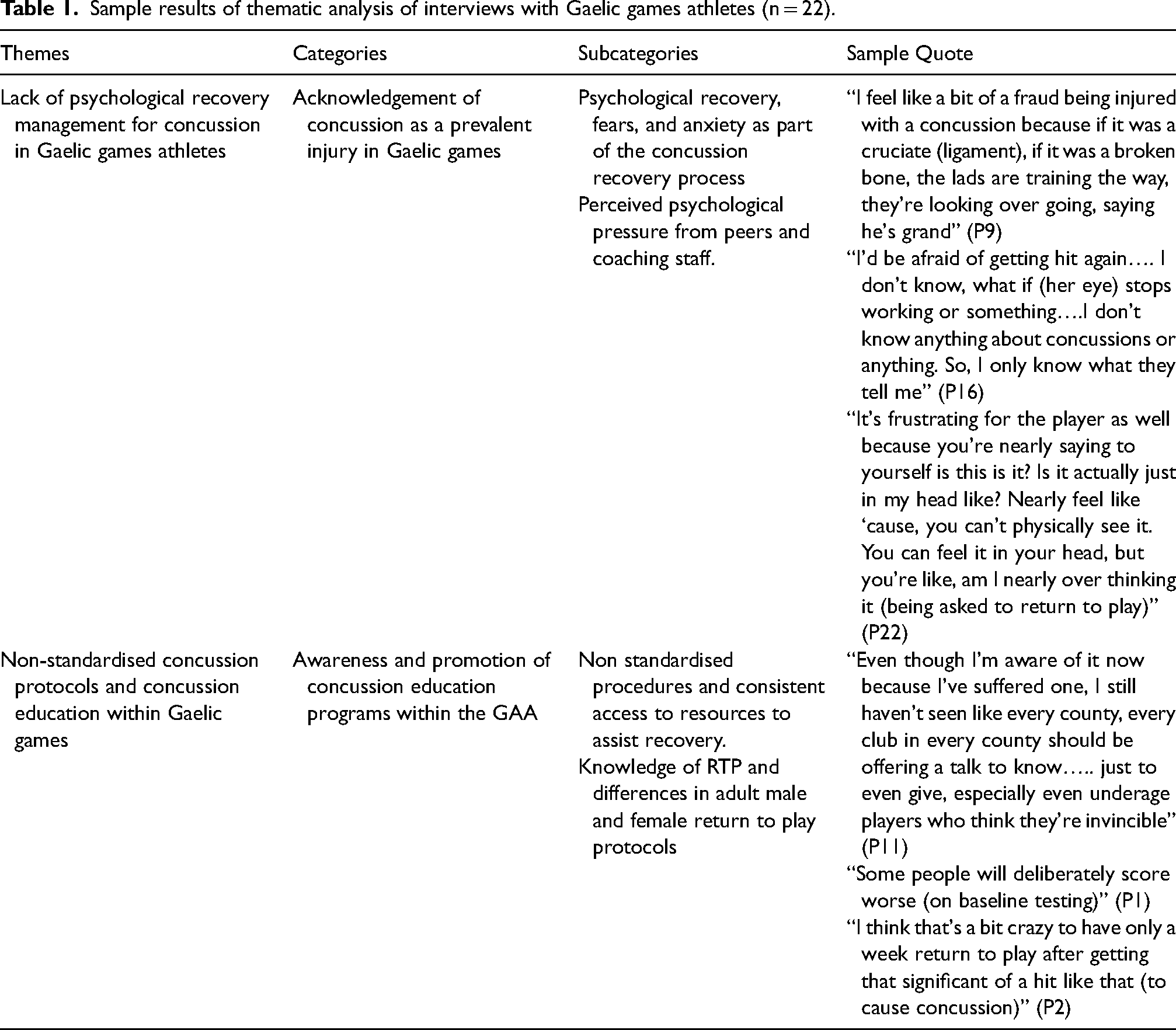
The lead researcher identified thematic categories and subcategories from the twenty-two-athlete interview transcripts, 30 during the recontextualization process, the initial list of identified themes were reviewed and consolidated into subcategories to reduce the overall number of themes. 31 Table 1 presents the athletes’ perceptions of concussion recognition and management within this group of Gaelic games athletes.
Sample results of thematic analysis of interviews with Gaelic games athletes (n = 22).
Coding
The coding process for this study applied a semantic interpretation of the interview transcripts. 30 This coding process was conducted by the first author (E.D.) and reviewed collaboratively with a second researcher (L.R.). The initial codes encompassed the full range of experiences related to the recovery process from concussion and concussion education practices in Gaelic games from the athletes’ perspective. Themes were identified and organised by the first author (E.D.) through discussions with the co-author (L.R.).
Potential themes, such as an absence of recovery protocols for psychological recovery in Gaelic games and the non-standardised approach to concussion education were identified. Following this, the authors established categories to organize the data into coherent groups. Subcategories were then developed to reflect the relationships among these categories. Through further analysis of the subcategories, two overarching themes were identified (see Table 1).
Results
In this study, two major themes were identified, (1) the lack of treatment for the psychological recovery management for concussion in Gaelic games athletes and (2) non-standardised concussion protocols and concussion education within Gaelic games. (see Table 1).
Theme 1 – the lack of treatment for the psychological recovery from concussion in Gaelic games athletes
Psychological recovery as part of the concussion recovery process
Most of the focus in concussion recovery research is focused on the physical recovery or the negation of concussion symptoms by symptom provocation and symptom monitoring. A common manifestation of non-physical recovery which presented during the interviews were the number of athletes who expressed concerns regarding psychological issues during return to activity or return to play. These concerns were amplified after they experienced post-concussion syndrome or if they experienced a number of diagnosed or undiagnosed concussions. Interestingly, this ‘psychological recovery’ is oftentimes neglected in large swathes of academic research with respect to concussion in sport. Perhaps this amplification is more overtly observed in elite amateur athletes where the perceived pressures of returning to competition are more publicly known when compared to amateur levels. A subsequent point which emerged was that this type of recovery only became obvious once they began to discuss the complications they experienced during recovery. It was imminently obvious this psychological recovery went unnoticed or unrecognised by most of the cohort involved in this research, “It was actually the next game that I got hit, but I was so afraid, I was so afraid. I had not got over the actual concussion, even though physically I was fine” (P5) supported by “I can get past this stuff (anxiety caused by concussion symptoms) and it wasn't a new occurrence to me” (P6).
All participants expressed frustrations and internal anxieties about being injured, whether this was a physical injury involving a musculoskeletal injury, or where the injury involved concussion. They were generally of the opinion, if the injury was ‘physical’, this category of injury was more manageable. The rationale behind this manageability was that physical injuries had defined timelines and/or, physiotherapists or medical staff had better knowledge of these injuries and were able to get athletes back on track quicker. The less overt frustrations emerged with concussion as athletes felt ““Really lonely, and especially as well, I was meant to be captain, you nearly feel like a failure letting them down because like, I couldn't lead myself, never mind them”. (P10) or “When can I do that (exercise) again? Then you start to, even though you know you shouldn't, you feel I won't use the word depressed, but definitely really down”. (P11).
These types of stresses and anxieties were heightened because in the athlete's opinion, their concussion did not have a defined recovery period. Many of the athletes had added stress because they did not know if they had recovered or not, due to poorly managed recovery timescales, most of the athletes self-managed their RTP, or went back to activity when they felt they had recovered. However, this was generally ill advised, as many discovered to their detriment that they were not fully recovered, which in turn had a negative cascade effect “I was crying and stuff. I wasn't in pain. It was like my body was like, ‘oh, God, don't let this happen again’…. or if my body was just kind of like gone into shock because it didn't want to get hit again” (P16)
These categories of ‘anxious experiences’ were common across many of the athletes’ recovery trajectories, whereby they would make some progress, and in many instances, this apparent progress was accompanied by periods of regressions. For example, with one athlete who was self-managing their recovery, they went through bouts of nausea while attempting to return to activity “I was really sick….and it just started to hit my system as if we need to, we need to go quick because I don't feel well, and so, I was like, get dressed quick and we'll get out of here.” (P16). Another athlete had a similar experience while they were receiving specialist concussion care, “Doing all these tests and she (physiotherapist) kept failing me for about three or four weeks in a row” (P15).
It is notable to observe the number of athletes who are having to manage long term post-concussion symptoms. With some of these athletes, the long-term symptoms such as ‘headaches’ or ‘migraines’ share a common trait which is that these symptoms are part of their ‘daily lives’, “I remember being so annoyed (long term symptoms) with the whole situation because when it was affecting my day-to-day life, it was really annoying me” (P18). Other long-term issues which are perceived to be connected to their concussion histories come in form of panic attacks and heightened emotions, “I kind of get panic attacks too…… I just don't feel right, they just come out of the blue like, you know, just like a freight train” (P8) or “I just had, like a bit of an episode (panic attack)….I kind of felt nauseous and again and dizzy and frustrated and was kind of was crying….I don't know what's wrong with me” (P16). One athlete who has struggled with severe side effects of concussions, attempted to seek multiple medical sources to ‘fix’ how they were feeling commented “I was kind of dealing with it, and that's what she (clinical psychologist) was saying (I) was kind of presenting as someone with a mild traumatic kind of background or PTSD” (P5).
Different athletes have developed different coping mechanisms to disguise these long-term effects, “I'd be halfway through a sentence like nearly forget what I was saying, and I'd be like all, oh, never mind” (P14). Even though some athletes may use dismissive language or other types of behaviour to not disclose how they are feeling, other athletes are focused on the potential long term effects of multiple concussions, “(It) was hard enough to remember them, like, how many (concussions)….you'd like to look into more and see what's the damage doing to your head” (P15) supported by “worries, because I experienced them, but I still don't know if I understood the seriousness of it (multiple concussions)” (P18).
Perceived psychological pressure from peers and coaching staff
During the interview process, there was a generic admission by many of the athletes during the recovery process that they felt various pressures from a variety of sources, including self-imposed pressure to RTP. Many of these pressures were latent, or a combination of latent and direct, particularly in relation to pressure to RTP from the management of squads. The consensus was that concussion was not ‘taken as seriously’ as other injuries such as musculoskeletal injuries. By extension, when athletes were forced to retire because of concussions, these were viewed with scepticism, “fellas that had to stop playing because of multiple concussions….I know for fact they're viewed differently, are perceived differently than those who had the stop playing because of a serious knee injury and that's the sad reality” (P4).
Concerns discussed during the interviews highlighted a relatively well managed RTP process for most categories of injuries in Gaelic games. These processes became less defined for athletes once they were managing a concussion and the associated steps to recovery. The complexities involved in these procedures became additionally muddied when the processes were ill defined “I wanted to get back as fast as I could, and the doctor doesn't want you back at all. Like, the management keep checking out. ‘When will you be back?’ So, everyone's kind of pulling out of you, and then when you're not training, you kind of don't feel like you're a part of the team” (P15). Regardless of whether athletes were coming from an amateur or elite amateur background, many of them expressed points of view where management were attempting to influence an earlier RTP. It was a widely held belief, that if the athletes had a visible injury, or were obviously injured such as having a broken limb, then the pressure to return would not have been present. It appears that some athletes felt a level of distrust by their management or coaches, some thought the coaches believed they were just ‘trying to get out of training’. “they're all like ‘Are you going to be back tonight?’ nobody knows what or how to deal with your situation….you're probably worse off than if you tore your hamstring. “ (P10)
Other comments from the athletes suggested that the main reason for the ‘pressures’ had a more concise explanation. It was clear from the interviews that concussion is a largely unrecognised injury in Gaelic games. The participants believed there is an education and knowledge gap in the implementation of suitable processes to manage RTP, this is one of the reasons why concussion is not widely discussed in Gaelic games. An athlete commented that his conversation with a manager was “You're fine, you're alright, like you know, but obviously they didn't know that much about it (concussion) either” (P8) and supported by “ They (management and coaches) just don't know….I think it could be a lack of education around the issues that could happen as a result (long term effects)” (P13)
The lack of knowledge about the subtleties of concussion recovery are compounded by factors such as the limited time they (managers and athletes) physically meet “I think they (team management) don't see. They only see you for an hour of the day. But they don't see the symptoms for the rest of the day or they don't feel the headaches” (P17). Intentionally or unintentionally, these types of comments from management exert a form of pressure on athletes to consider returning to play while symptomatic or remaining unwell due to the myriad of long-term effects of concussion. “And the managers were always asking ‘how are you’, but at the same time, they want you back. and every time you say ‘no’, you feel like you're putting a dagger in their heart”. (P10). It's well established that athletes will continue to play while injured for various reasons, such as loyalty to a team, determination to play due to being competitive individuals or the perceived magnitude of the games being played.
Theme 2 – non-standardised concussion protocols and education within Gaelic games
Non standardised procedures and consistent access to resources to assist recovery
There are many ways to view the current concussion protocols in Gaelic sports, it is possible to view RTP through the prism of whether athletes are informed that protocols exist. Another lens may examine if there are sufficient measures to create awareness regarding brain injury as a consequence of participating in Gaelic sports. Another viewpoint may critique if there is a sufficient depth of specific concussion knowledge within the medical and physiotherapy practitioners servicing Gaelic sports at amateur or elite amateur levels. Reviewing the remarks from the cohort of athletes in this research, all these observable viewpoints came under scrutiny.
For instance, one athlete commented “there wasn't as much awareness around it. The amount of players that probably played through (while symptomatic)….and yeah, didn't give it the healing process” (P4). As has been established, all of this cohort had experienced at least one medically diagnosed concussion, however the vast majority of athletes, either did not recognise concussion as an injury or the processes in place were simply not adequate “Like, nobody knows how long the recovery process takes, no one really cares how long it takes. All they want to know is when you're back that like there's no, there's no kind of procedure in place for concussion” (P12). It was notable that athletes who had retired due to multiple concussions, or those who had experienced a number of concussions believed that the current RTP system and Gaelic games concussion protocols were “not fit for purpose….seven days is a cop out” (P9).
One point on which there was universal agreement was the need to officially standardise the process and more importantly, make the process as objective as is possible. These ‘objective’ comments were prominent across the cohort of participants, “I could look at someone and think something (concussion assessment) and you could look at someone and think something else. So, it probably would need an objective measurement which could reduce the risk of people lying about their symptoms” (P17). The principles regarding an objective test centred around two distinct point; taking the decision out of the athletes’ hands as to whether they were concussed or not, and secondly, an objective measure may reduce the incidence of athletes not disclosing their symptoms.
During the interviews, many athletes suggested that the GAA give serious consideration to introducing a head injury assessment (HIA) similar to other field sports, “I think it would definitely be very easily put in place the HIA, just like that's in the rugby. I don't see how that would slow down the game or have any effect on it, and I think that would definitely be a huge benefit if they (GAA) could” (P12). These sentiments were shared and added to by other athletes, particularly in relation to the use of helmets in hurling and camogie, “If you get a belt to the head, I think you should be going off for a HIA just like the rugby…… I don't think there's any of that in GAA….the helmet doesn't really save you” (P15). Gradually during the interviews, a range of tangential comments were expressed by the athletes, as for many it was their first-time discussing concussion and the wider concerns they held about head injury. Some of these comments led to a broader concern for concussion management across other sports, as some of these athletes were currently, or former multisport athletes, “And the one thing I would say that really bothers me is that everyone, like the IRFU, the GAA they all seem to have different protocols and like should it not be a one size fits all?” (P10). This was an interesting point to note as in many countries, concussion is growing public health concern, and this is an area where the governance of sport in Ireland needs to take a unified approach.
Deficits in concussion management for many participants originated from the initial level of care and subsequent follow-on levels of care received in amateur and elite amateur settings. This very common standpoint reflected the opinions of many athletes “I probably don't think it's treated equally….the biggest problem is probably the practitioners working with the teams aren't in a position to deal with it (concussion) at the same as they deal with hamstrings, quads, calves”. (P10). The widely stated issue in which practitioners were not able to fully assist was stated in a number of ways “I definitely think a lot of physios are, I would say probably don't know the proper symptoms of concussion” (P20) or “I didn't go to any physio because I didn't see the point of going to physio, I don't know what physios do in terms of concussion” (P14) supported by “There's not enough requirements for people to who are involved to know what the best path…and I find a lot of people who get concussed now don't go to the physio” (P10) and more explicitly as “things (recovery)were really difficult, but there was no return to play and there was no real (player) welfare in it, you know, and I felt that pressure” (P3). As mentioned, all athletes had or have played amateur and a large percentage had or have played at elite amateur level, this parallel career reflected some commentary around better treatment outcomes for athletes at all levels, “At club level, there's no charter to ensure that all those medical professionals are there. They need to start putting structures in place to be able for clubs to be able to facilitate the protocols” (P17). Even where changes may be implemented regarding concussion management, some feared that meaningful changes may still be remote “I think people are more aware of it (concussion), whether practice changes, I'm not 100% sure” (P13).
Even though the athletes openly acknowledged a lack of standardised care from their concussion experiences, they felt that there were a series of relatively implementable steps which may improve the outcomes for athletes who experience concussion “I think the biggest thing that needs to be done is just training the people that are going to be on the sidelines to be able to respond effectively” (P10) and “I suppose to have information on what professional to see if you suspect a concussion or how they might help you” (P14). In parallel, with medical staff and allied health practitioners, the athletes acknowledged that it goes beyond the medical dimension. Whereby they believed that the responsibility for concussion identification and management should be within the remit of other officials and administrators associated with Gaelic sports. “I think physios and managers, need to have more power…..it's not up to the player; referees as well that if they suspect a concussion, it's non-negotiable, you're off the pitch for a proper assessment” (P14) along with a greater focus on stricter implementation of the rules of the game “I think it's more referees getting strict and if you get a hurl in the head….. I didn't even get a free when I got hit in the head” (P16).
Being cognisant of the fact that many athletes purported there may be potential for long term effects of repeated concussions over the course of a Gaelic games career. These short- and long-term effects were discussed by the athletes, particularly considering historic and recent litigation in other organised field sports “I would follow, obviously other sports and you see the fallout from those sports where players were exposed…… it wasn't really given the respect it needed, you see the fallout down the line that those players encounter, and that scares you” (P4).
Knowledge of RTP and differences in adult male and female return to play protocols
Based on discussions and remarks from the participants, there was no ongoing education and awareness regarding concussion during any part of their Gaelic games’ careers. The principal reason the athletes began to recognise concussion as an injury was when they experienced it directly for themselves. Other than physically going through the range of signs and symptoms, they would not have viewed concussion as an injury which would have made them stop competing. As a peripheral consequence of possessing a low level of concussion knowledge, even while they suspected themselves of being in a concussed state, they chose not to disclose their condition for a variety of reasons, “You have other players who are fiercely competitive and will not show anything, and we've had one other girl who I don't know if she was concussed, I think potentially was, and again played on, this was a training session and (she) continued to train through it (being concussed)” (P13).
Playing through symptoms, either acute or chronic, was a common occurrence within the cohort of athletes interviewed. There were many reasons for continuing to play, two in particular stand out from the others. These were that (a) nobody in a management position consistently checked their health status, or (b) they managed to ‘hold things together’ and hide the true effects of concussion. For example one athlete stated that “where you get those effects, you get the stares in your eyes and especially where you're kind of mentally exhausted, your just drained (trying to hide symptoms)” (P8) and “maybe one of the selectors said ‘are you alright’ and I was probably like, ‘yeah, I'm grand’ cause I was still standing, moving and walking around, so I was still all right” (P16).
There was a diversity of responses to what the current Gaelic games RTP might include or the duration of a standard RTP is in the GAA. Some respondents had categorised their concussion symptoms as ‘delayed concussion’ where they believed these symptoms were not ‘as bad’ as being knocked unconscious, hence they could continue to play their sport “I suppose my first concussion was in 2018 or 19. I think it was, I get a ‘delayed concussion’, so I haven't been fully knocked out” (P15). There were a number of comments regarding the volume of concussions which could be experienced “If you pick up a number of them in a year, you have to be very worried about (them) but that was my understanding” (P5) and conversely a number of athletes questioned if they had returned to play too quickly, particularly if they had an amount of both diagnosed and undiagnosed concussions, “(I) do wonder if going back too early was half the reason why mine (symptoms) kept returning and the first two times I got back before or the first time I was back well before I should” (P18), and supported by “I don't know if it was a coincidence that the two that I had were probably in the space of twelve months of each other…..you probably do hear people who have had two-three, maybe even four concussions…..if you look at the stats if you've had one maybe you are more inclined to get a second or even a third”. (P21). For those athletes who had progressed through an RTP process, they felt there was either outdated or obscure information received from people who were helping them to recover “it's completely changed now because, I was told to go into a dark room. No screen time, no nothing. And then last year, the protocol has changed completely, now it's you have to be more active, so I actually stayed working and everything” (P15).
On first inquiry, knowledge of RTP in Gaelic sports was superficial and generally poor across amateur and elite amateur levels. There was evidence of vague recollections of structured attempts to create awareness of the complexity and dangers of undiagnosed concussions by player welfare groups. Others simply had no knowledge of what the RTP processes were “I can assume that they (RTP protocols) may be similar to what to do in the rugby practices….I'd only be guessing really if I told you what like what the steps were or what they did” (P7) and “the GPA (Gaelic Players Association) would have ran a campaign a couple of years ago….so there's been some effort to try and like raise awareness of it.” (P5).
A final area of contention for RTP was the anomaly of differing durations for female and male athletes. For the majority of the cohort, they were unaware that for female athletes, the recommended RTP, once formally diagnosed was fifteen days. For male Gaelic sports athletes, this duration was seven days. Examining this incongruity in Gaelic games, it was not apparent for the justification of this rationale, the GAA do not overtly provide reasons for these differences in duration for RTP.
It may be concisely summarised in the following statements “If you're a male or female, why would they be different to one another. The thing that's jumps out in me, and why would they not merge them, and form one return (to play) protocol? Obviously, they both have to go through the same steps, same procedures” (P11) and supported by “I mean a head trauma is a head trauma, a head injury is a head injury…… so, I don't understand why there would be a difference in that (difference in RTP durations in GAA)” (P13). Once participants in the research understood that there were differences, people began to view the reality of RTP in terms of “Surely the recovery rate is the same, and it's putting more pressure on men…. It's giving them (male GAA players) less of a chance to actually see if they have symptoms” (P14). The pertinent issue of full symptomology resolution in male athletes was strongly expressed, particularly where symptoms may not be fully dissipated in seven days. “you're putting that player back into a scenario where they could very much get crushed.” (P11)
These differences in RTP duration either in an overt or covert manner, add to the pressure under which male athletes operate in Gaelic games, it was summed up effectively in one comment “but if the game was on the eight (day), I could play that. See the problem is as well, like if a big game is coming up, no one wants to miss it.” (P22). From a male athlete perspective, they felt that the seven-day RTP was an inadequate timeframe to be for to play at a high level due to wide range of concussion symptomology . “ If you get a leg injury, take fourteen days and come back, well, did you strain your hamstring or did you have like a leg break? Do you know it's just; it just makes no sense” (P5) and “There's still underlying things going on that are just kind of invisible until you actually test and have a look at them….. but I don't think it should be seven days after my experience with it.” (P16).
Discussion
The psychological impacts of recovery from any injury can manifest in various forms, this is particularly important when we seek to understand the complexity of the psychological recovery from concussion. 22 As has been established in the literature, athletes may be at risk of suffering from anxiety and/or depression which can be instigated by the uncertainly of an unknown recovery duration, or any fears of the potential long-term effects of the injury.32,33 Athletes may have concerns of cognitive effects such as issues with decision making or difficulties with memory or concentration. 34 These types of issues may have a cascade effect on athletes with respect to their mental health. Where there are deficits in targeted psychological interventions regarding mental health, these athletes may not receive the support they require to make a full uninhibited recovery.35,36
In the short-term phase of injury recovery, these untreated or unknown associated effects of concussion recovery may lead to further anxieties related to the potential for reinjury. In some instances, there may be stigmas associated with stating that their mental health is affected, which may deter athletes from seeking the assistance they require. 37 In some instances, this may develop into a cycle where psychological distress exacerbates physical symptoms, which may make it more difficult for athletes to return to their pre-injury level of performance. 23 These conditions may be compounded by either self-imposed or external sources of pressure to return to play, which can lead athletes to ignore or downplay their symptoms, which in turn, may add further complications to recovery.38,39
The long-term effects of poorly managed psychological symptoms may evolve into chronic issues such as long-term depression and long-term anxiety, these conditions will not only affect athletic performance but also overall quality of life. 40 Without appropriate psychological support, athletes may struggle with these issues long after they have retired from the sport. This may lead to prolonged periods of mental health issues and/or a diminished ability to cope with everyday stressors or fully engage with general activities of daily living. 41
As has been established by the current research, one of the most notable psychological barriers to returning to play after an injury such as concussion is the tangible fear of reinjury. 42 These types of fears can be multifaceted, which may inhibit the athletes to be reluctant to fully engage in the sport, these fears can emerge as a decreased confidence in physical abilities, and/or heightened anxieties during games.43,44 These anxious feelings are particularly pertinent in Gaelic games, where there are many incidences (either intentional or unintentional) of contact in the sports which makes the threat of reinjury a constant and realistic concern. 45
The pervasive fears of reinjury can lead to a multitude of alterations in playing style, such as avoiding physical confrontations, or playing the game in a more cautious manner, these alterations can detract from an athlete's effectiveness on the field of play. Additionally, the fear of reinjury can create subtle mental distractions, exposing the athlete to further injury risk which is crucial in high-intensity sports such as Gaelic games.46,47
Many field sports proport to have established concussion protocols embedded in their respective sports. however, a common malfunction of these protocols revolves around inadequate enforcement of these guidelines. 48 As evidenced by this research, the application of these guidelines in Gaelic games remains haphazard and non-standardised. As a result, the current officially documented approach to concussion management in the GAA and Gaelic games focuses predominantly on physical recovery.49,50 There is an urgent need for a broader approach which includes the possibility of psychological support as a core component of the recovery process. This could involve a standardised sequence of routine assessments following a concussion, including access to mental health professionals through medical teams where available. In a wider context, these initiatives may provide a deeper educational understanding of the psychological aspects of concussion to athletes, coaches, and the broader GAA community.
Developing an awareness about the full impacts of acute, chronic, and post-concussion symptoms would be a beneficial aspect of a comprehensive concussion education programme. 51 These types of programmes may assist athletes and coaches to demystify mental health issues and reduce the stigma associated with seeking psychological help. This might encourage Gaelic games athletes to be more forthcoming about their acute and chronic symptoms and be more willing to engage in psychological treatment where required.
Conclusions
Concussion in sport, whether it is played at an amateur or elite level, is likely to persist for the foreseeable future. The current nature of contact and collision sport means that participants will be exposed to injury risk simply because of participation. This research has highlighted that regardless of the level of sport being played, those who are appointed as administrators, or who lead governing bodies should offer a comprehensive duty of care to the participants.
The bulk of this comprehensive duty of care revolves around measures which would instigate a robust and meaningful concussion education programme. This proposed education programme needs to be introduced alongside an equally robust enforcement of a well-structured concussion protocol. These actions include an ongoing education programme for governing bodies, regional administrations, coaches, athletes, referees, and supporters about the invisible dangers of concussion in Gaelic games.
In essence, much of the apathy towards acting on these basic initiatives has evolved from a lack of understanding of concussion as a significant injury in Gaelic sports. Concussion as an injury is invisible when compared to more obvious injuries such as muscle ruptures or bony fractures therefore concussion as an injury is difficult to comprehend, and easy to dismiss. As has been previously demonstrated in other field (contact and collision) sports, tangible action is required to protect the athletes from concussion and from poor concussion management processes.
Footnotes
Authors contributions
E.D. participated in the design of the study, data collection, data analysis and editing. L.R. contributed to data collection, data analysis and editing; All authors contributed to the manuscript writing and all authors have read and the final version of the manuscript.
Declaration of conflicting interests
The authors declared no potential conflicts of interest with respect to the research, authorship, and/or publication of this article.
Funding
The authors received no financial support for the research, authorship, and/or publication of this article.
