



Abstract
This study investigated the inter-rater reliability and validity of the Fulltrack AI application, to measure ball speed under a range of cricket training conditions in comparison to a radar gun. Ball speed (km/hr) of 1081 deliveries (pace = 783; spin = 298) from a range of training sessions and conditions were recorded simultaneously using a radar gun (Stalker Pro IIs) and iOS device running Fulltrack AI (v1.13.1). Statistical analyses were conducted in R Statistical Software. Reliability was assessed with standard error of measurement (SEM), coefficient of variation (CV) and intraclass correlation coefficient (ICC). Agreement was assessed using Bland Altman's 95% limits of agreement (LOA). Validity was assessed using generalised additive models (GAMs). Pace deliveries were associated with good agreement (ICC: 0.87–0.90, CV: 2.56–3.13%), whilst spin deliveries demonstrated lower agreement (ICC: 0.72–0.76, CV: 3.08–4.33%). LOA established poor to fair levels of agreement, exceeding maximal allowable differences (>3%). GAMs identified Fulltrack AI overestimated ball speed (pace: estimate 0.72–0.77 m/s, SE = 0.34–0.34; spin: estimate 1.09–1.18 m/s, SE = 0.23–0.25) when compared to the radar gun. Fulltrack AI is an ecologically valid and reliable field-based method for measuring ball speed. However, caution is warranted given the significant overestimation of ball speed in contrast with a radar gun, even after controlling for different training conditions, suggesting software could benefit from refinement.
Introduction
In cricket, bowlers play an important role, seeking to achieve the concurrent goals of trying to dismiss an opposing batter, whilst also trying to restrict their scoring. Skilled bowlers tend to adopt key attributes that facilitate success; namely, bowling with accuracy and consistency (in relation to where the ball lands), 1 and with the ability to functionally vary deliveries to meet task demands. 2 Another key bowling performance indicator is that of ball speed (or velocity).1,3,4 For pace bowlers alongside inducing seam and swing movement, varying ball speed and landing position (line and length) can help to cause interception difficulty for the batter and reduce the time available for them to play a shot.1,2,4–6 Further, a pace bowler's maximum ball speed at release may be used by coaches to classify a bowler within four distinct categories, first proposed by Abernethy (1981).3,7 For spin bowlers, ball speed, alongside other attributes such as drift, dip and horizontal spin may be manipulated to help exploit environmental conditions such as pitch condition.8,9,10 Given its relative importance as an indicator of bowling performance, 11 accurate methods for measuring ball speed are important. A methods accuracy is how close the recorded measure is to the true value, which can be influenced by both the reliability and validity of the method. Broadly, intra-rater reliability is defined as the reproducibility of a measure under repeated trials 12 and inter-rater reliability, the degree of agreement between two different methods in measuring the same phenomenon,13,14 whilst validity assesses if the method measures what it purports to measure. 15
Ball speed associated with national level cricket bowlers have been reported as 18.95 ± 1.12 m/s for spin and 32.22 ± 1.83 m/s for pace, 8 with ball speeds capable of reaching upwards of 44.8 m/s during international level match-play.16,17 As such, a range of approaches and technologies have been utilised to quantify ball speed in cricket in keeping with those commonly utilised across sporting codes.1,7,8,11,18,19,20 3D motion capture analysis is considered the criterion measurement for ball speed in part due to small instrumental errors and the capacity to capture motion at high frame rates in accordance with Nyquist theorem to ensure the true instant of ball release is identifiable.19,21,22 The accessibility, expertise and time-consuming nature associated with 3D motion capture analysis has primarily limited its application to laboratory-based settings22,23 with either 2D motion capture analysis or radar guns more commonly applied within field-based settings to quantify ball speed in cricket bowlers. 1
In the act of deceiving the batter, bowlers aim to manipulate the trajectory of the ball, 8 as such hindering the capacity of ball speed to be accurately measured using methods such as 2D motion capture analysis and radar guns that are unable to capture movement outside the single plane of motion. 22 Radar guns measure an object's speed of approach or recession within the line-of-sight based on the doppler effect. 24 When the motion of the object does not correspond with the line-of-sight, referred to as the cosine effect, accuracy may be impaired unless mathematically corrected for, 24 however, the application of this correction within practice appears limited. 1 As such, radar guns whilst established as a valid and reliable method to measure cricket ball speed, have been reported to over-estimate ball speed by 1.7 ± 0.8 m/s when positioned directly behind the bowlers-end stumps in comparison to 3D motion capture analysis. 19 The immediacy of ball speed reported by a radar gun, has resulted in this method being utilised within field-based settings such as within training sessions whereby coaches can provide reliable and timely feedback to bowlers, when cognisant of the systematic over-estimation of the device. 19
The utilisation of 2D motion capture analysis to measure ball speed across sporting contexts, in contrast to radar guns has been limited, in part due to the time associated with digitising ball location to quantify ball speed, and therefore reduced immediacy of feedback possible during a training session. In addition, low frame rates (50 frames per second (fps)) of consumer-level devices typically used are unable to capture the instant of ball release, 23 that may be further impaired by low shutter-speeds causing motion blur given the associated ball speed. More commonly, 2D motion capture analysis has been used to consider the accuracy of a delivery in respect to the location it lands on the wicket relative to the batters-end stumps or, for coaches to provide visual-feedback to bowlers of their bowling performance.2,18,25,26 With the accessibility of smart devices, such as tablets and smartphones, now incorporating cameras capable of capturing at higher frame rates (>200 fps), such technology when leveraged through commercially available applications, has the potential to address previous limitations of 2D motion capture analysis in quantifying ball release speed in a cost-effective and accessible manner.
A range of applications have been validated to monitor physiological, kinanthropometric and performance measurements against laboratory-based criterion measures within sporting and clinical contexts. 27 For instance, applications measuring vertical jump height such as “My Jump” leverage the higher frame rates of smartphone cameras to identify take-off and landing to derive jump metrics in an accurate, valid and reliable manner.28,29 The advent of Artificial Intelligence (AI) has expanded the capacity of such applications to facilitate the automatic detection of motion such as tracking a barbell30,31 or, a ball across a range of sports including tennis 32 and baseball. 33 However, the proprietary nature of underlying algorithms and associated lack of transparency around data handling processes by some developers impairs the critical evaluation of commercial applications. This is further confounded by the general tendency of smartphone application validation studies being completed under constrained laboratory-based conditions, failing to consider ecological validity and typical conditions consumers would seek to utilise the application. 27
Therefore, the aim of this study was to investigate the inter-rater reliability and validity of the Fulltrack AI application, a commercially available smart-device application, to measure ball speed under a range of cricket training conditions in comparison to a radar gun (criterion method). It was hypothesised that the Fulltrack AI application would demonstrate good inter-rater reliability and validity with respect to a radar gun in quantifying ball speed.
Methods
Research design
Data were collected across nine club cricket training sessions in Victoria, Australia, both at an indoor cricket centre (n = 5) and outdoor cricket nets (n = 4). Of these nine sessions, two outdoor sessions were undertaken on a turf cricket pitch, whilst all other sessions utilised artificial (synthetic) cricket pitches. Both pace and spin bowlers were recruited, with a total of 62 bowlers participating (mean ± SD overs bowled = 3.2 ± 2.8), with a range of playing experience (elite (international, n = 1), sub-elite (district, n = 9; sub-district, n = 25) and community cricket (n = 27)), with two batter conditions (batter or no batter) explored. As data collected was intended to reflect typical cricket training conditions to maximise ecological validity, the number of deliveries bowled by each bowler was in keeping with the club's training schedule and the individual bowler's workload. To explore the agreement and validity between two devices, ball speed (km/hr) of each delivery bowled with regulation sized men's cricket ball (Kookaburra Sport Pty Ltd, Australia), were captured simultaneously using the Fulltrack AI application (Maiden AI Inc., USA) and a speed radar gun (Stalker Pro IIs, Applied Concepts Inc, USA); considered the criterion measure for field-based measures of ball speed 19 (Figure 1). Bowlers and batters provided informed consent for the study, which was approved by the university human research ethics committee (project no. 20225871-11346).
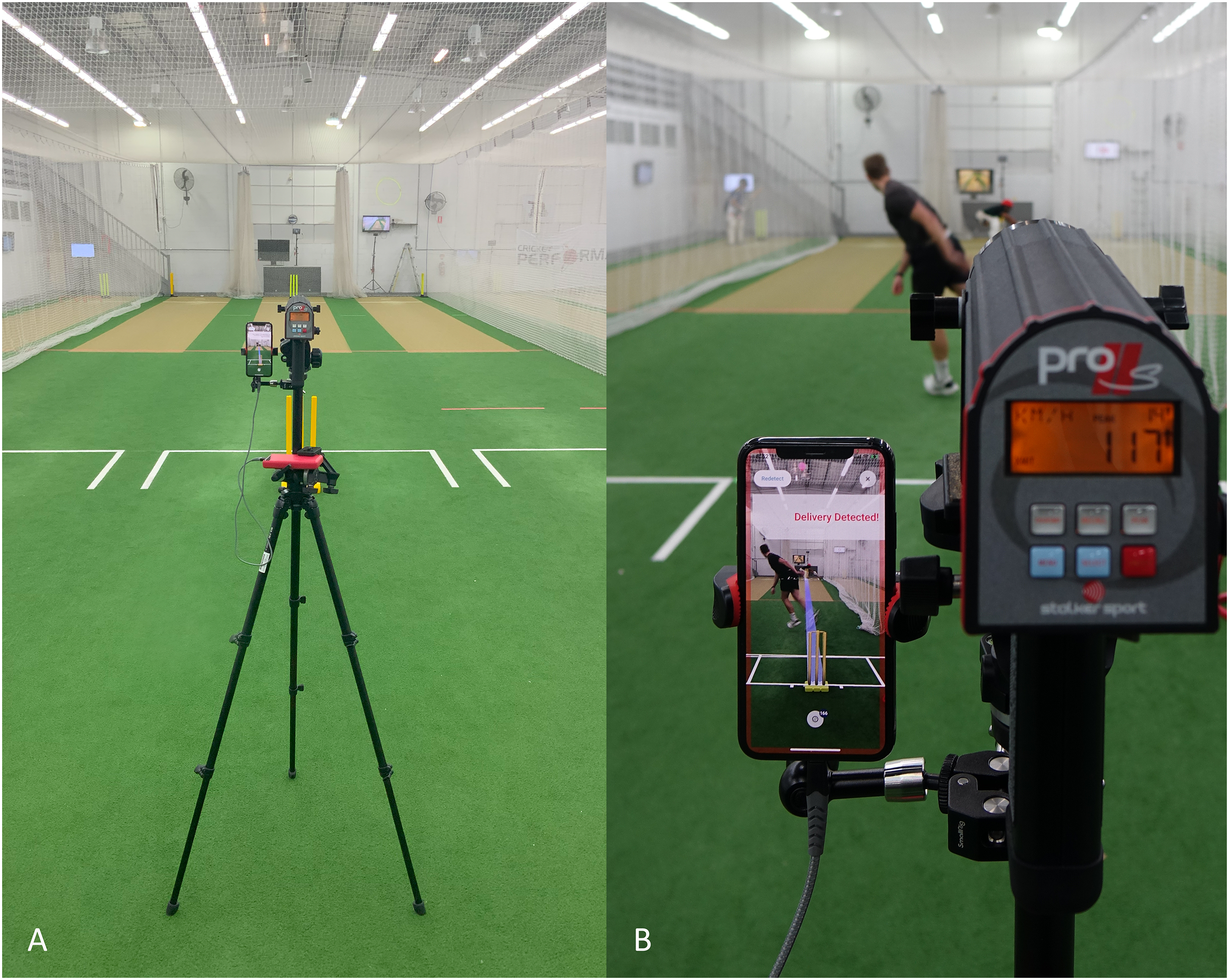
Testing set-up: A: position of the Stalker Pro IIs radar gun and iPhone running the Fulltrack AI application relative to the wicket B: zoomed in perspective view of each device.
Instrumentation
Stalker Pro IIs radar gun
Speed data were collected using the Stalker Pro IIs radar gun (Applied Concepts Inc., USA) positioned behind the bowlers-end stumps, at a distance of 4 m, mounted on a tripod at a height of 1.75 m. The radar gun was slightly angled to correspond with the anticipated height of ball release for the average bowler within each session. 1 The automatic trigger function was set, so that the radar gun would continuously record. The researcher manually transcribed ball speed following each delivery to the stated km/hr, reflective of the level of precision of the device. Cosine error associated with radar gun misalignment 24 was not corrected for due to the variance in ball release heights attributable to the range of bowlers utilised within each training session, a practical affordance identified to have minimal impact on the reliability of the device. 19
Fulltrack AI iOS application
The Fulltrack AI application (version 1.13.1, Maiden AI Inc., USA) was used on an iPhone running iOS 16.1.2 (iPhone X, Apple Inc., USA). The device was mounted on the same tripod as the radar gun using an adapter (Figure 1B) aligning both devices to the same plane of motion, with the application set-up and calibrated as per developer instructions; positioned at a height of 1.66 meters (from the iPhone camera to the ground), located 4 meters behind the bowlers-end stumps, with the iPhone tilted, parallel to angle of inclination of the radar gun, to capture the full pitch. 34 The application uses a proprietary algorithm using AI to generate data for each delivery. For each delivery, ball delivery speed (km/hr), in addition to ball positional data (ie. the width (line (m)) and length (m) the ball landed relative to the batters-end stumps), was provided by Maiden AI Inc. via email post-testing as a csv file. All deliveries that had successful detection of speed for both devices were included for subsequent analysis.
Statistical analysis
Ball speed data from each device were converted from the recorded unit of measurement (km/hr) into meters per second (m/s) and, subsequently differences in ball speed were calculated as Fulltrack AI minus Stalker Pro IIs. Statistical analyses were conducted in R Statistical Software (version 4.0.2; R Core Team, https://www.r-project.org/) independently for bowling type (pace, spin), with analyses completed twice (with and without outliers (differences more extreme than two standard deviations from the mean)). Reliability was assessed with standard error of measurement (SEM), standard error of prediction (SEP), coefficient of variation (CV) and intraclass correlation coefficient (ICC). ICCs were interpreted with values <0.5 considered as poor, values between 0.5 and 0.75 considered as moderate, values between 0.75 and 0.9 considered as good, and values >0.9 considered as excellent reliability. 35
To assess the agreement between the measurement methods, 95% limits of agreement (LOA) were calculated using the Bland-Altman method. 36 Differences between measurement methods were plotted against their respective means with LOA assessed using maximal allowable difference thresholds defined as ±3% of the mean Stalker Pro IIs ball speed across all recorded deliveries in accordance with the reported accuracy of the device, 37 resulting in thresholds of ±0.83 m/s for pace deliveries and ±0.56 m/s for spin deliveries. If the upper and lower 95% confidence limits (CI) of the LOA lay within the maximal allowable difference thresholds, the methods were considered to agree. 38
As the assumption of normality was violated, as assessed by visual inspection of Q-Q plots, generalised additive models (GAMs) were undertaken to explore differences in speed as measured by Fulltrack AI and the Stalker Pro IIs radar gun (reported as method difference; ie the difference between these two methods of measurement) whilst considering the interaction of the fixed effects of batter condition (batter versus no batter), wicket location (indoor or outdoor), and, as determined by Fulltrack AI application, pitch line (the location of the ball at landing in relation to middle-stump), pitch length (the distance the ball lands on the wicket relative to the batter-end stumps), and the interaction between pitch line and length (encompassing the 2D ball landing position on the wicket relative to the batter-end stumps). To ensure the results observed from the dataset were not subject to large sample sizes bias the results of the GAMs were analysed for both: (a) the full data, and (b) five smaller subsets/simulations of the data. 39 The five smaller subsets were partitioned from the whole dataset using simple random sampling to facilitate the creation of unbiased subsets with sample size (n = 200) identified through sample size calculations with the effect size (based on the full data), significance level (0.05), and desired statistical power (0.80). To obtain a more robust and reliable model that accounted for the variability across the different subsets, the average of the parameter estimates from the subsets, the ‘Averaged Model’ is presented.
Results
There were 1081 deliveries included in the analysis, of which 783 were bowled by pace bowlers and, 298 by spin bowlers. There were 37 outlier deliveries (differences in ball speed ± 3% of the mean Stalker Pro IIs ball speed across all recorded deliveries), of which 23 deliveries were pace deliveries and, 14 spin deliveries that were included when the whole data set was analysed and, excluded for the outlier removed analysis. Ball speeds are reported in Table 1.
Mean ± SD ball speed (m/s) for pace and spin deliveries.
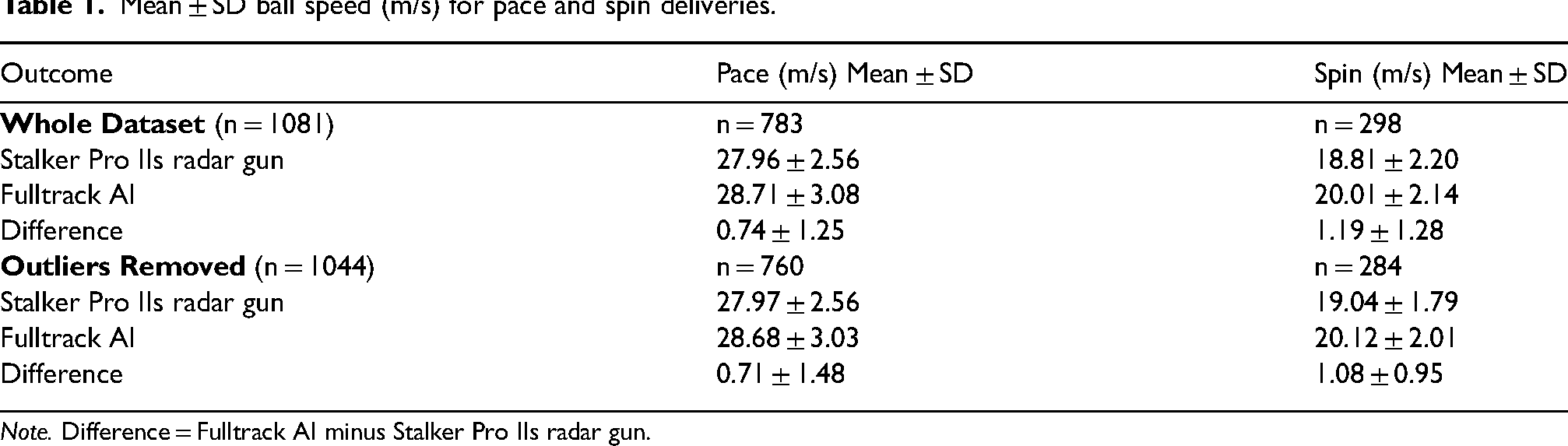
Note. Difference = Fulltrack AI minus Stalker Pro IIs radar gun.
Agreement analysis (inter-rater reliability)
Reliability coefficients demonstrated consistent trends for both the whole data set and, with the removal of outliers. Pace deliveries were associated with good agreement (whole dataset: ICC: 0.87, CV: 3.13%; outliers removed: ICC: 0.90, CV: 2.56%) whilst spin deliveries were found to have lower agreement (whole dataset ICC: 0.72; outliers removed ICC: 0.76) albeit with small coefficients of variation (whole dataset CV: 4.33%; outliers removed CV: 3.08%). Standard error of measurements (SEM), standard error of estimates (SEE) and standard error of predictions (SEP) were similar for both pace (whole dataset SEM: 0.89 m/s, SEE: 1.20 m/s, SEP: 1.75 m/s; outliers removed SEM: 0.73 m/s, SEE: 1.0 m/s, SEP: 1.44 m/s) and spin (whole dataset SEM: 0.84 m/s, SEE: 1.14 m/s, SEP: 1.68 m/s; outliers removed SEM: 0.60 m/s, SEE: 0.84 m/s, SEP: 1.22 m/s) deliveries.
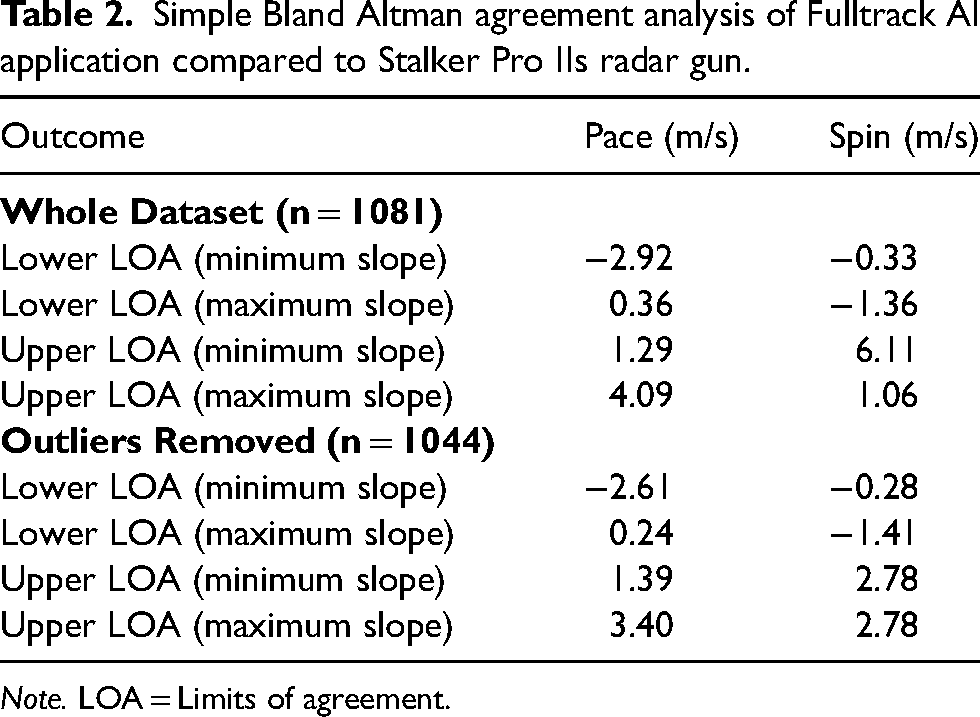
Bland-Altman plots were generated to compare the agreement between the measurement of speed between the Fulltrack AI application and the Stalker Pro IIs radar gun considering both the whole dataset and, the outlier removed dataset for both pace (Figure 2) and spin deliveries (Figure 3). Limits of agreement (LOA) demonstrated poor to fair levels of agreement 36 for both pace and spin deliveries (Table 2), exceeding maximal allowable difference thresholds (pace: ± 0.83 m/s, spin: ± 0.56 m/s), (Figure 2).
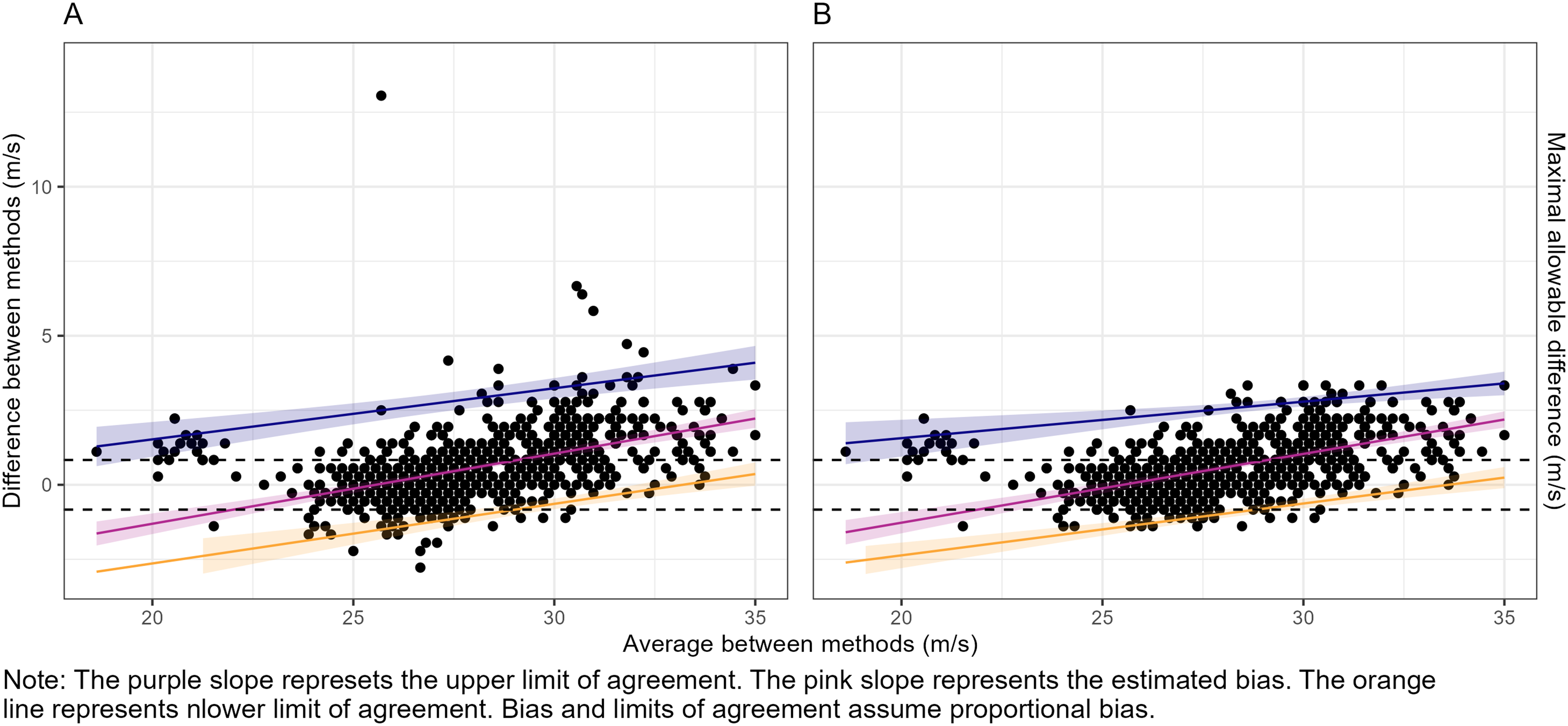
Bland-Altman plots comparing ball speed (m/s) between methods (Fulltrack AI minus Stalker Pro IIs) for pace deliveries: A: whole dataset B: outliers removed.
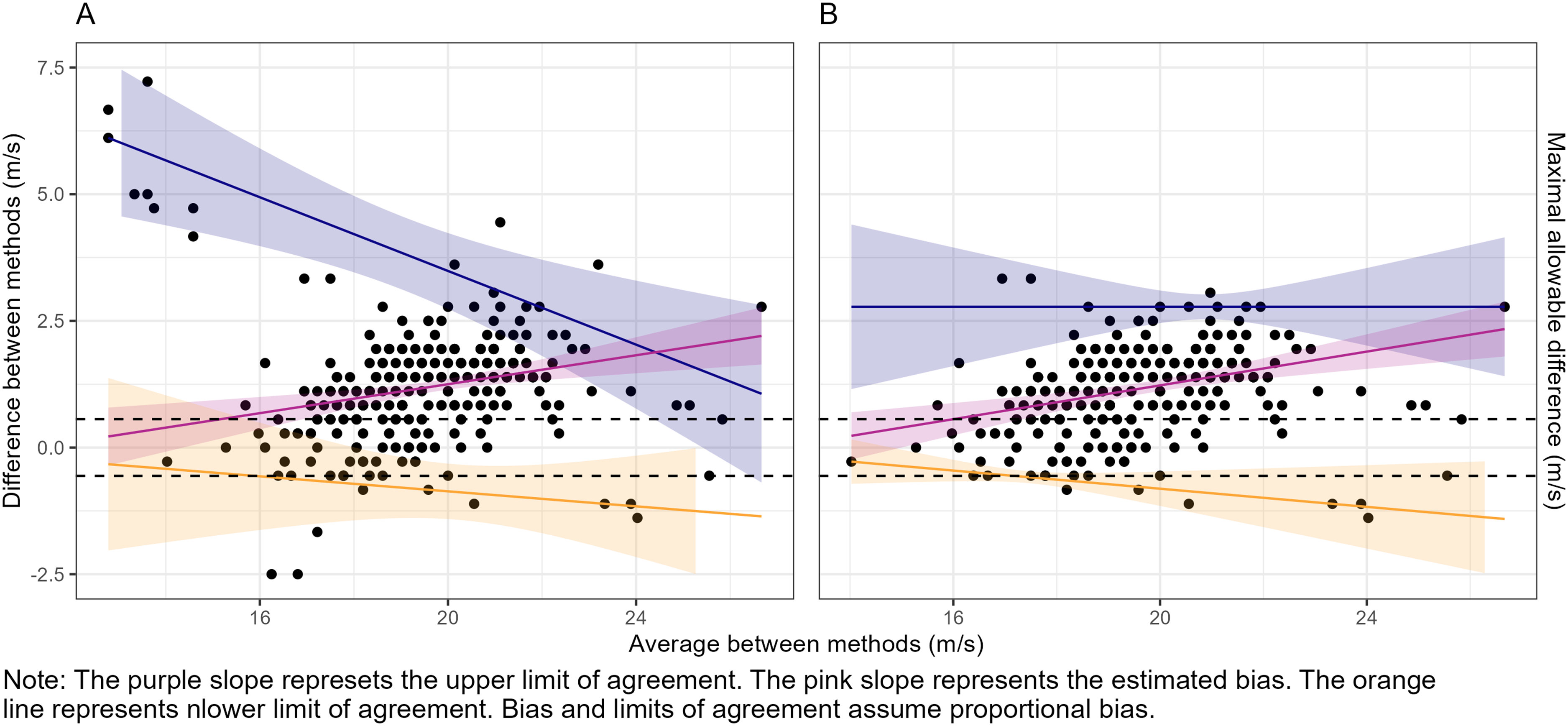
Bland-Altman plots comparing ball speed (m/s) between methods (Fulltrack AI minus Stalker Pro IIs) for spin deliveries: A: whole dataset B: outliers removed.
Simple Bland Altman agreement analysis of Fulltrack AI application compared to Stalker Pro IIs radar gun.
Note. LOA = Limits of agreement.
Difference analysis (validity between methods)
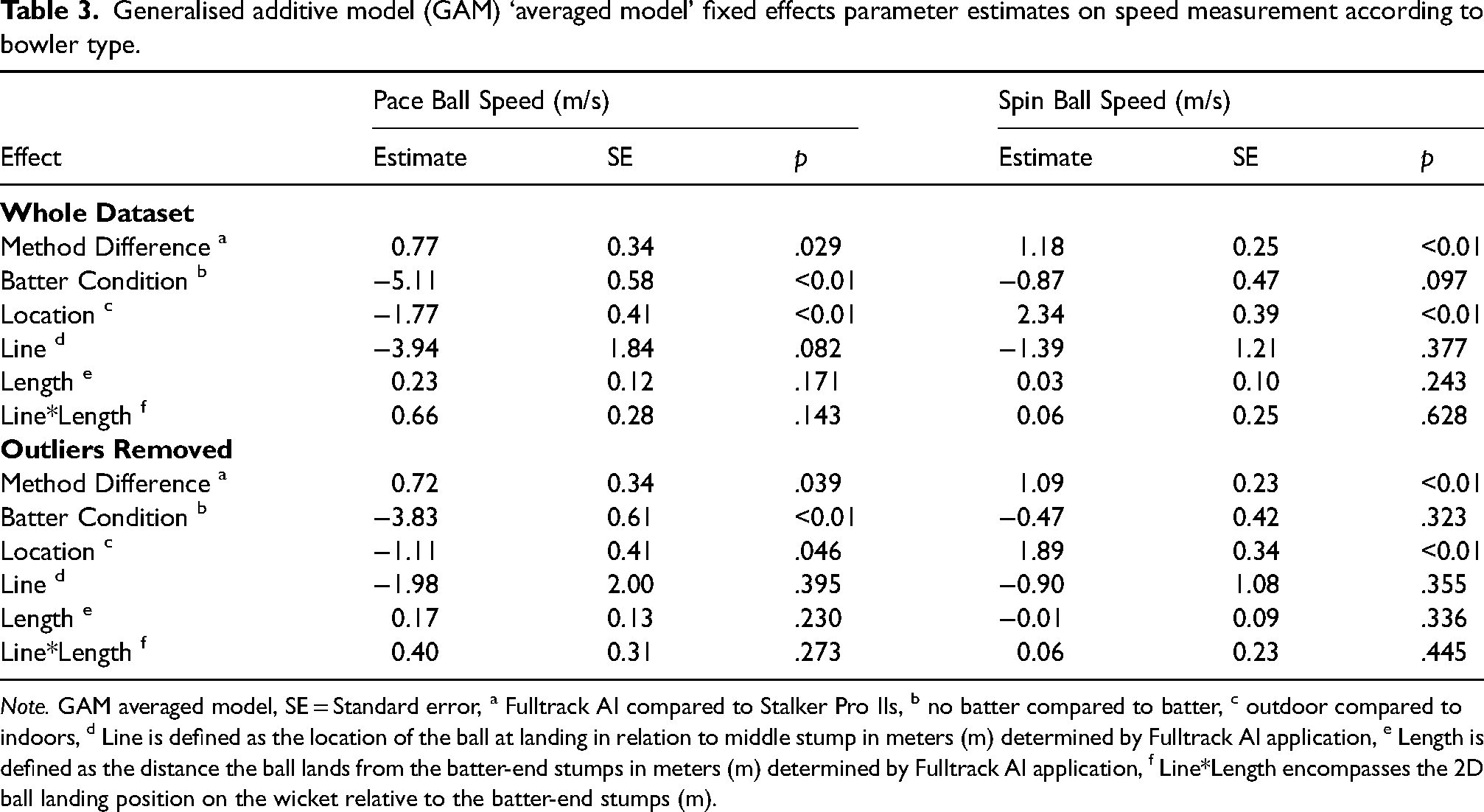
The results from the ‘averaged model’ generated from the generalised additive models (GAMs) are presented in Table 3. When controlling for batter condition, location, line, length and the interaction between pitch line and length, GAMs established that the Fulltrack AI application significantly over-estimated ball speed in contrast to the Stalker Pro IIs radar gun for both pace (whole dataset estimate = 0.77 m/s, p = 0.029; outliers removed estimate = 0.72 m/s, p = 0.039) and spin deliveries (whole dataset estimate = 1.18 m/s, p < 0.01; outliers removed estimate = 1.09 m/s, p < 0.01). Whilst significant effects were observed within the GAMs for both batter condition and location across both pace and spin deliveries, these were independent of the method used to quantify ball speed.
Generalised additive model (GAM) ‘averaged model’ fixed effects parameter estimates on speed measurement according to bowler type.
Note. GAM averaged model, SE = Standard error, a Fulltrack AI compared to Stalker Pro IIs, b no batter compared to batter, c outdoor compared to indoors, d Line is defined as the location of the ball at landing in relation to middle stump in meters (m) determined by Fulltrack AI application, e Length is defined as the distance the ball lands from the batter-end stumps in meters (m) determined by Fulltrack AI application, f Line*Length encompasses the 2D ball landing position on the wicket relative to the batter-end stumps (m).
Discussion
Findings from this investigation show that the Fulltrack AI application has good to moderate inter-rater reliability and is an ecologically valid field-based method of quantifying cricket ball speed under training conditions compared with a Stalker Pro IIs radar gun, however, caution is warranted when considering the level of accuracy required or when using the methods interchangeably.
Average ball speeds measured within this investigation were in keeping with those previously reported for pace and spin cricket deliveries, 8 with the range of training conditions (batter vs no batter; indoor vs outdoors) identified within the GAMs to influence ball speed independent of the method (Fulltrack AI application or Stalker Pro IIs radar gun) used. For example, ball speed associated with bowling outdoors was significantly faster than when bowling indoors, attributable to an unrestricted run-up maximising the translation of momentum into increased ball speed at release 11 as opposed to being influenced by the method of ball speed measurement. As such, findings from this investigation support the robustness of the Fulltrack AI application as an ecologically appropriate field-based method of quantifying ball speed, however, users must be cognisant of the varied performance of the application between pace and spin deliveries.
Reliability coefficients identified that the Fulltrack AI application demonstrated good reliability for pace deliveries however moderate reliability for spin deliveries. The SEM associated with both pace and spin deliveries within this investigation approached half of the reported variance associated with deliveries by Cork et al. 8 As bowlers will naturally adjust ball speed within their pursuit to deceive the batter, 8 methods to quantify ball speed must be reliable to ensure that any variance in ball speed is a manifestation of the bowler's technique and not due to methodological measurement error. The poor to fair levels of agreement, as demonstrated through Bland-Altman plots, emphasise that whilst both the Fulltrack AI application and the Stalker Pro IIs radar gun are both field-based methods of quantifying ball speed, these methods should not be used interchangeably when monitoring a bowler's performance either within- or between-training sessions.
The Fulltrack AI application was found to significantly over-estimate ball speed in comparison to the Stalker Pro IIs radar gun for both pace (ranging between 0.72 to 0.77 m/s) and spin deliveries (ranging between 1.09 to 1.18 m/s), with Bland Altman plots identifying an increase in error for pace bowlers at faster speeds, which warrants further investigation in the future. When considered within the context of the validation, undertaken by Smith & Burke 19 using a bowling machine, of the Stalker Pro IIs radar gun against 3D motion capture analysis, albeit using a slightly lighter and smaller women's cricket ball, the radar gun was reported to over-estimate ball speed by 1.7 ± 0.8 m/s. Therefore, the true magnitude of inaccuracy associated with the Fulltrack AI application in quantifying cricket ball speed is unknown, which could result in the misclassification of a pace bowler within the reported speed bands for fast, fast-medium and medium pace bowlers. 7 Given this, further research incorporating the criterion measure of 3D motion analysis is warranted. Hawk-EyeTM, with a manufacturer reported accuracy of <0.05 mm, equating to detecting ball speeds within 2.56 m/s at a sampling rate of 106 Hz, 22 could be utilised as a field-based criterion measure to identify how more accessible consumer-based approaches to define ball speed such as the Fulltrack AI application and radar guns may be further refined to enhance accuracy.
The accuracy of the Stalker Pro IIs radar gun when measuring ball release speeds within sporting contexts (badminton, baseball, cricket, football and tennis) has been reported to both under- and over-estimate19,21,23,40 and its accuracy can be confounded by factors such as the positioning and alignment of the radar gun as well as the application of a correction factor to minimise the influence of the cosine effect.19,24 Mounting both devices to the same tripod and aligning each device to be parallel attempted to minimise the influence position and alignment may have imparted on the ball speed measurement. However, it should be noted this approach still assumed the field of view of both devices and any associated perspective and parallax error would be relative to each other. As such findings from this investigation cannot quantify the absolute inaccuracy of the Fulltrack AI application and instead those seeking to quantify ball speed using field-based methods should be mindful of the degree of precision current methods avail within the context of the desired application.
At the point of release, bowlers will manipulate the trajectory of a ball to deceive the batter through factors such as imparting backspin (pace bowlers) or spin through the rotation of the ball (spin bowlers). 8 The comparison of the Fulltrack AI application with the Stalker Pro IIs radar gun involved two methods of measurement of speed where the accuracy would be dependent on the trajectory of the ball remaining within the plane of motion and aligning with the line of sight. 22 The experimental design adopted by aligning both the plane of motion and line of sight of each device to be parallel to each other helped to mitigate this influence, however, further research should consider the incorporation of 3D motion capture analysis of bowlers across a range of playing levels, bowling styles and tactics (such as bowling around the wicket) to comprehensively consider the myriad of factors that could impact ball release speed and therefore subsequentially its measurement as well as intra-bowler effects. This is particularly pertinent for spin bowlers where the Fulltrack AI application demonstrated poorer reliability and validity; where underlying software algorithms may struggle to accommodate the broad range of spin variations and the impact these would have on the subsequent ball trajectory and calculation of ball speed.
Conclusion
The Fulltrack AI application is a reliable and ecologically appropriate field-based method of quantifying ball speed compared with a radar gun that is typically used in cricket training environments to provide feedback to bowlers. Significant over-estimation of ball speed in contrast with a Stalker Pro IIs radar gun, even after controlling for different training conditions, suggests software refinement is required to reduce the variation between pace and spin deliveries. Users should not use the Fulltrack AI application and Stalker Pro IIs radar gun interchangeably when monitoring a bowler's performance either within- or between-training sessions and be mindful of the degree of precision required for their desired use. Further research is required to fully elucidate the absolute difference of the Fulltrack AI application using the criterion method of 3D motion capture analysis, given the inherent limitations associated with current accessible field-based methods of quantifying ball speed such as radar guns.
Footnotes
Acknowledgments
The authors would like to thank all the bowlers that took part in the testing sessions, and the Cricket Performance Lab and staff for access to their indoor venue.
Availability of data and material
Data used within the study is available upon reasonable request from the corresponding author.
Declaration of conflicting interests
The authors declared no potential conflicts of interest with respect to the research, authorship, and/or publication of this article.
Funding
The authors received no financial support for the research, authorship, and/or publication of this article.
